Proceedings of the Integrated Ocean Drilling Program, Volume 303/306
Abstract
The overall aim of the North Atlantic paleoceanography study of Integrated Ocean Drilling Program Expedition 306 is to place late Neogene–Quaternary climate proxies in the North Atlantic into a chronology based on a combination of geomagnetic paleointen-sity, stable isotope, and detrital layer stratigraphies, and in so do-ing generate integrated North Atlantic millennial-scale stratigra-phies for the last few million years. To reach this aim, complete sedimentary sections were drilled by multiple advanced piston coring directly south of the central Atlantic “ice-rafted debris belt” and on the southern Gardar Drift. In addition to the North Atlantic paleoceanography study, a borehole observatory was suc-cessfully installed in a new ~180 m deep hole close to Ocean Drill-ing Program Site 642, consistDrill-ing of a circulation obviation retrofit kit to seal the borehole from the overlying ocean, a thermistor string, and a data logger to document and monitor bottom water temperature variations through time.
Preface
Integrated Ocean Drilling Program (IODP) Expedition 306 is based on two separate proposals entitled (A) “Ice sheet–ocean at-mosphere interactions on millennial timescales during the late Neogene–Quaternary using a paleointensity-assisted chronology (PAC) for the North Atlantic” and (B) “Installation of a circulation obviation retrofit kit (CORK) near Hole 642E to document and monitor bottom water temperature variations through time.” Since both parts are independent of each other, the introductory sections of the Expedition 306 report (introduction, background, geological setting, and objectives) have been divided into Part A and Part B. Sites U1312, U1313, and U1314 are related to the North Atlantic paleoceanography study (Part A), whereas Site U1315 and the revisited Ocean Drilling Program (ODP) Hole 642E are related to the CORK program (Part B).
Expedition 306 summary
1Expedition 306 Scientists
2Chapter contents
Abstract . . . 1
Preface . . . 1
Part A: Introduction . . . 2
Background . . . 2
Scientific objectives . . . 3
Relationship to previous North Atlantic drilling . . . 5
Drilling strategy. . . 5
Part B: Introduction . . . 6
Background . . . 6
Scientific objectives . . . 6
Proposed research. . . 7
Operational strategy . . . 7
Principal results . . . 7
Summary and conclusions. . . 14
References . . . 16
Figures . . . 20
Table . . . 29
Part A: Ice sheet–ocean atmosphere
interactions on millennial timescales during the
late Neogene–Quaternary using a PAC for the
North Atlantic
Introduction
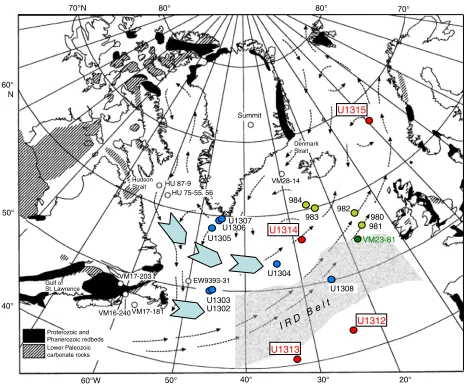
Following Expedition 303, Expedition 306 is the sec-ond cruise of the North Atlantic paleoceanography study that aims to generate a late Neogene–Quater-nary chronostratigraphic template for North Atlantic climate proxies and allow for their correlation at a sub-Milankovitch scale and their export to other parts of the globe by using a PAC. The nine primary drilling locations selected for the North Atlantic
paleoceanography study (Fig. F1) are known, either
from previous ODP/Deep Sea Drilling Project (DSDP) drilling or from conventional piston cores, to have the following attributes:
• They contain distinct records of millennial-scale environmental variability (in terms of ice sheet– ocean interactions, deep circulation changes, or sea-surface conditions).
• They provide the requirements for developing a millennial-scale stratigraphy (through geomag-netic paleointensity, oxygen isotopes, microfos-sils, and regional environmental patterns).
• They document the details of geomagnetic field behavior.
Expedition 303, carried out in October–November 2004, occupied seven precruise sites recovering over 4600 m of high-quality upper Pliocene–Quaternary
sediments (Fig. F1): Sites U1302/U1303 (proposed
sites ORPH3A and 2A), U1304 (proposed site GAR2B), U1305, U1306, and U1307 (proposed sites LAB6A, 7A, and 8C), and U1308 (proposed site
IRD1A) (see Expedition 303 Preliminary Report
[Ship-board Scientific Party, 2005] for additional details).
Results from drilling at Site U1307 (LAB8C) during Expedition 303 established the feasibility of recover-ing the Pliocene sedimentary section on the Eirik Drift using the advanced piston corer (APC) system. Two holes were drilled at Site U1307 (LAB8C) reach-ing a maximum depth of 162 meters composite depth (mcd) in the uppermost Gilbert Chronozone (~3.6 Ma). Coring was terminated due to excessive heave when a passing storm system began to affect drilling operations. Proposed Expedition 306 sites on Eirik Drift would have offered the unique opportu-nity to extend the upper Pliocene–Quaternary record recovered during Expedition 303, back in time to the
Miocene (see Expedition 303/306 Scientific Prospectus
Addendum [Kanamatsu et al., 2005]).
Based on the Expedition 303/306 Scientific Prospectus
(Channell et al., 2004) and the results of Expedition 303, Sites IRD3A and IRD4A and two sites on Eirik Drift were selected to become the primary Expedi-tion 306 sites. Continuous weather observaExpedi-tions per-formed throughout Expedition 306 showed, how-ever, that coring operations on Eirik Drift were not possible at any time due to extremely bad weather conditions in the Labrador Sea. Thus, the alternate Site GAR1B was a primary site instead. In total we lost 10 days due to severe weather conditions during the first part of the expedition. Therefore, only three, instead of the planned four sites related to the North Atlantic paleoceanography study, could be drilled during Expedition 306 (Sites U1312, U1313, and U1314) (Fig. F1).
Background
The North Atlantic Ocean is undoubtedly one of the most climatically sensitive regions on Earth because the ocean-atmosphere-cryosphere system is prone to mode jumps that are triggered by changes in fresh-water delivery to source areas of deepfresh-water forma-tion. During the last glaciation, these abrupt jumps in climate state are manifested by Dansgaard/ Oeschger (D/O) cycles and Heinrich events in ice and marine sediment cores, respectively. Given the paramount importance of the North Atlantic as a driver of global climate change, we proposed to drill at nine key locations to extend the study of millen-nial-scale climate variability over the last few million years. The rationale for studying millennial-scale variability in the North Atlantic over the last few million years rather than just the last glacial cycle (recoverable by conventional piston cores) is to re-construct the long-term evolution of millennial-scale variability in surface temperature, ice sheet dynam-ics, and thermohaline circulation and to thereby provide clues to the mechanisms responsible for abrupt climate change. For example, the average cli-mate state evolved toward generally colder condi-tions with larger ice sheets during the Pliocene– Pleistocene. This shift was accompanied by a change in the spectral character of climate proxies, from dominantly 41 to 100 k.y. periods between ~920 and 640 ka (Mudelsee and Schulz, 1997; Schmieder et al., 2000). Among the numerous questions to be an-swered are the following:
• When did Heinrich events first appear in the sedi-mentary record of the North Atlantic?
Scientific objectives
Climate-related objectives
Stratigraphy is the fundamental backbone of our un-derstanding of Earth’s history, and stratigraphic reso-lution is the main factor that limits the timescale of processes that can be studied in the past. Sub-Milankovitch-scale climate studies face the challenge of finding a stratigraphic method suitable for correla-tion at this scale (see Crowley, 1999). Even under
op-timal conditions, chronologies based on δ18O are
un-able to provide sufficient stratigraphic resolution. Within the North Atlantic region, recent improve-ments in stratigraphic resolution have resulted in a new understanding of the dynamics of millennial-scale climate variability over the last ~100 k.y. (e.g., van Kreveld et al., 2000; Sarnthein et al., 2000). These stratigraphies have utilized chronologies from the Greenland Summit ice cores (GRIP/GISP2) and the recognition of regional lithostratigraphic link-ages such as Heinrich events and higher frequency ice-rafted debris (IRD) layers, ash layers, and suscep-tibility cycles combined with planktonic/benthic
δ18O, acceleration mass spectrometry (AMS) 14C
dates, and geomagnetic paleointensity data (e.g., Bond et al., 1992, 1993, 1999b; McManus et al., 1994; Stoner et al., 1998, 2002; Voelker et al., 1998; Kissel et al., 1999; Laj et al., 2000).
The objective of the expedition is to integrate stable isotope and relative geomagnetic paleointensity data with paleoceanographic proxies, and in so doing generate integrated North Atlantic millennial-scale stratigraphies for the last few million years.
Understanding the mechanisms and causes of abrupt climate change is one of the major challenges in glo-bal climate change research today (see Clark et al., 1999) and constitutes a vital initiative of the Initial Science Plan of IODP. Ideally, the best approach to this problem would be to collect records of climate variability from a dense geographic network of sites, but this is impractical in paleoceanographic research. In the absence of dense coverage, the most viable ap-proach is to obtain long, continuous time series from key regions and compare the response and timing of climate change among sensitive regions. Here, we in-tend to develop PACs to establish the phase relation-ships among globally distributed millennial-scale records. Building global correlations on millennial timescales is an essential step to defining the under-lying mechanisms of abrupt climate change.
A persistent ~1500 y cycle has been observed for the past 80 k.y. that is apparently independent of glacial or interglacial climate state (Bond et al., 1999b). The millennial-scale cyclicity in the Holocene appears to
be mirrored in the last interglacial (marine isotope Stage [MIS] 5e) and is defined by the same petrologic proxies in both interglacials. The presence of this cy-clicity in interglacials, and the IRD petrology that de-fines it, indicates that the cyclicity does not reflect ice sheet instability or changes in calving of coastal glaciers, but rather changes in sources of drifting ice, driven by changes in the size and intensity of the subpolar cyclonic gyre (Bond et al., 1999b). The Ho-locene cycles reflect a mechanism operating on at least a hemispheric scale (Sirocko et al., 1996; Camp-bell et al., 1998; deMenocal et al., 2000), indicating that the MIS 5e and Holocene cyclicities have a com-mon origin, possibly related to solar forcing (Bond et al., 2001). The implication is that the 1500 y cycle may have been a dominant feature of the Earth’s ocean-atmosphere climate for a very long time. How far back in time does the ~1500 y cycle extend? Do D/O cycles simply represent an amplification of this? Do distinct modes of variability persist through other glacial and interglacial intervals? If so, is the pacing always the same or does millennial-scale vari-ability evolve during the late Pleistocene?
Recently published evidence from earlier intergla-cials (MIS 11 and 13) in both the subpolar and sub-tropical North Atlantic suggests that interglacial cy-clicity at those times may have had a significantly longer pacing, on the order of 5000 y or more. The interglacial records from MIS 11 and 13 in Oppo et al. (1998) and McManus et al. (1999), for example, show rather sporadic IRD events that, regardless of age model, cannot occur every 1500 y. Similarly, the MIS 11 record from Site 1063 off Bermuda indicates
large shifts in benthic δ13C on the order of 5–6 k.y.
(Poli et al., 2000). In contrast, surface water tempera-ture and deepwater ventilation data from MIS 11 and 13 at Site 980 imply the presence of a 1–2 k.y. pacing (McManus et al., 1999; Oppo et al., 1998), suggesting that the 1500 y cycle may be operating in MIS 11 and in other pre-MIS 5e interglacials. If this is true, then the interglacial climate variability may reflect a persistent, perhaps periodic, process operating con-tinuously within the Earth’s climate (rather than red noise resulting from a highly nonlinear climate sys-tem).
circula-tion. If we can connect the 1500 y cycle to paleointensity records, we will have a means of di-rectly comparing both signals with climate records from well outside the North Atlantic.
Geomagnetic-related objectives
Understanding the changes in the ice sheet-ocean-atmosphere system that gave rise to millennial-scale climate changes requires the precise long-distance correlation of ice cores and marine sediment cores. Geomagnetic paleointensity records from marine sediment cores have been shown to contain a global signal suitable for fine-scale correlation (see Mey-nadier et al., 1992; Guyodo and Valet, 1996; Chan-nell et al., 2000; Stoner et al., 2000, 2002; Laj et al., 2000), at least for the last glacial cycle.
Beyond the range of AMS 14C dating, geomagnetic
paleointensity data may provide the only viable means of sub-Milankovitch-scale long-distance cor-relation. Paleointensity records have been applied to stratigraphic correlation in the Labrador Sea for the last 200 k.y. (Stoner et al., 1998), throughout the North Atlantic for the last 75 k.y. (Laj et al., 2000), and for the Atlantic realm for the last 110 k.y. (Stoner et al., 2000). As variations in geomagnetic paleointensity control atmospheric production of 10Be and 36Cl isotopes and the flux of these isotopes is readily measurable in ice cores, paleointensity records in marine cores provide an independent link between marine sediment and ice core records (e.g., Mazaud et al., 1994). The paleointensity lows at ~40
and ~65 ka are readily identifiable as highs in 10Be
and 36Cl fluxes (Raisbeck et al., 1987; Baumgartner et
al., 1998) in the Vostok and GRIP ice cores, respec-tively. Frank et al. (1997) showed that 104–105 y
vari-ability in the 10Be production rate, as determined
from globally distributed deep-sea cores over the last 200 k.y., can be matched to sediment paleointensity data. This observation and the similarity of globally distributed paleointensity records indicate that much of the variability in paleointensity records is globally correlative. The few high-resolution paleointensity records available beyond 200 ka also indicate that fine-scale features are correlative. For example, the paleointensity record for the MIS 9–11 interval (300–400 ka) from the Iceland Basin (Sites 983 and 984) can be correlated to the sub-Antarctic South Atlantic (Site 1089) at suborbital (millennial) scale (Stoner et al., 2002).
In addition to the practical use of magnetic field records for correlation of climate records, further drilling of high-sedimentation-rate drift sites impact the “solid Earth” theme of IODP by documenting the spatial and temporal behavior of the geomag-netic field at unprecedented resolution. Such data
elucidate processes in the geodynamo controlling secular variation and polarity reversal of the geomag-netic field. Recently derived records of directional secular variation and paleointensity from drift sites (e.g., Legs 162 and 172) have substantially advanced our knowledge of magnetic secular variation, mag-netic excursions, and directional/intensity changes at polarity reversal boundaries (see Channell and Lehman, 1997; Channell et al., 1998, 2002; Lund et al., 1998, 2001a, 2001b). Numerous directional mag-netic excursions have been observed within the Brunhes Chron at ODP Leg 172 drift sites (Lund et al., 1998, 2001a, 2001b) and in the Matuyama Chron at ODP Leg 162 sites (Channel et al., 2002). These excursions (or brief subchrons) correspond to paleointensity minima and have estimated durations of a few thousand years. From ODP Leg 162 records and records from the Pacific Ocean, it has been sug-gested that spectral power at orbital frequencies in paleointensity records may reflect a fundamental property of the geodynamo (Channell et al., 1998; Yamazaki, 1999) rather than climate-related contam-ination of paleointensity records (Guyodo et al., 2000).
There is no doubt that North Atlantic drift sites have revolutionized our understanding of the behavior of the geomagnetic field by providing Brunhes paleo-magnetic records of unprecedented resolution. These records can now provide useful constraints for nu-merical simulations of the geodynamo (e.g., Glatz-maier and Roberts, 1995; Gubbins, 1999; Coe et al., 2000). As a result of these parallel advances, our un-derstanding of the geomagnetic field is on the threshold of substantial progress.
The Expedition 303 and 306 drilling sites provide high-resolution paleomagnetic records extending through the Matuyama Chron (to ~3 Ma). They will allow us to assess the temporal and spatial variability of the geomagnetic field in the Brunhes Chron and compare these records with reversed polarity records from the Matuyama Chron. Are the characteristics of secular variation different for the two polarity states? Are polarity transition fields comparable for sequen-tial polarity reversals? Does the geomagnetic field ex-hibit a complete spectrum of behavior from high-amplitude secular variation to polarity reversals, which has not hitherto been documented due to lack of high-resolution records?
field. On the other hand, standing NAD components have been detected in the 5 m.y. time-averaged field, although the distribution of these NAD features re-mains controversial (Kelley and Gubbins, 1997; Johnson and Constable, 1997; Carlut and Courtillot, 1998). Refinement of time-averaged field models as the paleomagnetic database is augmented will lead to a better grasp of how the nonzonal terms in the time-averaged field may influence paleointensity records.
Relationship to previous
North Atlantic drilling
Prior to Expeditions 303 and 306, two previous ODP legs to the North Atlantic recovered sequences that are continuous and have sedimentation rates high enough to study oceanic variability on sub-Milankovitch timescales. During Leg 162 four sites were drilled on sediment drifts south of Iceland (Fig.
F2). These sequences are yielding invaluable insight
into the nature of millennial-scale climate variability in the North Atlantic (Raymo et al., 1998; McManus et al., 1999; Raymo, 1999, 2004; Flower et al., 2000; Kleiven et al., 2003). Similarly, Leg 172 recovered se-quences with high deposition rates that are suitable for millennial- and perhaps centennial-scale studies in the northwest Atlantic between ~30° and 35°N (Keigwin et al., 2001; Rio and Arnold, 2002). Given the successes of Legs 162 and 172, why are addi-tional sites needed in the North Atlantic? The sites herein will augment those of Legs 162 and 172 in two fundamental ways. First, most of our sites are lo-cated in or close to the North Atlantic “IRD belt,”
(Fig. F2) where massive iceberg discharges are
re-corded by coarse layers of IRD that are depleted in planktonic foraminifers and have oxygen isotopic values indicative of reduced sea-surface salinities. Site 980 (from Leg 162) was recovered within the IRD belt, but it is located on its distal northeastern edge and, consequently, lacks the strong sea-surface response to millennial-scale IRD events that are so well displayed to the south and west. Second, the depth distribution of the proposed sites (2273–3884 meters below sea level [mbsl]) are ideal for monitor-ing millennial-scale changes in the production of North Atlantic Deep Water (NADW). Leg 162 sites span 1650–2170 mbsl and provide the intermediate-depth end-member for studies of the formation of Glacial North Atlantic Intermediate Water (GNAIW). Leg 172 drift sites provide a relatively complete depth transect spanning 1291–4595 mbsl. The Expe-dition 303 and 306 sites will unify the record of mil-lennial-scale variability in the North Atlantic by bridging the “gap” between Legs 162 and 172. The
sites will also expand the geographic range of sites needed to distinguish between latitudinal changes in the mixing zone between southern and northern source waters and changes due to vertical migration of water mass boundaries (Flower et al., 2000). Data and modeling studies point to changes in the modes of NADW formation as one of the principal factors driving millennial-scale climate change in the high-latitude North Atlantic and Europe (for re-view, see Alley et al., 1999). Expedition 303 sites (Fig.
F1) are distributed so that they monitor the major
deepwater end-members of NADW: Norwegian-Greenland Sea Water (Site U1304) and Labrador Sea-water (Sites U1305–U1307) as well as the NADW mixture (Site U1302/U1303). Alley et al. (1999) dis-cussed three distinct modes of thermohaline circula-tion in the North Atlantic: modern (M), glacial (G), and Heinrich (H). The modern mode is marked by deepwater formation in the Nordic seas and North Atlantic where the three end-members mix to form NADW. In the glacial mode, deepwater formation is suppressed in the Nordic seas and GNAIW forms far-ther south in the North Atlantic. In the Heinrich mode, both deep- and intermediate-water formation is greatly reduced. Together with the depth transects drilled during Legs 162 and 172, the Expedition 303 and 306 sites will permit monitoring deep and intermediate-water formation during all three modes of formation.
Drilling strategy
steel magnetic barrels were used after the initiation of drillover.
Two factors influenced the decision to terminate
holes at the limit of the APC, and therefore not to
utilize extended core barrel (XCB) technique:
1. The increase in drilling disturbance associated with the XCB, particularly in the upper part of the XCB section, has not been conducive to the generation of high-resolution PAC chronolo-gies. Poor recovery and “biscuiting” are com-mon in poorly consolidated lithologies recov-ered by XCB.
2. At all locations, other than Site U1314, the deeper stratigraphic section has been sampled in the region during DSDP Leg 94.
Part B: Installation of a CORK close to ODP Site
642 to document and monitor bottom water
temperature variations through time
Introduction
The northern North Atlantic is the primary deep ventilator of the oceans, and it is now recognized that production of deep water in the northern North Atlantic is intimately related to the global climate (Broecker, 1987; Dickson, 1997; Wood et al., 1999). Changes in the production of NADW may be the re-sult of, or lead to, regional or global climatic changes. Unfortunately there is a lack of long-term observations, and those that do extend back in time are concentrated at the surface or near-surface. Hy-drographic time series from the North Atlantic, though sparse and sporadic, show natural variability on timescales of decades to centuries (Wunsch, 1992). In the deep ocean the few observations that do exist show variability on similar timescales and at large spatial scales. Oceanographic observations indi-cate that the thermohaline structure of the North At-lantic has changed over the past 20 to 30 y, indicat-ing the presence of significant variations in bottom water temperature (BWT) (Roemmich and Wunsch, 1984; Antonov, 1993).
Background
It is hypothesized that subbottom temperature-depth profiles can be used to construct BWT histo-ries at timescales on the order of decades to a cen-tury. The conductive thermal regime of oceanic crust comprises the superposition of two processes: the outward flow of heat from the Earth’s deep interior, and perturbations to the deep regime by changes of BWT at the seafloor. The latter effects operate on a
relatively short timescale (decades, centuries, and millennia), whereas the former process operates on a geologic timescale, with secular changes taking place over millions of years. In the context of the short-term BWT perturbations, the outward flow of heat from the interior is seen as a quasi steady-state pro-cess. Because oceanic sediments have a low thermal diffusivity, changes in BWT diffuse slowly downward by conduction, perturbing the background thermal regime. These measurable anomalies are a direct thermophysical consequence of BWT variations, and as such are a straightforward measure of tempera-ture, not a proxy. Resolution analysis indicates that 100 y of temperature change is potentially recover-able from high-precision temperature-depth logs in boreholes 200 m deep. If this hypothesis is correct and because ocean bottom sediments continuously record changes in BWT, it is theoretically possible to reconstruct BWT histories anywhere in the ocean.
Site 642 (Fig. F3) represents an ideal candidate to test
this hypothesis for two reasons. First, it is located
near Ocean Weather Ship Station Mike, which has
been in continuous operation over the last 50 y. Weekly temperature and salinity measurements at depths of greater than 2000 m have been made since 1948 (Gammelsrød et al., 1992). These measure-ments represent the longest homogeneous time se-ries from the deep ocean, and they will be used to check the efficacy of our measurements and analysis as well as to provide a direct test of our hypothesis. Second, it is located on the eastern margin of the
Norwegian Sea (Fig. F3), a climatically sensitive area
that records the changing hydrographic character and horizontal exchange of deep water from the Greenland Sea, Arctic Ocean, and Norwegian Sea. As such, BWT histories will yield insight into the com-plex interplay between these important water masses.
Scientific objectives
The primary objectives of this study are:• To document the ability to recover BWT histories from temperature-depth profiles. The possibility to reconstruct BWT histories with sufficient resolution creates the potential for transects of such measure-ments across climatologically important gateways such as the Reykjanes Ridge.
• To reconstruct BWT histories at Site 642. How large have these variations been? How far back in time can we reliably estimate BWT histories?
background thermal field in fact due to variations in BWT?
Proposed research
To capture thermal transients associated with tempo-ral variations in BWT, we envision a borehole obser-vatory in a new ~180 m hole close to Site 642, con-sisting of a CORK to seal the borehole from the overlying ocean, and a thermistor string and data logger to make and record the temperature measure-ments was envisioned. This configuration allows high-precision temperature measurements as a func-tion of both depth and time. High-precision temper-ature measurements will be made at two timescales; in quick succession and over longer time intervals. Averaging a quick succession of temperature mea-surements is an effective way to reduce instrumental and environmental noise. Temperature measure-ments with an appropriate length of time between them can be used to directly monitor the propaga-tion of transient temperatures (Chapman and Harris, 1992).
Operations strategy
At 67°12.7′N, 02°56.2′E (water depth = 1289 m) near
Hole 642E, operations began by drilling to ~180
meters below seafloor (mbsf) with 10¾ inch casing
and reentry cone. The bottom of the cased hole was sealed with cement to ensure against formation flu-ids entering the borehole interval where the mea-surements are made, and then the CORK and ther-mistor string were installed.
The operational plan for the new hole at Site 642 precluded a logging program in that hole. To assess current background thermal conditions in the re-gion, however, a downhole record of temperature from Hole 642E was obtained, using the Lamont-Doherty Earth Observatory-Borehole Research Group (LDEO-BRG) high temperature tool. In addition to the temperature tool, the triple combination (triple combo) and the Formation MicroScanner (FMS)-sonic tool strings were run in the northwest Atlantic
between ~30° and 35°N (see “Downhole
measure-ments” in the “Sites U1312–U1315 methods” chap-ter for description of tool strings).
Principal results
Site U1312
Site U1312 (proposed Site IRD-4A) constitutes a reoc-cupation of DSDP Site 608 located northeast of the Azores on the southern flank of the King’s Trough
tectonic complex in a water depth of 3554 m (Fig.
F1). Two principal holes (Holes 608 and 608A) were
drilled to 515.4 and 146.4 mbsf, respectively, with the variable-length hydraulic piston coring (VLHPC) system and the XCB system during Leg 94 (Ruddi-man et al., 1987). At this site, a nearly continuous bio- and magnetostratigraphic section of Quaternary to middle–upper Oligocene sediments was recovered to 455 mbsf (Baldauf et al., 1987). Below this depth, some coring gaps and the presence of a major hiatus representing at least 7.5 m.y. (late Eocene–early Oli-gocene), cause the record to be less complete through the Oligocene and into the Eocene. Upper middle Eocene (NP16) sediments lie upon the basal-tic basement at 515.4 mbsf. Mean sedimentation rates at Site 608 are 2–3 cm/k.y., with the higher val-ues generally occurring in the late Neogene–Quater-nary time intervals. Incomplete recovery and the present condition of the existing DSDP cores col-lected in 1983 do not permit the detailed paleocean-ographic studies proposed here. The main objective at Site U1312 was to obtain continuous records of surface and deepwater characteristics and their inter-actions with ice sheet instabilities during Neogene– Quaternary times. In this context, an important tar-get at this site was the recovery of a complete undis-turbed upper Miocene section by means of APC.
Two holes were cored with the APC system and non-magnetic core barrels at Site U1312. Hole U1312A was drilled to a maximum depth of 238.03 mbsf (Fig.
F4), with a recovery of 104.5%. In this hole, drillover
was required for recovery of Cores 23H through 25H. Because of excessive heave (>5 m), initial coring con-ditions were not optimum. This prevented the recov-ery of a good mudline in Hole U1312A, and the first several cores (1H through 3H and 5H) were disturbed by flow-in. Hole U1312B was drilled to a maximum
depth of 232.05 mbsf (Fig. F4), with a recovery of
102.1%. In Hole U1312B, a successful mudline was achieved during a period of reduced heave, and drill-over was required only for the recdrill-overy of Core 25H. Drilling of a third hole was precluded as weather conditions dramatically deteriorated.
much of the unit. Most contacts between the various lithologies are gradational and/or bioturbated. Unit I was further divided into two subunits. Subunit IA ex-hibits high-amplitude variations in magnetic suscep-tibility and carbonate content, whereas in Subunit IB these variations are less distinct. Dropstones are gen-erally rare and small (2–15 mm in diameter) and are concentrated in the upper 23 m of Subunit IA. Unit II (78.95–238.03 mbsf in Hole U1312A; 79.70–232.05 mbsf in Hole U1312B; late Pliocene to late Miocene) is dominated by nannofossil ooze that exhibits little change in color due to a downhole decrease in abun-dance of both detrital content and diffuse color bands.
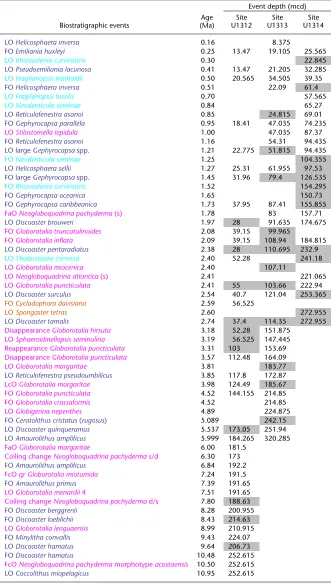
Abundant, generally well preserved calcareous nan-nofossils and planktonic foraminifers occur through-out both holes at Site U1312. Planktonic foraminifer assemblages are mainly composed of species that thrive today or are related to temperate to subpolar waters, with some sporadic incursions of polar water and subtropical species. Nannofossil assemblages consist of cosmopolitan species typical of the North Atlantic at midlatitude. A reliable chronostrati-graphic framework spanning from the late Miocene (~11 Ma) to the present was established based on the succession of biostratigraphic events identified in
the cores (Table T1). Linear sedimentation rates were
estimated based on the depth of these events. Aver-age sedimentation rates were low during the late Miocene (1–2 cm/k.y.), increased in the early Pliocene (2.5–6 cm/k.y.), and decreased again in the latest Pliocene and Pleistocene (1.5–2 cm/k.y.) (Fig.
F5). Although calcareous plankton species were
usu-ally well preserved, intense fragmentation of plank-tonic foraminifer shells and overgrown discoasters was observed in the uppermost Miocene (161–171 mbsf in Hole U1312A and 165–175 mbsf in Hole U1312B), coinciding with an interval of very low sedimentation rates. The occurrence of a hiatus due to carbonate dissolution in this part of the record is probable, since several biostratigraphic events were observed in the same core. A similar interval with ex-tremely low sedimentation rates and/or a possible hiatus but good carbonate preservation was also ob-served in the upper Pliocene–lower Pleistocene (38– 47 mbsf in Hole U1312A and 32–41 mbsf in Hole U1312B). Nannofossils recovered from this interval in Hole U1312B indicate an age older than plank-tonic foraminifers from the same horizon, further suggesting the presence of a hiatus or significant re-working.
Biostratigraphy based on siliceous fossils was hin-dered by rare occurrences and dissolution of radiolar-ians and diatoms. Trace numbers of diatoms are present in the upper ~60 m of both holes and show
an age-depth progression similar to the calcareous nannofossils. Below 60 mbsf, the sediments are al-most entirely barren of diatoms. Likewise, radiolar-ians are found in trace numbers to a depth of 85.5 mbsf in Hole U1312A and 114 mbsf in Hole U1312B. Only one radiolarian event was observed in Hole U1312B, whereas only samples at 28.5 and 37.5 mbsf contained rich radiolarian faunas.
The magnetic interpretations at Site U1312 were based on measurements of the natural remanent magnetization (NRM) after alternating-field (AF) demagnetization at a peak field of 20 mT. The Brun-hes/Matuyama reversal occurs at 18.40 mbsf in Hole U1312A and at 16.95 mbsf in Hole U1312B. The Jaramillo Subchron occurs between 20.90 and 24.80 mbsf in Hole U1312B. In Hole U1312B, the Gauss/ Matuyama and Gauss/Gilbert boundaries were tenta-tively placed at 51.60 and 72.2 mbsf, respectenta-tively, al-though a significant part of the Gauss interval (Chron C2An) is missing due to coring-induced sedi-ment deformation. NRM intensities fall in the range
of 10–5 A/m between ~100 and 210 mbsf in both
holes. This range is close enough to the noise level of the magnetometer that establishing a continuous magnetostratigraphy was not possible by shipboard measurements. A long interval of normal polarity at the bottom of Holes U1312A and U1312B (top at 207.6 and 204.7 mbsf, respectively) was tentatively
identified as Chron 5n (Fig. F6).
Because only two holes were cored and much of the upper portion of Hole U1312A was affected by cor-ing disturbance, it was difficult to construct a com-plete splice for the entire sedimentary section. The remanent magnetic intensity following 20 mT AF de-magnetization and the lightness parameter from color reflectance measurements proved to be the most useful for correlating between holes to 158.89 mcd (the bottom of Core 307-U1312B-16H). Below 158.89 mcd, stratigraphic correlation was difficult because of the very uniform sediment composition, resulting in few diagnostic variations in physical properties. From 158.89 to 68.05 mcd, between-hole correlation was good and all core breaks could be filled, resulting in a complete splice. Above this, sev-eral gaps occur between core breaks, and much of the spliced section is built from Hole U1312B cores, which contained virtually no coring deformation within this interval. From 0 to 40 mcd, lightness (L*) variations, which mainly reflect the carbonate con-tent, mirror variations observed in the 0–1.5 Ma por-tion of benthic oxygen isotope stacks. Sedimentapor-tion rates derived from this correlation vary between 0.5 and 3.5 cm/k.y. over the past 1.5 Ma.
down-hole to a depth of ~80 mbsf, followed by a decrease thereafter. In contrast, chlorinity decreases with depth. The highest silica value of ~641 µM was mea-sured at 53.5 mbsf. Barium exhibits its highest values (0.7 µM) at 82 mbsf, just below the boundary be-tween lithostratigraphic Units I and II.
Carbonate concentration in the sedimentary record of Hole U1312A ranges from 59 to 98 wt% (average = 90.4 wt%). Highest values (92–98 wt%) are observed in the lower part of the record (below ~55 mbsf), whereas the top ~55 m (lithostratigraphic Subunit IA) is characterized by lower values and high
vari-ability. Two discrete intervals of decreased CaCO3
values (82 wt%) occurred at 81.95 and 110.45 mbsf.
A similar trend was observed in the overall CaCO3
concentration at Site 608. Total organic carbon varies between 0 and 0.9 wt%, with the lowest values (0– 0.1 wt%) found below 85 mbsf and higher and more variable values (0.1–0.9 wt%) above. Total nitrogen is low and relatively constant throughout the hole (~0.1 wt%).
Physical property measurements at Site U1312 in-cluded magnetic susceptibility, density, and natural
gamma radiation (Fig. F7). Working sections were
used to measure moisture and density (MAD) and
compressional P-wave velocity. These properties
gen-erally show greatest variability in the upper 40 m consistent with greater clay content and generally show lower values with depth, except for density
and P-wave velocity, which increase with depth.
Site U1312 accomplished near full recovery of the excellent upper Miocene section first drilled at Site 608. The sedimentary sequence representing the last ~11 m.y. will allow for the study of short- and long-term climate variability and ocean-atmosphere inter-actions under very different boundary conditions, such as the closure and reopening of Atlantic/Medi-terranean connections at the end of the Miocene (6– 5 Ma), the closing of the Isthmus of Panama (4.5–3 Ma), and the onset of major northern hemisphere glaciation near 2.5 Ma.
Site U1313
Site U1313 (proposed Site IRD-3A) constitutes a reoc-cupation of DSDP Site 607 located at the base of the upper western flank of the Mid-Atlantic Ridge in a water depth of 3426 m, ~240 mi northwest of the Azores. Two holes were drilled at this site during Leg 94 (June–August 1983) using VLHPC and XCB sys-tems (Ruddiman et al., 1987). Hole 607 penetrated to a total depth of 284.4 mbsf and Hole 607A to a total depth of 311.3 mbsf. The sediments recovered at Site 607 predominantly consist of calcareous biogenic oozes with variable amounts of fine-grained
terrige-nous material. Based on magneto- and biostratigra-phy, the mean sedimentation rate at Site 607 is ~5 cm/k.y. for the Pliocene–Pleistocene time interval. The rationale for reoccupying this site is essentially the same as for Site U1308 (recoring of Site 609; see “Expedition 303 summary”). Together, Sites 607 and 609 constitute benchmark sites for long-term (millions of years) as well as short-term surface and deep ocean climate records from the subpolar North Atlantic. These sites, today situated under the influ-ence of the NADW, have been very important for
generating benthic δ18O, δ13C, and CaCO
3 records for the Pleistocene (Ruddiman et al., 1989; Raymo et al., 2004) and late Pliocene (Ruddiman et al., 1986; Raymo et al., 1989) and for interpreting these records in terms of ice sheet variability and changes in NADW circulation, as well as for generating orbit-ally tuned timescales. Site 607, at a water depth of 3427 m, remains the only site in the high-latitude North Atlantic that monitors NADW circulation throughout the Pleistocene.
Reconstruction of sea-surface temperatures (SST) in the North Atlantic indicates that the Polar Front was situated between 42° and 46°N during glacial times, extending in an east-west direction and resulting in a steep south-north SST gradient (CLIMAP, 1976; Pflaumann et al., 2003). Alkenone SST estimates de-termined in sediment cores from areas south of and within the Polar Front resulted in very different val-ues for different glacials (Calvo et al., 2001), indicat-ing different climatic conditions (e.g., the location of the Polar Front) in these glacial periods. At the site of Core VM 30–97, located close to Site 607, Heinrich events are marked by the distinctive detrital carbon-ate signature, and planktonic foraminifer-derived SST warmed markedly during the Heinrich events and during the Last Glacial Maximum (LGM), in dis-tinct contrast to the climate records from the sub-polar North Atlantic (Bond et al., 1999a).
Four holes (U1313A, U1313B, U1313C, and U1313D) were cored with the APC system and nonmagnetic core barrels to a maximum depth of 308.64, 302.67,
293.45, and 152.34 mbsf, respectively (Fig. F8). The
average recovery was 103.5%. In Holes U1313A and U1313C, drillover was required for recovery of the last two and four cores, respectively. After complet-ing corcomplet-ing operations in Hole U1313B, the hole was prepared for logging and the triple combo tool string was deployed (including the General Purpose Incli-nometer Tool and Multi-Sensor Spectral Gamma Ray Tool) to 2.0 m off the bottom of the hole. The entire 300 m sequence was successfully logged.
clay- to gravel-sized terrigenous components. Two major lithostratigraphic units were identified. Unit I (0–111.86 mbsf in Hole U1313A, 0–111.28 mbsf in Hole U1313B, 0–112.00 in Hole U1313C, and 0– 113.14 mbsf in Hole U1313D) mainly consists of Ho-locene to upper Pliocene alternating nannofossil ooze, silty clay nannofossil ooze, and nannofossil ooze with clay. Regular occurrences of dropstones in Unit I demonstrate that northern hemisphere ice sheet instability plays a role in the sediment’s paleo-climate record from the late Pliocene to Pleistocene. Unit I can be further divided into two subunits. Sub-unit IA exhibits the largest amplitude fluctuations in detrital clay and biogenic carbonate and is reflected
by distinct color changes and shifts in L* (Fig. F8),
percent carbonate, gamma ray attenuation, and magnetic susceptibility, whereas Subunit IB is de-fined by decreased variability in these components. Millimeter- to centimeter-scale pale green color bands are distributed throughout the succession, and a horizon of reworked volcanic ash can be correlated across all holes in Subunit IA. Unit II extends to the bottom of each hole (111.86–308.64 mbsf in Hole U1313A, 111.28–302.67 mbsf in Hole U1313B, 112.00–293.45 mbsf in Hole U1313C, and 113.14– 152.34 mbsf in Hole U1313D). Unit II is very homo-geneous and differs from Unit I mainly in its smaller terrigenous component, which decreases gradually downhole from the unit boundary to ~150 mbsf. Unit II consists of upper Pliocene to uppermost Mio-cene nannofossil ooze and is characterized by high and stable carbonate concentrations. Discrete patches and streaks of pyrite occur throughout this unit and are probably related to local reducing con-ditions associated with organic matter complexes. Pale green color bands continue to be prevalent in the otherwise nearly white sediment.
Site U1313 yielded abundant assemblages of calcare-ous microfossils spanning the late Miocene to Ho-locene. Biostratigraphic events based on calcareous microfossils closely match ages based on paleomag-netic data for the Pliocene and Pleistocene and indi-cate nearly constant sedimentation rates of 4–5 cm/
k.y. throughout this time interval (Fig. F5). The
old-est sediments at Site U1313 are tentatively dated at 6 Ma based on a nannofossil last occurrence near the base of Holes U1313A and U1313C, a tentative planktonic foraminifer event at the base of Hole U1313A, and a possible diatom event in Core
307-U1313C-32H (Table T1). Based on these
biostrati-graphic events, sedimentation rates within the late
Miocene are ~13–14 cm/k.y. (Fig. F5).
Calcareous nannofossils are well preserved through-out much of the section, although some dissolution and overgrowth is present within the upper
Mio-cene. Pleistocene sediments contain very minor amounts of reworked nannofossils. Planktonic fora-minifers are moderately to well preserved and reveal a high faunal diversity including several
(sub)tropi-cal species. An incursion of encrusted
Neogloboquad-rina atlantica (dextral) occurs in the lower Pleis-tocene, making this the youngest occurrence of this species in the midlatitude North Atlantic.
A diverse warm-water diatom flora is generally present within the upper 0 to 40–70 mbsf of each hole, which corresponds to Pliocene–Pleistocene in-tervals. These sediments contain an in-mix of Arctic and Subarctic, possibly ice-rafted species. Diatoms, however, are only abundant in the first two core catchers and occur only as traces below 50–60 mbsf. When present, warm-water diatoms are generally well preserved but often fragmented. The diatoms from colder water masses are usually partially dis-solved.
Radiolarians reveal great variation in abundance, state of preservation, and faunal associations among the four holes. Generally, radiolarians are abundant and well preserved in the upper five to six core catcher samples of each hole, whereas dissolution is
severe in the lower part. Cycladophora davisiana is
found in samples as many as 14 cores deeper than its anticipated first occurrence (at 2.6 Ma) in the North Atlantic. If these occurrences are real and not a result of downhole contamination, then the first
occur-rence of C. davisiana is ~5.5 Ma.
The magnetostratigraphy at Site U1313 was con-structed on the basis of continuous NRM measure-ments after AF demagnetization at a peak field of 20 mT. NRM intensities after 20 mT AF demagnetization
are in the range of 10–3 to 10–4 A/m above 150 mbsf,
but fall in the range of 10–5 A/m in the lower part of
the section. The sediments provide a good record of the Brunhes, Matuyama, and Gauss polarity intervals
down to ~150 mbsf (Fig. F6). Below this depth, the
inclination signal is noisier but alternating intervals of normal and reversed polarities can still be defined with confidence to ~250 mbsf. The magnetostratig-raphy is uncertain below this depth, as it varies from one hole to the other, part of which might be due to the stronger drill string overprint induced by alloy steel core barrels used in the bottom part of Holes U1313A and U1313C instead of nonmagnetic core barrels. The magnetostratigraphy is consistent with the biostratigraphy from the top to ~220 mbsf. In the underlying sediment, however, the link to the
biostratigraphy is not straightforward (Fig. F5).
upper 168.5 mcd because of pronounced variations in nearly all physical properties measured. In partic-ular, the L* parameters from color reflectance mea-surements mimic variations in the global benthic ox-ygen isotope stack (e.g., Lisiecki and Raymo, 2005), and a preliminary age model was constructed by matching sharp L* variations with glacial and inter-glacial terminations. Between-hole correlation was more difficult below 168.5 mcd (~151 mbsf), because the sediments are fairly homogeneous nannofossil ooze.
Apart from their general trends, most pore water chemical constituents show a notable change tween ~80 and 110 mbsf (i.e., at the transition be-tween lithostratigraphic Units I and II). Alkalinity
and Sr2+ increase downhole, while Li+ decreases. The
highest dissolved silica content of ~563 µM is
mea-sured at 39.3 mbsf. SO42– concentration exhibits a
slight downhole decrease from ~26 to 24 µM,
whereas the NH4+ shows an opposite trend (126–418
µM with a high value of 615 µM at 47.8 mbsf). Ba2+
shows a more or less uniform concentration (~3.2 µM) throughout the profile.
Carbonate concentrations in the sediments of Hole U1313A range from 31.5 to 96.7 wt% (average = 80.5 wt%). Relatively uniform and high values (>90 wt%) are observed below ~120 mbsf (Unit II), whereas the top ~120 mbsf (Unit I) is characterized by distinct and strong variations (30–90 wt%). Maximum
ampli-tude with up to 60 wt% difference in CaCO3 occurs
in the uppermost 40 mbsf, whereas the amplitude of variation is reduced to 40–50 wt% from 40 to 120
mbsf. Similar general features of the CaCO3
variabil-ity were observed at Site 607. Total organic carbon varies between 0 and 0.65 wt%, with the lowest val-ues (<0.1 wt%) below 170 mbsf but higher and more variable values (0.1–0.65 wt%) above. Total nitrogen is low and relatively constant throughout the hole (0.1–0.15 wt%). Preliminary results from a limited number of samples (16) show that solvent extract-able organic matter at Site U1313 consists primarily
of odd-numbered C25–C35 n-alkanes and long chain
C37–C40 alkenones. Variations in proportions of these
compound classes reflect a change in the organic matter composition with respect to terrigenous and marine sources. Alkenone-derived SSTs show vari-ability from ~13° to 19°C in the Pleistocene, whereas temperatures of ~20° and 22°C are obtained for the late Pliocene and the latest Miocene, respectively. Physical properties measured at Site U1313 include magnetic susceptibility (by multisensor track [MST] and magnetic susceptibility core logger), gamma ray
attenuation (GRA) density, P-wave logger, and
natu-ral gamma radiation (NGR) using the MST. In addi-tion, porosity and density were measured on discrete
samples by MAD. Finally, P-wave velocities were
measured in the x-direction using the P-wave sensor.
The results show a large variability of all physical properties in the upper ~120–140 m, which is proba-bly related to the variation of clay content in the
up-per part (Fig. F8). Below 120 mbsf, the variability in
physical properties is small as a result of the very high carbonate content (>95 wt%).
The successful deployment of the triple combo tool string in Hole U1313B provided complete coverage of the 300 m section and very good physical prop-erty and lithologic information for density, porosity, natural gamma radiation, resistivity, and photoelec-tric effect. Corresponding core physical property measurements were very consistent with in situ downhole data. Of special note is the dramatically consistent linear correlation of downhole NGR (up-per 225 mbsf) with the recent Lisiecki and Raymo (2005) benthic oxygen isotope record over the last 5.3 m.y. The consistency of downhole data with both core data and age models will allow mapping of the spliced core record to actual depth, resulting in more accurate sedimentation rate calculations as well as more detailed age/depth models.
Site U1313 (especially in combination with similar records from other Expedition 303 and 306 sites) will document the evolution of the complex surface-temperature phasing over time, addressing questions such as whether the patterns are a peculiarity of the last glaciation, whether they were present in the 41-k.y. world, and whether they appeared at the onset of northern hemisphere glaciation. By placing the surface-temperature signals into a chronological framework based on a combination of oxygen isoto-pic stratigraphy, detrital carbonate-bearing IRD (Hei-nrich-type) events, and geomagnetic paleointensity, we expect to obtain an optimal reconstruction of the phasing of the temperature records and its relation-ship to ice sheet instability and changes in deepwa-ter circulation.
Site U1314
Site U1314 (proposed Site GAR1B) is located on the southern Gardar Drift in a water depth of 2800 m
(Fig. F1). Close to the location of Site U1314, a 33 m
Marion Dufresne core (MD99-2253) was collected on the crest of the Gardar Drift in 1999 (Labeyrie et al., 2003). The MD99-2253 piston core has a high sedi-mentation rate of ~9 cm/k.y. for the last glacial cycle
and well-defined planktonic δ18O and geomagnetic
paleointensity record reference. During Leg 162, Sites 983 and 984 were drilled off Iceland on the northern part of the Gardar and Bjørn Drifts,
respec-tively (Fig. F2). These sites have mean Pleistocene
have produced high resolution climatic and geomag-netic records. Sites 983 and 984, however, are located
outside the main IRD belt (Fig. F2) and do not
con-tain a robust detrital carbonate (Heinrich layer) sig-nal. Furthermore, both sites are at shallower water depths (<2000 m) than Site U1314 and therefore monitor intermediate water but not NADW. Site U1314, on the other hand, is located (1) close enough to the IRD belt to record the Heinrich-type detrital layers that monitor ice sheet instability and (2) in a water depth of 2820 m, allowing for a high-resolution monitoring of NADW and its short-term (sub)millennial scale variability.
Three holes (Holes U1314A, U1314B, and U1314C) were cored with the APC system and nonmagnetic core barrels to maximum depths of 257.58, 279.91
and 208.18 mbsf, respectively (Fig. F9). The average
recovery was 102.7%. Drillover was not required for the three holes.
The sedimentary sequence at Site U1314 mainly con-sists of nannofossil- and clay-rich sediments with minor and varying proportions of diatoms and fora-minifers. Only one lithostratigraphic unit was de-fined at Site U1314, which spans the late Pliocene to Holocene time interval. In particular, two sets of li-thologies can be identified:
1. Predominantly nannofossil oozes enriched in bio-genic (mainly diatoms and foraminifers) and ter-rigenous (principally clay minerals, quartz, opaque minerals, and calcite) components; and 2. Terrigenous silty clay with a varying proportion of
calcareous and siliceous microfossils.
The sediment varies in color from very dark gray to light gray to hues of greenish gray. Slight to moder-ate bioturbation is typical for most of the section. Horizontal and parallel bedding planes and color contacts without erosional relief suggest that there is no visible evidence of significant sediment distur-bance by natural processes. Sand- and gravel-sized sediment, common at Site U1314 from 0 to 240 mbsf, provides direct evidence of ice rafting and doc-uments the influence of Pliocene–Pleistocene glacia-tions in this region. Based on the occurrence of felsic and mafic igneous dropstones, as well as sand-sized, hematite-stained quartz, Iceland and Greenland are probable source areas of the IRD material.
Site U1314 yields abundant assemblages of calcare-ous and silicecalcare-ous microfossils spanning the late
Pliocene to Holocene (Table T1). Sedimentation rates
based on microfossil datums and paleomagnetism indicate decreasing rates from ~11–11.5 cm/k.y. dur-ing the late Pliocene to ~7.0–7.5 cm/k.y. durdur-ing the
Pleistocene (Fig. F5). Polar and subpolar species
dom-inate the assemblages with a suborddom-inate amount of transitional species present as well.
Calcareous nannofossils are abundant and generally well preserved throughout the section. Minor amounts of Cretaceous and Paleogene reworked nan-nofossils occur in all holes. Samples with increased amounts of reworked material typically contain coarser sediment and reduced abundances of in situ nannofossils. Late Pliocene discoasters are rare, but present, and can be used with caution for biostratig-raphy, even though they are considered warm-water species. Generally well preserved planktonic fora-minifers are the dominant component in the sand fraction of most core catcher samples, with lower proportions of benthic foraminifers, ostracodes, sili-ceous microfossils, and IRD. Fauna consists of species typical for transitional to subpolar provinces in the
Pleistocene and Pliocene. Neogloboquadrina
pachy-derma (sinistral) is dominant in several of the glacial samples.
Abundant and diverse boreal to Subarctic diatom flo-ras, with a minor input of warm-water species, are present in all holes. The exception is the interval be-tween 307-U1314A-13H-CC and 15H-CC, where few or rare diatoms coincide with high content of silici-clastic material. The preservation is generally moder-ate to good, with a deteriorating trend downhole, as well as poor preservation coinciding with lithic-rich intervals. The flora is dominated by long pennate
specimens, as well as resting spores of Chaetoceros
and fragments of big Coscinodiscus species.
Radiolarians at this site show great variation in spe-cies and abundances among the three holes. The
state of preservation is generally good in all holes. C.
davisiana is found in most samples, with a first com-mon occurrence in Samples 307-U1314A-25H-CC and 307-U1314B-24H-CC. This species has a first common abundance in the North Atlantic at ~2.6 Ma. Cycladophora sakaii is commonly found in Sam-ples 25H-CC in Holes U1314A and U1314B. In the
North Pacific, C. sakaii evolves into C. davisiana at
~2.6 Ma. This is the first documented occurrence of C. sakaii in the North Atlantic. The last occurrence of Spongaster ?tetras (2.6 Ma) is found in Samples 307-U1314A-28H-CC and 307-U1314B-27H-CC.
The magnetostratigraphy at Site U1314 was con-structed on the basis of continuous NRM measure-ments after AF demagnetization at a peak field of 20 mT. NRM intensities after 20 mT AF demagnetization
are in the range of 10–1 to 10–2 A/m. These values are
considerably greater than those at Sites U1312 and U1313, owing to a higher magnetic mineral content. Site U1314 provides a very good record of the Brun-hes, Matuyama, and upper part of the Gauss Chrons
(Fig. F6). The Brunhes/Matuyama reversal occurs at
The deepest magnetic polarity interval recorded at Site U1314 corresponds to the top normal interval of the Gauss (Subchron 2An.1n; 2.58 Ma). Several short geomagnetic intervals are present in the paleomag-netic record, such as the Cobb Mountain and the Re-union events. The magnetostratigraphy is consistent with the biostratigraphy throughout the section. Stratigraphic correlation was straightforward at Site U1314 because most of the sediment physical prop-erties show prominent short-wavelength amplitude variations related to changes in lithology. For depth-shifting the cores, we relied mainly on between-hole correlation of distinctive magnetic susceptibility and natural gamma ray variations. These correlations were confirmed to be consistent with geomagnetic polarity reversals recorded in the paleomagnetic in-clination. The resulting mcd scale is well resolved, and the spliced section is complete to 281 mcd. Be-cause of core disturbance in the upper part of Hole U1314A, the splice in the interval 0–188.30 mcd was built from Holes U1314B and U1314C, with the ex-ception of a short interval (65.80–69.50 mcd) where an undisturbed section of Core 307-U1314A-8H was incorporated into the composite section. From 188.30 to 300 mcd the splice was constructed from Holes U1314A and U1314B because Hole U1314C was drilled only to 222 mcd. The two deepest cores, 307-U1314B-29H and 30H, which span an interval not cored in Holes U1314A or U1314C, were ap-pended to the splice. A growth factor of 1.08 is calcu-lated by linear regression for the three holes at Site U1314, indicating an 8% increase in mcd relative to mbsf.
The ionic composition of the pore waters at Site U1314 was measured between Cores 307-U1314A-1H and 12H. Pore water alkalinity increases downhole
from 5.34 to 7.46 mM. Ca2+ and Mg2+ concentrations
decrease downhole from 8.4 to 5.2 mM and 48.7 to
37.4 mM, respectively. Fe2+ concentrations are
vari-able, with the lowest value (6.5 µM) measured at 36.4 mbsf, which coincides with more abundant
darker lithologies. Ba2+ concentration is higher at Site
U1314 than at the other sites, ranging from 17 to
18.3 µM. Mn2+ concentration ranges from 46.8 to
15.9 µM and shows a rapid decrease downhole
be-tween 17.4 and 36 mbsf. H4SiO4 concentration
in-creases with depth from 487.6 to 571.9 µM.
Carbonate concentrations in the sediments of Hole U1314A range from 3.7 to 70.5 wt%. The average carbonate value linearly shifts from 20 wt% at 250
mbsf toward 40 wt% near the top. CaCO3 values
show a good correlation to L* data throughout the section. Total organic carbon (TOC) varies between <0.1 and 0.5 wt% with an average of 0.2 wt%. The downhole TOC variation is similar to the variability
in magnetic susceptibility, suggesting that organic carbon at Site U1314 is primarily of terrigenous ori-gin. Based on initial results from eight samples, sol-vent extractable organic matter at Site U1314
con-sists mainly of long-chain, odd-numbered C25–C35n
-alkanes and long-chain C37–C40 alkenones. Except for
one sample from the upper Pliocene, all Pleistocene
samples show a distinct prevalence of n-alkanes
rela-tive to alkenones, confirming the assumption of a mainly terrigenous origin of the organic matter at Site U1314. Alkenone-derived SSTs vary between ~10° and 13°C.
Physical property measurements at Site U1314
in-cluded magnetic susceptibility, density, P-wave
ve-locity, and NGR (Fig. F9). Working sections were
used to measure MAD and compressional P-wave
ve-locity. These properties are positively correlated, con-sistent with the terrigenous nature of the sediment. The magnetic susceptibility records, for example, show a highly variable record attributed to lithologic and/or mineralogic changes; multiple excursions to-ward high values are generally associated with IRD layers.
At Site U1314, a complete upper Pliocene to Ho-locene sequence, characterized by high sedimenta-tion rates of 7 to >11 cm/k.y., was recovered. Because of its location close to the IRD belt and within the NADW, as well as its high potential for paleomag-netic and isotopic age control, this section will be used to establish a high-resolution (millennial to submillennial) environmental record of sea-surface and bottom water characteristics and a detrital (Heinrich type) stratigraphy for the past ~2.7 m.y.
Site U1315
Site 642 (Site U1315), located on the Vøring Plateau in a water depth of ~1280 m, was visited during Leg 104 (Eldholm, Thiede, Taylor, et al., 1987) (see Fig.
F1 in the “Site U1315” chapter). In Hole 642E, a
1229 m deep sequence was drilled that is composed of upper Eocene to Quaternary biogenic and terrige-nous sediments with volcaniclastics in the lower part (lithostratigraphic Units I–IV; 0–315 mbsf) and Eocene tholeiitic (upper series) and andesitic (lower series) basalt flows with interbedded volcaniclastic
sediments (315–1229 mbsf) (see Fig. F2 in the “Site
U1315” chapter). The location of Site 642 was revis-ited during Expedition 306 (Site U1315A; 67°12.74′N, 02°56.24′E).
the thermal wave through the subsurface is moni-tored with a 150 m thermistor string deployed in a cased borehole fitted with a CORK. Hole U1315A was drilled to a depth of 179.07 mbsf and cased with
10¾ inch casing. The base of the casing was
ce-mented and the casing string was displaced with bentonite mud. The thermistor string is attached to Spectra rope using friction tape, cable ties, and ma-rine duct tape to carry the weight of the load and a 250 lb sinker bar. The thermistor string is connected to a data logger and external battery.
To assess current background thermal conditions in the region, a downhole record of temperature from nearby Hole 642E was obtained using the LDEO Temperature/Acceleration/Pressure (TAP) tool in combination with the triple combo tool string. In addition, the FMS-sonic tool was deployed. At a depth of 588 mbsf, an impassable obstruction was reached, and downhole logging had to be stopped. The TAP tool indicated a BWT at the seafloor of ~0.2°C. The upper 10 m of the borehole has a very steep thermal gradient (~2500°C/km). Below this depth, the borehole has a relatively low gradient of ~22°C/km. At a depth of ~500 mbsf, a strong positive temperature excursion to ~42°C may indicate inflow. FMS imaging of the hole yielded good results and will allow correlation to existing core data and filling in the gaps (~60% of the formation). In combination with detailed FMS resistivity measurements and im-aging and sonic data, it may be possible to get reli-able permeability estimates. Understanding the per-meability will allow better understanding of fluid flow and temperature gradients observed in the bore-hole.
Summary and conclusions
Following Expedition 303, Expedition 306 was the second cruise of the North Atlantic paleoceanogra-phy study that aims to generate a late Neogene– Quaternary chronostratigraphic template for North Atlantic climate proxies, to allow their correlation at a sub-Milankovitch scale and their export to other parts of the globe by using a PAC. In addition, Expe-dition 306 also included the installation of a CORK near Site 642 (Vøring Plateau, Norwegian margin) to investigate the feasibility of reconstructing BWT his-tories at the decadal to centennial timescale by mak-ing high-precision temperature-depth measure-ments.Based on the Expeditions 303 and 306 Scientific
Pro-spectus and results of Expedition 303, Sites IRD3A and IRD4A and two sites on Eirik Drift were origi-nally selected to become the primary Expedition 306 sites. Extremely bad weather conditions in the
Labra-dor Sea, however, did not allow coring operations on Eirik Drift at any time. Thus, we concentrated our work related to the North Atlantic paleoceanography study in the area directly south of the central North Atlantic IRD belt and on the southern Gardar Drift. These locations are known either from Leg 94 or from conventional piston coring to have the poten-tial for paleomagnetic and isotopic age control and sedimentation rates high enough for high-resolution reconstructions of sea-surface and bottom water characteristics and ice sheet instabilities during late Neogene to Pleistocene times.
The main objective at Site U1312, a reoccupation of Site 608, was to obtain continuous records of surface and deepwater characteristics and their interactions with ice sheet instabilities during Neogene–Quater-nary times. In this context, an important target at this site was the recovery of a complete undisturbed upper Miocene section by means of APC coring. The Holocene to upper Miocene sedimentary succession at Site U1312 consists of varying mixtures of bio-genic and detrital components, primarily nannofos-sils, foraminifers, and clay minerals. Near 3.5 Ma, the progressive but oscillatory deterioration of the northern hemisphere climate, which gradually led to the onset of major continental ice sheets at ~2.7 Ma, is reflected in the increase in detrital sediment input, followed by late Pliocene–Pleistocene climate-con-trolled short-term variability in detrital input. Aver-age sedimentation rates were low during the late Miocene and in the latest Pliocene and Pleistocene (1–2 cm/k.y.) but increased in the early Pliocene (3–8 cm/k.y.).
The sedimentary sequence of Site U1312 represent-ing the last ~11 m.y. will allow the study of short-and long-term climate variability short-and ocean-atmo-sphere interactions under very different boundary conditions, such as the closure and reopening of At-lantic/Mediterranean connections at the end of the Miocene (6–5 Ma), the closing of the Isthmus of Pan-ama (4.5–3 Ma), and the onset of major northern hemisphere glaciation at ~2.7 Ma.
Site U1313 is a reoccupation of Site 607. Site 607 has been very important for generating a late Pliocene to Pleistocene stable isotope stratigraphy and its inter-pretation in terms of ice sheet variability and changes in NADW circulation. At the site of Core VM 30-97, located close to Site 607, Heinrich events are marked by the distinctive detrital carbonate sig-nature, and planktonic foraminifer-derived SSTs warmed markedly during the Heinrich events and during the LGM, in distinct contrast to the climate records from the subpolar North Atlantic.
up-permost Miocene sedimentary succession at Site U1313 consists primarily of nannofossil ooze with varying amounts of foraminifers and clay- to gravel-sized terrigenous components. The detrital compo-nents become much more important and variable in the upper Pliocene–Pleistocene interval of the se-quence, probably reflecting northern hemisphere ice sheet instability. Bio- and magnetostratigraphy indi-cate nearly constant sedimentation rates of ~4.1–4.5 cm/k.y. throughout the Pliocene–Pleistocene time interval, whereas in the late Messinian sedimenta-tion rates were ~13–14 cm/k.y. Correlasedimenta-tion between the holes was excellent in the upper 168.5 mcd be-cause of pronounced variations in nearly all physical properties measured. In particular, the L* from color reflectance measurements mimic variations in the global benthic oxygen isotope stack (e.g., Lisiecki and Raymo, 2005), and a preliminary age model was constructed by matching sharp L* variations with glacial and interglacial terminations. Alkenone-derived SSTs show variability from ~13° to 19°C in the Pleistocene, whereas temperatures of ~20° and 22°C are obtained for the late Pliocene and the latest Miocene, respectively. The consistency between downhole-logging data and core data will allow mapping of the spliced core record to actual depth, resulting in more accurate sedimentation rate calcu-lations as well as more detailed age-depth models. Of special note is the very consistent linear correlation of downhole NGR (upper 225 mbsf) with the recent Lisiecki and Raymo (2005) benthic oxygen isotope record over the last 5.3 m.y.
Site U1313 provides a unique and complete Pliocene–Pleistocene sedimentary section with re-markably constant sedimentation rates. This site will allow an optimal reconstruction of the phasing of the temperature records and its relationship to ice sheet instability and changes in deepwater circula-tion throughout the last 5 m.y. High sedimentacircula-tion rates of 13–14 cm/k.y. will allow a high-resolution study of paleoenvironmental change during the late Messinian.
Site U1314 was drilled on the southern Gardar Drift, close enough to the IRD belt to record the Heinrich-type detrital layers that monitor ice sheet instability, and in water depth of 2800 m, allowing a high-resolution monitoring of NADW and its short-term (sub)millennial scale variability.
The upper Pliocene to Holocene sedimentary se-quence at Site U1314 consists of an alternation of predominantly nannofossil oozes enriched in bio-genic and terrigenous components and terrigenous silty clay with a varying proportions of calcareous and siliceous microfossils. This alternation is also re-flected in the carbonate content, varying between ~5
and 70 wt%. Sand- and gravel-sized sediment, com-mon at Site U1314 from 0 to 240 mbsf, provides di-rect evidence of ice rafting and documents the influ-ence of Pliocene–Pleistocene glaciations in this region. Site U1314 yields abundant moderately to well-preserved assemblages of calcareous and sili-ceous microfossils throughout the section and an ex-cellent paleomagnetic record of the Brunhes, Matu-yama, and the upper part of the Gauss Chrons. Even several short geomagnetic reversals are present in the paleomagnetic record. Sedimentation rates based on microfossil datums and paleomagnetic reversals indi-cate decreasing rates from ~11–11.5 cm/k.y. during the late Pliocene to ~7.0–7.5 cm/k.y. during the Pleis-tocene. Stratigraphic correlation was straightforward at Site U1314 because most of the sediment physical properties show prominent short-wavelength ampli-tude variations. The resulting mcd scale is well re-solved, and the spliced section is complete to 281 mcd.
At Site U1314, a complete upper Pliocene to Ho-locene sequence, characterized by high sedimenta-tion rates from 7 to >11 cm/k.y., was recovered. Be-cause of its location close to the IRD belt and within the NADW, this section will be used to establish a high-resolution (millennial to submillennial) envi-ronmental record of sea-surface and bottom water characteristics and a detrital (Heinrich-type) stratig-raphy for the past ~2.7 m.y.
At Site U1315, a borehole observatory was success-fully installed in a new ~180 m deep hole close to Site 642. This borehole observatory consists of a CORK to seal the borehole from the overlying ocean and a thermistor string/data logger unit to document BWT variations and monitor its subbottom diffusion over a 5 y period. To assess current background ther-mal conditions in the region, logging down to al-most 600 mbsf was performed at Hole 642E, using the LDEO TAP tool in combination with the triple combo and FMS-sonic tool strings. The upper 10 m of the borehole has a very steep thermal gradient (~2500°C/km). Below this depth, the borehole has a relatively low gradient of ~22°C/km. At a depth of ~500 mbsf, a strong positive temperature excursion to ~42°C may indicate inflow.
Although we lost 10 days to severe weather condi-tions with very strong winds up to hurricane force and could not reach the Eirik Drift as one of our main target areas because of the bad weather, Expe-dition 306 was successfully completed and most of the objectives outlined in the Expeditions 303 and 306 Scientific Prospectus and Addendum were fulfilled: 1. For the North Atlantic paleoceanography study