This Article has been accepted for publication by the Institute, which does not itself take institutional policy positions. Special Articles are subject to refereeing prior to publication. The authors are solely
ESRI SPECIAL ARTICLE
Exploring the Implications of Monetary Policy
Normalisation for Irish Mortgage Arrears
M. Fahy, K. McQuinn, C. O’Toole and R. Slaymaker
https://doi.org/10.26504/QEC2019SPR_SA_Fahy
EXPLORING THE IMPLICATIONS OF MONETARY POLICY
NORMALISATION FOR IRISH MORTGAGE ARREARS
1,2Mike Fahy, Kieran McQuinn, Conor O’Toole, Rachel Slaymaker*
ABSTRACT
The current level of the monetary policy rate in the Eurozone is low both by international and historical standards and will likely rise over the coming years. In this Article we consider what the impact of a rise in ECB policy rates would mean for the Irish mortgage market. First, we examine the structure of the Irish mortgage market in terms of interest rate contract types and explore the link between the mortgage rate and the policy rate. Second, we draw out the results of policy modelling linking arrears and interest rates using a model put forward in Slaymaker et al. (2019). We then use this model to provide some further scenarios exploring the impact of interest rate rises on the arrears rate for particular groups of Irish households. Our findings suggest a 25 basis point increase in the policy rate would lead to a 0.1 percentage point increase in new missed mortgage payments. While households are in a better economic position to withstand policy rate increases given the recovery in the labour market and in house prices, rate rises would lead to payments rising faster than long-term income growth. Younger, lower income households who are at an earlier stage in their mortgage contract are more at risk, as are households on tracker interest rates who have a contractual pass-through from the policy rate to the lending rate.
1. INTRODUCTION
Since the beginning of the financial crisis in 2008, the Irish mortgage market has gone through a period of considerable upheaval. At the peak of the crisis, one-in-five mortgage loans were in arrears as households were confronted with simultaneous shocks in the labour market and to house prices. High origination loan-to-value and loan-to-income ratios, as well as an over-extension of credit to low income households meant few buffers were available to absorb the
1 This research is funded under the Macroeconomy, Taxation and Banking Joint Research Programme between the
Department of Finance and the ESRI. The views presented in this paper are those of the authors alone and do not represent the official views of either the Department of Finance or the Economic and Social Research Institute. Results presented in this paper are based on analysis of strictly controlled research microdata files provided by the Central Statistics Office (CSO). The CSO does not take any responsibility for the views expressed or the outputs generated from this research. Any remaining errors are our own.
*
2
Mike Fahy is a Senior Economist in the Department of Finance, Kieran McQuinn is Research Professor at the Economic and Social Research Institute, Conor O’Toole is a Senior Research Officer at the Economic and Social Research Institute and Rachel Slaymaker is a Postdoctoral Research Fellow at the Economic and Social Research Institute. Corresponding author: [email protected].
macroeconomic downturn which transpired after 2008 (McCarthy and McQuinn, 2017; Lydon and McCann, 2017).
As the domestic economy continued to deteriorate, real earnings fell and unemployment rose strongly. Few policy levers were available to offset the decline in the economy given the requirement to follow a pro-cyclical fiscal policy adjustment under the economic support programme with the International Monetary Fund (IMF), the European Union (EU) and the European Central Bank (ECB). One policy lever that did provide a countervailing force was the decline in the monetary policy rate which was part of a broader package of aggressive monetary policy actions by the ECB and other global Central Banks to offset the financial and sovereign debt crises (Gerlach, 2013).
For a highly indebted economy like Ireland, reductions in the ECB policy rate are beneficial from a financial stability perspective if they reduce the debt repayment burden for borrowers. While not all mortgage holders in Ireland benefited from lower policy rates due to a breakdown in interest rate pass-through, certain cohorts such as tracker rate contract holders saw their repayments decline automatically. This helped provide a buffer to absorb some of the negative economic shocks. Byrne et al. (2017) find that monetary policy rate pass-through in Ireland led to a lower default rate amongst tracker borrowers than would otherwise be the case.
Since 2013 the Irish economy has recovered, house prices have rebounded dramatically and unemployment has fallen to just under 6 per cent. The significant turnaround in economic fortunes has provided a supportive context for improvements in the mortgage market with the share of mortgage loans in arrears falling to just under 7 per cent in the first half of 2018 (Central Bank of Ireland, 2018). An extensive programme of mortgage modification has also played a role in reducing the share of mortgages in arrears (McCann, 2017; Donnery et al., 2018).
To consider what the impact of a rise in ECB policy rates would mean for the Irish mortgage market, the aims of this Special Article are threefold. First, we consider the structure of the Irish mortgage market in terms of interest rate contract types and explore the link between the mortgage rate and the policy rate. Second, we draw out the results of policy modelling linking arrears and interest rates using a model put forward in Slaymaker et al. (2019). We use this model to provide some further scenarios exploring the impact of interest rate rises on whether or not Irish households would miss a mortgage payment due to financial distress if interest rates were to rise. Our indicator of missed mortgage payments is broader than the strict 90 days past due definition that is used by the Central Bank for reporting and monitoring purposes. Instead, it captures those households who miss any payments due to financial distress. The model documented in Slaymaker et al. (2019) links mortgage arrears to changes in the actual monthly repayment-to-net income level of the household. This provides a direct measurement of the effect of interest rate rises on the affordability of payments for each household. Finally, we discuss the implications for policy.
A number of findings emerge. As outlined in Slaymaker et al. (2019), a 25 basis point increase in the monetary policy rate leads (within one year) to a 0.1 percentage point increase in the flow of new missed mortgage payments based on 2016 data. As noted above, the measurement of arrears is not the standard 90 days past due as measured by the official Basel definition, so the flow to new 90-day arrears would therefore be lower than that provided by our estimates. As the effects of interest rates are non-linear (through the standard non-linear, repayment amortisation schedule), a larger adjustment of 100 basis points (similar to the 2018 US Federal Reserve adjustment) in the policy rate raises the flow of households into arrears by 0.5 percentage points.
Given that the Irish economy is growing at a significant rate at present, it is useful to explore whether a rise in household incomes would offset any of the increase in the policy rate. To address this issue, Slaymaker et al. (2019) raise all household incomes by the long-run average income growth rate in the economy adjusted for the higher policy rate using COSMO (Bergin et al., 2017), a structural model of the Irish economy. They find that the rise in income does not offset the increase in repayments due to higher interest rates. This is because mortgage repayments, owing to the non-linear combination of income and interest rates, rise at a faster pace than income levels. However, this does not take into account a lower unemployment rate which would arise in an improved economy and is a critical determinant of mortgage default.
those on tracker versus standard variable (SVR) rates; b) young versus older households; c) low versus higher income borrowers; and d) loans with a longer term remaining versus loans closer to maturity. We find that younger, lower income households who are at an earlier stage in their mortgage contract are more at risk. In addition, tracker borrowers, who have a contractual pass-through from the policy rate to the lending rate, will inevitably face larger increases in their repayments compared to standard variable rate borrowers.
Understanding the likely path of ECB interest rates over the coming years is complicated as it is affected by a range of factors. Such factors include the outlook for the European economy, European inflation, and broader developments in Europe around the balance of Central Bank policymaking power. The negative effects of Brexit again may delay normalisation. However, for a highly indebted economy like Ireland with a vulnerable mortgage market, it is prudent to plan for eventual rate rises and ensure buffers are available to absorb these at a household and bank level.
The rest of this Article is structured as follows. Section 2 explores the structure of the Irish mortgage market and discusses the link between lending rates and the policy rate. Section 3 presents the main findings in Slaymaker et al. (2019). Section 4 presents some additional scenarios and Section 5 draws out the implications for policy.
2.
STRUCTURE OF IRISH MORTGAGE MARKET AND INTEREST RATE RISK
The degree to which policy rate increases are passed through to borrowers depends on two structural features of the mortgage market. First, the share of new loans and the outstanding stock that are on variable rate contracts determines the degree to which banks can pass through increases in their cost of funding to households. Second, pass-through from the policy rate to the lending rate which depends on a number of factors including the degree of competition, the cost of funds, credit risk, and the ability of households to refinance mortgages in the face of interest rate increases. In Section 2.1, we will document the first of these issues while discussing the second in Section 2.2.
2.1
Interest rate types in the Irish mortgage market
mortgages, we mean excluding trackers. The most common variable rate product is the Standard Variable Rate or ‘SVR’.
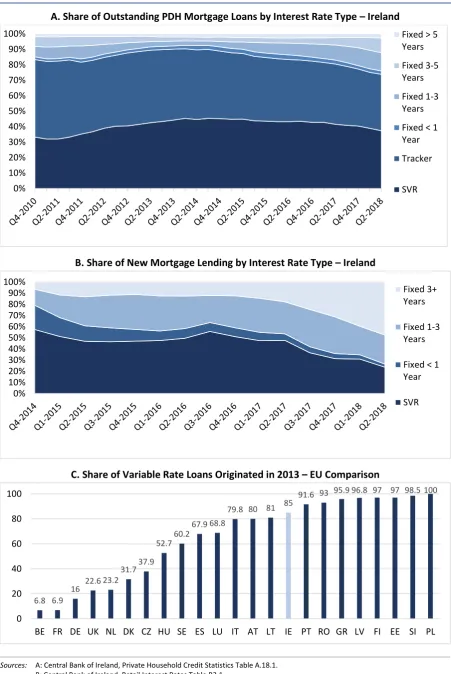
Figure 1 panel A outlines the share of outstanding mortgage loan balances3 on standard variable rate, tracker rate, and fixed rate loans. It can be seen that in Ireland the market is currently dominated by variable rate contracts. As of Q2 2018, by outstanding loan value (loan balances), 37 per cent of the balance of mortgage loans outstanding in Ireland have standard variable rate contracts, a further equal share of 37 per cent of the balance have tracker interest rates. A further 2.5 per cent of the balance have fixed rate loans of less than one-year fixation which is in essence a variable rate loan. In terms of longer-term fixed rates, 12 per cent of mortgage balances had a one- to three-year fixed rate, a further 9.5 per cent of balances had a three- to five-year fixed rate while a total of 2.5 per cent had a fixed rate greater than five years. This indicates that a total of 26 per cent of Irish mortgage balances have some type of rate fixation leaving approximately 74 per cent, or three-quarters of the balance of loans, at risk of rate changes if the ECB adjusts its policy rate. In terms of the number of loans, the Central Bank of Ireland
Credit Market Report 2018, indicates that as of Q2 2018, 21 per cent of fixed rate
contracts were over one year maturity.4
This reliance on variable rate contracts leaves the holders of these mortgages very exposed to increases in rates in the future. Indeed, the short-term nature of the fixed rate loans in the Irish market is also a cause for structural concern as, compared to markets such as the US or Denmark where mortgage fixation periods often last 30 years, all the fixed rate products in Ireland are short-term in duration. The longest fixed-term rate on the market in Ireland currently is ten years in duration.5 In comparison to other European countries, Ireland’s share of variable rate origination is higher than the median (See Figure 1, panel C). In 2013, mortgage markets such as France and Belgium had fewer than 10 per cent of loans on variable contracts as compared to 85 per cent of loans in Ireland.
3 This refers to the proportion of the value of outstanding loans by interest rate type, not the proportion of the number
of loans.
4
https://www.centralbank.ie/docs/default-source/publications/household-credit-market-report/household-credit-market-report-2018.pdf?sfvrsn=4
5 Sibley, E. (2018) ‘The Irish Mortgage Market – 2018 and beyond’, Remarks delivered to the Institute of Banking
FIGURE 1 OVERVIEW OF INTEREST RATE TYPES IN IRELAND AND EUROPEAN COMPARISON
A. Share of Outstanding PDH Mortgage Loans by Interest Rate Type – Ireland
B. Share of New Mortgage Lending by Interest Rate Type – Ireland
C. Share of Variable Rate Loans Originated in 2013 – EU Comparison
Sources: A: Central Bank of Ireland, Private Household Credit Statistics Table A.18.1.
B: Central Bank of Ireland, Retail Interest Rates Table B3.1.
C: European Systemic Risk Board, Report on Residential Real Estate and Financial Stability in the EU, 2016.
0% 10% 20% 30% 40% 50% 60% 70% 80% 90%
100% Fixed > 5
Years
Fixed 3-5 Years
Fixed 1-3 Years
Fixed < 1 Year
Tracker
SVR
0% 10% 20% 30% 40% 50% 60% 70% 80% 90% 100%
Fixed 3+ Years
Fixed 1-3 Years
Fixed < 1 Year
SVR
6.8 6.9
16 22.6 23.2
31.737.9
52.760.2
67.9 68.8
79.8 80 81 85
91.6 93 95.9 96.8 97 97 98.5 100
0 20 40 60 80 100
The high share of interest rates on variable contracts heightens the risk associated with the mortgage market’s potential exposure to changes in the banks’ cost of funding through the policy rate. The difference in interest rate type has important implications from a modelling perspective when attempting to estimate the impacts of interest rate changes on households’ repayment capacity.
For the Irish mortgage market, borrowers holding tracker rate contracts are a substantial source of vulnerability. These loans were originated at the height of the credit boom and the underlying loan sizes are larger than for other contracts. Kelly et al. (2015) show that, while tracker loans are larger, their median repayments have been lower than other contract types as they have benefited considerably from the low interest rate environment and the contractual margin between the policy rate and their mortgage rate. Byrne et al. (2017) further document that tracker borrowers have experienced much lower default rates as a result of the lower ECB policy rate. Naturally, as tracker borrowers have benefited from a fall in the policy rate, these loans will be immediately impacted when the policy rate begins to move.
2.2
Interest rates and the link to monetary policy
It has been well documented that mortgage interest rates in Ireland are high by European standards.6 Figure 2 plots the average interest rate in Ireland on outstanding mortgage loans relative to other European countries. From 2000 onwards, Irish rates, mainly due to increased competition in the domestic market, were below the median in other countries; since 2014, Irish mortgage interest rates are now the highest of the group of countries for which data are available.
6 See ESRI Quarterly Economic Commentary, Summer 2018; Central Bank of Ireland Influences on Standard Variable Rate
FIGURE 2 INTEREST RATES ON NEW HOUSE PURCHASE LOANS TO HOUSEHOLDS – EUROPEAN COMPARISON
Sources: Central Bank of Ireland, SME Credit Series, Table A.14.1.
Notes: Countries included are: AT, BE, EE, ES, FI, FR, IE, IT, LT, NL, PT, SI. These countries are selected due to data availability. Data differ between this chart presented and the text as the ECB comparison data include restructured mortgages whereas the new business SVR is only for new drawdowns.
Understanding the determinants of interest rates in Ireland is particularly important when considering the extent to which rates will be passed through to borrowers in the event of a monetary policy rate rise. The process of rate ‘pass-through’ is an important structural feature of any mortgage market and is a critical channel in the functioning of monetary policy (Hofmann and Mizen, 2004; Karagiannis, 2010).
The pass-through inevitably depends on the share of variable and fixed rate contracts in the market as discussed above. Having determined in Section 2.1 that Ireland is a market with predominantly variable rates, this transmission channel of monetary policy is particularly important. However, rate pass-through also depends on a multitude of other factors. A number of studies (including Goggin et al., 2012 and McQuinn and Morley, 2015) conclude that the monetary policy transmission mechanism, i.e. the extent to which European policy rates influence domestic rates, has, in the aftermath of the financial crisis, broken down in the case of the Irish mortgage market. The reasons for this are primarily concerned with the many legacy issues arising in the Irish banking sector after the 2007/2008 crash. Internationally, there is evidence of a weaker pass-through following the crisis. Illes et al. (2015) explore why bank lending rates did not fall as much as the decline in policy rates would have suggested following the crisis. They find this was due to the fact that the policy rate did not accurately reflect the cost of bank liabilities.
0 2 4 6 8 10 12
%
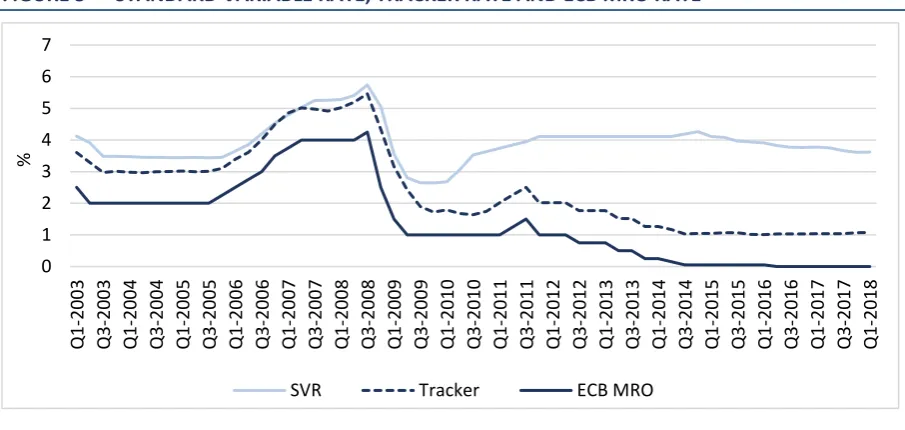
Figure 3 plots the Irish SVR, tracker rate and the ECB policy rate over time. As noted in Goggin et al. (2012), mortgage lenders in the Irish market tend to use the three-month Euribor as a benchmark for adjusting the pricing of variable rate mortgages. Euribor in general follows the ECB MRO (Main Refinancing Operations rate), as presented in Figure 3. Up to 2010, it is clear that Irish lenders tended to track the policy rate both for increases and decreases in the Euribor rate. However, since 2011, domestic policy rates have not fallen by as much as the decline in the Euribor would suggest. Goggin et al. (2012) contend that one reason for the divergence is that some Irish lenders are charging higher variable rates to compensate for the losses being made on their tracker loans given the relatively higher funding costs associated with these products. The interest rate on tracker loans has fallen in line with their contractual mark-up to the ECB base rate. Other structural factors such as market competition can also impact the degree of pass-through of the policy rate to mortgage rates. It is clear that competition in the Irish market declined in the aftermath of the financial crisis as a number of institutions left the Irish market.7 Other factors impacting the degree of pass-through can include the banks’ cost of funds and the credit risk of borrowers. Indeed, Illes et al. (2015) find the weighted cost of liabilities to be a good driver of bank lending margins since the crisis. The banks’ cost of funds is determined by their liability structure, for example the ability of the banks to access funding internationally as well as domestically through bonds, share issuance, interbank lending, and savings products (household and corporate). More recently, Sibley (2018) has focused on the low rate of repossessions in the Irish market and the inability of banks to repossess collateral which, in turn, undermines the link between lending and security. Sibley (2018) also notes that capital requirements and risk weighting, in an economy with high levels of legacy debts, and the subsequent provisions that must be held against mortgages, may also raise the cost of lending in Ireland.8
7 See Influences on Standard Variable Rate Pricing in Ireland – Central Bank of Ireland report.
8 Ibid. and Sibley, E. (2018). ‘The Irish Mortgage Market – 2018 and beyond’. Remarks delivered to the Institute of
FIGURE 3 STANDARD VARIABLE RATE, TRACKER RATE AND ECB MRO RATE
Source: Authors calculation using Central Bank of Ireland, Byrne et al. (2017), and ECB data.
In more recent years, increased competition has occurred in the domestic market and a marginal decline in the standard variable rate can be seen. Of critical importance from our perspective is how increases in the policy rate would be passed through to borrowers on the ground and in turn how this would impact mortgage arrears. For tracker borrowers it is clear, these would face a contractual 100 per cent through. For standard variable rate holders, the degree of pass-through is less clear. Goggin et al. (2012) found that the pass-pass-through parameter to the standard variable rate in the period before the financial crisis was 0.6 per cent for every 1 per cent change in the policy rate. If this relationship was to continue, then any increase in the policy rate would represent a considerable rate increase for variable rate contracts.
Taken together, the pass-through to Irish households on variable rate contracts (both tracker and standard variable) would certainly pose an additional risk in terms of their repayment capacity and inevitably lead to a heightened risk of arrears.
3.
POLICY RATE NORMALISATION AND ARREARS
3.1
Sample, model and empirical approach
In this section, we present a short overview of the methodology and analysis in Slaymaker et al. (2019) as context for understanding the impact of policy rate changes on mortgage arrears. The dataset used is the EU-SILC survey for Ireland which has been collected annually since 2003. The main aim of the survey is to collect information on poverty, household incomes and deprivation. However, critically for our purposes, the Irish SILC survey has a variable which captures the 0 1 2 3 4 5 6 7 Q1-200 3 Q3-200 3 Q1-200 4 Q3-200 4 Q1-200 5 Q3-200 5 Q1-200 6 Q3-200 6 Q1-200 7 Q3-200 7 Q1-200 8 Q3-200 8 Q1-200 9 Q3-200 9 Q1-201 0 Q3-201 0 Q1-201 1 Q3-201 1 Q1-201 2 Q3-201 2 Q1-201 3 Q3-201 3 Q1-201 4 Q3-201 4 Q1-201 5 Q3-201 5 Q1-201 6 Q3-201 6 Q1-201 7 Q3-201 7 Q1-201 8 %
level of the monthly mortgage payment. It also has information on the current loan balance outstanding, an estimate of the current house price, originating mortgage conditions (term and balance), current interest rate type and importantly whether or not the household missed a mortgage repayment due to financial difficulties. The interest rate on a loan-by-loan basis can be solved from an amortisation formula given the originating balance, term and current payment. The data do not capture mortgage equity releases or top-ups so these estimates may underestimate the overall effects of rate rises for households with these products. SILC is an annual survey so all variables are measured in annual terms.
The dataset also has a four-year rotating panel with each household remaining in the sample for a maximum of four years. This provides a rich source of within-household variation in key variables over time. For brevity, we do not go into detail in this Article on the specifics of the sample. However, these can be found in Fahy et al. (2018) and Slaymaker et al. (2019).
The combination of current information on income and mortgage payments as well as an arrears flag is relatively unique and is not available in many loan-level datasets available in Ireland, Europe and the US which are used for official stress testing purposes. Having this information allows us to calculate a current debt service ratio as follows:
𝐷𝑒𝑏𝑡 𝑆𝑒𝑟𝑣𝑖𝑐𝑒 𝑅𝑎𝑡𝑖𝑜 (𝐷𝑆𝑅) = ( 𝑃𝑎𝑦𝑚𝑒𝑛𝑡 𝑁𝑒𝑡 𝐼𝑛𝑐𝑜𝑚𝑒)
This current debt service ratio can then be included as a covariate explaining arrears. A noteworthy distinction between SILC and the official Central Bank measure of mortgage arrears is important at this juncture. In SILC, mortgage arrears are measured using responses to the following question:
In the last 12 months, did it happen that the household was unable to make a mortgage repayment for the main dwelling on time, due to financial difficulties?
The Central Bank mortgage arrears data use a more standard Basel definition of mortgage arrears which is 90 days past due. Our measure is therefore a looser indicator and could capture households who are early in the arrears process, even those who are only a very small number of days past due.
The model and empirical findings
mortgage arrears as a function of the change in the debt service ratio (DSR) to capture payment or income shocks, the lagged level of the DSR to capture indebtedness and repayment capacity, the level of the current loan-to-value (CLTV) ratio, the log of lagged income, employment status, loan vintage, regional macroeconomic controls and other household controls.
Pr(𝐷𝑖𝑡 = 1) = 𝑓(∆𝐷𝑆𝑅𝑖𝑡, 𝐷𝑆𝑅𝑖𝑡−1, 𝐶𝐿𝑇𝑉𝑖𝑡−1, 𝑙𝑛𝑌𝑖𝑡−1,𝑋𝑖𝑡, 𝑍𝑟𝑡−1, 𝑡)
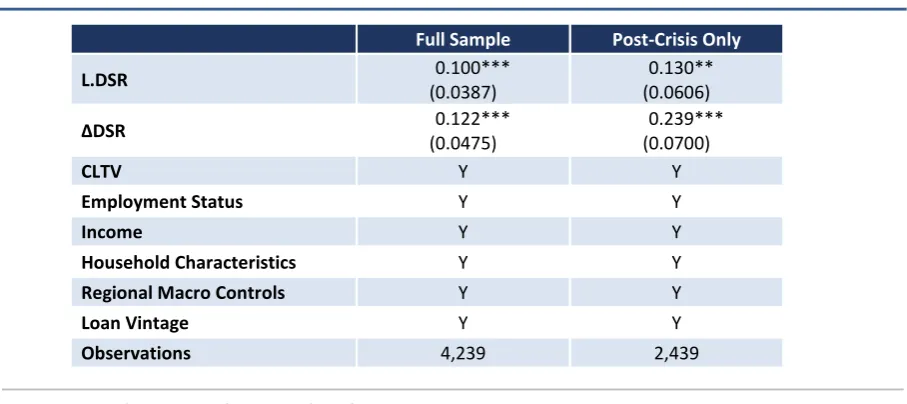
[image:13.595.71.525.361.563.2]Table 1 shows the importance of both the lagged level of the DSR capturing repayment capacity and the change in the DSR capturing payment and income changes as determinants of households falling into mortgage arrears. It also demonstrates that the parameters on these two key determinants of mortgage arrears have changed over time. We therefore focus on the post-crisis period 2010-2016 only in the following scenario analysis to ensure that the parameters provide the most accurate predictions.
TABLE 1 EMPIRICAL MODEL ESTIMATES
Full Sample Post-Crisis Only
L.DSR 0.100***
(0.0387)
0.130** (0.0606)
ΔDSR 0.122***
(0.0475)
0.239*** (0.0700)
CLTV Y Y
Employment Status Y Y
Income Y Y
Household Characteristics Y Y
Regional Macro Controls Y Y
Loan Vintage Y Y
Observations 4,239 2,439
Source: ESRI and Department of Finance analysis of EU-SILC.
Notes: Household characteristics include; age, marital status, education, household composition and NUTS3 region. Full sample refers to 2004-2016, while post-crisis sample refers to 2010-2016.
3.2
Scenario analysis
across all households in each year and compare to the mean baseline figure to quantify the increase in the average predicted probability of falling into arrears.
Given the uncertainty over the likely magnitude of future policy rate rises, we examine the impact of a range of interest rate shocks from a small 25 to a larger 100 basis point rise. In a speech to the ECB Forum on Central Banking in June 2018, Mario Draghi stated that the ECB ‘will remain patient in determining the timing of the first rate rise and will take a gradual approach to adjusting policy thereafter’. We therefore begin with a 25 basis point shock. As our model is annual and looks at the one-year impacts of an interest rate rise, it is plausible that we could see a number of smaller quarterly rises totalling a larger annual increase such as 50 or 100 basis points. At the more severe end of the scale, the 2018 EBA banking stress test adverse scenario for the Irish long-term rate has an increase of 150 basis points; while McCann (2017) implements a 200 basis point shock on tracker loans in work using loan-level data. From the perspective of our static one-year model, we feel that increases of these magnitudes are not realistic within a calendar year and instead undertake three shocks 25, 50 and 100 basis points.
FIGURE 4 DEVIATIONS FROM BASELINE PREDICTED PROBABILITY OF ARREARS UNDER INTEREST RATE SHOCK
Source: ESRI and Department of Finance analysis of EU-SILC.
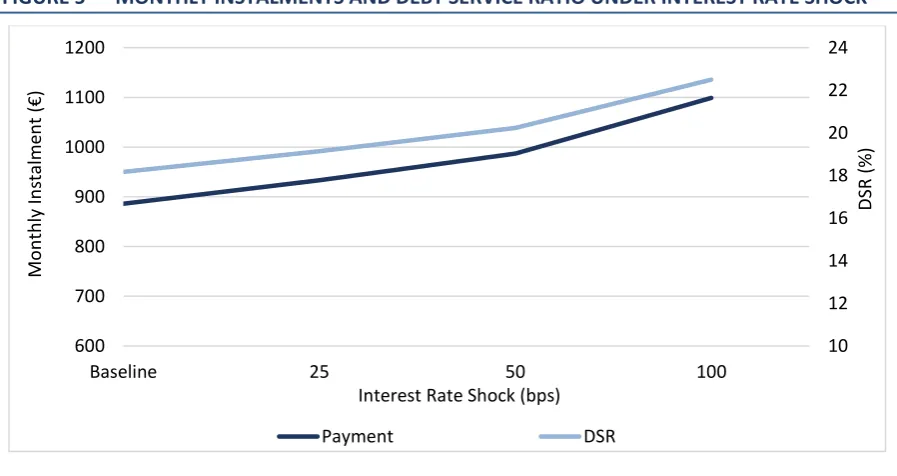
Looking more closely at the mechanism through which this occurs, Figure 5 illustrates how both monthly mortgage instalments and the debt service ratio increase in the event of an interest rate shock. A 50 basis point rise increases the mean payment by €100 per month and increases the DSR from 18.2 to 20.2 per cent.
FIGURE 5 MONTHLY INSTALMENTS AND DEBT SERVICE RATIO UNDER INTEREST RATE SHOCK
Source: ESRI and Department of Finance analysis of EU-SILC.
0 0.1 0.2 0.3 0.4 0.5 0.6 0.7 0.8 0.9 1
2014 2015 2016
Cha
n
ge
in
Arr
ear
s
(PP)
25bps 50bps 100bps
10 12 14 16 18 20 22 24
600 700 800 900 1000 1100 1200
Baseline 25 50 100
DSR
(%
)
Mo
n
th
ly
In
sta
lm
en
t
(€)
Interest Rate Shock (bps)
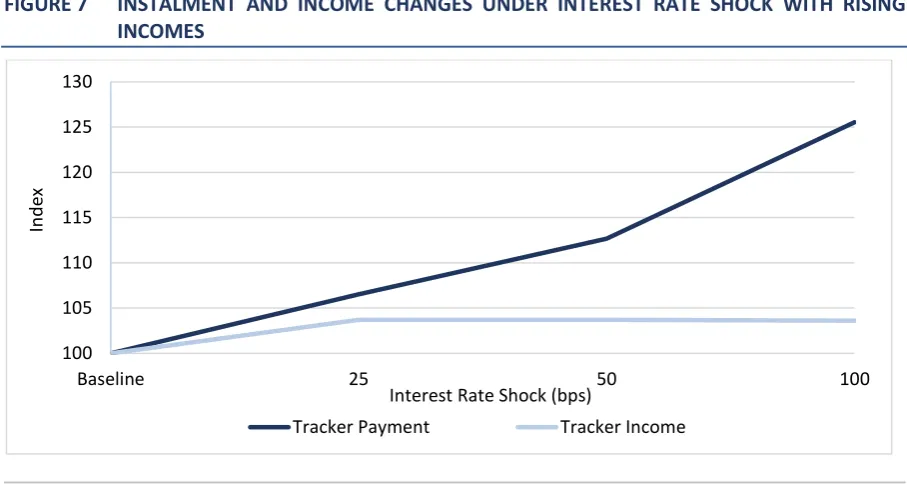
[image:15.595.70.524.81.336.2] [image:15.595.71.520.492.730.2]Given the recent rapid growth of the Irish economy, it is useful to explore whether an increase in household income could offset any of the increase in the arrears rate caused by an increase in the policy rate. To address this issue, Slaymaker et al. (2019) raise all household incomes by the long-run average growth rate in the economy, adjusted for the sensitivity of income to the higher policy rate using COSMO, the Core Structural Model of the Irish Economy (see Bergin et al., 2017). Figure 6 shows that the increase in the arrears rate is lower in the scenario with rising incomes as households have more buffers to withstand shocks. However, rising incomes do not fully offset the rise in repayments due to increases in the policy rate. This is due to the non-linear nature of mortgage interest rate increases.9 This non-linearity is clearer in relation to tracker borrowers as illustrated in Figure 7 as these mortgage holders are more exposed to interest rate rises (through a greater pass-through of monetary policy).
FIGURE 6 EFFECTS OF INTEREST RATE SHOCK ON MORTGAGE ARREARS UNDER RISING INCOMES
Source: ESRI and Department of Finance analysis of EU-SILC.
9 See McQuinn and O’Reilly (2008) for more on the sensitivity of mortgage repayments due to the non-linear
combination of income levels and interest rates.
1 2 3 4
Baseline 25 50 100
Predicted
Pro
b
ab
ili
ty
o
f Arr
ear
s
Flow
s
(%
)
Interest Rate Shock (bps)
[image:16.595.72.521.312.549.2]FIGURE 7 INSTALMENT AND INCOME CHANGES UNDER INTEREST RATE SHOCK WITH RISING INCOMES
Source: ESRI and Department of Finance analysis of EU-SILC.
It should be noted that raising incomes for all households is only one channel through which risks would be mitigated. Often households that go into arrears would suffer catastrophic economic circumstances such as unemployment, which would lead to a much larger change in incomes than the standard annual rise posited here. Therefore in a growing economy, as employment increases, this would naturally increase income more than the standard factor increased here. As the unemployment rate has declined rapidly in Ireland in recent years, it is likely that further employment growth would help boost households’ ability to manage their mortgage payments and also lead to a smaller increase in the arrears rate than the simple exercise that we calculate here. More generally it is important to note that the most recent data we are able to use for this analysis are for 2016. As the economy has continued to improve into 2017 and 2018, accompanied by a falling arrears rate, it is likely that Irish households would in fact currently be better placed to absorb an interest rate rise. The results from this analysis can therefore be thought of as an upper bound of the likely true effect.
Another channel which may help to moderate the increase in cases of arrears in a growing economy is rising house prices. One of the key features of the mortgage arrears crisis in Ireland was the extent to which short-term arrears cases transitioned into longer-term arrears due to many of these households being in negative equity, leaving them with little option but to remain in their property and fall deeper into arrears. As house prices have rebounded strongly in recent years, this naturally lowers the impact of negative equity on arrears and may lower the increase in arrears due to a policy rate rise.
100 105 110 115 120 125 130
Baseline 25 50 100
In
d
ex
Interest Rate Shock (bps)
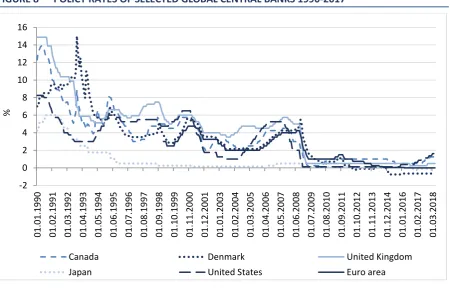
[image:17.595.70.524.77.323.2]In the scenario analysis presented here we deploy a range of interest rate increases from 25 to 100 basis points and test the impact on the likelihood of arrears over a one-year horizon. However, at this juncture, it is informative to reflect on what might the path of normalisation look like when the ECB does begin to raise the policy rate. In this context it is useful to consider how other Central Banks have historically changed rates as an indicator of the ECB’s path. Figure 8 presents the policy rates of selected global Central Banks including the ECB, US Federal Reserve and Bank of England. It can be seen that policy rates are at a historic low since the aggressive loosening following the financial crisis. The Federal Reserve and Bank of Canada have begun a policy of unwinding low rates on the back of stronger economic fundamentals and rising prices in these economies. Both the Federal Reserve and the Bank of Canada undertook between 25 basis points and 75 basis points increases per annum from 2015-2018. If the ECB was to follow a similar policy it would mean the annual increases of between 25 and 50 basis points are more likely in the short run.
FIGURE 8 POLICY RATES OF SELECTED GLOBAL CENTRAL BANKS 1990-2017
Source: ESRI and Department of Finance analysis of EU-SILC.
However, historically, the ECB has acted aggressively, with a 125 basis points rise in the year between Q1 2006 and Q1 2007. Going forward, how they react will depend on the strength of inflation in the Eurozone economy and, ultimately, the magnitude of the European economic recovery. However, on balance, it is unlikely that any more than a 100 basis points rise within a calendar year would be undertaken without a significant increase in price levels. In this context, our 100 -2 0 2 4 6 8 10 12 14 16 01 .01.19 90 01 .02.19 91 01 .03 .19 92 01 .04.19 93 01 .05.19 94 01 .06.19 95 01 .07.19 96 01 .08.19 97 01 .09.19 98 01 .10.19 99 01 .11.20 00 01 .12.20 01 01 .01.20 03 01 .02.20 04 01 .03.20 05 01 .04.20 06 01 .05.20 07 01 .06.20 08 01 .07.20 09 01 .08.20 10 01 .09.20 11 01 .10.20 12 01 .11.20 13 01 .12.20 14 01 .01.20 16 01 .02 .20 17 01 .03.20 18 %
Canada Denmark United Kingdom
[image:18.595.75.526.350.643.2]basis points shock is, arguably, the largest increase that would occur within a calendar year in a recovering European economy.
Another point is noteworthy. The research works on a ceteris paribus basis holding all other factors constant. Households could, as an alternative, approach the bank for a temporary restructure to avoid a technical default and we do not take this into account. The household may also be able to delve into savings or other wealth to avoid payment and we cannot model this.
4.
ARE PARTICULAR GROUPS MORE EXPOSED?
In this section we explore the impact of interest rate rises on the flow of households falling into arrears for particular groups of Irish households. To do this we calculate the predicted probabilities of falling into arrears for a 50 basis point shock by interest rate type, loan vintage, household age and disposable income.
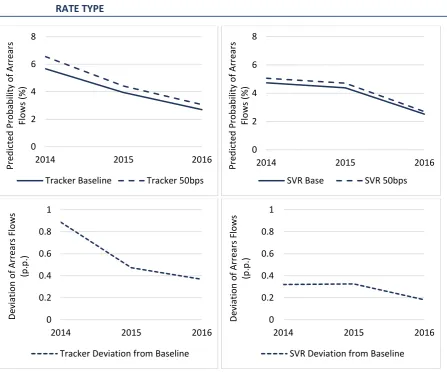
Figure 9 presents the predicted probability of new arrears flows for households with tracker and SVR mortgage rates (top two panels), and the corresponding percentage point difference between the initial baseline and 50 basis point interest rate shock scenario (bottom two panels). It must be noted that while the SILC survey gives a good representation of the mortgage market in general, it may under- or over-represent the sample for each specific rate type as the survey does not stratify by these criteria. These results must be interpreted with this caveat.
FIGURE 9 PREDICTED PROBABILITY OF ARREARS FLOWS UNDER 50BPS INTEREST RATE SHOCK BY RATE TYPE
Source: ESRI and Department of Finance analysis of EU-SILC.
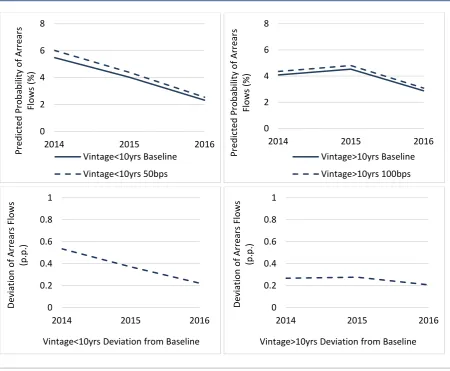
Figure 10 examines the differing impacts of a policy rate rise by loan vintage, defined as years since mortgage origination. In 2016 younger vintage loans (less than ten years) actually have a lower probability of falling into arrears. However, these households are generally slightly more vulnerable to an increase in the policy rate compared to those with older vintage loans. Drawing any firm conclusions looking at the effects across loan vintage is complicated due to the number of loans issued under loose credit conditions in the early to mid-2000s.
Another potentially vulnerable group of households are younger mortgage holders at the beginning of their income life cycle. In Figure 11 we show that not only do younger households (aged less than 35 years) have a higher likelihood of falling into arrears, they also face a larger increase in their probability of falling into arrears as a result of an interest rate shock.
Finally, turning to income, Figure 12 illustrates that households outside the top quartile of the income distribution have a higher likelihood of falling into arrears, 0
2 4 6 8
2014 2015 2016
Predicted Pro b ab ili ty o f Arr ear s Flow s (% )
Tracker Baseline Tracker 50bps
0 2 4 6 8
2014 2015 2016
Predicted Pro b ab ili ty o f Arr ear s Flow s (% )
SVR Base SVR 50bps
0 0.2 0.4 0.6 0.8 1
2014 2015 2016
De viat ion o f Arr ear s Flow s (p .p .)
Tracker Deviation from Baseline
0 0.2 0.4 0.6 0.8 1
2014 2015 2016
De viat ion o f Arr ear s Flow s (p .p .)
[image:20.595.73.521.84.465.2]and they also face a larger increase in their probability of falling into arrears as a result of an interest rate shock.
FIGURE 10 PREDICTED PROBABILITY OF ARREARS FLOWS UNDER 50BPS INTEREST RATE SHOCK BY LOAN VINTAGE
Source: ESRI and Department of Finance analysis of EU-SILC.
0 2 4 6 8
2014 2015 2016
Predicted Pro b ab ili ty o f Arr ear s Flow s (% ) Vintage<10yrs Baseline Vintage<10yrs 50bps 0 2 4 6 8
2014 2015 2016
Predicted Pro b ab ili ty o f Arr ear s Flow s (% ) Vintage>10yrs Baseline Vintage>10yrs 100bps 0 0.2 0.4 0.6 0.8 1
2014 2015 2016
De viat ion o f Arr ear s Flow s (p .p .)
Vintage<10yrs Deviation from Baseline
0 0.2 0.4 0.6 0.8 1
2014 2015 2016
De viat ion o f Arr ear s Flow s (p .p .)
FIGURE 11 PREDICTED PROBABILITY OF ARREARS FLOWS UNDER 50BPS INTEREST RATE SHOCK BY AGE
Source: ESRI and Department of Finance analysis of EU-SILC.
0 2 4 6 8 10
2014 2015 2016
Predicted Pro b ab ili ty o f Arr ear s Flow s (% )
Aged 18-35 Base Aged 18-35 50bps
0 2 4 6 8 10
2014 2015 2016
Predicted Pro b ab ili ty o f Arr ear s Flow s (% )
Aged >35 Baseline Aged >35 50bps
0 0.2 0.4 0.6 0.8 1
2014 2015 2016
De viat ion o f Arr ear s Flow s (p .p .)
Aged 18-35 Deviation from Baseline
0 0.2 0.4 0.6 0.8 1
2014 2015 2016
De viat ion o f Arr ear s Flow s (p .p .)
FIGURE 12 PREDICTED PROBABILITY OF ARREARS FLOWS UNDER 50BPS INTEREST RATE SHOCK BY INCOME
Source: ESRI and Department of Finance analysis of EU-SILC.
5.
CONCLUSIONS AND POLICY IMPLICATIONS
A number of policy implications arise from our research. The current level of the monetary policy rate in the Eurozone is low both by international and historical standards and will inevitably rise over the coming years. It is clear that interest rate normalisation poses a risk to many Irish households given high levels of indebtedness and the variable nature of interest rate contracts; an economy with a high share of variable rate contracts is particularly exposed to considerable interest rate risk (Leece, 2000). Our findings show that any increase in the policy rate would be somewhat offset by expected household income growth. The improved economic circumstances in Ireland in the past couple of years, in particular the fall in unemployment and recovery in house prices, does leave households in a better position to manage any increase in interest rates.
The results point to specific households being more vulnerable to any interest rate rises. We find that tracker borrowers, who have a contractual pass-through from the policy rate to the lending rate, will inevitably face higher repayments. As the rates for these borrowers are still well below those for other contract types (fixed
0 2 4 6 8 10
2014 2015 2016
Predicted Pro b ab ili ty o f Arr ear s Flow s (% )
Income Q1-3 Baseline Income Q1-3 50bps
0 2 4 6 8 10
2014 2015 2016
Predicted Pro b ab ili ty o f Arr ear s Flow s (% )
Income Q4 Baseline Income Q4 50bps
0 0.2 0.4 0.6 0.8 1
2014 2015 2016
De viat ion o f Arr ear s Flow s (p .p .)
Income Q1-3 Deviation from Baseline
0 0.2 0.4 0.6 0.8 1
2014 2015 2016
De viat ion o f Arr ear s Flow s (p .p .)
or variable), it would require a steep rise in rates to make it beneficial for these households to switch rate type or to fix. Therefore until such time as tracker rates move towards fixed rates, fixation would not be optimal for these borrowers. For such households, if they have spare financial resources, steps to redeem part of the balance through increased payments would help to reduce indebtedness. However, this will not be possible for households without sufficient resources.
We also find that younger, lower income households who are earlier into their mortgage contract are more at risk. Given the expected upward path of interest rates, encouraging such households to contract longer-term fixed interest rates would ensure these borrowers would be protected from future rate volatility. At present, only two banks offer fixed-rate mortgage products of ten years, and no provider offers fixed rates for the duration of the term (as would be standard in many other countries). From a market structure policy perspective, steps to move towards the introduction of longer-term fixed rate loans in the Irish market would be advantageous for two reasons.10
From a household demand perspective, the option to fix for longer-term horizons would allow them to balance repayment risks with other factors such as income volatility. The use of longer-term fixed rate mortgage loans in the Irish market could also benefit households, by increasing transparency and stability for borrowers (CCPC, 2017). However, it is important to note that while in the short to medium term, rate fixation may be desirable for certain households given the expected upward path of interest rates, long-term fixed rates do remove flexibility and the ability of a borrower to potentially benefit from any fall in interest rates during an economic downturn. It has been well established that factors such as financial literacy, risk preference and interest rate expectations all feed into households’ choice of mortgage contract (Devine et al., mimeo). Information, increased awareness of the different loan options available in the market, and educational programmes that improve households’ understanding of complex choices would likely lead to a more optimal choice of interest rates.
From the supply-side perspective of the financial sector, mortgage providers themselves would benefit from offering longer-term fixed rates if it reduced the likelihood of default and allowed financial institutions to better match the cost of liabilities with the return on assets.
For some households who are exposed to interest rate increases, fixing may not be possible either due to financial circumstances or the fact that they continue to hold
10 Similar conclusions for the UK market are presented in the Miles (2004) report. The Rebuilding Ireland Home Loan
tracker rates which are lower than the current market-provided fixed rate options. In these circumstances, providing sufficient and timely information to households of the likely changes to payments when rates rise would be useful and allow them to plan accordingly.
REFERENCES
Bergin, A., N. Conroy, A. Garcia Rodriguez, D. Holland, N. McInerney, E. Morgenroth and D. Smith (2017). ‘COSMO: A new Core Structural Model for Ireland’, ESRI Working
Paper No. 553.
Byrne, D., R. Kelly and C. O’Toole (2017). ‘How does monetary policy pass through affect mortgage default? Evidence from the Irish mortgage market’, Research Technical
Papers No. 04/RT/17, Central Bank of Ireland.
Central Bank of Ireland (2018). ‘Mortgage Arrears Official Statistics’. Central Bank of Ireland.
Competition and Consumer Protection Commission (CCPC) (2017). ‘Options for Ireland’s
Mortgage Market’.
www.ccpc.ie/business/wp-content/uploads/sites/3/2017/06/CCPC-Mortgages-Options-Paper.pdf.
Devine, K., Y. McCarthy and C. O’Toole (mimeo). ‘Mortgage Choice and Expectations’. Central Bank of Ireland.
Donnery, S., T. Fitzpatrick, D. Greaney, F. McCann and M. O’Keeffe (2018). ‘Resolving Non-Performing Loans in Ireland: 2010-2018’, Central Bank of Ireland Quarterly
Bulletin.
Fahy, M., C. O’Toole and R. Slaymaker (2018). ‘The Financial Crisis and the Changing Profile of Mortgage Arrears in Ireland’, Research Note, Quarterly Economic
Commentary, Winter 2018. ESRI: Dublin.
Gerlach, S. (2013). ‘Monetary Policy after the Crisis’, Manchester School, 81(S1), pp.16-34.
Goggin, J., S. Holton, J. Kelly, R. Lydon and K. McQuinn (2012). ‘The financial crisis and the pricing of interest rate in the Irish mortgage market: 2003-2011’, Research
Technical Papers No. 01/RT/12, Central Bank of Ireland.
Hofmann, B. and P. Mizen (2004). ‘Interest Rate Pass‐Through and Monetary Transmission: Evidence from Individual Financial Institutions’ Retail Rates’, Economica, 71(281), pp.99-123.
Illes, A., M. Lombardi and P. Mizen (2015). ‘Why Did Bank Lending Rates Diverge from Policy Rates After the Financial Crisis?’, Centre for Finance, Credit and
Macroeconomics (CFCM) Discussion Paper No. 2015/05, University of
Nottingham.
Karagiannis, S., Y. Panagopoulos and P. Vlamis (2010). ‘Interest rate pass-through in Europe and the US: Monetary policy after the financial crisis’, Journal of Policy
Modeling, 32(3), pp.323-338.
Kelly, R., P. Lyons and C. O’Toole (2015). ‘Mortgage Interest Rate Types in Ireland’,
Economic Letters No. 09/EL/15, Central Bank of Ireland.
Leece, D. (2000). ‘Household Choice of Fixed Versus Floating Rate Debt: A Binomial Probit Model With Correction For Classification Error’, Oxford Bulletin of Economics and
Statistics, 62, pp. 61-82.
Lydon, R. and F. McCann (2017). ‘The income distribution and the Irish mortgage market’,
McCann, F. (2017). ‘Resolving a Non-Performing Loan crisis: The ongoing case of the Irish mortgage market’, Research Technical Papers No. 10/RT/17, Central Bank of Ireland.
McCarthy, Y. and K. McQuinn (2017). ‘Credit conditions in a boom and bust property market: Insights for macro-prudential policy’, The Quarterly Review of Economics
and Finance, 64(C), pp. 171-182.
McQuinn, K. and C. Morley (2015). ‘Standard Variable Rate Pass-Through in the Irish Mortgage Market: An Updated Assessment’, Quarterly Economic Commentary, Summer, 2015. ESRI: Dublin.
McQuinn, K. and G. O'Reilly (2008). ‘Assessing the role of income and interest rates in determining house prices’, Economic Modelling, 25(3), pp.377-390.
Sibley, E. (2018). ‘The Irish Mortgage Market - 2018 and beyond’. Remarks delivered to the Institute of Banking Breakfast briefing, ‘The Irish Mortgage Market - past, present and future’, Dublin.