Copyright © 1999, American Society for Microbiology. All Rights Reserved.
The Epstein-Barr Virus BZLF1 Protein Interacts Physically and
Functionally with the Histone Acetylase CREB-Binding Protein
AMY L. ADAMSON
1ANDSHANNON KENNEY
1,2*
Lineberger Comprehensive Cancer Center
1and Department of Medicine and Department of Microbiology,
2University of North Carolina at Chapel Hill, Chapel Hill, North Carolina 27599-7295
Received 14 December 1998/Accepted 30 April 1999
The Epstein-Barr virus (EBV) immediate-early protein BZLF1 (Z) is a key regulator of the EBV
latent-to-lytic switch. Z is a transcriptional activator which induces EBV early gene expression. We demonstrate here
that Z interacts with CREB-binding protein (CBP), a histone acetylase and transcriptional coactivator. This
interaction requires the amino-terminal region of CBP as well as the transactivation and leucine zipper
domains of Z. We show that CBP enhances Z-mediated transactivation of EBV early promoters, in reporter
gene assays and in the context of the endogenous genome. We also demonstrate that Z decreases CREB
transactivation function and that this inhibitory effect is reversed by overexpression of CBP. We show that Z
also interacts directly with CREB. However, mutational analysis indicates that Z inhibition of CREB activity
requires the direct interaction between Z and CBP but not the direct interaction between Z and CREB. We
propose that Z interacts with CBP to enhance viral early gene transcription. In addition, the Z-CBP interaction
may control host cellular transcription factor activity through competition for limiting amounts of cellular CBP.
Epstein-Barr virus (EBV) is a human herpesvirus that has
infected a large majority of the world’s population. EBV is
responsible for the onset of infectious mononucleosis and has
been found in association with a number of cancers, including
Burkitt’s lymphoma and nasopharyngeal carcinoma (52, 68).
EBV infects primarily two cell types: epithelial cells, where it
exists in a lytic state, and B cells, where it persists in a latent
state (33, 41, 52, 57). Periodically, the virus of a latently
in-fected B cell can undergo lytic replication. This disruption of
latency is characterized by a cascade of viral gene expression:
immediate-early gene expression, followed by early gene
ex-pression, and then late gene expression (33).
The immediate-early gene BZLF1 encodes a transcriptional
activator, Z, that plays a key role in the disruption of EBV viral
latency (8, 11, 60). Z transcriptionally activates its target genes
by binding to Z-responsive elements (ZREs) which are similar
to AP1 sites and are present in many of the EBV early gene
promoters (7, 16, 42, 51, 54), as well as in the promoters of the
two immediate-early genes, BZLF1 and BRLF1 (21, 49). Z is
also required for lytic replication of the virus and binds to the
origin of lytic replication, oriLyt (7, 17, 18, 54).
Z is a 245-amino-acid protein that contains specific domains
for transactivation, DNA binding, and protein-protein
dimer-ization (20, 36, 49). Z is a member of the bZIP family of
proteins and shares homology within the DNA-binding domain
to the c-Fos and c-Jun proteins (7, 16, 21). The Z protein has
been shown to interact with its cellular environment by
asso-ciating with a number of cellular proteins. Our laboratory has
shown that Z can interact directly with p53 and the NF-
B
subunit p65 (27, 67). It is likely that Z alters the functions of
these proteins in order to promote viral replication.
CREB-binding protein (CBP) is a transcriptional regulator
by virtue of its histone acetylase activity (5). The association of
histones and DNA becomes weakened by histone acetylation,
leading to altered nucleosomal conformation and stability (48).
This chromatin alteration may then facilitate transcription by
the transcriptional machinery (39, 63). CBP and the highly
homologous protein p300 have been shown to interact with
several cellular proteins, including p53, p65, c-Jun, c-Myb,
Ets-1, and NFAT1, as well as viral proteins such as adenovirus
E1A, simian virus 40 (SV40) T antigen, cytomegalovirus
(CMV) IE2, herpes simplex virus VP16, and human
immuno-deficiency virus type 1 Tat (4, 12–14, 23, 24, 28, 43, 55, 56, 62,
65).
Since Z is a potent transcriptional activator, it may target
histone acetylase activity to the early viral promoters, either by
interacting with CBP directly or by possessing an intrinsic
hi-stone acetylase activity. Here we demonstrate that Z and CBP
physically interact both in vivo and in vitro. We have mapped
the regions of this interaction, for both Z and CBP, and show
that Z and CBP interact in a functional manner to activate
EBV early gene expression. We have also discovered that Z
inhibits the transcriptional activation function of the
transcrip-tion factor CREB. We propose that Z may inhibit CREB
function by competing for limiting amounts of CBP.
MATERIALS AND METHODS
Cell lines.DG75, an EBV-negative Burkitt’s lymphoma cell line, was main-tained in RPMI 1640 medium supplemented with 10% fetal calf serum. HeLa is a cervical carcinoma cell line; D98/HE-R-1 is an EBV-positive epithelial cell line formed by the fusion of a HeLa subclone (D98) with the EBV-positive Burkitt’s lymphoma cell line P3HR/1. Epithelial cell lines were maintained in Dulbecco’s modified Eagle’s medium H supplemented with 10% fetal calf serum.
Adenovirus construction and infection.The BZLF1 cDNA was cloned into a shuttle vector (under the control of the CMV promoter) which contains a Lox P site, the left adenovirus terminal repeat, and a packaging signal. This vector was recombined (in a cell line expressing the phage P1 Cre protein) into the Lox P site of an adenovirus lacking the E1 and E3 genes, as well as lacking a packaging sequence, to create adenovirus-Z. A control vector containing thelacZgene (adenovirus-LacZ) was made in the same manner.
HeLa cells were plated at a cell density of 3⫻106cells per 150-mm-diameter plate. Cells were infected with no adenovirus (mock), adenovirus-LacZ, or ad-enovirus-Z at a multiplicity of infection of 50. The cells were harvested 24 h postinfection.
Plasmids.EApBS-CAT contains the early EBV BMRF1 promoter sequences from⫺331 to⫹1 linked to the chloramphenicol acetyltransferase (CAT) gene (51). BHRF1-CAT contains a 1,020-bp NaeI-HincII fragment of the early BHRF1 promoter (EBV positions 52800 to 53819) (27). GAL4-E1B-CAT (gift of Michael Green) contains five copies of the GAL4 DNA-binding site upstream
* Corresponding author. Mailing address: Lineberger
Comprehen-sive Cancer Center, University of North Carolina at Chapel Hill,
Chapel Hill, NC 27599-7295. Phone: (919) 1248. Fax: (919)
966-8212. E-mail: [email protected].
6551
on November 9, 2019 by guest
http://jvi.asm.org/
of the E1B minimal TATA element and the CAT gene (44). GAL4-CREB (gift of Michael Green) contains the GAL4 DNA-binding domain fused to the CREB cDNA in the SG424 vector (53). Zp-CRE-CAT contains three copies of the CRE site from the Z promoter (TGACATCA) fused to the E1B minimal TATA element and the CAT gene.
The Z expression vector contains the BZLF1 cDNA, downstream of the CMV immediate-early promoter, in the pHD1013 vector (51). The ZE2ter expression vector has a deletion of the Z carboxy-terminal amino acids 228 to 245, down-stream of the SV40 immediate-early promoter, in the pKSV vector (gift of Alain Sergeant). The Z311 expression vector contains a mutation in the DNA-binding domain of Z in which amino acid 185 is altered (abolishing DNA binding), downstream of the CMV immediate-early promoter, in the pHD1013 vector (25, 31). Z-CT (previously referred to as RAZ⌬R), contains amino acids 2 to 86 deleted (gift of Joseph Pagano) (22). Z⌬200 contains a mutation of amino acid 200 of Z from tyrosine to glutamic acid, downstream of the CMV immediate-early promoter, in the pHD1013 vector. The CBP expression vector contains the CBP cDNA, downstream of the CMV immediate-early promoter (gift of Michael Rosenfeld) (29). CBP-HAT(⫺) contains mutations of amino acids 1689 and 1690 of CBP from leucine-cysteine to lysine-leucine, downstream of the CMV imme-diate-early promoter (gift of Jenny Ting). The CREB expression vector contains the CREB gene, downstream of the Rous sarcoma virus promoter (gift of Michael Green; from Marc Montminy). The protein kinase A (PKA) expression vector contains the gene for the catalytic subunit of PKA, downstream of the mouse metallothionein 1 promoter (gift of Michael Green; from Stanley Mc-Knight).
The Z cDNA plasmid contains the BZLF1 cDNA in the pSP64 (Promega) vector (a gift from Paul Farrell) (16). The Z cDNA was also inserted into the pBluescript (pBS; Stratagene) vector so that it could be cut withHincII to make a carboxy-terminal truncation of Z (referred to as Z⌬ter). Z⌬LZ (from Alain Sergeant) was cut out of the pKSV vector withEcoRI and cloned into pBS. Z-NT contains amino acids 1 to 140 of Z. Z-CT is RAZ⌬R in the pBS vector (22). Z⌬200 contains a mutation at amino acid 200 of tyrosine to glutamic acid, in the pSP64 vector. Z⌬214/218 contains mutations at amino acids 214 and 218 (both leucine to serine), in the pSP64 vector.
pGEX-3X-Z contains the Z cDNA fused in frame to the glutathione S-transferase (GST) gene in the pGEX-3X (Pharmacia) vector (51). CBP was subcloned as five pieces into the pGEX vector (fragments 1 to 721, 706 to 1009, 1069 to 1459, 1459 to 1891, and 1892 to 2441) (gifts of Michael Rosenfeld) (29). pGEX-CREB contains the CREB cDNA fused in frame to GST in the pGEX1 vector (gift of Michael Green). pGEX-3X was used as the control vector.
DNA purification.Plasmid DNA was purified through Qiagen columns as described by the manufacturer.
DNA transfection.DNA (5 to 10g) was transfected into cells by electropo-ration with a Zapper electropoelectropo-ration unit (Medical Electronics Shop, University of Wisconsin) at 1,500 V as described elsewhere (61). All cells were resuspended in RPMI 1640 medium prior to electroporation.
CAT assays.Cell extracts were prepared 48 h posttransfection and incubated at 37°C with [14C]chloramphenicol in the presence of acetyl coenzyme A as described elsewhere (26). The percent acetylation of chloramphenicol was quan-titated by thin-layer chromatography followed by PhosphorImager screening (Molecular Dynamics).
Immunoblot analysis.Immunoblot analysis was performed for the detection of the Z, retinoblastoma (Rb), BMRF1 (early-antigen diffuse; EAD), and CREB proteins as follows. Briefly, 10 to 100g of protein was loaded in each lane, and sodium dodecyl sulfate (SDS)-polyacrylamide gel electrophoresis (PAGE) was performed. The proteins were transferred overnight onto nitrocellulose (Prot-ran), blocked in 1⫻phosphate-buffered saline (PBS)–5% milk–0.1% Tween 20, and incubated in primary antibody for 1 h at room temperature (BZ1 [1:40; from Alan Rickinson] [66]; anti-Rb [1:400; PharMingen]; anti-EBV [EAD; 1:100; Capricorn] anti-CREB [1:500; Santa Cruz Biotechnology]). The membrane was washed in PBS–0.1% Tween 20, incubated in secondary antibody for 1 h at room temperature (goat anti-mouse kappa-horseradish peroxidase [1:2,000; Southern Biotechnology]; goat anti-rabbit conjugated to horseradish peroxidase [1:10,000; Promega]) and washed, and the results were visualized with an ECL (enhanced chemiluminescence) kit (Amersham) according to the manufacturer’s instruc-tions.
Z protein expression.The Z cDNA plasmid in SP64 was linearized withEcoRI and transcribed with SP6 polymerase, using a Riboprobe System II kit from Promega. The resulting RNA was translated in the presence of [35S]methionine, using the rabbit reticulocyte lysate system (Promega). The Z cDNA plasmid in SP64 was also cut withNheI to make Z-NT. The Z cDNA in pBS was cut with HincII and prepared as described above to yield a carboxy-terminal deletion of Z. Z⌬LZ was transcribed uncut, while Z-CT was cut withSalI and prepared as for Z. Z⌬200 and Z⌬214/218 were both linearized withEcoRI and transcribed with SP6. Protein quantities were normalized by running aliquots of each protein on an SDS-polyacrylamide gel, followed by autoradiography.
GST, GST-Z, GST-CREB, and GST-CBP proteins were induced, sonicated, and centrifuged. Protein quantities were normalized by affinity purifying aliquots of the proteins, followed by SDS-PAGE and Coomassie staining.
Immunoprecipitation.HeLa cells were infected with no adenovirus (mock), adenovirus-LacZ, or adenovirus-Z. Cells were harvested after 24 h and resus-pended in buffer 7 (20 mM HEPES [pH 7.7], 25 mM NaCl, 2.5 mM MgCl2, 0.1
mM EDTA, 1 mM dithiothreitol, 0.05% Nonidet P-40, protease inhibitors), sonicated, and centrifuged. Anti-CBP antibody (Santa Cruz), CREB anti-body (Santa Cruz), or rabbit serum (Sigma) was added to 10 to 100g of protein and incubated for 1 h at 4°C. The reaction mixtures were then incubated with protein A-Sepharose beads for 1 h at 4°C. The beads were washed three times with buffer 7 and loaded onto an SDS-polyacrylamide gel. Ten micrograms of crude extract was loaded onto the gel for a control. Immunoblot analysis was performed with either an anti-Z antibody or an anti-CREB antibody.
Affinity chromatography.The GST fusion proteins were incubated with glu-tathione-agarose beads for 10 min at room temperature. The beads were washed three times with PBS, resuspended in buffer 7 or buffer CBP (25 mM HEPES [pH 7.3], 100 mM sodium chloride, 5 mM magnesium chloride, 100 mM EDTA, 0.2 mg of bovine serum albumin per ml, 0.1% Tween 20, protease inhibitors), and incubated with 2.5 to 10 l of in vitro-translated protein for 1 h at room temperature. The beads were washed five to six times with buffer and loaded onto an SDS-polyacrylamide gel. After electrophoresis, the gel was fixed in 50% methanol plus 10% acetic acid, enhanced in 1 M sodium salicylate, and exposed to X-ray film.
RESULTS
[image:2.612.343.519.69.295.2]Z interacts with CBP in vivo.
Since several transcriptional
activators have recently been shown to interact with CBP
and/or p300 to facilitate the opening of chromatin, we
inves-tigated whether Z, a transcriptional activator of the EBV early
genes, can physically interact with CBP. CBP was
immunopre-cipitated from extracts of HeLa cells that had been mock
infected, infected with a replication-deficient adenovirus
ex-pressing the
lacZ
gene (as a control), or infected with a
repli-cation-deficient adenovirus expressing the Z gene. Following
the CBP immunoprecipitation, we performed immunoblot
analysis with an anti-Z antibody (Fig. 1A). The results clearly
demonstrate that the anti-CBP antibody
coimmunoprecipi-tates Z from the adenovirus-Z-infected extract. A control
an-tibody (rabbit serum) did not coimmunoprecipitate Z.
There-fore, Z and CBP physically interact in vivo. As a negative
FIG. 1. Z and CBP associate in vivo. (A) Anti-CBP antibody and a control antibody (Ab.) (rabbit serum) were used to coimmunoprecipitate Z from mock-, adenovirus-LacZ-, or adenovirus-Z-infected HeLa cell extracts (100g) (lanes 1 to 6). Direct loads (10g) of each extract were used to confirm the presence of Z (lanes 7 to 9). Western blot analysis was performed with an anti-Z antibody. (B) Anti-CBP antibody and a control antibody (rabbit serum) were used to coimmunoprecipitate Rb from adenovirus-LacZ- or adenovirus-Z-infected HeLa cell extracts (100g) (lanes 1 to 4). Direct loads (20g) of each extract were used to confirm the presence of Rb (lanes 5 and 6). Western blot analysis was performed with an anti-Rb antibody.6552
ADAMSON AND KENNEY
J. V
IROL.
on November 9, 2019 by guest
http://jvi.asm.org/
control, we attempted to coimmunoprecipitate the Rb protein
from the same extracts (Fig. 1B). Rb has been shown to
inter-act with histone deacetylase inter-activity (5a), and therefore we
speculated that it would not interact with CBP. We did not
coimmunoprecipitate CBP and Rb, demonstrating that our
procedure does not allow for nonspecific
coimmunoprecipita-tions.
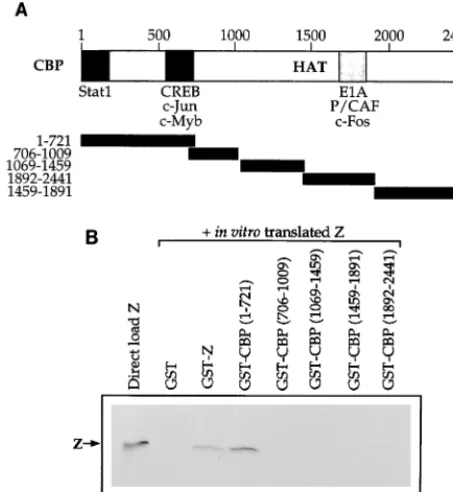
Z interacts with the first 721 amino acids of CBP.
To
ex-amine which region of CBP is responsible for the CBP-Z
in-teraction, we performed affinity chromatography experiments
with five consecutive segments of CBP (as depicted in Fig. 2A)
fused to GST and in translated Z protein. The in
vitro-translated Z protein did not bind to GST alone but did
ho-modimerize with GST-Z, as expected (Fig. 2B). Z bound to the
GST-CBP protein containing the first 721 amino acids of CBP
but not to the other regions of CBP. The amino terminus of the
CBP protein has also been shown to interact with several other
transcriptional activators, including CREB, c-Jun, and p65 (4,
9, 24).
Several domains of Z are required for association with CBP.
To determine which regions of Z are necessary for the Z-CBP
association, we performed affinity chromatography
experi-ments with in vitro-translated wild-type Z and Z mutants, as
depicted in Fig. 3A, and GST-CBP(1-721). The results
indi-cated that a large portion of the Z protein is necessary for the
Z-CBP interaction. The leucine zipper of Z is required for
interaction with CBP (as well as for Z homodimerization) (Fig.
3B, lanes 5 to 8). Furthermore, a mutant form of Z that is
incapable of homodimerization (Z
⌬
214/218) is unable to
as-sociate with CBP (Fig. 3B, lanes 9 to 12), suggesting that the
Z/CBP interaction requires Z dimerization. However, the
car-boxy-terminal half of Z (Z-CT) is insufficient for the CBP
interaction (Fig. 3B, lanes 13 to 16). The amino-terminal half
(containing the transcriptional activation domain) (Z-NT) is
also required, although not in itself sufficient, for the CBP
interaction (Fig. 3B, lanes 21 to 24). In addition, a mutant form
of Z lacking the carboxy-terminal 17 amino acids cannot
inter-act efficiently with CBP (Fig. 3B, lanes 17 to 20). Finally, two
mutant forms of Z containing mutations in the DNA binding
domain, Z311 (altering residue 185 from alanine to lysine) and
Z(S186A), were still able to associate with CBP (data not
shown). The finding that both the amino- and carboxy-terminal
domains of Z are essential for interaction with CBP suggests
that a certain conformation of Z may be required for this
interaction or that Z contacts two distinct regions (within the
amino terminus) of CBP.
[image:3.612.56.283.75.321.2]Z synergizes with CBP to activate the EBV early genes
BMRF1 and BHRF1.
CBP enhances transcriptional activation
by acting as a histone acetylase and destabilizing nucleosome
structure. The disruption of chromatin organization is thought
FIG. 2. Z binds to the amino-terminal portion of CBP. (A) Schematic of the [image:3.612.314.547.75.420.2]CBP protein. The regions previously reported to bind various proteins are indi-cated. Below the CBP map are the five segments of CBP that have been fused to GST. (B) Affinity chromatography experiments were performed in which 10l of in vitro-translated Z was incubated with GST alone, GST-Z, or the GST-CBP segments (amino acids 1 to 721, 706 to 1009, 1069 to 1459, 1459 to 1891, and 1892 to 2441) bound to glutathione-agarose beads. Lane 1 shows the direct load of in vitro-translated Z protein (10l).
FIG. 3. The Z-CBP association requires several regions of the Z protein. (A) Schematics of the wild-type Z protein (Z wt) and the various Z mutants used in this study. The transactivator (TA), dimerization (DIM), and DNA binding domains are indicated. (B) Aliquots of 5l of in vitro-translated wild-type Z protein (lanes 2 to 4), 10l of in vitro-translated Z⌬LZ (lanes 6 to 8), 5l of in vitro-translated Z⌬214/218 (lanes 10 to 12), 5l of in vitro-translated Z-CT (lanes 14 to 16), 5l of in vitro-translated Z⌬ter (lanes 18 to 20), or 5l of in vitro-translated Z-NT (lanes 22 to 24) were incubated with GST alone, GST-Z, or GST-CBP(1-721). Lanes 1, 5, 9, 13, 17, and 21 contain the direct loads for each protein (3l of Z, 10l of Z⌬LZ, 5l of Z⌬214/218, 5l of Z-CT, 5l of Z⌬ter, and 3l of Z-NT).
on November 9, 2019 by guest
http://jvi.asm.org/
to aid in the access of the transcriptional machinery to DNA.
Since we found that Z and CBP physically interact, we next
examined whether CBP enhanced the ability of Z to activate
EBV early gene promoters. In transient reporter gene assays,
CBP enhanced the Z-mediated activation of the EBV early
gene promoters, BMRF1 and BHRF1 (Fig. 4A). The increase
in Z-induced activation of the BMRF1 and BHRF1 promoters
in the presence of CBP was not due to an increased level of Z
protein made by the CMV-Z expression construct (Fig. 4B).
To examine whether the histone acetylase function of CBP is
required for the CBP-mediated augmentation of Z
transacti-vator function, we performed reporter gene assays with a CBP
expression plasmid that contained two point mutations within
the histone acetyltransferase (HAT) domain, abolishing HAT
activity (35a). CBP-HAT(
⫺
) was still able to increase Z
trans-activator function to some extent, although it was significantly
less active than wild-type CBP (Fig. 4A). This ability of
CBP-HAT(
⫺
) to partially activate Z function may reflect the
inter-action between CBP and P/CAF, which is another histone
acetylase (35a).
We also examined the ability of CBP to enhance the
trans-activator activity of mutant forms of Z (those which retain
transactivator activity). As shown in Fig. 4C and D, in the
absence of exogenous CBP, a mutant form of Z, ZE
2ter (which
lacks amino acids 228 to 245 and did not interact efficiently
with CBP in vitro [Fig. 3]), activated the BHRF1 and BMRF1
promoters inefficiently compared to wild-type Z. However, in
the presence of exogenous CBP, ZE
2ter became a much more
efficient transcriptional activator, suggesting that this mutant
has decreased, but not absent, ability to interact with CBP in
vivo. Z311, which is unable to directly bind at least some ZREs
(25), activated the BMRF1 promoter to a low level compared
to wild-type Z, and the addition of CBP enhanced activation by
Z311 only slightly. However, Z311 unexpectedly activated the
BHRF1 promoter as well as wild-type Z, and the addition of
exogenous CBP greatly enhanced activation of the promoter
by Z311. Z311 may directly bind to the BHRF1 promoter in
vivo or, alternatively, may activate BHRF1 in an indirect
man-ner, as it activates the Z promoter (20a).
CBP increases the ability of Z to disrupt viral latency.
To
examine the effect of CBP on Z-mediated transactivation of
promoters from the endogenous viral genome, we transfected
either vector DNA or Z expression plasmid with either 0, 2, 4,
or 6
g of CBP expression plasmid (Fig. 5) and then performed
immunoblot analysis with an anti-BMRF1 (EAD) antibody.
While CBP expression alone had no effect on viral reactivation,
increasing amounts of CBP cotransfected with Z led to
increas-ing amounts of EAD production. These data demonstrate that
the Z-CBP interaction is functionally relevant in vivo, in the
context of the intact viral genome, and that CBP greatly
in-creases the efficiency of Z transactivation function.
[image:4.612.54.287.70.516.2]Z inhibits CREB transactivator function.
CREB is a
mem-ber of the CREB/ATF family of transcriptional activators and
associates with CBP in order to activate its transcriptional
FIG. 4. CBP enhances Z-mediated activation of EBV early gene promoters.(A) Transient reporter assays were performed in which DG75 cells were trans-fected with 5g of each promoter construct (EApBS-CAT or BHRF1-CAT) and 1g of Z expression plasmid with or without 2g of CBP expression plasmid or CBP-HAT(⫺) expression plasmid (for a total of 8g DNA). CAT assays were performed as described in the text. The results are a combination of at least two separate experiments. (B) Extracts (containing either vector alone, Z, or Z plus CBP) from one of the CAT assays above were analyzed for Z protein levels. Western blot analysis was performed with an anti-Z antibody. (C and D) Tran-sient reporter assays were performed in which DG75 cells were transfected with 5g of each promoter construct (EApBS-CAT [C] or BHRF1-CAT [D]) and 1 g of Z, Z311, or ZE2ter expression plasmid with or without 2g of CBP expression plasmid (for a total of 8g DNA). CAT assays were performed as described in the text. The results are a combination of two separate experiments.
FIG. 5. CBP enhances Z-mediated transactivation of BMRF1 from the en-dogenous viral genome. D98/HE-R-1 cells were transfected with either 2g of vector (vec.; lanes 1 to 4) or 2g of Z expression plasmid (lanes 5 to 8), along with increasing amounts (0, 2, 4, and 6g) of CBP expression plasmid. Cells were harvested 14 h posttransfection. Western blot analysis was performed with an anti-EAD antibody.
6554
ADAMSON AND KENNEY
J. V
IROL.
on November 9, 2019 by guest
http://jvi.asm.org/
target promoters (9, 37). The level of CBP/p300 in cells is
limiting, such that other viral proteins (including adenovirus
E1A), which interact efficiently with CBP or p300, have been
shown to inhibit cellular transactivator function by competing
for CBP or p300 (2, 3, 40, 50, 59). Therefore, we examined the
effect of Z on CREB transactivator function. As shown in Fig.
6A, Z suppressed CREB transcriptional activity in reporter
gene assays. The inhibition of CREB’s activity by Z could be at
least partially reversed by increasing cellular CBP levels (Fig.
6A).
The Z promoter contains a CRE/ATF motif (referred to as
the ZII site) which is important for activation of Z
transcrip-tion (20b) and which has been previously shown to bind CREB,
ATF1, and ATF2 (6, 45, 64). CREB (which requires
phosphor-ylation by PKA [64a] and the presence of CBP for
transcrip-tional activation function) has been reported to activate the Z
promoter through this site (reference 19, our laboratory, and
unpublished data). Therefore, we examined the effect of Z on
CREB’s ability to activate a promoter construct containing
three copies of the ZII site linked to the minimal adenovirus
E1B promoter and the CAT reporter gene. As shown in Fig.
6B, in the presence of PKA and CBP, CREB efficiently
vated the construct containing the ZII motif but did not
acti-vate a control construct containing the minimal E1B promoter
alone (data not shown). Furthermore, Z inhibited the ability of
CREB to activate the ZII motif.
Z interacts directly with CREB.
The finding that exogenous
CBP expression at least partially reversed the inhibitory effect
of Z on CREB function (Fig. 6A) suggests that Z and CREB
compete for limiting amounts of cellular CBP. Therefore, we
examined the efficiency of the CREB-CBP interaction in the
presence and absence of Z. Unexpectedly, the level of
coim-munoprecipitated CREB-CBP protein complexes was not
de-creased in cells infected with adenovirus-Z (Fig. 7A).
Never-theless, it is possible that Z and CREB bind to different sites in
CBP (although both bind to regions in the first 721 amino acids
of CBP) and that both Z and CREB can bind to CBP
simul-taneously.
However, coimmunoprecipitation analysis of adenovirus
Z-infected HeLa cells suggested that Z and CREB (both bZip
proteins) also interacts directly (Fig. 7B). This interaction (as
well as the Z-CBP interaction) also occurred with bacterially
FIG. 6. Z inhibits CREB activity. (A) Transient reporter assays wereper-formed in which DG75 cells were transfected with 5g of GAL4-E1B-CAT, 1g each of SG424 (GAL4 DNA-binding domain alone) or GAL4-CREB, and 1g each of control vector or Z expression plasmid with or without 1g of CBP expression plasmid (8g of total DNA). CAT assays were performed as de-scribed in the text. The results are a combination of two separate experiments. (B) DG75 cells were transfected with 5g of Zp-CRE-CAT and 1g each (or a combination) of control vector, CREB, PKA, Z, or CBP expression plasmid (9
[image:5.612.316.549.69.374.2]g in total). CAT assays were performed as described in the text. The results are a combination of two separate experiments.
FIG. 7. Z interacts directly with CREB. (A) Anti-CBP antibody (Ab.) and a control antibody (rabbit serum) were used to coimmunoprecipitate (Ip) CREB from adenovirus-LacZ- or adenovirus-Z-infected HeLa cell extracts (10 g). Western blot analysis was performed with an anti-CREB antibody. (B) Anti-CREB antibody was used to coimmunoprecipitate Z from mock-, adenovirus-LacZ-, or adenovirus-Z-infected HeLa cell extracts (100 g) (lanes 1 to 3). Direct loads (10g) of each extract were used to confirm the presence of Z (lanes 4 to 6). Western blot analysis was performed with an anti-Z antibody. The results from the control antibody used in this experiment are presented in Fig. 1. (C) Aliquots of 4l of in vitro-translated wild-type Z protein (lanes 2 to 5), 5l of in vitro-translated Z-CT protein (lanes 7 to 10), or 5l of in vitro-translated Z⌬200 protein (lanes 12 to 15) were incubated with GST alone, Z, GST-CREB, or GST-CBP(1-721). The direct loads (lanes 1, 6, and 11) contain 4l of Z, 5l of Z-CT, or 5l of Z⌬200. (D) DG75 cells were transfected with 5g of GAL4-E1B-CAT, 1g each of SG424 (GAL4 DNA-binding domain alone) or GAL4-CREB, and 1g each of vector, Z, Z311, Z-CT, or Z⌬200 expression plasmid. CAT assays were performed as described in the text. The results are a combination of two separate experiments. Fold activation was calculated by taking the ratio of GAL4-CREB activity to SG424 activity in the presence of each Z construct.
on November 9, 2019 by guest
http://jvi.asm.org/
synthesized proteins (data not shown), excluding the possibility
that the Z-CREB or Z-CBP interactions require the presence
of all three proteins. To distinguish if Z inhibition of CREB
transactivator function is due to the Z-CBP or the Z-CREB
interaction, we compared the regions of Z required for each
interaction. The amino-terminal domain of Z, which is
re-quired for interaction with CBP (Fig. 3B) but not CREB (Fig.
7C, lanes 6 to 10), is essential for Z inhibition of CREB
trans-activator function (Fig. 7D). Furthermore, amino acid 200,
within the leucine zipper of Z, is required for interaction with
CREB but not CBP (Fig. 7C, lanes 11 to 15) and is not
re-quired for Z inhibition of CREB transactivator function (Fig.
7D). These results (in addition to the finding that CBP reverses
the Z inhibitory effect) suggest that the Z-CBP interaction, and
not the Z-CREB interaction, causes the inhibition of CREB
function.
DISCUSSION
CBP is a histone acetylase and functions as a coactivator for
several cellular transcriptional activators, including p53 and
p65 (24, 56). CBP is also harnessed by viral proteins, such as
adenovirus E1A and SV40 T antigen, to promote viral gene
transactivation (13, 14, 43). Since the level of CBP in each cell
is limiting, the harboring of CBP by viral proteins can inhibit
certain cellular transcription factors, including p53, MyoD,
c-Fos, and c-Myb, that require CBP for their function (3, 10, 50,
59). Inhibition of cellular differentiation by E1A is mediated
(in part) by titration of limiting amounts of CBP/p300 (34, 47).
Therefore, competition for cellular CBP/p300 may be an
im-portant mechanism by which DNA viruses regulate the host
cell environment.
Z is a critical regulatory protein of EBV which mediates the
switch from latent to lytic infection. In addition, Z functions as
the origin-binding protein of oriLyt (17, 18, 54) and thus is a
required replicative protein. Here we have demonstrated that
the EBV immediate-early Z protein engages CBP as a
coacti-vator. Z may also associate with the closely related protein,
p300, although we have not examined this interaction. Z
phys-ically associates with CBP in vivo and in vitro, as shown by
coimmunoprecipitation and affinity chromatography studies,
through the region comprising the first 721 amino acids of
CBP. This region of CBP has also been shown to bind CREB,
c-Jun, p65, and c-Myb (4, 9, 12, 24).
It appears that at least two different domains of the Z
pro-tein are required for the Z-CBP association in vitro. Previous
reports indicate that many transcriptional proteins, including
p53, p65, c-Jun, and c-Myb, interact with CBP through their
transactivation domains (4, 12, 24, 56). Consistent with this,
deletion of the Z transactivation domain (amino acids 1 to 86)
completely abrogates the Z-CBP interaction. However, the
leucine zipper domain of Z is also clearly required for the
interaction with CBP in vitro. Z homodimerization may be
required for the transactivation domain to interact with CBP.
Alternatively, deletion of the leucine zipper may alter Z
con-formation such that the Z-CBP association cannot occur.
Although our in vitro data suggest that the carboxy terminus
of Z is also required for efficient Z-CBP interaction, our in vivo
data indicate that a Z mutant (ZE
2ter) missing the carboxy
terminus is coactivated by exogenous CBP even more
effi-ciently than wild-type Z. It is possible that a cellular protein
stabilizes the interaction between Z and CBP in vivo, such that
the ZE
2ter mutant can interact with CBP more efficiently in
vivo. Alternatively, the low transactivation function of the
ZE
2ter mutant in the absence of exogenous CBP may reflect its
relatively poor affinity for CBP, such that it is unable to
com-pete for limiting amounts of CBP in the normal host cell
environment but can function as well as wild-type Z when CBP
is supplied exogenously.
The interaction between Z and CBP serves to increase
Z-induced transactivation of lytic EBV promoters. We have
dem-onstrated here that increased levels of CBP enhance
Z-medi-ated transcriptional activation of two EBV early gene
promoters, BMRF1 and BHRF1, in reporter gene assays and
that CBP enhances Z-mediated activation of BMRF1 from the
endogenous viral genome. By physically associating with CBP,
Z presumably tethers CBP to EBV early gene promoters
con-taining Z-binding sites. CBP-mediated acetylation of histones
would then aid in transcriptional activation of EBV early
pro-moters. Interestingly, the BHRF1 promoter appears to be
more dependent on the Z-CBP interaction than the BMRF1
promoter. Therefore, the exact number and positioning of the
ZRE sites may influence the degree Z-CBP synergy. A histone
acetylase-deficient mutant of CBP partially retains the ability
to enhance Z-mediated transcription. This may be explained
by the fact that CBP interacts with another histone acetylase,
P/CAF, and that the activity of P/CAF may contribute to the
enhancement of Z function observed with CBP (35a).
In addition to the role of the Z-CBP interaction for inducing
early gene transcription, this interaction could potentially be
important for Z’s role as the oriLyt origin-binding protein.
Origin-binding proteins may function to open chromatin,
al-lowing formation of the replication complex. The interaction
between Z and CBP may thus be required for histone
acety-lation near oriLyt ZRE sites, thereby allowing access of the
replication machinery. In addition, CBP has been recently
shown to localize within promyelocytic leukemia protein
(PML)-containing nuclear bodies (38). The ability of herpes
simplex virus and CMV immediate-early proteins to localize
within and subsequently disperse PML bodies appears to be
important for lytic replication (1, 15, 30, 35, 46). Assuming that
lytic EBV replication likewise requires modulation of
PML-associated nuclear bodies, the Z-CBP interaction could
poten-tially provide a mechanism for disrupting the PML-CBP
inter-action.
Although the Z-CBP interaction is likely required for
effi-cient transactivation of EBV early promoters, it may also be
important for regulating host cell transcription factors. Our
results clearly indicate that Z inhibits CREB transactivation
function in GAL4 reporter gene assays. This inhibition is
alle-viated by the overexpression of CBP; therefore it is likely that
Z competes with CREB for CBP. These results are in contrast
with the effect of the CMV immediate-early IE2 protein, which
utilizes its interaction with CBP to enhance CREB-mediated
transactivation (55), but are in accordance with the effect of
the adenovirus E1A protein, which has been shown to decrease
CREB activity (2). The inhibition of CREB by Z requires the
amino terminus of Z, consistent with our in vitro data showing
that the CBP-Z interaction involves this region.
The interpretation that Z inhibits CREB function by
com-peting for limiting amounts of CBP may be overly simplistic, in
that the total number of CREB-CBP complexes was not
de-creased in the presence of Z (Fig. 7A). Furthermore, Z and
CREB also directly interact. Nevertheless, our mutational
analysis suggests that Z inhibition of CREB function requires
its ability to interact directly with CBP but not CREB. One
explanation for these results is that Z also interacts with p300
through the same domains required for its interaction with
CBP and that the Z-p300 interaction competitively inhibits the
CREB-p300 interaction. At this point, the functional role of
the Z-CREB interaction remains unknown, but it could
poten-6556
ADAMSON AND KENNEY
J. V
IROL.
on November 9, 2019 by guest
http://jvi.asm.org/
tially be important for regulating early EBV transcription
through either ZRE/AP1- or CREB-binding motifs.
CREB-binding sites have been identified in two promoters
within the EBV genome, the Z promoter (6, 45, 64) and the
LMP1 promoter (58). CREB has been shown to activate the Z
promoter through the ZII regulatory element (reference 19,
our laboratory, and unpublished data). Z inhibition of CREB
function could serve to autoregulate the Z promoter and turn
off Z expression after critical amounts of the protein are
pro-duced. In addition, we have previously shown that Z inhibits
the activity of the LMP1 promoter (32).
E1A, by interacting with CBP, decreases the activities of
other transcription factors, including p53, by competing for
limiting amounts of cellular CBP (59). Although we have
spe-cifically shown that Z inhibits CREB transactivator function,
the Z-CBP interaction could likewise inhibit the functions of
other transcription factors regulated by CBP. Interestingly, we
have previously shown that two of the transcription factors
known to interact with CBP (p53 and p65) can inhibit BZLF1
function (and vice versa) (27, 67). Interaction with CBP/p300
may prove to be a common mechanism by which viruses
reg-ulate the host cell environment.
ACKNOWLEDGMENTS
This work was supported by grants RO1-CA58853, RO1-CA66519,
and PO1-CA19014 from the National Institutes of Health.
We thank Brian Ashburner from Al Baldwin’s laboratory and
Jona-thon Harton from Jenny Ting’s laboratory for providing CBP
con-structs and for helpful discussions, Amy Mauser for the adenovirus-Z,
and the UNC Gene Therapy Core (R. Jude Samulski and Douglas
McCarty) for preparing the adenovirus-LacZ and adenovirus-Z.
REFERENCES
1.Ahn, J. H., and G. S. Hayward.1997. The major immediate-early proteins IE1 and IE2 of human cytomegalovirus colocalize with and disrupt PML-associated nuclear bodies at very early times in infected permissive cells. J. Virol.71:4599–4613.
2.Arany, Z., D. Newsome, E. Oldread, D. M. Livingston, and R. Eckner.1995. A family of transcriptional adaptor proteins targeted by the E1A oncopro-tein. Nature374:81–84.
3.Bannister, A. J., and T. Kouzarides.1995. CBP-induced stimulation of c-Fos activity is abrogated by E1A. EMBO J.14:4758–4762.
4.Bannister, A. J., T. Oehler, D. Wilhelm, P. Angel, and T. Kouzarides.1995. Stimulation of c-Jun activity by CBP: c-Jun residues Ser63/73 are required for CBP induced stimulation in vivo and CBP binding in vitro. Oncogene
11:2509–2514.
5.Bannister, A. J., and T. Kouzarides.1996. The CBP co-activator is a histone acetylase. Nature384:641–643.
5a.Brehm, A., E. A. Miska, D. J. McCance, J. L. Reid, A. J. Bannister, and T. Kouzarides.1998. Retinoblastoma protein recruits histone acetylase to re-press transcription. Nature391:597–601.
6.Cen, H., and J. L. C. McKnight.1994. EBV-immortalized isogenic human B-cell clones exhibit differences in DNA-protein complex formation on the BZLF1 and BRLF1 promoter regions among latent, lytic and TPA-activated cell lines. Virus Res.31:89–107.
7.Chang, Y., D. Dong, G. Hayward, and S. D. Hayward.1990. The Epstein-Barr virus Zta transactivator: a member of the bZIP family with unique DNA-binding specificity and a dimerization domain that lacks the charac-teristic heptad leucine zipper motif. J. Virol.64:3358–3369.
8.Chevallier-Greco, A., E. Manet, P. Chavrier, C. Mosnier, J. Daillie, and A. Sergeant.1986. Both Epstein-Barr virus (EBV) encoded trans-acting factors, EB1 and EB2, are required to activate transcription from an early EBV promoter. EMBO J.5:3243–3249.
9.Chrivia, J. C., R. P. S. Kwok, N. Lamb, M. Hagiwara, M. R. Montminy, and R. H. Goodman.1993. Phosphorylated CREB binds specifically to the nu-clear protein CBP. Nature365:855–859.
10. Colgin, M. A., and J. K. Nyborg.1998. The human T-cell leukemia virus type 1 oncoprotein Tax inhibits the transcriptional activity of c-Myb through competition for the CREB binding protein. J. Virol.72:9396–9399. 11. Countryman, J., and G. Miller.1985. Activation of expression of latent
Epstein-Barr virus after gene transfer with a small cloned fragment of het-erogeneous viral DNA. Proc. Natl. Acad. Sci. USA82:4085–4089. 12. Dai, P., H. Akimaru, Y. Tanaka, D. X. Hou, T. Yasukawa, C. Kanei-Ishii, T.
Takahashi, and S. Ishii.1996. CBP as a transcriptional coactivator of c-Myb. Genes Dev.10:528–540.
13. Dorsman, J. C., A. F. Teunisse, A. Zantema, and A. J. van der Eb.1997. The adenovirus 12 E1A proteins can bind directly to proteins of the p300 tran-scription co-activator family, including the CREB-binding protein CBP and p300. J. Gen. Virol.78:423–426.
14. Eckner, R., J. W. Ludlow, N. L. Lill, E. Oldread, Z. Arany, N. Modjtahedi, J. A. DeCaprio, D. M. Livingston, and J. A. Morgan.1996. Association of p300 and CBP with simian virus 40 large T antigen. Mol. Cell. Biol.16:3454– 3464.
15. Everett, R. D., and G. G. Maul.1994. HSV-1 IE protein Vmw110 causes redistribution of PML. EMBO J.13:5062–5069.
16. Farrell, P., D. Rowe, C. Rooney, and T. Kouzarides.1989. Epstein-Barr virus BZLF1 trans-activator specifically binds to consensus Ap1 site and is related to c-fos. EMBO J.8:127–132.
17. Fixman, E., G. Hayward, and S. D. Hayward.1995. Replication of Epstein-Barr virus oriLyt: lack of a dedicated virally encoded origin-binding protein and dependence on Zta in cotransfection assays. J. Virol.69:2998–3006. 18. Fixman, E., G. Hayward, and S. D. Hayward.1992.trans-acting requirements
for replication of Epstein-Barr virus oriLyt. J. Virol.66:5030–5039. 19. Flamand, L., and J. Menezes.1996. Cyclic AMP-responsive
element-depen-dent activation of Epstein-Barr virus Zebra promoter by human herpesvirus 6. J. Virol.70:1784–1791.
20. Flemington, E. K., A. M. Borras, J. P. Lytle, and S. H. Speck.1992. Char-acterization of the Epstein-Barr virus BZLF1 protein transactivation do-main. J. Virol.66:922–929.
20a.Flemington, E. K., J. P. Lytle, C. Cayrol, A. M. Borras, and S. H. Speck.
1994. DNA-binding-defective mutants of the Epstein-Barr virus lytic switch activator Zta transactivate with altered specificities. Mol. Cell. Biol.14:3041– 3052.
20b.Flemington, E., and S. Speck.1990. Identification of phorbol ester response elements in the promoter of Epstein-Barr virus putative lytic switch gene BZLF1. J. Virol.64:1217–1226.
21. Flemington, E., and S. Speck.1991. Evidence for coiled-coil dimer formation by an Epstein-Barr virus transactivator that lacks a heptad repeat of leucine residues. Proc. Natl. Acad. Sci. USA87:9459–9463.
22. Furnari, F. B., V. Zacny, E. B. Quinlivin, S. Kenney, and J. S. Pagano.1994. RAZ, an Epstein-Barr virus transdominant repressor that modulates the viral reactivation mechanism. J. Virol.68:1827–1836.
23. Garcia-Rodriguez, C., and C. Rao.1998. Nuclear factor of activated T cells (NFAT)-dependent transactivation regulated by the coactivators p300/ CREB-binding protein (CBP). J. Exp. Med.187:2031–2036.
24. Gerritsen, M. E., A. J. Williams, A. S. Neish, S. Moore, Y. Shi, and T. Collins.1997. CREB-binding protein/p300 are transcriptional coactivators of p65. Proc. Natl. Acad. Sci. USA94:2927–2932.
25. Giot, J.-F., I. Mikaelian, M. Buisson, E. Manet, I. Joab, J.-C. Nicolas, and A. Sergeant.1991. Transcriptional synergy and interference between the EBV transcription factors EB1 and R require both the basic region and the activation domains of EB1. Nucleic Acids Res.19:1251–1258.
26. Gorman, C., L. Moffat, and B. Howard.1982. Recombinant genomes which express chloramphenicol acetyltransferase in mammalian cells. Mol. Cell. Biol.2:1044–1051.
27. Gutsch, D., E. Holley-Guthrie, Q. Zhang, B. Stein, M. Blanar, A. Baldwin, and S. Kenney.1994. The bZIP transactivator, BZLF-1, of Epstein-Barr virus functionally and physically interacts with the p65 subunit of NFB. Mol. Cell. Biol.14:139–149.
28. Hottinger, M. O., and G. J. Nabel.1998. Interaction of human immunode-ficiency virus type 1 Tat with the transcriptional coactivators p300 and CREB binding protein. J. Virol.72:8252–8256.
29. Kamei, Y., L. Xu, T. Heinzel, J. Torchia, R. Kurokawa, B. Gloss, S. C. Lin, R. A. Heyman, D. W. Rose, C. K. Glass, and M. G. Rosenfeld.1996. A CBP integrator complex mediates transcriptional activation and AP-1 inhibition by nuclear receptors. Cell85:403–414.
30. Kelly, C., R. Van Driel, and G. W. Wilkinson.1995. Disruption of PML-associated nuclear bodies during human cytomegalovirus infection. J. Gen. Virol.76:2887–2893.
31. Kenney, S., E. Holley-Guthrie, E. Quinlivan, D. Gutsch, Q. Zhang, T. Bender, J. Giot, and A. Sergeant.1992. The cellular oncogene c-mybcan interact synergistically with the Epstein-Barr virus BZLF1 transactivator in lymphoid cells. Mol. Cell. Biol.12:136–146.
32. Kenney, S., J. Kamine, E. Holley-Guthrie, J.-C. Lin, E.-C. Mar, and J. Pagano.1989. The Epstein-Barr virus (EBV) BZLF1 immediate-early gene product differentially affects latent versus productive EBV promoters. J. Vi-rol.63:1729–1736.
33. Kieff, E.1996. Epstein-Barr virus and its replication, p. 2343–2396.InB. N. Fields, D. M. Knipe, P. M. Howley, et al. (ed.), Fields virology, 3rd ed. Lippincott-Raven, Philadelphia, Pa.
34. Kirshenbaum, L., and M. D. Schneider.1995. Adenovirus E1A represses cardiac gene transcription and reactivates DNA synthesis in ventricular myo-cytes, via alternative pocket protein- and p300-binding proteins. J. Biol. Chem.270:7791–7794.
35. Korioth, F., G. G. Maul, B. Plachter, T. Stamminger, and J. Frey.1996. The nuclear domain 10 (ND10) is disrupted by the human cytomegalovirus prod-uct IE1. Exp. Cell Res.229:155–158.
on November 9, 2019 by guest
http://jvi.asm.org/
35a.Korzus, E., J. Torchia, D. W. Rose, L. Xu, R. Kurokawa, E. M. McInerney, T.-M. Mullen, C. K. Glass, and M. G. Rosenfeld.1998. Transcription factor-specific requirements for coactivators and their acetyltransferase functions. Science279:703–707.
36. Kouzarides, T., G. Packham, A. Cook, and P. Farrell.1991. The BZLF1 protein of EBV has a coiled coil dimerization domain without a heptad leucine repeat but homology to the C/EBP leucine zipper. Oncogene6:195– 204.
37. Kwok, R. P. S., J. R. Lundblad, J. C. Chrivia, J. P. Richards, H. P. Bach-inger, R. G. Brennan, S. G. E. Roberts, M. R. Green, and R. H. Goodman.
1994. Nuclear protein CBP is a coactivator for the transcription factor CREB. Nature370:223–226.
38. LaMorte, V. J., J. A. Dyck, R. L. Ochs, and R. M. Evans.1998. Localization of nascent RNA and CREB binding protein with the PML-containing nu-clear body. Proc. Natl. Acad. Sci. USA95:4991–4996.
39. Lee, D. Y., J. J. Hayes, D. Pruss, and A. P. Wolffe.1993. A positive role for histone acetylation in transcription factor access to nucleosomal DNA. Cell
72:73–84.
40. Lee, J.-S., R. H. See, T. Deng, and Y. Shi.1996. Adenovirus E1A downregu-lates c-Jun- and JunB-mediated transcription by targeting their coactivator p300. Mol. Cell. Biol.16:4312–4326.
41. Li, Q. X., L. S. Young, G. Niedobitek, C. W. Dawson, M. Birkenbach, F. Wang, and A. B. Rickinson.1992. Epstein-Barr virus infection and replica-tion in a human epithelial cell system. Nature356:347–350.
42. Lieberman, P., J. M. Hardwick, and S. D. Hayward.1989. Responsiveness of the Epstein-Barr virusNotI repeat promoter to the Z transactivator is me-diated in a cell-type-specific manner by two independent signal regions. J. Virol.63:3040–3050.
43. Lill, N. L., M. J. Tevethia, R. Eckner, D. M. Livingston, and N. Modjtahedi.
1997. p300 family members associate with the carboxyl terminus of simian virus 40 large tumor antigen. J. Virol.71:129–137.
44. Lillie, J., and M. Green.1989. Transcriptional activation by the adenovirus E1a protein. Nature338:39–44.
45. Liu, P., S. Liu, and S. H. Speck.1998. Identification of a negativeciselement within the ZII domain of the Epstein-Barr virus lytic switch BZLF1 gene promoter. J. Virol.72:8230–8239.
46. Maul, G. G., and R. D. Everett.1994. The nuclear location of PML, a cellular member of the C3HC4 zinc-finger domain protein family, is rearranged during herpes simplex virus infection by the C3HC4 protein ICP0. J. Gen. Virol.75:1223–1233.
47. Mymryk, J. S., R. W. H. Lee, and S. T. Bayley.1992. Ability of adenovirus 5 E1A proteins to suppress differentiation of BC3H1 myoblasts correlates with their binding to a 300 kDa cellular protein. Mol. Biol. Cell3:1107–1115. 48.Norton, V. G., B. S. Imai, P. Yau, and E. M. Bradbury.1989. Histone
acetylation reduces nucleosome core particle linking number change. Cell
57:449–457.
49.Packham, G., A. Economou, C. M. Rooney, D. T. Rowe, and P. J. Farrel.
1990. Structure and function of the Epstein-Barr virus BZLF1 protein. J. Vi-rol.64:2110–2116.
50.Puri, P. L., M. L. Avantaggiati, C. Balsano, N. Sang, A. Graessmann, A. Giordano, and M. Levero.1997. p300 is required for MyoD-dependent cell cycle arrest and muscle-specific gene transcription. EMBO J.16:369–383. 51.Quinlivan, E., E. Holley-Guthrie, M. Norris, D. Gutsch, S. Bachenheimer,
and S. Kenney.1993. Direct BRLF1 binding is required for cooperative BZLF1/BRLF1 activation of the Epstein-Barr virus early promoter, BMRF1. Nucleic Acids Res.21:1999–2007.
52.Rickinson, A. B., and E. Kieff.1996. Epstein-Barr virus, p. 2397–2446.In
B. N. Fields, D. M. Knipe, P. M. Howley, et al. (ed.), Fields virology, 3rd ed. Lippincott-Raven, Philadelphia, Pa.
53.Sadowski, I., and M. Ptashne.1989. A vector for expressing GAL4(1-147) fusions in mammalian cells. Nucleic Acids Res.17:7539.
54.Schepers, A., D. Pich, and W. Hammerschmidt.1993. A transcription factor with homology to the Ap1 family links RNA transcription and DNA repli-cation in the lytic cycle of Epstein-Barr virus. EMBO J.12:3921–3929. 55.Schwartz, R., B. Helmich, and D. H. Spector.1996. CREB and
CREB-binding proteins play an important role in the IE2 86-kilodalton protein-mediated transactivation of the human cytomegalovirus 2.2-kilobase RNA promoter. J. Virol.70:6955–6966.
56.Scolnick, D. M., N. H. Chehab, E. S. Stavridi, M. C. Lien, L. Caruso, E. Moran, S. L. Berger, and T. D. Halazonetis.1997. CREB-binding protein and p300/CBP-associated factor are transcriptional coactivators of the p53 tumor suppressor protein. Cancer Res.57:3693–3696.
57. Sixby, J. W., J. G. Nedrud, N. Raab-Traub, R. A. Hanes, and J. S. Pagano.
1984. Epstein-Barr virus replication in oropharyngeal epithelial cells. N. Engl. J. Med.310:1225–1230.
58. Sjoblom, A., W. Yang, L. Palmqvist, A. Jansson, and L. Rymo.1998. An ATF/CRE element mediates both EBNA2-dependent and EBNA2-indepen-dent activation of the Epstein-Barr virus LMP1 gene promoter. J. Virol.
72:1365–1376.
59. Somasundaram, K., and W. S. El-Deiry.1997. Inhibition of p53-mediated transactivation and cell cycle arrest by E1A through its p300/CBP-interacting region. Oncogene14:1047–1057.
60. Takada, K., N. Shimizu, S. Sakuma, and Y. Ono.1986. Transactivation of the latent Epstein-Barr virus (EBV) genome after transfection of the EBV DNA fragment. J. Virol.57:1016–1022.
61. Tonneguzzo, F., A. C. Hayday, and A. Keating.1986. Electric field-mediated DNA transfer: transient and stable gene expression in human and mouse lymphoid cells. Mol. Cell. Biol.6:703–706.
62. Utley, R. T., K. Ikeda, P. A. Grant, J. Cote, D. J. Steger, A. Ebernarter, S. John, and J. L. Workman.1998. Transcriptional activators direct histone acetyltransferase complexes to nucleosomes. Nature394:498–502. 63. Vettese-Dadey, M., P. A. Grant, T. R. Hebbes, C. Crane-Robinson, C. D.
Allis, and J. L. Workman.1996. Acetylation of histone H4 plays a primary role in enhancing transcription factor binding to nucleosomal DNA in vitro. EMBO J.15:2508–2518.
64. Wang, Y.-C. J., J.-M. Huang, and E. A. Montalvo.1997. Characterization of proteins binding to the ZII element in the Epstein-Barr virus BZLF1 pro-moter: transactivation by ATF1. Virology227:323–330.
64a.Yamamoto, K. K., G. A. Gonzalez, W. H. Biggs III, and M. R. Montimony.
1988. Phosphorylation-induced binding and transcriptional efficacy of nu-clear factor CREB. Nature334:494–498.
65. Yang, C., L. H. Shapiro, M. Rivera, A. Kumar, and P. K. Brindle.1998. A role for CREB binding protein and p300 transcriptional coactivators in Ets-1 transactivation functions. Mol. Cell. Biol.18:2218–2229.
66. Young, L., R. Lau, M. Rowe, G. Niedobitek, G. Packham, F. Shanahan, D. Rowe, D. Greenspan, J. Greenspan, A. Rickinson, and P. Farrell.1991. Differentiation-associated expression of the Epstein-Barr virus BZLF1 trans-activator in oral hairy leukoplakia. J. Virol.65:2868–2874.
67. Zhang, Q., D. Gutsch, and S. Kenney.1994. Functional and physical inter-action between p53 and BZLF1: implications for Epstein-Barr virus latency. Mol. Cell. Biol.14:1929–1938.
68. Zur Hausen, H., H. Schulte-Holthauzen, G. Klein, G. Henle, W. Henle, P. Clifford, and L. Santesson.1970. EBV DNA in biopsies of Burkitt tumours and anaplastic carcinomas of the nasopharynx. Nature228:1956–1958.
6558
ADAMSON AND KENNEY
J. V
IROL.
on November 9, 2019 by guest
http://jvi.asm.org/