0022-538X/97/$04.00
1
0
Copyright
q
1997, American Society for Microbiology
Human Immunodeficiency Virus Type 1 gp120 Stimulates
Cytomegalovirus Replication in Monocytes: Possible
Role of Endogenous Interleukin-8
MARIA R. CAPOBIANCHI,
1* CATERINA BARRESI,
1PAOLA BORGHI,
2SANDRA GESSANI,
2LAURA FANTUZZI,
2FRANCO AMEGLIO,
3FILIPPO BELARDELLI,
2SERGIO PAPADIA,
1AND
FERDINANDO DIANZANI
1Institute of Virology Universita
` “La Sapienza,”
1Istituto Superiore di Sanita
`,
2and Institute San Gallicano,
3Rome, Italy
Received 11 March 1996/Accepted 7 November 1996
Recombinant gp120, but not other human immunodeficiency type 1 (HIV-1) structural proteins,
dose-dependently stimulates human cytomegalovirus (HCMV) immediate-early antigen (IEA) expression and
in-fectious virus yield in freshly isolated normal monocytes infected with HCMV. Monoclonal antibodies (MAbs)
recognizing the gp120 V3 loop, as well as V3 loop octameric multibranched peptides and antibody to
galac-tocerebroside, but not sCD4, abrogate the gp120 stimulation of IEA expression, suggesting that the effect
involves V3 loop-galactocerebroside interaction and is not mediated by CD4. Interleukin 8 (IL-8) gene
expres-sion is enhanced in monocytes treated with gp120 at the level of both mRNA and released protein. Exogenous
IL-8 could replace gp120 in the stimulation of HCMV infection, while a MAb capable of neutralizing IL-8
activity abrogates the gp120-induced HCMV stimulation. These data indicate that HIV-1 glycoprotein induces
stimulation of productive infection of monocytes with HCMV and that such stimulation may be mediated by
the upregulation of IL-8 gene expression. This is the first evidence that HIV-1 may affect HCMV replication
indirectly, via the interaction of gp120 with the monocyte membrane, in the complete absence of retroviral
replication, through the stimulation of IL-8 release. Because in HIV-1-infected individuals, HCMV infection is
frequently activated and the levels of circulating IL-8 are enhanced, these findings may be pathogenetically
relevant.
Human cytomegalovirus (HCMV) infection is widely
dif-fused in the human population, with over 50% of adults
show-ing the presence of specific antibodies by 50 years of age.
Recently, the use of amplified nucleic acid detection has
indi-cated that HCMV infection is even more common than
previ-ously suggested by serology (28, 43). Usually HCMV infection
is asymptomatic in people with a mature, competent immune
system, remaining mostly latent after primary infection.
Occa-sional episodes of reactivation in these subjects are often
co-incident with transient immunosuppression and rarely become
clinically evident.
Several studies have suggested that bone marrow progenitor
cells, circulating neutrophils, monocytes, and lymphocytes, as
well as endothelial cells, are the sites of acute or latent in vivo
HCMV infection (4, 14, 17, 30, 31, 33, 41–43, 46), and
infec-tious virus has been isolated from circulating leukocytes during
active disease (4, 38).
However, HCMV is one of the most frequent opportunistic
agents causing severe illness in immunocompromised hosts,
including human immunodeficiency virus type 1
(HIV-1)-in-fected patients (25, 26). HCMV clinical manifestations, often
at unusual body sites, are very common in the advanced stages
of HIV infection, and up to 90% of AIDS patients display signs
of disseminated HCMV infection at autopsy (47).
Several reports indicate that CMV and HIV can reciprocally
influence (positively or negatively) each other’s expression,
suggesting that the two infections may be pathogenetically
connected (22, 27, 29, 37, 40). While there is evidence that
virus replication is not essential for HCMV to either stimulate
or inhibit HIV expression (27, 29, 37), the need for HIV
rep-lication has not been clearly established for its effect on
HCMV. In fact, conflicting results have been obtained under
different experimental conditions, suggesting that HIV
produc-tive infection can either up- (40) or downmodulate HCMV
expression, possibly through its surface glycoprotein, gp120
(30), whereas tat gene-coded protein is mostly stimulatory (22,
30). Therefore, it seemed interesting to further explore the
effects of HIV on HCMV replication by considering
addi-tional, indirect mechanisms. To this aim, we investigated the
effects of HIV-1 structural proteins, including gp120, on
HCMV infection of freshly isolated normal monocytes. In fact,
these cells have been shown to be one of the major sites of
HCMV persistence in vivo (17, 42, 43) and have been shown to
be permissive to HCMV in vitro, since they express
immediate-early antigens (IEA) and produce infectious progeny after in
vitro infection with either laboratory strains or fresh isolates, as
well as after cocultivation with HCMV-infected cells (14, 31,
33, 41, 46).
It has been found that gp120 actually potentiates HCMV
replication in these cells. Since normal monocytes show
in-creased cytokine production after exposure to HIV gp120 (5,
18, 21, 23, 45), the possibility that the gp120-induced cytokines
can be involved in the upmodulation of HCMV replication has
been considered.
MATERIALS AND METHODS
Monocyte cultures.Human monocytes were isolated by Ficoll-Hypaque den-sity gradient centrifugation from the peripheral blood of healthy donors and were separated from lymphocytes by adherence to plastic dishes as described
* Corresponding author. Mailing address: Institute of Virology,
Viale di Porta Tiburtina 28, 00185 Rome, Italy. Phone: 39.6.4452846.
Fax: 39.6.4469024. E-mail: [email protected].
1591
on November 9, 2019 by guest
http://jvi.asm.org/
previously (18). Cytochemical (i.e., sodium fluoride-inhibited esterase activity) and fluorescence-activated cell sorter analysis of surface markers (CD14 antigen) revealed that the adherent cell population consisted of.95% monocytes. These were seeded in multichamber plastic slides (Nunc, Inc., Naperville, Ill.) at a concentration of 105/ml in 0.5 ml of RPMI containing 20% heat-inactivated fetal calf serum. Duplicate cultures were tested for each experimental point, and results were expressed as means6standard errors of repeated experiments. Statistical significance was evaluated by Student’s t orx2tests, as appropriate.
Reagents.The following recombinant proteins were prepared in a baculovirus expression system: gp120 (HIV-1IIIB) and p24 and soluble CD4 (sCD4), obtained from Intracel, Cambridge, Mass. P17 was expressed in pGEX as a glutathione S-transferase fusion protein and was obtained from S. Adams, through the Medical Research Council AIDS Directed Programme Reagent Project, En-gland. A monoclonal antibody (MAb) to gp120 (clonea70), recognizing the HIV-1IIIBV3 loop was obtained from Intracel.
The multibranched peptide constructs (GPGRAF)8-mbpc and (APGRAF)8-mbpc were synthesized by automated solid-phase peptide synthesis starting with Fmoc8-k4-k2-k-beta A-NovaSyn-KA resin (Calbiochem-Novabiochem, San Di-ego, Calif.) as previously described (48, 49). They were synthesized at the Protein and Nucleic Acid Shared Facility of the Medical College of Wisconsin, Milwau-kee. The toxicity of these multibranched peptides for peripheral blood mono-nuclear cells (PBMCs) was very low (50% tissue culture infective dose [TCID50],
.250mg/ml) as determined in an MTT assay (13). The inhibitory effect on HIV-driven syncytium formation was tested by using chronically infected H9/ HIVIIIBand lymphoblastoid C8166 cells according to standard procedures (48). The 50% inhibitory dose (ID50) for both peptides was 0.5 to 1mg/ml.
A MAb to galactocerebrosides (Gal-cer) (clone mGalC) was obtained from Boehringer-Mannheim S.p.A., Milan, Italy. This antibody binds Gal-cer and sulfatides, but does not cross-react with glucocerebrosides, ceramide, sphin-gosine, and mixed brain gangliosides. The antibody was used at 10mg/ml.
Nylon filters (0.2mm pore diameter) able to remove lipopolysaccharide were obtained through Nalgene, Rochester, N.Y.
Escherichia coli-expressed recombinant human interleukin 8 (rhIL-8) and a neutralizing MAb to IL-8 (clone 6217.11) showing no cross-reactivity with rhRANTES, rhGRO alpha, rhMIP-1 alpha, rhMIP-1 beta, rmMIP-1 alpha, or rmMIP-1 beta were purchased from R&D System Europe Ltd., Abingdon, United Kingdom.
Virus.HCMV AD169 (ATCC VR538) was propagated on human diploid HEL299 fibroblasts (ATCC), obtained from the Istituto Zooprofilattico, Brescia, Italy. Virus titrations were performed with the same cells by the limiting dilution method, by using four replicates for each 0.5-log-based dilution. The titration cultures were refed with fresh medium at day 6 or 7 postinfection, and the final
score for cytopathic effect was determined by light microscope examination at day 10 postinfection. Infectious titer was calculated according to the Reed and Muench formula. Virus stocks with titers of at least 5 log TCID50/ml were used. Monocytes were infected at a multiplicity of infection (MOI) of 1 TCID50/cell. After a 1-h incubation at 378C, cell monolayers were washed twice and refed with fresh medium. The expression of IEA was determined at day 1 postinfection by direct immunofluorescence by using a fluorescein isothiocyanate-conjugated MAb (FITC-MAb) to the 76-kDa nonstructural antigen of HCMV (clone E13) from Argene (previously Biosoft), Varhiles, France. The expression of HCMV late antigens (LA) was tested at day 3 postinfection, with a specific MAb (clone SL20) from Argene in an indirect immunofluorescence assay by using an FITC-antimouse immunoglobulin G antiserum from Dako, Glostrup, Denmark. Stain-ing was performed accordStain-ing to the manufacturer’s instructions, and phosphate-buffered saline supplemented with 10% human serum negative for HCMV antibodies was used as a blocking solution. As a control for unspecific fluores-cence, an FITC-MAb to herpes simplex virus type 1 (clone H62) from Argene, which showed no staining in HCMV-infected monocytes, was used. For each experimental condition, at least 200 cells were scored, positive cells (showing nuclear fluorescence for IEA and cytoplasmic fluorescence for LA) were counted, and the results were expressed as the percentage of positive cells.
To determine the infectious virus yield, monocytes were infected as described above, washed twice after the adsorption period, and refed with fresh medium. At the indicated time points, the whole culture wells, containing the same volume of medium and number of cells for each experimental condition, were frozen and thawed twice, and the cryolysates were backtitrated on diploid HEL299 fibro-blasts as described above.
A fresh clinical isolate of HCMV was generated from the urine of a congen-itally infected neonate. It was propagated on HEL299 fibroblasts as described above and used at passage 2.
IL-8 gene expression.Culture supernatants were assayed for IL-8 content with a commercial enzyme-linked immunocapture assay (ELISA) from R&D systems (detection limit, 18 pg/ml).
IL-8 mRNA expression was analyzed by reverse transcription-PCR (RT-PCR). Total cellular RNA was extracted by the method of Chirgwin et al. (10). The RT-PCR was performed as described in reference 24, but with the following modification. For the RT reaction, 0.5mg of RNA was mixed with 1mg of oligo(dT) (12 to 18 oligomer; Pharmacia, Uppsala, Sweden) and incubated for 10 min at 658C. After cooling on ice, the mixture was incubated with RT buffer (24)–1 mM deoxynucleoside 59-triphosphates (dNTP) in the presence of 50 U of Moloney murine leukemia virus reverse transcriptase for 60 min at 378C. The cDNA obtained was amplified by using 0.1mg of primers specific for glyceral-dehyde-3-phosphate dehydrogenase (GAPDH) or IL-8 in a mixture containing FIG. 1. HCMV IEA expression in monocytes infected with HCMV. Fresh monocytes obtained by adherence of normal PBMCs were infected with HCMV AD169 at an MOI of 1 TCID50/cell. After 1 h of adsorption, the virus inoculum was discarded, and then the cultures were refed with complete medium. HCMV IEA expression was assessed after 1 day of incubation by staining with an FITC-MAb. Evans blue was used to counterstain the cells (original magnification,3250). (A) HCMV-infected monocytes. (B) Uninfected monocytes.
on November 9, 2019 by guest
http://jvi.asm.org/
200mM dNTP and 0.5 U of Taq polymerase in PCR buffer (24). The sequences of the IL-8 primers (according to reference 9) were as follows: IL-8 sense, 59-ATTTCTGCAGCTCTGTGTGAA-39; IL-8 antisense, 59-TGAATTCTCAG CCCTCTTCAA-39. The sequence of the GAPDH primers has been previously described (24). PCR was performed in a thermal cycler (Perkin-Elmer, Monza, Italy) for 20 cycles of 40 s at 948C, 40 s at 628C, and 60 s at 428C. This low number of amplification cycles ensures the detection of mRNA bands in conditions of linear amplification, as assessed in exploratory experiments. However, a basal level of IL-8 mRNA expression can be detected by increasing the number of cycles up to 25. The reaction products were analyzed on a 2.5% agarose gel with a molecular size ladder (fX174 replicative form DNA HaeIII digest; New En-gland Biolabs, Beverly, Mass.). The expected sizes of the amplified bands were 255 bp for IL-8 and 196 bp for GAPDH.
RESULTS
In a first set of experiments, we tested the effects of
glyco-protein gp120 on the susceptibility of monocytes to infection
with a laboratory strain (AD169) of HCMV by counting the
cells expressing HCMV IEA. For this purpose, recombinant
gp120 was administered to 1-day-old monocyte cultures, and
after overnight incubation, the cells were washed and infected
with HCMV. The expression of IEA was tested 1 day later by
staining with a MAb to HCMV IEA. As shown in Fig. 1, the
staining was confined to the nuclei of infected cells, as
ex-pected. Furthermore, in gp120-stimulated cultures, the
num-ber of positive cells was dose-dependently increased, being
maximal at a gp120 concentration of 4
m
g/ml, as shown in Fig.
2. Consistent results were obtained in repeated experiments. In
fact, the frequency of HCMV IEA-expressing monocytes in
unstimulated cultures was 12.0%
6
2.0% (mean
6
standard
error of nine independent experiments); an about twofold
stimulation was observed at a gp120 concentration of 2
m
g/ml
(positive cells, 23.1%
6
4.2%; mean
6
standard error of five
independent experiments, P
5
0.015 by Student’s t test), and a
fourfold stimulation was observed at a gp120 concentration of
4
m
g/ml (positive cells, 48.9%
6
13.5%; mean
6
standard error
of six independent experiments; P
5
0.001). A fresh clinical
isolate of HCMV was similarly affected by gp120, showing
6.9%
6
1.1% IEA-positive cells in control cultures and 15.5%
6
0.5% positive cells in cultures exposed to 2
m
g of gp120 per
ml (P
5
0.019). gp120 filtered through membranes capable of
removing lipopolysaccharide was as effective as unfiltered
gp120 in stimulating HCMV IEA expression (not shown).
Other HIV-1 recombinant proteins (i.e., the major capsid
pro-tein p24 and the matrix propro-tein p17) did not affect HCMV IEA
expression up to a concentration of 8
m
g/ml (Fig. 2).
Since the expression of IEA does not necessarily lead to
productive HCMV infection, especially in blood-derived cells,
and some investigators have failed to show productive
infec-tion of monocytes by HCMV laboratory strains (17, 31, 41–43),
we performed exploratory experiments to determine the
ex-pression of HCMV LA and the replication curve of the AD169
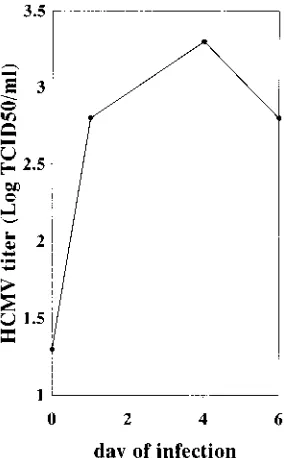
HCMV strain in fresh monocytes. A representative replication
curve is shown in Fig. 3, indicating that virus titer progressively
increased in these cell cultures, reaching a value at day 4 about
100-fold higher than that found after the adsorption period
(time zero), and slightly declined thereafter. In repeated
ex-periments, peak virus yield was observed between days 4 and 5
postinfection, indicating that a fully productive replication
cy-cle occurs under our experimental conditions. Furthermore,
the number of cells expressing HCMV LA at day 3
postinfec-tion was consistent with the number of cells expressing HCMV
IEA early after infection, indicating that IEA-expressing cells
are an effective indicator of the extent of HCMV infection in
monocytes (described below).
We then determined the effect of gp120 on both HCMV
IEA and LA expression, as well as on the virus yield. The
results, shown in Table 1, indicate that both the number of
HCMV IEA- and LA-expressing cells and the HCMV
infec-tious yield are significantly higher in gp120-stimulated cultures
than in untreated cultures. Furthermore, the amount of virus
that remained cell bound after the adsorption period was
[image:3.612.106.250.67.298.2]in-creased
.
3.5-fold in gp120-treated cultures compared with in
FIG. 2. Effect of HIV-1 gp120, p24, and p17 on HCMV IEA expression by monocytes. Monocytes were exposed to various amounts of HIV-1 structural proteins for 24 h and then washed and infected with HCMV as described in the legend to Fig. 1. Cells with fluorescent nuclei were counted, and the results are expressed as the percentage of positive cells. A representative experiment is shown. P,0.001 by thex2test for gp120; P.0.50 for p24 and p17.
FIG. 3. Growth curve of HCM AD169 in fresh monocytes. Monocytes were infected with HCMV and sampled at the indicated time points to determine the titer of infectious virus present in the culture cryolysates. The virus titer at day 0 represents the amount of HCMV detected in the cultures after the adsorption and subsequent washings.
on November 9, 2019 by guest
http://jvi.asm.org/
[image:3.612.366.508.70.299.2]control cultures (1.9 versus 1.3 log TCID
50/10
5cells,
respec-tively), suggesting that very early events in the virus replicative
cycle, possibly involving virus adsorption and/or penetration,
could be affected by gp120 stimulation.
The membrane interactions responsible for HCMV
stimu-lation by gp120 were explored by competition experiments with
either a gp120-specific MAb or sCD4 used as the competitor.
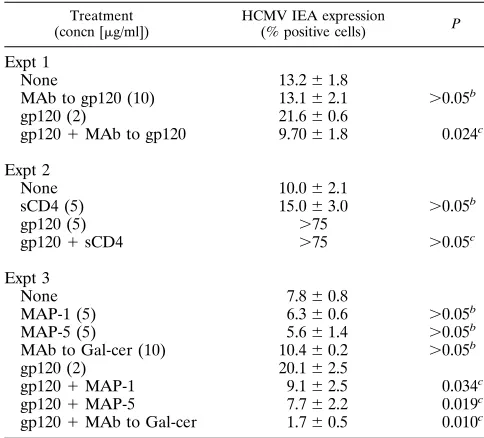
The results, shown in Table 2, indicate that the MAb to gp120
abrogated the gp120 effect on HCMV IEA expression, while
sCD4 was completely uneffective. Since the anti-gp120 MAb
was raised against the third variable domain of the
glyco-protein (V3 loop), we explored the role of this region.
Spe-cifically, we used gp120 octameric branched-peptide
con-structs representing the apex of the V3 loop consensus
se-quence, (GPGRAF)8-mbpc (MAP-5), or a slight variant of it,
(APGRAF)8-mbpc (MAP-1). MAP-5 has been previously
shown to bind to Gal-cer and to block HIV-1-driven syncytium
formation (48, 49). Exploratory experiments had shown that
the two peptide constructs are equally effective in blocking
syncytium formation between CD4 T-lymphoblastoid and
HIV-1-infected cells (ID
50, 0.5 to 1
m
g/ml, data not shown).
Moreover, a MAb to Gal-cer was used. The results, shown in
Table 2, indicate that neither of the two peptides tested nor the
MAb to Gal-cer was able per se to significantly affect HCMV
IEA expression. Furthermore, both V3 loop multibranched
peptides and the MAb to Gal-cer abrogated the effect of
gp120. These findings suggest that the gp120 interaction with
the monocyte membrane responsible for the HCMV activation
is not mediated by CD4, but possibly is mediated by V3 loop
binding to Gal-cer, which has been suggested as a possible
alternate receptor for HIV gp120 (11, 16, 19, 39, 49).
However, the data do not help define whether gp120
stim-ulates HCMV directly or through induction of soluble
media-tors. In fact, gp120 has been shown to induce a number of
cytokines and products of immune activation in monocytes (5,
18, 21, 23, 45). Since it has been recently shown that a
chemo-kine (i.e., IL-8) produced by several cell types, including
mono-cytes (50), can upmodulate HCMV replication in fibroblasts
(35), we tested whether gp120 activation of HCMV could be
mediated by the induction of this chemokine. We then
ana-lyzed IL-8 gene expression at the level of both mRNA (as
detected by RT-PCR) and released protein (as detected by
ELISA) in monocyte cultures stimulated with gp120 compared
with that in untreated cultures as follows. Monocytes were
exposed (or not exposed) to 5
m
g of gp120 per ml. After
overnight incubation, their supernatants were assayed for IL-8
content with a commercial ELISA. With no treatment, the
yield of IL-8 was 11.9
6
3.4 nl/ml; with gp120 treatment, the
yield of IL-8 was 63.6
6
9.4 nl/ml (mean
6
standard error of
four independent experiments; P
,
0.001). The results indicate
that a substantial amount of this cytokine is constitutively
re-leased by cultured monocytes (range 4.8 to 21.5 ng/ml) and
that gp120 treatment results in a significant stimulation of this
production, causing a more than fivefold enhancement of IL-8
release (range, 31.8 to 95.0 ng/ml). In keeping with these
find-ings, a marked induction of the IL-8 mRNA was observed in
gp120-treated compared to untreated monocytes (Fig. 4)
un-der conditions of linear amplification (i.e., 20 amplification
cycles). The IL-8 mRNA band was observed in untreated
monocytes with a higher number of amplification cycles (not
shown), in keeping with the constitutive expression of the
che-mokine under these experimental conditions.
These findings suggest that endogenous IL-8 could play a
role in the susceptibility of fresh monocytes to HCMV and in
the gp120-driven stimulatory effect. To test this hypothesis, we
used a MAb capable of neutralizing IL-8 activity. Particularly,
a MAb capable of neutralizing IL-8 activity was added with
gp120 to monocytes, and after overnight incubation, the cells
were washed and infected with HCMV. As a positive control
for HCMV stimulation by the chemokine, exogenous IL-8 was
added at a concentration similar to that found in
gp120-stim-ulated cultures (i.e., 50 ng/ml). HCMV IEA expression and
infectious yield were tested on days 1 and 5, respectively. The
results, shown in Fig. 5, indicate that, while IL-8 at the
con-centration used could replace gp120 in stimulating both
HCMV IEA expression and infectious virus yield, the MAb to
IL-8 abrogated the gp120-induced stimulation of both
param-eters.
DISCUSSION
[image:4.612.58.300.91.145.2]These findings demonstrate that normal monocytes exposed
to HIV-1 gp120 have increased sensitivity to the productive
TABLE 1. Effect of gp120 on expression of HCMV IEA
and LA and infectious virus yield by monocytes
aTreatment
% of positive cells (P) HCMV yield
[log TCID50/ml (P)]
HCMV IEA HCMV LA
None 17.063.0(0.001) 15.064.4(0.004) 2.860.2(0.02)
gp120 46.969.1 46.567.4 3.760.2
a
[image:4.612.56.298.450.669.2]Monocytes obtained by plastic adherence were exposed to gp120 (5mg/ml), and 1 day later, they were infected with HCMV (MOI of 1 TCID50/ml). Cell monolayers were stained for IEA and LA expression on days 1 and 3 postinfec-tion, respectively; parallel cultures were analyzed for infectious virus yield by backtitration of culture cryolysates on day 5 postinfection, as specified in Mate-rials and Methods. Values are means6standard errors of four independent experiments.
TABLE 2. Effects of sCD4, the MAb to gp120, the octameric
branched V3 loop peptides, and the MAb to Gal-cer on the
gp120-driven stimulation of HCMV IEA expression in monocytes
aTreatment (concn [mg/ml])
HCMV IEA expression
(% positive cells) P
Expt 1
None
13.2
6
1.8
MAb to gp120 (10)
13.1
6
2.1
.
0.05
bgp120 (2)
21.6
6
0.6
gp120
1
MAb to gp120
9.70
6
1.8
0.024
cExpt 2
None
10.0
6
2.1
sCD4 (5)
15.0
6
3.0
.
0.05
bgp120 (5)
.
75
gp120
1
sCD4
.
75
.
0.05
cExpt 3
None
7.8
6
0.8
MAP-1 (5)
6.3
6
0.6
.
0.05
bMAP-5 (5)
5.6
6
1.4
.
0.05
bMAb to Gal-cer (10)
10.4
6
0.2
.
0.05
bgp120 (2)
20.1
6
2.5
gp120
1
MAP-1
9.1
6
2.5
0.034
cgp120
1
MAP-5
7.7
6
2.2
0.019
cgp120
1
MAb to Gal-cer
1.7
6
0.5
0.010
caMonocytes were exposed to gp120 in the presence of each competitor at the
indicated concentration. One day later, the cells were infected with HCMV as described in the legend to Table 1. HCMV IEA expression was measured on day 1 postinfection, as described in Materials and Methods, and is expressed as the mean6standard error of two independent experiments.
bWith respect to untreated monocytes. cWith respect to gp120-treated monocytes.
on November 9, 2019 by guest
http://jvi.asm.org/
infection by HCMV, since both HCMV IEA expression and
LA expression, as well as infectious virus yield, are higher in
gp120-stimulated monocyte cultures.
HCMV stimulation seems not to be restricted to a
labora-tory strain of HCMV, since a fresh virus isolate also infects
gp120-treated monocytes more efficiently than control cells.
The stimulation appears to be specific for HIV-1 gp120. In
fact, the contribution of contaminants to the observed
phe-nomenon can be ruled out, since (i) gp120 filtered to remove
LPS is as active as untreated gp120; (ii) other proteins
ob-tained in the same recombinant DNA expression system, such
as sCD4 and p24, or obtained in a different expression system,
such as p17, do not affect HCMV infection; and (iii) the
en-hancing effect is abrogated by a MAb specific for the gp120 V3
loop and by multibranched peptides representing the gp120 V3
loop conserved apical region, known to effectively inhibit other
gp120 effects (48, 49), as well as by antibodies to Gal-cer,
whereas sCD4 is ineffective. These results suggest that the
gp120 interaction with monocytes is not mediated by CD4, but
rather involves the V3 loop and Gal-cer. This type of
interac-tion appears to be crucial for other gp120-induced effects, such
as fusion (11, 48) and interferon induction (3), and has been
suggested to mediate HIV infection of CD4-negative cells,
such as nerve epithelial, and endothelial cells (11, 16, 19, 39,
49). In this respect, it will be of interest to compare gp120 from
HIV strains with different tropisms and syncytium-forming
abilities with respect to their ability to stimulate HCMV
rep-lication.
The effect of gp120 on HCMV infection of monocytes
ap-pears to be mainly due to the induction of a chemokine. A key
role of IL-8 in such a phenomenon is supported by the
follow-ing observations. (i) Endogenous IL-8, although substantially
expressed by unstimulated cells, is strongly upmodulated in
monocytes exposed to gp120. (ii) Exogenous IL-8 strongly
up-modulates HCMV replication in monocytes. (iii) The
IL-8-neutralizing MAb is able to abrogate the gp120-driven
stimu-lation of HCMV infection.
The finding that in gp120-stimulated monocytes an
in-creased amount of HCMV remains bound to the cells after the
adsorption period suggests that very early events of the virus
replication cycle are the possible target of the IL-8 action
under the present experimental conditions. This issue is
pres-ently under investigation, in view of the recent observation that
a late open reading frame of HCMV (unique short region 28)
codes for an analog of the family of the seven transmembrane
domain chemokine receptors (20).
Taken together, our results have a number of implications.
In fact, this is the first evidence that a soluble HIV-1 structural
protein (i.e., gp120) can induce HCMV stimulation in cells,
such as monocytes, that may have a major role in HCMV
pathogenesis (14, 17, 31, 33, 41, 43, 46). gp120 has been shown
to be released into the circulation of HIV-infected subjects and
is thought to have a role in the progressive immune
derange-ment of these patients by several mechanisms, including the
induction of lymphocyte- and monocyte-derived cytokines and
chemokines (1–3, 5, 7, 8, 18, 21, 23, 45).
Recently, it has been reported that the amount of circulating
IL-8 is increased in 1-infected patients (32) and that
HIV-infected monocytes show enhanced IL-8 expression (36). The
present findings indicate that IL-8 stimulation occurs in
healthy monocytes from different donors treated with HIV-1
gp120, in the absence of any sign of HIV-1 replication.
There-fore, we think that the indirect effect of HIV on HCMV
rep-lication shown here, which is transmissible at distant body sites,
may have even stronger pathogenetic significance than the
previously reported tat-mediated transactivation of HCMV
replication (22, 30, 40), which requires simultaneous infection
or rather close contact between cells individually infected by
the two viruses.
It is widely accepted that cytokine disregulation is involved
in the pathogenetic events leading to disease progression in
HIV-infected individuals. Several cytokines, including
inter-feron alpha and gamma, tumor necrosis factor alpha, IL-1
alpha and beta, IL-6, IL-10, etc., are induced in vitro by HIV-1,
FIG. 4. Effect of gp120 on IL-8 gene expression in monocytes. Total cellular RNA was extracted from monocytes exposed to gp120 (1mg/ml) for 6 h. RNA was analyzed for the presence of IL-8 and GAPDH mRNA by RT-PCR, as described in Materials and Methods.
FIG. 5. Effects of neutralizing anti-IL-8 MAb on gp120-driven HCMV stim-ulation in monocytes. Monocytes were exposed to gp120 (5mg/ml) in the pres-ence or abspres-ence of anti-IL-8 MAb (4mg/ml) for 24 h and then infected with HCMV as described in Materials and Methods. Exogenous IL-8 (50 ng/ml) was used to establish the susceptibility of monocytes to HCMV stimulation by the chemokine. HCMV IEA expression and infectious yields were measured on days 1 and 5, respectively.
on November 9, 2019 by guest
http://jvi.asm.org/
HIV-1-infected cells, or viral soluble products such as gp120
(1–3, 5–8, 18, 21, 23, 45) and are found in the circulation of
HIV-infected subjects at increased levels (12, 15, 34, 44). Many
of these cytokines are potentially capable of influencing the
outcome of opportunistic infections that plague HIV-infected
patients, particularly those due to viral agents such as HCMV.
Since IL-8 is upmodulated by HIV-1 gp120 in monocytes,
leading to an increased yield of HCMV, the hypothesis that
IL-8 production in vivo is also responsible for stimulation of
HCMV infection should be considered, especially in
HIV-infected patients, in whom virus-produced gp120 can boost
IL-8 production.
ACKNOWLEDGMENTS
This work was partly supported by grants from the Italian Ministry
of Health (IX Progetto AIDS) to F.D. and to F.B. and from the
Istituto Pasteur, Fondazione Cenci-Bolognetti, to F.D.
We acknowledge the Medical Research Council AIDS Directed
Programme Reagent Project for providing p17 (prepared by S.
Ad-ams).
REFERENCES
1. Ameglio, F., M. R. Capobianchi, C. Castilletti, P. Cordiali Fei, S. Fais, E. Trento, and F. Dianzani.1994. Recombinant gp120 induces IL-10 in resting peripheral blood mononuclear cells: correlation with the induction of other cytokines. Clin. Exp. Immunol. 95:455–458.
2. Ankel, H., M. R. Capobianchi, C. Castilletti, and F. Dianzani. 1994. Inter-feron induction by HIV glycoprotein 120: role of V3 loop. Virology 205:575– 579.
3. Ankel, H., M. R. Capobianchi, F. Frezza, C. Castilletti, and F. Dianzani. 1996. Interferon induction by HIV-1: a possible role of sulfatides or related glycolipid. Virology 221:113–119.
4. Bitsch, A., H. Kirchner, R. Dupke, and G. Bein. 1993. Cytomegalovirus transcripts in peripheral blood leukocytes of actively infected transplant patients detected by reverse transcription-polymerase chain reaction. J. In-fect. Dis. 167:740–743.
5. Borghi, P., L. Fantuzzi, B. Varano, S. Gessani, P. Puddu, L. Conti, M. R. Capobianchi, F. Ameglio, and F. Belardelli.1995. Induction of interleu-kin-10 by human immunodeficiency virus type 1 and its gp120 protein in human monocytes/macrophages. J. Virol. 69:1284–1287.
6. Capobianchi, M. R., F. De Marco, P. Di Marco, and F. Dianzani. 1988. Acid-labile human interferon alpha production by peripheral blood mono-nuclear cells stimulated by HIV-infected cells. Arch. Virol. 99:9–19. 7. Capobianchi, M. R., H. Ankel, F. Ameglio, R. Paganelli, P. M. Pizzoli, and
F. Dianzani.1992. Recombinant glycoprotein 120 of human immunodefi-ciency virus is a potent interferon inducer. AIDS Res. Hum. Retroviruses 8:575–579.
8. Capobianchi, M. R., F. Ameglio, P. Cordiali Fei, C. Castilletti, F. Mercuri, S. Fais, and F. Dianzani.1993. Coordinate induction of interferon alpha and gamma by recombinant HIV-1 glycoprotein 120. AIDS Res. Hum. Retrovi-ruses 9:957–961.
9. Carre`, P. C., R. L. Mortenson, T. E. King, Jr., P. W. Noble, C. L. Sable, and W. H. Riches.1991. Increased expression of the interleukin-8 gene by alve-olar macrophages in idiopathic pulmonary fibrosis. J. Clin. Invest. 88:1802– 1810.
10. Chirgwin, J. M., R. Przybyla, R. J. MacDonald, and W. J. Rytter. 1979. Isolation of biologically active ribonucleic acid from sources enriched in ribonuclease. Biochemistry 18:5294–5299.
11. Cook, D. G., J. Fantini, S. L. Spitalnik, and F. Gonzales-Scarano. 1994. Binding of human immunodeficiency virus type 1 (HIV-1) gp120 to galac-tosylceramide (GalCer): relationship to the V3 loop. Virology 201:206–214. 12. Cordiali Fei, P., A. Massa, G. Prignano, M. Pietravalle, L. Alemanno, G. Vitelli, G. Palamara, A. Giglio, G. M. Gandolfo, G. Gentili, F. Caprilli, and F. Ameglio. 1992. Behavior of several progression markers during the HIV-ab seroconversion period. Comparison with later stages. J. Biol. Regul. Homeostatic Agents 6:57–64.
13. Denizot, F., and R. Lang. 1986. Rapid colorimetric assay for cell growth and survival. J. Immunol. Methods 89:271–277.
14. Einhorn, L., and A. Oste. 1984. Cytomegalovirus infection of human blood cells. J. Infect. Dis. 149:207–214.
15. Fan, J., H. Z. Bass, and J. L. Fahey. 1993. Elevated IFN-gand decreased IL-2 gene expression are associated with HIV infection. J. Immunol. 151: 5031–5040.
16. Fantini, J., D. G. Cook, N. Nathanson, S. L. Spitalnik, and F. Gonzales-Scarano.1993. Infection of colonic epithelial cell lines by type 1 human immunodeficiency virus is associated with cell surface expression of galac-tosylceramide, a potential alternative gp120 receptor. Proc. Natl. Acad. Sci. USA 90:2700–2704.
17. Gerna, G., D. Zipeto, E. Percivalle, M. Parea, M. G. Revello, R. Maccario, G. Peri, and G. Milanesi.1992. Human cytomegalovirus infection of the major leukocyte subpopulations and evidence for initial viral replication in poly-morphonuclear leukocytes from viremic patients. J. Infect. Dis. 166:1236– 1244.
18. Gessani, S., P. Puddu, B. Varano, P. Borghi, L. Contu, L. Fantuzzi, and F. Belardelli.1994. Induction of beta interferon by human immunodeficiency virus type 1 and its gp120 protein in human monocytes-macrophages: role of beta interferon in restriction of virus replication. J. Virol. 68:1983–1986. 19. Harouse, J. M., R. G. Collman, and F. Gonza´lez-Scarano.1991. Human
immunodeficiency virus type 1 infection of SK-N-MC cells: domains of gp120 involved in entry into a CD4-negative, galactosyl ceramide/39sulfo-galactosyl ceramide-positive cell line. J. Virol. 69:7383–7390.
20. Gao, J. L., and P. M. Murphy. 1994. Human cytomegalovirus open reading frame US28 encodes a functional beta chemochine receptor. J. Biol. Chem. 269:28539–28542.
21. Glienke, W., H. Von Briesen, R. Esser, S. Muller, R. Andreesen, and H. Rubsamen-Waigmann.1993. Expression of macrophages products after in vitro infection of human monocytes-macrophages with HIV. Res. Virol. 144:35–40.
22. Ho, W. Z., J. M. Harouse, R. F. Rando, E. Gonczol, A. Srinivasan, and S. A. Plotkin.1990. Reciprocal enhancement of gene expression and viral repli-cation between human cytomegalovirus and human immunodeficiency virus type 1. J. Gen. Virol. 71:97–103.
23. Hochestein, H. D., V. Natarajan, and W. L. Farrar. 1991. The HIV-1 gp120 envelope protein has the intrinsic capacity to stimulate monokine secretion. J. Immunol. 147:2892–2901.
24. Jacobsen, H., J. Mestan, S. Mittnach, and C. W. Dieffenbach. 1989. Beta interferon subtype 1 induction by tumor necrosis factor. Mol. Cell. Biol. 9:3037–3042.
25. Jacobson, M. A. 1994. Current management of cytomegalovirus disease in patients with AIDS. AIDS Res. Hum. Retroviruses 10:917–923.
26. Katlama, C. 1993. Cytomegalovirus infection in acquired immune-deficiency syndrome. J. Med. Virol. 1:128–133.
27. Koval, V., C. Clark, M. Vaishnav, S. A. Spector, and D. H. Spector. 1991. Human cytomegalovirus inhibits human immunodeficiency virus replication in cells productively infected by both viruses. J. Virol. 65:6969–6978. 28. Landini, M. P. 1993. New approaches and perspectives in cytomegalovirus
diagnosis. Prog. Med. Virol. 4:157–177.
29. Lathey, J. L., D. H. Spector, and S. A. Spector. 1994. Human cytomegalo-virus-mediated enhancement of human immunodeficiency virus type-1 pro-duction in monocyte-derived macrophages. Virology 199:98–104. 30. Lazzarotto, T., G. Furlini, M. C. Re, E. Ramazzotti, B. Campisi, and P.
Landini.1994. Human cytomegalovirus replication correlates with differen-tiation in a hematopoietic progenitor cell line and can be modulated by HIV-1. Arch. Virol. 135:13–28.
31. Maciejewski, J. P., E. E. Bruening, R. E. Donahue, S. E. Sellers, C. Carter, N. S. Young, and S. Jeor.1993. Infection of mononucleated phagocytes with human cytomegalovirus. Virology 195:327–336.
32. Matsumoto, T., T. Miike, R. P. Nelson, W. L. Trudeau, R. F. Lockey, and J. Yodoi.1993. Elevated serum levels of IL-8 in patients with HIV infection. Clin. Exp. Immunol. 93:149–151.
33. Minton, E. J., C. Tysoe, J. H. Sinclair, and J. G. P. Sissons. 1994. Human cytomegalovirus infection of the monocyte/macrophage lineage in bone mar-row. J. Virol. 68:4017–4021.
34. Mosmann, T. R. 1994. Cytokine patterns during the progression to AIDS. Science 265:193–194.
35. Murayama, T., K. Kuno, F. Jisaki, M. Obuchi, D. Sakamuro, T. Furukawa, N. Mukaida, and K. Matsushima.1994. Enhancement of human cytomeg-alovirus replication in a human lung fibroblast cell line by interleukin-8. J. Virol. 68:7582–7585.
36. Ohashi, K., R. Akazawa, and M. Kurimoto. 1994. Effects of interferon-alpha on a reduced release of interleukin-8 from latently HIV-1-infected mono-cytic cell line U937 cells. J. Interferon Res. 14:129–132.
37. Rando, R. F., A. Srinivasan, J. Feingold, E. Gonczol, and S. Plotkin. 1990. Characterization of multiple molecular interactions between human cyto-megalovirus (HCMV) and human immunodeficiency virus type 1 (HIV-1). Virology 176:87–97.
38. Revello, M. G., M. Furione, M. Zavattoni, and G. Gerna. 1994. Human cytomegalovirus infection: diagnosis by antigen and DNA detection. Med. Microbiol. 5:265–276.
39. Scheglovitova, O., M. R. Capobianchi, G. Antonelli, D. Guanmu, and F. Dianzani.1993. CD-4 positive lymphoid cells rescue HIV-1 replication from abortively infected human primary endothelial cells. Arch. Virol. 132:267– 280.
40. Skolnik, P. R., B. R. Kolstoff, and M. Hirsch. 1988. Bidirectional interactions between human immunodeficiency virus type 1 and cytomegalovirus. J. In-fect. Dis. 157:508–514.
41. Soderberg, C., S. Larsson, S. Bergstedt-Lindqvist, and E. Mo¨ller. 1993. Definition of a subset of human peripheral blood mononuclear cells that are permissive to human cytomegalovirus infection. J. Virol. 67:3166–3175. 42. Taylor-Wiedeman, J., J. G. P. Sissons, L. K. Borysiewicz, and J. H. Sinclair.
on November 9, 2019 by guest
http://jvi.asm.org/
1991. Monocytes are a major site of persistence of human cytomegalovirus in peripheral blood mononuclear cells. J. Gen. Virol. 72:2059–2064. 43. Taylor-Wiedeman, J., P. Sissons, and J. Sinclair. 1994. Induction of
endog-enous human cytomegalovirus gene expression after differentiation of mono-cytes from healthy carriers. J. Virol. 68:1597–1604.
44. Von Sydow, M., A. Sonnenberg, H. Gaines, and O. Strannegard. 1992. Interferon alpha and tumor necrosis factor alpha in serum of patients in various stages of HIV-1 infection. AIDS Res. Hum. Retroviruses 7:375–380. 45. Wahl, L. M., M. L. Corcoran, S. W. Pyle, L. O. Arthur, A. Harel-Bella, and W. L. Arrar.1989. Human immunodeficiency virus glycoprotein (gp120) induction of monocyte arachidonic acid metabolites and interleukin 1. Proc. Natl. Acad. Sci. USA 86:621–625.
46. Waldman, W. J., D. A. Knight, E. H. Huang, and D. D. Sedmak. 1995. Bidirectional transmission of infectious cytomegalovirus between monocytes and vascular endothelial cells: an in vitro model. J. Infect. Dis. 171:263–272. 47. Webster, A., J. E. McLaughlin, M. A. Johnson, V. C. Emery, and P. D.
Griffiths.1995. Use of the polymerase chain reaction to detect genomes of human immunodeficiency virus and cytomegalovirus in post-mortem tissues. J. Med. Virol. 47:23–28.
48. Yahi, N., J. Fantini, K. Mabrouk, C. Tamalet, P. De Micco, J. Van Rietscho-ten, H. Rochat, and J.-M. Sabatier.1994. Multibranched V3 peptides inhibit human immunodeficiency virus infection in human lymphocytes and macro-phages. J. Virol. 68:5714–5720.
49. Yahi, N., J.-M. Sabatier, S. Baghdiguian, F. Gonzalez-Scarano, and J. Fan-tini.1995. Synthetic multimeric peptides derived from the principal neutral-ization domain (V3 loop) of human immunodeficiency virus type 1 (HIV-1) gp120 bind to galactosylceramide and block HIV-1 infection in a human CD4-negative mucosal epithelial cell line. J. Virol. 69:320–325.
50. Yoshimura, T., K. Matsushima, J. J. Oppenheim, and E. J. Leonard. 1987. Neutrophil chemotactic factor produced by lipopolysaccharide (LPS)-stim-ulated human blood mononuclear leukocytes: partial characterization and separation from interleukin 1 (IL 1). J. Immunol. 139:788–793.