STANDARDS AND REGULATIONS:OVERVIEW
Standards and Regulations
B
EATEH
UBER1 ANDO
TTOS
CHMID2Introduction
Farmers' associations developed the first standards for organic production in the middle of the last century. The first international standards were published by IFOAM in 1980. The first governmental regulations were introduced by some European countries, including Austria and France, in the 1980s. In 1991, the EU passed the organic EU Regulation 2092/91 and set standards with major implications for international trade; they covered not only production standards, but standards for labeling and inspection as well. Various coun-tries in Europe, Latin America and Asia - including Japan - introduced legislation in the 1990s. In 1999, the Codex Alimentarius approved the first guidelines for organic plant production, which were amended with requirements for livestock production in 2001. In the new millennium, most major economies have established a regulation for organic produc-tion. On January 1, 2009, the completely revised Regulation on Organic Production EU Regulation (EC) 834/2007 and its implementation rules came into force.
[image:1.595.58.541.550.688.2]For a list of countries with regulations or in the process of drafting regulations on organic agriculture, see Table 17. The data on regulations around the world were collected from authorities and experts. The classification of whether the regulation is “not yet fully” or “fully implemented” is based on feedback from the persons interviewed, but was not subject to verification. We received responses from experts and authorities in 60 percent of the countries. It is assumed that a majority of the 40 percent of non-responding countries did not pass legislation on organic production, although the share of countries in the process of developing legislation is probably greater than reflected. Please send comments or informa-tion on countries not listed to [email protected].
Table 17: Regulations: Countries with regulations on organic agriculture
Region Country Remark
European Union (27)3 Austria Fully implemented
Belgium Fully implemented
Bulgaria Fully implemented
Cyprus Fully implemented
Czech Republic Fully implemented
Denmark Fully implemented
Estonia Fully implemented
Finland Fully implemented
1 Beate, Huber, Research Institute of Organic Agriculture FiBL, Ackerstrasse, CH-5070 Frick, Internet www.fibl.org 2 Otto Schmid, Research Institute of Organic Agriculture FiBL, Ackerstrasse, CH-5070 Frick, Internet www.fibl.org 3 Council Regulation (EC) No 834/2007 of 28 June 2007 on organic production and labelling of organic products and
repealing Regulation (EEC) No 2092/92.
Region Country Remark
France Fully implemented
Germany Fully implemented
Greece Fully implemented
Hungary Fully implemented
Ireland Fully implemented
Italy Fully implemented
Latvia Fully implemented
Lithuania Fully implemented
Luxembourg Fully implemented
Malta Fully implemented
Poland Fully implemented
Portugal Fully implemented
Romania Fully implemented
Slovak Republic Fully implemented
Slovenia Fully implemented
Spain Fully implemented
Sweden Fully implemented
The Netherlands Fully implemented
United Kingdom Fully implemented
Others Europe (11) Albania Not fully implemented
Croatia Fully implemented
Iceland1 Fully implemented
Kosovo Not fully implemented
Macedonia, The former Yugoslav Republic
Fully implemented
Moldova Fully implemented
Montenegro2 Fully implemented
Norway Fully implemented
Serbia Fully implemented
Switzerland3 Fully implemented
Turkey Fully implemented
Asia&Pacific Region (11) Azerbaijan Not fully implemented
Australia4 Only export regulations
Bhutan Not fully implemented5
China Fully implemented
Georgia Not fully implemented
India6 Only export regulations7
Israel Only export regulations1
1 www.landbunadarraduneyti.is/log-og-reglugerdir/Reglugerdir/Allar_reglugerdir/nr/79 2 www.skupstina.cg.yu/skupstinaweb /tekstovi_list.php?s_id_zakoda=110
3 www.admin.ch/ch/d/sr/c910_18.html
4 www.affa.gov.au/corporate_docs/ publications/ word/quarantine/approg/ nationalstandard2.doc. 5 National framework, but no labeling regulation.
Region Country Remark
Japan2 Fully implemented
New Zealand3 Only export regulations
Philippines Not fully implemented
Korea South Fully implemented
Taiwan Fully implemented
Thailand4 Fully implemented
The Americas & Caribbean (17)
Argentina Fully implemented
Bolivia5 Fully implemented
Brazil6 Fully implemented
Canada Not fully implemented
Chile Fully implemented
Costa Rica7 Fully implemented
Colombia Fully implemented
Dominican Republic Not fully implemented
Ecuador8 Fully implemented
El Salvador9 Not fully implemented
Guatemala Fully implemented
Honduras10 Not fully implemented
Mexico Not fully implemented
Paraguay11 Not fully implemented
Peru12 Fully implemented
USA13 Fully implemented
Venezuela Not fully implemented
Africa (3) Ethiopia Not fully implemented
Ghana Not fully implemented
Tunisia Fully implemented
Source: Huber, Silva, Gelman, FiBL 2006 updated 2009
1 Regulation for national market will come into force in 2009. 2 JAS Standards for organic plants and organic processed foods
www.maff.go.jp/soshiki/syokuhin/hinshitu/e_label/specificJAS-organic.htm
3 New Zealand Food Safety Authority (NZFSA) Official Assurance program for Organic Products
www.nzfsa.govt.nz/organics/index.htm
4 Homepage of the National Bureau of Agricultural Commodity and Food Standards www.acfs.go.th/eng/index.php 5 www.aopeb.org/
6 www.planetaorganico.com.br
7 www.mag.go.cr/doc_d/reg_ley_mag.html
8 www.sica.gov.ec/agronegocios/ productos%20para%20invertir/organicos/principal.htm 9 www.elsalvadororganico.com.sv/
10 www.senasa.gob.hn
11 www.senave.gov.py/index.php ?pag=ampliamos&Cod_noticias=102
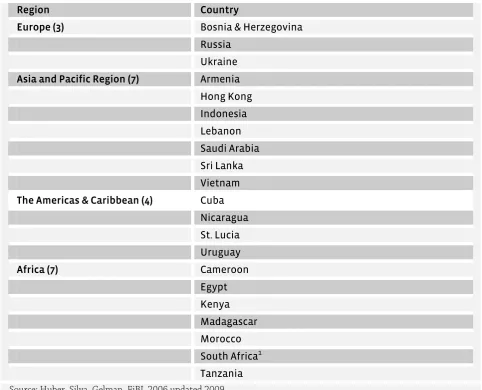
Table 18: Countries in the process of drafting regulations
Region Country
Europe (3) Bosnia & Herzegovina Russia
Ukraine Asia and Pacific Region (7) Armenia
Hong Kong Indonesia Lebanon Saudi Arabia Sri Lanka Vietnam
The Americas & Caribbean (4) Cuba
Nicaragua St. Lucia Uruguay
Africa (7) Cameroon
Egypt Kenya Madagascar Morocco South Africa1 Tanzania
Source: Huber, Silva, Gelman, FiBL 2006 updated 2009
International standards & regulations
IFOAM Organic Guarantee System
The IFOAM Basic Standards2 define how organic products are grown, produced, processed and handled. They reflect the current state of organic production and processing methods. The IFOAM Basic Standards - together with the IFOAM Accreditation Criteria - constitute the IFOAM Norms, which provide a framework for certification bodies and standard-setting organizations worldwide to develop their own certification standards.
Based on the decision of the IFOAM General Assembly in September 2005, IFOAM has been revising the Organic Guarantee System (OGS) with the aim of creating more access to
1 www.afrisco.net/Html/Product_Stardards.htm
2 On the homepage of IFOAM www.ifoam.org under “Organic Guarantee System,” the IFOAM Norms, consisting of
it. IFOAM decided that the OGS, while always upholding the integrity of organic agriculture, should aim to facilitate trade and be able to accommodate all serious organic certification bodies and their clients.
The Codex Alimentarius Guidelines
The need for clear and harmonized rules has not only been taken up by private bodies, IFOAM and state authorities, but also by United Nations Organizations, including the Food and Agriculture Organization of the United Nations (FAO), the World Health Organization (WHO) and the United Nations Conference on Trade and Development (UNCTAD). The FAO and WHO consider international guidelines on organically produced food products to be important instruments for consumer protection and to facilitate trade. They also provide assistance to governments wishing to develop regulations in this area, in particular in devel-oping countries and countries in transition economies.
The Codex Alimentarius Commission was created in 1963 by the FAO and WHO to develop food standards, guidelines and related texts such as codes of practice under the Joint FAO/WHO Food Standards Program; it established the Guidelines for the Production, Processing, Labeling and Marketing of Organically Produced Foods. The Codex Commission approved plant production guidelines in June 1999, and animal production guidelines in July 20011 The requirements in these Codex Guidelines are in line with the IFOAM Basic Standards and the EU Regulation (EEC) 2092/91. There are, however, differences with regard to the details and some specific areas that are covered by the varying standards.
The trade guidelines on organic food take into account the current regulations in several countries, in particular the former EU Regulation 2092/91, private standards applied by producer organizations - especially those based on the IFOAM Basic Standards. These guide-lines define the nature of organic food production and prevent claims that could mislead consumers about the quality of the product or the way it was produced.
From IFOAM's perspective, the Codex Guidelines are an important step towards the har-monization of international rules that serve to build consumer trust. They will be important for equivalence judgments under the rules of WTO. In terms of developing the market for organically produced food, these Codex Guidelines provide guidance to governments in developing national regulations for organic food.
The annex lists, which define what substances can be used in organic food and farming systems, have been under revision since 2005, with a focus on substances for food process-ing and the criteria for the use of new substances. A workprocess-ing group within the Codex Com-mittee for Food Labeling (CCFL), which meets every year in May and is supported by the government of Canada, is charged with this work. The Codex Commission adopted several amendments in the annex lists that were proposed by the CCFL in July 2008. Other sub-stances, like nitrate, nitrates and ascorbates for meat processing and phosphates as food additives, however, were rejected for inclusion in the Codex Guidelines for organic food. In 2009, the discussion about deleting or restricting substances for pest control (in particular
1 Information about Codex Alimentarius is available via the homepage www. codexalimentarius.net. The
Rotenone) and concerning the use of ethylene other than for bananas and kiwi fruits will continue.
EU Regulation on Organic Agriculture
Revision of the basic rules
In their conclusions on the European Action Plan on Organic Agriculture in 2004, the Euro-pean Council requested that the EU Regulation 2092/91 on organic farming be revised in order to achieve a simplified, more coherent and less detailed regulation. In July 2007, ‘Council Regulation (EC) No 834/2007 of 28 June 2007 on organic production and labeling of organic products and repealing Regulation (EEC) No 2092/91’ was adopted. This regula-tion describes the objectives, principles and basic requirements of regularegula-tions for organic production. It does not cover most of those sections that are currently regulated by annexes I to VIII, including production rules, minimum inspection rules, list of approved farm in-puts, ingredients, aids and additives.
The new regulation was completely re-structured and rephrased. It replaces EU Regulation (EEC) 2092/91 and came into force on January 1, 2009. Although the European Commission aimed at conserv-ing the main content of the regulation 2092/91, there are abundant changes in the details, some of which may have seri-ous impacts on organic farming in future. Changes relevant to producers and traders can be found in the following areas:
- Labeling requirements: the EU logo becomes mandatory for pre-packaged products produced in the EU from mid 2010 onwards. The use of the EU logo for imported products is voluntary. The EU has announced a revision of the current EU logo. The new design is expected to be pub-lished in 2009. Other changes in-clude the introduction of the indica-tion of origin and the labeling of or-ganic ingredients in products that are mainly non-organic.
Overview on the structure of the new EU Regulation on Organic Production (EU Reg. 834/2007 and its implementa-tion rules)
Basic Regulation
- Council Regulation (EC) No 834/2007 of 28 June 2007 on organic production and labeling of organic products and repea-ling Regulation (EEC) No 2092/91 Implementation Rules
- COMMISSION REG. (EC) No 889/2008 … for the implementation of Council Reg. (EC) No 834/2007… with regard to orga-nic production, labeling and control - COMMISSION REG. (EC) No 1235/2008 … for implementation of Council Reg. (EC) No 834/2007…regarding the arrange-ments for imports of organic products from third countries
Further implementation rules, such as for aquaculture, wine… Guidelines
- Flexibility rules: The rules shall be more flexible to reflect different regional frameworks and allow for suitable reactions in catastrophic circumstances.
- There is a standard form for certificates.
- The import scheme will be completely revised (see below).
The IFOAM EU Group has published an introduction and interpretation on the new EU regulation.1 The revised Regulation 834/2007 and its implementation rules are published on the EUR-Lex website. They are available in all official languages of the European Union.
Revised import procedures
At the end of December 2006, the EU published new regulations concerning the importa-tion of organic products. The revised import procedures will replace the current (temporary) system of import authorizations by an approval system for inspection bodies operating in countries outside of the EU. Import authorizations will only be issued 12 months after the EU has published the first list of approved inspection bodies operating in Third Countries. The list is expected to be published in 2010 or 2011.
The existing system for approval of countries in the so-called ‘Third Country List’ is main-tained. In the future, products can only imported into the EU if they have been certified by an inspection body or authority recognized by the European Commission. The EU will pub-lish lists of approved inspection bodies and authorities as well as approved third countries. There will be three different lists:
1) List of inspection bodies that apply an inspection system and production stan-dards equivalent to the EU regulation.
2) List of inspection bodies that have been accredited according to EN 45011/ISO 65 and that apply an inspection system and production rules compliant with the EU Regulation. The provision on compliance with the EU regulation is new.
3) List of countries whose system of production complies with rules equivalent to the EU production and inspection provisions.
Under options 1) and 2), the inspection bodies can either be located within or outside the EU.
Under options 2) and 3) (equivalency-option), the imported products have to be covered by a certificate of inspection, which is not a provision under option 1. For options 2) and 3), the Codex Alimentarius shall be taken into account for assessing equivalency.
The new import regulation allows a more consistent and effective control system for im-ported products and improves the possibilities for supervision of inspection bodies operat-ing in Third Countries. It further increases transparency by publishoperat-ing lists of recognized inspection bodies. In the current system, it was difficult for inspection bodies outside the EU to prove the acceptance of their certification in the EU. They depended on European importers willing to take the hurdle to apply for an import authorization with a new or unknown inspection body. The new system allows inspection bodies from non-EU-countries to apply for recognition at their own initiative; they may prove their recognition prior to the
start of trade relationships. This reduces the risk of importers when importing products certified by non-European and/or less known inspection bodies.
Import requirements of major economies
The most important import markets for organic products are the EU, US and Japan. All have strict regimes for the importation of organic products. In the EU, US and Japan, prod-ucts may only be imported if the certifying agency has been approved by the respective competent authority.
Approval of certification bodies requires compliance or equivalency with the requirements of the importing countries, which can be achieved by the following options: a) Bilateral agreements between the exporting and the target import country and b) direct acceptance of the certifying agency by the target import country.
Bilateral agreements between the exporting and the target import country:
Most importing countries - including US, EU and Japan - have options for bilateral recogni-tion. A country may confirm that another country's control system and the standards are in line with the national requirements, and that the products certified in those countries can be sold on the national market. The EU currently recognizes seven countries.1 The bilateral agreements are largely political agreements that depend on the will and political negotia-tions of the governments, rather than the results of technical assessments.
So far, the US has accepted few foreign governments’ accreditation procedures. Certification bodies accredited according to the US requirements by Denmark, UK, India, Israel, New Zealand and Quebec are accepted by the USDA for certifying according to the US National Organic Program (NOP)2 without being directly accredited by United States Department of Agriculture (USDA). This is just recognition of the accreditation procedures; the respective certification bodies still have to meet the requirements of NOP to issue certificates accepted by the US.
In addition, the US is negotiating equivalency agreements with Australia, the European Union, India and Japan. This means that USDA would determine that their technical re-quirements and conformity assessment system adequately fulfill the objectives of the NOP, and double certification would not be necessary for imports. The US announced that equiva-lency determinations are very complex and time consuming, and for the time being, nego-tiations with the EU are on hold, especially for animal production.
Acceptance of the certifying agency by the target import country
The US, EU and Japan have options for recognizing certification bodies operating outside the country. The technical requirements for achieving such recognition are difficult to meet, and the associate fees are high. Maintaining recognition and/or the necessary accreditation requires substantial financial capacity and personnel from the certification agency.
The US NOP requires all produce labeled as organic in the US to meet the US standards, including imported products. The US system provides for the approval of certification bod-ies as agents to operate a US certification program. Retroactive certification is not possible. Inspections have to be conducted by inspectors trained in NOP requirements using NOP questionnaires, and only certificates issued by certification bodies accredited by the US Department of Agriculture USDA are accepted. It is not relevant whether the certification body is based in the US or elsewhere. So far, almost 100 certification bodies have been accredited according to NOP by the USDA, and only produce certified by these certification bodies may be exported to the US.
Literature
Council Regulation (EC) No 834/2007 of 28 June 2007 on organic production and labelling of organic products and repealing Regulation (EEC) No 2092/91;
eur-lex.europa.eu/LexUriServ/LexUriServ.do?uri=OJ:L:2007:189:0001:0023:EN:PDF
Commission Regulation (EC) No 1254/2008 of 15 December 2008 amending Regulation (EC) No 889/2008 laying down detailed rules for implementation of Council Regulation (EC) No 834/2007 on organic production and labelling of organic products with regard to organic production, labelling and control;
eur-lex.europa.eu/LexUriServ/LexUriServ.do?uri=OJ:L:2008:337:0080:0082:EN:PDF
Commission Regulation (EC) No 1235/2008 of 8 December 2008 laying down detailed rules for implementation of Council Regulation (EC) No 834/2007 as regards the arrangements for imports of organic products from third countries; eur-lex.europa.eu/LexUriServ/LexUriServ.do?uri=OJ:L:2008:334:0025:0052:EN:PDF Commission Regulation (EC) No 889/2008 of 5 September 2008 laying down detailed rules for the implementation of
Council Regulation (EC) No 834/2007 on organic production and labelling of organic products with re-gard to organic production, labelling and control;
eur-lex.europa.eu/JOHtml.do?uri=OJ:L:2008:250:SOM:EN:HTML
DiMatteo, Katherine (2007) Overview of group certification. Prepared for the 7th meeting of the UNCTAD/ FAO/ IFOAM International Task Force on Harmonisation and Equivalence in Organic Agriculture in Bali, Indo-nesia. 27-30 November 2007.
http://www.unctad.org/trade_env/itf-organic/meetings/itf7/ITF0711_GrowerGroups.pdf
Huber et al. (2008) Standards and Regulations. In: Willer/Yussefi (Eds.) The World of Organic Agriculture. Statistics and Emerging Trends 2007, International Federation of Organic Agriculture Movements IFOAM, Bonn, Germany and Research Institute of Organic Agriculture FiBL, Frick, Switzerland. orgprints.org/10506/ Schmid, Otto, et al. (2007): Analysis of EEC regulation 2092/91 in relation to other national and international organic
standards. Report (Deliverable D 3.2). EEC 2092/91 (Organic) Revision project. Research Institute of Or-ganic Agriculture FiBL, CH-Frick. www.orOr-ganic-revision.org/pub/D_3_2_final%20report_low.pdf. Data-base www.organicrules.org
IFOAM EU Group (2009): The New Organic Regulation for Organic Food and Farming in Europe: EC 834/2007 - Background, assessment and interpretation for stakeholders. IFOAM European Union Group, Brussels
Websites
www.fao.org/organicag/: Information on organic agriculture by FAO with detailed country reports including the on legal situation
www.ifoam.org/about_ifoam/standards/index.html: IFOAM Guarantee system
www.ams.usda.gov/nop/indexIE.htm: Information about the US National Organic Program (NOP)
www.unctad.org/trade_env/itf-organic/ welcome1.asp: International Task Force on Harmonization and Equivalency in Organic Agriculture (ITF).
www.codexalimentarius.net/ download/standards/360/CXG_032e.pdf The Codex Alimentarius Commission and the FAO/WHO Food Standards Program: Organically Produced Foods, Rome 2007
www.ifoam.org/about_ifoam/around_world/eu_group/web_Revision/Revision_info_page.html : IFOAM EU Info page on the Revision process of EU Regulation 2092/91.
www.unctad.org/trade_env/ITF-organic/welcome1.asp: Minutes and working documents of the International Task Force on Harmonization and Equivalence in Organic Agriculture