Genesis: An Extensible Java
by
Ian Lewis BComp Hons
Submitted in fulfilment of the requirements for the
Degree of Doctor of Philosophy
University of Tasmania
This thesis contains no material which has been accepted for a degree or diploma by the University or any other institution, except by way of background information and duly acknowledged in the thesis, and to the best of the candidate’s knowledge and belief no material previously published or written by another person except where due
acknowledgement is made in the text of the thesis.
This thesis may be made available for loan and limited copying in accordance with the
Copyright Act 1968.
Abstract
Extensible programming languages allow users to create fundamentally new syntax and translate this syntax into language primitives. The concept of compile-time meta-programming has been around for decades, but systems that provide such abilities generally disallow the creation of new syntactic forms, or have heavy restrictions on how, or where, this may be done.
Genesis is an extension to Java that supports compile-time meta-programming by allowing users to create their own arbitrary syntax. This is achieved through macros that operate on a mix of both concrete and abstract syntax, and produce abstract syntax. Genesis attempts to provide a minimal design whilst maintaining, and extending, the expressive power of other similar macro systems.
The core Genesis language definition lacks many of the desirable features found in other systems, such as quasi-quote, hygiene, and static expression-type dispatch, but is expressive enough to define these as syntax extensions. User-defined macros produce only well-formed syntactic structures via the use of a predefined set of classes that define a Java abstract syntax.
At the heart of Genesis is a flexible parser that is capable of parsing any context-free grammars — even ambiguous ones. The parser is capable of arbitrary speculation and will consider all possible parses. The parser constructs a graph of possible paths, and is capable of dynamically pruning this graph, or combining nodes, based on precedence or associativity rules. This general parser allows macro programmers to forget about parsing, and concentrate on defining new syntax.
One key goal of this system was to address the programmer’s learning curve by providing as simple a system as possible. This was achieved by the use of the flexible parser, the introduction of only one new construct to standard Java, and extensions to make programming macros more user friendly.
Acknowledgements
Thanks to Vishv for being my most long-suffering supervisor and for steadfastly maintaining to this day that he has no idea what I am doing whatsoever.
Also, to Arthur and Julian for helping get me over the line, battered and bruised though I may be.
Thanks to the School of Computing for providing support when it was really necessary and without which I would never even come close to finishing.
To Julian for showing me no matter how annoyingly pedantic I may have thought myself there is always someone worse, and who will scare me.
To Nicole simply for torturing countless cats (as is my understanding) rather than slaying me alive simply because, as my office neighbour, she was Ned to my Homer. To Adam for giving us all someone to mutter incessantly under our breaths about at his appearance of progress and for all the tennis ball humour — just hilarious. Oh yeah, and for proof-reading.
Thanks to Mark for all of those closed door discussions, the whiteboard Jeffisms, misogynistic research proposals, and for becoming a living urban legend.
To Byeong for showing me that it really is worth taking the time to greet people, and for being brave enough to come drinking with me — once.
To Craig, for scheduling his holiday for the worst possible time… and for making up for it by scheduling another celebratory one once this ordeal is finally over.
Thanks to Banjo’s, Hungry Jacks, Eastlands, Centrepoint, Northgate, KFC, and their ilk for donating places where, strangely, I initially found myself most productive.
Particularly thanks to those who donated their power to make this all possible.
To my darling girlfriend Kim for tolerating all those assurances of “two more weeks”, and just being tolerant in general.
Table of Contents
ABSTRACT...VII
ACKNOWLEDGEMENTS...IX
TABLE OF CONTENTS...XI
LIST OF CODE EXAMPLES...XVIII LIST OF FIGURES...XXI
LIST OF TABLES...XXII
1 INTRODUCTION...1
1.1 OVERVIEW...2
1.1.1 Assessment of Success ...3
1.1.2 Conventions...4
1.2 SOURCES OF CODE EXAMPLES...6
1.2.1 Java...6
1.2.1.1 Java1.4...6
1.2.1.2 Java1.5...7
1.2.2 MultiJava ...7
1.2.3 Maya...7
1.2.4 Java Syntax Extender ...8
1.2.5 OpenJava ...8
1.2.6 Haskell...8
1.2.7 Template Haskell...9
1.2.8 Lisp...9
1.2.8.1 Common Lisp ...9
1.2.8.2 Scheme ...9
1.2.9 C++...10
1.2.10 MS2...10
1.2.11 SQL ...10
1.2.12 Pro*C...10
1.2.13 Icon...11
1.2.14 Ada ...11
1.3 THESIS STRUCTURE...12
2 EXTENSIBILITY...15
2.1 OVERVIEW...16
2.2 DEFINING EXTENSIBLE...17
2.2.1 Other Similar Terminology ...17
2.2.2 Previous Extensibility Definitions...17
2.2.3 Definition of Extensible ...18
2.3 LANGUAGE EXTENSION MECHANISMS...20
2.3.1 Library Systems...20
2.3.1.1 Threading...21
2.3.1.2 SQL ...22
2.3.1.3 Summary ...24
2.3.2 Open Compilers...24
2.3.2.1 Glasgow Haskell Compiler ...25
2.3.2.2 Summary ...25
2.3.3 Text Macros...25
2.3.3.1 Assertions...27
2.3.3.2 Iteration ...28
2.3.3.3 Generators ...28
2.3.3.4 Message Maps ...33
2.3.3.5 DEBUG_NEW ...34
2.3.3.6 Summary ...35
2.3.4 Two-tier Languages...35
2.3.4.1 C++ Template Meta-programming ...36
2.4 IS EXTENSIBILITY NECESSARY? ... 40
2.4.1 What is Necessary? ... 42
2.4.2 Language Modifications ... 43
2.4.2.1 Language Standards Revision / Development ... 44
2.4.2.2 Research Languages... 44
2.4.2.3 Embedded Languages... 45
2.4.2.4 Java1.5 ... 46
2.4.3 How Much Power is Too Much Power? ... 47
2.4.4 Multi-paradigm languages ... 48
2.4.5 Previous Interest ... 49
3 ASSESSMENT OF EXTENSIBILITY... 51
3.1 OVERVIEW... 52
3.2 DESIRABLE LANGUAGE PROPERTIES... 53
3.2.1 Hygiene and Referential Transparency... 54
3.3 CRITERIA FOR RATING EXTENSIBLE LANGUAGES... 56
3.3.1 Power ... 56
3.3.2 Usability... 57
3.3.3 Error Handling ... 58
3.3.4 Previous Research... 58
3.4 BENCHMARK TEST CASES... 60
3.4.1 Simple constructs ... 61
3.4.1.1 Assertions ... 61
3.4.1.2 Iteration... 63
3.4.1.3 Typesafe Formatted Output ... 65
3.4.2 Complex Constructs... 67
3.4.2.1 SQL Subset ... 67
3.4.2.2 Generators... 68
3.4.2.3 Haskell Subset ... 69
4 REVIEW OF EXTENSIBLE LANGUAGES... 75
4.1 OVERVIEW... 76
4.2 LISP /SCHEME... 78
4.2.1 Power ... 79
4.2.1.1 S-expressions ... 79
4.2.1.2 Macros: defmacro ... 80
4.2.1.3 Macros: define-syntax ... 81
4.2.1.4 Syntax Creation ... 82
4.2.2 Usability... 82
4.2.2.1 Name Capture: gensym ... 83
4.2.2.2 Name Capture: define-syntax Revisited ... 83
4.2.3 Error Handling ... 84
4.2.4 Applicability to Benchmarks ... 85
4.2.5 Extensibility Criteria Assessment ... 86
4.3 TEMPLATE HASKELL... 88
4.3.1 Power ... 88
4.3.1.1 Reification ... 89
4.3.2 Usability... 89
4.3.2.1 Splicing... 90
4.3.2.2 Quasi-quotation... 91
4.3.3 Error Handling ... 91
4.3.4 Worked Examples... 92
4.3.4.1 Type-safe Formatted Output... 92
4.3.4.2 Selection From an N-tuple... 93
4.3.5 Applicability to Benchmarks ... 94
4.3.6 Extensibility Criteria Assessment ... 95
4.4 META SYNTACTIC MACRO SYSTEM... 97
4.4.1 Power ... 97
4.4.2 Usability... 97
4.4.4 Worked Examples ...98
4.4.4.1 Dynamic Binding ...98
4.4.4.2 Extended Enumerations ...100
4.4.5 Applicability to Benchmarks...102
4.4.6 Extensibility Criteria Assessment...103
4.5 JAKARTA TOOL SUITE...105
4.6 JAVA SYNTAX EXTENDER...106
4.6.1 Power...106
4.6.2 Usability ...107
4.6.3 Error Handling...108
4.6.4 A Worked Example: foreach ...108
4.6.4.1 Underlying Implementation ...108
4.6.4.2 The syntax Macro...109
4.6.5 Applicability to Benchmarks...110
4.6.6 Extensibility Criteria Assessment...111
4.7 OPENJAVA...113
4.7.1 Power...113
4.7.2 Usability ...114
4.7.3 Error Handling...114
4.7.4 Applicability to Benchmarks...115
4.7.5 Extensibility Criteria Assessment...115
4.8 MAYA...117
4.8.1 Power...117
4.8.1.1 Grammar Productions and Semantic Actions...117
4.8.1.2 Laziness...117
4.8.1.3 Overloading Mayans...118
4.8.2 Usability ...118
4.8.3 Error Handling...119
4.8.4 Worked Examples ...119
4.8.4.1 Assertions...119
4.8.4.2 Iteration ...120
4.8.5 Applicability to Benchmarks...123
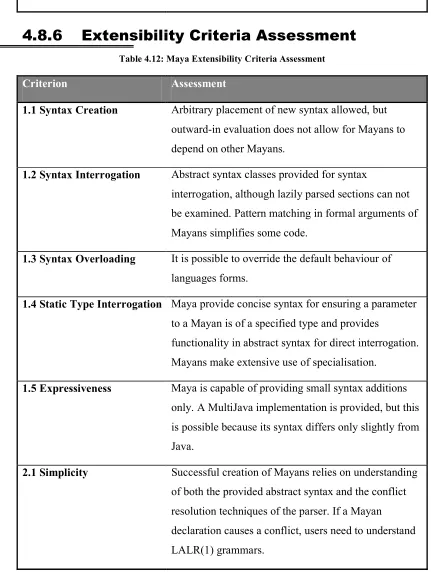
4.8.6 Extensibility Criteria Assessment...124
5 GENESIS LANGUAGE DEFINITION...127
5.1 OVERVIEW...128
5.2 DESIGN RATIONALE...129
5.2.1 Arbitrary Syntax Creation ...129
5.2.2 Compile-time Interrogation ...129
5.2.3 Base Language ...130
5.2.4 Outward Language Simplicity...130
5.2.4.1 Programmer Support ...131
5.2.4.2 Parser Restrictions ...131
5.2.5 Inward Language Simplicity ...131
5.2.6 Error Reporting ...132
5.3 MACRO DEFINITIONS...133
5.3.1 Parameters ...133
5.3.2 Precedence...134
5.3.2.1 Precedence by Grammar Modification...135
5.3.3 Associativity...136
5.3.3.1 Associativity by Grammar Modification ...136
5.3.4 Zero Argument Macros ...136
5.3.5 Modifiers ...137
5.3.6 Exceptions ...137
5.3.7 Macro Body...138
5.3.8 Evaluation Order ...138
5.3.9 Placement and Scope...138
5.3.10 Grammar...139
5.4 TOKENISING...140
5.4.2 Special Cases ... 141
5.4.3 Symbol Handling ... 141
5.4.3.1 Traditional Approach ... 142
5.4.3.2 Explicit Spaces ... 142
5.4.3.3 Single-character Symbols... 142
5.4.3.4 Symbol Combinations... 143
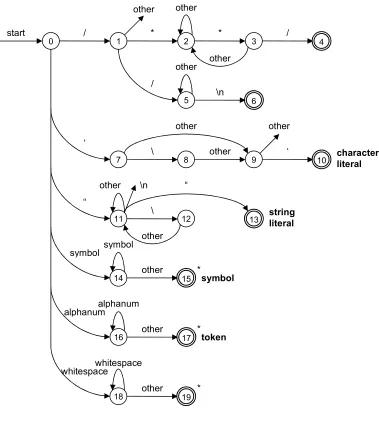
5.4.4 Tokeniser Algorithm... 144
5.5 MACRO EXPANSION... 146
5.5.1 Import Mechanism ... 146
5.5.2 Expansion Strategy ... 146
5.5.2.1 Evaluation Order... 146
5.5.2.2 Construction Versus Manipulation... 147
5.5.2.3 Outermost Versus Innermost Evaluation... 148
5.5.2.4 Non-destructive Restriction ... 149
5.5.2.5 Standard Usage ... 149
5.5.3 Macro Matching... 150
5.5.4 Precedence ... 150
5.5.4.1 Same Sub-rules ... 151
5.5.4.2 Different Sub-rules ... 151
5.5.5 Associativity ... 152
5.5.6 Exceptions... 153
5.5.7 Restrictions ... 153
5.6 STANDARD ENVIRONMENT... 155
5.6.1 Abstract Syntax Classes ... 155
5.6.2 Exceptions... 157
5.6.3 Compile-time Typing... 157
5.6.4 Macro Reflection ... 158
6 REVIEW OF PARSERS... 159
6.1 OVERVIEW... 160
6.1.1 Extensible Language Parsing ... 160
6.1.1.1 Usability ... 161
6.1.1.2 Mid-parse Grammar Modification ... 161
6.2 GRAMMARS... 163
6.2.1 Grammar Structure ... 163
6.2.2 Chomsky Hierarchy ... 163
6.2.3 Context-free Grammars ... 164
6.2.3.1 Backus-Naur Form ... 165
6.2.3.2 Extended BNF ... 165
6.2.4 Grammar Properties ... 166
6.2.4.1 Ambiguous Grammars... 166
6.2.4.2 Left- and Right-recursive Grammars ... 167
6.3 PARSERS... 168
6.3.1 Derivation ... 168
6.3.2 Naming ... 169
6.3.2.1 Derivation Categorisation... 169
6.3.2.2 Lookahead Categorisation ... 169
6.3.3 Tokenising ... 170
6.3.4 Parsing Methods ... 171
6.4 TOP-DOWN PARSING... 172
6.4.1 Predictive Parsing ... 172
6.4.1.1 Advantages ... 173
6.4.1.2 Disadvantages ... 173
6.4.2 Parse Table Approach ... 174
6.4.2.1 Advantages ... 176
6.4.2.2 Disadvantages ... 177
6.4.3 Suitability to Extensible Languages... 177
6.4.3.1 Usability ... 177
6.4.3.2 Mid-parse Grammar Modification ... 177
6.5.1 Shift-reduce Parsing ...178
6.5.2 Operator-precedence Parsing...179
6.5.2.1 Advantages...181
6.5.2.2 Disadvantages...181
6.5.3 LR Parsing...182
6.5.3.1 LALR Parsing ...185
6.5.3.2 SLR Parsing ...187
6.5.3.3 Advantages...187
6.5.3.4 Disadvantages...188
6.5.4 Suitability to Extensible Languages ...188
6.5.4.1 Usability...188
6.5.4.2 Mid-parse Grammar Modification ...189
6.6 GENERAL PARSING...190
6.6.1 CYK Parsing ...190
6.6.2 Earley’s Algorithm ...191
6.6.3 Chart Parsers ...192
6.6.4 Suitability to Extensible Languages ...193
6.6.4.1 Usability...193
6.6.4.2 Mid-parse Grammar Modification ...193
6.7 ANALYSIS...194
6.7.1 Power...194
6.7.2 Efficiency ...195
6.7.3 Suitability to Extensible Languages ...195
6.7.3.1 Usability...195
6.7.3.2 Mid-parse Grammar Modification ...196
7 GRAPH EXPANSION PARSING...197
7.1 OVERVIEW...198
7.1.1 Similarities to Chart Parsing Methods...198
7.2 DEVELOPMENT...199
7.2.1 Multipass Method...199
7.2.2 Single Pass Method ...201
7.2.3 Optimised Method...204
8 IMPLEMENTATION...207
8.1 OVERVIEW...208
8.2 MACRO DEFINITION TRANSLATION...209
8.2.1 Basic Translation...209
8.2.2 Name Mangling...210
8.2.2.1 Terminals and Non-terminals ...210
8.2.2.2 Symbols ...212
8.2.2.3 Precedence...213
8.2.2.4 Associativity ...213
8.2.2.5 Delayed Macros ...213
8.2.2.6 Mangling Grammar and Algorithm ...213
8.3 IMPORT MECHANISM...215
8.4 TOKENISER...216
8.4.1 String and Character Literals...216
8.4.2 Multi-character Symbols ...217
8.5 PARSER...218
8.5.1 Sub-type Non-terminal Matching...218
8.5.2 Partial Match Tree ...218
8.5.3 Abstract Syntax Tree ...219
8.5.4 Error Handling...219
8.5.4.1 Syntax Errors ...219
8.5.4.2 Exception Errors...220
8.6 STANDARD USAGE...221
8.6.1 Command-line Arguments ...221
8.6.1.1 Classpath ...221
8.6.1.3 Production of Java Source Code ... 222
8.7 STANDARD LIBRARY EXTENSIONS... 223
8.7.1 Quasi-quotation... 223
8.7.1.1 Hygiene ... 224
8.7.1.2 Unquoting... 225
8.7.2 Macro Definition Shorthands... 226
8.7.2.1 Automatic Construction Macros... 226
8.7.2.2 Automatic Lists ... 226
8.7.2.3 Optional Macro Parameters... 227
8.7.2.4 Statically Type-checked Parameters ... 229
9 ANALYSIS AND COMPARISON... 231
9.1 OVERVIEW... 232
9.2 IMPLEMENTATION OF TEST CASES... 233
9.2.1 Assertions ... 233
9.2.1.1 Basic Implementation ... 233
9.2.1.2 Quasi-quote Implementation ... 234
9.2.1.3 Implementation Issues ... 234
9.2.2 Iteration... 234
9.2.2.1 Basic Implementation ... 234
9.2.2.2 Quasi-quote Implementation ... 235
9.2.2.3 Hygienic Implementation ... 236
9.2.2.4 Static-type Matching Implementation... 236
9.2.3 Type-safe Formatted Output ... 236
9.2.3.1 Example Expansion ... 239
9.2.4 SQL Subset ... 239
9.2.5 Generators... 241
9.2.5.1 Translation of Formal Parameters... 243
9.2.5.2 Translation of Local Variable Declarations ... 243
9.2.5.3 Generation of Resumable Code... 244
9.2.5.4 Example Expansions... 244
9.2.5.5 Explicit Use of GeneratorBase ... 246
9.2.5.6 Implementation Issues ... 247
9.2.6 Haskell Subset... 248
9.2.6.1 Construction ... 248
9.2.6.2 Type Abstract Syntax Classes... 249
9.2.6.3 Evaluation ... 251
9.2.6.4 Type Checking ... 253
9.2.6.5 Embedded Usage... 253
9.2.6.6 Standalone Usage... 254
9.2.6.7 Extended Forms... 255
9.2.7 Implementation Review ... 257
9.3 QUALITATIVE ASSESSMENT... 261
9.3.1 Power ... 261
9.3.1.1 Benchmark Test Cases... 262
9.3.1.2 Quasi-quotation Implementation... 262
9.3.1.3 Other Standard Library Macros... 262
9.3.2 Usability... 263
9.3.3 Error Handling ... 264
9.3.4 Extensibility Criteria Assessment ... 264
9.4 MAYA COMPARISON... 269
9.4.1 Benchmark Test Cases Comparison ... 269
9.4.1.1 Lines of Code Comparison ... 271
9.4.2 MultiJava ... 272
9.4.3 Extensibility Criteria Comparison Summary ... 273
9.5 GRAPH EXPANSION PARSING... 277
9.5.1 Acceptable Grammars... 277
9.5.2 Efficiency... 277
9.5.2.1 Theoretical Performance... 277
10CONCLUSION AND FUTURE WORK...283
10.1 CONCLUSION...284
10.2 FUTURE WORK...286
10.2.1 Flexible Lexical Analysis ...286
10.2.2 Delayed Macros...287
10.2.3 Zero Argument Macros ...287
10.2.4 Migration to Java1.5...288
10.2.5 Parser Efficiency ...288
10.2.6 Context-sensitive Graph Expansion Parsing ...289
10.2.7 Integration of Genesis Parsing and Java Compiling...289
10.2.8 Improved Error Tracking...289
10.2.9 Usability Surveys ...290
10.2.10 Library Support ...290
10.2.11 Improved Embedded Haskell ...290
10.2.12 Ultimate Aim ...291
REFERENCES...293
AGENESIS ABSTRACT SYNTAX...305
A.1 ABSTRACT SYNTAX CLASSES...306
BGENESIS AND MAYA SIMPLE TEST CASES...313
B.1 ASSERTIONS...314
B.2 ITERATION...315
List of Code Examples
Code Example 2.1: Java Threading ...21
Code Example 2.2: Ada Threading (modified from [Bar91§14.4, pp. 291])...22
Code Example 2.3: Java Embedded SQL ...23
Code Example 2.4: Pro*C Embedded SQL ...24
Code Example 2.5: C++ Macro Misuse...26
Code Example 2.6: C++ Macro Parsing Difficulties ...26
Code Example 2.7: Powerful C++ Macro Construct ...27
Code Example 2.8: C++ Assertion Macro...27
Code Example 2.9: C++ Iteration Macro...28
Code Example 2.10: Icon Fibonacci Generator ...29
Code Example 2.11: Icon Fibonacci Sequence...29
Code Example 2.12: Improved Icon Fibonacci Sequence ...29
Code Example 2.13: C++ Generator Helper Classes ...30
Code Example 2.14: Basic C++ Generator Macros...31
Code Example 2.15: C++ Fibonacci Generator ...31
Code Example 2.16: C++ Fibonacci Generator After Macro Expansion ...32
Code Example 2.17: Extended C++ Generator Macros...33
Code Example 2.18: Improved C++ Fibonacci Generator ...33
Code Example 2.19: C++ Message Map Macro Usage ...34
Code Example 2.20: C++ Debugging Macro ...34
Code Example 2.21: C++ Debugging Macro Usage...35
Code Example 2.22: C++ Debugging Macro After Expansion ...35
Code Example 2.23: C++ Template Meta-programming ...36
Code Example 3.1: Assertions...61
Code Example 3.2: Java1.5 Assertions...62
Code Example 3.3: Maya Assertions...63
Code Example 3.4: Iteration ...63
Code Example 3.5: C++ STL Iteration ...64
Code Example 3.6: Java1.5 Iteration ...64
Code Example 3.7: Maya Iteration ...65
Code Example 3.8: Typesafe Formatted Output...65
Code Example 3.9: Java1.5 Typesafe Formatted Output...67
Code Example 3.10: Embedded SQL Subset...68
Code Example 3.11: Java Generators ...69
Code Example 3.12: Embedded Haskell Subset ...70
Code Example 3.13: map Function ...70
Code Example 3.14: map Function with Type Signature ...71
Code Example 3.15: map Function Without Pattern Matching...72
Code Example 3.16 map Function Using Lambda Functions ...72
Code Example 3.17: List Comprehension Decomposition ...73
Code Example 4.1: Simple Lisp Program Fragment ...79
Code Example 4.2: Lisp Quotation Expression for Code Example 4.1 ...79
Code Example 4.3: Lisp Simulated Infix Expressions...80
Code Example 4.4: defmacro...80
Code Example 4.5: define-syntax...81
Code Example 4.6: define-syntax General Form ...81
Code Example 4.7: Quasi-quote and Unquote...82
Code Example 4.8: swap Function...82
Code Example 4.9: Improved swap Function ...83
Code Example 4.10: Hygienic swap Function ...83
Code Example 4.11: swap Function using syntax-case...84
Code Example 4.12: swap Function with Error Handling...85
Code Example 4.13: Template Haskell printf Expansion ...90
Code Example 4.15: Illegal Template Haskell Quasi-quotation ... 91
Code Example 4.16: Template Haskell printf Definition ... 92
Code Example 4.17: Template Haskell printf Usage... 93
Code Example 4.18: Template Haskell N-tuple Selection ... 94
Code Example 4.19: Template N-tuple Selection Expansion ... 94
Code Example 4.20: MS2 Enumerations ... 97
Code Example 4.21: MS2 Dynamic Binding... 99
Code Example 4.22: Printable Enumerations... 101
Code Example 4.23: JSE Iteration Definition ... 109
Code Example 4.24: JSE Improved Iteration Definition... 109
Code Example 4.25: Open Java Visitor Methods Usage... 113
Code Example 4.26: Open Java Visitor Methods Definition ... 114
Code Example 4.27: Maya Assertions ... 120
Code Example 4.28: Maya Iteration Usage and Expansion ... 121
Code Example 4.29: Partial Maya Iteration Definition ... 122
Code Example 5.1: Grammar to Macro Translation ... 133
Code Example 5.2: Raw and Quoted Terminals ... 134
Code Example 5.3: Precedence Syntax ... 134
Code Example 5.4: Associativity Syntax ... 136
Code Example 5.5: printf Macro Prototypes ... 147
Code Example 5.6: Nested Macro Use ... 148
Code Example 5.7: Ambiguous Java Declarations ... 150
Code Example 5.8: Macro Reflection Methods ... 158
Code Example 6.1: Simple Expression Predictive Parser ... 173
Code Example 6.2: Table-driven Simple Expression Parser... 175
Code Example 6.3: Simple Expression Operator-precedence Parser ... 181
Code Example 6.4: Simple Expression LR Parser ... 184
Code Example 6.5: CYK Algorithm ... 190
Code Example 6.6: Earley’s Algorithm ... 192
Code Example 7.1: Multipass Graph Expansion Algorithm ... 199
Code Example 7.2: Single Pass Graph Expansion Algorithm... 201
Code Example 7.3: Final Graph Expansion Algorithm... 204
Code Example 8.1: Basic Macro Translation... 209
Code Example 8.2: Basic Name Mangling ... 210
Code Example 8.3: Java Reserved Word Mangling... 211
Code Example 8.4: Mangled Name Conflict Resolution ... 212
Code Example 8.5: Symbol Mangling ... 212
Code Example 8.6: Code Fragment Without Multi-character Symbols... 216
Code Example 8.7: Code Fragment Containing Multi-character Symbol s ... 217
Code Example 8.8: Genesis Quasi-quotation ... 223
Code Example 8.9: Partial Basic Quasi-quotation Definition ... 224
Code Example 8.10: Unquoting Implementation ... 225
Code Example 8.11: Optional Macro Parameter Class ... 228
Code Example 8.12: Extended Macro Parameter List ... 228
Code Example 8.13: Implementation Outline of Macro Definitions With Optional Arguments ... 229
Code Example 8.14: Factorial Literal Specialisation ... 229
Code Example 9.1: Basic Assertion Implementation... 233
Code Example 9.2: Quasi-quote Assertion Implementation ... 234
Code Example 9.3: Basic Iteration Implementation... 235
Code Example 9.4: Quasi-quote Iteration Implementation ... 235
Code Example 9.5: Hygienic Iteration Implementation ... 236
Code Example 9.6: Static-Type Matching Iteration Implementation... 236
Code Example 9.7: Partial Type-safe Formatted Output Implementation ... 238
Code Example 9.8: Type-safe Formatted Output Expansion ... 239
Code Example 9.9: Partial SQL Subset Implementation ... 240
Code Example 9.10: Generator Helper Class... 241
Code Example 9.12: Generator Method Implementation ...242
Code Example 9.13: Translation of Formal Parameters ...243
Code Example 9.14: Translation of Local Variable Declarations ...243
Code Example 9.15: Repeating Generator Expansion...244
Code Example 9.16: Fibonacci Generator Expansion ...246
Code Example 9.17: Sub-sequence Generator Expansion and Use ...247
Code Example 9.18: FunObject Interface...248
Code Example 9.19: Haskell Subset Cons Abstract Syntax Class...249
Code Example 9.20: Type Abstract Syntax Classes for the Haskell Subset ...250
Code Example 9.21: Evaluation of Function Application ...252
Code Example 9.22: Haskell Subset if Expression...253
Code Example 9.23: Embedded Haskell Wrapper Definition ...254
Code Example 9.24: Standalone Haskell Module ...254
Code Example 9.25: Standalone Haskell main Method...255
Code Example 9.26: Function Declarations Definition ...256
Code Example 9.27: Operator Currying Definition...256
Code Example 9.28: Simple Single Source List Comprehensions ...256
Code Example 9.29: Multiple Condition Single Source List Comprehensions ...257
Code Example 10.1: Extended Tokeniser Possibility ...286
Code Example 10.2: Macro Expansion Requiring Delayed Macros ...287
Code Example A.1: Compilation Unit Classes ...304
Code Example A.2: Type Classes...305
Code Example A.3: Statement Classes...305
Code Example A.4: Variable Declaration Classes...306
Code Example A.5: Method and Type Declaration Classes ...307
Code Example A.6: Expression Classes ...308
Code Example A.7: Identifier Classes ...309
Code Example A.8: Literal Classes ...309
Code Example B.1: Genesis Assertion Definition...314
Code Example B.2: Maya Assertion Definition ...314
Code Example B.3: Genesis Iterator Definition ...315
Code Example B.4: Maya Iterator Definition...315
Code Example B.5: Genesis Type-safe Formatted Output Definition...316
List of Figures
Figure 3.1: SQL Subset Grammar... 68
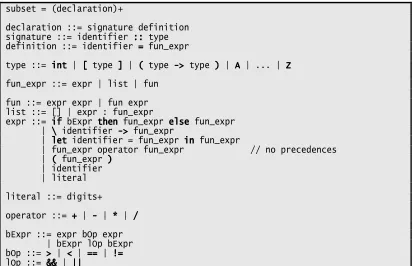
Figure 3.2: Haskell Subset Grammar ... 73
Figure 3.3: Haskell Embedding Grammar ... 74
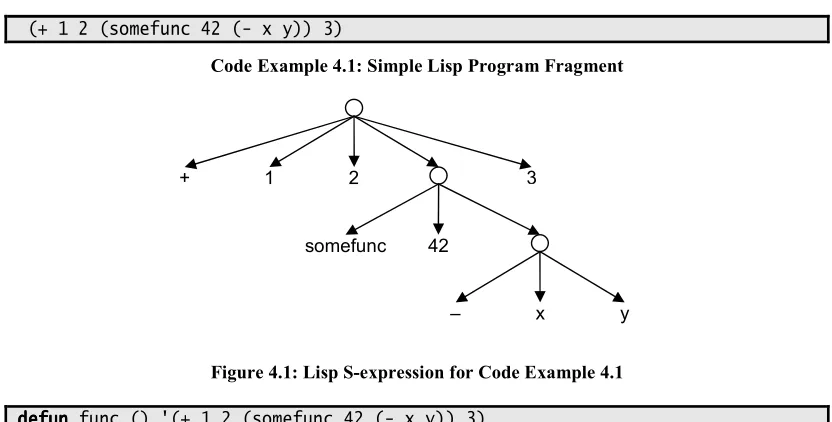
Figure 4.1: Lisp S-expression for Code Example 4.1... 79
Figure 4.2: JSE Call and Statement Macro Grammars... 106
Figure 5.1: Expression Grammar ... 135
Figure 5.2: Method Definition Grammar ... 137
Figure 5.3: Genesis Grammar ... 139
Figure 5.4: Simple Tokenising ... 141
Figure 5.5: Multi-character Symbol Grouping Tokenising ... 141
Figure 5.6: Single-character Symbol Output Tokenising ... 142
Figure 5.7: Multi-character Symbol Combinations Tokenising ... 143
Figure 5.8: Tokeniser Transition Diagram ... 145
Figure 5.9: Same Sub-rule Precedence... 151
Figure 5.10: Different Sub-rule Precedence... 152
Figure 5.11: Associativity ... 152
Figure 5.12: Partial Abstract Syntax Type Hierarchy ... 156
Figure 5.13: Exception Type Hierarchy ... 157
Figure 6.1: Generalised Grammar Rule ... 163
Figure 6.2: BNF Context-free Grammar ... 165
Figure 6.3: Ambiguous Simple Expression Grammar... 166
Figure 6.4: Unambiguous Simple Expression Grammar... 166
Figure 6.5: Non Left-recursive Simple Expression Grammar... 167
Figure 6.6: High-level Compiler Model... 168
Figure 6.7: Derivations... 169
Figure 6.8: Non-ambiguous Unparsable Grammars... 170
Figure 6.9: Deterministic Finite Automaton ... 171
Figure 6.10: Table-driven Predictive Parser Model ... 174
Figure 6.11: Shift-reduce Parser Reductions... 178
Figure 6.12: Shift-reduce Parser Model ... 179
Figure 6.13: Operator-precedence Parser Model... 180
Figure 6.14: LR Parser Model... 182
Figure 6.15: Expression Grammar in Chomsky Normal Form ... 191
Figure 6.16: CYK Expression Parsing Recognition Table ... 191
Figure 6.17: Chart Parser Representation... 193
Figure 7.1: Multipass Graph Expansion... 200
Figure 7.2: Single Pass Graph Expansion ... 202
Figure 7.3: Simple Expression Partial Match Tree ... 205
Figure 7.4: Dangling-else Partial Match Tree ... 205
Figure 8.1: Genesis Compiler Structure ... 208
Figure 8.2: Precedence Mangling Examples ... 213
Figure 8.3: Mangled Name Grammar ... 214
Figure 8.4: Name Mangling Algorithm... 214
Figure 8.5: Graph Produced From Tokenising Code Example 8.6 ... 216
Figure 8.6: Graph Produced From Tokenising Code Example 8.7 ... 217
Figure 8.7: Method Declaration Fragment ... 227
Figure 9.1: Differing Time Complexities of Earley’s Algorithm... 278
Figure A.1: High-level Abstract Syntax Class Hierarchy ... 306
Figure A.2: Declaration Abstract Syntax Class Hierarchy... 306
List of Tables
Table 3.1: Criteria for rating an Extensible Language’s Power...56 Table 3.2: Criteria for rating an Extensible Language’s Usability ...57 Table 3.3: Criteria for rating an Extensible Language’s Error Handling...58
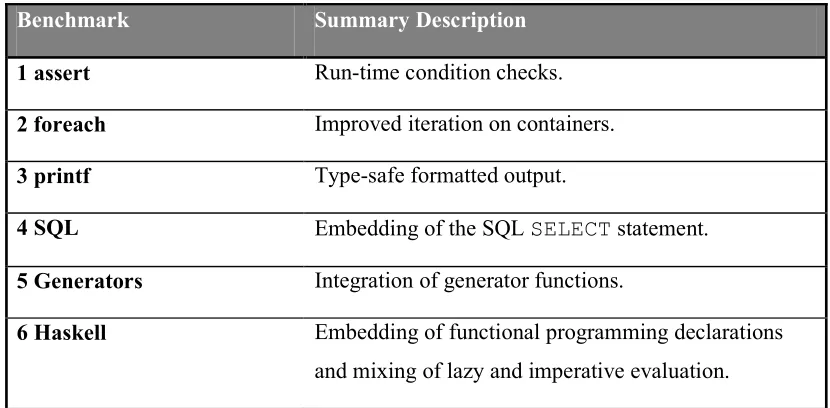
Table 3.4: Benchmark Test Cases Summary ...60
Table 4.1: Lisp Applicability to Benchmark Test Suite...85 Table 4.2: Lisp Extensibility Criteria Assessment...86 Table 4.3: Template Haskell Applicability to Benchmark Test Suite...95 Table 4.4: Template Haskell Extensibility Criteria Assessment...95 Table 4.5: MS2 Applicability to Benchmark Test Suite...102 Table 4.6: MS2 Extensibility Criteria Assessment...103 Table 4.7: JSE Applicability to Benchmark Test Suite...110 Table 4.8: JSE Extensibility Criteria Assessment...111 Table 4.9: OpenJava Applicability to Benchmark Test Suite ...115 Table 4.10: OpenJava Extensibility Criteria Assessment ...115 Table 4.11: Maya Applicability to Benchmark Test Suite...123 Table 4.12: Maya Extensibility Criteria Assessment ...124
Table 6.1: Chomsky Hierarchy...163 Table 6.2: Simple Expression LL Parse Table...176 Table 6.3: Simple Expression Operator-precedence Table...182 Table 6.4: Simple Expression LR Parse Table ...185 Table 6.5: Simple Expression LALR Parse Table ...186
Table 7.1: Single Pass Graph Expansion Evaluation ...203 Table 7.2: Final Algorithm Graph Expansion Evaluation ...205
Introduction
CHAPTER
1
2
3
4
5
6
8
7
9
10
defining extensibility
introduction
assessing extensibility
reviewing extensibility
reviewing parsing designing
the language
language implementation
evaluation
conclusion
1.1
Overview
Extensible programming languages allow users to create fundamentally new syntax and translate this syntax into language primitives. The concept of compile-time meta-programming has been around for decades. It originally appeared in the Lisp [Ste90, Dyb03] community and similar approaches have been attempted in other languages. For example, extensions have been attempted for Haskell [PJ99] and C [KR78] (Template Haskell [SPJ02] and MS2 [WC93] respectively). There is also a limited
meta-programming facility in C++ [Str91]. Typically, systems that provide such abilities generally disallow the creation of new syntactic forms, or have heavy restrictions on how, or where, this may be done. Such restrictions severely limit the forms that can be expressed in such languages.
There have been many attempts of providing meta-programming facilities for Java (eg. [BP01, TCKI00, Bak01]) which are reviewed (along with those of Lisp, C, and Haskell) in Chapter 4.
Genesis is an extension to Java that supports compile-time meta-programming and provides further support by allowing users to create their own arbitrary syntax. This is achieved through macros that operate on a mix of both concrete and abstract syntax, and produce abstract syntax. Genesis provides a minimal design whilst maintaining, and extending, the expressive power of other similar macro systems.
The core Genesis language definition lacks many of the desirable features found in other systems, such as quasi-quote, hygiene, and static expression-type dispatch. Unlike other systems however, Genesis is expressive enough to define these as syntax
extensions (see section 8.6).
Like most such systems, Genesis’ user-defined macros produce only well-formed syntactic structures via the use of a predefined set of classes (see subsection 5.6.1) that define a Java abstract syntax. Programmers are free to extend and add to this set of classes to create their own abstract syntax and to define macros that specify translations in pure Java syntax.
possible paths, and is capable of dynamically pruning this graph, or combining nodes, based on precedence or associativity rules. This general parser allows macro
programmers to forget about parsing, and concentrate on defining new syntax. This is viewed as essential to providing a usable system that allows arbitrary syntax creation. Indeed, one key goal of this system was to address the programmer’s learning curve by providing as simple a system as possible (see section 5.2 for further rationale behind the design). This was achieved by the use of the flexible parser, the introduction of only one new construct to standard Java, and extensions to make programming macros more user friendly.
The expressiveness of Genesis is wide ranging: it is capable of providing small scale limited use macros, large scale semantic modifications, through to complete language replacements. Great care was taken not to limit the scope of applicability of Genesis’ macros.
To demonstrate this expressiveness, we implement many of the simple test cases found in other systems, such as a type-safe printf, assertions, and iteration statements (see subsection 3.4.1 for descriptions of these test cases and section 9.2 for their
implementations). These test cases require an ability to perform static type-checking and to manipulate compile-time values and abstract syntax trees. Whilst these test cases require sophisticated facilities for implementation, they are still limited in scope. As further examples of the expressive power of Genesis we also provide
implementations of embedded subsets of SQL and Haskell (see subsection 3.4.2 for their description and section 9.2 for their implementations). To provide a direct comparison with Maya (the most comparable of the Java extensions) the possibility of MultiJava implementation is discussed in subsection 9.4.2. In addition to these, a generator function (similar to that of Icon [GG90]) implementation is also provided (see subsections 3.4.2.2 and 9.2.5). These extensions require much more sophisticated syntax creation and manipulation facilities than simple statement macros.
As a final proof of power, the Haskell subset can operate as a stand-alone extension independent of any recognisable Java code (see section 9.2.6.6).
1.1.1
Assessment of Success
• Qualitative evaluation against a developed list of criteria for a “good” extensible language (see section 3.3). Other extensible languages will also be rated by these criteria also (see chapter 4).
• Implementation of the benchmark test cases from section 3.4. These test cases are carefully chosen to illustrate the ability to add simple confined constructs, to add outwardly simple but inwardly sophisticated constructs, and to make wholesale changes to the syntax and semantics of the language.
• Direct comparison with implementations of examples from Maya, which, as we shall see in section 4.8, is the most comparable of those languages from previous research. Code length can be used as a real metric of comparison (brevity is one of the criteria identified in section 3.3). Maya and Genesis are also compared across the full range of these criteria.
1.1.2
Conventions
Throughout this work a number of conventions are used for the layout of code examples, grammars, and internet addresses.
Code appearing within text is emphasised by the use of a fixed width font. Code Examples are also in a fixed width font, and use the following conventions:
• Keywords (or equivalent) appear in boldface, eg. while. • Indentation distance is two spaces.
• Gaps in code where effectively any form is appropriate is specified by ellipses, i.e. “…”.
Context-free grammars appear in a fixed width font and use the following conventions: • Terminals appear in boldface, eg. while, ++, etc.
• Productions have a non-terminal left-hand side, followed by ::=, and an Extended BNF right-hand side.
• Square brackets surround optional elements.
• A plus symbol indicates one-or-more of the preceding symbol, eg. identifier+.
• Parentheses group symbols and work in conjunction with other EBNF forms, eg. for a list of comma separated identifiers: identifier (, identifier)+ In-text references are in abbreviated author/date form, eg. [Doe99].
1.2
Sources of Code Examples
In this work, example code is drawn from a large variety of programming languages, either for introduction of the concepts involved, or for direct comparison purposes. Most of these languages are mainstream, while others, due to their research nature, are not. In order to facilitate the accessibility of these later code examples, all of these languages are briefly introduced. These introductions include (where available) references to their formal definitions (or closest approximation), downloadable versions of these
definitions for quick reference, and language homepages.
1.2.1
Java
Java is the implementation language for this work, but “Java” has continued to be redefined, and as a result two distinct flavours of Java are discussed. The version numbers of Java are confusing at best, so it is necessary to define precisely which are meant. In particular we are not concerned with versions of the Java Virtual Machine (JVM), the Java SDK, or any other auxiliary package/facility. In this context the important revisions are those that are made to the language definition and as a result to the compiler.
1.2.1.1
Java1.4
Java1.4 (a.k.a. Java 2 Standard Edition 1.4) had only one minor addition to the language: the introduction of a new statement for handling assertions.
This work describes an extension of Java1.4, and the implementation is in Java1.4.
Language specification: [GJSB00] James Gosling, Bill Joy, Guy Steele, and Gilad Bracha: The Java Language Specification, 2nd Edition, The Java Series, Addison-Wesley, Boston, Massachusetts, 2000. Available from:
ftp://ftp.javasoft.com/docs/specs/langspec-2.0.pdf
1.2.1.2
Java1.5
Java1.51 is the first revision to provide support for generics (also referred to as: templates, parametric polymorphism, etc.) and has a host of other new features, eg. an enhanced for loop, automatic boxing/unboxing, typesafe enumerations, variable length argument lists, static imports, and embedded class metadata.
Language specification: [GJSB05] James Gosling, Bill Joy, Guy Steele, and Gilad Bracha: The Java Language Specification, 3rd Edition, The Java Series, Addison-Wesley, draft, 2005. Available from:
http://java.sun.com/docs/books/jls/java_language-3_0-mr-spec.zip
See also [Bra99] and [Bra02] for further information.
Homepage: http://java.sun.com/
1.2.2
MultiJava
MultiJava is a Java extension that adds open classes and symmetric multiple dispatch (multimethods). Open classes allow the addition of methods to existing classes without modifying the original class, and multimethods provide run-time polymorphic dispatch on all of the arguments of a method, not just the first.
Language specification: [Cli01] Curtis Clifton: MultiJava: Design, implementation, and evaluation of a Java-compatible language supporting modular open classes and
symmetric multiple dispatch, Master’s Thesis, Iowa State University, December 2001. Available from:
http://www.cs.iastate.edu/~cclifton/papers/MastersThesis.pdf
Homepage:http://multijava.sourceforge.net/
1.2.3
Maya
Maya is a Java extension that allows for new syntax creation. It permits both abstract and concrete syntax extension and has a novel approach of lazily interleaving type-checking and parsing.
1 Java1.5 is the revised Java language definition included as part of the (increasingly confusingly named)
Language specification: [Bak01] Jason Baker: Macros that Play: Migrating from Java to Maya, Master’s Thesis, University of Utah, December 2001. Available from:
http://www.cs.utah.edu/~jbaker/maya/thesis.pdf
Homepage:http://www.cs.utah.edu/~jbaker/maya/
1.2.4
Java Syntax Extender
JSE is a Java extension that provides meta-programming support.
Language specification: [BP01] Jonathan Bachrach and Keith Playford: The Java Syntactic Extender (JSE). In, Proceedings of the 16th ACM SIGPLAN Conference on Object Oriented Programming Systems, Languages, and Applications, pp. 31–42, Tampa Bay, Florida, 2001. Available from:
http://people.csail.mit.edu/people/jrb/jse/jse.pdf
Homepage:http://people.csail.mit.edu/people/jrb/jse/index.htm
1.2.5
OpenJava
OpenJava is a Java extension that provides for class-based meta-programming support.
Language specification: [Tat99] Michiaki Tatsubori: An Extension Mechanism for the Java Language, Master’s Thesis, University of Tsukuba, February 1999. Available from:
http://www.csg.is.titech.ac.jp/~mich/openjava/papers/mich_thesis99.pdf
Homepage:http://www.csg.is.titech.ac.jp/openjava/
1.2.6
Haskell
Haskell is a general purpose purely functional language. Part of the motivation for the development of Pizza [OW97] came from a desire to provide some facilities found in languages like Haskell.
Language specification: [PJ99] Simon Peyton Jones (editor): Haskell 98 language and libraries: the Revised Report, Cambridge University Press, January 1999; revised Decemeber 2002. Available from:
http://www.haskell.org/definition/haskell98-report.pdf
1.2.7
Template Haskell
Template Haskell is a meta-programming extension of the Haskell language.
Language specification: [SPJ02] Tim Sheard and Simon Peyton Jones: Template Meta-programming for Haskell. In, Proceedings of the ACM SIGPLAN workshop on Haskell 2002, Pittsburgh, Pennsylvania, May 2002. Available from:
http://research.microsoft.com/~simonpj/papers/meta-haskell/meta-haskell.ps
Homepage:http://www.haskell.org/th/
1.2.8
Lisp
Lisp (an acronym for list processing) [Mcc60] is one of the first computer programming languages. It first appeared in 1959, which is within a few years of the time of early Fortran [For77]. It was originally an interpreted functional language. It is one of the earliest programming languages still widely used.
1.2.8.1
Common Lisp
The Lisp ANSI standardisation process was started in the early 1980s, and lead to Common Lisp in the early 1990s.
Language specification: [Ste90] G.L. Steele Jr., Common Lisp: The Language, 2nd edition, Bedford, Massachusetts, Digital Press, 1990. Available from:
http://www.supelec.fr/docs/cltl/cltl2.html
1.2.8.2
Scheme
Scheme is a statically scoped dialect of Lisp that was the first language to provide hygienic macros.
Language specification: [Dyb03] R. Kent Dybvig: The Scheme Programming Language, 3rd edition, MIT Press, 2003. Available from:
http://www.scheme.com/tspl/
1.2.9
C++
C++ is a multi-paradigm language that was built upon the C language [KR78]. Its major additions to C include improved data abstraction, object-orientation, generic
programming, and exception handling.
Please note that while mentioned in the text, the code examples do not specifically use the C language.
Language specification: [Str91] Bjarne Stroustrup: The C++ Programming Language,
2nd edition, Addison-Wesley, Reading, Massachusetts, 1991, reprinted with corrections January 1994, ISBN 0-201-53992-6.
1.2.10
MS
2MS2 is a meta-programming extension of the C language.
Language specification: [WC93] Daniel Weise and Roger Crew: Programmable Syntax Macros. In, Proceedings of the SIGPLAN ’93 Conference on Programming Language Design and Implementation (PLDI ’93), pp. 156–165, Albuquerque, New Mexico, June 1993.
1.2.11
SQL
SQL (Structured Query Language) is a database query language that has almost universal adoption.
Language reference: [ANS92] American National Standards Institute: Database Language SQL, ANSI standard X3.135-1992, 1992.
Homepage: http://sql.org
1.2.12
Pro*C
Pro*C is an Oracle precompiler that adds embedded SQL support to C/C++. All embedded SQL statements are translated to normal C/C++ functions and the resultant program is compiled by a regular compiler.
Corporation, June 1997. Available from:
http://www-rohan.sdsu.edu/doc/oracle/server803/A54661_01/toc.htm
1.2.13
Icon
Icon is a high-level language that treats all functions as limited co-routines with a concept of success or failure (called Generators). Unlike traditional call-return semantics, Icon Generators may return multiple (perhaps infinite) independent values.
Language reference: [GG90] Ralph E. Griswold and Madge T. Griswold: The Icon Programming Language, 2nd edition, Prentice Hall, Englewood Cliffs, New Jersey, 1990. ISBN 0-13-447889-4.
Homepage:http://www.cs.arizona.edu/icon/
1.2.14
Ada
Ada was a result of a ten year design process by the United States Department of Defense in an effort to reduce expenditure by providing a single common programming base. Ada was first ratified as a standard in 1983 by ANSI, and later by ISO in 1987. It was subject to revision in 1995.
Language specification: [Uni83] Reference Manual for the Ada Programming Language, ANSI/MIL-STD-1815A-1983, United States Department of Defence, February 1983.
1.3
Thesis Structure
The basic structure of this thesis is as follows: • a review of previous work is conducted; • a new language is proposed;
• along the path to implementation, a review of parser techniques is conducted; • as a result of this review, a new general parser is proposed;
• using this parser, the language is implemented; and • finally, the success of this new language is examined.
At the beginning of each chapter, a document map is provided with the current chapter highlighted to remind the reader of their current position in this work. A reader well-versed in parsing may choose to defer reading of the pre-implementation parser review and new parser design (chapters 6 and 7) and continue straight to the implementation of the Genesis language (chapter 8).
A chapter-by-chapter breakdown of the structure is as follows:
• In Chapter 2, a definition of the term extensible is given, uses of this term in the field of programming languages are examined, and a comprehensive review behind the reasons in providing an extensible system are provided.
• In Chapter 3, we provide criteria, and a suite of benchmark test cases in order to rate the success of this work and other extensible languages.
• In Chapter 4, an in-depth review of the most applicable languages from Chapter 2 is conducted — few of these languages are truly extensible, as per the
definition in Chapter 2.
• In Chapter 5, the definition of the Genesis language developed in this work is provided. This definition consists of the language grammar and semantics. • In Chapter 6, a review of parser techniques is conducted, along with an
examination of their applicability to the language defined in Chapter 4.
• In Chapter 7, a new parsing technique, Graph Expansion Parsing, is introduced and defined. This chapter explains the motivation for this technique, its
development, and the optimisations performed on the algorithm.
• In Chapter 9, a comparison of the efficiency of the parser to other techniques is given, the implementation of the test examples outlined in Chapter 3 is provided, Genesis is rated against the criteria specified in Chapter 3, and comparisons to other similar work are provided.
Extensibility
CHAPTER
1
2
3
4
5
6
8
7
9
10
defining extensibility
introduction
assessing extensibility
reviewing extensibility
reviewing parsing
implementing a parser designing
the language
implementing the language
evaluation
2.1
Overview
Before it is possible to review previous related work, it is necessary to have an exact understanding of what extensibility means in the field of programming languages. In the beginning of this chapter (section 2.2), we define precisely what extensibility means in the context of this work and look at the variety of areas in which the term extensibility is used (section 2.3). Uses of the term extensible differ markedly from source to source. To review those languages which are considered to satisfy our definition of
2.2
Defining Extensible
The term “extensible” is widely used in a variety of contexts. It is necessary to precisely define its meaning in this work and to look at some examples of its (mis)use in the field of programming languages.
2.2.1
Other Similar Terminology
Throughout this work the term extensible is used; however other works may refer to an equivalent concept as meta-programming, or merely speak of compile-time evaluation. As we shall see, both encompass the idea of extensibility partially in that they allow a user to write programs that themselves write programs, but extensibility concerns itself with more than just this meta-programming.
In essence, meta-programming differs from extensibility only in that programmers are given the ability to give their meta-programs any syntax they choose.
2.2.2
Previous Extensibility Definitions
In his work arguing for the necessity of extensible languages, Gregory Wilson split the definition of extensible:
“A syntactically extensible language allows programmers to define new forms by specifying what the new syntax looks like, and how it maps back to the language’s primitives.”
“A semantically extensible language allows programmers to define entirely new kinds of operations, or to change the behavior of built-in ones.” [Wil04]
These two definitions seem appropriate within the context of this work, but the following statement introduces doubt as to the exact meaning of these definitions:
“C macros and C++ operator overloading are probably the most familiar examples of each kind of extensibility, although both are severely restricted.” [Wil04]
possibly to modify the default behaviour of many language constructs (see section 2.3.3 for a more in-depth discussion, and particularly section 2.3.3.5, for an example). Also, C++ operator overloading satisfies only the second part of the definition of semantic extensibility, as it is possible to overload the built-in operators, but not possible to create new ones. However, operator overloading can satisfy the first part of the definition: Haskell [PJ99] provides such facilities.
In the description of the language Maya, extensibility is explained loosely by:
“Syntax extension can be used to embed a domain-specific language within an existing language” [BH02§1, pp. 1]
This explanation alone implies that extensibility is only useful for projects that fundamentally change the original language. While useful, language embeddings are only one of desirable capabilities of extensible languages. In addition, extensibility can be employed to add minor features perhaps very specifically targeted. Indeed, many of the examples that follow in the Maya work are of far smaller macros.
In the description of the language Template Haskell, meta-programming, a key aspect of extensibility, is defined as follows:
“The purpose of [meta-programming] is to allow programmers to compute some parts of their program rather than write them, and to do so seamlessly and conveniently.” [SPJ02§1, pp. 1]
This definition says that programs can be written that write programs, and also that these programs should be simple to construct and should be written in the same language as ordinary programs. Much of this definition concerns itself with matters of language quality that should not be confused with any definition of the term extensible — it should be clear that a language need not be convenient before it can be considered extensible.
2.2.3
Definition of Extensible
The definition of extensible used for the purposes of this work, and strictly within the domain of programming language design can be stated simply as:
It follows from this definition that:
An extensible programming language is one that allows for the creation of new syntax and semantics.
Meta-programming facilities are considered a requirement of this definition. Although it may be possible to define a programming language that was extensible but does not allow for meta-programming we will not concern ourselves with such possibilities. This seemingly simple definition has some heavyweight casualties — as we shall see in section 4.2 even Scheme does not allow the programmer to create new syntax.
Other definitions of extensible tend to allude to particular abilities of any given extensible language, but these can be viewed as merely a measure of the language’s quality. Such properties include, but are not limited to:
• the embedding of another domain-specific language within itself; • the creation of small syntax additions of limited scope;
• overriding the behaviour of built-in syntax; and • creation of optimisations.
2.3
Language Extension Mechanisms
This section introduces systems that either claim extensibility via various means, or attempt to provide an extension mechanism that would not fall under our definition of extensible from section 2.2.3. These range from simple libraries, through to open compilers, and even languages that are extensible but not via first-class language constructs.
The systems examined here demonstrate what is possible with traditional systems, and illustrates the various work-around approaches taken due to their lack of extensibility. These systems are reviewed here in increasing order of relevance, with the final subsection (2.3.5) merely introducing languages that are examined further in chapter 4.
2.3.1
Library Systems
We regard extensions provided through the use of the normal library mechanism, to not fit the definition of extensible. While libraries are important, and features may be added to the language via them, it is only in a very rigid and constricting form that must still fit the syntax of the original language exactly. As a result many things that may be
desirable are still impossible. Other constructs, whilst possible, are not easy to
implement, or must be implemented in an undesirable form — an often seen example is that SQL support is generally provided by forcing all queries to be written as strings (see subsection 2.3.1.1).
It is possible to provide new facilities through traditional libraries, but never new syntax or semantics. Library mechanisms can only use the primitives of the base language, be they classes, procedures, functions, or some other form of definition. All such primitives have a rigid syntax which is unalterable.
The major advantage of providing extra functionality through libraries is that the facilities are (ideally) available to all programmers — Java’s threading support shows how seamlessly this can be achieved2 (see section 2.3.1.1).
2 Although Java does rely on the use of
The examples provided here are typical of the kind of facilities provided through library systems, and in particular we look at how this support can rarely match the power and flexibility of direct language support.
2.3.1.1
Threading
A typical example of where facilities are provided through libraries is with many threading mechanisms.
C/Unix systems provide a host of different libraries to enable threading (eg. POSIX threads [Mue93, DM05] and UI threads [Nor96]). C++ systems on most platforms have similar approaches (e.g. Boost Threads [Gur04§9]).
Java’s threading mechanism (see Code Example 2.1), whilst not overly different to those of other languages (especially those of C++), is provided through a class that is part of Java’s Development Kit (JDK) [GJSB00§17.12], and is, as a result of being standard, available to all Java programmers. This universality results in the belief that threading is part of Java, even though it is only a feature of its standard libraries.
class class class
class AtTheSameTime extendsextendsextendsextends Thread { publicpublicpublic voidpublic voidvoidvoid run() {
// implementation goes here }
}
Code Example 2.1: Java Threading
Facilities such as inter-thread communication are left very much up to the programmer, Java does provide a synchronized keyword so that the programmer is not required to program mutual exclusion locks, but no other direct support is given.
Improved Approach
In stark contrast to Java are languages such as Ada [Uni83] which provide direct
support for threads through syntactic constructs, they provide functionality generally not provided in library systems - either due to complexity of implementation or sheer impossibility. Synchronisation of tasks is provided through a mechanism known as a
task task task
task PROTECTED_VARIABLE isisis is entryentryentryentry READ(x: outoutout ITEM); out entryentryentryentry WRTIE(x: inininin ITEM); end end end end; task task task
task bodybodybodybody PROTECTED_VARIABLE isisis is V: ITEM
begin begin begin begin
acceptacceptacceptaccept WRITE(X: ininin ITEM) doin dodo V:= X; enddo endendend; looplooplooploop
selectselectselect select
acceptacceptacceptaccept READ(X: outoutoutout ITEM) dodododo X:= V; endendend; end ororor or
acceptacceptacceptaccept WRITE(X: inininin ITEM) dodododo V:= X; endendend; end endendend selectend selectselect; select
endendendend looplooplooploop; end
end end
end PROTECTED VARIABLE;
... // somewhere else
PROTECTED_VARIABLE.WRITE(someValue); PROTECTED_VARIABLE.READ(someVariable);
... // somewhere else again
PROTECTED_VARIABLE.READ(someVariable2); PROTECTED_VARIABLE.READ(someVariable3);
Code Example 2.2: Ada Threading (modified from [Bar91§14.4, pp. 291])
Java’s use of the synchronized keyword on variables can be expressed in Ada as shown in Code Example 2.2. This example defines a task that has two entry points: READ and WRITE. This task will automatically execute when the program starts. The
body of the task stores insists that the first allowed access to the variable is a write (read attempts will just be queued until at least one write has completed), it then allows either read or write access in any order, but ensures that only one access to the variable can take place at any given time. This is a simple version that implements only a single protected variable of a fixed type, and Ada is expressive enough to remedy both of these flaws, but not quite expressive enough to provide access to the variable without function calls.
Ada provides for much more powerful uses of these constructs, such as task types, and timed and conditional rendezvous. Most of these features are impossible to provide in such a convenient form in other languages that support threading via library
mechanisms.
2.3.1.2
SQL
typically provided through allowing programmers to specify SQL queries in strings which are then passed to a SQL library for evaluation.
There are two notable aspects of this: the language is providing no real direct support for SQL (support for any language can be provided through parsing embedded strings), and syntax-checking must be performed at run-time. A SQL interpreter is provided within the library to check the validity of any given SQL query, and to execute once validated. Whilst this approach is highly desirable in some circumstances that require true run-time SQL creation, in those that don’t, it forces the programmer into an effective double-compilation situation.
// give all dynamic qualities a value, but normally this kind of SQL would // appear inside a function wrapper
String tableSource = "Movies"; String searchField = "Title"; String searchString = "Star"; String sortField = "Year";
Connection connection = null;
// perform some database connection code and hopefully succeed
try {
Statement stmt = connection.createStatement(); ResultSet resultSet = stmt.executeQuery( "SELECT * FROM " + tableSource +
" WHERE " + searchField + " LIKE /"*" + searchString + "*/"" + " ORDER BY " + sortField);
// now pull apart the ResultSet object and do something useful } catch (SQLException e) {
// do something useful with error information }
Code Example 2.3: Java Embedded SQL
The example in Code Example 2.3 shows typical embedded SQL in Java. The obvious inelegance of this approach compared to the three line SQL query it represents is immediately apparent from this example. Notice that the table to search, the field to search for, what the field is supposed to be “like”, and how the presentation order are all dynamic qualities. However, what is particularly important to note here, is that this is not truly dynamic SQL, as the structure of the SQL query never changes.
Improved Approach
embedded SQL is common enough for the ISO SQL standard to specify how it should be done [ANS89].
Code Example 2.4 demonstrates embedded ISO SQL in Pro*C. In this example, the colon is necessary to distinguish a from a database identifier. Pro*C allows fixed structure queries to be mixed with variables from the surrounding code but does not allow tables or fields to be specified dynamically within such queries. A more complete embedded SQL implementation would suffer from no such restrictions.
int int int int a; int int int
int taxFileNumber = 876543210;
EXEC EXEC EXEC
EXEC SQLSQLSQLSQL SELECTSELECTSELECTSELECT Salary IIIINTONTONTONTO :a FROMFROMFROMFROM Employee
WHEREWHEREWHEREWHERE TFN=:taxFileNumber;
printf("The salary is %d\n", a);
Code Example 2.4: Pro*C Embedded SQL
2.3.1.3
Summary
As we have seen, language extensions via library definition will almost certainly lead to imperfect extensions due to the necessity of compromises forced by the library
mechanism. Direct language modification always provides more power; the major argument against adding direct language support is that of complexity.
2.3.2
Open Compilers
Any language that claims to be extensible by merely opening the source of the compiler is another example of misuse of the term extensible as it has been defined in this work. Any compiler for which the source is available can be extended, and hence so too the language it compiles. This, however, does not provide extensibility in any truly useful way – any new features force a new compiler to be provided to all that wish to use them. If two modifications are made independently there is no way for these to be reconciled.
The major advantage of this approach is that with full compiler source, any modification is possible: the language can be altered in any way, from minor changes to entirely new typing systems.
Although not developed with the aid of an open source compiler, the language Pizza made such wholesale changes to Java’s type system, and in part to the development of the Java 1.5 specification.
2.3.2.1
Glasgow Haskell Compiler
The Glasgow Haskell Compiler (GHC) [GHC02] is an open-source compiler for which many extensions have been made for research purposes. Examples of such extensions include Concurrent Haskell [MPJT04], Parallel Haskell [TPL01] and Template Haskell. Template Haskell was considered interesting enough that its implementation has been added into GHC as an extension. Indeed, Template Haskell satisfies many of our properties of an extensible language, and is described further in section 4.3.
2.3.2.2
Summary
Open compilers facilitate the modification of a language as it is easier for people to realise extension ideas they may have. In section 2.4.2 we shall further examples of how in the most successful cases, such modification has led to adoption within the evolving original language.
2.3.3
Text Macros
This subsection gives us our first look at meta-programming facilities, albeit in a far-from-perfect form. In order to demonstrate their usefulness, a large number of examples are provided, the bulk of which are revisited in later sections, and actually serve as part of the benchmark test suite (see section 3.4).
Text macros (or token macros), were the earliest form of macro system [WC93], their development followed close behind that of assembly language.
Macro systems, such as those found in C++ [Str00§7.8] provide direct manipulation of the source text/tokens. This manipulation is via rigid macro syntax (which may be somewhat different from the language’s normal syntax), and is unable to provide any error checking.
The classic example of macro misuse is demonstrated in Code Example 2.5. Unlike a function call, 10+10 is not evaluated before the macro is applied, so the result of sqr(10+10) is actually 10+10*10+10 which, due to precedence, evaluates to 120.
In this case the macro can be rewritten with liberal use of parentheses to ensure correct evaluation for simple arguments. However, nothing can be done to ensure intuitiveness if the argument to sqr contains side-effects.
#definedefinedefinedefine sqr(x) x*x ...
sqr(10+10)
Code Example 2.5: C++ Macro Misuse
In more pathological cases, macros can appear to the programmer as normal library extensions, but can break if certain arguments are supplied. The rather contrived example in Code Example 2.6 will fail due to the fact that the template call
sum<3,5>() is not resolved when the macro is expanded, and as a result the stream of
tokens appears to contain two arguments rather than one. This problem can be resolved by bracketing the expression on the calling side. For a user, this situation is intolerable and may be many calls deep within macro code.
template template template
template<intintintint a, intintint b> sum() { return a + b; } int #define
#define #define
#define negate(x) -x
int int int
int i = negate(sum<3,5>());
Code Example 2.6: C++ Macro Parsing Difficulties
#definedefinedefinedefine FAIL(x) { cerr << "error: " << x << endl; \
RELEASE_SYSTEM_RESOURCE(someLocalVariable); \ returnreturnreturnreturn false; }
bool bool bool
bool f() {
someLocalVariable = OBTAIN_SYSTEM_RESOURCE(); ...
ifififif (somethingBadHappend) FAIL("oh no!"); ...
ifififif (somethingElse) { intintintint errorCode = ...;
FAIL(errorCode); }
...
returnreturnreturnreturn true; }
Code Example 2.7: Powerful C++ Macro Construct
Text macros can provide much more complex and useful macros than these however, and we provide many examples of macro use in this section. What the following examples show is the power that these macros provide, even if it is in an imperfect form. Many of these examples are simplified versions of what could be possible using more advanced techniques such as templates, and template meta-programming (see section 2.3.4.1), for examples of such improvements see the Boost Libraries [AG04].
2.3.3.1
Assertions
It is often useful to test a condition and flag an error if the check fails. C++ macros can handle this with ease.
Almost all elements of the macro in Code Example 2.8 are heavily platform dependent, but the intent should be clear. If the condition passed to the assert does not evaluate to true, the macro will display the error and cause the program to break. Passed to the error display function is the current file, the line number that failed the assertion, and the text of the expression that caused it.
#definedefinedefinedefine ASSERT(x) { ifififif (!(x)) { \
DISPLAY_ERROR(THIS_FILE, __LINE__, #x); \ DEBUG_BREAK(); } }
Code Example 2.8: C++ Assertion Macro