STRUCTURE AND METAMORPHIC PETROLOGY OF
THE FORTH METAMORPHIC COMPLEX
ROB LEWIS
A research thesis submitted in partial fulfilment of ~e degree Bachelor of Science with Honours.
Geology department. University of Tasmania
ii
ABSTRACT
The Forth Metamorphics outcrop in the lower reaches of the Forth River, Northern Tasmania and comprise a banded garnetiferous schist and quartzite, interlayered with sub-ordinate orthoamphibolites of tholeiitic MORB-type affinity. Geochemical and sedimentological constraints are consistent with a passive continental depositional environment and the sequence has been regionally metamorphosed during a two-phase tectono-metamorphic event.
An early isoclinal fold phase (D1) produced a penetrative muscovite foliation but is largely overprinted by the dominant S2 schistosity. High temperature, relatively low strain quartz mylonites developed in narrow zones during west-directed D2 transport and are separated by domains of west vergent isoclinal F2 folds.
Microprobe analyses of stable pelitic and metabasite assemblages have been used in conjunction with (
traditional/dataset thermobarometric methods and phase equilibrium constraints to estimate P-T conditions during D2.
Peak conditions of 700°C
+/-
50° C and 13 kb+/-
2 kb for kyanite-garnet-biotite schists in the Forth Valley are matched by independant estimates for garnet amphibole plagioclase assemblages and the latter preserve an early garnet-clinopyroxene-albite assemblage indicating conditions of 660° C and 11 kb during core growth. These results are supported by semi-quantitative P-T modelling of local calcite-altered garnet clinopyroxene zoisite intetbands, which formed in a locally H20-poor environment during compression/heating from 675° C 9-11 kb to peak conditions of 740° C and 13-15kb.Significant P-T zonation is indicated by the spatial distribution of pelitic assemblages and peak temperatures some 100° C lower are inferred for staurolite-chloritoid bearing schists in the western half of the area. Paragonite and chloritoid textures in these units are consistent with breakdown of glaucophane, and may indicate an early high P-low T history.
Late sphene and possibly albite developed during decompression but the preservation of substantially unretrogressed high grade assemblages indicates rapid late-D2 uplift and cooling. In the Forth Valley, garnet amphibolite assemblages preserve geochemical and textural evidence of late-D2 K-metasomatism. The alteration is confined to a 300m wide local high strain zone along the contact with adjacent pelitic schists and thermometry results indicate post-peak conditions of around 600° C. The P-T history of the Forth Metamorphics is similar to that of the Collingwood River eclogites and may have developed during Precambrian partial subduction of a passive continental margin.
iii
ACKNOWLEDGMENTS
I would like to thank Dr. Ron Berry for suggesting this topic and guiding it to a satisfactory conclusion. Special thanks also to Michael Roach who donated much of his time to help with data compilation, formatting and drafting using the GIS software system and to Mr P. Robinson and Mr W. Jablonski for their expertise in analytical techniques.
The year was made tolerable by a great group of honours students and I would like to thank Dave B., Stewart, Rob and Rob, Ben, Dave J., Fiona, Dean, Nigel, Brendan and Justin for their comeraderie and useful feedback.
iv
CONTENTS
Page
Title page... i .
Abstract... ii
Acknowledgements ... :... iii
Table of contents ... iv
Ust of figures... vii
List of tables ... :... viii
CHAPTER 1 - INTRODUCTION ... ... 1
CHAPTER 2 -FIELD RELATIONSHIPS ... 3
2.1 Regional setting . ... ... ... ... ... .... 5
2.2 Lithologies... 6
2.2.1 Forth Schists... 6
2.2.2 Quartzites ... 9
2.2.3 Metabasites... 9
2.2.4 Serpentinite... 11
2.2.5 Minor rock-types... 11
CHAPTER 3 · GEOCIIEMISTRY ... 13
3.1 Pre-metamorphic affinities... 13
3.1.1 Sedimentary vs, igneous origin... 13
3.1.2 Petrologic/fectonic affinities... 17
3.2 Olrrelation ... 18
CHAPTER 4 - STRUCTURE ... 22
4.1 Syn-metamorphic structure... 23
4.1.1 Mesostructure ... 23
4.1.1.1 Olmpositional banding ... 23
4.1.1.2 D1 structures ... 23
4.1.1.3 D2 structures ... 24
Fold-related structures ... 24
Mylonites ... 27
4.1.2 Macrostructure/correlation ... 33
4.2 Post-metamorphic structure ... 34
4.2.1 Dominant post-82 deformation (D3) ... 35
4.2.1.1 Folding and cleavage development... 35
4.2.1.2 83 microstructure... 35
4.2.1.3 Serpentinite ... 37
Fabric... 37
v
4.2.1.5 Correlation ... . 43
4.2.2 Minor deformations ... . 44
4.2.2.1 Group A ... .. 44
4.2.2.2 Group B - ?Cambrian ... . 45
4.2.2.3 Post-S3 faulting ... . 46
4.2.2.4 Post-Permian extensional faults ... .. 46
4.3 Structural summary ... . 46
CHAPTER 5 - METAMORPIDC PETROLOGY ... .
485.1 Petrography/mineral chemistry ... . 48
5.1.1 Metapelites ... . 48
5.1.1.1 Descriptive petrography /mineral chemistry ... . 48
5.1.1.2 Critical assemblages ... . 54
Chloritoid schists ... . 54
Kyanite schists ... . 55
Garnet albite schist ... . 58
5.1.2 Metabasites ... . 60
5.1.2.1 Amphibolites ... . 60
5.1.2.2 Garnet-clinopyroxene gneisses ... . 65
5.1.2.3 Retrogressed amphibolites ... .. 72
5.1.2.4 Micaceous amphibolites ... .. 73
5.1.3 Serpentinite ... . 75
5.2 Thermobarometry ... . 77
5.2.1 Introduction ... .. 77
5.2.1.1 Calibrations ... . 77
5.2.1.2 Activity models ... . 78
5.2.2 Thermometry ... . 79
5.2.2.1 Garnet-biotite ... . 80
5.2.2.2 Garnet-phengite ... . 81
5.2.2.3 Garnet-clinopyroxene ... . 82
5.2.2.4 Garnet-hornblende ... . 84
5.2.2.5 Plagioclase-hornblende ... . 85
5.2.3 Barometry ... . 87
5.2.3.1 Metapelites ... .. 87
Gamet-aluminosilicate-plagioclase-quartz ... .. 87
Garnet-plagioclase-muscovite-biotite ... . 88
Other empirical calibrations ... . 88
5.2.3.2 Metabasites ... . 89
Gamet-plagioclase-hornblende-quartz ... . 89
Garnet-clinopyroxene-plagioclase-quartz ... . 91
Jadeite ... .. 91
vi
- kyanite parageneses ... . 98
- albite parageneses ... . 99
5.3.2 Metabasites ... . 102
5.3.2.1 Amphibolites ... . 103
5.3.2.2 Garnet clinopyroxene gneisses ... . 104
5.3.2.3 Micaceous amphibolites ... . 105
CHAPTER 6- CONCLUSIONS ... . 108
6.1 P-TSummary ... . 108
6.2 Tectonic implications ... . 109
APPENDICES ... . 111
A. Whole-rock analyses ... . 111
B. Rock catalogue ... . 115
LIST OF FIGURES
1.1 Locality Map
Page
1
1.2 Physiography and access ... 3
2.1 Regional geology- Northern Tasmania... 5
2.2 Lithological distribution - Forth Metamorphics ... 8
3.1 Ortho- vs. Para-amphibolite discriminant diagrams... 15
3.2 CaO vs. A1203 - garnet clinopyroxene gneisses and garnet amphibolites ... 16
3.3 Petrologic discriminant diagrams ... 19
3.4 Tectonic discriminant diagrams ... 20
3.5 Tasmanian high grade metabasites and hornblende mylonites... 21
4.1 Structural zones - Forth Metamorphics ... .. ... 22
4.2 'Porcupine Hill' style intersection lineations ... 28
4.3 'Goldie Creek' style stretching lineations ... ... .. ... 29
4.4 P-T orientation of deformation lamellae ... .. .. ... 31
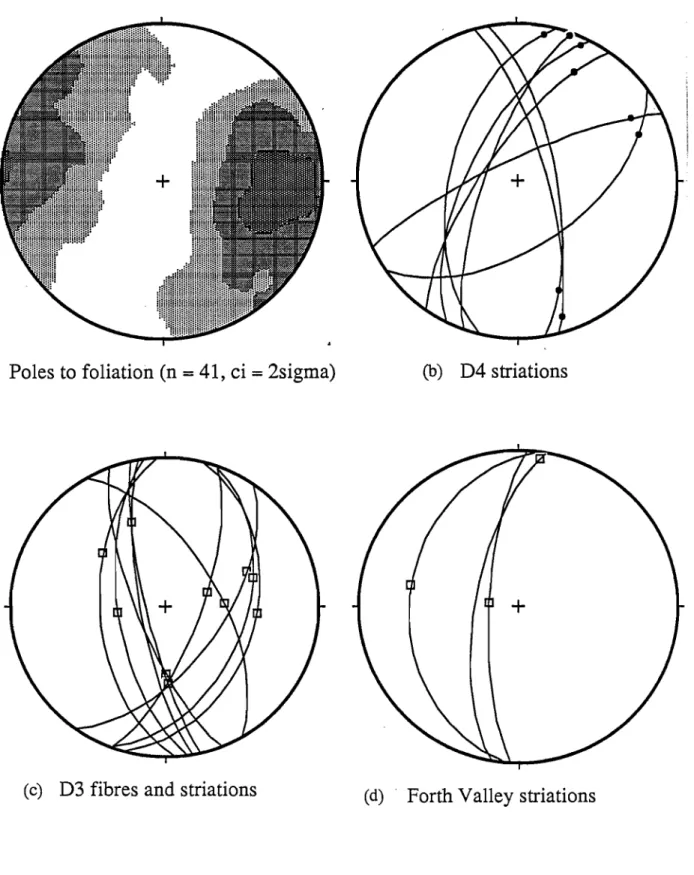
4.5 Late brittle-style structural elements ... :... 36
4.6 Serpentinite structures .... ... ... .. ... ... ... .. . . . ... ... 38
4. 7 Geology of the Lower Claytons Rivulet ... 39
4.8 Thrust zone at DQ331409 ... 40
4.9 Fault-related structures .... ... ... 41
4.10 Fault striation analysis - best fit stress tensors ... 42
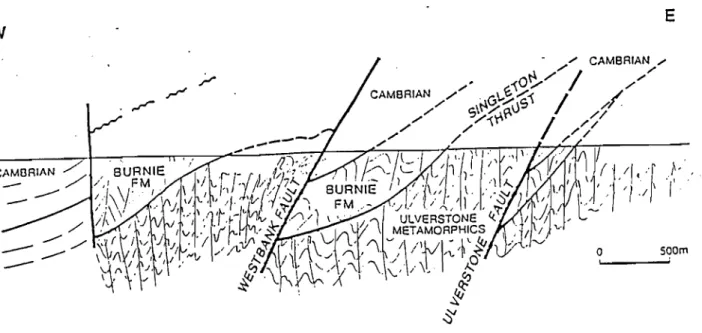
4.11 Structural profile across the north-western (coastal) part of the Forth block ... 43
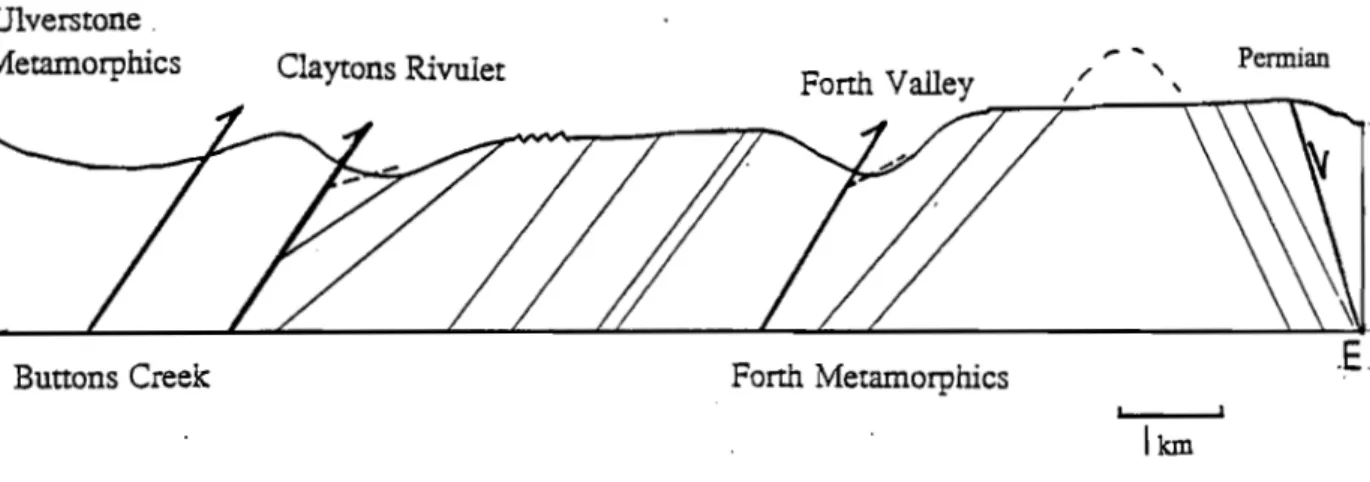
4.12 Interpretive compositon section across the Forth Metamorphics ... 44
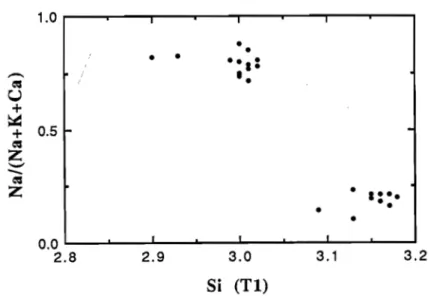
5.1 Phengite compositions- FeO* vs. A1203, Na/(Na+K) vs. Si ... 50
5.2 Biotites-K vs. Mg# ... 51
5.3 Pelitic garnets - CFM diagram ... 52
5.4 White mica compositions-75602 ... 55
5.5 Garnet zonation-75641 ... 58
5.6 Garnet, amphibole and clinopyroxene compositions - amphibolites ... 60
5.7 Amphiboles- Aliv vs. (Na + K)A ... 63
5.8 Garnet, amphibole and clinopyroxene compositions - gneisses ... 65
,•, 5.9 Clinopyroxene compositions ... 70
5.10 Amphibole zonation-75627 ... 71
5.11 Amphibole compositions: (v)K~v-Alvi, Aliv vs. Alvi ... 86
5.12 GEOCALC P1'X results- 75641 ... 93
5.13 Chloritoid parageneses ... 97
5.14 AFM projection-75602 ... 98
viii
5.15 AFM projection- 75641 ... 99
5.16 Albite parageneses ... 100
5.17 GEOCALC PTX results- 75637 ... 101
5.18 GEOCALC P-Xc02 results- 75662 ... 106
5.19 GEOCALC PTX results 75662 ... :... 107
LIST OF TABLES
Page 3.1 Selected whole-rock analyses ... 144.1 Results of fault striation analysis ... 42
4.2 Structural sequence in the Forth Metamorphics ... 47
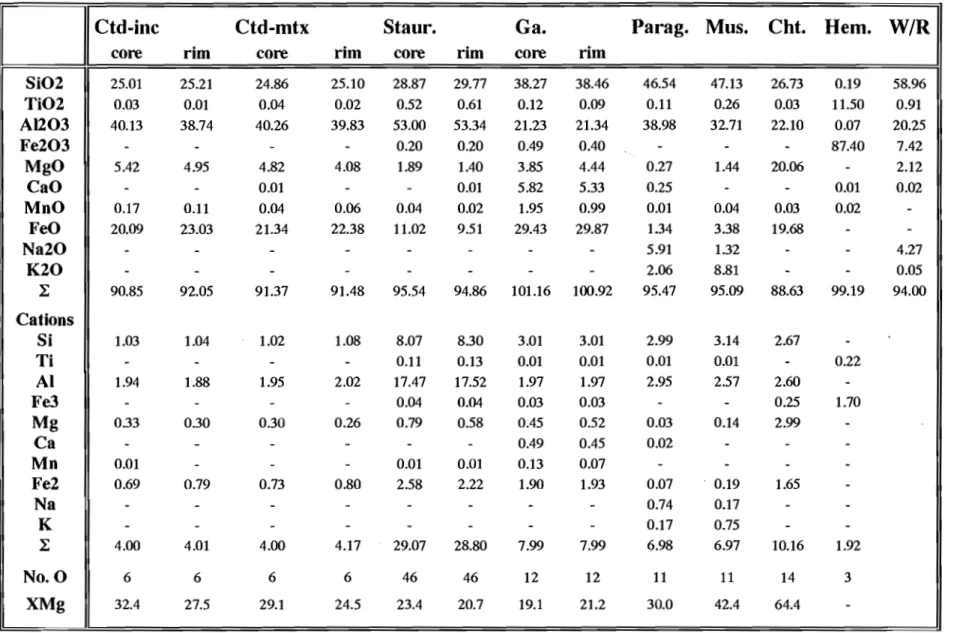
5.1 Whole-rock and mineral compositions- 75602 ... 56
5.2 Whole-rock and mineral compositions - 75641 ... 57
5.3 Mineral compositions - 75637 ... 59
5.4 Mineral compositions - 75628 ... 61
5.5 Mineral compositions - 75617 ... 62
5.6 Mineral compositions - 75627 ... 66
5.7 Mineral compositions- 75662 ... 68
5.8 Mineral compositions - 75619 ... 69
5.9 Mineral compositions - 75605 ... 72
5.10 Mineral compositions- 75669 ... 74
5.11 Mineral compositions- 75636 ... 76
5.12 Garnet-biotite thermometry ... 81
5.13 Garnet-phengite thermometry ... 82
5.14 Garnet-clinopyroxene thermometry... 83
5.15 Garnet-hornblende thermometry ... 84
5.16 Plagioclase-hornblende thermometry ... 85
5.17 GASP calibrations ... 88
5.18 Empirical pelitic barometers ... 89
5.19 Garnet-hornblende-plagioclase-quartz barometry ... 90
5.20 Garnet-clinopyroxene -plagioclase-quartz barometry ... 91
5.21 Jadeite barometry ... 92
5.22 Mineral chronology - Forth schists ... 94
CHAPTER 1 -INTRODUCTION
Burns (1963) defined the Forth Metamorphics as the quartzite, garnet schist and amphibolite which outcrop in the valley of the Forth River, between the township of Forth (DQ367397) and a reef of Ordovician conglomerate on Porcupine Hill (DQ385342). The metamorphics underlie an area of approximately 60 km2 and together with the Ulverstone Metamorphics to the west, form zoned
complex known as the Forth Region (Burrett & Martin 1989). In addition, the study area includes a number of ultramafic bodies and is shown in figure 1. L
428000
428000
438e00
Bass Strait
433000 438000
Forth Metamorphics
Locality Diagram
&
Study
1 : 1 0 0
J0 0 0
443800
Area
AIMS.
The principal aims of this study are as follows:
(i) To determine the metamorphic pressure-temperature-time (PTt) conditions that affected the rocks in the study area.
(ii) To establish the geochemical affinities of the amphibolites.
(iii) To document and re-evaluate the syn-metamorphic structural history.
(iv) To assess the tectonic significance of ultramafic bodies and post-metamorphic deformation in the context of current models for Northern Tasmania.
PHYSIOGRAPHY/ACCESS.
2
The area comprises a low coastal plain backed by an undulating plateau which rises to approximately 300m on Porcupine Hill (fig.1.2).
The plateau is underlain by a discontinuous cover of Tertiary basalt and dissected by a northward trending drainage system, which includes the catchments of Buttons Creek, Claytons Rivulet and tributaries of the Lower Forth River.
The temperate sub-humid climate supports intensive cultivation on the rich plateau soils and the metamorphics are largely restricted to lower valley slopes, on which steep terrane and generally poor soils support uncleared open to closed schlerophyll forest.
Physical access is aided by a dense network of roads and vehicular tracks (figure 1.2), although natural exposure of the metamorphics is restricted to creeks, which are only accessible on foot. The area is extensively sub-divided and, despite the relatively easy physical access, legal access is complicated by the large degree of private ownership.
430000 435000
Bass Strait
435000
Forth Metamorphics
Physio«raphy
&
Access
1 : 1 0 0 , 0 0 0
4
PREVIOUS WORK.
The Forth Metamorphics were first described by Gould (1867) during reconnaissance mapping of northern Tasmania. Petterd (1893, 1896, 1910) reported kyanite-bearing schists from the Claytons River, collected by Gould in 1873. Twelvetrees (1906b, 1909b) described the amphibolites as "hornblende gneiss" and selected whole rock analyses are presented in Spry (1962). Spry (1962) assigned the Forth Metamorphics to a lower division of the Precambrian, deformed and regionally metamorphosed during the Frenchmans orogeny (800Ma ).
Regional mapping by Burns (1963, 1964) outlined a complex polyphase deformation sequence and correlated post-metamorphic brittle-style deformation with Tabberraberran structures in the surrounding Lower Paleozoic sediments.
The ultramafic bodies were recorded by Gould (1867) and Twelvetrees (1906b, 1909b) described the original rock as an olivine-enstatite peridotite or harzburgite.
An
intrusive relationship with the metamorphics was suggested by Blake (1928c) and supported by Taylor (1955) who postulated a discontinuous series of 4 or 5 sub-concordant sill-like bodies. Burns (1963, 1964) correlated the serpentinite with other ?Cambrian ultramafic bodies in Tasmania and reported large aligned xenoliths of lineated amphibolite from near the western margin of the Claytons Rivulet body.The following report is organised into 4 main sections. Field relationships - which define critical structural and metamorphic problems - are outlined in chapter 2. Geochemical features of the metabasites are presented in chapter 3. Syn-metamorphic and later brittle-style deformation are considered in detail in Chapter 4. Chapter 5 discusses the metamorphic petrology and P-T conditions inferred from traditional and database thermobarometric methods.
5
CHAPTEE. 2 - FIELD RELATIONSHIPS
2.1 REGIONAL SETTING:
The geology of Northern Tasmania is complex and not well understood, despite over thirty years of
work (Woodward et at - in review). The regional setting of the Forth Metamorphics is shown in
figure 2.1 and summarised below, based on mapping by Burns (1963, 1964) and the recent
compilation of Burrett & Martin (1989).
BASS STRAIT
, . I
I
. I
o I Z J ~ SkIn·
J
MAJOR TECTONIC UNITS
'... Jurassic and Temary
.or taulting
CJ Perm,an ana Meso:z::ia I
N ,
_ Uccer Oevon,an """'" -:"aoceracceran· Oroqeny IIIIJ Orcovican ana Silunan
I
'\IVV °Jukeslan' movemenl c::J Camcnan VV\I' O?9nquUl' Oraqeny c:J Surnie Formation
E Ulverstone Meramorpni= b ':onn Meramoranlc
6
The Forth Metamorphics form the eastern half of the Forth Region ("Forth Block or Nucleus" of
Carey (1953)) - a zoned metamorphic complex which includes the lower greenschist facies
Ulverstone Metamorphics (Burns 1964). The boundary between the two assemblages was arbitrarily
defined by Burns (1964) at the first appearance of garnet in the Forth Metamorphics - which
corresponds approximately to the eastern-most limit of metaconglomerate (Spalford Conglomerate)
in the Ulverstone Metamorphics. Mapping and sample collection for the present study is confined to
the Forth assemblage, as defined above and delineated on the Devonport Sheet (Burns 1965).
Burns (1964) considered the two complexes to be structurally. concordant as the dominant syn
metamorphic foliation (S2) is of similar style and orientation along the margin, although this may
largely reflect post-metamorphic deformation (Chapter 4).
To the east, the Forth Region is in faulted contact with sub-horizontal Permian sediments and is
unconformably overlain to the south-east by deformed but un-metamorphosed quartzose clasties of
the OrdovicianDial Subgroup (Burns 1964, Woodward et al- in review).
Although poorly exposed, the Ulverstone Metamorphics appear to be faulted along their western
margin against relatively unmetamorphosed turbidites of the Burnie Formation which are in turn
unconformably overlain to the south-west by Late Middle to Late Cambrian volcanics and
volcaniclastics. The latter occupy a bifurcating N-S and E-W trending belt - the Dial Range or
'Fossey Mountain' Trough - generally considered to be a northern extension of the Mount Read
Volcanic Arc (Williams et aI1989). The southern margin of the Forth Region is obscured by Tertiary
cover and generally poor ou.tcrop. The Forth Metamorphics are overlain to the north by
unconsolidated PleistocenelHolocene marine and fluvial sediments and are not exposed along the
coast.
2.2 LITHOLOGIES:
The present study follows the grouping of Burns (1964) and mapping units are defined in terms of
four major lithologies: schist, quartzite, amphibolite and serpentinite. Major lithological units outcrop
as eHmgate, roughly N-S striking belts 100-700m wide, with lithological layering, on all scales,
generally sub-parallel to the dominant tectonic foliation (S2) (fig. 2.2).
2.2.1 FORTH SCHISTS:
The pelitic lithologies are well-foliated rocks with a 1-30 cm lithological banding defined by
7
schists. The rocks outcrop poorly, are often deeply weathered and generally unsuitable for
petrological work.
The schists show a significant variation in structural and metamorphic style across the Claytons
Valley. Along the western margin, the metapelites are pale or dark grey, fine to medium-grained
foliated or penciled rocks with small «lmm), often weathered, porphyroblasts of garnet and rare <
0.5mm albite. The early deformation style in this area is relatively open and garnet-free lithologies
are phyllitic rather than schistose, in field appearance.
In the Claytons Valley, similar units with larger (>lmm) and more abundant garnet enclose discrete
pods of coarse chloritoid
+
paragonite+/-
staurolite-bearing lithologies.In contrast, east of the Claytons Valley, the dominant pelitic lithology is a brown to pale grey,
medium to coarse-grained schist with equant 1.5-2mm porphyroblasts of garnet in an anastomosing
foliated matrix of muscovite with minor biotite, quartz and usually chlorite. Garnetiferous units are
interbanded with pale quartz muscovite schists which grade into bands of coarse micaceous quartzite.
In the Forth Valley (DQ368361), garnet mica schist bands interlayered with mylonitic quartzite,
contain kyanite as tabular 1-1.5mm porphyroblasts mantled by clots of coarse muscovite. Kyanite has
also been reported from the Claytons rivulet (Petterd 1893), but this was not found during the present
study.
Bands of highly feldspathic, garnet-free schists occur, generally east of the Forth River, as discrete
zones interlayered with both schist and quartzite. These contain strongly weathered 0.3 - 2.0 mm
feldspar porphyroblasts wrapped around by a foliated matrix of muscovite and quartz, which is
locally mylonitic. In places, abundant asymmetric augen reach up to 8mm across, suggesting an
arkosic or tuffaceous protolith or possibly a pegmatitic phase owing to the coarse grain size of the
blasts. The coarse feldspathic bands are laterally discontinuous but apparently concordant with
compositional banding.
In general, the metapelites show little field evidence of retrogression, but are locally interlayered with
concordant zones of a dark strongly weathered foliated rock, containing 1.5mm asymmetrical lenses
430000 432000 434080 436000 438090 440000 442000
If
\r
+
Bass Strait
r - - - .
)
+
i
FORTH METAMORPHICS
GEOLOGY
1:50,000
~f
-
+
UJ))~
+
+
r~
I
I
' .
Legend
G<rnel mica s"'isl
if
-o - . "
+_
.AI
Forth
{
~
LAL
I
rim
I •
D
CUrlzile
A/rflhibol ile
Serpenl ini le
Li loo I09 i caI oo.ndcry
i
~
I
[ZSZ]
fQJllsfQJlls - infErred
m
i
[ZSZ]
[ZY]
TErlicry LnCOnformi ly
CTdovicicr. LnCOnformi ly
430000 432000 434000 436000 438800
IlII
440000
Porcupine Hill
442000
Figure 2.1
Grid: Auslral i<rl ~ Grid (~)
Basemq> Delai Is: UlvErslane, Kind-eel &. Lalr<lbe 1:25,000 Geology by ROO Lewis - Nov~ 1991
Geo Iogy Depcrlmenl
9
2.2.2 QUARTZITES:
Quartzites are well exposed in a number of large gravel pits (e.g. Porcupine Hill) and quarries along
N-S trending strike ridges which form topographic highs between the major catchments.
The majority of quartzites are coarse-grained roc~ with a spaced muscovite foliation sub-parallel to
interbands of quartz mica schist. Rare garnet porphyroblasts, often weathered to limonite, occur as
skeletal grains mantled by clots of chlorite. A coarse shallow plunging muscovite intersection
lineation (L12) is the dominant structure in most outcrops and in places forms well-developed 5
lOcm wide mullions on the margin of quartzite and mica schist bands.
Very pure, coarse vitreous quartzite occurs as a massive poorly foliated sequence up to 200m thick,
near Forth Township, and also as discrete 1-5m thick bands interlayered with micaceous quartzite.
The former is a distinctive marker horizon which can be traced for 4km along strike, and has been
quarried for metallurgical flux at DQ385368, Sayers Hill (DQ365380) and at the Dunham quarry
(DQ367394), where the rock contains over 99.9% silica (Burns 1963).
Quartz mylonites are common in the Forth Valley and occur in narrow zones associated with high
grade pelitic interbands. The field appearance is a tough compact fine to medium-grained rock with a
penetrative quartz muscovite foliation and closely spaced muscovite, quartz +/- tourmaline stretching
lineation. This lineation differs in style and orientation from the more widely developed intersection
lineation and is a useful field indicator of local mylonitic zones.
2.2.3 METABASITES:
Arnphibolites, of variable textural and mineralogical style, occur in two 500m wide belts in the Forth
Valley, as a small tnlier NW of Forth township and as thin discontinuous bands along the western
margin of the Claytons serpentinite. Burns (1964) mapped an area of amphibolite along the SE
margin of the block, but this was not rediscovered during the present mapping.
The dominant lithology in the Forth Valley is a medium to coarse grained, massive or foliated rock
with a variably developed down-dip LS fabric and locally, gneissic texture due to mineral segregation
(Twelvetrees 1906b).
Typically, the amphibolites contain abundant 1-2mm porphyroblasts of pink garnet in a matrix of
dark green prismatic hornblende, pale elongated zoisite,minor interstitial plagioclase and rare
clinopyroxene (75628, 75622). In gneissic units, the garnet is segregated into 1-5cm bands
10
component, concentrated in medium-grained granoblastic garnet-free bands with quartz, hornblende
and granular epidote (75617).
Bodies of garnet clinopyroxene zoisite quartz rock occur at DQ361382 and 1.2km south at
DQ359370. The rocks resemble the Lyell Highway eclogite in hand specimen/thin section but despite
the field appearance, the clinopyroxene is low in Na (Le. not omphacite) and, on textural grounds,
this rocktype will be referred to as garnet-clinopyroxene gneiss (gnt-cpx gneiss).
At DQ361382, the gneiss outcrops as locally continuous layers in a 1.5m thick zone enclosed within
and sharply bounded by clinopyroxene-free garnet amphibolite. Individual layers are up to 30cm
thick and contain thin bands of coarse granoblastic garnet
+
clinopyroxene (75627) interlayered withmoderately foliated medium-grained zoisite-clinopyroxene-quartz domains (75625, 75662). The rock
has a weakly developed LS fabric, concordant with a similar, but more strongly developed fabric, in
the enclosing amphibolites. The gneiss at DQ359370 has a distinct colour banding due to 1-3mm
wide strings of pink fine-granular garnet and bands of well foliated pale-green clinopyroxene
+
zoisite
+
quartz (75615) and occurs as surface float over an area of 100m2•Quartz and mica-rich garnet amphibolites occur in a narrow zone along the west bank of the Forth
River (DQ361382) and where fresh, outcrop as tough compact, moderately well-foliated units with a
variably developed down dip biotite + hornblende +/-muscovite lineation.
The micaceous sequence is at least 300m thick and inter-layered with 1-5m bands of massive garnet
amphibolite. Micaceous bands locally wrap around and appear to be replacing 30cm x lOcm lenses of
well-foliated mica-free garnet amphibolite which are oriented with their long axes parallel to the
enclosing foliation. Both pods and the enclosing units have weakly developed but structurally
concordant mylonitic textures and contain rare strongly deformed 3mm amphibole porphroclasts.
The anomalous zone is close to the margin of mica-free garnet amphibolite and pelitic schist and
continuous along strike with gnt-cpx gneiss-bearing amphibolites and mylonitic, kyanite-bearing
quartzites. The field relationships suggest that micaceous bands formed at the expense of mica-free
garnet amphibolite. This possibility is supported by geochemical, petrographic and structural
evidence and is evaluated in a later section.
The range of lithologies in the Forth Metamorphics is similar to that of other metamorphic complexes
in Tasmania and indicates derivation from a largely clastic pelite-psammite sequence (Spry 1962a,
Boulter 1978, Turner 1989). The predominantly homogeneous field appearance of the amphibolites
suggests they were originally massive lava flows, although local banding is not inconsistent with a
11
2.2.4 SERPENTINITE:
The metamorphics enclose bodies of serpentinite in the lower reaches of the Claytons Rivulet and in
the vicinity of Forth Weir (Gould 1867, Twelvetrees 1906b, 1909b, Blake 1928c, Taylor 1955, Burns
1963, 1964).
In the Lower Claytons Rivulet, strongly sheared but locally massive serpentinite forms a
discontinuous west-dipping meridional belt approximately 1 x 4 km, interlayered with 2-20m thick
slivers of quartzite, schist and minor amphibolite (fig.4.6) and structurally overlain to the west by
massive quartzite.
An isolated body of well-foliated and lineated chlorite tremolite serpentine schist occurs 500m south
of and along strike from a small serpentinite body at Forth Weir (DQ363383). The schist is enclosed
by and structurally concordant with foliated garnet amphibolite but correlates with the ultramafics on
geochemical and mineralogical grounds (Chapter 3).
Discontinuous layers of well-foliated and lineated, banded 'greenschist' are interlayered with quartzite
along the western margin of the Claytons serpentinite body. The banding is defined by domains of
coarse amphibole which are wrapped around and locally cut by zones of fine-grained amphibole +
epidote + albite. Relict garnet porphyroblasts, now substantially altered to epidote, are present as
discontinuous trails in some units, suggesting that at least some of the rocks were originally garnet
amphibolites.
The structural characteristics and field appearance of these amphibolites are not dissimilar to basal
hornblende mylonites, reported from the margins of other ultramafic bodies in Tasmania (Berry
1988, Berry & Crawford 1988) and this is discussed further in chapter 3.
2.2.5 MINOR ROCKTYPES:
Discordant 1-3m pods and lenses of coarse, highly weathered quartzo-feldpathic rock occur on
Porcupine Hill. The outcrop style is similar to the ?Cambrian Dove Granite, which intrudes
Precambrian quartzites and schists on the northern margin of the Tyennan Region.
At DQ408374, pegmatitic quartz feldspar tourmaline veins cross-cut schist bands containing a
medium-grained pink mica which may be lepidolite (?pseudomorphing muscovite). Feldspathic
schist bands at DQ319386 contain 1mm cubic voids after ?pyrite and films of pale green malachite
possibly after chalcopyrite. Apart from these scattered occurrences, there is no mineralisation in the
12
Brittle fault zones in quartz-rich lithologies contain angular misoriented blocks of quartzite in a
siliceous matrix of granulated quartz and well-foliated quartz muscovite cataclasite is locally
developed in pelitic lithologies (DQ407385). Late faults are often bounded by smooth polished
13
CHAPTER 3
GEOCHEMISTRY
Whole-rock XRF analyses of representative compositions have been obtained, in order to address the
following issues:
1) Were the metabasites originally igneous compositions and if so what were their petrologic and tectonic affinities?
2) Do mineralogical variations reflect differences in bulk geochemistry (or differences in metamorphic grade)?
3) Do the Forth Metabasites correlate with other high grade (Nye Bay Amphibolites and Lyell Highway Eclogites) and low grade (Rocky Cape Dykes) metabasites in Tasmania?
4) Do the amphibolites occurring near the Claytons Serpentinite resemble basal hornblende mylonites from other ultramafic complexes in Tasmania?
In addition to Sr, Rb, Zn and Cu, analyses include trace elements which are generally considered
immobile during regional metamorphism - Zr, Nb, Y, V, Ni, Cr (Winchester & Floyd 1976) and have
been grouped into 4 categories, based on mineralogy: garnet amphibolites, garnet-clinopyroxene
gneisses, (retrogressed) epidote-albite amphibolites and micaceous amphibolites. Representative
samples are given in table 3.1 and the entire dataset, including two 'wet' chemical analyses from Spry
(1962) is reproduced in Appendix A.
3.1 PRE-METAMORPHIC AFFINITIES:
3.1.1 SEDIMENTARY VS. IGNEOUS ORIGIN:
The garnet amphibolites resemble igneous compositions of basaltic to andesitic affinity and are
compositionally similar to apparently retrogressed lithologies from the Claytons Rivulet.
Metamorphic hornblende + plagioclase +/- garnet assemblages may be derived from igneous parents
of basaltic affinity (ortho-amphibolites) are, more rarely, from calcareous or dolomitic shales (para
amphibolites) (Orville 1969). The latter often show well-developed compositional banding (Leake
14
Leake (1964) documented a number of inter-element variation trends, which may be used to
distinguish the two parageneses (fig. 3.1). The Forth amphibolites show a positive correlation
between 'Niggli Mg' (a measure of Mg-enrichment generally and igneous fractionation in particular)
and both Ni or Cr which is consistent with an igneous protolith. An igneous derivation is also
supported by coupled variation in Niggli Mg an~ Niggli C and the amphibolites plot towards the
evolved end of typical igneous fractionation trends (fig.3.1c).
75606 75660 75663 75670 75636 Si02 51.36 45.99 49.11 61.12 36.63
I
Ti02 0.88 0.84 1.44 1.51 0.22 ;
Al203 15.09 13.79 11.86 13.64 4.55
Fe203 10.79 11.17 10.52 10.00 12.28
MnO 0.14 0.19 0.13 0.12 0.16
MgO 6.12 12.04 5.00 4.07 31.61
Cao 8.22 10.38 19.07 1.63 2.84
NalO 4.95 2.84 0.98 2.68 1.04
lOO 0.60 0.47 0.06 2.38 0.06
P205 0.09 0.10
.
0.25 0.22 0.02LOI 1.52 1.60 1.56 2.12 10.66
TOTAL 99.76 99.41 99.98 99.49 100.07
Nb 8 8 20 41 2
Zr 56 50 175 365 10
Y 21 18 36 59 8
Sr 120 97 512 142 13
Rb 14 7
-
85-Ni 181 391 100 88 1794
Cr 678 730 254 143 3001
V 276 228 216 154 65
Zn 88 89 103 127 51
Cn 57 23 88 57 16
\
Table 3.1: Selected representative whole rock analyses. 75606 - retrogressed
amphibolite (Claytons Rivulet - DQ331405). 75660 ~ garnet amphibolite (Forth
•
•
(a) 1200 15
1000
~
•
,-..
~
800~
c•
•
c'-' 600 s..
U 400 j-
•
x
•
•
200l- c
•
xx 00.1 0.2 0.3 0.4
Niggli Mg
(b) 500 [
•
400
,-.. c
•
S
Cl. 300 Cl.•
' - '
Z
200~
C • c
•
xx xI
•
100
~
0
0.1 0.2 N'
r
M 0.3 0.41991 g
100
(c) ~ r '~1"1t~ I I • Gnt-cpx gneisses
c Epidote Amphibolites
•
Garnet AmphibolitesI x Micaceous arnphibolites
U '\. Pelite-carbonate mixtures Dolomite I
...
~
"eJl
eJ:) 50
Z
I
x
x
o
0.0 0.5 1.0
Niggli Mg
Figure 3.1: (a) Cr (ppm) vs. Niggli Mg. (b) Ni (ppm) vs. Niggli Mg (MgO/(FeO +
MnO +
2F~03
+ MgO)). (c) Niggli C (lOOCaO/(Cao + MgO + FeO +F~03
+A120 3)) vs. Niggli Mg - trend line of Karoo dolerites and pelite-carbonate mixtures
16
The garnet clinopyroxene gneisses are geochemically distinct from the amphibolites, having up to
20% Cao (cf. 12%) and are correspondingly depleted in MgO, NazO and KzO. The high Cao content
is unlike common magmatic liquid compositions (fig.3.1c) and three alternative explanations for the
enrichment have been considered.
A cumulate origin is consistent with the interbanded morphology of the units, although the excess
Cao is not matched by high MgO (clinopyroxene cumulate) or AlZ0 3 (plagioclase cumulate - see
below) and therefore this model has been discarded.
In newly accreted oceanic crust, enrichment in Cao may result from local precipitation of hydrous
calc-silicates (such as hydrogrossular, prehnite, pumpellyite or epidote) in a process known as
rodingitisation (Honnorez & Kirst 1975, Ito & Anderson 1983). The Ca-rich fluids are derived from
heated sea-water during amphibolitisationlalbitisation of clinopyroxene/anorthitic plagioclase
assemblages (Hardie 1983, Bideau et aI1991).
This possibility can be discounted, as Cao vs. AlZ0 3 variation between the gneisses and
amphibolites, is unrelated to representative calc-silicate compositions (fig.3.2).
60
• Amphibolites • Gnt-cpx gneisses
50 [J End-members
..- Hydrogrossular
40
~ D
-
~'--' 30
[J Clinozoisite
0
~ Prenhite D
U 20
•
10
0
0 10 20 30
AI203 (wt.%)
Figure 3.2: Cao (wt%) vs. AlZ0 3 (wt%) for garnet clinopyroxene gneisses and
amphibolites. Compositions of calc-silicate phases from Deer et al (1967).
The gneisses are intermediate in composition between garnet amphibolites and an Al-free end
member with approximately 60% CaO. A similar trend is shown in figure 3.1c, where the gneisses lie
on a mixing line between the garnet amphibolite cluster and a 100% CaOI 0% MgO diluent. These
consideration support calcite (60% Cao, Niggli C = 100) alteration, possibly as a result of local
17
This is consistent with petrogenetic constraints (sect.5.3) suggesting significant H20-dilution by a
CO2-rich fluid during prograde metamorphism and, in this context, the mineralogical difference
between the gneisses and amphibolites is largely a result of geochemical, rather than P-Tvariation.
As apparent from their mineralogy, the mica-rich garnet amphibolites are enriched in Si, K and Na
and depleted in Ca and Mg in comparison with adjacent garnet amphibolites. The group forms
isolated clusters or linear trends on most inter-element variation diagrams, and shows strong
enrichment in Rb, Zr, TiN and Nb/Y . The enrichment in alkalis and incompatible elements is not
modelled by typical igneous fractionation trends (fig.3.1c) and sub-horizontal variation of FeO*/MgO
vs. Ti, Zr and FeO* (fig.3.5) also argue against a magmatic origin - for which coupled variation
would be expected (Hall 1987).
The distinctive geochemical signature is, however consistent with textural evidence suggesting
heterogeneous syn-post metamorphic development of alkali-rich phases and is considered to be
metasomatic in origin.
3.1.2
PETROL0 GIC/TECTONIC AFFINITIES:
Simple trace element discriminant diagrams, based on the petrological features of fresh igneous
rocks, have been compiled by Floyd & Winchester (1975) and Winchester & Floyd (1976). Coupled
variation of Ti02, Zr and P205 indicate a broadly tholeiitic character for the Forth amphibolites
(fig.3.3).
Zr-Y-Ti-V discriminant diagrams, based on the geochemistry of recent volcanics, may also be used
to constrain the original tectonic setting of metamorphosed basaltic compositions (Pearce & Cann
1973)..
The micaceous amphibolites and garnet clinopyroxene gneisses plot wholly within the calc-alkaline
field but in view of their anomalous major element geochemistry, this is of doubtful significance. The
unaltered amphibolites appear to have no within plate affinity and figure 3.4a suggests ocean-floor
affinities. This is however complicated by ambiguous overlap with both ocean floor and island arc
basalts fields and the associated, largely clastic sequence makes an ocean-floor (i.e. mid-ocean ridge)
origin unlikely. Local sequences of extremely pure quartzite may be derived from deep-sea chert, but
show no mineralogical evidence of the Fe or Mn enrichment, characteristic of these rocks.
Despite this conclusion, an island arc origin appears equally unlikely given the quartz-rich, potassic
composition of the metasediments. These features are more characteristic of a passive continental
rather than convergent margin setting, in which sediments are typically dominated by Ca-rich
18
Continental rift tholeiites, approaching MORB compositions have been reported from continental
provinces (Crawford & Berry 1991 - in review) and a passive margin setting with minor MORB-type
volcanics appears to be the most plausible tectonic model for this sequence.
3.2 CORRELATION:
The petrologic features of the Forth metabasites are unlike the Rocky Cape Dyke suite which has well
defined alkaline affinities (Brown 1989) and this correlation is not pursued further.
The garnet amphibolites are broadly similar in their major element geochemistry to other high grade
Tasmanian metabasites - specifically the Lyell Highway eclogites (Kamperman 1984) and Nye Bay
Amphibolites (McNeill 1985). Trace element variation between the groups is ambiguous and
significant differences are evident in terms of Zr(fi and Nb/Y variation. The co-genesis of these
suites cannot be established on available data.
The Forth amphibolites have little affinity with basal hornblende mylonites associated with mafic
ultramafic complexes in Tasmania, which are significantly depleted in incompatible elements.
Serpentinitic schist from the Forth Valley (75636) correlates with the ultramafics in terms of both
major (low SiOz -36.63%, high MgO - 31.61%) and minor elements (low Ti, high Ni and Cr), and in
most inter-element diagrams plots within hornblende mylonite fields. Of three epidote amphibolites
from the western margin of the Claytons serpentinite, 75608 plots consistently within or on the
margin of this group. Apart from the absence of a Ti-bearing phase, however, this unit is
petrographically similar to other amphibolites in the area, and the significance of this correlation
19
3 (a)
..-
I
Alkaline /
ThO~tic
~• 2
....
==
~
-
N
0
/ .
•
,.
•
xE::lb1' • c ·
• c x
c
•
I
0
0.0 0.1 0.2
Zr/P205
(b) 0.6
• Gnt-cpx gneisses 0.5 I- Alkaline x Micaceous amphibolites
.--.. I
~
....
0.4~v
- 0.3~
0.2 .•
0.1 I
1J
. /
•
•
••
x Tholeiitic x x • c Forth Amphibolites Epidote Amphibolitese.
0.0 L..-
0 100 200 300 400
Zr (ppm)
Figure 3.3: Forth amphibolites - petrologic discriminant diagrams. (a) TiO (%) vs. z
Zr!PzOs' (b) PzOs (%) vs. Zr (ppm). Fields from Floyd & Winchester (1975) and
20
(a)
Ti/100
+
Micaceous amphibolitesCl Epidote amphibolites
o
Garnet amphibolites X Gnt-cpx gneissesZr
Zr-Y-Ti
(b) 14000
•
Gnt-cpx gneissesx
•
Garnet amphibolites12000
I
.Aa Epidote amphibolites
I I )( Micaceous amphibolites
e
10000r
(P
;;
)(
c. c.
'-"
8000
.-E
6000
4000
2000
0 100 200 300 400
Zr (ppm)
Figure 3.4: Forth amphibolites - tectonic discriminant diagrams. (a) Zr (ppm) -Y
(ppm) x 3 - Ti (ppm)/lOO. (b) Ti (ppm) vs. Zr (ppm). Within plate basalts = D, ocean
floor basalts
=
B, low-K tholeiites=
A&B, calc-alkali basalts=
B&C (Pearce & Cann21
.1, i l l l l " " ' i ""'"1 " ' i " i ' J
(a) i
x +
x
11 011
.•
+O,~
·
Eo 11
~ .01
f
• • • • C.11I.(
•
-
Nb
.+ ..•
•
.001 I ' " , , ,.rI ' " " " I' " " , , 'rI
.01 .1 1 10
Nb/Y
(b)
6
11
5
J
0 4
::;
l:ll3
-l•
-
..
x x x02 •
~~
~.,.
....
•
*kt
0
100
200
300
400
Zr (ppm)
100 E i i i i i i i i I ' i i , i i i i I i i i i i i i'1 I I
(c)
• Gnt-cpx gneisses
o Lyell Hwy Eclogites
•
• Forth Amphibolites10 "" X
>-
&I , XX X Micaceous Amphibolites~ ~ 11 Nye Bay Amphibolites
N•
JII>+
11+ • +~ 11 C Epidote Amphibolites
+
b·
+
+ + Hornblende Mylonites
.1' I ! ' " , , , 1 I , ! ' , 1 . " ' " "".1
1 10 100 1000
Zr (ppm)
Figure 3.5: Inter-element variation of Tasmanian high grade metabasites and
hornblende mylonites. (a) ZrlTi vs. NblY. (b) FeO*/MgO vs. Zr (FeO* = FeO + O.9x
22
CHAPTER 4
STRUCTURE
Apart from scattered reconnaissance work (Gould 1867, Twelvetrees 1906b, 1909b) and regional
mapping by Burns (1963, 1964), little work' has been done on the structure of the Forth
Metamorphics. This early work proposed a broad division between early syn-metamorphic ductile
strain and later more brittle-style deformation which is maintained in the following discussion.
Interpretation of the early structural history is complicated by later events and, for this reason, the
area is sub-divided into a number of zones (figA.1).
439900 435009 440eOO
i
~w
00
~
I
430009 435000 440000·
For t h Met am
0
rp hie s
Structural Zones
23
4.1 SYN-METAMORPHIC STRUCTURE:
4.1.1 MESOSTRUCTURE:
4.1.1.1 COMPOSITIONAL BANDING:
The earliest recognisable structure in the metasediments is a well-developed compositional layering
due to 1-10 cm alternation of quartzite and garnetiferous schist bands. In most cases this is a
transpositional layering, parallel to the dominant tectonic surface (S2) and has nostratigraphic
significance. Near Abbotsham, however, 1-2cm dark layering due to layers rich in iron oxides is
folded by F1 and may represent original bedding (Burns 1964). No other sedimentary structures are
preserved .
Compositional banding in the amphibolites/gneisses, due to alternating pale plagioclase/quartz and
dark garnet or hornblende/clinopyroxene/zoisite domains, is always parallel to the dominant foliation
and probably due to metamorphic segregation.
4.1.1.2 D1 STRUCTURES:
Mesoscopic F1 folds are only found in fine grained garnet mica schist along the western margin of
the metamorphics. At DQ312384, 1-2cm quartzite bands are folded into a series of isoclinal 5cm
wavelength rootless intrafolial folds with a muscovite foliation, SI as axial plane.
Away from F1 hinge zones, SI is parallel to compositionallayering and moulds discontinuous lenses
of quartzite and vein quartz. In pelitic layers, the foliation is a well developed penetrative dimensional
preferred orientation of muscovite (PI.4.1). In quartz-rich interbands, SI is a statistical preferred
orientation of fine-grained muscovite in a mosaic of equant undulose quartz with fine-grained
disseminated ?hematite and scattered granular rutile. In quartzites, SI is mesoscopically preserved in
the hinge zone of F2 folds as a variably developed fine-grained muscovite foliation parallel to
compositionallayering.
East of the Claytons Rivulet, meso~copic F1 folds are absent and SI is only present as a
microstructure. Relicts of SI are preserved in micaceous units either as microlithons at a high angle
to the dominant S2 foliation (PI.4.1), as a statistical preferred orientation of muscovite in quartz-rich
domains or as linear or curved quartz inclusion trails in coarse garnet porphyroblasts which are
wrapped around by 52. In places, coarse 52 muscovite and quartz contain linear trails of very fine
24 4.1.1.3 D2 STRUCTURES:
The morphological expression of the dominant D2 deformation varies between different lithologies
and spatially from west to east across the Forth Metamorphics.
Fold related structures:
Fold Style:
F2 folds are only rarely found in pelitic lithologies. Near Abbotsham (DQ312384), Sl is parallel to a
quartzite-schist compositional banding and folded in narrow bands of angular upright 2m wavelength
close to tight symmetrical folds with a 1mm spaced crenulation cleavage (S2) as axial plane (PI.4.1).
Further east, tight to isoclinal intrafolial folds in quartzite interbands are the only evidence of F2
folding in schist, and S2 is a closely spaced domainal schistosity defined by coarse flakes of
syntectonic muscovite and biotite.
F2 folds in quartzite are widespread but not abundant. Two kilometers south-east of Buttons Creek,
the small gravel pit at DQ316373 exposes a sequence of south-west dipping, shallow north-west
plunging tight to isoclinal folds in interlayered banded quartzite and quartz mica schist. The folds are
defined by thin trails of opaque material, rotate an early penetrative layer-parallel mica foliation (Sl)
and have a weak axial plane cleavage (S2) due to spaced muscovite flakes and flattened quartz grains.
In profile, the folds have rounded thickened hinge zones, attenuated planar limbs and are type
:2
similar folds according to the dip isogon classification of Ramsey (1967). The fold hinges at thislocality form a series of north-east facing synformal closures, of 2m wavelength, separated by small
shear zones which have a streaky stretching lineation at approximately 90 0 to the fold axes. These
features are consistent with local westward transport.
On Porcupine Hill, isolated small-scale F2 folds in interbanded quartzite and schist have variable
morphology. Quartzite layers are preserved through the fold profile and have a weakly developed S2
cleavage which crenulates layer-parallel Sl on the limbs. Schist bands, in contrast, are markedly
attenuated on the limbs and thickened in the hinge zones forming angular wedges with a strongly
developed axial plane schistosity.
Where F2 folds are absent, S2 is sub-parallel to compositional banding but is locally deflected into
discrete low angle slip planes which transect the mesoscopic layering, forming an asymmetrical
tapered wedge known as foliation boudinage. This is a high strain feature, characteristically
25
The amphibolites, in places, contain strings of disjunctively folded quartz veins with axial surfaces
sub-parallel to a moderately developed amphibole-zoisite foliation but otherwise show little evidence
of folding. Where present, the foliation is parallel to a hornblende-plagioclase compositional banding
and sub-parallel to S2 in adjacent schists. Burns (1964) describes long-limbed isoclinal folds in
compositional banding with the amphibole foliation as axial plane, but these were not rediscovered
during the present study. During D2 the amphibolite bodies appear to have behaved as massive
competent blocks or were folded on a long wavelength only. The dominant foliation may have
formed during D1 and been passively rotated parallel to S2.
82 Microstructure:
The petrographic expression of S2 varies with the mesoscopic F2 style. In the west, S2 is a medium
grained 1mm spaced cr~nulationcleavage in fine to medium-grained schists, defined by thin foliae of
muscovite and chlorite which offset a layer parallel SI fabric. The foliae separate domains of
medium-grained non-undulose granoblastic quartz
+/-
plagioclase and wrap around O.5mm garnetporphyroblasts.
Over most of the Forth Metamorphics, however, S2 is a coarse anastomosing domainal foliation,
axial plane to rare isoclinal crenulations in recrystallised SI muscovite. Phyllosilicate-rich (P-)
domains enclose discontinuous ribbons or lenses of weakly undulose, medium to coarse granoblastic
quartz (Q-domains) and wrap around porphyroblasts of garnet
+/-
deformed kyanite+/-
chloritoid(PI.4.1 & 5.1).
The dominant amphibolite foliation is expressed petrographically as a strong dimensional preferred
orientation of non-undulose, sub-idioblastic 1-1.5mm hornblende
+/-
zoisite prisms which enclosegranoblastic lenticular domains of medium:'grained non-undulose plagioclase
+/-
undulose quartz.Equilibrium grain textures are indicated by curvilinear grain boundaries and predominantly three
phase intersections.
The gneiss at DQ361382 has granoblastic domains of equant 1.5mm garnet intergrown with plates of
coarse xenoblastic clinopyroxene. These are interlayered with foliated bands of prismatic zoisite,
Plate 4.1:
Pelitic microtextures. Scale bar O.5rmn.
A. Buttons Creek. Penetrative SI cleavage preserved between spaced foliae
of S2 - Crossed Nicols (XN)(75598 - DQ315385).
J3.
Forth Valley. SI microlithon between coarse anastomosing S2 in albite
garnet schist - XN (75637 - DQ372366).
C. Forth Valley. Coarse domainal S2 schistosity - XN (75641 -DQ368361).
D. Claytons Rivulet. F3 microfold - Plane Polarised Light (PPL). Grains of
apparent high relief (circled) are plagioclase mantled with a thin selvage of
iron oxides (75600 - DQ322396).
E. S3 quartz sub-grain preferred orientation at a high angle to spaced S2
muscovite foliation in hinge zone of F3 microfold XN (75600
27
Micaceous and quartz rich arnphibolites have complex mineralogy and grain textures. 82 in these
units is defined by irregular elongate domains of quartz + plagioclase and ragged prisms of sub
idioblastic amphibole. The amphibole is overgrown by interlayered biotite and muscovite which may
be parallel or at a high angle to the foliation.
Lineations:
The quartzites have a coarse muscovite lineation due to the intersection of SI and S2, which in places
forms a characteristic mullion structure on the margin of quartzite and schist bands. Where SI is
well-developed, the lineation on S2 is a variable striping of medium to coarse grained muscovite
depending on the local development of SI. Similar intersections are not found in schist, owing to the
almost complete transposition of SI parallel to S2.
The zonal orientation and geographical distribution of these lineations are shown in figure 4.2. In
each of the structural zones, L12 is locally sub-parallel to F2 fold axes and has a characteristic
uniformly shallow pitch on S2. The lithological distribution and consistent orientation define a
distinctive morphology, which Burns (1964) named the Porcupine Hill Style. The shallow pitch is
maintained despite the late brittle-style rotation of S2: this is a significant feature and is returned to in
a later section (see 4.2.1.4).
Mylonites:
Field Relationships:
In addition to the shallow pitching axial structures of the Porcupine Hill Style, Burns (1963,1964)
noted a second distinctive linear morphology on S2, well developed in schists (?) andamphibolites
near the mouth of Goldie Creek.
In amphibolites, the 'Goldie Creek Style' is a strong hornblende or zoisite lineation producing a well
developed mesoscopic LS fabric in hand-specimen. A similar but weakly developed clinopyroxene +
zoisite lineation is also present in gneiss interbands at DQ361382. In quartzites, the style is a
dimensional preferred orientation of quartz, fine-grained muscovite and prismatic tourmaline
developed on S2 surfaces in compact, well-foliated rocks which lack the L12 intersection.
In contrast to the Porcupine Hill intersections, Goldie Creek Style lineations have a steep pitch on 52
and are only found east of the CIaytons Rivulet (figA.3). They are best developed along the axis of
the Forth Valley, where gnt-cpx gneisses and coarse kyanite-bearing schists are found. Despite
28 r
ZONE 3 -
L12
ZONE 6 -L12
ZONE 7 -
L12
ZONE 7 . F2 HINGES
(b)
I ! I
" /
jt
,
I ,I I,
I \ \
't
If, \
I \ \
\ "/
)'"
-,
,
"
"
"
ZONE 1 - F2 HINGES
Figure 4.2: (a) Zonal orientation of L12 and F2 fold axes. (b) Geographical
29 (a)
ZONE 5· Lmus
ZONE6·Lmus
ZONE5·Lh
ZONE7·Lmus
(b)
--.
\
I - 1\
/
.'
I
/ \
Figure 4.3: (a) Zonal orientation of hornblende and muscovite stretching lineations.
30
Burns (1964) noted strong quartz microfabrics in some units of the Forth Metamorphics, but gave no
explanation for the bimodal distribution of lineation types. In the present study, down dip mineral
lineations in quartzite and amphibolite are found to be associated with mylonitic grain fabrics. In this
context, the Goldie Creek Style marks the location of ductile shear zones, which separate folded
domains where axes and intersections of the Porcupine Hill style are developed.
Mylonitic micro-fabrics:
In thin section, the quartz mylonites have a medium-grained mosaic of elongate strongly undulose
quartz with serrate or partially recrystallised grain boundaries. The mylonitic foliation is defined by a
preferred orientation of quartz and strongly appressed muscovite +/- biotite flakes. The latter have an
asymmetric 'fish' mprphology, show evidence of (001) slip and wrap around rare 1.5mm tourmaline
prisms which have sp~ced extensional microfractures. Individual quartz grains have sub-parallel
O.lmm deformation bands which dictate a strong optical preferred orientation (PI..4.2). Deformation
lamellae are common and appear as 0.05mm lenticular bands of slightly different refractive index
from the host grains. The lamellae terminate within grain margins and are consistently oriented at
80-90 ° to deformation bands.
In quartz aggregates, experimentally deformed below about 700°, deformation bands
characteristically result from basal <c> slip on (0001), although prism <a> slip mechanisms may
operate at high temperatures (Nicolas & Poirier 1976) or under conditions of high fluid pressure
(Garbutt & Teyssier 1991). Basal slip appears to be the dominant mechanism of plastic deformation
in most natural quartz mylonites (Vernon 1976).
Experimental work by Ave Lallemant & Carter (1971) has shown the orientation of deformation
lamellae to be dependant on the P-T conditions during deformation (fig.4.4). This model must be
applied with caution, however, as TEM investigation of natural quartzites, has shown that
microstructural features identified as deformation lamellae can result from a number of physical
processes and may not necessarily define active slip planes (Christie & Ardell1974). The model also
requires the extrapolation of experimental conditions to natural strain rates.
In the majority of mylonites studied here, deformation lamellae are consistently oriented at 80-90° to
deformation bands (PI.4.2) and two interpretations are possible. According to figure 4.4, if the
deformation bands resulted from basal slip, the prismatic lamellae orientation indicates temperatures
at or above 800°C. Alternatively, the lamellae may have a'non-prismatic orientation with respect to
31
mechanism, although relatively high temperature and low stress conditions are suggested by the
relatively coarse grain size, lack of recrystallisation and limited retrogression of these mylonites
(Nicolas & Poirier 1976).
1100
u
~ <IJ ~ "5 ~ E <IJ I 10001900 l
800
700
600
\1
~i
PRISMATIC I
a
·3
1
®'
ll! ~~~
--r
~i-'1--
SU88ASAL I
• •
--I
.-e--.--i-
CANYON CREEK QUARTZITE
~ -I
«=7·8xlQ sec
{COOl} 1\ dab motion Ianellae
:It I basal. .••..••••••••••••••••..00-50
a
S\bbOSCII ][•••••••••••••••• (30-15°a
subbosd L...16°-300~ : ~~;;t~··_··81°-90°
-b--
L...._:w:
~_-..,
- - - BASAL
500
•
•
400 ---'
5 10 15 20
Confining pressure (kbl
Figure 4.4: Orientation of deformation lamellae ({OOOl Ylamellae) with respect to
temperature and confining pressure (from Ave Lallemant & Carter 1971).
Well-developed mylonitic textures are also found in albitic schists from the eastern margin of the
metamorphics (DQ407386). In 75653, abundant 1mm porphyroblasts of asymmetrical elongate
albite, containing sigmoidal opaque inclusion trails, are wrapped around by a fine-grained well
foliated matrix of asymmetrical 'fish-like' muscovite. The mylonitic foliation has a strong down dip
lineation and is disrupted by abundant extensional shear bands. The mineralogy and grain texture of
this unit resemble albitic schists from the Mary Group in central Tasmania, and indicate albite growth
prior to mylonitisation.
Despite the strong mesoscopic LS fabric, mylonitic micro-textures are only weakly developed in the
amphibolites and only in a restricted area. Along the west bank of the Forth River, rotational grain
fabrics are preserved in pods of foliated mica-free garnet amphibolite enclosed within bands of
muscovite and biotite-rich amphibolite. The pods have a strong mesoscopic
LS
fabric and containasymmetric garnet porphyroblasts, weakly developed sinistral shear bands and spectacular 2mm long
Plate 4.2: Mylonitic textures. Scale bar O.Smm.
A. Quartz deformation lamellae - XN (75657 - DQ409373).
/
/
B. Quartz deformation bands/lamellae and mica 'fish'. Note sub-vertical
deformation bands oblique to mica foliation and lamellae (fine
subhorizontal hatching) at approximately 900 to bands XN (75657
-DQ409373).
C. Quartz microtexture - XN (75666 - DQ330364).
D. As above with gypsum plate showing strong quartz lattice preferred
orientation.
E. Strongly appressed albite porphroblasts - XN (75653 - DQ407386).
F. Shear band in well-foliated amphibole zoisite amphibolite - XN. Zoisite
has low birefringence and spaced transverse fractures
(756710-DQ362375).
G. Recrystallisation in large amphibole porphroblast - XN
(75669-DQ361375).
33
Limited experimental work has shown that amphiboles are among the strongest of silicate minerals.
Plastic deformation by mechanical twinning on (101)[101] is only activated if the resolved stress
exceeds 2-4kb at 400-600°C, E
=
10-5 S-1 and 5-15 kb confining pressure (Nicolas & Poirier 1976).Distinct weakening occurs above 800° C or at high pore fluid pressure.
It appears that, over most of the Forth Metamorphics, although the temperature and strain rate were
high enough to induce local plastic deformation in quartz, conditions were not sufficiently extreme to
initiate intracrystalline slip in amphibole.
Shear indicators:
Many of the microstructural features described above can be used to determine the sense of shear
(Simpson 1986).
The orientation of quartz deformation bands record the last increment of ductile strain during D2. In
eight oriented quartzites from widely scattered localities with variable S2 orientation the bands are
oriented at 30-50° to the mylonitic foliation and indicate left lateral, westward transport. This sense
of shear is supported by weak muscovite shear bands, rare asymmetrical a-type skeletal garnet
porphyroblasts and asymmetric mica 'fisht (p1.4.2).
In 75671, the asymmetric morphology and strong sub-grain preferred orientation in kink-banded
amphibole also supports left lateral shear.
4.1.2 MACROSTRUCTURE/CORRELATION:
The strong ci~formation and .regiQIlal m~tamQIphism Ln the Forth Meta_mQrphics is~imilar to that in
the Tyennan Region and is generally considered to be of Precambrian age (Spry 1962, Bums 1963,
1964, Turner 1989 - see Ch).
As noted by Bums, the most striking structural feature of the Forth Metamorphics is the almost
complete transposition and overprinting of the early S1 fabric by the late S2 crenulation cleavage.
Fold axial structures are restricted in occurrence and their present orientation suggests isoclinal
folding about a shallowly N-S plunging axis.
Quartz mylonites are widespread east of the Claytons Rivulet and shear indicators consistently
support west-directed tectonic transport. Schist belts were high strain zones, in which there was
almost complete transposition of D1 structures during D2. Despite the development of strong