SCATTERING OF A RAYLEIGH WAVE BY THE EDGE OF A THIN SURFACE LAYER
Thesis by
Donald Alan Simons
In Partial Fulfillment of the Requirements For the Degree of
Doctor of Philosophy
California Institute of Technology Pasadena, California
1975
Acknowledgments
The author wishes to express his sincere appreciation to
Professor J. K. Knowles for his invaluable guidance during the course of this work.
The work was performed with the support of Hughes Aircraft Company through its Howard Hughes Doctoral Fellowship Program. The author is deeply appreciative of this support.
In addition, partial support was provided by the Institute under its Graduate Teaching Assistantship and Fellowship programs, and by the Office of Naval Research under Contract N00014-67 -A
Abstract
This investigation treats the problem of the scattering of a Rayleigh wave by the edge of a thin layer which covers half the surface of an elastic half-space. The interaction between the layer and the half-space is described approximately by means of a model in which the effect of the layer is represented by a pair of boundary conditions at the surface of the half-space. Two parameters- one representing mass and the other, stiffness- are found to characterize the layer.
The incident Rayleigh wave impinges normally upon the plated region from the unplated side.
In the case where the mass of the layer vanishes, the problem is solved exactly using Fourier transforms and the Wiener-Hop£
technique, and numerical results are obtained for the amplitudes of the reflected and transmitted surface waves. In the more general case of a layer possessing both mass and stiffness, a perturbation procedure leads to a sequence of problems, each of which may be
Table of Contents
Introduction 1
l. Pure Surface Waves 6
2. Formulation of the Problem 15
3. Solution for a Massless Layer 21
4. Approximate Solution for a Very Thin Layer.
39
5. Conclusions and Comments 51
>:<
Appendix A - Roots of R (x.) 52
Appendix B - Factorization of D(x.); Properties and
Evaluation of D+(x.) and D-(x.) 58 Appendix C - Certain Aspects of the Solution in the 66
Case of a Massless Layer
List of Figures
Figure 1.
Figure 2. Figure 3.
Figure 4. Figure 5.
Figure
6.
Figure 7.
Figure 8. Figure
9.
Coordinates for a Half-Space Covered by a Thin Layer.
Differential Element of the Surface Layer. Coordinates for a Half-Space Cove red by a
Semi-Infinite Thin Layer. Complex x.- Plane.
Transmission and Reflection Coefficients for the Case of a Massless Layer.
Approximate Transmission and Reflection Coefficients for the Case of a Very Thin Layer. Com,flex x.-Plane for Determination of Zeros
of R (x.).
*
Complex R -Plane.
Complex a-Plane for Evaluation of D+(x.).
7
10
16
25
37
50
53
Introduction
The present work is concerned with the scattering of an
elastic surface wave by the edge of a thin surface layer.
The principal motivation for studying the relation between
elastic surface waves and thin surface films comes from the field of
microwave signal processing. Electromagnetic waves may be
con-verted to elastic waves in solids, and vice versa, by means of
piezo-electric transducers. Operations such as delaying and filtering of
signals may be performed on the elastic waves by suitably designed
devices [ 1] 1. The advantage of carrying out such operations in the
elastic- rather than the electromagnetic- medium comes about
primarily from the fact that the phase velocities of elastic waves are
typically five orders of magnitude smaller than those of
electro-magnetic waves [ 2]. Thus, for example, the length of delay line
required for a given delay is smaller, by this ratio of phase
veloc-ities, for an elastic wave than for an electromagnetic wave.
Elastic surface waves prove to be more advantageous than
body waves because of their accessibility. Thus, for example,
sur-face wave delay lines may be built with numerous taps along the way,
providing incrementally varying delays.
The surface of an elastic solid acts in a sense as a waveguide,
i.e. , energy once transferred into surface waves tends to remain in
fields concentrated near the surface. For purposes of microwave
Reference [ 1] provides a general survey of the design and function
signal processing it is also desirable to confine- or guide- elastic
fields laterally. The basic premise in designing "surface waveguides"
is that a strip of the surface on which the characteristic surface wave
velocity is lower than that of the surroundings will tend to guide
sur-face waves along its length. This is sometimes implemented by
depositing a thin layer of a heavy, soft material on the surface in the
form of a strip. The thin layer ''loads" the substrate, creating a
zone in which the surface wave velocity is lower than that in the
unplated region. Conversely, on a surface fully plated with a light,
stiff material except for a strip that is left unplated, the strip again
acts as a guide since the surface wave velocity is higher in the coated
. [ 2] 1. reg1on
Straight surface waveguides of the type described above have
been analyzed by Tiers ten [ 3], who represents the effect of the
sur-face layer by a boundary condition at the surface of an isotropic
substrate. He derives from his model an equation for the velocity of
the "straight-crested" (i.e., plane strain) surface waves
character-istic of the plated region. He then appeals to a concept introduced by
Knowles [4] to demonstrate the existence- in the same plated
region- of a more general class of surface waves referred to as
"variable-crested" surface waves. The full field in the substrate is
synthesized approximately from the variable- ere sted surface waves
characteristic of the plated and unplated regions, by applying an
approximate m atching condition at the boundary between the regions,
and by requiring the surface waves outside the strip to decay
exponen-tially along the surface away from the strip. This leads to an
approxi-mate dispersion relation for the guide, i.e. , an equation relating the
frequency and velocity of disturbances propagating along the guide.
Tiers ten and Davis [ 5] have extended this analysis to the case of a
curved surface waveguide.
Freund [6] has treated a structure similar to that treated in
[3] using a more exact approach. The surface of the guiding strip
considered in [6] is assumed to be traction-free, while the surface
outside the guide is assumed to be free of shear stress and to suffer
no vertical displacement. The scattering of a single straight-crested
surface wave incident on the edge of a semi-infinite guide at
arbi-trary angle is solved exactly. An approximation to the dispersion
relation for a guide of finite width is obtained by superposing incident
and reflected straight-crested surface waves and neglecting at one
edge of the guide the body waves generated at the other edge. Fossum
and Freund [7] have obtained and solved the dispersion equation for
the guide by an independent method based on an integral equation, and
thereby have validated Freund's original approach.
Apart from the problem solved by Freund in [6] as an
inter-mediate step in his analysis, there are no known exact solutions for
scattering of an elastic surface wave by the edge of a surface layer.
Approximate solutions employing juxtaposition of straight-crested
surface wave modes have been obtained by Li et al [8] and McGarr
In contrast, exact solutions do exist for the scattering of
cer-tain types of electromagnetic surface waves. Of particular interest
is the work of Kay [10], who considers the scattering of an
electro-magnetic surface wave by a discontinuity in a property of the surface
known as normal impedance. An exact solution is obtained by using
the Wiener-Hop£ technique. The problem is closely analogous to the
present one, and in fact has served as a "proving ground" for some of
the techniques employed here.
To complete this brief summary of related literature, note
should be taken of the study of Koiter [ 11] of the static problem of
load transfer from a stringer into a plate. The problem is one of
generalized plane stress, but is essentially identical to that of a
half- space in plane strain, half of whose surface is plated with a thin
layer, with a static line load acting on the edge of the layer and
paral-lel to the surface. The effect on the substrate of the stiffness of the
layer is modeled in precisely the same manner as in the present
analysis.
Although the present consideration of the scattering of a
sur-face wave by a thin layer was motivated by the signal-processing
applications discussed above, the results of the analysis may also be
of interest in connection with seismology.
This study begins in Section 1 with a review of pure surface
waves in half-spaces with the surface either fully traction-free or
fully covered with a thin layer. In Section 2 the central problem is
-6-l. Pure Surface Waves
For the purposes of this study, a pure surface wave is a
solu-tion of the elastodynamic equasolu-tions of mosolu-tion in a half- space which
propagates in a direction parallel to the surface and decays
exponen-tially with depth. Such waves can exist in a half space with the
sur-face either fully traction-free or fully covered by a layer of a
differ-ent elastic material. In this section the properties of pure surface
waves are reviewed, with emphasis upon a method of approximating
the effect of a surface layer in the case where the layer is thin. It is
necessary to understand these waves before the problem
correspond-ing to the scattercorrespond-ing of a surface wave can be formulated.
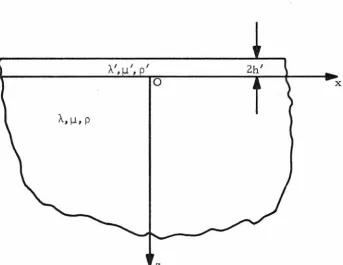
Consider a half- space occupied by an elastic, isotropic,
homo-geneous solid with Lame parameters
A.
and ~ and density p, coveredby a layer of thickness 2h' of a different material with Lam~
param-eters
A.'
and ~' and density p'. A coordinate system is establishedas shown in Fig. 1, with a y-axis running out of the plane of the
paper. The displacements in the x-, y-, and z-directions in the
half-space are denoted by U, V, and W respectively, and in their
fullest generality are functions of x, y, z, and time t. The case of
plane strain is assumed, so that all displacements are independent of
y, and V
=
0. Further, the time dependence is assumed to behar-monic with
-iwt U(x, z, t)
=
u(x, z)e ,w
>0.l
( l. 1) -iwt
A.',fJ', p' 0
A.,IJ.,p
[image:12.563.128.471.266.530.2]z
Figure
1.
Coordinates for a Half-Space Covered by a Thin Layer.
-8-For convenience, the amplitudes u, w will henceforth be referred to
as displacements. Since actual, physical displacements must be
real, those corresponding to the present problem are either the real
or imaginary parts of the quantities appearing in (1. 1).
Under the foregoing assumptions the elastodynamic equations
of motion will be satisfied if the displacements are related to the
two-dimensional Lame' potentials iii (x, z), 'Y(x, z) by1
u(x, z)
( l. 2)
w(x, z)
and if the potentials satisfy the reduced wave equations
2
2
'V iji +kd iji
=
0 ',..,2,u+k2w V I S I
=
0 , - 00 <X< 00 , Z;;:: , 0where
( l. 3)
The potentials iJi and '¥ are referred to respectively as the dilatation
and shear potentials; the speeds cd and cs are respectively the
dila-tation- and shear-wave speeds.
2
The stresses are related to the potentials by the formulas
1see[l2]
2 2 82 82'¥ 0 = 11 [ (2kdk + 2
-2) iJi -2~ ],
XX S
8X uxuz
82iJi 2 82 0xz = 1J[2n--a- (k + 2 - ) '¥],
uxuz s 8z2
0
zz
( l. 4)
The pure surface waves of interest here are solutions of (1. 3)
which decay exponentially with z and satisfy appropriate conditions at
z
=
0. Such solutions take the formiJi(x, z)
=
Ae -nd(k)z±ikx,'" ( r x, z -) _ AP. 1-'e -n (k)z±ikx s , ( l. 5)
where
n (k)
=
Jk
2 -k2 ' k>k , p=
d, s,p p' p
and where A, (3, and the wave number k are constants yet to be
deter-mined.
Now assume that the layer covering the half- space is thin
enough that the displacements within the layer can be taken
approxi-mately as independent of z. By virtue of the requirement that
dis-placements be continous across the interface between the layer and
the half-space, the displacements in the layer must then coincide with
those in the half-space at z
=
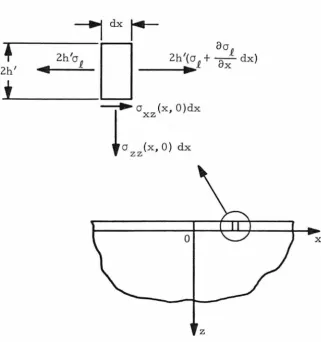
0.Consider the forces acting on a differential element of the layer
of unit width in the y-direction and of length dx, as shown in Fig. 2.
Upon neglecting all internal stress resultants in the layer except those
due to simple stretching, the balance of momentum in the x- and
-,dxr-.,+ ___
2_h_'cr_n_D
2h '( (J n+ :
(J p_ dx)Zh' ... X ----~~X X
t
!
..
cr xz (x, O)dx cr (x, O) dxzz
z
Figure 2. Differential Element of The Surface Layer .
[image:15.566.131.453.201.543.2]oa
2hl J. ( ) 1 I 2
a-+a
ux xz x,O +2hpw u(x,O)=O,la
(x, 0) + 2h1p\iw(x, 0) = 0, zz
( l. 6)
where
a;
is the axial stress in the layer. The stressesa
(x, 0) and xza
(x, O) are those exerted by the substrate on the layer. The axial zzstress
a;
is related to the displacement u(x, 0) byI( ) -4 I(
A
1+U1) ou(x, 0) ~ x - u X~2u'ox
Substitution of ( l. 7) into ( l. 6) yields
where
2
-o
u(x 0)a
(x, O) +uNi
+uMu(x, O) = 0,xz
o
x
a
(x, 0) +uMw(x, 0) = 0, zz8hl I 11+ I 2hlpiW2 N -~ ( fl. bl ) M- =~-...;,;._.,
- u "-'+2u' ' - u
( 1. 8)
Note that N and M are measures of the layer's stiffness and mass,
respectively.
Equations (1. 8) may be thought of as boundary conditions to be
satisfied by the fields in the substrate. Note that in the absence of a
covering layer, M = N = 0 and ( 1. 8) reduce to the boundary conditions
appropriate to a traction-free surface. Tiers ten [3] deduced ( l. 8)
from a more general development in which Mindlin's plate equations
[ 13] were taken as a starting point2. He argued that for thin plates
1 This relationship is derived from the three -dimensional stress- strain law under the assumption of plane strain in the y-direction and vanish-ing of normal stress in the z-direction.
all terms except those involving axial stretching and inertial reaction
are negligible.
Substitution of the potentials (l. 5) into (l. 2) and (l. 4), and
thence into the boundary conditions (l. 8), yields a pair of
homage-neous, linear, algebraic equations in
A
andA!3.
The condition forthe existence of a non-trivial solution is that the determinant of the
coefficient matrix vanish. This is
R(k)- Nk2k2n (k) + M[k2[n (k) + nd(k)]
s s s s
2 2 2 2
+Nk [k - ns(k)nd(k)]}+M [ns(k)nd(k)- k } = 0 ( l. 9)
where
2 2 2 2
R(k) = (2k - k ) - 4k n (k)nd(k)
s s (l. 10)
Each value of k satisfying ( 1. 9) determines an elastic surface
wave through ( l. 5), provided k>k (note that k > kd' provided A> 0
s s
and ~ > 0 - see (
l.
3)) and provided!3
has the now common valuere-quired by either of the boundary conditions (1.8). If the time
depen-dence is restored in the potentials (l. 5), their x- and t-dependence,
and hence that of all field quantities, is of the form
±ikx- iwt ±ik(x :ret)
e
=
e (l. 11)where c=w /k. Thus the surface wave ( l. 5), while decaying
exponen-tially with z, propagates unchanged in form with speed c in the
positive or negative x-direction according to whether the positive or
negative sign is used in (
l.
ll ).If the surface layer thickness 2h' vanishes, M=N=O, the
R(k)
=
0 . ( l. l 2)Equation (l. 12) determines the propagation speed of Rayleigh waves,
an extensive discussion of which may be found on pp. 307- 309 of
Love's text [15]. Achenbach, on p. 190 of [16], proves that there is
only one root of (l. 12) greater than ks. This root is denoted by kR
and referred to as the Rayleigh root or the Rayleigh wavenumber. If
(l. 12) is multiplied by w -4 the resulting equation for cR
=
w/kR, andhence cR itself, is independent of w. The Rayleigh wave is thus said
to be non-dispersive, i.e., its propagation speed cR is independent of
frequency w.
In the more general case Eq. (l. 9) may have one or two
roots [3]. The smaller one, which will be denoted kT and referred
to as the extended Rayleigh root, reduces continuously to kR as M and
N go to zero, while the other root goes to infinity in this limit. If
N ~ 0 or M
f:.
0, the speed corresponding to the extended Rayleigh rootis frequency-dependent, so the presence of the layer results in
sur-face waves which are dispersive.
A special case of interest is that of a massless layer, for which,
by (1.8), M=O, and (1.9) reduces to
>:< 2 2
R {k) = R(k) - Nk k n {k) = 0
s s (l. 13)
It is shown in Appendix A that this equation also has but one
admissi-ble root. This root is less than kR' reduces continuously to kR as
N .... 0, and corresponds to a dispersive surface wave which propagates
in keeping with the intuitive expectation that a stiffening layer would increase the characteristic surface wave speed.
It must be noted that if the sole objective of the present paper were a study of pure surface waves, it would not be necessary to make
2. Formulation of the Problem
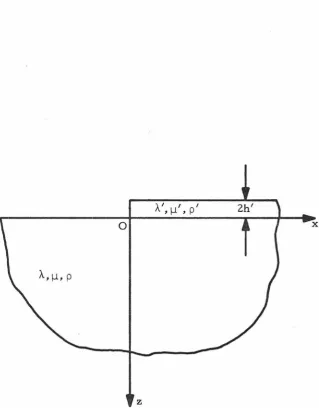
An elastic, isotropic, homogeneous solid occupies the half-space -ro<x, y<oo, z~O . A thin layer covers and is bonded to the surface z
=
0, -ro<y<ro, x>O, as shown in Fig. 3. Notations for coordinates, material properties, and field quantities are exactly as in the previous section. The assumptions of plane strain and harmonic-iwt
time dependence of the form e are maintained, so that the problem may be formulated in terms of the time-independent Lam~ potentials
<t> (x, z), 'f(x, z). The reduced wave equations governing these
paten-tials are (1. 3), the displacement-potential relations are (1. 2), and the stress-potential relations are (1. 4). The boundary conditions for the unplated surface are
a
(x, 0)=
0-oo<x<O
.1
zz
( 2. 1)
a
(x, O)=
0xz
and for the plated surface, in accordance with the assumptions and results of the previous section,
a
(x, 0)+
f..LMw(x, O) =zz
0 ,
1
a
2u(x 0)a (x, 0)
+
f..LNz'
+
f..LMu(x, 0)=
0 , O<x<ro .xz
ox
(2. 2)
The potentials 4>, 'f are required to be twice-continuously differentiable in the interior of the half-space. The quantities appear-ing in the boundary conditions (2. 1), (2. 2) are required to be continu-ous up to the respectively appropriate segment of the boundary, ex
-cepting the origin x
=
z=
0 . Certain further conditions, which will be-16-AI I I
, ~ , p
0
/..,~,p
z
Figure 3. Coordinates for a Half-Space Covered
by a Semi-Infinite Thin Layer.
[image:21.563.125.445.88.496.2]various field quantities as the origin is approached, these conditions
having the effect of ruling out point loads and higher-order
singulari-ties at the origin.
The potentials <ii, '¥ are required to be of the form
<ii (x, z) = A0cpR + (x, z)H( -x) + ArcpR- (x, z)H( -x)
+AtcpT+(x, z)H(x) +cp(x, z),
'i'(x, z)
=
A01jTR+(x, z)H(-x) + ArljiR- (x, z)H(-x)
+ AtljTT+(x, z)H(x) + ljl(x, z) .
( 2. 3)
In Eq. (2. 3), cpR±, ljiR±, cpT+, and ljiT+ are normalized potentials
representing positive- and negative -traveling Rayleigh waves and the
positive-traveling extended Rayleigh wave corresponding to the layer,
and are given by
where
=
-nd(kR)z ± 2kRx ,1,=
±~ -n (kR)z±ikRxcpR± e , "'R± ~"R e s ,
i3R
=
2ikR ns (kR) '2 2
2kT-ks -~Mnd(kT)
f3T
=
2ikTns(kT)-i~MkT
(2. 4)
The constant A
0 is given, the constants Ar and At are unknown,
H(x) is the unit step function, and cp and 1jT are required to satisfy the
radiation conditions
ik r e s
ljl(x, z)""'G(8)
J? ,
-18-t 2 21
-1
uniformly in 8 for 0S:8$1T . Here r:::: 'Vx +z ,
8
::::Tan (z /x), as r-+oo,F(8) and G(8) are unknown functions of 8, and the symbol
"rv"
denotes asymptotic equality in the usual sense.
The motivation behind (2. 4) will be discus sed presently, but
first a matrix notation will be introduced which not only simplifies
some of the subsequent manipulations, but consolidates the
fundamen-tal concepts of the analysis. Twice-underlined letters will denote
2
x
2 matrices of partial differential operators, and underlined letterswill denote column vectors with two components, the first of which is
a dilatational potential, and the second, the corresponding shear
potential. Thus the reduced wave equations ( l. 3) become
where
L::::
L iJi:::: 0
-~
:::: lip
(x, z)'!'(x, z)
The boundary conditions (2. l) and (2. 2) become
where
R iJi :::: 0, z :::: 0, -oo<x<O,
= - -
-(R
+
N~+
MT)_! ::::
0 , z :::: 0 , 0 <x<oo ,R::::
0 0
S::::
03
a3
-2
ax az
a2
2-axaz
a
T::::-
a a
( 2. 6)
The required form of the solution (2. 3) becomes
where
.P_R±=
(2. 8)
ikTx
e ,
l
cp(x,
z)l ,
~(x,z)
and where cp(x, z) and ~(x, z) must satisfy the radiation conditions (2. 5).
Now it can be seen that in the assumed form (2. 8) each of the first three terms represents a surface wave propagating in either the positive or negative x-direction and existing only for either positive or negative x. The first term is the incident wave and has amplitude A
0 . The remaining terms taken together constitute the scattered wave and propagate outward from the origin. These terms are
referred to respectively as the reflected wave, the transmitted wave, and the radiated wave; the ratios Ar/ A
0 and A/ A0 are referred to respectively as the reflection and transmission coefficients.
is separated into various parts, some representing surface waves,
3. Solution for a Massless Layer
It is now assumed that the layer's density p' vanishes.
According to (1. 8), this causes M to vanish. Under this condition the
governing differential equations (2. 6) remain the same, but the
bound-ary conditions (2. 7) reduce to
R ! =
Q,
z = 0, -oo<x<O,(R + NS)ili = 0, z = 0, O<x<oo
=
::::::::~-
-
.}
(3. 1)
The assumed form (2. 8) and the radiation conditions (2. 5) remain, but
the wave number kT appearing in (2. 8) is now a root of the simplified
form (1. 13) of the more general dispersion relation (1. 9).
The order conditions at the origin are taken as
0 (x,O)=O(l), xz
80 (x, 0)
+
xz
ox
-pl= O(x ) as x ... 0 , p1 <1 , (3. 2)
The solution to the problem specified by (2. 6), (3. 1), (2. 8),
(2. 5) and (3. 2) will be obtained in closed form in this section.
It is convenient to define a new function ~(x, z) by
A
,!(x, z) = A
0cpR+(x, z) +~(x, z) . (3. 3)
Recall that A
0 is the amplitude of the incident Rayleigh wave. Thus A
for x<O,
2
comprises the scattered wave, while for x> 0 it consistsof the scattered wave minus a positive-traveling Rayleigh wave of
A
amplitude A
0. In either case,
.:£.
consists only ofA
The differential equations governing T_ are obtained by
substi-tuting (3. 3) into (2.
6),
and by noting that, according to (1. 3) and (2.6),
L T_R
+
=
Q.
This yields AL T_
=
Q ,
-co <x <co , z:?: 0 • (3. 4)A
The boundary conditions for cp are obtained by substituting (3. 3) into
(3. 1), and by noting that, according to (1. 8), (1. 2), (1. 4) and (2. 7),
R cpR+
=
Q.
This yieldsA
R T_
=
Q ,
z=
0 , -co <x <co ,A
AONik;kR {0} ik
X(R
+
N~)5£=
2 e R , z
=
0 ,- - 1
O<x<oo,
l
(3. 5)
where use has been made of the definition of S in (2. 7) and that of
13R
in (2. 4).This problem will be solved with the aid of a Fourier
trans-form on x. Let f(x) be a complex-valued, absolutely integrable
func-tion of the real variable x which satisfies
(3. 6)
for some positive constants K,
o
andx
0. The exponential Fourier
transform of f(x) is defined by
co
"'
f (x.)=
J -
f(x)e ix.x dx, -o <Irn x. <o , [ } (3. 7)-co
and the inversion formula is
co
1
J"'
i~x
f(x)
=
21T f (x.)e · drt, -co<x<co . (3. 8) -co
transform f(x.) is analytic in the domain - o <hn [x.} <o (see [ 20],
p. 338).
It is clear from (2. 8) that for fixed z the potentials P, '1' will
not satisfy the decay condition (3. 6) for any o>O, as long as the wave
numbers kR'· kT, ks and kd are real. However, application of the
Wiener-Hop£ technique (which will be explained presently) requires
that the transforms be analytic in strips of the complex x.-plane such
as that defined in (3. 7). The difficulty is resolved by temporarily
assuming that the frequency
w
has a small, positive, imaginary part,while all propagation speeds remain real. This is a standard artifice;
it is discussed, for example, on p. 28 of [ 21 ]. After the solution is
obtained, the imaginary part of w will be taken to vanish.
Now since ~ is required to contain only outwardly propagating
waves, the assumption that hn
fw}
> 0 (and consequently thathn[kQ'} >0, Q'
=
d, s, T, R) rendersi
exponentially decaying in lxl asrequired by (3. 6), with decay constant 6 satisfying O<o<hn[kd}
(c£. (3. 3), (2. 8), (2. 5)).
Formal application of the transform (3. 7) to the differential
equations (2. 6) yields
(3. 10)
2'">:'
a
'l'(x., z)- 2( );;( )2- n x. r x., z
=
oz
s0 , -o <hn [ x.} <6,
where
1 2 21
n =Vx. -k
The functions ns (x.) and nd(x.) are rendered single-valued in the entire rt-plane and analytic in the strip -o<Irn[rt}<o by taking branch cuts as shown in Fig. 4, and by requiring ns (rt) and nd(x.) to approach
+oo as x. ... oo along the positive real x.-axis. The solutions of (3. 10) are then
~(x.,
z)=
A(rt)e -nd(x.)z + A'(x.)end(x.)z,l
r (
1{ ' z ) = B ( 1{. ) e - n s ( 1{. ) z + B I ( 1{.) ens ( 1{. ) z ' -0 <Irn [ 1{. } < 0 '(3. 11)
where A(x.), A'(x.), B(x.), and B'(x.) are unknown functions of x.. How-ever, the coefficients A'(rt) and B'(x.) must vanish; otherwise the transforms would grow exponentially with lx.l for z>O, and the inver-sion integrals (3. 8) would not converge. This leaves
'i::' ~(x.,z)
~(x.,
z)=
A(rt)e -nd(rt)z,I
= B (x.) e-ns ( x.) z , -6 <lrn [ x.} <
o
.
(3. 12)
The boundary condition (3. 5), when written in component form, becomes
2
2 ....
( 2k2 - k2 + 2-8
-)cr
+2~
=
o,
z=
o,
-oo<x<oo,d s
az2
axaz
(3. l3a)(3. 13 b)
0
-k R
-k s
Im[;~t}
B_
[image:30.566.69.517.104.709.2]-26-fact that the mass of the layer is neglected at present, so that M
=
0 1n(2. 2). In contrast, the conditions (3. 13b, c), which relate to the
normal tractions at z = 0, take different forms according as x<O or
x> 0. The fact that only one of the boundary conditions changes form
at x
=
0 makes possible the application of the Wiener-Hop£ procedurein its simplest form.
It is now convenient to define functions f(x) and g(x) on (0, co)
and (-co, 0), respectively, by setting
(3. 14)
Apart from a factor ~. f(x) and g(x) are the unknown values of 0 and xz
2 2
0 +~No u/Elx under the layer z = 0, O<x<oo, and on the free sur-xz
face -oo<x<O, z
=
0, respectively.Formal application of the transform (3. 7) to (3. 13) and {3. 14),
followed by use of (3. 12), yields
(2x. 2- k2)A(x.) - 2ix.n (x.) B(x.)
=
0,s s
2 2
-- 2ix.n (x.)A(x.)-- {2x. -- k )B(x.)
=
F (x.),s s
where
(X)
I
-htx F- (x.)=
f(x)e dx,0
0
G+(f(.)
=
Jg(x)e-ix.xdx.-(X)
(3. 16)
The functions f(x) and g(x) as defined by (3. 14) are
exponen-tially decaying for large positive and negative x, repsectively, with
-
+
decay constant 6. Moreover, since F (x.) and G (x.) are half-range
transforms of f(x) and g(x), F- (x.) and G+ (x.) are analytic functions
of x. on the half-planes Imfx.} <6 and Im[x.}
>
-6, respectively (seep. 12of[21]). The superscripts on F (x.) and G (x.) are thus seen
-
+
to be suggestive of the half-planes on which the functions are
respec-tively analytic.
After A(x.) and B(x.) are eliminated from (3. 15) there remains
the single equation
where
R(x.)
*
2 2R (x.)
=
R(x.) - Nk x. n (x.) s s(3. 17a)
(3. 17b)
It is important to note that the domain of validity of (3. 17a) is the
strip -6 <Im [ x.} <6.
Now define D(f(.) by
D(x.)
=
2(k;-
k~)R*
(x.)2
'
Nk n (x.)R(x.) s s
It is shown in Appendix B that D(x.) admits the representation
where
D(x.)
=
D- (x.) D+(x.)OO'FiO
=
exp{--1-.J
Log[D(ct)]da} -o<Im[x.}<o2TT1 • J: Q'-1{ '
-<Xl=fl u
(3. 19)
and that D+(x.) and D-(x.), by trivial analytic continuations, have the
scune domains of analyticity as G + (x.) and F- (x.), respectively. In
view of (3. 18) and (3. 19), Eq. (3. 17a) may be rewritten as
2 - -
-Nk n (x.) D (x.)F (x.) s s
The functions n±(x.) are rendered single-s
valued in the entire complex x.-plane and analytic in the strip
-o<Im[x.} < 6 by taking branch cut!:! as shown in Fig. 4, and by
re-quiring both n+(x.) and n-(x.) to approach too as x.-oo along the
posi-s s
tive real axis. Note that the superscripts have the scune meanings as
above.
Equation (3. 20) is said to be of Wiener-Hop£ type. The method
used to solve it is referred to as the Wiener-Hop£ technique, and is
,Im[K}<6,
(3. 21)
The function H+(K), by a trivial analytic continuation, is analytic for Im[K}>-6, while H-(K) is similarly analytic for Im[K1<6. Accord-ing to {3. 20), there is a common strip of analyticity in which
{3.22)
It follows that there is an entire function H(K) such that
(3. 23)
+
Now it will be proved that both H-(K) and H (K) tend to zero as IKI-+oo in the appropriate half-plane. The order conditions {3. 2) imply the existence of positive constants L and E: such that
Ia {x, O)I<L
xz , O<x==::E:,
(3. 24) Ela (x, 0)
I
x:x
I
<Lx -pl ' 0 <x::::E: 'I
a
(x, O)I
< Ke -ox , E:~x<oo,xz
(3.25)
8a (x, 0) l'.
I xz Clx I <Ke -vx , E:~x<oo, 2
I
a
xz(x,O)+~Na
u(x,O)I<Keox 2 '-oo<x~-E:.
8x
Substitution of (1. 2) and (1. 4) into (3. 14), thence the result into (3. 16), yields
(X)
-
I
-i~x~F (~)
=
a
(x, O)e dx,xz (3. 26a)
0
0 2 .
~G+ (~)
=
I
[a
xz (x, 0) +~N
8u(~,
0)J
e-l~xdx
•-oo 8x
(3. 26 b)
One integration of (3. 26a) by parts, followed by use of (3. 24) and
(3. 25), leads to the following asymptotic estimates for F-(~) and
G+(~):
a
(x, o) . loo 1 ooraa
(x, o) .I
IIF-(~)1=
xz l~X + xz -l~Xdx~ -i~ e o+ i~ oi 8x e
0
(3. 27)
= 0(
~~-l)
asl~l
.... oo,Im[~}<o,
0 -8
I~G+ (~)I ~
I
L lxrp2 dx +IKe
oxdxIt is proved in Appendix B that
ID+(~)I
....
l
as1~1-+oo, Imf~}>
-6,}
ID-(~)1-+1 as 1~1-+oo, Imf~}<6.
Use of (3. 27) and (3. 28) in (3. 21) yields
H- ( ~) .... 0 as 1~
1-+ oo ,
Im [
~}
<
6 ,+
H (~)-+0 as 1~1-+oo, Im[~}>-6.
(3. 28)
Therefore (3. 23) and a trivial extension of Liouville's theorem (p. 125
of [22]) imply that
H(~)
=
0 . (3. 29)+
In view of (3. 29), (3. 23), and (3. 21), F-(~) and G (~) are
given by
rm[~}<6,
(3. 30)
Im[~}>-
6.
Substitution from (3. 30) into (3. 15) yields three equations in A(~) and
B(~). Any one of these may be considered as redundant and the
re-maining two solved for A(~) and B(~) to give
A(~) = (3.3la)
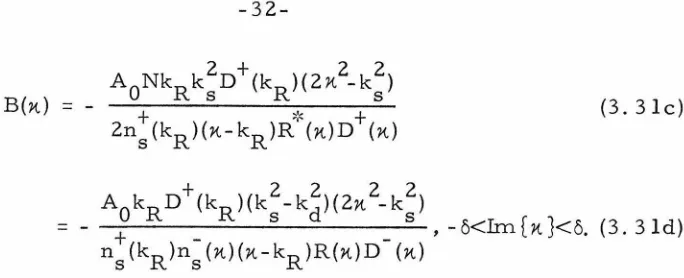
B(1-t)
=
(3.3lc)The alternate forms are obtained by using (3. 18) and (3.19).
yields
Application of the Fourier inversion formula (3. 8) to (3. 12)
00
cp(x, z)
=
2
~
J
A(1-t)e -nd(1-t)z + i1-txd1-t, -0000
~
(x, z)=
2~
J
B(1-t)e -ns (1-t)z + i1{xd1-t -00(3. 32)
as formal candidates for a solution to the original problem for cp, ~. Several steps are now necessary to prove that the functions cp,
$
appearing in (3. 32) are properly defined and actually satisfy (3. 4) and (3. 5). These steps are left to Appendix C. It is also proved there that the asymptotic forms of F-(1-t) and G+(1-t) as j1-tj ... oo are in fact as specified in (3. 27).In order to demonstrate that (3. 32) contain the surface waves required by (2. 8), the integrals in (3. 32) must be regarded as complex contour integrals along the real 1-t-axis in the complex 1-t-plane (see Fig. 4). The singularities in the integrands in (3. 32) are due to the various singularities of D+(1-t) and D- (1-t), the branch points of n (1-t)
[image:37.560.153.495.66.205.2]points at -ks and -kd' no zeros, and a simple pole at -kT' while
D- (x.) has branch points at ks and kd, no zeros, and a simple pole at
*
By inspection of (3. 17b) it is seen that R(x.) and R (x.) have
branch points at ± ks and ± kd' and it is proved in Appendix A that
their only zeros are located at ± kR and ± kT, respectively. Hence
the singularities of the integrands in (3. 32) are branch points at ± k
s
and ± kd' and simple poles at ± kR and ± kT. These are shown in
Fig. 4. That they are not on the real axis is due to the assumed small,
positive, imaginary part of
w.
The branch cuts are taken as shownin Fig. 4. The segments of these cuts between the branch points and
the imaginary axis will lie along the real axis in the limit as Im
[w} ...
0.Now consider an integration around the closed contour formed by
the quarter-circular arcs of radius R and the appropriate segments
of the branch-line contour and the real axis, as shown in Fig. 4. If
the integrals over the quarter-circular arcs vanish in the limit as
R ... oo, then by Cauchy1 s theorem the integral over the real axis may
be replaced by that over the branch-line contour plus the contribution
from the residues at the poles kT and kR. It can easily be shown
that this is in fact the case when x>O. The residues are evaluated
using (3. 3la, c) and (3. 32). With the aid of (3. 17b) and (3. 3) it is
seen that the contribution due to the pole at kR is equal to the
inci-dent wave AO~R+(x, z) but for its sign. Thus substitution of the
where
-34-<.P (x, z)
=
AtcpT+(x, z) + cp(x, z),l
'Y(x, z)
=
AtiJ!T+(x, z) + IJ!(x, z), x>O,A
=
t
,r,. I
R'
'
(kT)cp(x, z)
IJ!(x,z) =
=
=
-
·-,
dR~-dtt 1{ = k
T
2~
J
A(tt)e -nd(tt)z + ittxdtt'x>OJ
B+
_1_
J
B( ) -n (tt)z + ittxd2rr tt e s tt '
B+
(3. 33)
(3. 3 4)
(3. 3 5)
and where B+ denotes the branch-line contour in the upper half-plane
(see Fig. 4). The full field is thus seen to have the required form
(2. 8) for x> 0, with At as the amplitude of the transmitted wave,
pro-vided
cp
and 1J! satisfy the radiation conditions (2. 5). That they do maybe proved by analyzing the asymptotic behavior for large Jx2+z21 of
the integrals in (3. 35). When z
=
0, such an analysis may be carriedout with the aid of Watson's lemma, and when z
f:
0, by the saddlepoint method.
When x<O, a similar procedure applied in the lower half of the
tt-plane leads to the result
where
A = r
2 2
+
+
AOkR (ks- kd)D (kR)ns (- kR)
n: (kR)D- (- kR)R'(- kR)
=
d){
dRI,
1-t =-kR
cp(x, z}
=
2~
I
A(7-t)e -nd(ft)z+
iftxdft, B~
(x, z)=
2~
I
B(7-t)e -ns (7-t)z+
i){xdft, B_(3. 37)
x<OJ
(3. 38)
and where B denotes the branch-line contour in the lower half-plane.
Thus the full field has the required form for x<O, with A as the
r
amplitude of the reflected wave.
Note that the functions cp(x, z), ~(x, z) as defined by (3. 35) and
(3. 38) are discontinuous across x = 0, z> 0, but the full field
.!
istwice-continuously differentiable in the interior of the half-space.
Also note that had (3. 32} been derived formally without
recourse to the assumption of complex frequency, the inversion
con-tour would appear to pass directly through the poles and branch points
(since they would now lie on the real 7-t-axis), and it would be
neces-sary to appeal to some other argument to determine whether this
contour should be considered as passing above, below, or through
these singularities. The assumption of complex frequency, in
addi-tion to providing the overlapping domains of analyticity required for
the Wiener-Hop£ analysis, serves in effect to resolve this dilemma.
-36-It is now desired to obtain numerical values for the reflection
and transmission coefficients Ar
I
A0, A/ A0. All quantities in (3. 34) and (3. 37) can be evaluated straightforwardly except for the functions
+
-D and D . It is proved in Appendix B that
(3. 39)
so for the purpose of determining Ar/ A
0 and At/ A0 from (3. 34) and (3. 37), it is only necessary to compute D+(kR) and D+(kT). This is done by a numerical integration, the details of which are explained in Appendix B. After rewriting (3. 34) and (3. 37) in dimensionless form it is seen that the coefficients Ar
I
A0, At/ A0 are functions only of the dimensionless layer parameter Nk and Poisson's ratio
v.
Thes
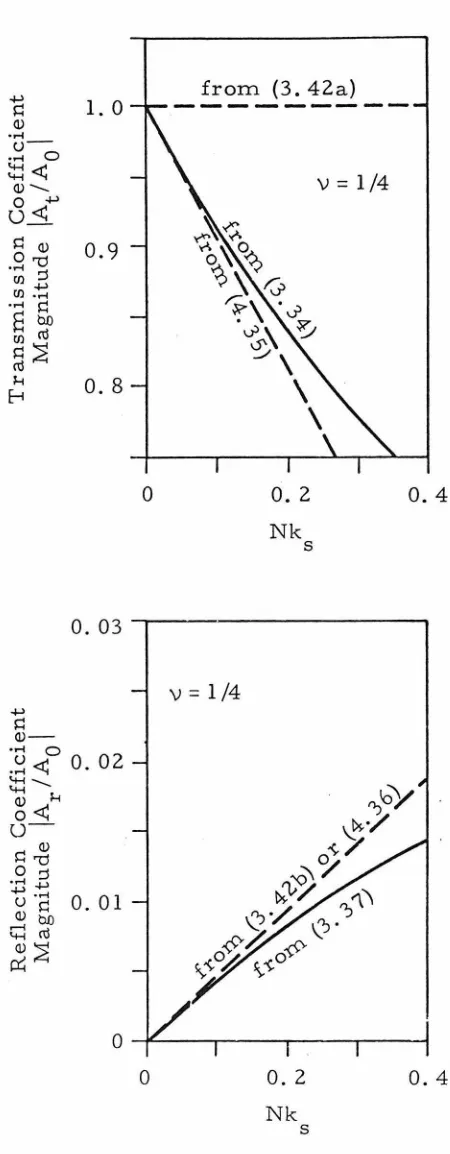
dependence on Nk of the transmission and reflection coefficients is s
shown for v= 1/4 in Fig. 5. The coefficients Ar/A
0 and At/A0 are complex, but for the range of Nk shown the imaginary parts never
s
exceed 0. 4o/o of the corresponding real part. A complex coefficient simply signifies a wave whose phase is shifted with respect to the incident wave.
A check of these numerical results may be obtained by com-puting, from (3. 34) and (3. 37), the asymptotic forms of Ar/A
0 and A/ A
0 as N-+ 0. The wave number kT is a function of N defined im pli c i tl y by ( 1. 1 3 ) :
1:l
1. 0<!)
...
u -... 0:::::~
< ! )
-0 ....,
u~
!=: <!)
.s
'1J (/) ::s (/) ."",::!... !=:
s
bO (/) ell@~
H E-i0.9
0.8
0. 03 0
0
from {3. 42a)
\) =
1/40.2
Nk
s
0.2
Nk
s
\) =
1/40.4
0.4
Figure 5. Transmission and Reflection Coefficients
[image:42.560.135.360.80.657.2]
-38-Upon setting N=O, and noting from (1.13) and (1.12) that kT(O) =kR'
there results
Thus
It is proved in Appendix B that for k>k s
Applicationof(3. 39)-(3. 41) to (3. 34) and (3. 37) yields
At = A
0
+
o ( 1 ) ,(3. 40)
(3. 41)
(3. 42a)
(3. 42b)
The first terms of (3. 42a) and (3. 42b) are plotted in Fig. 5 and it is
clear that they do agree with the numerical computation with
increas-ing accuracy as N-+ 0. Equation (3. 42a) expresses nothing more than
the fact that the amplitude of the transmitted wave approaches that of
4. Approximate Solution for a Very Thin Layer
It is now assumed that the layer is thin enough, when com-pared with the wavelength of any of the characteristic surface or body waves, that the layer parameters M and N, defined by (1. 8), may be taken as perturbation parameters in a sense to be described pres-ently.
so that
Let a constant ex be defined by
p I W 2 (
A/
+
2 ')a =
""V
X'+
~t;
,
M=aN.
( 4. 1)
(4. 2)
The perturbation process consists of allowing the layer thickness 2 h' to grow from zero to some small, non-zero value while holding ex fixed. Thus, in view of (1. 8), (4. 1), and (4. 2), the problem may be expressed in terms of the single perturbation parameter N.
The differential equation (2. 6) for _!(x, z) remains. By using (4. 2), the boundary conditions (2. 7) may be rewritten as
~!
=.Q.,
z=
0, -oo<x<O, }[ R
+
N (~+
aT )1!
=
.Q ,
z=
0 , 0 <x <oo(4. 3)
-
-
-The assumed form (2. 8) also remains appropriate, with the wave number kT a root of (1. 9), but now it is assumed that the amplitudes Ar' At appearing in (2. 8) may be represented by
A = A(O)+N A(l)+ o(N)
r r r ' }
A= A(O)+NA(l)+o(N) as N ... O,
t t t
and that the radiated wave
cp
may be expressed as:£(x,z)
=
:e_(O)(x,z)+Ncp(l)(x,z)+o(N) as N-oO (4. 5)Each term on the right of (4. 5) is assumed separately to satisfy the
radiation condition (2. 5).
The remainder of this section is concerned with the
determi-. (m) (m)
nahon of Ar , At , m
=
0, 1 The first step is to derive theequa-tions governing
~(O)
and .:r_(l). By substitution of (2. 8) into (2. 6) and(4. 3), there results the following problem for
2£.:
L
~
=
Q ,
z>
0 , - ro <x <ro , x~
0 } R :£=
0 , z=
0 , - ro <x <0 , '{ R + N
(g
+ a T) } ~=
0 , z=
0 , 0 <x <ro .( 4. 6)
The requirement that
!
be twice-continuously differentiable, whenapplied to (2. 8), leads to the jump conditions
[T]- Ao'£R+ (0, z)- ArTRJO, z) + AtTTt (0, z)
=
0,}
[2£,
x] - 1kRAO.:P_R+(O, z) + 1kRArcpR-
(0, z) (4. 7)+
ikTAt~T+(O, z)=
Q,
O<z<ro,where
J
+
-[cp
=
:£(0 , z)-:£(0 , z) .When (4. 2) is substituted into ( 1. 9), there results an equation
which defines kT implicitly as a function of N. By differentiating
Equation (4. 8), and the fact that kT = kR when N = 0, lead to
kT = kR +
Nk~l)+o(N)
as N-+0. (4. 9)The quantity ~T+(O, z), defined by (2. 8), may similarly be
expanded in a power series in N, resulting in
cpT+(O,z)
=.:f:R+(O,z)+N~~l(O,z)+o(N)
as N-+0, (4. 10)where
N=O
Now (4. 4), (4. 5), (4.
9),
and (4. 10) are substituted into (4. 6)and (4. 7), and the coefficients of the zeroth and first powers of N in
each equation are separately set equal to zero, to yield
L~(O)=Q,
z> 0, -oo<x<oo, X;{: 0;R
~(0)
= Q, z = 0, -oo<x<oo, XF
0;(0) (0) (O) _
L
~
( 1 ) =Q ,
z > 0 , - oo <x <oo , x f. 0 ;R~(
1)=..Q.,
z=O, -oo<x<O;
R
~
( 1 ) = -(~
+ a T)~
( 0) , z = 0 , 0 <x <oo ;[ r()(1 )J -A( 1)cp (O z)+A( 1 )cp (O )+A(O)cp( 1)(0 ) =_0,
::t:. r - R- ' t -R
+ '
z t - T+ '
z [cp(l)]+ik A(l)cp (O z)+ik A(l)cp (0 z)-'x R r -R- ' R t -R+ '
+ ik A(O)cp(l) (0 z)+ik(l)A(O)r() (0 z) = 0 z>O
R t -T+ ' T t .!:.Rt ' - ' ·
( 4. 12)
In order to solve (4. 11), it is convenient to define an
auxil-iary function
~(O)
by
cP(O) = cp(O)- A
cp
H(x) +A (O)cp H( -x) + A(O)cp H(x)- - 0-R+ r -R- t -R+ ( 4. 13)
When (4. 13) is substituted into (4. 11), the equations governing cP(O)
are found to be
A(O)
L ~ =
Q,
z>O, -oo<x<oo, } R~(O)
= 0, z = 0, -oo<x<oo, [cP(O)J = [cP(,O)J = 0, z>O.- - X
-(4. 14)
In particular, note that the differential equation for cP(O) holds
throughout the interior of the half- space. From (4. 13) it is seen that
~(O)
is everywhere outwardly propagating. This fact together with(4. 14) implies that T(O)
=
Q.
Thus, from (4. 13),cp(O) = (A -A (O))
cp
H(x)- A (O)cp H( -x)- 0 t -R+ r -R- ( 4. 15)
A (O)
=
A A (O} - 0 }t 0' r - '
(0)
T_
(x, z)=
0 .( 4. 16)
Equations (4. 16) simply express the fact that in the limit as the
layer vanishes, the full field
!
consists only of a positive-travelingRayleigh wave of amplitude A 0.
In view of (4. 16), Eqs. (4. 12) become
L
5£
(
1) =Q ,
z>
0 , -co <x <co , x -/: 0 ;R
T_(
1) =Q,
z = 0 , -co <x<co , x -/: 0;(4. 17)
The solution of (4. 17) is facilitated by the introduction of an
auxiliary function
~(
1) defined by"(1)
When (4. 18) is substituted into (4. 17), the equations for~
found to be
A k(l)
"( 1} _ 0 T { -ik
x}
R~ - ZkR R cpR+(O, z}e R H(-x)
{ ( 1) ik
X}
_
+ A
0 R _T.T+(O, z)e R H(x}, z- 0, -co<x<co,
( 4. 18)
are
(4. 19a)
(4. 19c)
As in the case of .P_(O), the function p_(l) is smooth enough that the
differential equation (4. 19a) holds throughout the interior of the
half-space.
The right-hand sides of (4. 19a, b) may be simplified
some-what. Note that
ik X
3:T+(x, z) = 3:T+(O, z)e T
= [ 3:R+ (0, z) + N
.'£~~
(0, z) + O(N2)] e ikRx [1 +iNk¥ )x + O(N2)J
lr()(l) ik X . (1)
J
2= cpR++N[!=-T+(O,z)e R +tkTx~R+ +O(N )asN ... O. (4.20)
Since L ~T+(x, z)
=
Q, each term of the latter form of (4. 20), whenoperated upon by L, must vanish. Thus
[-11) ik x
1
_
.
(1) [ }L pT+(O, z)e R _- -1kT L xcpR+(x, z) ( 4. 21)
From (1. 8), (1. 2), (1. 4), (2. 7), and (4. 2) it follows that
( 4. 22)
Substitution of (4. 20) into (4. 22) leads to
2
+ O(N ) = 0 as N ... 0 , z = 0 . ( 4. 23)
Each term of ( 4. 23) must likewise vanish separately, so
[ (1) ik x
1
.
(1) [ }R :!:T+(O,z)e R =-1kT R x.:!:R+ -(.e_+aT).:!:R+' z=O (4. 24)
The right-hand sides of (4. 21) and (4. 24) may be easily computed by
R 5£R+
=
Q
at z=
0. The first term in the right-hand side of (4. 19b) may also be computed directly. These results are then incorporatedinto (4. 19) to yield
(4. 25a)
where
( 4. 26)
Equations (4. 25) may be solved with the aid of the Fourier
transform (3. 7). It is once again assumed that the frequency
w
has asmall, positive, imaginary part. The transform of (4. 25a) is then
found to be
"'
2 " (1)a
cp (x., z) 2( )0:'(1)( ) 2 - n x. cp x., z=
oz
s2A
0kR k(.i.)e -nd(kR)z i(x.- kR)
2AOkR k(.-i)f3Re-ns (kR)z
i(x.- kR)
z> O, -o<hn{x.}<6 ,
(4. 27)
where 6 is a constant such that 0<6<hn{kd}. The solution of the
homogeneous version of (4. 27) is given in (3. 11), and again A'(x.),
-46-2A
0kR
k~)e-nd(kR)z
i(x.-kR)2(x.+kR)
z
>
0 ' - 6<Im [
/{. } <
6( 4. 28)
Application of the transform (3. 7) to the boundary conditions
(4. 25b), followed by use of (4. 28), yields
=
( 4. 2 9)This is a system of two simultaneous, linear equations in the two
unknowns A(x.), B(x.). It possesses a unique solution provided the
determinant of the coefficient matrix does not vanish. That
determi-nant is found to be -R(x.), where R(x.) is given by (3. l7b) and is
known to vanish only at x.
=
± kR. Since these points lie outside thedomain of validity of (4. 29), A(x.) and B(x.) may be computed
( 4. 3 Oa)
(4.30b)
Equation (4. 30a), for example, may now be used in the inversion
formula
00
cP(l)(x, z)
=
2~
J
~(7t)e-nd(rt)z_
-co
which follows from (3. 8) and (4. 28).
(4. 3 1)
The singularities of the integrand in (4. 31) are branch points
at ±kd' ±ks' and poles at ±kR. The contributions due to the residues
at the poles represent, as in the previous section, the surface waves.
For x> 0 the contour may be closed in the upper half-plane, as shown
in Fig. 4, so in this case it is the pole at kR. which is of interest.
-48-arising from the last term in (4. 31). The residue of each term may
be computed separately. The first, third and fourth terms have
double poles; the second, a simple pole.
The double poles will lead to secular terms, i.e., terms
con-taining x or z as a factor. It will be seen, however, that none of
these terms appears in the asymptotic expansion of
~(l)(x,
z) asx -t±oo. This is necessary in order that the asymptotic expansion be
valid; otherwise the representation of
!(
1) (x, z) would not beuni-formly valid in x and the asymptotic expansion could not be justified.
In fact, it is this very requirement which necessitated the seemingly
roundabout formulation employed in this section.
From (4. 18), for x>O,
(1) - A(l) (1)
cp {x, z) - cp {x, z) - At cpR+(x, z)
( 1 )
(1) ik X AOk:T
-A
0cpT+(O,z)e R - 2k cpR+(x,z), x>O. (4.32)
R
When the four residue contributions from
c$(
1) are combined with the latter three terms of (4. 32), there resultswhere
( 1) I
A
=
t
A 0 R"(kR)k! { 2
J}
___;:. _ __:::..::..._
2
-=- -
kRn (kR) + et [ n (kR) + nd(kR)2[R'(k )] s s
R
( 4. 3 3)
Note that the secular terms due to the double poles have been
can-celled by each other and by the third term on the right-hand side of
(4. 32). Now since Cj)(l)(x, z) must obey the radiation condition (2. 5),
it cannot contain any surface waves, so from (4. 33) it follows that
(4.35)
The coefficient A( 1) may be determined by a procedure analo-r
gous to that described above, but with the integration contour closed
in the lower half rt-plane. Because A(rt) has only a simple pole at
rt
=
-kR' the computation is somewhat simpler. The final result isWhen (4. 16) and (4. 34)- (4. 36) are used in (4. 4), the
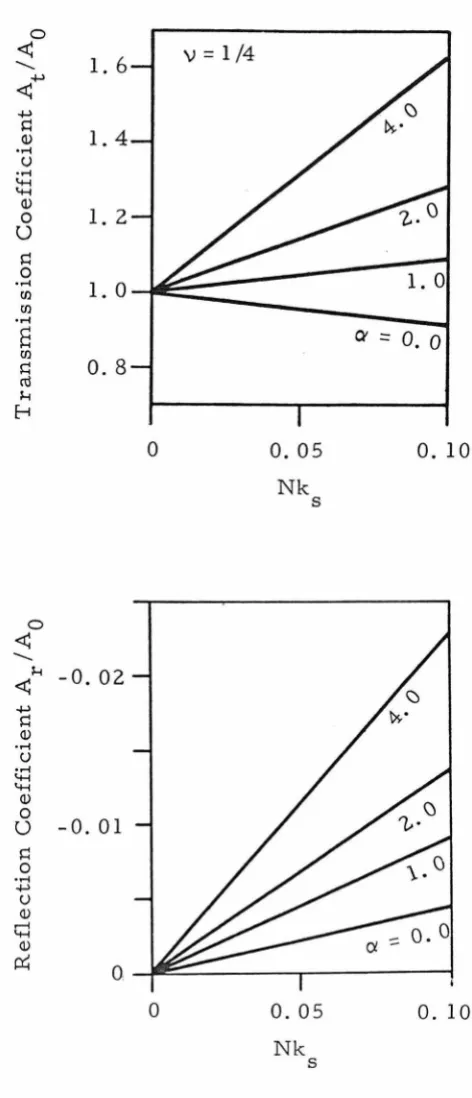
trans-mission and reflection coefficients may be computed to first order in
N. The resulting approximations to the coefficients are shown in
Fig. 6 for v
=
1/4.If the layer is massless, M=O, a=O, and the results may be
compared with those of the previous section. This is done in Fig. 5
0 ~ ..._ ~ ~ ~ 1=1 Q) ... u ... '+-i '+-i Q) 0 0 1=1 0 ... (IJ (IJ
...
s
(IJ1=1 til l-< f-i 0 ~ ..._ l-< ~ ~ 1=1 Q) ... u ... '+-i '+-i Q) 0 0 1=1 0 ... ~ u Q) ... '+-i Q) r:r::
1.6
v
=
1/4
1.4
1.2
1.0
0.8
0-0.02
-0.
01
Q
0
-50-0.05
Nk s0.05
Nk sQl :::
o.
00. 10
0. 10
Figure
6.
Approximate Transmis sian and Reflection5. Conclusions and Comments
The problem of the scattering of a Rayleigh wave by the edge
of a thin surface layer is amenable to solution by the Wiener-Hop£
technique in the case where the density of the layer vanishes. The
amplitudes of the reflected and transmitted surface waves computed
by such an analysis are shown in Fig. 5 for v
=
1I
4.A perturbation process leads to an approximate solution for
the case of a layer possessing both mass and stiffness. This analysis
yields the transmission and reflection coefficients shown in Fig. 6,
for v
=
1/4. The results of the two analyses agree closely for verythin, massless layers.
It is reasonable to ask whether the results of Section 3 might
be extended to the case of a layer having mass, by treating the
layer's mass parameter M as a perturbation parameter, while
allowing the stiffness parameter N to remain arbitrary. Such a
pro-cess leads to a sequence of problems, the zeroth order problem
being precisely that solved in Section 3. This procedure has been
attempted, but the computations required to obtain the first order
solution were found to be of prohibitive complexity. Part of the
diffi-culty arises from the fact that the zeroth-order solution, which is
known only as a Fourier inversion integral, appears as a forcing
function in the first-order problem. This necessitates the
.,,
Appendix A - Roots of R,,,{l-t)
In this section the roots in a suitably cut complex plane of
the function
(Al)
are located.
It is assumed that w
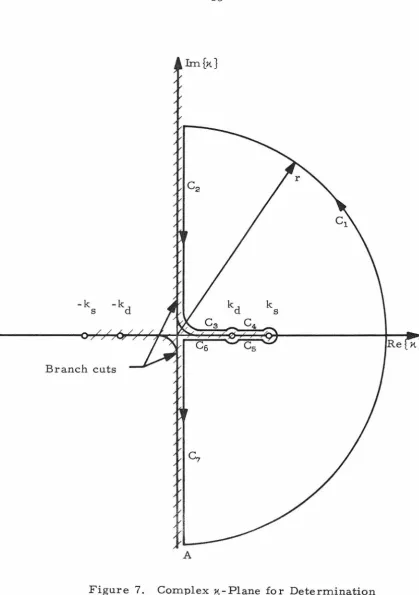
=
0, so that ks and kd are real. Thebranch cuts in the complex x.-plane are taken as shown in Fig. 7,
except that the radii of the cuts in the vicinity of the origin is
vanish-ingly small. The functions ns(x.) and nd(x.) are then defined by
requiring that they be positive for x.>ks. When ns(x.) and nd(x.) are
pontinued analytically throughout the cut 11.-plane, it can be seen that
>!:: >::: ~:<
f-
(x.) is even in 11., i.e., R (11.)=
R (-x.). Therefore it is onlyneces-sary to consider the right half-plane Re[x.}:::: 0.
The number of roots in the right half-plane may be determined
p
Y
the principle of the argument (see pp. 271-272 of [22]). Thef rinciple may be stated as follows: Let a function be analytic inside
qnd on a closed contour C except for at most a finite number of
poles inside C. Let f have no zeros on C and at most a finite
number of zeros inside C. Then
N - N
0 . p (A2)
where N
0 is the number of zeros of f inside C, a zero of order
m
0 being counted m 0 times, Np is the number of poles of f inside
C, a pole of order m being counted m times, and 6C
I
argf(x.)] isp p
-the change in -the argument of f(x.) as C is described in a positive
-k -k
s d
Branch cuts
Figure 7.
A
k s
Complex x.-Plane for Determination of Zeros of R*(x.).
[image:58.564.70.489.74.669.2]The curve C is taken as shown in Fig. 7. It is clear by
in-,,,
spection of (Al) that R1,(1-t) has no poles inside or on C, so (A2),
;~
*
when applied to R (11.), will give the number of zeros of R (71.) inside
,,,
>!<
C, provided that R (71.) has no zeros on C. To prove that
R''
(1-t)f:
0on C, each segment of C must be examined separately. The
appro-priate values of ns{71.) and nd(71.) for each segment of C are
deter-mined by analytic continuation from the half-line Im.{11.} = 0,
Re {11.}
>
k .s
>!<
These and the corresponding formulas for R (11.) are
given in Table 1 in terms of
s
and 'f1, where 71. =S
+
i'f1. By referringto the table, the following facts are noted: On
c
2 and C7'
Im.{R:<(71.)} =0 only at 'f1=0, where
Re{R~(71.)}
f:O.
On c3 and c6'Irn{i'<(71.)} =0 only at s=O, where Re{R:<(71.)}
f:O.
Onc
4 and
c
5,s=k
/JZ,
where Irn{i'<(71.)}f:O.
Hence s>:<
Re {R (11.)} = 0 only at
i:<(71.) 1=
o
onc
2 - cT
i8 -1
On
c
1, ns(71.)"'nd(71.)"'re as r-+oo, where 8 =Tan (Tl/s), so
from (Al),
R~<(11.)"'
[2 (rei8)2 _ k2] 2 _ 4 (rei8)2(rei8 )2 _ Nk2(rei8)2rei8s s
2 3 3i8
""'- Nk r e as r .... oo (A3) s
*
Thus R (x)
f:
0 on C, so the principle of the argument may be applied.*
One way to determine (l/2rr).6C[argR (11.)] is to plot the
*
*
trajectory of R (11.) in the complex R -plane as 71. describes C in the
complex 11.-plane, and then simply count the net number of times the
origin is encircled in a counterclockwise direction. The complex
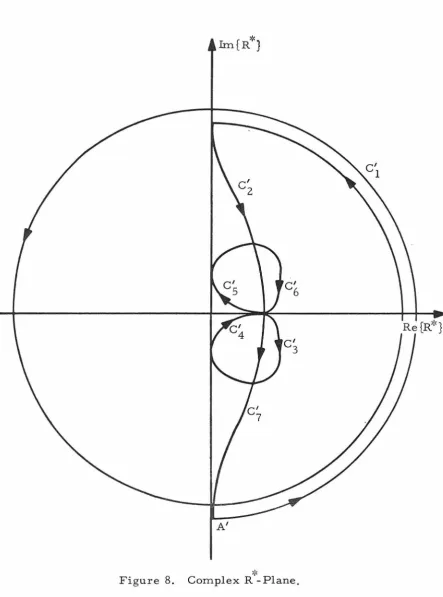
~<
R -plane is shown in Fig. 8. Point A, which corresponds to 71. = -ir,
.), Segment Range of X. nd (x.) n ( x.) R' -(x.) of C s c2 O+i n, co >'fl;;:o:O
i
Jk
~+n
2 iJk2+Tlz s( 21
}+k
2)
2
_
4
T1
2Jk~+T12
Jk2 +T12 +iNk 2T12 Jk 2 +T12 . s s s s c3 s +io , o:-:;; s:o:;;kd iJk 2 -s 2 d iJk2-s2 s (zsz -kz)z+ 4 s z Jkz-s
z'-hz~r!--iNkzr;Jkz -sz s d s . s s c4 s+iO, kd :o:;;g:o:;;k 8 Jsz-kz d i Jk2 -s
2 s (Zsz-kz) 2- 4if,2Js2-k2
fk.~r--_
iNk2 s2Jk2 -s2 s -d s s sJ
s2 -k2 i Jk 2 -s 2 ( zs 2 -k 2 ) 2 +4i s 2 J s 2 -k
2 J
k
2
-s
2 +
iNk 2 s 2 Jk 2
-~
cs s +iO, k 8 ;;::g;;::kd d s s d s s s c6 s+io, kd;;::g;;::o -i Jk2 -s
2 iJk2-g2 (2S2-k2) 2 +
4~Jk2-~
Jk2-s2 -+ iNk2 s2.£2-s2 d s s d d s s c7 O+iT],0:2':T]> -co -iJk2+T12 d
i[k2;T1
2
s
( 2
T12+k2)2
_ 4
-56-Re