GENERATING RETURN VISTOR WEBSITE TRAFFIC
Leonie J. Cassidy, James Cook University, Cairns, Australia, [email protected]
John R. Hamilton, James Cook University, Cairns, Australia, [email protected]
Singwhat Tee, James Cook University, Cairns, Australia, [email protected]
ABSTRACT
Revisit traffic into a website arises when the consumer is in pursuit of website offerings that are sufficiently in line with their motivations and/or with their desired outcomes. This one hundred week study upgrades and changes a business website over time. In six stages, the website is changed from static to interactive environments. At each website change the levels of functionality, interactivity and/or external post are altered to determine their effect on website traffic. Findings offered herein suggest a website’s consumer targeting should be monitored from multi-perspectives.
Keywords: Consumer website traffic, functionality, external posts, aesthetics, innovation, interactivity
INTRODUCTION
From the emergence of the internet in the early 1990’s websites have been recognized as a consumer reach mechanism for business. Early studies considered consumers as applying reasoned action [18] where technology acceptance by consumers provided a belief that influenced attitude, then instilled intention, and then established behavior. Davis [15] extended this concept with consume-perceived-usefulness and ease-of-use of technology determining attitude (to using), behavioral intention (to use) and actual system use. Hence, researchers have considered the marketing, technology and/or design causes of website effectiveness. Studies have included site recognition, comprehension, connection, interactivity, value, quality, performance, and outcomes focused studies in satisfaction, trust, and loyalty (often gauged as revisiting).
Psychology social approaches enable additional reflection around the website consumer. Petty and Cacioppo’s [46] ‘elaboration-likelihood-model’ builds a cognitive persuasive assessment of the consumer first from their central and carefully-reasoned, logical, and thoughtful perspective. Here, the consumer is motivated to assess the website against personal specific frames-of-reference, and if the website is deemed supportive, then the consumer’s motivation remains over time. In addition a second peripheral ‘elaboration-likelihood-model’ assessment pathway arises through the consumer’s attitudinal perception [47],[48],[49]. This emanates from peripheral experiential (or chance) cues (such as activating a link from a similar content website), but these peripheral cues can engender short-term motivational effects within the consumer.
Thus, the ‘elaboration-likelihood-model’ houses a central persuasion route where consumers are motivated and can jointly comprehend a raft of complementary frames-of-reference. This persistent motivation behavior has application in consumer outcomes studies such as website loyalty and revisiting intentions. In website business consumer reach studies such as marketing, advertising, and human-computer-interface perceptions, consumers are best motivated through peripheral (and repetitive) persuasion approaches.
The central and peripheral persuasion approaches of the ‘elaboration-likelihood-model’ are extended when behavioral considerations are included. Where the consumer is motivated to browse a website, each is more likely to consume (transact or engage), and where each consumption delivers suitable value, then a reflective consumer gratification process occurs - and this also influences the likelihood of revisits [29].
Consumer involvement is another feature of websites. Involvement fits within social judgment theory [54] and today involvement is often termed interactivity. Like involvement, interactivity is induced by a circumstance, a stimulus or an occasion and is an emotive arousal or a motivation into action [4],[43]. Some consider involvement a moderator to persuasion [56], yet persuasion likely precedes involvement. In this study we consider involvement to be portrayed as website interactivity – and involvement can be business and/or consumer generated.
Consumer website interactivity
The interactivity offered within a website is a positive consumer motivator [32]. Website interactivity gives consumers a sense of control and challenge, and also increases their intention to engage with the website [3],[36],[60]. From a marketing perspective, greater web interactivity levels build the consumers’ perceptions of their relationship with the website, and may increase their connection with this website [41] as a first time visiting consumer (FTVC) or a multi-time visiting consumer (MTVC). Added convenience, plus usefulness and enjoyment, enrich the consumer’s view of the website. This in-turn promotes the likelihood a revisit (MTVC) [58], and in websites with ready and convenient access, interactivity (through personalization functionality) incites FTVC and MTVC traffic [33]. Thus interactivity induces further traffic, and is also linked to website functionality.
Hence, we propose the following website relationship:
Consumer website functionality
Psychology, computer science, engineering and benchmarking studies have dissected the website into their perceived functional comparison sections. To interpret and compare websites Cassidy and Hamilton [5],[6] typologically classify website functionality under three domains (marketing, technology and aesthetic). They further divide each domain into nine differing, but recognizable functional sections. Others have recognized the website contains functional sections and have deployed qualitative, quantitative, or mixed method approaches to functionally divide specific areas of websites. Static websites (content providers that do not change) typically engage low levels of functionality. Interactive websites (where degrees of change, and allowing both business and consumer upgrades are available) typically engage mid-levels of functionality. Dynamic websites with a substantive range of connectivities (including social/forum feeds, intelligent database responses, and customizable features) typically engage higher levels of functionality. Thus functionality induces further FTVC and MVC traffic, and greater functionality can provide consumers with more dynamic websites.
Hence, we propose the following website relationship:
H2: website functionality influences website traffic
Consumer website posts
Functionality is linked with content posts – particularly posts into social networks. These external communications about the website can influence website traffic. Bai [2], Lee and Kozar [38], and Gerlitz and Helmond [21] recognize that well-targeted and well-implemented external social media ‘posts’ draw the social consumer back to the website - where an additional awareness, a sense of belonging, and sometimes additional pleasure perceptions or experiences may be derived [40]. These external social and informative post connections can motivate both FTVCs and MTVCs to pursue additional consumption options within the website [12],[52], and to hold positive perceptions regarding its informative usefulness [42],[58]. The combinations of positive social network posts (along with external forums and/or blogs) build the consumer’s motivation to repetitively engage, and to add to MTVC traffic [21]. Kabadayi and Gupta [33] show that at higher levels of relevant consumer-targeted website content, website traffic increases - especially where each website content block is also suitably promoted. Thus, external social and informative post connections directing consumers towards specific website inclusions typically results in greater website traffic.
Hence, we propose the following website relationships:
H3: external posts (from social and informative connections) influence website traffic
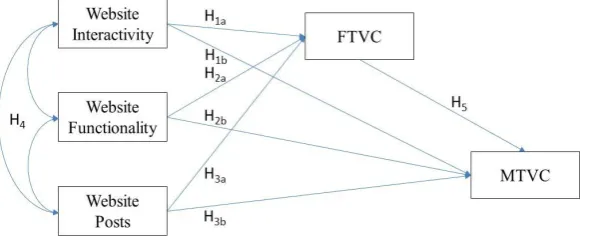
H4: external posts (from social and informative connections) co-vary with website functionality and interactivity
Consumer website traffic
The business website competes feverishly to establish its brand recognition, and to win consumer awareness [31]. Many businesses engage Google analytics to assess their consumers and to monitor their transactions (including retrieval of information, purchasing, or engaging in discussions) but they also seek to capture their consumer’s behavioral connotations [11], and to monitor when consumers shift into the website from the business’ social networks (including Facebook, Instagram or Twitter). Traffic from social networks arises through differing social media connectivity approaches including email, events, ads, news-releases, sponsorships, videos/webinars [55].
Other Internet-based analysis tools - like Google analytics, offer real-time data feeds suitable to track individual consumer website pathways [25], However, social networks that link traffic back into websites typically remain selective, non-generalizable, use point-in-time reference points, and so deliver point-in-time social community traffic comparisons [24],[27]. Hence, ad hoc changes to a website (or its connecting social network) complicate both the data capture, and the interpretation of website traffic algorithm calculations [59].
Consumer consumption
Online consumer consumption appears as either transactional, or usage, or content-downloading behaviour. This group behavior typifies the FTVC [22],[23]. The MTVC often pursues more creative behaviours such as uploading of their consumer-created content [1], [16]. Albuquerque [1] discriminates between FTVCs and MTVCs by assessing each group from referral, search (browsing) and direct (or familiarity-with-website) engagement perspectives. Toufaily [57] typologically groups literature showing FTVCs differ from MTVCs in regard to the consumer, the environment, the product/service, the company, and the website’s characteristics, and suggest these factors influence the online MTVC traffic into a business’ website.
Website design approaches
solutions [39], or point-in-time qualitative and/or quantitative studies [10],[37].
Website design approaches today
Website consumer traffic studies are now including the specifics of consumer behavior - such as transactional-to-revisit traffic studies [29],[56] or motivation-consumption-user gratification studies [26], or expectations-loyalty/revisiting studies. Such website traffic studies engage computer science, engineering, or benchmarking style approaches (Law et al. 2010; [8],[37],[42].
FTVCs versus MTVCs traffic
Website traffic arises when FTVCs enter the website and explore its functional deliverables. FTVCs can be directed to this website, or they can be ‘chance’ visitors who find the site through search processes. MTVCs revisit the website because they recognize it likely offers a consumptive deliverable that may meet one of their specific requirements. This typically involves the consumer interacting with some functional aspect of the website, and can be gauged against the website traffic [56]. Other psychological links into the website arise from social networks and consumers are likely influenced by posts. Thus, as their visiting behaviors’ differ, and for the reasons discussed above and so may relate to changes in website traffic for FTVCs and MTVCs.
Website connection to consumers
[image:3.595.102.502.335.495.2]Websites directly connect with the consumer. As different businesses pursue different consumer markets, and each offers website content differences – typically focused at information, or social-connection, or entertainment content [28]. Hamilton and Tee [26] trisect these website content groupings with Shao’s [53] consumer consumptive (interactive, participatory, or production-related) aspects, and deliver Table 1’s nine alternative groupings of website consumers.
TABLE 1.
SNS Consumer targeting matrix [26]
Interaction Participation Production
E n te rt a in m en t
Create games, scenarios and/or on-line content.
Build creative tools for users' daily activities. Enable different user generated
content sections for entertainment practices.
Connect users in real-time games, and/or serious scenario environments. S o ci a l C o n n ec ti o
n Enable interactions between users.
Build Chat functions. Build on-line communities.
Support activities and interactions. Build business's image on-line.
Enable and facilitate interactive
social connections. Create new solutions by learning
from discussions. In fo rm a ti o
n Provide product/service
information and free downloads. Link business and offering to
current activities that user advocates.
Create real-time reviews and
product/service tests. Clarify relationships between user and business (and its offerings).
Provide tools that enable daily
practices. Invite customers into the
development of new offerings.
M O T IV A T IO N
Each consumer group is motivated to choose their level (or aspect) of website involvement, and each consumer opts to consume either low, or medium, or high levels of immersive content-rich media [13],[19]. Website traffic from social networks [16] can be further enhanced [13] with external content-related posts [21] and with dynamic animated-video content, colour-contrasts, highlight images, and interactive linkages [52] with other stimulating websites [14],[32]. Provided the website remains suitably sequenced, and is of quality design, then as the consumer’s perception of accessible content rich media increases, and this shows as an increase in website traffic [45]. Where content-rich media is benchmarked, it can them be consumer-targeted with online promotional marketing to increase the website’s appeal, or with better aesthetics or with more appealing designs, or with faster latest information technologies integrating the consumer’s desired transaction or sourcing packages [37]. As content enhancements and website coverage remain inconsistent this study adopts benchmarking and compares existing website functional features (and any added functional feature inclusions) against the ‘universal’ set of benchmarking functional features.
Francis [20], Kim [34] and Zhu [61] classify the functional features of websites into likeness groups. Cassidy and Hamilton [7] typologically refine existing quantitative website studies into over 220 measurable functional features- further grouping them into 28 functional (likeness) sets and fitting each set into one of three larger website domains (marketing, aesthetics, technology). Law’s [37] 140 qualitative and quantitative functional features are listed and likeness re-grouped. When the website’s content is enhanced its suite of functional features expands, and the relative presence of some groupings improve. As greater (and targeted) content offers more reasons for the consumer to engage with the website, it is likely to be a positive consumer motivator, and is also likely to encourage greater consumer website traffic.
Hence, we propose the following website relationship:
WEBSITE-CONSUMER ENGAGEMENT MODEL
From the above literature, and hypothetical relationships, we note that where the website provides higher interactivity, and/or higher levels of functional features and/or where SNS, blog and forum posts are provided by the business consumer traffic into the website can be improved. We also note that FTVCs are typically single-minded and visit for a single specific purpose, whereas MTVCs have detailed or multiple agenda requirements.
The three independent variables (website interactivity, website functionality, and website posts) all show positive variance and covary with website traffic. Both FTVCs and MTVCs draw on these offerings when deciding to engage. These independent variables each link with the intermediate FTVCs, and all link with the final dependent MTVCs. Built from the above literature derived hypotheses, we relate, and summarize, these consumer considerations of the business website-related deliverables as our Figure 1 ‘website-consumer engagement model.’
[image:4.595.168.465.196.317.2]
FIGURE 1: Website-Consumer Engagement Model
METHODOLODY
As the business’s understanding generated from consumer website traffic flow studies remains mixed, this website traffic study follows others and engages full access to Google analytics to monitor its website traffic patterns. Hence, the website is continually monitored and logged daily, and unique group traffic is segregated into FTVC and MTVC groups.
At set times the website is step-by-step enhanced through the inclusion of functional development stages. These stages are pre-determined and introduced based on pre-launch decisions, framed by the research team under the auspices of a sizeable corporate team of experts drawn from five national website companies. These corporate experts included five marketers, three IT leaders, two operations managers, and five social network managers. Each staged website inclusion represented a stepwise enhancement, specifically designed to build consumer appeal, and so to generate further consumer traffic.
To minimize traffic interpretations, and to ensure real traffic comparisons, a new commercial website business is lean-canvas modelled, feasibility-tested, financed, planned to completion, built, and launched in stages. This new website fills a current business niche, has a substantive market reach, and after this 120 weeks study is absorbed by a large commercial enterprise. Normal market reach content procedures are appropriately included at specific stages of the website’s development, and its format and overall structure remains consistent.
Stage 1 of the website build is a one page static brochure. This simplest of sites is projected to deliver traffic. Stage 2 is a static content-rich five page website. Stage 3 is a five, then seven page content-rich site. It allows some simple consumer interactivity such as image uploads, email, GPS location and weather. No external traffic-driving links are employed prior to the Stage 4 blog/forum/Facebook/posts website additions. These additions bring external consumers into the website’s FTVC and MTVC community. Stage 5 engages connecting with ‘like’ consumers. This approach taps complementary tourist activities to those of a forthcoming major event. These major-event-driven FTVCs or MTVCs typically visit our website by mistake, but once they enter, we seek hold their interest in our tourist-related activities. Stage 6 adds a diverse broad-ranging database of supporting and complementary destination activities, suggestions and costings.
The consumer traffic is continually captured through Google analytics. This data feed is cleaned to remove the ‘chance’ visitor traffic related to bounce, crawlers, and bots. Consumer traffic is analysed as either FTVC or MTVC groupings across one hundred weeks. The study captures each day’s traffic. To clarify the consumer traffic trends this study adopts a five week running average curve approach [17]. This visual smoothing of the graphical traces highlights consumer traffic trends.
ANALYSIS AND DISCUSSION
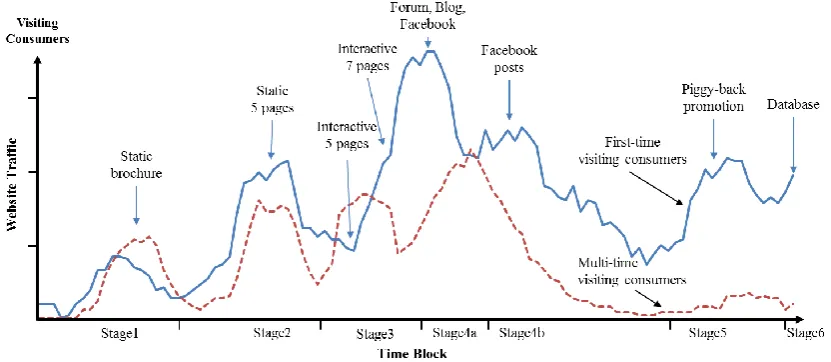
FIGURE 2: FTVC and MTVC website traffic (95 week timeline)
The one page static brochure website sees FTVC traffic rising, peaking and declining to almost zero. The MTVC traffic starts later and reaches a lower peak before falling to near zero. Throughout this Stage 1 of website development no changes or additions are made. This simplest of websites is soon ‘out-of-date’ and being of little value to the FTVC, also has a low revisit rate and both traces follow a typical product life cycle (LC) trace [17].
Stage 2’s static five pages of aesthetically-aligned, and contextualized content, adds additional reasons for FTVCs and MTVCs to visit (or revisit) the business website. As Stage 2’s content remains static, and non-changing, traffic again falls back to near zero. This stage shows an increase in website functionality does generate more traffic when compared to the less functional Stage 1. Thus H2 is supported for FTVCs and for MTVCs. Stage 1 sees most FTVCs do return as MTVCs (and that they check
on what is forthcoming for this new website). In contrast and in Stage 2, FTVCs see a typical static website but they return less frequently as MTVCs.
[image:5.595.77.494.542.710.2]Stage 3 introduces interactivity first as a five page site that allows for video views and additional information regarding consumer related activities. This increase in traffic just exceeded the Stage 2 traffic peak. Next further interactivity and content is added. This includes consumer uploads, comments, and additional videos, continually-updating weather, and targeted content. In line with H1, additional traffic is generated, and the change in FTVC traffic is both rapid and significant.
Figure 3 highlights the traffic trend line for additional functionality inclusions, and does so for FTVCs (steeper trend) and for MTVCs (flatter trend). This also supports H2. The steeper line suggests that FTVCs are likely more influenced by new features
than are MTVCs (flatter trend).
FIGURE 3: FTVC and MTVC website traffic trend as functionality added (95 week timeline)
FTVC traffic quickly subsides to the starting point of Stage 4b. Here, the business does make contributions with posts to facebook and immediately a FTVC response is generated as a small peak. Two subsequent posts also drive small peaks. Then, with not further posts the traffic steadily declines. This trend suggests external posts do influence the website traffic of FTVCs, but not for MTVCs. Hence H3 is partially supported.
Considering the traffic trend across Stages 1 to 4 functionalities, interactivities and external posts drive FTVC traffic, and again H4 is supported for FTVCs, but partially supported for MTVCs. Hence H4 is partially supported.
Figure 2 indicates Stage 1’s FTVCs do return as MTVCs. This is also indicated in Stage 2, but this trend is less clear for subsequent stages of this study. Across all stages 1 to 6 consumptive deliverables (including functionalities, interactivities and posts) influence and drive differing levels of traffic. Hence this provides some support for H5 combinations.
CONCLUSION
In summary, this study finds three independent variables each contribute towards growth in the business’ website traffic. Thus H1, H2 and H3 are supported, and when all three covary, as shown in Figure 1, H4 is partially supported. The shift of FTVCs
into MTVCs is more complex and is only partially supported.
FTVC’s are influenced by website functionalities, by the levels of interactivities available, and by the extent and frequency of external posts. As these levels broaden, the business influences become more important in the continuous engagement of FTVCs. This study did not provide clear evidence on how FTVCs migrate to MTVC status. However, some evidence suggests functionality, interactivity and posts do play a significant role in attracting consumer traffic. But, at what level of engagement the FTVC is converted into a MTVC (and likely remain loyal), remains a challenge for the ongoing website business.
By including, and maintaining the currency of all the above six stages of website development into one comprehensive, dynamic and interactive website solution, this study posits targeted websites can be successfully delivered for both FTVCs and MTVCs.
This study’s approach to investigating consumer traffic relationships generated across the ‘website-consumer engagement model,’ can be easily adapted and refined to suit individual website situations, and as a framework for further research studies.
REFERENCES
[1] Albuquerque, P., Pavlidis, P., Chatow, U., Chen, K.Y., & Jamal, Z. (2012) ‘Evaluating promotional activities in an online two-sided market of user-generated content’, Marketing Science, Vol. 31, No. 3, pp. 406-432.
[2] Bai, B., Law, R., & Wen, I. (2008) ‘The impact of website quality on customer satisfaction and purchase intentions: Evidence from Chinese online visitors’, International Journal of Hospitality Management, Vol. 27, No. 3, pp. 391-402. [3] Bilgihan, A. Okumus, F., Nusair, K., & Bujisic, M. (2014) ’Online experiences: Flow theory, measuring online customer
experience in e-commerce and managerial implications for the lodging industry’, Information Technology & Tourism , Vol. 14, No. 1, pp. 49-71.
[4] Bloch, P.H. (1982) ‘Involvement beyond the purchase process: Conceptual issues and empirical investigation’, Advances in Consumer Research, Vol. 9, No. 1, pp. 413-417.
[5] Cassidy, L.J., & Hamilton, J.R. (2011a) ‘Website benchmarking: evaluating scaled and dichotomous approaches. Proceedings’, 11th
International Conference on Electronic Business, 2-4 Dec, Vol. 11, No. 1, pp. 408-412.
[6] Cassidy, L.J., & Hamilton, J.R. (2011b) ‘Website benchmarking: theoretical and measurement aspects. Proceedings’, 11th International Conference on Electronic Business, 2-4 Dec, Vol. 11 No. 1, pp. 413-416.
[7] Cassidy, L.J., & Hamilton, J.R. (2013) ‘A comprehensive approach to capturing website quality measures’, 12th International Decision Sciences Institute and 6th Asia-Pacific Decision Sciences Institute Conference, Nusa Dua, Bali, Indonesia, 9th -13th July, Vol. 12, no. 1, pp. 280-289.
[8] Cassidy, L.J., & Hamilton, J.R. (2014) ‘Tropical tourism website qualities’, 24th Cauthe Conference, Brisbane, Australia, 10-13 Feb, Vol. 24, No. 1, pp. 232-245.
[9] Cebi, S. (2013) ‘A quality evaluation model for the design quality of online shopping websites’, Electronic Commerce Research and Applications, Vol. 12, No. 2, pp. 124-135.
[10] Chiou, W.C., Lin C.C., & Perng, C. (2010) ‘A strategic framework for website evaluation based on a review of the literature from 1995 to 2006’, Information & Management, Vol. 47, No. 5, pp. 282-290.
[11] Choi, H.K., & Limb, J.O. (1999) ‘A behavioral model of web traffic’, IEEE Proceedings 7th International Conference on Network Protocols, Vol. 7, No. 1, pp 327-334.
[12] Chung, S., Animesh, A., Han, K., & Pinsonneault, A. (2014). ‘Firms’ social media efforts, consumer behavior, and firm performance: Evidence from Facebook’, Available at SSRN: http://ssrn.com/abstract=2448510, pp. 1-48.
[13] Cvijikj, I.P., & Michahelles, F. (2013) ‘Online engagement factors on Facebook brand pages’, Social Networking Analysis and Mining, Vol. 3, No. 4, pp. 843-861.
evaluation’, International Journal of Human-Computer Studies, Vol. 68, no. ½ , pp. 1-21.
[15] Davis, F.D., Bagozzi, R.P., & Warshaw, P.R. (1989) ‘User acceptance of computer technology: a comparison of two theoretical models’, Management Science, Vol. 35, No. 8, pp. 982-1003
[16] deVries, L., Gensler, S., & Leeflang, P.S.H. (2012) ‘Popularity of brand posts on brand fanpages: An investigation of the effects of social media marketing’, Interactive Marketing, Vol. 26, No. 2, pp. 83-91.
[17] Finch, B.J. 2008. Operations Now: Supply chain profitability and performance (3rd Ed.). McGraw-Hill/Irwin, New York, NY.
[18] Fishbein, M., & Ajzen, I. (1975) Belief, attitude, intention and behavior: An introduction to theory and research, Addison-Wesley, Reading, MA.
[19] Fortin, D.R., & Dholakia, R.R. (2005) ‘Interactivity and vividness effects in social presence and involvement with a web-based advertisement’, Journal of Business Research Vol. 58, No. 3, pp. 387-396.
[20] Francis, J.E. (2009) ‘Category-specific RECIPEs for internet retailing quality’, Journal of Services Marketing, Vol. 23, No. 7, pp. 450-461.
[21] Gerlitz, C., & Helmond, A. (2013) ‘The like economy: Social buttons and the data-intensive web’, New Media & Society, Vol. 15, No. 8, pp. 1348-1365.
[22] Ghose, A., & Han, S.P. (2010) ‘A dynamic structural model of user learning in mobile media content’, Working Paper, New York University, New York, NY.
[23] Ghose, A., & Han, S.P. (2011) ‘An empirical analysis of user content generation and usage behaviour on the mobile Internet’, Management Science, Vol. 57, No. 9, pp. 1671-1691.
[24] Girvan, M., & Newman, M. E. (2002) ’Community structure in social and biological networks’, Proceedings of the National Academy of Sciences, Vol. 99, No. 12, pp. 7821-7826.
[25] Glommen, C., & Barrelet, B. (2004) U.S. Patent No. 6,766,370. U.S. Patent and Trademark Office, Washington, DC. [26] Hamilton, J.R., & Tee, S. (2013) ‘Understanding social network site consumer engagements’, 24th ICIS Conference,
Melbourne, Australia, 4-6 Dec, Vol. 24, No. 1, pp. 1-10.
[27] Hanna, R., Rohm, A. & Crittenden, V.L. 2011. “We’re all connected: The power of the social media ecosystem,” Business Horizons, (54:3), pp. 265-273.
[28] Heinonen, K. (2011) ‘Consumer activity in social media: Managerial approaches to consumers’ social media behaviour’, Journal of Consumer Behaviour, Vol. 10, No. 6, pp. 356-364.
[29] Huang, L.Y., Hsieh, Y.J., & Wu, Y.C.J. (2014) ‘Gratifications and social network services usage: The mediating role of online experience’, Information & Management, pp. 1-9, Article in Press, doi: 10.1016/j.im.2014.05.004.
[30] Huizingh, E.K.R.E. (2000) ‘The content and design of websites: An empirical study’, Information & Management, Vol. 37, No. 3, pp, 123-134.
[31] Ilfeld, J.S., & Winer, R.S. (2001) ‘Generating web site traffic: An empirical analysis of web site visitation behaviour’, Journal of Retailing and Consumer Services, Vol. 1, No. 6, pp. 181-189.
[32] Jiang, Z., Chan, J., Tan, B.C.Y., & Chua, W.S. (2010) ‘Effects of interactivity on website involvement and purchase intention’, Journal of the Association for Information Systems, Vol. 11, No. 1, pp. 34-59.
[33] Kabadayi, S., & Gupta, R. (2011) ‘Managing motives and design to influence website revisits’, Journal of Research in Interactive Marketing, Vol. 5, No. 2/3, pp. 153-169.
[34] Kim, J-H., Kim, M., & Kandampully, J. (2009) ‘Buying environment characteristics in the context of e-service’, European Journal of Marketing, Vol. 43, No. 9/10, pp. 1188-1204.
[35] Kim, W.C., & Mauborgne, R. (2005) Blue Ocean Strategy: How to Create Uncontested Market Space and Make the Competition Irrelevant, Harvard Business School Press, Boston, MA.
[36] Korzaan, M.L. (2003) ‘Going with the flow: Predicting online purchase intentions’, Journal of Computer Information Systems, Vol. 43, No. 4, pp. 25-31.
[37] Law, R., Qi, S., & Buhalis, D. (2010) ‘Progress in tourism management: A review of website evaluation in tourism research’, Tourism Management, Vol. 31, no. 3, pp. 297-313.
[38] Lee, Y., & Kozar, K.A. (2008) ‘Investigating the effect of website quality on e-business success: An Analytical hierarchical process (AHP) approach’, Decision Support Systems, Vol. 42, No. 3, pp. 1383-1401.
[39] Li, X., & Huang, W. (2007) ‘Design a knowledge-based system to automatically assess commercial websites’, International Journal of Information Technology, Vol. 6, No. 1, pp. 43-59.
[40] Lin, H., Fan, W., & Chau, P.K.Y. (2014) ‘Determinants of user’s continuance of social networking sites: A self-regulation perspective’, Information & Management, Vol. 51, No. 5, pp. 595-603.
[41] Merrilees, B. (2002) ‘Interactivity design as the key to managing customer relations in e-commerce’, Journal of Relationship Marketing, Vol. 1, No. 3/4 pp. 111- 125.
[42] Milano, R., Baggio, R., & Piattelli, R. (2011) The effects of online social media on tourism websites, In P.R. Law, P.M. Fuchs, & P.F. Ricci (Eds.), Information and Communication Technologies in Tourism 2011 pp. 471-483, Springer, Vienna.
[44] Pallud, J., & Straub, D.W. (2014) ‘Effective website design for experience-influenced environments: The case of high culture museums’, Information & Management, Vol. 51, no. 3, pp. 359-373.
[45] Palmer J.W. (2002) ‘Web site usability design and performance metrics’, Information systems Research, Vol. 13, No. 2., pp. 51-67.
[46] Petty, R.E., & Cacioppo, J.T. (1981) Attitudes and persuasions: Classic and contemporary approaches. W.C. Brown Co. Publishers, Dubuque, IA.
[47] Petty, R.E., & Cacioppo, J.T. (1983) Central and peripheral routes to persuasion: application to advertising. In: L. Percy, A.G. Woodside (Eds.), Advertising and consumer psychology, Vol. 1, Lexington Books, Lanham, MD (1983), pp. 3–23 [48] Petty, R.E., & Cacioppo, J.T. (1986) Communication and persuasion: Central and peripheral routes of attitude change.
Springer-Verlag, New York, NY.
[49] Petty, R.E., Cacioppo, J.T., & Schumann D. (1983) ‘Central and peripheral routes to advertising effectiveness: the moderating role of involvement’, Journal of Consumer Research, Vol. 10, No. 2, pp. 135–146.
[50] Rahimnia, F., & Hassanzadeh, J.F. (2013) ‘The impact of website content dimension and e-trust on e-marketing effectiveness: The case of Iranian commercial saffron corporations’, Information & Management, Vol. 50, no. 5), pp. 240-247.
[51] Robbins, S.S., & Stylianou, A.C. (2003) ‘Global corporate websites: An empirical investigation of content and design’, Information & Management, Vol. 40, No. 3, pp. 201-212.
[52] Sabate, F., Berbegal-Mirabent, J., Canabate, A., & Lebherz, P.R. (2014) ‘Factors influencing popularity of branded content in Facebook’, European Management Journal, Article in Press, http://dx.doi.org/10.1016/j.emj.2014.05.001. [53] Shao, G. (2009) ‘Understanding the appeal of user-generated media: A users and gratification perspective’, Internet
Research, Vol. 19, No. 1, pp. 17-25.
[54] Sherrif, M., & Cantril, H. (1947) The psychology of ego-involvements, social attitudes and identifications. John Wiley & Sons, Hoboken, NJ.
[55] Stelzner, M. (2011) ‘Marketing industry report: How marketers are using social media to grow their business’, SocialMediaExaminer.com. Accessed 25 June 2014 at www.socialmediaexaminer.com/SocialMediaMarketingReport2011 [56] Tang, L.R., Jang, S.S., & Morrison, A. (2012) ‘Dual-route communication of destination websites’, Tourism Management,
Vol. 33, No. 1, pp. 38-49
[57] Toufaily, E., Ricard, L., & Perrien, J. (2013) ‘Customer loyalty to a commercial website: Descriptive meta-analysis of the empirical literature and proposal of an integrative model’, Journal of Business Research, Vol. 66, No. 9, pp. 1436–1447. [58] Tsai, C-H. (2011) ‘The e-commerce model of health websites: An integration of web quality, perceived interactivity, and
web outcomes’, Journal of Networks, Vol. 6, No. 7, pp. 1017-1024.
[59] Wang, M., Madhyastha, T., Chan, N.H., Papadimitriou, S., & Faloutsos, C. (2002) ‘Data mining meets performance evaluation: Fast algorithms for modeling bursty traffic’, IEEE Proceedings 18th International Conference on Data Engineering Vol. 18, No. 1, pp. 507-516.
[60] Weinberg, B.D., Berger, P.D., & Hanna, R.C. (2003) ‘A belief-updating process for minimizing waiting time in multiple waiting-time events: Applications in website design’, Journal of Interactive Marketing, Vol. 17, No. 4, pp. 24-37.
![TABLE 1. SNS Consumer targeting matrix [26]](https://thumb-us.123doks.com/thumbv2/123dok_us/153310.30454/3.595.102.502.335.495/table-sns-consumer-targeting-matrix.webp)