Simulation of Sawmill Yields at Hyne Tuan Pine
Mill
A dissertation submitted by Mr. Eyre Campbell
In fulfilment of the requirements of ENG4112 Research Project
Supervisor Kazem Ghabraie
Abstract
Tuan plant processes between six and seven hundred thousand cubic meters of planta-tion pine annually, on average this equates to around five thousand trees daily. Logs are cut to length through a Log Merchandising machine. The numerical data generated by the dimensional measuring system is proposed as feedstock for an ambitious computer program that is designed to imitate the computerised, electrical and mechanical pro-cesses of sawmill plant. Supposition being that a well fashioned predictive software can provide an element of competitive advantage through the potential to aid production planning. The program takes any user specified generic Tuan sawmill alpha-numeric cut pattern code and interrogates into dimensional pattern cross-sections. The software has been fashioned to select the sideboard width option that maximizes sawn volume yield recovery.
The board trimming process synthesises laser vision sensing and computer processing to determine the mechanical saw docking requirements; it is the vital final quality control mechanism at the sawmill. Sensed wane dimensions of the timber are paired up against programmed wane rules in the solutions computer to decide which trim saws will actu-ate and dock to chip. The yield predictor program does a virtual trimmer processing of every sawn board to assess the length output of sawn boards, dock to chip and sawdust exhaust by saws.
The program is predicting the sawmill yields for sawn timbers, chip and sawdust, all the yield indicators are reported as displayed outputs.
The Council of the University of Southern Queensland, its Faculty of Engineering and Surveying, and the staff of the University of Southern Queensland, do not accept any responsibility for the truth, accuracy or completeness of material contained within or associated with this dissertation.
Persons using any or all of this material do so at their own risk, and not at the risk of the Council of the University of Southern Queensland, its Faculty of Engineering and Surveying or the staff of the University of Southern Queensland.
This dissertation reports an educational exercise and has no purpose or validity be-yond this exercise. The sole purpose of the course pair entitled ‘Research Project’ is to contribute to the overall education within the students chosen degree program. This document, the associated hardware, software, drawings and other material set out in the associated appendices should not be used for any other purpose: if they are so used it is entirely at the risk of the user.
Prof Frank Bullen
Dean
Certification
I certify that the ideas, designs and experimental work, results, analyses and conclusions set out in this dissertation are entirely my own effort, except where otherwise indicated and acknowledged.
I further certify that the work is original and has not been previously submitted for assessment in any other course or institution, except where specifically stated.
Mr. Eyre Jeffery Campbell
Student Number: W0039574
Signature Date
Sincere thanks to Angela Pappin (Optimisation Engineer) for contributing to the tech-nical understanding and interpretation of sawmill patterns and processes; a necessity for true and accurate simulation.
To Gil Little (Senior Analyst/Programmer) for his contribution in enabling access to stems and logs files as well as some ideas and strategies for potential integration of a predictive modelling system with log-stocks.
Contents
Abstract i
Disclaimer ii
Certification iii
Acknowledgments iv
List Of Figures vi
List Of Tables x
1 Introduction and Background 1
1.1 Softwood Milling 2
1.2 Sawmill Simulation 6
1.3 Sawmill Sawing Simulation Literature Review 10
1.4 Risk Assessment 13
1.5 Resource Analysis 14
1.6 Project Time-lines 14
2 Log Break Down Process 16
2.1 Log Bucking System 16
2.2 Milling Pre-sorted Logs 22
3 Mining the Data Resource 26
3.1 Geometric Stem Data Retrieval and Router Processing 27 3.2 Data Bank for Stems and Logs 29
4 Mill Modelling 40
4.1 Decoding Sawmill Patterns 40
4.2 Sideboards 41
4.3 Transform Sawmill Pattern Code to Dimensions 41 4.4 Overlaying Cartesian Co-ordinates 43 4.5 Processing Face and Edge Wane 45
5 Trim Sawing Process 47
5.1 Trimmer Machine Centre 47
6 Virtual Product Volumation 56
6.1 F1 Sideboards 56
6.2 Cant Products 65
7 Performance of Simulation Software 68
7.1 Software Outputs 68
7.2 Accumulating Yields 70
7.3 Comparison of Software Yields and Actual Mill Yields 71
8 Summary of Findings and Future Direction 76
Bibliography 78
Appendices 80
List of Figures
1.1 Hyne and Sons original hardwood milling operation in Maryborough Qld. 1
1.2 Tuan exotic pine plantation forest 3
1.3 Overview of Tuan softwood processing plant. 4 1.4 Trend in Australian housing starts and forecasts 5 1.5 Monthly change in total dwelling units approved (trend). 6
1.6 Total dwelling units approved (trend), Queensland. 6
1.7 Sawn timber from the Tuan sawmill. 7 1.8 Batch sorted log bays sitting in storage awaiting processing through the
sawmilling plant. 8
1.9 Chip and sawdust residue from the Tuan sawmill. 8 1.10 Black sections yield chip material and the yellow saw-lines yield dust 9 1.11 Logs tippled to the Sorting System. 10
2.1 Stems (or trees) at approx. 19m length are input resource for the log merchandiser. 16 2.2 Overview of the log merchandiser system and process. 17 2.3 Setup screen for loading product diameter and sweep allowances. 18 2.4 Setup screen for control of product length, destination and priority to value
combination. 18
2.5 Log cut solution for a stem and stem dimensions. 19
2.6 Log 1 from the parent stem above showing bucket diameters every 150mm. 19 2.7 Parent stem processing into logs, from geometric scanning through to cutting. 19 2.8 Log sorting process is initiated when pneumatic cylinder driven tipples drop logs
in sequence to the sorter conveyor. 20
2.9 Showing the log sorting facilities, chain, kickers and bins. 21
2.10 Snapshot of Tuan virtual logstock program 22
2.11 Virtual logstock data stored for each bin destination 23 2.12 Overview of the Tuan sawmill process and the flow direction of sawn products. 23 2.13 F1 & F2 Profiler unit and one of the internal heads. 24 2.14 Cut pattern with outside edges and kerfs dimensioned. 25 2.15 Chip removed for opening faces at first chipper canter. 25 2.16 After first rotation chip removed by second chipper canter. 25 2.17 After second rotation Profiler chips around the side boards. 25
2.18 Side boards sawn off producing sawdust. 25
2.19 After third rotation the cant is vertically sawn. 25
3.1 Hyne Model Perceptron Dimensional Measuring Instrument. 27 3.2 Side vision of a scanned log that has had scan points processed though a 6 in
data bucket router. 28
3.3 End view of a scanned log where data has been processed through 6 inch data
bucket router. 28
3.4 Extract from the logs file. 29
3.5 More complete version of logs file information. 30
3.6 Extract from a stems data file. 31 3.7 Mapping solutioned logs from a stem to the resource file. 32 3.8 Sourcing and loading the log profile from the stems file. 33 3.9 Simulator loop that controls the quantity of logs scanned for batch
suit-ability. 35
3.10 Locating the log in the parent stem. 36
3.11 General Program flowchart. 37
3.12 Program gathered log batch data for pre-selected bin. 39
4.1 Mapping a Tuan sawmill cut pattern code. 40
4.2 Cut pattern with F1 and F2 sideboards. 42
4.3 Cut pattern with F1 and F3 sideboards. 42
4.4 Dimensioned sawmill pattern. 42
4.5 Cant from pattern 3-3-2+c100-300. 42
4.6 Graphical depiction of the search options for increasing width of sideboards. 44 4.7 When sideboard edges are outside the bounds of the log then wane is introduced
List of Figures
4.8 Sideboard vertices and intersects with log perimeter co-ordinates. 44
4.9 Board wane diagram. 45
5.1 Block diagram of the trimming system. 48
5.2 Trimmer solution computers. 48
5.3 Operator controls material flow into trimming system. 49
5.4 Trimmer geometric scanning module. 50
5.5 Point lasers scanning a board as it moves through. 51
5.6 Trimmer scan head block diagram. 52
5.7 Scanned and solutioned boards entering the trim saws. 52
5.8 Trimmed boards exiting the trim saw booth. 52
5.9 Top view of a trim saw elements. 54
5.10 Isometric view of three trim saws. 54
6.1 Computed Percentage Edge and Face wane results for F1 sideboards on a bin
24 log. 57
6.2 Predicted length and volume recovery for all potential sideboard widths. 57 6.3 Extract from program code that checks that good section of 96mm wide F1
sideboard is longer than minimum standard length. 58
6.4 Extract of program code showing volumation of sideboard sections. 60
6.5 Face wane<100% and Edge wane<100%. 60
6.6 Face wane = 100% and Edge wane<100%. 61
6.7 Face wane = 100% and Edge wane = 100%. 61
6.8 Face wane<100% and Edge wane = 100%. 61
6.9 Summary yields for potential F1 sideboard widths. 62
6.10 Flowchart for volumating sawn board sections. 63
6.11 Area grouping for F1 sideboard when Face wane<100% and Edge wane = 100% 64
6.12 Chord formed by the corners of the F1 sideboard. 65
6.13 Flowchart for volumating within wane specification sections of sideboard 66 6.14 Segmenting the right outer sideboard for computing area. 67 6.15 Cartesian co-ordinates are applied for geometric computation of outer cant board
area. 67
7.1 Log statistics 68
7.2 F1 sideboard yield indicators 69
7.3 Cant board yield indicators 70
7.4 Accumulated sawmill yield indicators 71
7.5 Sawmill yield by log from simulator chart 72
7.6 Predicted sawn stock 73
7.7 Sawmill actual sawn recovery sample 73
7.8 Sawmill residues production monitor chart 74
7.9 Rate of Chip production vs. rate of Sawdust production 75
7.10 Profiler head 75
List of Tables
1.1 Australia’s production of Sawn Timber plus selected Wood Products 4
3.1 Nominal and Actual target widths of sawn timber 38 3.2 Cut code for target thickness of sawn timber 38
3.3 Saw blade kerf 38
5.1 Trim saw table 54
Introduction and Background
Hyne and Sons quality milled timber brand and products have been around for more than 120 years. During Hynes history there have been numerous boom and bust cycles in the economies but the Hyne family business has manoeuvred for survival in economic troughs, and then reinvigorated for expansion in the upswings. Originating in Queens-lands Fraser Coast region Hyne began as a miller of native forest hardwoods. Figure 1.1 shows Hynes original hardwood mill situated on the banks of the Mary River along which, logs were originally ferried from from selective harvesting operations on Fraser Island.
Figure 1.1: Hyne and Sons original hardwood milling operation in Maryborough Qld.
Introduction and Background
grown species of Pine. During the middle decade of this transition Hyne aspired to be the number one softwood processor in Australia. Hyne now has three significant mills dedicated to processing plantation pine. One is at Tuan (east of Maryborough) that processes Exotic Pine varieties: Slash, Carribea , hybrids of the two and occasionally native Hoop pine. The second operation is situated at Imbil (west of Gympie) is fully focused on native Hoop pine and the third operation in Tumberrumba (west of Wagga) is fully focused on exotic Radiata pine.
1.1
Softwood Milling
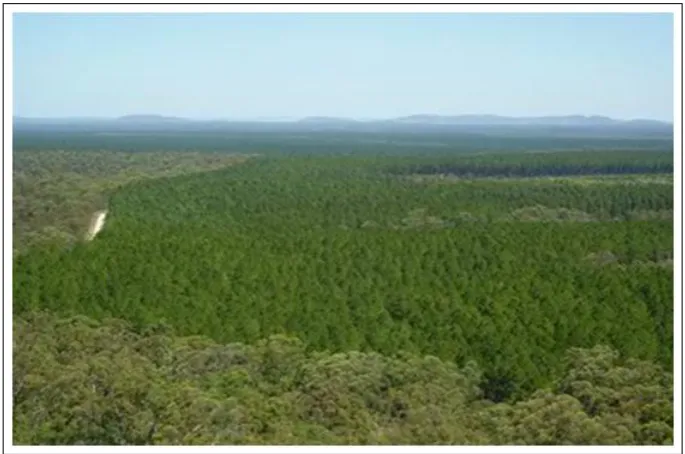
Softwood milling in many ways is vastly different to hardwood milling and to that extent it is not so far fetched to classify them as different industries altogether. The softwood industry operates from a base of large tracts of private and public plantations that have been established and maintained primarily for the purpose of growing saw log and by products. Figure 1.2 on the following page is a sample view of the Tuan plantation forest that in total covers an area of 70 000 hectares, stretching from Maryborough in the north right down to the northern fringes of Noosa in the south. Softwood mills can be up to 20 times larger than hardwood mills generally because of the assured long term availability of a resource that is fairly uniform.
Significant investment, foresight and hard work goes into the sustainable resource banks that underpin softwood milling in this country. The rotation periods for the above men-tioned species vary between 28 years to maturation for the exotics and 40 years for the native hoop. In the meantime between harvesting these forests provide abundant eco-logical habitats to a range of wildlife.
1.1.1 Securing a Position in Softwoods
To be a major player in the softwood industry requires significant capital investment in plant and technology. Hyne annually processes volumes in the vicinity of 1.3 million cu-bic metres. Very generally speaking recovered sawn percentage is around 50%, Table 1.1
Figure 1.2: Tuan exotic pine plantation forest
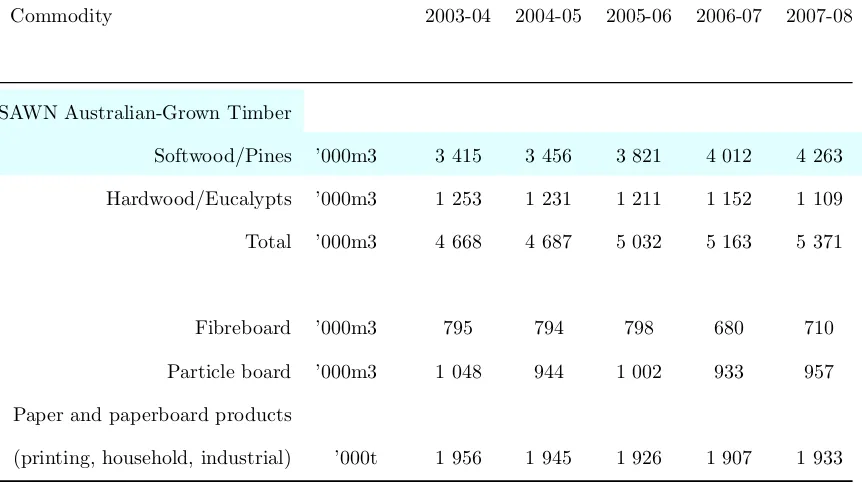
is the most recent and most comprehensive statistics for the Australian production of sawn timbers and wood products. The table gives a sense of Hynes relative share of the Australian sawn softwood, and contribution to wood products feedstock due to produc-tion of sawing by-products of chip and sawdust.
Hyne has geared mills with highly automated processes, incorporating various machine vision instruments, customized software and precisely controlled electronic, pneumatic and hydraulic systems in order to cope with the required productivity. Figure 1.3 is an aerial view of the Tuan pine processing plant, the finished timber section towards the front of this view, the log breakdown areas are all toward the middle-rear and plantation forest surrounds the plant.
Introduction and Background
Table 1.1: Australia’s production of Sawn Timber plus selected Wood Products
Commodity 2003-04 2004-05 2005-06 2006-07 2007-08
SAWN Australian-Grown Timber
Softwood/Pines ’000m3 3 415 3 456 3 821 4 012 4 263 Hardwood/Eucalypts ’000m3 1 253 1 231 1 211 1 152 1 109
Total ’000m3 4 668 4 687 5 032 5 163 5 371
Fibreboard ’000m3 795 794 798 680 710
Particle board ’000m3 1 048 944 1 002 933 957
Paper and paperboard products
[image:16.595.117.548.154.396.2](printing, household, industrial) ’000t 1 956 1 945 1 926 1 907 1 933 Source: Australian Bureau of Agricultural and Resource Economics (online)
Figure 1.3: Overview of Tuan softwood processing plant.
1.1.2 Impact of Market Forces
When the Australian domestic building market is buoyant and the Australian dollar is below parity then generally the softwood mills primary concern for profit maximization is to maximize sawn recovery. This is because the highest cost to the business is the log resource and the highest return is from sawn yield. In this market scenario cut patterns are often selected so as to maximize the sawn yield which, is the highest value yield product. Stockpiling whether it be logs for the sawmill or finished packs of product in the warehouses is rarely a concern because the turn over of inventory is so positive and average sale price high.
When demand is weaker and the Australian dollar is above parity (as is the recent trend) the average sale price for timber is forced down; currently down some 25%. Housing In-dustry Association and Australian Bureau of Statistics modelling such as supplied in Figure 1.4, Figure 1.5 and Figure 1.6, the summary is that 2013 is to be a year of con-traction for Australian new house starts and perhaps modest growth forecast for 2014 and 2015. These levels of activity are historically low.
Figure 1.4: Trend in Australian housing starts and forecasts
Introduction and Background
Primary focus switches to trying to cut only products that can be converted to sales with minimum storage period and costs. Stockpiling at any part of the process is undesirable because it represents a cost and risk to the business because of the market conditions. Hynes new mission for the business is to become the supplier of choice. Sensitivity and dynamic response to economic opportunities driven by solid relationships with customers underpin the new focus.
Figure 1.5: Monthly change in total dwelling units approved (trend).
Figure 1.6: Total dwelling units approved (trend), Queensland.
ABS 8731.0(2013)
1.2
Sawmill Simulation
Ertas & Jones’s (1996) elucidate the design process begins with an identified need that can be satisfied by a product of engineering effort. Identification of this need for a custom built sawmill simulator to suit the Tuan mould/model has grown through the authors journey with the stem and log breakdown team at the plant. Better management of wood flows within the wood supply chain has been a clear priority for the majority of forest products companies over the last couple of years (Apthorp 2013). Technology research and development designed for implementation into the operations to gain some improvement is a cultural driver at the plants. There are notable accomplishments to date that fuel a continuation.
Realising a fully functional sawmill simulation of yield software would rank as a tech-nology development achievement for the company. The potential for such a system to
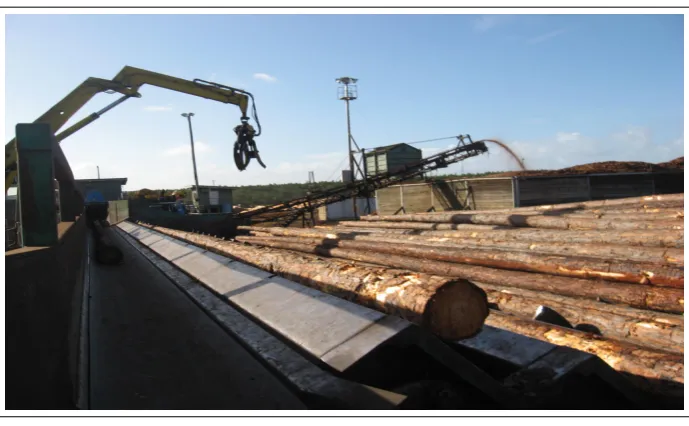
bring new knowledge to the organization is multifaceted from an analytical research perspective and product planning/mix perspective. It is desirable to have the provision to look at a piece of software and have it predict in real time what is likely to be the sawn output for the mill based (example of sawn material is on display at Figure 1.7) on sorted batches of logs sitting in storage at the log yard, see Figure 1.8. The plant Merchandiser is a reliable source of geometric data characteristics of stems.
Sawlog simulation could be programmed to display volumes of fibre likely to be recov-ered from log yard batches/classes. The implications of a sawmill forecasting facility relate primarily to production planning efficiencies. There is no foreseeable moral or ethical dilemma generated with either the development or end uses of this product. The intended system would be linked into the current log stock program and act merely as an informative aid for production planning. There is no intention for the predictive modelling to be linked into the machine control processes. Energy efficiency is certainly gaining momentum in the management priority stakes and as such there is scope to broaden simulation modelling to predict energy consumption in the sawmilling process for any batch of logs.
Figure 1.7: Sawn timber from the Tuan sawmill.
Introduction and Background
Figure 1.8: Batch sorted log bays sitting in storage awaiting processing through the sawmilling plant.
sawmill then for any given schedule of cut patterns planners can forecast the comparative volume of high value sawn products (e.g. framing, fencing/landscape), versus residue fibre proportions, in the form of wood chip and sawdust which as shown in Figure 1.9 are conveyed to dedicated storage bunkers before being transporting on as feedstock for other production.
Figure 1.9: Chip and sawdust residue from the Tuan sawmill.
A small percentage increase in recovery translates into a significant financial advantage for the timber manufacturer. Sawn product even as valued out of the mill (i.e. not yet
seasoned or planed) returns a higher price on average ($200/cubic unit) than does chip ($40/cu) or sawdust ($20/cu). For this reasons sawn recovery is a significant factor in sawmill financial viability and there is always a strong push to maximise sawn recovery. Figure 1.10 is a brief demonstration of how each product of sawmill yield evolves.
Figure 1.10: Black sections yield chip material and the yellow saw-lines yield dust
This project will investigate the possibilities of developing a suitable strategy and try to design and build a computer program that might be integrated into current systems. Ultimately the program output is envisaged to be a tool that can aid the Optimization Engineer and Production Managers to improve production decision making. For example accurate forward forecasting of residue volumes would be a useful tool for planning the number of trucks needed to control residue levels in the bunkers for any given production schedule. The ultimate concept for simulation package is to build it up to be efficient enough to process individual logs as they are cut out of a parent stem, see Figure 1.11.
Introduction and Background
Figure 1.11: Logs tippled to the Sorting System.
orders may influence more dynamic tuning of log sorting priorities. At another end of the spectrum, accurate prediction of residue volumes would be a useful tool for planning the number of trucks needed to control the level residue in the sawmill fed bunkers.
1.3
Sawmill Sawing Simulation Literature Review
The high Aussie dollar has created the difficult dichotomy of increased relative price paid by the international customer for exported timber and relatively low price paid by domestic customers for imported timbers. The languishing Australian domestic market for construction and building plus rising operating costs (eg. power and labour), sees building material manufacturers embroiled in a constant battle to survive. Hyne Tuan sawmill, being a large volume manufacturer of solid wood framing, primarily for new houses, is certainly not immune to these prevailing conditions nor, the ever present threat of market failure. As the demand has contracted Hyne has worked to shift from supply driven to demand driven model for production planning. Moving closer to the customers needs has increasingly meant producing products that can be quickly converted to sales. Stockpiling of inventory as logs or as sawn is no longer desirable from an economic risk and cash flow perspective Maness & Adams’s (1991) suggest that to meet the trends in market demand sawmills need to adopt bucking and sawing practices that are flexible
and responsive.
Todoroki’s (1990) work introduced AUTOSAW system for sawing simulation. With this software simulation was performed on both individual logs and batches of logs. Batch size was not a restriction. Flexibility also allowed simulations to run interactively or as an automated process. In 1990 automated sessions required 8 to 16 seconds to process each log. An interactive session provided graphic images of the log at each stage of simulation and it was possible to interrupt at any stage.
Maness & Adams (1991) presented and demonstrated three models for production plan-ning for a sample sawmill. One of these models was a cutting pattern optimizer for simulating the sawing of a log. The goal of integrating the three models was to choose a sawing policy for a given log class that maximized the value of the lumber produced. Potential advantages of moving from conventional static optimization product values to dynamic product values where investigated by Todoroki & Ronnqvist (2002). Using AUTOSAW product values where updated regularly according to previous timber pro-duction. Todoroki & Ronnqvist found that this strategy could reduce the production of un-ordered timber which alleviates storage and stockpiling issues.
Again using AUTOSAW as a research tool Todoroki & Monserud’s (2004) studied the effect sweep has on lumber recovery. Todoroki & Monserud propose that a real log is unique in its form, with several independent sources of variation (e.g. sweep, diameter and knots). Each log can be sawn into products only once. To overcome multitude of po-tential variation in results the sample of 51 real logs were converted into digital formats and then increasingly bent at 1 inch increments in the virtual environment. Through simulation it was found that conversion losses due to increasing sweep were represented by an exponential decay function.
Introduction and Background
log is better than that of a round log of the same size. When sawing is carried out in the wrong position the opposite applies.
Todoroki et al. found that the most probable orientation for obtaining increased lumber yield from oval logs was if the first saw cut is parallel to the major axis. Maximum lumber yield was significantly greater from oval logs than from round logs. In some cases yield from oval logs is less than that from round logs if rotation is not optimum.
Usenius & Heikkila (2007) introduced WoodCIM software which is currently used in advanced planning at many Finnish sawmills. WoodCim is a computer aided sawmill planning and controlling software developed at the Technical Research centre of Finland. WoodCIM can be linked into mill computer system and provide support for product and material flow control. WoodCIM post installation outcomes are linked with increased sales value of production compared to less sophisticated planning methods. The goal of WoodCIM is to achieve best profitability for sawing periods. For example a one month strategy can be derived through an optimization model based on linear programming. This sawing model works to optimally combine log supply, sawing possibilities and sales.
Song & Usenius (2007) evaluated InnoSim, a sawing simulator that has been developed in an incremental manner in a series of research projects over the years. The paper em-phasizes the push for logs used in simulation to better represent real logs. Aside from the external log characteristics of diameters, length, taper and sweep they suggest modelling the internal defects generated by knots and resin. They suggest that a distribution of lumber quality could be predicted in simulation if statistics are gathered through trial sawing investigations.
Lyhykainen et al. (2009) did sawing simulation using WoodCIM to predict sawn yields of lumber grades and byproducts for Scots pine (plantation raw material in Finland).
According to this collection of published works it is apparent that WoodCIM and AUTO-SAW are two simulation packages that have been utilized extensively for valid industry research as well as for sawmill planning. WoodCIM has origins in Scandinavia and AU-TOSAW in Canada. Enquiries to associated parties in each of these countries suggests
high levels of protection and privacy on these software. The Canadian group in particular indicated some strict rules regarding the AUTOSAW simulator because only Canadian Timber groups have the permission to access. This could indicate that the Canadians feel that the simulator is a valued resource for achieving some competitive advantages.
The Scandinavian group where more willing to communicate particularly in relation to apparent abilities of their simulator. However when it came to the nuts and bolts of the simulator software and/or potential provision of a demo version there was no response. Of the two major simulators uncovered in this review there is little doubt that the Scandinavian built system is likely to be the more commercial opportunity for a sawmill operation. AUTOSAW on the other hand, seems to be much more associated with research and study objectives in order to establish conventions of practice for efficient sawmilling.
1.4
Risk Assessment
Softwood sawmills comprise an abundance of heavy machinery and mobile plant such as trucks and forklifts. Entry to Tuan site is security restricted for several reasons least not the obligation to ensure that anyone entering site is sufficiently insured and have proven that they are aware of personal safety obligations. The two primary requirements for passing through security to the the plant is completion of a comprehensive induction and secondly ensuring one is in possession of adequate personal protective equipment, including: ear protection, isolation tags, high visibility clothing and steel capped boots. The induction will include compulsory completion of modules and assessment for Site Isolation and Emergency Response.
Introduction and Background
There is no foreseeable environmental effects arising out the main objectives of this project. The plant is concerned with processing plantation grown pine which is a renew-able natural resource. All yields from the sawmill are renewrenew-able fibres all with useful secondary applications. Although the project seeks to enhance efficiency of yield conver-sion the potential advantages generally relate financially because the carbon converconver-sion is fairly neutral. Perhaps there maybe some side effect where coal fire sourced electricity is more efficiently used as an input to the production timber fibres.
1.5
Resource Analysis
A driving factor for selecting this project is a desire to steer away from potential to be caught with ballooning costs or critical component failures. This does not suggest that the technical demands of simulating a high speed, highly automated plant are to be underestimated. Aside from sourcing critical technical information from machine manuals or from other technical staff the project has not acted as a burden to plant operation. Aside from plant technical information (gathered in the literature review, company sources and USQ project supervisor) the significant resources used in develop-ment are a laptop computer, backup memory facility, email access, MATLAB software, Latex software and feedstock Excel data files sourced from IT services.
Extension work would necessitate batch trial comparisons of sawmill runs and software predictions. Such trials would present increased burden to plant operation because the process would likely generate delays in production.
1.6
Project Time-lines
There a few essential foundation requirements and numerous potential avenues for en-hanced software development. Technical analysis of log form parameters and how these relate to conventions for batch cutting in the sawmill is complicated. As such the devel-opment strategy is to simplify where possible in order to build a framework that is ready to be extended upon. The nature of this undertaking somewhat limits the time available for the dedicated programming orientation needed to get an algorithm and outputs for
all log form parameters. Some 50% of budgeted time is gobbled up by the technical presentation aspects of the project (including mastering Latex). The general order and approximated contributed workloads are listed below.
1. Literature review and contacting international bodies(40hrs);
2. Detailed background, machine and process specifics (30hrs);
3. Source stems and logs data file, import into MATLAB and write code to perform the necessary manipulations (20hrs);
4. Write MATLAB code for the conversion of a sawmill cut pattern into geometric dimensions of the associated cross-sectional representation (50hrs);
5. Write code for a virtual F1 sideboard, that determines the relative goodness of fit of the sideboard at log every bucket interval. This is done for all potential sideboard widths and the width that returns the highest volume sawn yield is selected. (80hrs)
6. Construct working code loops that for example find a matching batch log for processing and filters out non-matches (40hrs)
7. Code that volumates each 150mm section of the cant after virtual processing (30hrs)
8. Code that volumes each 150mm section of the F1 sideboard after virtual processing (40hrs)
9. Face and edge wane computation for F1 sideboards and outer cant products (30hrs)
Chapter 2
Log Break Down Process
2.1
Log Bucking System
[image:28.595.152.497.459.672.2]Stem level bucking can either be done in the bush using a harvesting machine or at the mill. Tuan is configured with a dedicated Log Mechandiser line that is fitted out with multidimensional measuring system, optimization software and precision cross cut sawing system. For Tuan Mill stems are trucked in from harvesting operations in the surrounding forests. Figure 2.1 shows the stems loaded onto the infeed deck of the log merchandiser line.
Figure 2.1: Stems (or trees) at approx. 19m length are input resource for the log merchandiser.
The target length for this resource is 18.3m so that if all things are ideal the mill based
bucking system can retrieve three six metre logs; 6.2m being the maximum length that the sawmill process due to plant configuration. Some quantity of supplied stems in-evitably come in under the desirable length due to smaller parent tree or error in the processor length detection (as is the case for stems that come in longer). Figure 2.2 is a plan view of the Tuan merchandiser operation, it shows the flow of stems from debarking infeed, through the scanning and cross-cut sawing system and then onto the sorting line as logs. Mobile log handling machines pick sorted logs up out of the bins and subsequently place logs in batch storage bays ready for sawmill processing.
Figure 2.2: Overview of the log merchandiser system and process.
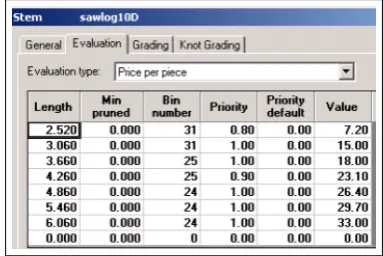
The objective of bucking optimization at the stem level is to maximise the stem value by selecting the combination of logs to cross-cut from a stem that maximises potential revenue. To do this task anticipated market prices and operational constraints must be balanced. This decision making process involves programming optimizer software (see Figure 2.3 and Figure 2.4) to compute the highest value combination of log products. Log product parameters such as small and large end diameter, sweep range (degree of bendyness) and length are programmed into the optimizer along with a priority and value combination.
Log Break Down Process
[image:30.595.131.311.72.219.2]Figure 2.3: Setup screen for loading product di-ameter and sweep allowances.
Figure 2.4: Setup screen for control of product length, destination and priority to value
combi-nation.
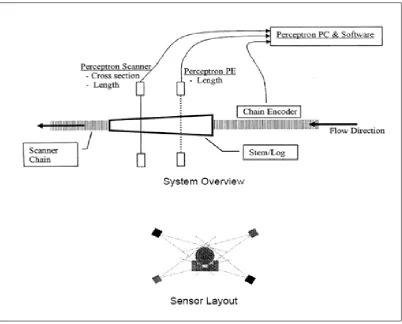
points every 33mm. The stem cross-section model is developed by considering the speed of light, halving the time the light beam takes to travel toward the wood then return to the receiver and so represent x and y co-ordinates of the outer shape of the stem. This geometric data is collated and the solutions computer works with the loaded software settings to calculate a combination of logs to be cut from the stem.
Solutioning time for each stem is around 15 seconds. When a solution is done it is transferred through data packet to the machine control Programmable Logic Controller (PLC). This data is used to control the solenoid proportional valves to traverse the saws to cut locations and make the necessary cuts. Figure 2.5 shows a cut solution for a stem with primary dimension details and the proceeding Figure 2.6 is one of the solutioned logs showing assigned cross-sectional diameters every 150mm.
Figure 2.7 shows the sawing solution process from a stem being conveyed through the scan zone on the right of figure. As the stem moves up the ladder to the top pocket the solution computer is running through all potential cut solution to find the best return. In the top pocket a hydraulic pusher 0-lines the stem with reference to saws position tracking and the solution is transferred to the PLC. Figure 2.7 shows merchandiser saws cutting a parent stem into log products. This has all been directed by a data packet transfer from solutions computer to the machine control PLC.
While scanned data is being analysed by the solutions computer there is a secondary
Figure 2.5: Log cut solution for a stem and stem dimensions.
Figure 2.6: Log 1 from the parent stem above showing bucket diameters every 150mm.
Log Break Down Process
process going on that is dedicated to storing geometric information about each stem, often referred to as a royalty process. Comma Separated Values (CSV) files are written for each forest compartment during real time processing. Each day the CSV files are securely copied through File Transfer Protocol out of the merch solutions computer for various business applications.
While the solutions computer moves on to solving for subsequent stems the PLC carries the responsibility of precisely (± 1 cm) driving each log to it’s correct batch location, otherwise called ‘bin destination’. Figure 2.8 shows the very beginning of a logs journey along the sorting process. There are 49 bin destinations on the sorter line. As the con-veyor chain drives through the logs down the line an encoder sends pulses back to the PLC. These are transformed into a length of travel. In the PLC each log has a counter tagged to it and a loaded command count associated with where the solutions computer decided this log is to reside due to form characteristics. This information was also passed to the PLC in the data packet transfer for the cut solution.
Figure 2.8: Log sorting process is initiated when pneumatic cylinder driven tipples drop logs in sequence to the sorter conveyor.
When the two counts match the PLC activates a solenoid valve for the relevant hydraulic bin kicker. The cylinder actuation rotates the steel kicker assembly about a central shaft to push the log into a bin. The top section of chain is around 150m in length (return section also 150m), log separation is about 60cm, so at any one time there is a great deal
of simultaneous machine routines involved with sorting the logs. Figure 2.9 is a perspec-tive of the log sorting and storage facilities on the outfeed end of the merchandiser. Any orphaned logs go right to the end of the line and a presence sensor activates kicker 48. These logs will either be manually by log yard mobile plant or re-processed through the merchandiser.
Figure 2.9: Showing the log sorting facilities, chain, kickers and bins.
Log output data from the merch is fed into a computer program called ‘virtual log-stock’. Figure 2.10 shows the virtual log yard program that is a real time account of logs in the log yard. Additions to stock are made by the merch cutting stems into logs and subtractions are made when logs are processed through the mill. The dis-play of numbered squares in Figure 2.10, represents a plan view of the merch sorting system, showing all the physical classes of logs that are controlled and sorted by the merchandiser. There are 48 hydraulically powered kickers that actuate any time a log matching the bins class characteristics is driven to that location by the main chain.
Log Break Down Process
Figure 2.10: Snapshot of Tuan virtual logstock program
2.2
Milling Pre-sorted Logs
The Tuan sawmill is a sequential line of machines that chip, rotate, profile and saw the log into boards. Figure 2.12 gives a plan view of the Tuan sawmill showing the flow of logs from log infeed to board sorting. The sawline is a German designed installation from a company named Linck. The entire process is designed for high-speed production capability. Drive line speeds can be manually varied and the current high speed for driving logs down the sawline is 180m/min.
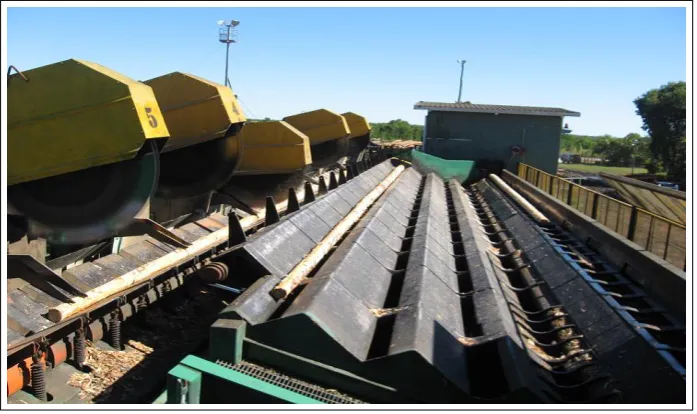
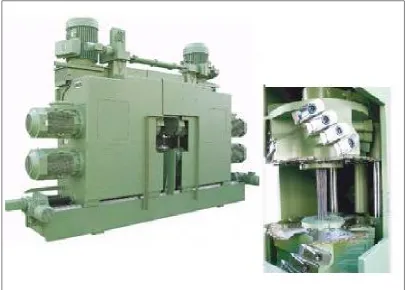
Each machine is equipped with tooling to perform the task, for example knives and segments for chipping and profiling actions (see Figure 2.13) and saws for cutting. New tooling is installed after every shift. Sometimes tooling might fail mid-shift, for example a set of saws might get damaged or a chipper segment might come lose.
Aside from changing the tooling there is virtually no manual handling required for pro-cessing logs down the sawline. The Linck line is a fully automated machine that reduces
Figure 2.11: Virtual logstock data stored for each bin destination
Log Break Down Process
Figure 2.13: F1 & F2 Profiler unit and one of the internal heads.
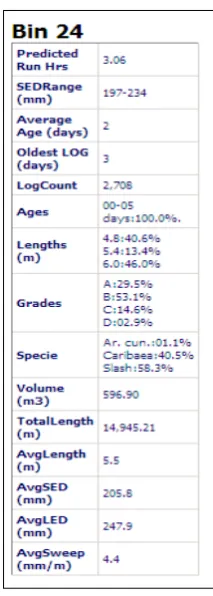
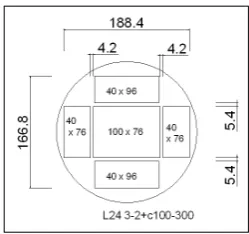
a log batch down to sawn boards with seemingly little effort. Figure 2.14 to Figure 2.19 is a sequence of diagrams showing the log cross-sectional view, to demonstrate the Tuan profiling line working on a Bin 24 log.
Figure 2.14: Cut pattern with outside edges and kerfs dimensioned.
Figure 2.15: Chip removed for opening faces at first chipper canter.
[image:37.595.157.282.148.265.2]Figure 2.16: After first rotation chip removed by second chipper canter.
Figure 2.17: After second rotation Profiler chips around the side boards.
Figure 2.18: Side boards sawn off producing sawdust.
[image:37.595.160.279.324.461.2]Chapter 3
Mining the Data Resource
With the proposal established to develop and apply a virtual sawmill cut regime, (based on potential cut patterns for each log class), on logs immediately after they have been produced at the merchandiser. Logs cut at the merchandiser will generally sit in storage as stock waiting for batch processing commands from the green mill. It is proposed that in the meantime before batch processing at the sawmill, the Optimization and Pro-duction Management personnel will have at their disposal, the luxury of an accurate output forecast of sawdust, chip and sawn volumes. In theory production planners will be informed (to some level of accuracy) about green mill output for any batch of logs prior to a batch being called for cutting. In effect virtual log yard stock will be enhanced to include virtual sawn stock.
Simulation of written code could only begin by sourcing a resource file. The ‘Logs and Stems file’ from the company Information Services Team has served as a resource platform function for foundations development. The stems sheet importantly contains the stem counter which, is reset every eight hours (every shift). It also has a row of diameters written at 150mm increments. These have been written to file by a three dimensional tri-cam laser scanner system as depicted in Figure 3.1 on the next page.
Figure 3.1: Hyne Model Perceptron Dimensional Measuring Instrument.
3.1
Geometric Stem Data Retrieval and Router Processing
Scan chain speed is 120m/min and the scan heads operate at 60 Hz which, equates to one snapshot scan produced every 33.3mm of the length of a stem. A high speed photocell ensures length error margins are significantly less than 30mm. In each ‘6’ in scan bucket, there will accordingly be between 4 and 5 ‘snapshots’ of scan data. Each snapshot retrieves something like 90-120 points per scanner head.
Mining the Data Resource
centre and measure the line length.
Data points scanned within the 6 inch bucket router are pushed together and a line of best fit is drawn through the points. From this irregular near-circular closed 2-d shape the 64 diameters at even spacing around the 360 degrees are calculated and averaged to form the bucket diameter. Figure 3.2 is a log xyz file viewed with looklog program from the side of a log. Figure 3.3 shows the end viewpoint of a log. The figures show the grouped 64 points sourced from all the individual scanned points in bucket range spaced at 6 inch intervals, particularly evident in the side view of Figure 3.2.
Figure 3.2: Side vision of a scanned log that has had scan points processed though a 6 in data bucket router.
Figure 3.3: End view of a scanned log where data has been processed through 6 inch data bucket router.
3.2
Data Bank for Stems and Logs
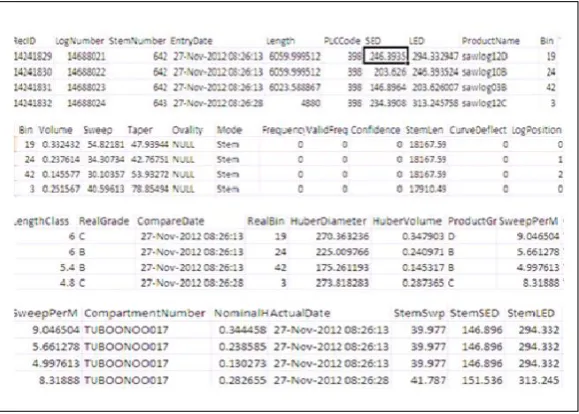
The high frequency of diameter readings written to the stems file gives rise to an op-portunity for micro-scale simulation analysis on the logs. Although the logs sheet does not have the bucket information it does have a link to the stems via the parent stem number that is written in each log row, clearly indicated by the highlighted column in Figure 3.4. This parent stem number is used as a link to the stems sheet and the useful micro scale geometric information. Each stem however likely gives birth to on average three logs so there is a challenge in linking the log to its associated diameter buckets in the stems sheet. Given the log length from the logs sheet the number of buckets can be calculated (by dividing by 150mm). Last column on the second row of Figure 3.5 indi-cates that there is also a column (labelled ‘LogPosition’) in the logs sheet that identifies the log position in the stem starting from zero through to the highest log count in a stem.
Figure 3.4: Extract from the logs file.
One weakness of this log file data is that log diameters are given only for the Small End Diameter(SED) and Large End Diameter (LED). For increased predictive mate-rial recovery accuracy it would be very preferable to have and use bucket data. The more descriptive and desirable bucket data is only recorded in the stems CSV file. Data given in Figure 3.6 is an example extracted from a stems CSV file, note that only a portion of bucket diameters have been provided from a calibration event. Centre diam-eter is the Huber diamdiam-eter (Hdia). The additional strength of referencing to the stem CSV bucket data is that the dimensional measuring system is regularly calibrated and trade measurement certified within tolerances of 1mm for diameters and 10mm on length.
Mining the Data Resource
Figure 3.5: More complete version of logs file information.
from the CSV file to get the full bucket data, (refer to Figure 3.6) . Each log is (most often) only a portion of a parent stem. The solution will be to develop an al-gorithm that will both reference the parent stem and the matching range of bucket data. The added advantage of referencing to the stem CSV bucket data is that the Dimensional Measuring System is regularly calibrated and Trade Measurement Cer-tified (applied tolerance standards of ± 1mm for diameter and ± 10mm on length.
Log zero is the last section of a stem to be measured due to the saws o-lining at the last bucket measured by the scanners (refer to Figure 3.7). To get the correct diameter buckets for log zero the program needs to go to the end of the parent stem. This end of the stem is most often the largest end of the stem due to taper and it is conventional to have the smaller end in the lead. Thus for log zero the program starts loading bucket diameters from the end of stems’ buckets minus the number of buckets associated with that logs’ length. For log one the program starts loading bucket diameters from the end of the stems buckets minus the number of buckets for log zero and minus the number of buckets for log one. The process of loading bucket data for a log in position one ceases when reaching the beginning of log zeros’ diameter buckets. The process increments for any other target logs parented by the same stem, Figure 3.8 is a flowchart example of this bucket diameter loading process.
Mining the Data Resource
Figure 3.7: Mapping solutioned logs from a stem to the resource file.
Wood in raw form as a log is mostly non uniform character. Each log will be unique on the basis of combined physical characteristics including: sweep, taper, and diameters. Early development work on a program to gather useful log data from a provisioned file highlighted the need for data filtering. To begin with logs belonging to just one pre-determined merchandised bin are to be searched for and returned. The idea is that this bin number plus a relevant sawmill cut pattern code can be input and changed by a user. These inputs will be taken up as global variables by the programs processes.
A global counter variable counts the number logs retrieved by the program. This counter also offsets the row number for storing sequential log bucket data. Alternatively it would be possible to have only one row for storing the log bucket data, perform the required analysis, store those results then write over the single bucket data row with the next retrieved log. One of the drawbacks of storing all found logs bucket data is that logs are not all the same length hence zeros are written on the end of any logs shorter than the longest length. For example the longest log cut by the bucking system will nominally be a 6m log, having 40 buckets while a mid length log nominally 4.8m length will have 32 buckets. The 4.8m log having 8 zeros at the end of its bucket data storage row. Trailing zeros are obviously ignored during the application of cut pattern analysis to log diameter data.
Mining the Data Resource
3.2.1 User Control for Log Batch Size
The program has been designed with an outer loop (a ‘For’ loop). This loop controls how many rows are to be incrementally searched for matches from within the logs file. From a user perspective in order to increase the number of rows searched for a designated batch of logs (say bin 24 logs) it is simply a matter of increasing the range allocated to this outer loop, as depicted by variable ‘k’ in Figure 3.9.
3.2.2 Loading Appropriate Log Data
Identifying the logs to capture is a matter of using an arrangement of ‘If’ statements. The process, as depicted in Figure 3.10 is designed to scan the contents of current logs bin number and compare to the pre-defined bin number. An ‘And’ statement is com-bined with the ‘If filter’ and serves to ascertain the log position. It is assumed that the maximum log count in any one stem would be no more than six. Therefore six ‘If’ statements exist to look for the combinational match of bin number and log position in the stem. Figure 3.11 condenses this particular process and explains how this part of the program fits into the overall structure. Figure 3.12 gives the Matlab log data summary output for a retrieved batch of logs, the counter returns how many logs matching the desired.
3.2.3 Cant Cross-sectional Target Products
To reveal these cross sectional dimensions code elements must be identified in particular order and decoded to reveal metric identities. To start from the centre with the thickness of the cant. The first character in a pattern code specifies the cant thickness, so this particular code says that the cant is three inches thick.
3-
3-2 + c100 -300Cant thickness is going to be the same as the width of the boards cut from the cant after vertical saws break the cant down. According to Table 3.1 the 3 inch thick cant has a target thickness of 75.5mm actual and 75mm nominal.
Mining the Data Resource
Figure 3.10: Locating the log in the parent stem.
Mining the Data Resource
Table 3.1: Nominal and Actual target widths of sawn timber
Nominal(in) Nominal(mm) Actual(mm)
3 75 75.5
4 100 961
6 150 150
6 150 1602
8 200 200
1For most product, but 100 for 100×75 and 100×15. 2 160×38 in side boards are nominally 150 wide due
to later resaw to 2 x (76×38).
Table 3.2: Cut code for target thickness of sawn timber
Code Nominal(in) Nominal(mm) Actual(mm)
1 5/8 15 15.7
2 1 25 26.51
3 1.5 38 39.6
4 2 50 50.0
1 for most product, but 25.5 for 100×25.
Table 3.3: Saw blade kerf
Saw Unit Kerf/cut (mm) Sideboards:
Inner 5.4 Outer 4.8 Cant Breakdown 4.2
Figure 3.12: Program gathered log batch data for pre-selected bin.
The addition of the second alpha numeric character is to describe thickness (decoded by Table 3.2) of some cant boards. In the standard pattern code the thickness of these boards are known only by non coded convention.
3-
3
-2 + c100 -300Programmable computation is made simpler with the addition of this character. This character is included to explain the thickness of timber pieces either at the centre of the cant or neighbouring the cant; depending on which of the two is not described by the second section of pattern code. In the example code the second section of code describes the ’centre (c)’ as being 100mm wide. The preceding two characters say there are two pieces of timber to be cut at the thickness described by the introduced character i.e. two pieces at 39.6mm thick. These pieces will be cut from either side of the cant on the cant width plane.
3-
3-2
+c100 -300The three code characters in the middle (c100) say that there is a 100mm wide product being cut in the centre of the cant.
Chapter 4
Mill Modelling
4.1
Decoding Sawmill Patterns
[image:52.595.154.497.462.672.2]Tuan sawmill cut patterns (see Figure 4.1) are an important determinant of the sawmill yield process. It is critical to this project that the conversion process from any cut code to an understanding of the geometric dimensions is precise and fully automated. Matlab code has been written to perform the computation of perpendicular dimensions of a user selected pattern. Since the logs are modelled as circular, orientation conven-tion has been described based upon the thickness and width plane orientaconven-tion of the cant.
Figure 4.1: Mapping a Tuan sawmill cut pattern code.
The last three characters in the cut code is the code dedicated for side board locations and their respective thickness (decoded in Table 3.2). Sideboards are generally cut as a pair with each partner piece always cut opposite sides of the cant.
4.2
Sideboards
4.2.1 F1 Sideboards
The first character in the sideboard range (3) details presence or absence, if the char-acter is zero then there will be no such sideboard and thickness of F1 sideboard pair is zero. If numeric character greater than zero is present F1’s are to be cut from above and below the cant (on the cant thickness plane). The kerf between cant and these particular sideboards is 5.4mm and for the pair there is 10.8mm (i.e. two saw cuts), refer to Table 3.3.
3-3-2 + c100 -
3
004.2.2 F2 and F3 Sideboards
The second character (‘2’ in Figure 4.2 ) indicates presence and thickness of a sideboard pair, located outside the first pair but in the same plane. The kerf to cut each one of these sideboards is 4.8mm, so 9.6mm for the pair. The third character (‘2’ in Figure 4.3) indicates presence and thickness of a sideboard pair to be cut from the outsides of the cant in the cant width plane. These sideboards are removed at the cant breakdown saws hence the kerf is only 4.2mm and 8.4mm for the pair.
4.3
Transform Sawmill Pattern Code to Dimensions
Mill Modelling
Figure 4.2: Cut pattern with F1 and F2 side-boards.
Figure 4.3: Cut pattern with F1 and F3 side-boards.
thickness of both the cant and the sideboards. Kerf for the inner sideboards breakdown saw is 5.4mm, so the total kerf thickness for the removal of two sideboards is 10.8mm. Finally adding the thickness of the two sideboards, the kerf and the cant thickness gives one planar dimension of 75.5 + 2*(39.6)+10.8 =165.5mm actual (difference compared with cut pattern diagram dimension is that product dimensions have been rounded to integers).
Figure 4.4: Dimensioned sawmill
pat-tern. Figure 4.5: Cant from pattern 3-3-2+c100-300.
[image:54.595.145.533.72.282.2]Perpendicular to cant thickness plane is the cant width plane. This pattern dimension is the total width of the cant; all cant products plus the cant breakdown saw kerf of 4.2mm for every cut. For this particular cut pattern there are two cant breakdown cuts each with kerf of 4.2mm yielding three cant products; two at 39.6mm thick (code characters 3 and 5) and one at 100mm thick (code characters 7-10). The dimension in cant width plane is therefore: 100 + 2*(39.6) + 8.4 = 187.6mm actual.
3-
3-2+c100
-300The thickness of a designated sideboard is always held constant (as prescribed by the pattern code) but the width can vary depending on: fit to an individual log, width categories (Table 3.1) and programmable priority and value settings. See Figure 4.6 for demonstration of a sample of some potential width of F1 side boards examined through simulation. At this stage of the development strategy it is decided to have the software designed specifically for targeting the highest potential sawn yield rather than to delve into the variables of optimising sideboard width according to fluctuations in customer demands.
For virtual simulation and decision making in regards to max sawn yield regime on the sideboards the potential vertices of the sideboards need be compared to corresponding adjacent points on the perimeter of the log, see Figure 4.8 on the following page.
4.4
Overlaying Cartesian Co-ordinates
Mill Modelling
[image:56.595.371.539.78.186.2]Figure 4.6: Graphical depiction of the search options for increasing width of sideboards.
Figure 4.7: When sideboard edges are outside the bounds of the log then wane is introduced
along the outer face edges.
established and the [y] intersect with sideboard face edge is constant then the intersect in terms of [x] is determinable.
Figure 4.8: Sideboard vertices and intersects with log perimeter co-ordinates.
By introducing [x] coordinates that match the array of sideboard width options (refer to Table 3.1) a comparative computational analysis between the vertices of the sideboard and intersects to the outer edge of the log is performed. The result of such analysis determines two things. Firstly if the vertices of the sideboard are located within the bounds of the log and secondly if a board corner is located outside the log then the rel-ative percentage of wane along the width face is computed, Figure 4.7 illustrates wane introduced when projected sideboard edges stretch out beyond the perimeter of the log,
also see see Figure 4.9. The percentage wane parameter is highly sought after for this project because there are, specific wane tolerance ranges governing whether a piece of timber will be accepted by downstream grading stations or alternatively docked/rejected and converted into chip.
4.5
Processing Face and Edge Wane
There are two places or types of wane that must be predicted one on the width face (face of sawn), and the other on the thickness face (edge of sawn), refer Figure 4.9. At the profiling line product specific limits for both face and edge wane can be set inde-pendently. Primary and secondary wane limits can also be set where, primary wane is allowed full length and secondary is allowed for a percentage of length. Typical pri-mary and secondary limits are 30%f ace×30%edge×100% length and 33%f ace×35%
edge×30% length.
Figure 4.9: Board wane diagram.
First a strategy for modelling face and edge wane is identified and demonstrated by example. In terms of [x] any point on a circle quadrant - 0 to π/2 can be described by:
x2=r2−y2
If the sideboard vertices are assigned Cartesian co-ordinates [x1,y1] and [x1,y2] for the
lower and upper corners respectively. For example if the radius of the log is 105 mm for pattern ‘3-3-2+c100-300’, the origin is at the centre of pattern and log, then [y1]
co-ordinate will be 0.5*(75.5) + 5.4 = 43.15 and [y2] is 82.75 (i.e. y1 + sideboard
Mill Modelling
then be solved by substituting the y values and the log radius into:
x2n=r2−yn2
The solutions for which are:
x1 = 95.7 and x2= 59.8
Mirroring the result about the [y] axis indicates the maximum available material a side-board located within the y axis range. The maximum material width of the inner face of the sideboard according to this method is 191.45mm. The outer face has less material as it is further from the centre; leaving cross section of only 119.6mm. If the sideboard vertices extend beyond these values then edges will not be cut square and will inherit wane on both face and edge.
The largest standard sideboard width (Table 3.1) that will fit inside the inner face is 160mm (actual). Projecting this width up to the top face means going beyond the out-side of the log since the max material width here is 119.6mm. The difference between these two values is the absolute measure of wane on the top face (i.e. 160 - 119.6 = 40.4). The relative percentage of face wane computed is 40.4/160 *100 = 25.25% which, is within the acceptable range.
In the instance of edge wane the intersection of the outside perimeter of the log and edge of the board needs be determined. In terms of [y] any point on a circle quadrant - 0 to
π/2 can be described by:
yn2 =r2−x2n
hence:
y32 =r2−x21
The result for y3 is 68mm. Difference between y3 and y2 is 14.75mm (82.75 - 68). The
relative percentage of edge wane computed is 14.75/39.6 *100 = 37.25%. This would fail the typical wane rule test because edge wane percentage is too high.
Trim Sawing Process
Board trimming is the final breakdown process for unseasoned sawn timber at the Tuan sawmill. Where once the inspection and docking process may have been manually performed by human operator/s, the shear rate of volume being supplied by the profiling line demands an automated solution with equal capacity handling capability.
5.1
Trimmer Machine Centre
The trimmer machine center is a system that integrates several major components. A computer system calculates the maximum value of recoverable timber and chips for each piece of material processed. The system uses accurate scanning, PCs and
dedicated software packages. The system scans material and calculates board solutions. A Programmable Logic Controller (PLC) controls the timing and movement of machine centre equipment. The scanning system determines thickness, width and length for each material piece. A solution is computed by using the current set parameters and the scan data. The parameters can be edited and allows for customization.
The solutions PC:
• Calculates board solutions and controls saw movement/activation through the PLC.
• Sends commands to other PCs.
Trim Sawing Process
Figure 5.1: Block diagram of the trimming system.
Figure 5.2: Trimmer solution computers.
• Sends and receives PLC data.
• Stores solution parameters.
The Solutions PC is the controlling PC for the system. It uses scanner data to calculate board solutions and position data for each piece.
5.1.1 Material Flow
At the end of profiling line the sawn boards are shunted and subsequently chain conveyed in a perpendicular orientation of motion (in relation to board length). Each board from a parent log needs to be separated from its mates so that it can be
analysed by a geometric scanning system. Using buttons on the consoles, the operator tells the computers to automatically scan and cut material (see Figure 5.3).
Figure 5.3: Operator controls material flow into trimming system.
Cant and side board products alike move through the trimmer system in the following sequence (sourced from the Trimmer Operating Manual USNR (2002) ):
1. Unscrambler separates the pieces and moves each onto the scanner infeed chain.
2. The scanner infeed transfer moves them onto a conveyor called the lug chain.
3. The ending rollers move the board against a fixed lumber line and boards move onto a scanner transfer chain.
Trim Sawing Process
thickness of the board. The scan data is sent to the solutions computer, refer to Figure 5.4.
5. The length scanner tells the scanner computer the length and width of the board. Data sourced from this length-cell is sent to the solutions computer. The scanner computer generates a geometric picture of each piece of material for the solutions computer.
Figure 5.4: Trimmer geometric scanning module.
6. The solution computer calculates the most valuable combination of boards and chips that can be cut from each board.
7. After passing through the scanner, the lug chain moves the board through the trim saws, producing a final board.
8. The boards are moved to the sorter. Using buttons on the consoles, the operator tells the computers to automatically scan and cut material.
5.1.2 Trimmer Laser Sensing
There are two trimmers in the Tuan sawmill. The laser spacing on trimmer 1 is one inch and on trimmer two is four inches. Trimmer one has 22 heads with 23 lasers on each, trimmer two has 20 heads with six lasers on each (half heads are on top and half on the bottom). The lasers in these trimmers are point lasers which means there are
blind spots along the length of the boards from the laser data. Both trimmers use lasers in coordination with a light curtain (spacing on Trimmer one and Trimmer two light curtain is 2.5mm). Lasers measure the thickness and the wane profile, the light curtains measure the length and combination of lasers/light curtain measures the width of the board.
Briefly (also refer to Figure 5.5 and Figure 5.6) the laser scanner module for trimmer machine centre generates geometric representation data in following manner:
• Lasers emit beams of infrared light into the scan area.
• The laser beams reflect off the material surface and the cameras sense the reflected light. The reflected laser beam angle and intensity corresponds to the thickness of measured material.
• Centroid data is the reflection position on the camera and peak data is the maximum intensity of the reflected beams. The scan head signal processor encodes the camera centroid and peak data.
• A fiber optic cable transmits the data to a receiving card in the scanner processor.
Figure 5.5: Point lasers scanning a board as it moves through.
Trim Sawing Process
[image:64.595.152.495.107.387.2]Figure 5.6: Trimmer scan head block diagram.
[image:64.595.127.314.485.672.2]Figure 5.7: Scanned and solutioned boards en-tering the trim saws.
Figure 5.8: Trimmed boards exiting the trim saw booth.
5.1.3 Trim for Wane Criteria
Wane allowances are programmed through the trimmer interface computer system. These parameters can be edited at any time by production controllers to control the wane quality characteristics of timber boards to be processed in an upcoming run. When setting up for wane by board rules data entry and changes are made in the Face, Edge and Area Wane tables of the trimmer control interface. Wane is the percentage of wood that can be missing. For example, face wane of 25% means that 75% of the face of the board must be good wood and 25% can be missing, see Figure 4.9.
Primary and secondary wane limits control the total combined length over which threshold face and edge wanes are allowed to be present on any one board product. These limits are applied in the sawmill trimming process and as such if limits are exceeded trim saws will activate to cut a section of the board off so that the remaining length meets the specified limits. Figure 5.7 and Figure 5.8 illustrate sawn boards first moving into the trim saws and second exiting the saws as finished sawmill board product. If a length section not greater than the minimum required board length (usually around 2.4m) cannot, be solved along the full length of a scanned board then trim saws at 150mm spacing along the length of the board will be activated to go down and cut up the entire length of board.
Trim Sawing Process
5.1.4 Trim for Length Criteria
[image:66.595.351.532.239.399.2]If a board is over the minimum required length but under the actual trim saw spacing, it would be allowed through without trimming. If a board is over the actual trim saw spacing, it would be docked to the actual trim saw spacing. Figure 5.9 and Figure 5.10 gives an internal top perspective and almost side view of trim saw elements. Short barrel hydraulic cylinders provide the mechanical thrust to drop saws into a board for cutting then retract the saw up and clear of the next board.
Figure 5.9: Top view of a trim saw elements. Figure 5.10: Isometric view of three trim saws.
[image:66.595.127.311.241.397.2]Trim saw spacings do vary, but usually sits around what is supplied in Table 5.1. Minimums also vary from one trimmer to the other, but sit around the +20mm mark, except for 2.4 / 3.0 which are 2.415 and 3.018.
Table 5.1: Trim saw table
Board nominal trim length (m) 2400 3000 3600 4200 4800 5400 6000 Trim saw fixed position (m) 2420 3026 3632 4238 4844 5450 6056 Min. allowed board length (m) 2415 3018 3620 4220 4820 5420 6020
The optimisers have the capacity to solution 2 boards from any single input piece however the trimming systems don’t have the hardware (mechanicals or control
system) to recover 2 pieces from 1 piece. The optimiser only considers a single product
output and so logically chooses the most valuable single product solution, usually this will be the longest length, but not always. If there’s two possible positions for the same product out (i.e. a 2.4 from either the near end or far end of a 6.0m input) it takes the solution closest to the 0 line. Provided it meets the wane criteria, there’s no value difference between a board with no wane and a board with maximum wane.
Each virtual sideboard is first processed through the wane rules. Later a determination is done on how well the remaining length fits with standard sawmill lengths so as to ultimately determine which trim saw actuate down for the cross cut. Eventual yield for that board at the trimmer is categorised into three:
1. Sawn board that will go to the sorter
2. Chip, which is produced from the docked sections and
3. Sawdust, which is produced by the sawcuts.
Given wane predictions at 150mm increments for F1 side boards for the various potential widths, query is raised about handling the sections in between the points of measurement. One way (also currently the way the program works) is to assume uniformity of wane over the entire 150mm bucket. This is certainly the easiest way to deal with the wane and reassuringly the trimmers do it this way. Slightly more
Chapter 6
Virtual Product Volumation
6.1
F1 Sideboards
In terms of programming it is critical to understand that in a board length there