Adaptation Pathways and Opportunities for
the Wet Tropics NRM Cluster region
Volume 2. Infrastructure, Industry, Indigenous peoples, Social
adaptation, Emerging planning frameworks, Evolving
methodologies and Climate adaptation planning in practice.
Precis
This chapter provides an update on progress from the ‘Participatory Scenarios and Knowledge Integration Node’ of the Wet Tropics Cluster (WTC) region. Since the first workshop, led by the ‘Participatory Scenarios and Knowledge Integration Node’ in April 2013, members of this research node, in collaboration with the natural resource
management (NRM) organisations, have initiated a wide range of research activities, based on the findings from this workshop and discussions with the four NRM organisations of the Wet Tropics Cluster. Appendix B summarises these transdisciplinary research activities, some of which are completed, while others are in progress. Our transdisciplinary research is showing that, based on the differences identified in the initial workshop with members of the Brokering Hub and discussions with staff of the four NRM organisations, the research needed to support these four NRM organisations in their planning for climate change differs considerably. This is not only a reflection of the differences between the four NRM regions in their biogeography, demography, and governance but also a reflection of past and current research activities carried out in these four NRM regions such as through the National Environmental Research Program (NERP) and the Rural Industries Research and Development Corporation (RIRDC). The key messages
associated with each of the topics addressed in this chapter are:
TOPIC KEY MESSAGES
Evolving
methodology 143. The co-research approach, i.e. the Brokering Hub and the co-research cycle, is critical to the success of the Wet Tropics Cluster project. 144. Research (synthesis) needs to be driven by the NRM organisations of the Wet Tropics Cluster, and
needs broad stakeholder support to facilitate development of ‘no regrets’ adaptation strategies. 145. Transparent and open communication is critical for improving understanding about issues and
supporting learning among Brokering Hub members (and among staff of the four NRM organisations).
146. The research approaches and methods taken by the ‘Participatory Scenarios and Knowledge Integration Node’ need to be flexible, adaptable and tailored to the needs of each of the four NRM organisations.
9.
Evolving methodology for identifying climate
adaptation pathways and options
Iris C. Bohnet, Matt Curnock, Robyn Bell, Rosemary Hill and Peci Lyons
IN A NUTSHELL
A ‘co-research’ approach involving multiple scientific disciplines and genuine collaboration
between researchers and NRMs is critical.
Participatory planning approaches are essential to the development of useful adaptation plans.
TOPIC KEY MESSAGES
147. Research syntheses need to involve careful processes of translation across the ‘boundaries’ between the “knowledges” of research and practice.
148. Close collaboration among researchers of different scientific disciplines, NRM staff and stakeholders within the NRM regions is critical to identification of adaptation pathways and options.
Adaptation pathways and options
149. Identification of climate adaptation pathways and options requires participatory approaches and collaboration with stakeholders representing the broad interests and sectors across the NRM region. 150. Social network analysis (SNA) can assist in the identification of key actors, networks, and institutions
that are important to collaborate with.
151. Participatory scenario planning is a powerful tool to engage multiple stakeholders in identifying adaptation pathways and options to address climate change and other key drivers of change in the region.
Introduction
In April 2013 the ‘Participatory Scenarios and
Knowledge Integration Node’ led a half-day workshop with members of the Brokering Hub to identify the key issues and drivers of change in the four NRM regions based on the knowledge and experiences of the members of the Brokering Hub (Stream 1 and Stream 2). The outcomes of this workshop were delivered to the Australian Government in a Milestone report in May 2013 and informed the research of our node (Bohnet et al. 2013). In Appendix B we provide an overview of all the activities undertaken by members of our Node. In subsequent sections we describe the activities in more detail and provide the rationale for each of the activities.
The aim of this chapter is to illustrate how the various activities carried out by our research node support NRM planning for climate change. In particular, we aim to show how participatory scenario planning can support transdisciplinary research activities and enables identification of different types of knowledges,
knowledge integration, and building of adaptive capacity.
Adapting to the impacts of
climate change – how science
informs NRM planning for
climate change
Scientists and NRM practitioners
working together in a Brokering Hub
The co-research approach, i.e. the Brokering Hub and the co-research cycle, is critical to the success of the Wet Tropics Cluster project.
A prerequisite and critical to the success of the Wet Tropics Cluster (WTC) project is this innovative co-research approach that has been taken by the project team, and the establishment of the Brokering Hub at the beginning of the project (see Chapter 1, Figure 1.2). The co-research cycle adopted includes stages that provide for: system analysis; processes and tools to support knowledge translation and integration; and updating through social learning (see Chapter 1, Figure 1.3).
Participation in regular meetings of the Brokering Hub is critical to the research carried out by the
science, approaches and methods, e.g. landscape approach, social network analysis, participatory scenario development, that may be useful in assisting the NRM organisations in their planning for climate change. In addition, participation in the Brokering Hub also enables the ‘Participatory Scenarios and
Knowledge Integration Node’ to gain a better
understanding of the research carried out in the other research nodes and to support and capitalise on their research activities (connection between the
‘Participatory Scenarios Node’ and other research nodes via Brokering Hub shown in Figure 1.2). For example, members of the ‘Participatory Scenarios and Knowledge Integration Node’ contributed substantially to, and thereby supported, the research carried out by the ‘Science Synthesis Node’ (Hilbert et al. 2014). At the same time, the ‘Participatory Scenario and Knowledge Integration Node’ used extracts from the suite of key messages from the science synthesis report (Hilbert et al. 2014) in a participatory scenario planning workshop (Bohnet and Bell 2014) to inform workshop
participants.
The co-research cycle (Chapter 1, Figure 1.3) is based on recognition that ‘knowledges’ generated under different disciplinary matrices, and under research or practice settings, are of different kinds and that any joint use will require careful processes of translation across the ‘boundaries’ between knowledge systems (Vatn and Vedeld 2012). Processes of conscious boundary management that include knowledge co-production, mediation, translation, and negotiation have been identified as necessary to build integrated knowledge for generation of adaptation pathways and sustainability solutions (Cash et al. 2006). A growing body of research has emerged that analyses boundaries and boundary work to link different knowledge
domains in sustainability science (Robinson and Wallington 2012). Our cycle is based on the six stages identified by Hill et al. (2010) which emphasises the need to pay attention to tools for developing knowledge integration and shared understanding. In addition to the participatory scenarios, cultural
mapping and social network analysis (SNA), the ongoing discussions at the Brokering Hub are critical to
identifying issues of knowledge translation and boundary management.
Workshop to identify key issues and
drivers of change in the Wet Tropics
Cluster NRM regions
Research (synthesis) needs to be driven by the NRM organisations of the Wet Tropics Cluster, and needs broad stakeholder support to facilitate development of ‘no regrets’ adaptation strategies.
Transparent and open communication is critical for improving understanding about issues and supporting learning among Brokering Hub members (and among staff of the four NRM organisations).
One of the initial steps that need to be taken in the process of identifying climate adaptation pathways and options is identification of key issues and drivers of change. A workshop, led by the ‘Participatory Scenarios and Knowledge Integration Node’ was organised with the members of the Brokering Hub to identify key issues and drivers of change in the four NRM regions of the WTC region. This workshop provided the
opportunity for scientists and managers to work together and to get a better understanding of the key issues and drivers of change in the four NRM regions of the Wet Tropics Cluster. The output from this workshop was a milestone report delivered to the Australian Government. The outcomes of this workshop (Bohnet
et al. 2013) informed the research synthesis that has been and is currently carried out by the ‘Participatory Scenarios and Knowledge Integration Node’.
Synthesis of climate change
knowledge and planning practices of
the Wet Tropics Cluster NRM
organisations
The research approaches and methods taken by the ‘Participatory scenarios and Knowledge Integration Node’ need to be flexible, adaptable and tailored to the needs of each of the four NRM organisations.
review of relevant documents, which the NRM organisations provided. To supplement the review and clarify questions that arose from the review, we conducted interviews with NRM staff members. The output from this research, a milestone report, was delivered to the Australian Government (Lyons et al. 2013). The outcomes, five key messages, were
presented to the NRM organisations in a Brokering Hub meeting and the report (Lyons et al. 2013) was made available. These five key messages further informed the research in our science node.
Contribution to research led by other
research nodes
Research syntheses need to involve careful processes of translation across the ‘boundaries’ between the “knowledges” of research and practice.
Close collaboration among researchers of different scientific disciplines, NRM staff and stakeholders within the NRM regions is critical to support identification of adaptation pathways and options.
The first science synthesis report (Hilbert et al. 2014) responded to a list of ‘Priority science deliverables’ initially prepared by the NRM organisations during the development of the project proposal, and subsequently updated through the Brokering Hub (Appendix A, Volume 1). The structure of the report was framed by this needs analysis, and lead authors were asked to direct their synthesis to these topics. Nevertheless, the evaluation conducted at the Brokering Hub meeting identified that authors did not include key information that was requested, and that insufficient review and interaction occurred around the document. Key authors on the other hand identified that meeting the exact requirements of the NRM groups would require a multi-year research program rather than a synthesis from a body of science largely driven by other needs. This again highlights the requirements for careful translation and management across the knowledge boundaries between research and practice.
Researchers from our science node contributed substantially to the science synthesis report (Hilbert et al. 2014) as outlined in Appendix B. This report was a
major project deliverable to the Australian Government and our four NRM collaborators. While the preparation, coordination and writing of these chapters was a time-consuming exercise it provided opportunities for collaboration amongst WTC researchers from the different science nodes and additional researchers from outside the project with specific expertise relevant to the research of the WTC project. Special attention was paid to the specific issues associated with knowledge integration across Indigenous and western world-views. The outputs, i.e. extracts from the key messages from each of the chapters, have already been displayed during scenario planning workshops in the Reef Catchments NRM region and will further inform the research in our node. Overall, the science synthesis report improves our understanding of the science that can support NRM adaptation planning for climate change.
To improve communication and co-ownership of key messages from the science synthesis report within the NRM groups, a brochure was developed in
collaboration with the NRM groups, led by Ro Hill and Cath Moran from the science team (Hilbert et al. 2014b), also outlined in Appendix B. Science teams provided the key messages and the NRM groups provided most of the images, and influenced layout and design.
Cultural Heritage Mapping and
participatory scenario planning with
Traditional Owners in the Reef
Catchments NRM region
Identification of climate adaptation pathways and options requires participatory approaches and collaboration with stakeholders representing the broad interests and sectors across the NRM region.
Engagement with a broad range of stakeholders, sectors and community groups is essential for
their needs and perspectives are incorporated into adaptation planning processes. This case study, initiated by Reef Catchments and our research node, consists of two components: a land use and occupancy mapping exercise (cultural heritage mapping) and an adapted scenario planning activity. The aim of this case study is to explore and critically assess the
appropriateness of planning and community
engagement tools to integrate knowledge, and include Indigenous cultural values, into regional planning. An Indigenous-driven process has been adopted as Indigenous driven processes have demonstrated greater capability for including Indigenous perspectives and protection of Indigenous intellectual property (Christensen and Grant 2007; Hill et al. 2012; Sillitoe and Marzano 2009).
Participatory Cultural Heritage and Land Use and Occupancy Mapping
Participatory mapping is a general term for gathering and mapping spatial information to help communities learn, discuss, build consensus, and make decisions about their communities and associated resources. The participatory cultural heritage mapping exercise will involve researchers who support the Traditional Owners to collect, depict, and interpret new
information to assist them and Reef Catchments NRM to make resource management decisions.
Participatory mapping is a powerful tool that increases Traditional Owner involvement and provides a means for participants to express their ideas in an easily understandable visual format. Participatory mapping has previously been used in the following ways: to create maps that represent cultural resources,
community values, perceptions of alternative scenarios and usage
to gather traditional knowledge and practices for assessment or monitoring
to identify data gaps
to inform other data collection methods (e.g. formal surveys, interviews, planning workshops)
to facilitate the decision making process
to empower stakeholders in resource negotiation processes
to conduct trend analyses.
Participatory mapping can simultaneously provide: a way to engage Traditional Owner groups near and
far
objective local information on resources
a means to strengthen traditional knowledge and practise from their Traditional Owner group(s) information on how Traditional Owners perceive,
value and use these resources
a focal point for discussion on climate change impacts and other issues/impacts on cultural heritage
a valuable tool to support decision making
graphical and easily understandable communication tools.
In the land-use use occupancy mapping Traditional Owners define what they want to map and the information they make public. The aim of the mapping exercise is to show the different ways that people are connected to particular features of their country and to draw the boundaries of that country. The types of information that can be mapped include use of and access to country, such as fishing, camping, art and story sites and historical use of land. Mapping can enhance engagement with other stakeholders, to visualise issues and resources and stimulate discussion.
Participatory Scenario Planning On-Country
Participatory scenario planning follows the cultural heritage mapping exercise. The maps will be the basis for discussion with the Traditional Owners to discuss their values of their country and develop scenarios and adaptation options for their country.
include adaptation of tools to support: Indigenous ways of communication and representation especially cultural values and connection to country; Indigenous interpretation and meaning that is based on Indigenous ways of knowing; negotiation of consensus which may require different types of agreement based on governance arrangements; alternative perspectives of time and scale; and recognition of Indigenous interests in the engagement process. This case study will use an Indigenous driven process to explore the capability of participatory scenario planning to address the Indigenous perspective.
Outputs from this case study will include a combination of the following: Traditional Owner approved maps of country, cultural heritage maps for the Traditional Owners, Traditional Owner vision or plan for country that include adaptation options, narratives and stories. A journal article and summary results sheets, for the Brokering Hub members and the Traditional Owner group, will be published from this work.
This case study will offer a unique approach to incorporating an Indigenous driven process and perspective into regional NRM planning. Through this research we will identify conditions, approaches and processes that support or limit the integration of Indigenous knowledge into a regional NRM governance setting.
Social Network Analysis
Social network analysis (SNA) can assist in the
identification of key actors, networks, and institutions that are important to collaborate with.
This social network analysis (Ahammad et al. 2013) case study, initiated by Terrain NRM and our research node, takes a broad structural view of knowledge integration in biodiversity management. This research investigates how knowledge and information is negotiated and brokered among conservation actors, at the broader structural network level. The SNA will be based on the institutional arrangements and contributions of different types of knowledge to biodiversity connectivity in the Terrain NRM region.
The aims of the SNA are to investigate and document:
the relational structural arrangements that support on-ground works for biodiversity
the types of relationships that support particular types of knowledge that contribute to biodiversity connectivity
the sharing of knowledge and the use of different types of knowledge that support decision-making gaps and opportunities to improve collaboration in
the knowledge networks to support effective biodiversity outcomes.
This project will investigate how different types of knowledge are shared and used to support decision-making for biodiversity management in the Wet Tropics Cluster region.
SNA is becoming a recognised and accepted tool to examine relationship ties and types of interactions that occur among actors in NRM (Bodin et al. 2011; Janssen
et al. 2006). SNA can identify exchange and connections among stakeholders that occur through institutional arrangements, information paths and resource relationships (Bodin et al. 2011; Hahn et al. 2006). An understanding of the interactions between
coastal, peri-urban and hinterland area, based on Terrain NRM’s off-set corridor maps.
Identification of an initial set of key actors involved in on-ground biodiversity corridor work will be completed with Terrain NRM staff. This will be followed by a snowball selection method. The case study will engage actors operating at different NRM scales, including industry, Traditional Owner groups and property owners.
The SNA will occur at the institutional level and will involve several stages:
1. scoping of the social network analysis with Terrain NRM based on their NRM program and their strategic offset corridor spatial maps
2. exploratory qualitative exercise, focus groups sessions with some of the stakeholder groups on information sharing and their decision networks to guide development of the quantitative survey (spatial map will be used to determine which groups to meet)
3. discussion of the findings and the development of the survey with Terrain NRM
4. development of a survey that will form the basis of mapping the social network of biodiversity corridors 5. pilot test and adjust questionnaire as required 6. conduct the SNA survey, through meetings and
phone conversations
7. development of the social network using exponential random graph modelling
8. review of the initial findings with Terrain NRM and supervisor to design the second stage of the study, a qualitative survey
9. pilot test then conduct focused qualitative survey on particular relationships in the network to identify how knowledge is negotiated, exchanged,
translated, and/or transformed and any interactions between scales
10. review of findings with Terrain NRM and supervisor and discuss implications for NRM planning for climate mitigation
11. write up results – report and paper.
The outputs from this case study will include: a journal article
summary report for Terrain NRM and participants, where requested
recommendations for actions that will strengthen decision-making and knowledge sharing for biodiversity management.
Outcomes include:
improved understanding of the key variables that influence, and can acted on to, to build on the benefits from existing biodiversity offset corridors improved planning and engagement strategies in
the NRM community for effective biodiversity management.
Scenario planning workshops in the
Reef Catchments NRM region
Participatory scenario planning is a powerful tool to engage multiple stakeholders in identifying adaptation pathways and options to address climate change and other key drivers of change in the region.
A series of regional stakeholder workshops were held in collaboration with Reef Catchments NRM to assist with their incorporation of climate change adaptation measures into their updated NRM plan. Earlier
Brokering Hub meetings with NRM representatives had identified a range of issues relevant to the NRM region that would affect stakeholder engagement and adaptation planning processes, including mining industry growth, port developments within and adjacent to the NRM region, and a degree of climate change scepticism among some community
stakeholders. A participatory scenario workshop process was applied to address these and other regionally relevant issues and elicit broad stakeholder participation into the identification of:
1. community and stakeholder values associated with the NRM region
2. key drivers of change in the NRM region
4. strategies and actions to reduce/mitigate risks and capitalise on opportunities
5. key players and potential working groups to implement the identified strategies and actions. Stakeholder workshops were held in two stages: 1. initial workshops to address (i) to (iii) above, held in
Mackay (12/2/14) and Proserpine (13/2/14) 2. a follow-up workshop to address (iv) and (v) above,
held in Mackay (17/6/14).
The initial workshops were held in two centres within the Reef Catchments NRM region as organisers
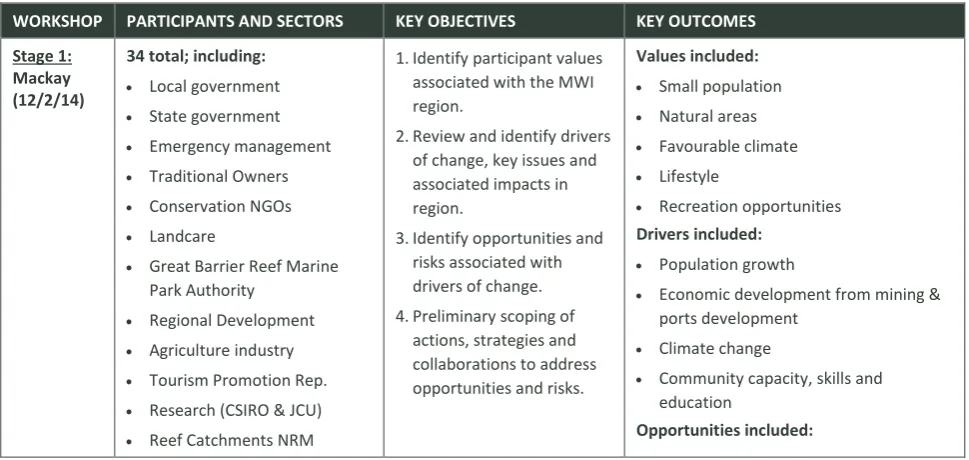
[image:9.595.56.541.402.632.2]considered the likelihood of intra-regional differences in key issues and drivers of future change identified by participants from different parts of the NRM region. The follow-up (Stage 2) workshop was help in Mackay, synthesising key outcomes of both initial workshops for regional stakeholders to review, prioritise and develop collaborative strategies and actions. Key details and outcomes of the workshops are summarised below in Table 9.1. Full details of the workshop structure, participants and outcomes are reported in Bell et al. (in prep). Workshops were held at a hired venue, with independent, professional facilitators appointed to mitigate any potential perception of bias in the process.
Table 9.1 Summary of Reef Catchments participatory scenario workshop in F.Y. 2013/14.
WORKSHOP PARTICIPANTS AND SECTORS KEY OBJECTIVES KEY OUTCOMES
Stage 1: Mackay (12/2/14)
34 total; including: Local government State government Emergency management Traditional Owners Conservation NGOs Landcare
Great Barrier Reef Marine Park Authority
Regional Development Agriculture industry Tourism Promotion Rep. Research (CSIRO & JCU) Reef Catchments NRM
1.Identify participant values associated with the MWI region.
2.Review and identify drivers of change, key issues and associated impacts in region.
3.Identify opportunities and risks associated with drivers of change. 4.Preliminary scoping of
actions, strategies and collaborations to address opportunities and risks.
Values included: Small population Natural areas Favourable climate Lifestyle
Recreation opportunities Drivers included:
Population growth
Economic development from mining & ports development
Climate change
Community capacity, skills and education
WORKSHOP PARTICIPANTS AND SECTORS KEY OBJECTIVES KEY OUTCOMES
Proserpine (13/2/14)
14 total; including: Local government Emergency management Landcare
Regional Development Corp. Agriculture industry Tourism industry Research (CSIRO & JCU) Reef Catchments NRM
Regional infrastructure investment New agricultural crops & diversification Carbon market opportunities
Business & retail growth Risks included:
Natural resource degradation Cultural shift and loss of values Water use competition and scarcity Economic inequality
Loss of agricultural land
Erosion of Traditional cultural heritage Reduces lifestyle quality
Coastal flooding and storm impacts Stage 2:
Mackay (17/6/14)
31 total; including: Local government State government Education sector Traditional Owners Conservation NGOs Landcare
Great Barrier Reef Marine Park Authority
Insurance industry Agriculture industry Mining industry Research (CSIRO & JCU) Reef Catchments NRM
1.Review and prioritise key drivers, opportunities and risks.
2.Develop collaborative strategies and actions to address opportunities and risks
3. Identify key players and potential collaborations to implement strategies and actions.
Strategies and actions included:
Professional development for teachers Development of a multicultural centre
and creation of a contact list to facilitate improved engagement with local Traditional Owners.
Development of regional renewable energy strategy
Planning mechanisms to preserve and prevent development over prime agricultural land
Establishment of a community development consultation forum. Build climate change adaptation
framework into NRM and council planning.
As reported in Bell et al. (in prep), the diversity of stakeholder participants at the Reef Catchments workshops was an aspect that was greatly appreciated by the workshop participants. The broad representation of a wide range of community sectors and industries in the region provided an opportunity for identifying shared values of the region, and for the
acknowledgement of opportunities and threats associated with different groups and sectors.
Regional values and issues
diversification arose as a key issue at both the Mackay and Proserpine workshops. Current dominant industry sectors include agriculture (primarily sugar cane and grazing), mining and tourism (principally in the Whitsundays region). Concerns about the reliance on mining for economic viability, and the impacts of this industry on both social and environmental issues were raised in both Mackay and Proserpine, reflecting the strong influence of this sector on the region. A key distinction between the two locations, was that the Mackay area had experienced a ‘boom’ but is now seeing a downturn in investment, whereas an impending ‘boom’ for the Whitsundays region was expected following the federal government’s recent approval of expansions to the Abbott Point coal export facility. The strength of the mining sector was identified as a key driver of both opportunities and risks to the future of the region’s landscape, other industries and the social well-being of communities within the region. While invitations were sent, unfortunately no mining industry representatives were able to attend the Stage 1 workshops; however, mining representation was achieved at the Stage 2 workshop.
Key drivers in the region
At both Stage 1 workshops, Reef Catchments staff provided a summary snapshot of the socio-economic and climactic drivers that are currently and likely to impact on the future of the region. These included: population growth (47% by 2031)
capacity – resources, people (e.g. low per capita higher education attainment, high per capita trade skills associated with mining and construction) climate change (high variability accepted as regional
norm, extreme events projected to increase in intensity, warming trend already evident, sea level rise expected to impact low lying areas).
economic sectoral growth/ decline (e.g. growth in mining and related industries, decline in relative economic importance of agriculture)
Risks and opportunities
At the Stage 1 workshops, the main impacts identified that were associated with the mining ‘boom’ included
increased urban and industrial development and an increasingly transient population. Impacts identified from such growth included reduced social connectivity and community capacity, degradation of the natural environment, and impacts to other sectors including tourism and agriculture. In Proserpine, concerns around mining included impacts on future tourism, the health of the Great Barrier Reef (in particular water quality from port dredging), biodiversity loss, industrial and urban encroachment on good quality agricultural land, and risks to the viability of the local sugar mill. The risks associated with climate change were
acknowledged by participants in all workshops, despite the earlier identification of climate change scepticism within the community. Contributions by emergency services representatives, who shared details of response plans and activities associated with extreme weather events in recent years contributed significantly to the identification of risks, opportunities and
strategies. Similarly, a presentation by an insurance industry representative at the Stage 2 workshop on insurance industry statistics, policy and issues in the north Queensland region provided excellent additional contextual information to inform the development of risk reduction and mitigation strategies by the
workshop participants (full details reported in Bell et al. in prep).
Actions, strategies and collaborations
and key players associated with implementation were identified for some examples (see Bell et al. in prep for further details and an outline of the Stage 2 workshop processes).
Future directions
Following reporting of workshop outcomes to
participants (Bell et al. in prep), further work is planned, involving the Participatory Scenarios and Knowledge Integration Node and Reef Catchments NRM staff, to develop spatially explicit scenarios and to provide support for community working groups to implement the identified adaptation strategies and actions. Participatory scenario methods, supported by spatial tools, and an ongoing participatory action research approach to advancing NRM adaptation planning will form a key component of the ‘evolving methodology,’ that is responsive to locally-specific contexts, issues, opportunities and problems that characterise natural resource management and planning.
Summary and conclusions
The research and communication activities carried out by the ‘Participatory Scenario and Knowledge
Integration Node’ have been driven by the needs of the four NRM organisations that are part of the Wet Tropics Cluster. As a result, a wide range of transdisciplinary research activities have been completed and are underway to address the diverse needs of the four NRM organisations (Appendix B). These activities comprise a wide range of research approaches and methods, including desktop based reviews, interviews and participatory research approaches such as scenario and cultural heritage planning, to support identification of climate adaptation pathways and options.
While the NRM adaptation checklist: Supporting climate adaptation planning and decision-making for regional NRM (Rissik et al. 2014) provides an excellent resource for NRM practitioners, the research carried out by our science node explicitly addresses the four challenges outlined in the NRM adaptation checklist:
1. making decisions for multiple possible futures 2. employing flexible and adaptive planning processes
3. explicitly identifying and preparing for likely future decisions
4. strengthening the adaptive capacity of people and organisations.
We acknowledge that our research is limited, in particular by the resources (time and funding) that we have available. However, the co-research and
collaborative approach taken in the Wet Tropics Cluster provides a framework and opportunity to strengthen the adaptive capacity of the people and organisations involved in the project. Strengthened adaptive capacity seems to be critical to address all other challenges and the participatory approaches employed in our research activities are a pathway to achieve this. In particular, the participatory scenario planning workshops provided opportunities to address the four challenges
simultaneously and to enhance collaboration among people and organisations.
Literature cited
Ahammad R, Nandy P and Husnain P. (2013) Unlocking ecosystem based adaptation opportunities in coastal Bangladesh. Journal of Coastal Conservation
17: 833-840.
Albert C, Zimmermann T, Knieling J, et al. (2012) Social learning can benefit decision-making in landscape planning: Gartow case study on climate change adaptation, Elbe valley biosphere reserve.
Landscape and Urban Planning 105: 347-360. Bodin Ö, Ramirez-Sanchez S, Ernston H, et al. (2011) A
social relational approach to natural resource governance. In: Bodin Ö and Prell C (eds) Social Networks and Natural Resource Management.
Cambridge: Cambridge University Press. Bohnet IC. (2010) Integrating social and ecological
knowledge for planning sustainable land- and sea-scapes: experiences from the Great Barrier Reef region, Australia. Landscape Ecology 25: 1201-1218. Bohnet IC and Bell R. (2014) Envisioning possible
futures for the Mackay Whitsunday Isaac NRM region. Canberra: CSIRO fact sheet.
Adaptation to Climate Change. In: Piantadosi J, Anderssen RS and Boland J (eds) MODSIM. Adelaide: MODSIM2013, 20th International Congress on Modelling and Simulation. Modelling and Simulation Society of Australia and New Zealand, 2214-2220. Bohnet IC, Roebeling PC, Williams KJ, et al. (2011)
Landscapes Toolkit: an integrated modelling framework to assist stakeholders in exploring options for sustainable landscape development.
Landscape Ecology 26: 1179-1198.
Cash DW, Adger WN, Berkes F, et al. (2006) Scale and cross-scale dynamics: Governance and information in a multilevel world. Ecology and Society 11. Christensen J and Grant M. (2007) How political change
paved the way for indigenous knowledge: The Mackenzie Valley Resource Management Act. Arctic
60: 115-123.
Hahn T, Olsson P, Folke C, et al. (2006) Trust-building, knowledge generation and organizational
innovations: The role of a bridging organization for adaptive comanagement of a wetland landscape around Kristianstad, Sweden. Human Ecology 34: 573-592.
Hilbert D.W. et al. (2014). Climate change issues and impacts in the Wet Tropics NRM cluster region.
James Cook University, Cairns, Australia.
Hill R, Grant C, George M, et al. (2012) A Typology of Indigenous Engagement in Australian Environmental Management: Implications for Knowledge
Integration and Social-ecological System Sustainability. Ecology and Society 17. Hill R, Williams KJ, Pert PL, et al. (2010) Adaptive
community-based biodiversity conservation in Australia's tropical rainforests. Environmental Conservation 37: 73-82.
Janssen MA, Bodin O, Anderies JM, et al. (2006) Toward a network perspective of the study of resilience in social-ecological systems. Ecology and Society 11. Johnson KA, Dana G, Jordan NR, et al. (2012) Using
Participatory Scenarios to Stimulate Social Learning for Collaborative Sustainable Development. Ecology and Society 17.
Lyons P, Bohnet IC and Hill R. (2013) Synthesis of Climate Change Knowledge and Planning Practices carried out by the Wet Tropics Cluster Natural Resource Management (NRM) Organisations. Cairns:
CSIRO Ecosystem Sciences and Climate Adaptation Flagship, 25.
Rissik D, Boulter S, Doerr V, et al. (2014) The NRM Adaptation Checklist: Supporting climate adaptation planning and decision‐making for regional NRM.: CSIRO and NCCARF, Australia.
Robinson CJ and Wallington TJ. (2012) Boundary Work: Engaging Knowledge Systems in Co-management of Feral Animals on Indigenous Lands. Ecology and Society 17.
Sillitoe P and Marzano M. (2009) Future of indigenous knowledge research in development. Futures 41: 13-23.
Vatn A and Vedeld P. (2012) Fit, Interplay, and Scale: A Diagnosis. Ecology and Society 17.