Improving the performance of ultrasonic horn reactor for deactivating microorganisms in water
This article has been downloaded from IOPscience. Please scroll down to see the full text article.
2012 IOP Conf. Ser.: Mater. Sci. Eng. 36 012037
(http://iopscience.iop.org/1757-899X/36/1/012037)
Download details: IP Address: 139.86.2.15
The article was downloaded on 21/09/2012 at 06:02
Please note that terms and conditions apply.
Improving the performance of ultrasonic horn reactor for
deactivating microorganisms in water
R A Al-juboori1 and T F Yusaf1,2
1
Faculty of Engineering and Surveying, University of Southern Queensland, Toowoomba 4350 Toowoomba, Australia
2
National Centre for Engineering in Agriculture, University of Southern Queensland, Australia
E-mail1: [email protected]
Abstract. The research on enhancing the performance of ultrasonic reactor for the purpose of microorganisms’ inactivation is still ongoing. In this work, covering the cavitation chamber bottom with a corrugated surface as a source for heterogeneous cavities has been proposed as a simple modification to improve ultrasonic deactivation for ultrasonic horn reactor. Escherichia coli ATCC 25922 was used as a model microorganism in this study. Before using the corrugated surface, the configuration of the cavitation chamber was optimized experimentally in regards to cavitation chamber diameter and the depth of ultrasonic probe tip in the suspension. The optimization of the aforementioned factors was conducted on a basis of using constant suspension volume of 50ml. The depth of the ultrasonic probe tip in the suspension was changed from 2-10mm with a step of 2mm in overall depth of the suspension of 2cm, while the diameter of the chamber was changed using five Pyrex beakers with different diameters. The study was carried out using three level of ultrasonic intensity; low (17.56), intermediate (21.49) and high (24.17) W/cm2. The results of the optimization showed that increasing the diameter of cavitation chamber can decrease the log reduction of E.coli significantly. However, changing the depth of ultrasound probe in the suspension within the studied range was found to have only slight effect on the log reduction of E.coli in the order of approximately 0.5-log10. When using the corrugated surface with optimum chamber design, the results revealed that the corrugated surface can increase the log reduction of
E.coli for the applied ultrasonic intensities. This effect was more discernable with low ultrasonic intensity than intermediate and high intensities.
1.Introduction
Ultrasonic reactors have various uses in different application including food processing, gene transfer, synthesis of biodiesel emulsifier preparation and water disinfection [1]. However the use of ultrasonic reactor for water disinfection is considered to be one of the valuable uses of ultrasound now days, due to the environmentally friendliness of this technique and its ability to deactivate and disintegrate the
1st International Conference on Mechanical Engineering Research 2011 (ICMER2011) IOP Publishing
clusters of the pathogenic microorganisms. The efficacy of ultrasound in deactivating microorganisms in the water lies in the simultaneous effects of bubble collapse which includes the generation of localized spots with high temperature and pressure, reactive free radicals and turbulences induced by the oscillations of bubbles [2]. The bubbles that are generated under the effect of acoustic cavitation can be categorised into two types; transient and stable bubbles. Transient bubbles last for one or few sound cycles and implode subsequently generating high temperature and pressure. Stable bubbles exist for many cycles during which the bubbles oscillate around its mean radius producing micro-streaming [2, 3]. Although the implosion of the stable bubbles is less violent than that of the transient bubbles, micro-streaming resulting from the oscillation of the stable bubbles was found to be producing shear stress that is sufficient to rupture the cell of microorganism [4, 5]. The bubbles generally develop and grow on the nucleation sites in the medium, as these sites are represented by the locations of the dissolved gases in the liquid body and the crevices and irregularities of the solid surfaces [6, 7]. In spite of the remarkable results that are achieved with using ultrasound alone or augmented with other techniques in deactivating microorganisms [8-13], the energy demand associated with using ultrasound for deactivating microorganism is considered to be high [14].
There are several types of ultrasonic reactors that are used for various applications; ultrasonic horn, ultrasonic bath, multiple transducer reactor and tubular reactor with two ends irradiated by transducers or transducer on one end and reflector on the other end [2]. Ultrasonic horn reactor is considered to be the most used reactor among the other types of ultrasonic reactors [2]. However the mechanical and chemical effects of ultrasound in this type of reactor is restricted to the axial and radial distances near to ultrasonic horn [15]. Another shortcoming of ultrasonic horn reactor is the shedding and the erosion of its irradiating surface when using it with high ultrasonic intensity [1]. To use ultrasonic horn reactor for deactivating microorganisms effectively, many factors have to be considered carefully including; the position of the ultrasonic horn in the suspension in regard to the axial and radial distances [2], and the depth of ultrasonic probe in the suspension. In addition to these factors, the efficiency of ultrasound reactor in the process of water disinfection can be improved by promoting cavitation intensity using different means such as the use of solid additives and combining ultrasound with other techniques such chlorination and ultraviolet [2] .
The present work was undertaken to examine the effect of covering the bottom of cavitation chamber by corrugated surface on the inactivation of E.coli. The corrugated surface was used in this study to serve as a source for the heterogeneous cavities. Prior to the use of corrugated surface, the configuration of cavitation chamber was optimized with regard to two parameters, the diameter of the chamber and the depth of ultrasonic probe in the suspension.
2.Materials and methods
2.1.Preparing the suspension of E. coli ATCC25922
E. coli was selected to be the sample microorganisms in this work owing to its widespread use as indicator microbial contamination in most of the water resources [16]. A 75 µl of saline (autoclaved to 121˚C) was spread with 25 µl of E. coli ATCC 25922 stock culture (cooked meat medium) on an agar plate (DifcoTM Nutrient Agar) and then incubated at 37˚C for 24 hours. Thereafter, the prepared plate was washed with 2ml of sterilised saline and small amount of the suspending fluid was diluted with 10 ml of sterilised saline to prepare the inoculum of E. coli. The concentration of E. coli in the prepared inoculum was estimated by measuring the optical density at 625 nm (OD625) of the inoculum using Hach DR/2000 direct reading spectrophotometer. Saline was used as a blank in the spectrophotometer measurements. When the optical density of the inoculum reaches between 0.08-0.13, this indicates that the concentration of E. coli in this inoculum is equivalent to approximately 1-2×10⁸ (Colony Forming Unit) CFU/ml. One millilitre of the prepared inoculum was added to 200 ml of autoclaved distilled water to obtain suspension with concentration of E. coli about 1×10⁶ CFU/ml.
1st International Conference on Mechanical Engineering Research 2011 (ICMER2011) IOP Publishing
2.2.Measurement log reduction of E. coli
Viable cell count technique was used in the present work to measure the reduction of E. coli after ultrasound treatment due to its reliability in measuring the CFU of the suspension after ultrasound treatment [17].The concentration of E. coli expressed in CFU/ml of the untreated suspension was measured by diluting 0.01 ml of untreated suspension with 10 ml of saline, then spreading 0.1 ml of this solution onto three plates of DifcoTM Nutrient Agar. The three plates were then incubated at 37˚C for 18-24 hours. Subsequently, the colonies were counted using SUNTEX colony counter model 570 with electronic register. The number of colonies for the untreated suspension was obtained by taking the average of the colonies of these plates. While, the concentration of E. coli in the treated suspension was measured using an appropriate serial 5-fold dilutions of the treated suspension. The dilution series consisted of 4 centrifuge tubes (1.5 ml) filled with 0.9 ml of sterilised saline. A 0.1 ml of the treated suspension was added to the first plate of the series and another 0.1 ml of the treated suspension was added to the first centrifuge tube. After vortexing the mixture in the first centrifuge tube, a 0.1 ml of the mixture was added to the second tube and then the same procedure was repeated for the rest of the series. Following, a 0.1 ml of each tube was spread on the plates of DifcoTM Nutrient Agar and again the plates were incubated for 24 at 37˚C. Log reduction of E.coli was obtained by subtracting log (CFU/ml) of the treated suspension from that of the untreated suspension. To ensure that there was no contamination taking place during ultrasound treatment, samples of the treated suspensions were cultured in MacCONKEY agar, as this agar displays the grown colonies of E. coli with a pink colour while other microorganisms are displayed in other colours. Additionally, triplication for the plates of the entire dilution series was applied to improve the accuracy of the viable cell count.
2.3.Ultrasound treatment
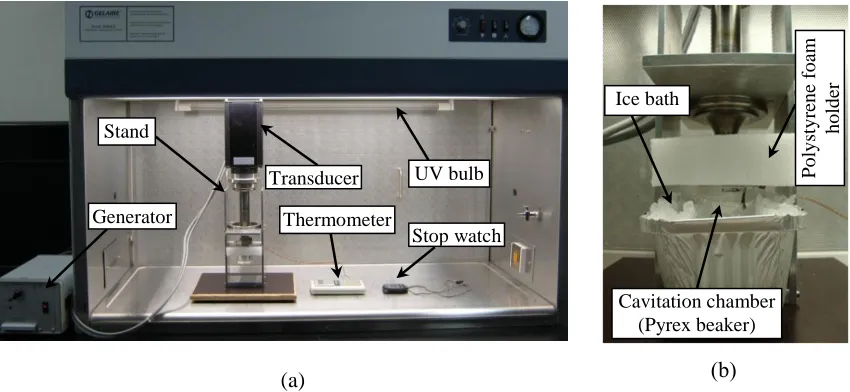
A commercial ultrasonic horn device (HielscherUIP500) with a 22 mm diameter probe tip (sonotrode, BS20d22 titanium) and a 55 kHz frequency was used to perform the experiments of ultrasound treatment as shown in figure1. The applied ultrasonic intensity can be controlled through regulating the amplitude of ultrasonic device. In this study, three levels of amplitude were applied; low 50% that gives 17.56W/cm2, intermediate 75% gives 21.49W/cm2and high 100% gives 24.17 W/cm2.
(a)
[image:4.595.94.519.516.712.2]
(b)
Figure 1. Sonication setup (a) the entire setup inside the laminar flow (b) enlarged view of the beaker immersed in the ice bath
Generator Stand
Transducer UV bulb Thermometer
Stop watch
Po
ly
sty
ren
e
fo
am
h
o
ld
er
Ice bath
Cavitation chamber (Pyrex beaker)
1st International Conference on Mechanical Engineering Research 2011 (ICMER2011) IOP Publishing
3.Optimizing the configuration of cavitation chamber
Prior using ultrasonic horn device for corrugated surface experiments, the configuration of cavitation chamber was optimized in regards to two parameters, the diameter of the chamber and the depth of ultrasonic horn tip in the suspension. It should be noted that cavitation chamber refers to the beaker that was used to carry the suspension. The optimization experiments were conducted with three ultrasonic intensities 17.56, 21.49 and 24.17 W/cm2
and fixed treatment time of 4minutes.
3.1.Chamber diameter
3.1.1.Procedure
The optimum diameter of cavitation chamber was indicated simply using five Pyrex beakers with different diameters 3.6, 3.8, 4.5, 5, 6.5 cm. It should be noted that changing the diameter of the chamber that carried a constant volume of E.coli suspension (50ml) with maintaining the depth of the ultrasonic horn tip at 2mm required changing the vertical distance between the irradiating surface of the probe and the bottom of the chamber (h) which was maintained within the effective axial range of ultrasonic reactor between 0 to 4cm [15]. Each diameter has its corresponding value of h as shown in table 1.
Table1.Beakers’ radius with their corresponding h.
Diameter (cm)
h
(cm) 3.6 3.6 3.8 3.3
4.5 2
5 1.8
6.5 1.1
3.1.2.Results
The effect of chamber diameter on the reduction of E.coli for three ultrasonic intensities; 17.56, 21.49 and 24.17W/cm2 for treatment time of 4 minutes is shown in figure 2. The values of E. coli log reduction presented in this figure and the following figures in this paper are expressed by mean value and the error bars represent the standard error of plate triplication.
The general trend of figure 2 suggests that increasing the chamber diameter within the effective axial distance of ultrasonic horn reactor can lead to a decrease in the log reduction of E. coil. The results in figure 2 showed that the maximum reduction of E.coli was achieved using the smallest diameter of 3.5cm. The maximum values of log reduction were 4.51, 5.05 and 5.45 for the intensities 17.56, 21.49 and 24.17W/cm2 respectively. These results are in agreement with the results obtained by Gogate et al. [15], as the latter confirmed that the mechanical and the chemical effects of ultrasound for ultrasonic horn reactor occur effectively under the centre of the horn tip and started to decrease away from the horn centre up to a distance of 3 cm. Beyond this limit the effect of ultrasound almost vanished. It can be also noticed from figure 2 that increasing the diameter of the chamber has a significant effect on the intermediate intensity of 21.49 W/cm2 as compared to the other intensities. The log reduction of 21.49 W/cm2 with small diameters became closer to that of high ultrasonic
1st International Conference on Mechanical Engineering Research 2011 (ICMER2011) IOP Publishing
intensity (24.17W/cm2), while with larger diameters the log reduction became closer to that of low ultrasonic intensity (17.56W/cm2).
From the results presented here, it can be said that the smaller the diameter of the beaker the better the results that can be obtained. However, the temperature rise of the suspension due to ultrasound treatment in the small beakers was significantly faster than that of the large beakers which can be a problem. It is worth to mention that temperature rise in a small diameter beaker can cause some problems including requirement for extensive cooling process and giving misleading results of ultrasound treatments. The increase in the temperature of the treated suspension can affect on the viability of microorganisms which makes it hard to identify the actual reduction of microorganisms caused by ultrasound. Condón et al.[18] suggested that the change in the outer membrane of the gram-negative microorganisms due to the thermal effect of ultrasound can be a possible reason for the synergistic inactivation. To avoid the rapid temperature rise in the treated suspension during ultrasound treatment, beaker with intermediate diameter of 4.5 cm was chosen to be used in the following ultrasound treatments.
Figure2. Log reduction of E.coli with different chamber diameters for three ultrasonic intensities ( ) 17.56, ( ) 21.49 and ( ) 24.17 W/cm2 and treatment time of 4 minutes.
3.2.Depth of ultrasonic horn tip
3.2.1.Procedure
The other parameter that is associated with the configuration of cavitation chamber is the depth of the ultrasonic horn tip. The effect of this parameter on the reduction of E.coli was investigated within the range of 2 to 10mm, as the ultrasonic horn was set at a fixed level while the depth of the horn tip in the suspension was changed by lifting the beaker up with a step of 2mm.
3.2.2.Results
The effect of changing the depth of the horn tip within the range of 2-10mm on the viability of E.coli
for three ultrasonic intensities 17.56, 21.49 and 24.17W/cm2 and fixed treatment time of 4minutes is shown in figure 3. The results presented in figure 3 show that changing the depth of probe from 2 to 10mm has a slight effect on the log reduction of E.coli of approximately 0.5-log10for all the applied ultrasonic intensities.
0 1 2 3 4 5 6
3.5 4 4.5 5 5.5 6 6.5 7
L
og
re
d
u
ction o
f
E
. c
oli
Beaker's diameter
Intensity = 17.56W/cm² Intensity = 21.49 W/cm²
1st International Conference on Mechanical Engineering Research 2011 (ICMER2011) IOP Publishing
Figure 3. The change in log reduction of E.coli versus probe depth for three ultrasonic intensities; ( ) 17.56, ( ) 21.49 and ( ) 24.17 W/cm2 and treatment time of 4 minutes.
Log reduction of E.coli for the intensities 17.56 and 21.49W/cm2 decreased with increasing the depth of the probe in the suspension from 2 to 10mm. This could be attributed to the increase in the lost volume of the suspension that is not subjected to the effect of ultrasound with increasing the depth of the probe as demonstrated in figure 4. However, log reduction of E. coli for the intensity 24.17W/cm2 increased when changing the depth from 2 to 4mm and then decreased with increasing the depth. Subjecting a suspension with small volume (50ml) to ultrasonic intensity of 24.17W/cm2 was found to be causing high level of turbulences in the suspension especially at the surface. When the depth of the ultrasonic probe is as small as 2mm, the turbulences at the suspension surface allow the air from the atmosphere to penetrate into the suspension and cause formation of large bubbles near to the irradiating surface as revealed in figure 5.
Figure4. Demonstration for the effect of probe depth on the lost volume of the suspension.
Figure5. Generation of large bubbles in the suspension with ultrasonic intensity of 24.17 W/cm2.
E.coli suspension Ultrasound
horn
depth1 Lost volume with depth1
depth2
Lost volume with depth 2
0.0 0.5 1.0 1.5 2.0 2.5 3.0 3.5 4.0 4.5 5.0
2 4 6 8 10
L
og
re
d
u
ction o
f
E
. c
oli
Probe depth (mm
) Intensity = 17.56 W/cm² Intensity = 21.49 W/cm² Intensity = 24.17 W/cm²1st International Conference on Mechanical Engineering Research 2011 (ICMER2011) IOP Publishing
The formation of large bubbles near to the ultrasound horn in this figure was captured using SONEY hybrid Handycam. The presence of the large bubbles in the affinity of the irradiating surface can hinder the transition of ultrasonic energy into the suspension. The increase in the log reduction at the depth of 4mm suggests that at this depth ultrasonic energy transmitted into the suspension body without obstacles (formation of large bubbles). This discussion is valid when ultrasonic horn reactor used to treat solution open to the atmosphere.
The outcome of the optimization for ultrasonic probe depth showed that the smaller the depth of the probe, the higher the reduction of microorganisms can be achieved for low and intermediate ultrasonic intensities, while in the case of high ultrasonic intensity the probe has to be immersed to a depth that is sufficient to prevent any air penetration from the atmosphere.
4.Experiments of immersing corrugated surface in E.coli suspension
4.1.Preparing the corrugated surface
The corrugated surface used in this study was constructed from pebbles with an average length of 10mm adhered on a circular plate with thickness of 1mm using commercial silicon.
4.2.Particle shedding
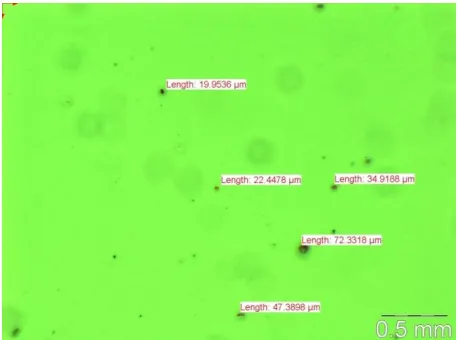
[image:8.595.184.413.578.748.2]Irradiating E. coli suspension with the corrugated surface immersed in it can cause particle shedding from the corrugated surface. To detect the occurrence of particle shedding during ultrasound treatment, the corrugated surface was submerged in a 50mL of nano-pure water and subjected to ultrasound irradiation with three intensities 17.56, 21.49 and 24.17 W/cm2 for 4 minutes. Thereafter, the treated water was filtered using flat-sheet RO membrane. The RO flat-sheet membrane was used due to its fine pores so as the particles with nano-scale size detained. Later, the filtrate particles were visualized using Motic Stereo-microscope. Photos of the eroded particles with the three ultrasonic intensities were captured using CC12 camera which is attached to the microscope as illustrated in Figure 6.
The photos were analysed using AnalySIS software. It is shown in figure 6 that the number of the eroded particles with ultrasonic intensity of 21.49W/cm2 is higher than that of 17.56 and 24.17W/cm2. This can be explained as increasing the ultrasonic intensity beyond 21.49W/cm2 did not result in an increase in the mechanical effects of ultrasound. As 21.49 W/cm2 can be considered as the optimum ultrasonic intensity for the used ultrasonic device in this study, and increasing the ultrasonic intensity more than its optimum level will generate a cloud of bubbles near to the irradiating surface that impairs the transition of ultrasonic energy into the body of the suspension [3, 19].
1st International Conference on Mechanical Engineering Research 2011 (ICMER2011) IOP Publishing
(a)
(b)
(c)
Figure6. Eroded particles from the corrugated surface with three different ultrasonic intensities (a) 17.56W/, (b) 21.49W/cm2 and (c) 24.17W/cm2.
4.3.Procedure for the corrugated surface experiments
The setup used to perform sonication experiments is a batch configuration as shown in figure 1, where the generator was placed outside the laminar flow while the transducer rested on an aluminium stand inside the laminar flow. The selected Pyrex beaker from the optimization was used to hold the suspension. The capacity of optimum Pyrex beaker is 80ml. before using the beaker for holding the suspension; the beaker was autoclaved for 15 minutes. The beaker was fitted between the two plates of the aluminium stand using a fitted holder made from foamed polystyrene (figure 1b). Treatment times of ultrasound treatments were measured using stop watch. The treatment time and the temperature of the treated suspension were measured using stop watch and DiGi-Sense thermometer type K.
Before performing the experiments of corrugated surface, the following precautions were adopted to avoid possible contamination.
1st International Conference on Mechanical Engineering Research 2011 (ICMER2011) IOP Publishing
1.UV light in the laminar flow was operated for one hour before starting the experiments to sterilise the air inside the laminar flow,
2.Ethanol 75% (volumetric percentage) was used to sterilise the steel bottom of the laminar flow, 3.The Ultrasound horn tip and the probe of thermometer were sterilised with ethanol, and
4.The corrugated surface was sterilised with ethanol 75% before immersing it in the suspension. The corrugated surface was placed on the beaker’s bottom before filling the beaker with E. coli
suspension. After that, the beaker was filled with 50 ml of the suspension and placed in-between the plates of the aluminium stand (Figure 1 b). Next, the horn tip of the ultrasound device was immersed in two different depths in the suspension depending on the supplied ultrasonic intensity. The depth of the ultrasonic horn tip was 2mm in case of 17.56 and 21.49 W/cm2, and 4mm in case of 24.17 W/cm2.
The pressure of the suspension in sonication treatment was constant at the atmospheric pressure as the suspension was exposed to the atmosphere, while the temperature of the suspension was variable due to ultrasound treatment. The temperature was controlled using an ice bath set up below the suspension beaker to cool down the temperature and maintain it to be less 40˚C. The generator of the ultrasonic device was operated at the targeted intensities for 5 minutes during which a 2 ml sample of the treated suspensions was withdrawn at 1, 2, 3, 4 and 5 minutes for analyses.
4.4.Investigating the effect of the eroded particles on the viability of E. coli
[image:10.595.100.491.484.560.2]The filtrate particles from the corrugated surface with three ultrasonic intensities 17.56, 21.49 and 24.17W/cm2 were seeded in 50mL of E.coli suspension and treated with their corresponding ultrasonic intensities for 3 minutes. The purpose of these experiments is to identify the effects of the eroded particles on the viability of E.coli. The results of viable cell count for these tests compared to the results of the treated suspension with and without corrugated surface are illustrated in table 2 in average values of viable cell count of three plates.
Table 2. Comparison between three different treatments; without corrugated surface, with corrugated surface and with the eroded particles suspended in E.coli suspension.
Ultrasonic intensity(W/cm2)
Log reduction of E.coli (CFU/ml) Without corrugated
surface
With corrugated surface
With eroded particles
17.56 1.966527 2.685172 2.045417
21.49 3.104567 3.485542 3.205275
24.17 3.567778 3.71963 3.602783
Generally, the presence of the eroded particles in the suspension has a slight effect on E.coli
reduction as compared to the overall effect of the corrugated surface. Submerging the corrugated surface in the suspension of E.coli led to increase the log reduction of E.coli by almost 0.72, 0.38 and 0.152, while seeding the eroded particles in the suspension resulted in an increase in the log reduction by approximately 0.08, 0.1 and 0.035 for the intensities 17.56, 21.49 and 24.17W/cm2 respectively.
However, table 2 shows that the effect of eroded particles on E.coli viability is more sensible in ultrasonic intensity of 21.49W/cm2 than the other two intensities (17.56 and 24.17 W/cm2) and this can be ascribed to the high loading of eroded particles of the intensity 21.49 W/cm2 as opposed to the other intensities as shown in figure 6. The eroded particles in the suspension act as beads in bead mill treatment, as increasing the loading of the beads in the suspension results in an increase in the disruption rate of the microorganisms [20].
4.5.Effect of corrugated surface on log reduction of E.coli
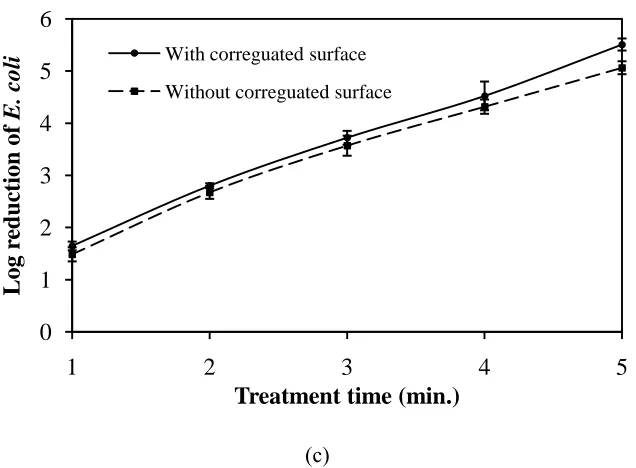
Figure 7 shows the log reduction of E.coli under the effect of three different ultrasonic intensities 17.56W/cm2, 21.49W/cm2 and 24.17W/cm2 for two treatments; with and without corrugated surface.
1st International Conference on Mechanical Engineering Research 2011 (ICMER2011) IOP Publishing
The improvement in the reduction of E.coli due to immersing a corrugated surface in the suspension could be due to the combination of the synergistic effects of the surface heterogeneity that served as cavitation nuclei and the effect of the eroded particles from the corrugated surface. The effect of the eroded particles was identified in the previous section (4.4) as having slight effects on the viability of
E. coli as compared to the overall effect of the corrugated surface. Therefore, the increase in the log reduction is believed to be due to the heterogeneity of the corrugated surface that contributed to the formation of large number of bubbles and thus increase the cavitational events. Ince, N.H. and R. Belen [21] found that the decrease in E.coli viability treated by ultrasound when seeding granules of activated carbon in E.coli suspension is attributed mainly to the cavitational effects induced by the formation of bubbles on the solid-liquid interface. Similarly, Dadjour, M.F., et al [22] used pellets of TiO2 with the diameter of 2mm to enhance the deactivation of E.coli using ultrasound treatment, and the decrease in the E.coli viability with presence of TiO2 was attributed to the catalytic effect of TiO2 and the surface heterogeneity of the pellets that contributed to the formation of additional bubbles.
(a)
(b)
0
1
2
3
4
5
6
1
2
3
4
5
L
og
r
ed
u
ct
ion
o
f
E
.
col
i
Treatment time (min.)
With correguated surface Without correguated surface
1st International Conference on Mechanical Engineering Research 2011 (ICMER2011) IOP Publishing
(c)
Figure7. Log reduction of E.coli for three ultrasonic intensities a) 17.56, b) 21.49 and c) 24.17W/cm2 using corrugated surface (solid line) and without corrugated surface (dashed line).
From Figure 7, it can be said that the presence of corrugated surface in the suspension is more effective with low ultrasonic intensities than higher intensities. This could be explained as the irregularities of the corrugated surface acted as a source for the heterogeneous cavities which in turn helped the low ultrasonic intensity to form additional bubbles at negative pressure less than the required pressure to overcome the cavitation threshold of the water [23]. Similar observations were reported by many studies, for instance Broekman, S., et al [24] reported that the presence of micro-bubbles in the medium can reduce the cavitation threshold and help the low power ultrasound to generate cavitation in that medium. Likewise, Mahulkar, A.V., et al.[25] injected steam bubbles into ultrasonic bath to enhance the cavitational yield. They succeeded to increase the efficiency of acoustic cavitation in the non-degassed and degassed water by 4 and 16 times respectively. However, the case of higher ultrasonic intensities is different, as these intensities may have sufficient negative pressure to rupture the water and generate bubbles. Hence, the effect of the corrugated surface wasn’t as pronounced as it was with low ultrasonic intensity.
Over all, immersing corrugated surface or constructing cavitation chamber with corrugated internal surface could increase the reduction of microorganisms for the same ultrasonic intensity. This technique could be even more feasible with low ultrasonic intensities than high intensities.
5.CONCLUSIONS
The effect of immersing corrugated surface in the cavitation chamber of ultrasonic horn reactor on the viability of E.coli was investigated in this work. Prior using corrugated surface, the configuration of the cavitation chamber was optimized in terms of chamber diameter and the depth of ultrasonic probe within the reported effective axial distance of ultrasonic horn reactor in the literature. The outcomes of the optimization are summarized in the following points
1. The general effect of the ultrasonic probe depth within the range of 2-10 mm in overall depth of the suspension of 2cm is considered to be slight in the order of 0.5-log10. However, increasing the
depth of the horn tip in the suspension resulted in a decrease in the log reduction of E.coli for all ultrasonic intensities with exception for high ultrasonic intensity with small probe depth. With high
0
1
2
3
4
5
6
1
2
3
4
5
L
og
re
d
u
ction o
f
E
. c
oli
Treatment time (min.)
With correguated surfaceWithout correguated surface
1st International Conference on Mechanical Engineering Research 2011 (ICMER2011) IOP Publishing
ultrasonic intensity of 24.17W/cm2 the ultrasonic probe needs to be immersed to a sufficient depth to avoid the penetration of the atmospheric air into the suspension causing turbulences that affect negatively on the delivery of ultrasonic energy into the suspension.
2. Increasing the radius of the cavitation chamber within the effective axial distance of the ultrasonic horn reactor led to decrease in the log reduction of E.coli for different ultrasonic intensities. The optimum configuration of cavitation chamber was used in the experiments of corrugated surface. Covering the bottom of the cavitation chamber with corrugated surface resulted in an increase in the log reduction of E.coli for different ultrasonic intensities. However, the effect of corrugated surface on the viability of E. coli appeared more clearly with low ultrasonic intensities than higher intensities. The heterogeneity of the corrugated surface seems to have the main role in increasing the log reduction of E. coli for the ultrasonic horn reactor.
From the results obtained in this study, it can be said that designing cavitation reactor with internal corrugated surface can decrease the required energy to obtain better killing of microorganisms especially for low ultrasonic power. This can be a possible solution to overcome the problem of high energy demand in ultrasound treatment.
ACKNOWLEDGEMENT
The authors would like to thank Mrs Morwenna Boddington and Mr Adrian Blokland for their technical support in the laboratory work.
References
[1] Gogate, P.R. and A.M. Kabadi, A review of applications of cavitation in biochemical engineering/biotechnology. Biochemical Engineering Journal, 2009. 44(1): p. 60-72.
[2] Gogate, P.R., Application of cavitational reactors for water disinfection: Current status and path forward. Journal of Environmental Management, 2007. 85(4): p. 801-815.
[3] Thompson, L.H. and L.K. Doraiswamy, Sonochemistry: Science and Engineering. Industrial & Engineering Chemistry Research, 1999. 38(4): p. 1215-1249.
[4] Hua, I. and J.E. Thompson, Inactivation of Escherichia coli by sonication at discrete ultrasonic frequencies. Water Research, 2000. 34(15): p. 3888-3893.
[5] Doulah, M.S., Mechanism of disintegration of biological cells in ultrasonic cavitation.
Biotechnology and Bioengineering, 1977. 19(5): p. 649-660. [6] Young, F.R., Cavitation. 1999, London: Imperial College Press.
[7] Marschall, H.B., K.A. Mørch, A.P. Keller, and M. Kjeldsen, Cavitation inception by almost spherical solid particles in water. Physics of Fluids, 2003. 15(2): p. 545.
[8] Phull, S.S., A.P. Newman, J.P. Lorimer, B. Pollet, and T.J. Mason, The development and evaluation of ultrasound in the biocidal treatment of water. Ultrasonics Sonochemistry, 1997.
4(2): p. 157-164.
[9] Blume, T. and U. Neis, Improving chlorine disinfection of wastewater by ultrasound application. Water Science and Technology, 2005. 52(10-11): p. 139-44.
[10] Joyce, E., T.J. Mason, S.S. Phull, and J.P. Lorimer, The development and evaluation of electrolysis in conjunction with power ultrasound for the disinfection of bacterial suspensions.
Ultrasonics Sonochemistry, 2003. 10(4-5): p. 231-234.
[11] Blume, T. and U. Neis, Improved wastewater disinfection by ultrasonic pre-treatment.
Ultrasonics Sonochemistry, 2004. 11(5): p. 333-336.
1st International Conference on Mechanical Engineering Research 2011 (ICMER2011) IOP Publishing
[12] Lee, H., B. Zhou, W. Liang, H. Feng, and S.E. Martin, Inactivation of Escherichia coli cells with sonication, manosonication, thermosonication, and manothermosonication: Microbial responses and kinetics modeling. Journal of Food Engineering, 2009. 93(3): p. 354-364. [13] Ayyildiz, O., S. Sanik, and B. Ileri, Effect of ultrasonic pretreatment on chlorine dioxide
disinfection efficiency. Ultrasonics Sonochemistry, 2011. 18(2): p. 683-688.
[14] Hulsmans, A., K. Joris, N. Lambert, H. Rediers, P. Declerck, Y. Delaedt, F. Ollevier, and S. Liers, Evaluation of process parameters of ultrasonic treatment of bacterial suspensions in a pilot scale water disinfection system. Ultrasonics Sonochemistry, 2010. 17(6): p. 1004-1009. [15] Gogate, P.R., P.A. Tatake, P.M. Kanthale, and A.B. Pandit, Mapping of sonochemical
reactors: Review, analysis, and experimental verification. Aiche Journal, 2002. 48(7): p. 1542-1560.
[16] Szewzyk, U., R. Szewzyk, W.Manz, and K.H. Schleifer3, Microbiological safety of drinking water. Annu. Rev. Microbiol., 2000. 54: p. 81–127.
[17] Mason, T.J., E. Joyce, S.S. Phull, and J.P. Lorimer, Potential uses of ultrasound in the biological decontamination of water. Ultrasonics Sonochemistry, 2003. 10(6): p. 319-323. [18] Condón, S., J. Raso, and R. Pagán, Microbial inactivation by ultrasound, in Novel food
processing technologies, M.S. Tapia and M.P. Cano, Editors. 2005.
[19] Gogate, P.R. and A.B. Pandit, Engineering design method for cavitational reactors: I. Sonochemical reactors. Aiche Journal, 2000. 46(2): p. 372-379.
[20] Tamer, I.M., M. Moo-Young, and Y. Chisti, Disruption of Alcaligenes latus for Recovery of Poly(β-hydroxybutyric acid): Comparison of High-Pressure Homogenization, Bead Milling, and Chemically Induced Lysis. Industrial & Engineering Chemistry Research, 1998. 37(5): p. 1807-1814.
[21] Ince, N.H. and R. Belen, Aqueous Phase Disinfection with Power Ultrasound: Process Kinetics and Effect of Solid Catalysts. Environmental Science & Technology, 2001. 35(9): p. 1885-1888.
[22] Dadjour, M.F., C. Ogino, S. Matsumura, and N. Shimizu, Kinetics of disinfection of Escherichia coli by catalytic ultrasonic irradiation with TiO2. Biochemical Engineering Journal, 2005. 25(3): p. 243-248.
[23] Bremond, N. and et al., Cavitation on surfaces. Journal of Physics: Condensed Matter, 2005.
17(45): p. S3603.
[24] Broekman, S., O. Pohlmann, E.S. Beardwood, and E.C. de Meulenaer, Ultrasonic treatment for microbiological control of water systems. Ultrasonics Sonochemistry, 2010. 17(6): p. 1041-1048.
[25] Mahulkar, A.V., P.S. Bapat, A.B. Pandit, and F.M. Lewis, Steam bubble cavitation. Aiche Journal, 2008. 54(7): p. 1711-1724.
1st International Conference on Mechanical Engineering Research 2011 (ICMER2011) IOP Publishing