Understanding the use of smart mobile technologies for
learning in higher education
Angela Murphy Australian Digital Futures Institute University of Southern Queensland
Helen Farley
Australian Digital Futures Institute University of Southern Queensland Andy Koronios
School of Information Technology and Mathematical Sciences University of South Australia
This paper presents a preliminary exploration of the types of smart mobile technologies higher education students have access to and use to support their learning by comparing cohorts from two Australian universities with quite different profiles, the University of Southern Queensland (USQ) and the University of South Australia (UniSA). These results are briefly compared to those obtained in earlier studies in a broad attempt to identify trends in the use of mobile technologies to support learning over time. The results indicate that levels of smart phone ownership are rising rapidly with a corresponding drop in levels of feature phone ownership. Tablet computers such as iPads have emerged since the earlier studies were completed with high levels of adoption by students. Significantly, students are using these smart mobile devices to support their learning.
Keywords: mobile learning, m-learning, smart mobile technologies, Chi-square
Introduction
The increasing processing power, improved accessibility and enhanced applications embedded in emerging mobile technologies has created a challenge for higher education institutions who want to provide students with high quality and sustainable technology-rich environments. Smart mobile technologies, such as tablet computers and smartphones, offer advanced computing abilities as well as access to internet-based resources without the constraints of time or place. The functionality of these devices is continuously enhanced through the inclusion of features from established technologies such as personal digital assistants (PDA), portable media players, GPS navigation, digital cameras and eBook readers (Alley & Gardiner, 2012). This has resulted in devices that enable the provision of ubiquitous learning environments that combine real-world and digital world resources.
Due to the fast-paced changes in mobile technologies, education institutions are cautious about investing resources to provide access to the latest devices. Education institutions are also often hampered by a
conservative organisational culture and entrenched processes which impact on their ability to provide wide-scale support for the use of innovative technologies (Maringai, Skourlas & Belsis, 2013). The development of
This research study aims to identify the levels of access students currently have to smart mobile technologies and whether they are currently using these technologies to support their learning. Some preliminary findings from a survey conducted with students at two Australian universities are presented and the implications are briefly considered. The findings from this study will be used to further refine the initial development of a Mobile Learning Evaluation Framework (Murphy & Farley, 2012).
Student access to smart mobile technologies
A study conducted by the research organisation Frost and Sullivan (2012) revealed that 41per cent of Australian residents currently own a smartphone and ownership is expected to increase to 65 per cent by 2017.
Approximately, 13 per cent of the population owns tablet computers and ownership is expected to increase to 29 per cent by 2017. Research commissioned by the Australian Communications and Media Authority (2013) also found that smartphones and tablets are not being used as a substitute for other devices already used to access the internet, but rather are being used as an additional device. According to this research study, more than 90 per cent of tablet users also access the internet using a laptop computer and more than 80 per cent access the internet using a desktop computer or smartphone.
Research literature focused around student access to information and communication technologies offers conflicting results. For example, research conducted by Oliver and Whelan (2010) revealed that almost every student owned a mobile device of which many were web enabled. Other highly referenced research conducted by Kennedy, Judd, Churchward, Gray, and Krause (2008) found that although Australian first year university students had widespread access to technology, including mobile devices; these technologies were used primarily for entertainment. It was also found in this research that most students do not have sufficient digital literacy skills to support the use of these technologies for academic purposes. A more recent survey of 10,269 students undertaken by Gosper et al., (2013) shortly after the release of the iPad tablet computer in 2010 revealed that at that time only 5 per cent of students frequently used a tablet computer in their everyday lives. However, this study is silent about use of smartphones for learning-related activities. The types of mobile technologies and rates of ownership have changed rapidly since these studies were conducted, with smart phones replacing the use of web-enabled feature phones. Few studies have been published that have
undertaken data collection activities since 2010 to explore the types of technologies owned by students and the manner in which they are using these technologies to support their studies.
Research method
The aim of this research study is to identify the types of mobile technologies that students have access to as well as the extent to which they are using these technologies for informal learning purposes. A quantitative survey was designed and hosted online using the Qualtrics survey platform. Data was collected from two Australian universities; the University of Southern Queensland (USQ), which is primarily an online learning institution, and the University of South Australia (UniSA) which offers the majority of its courses in a face-to-face or blended mode. Neither institution is currently providing learning content designed for mobile
technologies at an institutional level.
Course examiners from 17 online courses at USQ were asked to email a survey invitation to their students from April to May 2013. Students at UniSA were requested to complete the survey prior to attending focus groups about their perceptions of mobile learning during the last week in May 2013. The UniSA students completed a paper-based version of the survey. These students were recruited to the focus groups by email invitations sent out by lecturers to their students in the two weeks prior to the focus groups. The data file was compiled in SPSS for Microsoft Windows version 19.0. The results from the two groups of students were compared using the Chi-square statistic. Further data collection is still underway and only preliminary results from questions that relate to student ownership of technologies and use of these technologies for learning will be presented in this paper. A total of 48 completed responses to the online survey were obtained from USQ students and 21 were received from UniSA students participating in the focus groups.
Findings
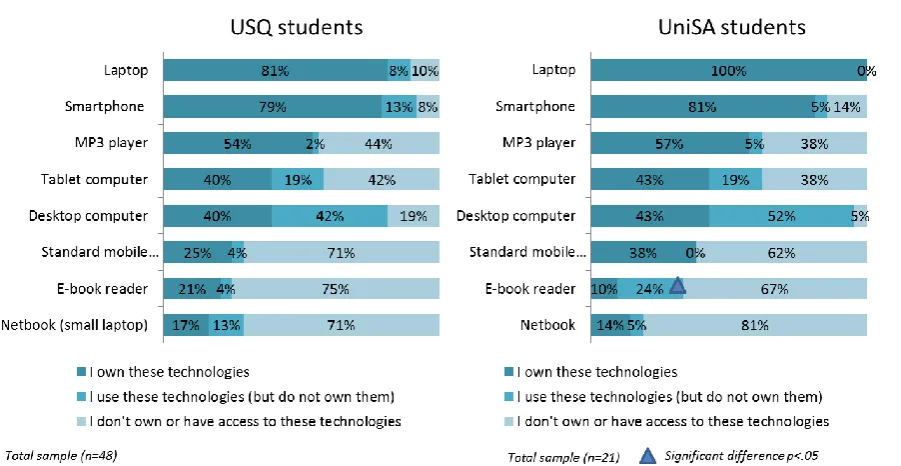
phones. Figure 1 provides information on student ownership of technologies for each of the institutions where data was collected.
Despite the differences between the two institutions, including location and anticipated student
demographics, the adoption profile of mobile technologies is remarkably similar between the two groups. Smartphone ownership in both cohorts of students is nearly on par with laptop ownership, with nearly all students owning or regularly using a smartphone. In comparison to the high proportion of students who owned (96 per cent) feature phones in 2006 (Kennedy et al., 2008), only 25 per cent of USQ students and 28 per cent of UniSA students owned a feature phone. A further 4 per cent of USQ students used one without owning it. Smartphones have therefore rapidly replacing feature phones and nearly all students have one.
Considering tablet computers only became available in 2010, one in two students either own a tablet or are regularly using one that they do not own. As illustrated in Figure 1, 40 per cent of USQ students own a tablet and 19 per cent have one at their disposal, compared to 43 per cent of UniSA students who own one and 19 per cent using one. Ownership of tablet computers was still exceeded by ownership of MP3 players, as more than half of students in both cohorts owned these devices. The rapid adoption of tablet computers since 2010, however, suggests that ownership of these devices will continue to rise rapidly. Ownership of e-Book readers and netbook computers was less significant.
[image:3.595.75.526.390.623.2]Further analysis was conducted to explore the adoption pattern of mobile technologies for leaning purposes between the two institutions. A Chi-square test indicated that the types of technologies owned by students were similar between the two groups. Only one significant difference was identified as students from UniSA were significantly more likely to use but not own eBook readers (24 per cent) as compared to students from USQ (4 per cent), X2 (2, N = 69) = 6.77, p <.05). This is most likely as the UniSA library allows students to borrow Kindle ebook readers, whereas the USQ library does not have such a program.
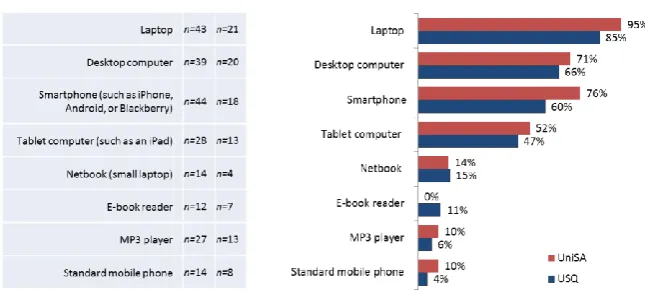
Figure 2: Use of technologies owned or used by UniSA and USQ students for learning purposes
We were particularly interested in understanding whether students who owned or used smart mobile
technologies were using them to support their learning activities. Participants who indicated that they owned or had use of these technologies were asked if they used these technologies to support their studies. As illustrated in Figure 2, a large proportion of participants who owned or had access to tablet computers and smartphones used these devices for study purposes. Of the students from UniSA who owned or used a smartphone, 76 per cent reported that they used these technologies to support their studies, as did 60 per cent of students from USQ. The use of tablet computers for study purposes was slightly less, with 52 per cent of UniSA students using their tablets for learning in comparison to 47 per cent from USQ. No significant differences were found between the two groups.
Conclusion
Mobile devices and ubiquitous connectivity potentially allow students to access course materials and activities through the creation of hybrid virtual and real-world resources and social spaces. Higher education institutions are reluctant to provide the support needed to enable access to university systems for students’ mobile devices due to the rapid turnover of models and types of technologies. Even so, studies at two Australian universities have shown that students’ ownership of smart mobile devices is increasing rapidly. Rates of smart phone ownership are particularly significant given their relatively recent emergence onto the mobile phone market. Unsurprisingly, levels of ownership of feature phones are correspondingly declining. Most notably, students are using their devices to support their learning, especially their smart phones and tablets (including iPads and Android tablets).
Though this data is compelling, studies need to be conducted at a larger number of Australian universities to determine whether or not these results are generally indicative of wider trends in smart mobile device ownership and use to support learning among Australian higher education students. The authors conducting such a study at the Australian National University during August 2013 and are currently compiling the results. Additionally, similar studies are underway among higher education students in Malaysia, Thailand, China, Vietnam, Saudi Arabia and Albania to determine if these results reflect global trends. The data will also be used to inform the development of a Mobile Learning Evaluation Framework to try and address issues around the sustainability of mobile learning initiatives in Australian higher education institutions. A thorough understanding of how students are currently using their own devices to support their learning will enable the developing of more sustainable mobile learning initiatives.
This project is supported through the Australian Government's Collaborative Research Networks (CRN) program.
References
Ally, M., & Gardiner, M. (2012). Application and device characteristics as drivers for smart mobile device adoption and productivity. International Journal of Organisational Behaviour, 17 (4), 35-47.
Australian Communications and Media Authority. (2013). Communications report 2011–12 series: Report 3— Smartphones and tablets Take-up and use in Australia. Retrieved from
http://www.acma.gov.au/webwr/_assets/main/lib310665/report-3-smartphones-tablets-comms_report_11-Gosper, M., Malfroy, J., & McKenzie, J. (2013). Students' experiences and expectations of technologies: An Australian study designed to inform planning and development Decisions. Australasian Journal of Educational Technology, 2013, 29(2), 268-282.
Frost and Sullivan (2012). Over two thirds of Australians aged 15-65 currently own a smartphone, finds Frost & Sullivan. [press release] 21 August, 2012. Retrieved from
http://www.frost.com/prod/servlet/press-release.pag?docid=265312994
Kennedy, G., Judd, T. S., Churchward, A., Gray, K. & Krause, K. 2008. First year students’ experiences with technology: Are they really digital natives? ‘Questioning the net generation: A collaborative project in Australian higher education’, Australasian Journal of Educational Technology, 24(1), 108-122.
Maringai, C., Skourlas. C., & Belsis, P. (2013). Employing ubiquitous computing devices and technologies in the higher education classroom of the future. Procedia - Social and Behavioral Sciences, 73, 487-494. Murphy, A. & Farley, H. (2012). Development of a framework for evaluating the impact and sustainability of
mobile learning initiatives in higher education. In M. Brown, M. Hartnett, & T. Stewart (Eds.), Future Challenges, Sustainable Futures: Proceedings of the 29th ASCILITE Conference (pp. 678-680). Wellington, New Zealand: ascilite.
Oliver, B., & Whelan, B. (2010). Student ownership and use of mobile technologies and social networking 2009 and 2010. Office of Assessment, Learning and Teaching, Curtin University.
Author contact details:
Angela Murphy, [email protected]
Helen Farley, [email protected]
Andy Koronios, [email protected]
Please cite as: Murphy, A., Farley, H., & Koronios, A. (2012). Understanding the use of smart mobile technologies for learning in higher education. In H. Carter, M. Gosper and J. Hedberg (Eds.), Electric
Dreams. Proceedings ascilite 2013 Sydney. (pp.602-606)
Copyright © 2013 Angela Murphy, Helen Farley, Andy Koronios.