See discussions, stats, and author profiles for this publication at: https://www.researchgate.net/publication/298734982
Enhancing Thermoelectric Performance of Bi 2
Te 3 -based Nanostructures through Rational
Structure Design
Article
in
Nanoscale · March 2016
DOI: 10.1039/C6NR00719H
CITATION
1
READS
76
4 authors:
Some of the authors of this publication are also working on these related projects:
Developing high-performance thermoelectric materials through nanostructuring and band
engineering
View project
TiO2 nanotube for gas sensor
View project
Min Hong
University of Queensland
16PUBLICATIONS
79CITATIONS
SEE PROFILE
Zhi-Gang Chen
University of Southern Queensland
159PUBLICATIONS
6,783CITATIONS
SEE PROFILE
Lei Yang
University of Queensland
33PUBLICATIONS
338CITATIONS
SEE PROFILE
Jin Zou
University of Queensland
715PUBLICATIONS
16,172CITATIONS
SEE PROFILE
All content following this page was uploaded by Min Hong on 06 April 2016.
This is an
Accepted Manuscript
, which has been through the
Royal Society of Chemistry peer review process and has been
accepted for publication.
Accepted Manuscripts
are published online shortly after
acceptance, before technical editing, formatting and proof reading.
Using this free service, authors can make their results available
to the community, in citable form, before we publish the edited
article. We will replace this
Accepted Manuscript
with the edited
and formatted
Advance Article
as soon as it is available.
You can find more information about
Accepted Manuscripts
in the
Information for Authors
.
Please note that technical editing may introduce minor changes
to the text and/or graphics, which may alter content. The journal’s
standard
Terms & Conditions
and the
Ethical guidelines
still
apply. In no event shall the Royal Society of Chemistry be held
responsible for any errors or omissions in this
Accepted Manuscript
or any consequences arising from the use of any information it
contains.
Accepted Manuscript
Nanoscale
Journal Name
ARTICLE
This journal is © The Royal Society of Chemistry 20xx J. Name., 2013, 00, 1-3 | 1
Please do not adjust margins
Please do not adjust margins
a.
Materials Engineering, University of Queensland, Brisbane, QLD 4072, Australia.
b.
Centre for Microscopy and Microanalysis, University of Queensland, Brisbane, QLD 4072, Australia.
Email: [email protected], [email protected].
† Electronic Supplementary Information (ESI) available: XRD pattern, SEM,and TEM images of as-synthesized Te nanotubes, See DOI: 10.1039/x0xx00000x
Received 00th January 20xx, Accepted 00th January 20xx
DOI: 10.1039/x0xx00000x
www.rsc.org/
Enhancing Thermoelectric Performance of Bi
2
Te
3
-based Nanostructures through Rational Structure
Design
Min Honga, Zhi-Gang Chen*a, Lei Yanga and Jin Zou*ab
Nanostructuring has been successfully employed to enhance the thermoelectric performance of Bi2Te3 due to their
obtained low thermal conductivity. In order to further reduce the thermal conductivity, we design a hierarchical nanostructures assembled with well-aligned Bi2Te3 nanoplates using Te nanotubes as templates by a facial
microwave-assisted solvothermal synthesis. From the comparisons of their thermoelectric performance and theoretical calculations with simple Bi2Te3 nanostructures, we found that Te/Bi2Te3 hierarchical nanostructures exhibits higher figure-of-merit due
to the optimized reduced Fermi level and enhanced phonon scattering, as well as the suppressed bipolar conduction. This study provides an effective approach to enhance thermoelectric performance of Bi2Te3 based nanostructures by rationally
designing the nanostructures.
Introduction
Considering the environmental pollution caused by the consumption of fossil fuels and the rising demand of energy depletion, it is necessary to develop green sustainable energy sources and energy harvesting technologies.1 Thermoelectric materials, enabling the direct conversion between heat and electricity, provide an alternative solution to these crises.2 The energy conversion efficiency of a thermoelectric material is gauged by the dimensionless figure of merit, ZT = S2σT/κ, where S, σ, κ and T are the Seebeck coefficient, electrical conductivity, thermal conductivity (including electronic component κe, lattice component κl, and bipolar component κbi), and the working temperature, respectively.
3-5
However, the current low ZT values, especially for n-type (with free electrons) thermoelectric materials, significantly hinder the commercialization of thermoelectric devices, which demand the synergistic development of both n-type and p-type (with free holes) thermoelectric elements.6,7
Bi2Te3 and the family of similar compounds are the
promising thermoelectric candidates at room temperature region.8-10 Because of their six valley degeneracy, the narrow energy gap and layered crystal structure, Bi2Te3 potentially
meets the criteria of high power factor (S2σ) and low κ.11 Compared with bulk counterpart, nanostructured Bi2Te3 can
achieve much lower κ, and provides promising possibilities to manipulate the thermoelectric properties.12 Especially, rhombohedral structured Bi2Te3 nanoplates, as
two-dimensional nanostructures,13-15 exhibit strengthened phonon scattering due to the dense grain boundaries after sintered into pellets.16 To further strengthen the phonon scattering, we can assemble the randomly orientated nanoplates in the form of well-aligned hierarchical nanostructures.17
Inspired by our previous study on epitaxial growth of T-shaped Te/Bi2Te3 heteronanojunctions,
18
we explored the fabrication of the hierarchical nanostructures by using the one-dimensional Te nanostructures as templates. One-one-dimensional Te nanostructures, including nanowires19 and nanotubes20,21 have been reported to be synthesized by the wet chemical method. Compared with nanowires, nanotubes show even lower κ due to the existence of tube channels.22 Because of the potential lattice match between trigonal structured Te (aTe =
4.45 Å, cTe = 5.92 Å)
23
and rhombohedral structured Bi2Te3
(aBi2Te3 = 4.38 Å, cBi2Te3 = 30.49 Å)
24
, i.e. aTe ≈ aBi2Te3, cTe ≈ 1/5
cBi2Te3, it is anticipated a small lattice mismatch of {112
̅
0} planefor Te and Bi2Te3 (< 2%), 25
so that {112
̅
0} planes of Te nanotubes can serve as templates for the epitaxial growth of Bi2Te3 nanoplates, as demonstrated in the atomic models ofTe/Bi2Te3 heteronanojunctions (refer to Fig. 1a and b). Using
this crystallographic relationship, Te/Bi2Te3 hierarchical
nanostructures can be formed on Te nanostructures. For layered Bi2Te3 single crystals, κ is anisotropic and its value
along the c-axis is only ~50% of that on the a-b plane,26 so that massive studies have explored the advantage of well-aligned Bi2Te3 layered nanostructures to reduce κ.
7,19,27
Therefore, this hierarchical nanostructures is expected to result in significantly
Page 1 of 7
Nanoscale
Nanoscale
Accepted
Manuscript
Published on 16 March 2016. Downloaded by University of Queensland on 17/03/2016 10:56:15.
View Article Online
ARTICLE Journal Name
enhanced phonon scattering, as schematically illustrated in Fig. 1c. On the other hand, the crystalline nature of Te nanotube walls may enhance σ.22,28
In this study, we employed a microwave-assisted solvothermal method to synthesize Te/Bi2Te3 hierarchical
nanostructures using Te nanotubes as templates. To confirm the superiority of Te/Bi2Te3 hierarchical nanostructures in
enhancing thermoelectric efficiency, highly uniform Bi2Te3
nanoplates were also investigated as a reference. Through the comparison of the morphology-dependent thermoelectric performance, we fundamentally studied the structural effects on tuning thermoelectric properties.
Experimental
Materials Synthesis and Processing
In this study, analytical grade Bi(NO3)3·5H2O, Na2TeO3,
ethylene glycol, poly(N-vinyl-2-pyrrolidone) (PVP, Mw = 4000), and NaOH solution were used as precursors.
The synthesis of the Te/Bi2Te3 hierarchical nanostructures
was carried out in two steps. The first step is to synthesize Te nanotubes as the precursors, following by the second step - synthesis of Te/Bi2Te3 hierarchical nanostructures. In the first
step, we added 332.4 mg Na2TeO3 and 0.2 g PVP into 40 mL
ethylene glycol. The solutions were stirred vigorously for 30 min at room temperature. Subsequently, the obtained clear solutions were sealed in a 100 mL teflon vessel, which was heated in a CEM Mars-6 microwave oven at 230 ˚C for 5 min. After naturally cooled to room temperature, the as-synthesized Te nanotubes were collected by a high-speed centrifugation, washed six times with distilled water and absolute ethanol and finally dried at 60 ˚C for 12 h in a vacuum oven. In the second step, the obtained Te nanotubes were mixed with Bi(NO3)3·5H2O into 40 mL ethylene glycol with a
mole ratio of 2:3, and with NaOH solution (5 mol/L, 2 mL). After stirring for ~30 min, the mixed solution was transferred
into the teflon vessels again, and heated in the CEM Mars-6 microwave oven at 230 ˚C for 5 min. In the second step, NaOH with low concentration enables the gentle dissolution of Te from their external size walls to allow the epitaxial growth of Bi2Te3 nanoplates through the entire body of the Te
nanotubes.29 Through washing, centrifuging and drying, we obtained the final nanopowders.
As a comparison, pure Bi2Te3 nanoplates were also
synthesized. During the synthesis, 485.1 mg Bi(NO3)3·5H2O,
332.4 mg Na2TeO3 and 0.2 g PVP were mixed with 40 mL
ethylene glycol and NaOH solution (5 mol/L, 2mL). After being stirred vigorously, the obtained clear solutions were sealed in the teflon vessel, and heated in the CEM Mars-6 microwave oven at 230 ˚C for 5 min. After naturally cooled to room temperature, the synthesized products were collected by a high-speed centrifugation, washed six times with distilled water and absolute ethanol, and finally dried at 60 ˚C for at least 12 h in a vacuum oven.
Materials Characterizations
The phase purities of the as-synthesized products were examined by the X-ray diffractometer (XRD) equipped with graphite monochromatized, Cu Kα radiation (λ = 1.5418 Ǻ).
The morphological, structural, and compositional
characteristics of the synthesized products were investigated by scanning electron microscopy (SEM, JEOL 7800) and transition electron microscopy (TEM, FEI F20), equipped with EDS for compositional analysis.
Fabrication of Pellets
The as-synthesized Te/Bi2Te3 hierarchical nanostructures and
Bi2Te3 nanoplates were compressed by the spark plasma
sintering (SPS) under 40 MPa and at 250 ˚C for 5 min in vacuum into pellets with a diameter of 12.5 mm and a thickness of 2 mm. The densities (d) of sintered pellets were measured by an Archimedes method, and confirmed to be over 90%.
Fig. 1 Schematic atomic models for Te/Bi2Te3 hierarchical nanostructures showing the crystallographic relationship along (a)
[11̅00] and (b) [0001]. (c) Schematic demonstrating the advantages of the hierarchical nanostructure in strengthening phonon scattering and ensuring high electrical conductivity.
Nanoscale
Accepted
Manuscript
Published on 16 March 2016. Downloaded by University of Queensland on 17/03/2016 10:56:15.
View Article Online
[image:4.595.106.551.66.228.2]Journal Name ARTICLE
This journal is © The Royal Society of Chemistry 20xx J. Name., 2013, 00, 1-3 | 3
Please do not adjust margins
Please do not adjust margins
Thermoelectric Performance Measurement
Thermal diffusivity (D) of sintered pellets was measured by a laser flash method (LFA 457, NETZSCH), and κ was calculated through κ=DCpd, where Cp is the specific heat capacity. Cp is obtained from empirical formulas CpBT = 108.06+5.53×10
-2
T
JK-1mol-1 for Bi2Te3.30σand S were measured simultaneously
on a ZEM-3, ULVAC. The uncertainties of the thermoelectric performance measurements (S, σ and D) were estimated as ~5% for each.
[image:5.595.55.544.397.699.2]Results and discussion
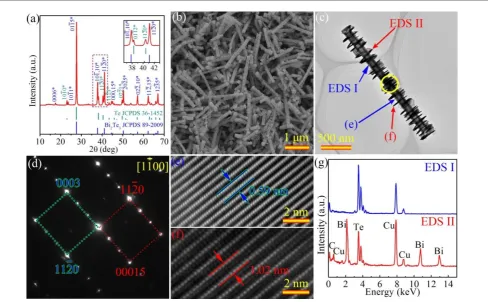
Fig. 2a is the X-ray diffraction (XRD) pattern collected from the as-synthesized Te/Bi2Te3 nanopowders with the inset showing
its enlarged view of 2θ in the range of 34° – 43°. As can be seen, the diffraction peaks can be indexed as the rhombohedral structured Bi2Te3 phase with lattice parameters
of a = 4.38 Å and c = 30.49 Å (JCPDS No. 89-2009)24 and the trigonal structured Te phase with lattice parameters of a = 4.45 Å and c = 5.92 Å (JCPDS No. 36-1452).23 It should be noted that no Bi contamination was detected in the as-prepared samples, although our samples contain excessive Bi3+ (dissolved from Bi(NO3)35H2O). We believe that the excessive
Bi3+ was still in the solvent after the synthesis that was washed away during the post-synthesis process. Fig. 2b is a SEM image, and shows that the majority (> 90%) of synthesized products
are rod-like nanostructures. Fig. 2c is a TEM image of a typical rod-like nanostructure, in which the feature of a hierarchical nanostructure is seen — many parallel nanoplates are linked by a nanotube (as a stem). Their crystallographic relationship was further analyzed using selected area electron diffraction (SAED) and high resolution TEM (HRTEM). Fig. 2d is a SAED pattern taken from the circled area of such hierarchical nanostructure showing superimposed [1 1̅00] zone-axis diffraction patterns of a trigonal structured Te phase and a rhombohedral structured Bi2Te3 phase, from which the
crystallographic relationship between the Te nanotube and the Bi2Te3 nanoplates can be determined as [0001]Te // [0001]Bi2Te3
and [112̅0]Te // [112̅0]Bi2Te3. Fig. 2e and f are the
corresponding HRTEM images taken from the arrowed nanotube body and the nanoplate edge, respectively, which further suggests the coexistence of a high-crystalline trigonal structured Te nanotube stem and rhombohedral structured Bi2Te3 nanoplate. EDS was applied to examine the
compositions of the nanotube and nanoplates. Fig. 2g shows the EDS profiles collected respectively from the labeled areas in Fig. 2c, suggesting that the nanotube is indeed Te, while the nanoplates are composed of Bi and Te with a mole ratio of approximately 2:3. To understand the structural characteristics of Te/Bi2Te3 hierarchical nanostructures, we examined
structures of Te nanotubes after first step synthesis (an example is shown in the ESI), which demonstrated that the
Fig. 2 (a) XRD patterns collected from as-synthesized Te/Bi2Te3 nanopowders with inset showing its enlarged view. (b) Low-magnification SEM image showing a large amount of hierarchical nanostructures. (c) TEM image of a typical Te/Bi2Te3 hierarchical nanostructure. (d) The [1𝟏̅00] zone-axis SAED. (e) and (f) HRTEM images respectively taken from the arrowed areas in (c). (g) EDS profiles respectively taken from the arrowed areas in (c).
Page 3 of 7
Nanoscale
Nanoscale
Accepted
Manuscript
Published on 16 March 2016. Downloaded by University of Queensland on 17/03/2016 10:56:15.
View Article Online
ARTICLE Journal Name
obtained nanotubes have their lengths of 2 - 6 µm and diameters of 100 - 200 nm. Our extensive electronic microscopy investigations of Te/Bi2Te3 hierarchical
nanostructures indicate that the lateral size and thickness of the epitaxially grown Bi2Te3 nanoplates are relatively
independent to the diameters of Te nanotubes.
As a comparison, Bi2Te3 nanoplates were also synthesized
and characterized. Fig. 3a is a XRD pattern of as-prepared Bi2Te3 nanoplates, confirming Bi2Te3 nanoplates are highly
pure rhombohedral structured Bi2Te3 phase. Fig. 3b is the
low-magnification SEM image of as-synthesized Bi2Te3
hexagonal-shaped nanoplates that have uniform morphology with their lateral size of ~1µm. The inset of Fig. 3b is the high-magnification SEM image showing the side-view of several nanoplates, from which the nanoplate thickness of ~20 nm can be revealed. Fig. 3c is the TEM image of a typical nanoplate with lateral size of ~1µm, in accordance with the size determined by SEM (refer to Fig. 3b). Fig. 3d is the [0001] zone-axis SAED pattern and Fig. 3e is the corresponding HRTEM image with a lattice spacing of 0.22 nm, which matches well with the d value of the {112̅0} planes of rhombohedral structured Bi2Te3.31 Fig. 3f shows the EDS profile, indicating
that the elemental ratio of Bi and Te is approximately 2:3 (note that Cu and C peaks are caused by the TEM Cu grid with C supporting films).
In order to evaluate their thermoelectric performance, we examined sintered pellets made from Te/Bi2Te3 hierarchical
nanostructures and Bi2Te3 nanoplates. Fig. 4a presents σ and S
as a function of temperature, indicated by the left-hand side
and the right-hand side y-axis, respectively. As can be seen, σ
declines from ~8×10⁴ Sm-1 to ~5×10⁴ Sm-1 with increasing the temperature for both Bi2Te3 and Te/Bi2Te3 based pellets;
however the declining trend in Te/Bi2Te3 is mitigated. In the
case of S, its negative sign for both Bi2Te3 and Te/Bi2Te3 cases
indicates their n-type feature. Specifically, S for Bi2Te3 ranges
from -150 μVK-1 to -170 μVK-1, while that for Te/Bi2Te3
fluctuates between -165 μVK-1 and -182 μVK-1 in the studied temperature range. Moreover, the absolute value of S
increases first and then decreases with increasing the temperature. The decrease in |S| should be caused by the bipolar conduction,32 and the peak of |S| for Te/Bi2Te3 shifts
towards the higher temperature, suggesting that the bipolar conduction is suppressed at the higher temperature. Based on the measured σ and S, we can calculate S2σ, and plotted in Fig. 4b as a function of temperature. As can be seen, the peak S2σ of 19.2×10⁻⁴ Wm-1K-2 for Te/Bi2Te3 is larger than that of 18×10-4
Wm-1K-2 for Bi2Te3, and the peak S2σ for Te/Bi2Te3 shifts to
higher temperature. This is due to the suppressed bipolar conduction and the mitigated declining trend in σ with increasing the temperature in Te/Bi2Te3 (refer to Fig. 4a).
To understand the enhanced S2σ, we calculated the reduced Fermi level (η=Ef/kBT, with Ef representing the Fermi level and kB is the Boltzmann constant) based on the measured S by using the following equation33
1 0 2 B F k S e F , (1)
with the generalized Fermi integral
0
1 exp i i
F d
; (2)where e is the elementary charge. The inset of Fig. 4b plots the variation of η with temperature for both Bi2Te3 and Te/Bi2Te3
Fig. 4 Thermoelectric properties of Te/Bi2Te3 hierarchical
nanostructures compared with Bi2Te3 nanoplates (a) σ and S,
(b) S2σ with inset showing calculated η, (c) κ and (d) ZT.
300 350 400 450 500 3 4 5 6 7 8 9 -180 -170 -160 -150 -140 -130 -120
Te/Bi2Te3
Sm -1
T (K) Bi2Te3
S
(10
-6 VK -1 )
300 350 400 450 500 12
14 16 18 20
300 400 500 0.4
0.6 0.8 1.0
Bi2Te3 Te/Bi2Te3
S
2
(1
0
-4 W
m
-1 K -2 )
T (K)
T (K)
300 350 400 450 500 0.7
0.8 0.9 1.0
1.1 Bi2Te3 Te/Bi2Te3
( W m -1 K -1 )
T (K) 300 350 400 450 500
0.4 0.6 0.8 1.0
Bi2Te3 Te/Bi2Te3
ZT
T (K)
(a)
(b)
(c)
(d)
Fig. 3 (a) XRD pattern taken from the as-synthesized Bi2Te3
nanopowders (b) Low-magnification SEM image with inset of side-view high-magnification SEM image. (c) TEM image of a typical Bi2Te3 nanoplate. (d), (e), and (f) Corresponding SAED
pattern, HRTEM image, and EDS profile, respectively.
Nanoscale
Accepted
Manuscript
Published on 16 March 2016. Downloaded by University of Queensland on 17/03/2016 10:56:15.
View Article Online
[image:6.595.305.550.69.288.2] [image:6.595.41.284.429.683.2]Journal Name ARTICLE
This journal is © The Royal Society of Chemistry 20xx J. Name., 2013, 00, 1-3 | 5
Please do not adjust margins
Please do not adjust margins
in which η for Te/Bi2Te3 is smaller than that for Bi2Te3.According to our previous study,34 to maximize S2σ, the Fermi level should locate near the conduction band edge for n-type thermoelectric materials. Compared with Bi2Te3, η for
Te/Bi2Te3 is closer to its conduction band edge, so that an
enhanced S2σ for Te/Bi2Te3 can be anticipated. The η decline
for Te/Bi2Te3 nanostructures can be ascribed to the excessive
Te (provided by Te nanotube stems), which might suppress the Te vacancies in epitaxially grown Bi2Te3 nanoplates. Te
vacancies in Bi2Te3 are generally unavoidable (giving n-type
transport feature), and the Te vacancies lead to the Fermi level residing deep in the conduction band. Favourably, by adding more Te, Te vacancies in in Bi2Te3 can be supressed; resulting
in the shift of the Fermi level towards the valance band in our Te/Bi2Te3 nanostructures. Fig. 4c plots κ versus temperature,
from which κ in Te/Bi2Te3 shows ~20% reduction than that for
Bi2Te3. Due to the enlarged S2σ and simultaneously decreased
κ, ZT for Te/Bi2Te3 is enhanced, as shown in Fig. 4d. ZT for
Te/Bi2Te3 reaches ~1, much larger than that of ~ 0.75 for
Bi2Te3.
From above discussion, one of the critical reasons for enhanced ZT is the significantly decreased κ. To clarify the underlying principle, we studied the contributions of κ from electrons, phonons and bipolar conduction. According to the Wiedemann-Franz law,35κecan be expressed as
e L T
, (3)
where L is the Lorenz number. Employing the single Kane band model, L can be determined by36
2 2 2 2 0 0 3 2B F F
k L
e F F
(4)
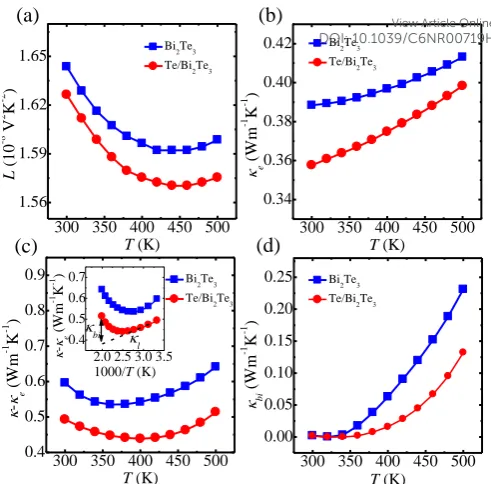
Through inputting the determined η (refer to the inset of Fig. 4b) into Equation (4), we can calculate L. The results are shown in Fig. 5a, in which L fluctuates around 1.6×10⁻⁸ V2K-2 for both samples, matching with reported values for nanostructured thermoelectric systems.37 On this basis, Fig. 5b plots the calculated κe over the studied temperature, where κe
is reduced in Te/Bi2Te3 due to its smaller σ and L over Bi2Te3.
By subtracting κe from κ, we can study the variation of κl, although there is a κbi contribution at high temperature. Fig. 4b shows the obtained temperature dependent κ-κe, which suggests that κl in Te/Bi2Te3 is significantly decreased. This is
because Te/Bi2Te3 hierarchical nanostructures have the
well-aligned nanoplates attached on the body surface, which lead to stronger phonon scattering compared with the randomly orientated Bi2Te3 nanoplates.38 Moreover, κbi is calculated using the reference-outlined method.39 Specifically, by extrapolating the linear relationship between κl and 1/T demonstrated in the insert of Fig. 5c, we can obtain κl in the entire studied temperature range, and finally, though subtracting κl from κ-κe, we can obtain κbi. Fig. 5d shows the determined κbi as a function of temperature. As can be seen, κbi for Te/Bi2Te3 is reduced; suggesting that the bipolar
conduction in Te/Bi2Te3 has been indeed suppressed, which is
consistent with the peak of S for Te/Bi2Te3 shifting to the high
temperature (refer to Fig. 4a). To understand this, we note that the band gap difference between Te (0.33 eV)40 and Bi2Te3
(0.15 eV) 41 may lead to an extra energy offset between the conduction and valance bands for the Te/Bi2Te3
nanostructures. In addition, our Bi2Te3 nanoplates in Te/Bi2Te3
are generally thinner than the normal Bi2Te3 nanoplates,
leading to the enlargement of band gap in our thinner Bi2Te3
nanoplates.42As a consequence, the bipolar conduction can be suppressed in our Te/ Bi2Te3 nanostructures.
Conclusion
We successfully fabricated Te/Bi2Te3 hierarchical
nanostructures using Te nanotubes as templates by the facial microwave-assisted solvothermal method. Through systematic morphological, structural and compositional characterizations, structural quality and the epitaxial growth of well-aligned Bi2Te3 nanoplates on Te nanotube stems are verified. The
thermoelectric properties measured from their sintered pellets indicate an increased ZT≈ 1 when compared with their pure Bi2Te3 nanoplates with ZT ≈ 0.75. Our modelling studies
suggest that the enhanced ZT of our Te/Bi2Te3 hierarchical
nanostructures is caused by the optimized reduced Fermi level, the strengthened phonon scatterings, and the suppressed bipolar conduction. This study provides an effective approach to enhance thermoelectric efficiency by designing rational nanostructures.
Acknowledgements
This work was financially supported by the Australian Research Council. MH thanks the China Scholarship Council for providing a PhD stipend. The Australian Microscopy & Microanalysis Fig. 5 (a) Calculated temperature dependent (a) L, (b) κe, (c) κ - κe with inset showing the inverse temperature dependence of κ - κe, and (d) κbi.
(a)
(b)
300 350 400 450 500 0.4 0.5 0.6 0.7 0.8 0.9
2.0 2.5 3.0 3.5 0.4
0.5 0.6 0.7
bi l
Bi2Te3 Te/Bi2Te3
-e ( W m -1 K -1 )
T (K)
-e ( W m -1 K -1 )
1000/T (K)
(c)
(d)
300 350 400 450 500 0.00 0.05 0.10 0.15 0.20 0.25 Bi
2Te3
Te/Bi2Te3
bi ( W m -1 K -1 )
T (K)
300 350 400 450 500 0.34
0.36 0.38 0.40
0.42 Bi2Te3 Te/Bi2Te3
e ( W m -1 K -1 )
T (K) 300 350 400 450 500
1.56 1.59 1.62
1.65 Bi2Te3
Te/Bi2Te3
L
(
1
0
-8 V 2 K -2 )
T (K)
Page 5 of 7
Nanoscale
Nanoscale
Accepted
Manuscript
Published on 16 March 2016. Downloaded by University of Queensland on 17/03/2016 10:56:15.
View Article Online
[image:7.595.304.550.65.307.2]ARTICLE Journal Name
Research Facility is acknowledged for providing
characterization facilities.
Notes and references
1. T. M. Tritt and M. A. Subramanian, Mrs. Bull., 2006, 31, 188-194.
2. G. J. Snyder and E. S. Toberer, Nat. Mater., 2008, 7, 105-114. 3. Z.-G. Chen, G. Han, L. Yang, L. Cheng and J. Zou, Prog. Nat. Sci.,
2012, 22, 535-549.
4. L. Yang, Z.-G. Chen, G. Han, M. Hong, Y. Zou and J. Zou, Nano Energy, 2015, 16, 367-374.
5. G. Han, Z.-G. Chen, L. Yang, M. Hong, J. Drennan and J. Zou, ACS Appl. Mater. Interf., 2014, 7, 989-995.
6. F. J. DiSalvo, Science, 1999, 285, 703-706.
7. H.-C. Chang, C.-H. Chen and Y.-K. Kuo, Nanoscale, 2013, 5, 7017-7025.
8. B. Poudel, Q. Hao, Y. Ma, Y. Lan, A. Minnich, B. Yu, X. Yan, D. Wang, A. Muto, D. Vashaee, X. Chen, J. Liu, M. S. Dresselhaus, G. Chen and Z. Ren, Science, 2008, 320, 634-638.
9. R. J. Mehta, Y. Zhang, C. Karthik, B. Singh, R. W. Siegel, T. Borca-Tasciuc and G. Ramanath, Nat. Mater., 2012, 11, 233-240. 10. M. Hong, Z. G. Chen, L. Yang and J. Zou, Nano Energy, 2016, 20,
144-155.
11. D. M. Rowe, CRC handbook of thermoelectrics, CRC Press, New York, 1995.
12. S. W. Finefrock, H. Yang, H. Fang and Y. Wu, Annu. Rev. Chem. Biomol. Eng., 2015, 6, null.
13. Y. Zhang, L. P. Hu, T. J. Zhu, J. Xie and X. B. Zhao, Cryst. Growth Des., 2013, 13, 645-651.
14. H.-W. Tsai, T.-H. Wang, T.-C. Chan, P.-J. Chen, C.-C. Chung, A. Yaghoubi, C.-N. Liao, E. W.-G. Diau and Y.-L. Chueh, Nanoscale, 2014, 6, 7780-7785.
15. L. Guo, H. Yan, Q. Moore, M. Buettner, J. Song, L. Li, P. T. Araujo and H.-T. Wang, Nanoscale, 2015, 7, 11915-11921.
16. A. Soni, Y. Shen, M. Yin, Y. Zhao, L. Yu, X. Hu, Z. Dong, K. A. Khor, M. S. Dresselhaus and Q. Xiong, Nano Lett., 2012, 12, 4305-4310.
17. W. G. Lu, Y. Ding, Y. X. Chen, Z. L. Wang and J. Y. Fang, J. Am. Chem. Soc., 2005, 127, 10112-10116.
18. L. Cheng, Z.-G. Chen, L. Yang, G. Han, H.-Y. Xu, G. J. Snyder, G.-Q. Lu and J. Zou, J. Phys. Chem. C, 2013, 117, 12458-12464. 19. H. Fang and Y. Wu, J. Mater. Chem. A, 2014, 2, 6004-6014. 20. B. Mayers and Y. Xia, Adv. Mater., 2002, 14, 279-282.
21. B. Kim and B.-K. Park, Electronic Materials Letters, 2012, 8, 33-36.
22. D. M. Rowe, Thermoelectrics Handbook : Macro to Nano, CRC Press, Hoboken, 2005.
23. J.-M. Song, Y.-Z. Lin, Y.-J. Zhan, Y.-C. Tian, G. Liu and S.-H. Yu, Cryst. Growth Des., 2008, 8, 1902-1908.
24. S. Nakajima, J. Phys. Chem. Solids, 1963, 24, 479-485.
25. J. L. Mi, N. Lock, T. Sun, M. Christensen, M. Sondergaard, P. Hald, H. H. Hng, J. Ma and B. B. Iversen, ACS Nano, 2010, 4, 2523-2530.
26. M. Carle, P. Pierrat, C. Lahalle-Gravier, S. Scherrer and H. Scherrer, J. Phys. Chem. Solids, 1995, 56, 201-209.
27. W. Shi, S. Yu, P. Liu and W. Fan, CrystEngComm, 2013, 15, 2978-2985.
28. W. Liu, X. Yan, G. Chen and Z. Ren, Nano Energy, 2012, 1, 42-56. 29. Y. Liang, W. Wang, B. Zeng, G. Zhang, Q. He and J. Fu, Mater.
Chem. Phys., 2011, 129, 90-98.
30. K. C. Mills, Thermodynamic Data for Inorganic Sulphides, Selenides and Tellurides, Butterworths, London, 1974.
31. L. Cheng, Z.-G. Chen, S. Ma, Z.-D. Zhang, Y. Wang, H.-Y. Xu, L. Yang, G. Han, K. Jack, G. Lu and J. Zou, J. Am. Chem. Soc., 2012,
134, 18920-18923.
32. S. Wang, G. Tan, W. Xie, G. Zheng, H. Li, J. Yang and X. Tang, J. Mater. Chem., 2012, 22, 20943-20951.
33. C. L. Chen, H. Wang, Y. Y. Chen, T. Day and G. J. Snyder, J. Mater. Chem. A, 2014, 2, 11171-11176.
34. M. Hong, Z.-G. Chen, L. Yang, G. Han and J. Zou, Adv. Electron. Mater., 2015, 1, 1500025.
35. J. R. Sootsman, D. Y. Chung and M. G. Kanatzidis, Angew. Chem. Int. Edit., 2009, 48, 8616-8639.
36. T. Zhu, H. Gao, Y. Chen and X. Zhao, J. Mater. Chem. A, 2014, 2, 3251-3256.
37. L. Zhao, S. H. Lo, J. He, H. Li, K. Biswas, J. Androulakis, C.-I. Wu, T. P. Hogan, D.-Y. Chung, V. P. Dravid and M. G. Kanatzidis, J. Am. Chem. Soc., 2011, 133, 20476-20487.
38. X. B. Zhao, X. H. Ji, Y. H. Zhang, T. J. Zhu, J. P. Tu and X. B. Zhang, Appl. Phys. Lett., 2005, 86.
39. W.-S. Liu, B.-P. Zhang, J.-F. Li, H.-L. Zhang and L.-D. Zhao, J. Appl. Phys., 2007, 102, 103717.
40. V. B. Anzin, M. I. Eremets, Y. V. Kosichkin, A. I. Nadezhdinskii and A. M. Shirokov, Phys. Status Solidi A, 1977, 42, 385-390. 41. D. L. Greenaway and G. Harbeke, J. Phys. Chem. Solids, 1965, 26,
1585-1604.
42. O. V. Yazyev, J. E. Moore and S. G. Louie, Phys. Rev. Lett., 2010,
105, 266806.
Nanoscale
Accepted
Manuscript
Published on 16 March 2016. Downloaded by University of Queensland on 17/03/2016 10:56:15.
View Article Online
Journal Name
ARTICLE
This journal is © The Royal Society of Chemistry 20xx J. Name., 2013, 00, 1-3 | 7
Please do not adjust margins
Please do not adjust margins
TOC
Enhancing
Thermoelectric
Performance
of
Bi
2
Te
3
-based
Nanostructures through Rational Structure Design
Min Honga, Zhi-Gang Chen*a, Lei Yanga and Jin Zou*ab
Enhanced thermoelectric performance in Te/Bi2Te3 hierarchical nanostructures caused by strengthened phonon
scattering, optimized Fermi level, and suppressed bipolar conduction
Page 7 of 7
Nanoscale
Nanoscale
Accepted
Manuscript
Published on 16 March 2016. Downloaded by University of Queensland on 17/03/2016 10:56:15.
View Article Online
![Fig. 1 Schematic atomic models for Te/Bi2Te3 hierarchical nanostructures showing the crystallographic relationship along (a) [1̅100] and (b) [0001]](https://thumb-us.123doks.com/thumbv2/123dok_us/147074.24218/4.595.106.551.66.228/schematic-atomic-models-hierarchical-nanostructures-showing-crystallographic-relationship.webp)