BORANG PENGESAHAN STATUS TESIS
JUDUL: GIS BASED CRIME ANALYSIS SYSTEM SESI PENGAJIAN : 2007/2008
Saya KAMIL HASSAN BIN AHMAD SUKKRI
Mengaku membenarkan tesis (PSM/sarjana/Doktor Falsafah) ini disimpan di Perpustakaan Fakulti Teknologi Maklumat dan Komunikasi dengan syarat-syarat kegunaa seperti berikut:
1. Tesis dan projek adalah hakmilik Universiti Teknikal Malaysia Melaka.
2. Perpustakaan Fakulti Teknologi Maklumat dan Komunikasi dibenarkan membuat salinan untuk tujuan pengajian sahaja
3. Perpustakaan Fakulti Teknologi Maklumat dan Komunikasi dibenarkan membuat salinan tesis ini sebagai bahan pertukaran antara institusi pengajian tinggi.
4.
**
Sila tandakan (/)SULIT
TERHAD
(Mengandungi maklumat yang berdarjah keselamatan atau kepentingan Malaysia seperti yang termaktub di dalam AKT A RAHSIA RASMI 1972)
(Mengandungi maklumat TERHAD yang te1ah ditentukan o1eh organisasi!badan di mana penyelidikan dijalankan
~
TERHAD
(/;trwQ
~
(T AND AT ANGAN PENULIS) (TANDA T ANGAN PENYELIA) Alarnat tetap:
N 26, Jalan Lundu 1, Taman Beringin, Jinjang Kuala Lumpur
Tarildl: 12 November 2007
PROFESOR MADYA DR NANNA SURYANA
GIS BASED CRIME ANALYSIS SYSTEM
KAMIL HASSAN BIN AHMAD SUKKRI
This report is submitted in partial fulfillment of the requirements for the Bachelor of Computer Science (Software Development)
FACULTY OF INFORMATION AND COMMUNICATION TECHNOLOGY UNNERSITI TEKNIKAL MALAYSIA :MELAKA
2007
DECLARATION
I hereby declare that this project report entitled
GIS BASED CRIME ANALYSIS SYTEM
Is written by my own effort and that no part has been plagiarized
without citations.
STUDENT Date: 1 'Z / I 1 / u:;c~
1-(KAMIL AN BIN AHMAD SUKKRJ)
SUPERVISOR:
w
~
~ Date:DEDICATION
To all my beloved family and friends
Whose boundless love and support replenishes and enriches my soul to complete this thesis. Thanks for being my inspiration and encouragement
ACKNOWLEDGE:M:ENTS
It's my greatest pleasure to acknowledge these people whose name may or may
not appear in the product, but whose hard work, guidance, cooperation, friendship and
understanding were crucial to the development of this report. Many people have devoted
long hours for this report. Without them, this report would not have been possible. J have tried to reflect this in the acknowledgement, but if there have been any omissions, my
sincerely apologize for the oversight.
This report was prepared under the general direction and being supervised by my
supervisor, Pn Nurazlina Bt Mohd Sanusi, who totally has given a lot of effort giving
comments and guidance to ensure that the report being done successfully. Her advices and
opinions have leaded me to develop this report in proper way. Under a tight time schedule,
she scrutinizes every aspect of the project and made countless suggestions for improving the
accuracy and the completeness of the report. She was the one who always there to help me in
any kind of time.
Thanks to my friends for always supporting and sharing knowledge with me. Their
opinion and positive critics have built confidents in me.
Thank you very much to all for improving the quality of the report. As well as people
who will use the project that will be developed, I would sincerely appreciate your comments,
ABSTRACT
FTMK Industrial Training System (FITPS) is base on latest technology where management becomes easier, quicker and more efficient. FITPS is a complete web based system for administrator, student, and industry to help FTMK in better management in placement industry training for FTMK student. By the way the flexible features can support multiple users enables them to apply industry training through on this system.
ACKNO~'LEDGEMENT
First of all, I would like to express my gratitude to all those who gave me the
possibility to complete this documentation. I want to thank my lecturer, Puan
Zahriah bt Othman and Puan Safiza Suhana bt Kamal Baharin for proposing this
project to me. Both them contribute many resources and ideas in developing the
system.
I am deeply indebted to my supervisor Professor Madya Dr. Nanna Suryana
whose help, stimulating suggestions and encouragement helped me in all the time of
Projek Sarjana Muda (PSM) for and writing of this docwnentation.
I would be remiss if I did not thank to all my friends, who gave me supports
and encouraged me in order to complete this report as well. The supports are always
making me strong and though enough to encounter any issues regarding the PSM
ABSTR.A.CT
GIS Based Crime Analysis System is developed for Jaw enforcement in order to solve the problem willie using the current system. TI1e cuiTent system is truly unsatisfied whlch made the Jaw enforcement suffer to analyze the crime data and problem in filing the system. The system not only makes the work faster but also it can store the complain and investigation information and produce statistic in various form. While developing the system, the SSADM approach were used where Waterfall model as the methodology. The system is programmed using Coldfusion and combined with Adobe Flash running on Apache ·web server and Windows. At the end of development, hope that the system can help the law enforcement to combat the crime and reduce the crime rate at the future.
.~STRAK
IV
TABLE OF CONTENTS
CHAPTER SUBJECT PAGE
ACKNOWLEDGEMENTS
ABSTRACT ii
ABSTRAK iii
TABLE OF CONTENTS iv
LIST OFT ABLES ,,ii
LIST OF FIGURES
,
,iii
LIST OF ABBREVIATONS X
LIST OF ATTACHMENTS xi
CHAPTER I 1
1.1 Project Background 1
1.2 Problem Statement 2
1.3 Scope 4
1.3.1 Target User 4
1.3.2 Modules 4
1.3.3 Where to Implement the System 5
1.3.4 Specific Platform 5
1.4 Project Significant 5
v
1.5
Expected Output 51.6
Conclusion6
CHAPTER II 8
2.1
Introduction 82.2
Fact and Finding 92.2.1
Domain 92.2.2
Existing System 92.2.3
Teclmique16
2.3
Project Methodology 192.3.1
Waterfall Model20
2.4
Project Requirement23
2.4.1
Software Requirement23
2.4.2
Hardware Requirement24
2.5
Project Schedule and Milestone25
2.6
Conclusion27
CHAPTER III 28
3.1
Introduction28
3.2
Problem Analysis28
3.3
Requirement Analysis30
3.3.1
Data Requirement30
3.3.2
Functional Requirement30
3.3.3
Non-functional Requirement38
3.3.4
Other Requirement38
3.4
Conclusion41
VI
4.2.1 System Architecture 43
4.2.2
User Interface Design 444.2.3
Database Design58
4.3
Detailed Design67
4.3.1
Softvvare Specification67
4.3.2
Physical Database Design74
4.4 Conclusion
80
CHAPTERV 81
5.1
Introduction 815.2
Software Development Environment Setup82
5.2.1
Preparation of Development Environment82
5.2.2
Sofu~>.'are and Hardware Acquisition82
5.2.3
Overview of Development Setup83
5
.
3
Software Configuration Management89
5.3.1
Configuration Enviromnent Setup89
5.3.2
Version Control Procedure89
5.4
Implementation Status 925.5
Conclusion93
CHAPTER VI 94
6.1 Introduction
94
6.2
Test Plan94
6.2.1
Test Organization95
6.2.2
Test Environment9
5
6.2
.3
Test Schedule96
6.3
Test Strategy97
6.3.1
Classes of Test97
6.4
Test Design98
VII
6.4.1 Test Description
99
6.4.2
Test Data101
6.5
Test Result and Analysis102
6.6
Conclusion1
02
CHAPTER VII
103
7.1 Observation on Weaknesses and StTengths
103
7.2 Propositions for Improvement
1
04
7.3 Contribution
104
7.4 ConcJusion
105
REFERENCES
106
APPENDIX A GANTT CHART
108
APPENDIX B USER MANUAL
111
Vlll
LIST OF TABLES
TABLE TITLE PAGE
Table 2.1: Software requirement during development 23
Table 2.2: Software requirement for server 23
Table 2.3: Software requirement for client 23
Table 2.4: Hardware requirement of sen'er 24
Table 2.5: lvfilestone for GIS Based Crime Analysis System 25
Table3.1: Functional requirement of Crime Analysis System 30
Table 3.2: Non-functional Requirement 38
Table 3.3: Nen,.rork Requirement 41
Table 4.1: Input Designs 53
Table 4.2: Example of Comparison between two ranges of month (.Tan-2007 to
May-2007) and (Jun-2007 to Dec-2007)) in Statistic module. 56
Table 4.3: Logical Database design data 62
Table 5.1: GIS Based Crime Analysis System versioning 90
Table 5.2: Crime Analysis System 92
Table 6.1: Crime Analysis Enviroment Setup 95
Table 6.2: Crime Analysisi System with GIS and sub component 96
Table 6.3: Test Schedule 96
Table 6.4: Test data (Pengadu) 101
Table 6.5: Test Case Result 102
JX
LIST OF FIGURES
[image:15.576.89.524.235.768.2]TABLE TITLE PAGE
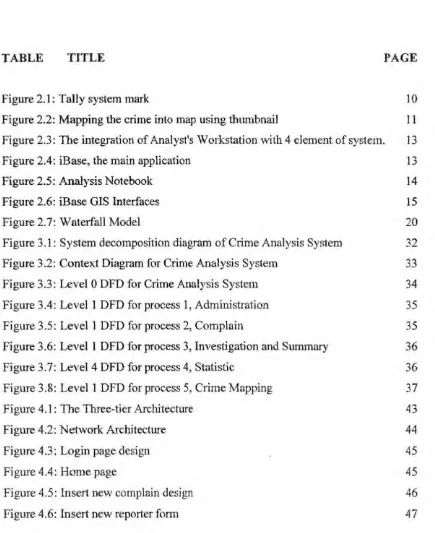
Figure 2.1: Tally system mark 10
Figure 2.2: Mapping the crime into map using thumbnail 11
Figure 2.3: The integration of Analyst's Workstation with 4 element of system. 13
Figure 2.4: iBase, the main application 13
Figure 2.5: Analysis Notebook 14
Figure 2.6: iBase GIS Interfaces 15
Figure 2. 7: Waterfall Model 20
Figure 3.1: System decomposition diagram of Crime Analysis System 32
Figure 3.2: Context Diagram for Crime Analysis System 33
Figure 3.3: Level 0 DFD for Crime Analysis System 34
Figure 3.4: Levell DFD for process 1, Administration 35
Figure 3.5: Level 1 DFD for process 2, Complain 35
Figure 3.6: Level 1 DFD for process 3, Investigation and Summary 36
Figure 3.7: Level4 DFD for process 4, Statistic 36
Figure 3.8: Levell DFD for process 5, Crime Mapping 37
Figure 4.1: The Three-tier Architecture 43
Figure 4.2: Network Architecture 44
Figure 4.3: Login page design 45
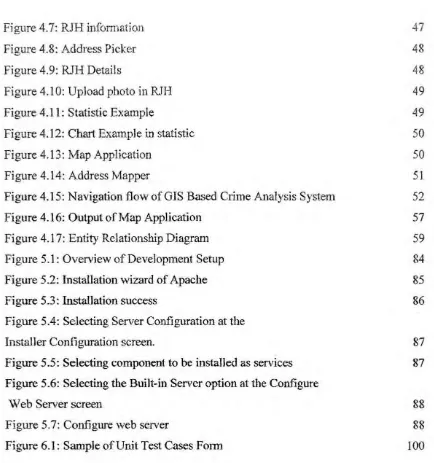
[image:15.576.90.522.262.785.2]Figure 4.7: RJH information
Figure 4.8: Address Picker Figure 4.9: RJH Details
Figure 4.10: Upload photo in RJH Figure 4.11: Statistic Example
Figure 4.12: Chart Example in statistic Figure 4.13: Map Application
Figure 4.14: Address Mapper
Figure 4.15: Navigation flow of GIS Based Crime Analysis System Figure 4.16: Output of Map Application
Figure 4.17: Entity Relationship Diagram Figure 5.1: Overview of Development Setup Figure 5.2: Installation wizard of Apache
Figure 5.3: Installation success
Figure 5.4: Selecting Server Configuration at the Installer Configuration screen.
Figure 5.5: Selecting component to be installed as services
Figure 5.6: Selecting the Built-in Server option at the Configure ·web Server screen
Figure 5.7: Configw·e web server
Figure 6.1: Sample of Unit Test Cases Form
©
Universiti Teknikal Malaysia MelakaDBMS DFD EMIS
ERD
FK GUI IELAN
OOADM PK PSARSS SDLC SSADM UTeM RJH XILIST OF ABBREVIATONS
- Database Management System
-Data Flow Diagram
-Education Management and Information System
-Entity Relationship Diagram
-Foreign Key
-Graphical User Interface
- Internet Explorer
-Local Area Network
- Object Oriented Analysis and Design Method
-Primary Key
- Primary School Achievement Retrieval Support System
-Software Development Life Cycle
- Structured Systems Analysis and Design Method
-Universiti Teknikal Malaysia Melaka
CH..<\.PTER I
INTRODUCTION
1.1 Project Background
Crime analysis is a method that used by Jaw enforcement to reduce, prevent,
and to solve crime, disorder, and quality of life issues. Our law enforcement in
Malaysi~ Royal Malaysian Police (PDRM), has used this method in order to protect
the civilization.
The system bas several functions which are crime complain, case investigation
and statistics. By the request of the customer, police department; the system can
show the statistic in geographical map form which requires GIS based technology.
By integrating GIS into, the user could see the analysis report in geographical form,
by example if the crime places are ticked in map, then user could determine which
area has highest crime rate.
The project is developed especially for Police Department. For starting, the
system will be used at IPD Melaka Tengah Bukit Beruang. The current system can
key in records and print them but there is no analysis features. As proposed by I.PD,
the new system would integrate report module, investigation, analysis and map.
2
1.2 Pmblcm Statement
We have identified some problems associated whh the existing system for
crime analysis in Malaysia. This is caused mainly by lack of a proper requirement
analysis and incomplete.
Furthermore, IPD use traditional statistical information in crime analysis and to
reveal crime pa:ttems. Even they also still use filling system to kept data such as
police report and Ringkasan Jenayah Harian (Rill), but they are not able to e>rtract
the data into statistic form. If they want to make a report or analysis, the police officer needs to open every single file in the cabinet to find the file. They also facing
problem to maintain the database because they don't have a centralized database. All
method that they used above is time consuming roughly. Thus, the achievements of combating crime are slow and this is not good.
The current system they have cannot generate report and they need to do it
manually. The way they use now would be primjtive as they must count manually on
crime cases to make statistic.
In order to combat crime more effective, v .. re proposed to use crime mapping.
Crime mapping can help in defining which the 'hotspot' of crime is. Apparently, they
have to use paper map and mark the location of crime using thumbnail, thus by
Objective
• To develop GIS Based Crime Analysis System
GIS Based Crime Analysis will be developed through this PSM course.
• To manage police complain and investigation iT?formation.
All basic transaction such as add, update and search can be done by user within the system.
• To produce statistical analysis
System can produce various type of statistic depend of user's requirement.
• To integrate the analysis with geographical display.
The system will automatically generate map with crime statistic.
• To make data processing better and work faster.
The system will be better and faster in data processing and accessing. The fact that it is an online system will make it accessible anyv·.rhere if there is an
intemet connection. Tllis will make police work become easier and faster to solve crime. By making crime analysis, the chances of crime prevent is high.
©
Universiti Teknikal Malaysia Melaka1.3 Scope
Scopes of GIS Based Crime Analysis System include the target user, modules
of the system, specific platform and resources.
1.3.1 Target User
The target user will be police officer in police department. They are divided to three types of user:
a. Complain Receh,er.
This user can input complain information that received from crime
infonner.
b. Investigator.
4
This user has higher level than Complain Receiver user. Not only can
access complain infom1ation, this user can manage investigation information.
c. Administrator.
User that highest level in system. This user can access all area in system and manage user infonnation.
1.3.2 :Modules
a. Complain
User can insert and update information of complain of crime here.
b. Investigation
Investigator may key in infonnation of cases here.
c. Statistic
Users can generate statistic base on user's defme.
5
1.3.3 'Vhere to Implement the System
GIS Based Crime Analysis System is developed to be used at Ibu Pejabat
Polis Daerah Melaka Tengah (IPD Melaka Tengah) which are required by them to do
analysis.
1.3.4 Specific Platform
The operating systems that use for this project are Microsoft Windows
operating system. It can be Windows XP Professional, Windows Server 2003 or
Windows 2000. This platform required Coldfusion MX 7 to be installed.
1.4 Project Significant
Thls project can give many benefits to police department and society. The
system can be used as tool to analyze and make decision of the spatial pattern and
processes of crime. If they able to find the crime pattern including hot spot area in
fast way, it would assist their patrol and increase their prevention activities.
J .5 Expected Output
As the system complete, user may able to record the report into database, print
them and they can input further detail about investigation information. After the
information of crime has recorded, the analysis of the system can be produced
whether in statistical data or in geographical data.
6
Lei Conclusion
Advances in computer technology and analytical techniques have given crime
analyst increasingly powerful toolboxes which to find the spatial pattern and
processes crime. By using the system, it can help to save time cost. increase crime
management capability and to empower the law enforcement organization. The next
chapter will discuss about literature review and methodology. The literature review is
very important in order to know others system features and somehow make
comparison between the existing system and the performed system. In addition, the