
Influence of elevated temperature on juvenile damselfish performance and their scope for adjustment through developmental plasticity
128
0
0
Full text
(2) Influence of elevated temperature on juvenile damselfish performance and their scope for adjustment through developmental plasticity. Thesis submitted by: Donald Thomas James Warren. BSc (Hons) in Biology The University of Iowa, Iowa, USA In March 2017. For the degree of Doctor of Philosophy in the College of Science and Engineering and Centre for Excellence for Coral Reef Studies James Cook University.
(3)
(4) Statement of contribution of others This thesis included collaborative work with my supervisors, Professor Mark I. McCormick, Professor Philip L. Munday, and Dr Jennifer M. Donelson as well with Dr Maud Ferrari. While undertaking these collaborations, I was responsible for the research concepts and designs, data collection, analysis, and interpretation of results. My co-authors provided intellectual guidance, editorial assistance, financial support, or statistical support. Financial support was provided by the Australian Research Council (McCormick, MI), the ARC Centre of Excellence for Coral Reef Studies (McCormick MI & Munday PL), Ian Potter Foundation (Donelson JM), University Technology, Sydney (Donelson JM) and James Cook University Graduate Research School Funding Scheme (Warren DT).. i.
(5) Declaration of ethics The research presented in this thesis was conducted in accordance with the JCU Animal Ethics Committee (A2079, A2080). Collecting permits for study species were acquired by the Great Barrier Reef Marine Park Authority (G10/33239.1, G12/35117.1) and Queensland fisheries (170251).. ii.
(6) Acknowledgements My first thanks must be given to my supervisory panel, Prof Mark I. McCormick, Prof Philip L. Munday, and Dr Jennifer M. Donelson for graciously imparting their wisdom, support, direction, and encouragement. Mark, thank you for all your help supporting my field studies and providing your input and lab to achieve this success. Phil, your feedback on writing has been both the most extensive and constructive advice I have received. Your ability to articulate my thoughts before I do is greatly appreciated. Jenni, I would have never accomplished the amount and quality of data collected without your guidance at MARFU. This thesis would not have been made possible without any of your contributions. Next, I must thank the support of my family. I would not have been able to leave my US home to begin this endeavour if I had not first received permission from my mother, Janet. Her selfless devotion to ensuring I achieve all that I may dare attempt gives me motivation to strive for more. I thank my father, Don, for being the role model I yearn to be and regret he was not able to live to also share in this accomplishment. I know he would be proud. I thank my siblings, Louise, Jack, Charlie, and Olivia for looking up to me with leaving to take on this challenge. I wish to remain the positive role they describe to me. I thank my officemate, Blake Spady, and close friend, Tory Chase, for making this degree more enjoyable. Blake, our time in the office has created some of my fondest and funniest memories throughout this degree. I am grateful for your input in experimental building ideas and feedback on research questions and writing. Tory, you have been my help both off campus on hiking and weekend trips to recalibrate myself and on campus of your time as postgraduate representative to untangle the complex.
(7) inner workings of JCU. I thank my housemates, Ryan Ramasamy and Lex Landry, to have shared such a wonderful living experience with each of you. Thanks to my lab mates, Maria Palacios and Bridie Allan, for making the field season an unforgettable time enriched with laughter. I thank the technicians at MARFU: Simon Wever, Ben Lawes, and Andrew Thompson who collectively keep this facility a thriving hub for supporting research students, such as myself. I thank Matt Glue who was a fantastic volunteer during my field studies. I also thank my fellow research students of the McCormick and Munday lab for their help in field studies at Lizard Island Research Station as well as at MARFU. I finally thank Emily Shaw for her support in my romantic life. I am happy to have found someone as great as you to share such an amazing romantic experience with. I hope to continue to share more wonderful times together and look forward to the adventures we will take on in the future..
(8) General Abstract Understanding how individuals and populations respond to higher temperatures is crucial for making predictions about the vulnerability of communities to global climate change. Studies within a climate-change context commonly expose adult animals to acutely elevated temperatures, but seldom account for the inherent capacity of individual and populations to change on longer time scales. Tropical ectotherms, like those inhabiting coral reefs, are expected to be particularly sensitive to thermal change as they have evolved in relatively stable thermal environments. However, recent evidence suggests that coral reef fishes are physiologically plastic if exposure to thermal change occurs during early life stages. Yet, it is unknown whether this thermal plasticity extends to individual performance in ecological processes and whether the link between physiological and ecological performance is temperature sensitive. This study aimed to determine the effects of projected future temperatures from climate change on the competitive performance, antipredator escape performance, and physiology of juvenile coral reef damselfishes, and to explore the extent of thermal plasticity individuals have for these processes. To determine the ability of species to cope with long-term elevations in average temperature, a baseline of how individuals respond to elevated temperature in the shortterm is required. This measure can be thought of as the thermal sensitivity of currentday populations for rising temperature. To address this aim, newly settling juveniles of Pomacentrus nagasakiensis and P. chrysurus were collected using light traps at Lizard Island, northern Great Barrier Reef. Juveniles were then randomly allocated to one of four temperature treatments for seven days (Chapter 2). Size-matched intraspecific pairs were then placed into competitive arenas where aggressive interactions for a coral shelter were video recorded. There was little effect of temperature on aggressive.
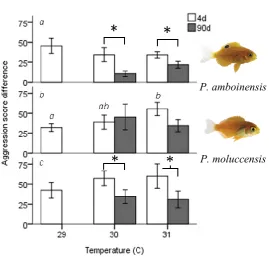
(9) interactions for P. chrysurus, whereas P. nagasakiensis displayed substantial increases in aggression levels with temperature. Furthermore, temperature changed the dynamics of contests of P. nagasakiensis, leading to fiercer contests. The differences in thermal sensitivity between species suggests reef assemblages may be restructured under warmer conditions. The next aim was to determine the extent of thermal plasticity for competitive interactions through longer-term exposure to rising temperatures. This chapter used juveniles of Pomacentrus amboinensis and P. moluccensis collected from the reefs near the Cairns region, Australia. Individuals were divided into ambient temperature for the collection season (29 °C) and two elevated temperature treatments (30 and 31 °C) for either 4d or 90d exposure periods. Chapter 3 followed methods similar to chapter 2 to record competitive performance, however with the added comparison of performance between the 4d and 90d exposure periods to test for thermal plasticity. Both intra- and inter-specific competitive contests were used to link differences in species thermal performance with interspecific competitive dominance. When comparing the control with 4d exposure to elevated temperatures, there were opposing responses by species, with P. moluccensis significantly increasing aggressive interactions whereas P. amboinensis exhibited a decreasing trend in aggression at higher temperatures. After 90d, P. moluccensis showed signs of beneficial plasticity as aggression trended back to control levels while P. amboinensis showed a further decrease in aggression. Interspecific contests showed a trend for P. moluccensis to win more contests in elevated temperatures. These results indicate that differences in species thermal performance may impact dominance hierarchies in fish assemblages. Chapter 4 used a similar experimental design of elevated temperature and extended exposure to explore the extent of thermal plasticity in antipredator escape.
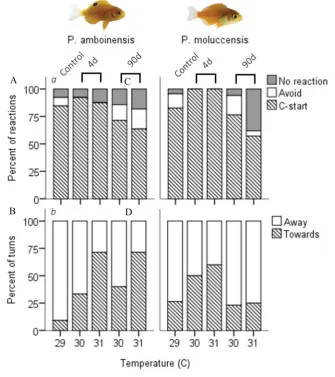
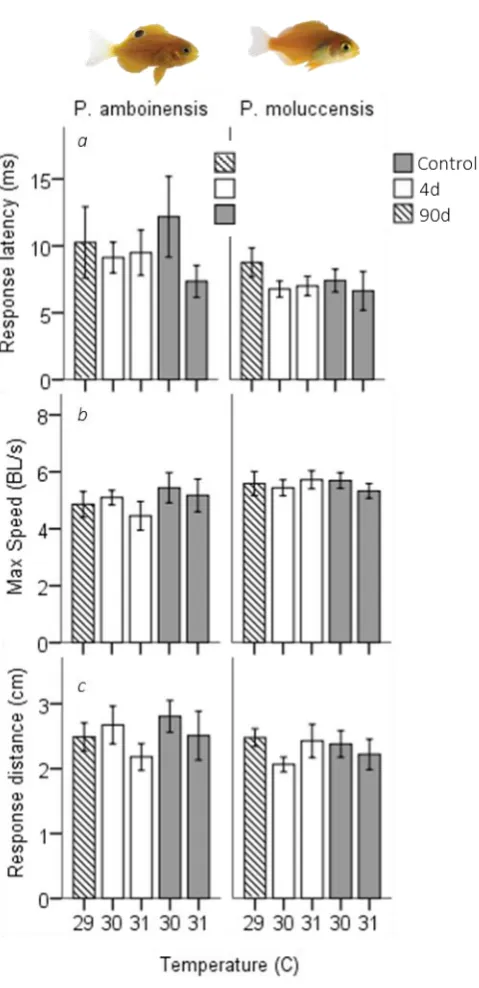
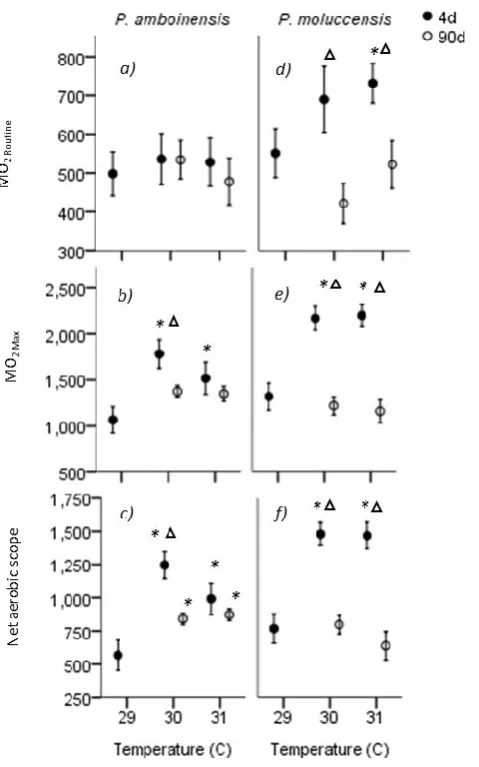
(10) performance for P. amboinensis and P. moluccensis. Many fish undertake a C-start escape response when faced with the threat of predation. Recordings from a high-speed camera show temperature effected behavioural decision-making more than physical ability to escape. Higher temperature altered the directionality of escape responses with both species exhibiting more reactions towards the stimulus. Only P. moluccensis showed a beneficial response after 90d, with directionality of response returning to control levels. There was a slight increase in responsiveness to the stimulus at elevated temperatures, suggesting a decrease in the stimulus threshold to trigger a C-start. However, this was reversed after 90d as both species showed significant decreases in responsiveness and even overcompensated as levels fell below control. Finally, I tested the plasticity of physiology through varying exposure durations to elevated temperature and explored the link between physiological and competitive performance (Chapter 5). Previous work has attempted to correlate metabolic rates with aggression and competitive dominance to better understand the ecological relevance of physiological performance; however, there is uncertainty about how these traits relate to one another. Individual oxygen consumption was recorded via closed chamber respirometry as a measure of metabolic rate and then paired with competitive data from chapter 3. Maximum metabolic rate (MO2 Max), routine metabolic rate (MO2 Routine), and aerobic scope (MO2 Max – MO2 Routine;. AS) significantly increased with short-. term exposure to elevated temperature. After 90d, all three metabolic traits for P. moluccensis had virtually returned to control levels, indicating plasticity fully compensated the effects of temperature while P. amboinensis only showed partial plasticity. Metabolic performance was then matched with competitive data from chapter 3 and individuals were categorised as dominant or subordinate. There was no association of individuals with greater metabolic rates becoming dominant necessarily..
(11) However, individuals more thermally sensitive with greater changes in metabolism tended to become subordinate in contests. With extended exposure, individuals that displayed greater signs of plasticity by returning to control metabolic rates were more likely to become dominant. This research showed projected elevated temperature will alter competitive ability, antipredator escape responses, and metabolic rates for several species of damselfish. After prolonged exposure to temperature, there were signs of beneficial plasticity of some traits for certain species. The extent of the effects and plasticity observed varied species to species. Such species-specific responses will have implications at the community level, potentially restructuring dominance hierarchies within and between species, and altering species assemblages..
(12) Table of Contents Title page ......................................................................................................................... Statement of contribution of others................................................................................. i Statement of access ...................................................... Error! Bookmark not defined. Statement of sources declaration ................................. Error! Bookmark not defined. Declaration of ethics ...................................................................................................... ii Acknowledgements .......................................................................................................iii General Abstract ............................................................................................................ v Table of Contents .......................................................................................................... ix List of tables .................................................................................................................. xi List of Figures .............................................................................................................xiii Chapter 1: General introduction..................................................................................... 1 Chapter 2: Intrageneric differences in the effects of acute temperature exposure on competitive behaviour between damselfishes .............................................................. 11 2.1 Abstract .............................................................................................................. 11 2.2 Introduction ........................................................................................................ 12 2.3 Methods.............................................................................................................. 14 2.4 Results ................................................................................................................ 19 2.5 Discussion .......................................................................................................... 22 Chapter 3: Duration of exposure to elevated temperature affects competitive interaction in juvenile reef fishes ................................................................................................... 25 3.1 Abstract .............................................................................................................. 25.
(13) 3.2 Introduction ........................................................................................................ 26 3.3 Methods.............................................................................................................. 28 3.4 Results ................................................................................................................ 33 3.5 Discussion .......................................................................................................... 36 Chapter 4: Extended exposure to elevated temperature affects escape response behaviour in coral reef fishes ....................................................................................... 39 4.1 Abstract .............................................................................................................. 39 4.2 Introduction ........................................................................................................ 40 4.3 Methods.............................................................................................................. 42 4.4 Results ................................................................................................................ 46 4.5 Discussion .......................................................................................................... 50 Chapter 5: Thermal plasticity of metabolic performance through extended exposure shows some impact on competitive dominance in two juvenile damselfish species ... 55 5.1 Abstract .............................................................................................................. 55 5.2 Introduction ........................................................................................................ 56 5.3 Methods.............................................................................................................. 59 5.4 Results ................................................................................................................ 64 5.5 Discussion .......................................................................................................... 70 Chapter 6: General discussion ..................................................................................... 75 References .................................................................................................................... 85 Appendix 1: Publications not arising from this thesis ............................................... 109.
(14) List of tables Table 2.1 Experimental design matrix. Control (grey) fish were compared to individuals with 40 exposure (solid) to elevated temperatures. Fish with 4d (solid) exposure were compared to 90d (open) exposure at each elevated temperature. Table 5.1 Planned comparisons of metabolic rates for temperature and exposure durations. There were six comparisons for each metabolic trait (MO2 Routine, MO2 Max, and AS) and replicated for each species, Pomacentrus amboinensis (a) and P. moluccensis (b). The first four comparisons measured control treatments against both temperatures at both exposure durations and the last two compared 4d and 90d exposure durations for each elevated temperature separately..
(15)
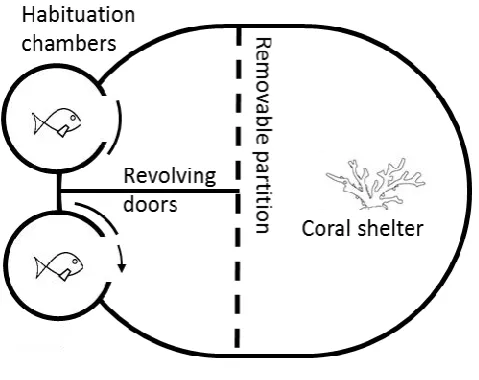
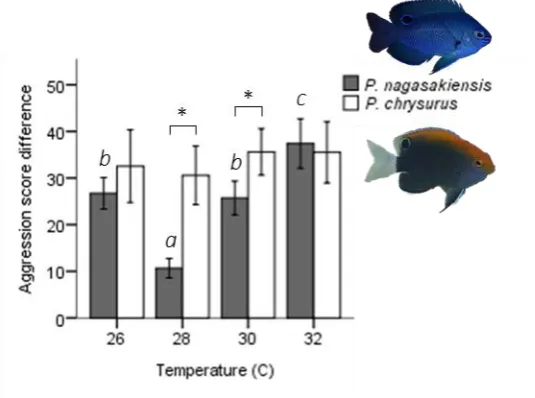
(16) List of Figures Fig 2.1. Seasonal and diurnal temperature fluctuation at Lizard Island, northern Great Barrier Reef. Seasonal fluctuation (23-30.6° C) from daily means recorded by longterm temperature loggers Dec 2013-2014. Inset shows the daily fluctuation (27.1-30.4° C) for the collection season, recorded every 20 min. Fig 2.2. Diagram of competition arena. Size-matched pairs were placed into habituation chambers at the beginning of a trial for 5 min. Next, revolving doors were opened simultaneously, allowing fish to exit and explore their portion of the arena. Once both fish had emerged, video recording commenced from an above camera and the clear removable partition was lifted, exposing fish to the coral shelter and each other. A 5min recording was taken starting from the first interaction. Videos were later analysed and 3 interactions were quantified: (i) displays, defined as a lateral fin flare towards the opponent; (ii) attacks, defined as a chase or biting of the opponent; and (iii) avoidances, swimming away from an opposing attack or display. Fig 2.3. Influence of temperature on aggression scores between dominant and subordinate fish. Mean aggression score difference (± SE), taken as aggression score of dominant competitor minus the subordinate score, for intraspecific contests at each of four temperatures. Only P. nagasakiensis (solid) showed an effect of temperature with aggression lowest at ambient and increasing in either direction. Italicised letters above error bars represent Tukey’s HSD means comparisons. P. chrysurus (open) was unaffected by temperature and aggression scores significantly differed from P. nagasakiensis at ambient and 30° C (shown by *). n = 17-20 pairs. Fig 2.4. Aggression score and proportion of interaction behaviour by each competitor. (a) Mean aggression scores (± SE) of dominant (open) and subordinate (solid).
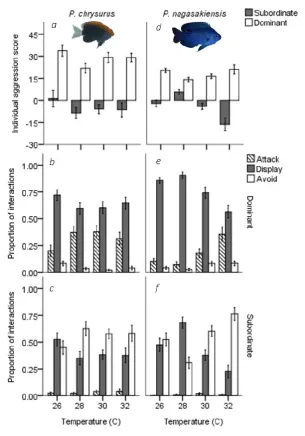
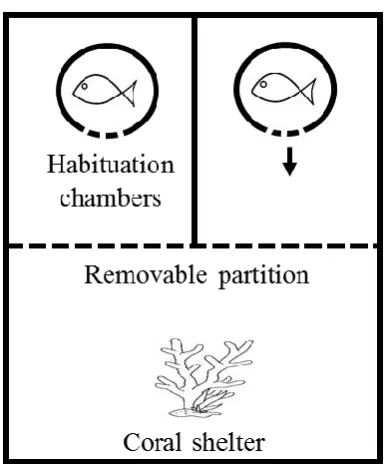
(17) competitors for intraspecific contests involving P. chrysurus (left) or P. nagasakiensis (right). P. nagasakiensis showed a significant effect of temperature on aggression score with subordinate competitors more affected compared to dominants. (b) Mean proportion (± SE) of attacks (shaded), displays (solid), and avoids (open) elicited by the dominant competitor. (c) Mean proportions of behavioural interactions elicited by subordinate competitors. As temperature increased dominant P. nagasakiensis decreased displaying behaviour and increased proportions of attacks while subordinates decreased displays but increased number of avoids. Figure 3.1 Experimental setup for competition trials. Fish began in habituation chambers (circles) for 10 min. Revolving doors were opened and fish were allowed to emerge. Once emerged, a second partition was raised (dotted line), exposing fish to each other and a coral skeleton for shelter. A 10-min video recording was taken of their interactions. Figure 3.2 Mean aggression score difference ± SE, calculated as winner fish score minus loser score between competitors by temperature of 4d (grey) and 90 exposure treatments (open). Species composition listed by row: intraspecific Pomacentrus amboinensis (a), intraspecific Pomacentrus moluccensis (b), and interspecific (c). Statistical significance (p < 0.05) between 4d and 90d treatments represented with (*). All treatments n = 10. Figure 3.3 Proportion of wins by species for interspecific contests. P. moluccensis (grey) and P. amboinensis (open) tested in “control” (29 °C) and “elevated” (30 + 31 °C combined) temperature treatment. Elevated temperature treatments are split by 4d and 90d exposure..
(18) Figure 4.1 C-start responsiveness of fish to a drop stimulus for juvenile Pomacentrus amboinensis (a) and Pomacentrus moluccensis (b) at 4d (left) or 90d (right) exposure durations to elevated temperatures. Types of reaction are: no reaction (black), avoidance (shaded), and C-start (open). Figure 4.2 Directionality of C-start for juvenile P. amboinensis (a) and P. moluccensis (b) at 4d (left) or 90d (right) exposure durations to elevated temperatures. Direction was determined whether individuals that made initial movement towards (shaded) or away from (open) the stimulus. Figure 4.3 Kinematic performance of fast starts by juvenile P. amboinensis (left) and P. moluccensis (right) at 4d (open) or 90d (grey) exposure durations to elevated temperatures. Variables measured were response latency (a), max speed (b), and escape distance (c). Figure 5.1. Metabolic rates across temperature and exposure durations. MO2 Routine (a,d), MO2 Max (b,e), and net aerobic scope (c,f) (mg O2 kg-1 h-1 ± SE) are given for two damselfish species, Pomacentrus amboinensis (left) and P. moluccensis (right). Thermal sensitivity was determined by comparing 4d exposure (solid) to temperature with control, and capacity for plasticity was measured through comparisons of 4d with 90d exposure (open). Treatments with (*) represent significant difference from control and (Δ) represent significant difference Figure 5.2. Metabolic rates for dominant and subordinate competitors. Metabolic performance of dominant (solid) and subordinate (open) competitors of Pomacentrus amboinensis and P. moluccensis are given. MO2 Routine (a,d), MO2 Max (b,e) and net aerobic scope (AS; c,f) (mg O2 kg-1 h-1 ± SE). Temperature exposure durations were 4d (left subdivide) and 90d (right subdivide). Treatments with (*) represent significant difference from control while.
(19) (Δ) represent significant difference between exposure durations (Planned comparisons, p < 0.05). Figure 5.3. Difference in metabolic rates between competitors shown as relative metabolism. MO2. Routine. (a), MO2. Max. (b), and AS (c) are given relative to the. subordinate individual in a trial (mg O2 kg-1 h-1 ± SE) for two damselfish species Pomacentrus amboinensis (left) and P. moluccensis (right). Effect of short-term temperature exposure was determined by comparing 4d (solid) with control treatments (*, planned comparison p < 0.05). Thermal plasticity was examined by comparing 4d with 90d exposure (open)..
(20) Chapter 1: General introduction Global climate change Climate change is a threat to the natural world requiring accurate predictions of how it will impact species, communities, and ecosystems. Since the industrial revolution, anthropogenic carbon dioxide (CO2) emissions have increased atmospheric CO2 from 280 ppm to 400 ppm, the highest level in the past 800,000 years (Lüthi et al. 2008). This addition of CO2 has created an enhanced greenhouse effect within the Earth’s atmosphere, raising the average surface temperature by nearly 0.85 °C (Collins et al. 2013). According to the Intergovernmental Panel on Climate Change (IPCC), atmospheric CO2 is projected to reach nearly 1000 ppm by 2100 if the current trajectory of CO2 emissions is maintained, which would cause global temperature to rise by as much as 4.5 °C (IPCC 2013). Global climate change has already caused changes to the distribution, behaviour, and physiology of many species of plants and animals (Parmesan 2006; Walther et al. 2002). As global temperatures continue to rise, further disruption of ecological processes is predicted, potentially leading to higher extinction rates and declining ecosystem function (Parmesan 2006; Scheffers et al. 2016). Rising temperatures and marine ecosystems Due to the high thermal capacity of water, the world’s oceans absorb over 90 % of the additional heat trapped by the enhanced greenhouse effect (Hoegh-Guldberg et al. 2013)). The IPCC predicts that sea surface temperatures will increase by as much as 3 °C by 2100 (Collins et al. 2013). This increase will likely exceed the thermal optimum for many tropical species (Tewksbury et al. 2008), disrupt the use of temperature as a cue in the timing of key events like reproduction and migration (Walther et al. 2002), and alter the distribution and abundance of many other species (Parmesan 2006). Many 1.
(21) marine birds and mammals coincide seasonal temperature change with migration patterns and increasing temperatures can result in delayed onset of these movement patterns (Doney et al. 2012). Temperatures rise will also alter species distributions across latitudes as populations shift towards cooler locations, increasing the number of invasive species and creating new interspecific interactions (Milazzo et al. 2013). Due to unequal thermal tolerances among species, rising temperatures can affect community assemblages leading to restructuring of dominance hierarchies and impacting predatorprey interactions (Hoegh-Guldberg & Bruno 2010). These examples stress the need for accurate predictions for the effect of climate change on marine species as well as their responses. Ectotherms and tropical species Ectothermic species may be especially sensitive to global warming as they rely on ambient environmental temperature for body heat. This means that performance is tightly linked to surrounding temperature. Since most marine organisms (e.g. fish, molluscs, crustaceans) are ectothermic, ambient temperature is therefore a major determinant of many biological processes including metabolism (Farrell 2002), growth (Pauly 1980) and locomotion (Wakeling & Johnston 1998). Changes in these processes can be due to various mechanisms either at the whole-animal level of balancing energy demand with consumption or at the cellular level due to the temperature dependency of chemical reactions and enzyme efficiencies (Cossins & Bowler 1987). For example, metabolic demands in ectotherms rise nearly exponentially with temperature (Clarke & Johnston 1999). This increase in energy requirement can alter behavioural habits such as increased foraging time to meet food intake rather than pursuing mates or finding shelter.. 2.
(22) The effect of temperature change on the performance a given trait for a species can be visualised using a thermal performance curve (TPC; Schulte et al. 2011). TPCs are a useful tool that helps show a species’ thermal tolerance range and illustrate performance in temperature-dependent traits. Performance curves begin at a species’ minimum critical temperature, generally increase with temperature, peak at a thermal optimum, then rapidly fall off as the maximum critical temperature is approached (Angilletta et al. 2002; Schulte et al. 2011). Although the thermal tolerance range for a species can vary among populations and life stages, tolerance ranges often reflect the temperature range experienced in their habitats (Sunday et al. 2011). TPCs can be generated for traits at the whole-organism level to study fecundity, growth, metabolic rate, and locomotor speed or at the molecular level to determine the rate of enzyme activity, oxygen consumption, and nerve connectivity. Recently, TPCs have received a rise in interest as they can provide insight on how species will perform with future temperature increase due to climate change (Deutsch et al. 2008). While studies have now begun to address the effects of global climate change, much of the effort has been devoted to temperate species, particularly in the northern hemisphere (Chambers et al. 2013). Yet, tropical species may be especially vulnerable to rising temperatures because they occupy more thermally stable habitats and are therefore predicted to have a relatively narrow range of thermal tolerance (Tewksbury et al. 2008).. When exposed to temperatures 3 °C above current summer maximums, several species of reef fish reduced aerobic scope by nearly half and show little capacity for additional oxygen consumption for temperatures above 3 °C indicating coral reef fishes may be living close to their thermal optimum for aerobic capacity (Munday et al. 2012). Aerobic scope is a measure of aerobic capacity and is an important attribute as it is believed to represent the energy budget of a species (Portner & Farrell 2008). 3.
(23) Rising temperatures can accelerate development for juvenile reef fish as elevated temperatures increase larval growth rate, decrease the age of metamorphosis, and increase swimming ability (McCormick & Molony 1995; Meekan et al. 2003). However, higher temperatures will require higher food intake and when food is limited, individuals suffer loss of body condition, growth rate, and larval duration below current-day control temperatures (McLeod et al. 2013). Increased temperature also impact predator-prey interactions with higher predation rates and prey item switching (Ferrari et al. 2015). Collectively, these examples demonstrate the sensitivity reef ecosystems will be to future ocean warming. Potential for plasticity While there is much concern over the threat and negative impacts of rapid climate change, there are also ways that organisms can cope with changing environments. Species might maintain their performance under elevated temperature through phenotypic plasticity or adaptive evolution. Adaptation occurs through selection on genetic variation which is inherited from one generation to the next. Over a number of generations, selection shifts the average phenotype of the population towards the fitness peak (Angilletta 2009). By contrast, phenotypic plasticity enables individuals to change morphology, physiology, or behaviour without genetic change (Schulte et al. 2011). While both plasticity and adaptation will likely be driving responses to climate change over the coming decades, plasticity may be particularly useful as it can operate over more rapid timescales similar to global climate change. Phenotypic plasticity can generally be divided into 3 categories; reversible, irreversible, and transgenerational (Angilletta 2009). Reversible plasticity is observed in adults and occurs frequently in nature with seasonal variation (Angilletta 2009).. 4.
(24) Reversible plasticity happens within an individual’s lifetime, is not considered permanent, and can serve as a method to cope with natural environmental variation (Angilletta 2009). Reversible plasticity is particularly useful for species living in variable habitats (Gabriel et al. 2005). Irreversible plasticity is usually a result of exposure to environmental conditions during earlier life stages, namely development, and aptly referred to as developmental plasticity. For example, adult zebrafish show enhanced swimming performance at elevated temperature if they had been first exposed to those same temperatures as embryos (Scott & Johnston 2012). Finally, plasticity can occur on a transgenerational scale when the performance of the offspring is influenced by non-genetic parental contributions. Non-genetic mechanisms that lead to transgenerational plasticity can be parents varying energy provisions, such as yolk reserves (Uller 2008), or through epigenetic processes, such as DNA methylation, influencing transcription of genes (Bonduriansky 2012; Sunday et al. 2014). The extent of plasticity can depend on the thermal environment a species occupies. Temperate species that experience wide fluctuations in temperature annually, have been shown to possess remarkable capacity for physiological plasticity to a range of temperatures (Johnston & Dunn 1987). Meanwhile, tropical species are expected to be more thermally intolerant (Wright et al. 2009) due to their relatively stable environments and this has been shown to be true for some coral reef fishes (Nilsson et al. 2010). Yet, studies of plasticity in tropical fish have focused on exposure of adults for times scales from a couple of days to a few weeks (Nilsson et al. 2010; Gardiner et al. 2010; Rummer et al. 2014). Recently, studies exposing reef fish during embryonic stages and even transgenerational exposure periods have produced promising results for plasticity (Donelson et al. 2012, 2011). Targeting younger individuals is important. 5.
(25) because this can unlock greater plasticity not observed in later stages of life (Angilletta 2009). Adaptive plasticity is generally considered to induce changes that are beneficial to performance, allowing individuals to better cope with new environmental conditions. However, detection and response to varying environments can be energetically costly (DeWitt et al. 1998). Resources spent on physiological or morphological modifications may be at the expense of growth rate and other functions (Hoffmann 1995). If the cost outweighs the benefit in performance, then plasticity may not be observed (Angilletta et al. 2003). Furthermore, phenotypic plasticity is limited and if the effect of environmental change is too great, plasticity may only be partial. Knowledge gaps The effects of environmental temperature on individual performance will be particularly important at life history bottlenecks (Fuiman et al. 2010). Animals migrating between habitats are often faced with the challenges of new competitors and predators. For reef fish transitioning from larval to juvenile stage, predation pressure can be highest. At 3-4 weeks of age, juveniles reef fish make their final metamorphosis and must transition from a pelagic larval stage back to the reef to join the adult population. Mortality due to predation in tropical marine fishes at settlement can average more than 50 % in the first 2 days (Almany & Webster 2006). Fish that can successfully fight for and hold adequate shelter may have a higher chance at survival to later life stages. While aggressive interactions among reef fishes has been closely examined (McCormick & Weaver 2012; Poulos & McCormick 2014) the effect that increased temperature will have on these interactions is still widely unknown.. 6.
(26) The effect that rising temperature will have on competitive interactions will be, in part, influenced by the capacity for thermal plasticity in reef fish. At settlement, thermal plasticity in juveniles is useful as individuals may recruit to reefs with thermal regimes different to what they experienced during their larval phase. Individuals with a greater thermal plasticity may be able to maintain competitive performance better than others. This can put a selective pressure on juvenile populations favouring more thermally tolerant competitors. Yet, the capacity for thermal plasticity in competitive contests is not known. Studying thermal plasticity and competitive interactions will be help define intraspecific and interspecific interactions in reef communities under climate change projections. If a competitive contest is lost and an individual finds themselves directly faced with a predatory attack without shelter, a C-start escape response is used in attempt to avoid capture. Many amphibians and fishes undertake C-start escape responses to a startling stimulus (Bullock 1984) involving a sudden acceleration away from the direction of perceived threat (Domenici 2010). C-start responses are triggered when 1 of the 2 large Mauthner cells, running laterally along both sides, is stimulated, usually in the laboratory by perturbance of the water’s surface. C-starts that result in successful evasion usually consist of highly tuned responsiveness and locomotor performance (Domenici 2010). Yet, studies have shown that C-starts are sensitive to environmental temperature with impacts differing between species and ontogenetic stages (Johnston & Temple 2002; Wilson et al. 2010). To date, few studies have explored the capacity for plasticity in escape responses. Exploring the extent of plasticity in escape responses to climate change temperatures will demonstrate the outlook of predator-prey interactions in the future.. 7.
(27) Along with investigating the effects of increased temperature on performance in ecological processes, e.g. competitive behaviour and escape performance, there is also a need to determine the direct influence of temperature through measuring physiological traits. This is because physiological performance is generally linked to performance in many ecological traits (Biro & Stamps 2010; Killen et al. 2013). Previous study on freshwater fish species have shown a relationship between physiological performance and competitive dominance (Cutts et al. 2001, 1998; Metcalfe et al. 1995) and this has also been shown to be true for a coral reef damselfish (Killen et al. 2014). However, determining how thermal plasticity of physiological performance can contribute to competitive dominance has not yet been tested. Aims and objectives The aim of this thesis is to elucidate the effects of elevated temperature on individual performance and the capacity for plasticity in coral reef fishes. Measures of competitive performance, metabolic rates, and antipredator escape performance as well as the linkages among them were investigated by exposing juvenile reef fish to elevated temperature for varying durations. The first data chapter (Chapter 2) measured the effects of elevated temperature on intraspecific competitive interactions in two species of damselfish, Pomacentrus chrysurus and Pomacentrus nagasakiensis. Following short-term exposure to higher temperature (+4 C above ambient) size-matched pairs of fish were placed into arenas with a fragment of coral to compete for shelter. Aggressive interactions (e.g. displays, bites, and chases) were recorded and an aggression index was calculated to compare across temperatures and species.. 8.
(28) The next three chapters explored the capacity for plasticity to increased temperature. Juvenile Pomacentrus amboinensis and Pomacentrus moluccensis were exposed to elevated temperatures (+1 and +2 °C above summer average) for either short-term (4d) or long-term (90d) durations. The effect of temperature and exposure duration was recorded for aggressive interactions during competition (Chapter 3), Cstart escape responses (Chapter 4), and metabolic rates (Chapter 5). Comparing results from the short-term treatments with current-day controls showed the level of thermal sensitivity to climate change temperatures in reef fish and the difference between short-term and long-term exposures at elevated temperature, if any, would suggest evidence of plasticity. Chapter 3 used the above described experimental design to determine the effect on aggressive interactions during competitive contests. Competitive interactions were recorded similar to chapter 2, however this design allowed for comparisons between exposure durations to elevated temperature to indicate capacity for plasticity. Matched pairs also consisted of within and between species combinations to examine differences in thermal tolerances across species. The next chapter (Chapter 4) tested the effect of climate change temperatures and thermal plasticity on antipredator escape response performance. This was measured by analysing slow motion video recording of individuals subjected to a startling stimulus. Once the effects of elevated temperature and duration of exposure for competition contests were understood, the next step was to address individual physiology. Chapter 5 used static respirometry to measure maximum metabolic rate, minimum metabolic rate, and aerobic scope. Metabolic measures were then matched to. 9.
(29) competitive performance to determine any links between physiology and competitive dominance and whether physiological plasticity can contribute to competition. Together, these four data chapters advance our knowledge of the impacts of ocean warming on coral reef fishes and the long-term effects of climate change on reef communities. Understanding these effects, the ability to cope with this temperature increase, and the link between physiological and ecological performance will be key to creating a more comprehensive picture of how communities may respond to a changing environment.. 10.
(30) Chapter 2: Intrageneric differences in the effects of acute temperature exposure on competitive behaviour between damselfishes Authors: Donald T. Warren & Mark I. McCormick 2.1 Abstract Projected increases in global temperatures brought on by climate change threaten to disrupt many biological and ecological processes. Tropical ectotherms, like many fishes, can be particularly susceptible to temperature change as they occupy environments with narrow thermal fluctuations. While climate change models predict temperatures to increase over decades, thermal fluctuation is already experienced on a seasonal scale, which may affect the ability to capture and defend resources across a thermal gradient. For coral reef fish, losers of competitive interactions are often more vulnerable to predation, and this pressure is strongest just after settlement. Competitive interactions may determine future success for coral reef fishes, and understanding how temperature experienced during settlement can influence such interactions will give insight to community dynamics in a future warmer world. We tested the effect of increased temperatures on intraspecific competitive interactions of two sympatric species of reef damselfish, the Nagasaki damselfish Pomacentrus nagasakiensis, and the whitetail damselfish Pomacentrus chrysurus. Juvenile fishes were exposed to one of four temperature treatments, ranging from 26-32° C, for seven days then placed into competitive arenas where aggressive interactions were recorded between sized matched individuals within each species. While there was no apparent effect of temperature treatment on aggressive behaviour for P. chrysurus, we observed up to a four-fold increase in aggression scores for P. nagasakiensis with increasing temperature. Results 11.
(31) suggest that temperature experienced as juveniles can impact aggressive behaviour, however species-specific thermal tolerances lead to behavioural affects that differ among closely related species. Differential thermal tolerance among species may lead to restructuring of the interaction network that underlies the structure of reef assemblages. 2.2 Introduction Temperature is an important abiotic factor that can have profound effects on behaviour, physiology, and life-history traits (Schulte et al. 2011). For many species, temperature dictates basic daily activities such as locomotion (Rome 2007), aggression (Pruitt et al. 2011), and boldness (Biro et al. 2010). Currently, climate change models predict sea surface temperature will rise as much as +3 °C by 2100 (Collins et al. 2013), impacting the ecology of many species (Walther et al. 2002). Yet, changes in temperature already occur temporally on a daily and seasonal scale or spatially such as across latitude or with water depth. Even within tropical ecosystems, which are considered relatively thermally stable, coral reef lagoons can experience seasonal thermal variation of up to 8 °C (McCabe et al. 2010). This effect of temperature change can be more pronounced in ectotherms as their metabolism tends to increase nearly exponentially with rising temperature (Clarke & Johnston 1999). Studying how reef species respond to temperature change can be helpful for determining the impact future climate change will have. While climate change models predict temperature change to occur over several decades, the effect of warmer temperatures on reef fish can be observed today on a seasonal scale. Many benthic marine species have a planktonic larval phase that coincides with the lunar cycle, where juveniles recruit back to the reef to join the adult population (Leis & Mccormick 2002). This oscillation with moon patterns results in 12.
(32) waves of newly settling juveniles over the reproduction season. Cohorts of juveniles that settle at the beginning of the season will experience cooler temperatures, have less competition for shelter sites, and have a head start on growth. Comparatively, cohorts that settle later in the season will experience warmer temperatures, must compete for shelter sites, and be behind on growth. As temperatures continue to rise, temperatures normally experienced during mid-late summer may occur earlier in the season. Determining the effects of temperature experienced by newly recruiting fish on individual performance will give insight to how increases in future averages may affect coral reefs. The effects of environmental temperature on individual performance will be particularly important at life-history bottlenecks (Fuiman et al. 2010). During reef fish recruitment, over half of juveniles are consumed by predation in the first two days (Almany & Webster 2006). Juveniles that acquire and defend a shelter have a greater chance of survival. In general, relatively dominant individuals can secure shelter sites that provide better refuge from predators and access to food sources compared to their subordinate counterparts (McCormick 2009; 2012). This creates a selective bottleneck on juveniles where aggression and competitive dominance can generate an advantage. Yet, how temperature experienced during this phase may influence aggressive interactions is poorly understood. Determining how temperature may affect these aggressive interactions in fish will add to the understanding of how reef community dynamics may be affected over seasonal temperature fluctuations and will be informative in a climate change context. The present study explores how temperature experienced during recruitment can impact intraspecific competitive interactions in two commonly found damselfish across the Great Barrier Reef, the whitetail damselfish Pomacentrus chrysurus and the 13.
(33) Nagasaki damselfish Pomacentrus nagasakiensis. Newly settled recruits were collected and reared in four temperatures for 7 days. Size-matched pairs were placed into competition arenas and their aggressive interactions over a coral shelter resource were quantified. We predicted that aggressive interactions would be lowest at ambient temperatures and increase as treatment temperature moved further from their ambient condition. However, it is likely that both species have different thermal tolerances, therefore, we predicted the magnitude of change will be difference for each species. 2.3 Methods Study species, collection, and holding facilities The study species were the whitetail damselfish, P. chrysurus, and the Nagasaki damselfish, P. nagasakiensis. These species are found throughout the Great Barrier Reef (Allen 1991) and have been the focus of multiple ecological and behavioural experiments (e.g. Ferrari et al. 2011; Chivers et al. 2014). As adults, P. chrysurus is generally found on dead and algal-covered corals while P. nagasakiensis is more associated with degraded corals (Feary et al. 2007). However, many recruiting juveniles settling to the reef can compete for similar habitats (Feary et al. 2007; Jones et al. 2004) before moving to their adult associated sites. Newly metamorphosed juveniles (3-4 weeks old; standard length, x̅ ± SD; P. chrysurus 13.26 ± 0.78 mm; P. nagasakiensis 15.46 ± 0.97 mm) were collected using light traps (M. G. Meekan et al. 2001) at Lizard Island on the northern Great Barrier Reef (-14°67´S, 145°44´E), Australia during November 2015 and held in replicate 32 L tanks on a flow-through system. Individuals were randomly allocated to 1 of 4 temperature treatments: 26, 28 (ambient), 30, and 32 °C. Temperatures revolved around ambient (28 °C) and ranged according to temperature fluctuation for the reproduction season (Oct-Jan). Temperature data was 14.
(34) based on temperature loggers deployed around Lizard Island in common settlement locations (Fig 2.1) and verified as standard for the season against long-term loggers (AIMS 2014). The 32 °C treatment represented potential maximum summer temperatures for 2100 (Collins et al. 2013). To reduce thermal stress, tank temperatures were changed 1.5 °C/day from ambient and held at treatment temperature for 7 days prior to testing (as per Gardiner et al. 2010). Holding temperatures and photoperiods fluctuated ± 0.5 °C around the mean and 12:12 hr, respectively. Fish were fed Artemia nauplii to satiation twice during daylight hours.. Fig 2.1. Seasonal and diurnal temperature fluctuation at Lizard Island, northern Great Barrier Reef. Seasonal fluctuation (23.0-30.6° C) from daily means recorded by long-term temperature loggers Dec 2013-2014. Inset shows the daily fluctuation (27.1-30.4° C), recorded every 20 min, for the collection season.. 15.
(35) Experimental design The effect of temperature on each species was measured by conducting intraspecific contests within temperature treatments. No trials occurred between fish from the same holding tank to control for the possibility of a pre-established hierarchy, and fish were used only once in the study to maintain novelty of the design and prevent any winner effect (Poulos & McCormick 2014). In total, there were 8 treatment combinations: 4 temperatures for each of 2 species. Replicates ranged from 17-20 pairs per treatment, due to mortality. Competitive interaction trials Size differences between competitors can influence the outcome of competitive interactions (McCormick 2009; McCormick & Weaver 2012). To control for this size effect, fish were measured and pairs were matched within 10% of their standard length to reduce the effect of size on outcome (Warren et al. 2016). The fish pairs were tested the day following measurement to decrease the effect of handling stress on the outcome. Fish were fasted for 12-24 h prior to competitive trials. Competitive arenas and procedures were modified from Warren et al. (2016). Arenas consisted of an oval tank (37 x 30 cm) filled with seawater to a depth of 10 cm with a fragment of live coral (Pocillopora damicornis ~5 cm3) in one half and two habituation chambers in the other half (Fig. 2.2). The coral provided shelter and served as a resource for competition. At the start of each trial, a size-matched pair of fish was transferred via water-filled jars to separate habituation chambers for 5 min. After the habituation period, revolving doors on both chambers were slowly opened simultaneously, allowing the two fish to emerge and explore their portion of the arena. Habituation chambers were separated by a solid fixed divider, preventing fish from seeing each other, thus making emergence an 16.
(36) independent decision. A clear partition allowed fish to view the coral on the other side but stopped either fish from reaching the shelter before the other. This partition prevented a priority effect of previous residency, a result known to influence outcomes of competitive interactions (Almany 2003; Geange et al. 2016). Once both fish exited their chambers, the clear partition was raised, exposing both fish to one another as well as allowing direct access to the coral fragment. Competitive interactions were videorecorded from the first encounter for 5 min and later analysed for three aggressive behaviours: (i) displays, defined as a lateral fin flare towards the opponent; (ii) attacks, defined as a chase or biting of the opponent; and (iii) avoidances, swimming away from an opposing attack or display. These variables were used to calculate an aggression score = attacks + displays – avoids (McCormick 2009; Warren et al. 2016). The individual with the higher aggression score was deemed dominant and the contest winner for that pair. Aggression was used as a measure for competitive performance as aggression provides a good indicator of contest outcomes (McCormick 2009; McCormick & Weaver 2012).. Fig 2.2. Diagram of competition arena. Size-matched pairs were placed into habituation chambers at the beginning of a trial for 5 min. Next, revolving doors were. 17.
(37) opened simultaneously, allowing fish to exit and explore their portion of the arena. Once both fish had emerged, video recording commenced from an above camera and the clear removable partition was lifted, exposing fish to the coral shelter and each other. A 5-min recording was taken starting from the first interaction. Videos were later analysed and 3 interactions were quantified: (i) displays, defined as a lateral fin flare towards the opponent; (ii) attacks, defined as a chase or biting of the opponent; and (iii) avoidances, swimming away from an opposing attack or display. Statistical analysis Differences in size for each pair, calculated as winner fish size minus loser size, were normally distributed and did not differ from 0 (one-sample t-test, t = 1.72, df = 157, p = 0.08). This analysis showed that size matching was successful and the remaining difference in sizes did not decide contest outcomes. Aggression scores for each competitor were calculated, and the difference, taken as the winner score minus the loser score, was computed. Aggression score differences were analysed with a two-way ANOVA using species and temperature as fixed factors. To ensure aggression score differences were not being driven by one competitor alone, separate two-way ANOVAs, one for each species, were generated with individual aggression score as dependent variable and competitor status (categorised as dominant or subordinate) and temperature as fixed factors. To examine how temperature affected the dynamics of a contest, the proportions of attacks, displays, and avoids elicited by each competitor were analysed using a twoway MANOVA with temperature and competitor as fixed factors and the proportion of interactions for each of the three behaviours as the dependant variables, again separate models were generated for each species. Any significance found was further. 18.
(38) investigated with Tukey’s HSD post-hoc analyses. Bonferroni correction was used for hypothesis tests on individual variables for each species (Adjusted α = 0.017). Preliminary analyses tested the presence of a tank effect by including holding tank as a random factor. However, this did not change the results, so holding tank was excluded from subsequent analyses. Data were found to conform to the assumptions of normality and homogeneity using residual analyses. 2.4 Results There was a significant difference in species’ response of aggression score differences to temperature. For P. nagasakiensis, aggression scores were lowest at ambient and increased as temperature moved from ambient in either direction (F1,145 = 10.24, p = 0.002; Fig 2.3). Conversely, aggression score differences for P. chrysurus were unaffected by temperature and were significantly greater than P. nagasakiensis at ambient and 30 °C (signified with *; Fig 2.3). When aggression score differences were separated by competitor, (i.e. dominant and subordinate scores), we found the change in aggression with temperature was more apparent in subordinate competitors of P. nagasakiensis (F1,146 = 12.45, p = <0.001; Fig 2.4d). Temperature also affected the proportion of interactions elicited by each competitor during contest of P. nagasakiensis (F6,290 = 6.91, Wilk’s Λ = 0.76, p < 0.001). At elevated temperature, dominant P. nagasakiensis decreased displays (F1,73 = 11.98, p < 0.001) and increased attacking behaviour (F1,73 = 8.69, p < 0.001; Fig 2.4e). Concurrently, subordinate P. nagasakiensis decreased displays (F1,73 = 11.64, p < 0.001) and increased avoidance behaviour (F1,73 = 10.92, p < 0.001; Fig 2.4f). For P. chrysurus, neither dominant nor subordinates showed a change in interaction proportions across temperatures (Fig 2.4b and 2.4c, respectively).. 19.
(39) Fig 2.3. Influence of temperature on aggression scores between dominant and subordinate fish. Mean aggression score difference (± SE), taken as aggression score of dominant competitor minus the subordinate score, for intraspecific contests at each of four temperatures. Only P. nagasakiensis (solid) showed an effect of temperature with aggression lowest at ambient and increasing in either direction. Italicised letters above error bars represent Tukey’s HSD means comparisons. P. chrysurus (open) was unaffected by temperature and aggression scores significantly differed from P. nagasakiensis at ambient and 30° C (shown by *). n = 17-20 pairs.. 20.
(40) Fig 2.4. Aggression score and proportion of interaction behaviour by each competitor. (a) Mean aggression scores (± SE) of dominant (open) and subordinate (solid) competitors for intraspecific contests involving P. chrysurus (left) or P. nagasakiensis (right). P. nagasakiensis showed a significant effect of temperature on aggression score with subordinate competitors more affected compared to dominants. (b) Mean proportion (± SE) of attacks (striped), displays (solid), and avoids (open) elicited by the dominant competitor. (c) Mean proportions of behavioural interactions elicited by subordinate competitors. As temperature increased dominant P.. 21.
(41) nagasakiensis decreased displaying behaviour and increased proportions of attacks while subordinates decreased displays but increased number of avoids. 2.5 Discussion Determining the effect of temperature on ecological processes will be crucial for making realistic predictions about how communities may change in response to a warming ocean (Walther et al. 2002). While previous studies have looked at the effects of temperature on aggressive interactions in freshwater systems (De Staso & Rahel 1994; Reese & Harvey 2002; Taniguchi et al. 1998), few have focused on marine species. The current study found that aggression levels during competitive contests can increase with temperature experienced during settlement. Furthermore, the effect that temperature will have can be specific to each species. The effect of temperature on competition suggests that aggression may increase as summer averages increase with climate change. However, the species-specific response illustrates that differential thermal tolerance may lead to restructuring of reef-assemblages and dominance hierarchies within reef communities. We found aggression scores differences for P. nagasakiensis were lowest when recruits were exposed to ambient temperature and increased when temperature changed in either direction. Increasing aggression with temperature is expected as activity level, boldness, and aggression have previously been shown to increase with temperature in a closely related damselfish (Biro et al. 2010). This may be due to the increased metabolism that coincides with rising temperatures for ectotherms (Clarke & Johnston 1999). When aggression score differences were separated into individual aggression score components (i.e. dominant and subordinate), we found that temperatures above ambient had a greater effect on subordinates. This may be due to an increasing stress of losing at elevated temperatures. Losing a competitive contest can be stressful for an 22.
(42) individual as subordinates will spend the duration avoiding aggressive displays and denied access to shelter (Senar et al. 2000). This stress can manifest as elevated cortisol levels and metabolic rates (McCormick 2016), which may make them less resilient to other stressors such as temperature change. However, aggression showed a similar increase at 2 °C below ambient (26 °C) as 2 °C above (30 °C). This change in aggressive performance contradicts trends predicted for physiological performance potentially indicating reducing temperature was more important to the behavioural response. Temperature also impacted the dynamics of contests through altering the proportions of competitive behaviours elicited by each competitor. At ambient temperature, dominant competitors won an encounter by displaying most often, followed by attacking, and avoiding least often. Conversely, subordinates showed avoidance behaviour most often, then displays, and attacked least of all. This is different to previous research on competitive interactions in other species of damselfish showing dominants win contests by attacking most, then displaying (Killen et al. 2014; Warren et al. 2016). As water temperature increased, there was a shift in the behaviour of dominant P. nagasakiensis to exhibit less displays and more attacks, while subordinates increased avoids and displayed less. This suggests that higher temperatures can both increase overall aggression during contests as well as lead to fiercer competition. Aggressive interactions can already be costly in energy expenditure and increase risk of injury (Briffa & Sneddon 2007). This transition to fiercer competition means individuals may be investing even more into contests, leaving less resources for other activities. When comparing species, temperature had little effect on aggression score differences for P. chrysurus and was overall greater than P. nagasakiensis at 28 (ambient) and 30 °C. This shows a species-specific response to elevated temperature 23.
(43) within congeneric species. Specificity by species to temperature has been shown in other work on competition in the damselfish Pomacentrus amboinensis and Pomacentrus moluccensis (Warren et al. 2016). Here, there was opposing trends in aggression after short-term exposure to elevated temperature. Differences in aggression help demonstrate species’ thermal performances across temperatures and may give insight to how species may fare with future warming. The increase of aggression with temperature for P. nagasakiensis suggests the thermal optimum for this species may be above current summer average with future warming potentially yielding better performance. Comparatively, the lack of change in aggression suggests P. chrysurus may have a broader thermal optimum with changes in temperature showing little effect on performance. Interestingly, the selected temperature range can also overlap with diurnal fluctuation questioning whether there could be a similar fluctuation of aggression in a day. Increasing temperature impacted aggressive contests and resulted in fiercer competition, however, the effect of temperature was specific to each species. Differences in thermal performance between species is most likely ubiquitous for many fishes within trophic groups. Species that are be dominant in current-day temperatures may be outcompeted at warmer temperatures, causing a shift in hierarchy assemblages and potentially species distributions. From here, there is a need to investigate what is driving these changes in competition and how our observed changes in aggressive behaviour will cascade into the reef community. Future studies should include competing species in interspecific trials, direct assessment of temperature on physiology, and longer-term exposure periods to temperature to give a more comprehensive picture of how climate change might be expected to influence coral reef fishes. 24.
(44) Chapter 3: Duration of exposure to elevated temperature affects competitive interaction in juvenile reef fishes This chapter was published in PLoS ONE (2016), doi:10.1371/journal.pone.0164505 Authors: Donald T. Warren, Jennifer M. Donelson, Mark I. McCormick, Maud C. O. Ferrari, and Philip L. Munday 3.1 Abstract Climate change will affect key ecological processes that structure natural communities, but the outcome of interactions between individuals and species will depend on their thermal plasticity. We tested how short- and long-term exposure to projected future temperatures affects intraspecific and interspecific competitive interactions in two species of coral reef damselfishes. In conspecific contests, juvenile Ambon damselfish, Pomacentrus amboinensis, exhibited no change in aggressive interactions after 4d exposure to higher temperatures. However, after 90d of exposure, fish showed a nonadaptive reduction in aggression at elevated temperatures. Conversely, 4d exposure to higher temperature increased aggression towards conspecifics in the lemon damselfish, Pomacentrus moluccensis. 90d exposure began to reduce this pattern, but overall there was little effect of temperature. Aggression in interspecific contests increased with short-term exposure, but was significantly lower after long-term exposure indicative of acclimation. Our results show how the length of exposure to elevated temperature can affect the outcome of competitive interactions. Furthermore, we illustrate that results from intraspecific contests may not accurately predict interspecific interactions, which will challenge our ability to generalise the effects of warming on competitive interactions. 25.
(45) 3.2 Introduction Climate change will alter the physiology, behaviour, and geographical distribution of many species (Botkin 2007; Huey et al. 2012; Parmesan 2006). However, the impact of these changes on population and community structure will depend on the outcome of biological interactions with other species (Harley et al. 2006; Hughes 2000). Due to differences in thermal tolerances, some species will be more capable of maintaining performance at higher temperatures than others (Milazzo et al. 2013; Pörtner 2001). Consequently, differences in thermal tolerance could dramatically alter the outcome of ecological interactions, such as competition and predation (Portner & Farrell 2008; Walther et al. 2002). Yet, thermal tolerances can change if exposure to new thermal conditions occurs for a sufficient amount of time at critical periods (Huey & Kingsolver 1989; Schulte et al. 2011). Furthermore, the extent of phenotypic change can depend on the length of exposure, with longer-term periods believed to unlock greater plasticity (Angilletta 2009; Munday et al. 2013). While many studies are now investigating the effects of higher temperatures on physiological processes (Johansen & Jones 2011; Mora & Ospína 2001; Nilsson et al. 2009), incorporating longer exposure lengths during early life has received much less attention. In climate change studies, relevant exposure will be critical for predicting the outcome of ecological processes in a future warmer world (Huey et al. 2012; Munday et al. 2013; Sentis et al. 2015). Much of our understanding of how species might respond to future warming comprises of relatively short-term experiments using adults (Frank Seebacher et al. 2012; Johnson & Bennett 1995). Yet, exposure of juveniles to higher temperatures during early development can potentially induce greater plasticity in phenotypic traits and greater thermal tolerance in later life stages than just exposure of adults (Donelson. 26.
(46) et al. 2011; Schaefer & Ryan 2006; Scott & Johnston 2012; Tracy & Walsberg 2001). These early life influences can then produce long-lasting alterations in phenotype, affecting individual success later in life (West-Eberhard 2003). Changes in phenotype that prove beneficial to an individual are known as acclimation and could be a method to maintain performance in a new environment (Nettle & Bateson 2015). However, acclimation may not always fully compensate for the negative effects of environmental stress and can result in partial acclimation or even overcompensation (Huey & Berrigan 1996; Precht 1958). Furthermore, not all induced changes will be beneficial to future performance (Woods & Harrison 2002, 2001). Instead, prolonged exposure to elevated temperature may result in a further degrade in performance compared to present-day levels (Huey et al. 1999; Leroi et al. 1994; Wilson et al. 2002). Understanding the influence of early environmental experience is important, because early life stages are critical in population regulation (Caley et al. 1996). Many juveniles are vulnerable to resource restriction and even small changes in resource acquisition can affect attributes like growth and survival (Moksnes 2004; Newman 1998). At this age, competitive interactions greatly influence which individuals will survive to the next life stage (Andersen et al. 2011; Nilsson & Gårdmark 2001). Performance in tropical ectotherms is believed to be particularly sensitive to higher temperature as they occupy relatively stable thermal environments and often live close to their thermal maximums (Hoffmann et al. 2013; Tewksbury et al. 2008). Small increases in temperature may have large effects on competitive performance in these environments (Gilman et al. 2010). However, the effect of longer-term exposure to elevated temperatures on competitive ability has not been tested. The objective of the present study was to determine how the length of exposure to elevated thermal conditions in post-settlement recruits affects the outcome of competitive interactions 27.
(47) within and between two species of coral reef damselfish, Pomacentrus moluccensis and P. amboinensis. These species are known competitors for shelter over a broad geographic range (McCormick & Weaver 2012), making them ideal candidates for this study. We raised juveniles of both species at three temperatures and two exposure lengths to test: (1) the effects of elevated temperature on aggressive interactions and (2) compare performance from short-term to long-term exposure to higher temperature. If these species are currently living close to their thermal optimum at average summer temperatures (29 °C), then we expected that short-term exposure would have a negative impact on competitive interactions by reducing aggression in contests. After long-term exposure, we predicted either acclimation to occur and aggression would be restored towards control levels, or that extended exposure would accumulate stress and lead to a further decline in aggression performance. 3.3 Methods Study species, collection, and holding facilities The study species were the lemon damselfish, P. moluccensis, and the Ambon damselfish, P. amboinensis. These species are commonly used in a wide range of ecological, behavioural and physiological experiments (Allan et al. 2013; Grenchik et al. 2013; McCormick & Weaver 2012). They co-occur in the same habitat for the majority of their geographic range, spanning from the Coral Sea to Southeast Asia (Allen 1991). Much research undertaken on their interactions has been done at Lizard Island on the northern Great Barrier Reef, Australia (-14°67´S, 145°44´E). Both species prefer to settle to live coral (McCormick et al. 2010; McCormick 2012) and in the wild P. moluccensis is exclusively found on live coral, while P. amboinensis is found on a broader range of habitats including dead coral and rubble (McCormick 2012; 28.
(48) McCormick & Weaver 2012). These species feed on similar food items as juveniles (McCormick & Weaver 2012) and P. moluccensis is normally outcompeted for preferred habitat and is forced to occupy a position near the top of a coral head, while P. amboinensis occupies the safer bottom part of the habitat patch (Feary et al. 2007). Body size is strongly related to dominance within (McCormick 2012; McCormick & Meekan 2007) and between the two species (McCormick & Weaver 2012). Like many reef fishes, these species have a pelagic larval phase that prevents rearing individuals from their embryonic phase. After 3-4 weeks, larvae make their final metamorphosis and recruit back as juveniles to join the reef community. This transition period is an important life history bottleneck as there are more juveniles than available shelter, forcing individuals to compete for space (Almany & Webster 2006). Collection efforts targeted the smallest (~20 mm standard length), and therefore youngest of these recruits. Fish were collected from reefs in the Cairns region (-16°78´S, 146°26´E) of the Great Barrier Reef, Australia during January 2014 and transferred to experimental facilities at James Cook University. Individuals were randomly allocated to replicate 40 litre tanks in three temperature treatments: 29 °C (current-day summer average for the collection region; control; AIMS 2014), 30 °C, and 31 °C (projected future temperatures by 2100; Collins et al. 2013). Elevated temperature treatments were split into two exposure lengths: 4d or 90d. We used 4d for our short-term exposure to explore the impacts of elevated temperature on competitive behaviour without causing a thermal stress response (Gardiner et al. 2010). Previous work using P. moluccensis has shown no acclimation to similar elevated temperatures to occur for up to 22 days, supporting that our 4d treatment would not be confounded by reversible acclimation (Nilsson et al. 2010). We chose a 90d exposure for our long-term treatment based on previous developmental studies using this species (Grenchik et al. 2013) and another 29.
(49) closely related species of damselfish (Donelson et al. 2011). Daily temperature variation and photoperiods followed a natural cycle for the collection region, ± 0.6 °C around the mean and 12:12h, respectively (AIMS 2014). Experimental design To determine the effects of short-term exposure to elevated temperature on competitive interactions we conducted intraspecific and interspecific trials with fish exposed to30 °C or 31 °C for 4d. Holding tank temperatures were raised 1 °C/day (to reduce the effect of heat shock; (Gardiner et al. 2010; Nilsson et al. 2010) and held at target temperature for 4d before testing. To determine the effects of long-term thermal exposure on competitive interactions, we conducted intraspecific and interspecific trials with fish maintained at 30 °C or 31 °C for 90d. Our control treatments maintained fish at 29 °C for entirety of the experiment. To control for any effect of time spent in captivity, the 4d treatments were first held at control temperature, then exposed to their randomly assigned temperature 4 days before the end of the long-term duration. This allowed all fish to finish temperature treatments at the same time. No trials occurred between fish from the same holding tank to control for the possibility of a pre-established hierarchy and no two competitors were matched more than once to prevent a winner effect. In total, there were 40 holding tanks for the five treatment combinations: control, two combinations for short-term exposure (30 and 31 °C), and two combinations for long-term exposure (30 and 31 °C; S1 Table). Ten replicates were conducted for each treatment combination. Competitive interaction trials. 30.
Figure

+7

Related documents