Data Selection in EEG Signals Classification
Shuaifang Wang, Yan Li and Peng Wen,David Lai
Abstract The alcoholism can be detected by 1
analyzing electroencephalogram (EEG) signals. 2
However, analyzing multi-channel EEG signals is 3
a challenging task, which often requires 4
complicated calculations and long execution time. 5
This paper proposes three data selection methods 6
to extract representative data from the EEG signals 7
of alcoholics. The methods are the principal 8
component analysis based on graph entropy (PCA-9
GE), the channel selection based on graph entropy 10
(GE) difference, and the mathematic combinations 11
channel selection, respectively. For comparison 12
purposes, the selected data from the three methods 13
are then classified by three classifiers: the J48 14
decision tree, the K-nearest neighbor (KNN) and 15
the Kstar, separately. The experimental results 16
show that the proposed methods are successful in 17
selecting data without compromising the 18
classification accuracy in discriminating the EEG 19
signals from alcoholics and non-alcoholics. Among 20
them, the proposed PCA-GE method uses only 21
29.69% of the whole data and 29.5% of the 22
computation time but achieves a 94.5% 23
classification accuracy. The channel selection 24
method based on the GE difference also gains a 25
91.67% classification accuracy by using only 26
29.69% of the full size of the original data. Using 27
as little data as possible without sacrificing the 28
final classification accuracy is useful for online 29
EEG analysis and classification application design. 30
Keywords EEG, data selection, horizontal visibility 31
graph (HVG), principal component analysis 32
(PCA). 33
34
1.
INTRODUCTION
35
Discovered by Hans Berger [1] in 1924, EEGs are 36
recorded using multiple electrodes placed on the 37
scalp to measure voltage fluctuations resulting 38
from ionic current flows within the neurons of the 39
brain. The brain electrochemical activity is widely 40
used in the detection of epilepsy [2-5] as well as 41
the assessment of alcoholism [6], the 42
characterization of sleep phenomena[7,8], the 43
diagnosis of encephalopathy [9], depression and 44
Creutzfeldt-Jakob disease [10], and monitoring the 45
depth of anesthesia [11,12]. The advantages, such 46
as having short time constants, less environmental 47
limits and inexpensive equipment, ensure the wide 48
practical uses of EEGs. Instead of making visual 49
presentations of the brain’s anatomy like computed 50
tomography (CT) or magnetic resonance imaging 51
(MRI), EEGs evaluate the brain’s physiology with 52
a millisecond-range temporal resolution in a 53
convenient and relatively inexpensive way. EEG 54
signals play a central role in the diagnosis and 55
management of patients with brain disorders, 56
working in conjunction with other diagnostic 57
techniques developed over the last 30 or so years. 58
People who drink alcohol excessively suffer from 59
blurred vision, difficulty walking, slurred speech, 60
slow reaction, impaired memory and sleep [13]. 61
Long-term alcohol abuse is called alcoholism. 62
Alcoholism is a common neurological disease 63
which may not only lead to cognitive, 64
identification and mobility impairments, but may 65
also damage the brain systems [14]. Clinical 66
evidences of using advanced signal processing 67
methods have proven that detecting alcoholism 68
from the EEG signals can be effective [15-17]. 69
Therefore, an increasing number of researchers are 70
studying the connections between EEGs and 71
alcoholics. 72
Currently, most of the diagnoses are done by 73
traditional visual inspections in the clinical settings. 74
However, it is time-consuming, error prone and 75
highly trained medical professionals are needed. 76
Therefore, automatic EEG analysis and 77
classification systems are the trend in both research 78
and clinical areas. In automatic EEG classification, 79
the amount of data needed increases exponentially 80
Shuaifang Wang,
Faculty of Health, Engineering and Sciences, University of Southern Queensland, Toowoomba, QLD 4350, Australia (e-mail: [email protected]).
Yan Li,
Faculty of Health, Engineering and Sciences, University of Southern Queensland, Toowoomba, QLD 4350, Australia (e-mail: [email protected]).
Peng (Paul) Wen
Faculty of Health, Engineering and Sciences, University of Southern Queensland, Toowoomba, QLD 4350, Australia (e-mail: [email protected]).
with the dimensionality of the feature vectors to 81
gain high classification accuracy. It is 82
recommended to use, at least, five to ten times as 83
many training samples per class as the 84
dimensionality. The analysis and classification of 85
EEG signals require a large amount of data when 86
dealing with high dimensional EEG data by 87
supervised classification. Besides, considering the 88
computation time of the classification, data 89
reduction is essential. Therefore, how to reduce the 90
amount of data while still preserving the original 91
critical information is one of the major problems in 92
EEG research. Of course, better classifiers also 93
contribute to the improvement of classification 94
accuracy. 95
There has been a host of related work on automatic 96
EEG classification published in the literature. Siuly 97
[5] chose nine statistical features instead of using 98
all the data points from each channel. Subasi [18] 99
decomposed EEG signals into frequency sub-bands 100
using discrete wavelet transform and classified 101
normal and epileptic EEGs with a mixture of 102
expert modes. İnan Güler and Elif Derya Übeyli 103
[19] extracted features using wavelet transform and 104
the adaptive neuro-fuzzy inference system trained 105
with the backpropagation gradient descent method 106
in combination with the least squares method. 107
Toshio et al. [20] employed a Gaussian mixture 108
model to conduct EEG pattern classification. 109
Vasicek [21] tested the normality using sample 110
entropy. Kemal [22] detected epileptic seizures in 111
EEG signals using a hybrid system based on a 112
decision tree classifier and fast Fourier transform 113
with 98.72% classification accuracy. 114
Suryannarayana et al. [23] introduced cross-115
correlation aided SVM based classifier, and 116
achieved 95.96% classification accuracy with 117
normal and epileptic EEG data. Guohun Zhu et al. 118
[24] analysed alcoholic EEG signals based on 119
HVG entropy, which dramatically decreased the 120
data size to be processed. Naoki Tomida et al. [25] 121
used an active data selection method for motor 122
imagery EEG data classification. Most of the 123
studies aim at improving the classification 124
accuracy only while my work is evaluated on terms 125
of both classification accuracy and execution time. 126
This study applies three different data selection 127
methods and compares their performances on EEG 128
signals from alcoholics. The first method is the 129
PCA based on GE features. The second one is the 130
channel selection based on GE difference. The 131
third one is the mathematic combinations channel 132
selection, which chooses the corresponding 133
numbers of channels randomly to get a subset of 134
the extracted data. All of the three methods 135
perform the features extracted based on the HVGs 136
mapped from the original data. After that, all the 137
selected data are classified by the J48 decision tree, 138
the KNN and the Kstar. 139
2.
EXPERIMENTAL DATA
140
The EEG signals (SMNI_CMI_TRAIN.tar.gz and 141
SMNI_CMI_TEST.tar.gz) from alcoholics and the 142
control subjects used in this paper were published 143
by Henri Begleiter from State University of New 144
York Health Center [26]. The large data sets 145
contain data from 10 alcoholic and 10 control 146
subjects, with 10 runs per subject. There are 600 147
samples making up of 64 channels of data in 148
SMNI_CMI_TRAIN.tar.gz and 600 samples 149
making up of 64 channels of data in 150
SMNI_CMI_TEST.tar.gz, respectively. Each data 151
sample contains the signals digitized at 256 Hz for 152
one second. The indices of the 64 electrodes are 153
"FP1", "FP2", "F7", "F8", "AF1", "AF2", "FZ", 154
"F4", "F3", "FC6", "FC5", "FC2", "FC1", "T8", 155
"T7", "CZ", "C3", "C4", "CP5", "CP6", "CP1", 156
"CP2", "P3", "P4", "PZ", "P8", "P7", "PO2", 157
"PO1", "O2", "O1", "X", "AF7", "AF8", "F5", "F6", 158
"FT7", "FT8", "FPZ", "FC4", "FC3", "C6", "C5", 159
"F2", "F1", "TP8", "TP7", "AFZ", "CP3", "CP4", 160
"P5", "P6", "C1", "C2", "PO7", "PO8", "FCZ", 161
"POZ", "OZ", "P2", "P1", "CPZ", "nd" and "Y". 162
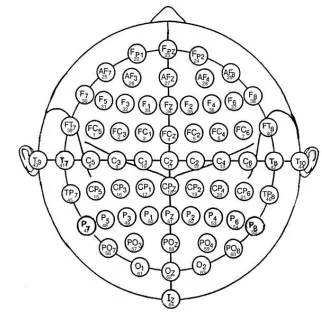
The electrodes, "X" and "Y", are EOG signals; and 163
"nd" is the reference electrode. The locations of the 164
EEG electrodes used for data acquisition are shown 165
in Fig. 1. In this paper, the data from 166
SMNI_CMI_TRAIN.tar.gz are used as the training 167
data, and those from SMNI_CMI_TEST.tar.gz are 168
used as the testing data, respectively. 169
[image:2.612.352.513.507.674.2]170
3.
METHODOLOGY
172The workflow of the three proposed data selection 173
methods is shown in Fig. 2. 174
175
[image:3.612.49.274.123.306.2]176 177 178 179 180 181 182 183 184 185
Fig. 2 The workflow of the proposed methods. 186
Data selection aims at using optimal subsets of 187
variables, while retaining as much useful 188
information as possible. The implementation 189
details are described below. 190
HVG 191
A HVG is a mapping between time series and 192
complex network [27] according to a specific 193
geometric criterion to make use of methods of 194
complex network theory for characterizing time 195
series. Each datum in the time series corresponds 196
to a node in the graph, such that two nodes are 197
connected if their corresponding data heights are 198
larger than all the data heights between them [28]. 199
Its degree distribution is a good discriminator 200
between randomness and chaos. Let X = (
x
i ∈ 201R≥0: i = 1, 2, . . . , n) be an ordered set (or, 202
equivalently, a sequence) of non-negative real 203
numbers. The HVG of X is graph G = (X, E), 204
where X is a set of elements called nodes and E is 205
a set of unordered pairs of nodes called edges. Its 206
definition is shown in equation (1): 207
k i k j
1, (
)
(
)
0,
ij
x
x
x
x
e
otherwise
(1)
208where every k(i, j). In graph theory, the degree 209
of a node (or vertex) of a graph is the number of 210
edges connecting to the node, with loops counted 211
twice [29]. The degree of a vertex is denoted as 212
deg(
x
i). The degree sequence (DS) is the sequence 213of the degree of a graph. The node degree and its 214
sequence can be used to describe the characteristics 215
of the graph. 216
In this paper, the time series of EEGs are mapped 217
into graphs (G (X, E)). Each EEG sample is 218
mapped to a HVG, and each HVG has a GE value. 219
There are 1200 samples to be analyzed for each 220
electrode from 10 different trails. Totally 76800 221
features are extracted for 64 electrodes. All GE 222
features are evaluated with groups of alcoholics or 223
non-alcoholics. To illustrate the data 224
transformation process, let us take the dataset 225
co2a0000368 from electrode FP1 in the 226
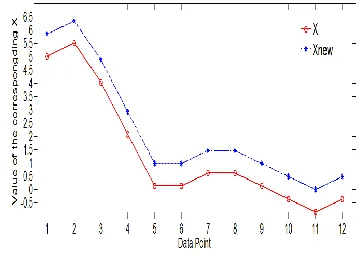
forementioned database for an example. Given X= 227
{5.015, 5.503, 4.039, 2.085, 0.132, 0.132, 0.621, 228
0.621, 0.132, -0.356, -0.844, -0.356}, we can get 229
the degree sequence DS= {1, 2, 2, 3, 2, 2, 3, 2, 2, 3, 230
2, 2} by the following implementation: 231
(a). Transform X into Xnew, making every element 232
be a non-negative real number by adding the 233
absolute value of the smallest value which is 234
negative. For example, 235
X= {5.015, 5.503, 4.039, 2.085, 0.132, 0.132, 236
0.621, 0.621, 0.132, -0.356, -0.844, -0.356} 237
should be transformed as 238
Xnew = {5.859, 6.347, 4.883, 2.929, 0.976, 0.976, 239
1.465, 1.465, 0.976, 0.488, 0, 0.488}, which is 240
demonstrated in Fig. 3. 241
242
Fig. 3 Nonnegative transform of X. 243
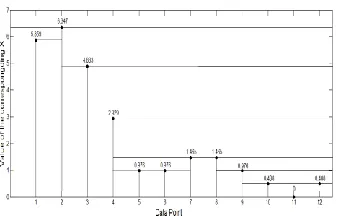
(b). Horizontal visibility check is used to calculate 244
the degree of each node, which is shown in Fig. 4. 245
Two nodes i and j in the graph are connected if one 246
can draw a horizontal line in the time series joining 247
i
x
andx
jthat does not intersect any intermediate 248data height. 249
EEGs
Mathematic Combinations
Kstar
Results PCA-GE Data Selection
Classification KNN GE Difference Based
[image:3.612.343.524.407.536.2]250
Fig. 4 The degree of each node from HVGs. 251
(c). Degree sequence. For arbitrary datum in the 252
time series, we calculate the visibility with all the 253
other corresponding nodes and record the number 254
of edges connecting to it as the degree of the node. 255
In the above example, the degree sequence is as 256
follows: 257
DS= {1, 2, 2, 3, 2, 2, 3, 2, 2, 3, 2, 2}. 258
GE 259
The GE is the entropy of the frequency distribution 260
of the node connections in an undirected and 261
unweighted HVG. It is a function from information 262
theory on a graph G, with a probability distribution 263
( )
p k
on its node set. It was introduced by Janos 264Korner in [30]. Shannon entropy [31] is used in 265
this paper, which is shown in equation (2): 266
1
( ) log( ( ))
n
k
h
p k
p k
(2) 267
where
entropy
is the degree distribution of graph 268G. The degree distribution p k( ) of a network is 269
defined to be the fraction of nodes in the network 270
with degreek . Thus if there are
n
nodes in total in 271a network and
k
n of them have degree
k
, we have 272equation (3) below: 273
k
( )
/
p k
n
n
(3) 274In the above case,
p k
( )
of DS is (0, 1/12, 8/12, 2753/12). The GE is 0.824 when it takes the logarithm 276
base two. The Mean GE plot from 64 electrodes is 277
shown in Fig. 5. From Fig. 5, it is clear that the 278
differences between the alcoholics and the control 279
subjects are indeed different from channel to 280
channel. That is the reason why optimal subsets of 281
channel selection are possible. In this paper, the 282
principal component analysis, the GE difference 283
and the mathematic combinations based on GE 284
channel selection are proposed. The details of the 285
proposed methods are demonstrated below. 286
[image:4.612.94.264.75.183.2]287
Fig. 5 Mean GE from 64 electrode signals. 288
3.1 The PCA Based on GE from HVG (PCA-GE) 289
Invented by Pearson [32] in 1901, the PCA was 290
widely used in mechanics and independently 291
developed (and named) by Harold Hotelling later 292
in the 1930s [33]. Nowadays, it is used as a tool in 293
exploratory data analysis and for making predictive 294
models. The faithful transformation T = XW maps 295
a data vector X from an original space to a new 296
space of 𝑝variables which are uncorrelated over 297
the dataset. However, not all the principal 298
components are kept. Keeping only the first L 299
principal components, it gives the truncated 300
transformation as shown in equation (4): 301
L L
T = XW
(4)
302where matrix
L
T now has
n
rows but onlyL
303
columns. By reconstruction, all the transformed 304
data matrices reserve only
L
columns out of the 305original data. Such dimensionality reduction can be 306
a very useful step for visualizing and processing 307
high-dimensional data while keeping as much 308
useful information as possible. In order to keep the 309
same size of input data for the further classification 310
process, here, the corresponding number of the 311
principal components which are the same as that of 312
channels has been chosen. Therefore, the 313
dimensionalities of all the samples are the same. 314
The PCA is implemented in Matlab2013b. The 315
distribution percentage of the total power is shown 316
318
Fig. 6 The corresponding power percentages of different 319
numbers of the principal components from the full size of data. 320
The PCA-GE technique is applied to extracted 321
representative data transformed from the dataset 322
without specific channel selection investigation. 323
For the alcoholic database, there are 64 electrodes 324
of signals per trial. The inconvenient data 325
preparation and complicated calculations are still 326
challenging for an online analysis and 327
classification system. In the following section, how 328
to gain an optimal subset of specific channels is 329
discussed. 330
3.2 The GE Difference Based Channel Selection 331
From Fig. 5, it is clear that the mean GE differs 332
from electrode to electrode between alcoholic 333
subjects and non-alcoholic ones. Therefore, the 334
channel selection based on the GE difference is 335
proposed. Firstly, the electrodes should be ordered 336
degressively according to the mean GE gap values. 337
They are C1, C2, PO8, PO7, C3, FC2, FCZ, CP2, 338
CPZ, PZ, FZ, CP5, F1, P2, C4, FC1, F2, P4, CP1, 339
P1, CP6, CZ, CP4, AFZ, FC5, AF2, AF1, F8, P3, 340
TP7, T7, POZ, F3, FPZ, FT7, FP1, PO2, AF8, OZ, 341
X, F4, CP3, P6, FC3, PO1, FC4, FT8, O2, Y, F6, 342
P7, P5, nd, C6, C5, TP8, AF7, F7, F5, FC6, T8, P8, 343
FP2, and O1. For comparison reasons, the 344
corresponding specific numbers of channels are 345
selected to generate the optimal subsets for 346
classification. For example, C1 is selected to gain 347
the one-channel subset because the mean GE gap is 348
the largest among all the channels. Similarly, C1 349
and C2 are chosen to gain the two-channel subset, 350
and so on. After that, all the selected data are 351
forwarded to three different classifiers for 352
classification separately. The performance of the 353
proposed channel selection method is demonstrated 354
in the experimental results section. 355
3.3 The Mathematic Combinations Channel 356
Selection 357
In mathematics, a combination is a way of 358
selecting members from a group, and the order of 359
members does not matter. In smaller cases, it is 360
possible to count the number of combinations. 361
More formally, a k-combination of a set S is a 362
subset of k distinct elements of S. If the set has n 363
elements, the number of k-combination is equal to 364
the binomial coefficient. 365
366
1 ... 1
1 ...1
k n
n n n k
C
k k
(5) 367
368
which can be written using factorials as ! !( )!
n k nk
if 369
k
n
, and is zero whenk
n
. The set of all k-370combination of a set S is sometimes denoted by 371
k n
C . 372
Here, mathematic combinations can also be used to 373
select channels from the original 64 electrodes. The 374
proposed method ignores the importance of the 375
individual channels and treats them equally. The 376
main idea of this method is to introduce a simple 377
computer-assisted-mathematic-method for medical 378
signals analysis. It seems inefficient to do random 379
mathematic combinations. However, it can easily 380
find out the optimal subsets in a dataset by 381
computers through k n
C runs. In this paper, the 382
average classification accuracy of the ten-time 383
trials with specific numbers of channels chosen by 384
mathematic combinations is demonstrated in the 385
experimental results section for comparison. 386
During the classification process in this paper, the 387
extracted data from the previous data selection 388
stage are classified by three different classifiers, 389
namely: the J48 decision tree, the K-nearest 390
neighbor (KNN) and the Kstar. The details of the 391
classifiers are introduced in this section. 392
J48 Decision Tree 393
The J48 decision tree (Weka implementation of 394
C4.5) was published by Ross Quinlan in 1993 [34]. 395
It is a classic method to represent information from 396
a machine learning algorithm and offers a fast and 397
powerful means to express structures in data [35]. 398
In this paper, the J48 algorithm provided by Weka 399
is used. Weka is an open-source Java application 400
produced by the University of Waikato in New 401
Zealand. This software offers an interface through 402
which many algorithms can be utilized on pre-403
formatted datasets. Using this interface, several test 404
0.4 0.5 0.6 0.7 0.8 0.9 1
1 6 11 16 21 26 31 36 41 46 51 56 61
P
o
w
er
P
er
ce
n
ta
g
e
domains are experimented to gain an insight into 405
the effectiveness of the above three different data 406
selection methods. 407
K-nearest neighbor (KNN) 408
The KNN algorithm is also selected to conduct the 409
binary classification. The KNN algorithm is a 410
statistical supervised classification which is widely 411
used in traditional pattern recognition techniques 412
[36]. The idea is that given a set of data
t
, the 413algorithm obtains the K nearest neighbors from 414
the training set based on the distance between
t
415and the training set. The most dominating class 416
amongst these K neighbors is assigned as class
t
. 417In this study, the KNN algorithm is implemented 418
as IBK package in Weka 3.7.11. 419
Kstar 420
The Kstar algorithm is used to evaluate the 421
efficiency of the proposed data selection methods. 422
It can be defined as a method of clustering analysis 423
which aims at partitioning
n
observations intok
424
clusters in which each observation belongs to a 425
cluster with the nearest mean. The algorithm 426
provides a consistent approach to handle real 427
valued attributes, symbolic attributes and missing 428
values. It uses entropy as a distance measure. In 429
this study, the Kstar algorithm is also implemented 430
in Weka 3.7.11. 431
4.
EXPERIMENTAL RESULTS
432
Experimental Environment 433
GE is extracted by R x64 3.1.0 and the 434
implementation of the PCA is done by 435
Matlab2013b. The classification is performed using 436
the J48 decision tree, the KNN and the Kstar in 437
Weka 3.7.10. All experiments are performed on a 438
3.40GHz Intel(R) Core(TM) i7-3770 CPU 439
processor PC, with 8.00G RAM and 64-bit 440
Operation System. The operation system of the PC 441
is Microsoft Windows 7. 442
Data Set Selection 443
The experimental EEG datasets consist of two 444
classes (denoted as alcoholic (a) and control (c)). 445
There are 600 samples in
446
SMNI_CMI_TRAIN.tar.gz and 600 samples in 447
SMNI_CMI_TEST.tar.gz from 64 different 448
channels, respectively. In this paper, GE is used to 449
extract features based on HVGs and then the PCA, 450
GE differential based selection or mathematic 451
combinations selection are implemented in 452
choosing the subset of the EEG signals. Each 453
channel data in one second from one sample is 454
mapped to a HVG, and each HVG is extracted as 455
one GE value. Therefore, 76,800 GE features are 456
extracted from the 1200 samples, with each sample 457
having 64 channels. That is to say, both the 458
training data and the testing data are transferred 459
into a [600*64] matrix. 460
Then different subsets of both the training data and 461
the testing data used during the experiments are 462
determined as: (1). Set 1 (1/64 of data), (2). Set 2 463
(2/64 of data), (3). Set 3 (19/64 of data), and (4). 464
Set 4 (64/64 of data). The reason why adopt the 465
above mentioned sets is illustrated as follows: The 466
classification results based on different percentages 467
of the whole data, which is 1/64, 2/64, 19/64, 26/64, 468
32/64, 39/64, 46/64, 53/64, 64/64, using the J48 469
decision tree, the KNN and the Kstar are displayed 470
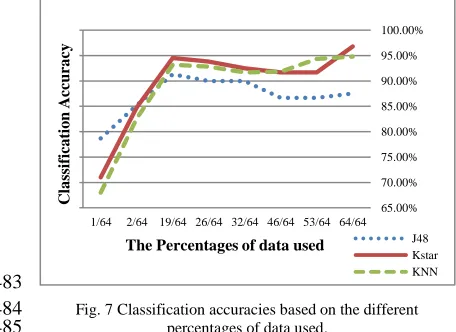
in Fig. 7. The classification accuracy increases 471
dramatically when increasing the amount of data 472
used between 1/64 and 19/64. But the accuracy 473
decreases slightly after that and rises again after 474
using 53/64 of the whole data. For online EEG 475
analysis and classification system design, both 476
classification accuracy and the computation time 477
are critical. The redundancy and noise often cause 478
the decrease of the classification efficiency. 479
Therefore, it is significant to select the informative 480
data and eliminate the redundant and misleading 481
data to reduce the computation time. 482
[image:6.612.313.541.427.593.2]483
Fig. 7 Classification accuracies based on the different 484
percentages of data used. 485
Data selection is expected to preserve as much 486
information as those in the whole database. This 487
paper proposes three data selection methods: (1). 488
the PCA-GE, (2). the GE difference based channel 489
selection, and (3). the mathematic combinations 490
channel selection. In PCA-GE, the four groups of 491
experiments with their power percentages are 492
shown in Table 1. The distributions of the data sets 493
65.00% 70.00% 75.00% 80.00% 85.00% 90.00% 95.00% 100.00%
1/64 2/64 19/64 26/64 32/64 46/64 53/64 64/64
C
la
ssi
fi
ca
ti
o
n
A
cc
u
ra
cy
The Percentages of data used J48
Kstar KNN
and the PCA selected data are summarized in Table 494
2. 495
Table 1 496
The corresponding power percentages of different numbers of 497
principal components from original data. 498
Table 2 499
The distribution of sample sets and the PCA extracted features. 500
Performance Comparisons 501
The performances of the PCA-GE method with the 502
experimental EEG datasets using the three different 503
classifiers are evaluated with the aspect of the 504
classification accuracy as shown in Table 3 and the 505
computation time in Table 4. From Tables 3 and 506
Table 4, it is apparent that using 19 out of 64 507
original data can achieve as high as 94.5% 508
accuracy by costing only 29.52% of the 509
computation time, compared to the 96.8% accuracy 510
by using the whole data through the Kstar classifier. 511
Besides, it is interesting to see the improvement of 512
the accuracy from 87.5% to 91.3% by using 19/64 513
data through the J48 decision tree classifier for the 514
PCA-GE data selection method. It is probably due 515
to the filtering of the noise, so that the remaining 516
data are more representative but with much smaller 517
amount. To evaluate the wide applicability of the 518
selected data, three different classifiers are adopted 519
and the one having the highest classification 520
accuracy among the three classifiers is denoted as 521
Bold in the following tables (e.g., Tables 3, 5 and 522
6). 523
Table 3 524
The classification accuracy of the proposed PCA-GE method. 525
Table 4 526
The computation time of the proposed PCA-GE method. 527
Apparently, less data means less computation time. 528
The computation times of all the three proposed 529
methods are reduced significantly when the 530
number of data used decreases as shown in Table 4. 531
In the meantime, the performances of the selected 532
channels subsets based on the mean GE gap values 533
are presented by Table 5 in terms of the 534
classification accuracy. The one-channel signal is 535
from electrode C1. The two-channel data are from 536
electrodes C1 and C2. The 19 channels data are 537
from electrodes C1, C2, PO8, PO7, C3, FC2, FCZ, 538
CP2, CPZ, PZ, FZ, CP5, F1, P2, C4, FC1, F2, P4, 539
CP1; and the 64 channels signals are all the 540
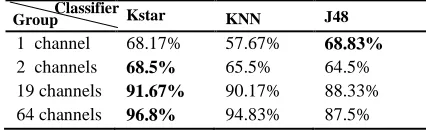
recorded signals from the HVG GEs, respectively. 541
According to our experiment, the proposed GE 542
difference based channel selection method achieves 543
as high as 91.67% classification accuracy by using 544
only 19 out of 64 channels of data for the Kstar 545
classifier. Therefore, it can significantly enhance 546
the efficiency of the EEG data collection. Instead 547
of using all the 64 electrodes placed on the scalp of 548
the subjects, 19 electrodes are enough to gain 549
[image:7.612.332.545.453.518.2]satisfactory classification results. 550
Table 5 551
The classification accuracy of the GE difference based channel 552
selection. 553
The performances of the selected channels subsets 554
from mathematic combinations are presented by 555
Table 6 in terms of the classification accuracy. 556
Compared to the data selection based on PCA-GE 557
or GE difference, this method neglects the possible 558
different impacts of the individual channels. The 559
method yields an 83.83% classification accuracy 560
when the channel number is 19 through the KNN 561
classifier. 562
Table 6 563
The classification accuracy of the mathematic combinations 564
based channel selection. 565
Set ID No. of Principal Components Power Percentage Set 1 1 0.479
Set 2 2 0.637
Set 3 19 0.935
Set 4 64 1
Set ID Training Set Testing Set Total
Set 1 [600 x 1] [600 x 1] [1200 x 1]
Set 2 [600 x 2] [600 x 2] [1200 x 2]
Set 3 [600 x 19] [600 x 19] [1200 x 19]
Set 4 [600 x 64] [600 x 64] [1200 x 64]
Kstar KNN J48
1 component 71.0% 68.0% 78.7%
2 components 84.8% 82.5% 85.2%
19 components 94.5% 93.2% 91.3%
64 components 96.8% 94.8% 87.5%
Kstar KNN J48
1 component 0.63s 0.01s 0.01s
2 components 1.28s 0.01s 0.02s 19 components 11.51s 0.06s 0.03s 64 components 38.99s 0.10s 0.04s
Kstar KNN J48
1 channel 68.17% 57.67% 68.83%
2 channels 68.5% 65.5% 64.5%
19 channels 91.67% 90.17% 88.33%
64 channels 96.8% 94.83% 87.5%
Group Classifier
Group
Group Classifier
In summary, all the proposed methods have been 566
proved to yield an acceptable classification 567
accuracy using significantly reduced amount of 568
data. The results validate the efficiency of the 569
proposed methods in the EEG data reduction. 570
Using as less as possible data to gain high 571
classification performances could significantly 572
reduce the processing time as well as the data 573
collection hardware requirements. 574
5.
DISCUSSION575
According to experimental results, the proposed 576
PCA-GE algorithm can achieve the comparable 577
accuracy 94.5% by costing only 29.52% of the 578
computation time and using 19 out of 64 original 579
data, compared to the 96.8% accuracy by using the 580
whole 64 channels of the data through the Kstar 581
classifier. Similarly, the proposed GE difference 582
based channel selection method also gets 91.67% 583
classification accuracy by using only 19 out of 64 584
channels of data for the Kstar classifier. They are 585
of high efficiency in terms of both the 586
classification accuracy and the computation time. It 587
is demonstrated that the proposed methods can 588
gain relatively high classification accuracies with a 589
significantly reduced running time during the EEG 590
analysis and classification process. Data selection 591
opens the possibility of using much less 592
representative data to gain satisfactory analysis and 593
classification results 594
6.
CONCLUSSION
595
For multi-channel real EEG signals, using optimal 596
data subsets instead of all the original data and 597
achieving relatively satisfactory classification 598
accuracies with much less computation time are 599
important for EEG analysis and classification. How 600
to get the optimal subsets from the original data is 601
crucial to the following classification performance. 602
In this paper, firstly the GE features from HVGs of 603
the EEG data from alcoholics are calculated. Based 604
on the GE features, the proposed data selection 605
methods are the PCA-GE, the GE difference based 606
channel selection and the mathematic combinations 607
channel selection. It is apparent that less running 608
time is needed by the analysis and classification 609
system if less data are used. Instead of using 610
original data, we extracted features using GE based 611
on HVG. The PCA is successfully used in data 612
selection. Meantime, channel selections based on 613
GE difference and mathematic combinations are 614
proposed for the purpose of comparisons. All of 615
them can gain high classification accuracy as well 616
as decrease the computation time, which is 617
important for the design of the online EEG signals 618
analysis and classification system. Data selection 619
using PCA-GE algorithm was found to be more 620
efficient and beneficial. 621
REFERENCES 622
[1] Haas LF (2003) Hans Berger (1873–1941), Richard Caton
623
(1842–1926), and electroencephalography. Journal of
624
Neurology, Neurosurgery & Psychiatry 74 (1):9-9
625
[2] Lehnertz K, Elger CE (1998) Can Epileptic Seizures be
626
Predicted? Evidence from Nonlinear Time Series Analysis of
627
Brain Electrical Activity. Physical Review Letters 80
628
(22):5019-5022
629
[3] Martinerie J, Adam C, Quyen MLV, Baulac M, Clemenceau
630
S, Renault B, Varela FJ (1998) Epileptic seizures can be
631
anticipated by non-linear analysis. Nat Med 4
(10):1173-632
1176
633
[4] Siuly S, Kabir E, Wang H, Zhang Y (2015) Exploring
634
Sampling in the Detection of Multicategory EEG Signals.
635
Computational and Mathematical Methods in Medicine
636
2015:576437. doi:10.1155/2015/576437
637
[5] Siuly, Li Y, Wen P (2011) EEG signal classification based on
638
simple random sampling technique with least square support
639
vector machine. International Journal of Biomedical
640
Engineering and Technology 7 (4):390-409.
641
doi:10.1504/IJBET.2011.044417
642
[6] Zhu G, Li Y, Wen P (2011) Evaluating functional
643
connectivity in alcoholics based on maximal weight
644
matching. Journal of Advanced Computational Intelligence
645
and Intelligent Informatics 15 (9):1221-1227
646
[7] Wackermann J (1995) Beyond mapping: estimating
647
complexity of multichannel EEG recordings. Acta
648
neurobiologiae experimentalis 56 (1):197-208
649
[8] Zhu G, Li Y, Wen PP (2012) An efficient visibility graph
650
similarity algorithm and its application on sleep stages
651
classification. In: Brain Informatics. Springer, pp 185-195
652
[9] Stam C, Lelj EHvd, Keunen R, Tavy D (1999) Nonlinear
653
EEG changes in postanoxic encephalopathy. Theory in
654
Biosciences-Theorie in den Biowissenschaften 118
(3-655
4):209-218
656
[10] Stam CJ, Van Woerkom T, Keunen R (1997) Non-linear
657
analysis of the electroencephalogram in Creutzfeldt-Jakob
658
disease. Biological cybernetics 77 (4):247-256
659
[11] Nguyen-Ky T, Wen P, Li Y, Malan M (2012) Measuring the
660
hypnotic depth of anaesthesia based on the EEG signal using
661
combined wavelet transform, eigenvector and normalisation
662
techniques. Computers in biology and medicine 42
(6):680-663
691
664
[12] Li T, Wen P, Jayamaha S (2014) Anaesthetic EEG signal
665
denoise using improved nonlocal mean methods.
666
Australasian Physical & Engineering Sciences in Medicine
667
37 (2):431-437
668
[13] Misulis KE, Spehlmann R (1994) Spehlmann's evoked
669
potential primer: visual, auditory, and somatosensory evoked
670
potentials in clinical diagnosis. Butterworth-Heinemann
671
Medical,
672
[14] Oscar-Berman M, Marinković K (2007) Alcohol: effects on
673
neurobehavioral functions and the brain. Neuropsychology
674
review 17 (3):239-257
675
[15] Richman JS, Moorman JR (2000) Physiological time-series
676
analysis using approximate entropy and sample entropy.
677
American Journal of Physiology-Heart and Circulatory
678
Physiology 278 (6):H2039-H2049
679
Kstar KNN J48
1 channel 58% 54.18% 58%
2 channels 58.33% 59.5% 61%
19 channels 81.33% 83.83% 78.5%
64 channels 96.8% 94.83% 87.5%
[16] Di W, Zhihua C, Ruifang F, Guangyu L, Tian L Notice of
680
Retraction Study on human brain after consuming alcohol
681
based on EEG signal. In: Computer Science and Information
682
Technology (ICCSIT), 2010 3rd IEEE International
683
Conference on, 2010. IEEE, pp 406-409
684
[17] Sun Y, Ye N, Xu X EEG analysis of alcoholics and controls
685
based on feature extraction. In: Signal Processing, 2006 8th
686
International Conference on, 2006. IEEE,
687
[18] Subasi A (2007) EEG signal classification using wavelet
688
feature extraction and a mixture of expert model. Expert
689
Systems with Applications 32 (4):1084-1093
690
[19] Güler I, Übeyli ED (2005) Adaptive neuro-fuzzy inference
691
system for classification of EEG signals using wavelet
692
coefficients. Journal of neuroscience methods 148
(2):113-693
121
694
[20] Tsuji T, Bu N, Fukuda O, Kaneko M (2003) A recurrent
log-695
linearized Gaussian mixture network. Neural Networks,
696
IEEE Transactions on 14 (2):304-316
697
[21] Vasicek O (1976) A test for normality based on sample
698
entropy. Journal of the Royal Statistical Society Series B
699
(Methodological):54-59
700
[22] Polat K, Güneş S (2007) Classification of epileptiform EEG
701
using a hybrid system based on decision tree classifier and
702
fast Fourier transform. Applied Mathematics and
703
Computation 187 (2):1017-1026
704
[23] Chandaka S, Chatterjee A, Munshi S (2009)
Cross-705
correlation aided support vector machine classifier for
706
classification of EEG signals. Expert Systems with
707
Applications 36 (2):1329-1336
708
[24] Zhu G, Li Y, Wen PP, Wang S (2014) Analysis of alcoholic
709
EEG signals based on horizontal visibility graph entropy.
710
Brain Informatics:1-7
711
[25] Tomida, Naoki, et al. "Active Data Selection for Motor
712
Imagery EEG Classification." Biomedical Engineering, IEEE
713
Transactions on 62.2 (2015): 458-467.
714
[26] Bache K, Lichman M (2013) UCI machine learning
715
repository. URL http://archive. ics. uci. edu/ml, vol 901.
716
[27] Gutin G, Mansour T, Severini S (2011) A characterization of
717
horizontal visibility graphs and combinatorics on words.
718
Physica A: Statistical Mechanics and its Applications 390
719
(12):2421-2428
720
[28] Luque B, Lacasa L, Ballesteros F, Luque J (2009) Horizontal
721
visibility graphs: Exact results for random time series.
722
Physical Review E 80 (4):046103
723
[29] Diestel R (2005) Graph Theory (3rd ed'n).
724
[30] Körner J Coding of an information source having ambiguous
725
alphabet and the entropy of graphs. In: 6th Prague conference
726
on information theory, 1973. pp 411-425
727
[31] Shannon CE (2001) A mathematical theory of
728
communication. ACM SIGMOBILE Mobile Computing and
729
Communications Review 5 (1):3-55
730
[32] Person K (1901) On lines and planes of closest fit to systems
731
of points in space. philosophical magazine 2 (6):559-572
732
[33] Hotelling H (1933) Analysis of a complex of statistical
733
variables into principal components. Journal of educational
734
psychology 24 (6):417
735
[34] Salzberg SL (1994) C4. 5: Programs for machine learning by
736
j. ross quinlan. morgan kaufmann publishers, inc., 1993.
737
Machine Learning 16 (3):235-240
738
[35] Sehgal L, Mohan N, Sandhu PS Quality prediction of
739
function based software using decision tree approach. In:
740
International Conference on Computer Engineering and
741
Multimedia Technologies (ICCEMT), 2012. pp 43-47
742
[36] Duda RO, Hart PE (1973) Pattern classification and scene
743
analysis. vol 3. Wiley New York,