Evaluating Topic Representations for Exploring
Document Collections
Nikolaos Aletras
Computer Science, University College London, Gower Street, London, WC1E 6BT, United Kingdom. E-mail: [email protected]
Timothy Baldwin
Computing and Information Systems, University of Melbourne, CIS, Melbourne, Victoria 3204, Australia. E-mail: [email protected]
Jey Han Lau
Department of Philosophy, King’s College, Strand, London, London, WC2R 2LS, United Kingdom. E-mail: [email protected]
Mark Stevenson
Computer Science, University of Sheffield, Regent Court, 211 Portobello, Sheffield, S Yorks S1 4DP, United Kingdom. E-mail: [email protected]
Topic models have been shown to be a useful way of representing the content of large document collections, for example, via visualization interfaces (topic brows-ers). These systems enable users to explore collections by way of latent topics. A standard way to represent a topic is using a term list; that is the top-n words with highest conditional probability within the topic. Other topic representations such as textual and image labels also have been proposed. However, there has been no comparison of these alternative representations. In this article, we compare 3 different topic representations in a document retrieval task. Participants were asked to retrieve relevant documents based on predefined queries within a fixed time limit, presenting topics in one of the following modalities: (a) lists of terms, (b) textual phrase labels, and (c) image labels. Results show that textual labels are easier for users to interpret than are term lists and image labels. Moreover, the precision of retrieved documents for textual and image labels is com-parable to the precision achieved by representing topics using term lists, demonstrating that labeling methods are an effective alternative topic representation.
Introduction
In recent years, a large amount of information has been made available online in digital libraries, collections, and archives. Much of this information is stored in unstructured format (e.g., text) and is not organized using any classification system. The sheer volume of available information can be over-whelming for users, making it very difficult to find specific information or even explore such collections. The majority of search interfaces rely on keyword-based search. However, this approach only works when users have sufficient domain knowledge to be able to generate appropriate queries, but this is not always the case. Users may not know what information is available or not be sufficiently familiar with the information to be able to select appropriate keywords.
There are, of course, alternatives to keyword-based search which are useful in situations where the user is not familiar with the collection. Approaches that provide the user with an overview of the information available in the collection have proved useful for information-seeking tasks such as exploratory search (Marchionini, 2006) and sense-making (Hearst, 2009). For example, faceted brows-ing has proved useful for exploratory search (Collins, Viegas, & Wattenberg, 2009; Hearst, 2006; Smith, Czerwinski, Meyers, Robertson, & Tan, 2006). However, these approaches often presuppose a consistent classifica-tion scheme for the collecclassifica-tion. Unfortunately, these do not exist for all collections (e.g., because the collection is Received January 21, 2015; revised April 13, 2015; accepted April 30, 2015
© 2015 The Authors. Journal of the Association for Information Science and Technology published by Wiley Periodicals, Inc. on behalf of ASIS&T
•
Published online in Wiley Online Libraryconstructed from a disparate set of documents with no clas-sification scheme, or is aggregated across collections with incompatible schemes), and manual classification is imprac-tical for all but the smallest of collections.
These problems can be ameliorated by using large-scale automatic data-analysis techniques to present the unstruc-tured information to the user in a distilled manner which they can browse through. Topic models (Blei & Jordan, 2003; Blei, Ng, & Jordan, 2003; Hofmann, 1999) offer an unsupervised, data-driven means of capturing the themes discussed within document collections. These are repre-sented via a set of latent variables called “topics.” Each topic is a probability distribution over words occurring in the collection such that words that co-occur frequently are each assigned high probability in a given topic. Topic models also represent documents in the collection as probability distri-butions over the topics that are discussed in them.
Topic models have been shown to be a useful way of representing the content of large document collections, for example, via visualization interfaces (topic browsers) (Chaney & Blei, 2012; Ganguly, Ganguly, Leveling, & Jones, 2013; Gretarsson et al., 2012; Hinneburg, Preiss, & Schröder, 2012; Snyder, Knowles, Dredze, Gormley, & Wolfe, 2013). These systems enable users to navigate through the collection by presenting them with sets of topics. Topic models are well-suited for use in these inter-faces since they are able to identify underlying themes in collections and can be applied at low human cost, through the use of unsupervised learning.
Topics are often represented using a list of terms; that is, the top-nwords with highest marginal probability within a topic, such asschool, student, university, college, teacher, class, education, learn, high, program. Alternative represen-tations such as textual phrase labels (e.g.,education for our example topic) can potentially assist with the interpre-tations of topics, and researchers have developed methods to automatically generate these (Lau, Newman, Karimi, & Baldwin, 2010; Lau, Grieser, Newman, & Baldwin, 2011; Mei, Shen, & Zhai, 2007). Approaches that make use of alternative modalities, such as images (Aletras & Stevenson, 2013b), also have been proposed, with the advantage that they are language-independent and potentially provide at-a-glance access to the collection.
Intuitively, labels represent topics in a more accessible manner than does the standard term list approach. However, there has not, to our knowledge, been any empirical valida-tion of this intuivalida-tion—a shortcoming that this article aims to address—in carrying out a task-based evaluation of different topic model representations. In this, we compare three approaches to representing topics: (a) a standard term list, (b) textual phrase labeling, and (c) image labeling. These are used to represent topics generated from a digital archive of newswire stories, and evaluated in an exploratory search task. The aim of this study is to compare different topic rep-resentations within a document retrieval task. We aim to understand the impact of different topic-representation modalities in finding relevant documents for a given query,
and also measure the level of difficulty in interpreting the same topics through different representation modalities. We are interested in answering the following research questions:
RQ1. Which topic representations are suitable within a docu-ment browser interface?
RQ2. What is the impact of different topic representations on human search effectiveness for a given query?
First, we review previous work on automatically labeling topics and the use of topic models to create search interfaces. Then, we introduce an experiment in which three approaches to topic labeling are applied and evaluated within an explor-atory search interface. The results of the experiment on exploratory search are presented next, followed by intrinsic evaluation of the labels generated by the different methods.
Related Work
In early research on topic modeling, topics were repre-sented as ranked lists of terms with the highest probability, and textual labels were sometimes manually assigned to topics for convenience of presentation of research results (Mei & Zhai, 2005; Teh, Jordan, Beal, & Blei, 2006).
The first attempt to automatically assigning labels to topics was described by Mei et al. (2007). In their approach, a set of candidate labels is extracted from a reference col-lection using noun chunks and bigrams with high lexical association. Then, a relevance scoring function is defined, which minimizes the distance between the word distribution in a topic and the word distribution in candidate labels. Candidate labels are ranked according to their relevance, and the top-ranked label is chosen to represent the topic.
Magatti, Calegari, Ciucci, and Stella (2009) introduced an approach for labeling topics that relies on two manually labeled hierarchical knowledge resources: the Google Direc-tory and the OpenOffice English Thesaurus. The automatic labelling of topics algorithm computes the similarity between latent Dirichlet allocation (LDA)-inferred topics and categories in the topic tree, a preexisting hierarchical set of labeled categories, by computing scores using six stan-dard similarity measures. The label for the most similar category in the topic tree is assigned to the LDA topic.
Lau et al. (2010) proposed selecting the most representa-tive term from a topic as its label by computing the similarity between each word and all others in the topic. Several sources of information are used to identify the best label, including pointwise mutual information scores, WordNet hypernymy relations, and distributional similarity. These features are combined in a reranking model.
article titles. Outlier labels are identified using a word-similarity measure (Grieser, Baldwin, Bohnert, & Sonenberg, 2011) and removed. Finally, the top-five topic terms are added to the candidate set. The candidate labels are ranked using information from word-association measures, lexical features, and an information retrieval technique.
Mao et al. (2012) introduced a method for labeling hier-archical topics which makes use of sibling and parent–child relations of topics. Candidate labels are generated using a similar approach to the one used by Mei et al. (2007). Each candidate label is then assigned a score by creating a distri-bution based on the words it contains, and measuring the Jensen-Shannon divergence between this and a reference corpus. Results show that incorporating information about the relations between topics improves label quality.
Hulpus, Hayes, Karnstedt, and Greene (2013) use the structured data in DBpedia1to label topics. Their approach maps topic words to DBpedia concepts and identifies the best ones using graph centrality measures, assuming that words co-occurring in text likely refer to concepts that are closer in the DBpedia graph.
Basave et al. (2014) presented a method for labeling LDA topics trained on social media streams (i.e., Twitter) using summarization techniques. Their method generates labels which exist in the Twitter stream rather than relying on external knowledge sources.
Aletras and Stevenson (2014) introduced an unsuper-vised graph-based method that selects textual phrase labels for topics. PageRank (Page, Brin, Motwani, & Winograd, 1999) is used to weigh the words in the graph and score the candidate labels.
In contrast, Aletras and Stevenson (2013b) proposed a method for labeling topics using images rather than text. A set of candidate images for a topic is retrieved by querying an image search engine with the top-ntopic terms. The most suitable image is selected using PageRank. The ranking algorithm makes use of textual information from the meta-data associated with each image, and visual features extracted from the analysis of the images themselves.
Topic modeling has been used to support browsing in large document collections (Chaney & Blei, 2012; Chuang, Ramage, Manning, & Heer, 2012; Ganguly et al., 2013; Gardner et al., 2010; Hinneburg et al., 2012; Newman et al., 2010; Snyder et al., 2013; Wei et al., 2010). The collection is often presented to users as a set of topics. Users can access documents in the collection by selecting topics of interest. The vast majority of topic-based browsers developed so far have relied on using lists of terms to represent the topics, and have not made use of previous research on automatically generating labels for topics. We address this limitation by making use of three approaches to labeling topics within a topic-based browser and carrying out experiments to compare their effectiveness.
Methods
We conducted an experiment to compare three topic rep-resentations: (a) lists of terms, (b) textual phrase labels, and (c) image labels. Users were provided with an interface representing a set of topic models derived from a collection and asked to search for documents that were relevant to a set of queries.
We chose to use a search task, given the widely used and well-understood methods that are available. Interfaces based on topic models are more suited to document browsing, but quantifying performance is less straightforward for this task.
Document Collection
We make use of a subset of the Reuters Corpus (Rose, Stevenson, & Whitehead, 2002), which is both freely avail-able and has manually assigned topic categories associated with each document. The topic categories are used both as queries in the retrieval task and to provide relevance judg-ments to determine the accuracy of the docujudg-ments retrieved by users.
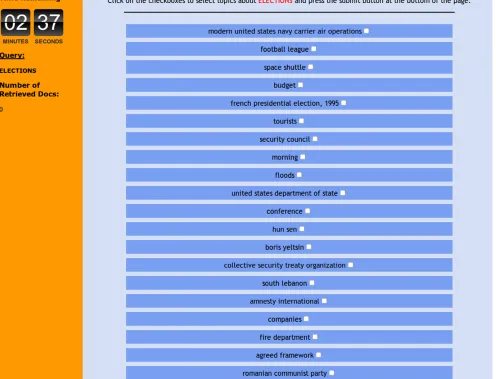
Twenty topic categories were selected, and 100,000 documents were randomly extracted from the Reuters Corpus. Each document is preprocessed by tokenization, removal of stop words, and removal of words appearing fewer than 10 times in the collection, resulting in a vocabulary of 58,162 unique tokens. Table 1 shows the Reuters Corpus topic categories used to form the collection, together with the number of associated documents.
[image:3.612.315.554.489.726.2]1http://dbpedia.org
TABLE 1. Number of documents in each Reuters Corpus topic category.
Reuters Topic Category (Query)
No. of Documents
Travel & Tourism 314
Domestic Politics (USA) 27,236
War—Civil War 16,615
Biographies, Personalities, People 2,601
Defense 4,224
Crime, Law Enforcement 10,673
Religion 1,477
Disasters & Accidents 3,161
International Relations 19,273
Science & Technology 1,042
Employment/Labour 2,796
Government Finance 17,904
Weather 1,190
Elections 5,866
Environment & Natural World 1,933 Arts, Culture, Entertainment 1,450
Health 1,567
European Commission Institutions 1,046
Sports 18,913
Topic Modeling
An LDA model was trained2
over the document collection using variational inference (Blei & Jordan, 2003). The number of topics learned was set toT=100 since topic inter-pretability in LDA tends to stabilize whenT≥100 (Stevens, Kegelmeyer, Andrzejewski, & Buttler, 2012). Default settings are used for all other parameters. Topics that are difficult to interpret were identified using the method of Aletras and Stevenson (2013a) and removed, leaving a total of 84 topics.
Topic Browsing Systems
The topic-browsing system developed for this study is based on the publicly available Topic Model Visualization Engine (TMVE; Chaney & Blei, 2012). TMVE uses a docu-ment collection and an LDA model trained over that collec-tion (discussed earlier). It generates a topic-browsing system with three main components: (a) a main page, (b) topic pages, and (c) document pages. The main page contains the list of automatically generated topics. Each topic page shows a list of documents with the highest conditional prob-ability given that topic. Document pages show the content of a document together with its topic distribution.
We created three separate browsing systems based on TMVE. The only difference between the three systems is the way in which they represent topics, namely: (a) term lists, (b) textual phrase labels, and (c) images. The term lists are created using a standard approach (discussed later), the textual phrase labels are generated from Wikipedia article titles (Lau et al., 2011) (discussed later), and the image labels are generated using publicly available images from Wikipedia (Aletras & Stevenson, 2013b) (discussed later). By default, TMVE only supports the term list representation of topics, and required modification to support textual phrase and image labels. Table 2 shows examples of the labels generated by the three approaches for a sample topic.3
In addition, in the topic page, each topic is associated with its top-300 highest likelihood documents given the topic. We restrict the number of documents shown to the user for each topic to avoid the task becoming overwhelming.
Term lists. Term lists are generated using the default approach of TMVE: selecting the top-10 terms with the highest conditional probability within the topic. This is the standard approach to representing topics used within the topic modeling research community.
Textual phrase labels. Textual phrase labels are generated using the approach of Lau et al. (2011), in two phases: candidate generation and candidate ranking.
In candidate generation, we use the top-seven topic terms4to search Wikipedia using Wikipedia’s native search application program interface (API) and Google’s site-restricted search. We collect the top-eight article titles returned from each of the search engines;5these constitute the primary candidates. To generate more candidates, we chunk-parse the primary candidates to extract noun chunks and generate component n-grams from the noun chunks, excludingn-grams that do not themselves exist as Wikipedia titles. As this procedure generates a number of labels, we introduce an additional filter to remove labels that have low association with other labels, based on the Related Article Conceptual Overlap (RACO) lexical association method (Grieser et al., 2011). The componentn-grams that pass the RACO filter constitute the secondary candidates. Last, we include the top-five topic terms as additional candidates.
In the candidate ranking phase, we generate a number of lexical association features of the label candidate with the top-10 topic terms: pointwise mutual information (PMI), Student’sttest, Pearson’sχ2test, log likelihood ratio, and two conditional probability variants. Term co-occurrence frequencies for computing these measures are sampled from the full collection of the English Wikipedia with a sliding window of length 20 words. We also include two features based on the lexical composition of the label candidate: the raw number of terms it contains and the proportion of terms in the label candidate that are top-10 topic terms. We combine all the features using a support vector regression model to rank the candidates.6The highest ranked candidate is selected as the textual phrase label for the topic.
Image labels. We associate topics with image labels using the approach described by Aletras and Stevenson (2013b). We generate candidate labels using images from Wikipedia, available under the Creative Commons license. The top-five terms from a topic are used to query Bing using
2We make use of the implementation provided by David Blei. https://
www.cs.princeton.edu/∼blei/lda-c/index.html
3Note that the textual phrase and image labels are created automatically
(discussed later) and may contain errors. In this example, the logo of the FBI may have been a more suitable image label than the one that was generated.
4From preliminary experiments, we found that using the top-10 terms
for search occasionally yields no results for a number of topics.
5The version of the Google search API used in the original article
limited the maximum number of results per query to eight.
6The model is trained using the labeled data collected by the authors in
Lau et al. (2011). TABLE 2. Labels generated for an example topic. [Color table can be
viewed in the online issue, which is available at wileyonlinelibrary.com.]
Modality Label
its Search API.7
The search is restricted to the English Wikipedia,8
with image search enabled. The top-20 images retrieved for each search are used as candidates for the topic and are represented by textual and visual features.
Textual features are extracted from the metadata associ-ated with the images. The textual information is formed by concatenating thetitleand theurlfields of the search result. These represent, respectively, the web page title containing the image, and the image file name. The textual information is preprocessed by tokenization and removal of stop words. Visual information is extracted using low-level image keypoint descriptors; that is, scale-invariant feature trans-form (SIFT) features (Lowe, 1999, 2004) sensitive to color information. Image features are extracted using dense sam-pling and described using Opponent color SIFT descriptors provided by thecolordescriptorpackage.9The SIFT features are clustered to form a visual codebook of 1,000 visual words usingk-means clustering, such that each feature is mapped to a visual word. Each image is represented as a bag-of-visual words (BOVW).
A graph is created using the candidate images as the set of nodes. Edges between images are weighted by computing the cosine similarity of their BOVWs. Then, Personalised PageRank (PPR; Haveliwala, Kamvar, & Jeh, 2003) is used to rank the candidate images. The personalization vector of PPR is initialized by measuring average word association between topic words and image metadata based on PMI, as in Aletras and Stevenson (2013b). The image with the highest PageRank score is selected as the topic label.
Task
The aim of the task was to identify as many documents as possible that are relevant to a set of queries. Each participant had to retrieve documents for 20 queries (see Table 1), with 3 minutes allocated for each query. In addition to the query (e.g., Travel & Tourism), participants also were provided with a short description of documents that would be consid-ered for the query (e.g.,News articles related to the travel and tourism industries, including articles about tourist des-tinations) to assist them in identifying relevant documents.
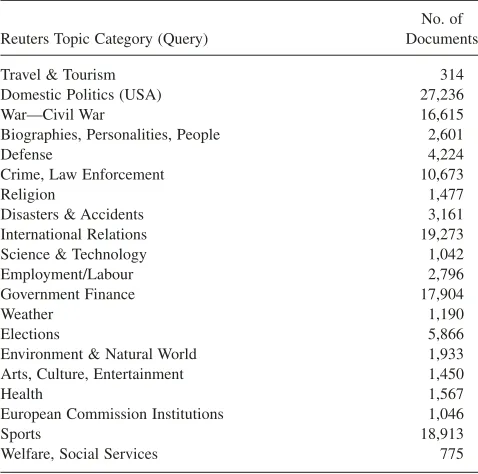
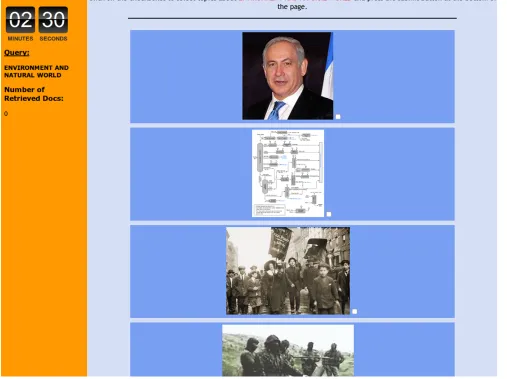
Participants were asked to perform the retrieval task as a two-step procedure. They first were provided with the list of LDA topics represented by a given modality (term list, textual label, or image), and a query. Next, they were asked to identify all topics that were potentially related to the query. Figure 1 shows the topic browser interface for the three different modalities. In the second step, participants were presented with a list of documents associated with the selected topics. Documents were presented in random order. Each document was represented by its title, and users were able to read its content in a pop-up window. Figure 2 shows a subset of the documents that are associated with the topics
selected in the first step. The documents that are presented to the user in the second step have high conditional probabilities of being associated with the topics that were selected in the first stage. However, note that this does not guarantee that they also are relevant to any given query.
In addition, we asked users to complete a posttask ques-tionnaire once they had completed the retrieval task. The questionnaire consisted of five questions, which were intended to provide insights into participant satisfaction with the retrieval task and the topic browsing system. Participants assigned an integer score from 1 to 7 (ranging fromuseful/ easy/familiar to very useful/easy/familiar) in response to each question. First, we asked about the usefulness of the different topic representations (i.e., term list, textual labels, and image labels). We also asked about the difficulty level of the task (“Ease of Search”) and the familiarity of the par-ticipants with the queries. The questions were as follows:
• How useful were the term lists in representing topics? (“Use-fulness [Term list]”)
• How useful were the textual phrases in representing topics? (“Usefulness [Textual label]”)
• How useful were the images in representing topics? (“Useful-ness [Image]”)
• How easy was the task? (“Ease of Search”)
• Did you find the queries easy to understand? (“Query Familiarity”)
Participants and Procedure
We recruited 15 members of the research staff and gradu-ate students at the University of Sheffield, University of Melbourne, and King’s College, London for the user study. All participants had a computer science background and also were familiar with online digital library and retrieval systems. Each participant was first asked to sign up to our online system so we could track a given user session across time. After logging in, participants had access to a personalized main page where they could read the instructions for the task, see how many queries they had completed so far, or select to perform a new query.
Participants were asked to perform the task for each of the 20 queries, which were presented in random order. Topic representation for each query was randomly chosen, and participants annotated different topics using varying topic representations. Topics and documents were presented in random order to ensure that there was no learning effect where participants became familiar with the order and were able to more quickly annotate some queries. We also encour-aged participants to perform their allocated queries in mul-tiple sessions by allowing them to return to the interface to complete further queries, provided that they completed the overall task within 1 week.
Results
We begin by exploring the number of documents retrieved and the proportion of retrieved documents that
7http://datamarket.azure.com/dataset/bing/search 8http://en.wikipedia.org
were relevant. Further analysis is carried out to determine relevance of the retrieved documents based on the topics that were selected in the first stage. Finally, results from the posttask questionnaire are discussed.
Number of Retrieved Documents
We assume that the number of retrieved documents for the three topic browsing systems is indicative of the time required to interpret topics and identify relevant ones. Topic representations that are difficult to interpret will require more time for participants to understand, which will have a direct effect on the number of documents retrieved.
Table 3 shows the number of documents retrieved for each query and modality. Representing topics using lists of terms results in the lowest number of documents retrieved both overall (1,086) and for the majority of the queries. The highest number of documents retrieved (1,264) occurs when the topics are represented using textual phrase labels. This
suggests that textual phrase labels are easier to interpret than are the other two representations, thereby allowing partici-pants to more quickly identify relevant topics. The number of documents retrieved for the image representation is slightly higher than the term lists, but lower than textual phrase labels.
The number of retrieved documents is high for queries that are associated with many relevant documents (Sportsin term lists, textual phrase labels, and image labels;Domestic Politics [USA]in image labels). The relatively large number of relevant documents leads to LDA generating a large number of topics relevant to them, which in turn provides users with many topics through which relevant documents can be selected. In addition, queries such as Weather and
[image:6.612.65.556.50.456.2]Further analysis compared the documents retrieved for individual queries. We computed the Pearson’s correlation coefficient between the number of documents retrieved for each query across the three topic representations. We observe a high correlation between term lists and textual phrase labels (r=0.76), and term lists and image labels (r=0.74), while the correlation between textual phrase and image labels is lower (r=0.63). These results demonstrate that the topic representation does not strongly affect the relative number of documents retrieved for each query. For example, for all three topic representations, two queries (Sports and Weather) appear within the top five of the ranking of documents retrieved, and three queries ( Biogra-phies, Personalities, People;Crime, Law Enforcement;and
Defense) appear within the bottom five. The correlation between term lists and textual phrase labels, and term lists and image labels, is higher than the correlation between textual phrase and image labels. The main reason might be that both textual phrase and image labels are automatically
generated from the topics, which introduces noise.10 Com-paring two noisy methods produces a lower correlation than when just one of them is noisy.
Precision
We also tested the performance of the different topic representations in terms of the proportion of retrieved docu-ments that are relevant to the query, by computing the average precision for each query across all 15 users. The results are shown in Table 4. Term lists achieve a higher precision (0.59) than did either the textual phrase (0.53) or image (0.56) labels. This is somewhat expected since label-ing is a type of summarization, and some loss of information is inevitable. Another possible reason is that the textual
10Note that the topics themselves are, of course, automatically generated
[image:7.612.62.558.56.435.2]and potentially noisy, but in terms of topic labeling, constitute the ground truth for a given topic.
phrase and image labels are assigned using automatic methods (discussed earlier), which leads to occasional bad label assignments to topics.
Queries such asSports,Health,Religion,andWar—Civil Warare in the top-three precision for the three topic repre-sentations. Identifying relevant documents might be easier for these queries since they tend to be distinct from other queries, making the process of identifying relevant docu-ments more straightforward. On the other hand, we observed low precision for queries that have a low number of relevant documents associated with them such as Welfare, Social Services;andBiographies, Personalities, People.
We computed the Pearson’s correlation coefficient between the precisions for the queries across topic represen-tations. An interesting finding is the similarly high correla-tion achieved between term lists and textual phrase labels (r=0.83), and term lists and image labels (r=0.84). Corre-lation between textual phrase and image labels is lower (r=0.79), suggesting that there is greater disparity between
the queries for which the two methods achieve high/low precision. This also is likely to happen because of bad label-ing of topics.
Document Relevance Based on Topic Selection
[image:8.612.57.564.59.438.2]P
U P t d
relevant
t T d D u U relu u
=
( )
∈ ∈ ∈
∑
∑
∑
1(1)
P
U P t d
irrelevant
t T d D u U irru u
=
( )
∈ ∈ ∈
∑
∑
∑
1 (2)
wheredis a document, Drelu
is the set of relevant documents retrieved by a useru, Dirru
is the set of irrelevant documents retrieved,Tuis the set of topics selected by useruin the first step of the task,P(t|d) is the conditional probability of topic
tgiven the documentdaccording to the topic model, andU
[image:9.612.63.551.47.442.2]is the set of users who performed the query.
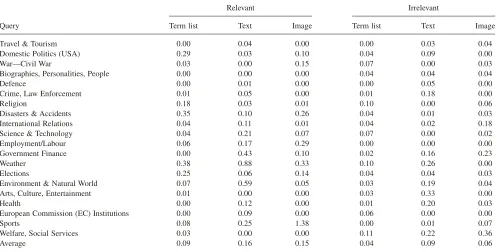
Table 5 shows the results of the average probability sum for relevant and irrelevant documents retrieved by users for each query and topic representation. The results show that both labeling methods perform better than the term list representation for retrieving relevant documents. Textual phrase labels perform best while image labels obtain com-parable performance. Apart from the fact that labeling
methods allow users to retrieve more documents, they also allow users to select more relevant topics for a given query.
On the other hand, the probability sum for irrelevant topics selected using the labeling algorithms is higher than are the term lists. Using lists of terms, participants select a lower number of irrelevant topics, which results in a lower irrelevant probability sum. The main reason might be the false labels assigned to topics by these algorithms, resulting in irrelevant topic selection by users.
We computed the ratio of the probability masses of the relevant and irrelevant documents retrieved for each topic. The highest ratio (2.5) was obtained when the image labels were used. The ratio for the topic terms is similar (2.3) while the ratio for textual phrases is lower (1.8). This suggests that the topic terms and image labels allow users to identify potentially relevant topics more accurately than when textual labels were used. This is supported by the rankings of the different approaches in terms of their overall precision (see Table 4).
[image:9.612.61.547.50.441.2]Posttask Questionnaire
The main finding of the posttask questionnaire is that all of the modalities achieve similar scores in terms of useful-ness, as detailed in Table 6. Term lists achieve the highest average score (4.33) while textual phrase labels are close behind (4.26), and image labels slightly lower again (4.00). This demonstrates that there is room for improvement in all modalities (recalling that the scores are of 7 in total) and that
the different topic representations can be complementary in topic browsers, providing users with alternative ways to explore a document collection.
Participants found the retrieval task quite challenging (3.53), although the average score for Query Familiarity was higher (4.40). Combined, these suggest that the majority of users were reasonably comfortable with the queries and that this is not a likely the cause of the lower score for ease of search. Rather, we consider it to be reflective of the nature of the task and the limited time available for each query.
Document Topic Label Relevance Human Judgments of Label Relevance
We conducted further analysis to explore the accuracy of the topic labeling methods. A crowdsourcing experiment was carried out in which participants were asked to rate topic labels using an annotation task that is similar to the “intruder detection” task (Chang et al., 2009) used to quan-tify topic interpretability.
Human judgments of the suitability of each label were obtained using the Crowdflower crowdsourcing platform.11 The document with the highest marginal probability is iden-tified for each of the 84 topics used in the previous experi-ment. This document is shown to the annotator together with four labels, one representing the topic and the other three representing randomly selected topics with low marginal probability for the document. The same three random topics are shown to all annotators for each document (although note that different random topics are used across questions). The order in which the topics are shown to annotators is randomized. Annotators were asked to judge the appropri-ateness of each topic label from 0 (irrelevant) to 3 (very relevant) with respect to the document’s main thematic content. The four topics were represented using each of the three topic modalities (i.e., term lists, text phrases, and images), and each topic was rated by at least 10 annotators. Figure 3 shows the interface of the crowdsourcing experiment.
This allows us to directly evaluate the interpretability of the topic representations since we assume that if the topic labels are appropriate, then annotators will assign higher scores to labels which are relevant to a document than to those which are randomly chosen.
Quality control in crowdsourcing experiments ensures reliability (Kazai, 2011). To avoid random answers, control questions with obvious answers were included in the survey. For example, we presented annotators with a document about finance in which the four available labels were a topic about finance and three stop words. Annotations by partici-pants who failed to correctly answer these questions or gave the same rating to all topics were ignored.
[image:10.612.58.297.68.306.2]11http://crowdflower.com
TABLE 3. Number of retrieved documents for each query and topic. representation.
Query Term list Text Image
Travel & Tourism 22 33 17
Domestic Politics (USA) 50 65 78
War—Civil War 61 31 40
Biographies, Personalities, People 27 37 29
Defence 26 51 29
Crime, Law Enforcement 34 49 25
Religion 84 97 44
Disasters & Accidents 73 62 63
International Relations 58 85 37
Science & Technology 60 38 56
Employment/Labour 51 49 58
Government Finance 42 61 34
Weather 95 129 111
Elections 47 58 50
Environment & Natural World 33 69 41 Arts, Culture, Entertainment 45 70 30
Health 82 76 37
European Commission (EC) Institutions 48 42 52
Sports 113 114 228
Welfare, Social Services 35 48 56
[image:10.612.58.297.351.589.2]Total 1,086 1,264 1,115
TABLE 4. Precision for each query and topic representation.
Query Term list Text Image
Travel & Tourism 0.73 0.42 0.59 Domestic Politics (USA) 0.62 0.69 0.69
War—Civil War 0.82 0.71 0.90
Biographies, Personalities, People 0.11 0.14 0.24
Defense 0.23 0.27 0.07
Crime, Law Enforcement 0.38 0.35 0.20
Religion 0.73 0.82 0.98
Disasters & Accidents 0.60 0.53 0.70
International Relations 0.66 0.69 0.70
Science & Technology 0.67 0.79 0.73
Employment/Labour 0.80 0.76 0.72
Government Finance 0.71 0.80 0.53
Weather 0.79 0.62 0.62
Elections 0.77 0.48 0.84
Environment & Natural World 0.45 0.54 0.49 Arts, Culture, Entertainment 0.44 0.04 0.50
Health 0.84 0.58 0.41
European Commission (EC) Institutions 0.35 0.33 0.33
Sports 0.99 0.98 0.98
Welfare, Social Services 0.17 0.00 0.04
Responses
A total of 2,520 filtered responses was obtained from 66 participants. The average response for each document–topic pair was calculated to create the final similarity judgment. The variance across judges (excluding control questions) was in the range of 0.22 to 0.29.
To measure inter-annotator agreement (IAA), we first calculated Spearman’s ρ between the ratings given by an annotator and the average ratings from all other annotators for those same document–topic pairs. We then averaged the
ρacross annotators and document–topic pairs. Average IAA scores are shown in Table 7. The lower agreement for the image labels indicates that the annotators found it more difficult to identify the correct label.
Evaluation
Topic representations were analyzed using the following two metrics:
• Top-1 average rating: the average human rating assigned to each topic label. This provides an indication of the overall
quality of the labels that the annotators judge as the best one. The highest possible score averaged across all topics is 3. • Match@1: the relative frequency of the correct topic for a
given representation being rated the highest of the four topics.
Results are shown in Table 8. Term lists achieve the best performance for both the Top-1 Average and Match@1 mea-sures, with scores of 1.70 and 0.92, respectively. As dis-cussed earlier, term lists have the advantage of being more descriptive and informative since they consist of more words than do textual phrase labels. The average ratings assigned by annotators are lower than the average scores assigned by humans to textual phrase and image labels in similar crowd-sourcing experiments (Aletras & Stevenson, 2013b; Lau et al., 2011). This is due to our labeling task being different in nature. We asked annotators to judge the appropriateness of the label given a document with high probability for that topic while previous experiments (Aletras & Stevenson, 2013b; Lau et al., 2011) seek to find the appropriateness of the label given the term list for a topic.
Textual phrase labels also perform well, with annotators able to identify the correct topic 83% of the time. Scores for this representation are close to those for the term lists despite the verbosity of topic labels generally being much lower than term lists. The average length of the textual phrase labels used in the experiment was 2.7 words while term lists contained 10 words. It is possible that the performance of textual phrase labels may equal, or even exceed, that of term lists with better labeling algorithms.
[image:11.612.59.556.61.313.2]On the other hand, results for image labels are substan-tially lower (Top-1 Average=0.83, and Match@1=0.67). This suggests that the image labels are not as clear as are the TABLE 5. Document relevance based on topic selection.
Query
Relevant Irrelevant
Term list Text Image Term list Text Image
Travel & Tourism 0.00 0.04 0.00 0.00 0.03 0.04
Domestic Politics (USA) 0.29 0.03 0.10 0.04 0.09 0.00
War—Civil War 0.03 0.00 0.15 0.07 0.00 0.03
Biographies, Personalities, People 0.00 0.00 0.00 0.04 0.04 0.04
Defence 0.00 0.01 0.00 0.00 0.05 0.00
Crime, Law Enforcement 0.01 0.05 0.00 0.01 0.18 0.00
Religion 0.18 0.03 0.01 0.10 0.00 0.06
Disasters & Accidents 0.35 0.10 0.26 0.04 0.01 0.03
International Relations 0.04 0.11 0.01 0.04 0.02 0.18
Science & Technology 0.04 0.21 0.07 0.07 0.00 0.02
Employment/Labour 0.06 0.17 0.29 0.00 0.00 0.00
Government Finance 0.00 0.43 0.10 0.02 0.16 0.23
Weather 0.38 0.88 0.33 0.10 0.26 0.00
Elections 0.25 0.06 0.14 0.04 0.04 0.03
Environment & Natural World 0.07 0.59 0.05 0.03 0.19 0.04
Arts, Culture, Entertainment 0.01 0.00 0.00 0.03 0.33 0.00
Health 0.00 0.12 0.00 0.01 0.20 0.03
European Commission (EC) Institutions 0.00 0.09 0.00 0.06 0.00 0.00
Sports 0.08 0.25 1.38 0.00 0.01 0.07
Welfare, Social Services 0.03 0.00 0.00 0.11 0.22 0.36
Average 0.09 0.16 0.15 0.04 0.09 0.06
TABLE 6. Results of the posttask questionnaire.
Question Average
Usefulness (Term list) 4.33
Usefulness (Text) 4.26
Usefulness (Image) 4.00
Query Familiarity 4.40
[image:11.612.58.298.354.432.2]other two types, making it difficult for annotators to identify the correct one. Image labels also are generated automati-cally, and mistakes in this process are likely to explain the lower performance to some extent. However, it also is pos-sible that images are inherently more ambiguous than are the other two types of labels, making it difficult for annotators to identify the correct topic.
The results from this experiment indicate some variation between how effectively the three topic representations are able to convey the semantics of a topic. However, results from the exploratory search experiment (discussed earlier) suggest that any of the three are useful ways of representing documents within a collection and, in particular, allow rel-evant documents to be identified. Term lists provide a faith-ful representation of a topic since they are generated directly from its keywords while the textual phrase and image labels are generated using labeling algorithms which rely on exter-nal resources and may make errors. On the other hand, the textual phrase and image labels are more compact than are term lists, allowing them to be interpreted more quickly and more to be fitted onto an interface. It is likely that these factors (fidelity and verbosity) balance out when the topic representations are used in the exploratory search interface. It also is possible, of course, that performance using textual phrase or image labels could be improved with the develop-ment of more accurate labeling algorithms.
Conclusion
[image:12.612.56.559.69.392.2] [image:12.612.57.298.456.513.2]We compared three representations for automatically generated topics: (a) lists of terms, (b) textual phrase labels, FIG. 3. Document topic relevance judgement interface.
TABLE 7. IAA across the four topic labels and document–topic pairs.
Representation IAA
Term list 0.81
Text 0.78
Image 0.57
TABLE 8. Results for the document topic detection task.
Representation Top-1 Average Match@1
Term list 1.70 0.92
Text 1.57 0.83
Image 0.83 0.67
[image:12.612.57.298.555.622.2]and (c) image labels. These representations were compared within an exploratory browsing interface, and an experiment was carried out in which users were asked to retrieve rel-evant documents using the interface.
Results show that participants were able to identify rel-evant documents using any of the three topic representa-tions. They were able to identify more documents when labels were used to represent topics than when term lists were used, suggesting that participants can interpret labels more quickly. However, a greater proportion of the retrieved documents are relevant to the query for term lists than for either type of label, suggesting that term lists contain more accurate information than do the labels. This hypothesis was explored in a further experiment in which participants were asked to identify the most appropriate topics for documents. The information in term lists was found to be more accurate, which is to be expected since the labels are effectively sum-maries of the topics and, since they are generated automati-cally from the topics, inevitably contain some errors (Aletras & Stevenson, 2013b; Lau et al., 2011). Despite this, the number of relevant documents retrieved in the exploratory search experiment is very similar for all approaches. Overall, textual phrases and image labels can be interpreted more quickly than can term lists, but not as accurately.
Results indicate that automatically generated labels are a suitable way for representing topics within search interfaces. They have the advantage of being more compact than are the term lists that are normally used, providing greater flexibil-ity in the creation of exploratory interfaces. Retrieval per-formance is comparable to when term lists are used and is likely to increase with improved topic labeling methods.
In the future, we would like to make use of other digital library collections to find out how successful these tech-niques are in other domains. We also would like to explore the connection between improved labeling methods and task performance.
Acknowledgments
We are grateful for support received from the Engineer-ing and Physical Sciences Research Council via the Network on Vision and Language, the Australian Research Council, and the Defence Science & Technology Laboratory through the Centre for Defence Enterprise.
References
Aletras, N., & Stevenson, M. (2013a). Evaluating topic coherence using distributional semantics. In Proceedings of the 10th International Conference on Computational Semantics (IWCS 2013)—Long Papers (pp. 13–22). Potsdam, Germany: Association for Computational Linguistics.
Aletras, N., & Stevenson, M. (2013b). Representing topics using images. In Proceedings of the 2013 Conference of the North American Chapter of the Association for Computational Linguistics: Human Language Tech-nologies (pp. 158–167). Atlanta, GA: Association for Computational Linguistics.
Aletras, N., & Stevenson, M. (2014). Labelling topics using unsupervised graph-based methods. In Proceedings of the 52nd annual meeting of the
Association for Computational Linguistics (Vol. 2: Short Papers) (pp. 631–636). Baltimore, MD: Association for Computational Linguistics. Basave, C., Elizabeth, A., He, Y., & Xu, R. (2014). Automatic labelling of
topic models learned from twitter by summarisation. In Proceedings of the 52nd annual meeting of the Association for Computational Linguis-tics (Vol. 2: Short Papers) (pp. 618–624). Baltimore, MD: Association for Computational Linguistics.
Blei, D.M., & Jordan, M.I. (2003). Modeling annotated data. In Proceed-ings of the 26th annual International ACM SIGIR Conference on Research and Development in Inform. Retrieval (SIGIR 03) (pp. 127– 134). Toronto, Canada: ACM.
Blei, D.M., Ng, A.Y., & Jordan, M.I. (2003). Latent dirichlet allocation. Journal of Machine Learning Research, 3, 993–1022.
Chaney, A.J.-B., & Blei, D.M. (2012). Visualizing topic models. In Pro-ceedings of the 6th International AAAI Conference on Weblogs and Social Media (pp. 419–422). Dublin, Ireland.
Chang, J., Boyd-Graber, J., & Gerrish, S. (2009). Reading tea leaves: How humans interpret topic models.Neural Inform., pp. 1–9.
Chuang, J., Ramage, D., Manning, C., & Heer, J. (2012). Interpretation and trust: designing model-driven visualizations for text analysis. In Proceed-ings of the SIGCHI Conference on Human Factors in Computing Systems (pp. 443–452). Austin, Texas: ACM.
Collins, C., Viegas, F.B., & Wattenberg, M. (2009). Parallel tag clouds to explore and analyze faceted text corpora. In Proceedings of IEEE Sym-posium on Visual Analytics Science and Technology (VAST 2009) (pp. 91–98). Atlantic City, New Jersey: IEEE.
Ganguly, D., Ganguly, M., Leveling, J., & Jones, G.J.F. (2013). TopicVis: A GUI for Topic-based feedback and navigation. In Proceedings of the 36th annual International ACM SIGIR Conference on Research and Develop. in Information Retrieval (SIGIR 13) (pp. 1103–1104). Dublin, Ireland: ACM.
Gardner, M.J., Lutes, J., Lund, J., Hansen, J., Walker, D., Ringger, E., & Seppi, K. (2010). The Topic Browser: An interactive tool for browsing topic models. In NIPS Workshop on Challenges of Data Visualization (pp. 5228–5235). Canada: Whistler.
Gretarsson, B., O’Donovan, J., Bostandjiev, S., Höllerer, T., Asuncion, A., Newman, D., & Smyth, P. (2012). TopicNets: Visual analysis of large text corpora with topic modeling. ACM Transactions on Intelligent System Technology, 3(2), 23, 26.
Grieser, K., Baldwin, T., Bohnert, F., & Sonenberg, L. (2011). Using ontological and document similarity to estimate museum exhibit relat-edness. Journal on Computing and Cultural Heritage (JOCCH), 3(3), 10, 20.
Haveliwala, T., Kamvar, S., & Jeh, G. (2003). An analytical comparison of approaches to personalizing PageRank. Tech. Rep. 2003–35, Stanford InfoLab.
Hearst, M.A. (2006). Clustering versus faceted categories for information exploration. Communications of the ACM, 49(4), 59–61.
Hearst, M.A. (2009). Search User Interfaces. Cambridge, United Kingdom: Cambridge University Press.
Hinneburg, A., Preiss, R., & Schröder, R. (2012). TopicExplorer: Exploring document collections with topic models. In P.A. Flach, T. Bie, & N. Cristianini (Eds.), Machine Learning and Knowledge Discovery in Data-bases, volume 7524 of Lecture Notes in Computer Science (pp. 838– 841). Heidelberg, Germany: Springer.
Hofmann, T. (1999). Probabilistic latent semantic indexing. In Proceedings of the 22nd annual International ACM SIGIR Conference on Research and Development in Information Retrieval (SIGIR 99) (pp. 50–57). Berkeley, CA: ACM.
Hulpus, I., Hayes, C., Karnstedt, M., & Greene, D. (2013). Unsupervised graph-based topic labelling using DBpedia. In Proceedings of the 6th ACM International Conference on Web Search and Data Mining (WSDM 13) (pp. 465–474). Rome, Italy: ACM.
Kazai, G. (2011). Search of quality in crowdsourcing for search engine evaluation. Advances in Information Retrieval, pp. 165– 176.
Conference on Computational Linguistics (COLING 10) (pp. 605–613). Beijing, China: Coling 2010 Organizing Committee.
Lau, J.H., Grieser, K., Newman, D., & Baldwin, T. (2011). Automatic labelling of topic models. In Proceedings of the 49th annual meeting of the Association for Computational Linguistics: Human Language Tech-nologies (pp. 1536–1545). Portland, OR: Association for Computational Linguistics.
Lowe, D.G. (1999). Object Recognition from Local Scale-invariant Fea-tures. In Proceedings of the 7th IEEE International Conference on Com-puter Vision (pp. 1150–1157). Kerkyra, Greece: IEEE.
Lowe, D.G. (2004). Distinctive image features from scale-invariant key-points. The International Journal of Computer Vision, 60(2), 91–110. Magatti, D., Calegari, S., Ciucci, D., & Stella, F. (2009). Automatic labeling
of topics. In Proceedings of the 9th International Conference on Intelli-gent Systems Design and Applications (ICSDA 09) (pp. 1227–1232). Pisa, Italy: IEEE.
Mao, X.-L., Ming, Z.-Y., Zha, Z.-J., Chua, T.-S., Yan, H., & Li, X. (2012). Automatic labeling hierarchical topics. In Proceedings of the 21st ACM International Conference on Information and Knowledge Management (CIKM 12) (pp. 2383–2386). Maui, HI: ACM.
Marchionini, G. (2006). Exploratory search: From finding to understand-ing. Communications of the ACM, 49(4), 41–46.
Mei, Q., & Zhai, C. (2005). Discovering evolutionary theme patterns from text: an exploration of temporal text mining. In Proceedings of the 11th ACM International Conference on Knowledge Discovery in Data Mining (SIGKDD 05) (pp. 198–207). Chicago, IL: ACM.
Mei, Q., Shen, X., & Zhai, C.X. (2007). Automatic labeling of multinomial topic models. In Proceedings of the 13th ACM International Conference on Knowledge Discovery and Data Mining (SIGKDD 07) (pp. 490–499). San Jose, CA: ACM.
Newman, D., Baldwin, T., Cavedon, L., Huang, E., Karimi, S., Martinez, D., . . . Zobel, J. (2010). Visualizing search results and document
collec-tions using topic maps. Web Semantics: Science, Services and Agents on the World Wide Web, 8(2), 169–175.
Page, L., Brin, S., Motwani, R., & Winograd, T. (1999). The PageRank citation ranking: Bringing order to the web. Tech. Rep. 1999–66, Stan-ford InfoLab.
Rose, T., Stevenson, M., & Whitehead, M. (2002). The Reuters Corpus Volume 1 from yesterday’s news to tomorrow’s language resources. In Proceedings of the 3rd International Conference on Language Resources and Evaluation (LREC 2002) (pp. 827–832). Las Palmas, Canary Islands.
Smith, G., Czerwinski, M., Meyers, B.R., Robertson, G., & Tan, D.S. (2006). Facetmap: A scalable search and browse visualization. IEEE Transactions on Visualization and Computer Graphics, 12(5), 797–804. Snyder, J., Knowles, R., Dredze, M., Gormley, M., & Wolfe, T. (2013). Topic models and metadata for visualizing text corpora. In Proceedings of the 2013 North American Chapter of the Association for Computa-tional Linguistics: Human Language Technologies–Demonstration Session (pp. 5–9). Atlanta, GA: Association for Computational Linguistics.
Stevens, K., Kegelmeyer, P., Andrzejewski, D., & Buttler, D. (2012). Exploring topic coherence over many models and many topics. In Pro-ceedings of the 2012 Joint Conference on Empirical Methods in Natural Language Processing and Computational Natural Language Learning (EMNLP 12) (pp. 952–961). Jeju Island, Korea: Association for Com-putational Linguistics.
Teh, Y.W., Jordan, M.I., Beal, M.J., & Blei, D.M. (2006). Hierarchical dirichlet processes. Journal of the American Statistical Association, 101(476), 1566–1581.
![FIG. 1.Topic browsing interfaces. [Color figure can be viewed in the online issue, which is available at wileyonlinelibrary.com.]](https://thumb-us.123doks.com/thumbv2/123dok_us/7865654.180992/6.612.65.556.50.456/topic-browsing-interfaces-color-gure-viewed-available-wileyonlinelibrary.webp)
![FIG. 2.Topic browsing: List of documents. [Color figure can be viewed in the online issue, which is available at wileyonlinelibrary.com.]](https://thumb-us.123doks.com/thumbv2/123dok_us/7865654.180992/9.612.63.551.47.442/topic-browsing-documents-color-gure-viewed-available-wileyonlinelibrary.webp)