Procedia Engineering 198 ( 2017 ) 227 – 239
1877-7058 © 2017 The Authors. Published by Elsevier Ltd. This is an open access article under the CC BY-NC-ND license (http://creativecommons.org/licenses/by-nc-nd/4.0/).
Peer-review under responsibility of the organizing committee of the Urban Transitions Conference
doi: 10.1016/j.proeng.2017.07.157
ScienceDirect
Urban Transitions Conference, Shanghai, September 2016
Open-source resilience: a connected commons-based
proposition for urban transformation
Corelia Baibarac
a*and Doina Petrescu
aa
The University of Sheffield, School of Architecture, Arts Tower, Sheffield S10 2TN, United Kingdom
Abstract
In this paper we propose the concept of ‘open-source resilience’ as a promising path towards urban transformation and greater resilience. This proposition is investigated through the process of co-designing a digital platform, providing tools for actors engaging with resilience through urban commoning processes. Such tools will have the role of sustaining commoning projects and scaling them (up and wide) by facilitating processes of knowledge-sharing and networking. To illustrate the approach, we present outcomes and observations from an initial stage of the co-design process, which resulted in a first digital prototype.
© 2017 The Authors. Published by Elsevier Ltd.
Peer-review under responsibility of the organizing committee of the Urban Transitions Conference.
Keywords: resilience, urban transformation, commoning, open-source, digital platform, co-design, agency, Paris
1.Background
The unprecedented environmental, social and economic challenges marking the 21st century have made it essential to search for ways of enhancing the resilience of cities and their inhabitants. It has been acknowledged that cities play a central role in the process of addressing the effects of climate change – arguably the most significant threat faced by our planet. Indeed, more than half of the world’s population lives in cities, a percentage that is
expected to increase to 70% by 2050 [1]. Furthermore, world-wide, cities are responsible for almost 75% of the global resource consumption, while they account for more than 70% of energy-related global greenhouse gas emissions [2]. In this context and given the unknown and unpredictable effects of climate change [3] and the multiple and interlinked challenges of resource depletion, loss of welfare and financial crises, cities are now faced
with a ‘resilience imperative’ [4].
The discourse of ‘resilience’, which broadly relates to the way in which societies adapt to externally imposed change [5] has indeed (re)gained prominence and popularity among the wider academic community, policy-makers and grassroots activist groups alike.
© 2017 The Authors. Published by Elsevier Ltd. This is an open access article under the CC BY-NC-ND license (http://creativecommons.org/licenses/by-nc-nd/4.0/).
Resilience theory was first introduced in the 1960s-70s as an area of ‘new ecology’ [6]. Against a backdrop of environmental degradation, social movements, challenges to the US industrial power and monetary hegemony, and increased concerns about energy scarcity, the new ecology pointed to the failure of the Fordist-Keynesian regime of unrestricted growth [7]. The work of the American ecologist C.S. Holling, often regarded as the founder of modern ecological resilience thought [8], developed in this context. Essentially an adaptive resource management strategy,
Holling’s resilience approach was concerned with the adaptive capacities of ecological systems under conditions of
irreducible uncertainty [7]. Specifically, ecological resilience refers to “the capacity of a system to absorb
disturbance and reorganize while undergoing change so as to still retain the same function, structure, identity, and
feedbacks” [9], p.2.
Subsequently, resilience has developed across disciplines, entering the mainstream academic discourse via the
concept of ‘social-ecological resilience’, which places a focus on ‘socio-ecological systems’ and their capacity to handle disturbance whilst maintaining the capacity for adaptation, learning and transformation [10]. In the last few decades, the concept has been applied to various objects of study, from the built environment to individuals, social systems and communities [11], with definitions proliferating in many different fields, including physics, ecology, business studies, psychology, geography, social science urban and regional planning (for example, [12-16]).
This has led to a deeper understanding of the conditions required by complex socio-ecological systems to thrive
with uncertainty and unpredictable change. In particular, ‘adaptive capacity’ and ‘transformation’ are two key
concepts within this interpretation of resilience. The capacity to learn from, and store, lessons from past disruptions and experiences, and the ability to prepare for, and adapt to, uncertainty and change, are important aspects for building adaptive capacity [8]. Transformation entails a more radical path than adaptation, which refers to system shifts that occur when the current system is no longer desirable [17]. Preparedness to change, options to change and the capacity to change are considered prerequisites for transformation, forming a social-ecological system’s potential for change.
With its emphasis on adaptation, flexibility and functional continuity, resilience has fast become “a pervasive
idiom of global governance” [18], p.144, entering the discourse and structuring policy and practice at different levels. For example, the resilience discourse has been adopted by major international development, research and policy institutions, such as UN (Resilient People, Resilient Planet, [19]. More recently, the policy discourse on resilience has shifted from the idea of mitigation to adaptation to climate change [7]. European Union (EU) directives tend to consider resilience mainly form technological and environmental perspectives (e.g., Policy on on Critical Information Infrastructure Protection, CIIP; Water Framework Directive) with little emphasis on social, cultural and political dimensions [20] or the ‘bottom-up’ perspective [21]. This policy framework has prompted
research in the area of engineering solutions that tackle ‘emergency’ aspects rather than ‘empowerment’ aspects of resilience processes [11].
The resilience discourse has also been adopted at the national and local policy levels, particularly in the context of the recession that followed the global economic crisis of 2008. In parallel with promoting sustained austerity measures, some governments have started to recognize the essential role of community empowerment in the economy of crisis and promote supporting policies, such as those advanced under the Big Society flagship programme of the UK government [22]. ‘Community resilience’ in these policies focuses on community self-reliance and empowerment, by reducing the state contribution and encouraging volunteering and community activity (e.g., the Strategic National Framework on Community Resilience, [23]).
This proliferation of resilience work in the last decade, both within academia and the wider policy arena, has led to questions regarding the political and economic ideologies involved in shaping resilience discourses [8]. Indeed, despite the widespread use of the concept of resilience across a range of disciplines and policy sectors, it remains significantly under-theorized in terms of power, conflict, contradiction and culture [20, 24]. Resilience has been put forward as a politically neutral term, which maintains the rhetoric of criticality in terms of what practices are ‘bad’
or unsustainable, and offers technocratic (adaptive management) solutions, arguably framed within, and using the pervasive capitalist logic and vocabulary [19]. Mainstream discussions of resilience are seen therefore to mask how the concept reinforces and perpetuates hegemonic values and discourse [8].
Resilience theory is thus argued to offer a scientific vocabulary for market-based approaches to climate change,
encouraging the idea of active citizenship, whereby people and communities take responsibility for their own social and economic wellbeing rather than relying on the state, resilience has been also associated with normalised neoliberal ideology [5]. This is illustrated by the ‘Big Society’ project, with its focus on localism and community as a way of legitimizing the dismantling of the welfare state and the provision of public services [25]. In a similar
manner, ‘top-down’ resilience strategies place the onus on individuals, communities and places to become more adaptable to various external threats, in turn reproducing wider social and spatial inequalities [11]. Indeed, some argue that resilience has come to represent the preferred means of maintaining business as usual [26], promoting
“responsibility without power” [27], p.386, and producing active citizens and active institutions whose purpose is to maintain the status quo rather than challenging it [19].
However, in parallel to this neoliberal framing, ‘resilience’ has also been used to frame particular forms of
activism, through the activities of community groups and environmental campaigns [11]. Such grassroots articulations of resilience involve the use of the term for designing community-driven approaches to environmental and social issues, utilising resilience as a vehicle for imagining and creating alternatives to mainstream society [8]. In such cases, aspects of adaptive capacity and transformation have been used to strengthen communities and promote anti-capitalist activist projects rather than maintaining dominant economic and political systems [25]. Seen as examples of localist civil society responses to the effects of globalising socio-economic practices, these grassroots conceptions of resilience are considered more closely allied with the normative aims of socio-ecological resilience theory [19]. One important theoretical aspect that could be addressed by grassroots movements is the idea of ‘regime
shift’ or the possibility of for a new system to arise out of the old, when this is no longer desirable or tenable [10].
This ‘ontology of potentiality’ suggests that resilience theory can offer radical possibilities, beyond its neoliberal
connotations and understandings of the world as an unstable and crisis-prone social-ecological economy [7].
1.1. Resilience and ‘commons’ movements
In this context, some have argued that more radical forms of transformation promoted by grassroots activist groups should abandon resilience as a framework for achieving change due to the ideological connotations of the
concept and indeed adopt other terms, for example ‘resourcefulness’, instead [11]. Furthermore, in order to challenge neoliberal policy frameworks at national and supranational scales, and overcome the ‘local trap’ [28], it is encouraged to foster trans-local relations between particular sites and exemplars, and creating links between community groups and broader social movements [11].
One such movement is the ‘new commons’ movement, which is concerned with communal management of land and resources as a project of resistance to privatisation and globalisation [29]. Traditionally, the ‘commons’ struggles focused on access to, and governance of, a common pool of physical resources, such as rural land and resources such as pastures, fishing waters and forests [30-31]. More recently, it has opened up to include new physical spaces of communal ownership and engagement, such as community gardens, and, importantly, also shared heritage and rights, including social and cultural resources, such as scientific knowledge and the internet [32]. Furthermore, the concept of ‘commons’ is also central to critiques of contemporary forms of capitalism [33], suggesting a new mode of economic production, which places an emphasis not on monetary value but on a wealth of knowledge, information, affects and social relationships [34].
While little research has been done on the link between grassroots resilience initiatives and the ‘new commons’
movement, some have argued that thinking resilience through the framework of the commons can bring back to light
the ‘transformability’ focus within social-ecological resilience literature [9] and the potential for regime shift. Grassroots resilience movements are producing new social and economic values and have an important role in ‘re
-commoning’ the assets necessary for a community to sustain collective activities in the neighbourhood and beyond
[29]. In doing so, they can contribute to a new political-economic agenda of the ‘commons’, within a broader
process of connecting and expanding the ‘cracks’ in the logic of capitalism and proposing new alternatives [35]. The
term ‘commoning’, coined by historian Peter Linebaugh [31] in his work on the living history of commoners’ struggles, refers to the social process that creates and reproduces the commons. It is also grounded in Ostrom’s
An additional yet related movement, which can help identify radical possibilities for resilience theory to go beyond its neoliberal framing and achieve its transformability potential [19] is the open-source, commons-based peer production movement. The open-source movement reflects the struggles over the digital commons and aims to democratise knowledge access to information and the means of knowledge production as a critique of proprietary capitalist production, corporate control of knowledge and tools for innovation [39]. Contemporary forms of open-source production, which instead of copyrights and patents use other forms of licences, such as the Creative
Commons Licence, have been termed ‘commons-based peer production’ [40]. This entails a socio-economic system of production, which is based on collaboration among large groups of individuals and argued to represent the beginning of a larger societal transformation as peer economies [40-41]. Open-source philosophies and practices have entered fields such as architecture and design, illustrated by the WikiHouse (http://www.wikihouse.cc/), while
the potential for an ‘open-source production of urban commons’, which could democratize urban development, has
also been noted and illustrated by the ‘temporary micro urban commons’ initiated by groups such as Rebar, a
design-art-activist group, and aaa, a studio for self-managed architecture [39].
1.2. An ‘open-source resilience’ proposition
Drawing on this background, we are proposing ‘open-source resilience’ as a path towards enhancing the resilience of cities and their inhabitants, which brings together resilience needs and opportunities offered by linking resilience theory and practice with the commons and open-source, commons-based peer production movements. The proposition acknowledges that achieving greater resilience requires a process of radical urban transformation through which “dominant structures, functions and identity of urban systems change fundamentally”
[42], p.160, so that new civic, cultural and economic practices, involving ethical, ecological and equitable uses of urban resources, can emerge. We consider that citizens and communities are key in driving this kind of
transformation and that processes of ‘commoning’ have the potential to be a viable vehicle in the process of urban
transformation, as they can bring to the fore new ways (e.g., more ethical, ecological and inclusive) of managing and governing shared (tangible and intangible) urban resources. Taking an extended view of the commons [43], commoning projects can broadly range from urban gardening, the rehabilitation of community parks and the reactivation of public space through cultural practices, to developing alternative participatory democratic practices, collaborative and sharing forms of economy, peer-to-peer production and open-source technology.
More specifically, the proposition of ‘open-source resilience’ builds on three key concepts (or principles), which have emerged from a transdisciplinary body of literature including resilience theory, and work on the commons and commons-based production, as related to cities.
The first principle is that the connected ‘local’ represents a significant site for resilience experimentation, which combines the re-localization of resilience knowledge and the means for co-producing it with trans-local connections across scales and locations:
Resilience literature has highlighted gaps between ideal (or theoretical) forms of resilience and how resilience has been adopted in practice, raising questions of what resilience is and for whom [8]. Performative accounts of how resilience is enacted in practice could provide a useful way of exploring these gaps between theories and practices of resilience [44], particularly given the importance of the ‘local’ as significant site for experimentation and
The second principle is that open-source, commons-based peer production (e.g., of knowledge, know-how, methods and practices) can offer a potential path towards radical transformation for greater resilience:
Current resilience discourses, particularly as adopted by national and supranational governments and institutions, are argued to reinforce neoliberalism and preserve the status quo [25]. In contrast, exploring resilience through the
‘commons’, which is central to critiques of contemporary forms of capitalism [33], has the potential to bring resilience closer to its theoretical aims of transformation and regime shift. In order to achieve the kinds of changes that could lead to radical urban transformation and societal change, there is a need to develop new modes of economic production that challenge current resource-intensive and wasteful practices. The forms of commons-based peer production advanced by the open-source movement are argued to illustrate possibilities for a new socio-economic system of production and create a new social context [46], which in turn could instigate the kinds of social practices and values needed to achieve greater resilience.
The third and last principles of our proposition is that collaborative technologies can be promising tools for connecting distributed local resilience initiatives and co-producing strategies with the potential to enable system change:
With the aim to enhancing urban resilience, the importance of engaging with multiple stakeholders, such as practitioners and communities experimenting with ways of implementing resilience on the ground, has become apparent [8, 47-48]. Indeed, there is a need for multiple knowledges and the recognition that local, non-expert knowledge has a significant place in resilience discourses, alongside scientific knowledge – in particular, when aiming to operationalise resilience as part of urban development or regeneration approaches. However, as the resilience literature shows, issues of power and social inequalities can make it difficult for some stakeholders (such as from socially and economically deprived urban areas) to have a voice in defining more resilient futures or informing these visions with their needs and wishes [19]. This highlights the need for tool that can enable co-production processes between multiple stakeholders, including possibilities for sharing local knowledge, creating collective memory and enabling learning across locations. In this context, collaborative technologies, such as social networking sites and crowdsourcing platforms, can facilitate the co-production of the urban commons by enabling the emergence of diverse and distributed local interventions addressing context-specific social, ecological and economic challenges. Connecting such local (urban commons) initiatives within the digital commons is argued to have the potential to instigate boarder cultural and institutional change and in turn drive systemic institutional changes [42].
In the following sections we introduce our approach to investigating this proposition, presenting initial reseacrh outcomes that illustrate this approach. The outcomes are discussed in relation to the three principles informing the
‘open-source resilience’ proposition, including observations made during the first stage of the research process.
2.Research approach
While processes of commoning have the potential to be a viable vehicle in the process of urban transformation towards greater resilience, commoning projects first need to gain agency and become more strategic in pursuing common goals, and ultimately lead to change. Commoning projects usually start from the grassroots, addressing local conditions and needs and therefore being better placed to enhance local resilience, which is now a key policy aim of many city leaders (e.g., London Resilience Partnership Strategy, [49]). However, too few seem to have the means to become sustainable in the long term or indeed to change the systems in which they operate so that urban resilience can actually be enhanced from the ground up. This raises the need for tools that can support existing projects to self-manage and at the same time create the infrastructure for experiences and knowledge to be shared across locations (neighbourhoods, cities, countries) in ways that can be adopted and adapted to different contexts. We argue that this is essential in order for local initiatives to scale up, both in terms of operating at levels beyond the
‘local’ to influence policy and development strategies, and also in terms of generating new iterations through
replication and multiplication.
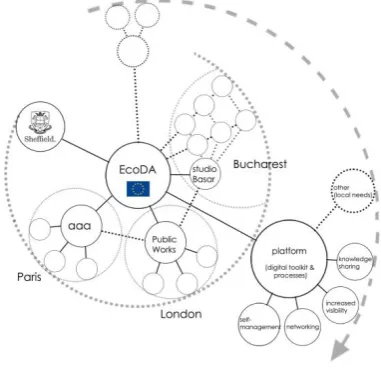
Paris and Bucharest)1. This is considered to offer opportunities for addressing various needs and therefore imagining diverse tools. The platform will be composed of a series of digital toolkits, which are based on existing (open or not) digital technologies, re-appropriated and re-framed according to the needs of the local actors involved in the co-design process, the contexts and scales at which they operate. The platform is conceived to evolve openly, to allow it to be further re-purposed and expanded by other users and in other city contexts, after the design of an initial platform prototype and beyond the life of the project.
[image:6.544.166.357.270.456.2]The digital toolkits are aimed at supporting local actors in developing their commoning projects and scale them (up and wide) by enabling and sustaining processes of knowledge-sharing and networking, providing spaces of opportunity and connection [50]. Such tools may include, for example: resource mapping (e.g., sites, volunteers, skills); databases and archives (e.g., project information, methods, documents, legislation); management and organisational frameworks (e.g., shared calendars, project management, local intranet); and communication between users (e.g., social networking, forums, chat rooms). The functions are identified with the local actors taking part in the research, based on their specific needs and interests. Moreover, both the platform and its design process will remain open after the end of the project to encourage other groups to join the process and further develop the platform (Fig 1). Inspired by the open-source, commons-based peer production movement [40, 46], this openness of the design process, including that of the knowledge produced and the means for its production, is intended to allow the platform to become a form of ‘commons’ in itself, whilst its production and use become a form of ‘commoning’.
Fig 1: co-design approach
In each of the three European cities selected as case studies, the research is carried out in partnership with local professional groups (addressed here as ‘practitioners’) and by tapping into their local networks. Typically, the practitioners are alternative architectural practices in London and Paris, but also NGOs and cultural groups in Bucharest, who have initiated commoning projects and/or have a strong interest in commoning and more broadly, in urban resilience. Their work varies according to the specific conditions and characteristics of each of the three urban settings, with a consequent different focus in terms of ‘commoning’. For example, they include practitioners experimenting with: alternative urban economies through temporary uses of space, in new or re-developed neighbourhoods in London; with locally closed ecological cycles to support the emergence of alternative models of living, producing and consuming, in socially and economically deprived suburban neighbourhoods in Paris; and with forms of cultural and civic activation of post-communist neighbourhoods, in Bucharest.
1 The digital platform introduced in this paper is developed as part of a wider European research project, based at the University of Sheffield,
These local practitioners offer ‘entry points’ into the three city contexts, in terms of obtaining a better understanding of the cultural and political framings shaping their activities, the challenges they face, and at the same time opening up the project through access to their local networks (e.g., local groups and communities with whom they work on commoning projects) and physical sites of experimentation, where we can prototype the toolkits. In this way, we can access both groups of citizens running commoning projects, and also actors operating on the municipal and regional levels (e.g., civic organisations, local authorities and institutions, and other networks aiming to enhance local resilience). Furthermore, the aim is also to create connections and collaboration across the cities where the platform is prototyped, through sharing information and experiences of projects, thus offering the platform a European level.
The scales of the toolkits reflect the scales at which these actors operate, varying from the local (e.g. hub, community, neighbourhood) to municipal, regional and European. The actors involved in the design of the tools take part in all stages of the design process, from defining the vision and local ‘briefs’ for the tools (i.e. those that they consider useful for their activities) to designing through making the toolkits, including their own ‘user guides’. While some of the actors are involved only in the design of the tools specific to their scale of operation (e.g., local), the design process includes opportunities for sharing experience between these groups, across the three cities and scales, with the aim to define together the form, functions and mode of operation of the final platform prototype that will result from the overall process.
This multi-level and multi-scale process offers opportunities to imagine and develop tools that address the three key needs of commoning processes: self-management, scaling (up and wide) and strategizing capacities as part of a collective effort to advance urban transformation and wider change towards resilience.
3.Discussion of initial outcomes
To illustrate our approach, in this section presents initial outcomes from the first case study, Paris, and a series of workshops through which we explored the local / self-management level of the platform. After briefly introducing the research process, these initial results are presented in the context of the principles informing our proposition of
‘open-source resilience’, focusing on how we applied them in the Paris case.
The research process included a series of co-design workshops with potential users of the prototyped toolkits, carried out as part of a research residence in June – July 2016. The main local partner in Paris is the architectural practice, Atelier d’Architecture Autogérée (AAA) and focus was placed on the R-Urban project, which AAA initiated in 2011, in the northern Paris suburb of Colombes and in partnership with the local authorities and a number of organisations, as well as with the involvement of a range of local residents. R-Urban is aimed at creating
a network around a number of ‘collective hubs’ – essentially, resident-run facilities aiming to form local ecological cycles and engage their users in everyday eco-civic practices [51]. R-Urban includes two established hubs in Paris, located in Colombes, in an area with relatively high levels of socio-economic. The network is currently expanding with new hubs soon to be created in the southern Paris suburb of Bagneux. In addition, the project has been adopted by a London-based architectural practice, Public Works, who have initiated the R-Urban Wick network in north-east London. In the initial stage of the research carried out in Paris, we focused on identifying potential tools for the self-management of a hub, and for the organisation and self-management of the emerging Paris network.
3.1. The connected ‘local’:
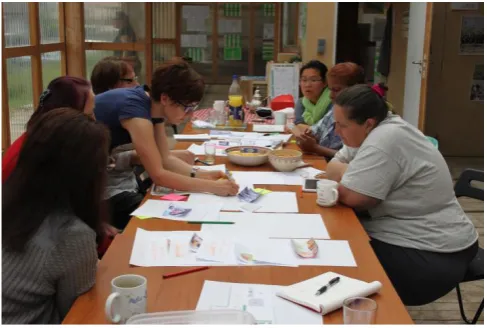
The research process included a series of workshops with this group running the hub and representatives from AAA (who also had a key role in translating elements of the discussions, which were held both in French and English) (for example, see Fig 2). It is important to note that this initial step in the design process was also aimed at engaging with ‘non-technical’ users who, prior to the workshops, would have not considered technology as a way of facilitating and enhancing their everyday commoning practices. Our premise is that tools developed with a non-technical user base can offer important insights into the kinds of technologies that could be replicated for other places and users, and also the kinds of processes required for replication.
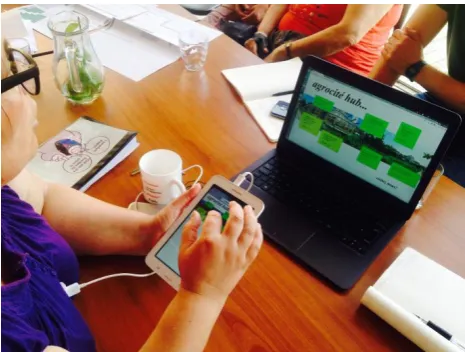
The outcome of the workshops is a digital toolkit – AgrocitéHub (agrocitehub.hotglue.me; Fig 3), essentially a portal into which converge a number of tools addressing specific hub needs as identified by those running it. These include tools for internal organisation and management (i.e. a shared calendar, an instructions wiki around the use and maintenance of specific facilities such as the compost unit and the chicken coop, and a planting and harvest guide for the collective garden); and also sharing tools for the hub to connect and mutualise resources with other similar hubs and networks (e.g., future Bagneux R-Urban hubs, AMAP network and BioCoop chain of organic supermarkets), such a community page, a public recipe book and a resource map.
While developed in the case of, and with, those running the Agrocité hub, similar micro-tools brought together
into one coherent ‘portal’ can be imagined for other local hubs and their own specific needs. Together, such tools
[image:8.544.144.388.295.459.2]illustrate possibilities for enabling trans-local connections between sites and experiences, which on the one hand can increase the sustainability in the longer term of individual hubs by providing agency, and on the other hand facilitate the sharing of knowledge and strengthening the collective capacities of local-level interventions to have large system effects [7].
Fig 3: A first prototype (AgrocitéHub)
3.2.Open-source, commons-based peer production
AgrocitéHub, built as a portal bringing together a number of tools into one single location, illustrates a ‘modular’
–rather than ‘monolithic’ – approach to the tools that populate the local ‘platform’ or toolkit [52]. Modularity is a common approach to software development, and in particular within the open source software movement, in terms
of both the ‘platform’ (and operating system) and the ‘tools’ (or software)2. The modularity and ease of use of the
Agrocité toolkit allows it to be maintained in a distributed way through usage (e.g., a group managing a specific hub activity, such as the café, can be in charge with the tool serving that activity, such as the recipe book). Importantly, while prototyped in the case of Agrocité, the toolkit is customizable (it offers the possibility of adding and/or removing tools according to local hub needs) and replicable (it provides a template that can be easily adapted in other locations).
Furthermore, the design process also includes knowledge transfer workshops, one for each tool, during which the
‘users’ learn how to use the tools through testing them, reflecting on their usage and formulating their own ‘user guides’ (Fig 4). This process of appropriating and ‘translating’ the tools enables the transfer of knowledge to others, outside the research project and without the involvement of the initiators of the hub (here, AAA). Reflecting open-source forms of production, which are based on collaboration among large groups of individuals [40], this distributed process can facilitate and sustain the collaborative production of knowledge and practices specific to the hub. If imagined on a broader, network scale of connected hubs, this process can strengthen the capacity to advance those types of practices that are key features to each hub (e.g., urban agriculture, composting, recycling) in a distributed and collaborative way, in turn potentially instigating the kinds of social practices and values needed to achieve greater resilience.
2 For example, from Raymond [52], the ‘Rule of Modularity’ determines that “Developers should build a program out of simple parts connected
Fig 4: Example of user-generated ‘user-guide’
3.3.Collaborative technologies:
The platform design approach tactically uses existing collaborative technologies and it re-appropriates them for
local conditions, needs and capabilities, through rapid prototyping and ‘nesting’ re-appropriated parts into new hybrid technological assemblies that are both digital and analogue. As part of the prototyping process, we explore possibilities for re-appropriating and re-framing existing (open or not) digital technologies as open (and incomplete) toolkits. For example, AgrocitéHub (the portal hosting micro-tools) has been created using an open-source visual website making tool (Hotglue, which does not require any coding skills to create the hub website). Moreover, the tools it re-appropriates include: the social networking site, Twitter, which is used as a way of creating a public archive of recipes or a recipe book; and the crowdsoured mapping platform, Ushahidi, as a way of creating a visual and interactive database of resources, similar hubs and other resilience networks (local, city-wide and European).
The modular and open approach to the design of the platform, which includes designing agency along with technology, illustrates possibilities for the platform to become a form of ‘commons’ in itself – and its production and use, a form of ‘commoning’. By enabling a distributed production of the knowledge and practices that characterise the hub, the Agrocité toolkit illustrates how collaborative technologies could be re-appropriated to sustain and connect local interventions addressing context-specific social, ecological and economic challenges. Furthermore, the continuous process of ‘de-stabilisation’ and ‘re-stabilisation’ [53] of technologies according to local specificities and types of users in quick, transparent and replicable ways, has the potential to instigate boarder cultural and institutional change through the scaling and multiplication of alternative socio-economic practices, leading to urban transformation.
4.Observations
Besides defining a digital toolkit for the ‘local’ level of the platform, the research carried out in Paris indicated
imagine that commoning could take place in terms of project processes (or project ‘codes’), modes of construction, methods, legislation, economic and organisational models3.
In relation to the platform, the digital tools that it will contain will need to address these various types of commons and levels of commoning – particularly reflecting on the questions of what can (and needs to) be commoned and for what purpose. Moreover, acknowledging that the commons are fundamentally complex socio-ecological systems [54], the platform – in itself a commons – will require a defined community (or a number of communities) and a set of values, protocols and norms devised collectively for the everyday subsistence of the resources produced through using it [37].
At the same time, all of these levels of commoning need to be connected and supported as part of a wider-reaching platform in order to allow the sharing and mutualising of resilience knowledge and resources, and enable an iterative and distributed production of the platform. This requires co-designing agency along with technology to enable the co-design process to continue beyond the life of the project, within and beyond the digital world. This is particularly important when producing knowledge for sustainability and resilience [55-56] because resilience requires multi-agency responses and partnerships between diverse groups [57]. Indeed, a co-production approach to resilience needs to enhance the ‘capability to act’ [58] of as many as possible.
As noticed in the case of the Agrocité hub, by providing access to easy to use functionalities, which address real needs of the hub and are identified together with the users, the a digital toolkit can enhance the agency of those running the hub, in terms of managing their activities independently from the initiators (i.e. AAA) and sharing the knowledge produced. Although many of them had no previous knowledge of using digital technologies, or indeed considered technology in relation to their everyday commoning practices before the workshops, the co-design process enabled them to take ownership of the tools, making them their own (as illustrated by the user-generated
‘user guides’). Furthermore, the process of using and re-appropriating existing technologies for local conditions,
needs and capabilities, through rapid prototyping and ‘nesting’ of re-appropriated parts into new hybrid and modular technological assemblies [52] has the potential to offer the kind of incompleteness [59] needed in order to achieve a truly open production of the urban commons. These aspects of the digital platform will be further explored through workshops organised and hosted in two additional locations and with different types of users, in London and Bucharest.
Acknowledgements
The results discussed in this paper are part of a wider European research project, based at the University of Sheffield, School of Architecture. The project, entitled EcoDA (Experimental co-Design Approaches: Investigating possibilities for creating networks of resilient citizens and civic actions of urban resilience through hybrid platforms), is funded by a Marie Skłodowska-Curie research grant (2015 – 2017).
References
[1] Department of Economic and Social Affairs (DESA), World Urbanization Prospects, the 2011 Revision: Highlights. 2011, United Nations, Department of Economic and Social Affairs, Population Division: New York.
[2] Nevens, F., et al., Urban Transition Labs: co-creating transformative action for sustainable cities. Journal of Cleaner Production, 2012. 50(Special Issue: Advancing sustainable urban transformation): p. 111-122.
[3] Intergovernmental Panel on Climate Change (IPCC), Climate Change 2014: Synthesis Report. Contribution of Working Groups I, II and III to the Fifth Assessment Report of the Intergovernmental Panel on Climate Change [Core Writing Team, R.K. Pachauri and L.A. Meyer (eds.)]. 2015, IPCC: Geneva.
[4] Lewis, M. and P. Conaty, The Resilience Imperative: Cooperative Transitions to a Steady-State Economy. Gabriola Island: New Society Publishers; 2012.
[5] Joseph, J., Resilience as embedded neoliberalism: a governmentality approach. Resilience, 2013. 1(1): p. 38-52.
3 Some of these aspects were noted during a first workshop on the network level of the platform (not reported here), which included
[6] Holling, C.S., Myths of Ecology and Energy, in Perspectives on Energy: Issues, Ideas, and Environmental Dilemmas, L.C. Ruedisili and M.W. Firebaugh, Editors. 1982, Oxford University Press: New York. p. 8-15.
[7] Nelson, S.H., Resilience and the neoliberal counter-revolution: from ecologies of control to production of the common. Resilience, 2014. 2(1): p. 1-17.
[8] Cretney, R., Resilience for Whom? Emerging Critical Geographies of Socio-ecological Resilience. Geography Compass, 2014. 8(9): p. 627-640.
[9] Walker, B., et al., Resilience, Adaptability and Transformability in Social–ecological Systems. Ecology and Society, 2004. 9(2): p. 5. [10] Folke, C., et al., Resilience Thinking: Integrating Resilience, Adaptability and Transformability. Ecology and Society, 2010. 15(4): p. 20. [11] MacKinnon, D. and K.D. Derickson, From resilience to resourcefulness: A critique of resilience policy and activism. Progress in Human
Geography, 2013. 37(2): p. 253-270.
[12] Holling, C.S., Resilience and Stability of Ecological Systems. Annual Review of Ecology and Systematics, 1973. 4(1): p. 1-23.
[13] Shaikh, A. and C. Kauppi, Deconstructing Resilience: Myriad Conceptualizations and Interpretations. International Journal of Arts and Sciences, 2010. 3(15): p. 155-176.
[14] Werner, E.E., Resilience in Development. Current Directions in Psychological Science, 1995. 4(3): p. 81-85.
[15] Godschalk, D.R., Urban Hazard Mitigation: Creating Resilient Cities. Natural Hazards Review, 2003. 4(3): p. 136-143.
[16] Timmerman, P., Vulnerability, resilience and the collapse of society Toronto: Institute for Environmental Studies, University of Toronto 1981.
[17] Folke, C., Resilience: The emergence of a perspective for social–ecological systems analyses. Global Environmental Change, 2006. 16(3): p. 253-267.
[18] Walker, J. and M. Cooper, Genealogies of resilience: From systems ecology to the political economy of crisis adaptation. Security Dialogue, 2011. 42(2): p. 143-160.
[19] Welsh, M., Resilience and responsibility: governing uncertainty in a complex world. The Geographical Journal, 2014. 180(1): p. 15-26. [20] Hornborg, A., Zero-Sum World: Challenges in Conceptualizing Environmental Load Displacement and Ecologically Unequal Exchange in
the World-System. International Journal of Comparative Sociology, 2009. 50(3-4): p. 237-262.
[21] Vale, L.J., The politics of resilient cities: whose resilience and whose city? Building Research & Information, 2014. 42(2): p. 191-201. [22] HR Government, Decentralisation and the Localism Bill: an essential guide. 2010, Department for Communities and Local Government:
London.
[23] Office, C., Strategic National Framework on Community Resilience. 2011, UK Government: London.
[24] Wilkinson, C., Social-ecological resilience: Insights and issues for planning theory. Planning Theory, 2012. 11(2): p. 148-169.
[25] Cretney, R. and S. Bond, ‘Bouncing back’ to capitalism? Grass-roots autonomous activism in shaping discourses of resilience and transformation following disaster. Resilience, 2014. 2(1): p. 18-31.
[26] Diprose, K., Resilience is futile: The cultivation of resilience is not an answer to austerity and poverty. Soundings, 2015. 58. [27] Peck, J. and A. Tickell, Neoliberalizing Space. Antipode, 2002. 34(3): p. 380-404.
[28] Purcell, M., Urban Democracy and the Local Trap. Urban Studies, 2006. 43(11): p. 1921-1941.
[29] Brown, G., et al., Holding the Future Together: Towards a Theorisation of the Spaces and Times of Transition. Environment and Planning A, 2012. 44(7): p. 1607-1623.
[30] Ostrom, E., Governing the Commons: The Evolution of Institutions for Collective Action. Cambridge: Cambridge University Press; 1990. [31] Linebaugh, P., The Magna Carta Manifesto: Liberties and Commons for All. Berkeley: University of California Press; 2008.
[32]On the Commons, Introduction to the Commons. 2014 [cited 2015 15 December]; Available from: http://www.onthecommons.org/work/introduction-commons.
[33] Negri, A. and M. Hardt, Commonwealth. Cambridge (MA): Harvard University Press; 2009.
[34] Casarino, C., Surplus Common: A Preface, in In Praise of the Common: A Conversation on Philosophy and Politics, C. Casarino and A. Negri, Editors. 2008, University of Minnesota Press: Minneapolis.
[35] Holloway, J., Crack Capitalism. London: Pluto Press; 2010.
[36] De Angelis, M., The Production of Commons and the “Explosion” of the Middle Class. Antipode, 2010. 42(4): p. 954-977.
[37] Bollier, D., Think Like a Commoner: A Short Introduction to the Life of the Commons. Gabriola Island: New Society Publishers; 2014. [38] Stavrides, S., Common Space: The City as Commons. Chicago: University of Chicago Press; 2016.
[39] Bradley, K., Open-Source Urbanism: Creating, Multiplying and Managing Urban Commons. Footprint, 2015(16): p. 91-108.
[42] Radywyl, N. and C. Biggs, Reclaiming the commons for urban transformation. Journal of Cleaner Production, 2013. 50: p. 159-170. [43] Foster, S. and C. Iaione, The City as a Commons. Yale Law & Policy Review, 2016. 34(2): p. 1-64.
[44] Wagenaar, H. and C. Wilkinson, Enacting Resilience: A Performative Account of Governing for Urban Resilience. Urban Studies, 2013. [45] Ingold, T., Making: Anthropology, Archaeology, Art and Architecture. London: Routledge; 2013.
[46] Benkler, Y. and H. Nissenbaum, Commons-based Peer Production and Virtue*. Journal of Political Philosophy, 2006. 14(4): p. 394-419. [47] Beilin, R. and C. Wilkinson, Introduction: Governing for urban resilience. Urban Studies, 2015. 52(7): p. 1205-1217.
[48] Boyd, E. and S. Juhola, Adaptive climate change governance for urban resilience. Urban Studies, 2014. [49] London Resilience Partnership, London Resilience Partnership Strategy. 2013, Mayor of London: London.
[50] Gilchrist, A., The well-connected community: A networking approach to community development. Second Edition ed. Bristol: Policy Press; 2009.
[51] Petcou, C. and D. Petrescu, R-URBAN or how to co-produce a resilient city. Ephemera, 2015. 15(1): p. 249-262. [52] Raymond, E.S., The Art of Unix Programming. Boston: Addison Wesley; 2003.
[53] Mackenzie, A., Cutting Code: Software and Sociality. New York: Peter Lang; 2006.
[54] Armitage, D., Governance and the commons in a multi-level world. International Journal of the Commons, 2008. 2(1): p. 7-32.
[55] Pohl, C., et al., Researchers' roles in knowledge co-production: experience from sustainability research in Kenya, Switzerland, Bolivia and Nepal. Science and Public Policy, 2010. 37(4): p. 267-281.
[56] Polk, M., ed. Co-producing Knowledge for Sustainable Cities: Joining Forces for Change. 2015, Routledge: London.
[57] Trogal, K. and D. Petrescu. Architecture and Resilience: Strategies to deal with global change at a human scale. in Architecture and Resilience at a Human Scale conference proceedings, 10-12 September. 2015. Sheffield.
[58] Sen, A., Development as Freedom. Oxford: Oxford University Press; 1999.