ISSN 0252-8266
%
eurostat
EUROSTATISTIK
Daten zur Konjunkturanalyse
EUROSTATISTICS
Data for short-term economic analysis
EUROSTATISTIQUES
Données pour l'analyse de la conjoncture
Monatlich Π Monthly D Mensuel
8/9 D 1995
i
Themenkreis / Theme /Thème
eurostat
OFICINA ESTADÍSTICA DE LAS COMUNIDADES EUROPEAS
DE EUROPÆISKE FÆLLESSKABERS STATISTISKE KONTOR
STATISTISCHES AMT DER EUROPÄISCHEN GEMEINSCHAFTEN
ΣΤΑΤΙΣΤΙΚΗ ΥΠΗΡΕΣΙΑ ΤΩΝ
ΕΥΡΩΠΑΪΚΩΝ ΚΟΙΝΟΤΗΤΩΝ
STATISTICAL OFFICE OF THE EUROPEAN COMMUNITIES
OFFICE STATISTIQUE DES
COMMUNAUTÉS EUROPÉENNES
ISTITUTO STATISTICO DELLE COMUNITÀ EUROPEE
BUREAU VOOR DE STATISTIEK DER EUROPESE GEMEENSCHAPPEN
SERVIÇO DE ESTATÍSTICA DAS COMUNIDADES EUROPEIAS
L2920 Luxembourg Tél. 43 011 Télex COMEUR LU 3423
B1049 Bruxelles, rue de la Loi 200 Tél. 299 11 11
Las publicaciones de Eurostat están clasificadas por temas y por series. La clasificación se encuentra al final de
la obra. Para mayor información sobre las publicaciones, rogamos se pongan en contacto con Eurostat.
Para los pedidos, diríjanse a las oficinas de venta cuyas direcciones figuran en la página interior de la
contracubierta.
Eurostats publikationer er klassificeret efter emne og serie. En oversigt herover findes bag i hæftet. Yderligere
oplysninger om publikationerne kan fås ved henvendelse til Eurostat.
Bestilling kan afgives til de salgssteder, der er anført på omslagets side 3.
Die Veröffentlichungen von Eurostat sind nach Themenkreisen und Reihen gegliedert. Die Gliederung ist hinten in
jedem Band aufgeführt. Genauere Auskünfte über die Veröffentlichungen erteilt Eurostat.
Ihre Bestellungen richten Sie bitte an die Verkaufsbüros, deren Anschriften jeweils auf der dritten Umschlagseite
der Veröffentlichungen zu finden sind.
Οι
εκδόσεις της Eurostat ταξινομούνται κατά θέμα και κατά σειρά. Η ακριβής ταξινόμηση αναφέρεται στο
τέλος κάθε έκδοσης. Για λεπτομερέστερες πληροφορίες σχετικά με τις εκδόσεις, μπορείτε να
απευθύ-νεσθε στην Eurostat.
Για τις παραγγελίες μπορείτε να απευθύνεσθε στα γραφεία πώλησης, των οποίων οι διευθύνσεις
αναγράφονται στη σελίδα 3 του εξωφύλλου.
Eurostat's publications are classified according to themes and series. This classification is indicated at the end of
the publication. For more detailed information on publications, contact Eurostat.
Orders are obtainable from the sales offices mentioned on the inside back cover.
Les publications d'Eurostat sont
classées par thème et par série. Cette classification est précisée à la fin
de l'ouvrage. Pour des informations plus détaillées sur les publications, contactez Eurostat.
Pour les commandes, adressez-vous aux bureaux de vente dont les adresses sont indiquées à la page 3
de la couverture.
Le pubblicazioni dell'Eurostat sono classificate per tema e per serie. Tale classificazione è precisata alla fine
dell'opera. Per informazioni più dettagliate sulle pubblicazioni rivolgersi all'Eurostat.
Per eventuali ordinazioni rivolgersi a uno degli uffici di vendita i cui indirizzi figurano nella 3
apagina della
copertina.
De publikaties van Eurostat zijn ingedeeld naar onderwerp en serie. Deze indeling is achter in het boek
opgenomen. Voor nadere informatie over de publikaties kunt u zich wenden tot Eurostat.
Gelieve bestellingen op te geven bij de verkoopbureaus, waarvan de adressen op bladzijde 3 van de omslag zijn
vermeld.
As publicações do Eurostat estão classificadas por tema e por série. Esta classificação está indicada no firn da
obra. Para mais informações sobre as publicações é favor contactar Eurostat.
EUROSTATISTIK
Daten zur Konjunkturanalyse
EUROSTATISTICS
Data for short-term economic analysis
EUROSTATISTIQUES
Données pour l'analyse de la conjoncture
Luxembourg: Office des publications officielles des Communautés européennes, 1995
© EGKS-EG-EAG, Brüssel · Luxemburg, 1995
Nachdruck — ausgenommen zu kommerziellen Zwecken — mit Quellenangabe gestattet.
© ECSC-EC-EAEC, Brussels · Luxembourg, 1995
Reproduction is authorized, except for commercial purposes, provided the source is acknowledged.
© CECA-CE-CEEA, Bruxelles · Luxembourg, 1995
Reproduction autorisée, sauf à des fins commerciales, moyennant mention de la source.
Vorwort
E
Mit der monatlich erscheinenden Veröffentlichung
Eurostatistik - Daten zur
Konjunkturanalyse
werden innerhalb kürzester Frist die neuesten statistischen Daten
über die Europäische Gemeinschaft als Ganzes (EUR 12), über jedes Mitgliedsland
sowie über die Vereinigten Staaten und Japan bekanntgegeben.
Eurostatistik
enthält nicht die Gesamtheit des bei Eurostat verfügbaren statistischen
Materials, sondern eine Auswahl der relevantesten Reihen über die konjunkturelle
Entwicklung.
Schnelligkeit und Pünktlichkeit sind die wichtigsten Vorzüge dieser Veröffentlichung.
Aus diesem Grunde wurde sie im Umfang bewußt klein gehalten und enthält keine
Anmerkungen zur Methodik, die im übrigen in den spezialisierten Veröffentlichungen
von Eurostat zu finden sind.
Die in Eurostatistik veröffentlichten Daten stammen aus der Datenbank New Cronos.
New Cronos setzt sich zusammen aus dem alten Cronos sowie REGIO und ist nicht
mehr in Form von Zeitreihen, sondern in Form von muitidimensionalen Tabellen
dargestellt. New Cronos ist somit eines der Produkte zur Verbreitung statistischer
"Daten, das direkt aus der Eurostat - Referenzdatenbank gespeist wird. Darüber
hinaus sind die Daten in der Datenbank Eurocron verfügbar, die vom Host Eurobases
der Kommission angeboten wird.
Weitere Informationen über Eurostat und seine Produkte können bei folgender Stelle
angefordert werden:
Eurostat - Informationsbüro Data Shop
L-2920 LUXEMBURG 121, rue Joseph II
Telephon: (352) 4301 34567 Büro 3/235
Telefax: (352) 43 64 04 B-1049 Bruxelles
1
Inhaltsverzeichnis
Zeichen und Abkürzungen
KURZ NOTIERT
5
KONJUNKTURDATEN
1. Volkswirtschaftliche Gesamtrechnungen . . 31
2. Beschäftigung
33
3. Arbeitslosigkeit
37
4. Industrielle Produktion
42
5. Meinungsumfrage in der Industrie
53
6. Industrieerzeugnisse
57
7. Einzelhandel
62
8. Landwirtschaftliche Erzeugnisse
64
9. Außenhandel
67
10. Verbraucherpreise
81
11. Landwirtschaftliche Erzeugerpreise . . . .
86
12. Löhne und Gehälter
88
13. Finanzstatistiken
89
14. Zahlungsbilanz
96
Anmerkung betreffend Grafiken und Tabellen:
O Die Daten beziehen sich auf das Gebiet der
Bundesrepublik Deutschland vor dem 3.10.1990
einschließlich WestBerlin.
πτι %
T/T4%
T/T-12%
BALANCE%
1990=100
1000
MIO
MRD
Τ
TJ(GCV)
GWH
USD
ECU
SZR
ESVG
NACE
SITC
EUR
UEBL
ACP
Weniger als die Hälfte der verwendeten
Einheit
Prozent
Prozentualer Zuwachs eines
Vierteljahres gegenüber dem vorher
gehenden Vergleichszeitraum
(Monat.Vierteljahr.Jahr)
Prozentualer Zuwachs eines
Vierteljahres gegenüber dem
entsprechenden Vierteljahr des
Vorjahres
Prozentualer Zuwachs eines Monats
gegenüber dem entsprechenden Monat
des Vorjahres
Saldo zwischen den positiven
Antworten (Zunahme.Verbesserung der
Situation)und den negativen Antworten
(Abnahme.Verschlechterung der
Situation)der Konjunkturumfrage bei
den Unternehmern in der Gemeinschaft
Basisjahr
in 1000
Million
Milliarde
Metrische Tonne
Terajoule = 109KJ
Gigawattstunde = 106kWh
USDollar
Europäische Währungseinheit
Sonderziehungsrechte
Europäisches System
Volkwirtschaftlicher Gesamtrechnungen
Allgemeine Systematik der
Wirtschaftszweige in den Europäischen
Gemeinschaften
Standard International Trade
Classification
Mitgliedstaaten insgesamt
BelgischLuxemburgische
Wirtschaftsunion
EUROSTATISTIK: kurz notiert
WECHSELKURSE:
Größere
Stabilität im Juni 1995
An den Devisenmärkten herrschte im Juni 1995 wieder relative Ruhe, und
der USDollar wurde ohne größere Kursschwankungen sowohl gegenüber
der DMark (mit rund 1,40 DM) als auch gegenüber dem japanischen Yen
(mit rund 84,5 Yen) gehandelt. Im Mai hatte sich der Dollar wieder etwas
erholt, nachdem er im vorangegangenen Monat gegenüber beiden Wäh
rungen auf ein Rekordtief von 1,35 DM bzw. 81,1 Yen gefallen war.
Das Ausmaß des Kursverlustes des Dollars in diesem Jahr bleibt dennoch
beachtlich: Seit Ende 1994 hat er gegenüber der DM 10 % und gegenüber
dem Yen 15 % seines Wertes eingebüßt. Auf dem G7Wirtschaftsgipfel in
Halifax (Kanada) Mitte Juni wurden keine nennenswerten Maßnahmen zur
Koordinierung der Wechselkurspolitik beschlossen.
Die Spannungen innerhalb des EWS, die in den Monaten April und Mai
bereits nachgelassen hatten, waren auch im Juni weiterhin gering. Die
spanische Peseta und der portugiesische Escudo blieben gegenüber der
DMark nahezu unverändert, das irische Pfund verlor dagegen beständig
an Wert und fiel im Wechselkursmechanismus noch unter den französi
schen Franken an die letzte Stelle. Der französische Franken war, nach
einer Periode größerer Unbeständigkeit während der Präsidentschafts
wahlen im April und Mai, gegenüber der DMark stabil und wurde
zwischen 3,50 und 3,52 FF gehandelt.
Die Währungen zeigten nur wenig Reaktion auf die Zinssatzänderungen
im Juni: Die spanischen kurzfristigen Zinssätze wurden am 2. Juni um
0,75 % angehoben, und die schwedische Zentralbank erhöhte am 6. Juni
ihren Zinssatz für Wertpapierpensionsgeschäfte um 0,25 %. Die belgi
schen und die niederländischen kurzfristigen Zinssätze wurden am 8. Juni
gesenkt.
Außerhalb des Wechselkursmechanismus des EWS waren die italienische
Lira, die schwedische Krone und die Finnmark im Juni stabil, das Rund
Sterling hingegen gab Ende des Monats, bedingt durch die politische
Ungewißheit im Vorfeld der Wahl des neuen Vorsitzes der Konservativen
Partei, nach und wurde am 26. Juni bei Börsenschluß in London mit
2,2084 DM gehandelt.
RENDITEN VON STAATSANLEIHEN: Ende der Erholung auf
dem euro
päischen
Markt
Auf den Rentenmärkten trat Anfang Juni eine Tendenzwende ein, mit der
eine mehrere Monate andauernde Erholungsphase ein abruptes Ende
fand. Der Trend setzte dann allerdings erneut ein, hauptsächlich, weil mit
einem verlangsamten Wirtschaftswachstum und einer niedrigen Inflation
gerechnet wurde. Die Renditen für 10jährige Staatsanleihen blieben im
Juni (bis zum 26.) in mehreren Ländern, darunter Deutschland, Frankreich
und die Niederlande, nahezu unverändert. Bei den höherverzinslichen
Staatsanleihen, einschließlich denen Italiens, Portugals, Spaniens und
Schwedens, tendierten die Renditen nach oben, zum Teil bedingt durch
Inflationsängste.
Als Folge der erhöhten politischen Unsicherheit im Vereinigten Königreich
stieg die Rendite der 10jährigen Staatspapiere am 26. Juni bis auf 8,4 %,
wenngleich diese Verzinsung nur um 0,2 Prozentpunkte höher lag als im
Vormonat. Die Reaktion des Anleihemarktes auf den Nachtragshaushalt
der neuen französischen Regierung am 22. Juni blieb gedämpft.
Trotz der Tendenzwende auf dem Rentenmarkt Anfang Juni hielt der
Abwärtstrend bei den USamerikanischen und den japanischen Renditen
an. In der Erwartung, daß die kurzfristigen USZinssätze möglicherweise
steigen würden, fiel die Rendite für 10jährige Staatsanleihen im Juni (bis
zum 26.) um 0,4 Prozentpunkte auf 6,1 %. Befürchtungen, daß die
japanische Volkswirtschaft wieder in eine Rezession eintreten könnte,
waren unter anderem der Grund dafür, daß die entsprechende japanische
Rendite in diesem Monat um 0,6 Prozentpunkte auf 2,7 % sank.
GELDVOLUMEN: Sehr
uneinheitliches
Verhalten
Was das Geldvolumen anbelangt, ist das Verhalten von Land zu Land
weiterhin sehr unterschiedlich. Bei den weitgefaßten Geldmengen ist in
Spanien, Portugal, Irland und Griechenland ein anhaltend starker Zuwachs
festzustellen, während in Dänemark, Deutschland, Italien, den Niederlan
den und Finnland die Zuwachsraten in den drei Monaten bis März 1995
negativ waren.
Im Vereinigten Königreich hat sich die Geldmenge M4 langsam zur Mitte
ihres Zielkorridors von 39 % hinentwickelt: Im April lag die jährliche
Zuwachsrate bei 5,3 %. Das M2Wachstum in Frankreich zeigt eine
ähnliche Tendenz, es liegt jedoch noch immer unter seinem Ziel von 5 %
für 1995, nämlich bei 3,4 % im Monat März. Das Wachstum von M3 in
Österreich verlief relativ gleichmäßig: In den drei Monaten bis März 1995
betrug die Zuwachsrate 4,7 %.
Der Trend beim Wachstum der enggefaßten Geldmengen ist nicht immer
der gleiche wie bei den weitgefaßten Geldmengen. Das M1Wachstum in
Finnland beispielsweise lag in den drei Monaten bis März bei 7,4 %
während bei M3 eine Verringerung um 0,3 % zu verzeichnen war.
AMTLICHE WAHRUNGSRESERVEN:
Bei den amtlichen Währungsreserven war, gemessen in Ecu, in den
vergangenen Monaten ein Abwärtstrend zu beobachten, bedingt durch
den schwächeren Dollar, da dieser nach wie vor die führende Reserve
währung darstellt.
Die ausgeprägtesten Rückgänge im Volumen der Währungsreserven
(ohne Gold) wurden im ersten Quartal 1995 in Spanien (um 7,7 Mrd. ECU
auf 26,1 Mrd. ECU) und in Italien (um 5,2 Mrd. ECU auf 21,1 Mrd. ECU)
verzeichnet. Im Falle Spaniens ist dies das geringste Reservevolumen seit
Juni 1989, dem Beginn der spanischen Beteiligung am Wechselkursme
chanismus des EWS. Für Italien ist es das geringste Volumen, seit die Lira
im September 1992 aus dem Wechselkursmechnismus ausgetreten ist.
Ein Land, dessen amtliche Währungsreserven im ersten Quartal 1995
anstiegen, war Österreich, das seit 1. Januar Mitglied der EU ist. Seine
Reserven (ohne Gold) erhöhten sich von 13,7 Mrd. ECU Ende 1994 auf
nunmehr 15,5 Mrd. ECU.
TEUERUNGSRATE der Europäischen Union
der 15
im
Mai 1995
unverändert bei 3,3
%
Die jährliche Inflationsrate der Europäischen Union der 15 lag im Mai wie
schon in den Vormonaten März und April bei vorläufig 3,3 %. Im gleichen
Monat des Vorjahres waren die Preise um 3,2 % gestiegen.
Mit 1,4 % hatte Belgien die geringste Teuerung. Danach folgten Frank
reich (vorläufig 1,6 %) und Finnland (1,6 %). Über dem EUDurchschnitt
lagen lediglich das Vereinigte Königreich (3,4 %), Portugal (4,3 %),
Spanien (5,1 %), Italien (vorläufig 5,4 %) und Griechenland (9,8 %).
Für die Inflationsraten der Mitgliedsländer im Maimit entsprechenden
Vorjahreszahlenergibt sich folgende ansteigende Reihenfolge:
Belgien
Finnland
Frankreich
Niederlande
Deutschland*
Luxemburg
Dänemark
Österreich
EUR 15
Mai
95
Mai 94
1,4%
1,6%
1,6% ρ
2,1 %
2,2 %
2,2 %
2,7 % E
2,8 % E
3,3 % ρ
Mai
94
Mai 93
2,6 %
0,2 %
1,7%
2,9 %
3,0 %
2,1 %
1,9%
3,0 %
3,2 %
Irland
Schweden
Ver. Königreich
Portugal
Spanien
Italien
Griechenland
Mai 95
Mai 94
2,8 %
3,2 %
3,4 %
4,3 %
5,1 %
5,4 % ρ
9,8 %
Mai
94
Mai 93
2,7 %
2,3 %
2,6 %
5,7 %
4,9 %
4,0 %
11,0%
Der Verbraucherpreisindex für die Bundesrepublik Deutschland bezieht sich weiterhin auf den Gebietsstand vor dem 3.10.90. In den neuen Ländern war der Preisindex im Mai um 1,4 % höher als vor Jahresfrist. Im Mai '94 hatte die Teuerungsrate bei 3,4 % gelegen.
Vorläufig
Eurostat Schätzung, Daten nicht verfügbar.
ARBEITSLOSENQUOTE: Februar bis
Mai 1995: 10,9 % Arbeitslose in
der Europäischen Union der 15
Laut Eurostat betrug die Arbeitslosenquote der Europäischen Union der
15 im Mai 1995 saisonbereinigt 10,9 %. Nach revidierten Schätzungen
hatte die Arbeitslosigkeit in den vorhergehenden drei Monaten auf dem
gleichen Niveau gelegen. Im Mai des Vorjahres lag die Arbeitslosenquote
bei 11,4%.
In den meisten Mitgliedstaaten blieb das Niveau der Arbeitslosigkeit im
Zeitraum von Februar bis Mai sowohl für die Frauen als auch für die
Männer relativ stabil. Der zuletzt in Spanien, das mit 23 % die höchste
Quote in der Europäischen Union der 15 aufweist, und Dänemark (8,8 %)
beobachtete Rückgang setzte sich im Mai nicht fort. Anders dagegen in
Frankreich (12,3 %) und dem Vereinigten Königreich (8,6 %), hier sanken
die Arbeitslosenquoten geringfügig.
Mit 3,9 % hatte im Mai wiederum Luxemburg die niedrigste Arbeitslosen
quote in der Europäischen Union der 15.
Anm
erklingen
Die Arbeitslosenquote und die Zahl der Arbeitslosen werden nach den
Empfehlungen der ILO und unter Berücksichtigung der unterschiedlichen
nationalen Methoden zur Erfassung der Arbeitslosigkeit geschätzt.
INDUSTRIEPRODUKTION: Europäischen Union der 15
industrieproduk-tion steigt weiter
In den Mitgliedstaaten der Europäischen Union der 15 ist der Trend* der
Industrieproduktion im ersten Quartal 1995 gegenüber dem letzten
Quartal 1994 um 1,1 % gestiegen.
„Das Wachstum ist ununterbrochen, aber nicht so kräftig wie Mitte '94,
als es ungefähr 2 % betrug", so Eurostat.
In den USA betrug der entsprechende Anstieg 1,4 %.
Das Wachstum der Europäischen Union der 15 ist besonders ausgeprägt
im Kraftfahrzeugbau (2,9 % zwischen Q4 '94 und Q1 '95),
Nachrichten-technik, TV-Geräte (2,4 %) und im Maschinenbau (1,8 %).
In den Mitgliedstaaten sind die Daten (in Prozent), soweit vorhanden, wie
folgt (E = geschätzt):
EUR 15
Schweden
Dänemark
Finnland
Spanien
Italien
1,1
4,1
2,7
2,3
2,0
1,3
Frankreich
Portugal E
Ver. Königreich
Niederlande
Österreich
Griechenland
1,0
0,6
0,5
0,5
0,4
0,1
„Trend" bedeutet bereinigt um den Saisoneinfluß und irreguläre
Schwankun-gen.
Außenhandel: 1994 stiegen die Einfuhren der Europäischen Union
etwas stärker als die Ausfuhren (Differenz: 0,7 Prozentpunkte)
Im Dezember 1994 erzielte die Europäische Union der 12 einen
Handels-bilanzüberschuß von 2,7 Mrd. ECU gegenüber 7 Mrd. ECU im gleichen
Vorjahresmonat. Die Folge war eine Verschlechterung der kumulierten
Handelsbilanz für Januar-Dezember 1994: Aus dem im gleichen Zeitraum
des Vorjahres verzeichneten Überschuß von 2 Mrd. ECU wurde ein Defizit
von 1 Mrd. ECU.
Im Jahr 1994 erzielte Deutschland nicht nur den höchsten
Extra-EU-Überschuß aller EU-Mitgliedstaaten (25,6 Mrd. ECU), sondern auch
die deutlichste Verbesserung seines Handelsbilanzsaldos gegenüber dem
Vorjahr (+5,6 Mrd. ECU).
Der italienische Handelsbilanzüberschuß erhöhte sich um 1,7 Mrd. ECU
von 11 Mrd. ECU im Jahr 1993 auf nunmehr 12,7 Mrd. ECU.
Am stärksten verschlechterte sich zwischen 1993 und 1994 der
Handels-bilanzsaldo der Niederlande. Ihr Extra-EU-Defizit stieg um 9,9 Mrd. ECU
auf 22 Mrd. ECU und war damit höher als in allen anderen EU-Staaten.
Das Vereinigte Königreich verzeichnete 1994 von allen EU-Mitgliedstaaten
mit 20,5 Mrd. ECU das zweitgrößte Handelsbilanzdefizit.
Der Extra-EU-Handelsbilanzüberschuß Frankreichs erhöhte sich 1994
gegenüber dem Vorjahr um 1,4 Mrd. ECU (von 9,4 Mrd. ECU auf 10,8
Mrd. ECU).
Infolgedessen entwickelten sich die Auslandspositionen der BLWU und
Griechenlands gegensätzlich: Während sich die griechische Handelsbilanz
von 1993 bis 1994 um 1,5 Mrd. ECU verbesserte, weitete sich das Defizit
der BLWU von 0,6 Mrd. ECU im Vorjahr auf 1 Mrd. ECU aus.
Die Handelsbilanzüberschüsse Dänemarks und Irlands gingen im
Ver-gleich zu 1993 leicht zurück, nämlich auf 2,5 Mrd. ECU bzw. 0,8 Mrd.
ECU.
Foreword
D
Eurostatistics - data for short-term economic analysis
is a monthly publication aimed
at providing, as rapidly as possible, the latest statistical data on the European
Community as a whole (EUR 12), each Member State, the United States and Japan.
Eurostatistics
does not present all the statistics held by Eurostat, but a selection of the
most relevant series on the economic situation.
Speed of publication and punctuality are the main features of this publication; that is
why it is deliberately streamlined and does not contain any methodological notes,
which are given in Eurostat's specialized publications.
The data published in Eurostatistics are taken from Eurostat's on-line database, New
Cronos. New Cronos includes old Cronos and Regio, both represented not by
chronological series but through multi-dimensional tables. New Cronos is a
dissemination product directly from Eurostat's Reference Environment. The data are
also available via the Commission host Eurobases in the Eurocron database.
Further information on Eurostat and its products can be obtained from the following
addresses:
Eurostat - Information Office Data Shop
L-2920 Luxembourg 121, Rue Joseph II
Tel.: (352) 4301-34567 Office 3/235
Fax: (352) 43 64 04 B-1049 Bruxelles
Contents
Symbols and abbreviations
M
IN BRIEF
9
SHORT-TERM TRENDS
1. National accounts
31
2. Employment
33
3. Umeployment
37
4. Industrial production
42
5. Opinions in industry
53
6. Industrial products
57
7. Retail sales
62
8. Agricultural products
64
9. External trade
67
10. Consumer prices
81
11. Producer prices of agricultural products. . 86
12. Wagesand salaries
88
13. Financial statistics
89
14. Balance of payments
96
Note concerning graphs and tables:
Π Data for the Federal Republic of Germany,
including West-Berlin, as constituted prior to
3 October 1990.
0
%
T/T-1
%
T/T-4%
T/T-12%
BALANCE%
1990=100
1000
MIO
MRD
Τ
TJ(GCV)
GWH
USD
ECU
ESA
SDR
NACE
SITC
EUR
UEBL
ACP
Data less than the unit used
Per cent
Percentage increase of one period
(month, quarter, year) on the
corresponding previous period
Percentage increase on the
corresponding quarter of the previous
year
Percentage increase on the
corresponding month of the previous
year
Balance between positive replies
(increase, improvement in the situation)
and negative replies (reduction,
worsening of the situation) in the
short-term-trends enquiry conducted among
heads of enterprises in the Community
Reference year
Thousand
Million
Thousand million
Tonne
Terajoule=109kj
Gigawatt hour (= 106kWh)
US dollar
European currency unit
European system of integrated
economic accounts
Special drawing right
General industrial classification of
economic activities within the European
Communities
Standard international trade
classification
EUROSTATISTICS: in brief
EXCHANGE RATES: greater stability in June
Foreign exchange markets returned to relative calm in June, with the US
dollar trading in a narrow range against both the German mark (at around
DM 1.40) and Japanese yen (at around 84.5). The dollar had recovered
somewhat in May, having reached record lows against both currencies in
the previous month of DM 1.35 and 81.1.
The extent of the dollar's depreciation this year remains very significant: a
fall of 10% against the mark and over 15% against the yen since the end
of 1994. The G7 economic summit in Halifax (Canada) in midJune
resulted in no major initiatives on exchange rate policy coordination.
Tensions in the EMS remained low in June, having eased during April and
May. The Spanish peseta and Portuguese escudo was almost unchanged
against the German mark, but the Irish punt steadily depreciated, falling
below the French franc to the bottom of the exchange rate mechanism.
Meanwhile the French franc was stable against the German mark,
following a period of greater volatility around the time of the presidential
elections in April and May, trading in a range of FF 3.503.52.
Currencies showed little reaction to official interest rate changes in June:
Spanish shortterm interest rates were increased by 0.75% on 2 June,
and on 6 June the Swedish central bank raised its 'repo' rate by 0.25%.
Belgian and Dutch shortterm rates were edged lower on 8 June.
Outside of the EMS exchange rate mechanism, the Italian lira, Swedish
krona and Finnish markka were stable in June, but sterling weakened late
in the month as a result of political uncertainty ahead of the Conservative
party leadership election, falling to DM 2.2084 at the close in London on
26 June.
GOVERNMENT BOND YIELDS: European market rally ends
Bond markets saw an abrupt reversal of trend in early June, ending a rally
lasting for several months. The trend then resumed, however, driven
largely by expectations of slowing economic growth and low inflation. In
the month to 26 June, yields on 10year government bonds were almost
unchanged in several countries, including Germany, France, and the
Netherlands. Yields tended to rise among the higheryielding government
bonds, including those of Italy, Portugal, Spain and Sweden, partly
because of concerns over inflation.
In reaction to increased political uncertainty in the UK, the 10year gilt
rose to 8.4% on26 June, although this was only 0.2 percentage points
higher than a month earlier. The market response to the supplementary
budget of the new government in France, on 22 June, was muted.
Despite the bond market reversal in early June, the downward trend in US
and Japanese yields continued. With expectations that US shortterm
interest rates may have peaked, the yield on 10year government bonds
fell 0.4 percentage points in the month to 26 June, to 6.1%. Meanwhile,
amid fears that the Japanese economy might slide back into recession,
the equivalent Japanese bond yield dropped to 2.7%, down 0.6 percenta
ge points on the month.
MONEY SUPPLY: behaviour varies widely
Money supply behaviour continues to vary widely between countries.
Broad money measures are showing persistently strong growth in Spain,
Portugal, Ireland and Greece, whereas growth rates are negative in
Denmark, Germany, Italy, the Netherlands, and Finland in the year to
March 1995.
In the UK, M4 growth has been slowly rising towards the midpoint of its
39% monitoring range. The annual rate of growth was 5.3% in April. M2
growth in France has shown a similar trend, but is still below the 5%
target for 1995, reaching 3.4% in March. M3 growth in Austria has been
fairly steady: in the year to March 1995 the rate was 4.7%.
The trend in narrow money supply growth is not always the same as that
for broad money. For example, M1 growth in Finland was 7.4% in the
year to March, compared with a decline in M3 of 0.3%.
FOREIGN OFFICIAL RESERVES:
When valued in ecu terms, foreign official reserves have tended to decline
in recent months because of the weaker dollar, since the dollar is still the
leading reserve currency.
The most significant declines in reserve levels (excluding gold) in the first
quarter of 1995 have been in Spain, down 7.7bn ecus to 26.1 bn, and
Italy, down 5.2bn ecus to 21.1bn. In the case of Spain this represents the
lowest level of reserves during the period of the peseta's participation in
the EMS exchange rate mechanism (since June 1989). In the case of Italy
it is the lowest level since the lira left the exchange rate mechanism in
September 1992.
One country whose official reserves increased in the first quarter of 1995
was Austria, which joined the EU on 1 January. Reserves (excluding gold)
increased from 13.7bn ecus at the end of 1994, to 15.5bn.
EUROPEAN UNION ANNUAL INFLATION: unchanged at 3.3% in May
1995
European Union of Fifteen annual inflation was a provisional 3.3% in May
1995, unchanged from March and April. In May last year it was 3.2%.
Belgium had the lowest rate1.4%. France with 1.6% (provisional) and
Finland (1,6%) came next. Only countries above the European Union of
Fifteen average were the United Kingdom (3.4%), Portugal (4.3%), Spain
(5.1%), Italy (5.4% provisional) and Greece (9.8%).
May rates in Member States, in ascending order of inflation, with
corresponding figures for a year earlier, are as follows:
Belgium
Finland
France
Netherlands
Germany*
Luxembourg
Denmark
Austria
EUR 15
Mai 95
Mai 94
1.4%
1.6%
1.6% ρ
2.1%
2.2%
2.2%
2.7% E
2.8% E
3.3% ρ
Mal
94
Mai 93
2.6%
0.2%
1.7%
2.9%
3.0%
2.1%
1.9%
3.0%
3.2%
Ireland
Sweden
United Kingdom
Portugal
Spain
Italy
Greece
Mai 95
Mai 94
2.8%
3.2%
3.4%
4.3%
5.1%
5.4% ρ
9.8%
Mai
94
Mai 93
2.7%
2.3%
2.6%
5.7%
4.9%
4.0%
11.0%
The CPI for Germany continues to reflect the geographical borders prior to 3
October 1990. Annual inflation in the new Lander in May was 1.4% compared
to May 1994, when it was 3.4%.
ρ
Provisional
E
Eurostat estimate, data not available
UNEMPLOYMENT: European Union of Fifteen unemployment 1 0 . 9 %
February to May 1995
Eurostat estimates European Union of Fifteen seasonallyadjusted unem
ployment in May 1995 at 10.9%. Revised estimates suggest this was also
the level in the three previous months. In May last year it was 11.4%.
The rate in most Member States was fairly stable from February to May,
for both men and women. Recent downward trends in Spain (which has
the European Union of Fifteen's highest rate, 23%) and Denmark (8.8%)
were not evident in this latest month. However, slow falls continued in
France (12.3%) and the United Kingdom (8.6%).
Luxembourg continues to enjoy the European Union of Fifteen's lowest
rate3.9%.
Eurostat estimates that around 18 million people were unemployed in the
European Union of Fifteen in May 1995. This is a seasonallyadjusted
figure in line with ILO criteria.
Note
The unemployment rate and numbers of unemployed are estimated
according to ILO recommendations after taking account of the differences
between national methods of recording unemployment.
EU INDUSTRIAL OUTPUT STILL RISING
European Union of Fifteen industrial production trend* rose by 1.1% in
first quarter this year compared to Q4 '94.
Eurostat comments that although growth is continuing it is not as high as
in mid'94 when it was around 2%.
Comparable rise in the United States was 1.4%.
European Union of Fifteen growth is strong in motor vehicles (2.9%
between the quarters), communications and television equipment (2.4%)
and mechanical engineering (1.8%).
Figures (in %)■ for Member States, where available, are (E = estimate):
EUR 15
Sweden
Denmark
Finland
Spain
Italy
1.1
4.1
2.7
2.3
2.0
1.3
France
Portugal E
United Kingdom
Netherlands
Austria
Greece
[image:11.595.39.556.24.803.2]EXTERNAL TRADE: European Union of twelve's imports increased
slightly more than exports during 1994 (+0.7 percentage points).
In December 1994 the European Union of Twelve's external trade balance
recorded a surplus of ECU 2.7 billion compared to the ECU 7 billion
registered in the same month of 1993. As a consequence the cumulated
balance for January-December 1994 went down to ECU 1 billion deficit
from ECU 2 billion surplus registered in the same period a year earlier.
In the year 1994 Germany registered both the largest extra-EU surplus
among the European Union of Twelve member states (ECU 25.6 billion)
and the most important improvement compared to the previous year
(ECU 5.6 billion).
During the year 1994 the Italian trade balance improved its surplus by
ECU 1.7 billion, reaching ECU 12.7 billion, from ECU 11 billion recorded in
1993.
The Dutch extra-EU deficit recorded the most important deterioration
between 1993 and 1994 (ECU 9.9 billion) and became the largest among
the European Union of Twelve countries (ECU 22 billion).
In the year 1994 the United Kingdom was the European Union of Twelve
country that experienced the second largest trade deficit, totalling ECU
20.5 billion.
France's extra-EU trade surplus improved by ECU 1.4 billion in 1994
compared to a year earlier (from ECU 9.4 billion to ECU 10.8 billion).
The external positions of the BLEU and Greece followed a different
evolution: while the Greek trade balance improved by ECU 1.5 billion
between 1994 and 1993, the BLEU's deficit went up to ECU 1 billion from
ECU 0.6 billion registered a year earlier.
The external trade surpluses of Denmark and Ireland slightly reduced
compared to 1993: respectively to ECU 2.5 billion and ECU 0.8 billion in
1994.
Avant-propos
E
Eurostatistiques - Données pour l'analyse de la conjoncture
est une publication
mensuelle qui a pour but de fournir dans les meilleurs délais les données statistiques
les plus récentes pour la Communauté européenne en tant qu'ensemble (EUR 12),
pour les pays membres ainsi que pour leurs principaux partenaires
extra-communautaires (États-Unis d'Amérique et Japon).
Eurostatistiques
ne publie pas d'une manière exhaustive toutes les statistiques
disponibles auprès d'Eurostat, mais les plus importantes parmi celles-ci.
Cette publication se veut rapide et facilement maniable. Pour cette raison, elle ne
comporte pas de notes méthodologiques, qui sont par ailleurs disponibles dans les
publications spécialisées d'Eurostat.
Les données publiées dans Eurostatistiques proviennent de la base de données New
Cronos. New Cronos se compose de l'ancien Cronos et de Regio, représentés non
plus sous forme de séries chronologiques mais de tableaux multidimensionnels. New
Cronos constitue en fait un des produits de diffusion émanant directement de
l'environnement de Référence. Ces données sont aussi disponibles dans la base de
données Eurocron, accessible par l'intermédiaire du serveur Eurobases de la
Commission.
De plus amples informations concernant Eurostat et ses produits peuvent être
obtenues aux adresses suivantes:
Eurostat - Bureau d'information Data Shop
L-2920 Luxembourg 121, Rue Joseph II
Tél. : (352) 4301-34567 Bureau 3/235
Fax : (352) 43 64 04 B-1049 Bruxelles
Tél.: (02) 299 66 66
Fax: (02) 295 01 25
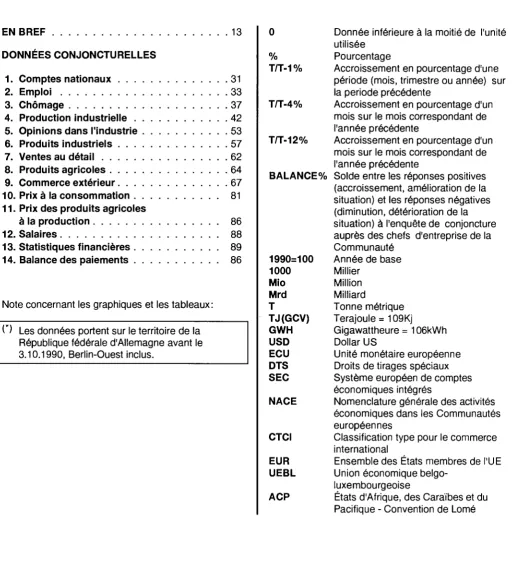
Table des matières
Signes et abréviations
a
EN BREF
13
DONNÉES CONJONCTURELLES
1. Comptes nationaux
31
2. Emploi
33
3. Chômage
37
4. Production industrielle
42
5. Opinions dans l'industrie
53
6. Produits industriels
57
7. Ventes au détail
62
8. Produits agricoles
64
9. Commerce extérieur
67
10. Prix à la consommation
81
11. Prix des produits agricoles
à la production
86
12. Salaires
88
13. Statistiques financières
89
14. Balance des paiements
86
Note concernant les graphiques et les tableaux:
Π Les données portent sur le territoire de la
République fédérale d'Allemagne avant le
3.10.1990, BerlinOuest inclus.
T/T-1 %
T/T4%
T/T-12%
BALANCE
0/.,
1990=100
1000
Mio
Mrd
Τ
TJ(GCV)
GWH
USD
ECU
DTS
SEC
NACE
CTCI
EUR
UEBL
ACP
Donnée inférieure à la moitié de l'unité
utilisée
Pourcentage
Accroissement en pourcentage d'une
période (mois, trimestre ou année) sur
la periode précédente
Accroissement en pourcentage d'un
mois sur le mois correspondant de
l'année précédente
Accroissement en pourcentage d'un
mois sur le mois correspondant de
l'année précédente
Solde entre les réponses positives
(accroissement, amélioration de la
situation) et les réponses négatives
(diminution, détérioration de la
situation) à l'enquête de conjoncture
auprès des chefs d'entreprise de la
Communauté
Année de base
Millier
Million
Milliard
Tonne métrique
Terajoule = 109Kj
Gigawattheure = 106kWh
Dollar US
Unité monétaire européenne
Droits de tirages spéciaux
Système européen de comptes
économiques intégrés
Nomenclature générale des activités
économiques dans les Communautés
européennes
Classification type pour le commerce
international
Ensemble des États membres de l'UE
Union économique belgo
luxembourgeoise
États d'Afrique, des Caraïbes et du
Pacifique Convention de Lomé
EUROSTATISTIQUES: en bref
TAUX DE CHANGE: une plus grande stabilité en juin 1995
Les marchés des changes ont retrouvé un calme relatif en juin 1995, avec
un dollar US se négociant dans une fourchette étroite tant par rapport au
mark allemand (à environ DM 1,40) qu'au yen japonais (à environ Y 84,5).
Le dollar a récupéré légèrement en mai, après avoir atteint des records de
baisse visàvis de ces deux monnaies le mois précédent, en s'échangeant
respectivement à DM 1,35 et 81,1.
L'ampleur de la dépréciation du dollar en cette année reste très
significative, la monnaie américaine ayant en effet perdu 10 % par rapport
au mark et plus de 15 % par rapport au yen depuis la fin de 1994. Le
sommet économique du G7 à Halifax (Canada) de la mijuin n'a débouché
sur aucune initiative majeure en matière de coordination politique de taux
de change.
Les tensions au sein du SME sont restées faibles en juin, après la détente
observée en avril et en mai. La peseta espagnole et l'escudo portugais
sont demeurés quasiment stables par rapport au mark allemand, mais la
livre irlandaise s'est dépréciée à un rythme régulier, pour tomber
audessous du franc français et se placer en dernière position au sein du
mécanisme de change. Dans le même temps, le franc français faisait
preuve de stabilité visàvis du mark allemand, à l'issue d'une phase de
plus grande volatilité autour de la période des présidentielles (avril et
mai), en s'échangeant dans une fourchette de FF 3,50 à 3,52.
Les monnaies n'ont que peu réagi aux changements des taux officiels
d'intérêt intervenus en juin. Les taux courts espagnols ont été majorés de
0,75 % le 2 juin et le 6 juin la banque centrale suédoise a relevé son taux
de prise en pension de 0,25 %. Les taux courts belges et néerlandais ont
été revus à la baisse le 8 juin.
A l'extérieur du mécanisme de change du SME, la lire italienne, la
couronne suédoise et le mark finlandais sont restés stables en juin, mais
la livre sterling s'est affaiblie vers la fin du mois en raison de l'incertitude
politique liée à la perspective des élections à la présidence du parti
conservateur et s'est échangée à DM 2,2084 à la clôture du marché
londonien le 26 juin.
RENDEMENT DES OBLIGATIONS D'ETAT: Fin de la reprise sur les
marchés européens
Les marchés obligataires ont connu un brusque renversement de
tendance début juin, avec la fin de la remontée des cours que l'on
observait depuis plusieurs mois. La tendance a néanmoins repris, en
grande partie sous l'effet des perspectives de ralentissement de la
croissance économique et d'inflation modérée. Jusqu'au 26 juin, le
rendement des obligations publiques à 10 ans est demeuré presque
inchangé dans de nombreux pays, dont l'Allemagne, la France et les
PaysBas. Les rendements ont eu tendance à augmenter pour les
obligations à forte rentabilité en Italie, au Portugal, en Espagne et en
Suède, en partie du fait des craintes inflationnistes.
En réaction à l'incertitude politique accrue au RoyaumeUni, le rendement
des fonds d'Etat à dix ans a atteint 8,4 % le 26 juin, ce qui ne représente
néanmoins qu'une hausse de 0,2 point par rapport au mois précédent.
Les marchés sont restés silencieux à l'annonce du collectif budgétaire
présenté par le nouveau gouvernement français le 22 juin.
En dépit du renversement de tendance du marché obligataire début juin,
la propension à la baisse se confirme au niveau des rendements des
obligations américaines et japonaises. Dans la perspective d'une flambée
des taux courts américains, le rendement des titres publics à dix ans a
fléchi de 0,4 point pour atteindre 6,1 % le 26 juin. En même temps, dans
la crainte d'une récession de l'économie japonaise, le rendement des
fonds d'Etat japonais équivalents a perdu 0,6 point par rapport au mois
précédent pour tomber à 2,7 %.
MASSE MONÉTAIRE: comportement très variable
Le comportement de la masse monétaire continue à fluctuer considéra
blement d'un pays à l'autre. En ce qui concerne la masse monétaire au
sens large, on continue d'observer une expansion soutenue en Espagne,
au Portugal, en Irlande et en Grèce, tandis que les taux de croissance ont
été négatifs au Danemark, en Allemagne, en Italie, aux PaysBas et en
Finlande jusqu'en mars 1995.
Au RoyaumeUni, la croissance M4 a lentement progressé pour atteindre
le point médian de sa fourchette indicative comprise entre 3 et 9 %. Le
taux d'expansion annuel était de 5,3 % en avril. La croissance M2 en
France a suivi une évolution similaire, sans toutefois réaliser l'objectif des
5 % pour 1995, puisqu'elle atteignait 3,4 % en mars. La croissance M3 en
Autriche a été assez régulière et a atteint 4,7 % en mars 1995.
En ce qui concerne la masse monétaire au sens étroit, l'expansion ne suit
pas toujours la même évolution que pour la masse monétaire au sens
large. C'est ainsi, par exemple, qu'en Finlande, la croissance M1 a atteint
7,4 % en mars 1995 alors que M3 a reculé dans le même temps de
0,3 %.
RESERVES EXTERIEURES OFFICIELLES:
En termes d'écu, les réserves extérieures officielles ont eu tendance à
diminuer ces derniers mois, en raison de la faiblesse du dollar, celuici
constituant toujours la principale monnaie de réserve.
Au cours du premier trimestre de 1995, les reculs les plus significatifs des
niveaux de réserve (à l'exclusion de l'or) ont été observés en Espagne
avec une diminution de 7,7 milliards d'écus pour atteindre 26,1 milliards
d'écus et en Italie avec une diminution de 5,2 milliards d'écus pour
atteindre 21,1 milliards d'écus. Dans le cas de l'Espagne, il s'agit là du
niveau de réserve le plus bas depuis que la peseta est entrée dans le
mécanisme de change du SME (juin 1989). En ce qui concerne l'Italie, il
s'agit là du niveau de réserve le plus faible depuis que la lire est sortie du
mécanisme de change en septembre 1992.
A l'inverse, l'Autriche, pays qui a rejoint l'UE le 1
e rjanvier dernier, a
augmenté ses réserves officielles au cours du premier trimestre de 1995.
Les réserves monétaires autrichiennes (à l'exclusion de l'or) sont passées
de 13,7 milliards d'écus en 1994 à 15,5 milliards d'écus actuellement.
INFLATION ANNUELLE DANS L'UNION EUROPEENNE:
inchangée à 3,3 % en mai 1995
L'inflation annuelle dans l'Union européenne des Quinze s'élève à 3,3 %
(taux provisoire) en mai 1995. Le taux est inchangé par rapport à mars et
avril. En mai 1994, il était de 3,2 %.
La Belgique détient le taux le plus faible (1,4 %). La France avec 1,6 %
(provisoire) et la Finlande (1,6 %) arrivent en deuxième position. Les
seuls pays audessus de la moyenne de l'Union européenne des Quinze
sont le RoyaumeUni (3,4 %), le Portugal (4,3 %), l'Espagne (5,1 %),
l'Italie (5,4 %, provisoire) et la Grèce (9,8 %).
Voici les taux enregistrés en mai, classés par ordre croissant, pour '
chaque Etat membre ainsi que les chiffres correspondants pour l'année
précédente:
Belgique
Finlande
France
PaysBas
Allemagne*
Luxembourg
Danemark
Autriche
EUR 15
mai 95
mai 94
1,4%
1,6%
1,6%
2.1 %
2.2 %
2.2 %
2.7 %
2.8 %
3.3 %
mai
94
mai 93
2,6 %
0,2 %
1,7%
2,9 %
3.0 %
2.1 %
1,9%
3,0 %
3.2 %
Irlande
Suède
RoyaumeUni
Portugal
Espagne
Italie
Grèce
mai 95
mai 94
2,8 %
3.2 %
3,4 %
4.3 %
5,1 %
5.4 % ρ
9,8 %
mai 94
mai 93
2,7 %
2,3 %
2.6 %
5.7 %
4,9 %
4,0 %
11,0%
L'IPC pour l'Allemagne continue de refléter les frontières d'avant le 3 octobre
1990. En mai, l'inflation annuelle dans les nouveaux Länder était de 1,4 %. En
mai 1994, elle était de 3,4 %.
Provisoire
estimation Eurostat, donnée non disponible
CHOMAGE: Le chômage dans l'Union européenne des Quinze:
à 10,9 % de février à mai 1995.
Le chômage dans l'Union européenne des Quinze, corrigé des variations
saisonnières, s'élève à 10,9 % en mai 1995. Des estimations révisées
indiquent que le taux était également à ce niveau durant les trois mois
précédents. En mai 1994, le taux était de 11,4 %.
De février à mai le taux de chômage a été relativement stable dans la
plupart des États membres pour les hommes ainsi que pour les femmes.
Les récentes tendances à la baisse en Espagne (qui avait le taux le plus
élevé de l'Union européenne des Quinze, 23 %) et au Danemark (8,8 %)
n'étaient pas évidentes ces derniers mois. Cependant, de lentes baisses
ont continué à se produire en France (12,3 %) et au RoyaumeUni (8,6
%).
Le Luxembourg avec 3,9 % continue d'enregistrer le taux le plus bas de
l'Union européenne des Quinze.
Eurostat estime qu'environ 18 millions de personnes sont au chômage
dans l'Union européenne des Quinze au mois de mai 1995. Ce chiffre,
corrigé des variations saisonnières, est établi en accord avec les critères
du Bureau International du Travail (BIT).
Remarque
Le taux de chômage et le nombre de chômeurs sont estimés selon les
recommandations du BIT après correction des différences entre les
méthodes nationales de recensement du chômage.
RODUCTION INDUSTRIELLE: La production industrielle dans l'Union
européenne des Quinze toujours en hausse
La tendance-cycle de la production industrielle dans l'Union européenne
des Quinze * a augmenté de 1,1 % au cours du premier trimestre de cette
année par rapport au dernier trimestre 1994.
Eurostat indique que, bien que la croissance se poursuive, elle n'atteint
pas le niveau de mi-1994 qui était d'environ 2 %.
Aux États-Unis, le taux de variation correspondant est de 1,4 %.
La croissance dans l'Union européenne des Quinze est forte dans
l'industrie automobile (2,9 % entre le premier trimestre 95 et le dernier
trimestre 94), les télécommunications et récepteurs de télévision (2,4 %)
et la construction mécanique (1,8 %).
Voici les chiffres (en %) pour les Etats membres pour lesquels des
données sont disponibles (E = estimation):
EUR 15
Suède
Danemark
Finlande
Espagne
Italie
1,1
4,1
2,7
2,3
2,0
1,3
France
Portugal E
Royaume-Uni
Pays-Bas
Autriche
Grèce
1,0
0,6
0,5
0,5
0,4
0,1
On entend par tendance-cycle les séries corrigées des influences saisonnières
et des variations irrégulières.
COMMERCE EXTÉRIEUR: Les importations de l'Union européenne des
Douze ont augmenté un peu plus que les exportations au cours de 1994
(+0,7 points en pourcentage).
En décembre 1994, le commerce extérieur de l'Union européenne des
Douze a enregistré un excédent commercial de 2,7 milliards d'écus contre
7 milliards d'écus pour le même mois en 1993. En conséquence, le déficit
cumulé pour la période janvier-décembre 1994 a été de 1 milliard d'écus
alors qu'on enregistrait un excédent de 2 milliards d'écus un an avant à la
même période.
Au cours de 1994, l'Allemagne a enregistré à la fois l'excédent extra-UE le
plus important des États membres de l'Union européenne des Douze
(25,6 milliards d'écus) et la hausse la plus forte par rapport à la même
période de l'année précédente (5,6 milliards d'écus).
Au cours de 1994, l'excédent de la balance commerciale italienne s'est
accru de 1,7 milliards d'écus, atteignant 12,7 milliards d'écus contre 11
milliards d'écus en 1993.
Le déficit extra-UE néerlandais a enregistré sa plus forte détérioration
entre 1993 et 1994 (9,9 milliards d'écus), atteignant 22 milliards d'écus
soit le niveau le plus élevé de l'Union européenne des Douze.
Au cours de 1994, le Royaume-Uni a, parmi les pays de l'Union
européenne des Douze, enregistré le deuxième plus fort déficit
commer-cial (20,5 milliards d'écus).
L'excédent commercial extra-UE de la France s'est accru de 1,4 milliard
d'écus en 1994 par rapport à l'année précédente (passant de 9,4 milliards
d'écus à 10,8 milliards d'écus).
La situation commerciale extérieure de de l'UEBL et de la Grèce a suivi
des courbes différentes: alors que la balance commerciale grecque s'est
redressée de 1,5 milliards d'écus, le déficit commercial de l'UEBL est
passé de 0,6 milliard d'écus à 1 milliard d'écus entre 1993 et 1994.
Entre 1993 et 1994, les excédent commerciaux du Danemark et de
l'Irlande se sont légèrement réduits pour atteindre respectivement 2,5 et
0,8 milliards d'écus en 1994.
De 1993 à 1994, les positions extérieures de l'Espagne et du Portugal
sont restées presque stables: les déficits extra-UE de ces deux pays ont
atteint respectivement en 1994, 4,3 et 2,7 milliards d'écus.
SCHAUBILDER
GRAPHICS
ARBEITSLOSENQUOTEN
SAISONBEREINIGTEUR
UNEMPLOYMENT RATES
SEASONALLY ADJUSTEDU S A
TAUX DE CHOMAGE
DESAISONNALISE
JAPAN
—»
— —
^
J l _ l I 1 I I I I I L J I I I I I I I I I L J l_l I I I I I I I L J l_l I I I I I I I L
12
π
10
9
8
~ i 7
1991
1992
1993
1994
15
14
13
12
11
10
9
8
7
β
ι ι 1
ARBEITSLOSENQUOTEN
^^^— mSGESAHT/SAISONBSRninGT — — — MAENMR/SAISONBEREMGT
FIUUHI/SAISONBERHNIGT
· '
'
—
.^'
1~*
ι ι Ι ι ι Ι ι ι
, , . · " ■ ' ' ' '
ι ι Ι ι ι Ι ι
UNEMPLOYMENT RATES
EUR
TOTAL/SEASONALLY ADJUSTED MEN/SEASONALLY ADJUSTED I OMEN/SEASONALLY ADJUSTED
_ « . - - ·
ι Ι ι ι
„ ,,
_ . ^ " "
ι ι Ι ι ι Ι ι
TAUX DE CHOMAGE
rOTAl/DESAISONNAlISE HOlOŒS/DESAISOmULISE FOOŒS/DESAISONNAIISE
I , !
, ■ ' * " ' ' ■ ' · ■ , t ■ 1 , ,
ι ι Ι ι ι Ι ι ι Ι ι
—
—
—
—
1
15
14
13
12
11
10
9
8
7
1991
1992
1993
1994
ARBEITSLOSENQUOTEN
SAISONBEREINIGT
UNEMPLOYMENT RATES
SEASONALLY ADJUSTED
%
TAUX DE CHOMAGE
DESAISONNAUSE
-IRL
■I1991
1992
1993
1994
2
1
υ
9
8
7
„ ^ _^-—"
"U
.- —
-""
, , 1 , , 1 , , 1 . .
UK F
/
—-. . 1 . , 1 , , 1 , ,
___,- —
—
v " ^
^~-~.
■ - B
"S¡r-r "~ ""* ~" ^ - » ^
. , 1 . . 1 . , 1 ,
—
— I 1211
10
— 7
1991
1992
1993
1994
12
10 —
"Ni
■
DC)
. , I , , 1 . . 1 , .
— — · —
, . 1 . . 1 . . 1 . . , , 1 . . 1 . . 1 . . . , 1 . . 1 . . 1 . .
— I 12
— 10
— 2
1991
1992
1993
1994
ARBEITSLOSENQUOTEN
SAISONBEREINIGT
UNEMPLOYMENT RATES
SEASONALLY ADJUSTED
TAUX DE CHOMAGE
DESAISONNAUSE
50
40
30
20
10;
0L
BELGIQUE - BELGIË
l l l l l l l l l l l l l l l n i J l 1 l l l . i l . I l
1991
1992
1993
1994
DANMARK
DEUTSCHLAND I
«¡ÄÜAUAii.
i l i i l i i l i i l i i l i i l u n i
1991
1992
1993
1994
ι n i ι I n i n i i l ,
1991
1992
1993
1994
50
4 0
-30
:2 0
1 0
-0L
ESPANA
FRANCE
IRELAND
l l M l l l l l l l l l l . i l l . . I . l l
1991
1992
1993
1994
50
40
30
20
10
0
I n
50
40
30
20
10
0
1991
1992
1993
1994
n i l ι ι Ι , ι Ι , , Ι , , Ι ι ι Ι , ι I l u l l .
1991
1992
1993
1994
50
40
30
20
10'
0L
ITALIA
i l n l i i l i i l I n i . . I l u l l
1991
1992
1993
1994
50
40
30
20
10
0
NEDERLAND
^
^
_
^ ^ < ^ Τ 7 Τ Γ ^ 3 ^ ^
50
40
30
20
10
JJ- 0
^ Τ Γ Γ ^ Τ "
PORTUGAL
_-—-—
1991
1992
1993
1994
1991
1992
1993
1994
50
40
30
20
10
UNITED KINGDOM
i l i i l i i l u l i Ι ι ι Ι ι ι Ι ι , Ι , ι Ι ι ι Ι ι ι
1991
1992
1993
1994
USA
ι Ι ι ι Ι ι ι Ι ι ι Ι ι ι Ι ι ι Ι ι ι Ι , . Ι . , ι , , I
1991
1992
1993
1994
TOTAL Moins de 2 5 ons F e m m e s
INDUSTRIELLE PRODUKTION
TENDENZ 1 9 9 0 = 1 0 0
INDUSTRIAL PRODUCTION
TREND 1 9 9 0 = 1 0 0
PRODUCTION INDUSTRIELLE
TENDANCE 1 9 9 0 = 1 0 0
NACE Rev. 1 C-Ε
EUR
USA
JAPAN
130
125
120
115
110
105
1UU
95
90
85
—
—
—
-
^
^
^
ι ι Ι ι ι Ι ι
'IlL'll.'. ''.'..
i l l ,
— —
—
~'
'"". ! n \ » f \
ι ι Ι ι ι Ι ι ι Ι ι ι
^ ^ "
1. . · ■ ' ^ í " . ,
ι ι Ι ι ι Ι ι ι Ι ι ι
,
"* ·
.·...-" ' ' " · '
ι ι Ι ι ι Ι ι ι 1
—
—
—
. —
—
ι 130
125
120
115
110
105
100
95
90
— 85
1991
tmriCB-LOGlBITBlQSCBI s u u
1992
1993
SBfl-LOGAHmPflC SCALE
1994
ICBDUE SDH-LOmsnHUlQUI
80
EUR
110
105
1UU
95
90
85
_ _ _ _
—
^V,-**^
ι ι Ι ι ι Ι ι
INDUSTRIE HACE Rer. 1 C-Ε GRUHDST. U. PRODUKTIONSGUETER
DAUERHArra KONSUMSGUETER
j ¿ > y ¡
i i i i
*^Γ"*>·
"
'
^
^
^
ι ι I ι ι I ι ι
zs
Ι ι ι
INDUSTRY NACE Rer.l C-E INTERMEDIATE GOODS
DURABLE CONSUMER GOODS
ι ι Ι ι ι Ι ι ι Ι ι ι
INDUSTRIE NACE Rer.l C-E BENS INTERMEDIAIRES
BIENS DE CONSOMMATION DURABLES
—
Λ .
~~
- • ^ . • / " » « w .
y
—
ι ι Ι ι ι Ι ι ι Ι ι ι
— 110
— 105
— 100
— 95
90
— 85
1991
1992
1993
1994
80
nWica-LOOAHTHiasCffl! s u u SuOfl-LOSAKnBMIC SOLI i c H r j j ! s n n - L o s u ¡ n m ü < i w