Int. J. Electrochem. Sci., 6 (2011) 484 - 491
International Journal of
ELECTROCHEMICAL
SCIENCE
www.electrochemsci.orgPtRu/Carbon Hybrids With Different Pt:Ru Atomic Ratios
Prepared by Hydrothermal Carbonization for Methanol
Electro-Oxidation
Marcelo Marques Tusi1, Nataly Soares de Oliveira Polanco1, Michele Brandalise1,
Olandir Vercino Correa1, Juan Carlo Villalba2, Fauze Jacó Anaissi2, Almir Oliveira Neto1, EstevamVitorio Spinacé1,*
1
Instituto de Pesquisas Energéticas e Nucleares – IPEN/CNEN-SP, Av. Prof. Lineu Prestes, 2422 – Cidade Universitária – CEP 05508-900 São Paulo, SP, Brazil.
2
Universidade Estadual do Centro-Oeste – UNICENTRO, R. Simeão Varela de Sá, 03 – Vila Carli – CEP 85040-080 Guarapuava, PR, Brazil.
*
E-mail: [email protected]
Received: 6 October 2010 / Accepted: 14 January 2011 / Published: 1 February 2011
PtRu/Carbon hybrid materials with different Pt:Ru atomic ratios (50:50, 60:40, 80:20 and 90:10) and 5 wt% of nominal metal loading were prepared by hydrothermal carbonization at 200°C using H2PtCl6.6H2O and RuCl3.xH2O as metals sources and catalysts of the carbonization process and starch
as carbon source and reducing agent. The obtained materials were further treated at 900 oC under argon and characterized by energy dispersive X-ray analysis (EDX), transmission electron microscopy (TEM), thermogravimetric analysis (TGA), X-ray diffraction (XRD) and cyclic voltammetry. The electro-oxidation of methanol was studied by cyclic voltammetry and chronoamperometry. The PtRu/Carbon materials showed Pt:Ru atomic ratios obtained by EDX similar to the nominal ones. XRD analysis showed that PtRu face-cubic centered (fcc) alloy and Ru hexagonal close-packed (hcp) phases coexist in the obtained materials. The average crystallite sizes of the PtRu (fcc) alloy phase were in the range of 10-12 nm. The material prepared with Pt:Ru atomic ratio of 50:50 showed the best electroactivity for methanol electro-oxidation.
Keywords: PtRu/Carbon hybrids, hydrothermal carbonization, starch, methanol electro-oxidation, ruthenium content
1. INTRODUCTION
production, storage and delivery of this fuel present some problems. Thus, fuel cells employing alcohols directly as fuel (Direct Alcohol Fuel Cell – DAFC) are very attractive as power source for portable, mobile and stationary applications. The alcohol is fed directly into the fuel cell, without any previous chemical modification or purification and it is oxidized at the anode while oxygen is reduced at the cathode. This characteristic avoids the problems related to the use of hydrogen [1-5].
Methanol has been considered the most promising fuel for DAFC because it is more efficiently oxidized than others alcohols due the low complexity of its molecular structure. PtRu/C electrocatalyst (carbon-supported PtRu nanoparticles) has been considered the best electrocatalyst for methanol electro-oxidation. However, the catalytic activity of the PtRu/C elecrocatalysts is strongly dependent on the composition, particle size, structure and morphology, which are influenced by the preparation methods [6-8]. Besides, the optimal Pt:Ru atomic ratio, as well, if the PtRu bimetallic alloy or a mixed-phase electrocatalyst containing Pt metal and ruthenium oxide/hydroxide is the most desired form of the catalyst, are still open questions [6-10].
Studies have been shown that the use of carbon nanotubes and mesoporous carbon as support increase the performance of the PtRu/C electrocatalysts, however, the synthesis of these supports are normally complex or involve harsh conditions [11-14]. Recently, the synthesis of metal/carbon nanoarchitectures by a one-step and mild hydrothermal carbonization was reported using starch or glucose and metals salts [15-16].
In this work, PtRu/Carbon hybrid materials with Pt:Ru atomic ratios of 50:50, 60:40, 80:20 and 90:10 and metal load of 5 wt% were prepared by hydrothermal carbonization process [15-16] and tested for methanol electro-oxidation.
2. EXPERIMENTAL
PtRu/Carbon materials were prepared by hydrothermal carbonization using H2PtCl6.6H2O
(Aldrich), RuCl3.xH2O (Aldrich) and starch (Aldrich). The noble metal salts were added to an aqueous
solution of starch and the pH of the resulting mixture was adjusted at about 11 using tetrapropylammonium hydroxide (TPAOH - 20 wt% in water) solution. Then, the obtained mixture was submitted to hydrothermal treatment at 200°C for 6 h in a 110 mL capacity Teflon-lined stainless steel autoclave. After this, the obtained solids were filtered, washed with ethanol and water and dried at 70oC for 2h. Finally, the obtained PtRu/Carbon hybrids were thermally treated under argon atmosphere at 900°C for 3h.
The X-ray diffraction analyses were performed using a Rigaku diffractometer model Miniflex II using Cu Kα radiation source (λ = 0.15406 nm). The diffractograms were recorded from 2θ = 20° to 90° with a step size of 0.05° and a scan time of 2 s per step.
The Pt:Ru atomic ratios were obtained by EDX analysis using a scanning electron microscope Phillips XL30 with a 20 keV electron beam and equipped with EDAX DX-4 microanaliser.
The PtRu metal loading (wt%) was determined by thermogravimetric analysis (TGA) using a Shimadzu D-50 instrument and platinum pans. Heating rate of 5°C min-1 was employed under dry oxygen (30 mL min-1) [17].
Electrochemical studies of electrocatalysts were carried out using the thin porous coating technique [18,19]. An amount of 20 mg of the electrocatalyst was added to a solution of 50 mL of water containing 3 drops of a 6% solution polytetrafluoroethylene (PTFE) suspension. The resulting mixture was treated in an ultrasound bath for 10 min, filtered and transferred to the cavity (0.40 mm deep and 0.47 cm2 area) of the working electrode. The quantity of electrocatalyst in the working electrode was determined with a precision of 0.0001g. In voltammetry cyclic experiments the current values (I) were expressed in amperes and were normalized per gram of platinum (A gPt-1). The quantity
of platinum was calculated considering the mass of the electrocatalyst present in the working electrode multiplied by its percentage of platinum. The reference electrode was a RHE and the counter electrode was a platinized Pt plate. Electrochemical measurements were made using a Microquimica (model MQPG 01, Brazil) potenciostat/galvanostat coupled to a PC and using the Microquimica software. Cyclic voltammetry was performed in a 0.5 mol L-1 H2SO4 and 0.1, 0.5 and 1.0 mol L-1 methanol in
0.5 mol L-1 H2SO4 solutions saturated with N2.
3. RESULTS AND DISCUSSION
PtRu/Carbon hybrids with different Pt:Ru atomic ratios were prepared by hydrothermal carbonization process (Table 1). In the reaction conditions, the starch hydrolyses to glucose units that acts as reducing agent of the Pt(IV) and Ru(III) ions and the resulting metal nanoparticles act as catalysts of the carbonization process [15]. The carbonization yields of the as-synthesized PtRu/Carbon hybrids were in the range of 60-70 wt%. The as-synthesized materials did not show catalytic activity for methanol electro-oxidation probably due to the carbonaceous structure having low electrical conductivity [20,21]. After thermal treatment at 900oC a weight loss of about 50 wt% was observed for all prepared materials, which become active for methanol electro-oxidation. The Pt:Ru atomic ratios of the obtained materials determined by EDX analysis after thermal treatment at 900oC were similar to the nominal ones. The obtained PtRu loadings (wt%) were around 5wt%, which were similar to the nominal value.
Table 1. Pt:Ru atomic ratios, carbonization yield, weight lost after thermal treatment, PtRu metal load, average crystallite size and Ru alloying of PtRu/Carbon hybrids.
Pt:Ru atomic ratio (nominal)
Pt:Ru atomic ratio (EDX)1
Carbonization yield (wt%)2
Weight lost (%)1
metal load (wt%)1
Crystallite size (nm)1,3
Ru alloying (%)1,4
50:50 51:49 71 51 4.8 12 47
60:40 61:39 74 55 6.1 12 64
80:20 74:26 62 50 4.7 10 10
90:10 87:13 63 50 6.0 11 7
1 after thermal treatment, 2 as-synthesized, 3 calculated from X-ray diffractograms using Scherrer equation, 4 calculated
[image:4.596.178.443.126.350.2]
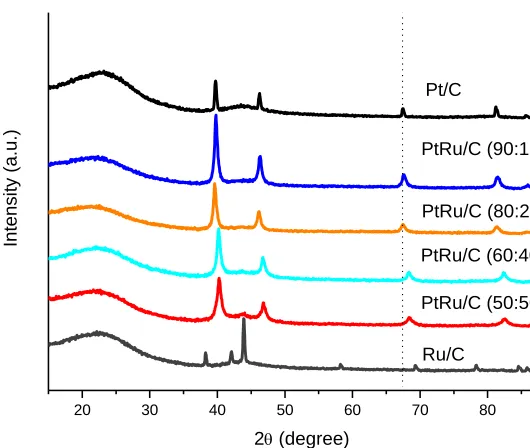
The X-ray diffractograms of PtRu/Carbon hybrids after thermal treatment were shown in Fig. 1.
20 30 40 50 60 70 80 90
Ru/C Pt/C
PtRu/C (50:50) PtRu/C (60:40) PtRu/C (80:20) PtRu/C (90:10)
In
te
n
si
ty
(a
.u
.)
2 (degree)
Figure 1. X-ray diffraction of PtRu/Carbon hybrid materials after thermal treatment under argon atmosphere at 900 oC.
The diffractograms of PtRu/C materials showed a broad peak at about 2θ = 23° associated to the carbon material and five peaks at about 2θ = 40°, 47°, 67°, 82° and 87° that are associated to the (111), (200), (220), (311) and (222) planes, respectively, of the fcc structure of platinum and platinum alloys [22-25]. All samples also presented a peak at about 2θ = 44º, which increase with the increase of the ruthenium content in the samples. This peak was attributed to a separated hexagonal close-packed (hcp) phase of metallic ruthenium [22,26]. The Ru/Carbon hybrid presented four peaks at about 2θ = 38º, 42º, 58o
and 69º of Ru (hcp) structure [26].
Peaks associated to ruthenium oxides species are not observed in the difractograms, however, they could not be discarded [23,27]. The (220) reflections of Pt (fcc) crystalline structure were used to calculate the average crystallite size according to Scherrer formula [22] and the calculated values are in the range of 10-12 nm (Table 1).
Thus, it was observed the presence of Pt(fcc) and Ru(hcp) phases for all prepared materials. The values of Ru alloying calculated by Vegard’s law [23,28] for PtRu/Carbon hybrid materials with different Pt:Ru atomic ratios showed that the materials with higher Ru content have about 50% of Ru alloyed with Pt, while for materials with low Ru content only 10% was alloyed with Pt (Table 1).
3 6 9 12 15 18
0 2 4 6 8 10 12 14 16 18 20 22 24 26 28
daverage = 8.2 nm
fre
q
u
e
n
cy
(%
)
particle size (nm)
5 10 15 20 25 30 35
0 2 4 6 8 10 12 14 16 18 20 22 24 26 28 30
fre
q
u
e
n
cy
(%
)
particle size (nm) d
average = 13.0 nm
(a) (b)
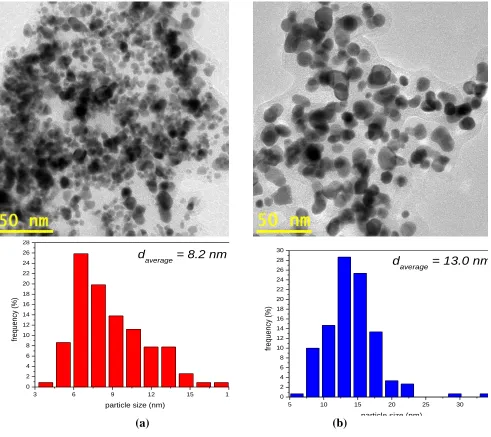
Figure 2. Image obtained by TEM and histogram of particle size distribution of the PtRu/Carbon hybrids with Pt:Ru atomic ratios of (a) 50:50 and (b) 90:10.
It was observed in both micrographs that the metallic nanoparticles were embedded in a carbon phase with a relative good distribution, however, the histograms showed a broad distribution of the particle sizes. The average particle size was about 8 nm for the material prepared with Pt:Ru atomic ratio of 50:50 and 13 nm for the material prepared with Pt:Ru atomic ratio of 90:10.
[image:5.596.57.548.69.506.2]
existence of ruthenium oxide species that are able to adsorb OH species during the polarization process [30].
0,0 0,1 0,2 0,3 0,4 0,5 0,6 0,7 0,8 0,9
-20 -15 -10 -5 0 5 10 15 I (A g Pt -1 )
E vs RHE (V)
PtRu/C (50:50) PtRu/C (60:40) PtRu/C (80:20) PtRu/C (90:10)
(a)
0,0 0,1 0,2 0,3 0,4 0,5 0,6 0,7 0,8 0,9
-16 -12 -8 -4 0 4 8 12 16 20 24 28 I (A g Pt -1 )
E vs RHE (V)
PtRu/C (50:50) PtRu/C (60:40) PtRu/C (80:20) PtRu/C (90:10)
(b)
Figure 3. (a) Cyclic voltammetry of PtRu/Carbon hybrids in 0.5 mol L-1 H2SO4. (b) Cyclic
voltammetry of methanol electro-oxidation on PtRu/Carbon hybrids with different Pt:Ru atomic ratios. These experiments were carried out with a sweep rate of 10 mV s-1 at room temperature.
The cyclic voltammetry of methanol electro-oxidation on PtRu/Carbon materials with different Pt:Ru atomic ratios (Fig 3b) indicates that the methanol electro-oxidation started in the range of 0.45-0.55 V and an increase of current values was observed with the increase of Ru content in the samples.
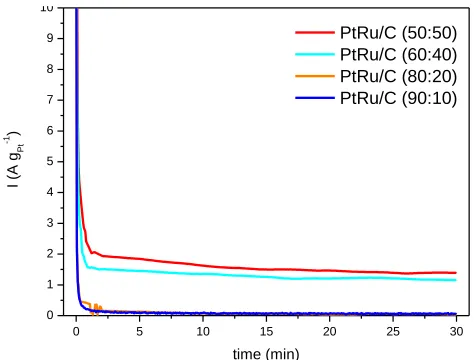
The chronoamperometry curves of the PtRu/Carbon hybrids with different Pt:Ru atomic ratios at 0.5 V are shown in Fig. 4.
0 5 10 15 20 25 30
0 1 2 3 4 5 6 7 8 9 10 PtRu/C (50:50) PtRu/C (60:40) PtRu/C (80:20) PtRu/C (90:10) I (A gPt -1 ) time (min)
Figure 4. Chronoamperometry of methanol electro-oxidation on PtRu/Carbon hybrid materials with different Pt:Ru atomic ratios in 0,5 mol L-1 H2SO4 containing 1.0 mol L-1 of methanol with a
[image:6.596.69.539.119.297.2] [image:6.596.184.421.522.702.2]
In agreement with cyclic voltammetry experiments (Fig. 3b) the activity of the PtRu/Carbon materials also increase with the Ru content in the samples. The current values increase in the following order: (50:50) > (60:40) >> (80:20) = (90:10). Thus, the materials with higher quantities of Ru showed a superior performance. The increase of activity of PtRu electrocatalyts for methanol electro-oxidation has been attributed by some authors [31] to an increase of Ru alloy degree with Pt while others authors [9,32-35] have reported that the presence of hydrous ruthenium oxides and/or metallic Ru are more important than the alloy degree. These types of active sites seem to be present in our materials.
4. CONCLUSIONS
The hydrothermal carbonization using starch as carbon source produces active PtRu/Carbon hybrids for methanol electro-oxidation. The metal load and Pt:Ru atomic ratios values of the obtained PtRu/Carbon materials were similar to the nominal values. X-ray diffractograms of the obtained materials showed that Pt-Ru(fcc) alloy and Ru(hcp) phase coexist in the obtained materials; however, the presence of Ru oxide/hydroxide could not be discarded. The average crystallite sizes of the Pt(fcc) phase were in the range of 8-12 nm. The PtRu/Carbon with Pt:Ru atomic ratio of 50:50 showed the best performance for methanol electro-oxidation. Further work is necessary to characterize our materials by other surface techniques (XPS and EXAFS) in order to obtain more information about the structure of these materials.
ACKNOWLEDGEMENTS
The authors thank CNPq, FAPESP, CAPES and FINEP-MCT-ProH2 for financial support and to
CCTM-IPEN-CNEN/SP for TEM measurements.
References
1. E. V. Spinacé, M. Linardi and A.O. Neto, Electrochem. Commun., 7 (2005) 365 2. A.Kirubakaran, S. Jain and R.K. Nema, Renew. Sust. Energy Rev., 13 (2009) 2430. 3. S.K. Kamarudin, F. Achmad and W.R.W. Daud, Int. J. Hyd. Energy, 34 (2009) 6902 4. J.M. Andújar and F. Segura, Renew. Sust. Energy Rev., 13 (2009) 2309
5. A.O. Neto, T.R.R. Vasconcelos, R.W.R.V. Silva and E.V. Spinacé, J. Appl. Electrochem., 35 (2005) 193
6. W.J. Zhou, B. Zhou, W.Z. Li, S.Q. Song, G.Q. Sun, Q. Xin, S. Douvartzides, M. Goula and P. Tsiakaras, J. Power Sources, 126 (2004) 16.
7. H. Liu, C. Song, L. Zhang, J. Zhang, H. Wang and D.P. Wilkinson, J. Power Sources, 155 (2006) 95.
8. F. Colmati Jr., W.H.L. Valbuena, G.A. Camara, E.A. Ticianelli and E.R. Gonzalez, J. Braz. Chem. Soc.; 13 (2002) 474
9. J.W. Long, R.M. Stroud, K.E.S Lyons, D.R. Rolison, J. Phys. Chem. B, 104 (2000) 9772. 10.H.A. Gasteiger, N. Markovic, P.N. Ross, E.J. Carins, J. Electrochem. Soc., 149 (1994) 1994. 11.P. Serp, M. Corrias and P. Kalck, Appl. Catal. A – Gen., 253 (2003) 337
13.Y.C. Liu, X.P. Qiu, Y.Q. Huang and W.T. Zhu, Carbon, 40 (2002) 2375
14.S. Basri, S.K. Kamarudin, W.R.W. Daud and Z. Yaakub, Int. J. Hyd. Energy, 35 (2010) 7957 15.S.-H. Yu, X. Cui, L. Li, K. Li, B. Yu, M. Antonietti and H. Cölfen, Adv. Mater., 16 (2004) 1636 16.H.-S. Qian, S.-H. Yu, L.-B. Luo, J.-Y. Gong, L.-F. Fei and X.-M. Liu, Chem. Mater., 18 (2006)
2102
17.O.A. Baturina, S.R. Aubuchon and K.J. Wynne, Chem. Mater., 18 (2006) 1498
18.A.O. Neto, M.J. Giz, J. Perez, E.A. Ticianelli and E.R. Gonzalez, J. Electrochem. Soc., 149 (2002) 272
19.E.V. Spinacé, A.O. Neto, T.R.R. Vasconcelos and M. Linardi, J. Power Sources, 137 (2004) 17 20.M. Sevilla and A.B. Fuertes, Carbon, 44 (2005) 468
21.B. Hu, K. Wang, L. Wu, S.H. Yu, M. Antonietti and M.M. Titirici, Adv. Mater., 22 (2010) 1 22.E. Antolini and F. Caderllini, J. Alloy Comp., 315 (2001) 118
23.V. Radmilović, H.A. Gasteiger and P.N. Ross, J. Catal., 154 (1995) 98
24.S. Jingyu, H. Jianshu, C. Yanxia and Z. Xiaogang, Int. J. Electrochem. Sci., 2 (2007) 64 25.L. Ma, C. Liu, J. Liao, T. Lu, W. Xing, J. Zhang, Electrochim. Acta, 54 (2009) 7274. 26.M. Brandalise, M.M. Tusi, R.M. Piasentin, M. Linardi, E.V. Spinacé and A.O. Neto, Int. J.
Electrochem. Sci., 5 (2010) 39
27.M.C.S. Sierra, J.G. Ruiz, M.G. Proietti and J. Blasco, J. Mol. Catal. A – Chem., 96 (1995) 65 28.J.W. Guo, T.S. Zhao, J. Prabhuram, R. Chen and C.W. Wong, Electrochim. Acta, 51 (2005) 754 29.T. Onodera, S. Suzuki, Y. Takamori and H. Daimon, Appl. Catal. A – Gen., 379 (2010) 69.
30.G.R.S. Banda, H.B. Suffredini, M.L. Calegaro, S.T. Tanimoto, L.A. Avaca, J. Power Sources, 162 (2006) 9
31.L.P.R. Profeti, F.C. Simões, P. Olivi, K.B. Kokoh, C. Coutanceau, J.M. Léger, C. Lamy, J. Power Sources, 158 (2006) 1195
32.A.S. Aricò, V. Baglio, A. Blasi, E. Módica, P.L. Antonucci, V. Antonucci, J. Electroanal. Chem., 557 (2003) 167
33.D.R. Rolison, P.L. Hagans, K.E. Swider, J.W. Long, Langmuir, 15 (1999) 774 34.Q. Lu, B. Yang, L. Zhuang, J. Lu, J. Phys. Chem. B, 109 (2005) 1715
35.Q. Lu, B. Yang, L. Zhuang, J. Lu, J. Phys. Chem. B, 109 (2005) 8873