September/98
The
5 ECU
z"'
"'
EDITED BY THE INSTITUTE FOR PROSPECTIVE TECHNOLOGICAL STUDIES (IPTS) AND ISSUED IN COOPERATION WITH THE EUROPEAN S&T OBSERVATORY NETWORK
SPECIAL ISSUE:
CLEAN TECHNOLOGIES
/t
An Editorial Outline of Aspects of "Clean
J:
Technologies"
The Role of Cooperative Cleaner
Production Projects
Consensus-Based Approaches to the
Development of Sustainable Industry
Eco·lndustrial Development: The Case of
the United States
From Products to Services: Selling
performance instead of goods
EUROPEAN COMMISSION Joint Reseorch Centre
. . .
. .
. .
.
.
The IPTS Report No . 2 7 S e p t e m b e r 1998
ABOUT THE
IPTS
REPORT
T
he !PT'S Report
was
launched in December
1995,on
the
request
and
under
the auspices of
Commissioner Cresson.
What
seemed
like a daunting
challenge
in late
1995, nowappears in
retrospect
as a
crucial galvaniser of
the IPTS
'
energies
and
skills.
The Rep011 has published
articles
in numerous areas,
maintaining a rough balance between them, and
exploiting
interdisciplinarity as far as possible. Articles are deemed prospectively relevant
if
they attempt to
explore
issues not
yet
on the policymaker's agenda (but projected to be there sooner or later),
or
underappreciated aspects of issues already
on
the policymaker's
agenda. The long drafting and redrafting
process
,
based
on
a
series
of interactive consultations with outside
experts
,
guarantees
quality
control.
The clearest indication
of
the
report
'
s success
isthat it
isbeing
read.
An initial print run of 2000 for the first
issue
(00)
in December
1995looked
optimistic at
the time
,
but issue 00 has
since
tumed into a
collector's
item. Total
readership rose to around 10
,
000
in
1997,with readers continuing
to
be drawn from
a
variety
of
backgrounds and
regions world-wide
,
and
in
1998a
shift
in emphasis towards the
electronic version on
the Web has begun.
The laurels the publication is reaping are rendering
itattractive for authors from
outside
the
Commission.
We have already published
contributions
by
authors
from
such
renowned institutions as the Dutch TNO
,
the
German VD!
, the Italian ENEA and the
US Council of Strategic
and International
Studies.
Moreover, the IPTS
formally collaborates on
the production of the !PT'S Report
with
a
group of
prestigious
European institutions, with whom the !PT'S has formed the European
Science and
Technology Observatory
(ESTO)
,
an important
part of the remit
of
the !PT'S. The IPTS Report
isthe most
visible
manifestation
of
this
collaboration.
The Report is produced simultaneously in four languages
(English,
French,
German
and Spanish) by the
!PT'S; to these
one could
add the Italian translation volunteered by ENEA:
yet another sign of
the Report
'
s
increasing visibility. The fact that it
is not only availablein
several
languages, but also largely prepared
and
produced
on
the lntemet World
Wide Web
,
makes
it
quite an uncommon
undertaking.
We shall continue
to
endeavour
to find the best
way of fulfilling the
expectations
of
our quite diverse
readership
,
avoiding oversimplification
,
as well as encyclopaedic reviews
and
the
inaccessibility
of
academic
journals.
The key
is
to remind
ourselves, as well as
the readers, that
we cannot
be
all
things to all people, that
it
is
important
to
carve out our
niche and
continue optimally exploring and exploiting it,
hoping to
illuminate topics under
a new, revealing
light for the benefit of the readers,
in
order
to prepare them for
managing the
challenges
ahead.
I I I I I
N
o
.
2 7September 1998
The IPTS Report
.IT .IT .IT .IT .IT © IPTS - JRC - Seville, 1998
P r e f a c e
T
hid 7PTS Report' c1peciaL idc1ue id devoted to clean technologi.ec:J:
which are new technologicaL c:JoLutionc:J offering conc:JWera61e
potentiaL in the context of a c:JUc:Jtaina61e economic development.
The European Union J
commitment to achieve a c:JUc:Jtaina61e
development path hac:J 6ecome a permanent characteridtic for rJUJc:Jt of itc:J
poLici.ec:J during the LaA decade. Indeed, in
1997
the Amc1terdam Treaty
hac:J introduced a renewed impetUd in thid direction 6y inc!.UJing a
c:Jtronger commitment on environment, with an expLicit obLigation to
integrate environmentaL requirementc1 into aLL EU poLici.ec:J and actionc1.
Of courc:Je, c:JUc:Jtaina61e development id not onLy of concern to the EU, /Jut
a glo6aL idc:Jue at c:Jtalce. The Kyoto Summit on Gl.o6aL Warming, heUJ in
December l.ac:Jt year, made clear that the current pattern of development
entaw confLict
c:J
6etween development and environment, which cannot 6e
permitted to continue. Hence,
the importance of creating an appropriate
legid/ative framework and exploring new technologicaL avenuec1, which
wiLL ruuLt from increac:Jed ruearch effortc:J.
At pruent, the appreciation of the potentiaL of clean technologiec:J, on the
one hand, and the pro61em of conc:Jumer demand increac:Je, on the other,
The IPTS Report N
o .
2 7 S e p t e m b e r 1998framework conJitiofld. PoLici.e.f have to aim at achieving a competitive
economy, combineJ with Le.M environmentaL JegraJation, improve()
reJource efficiency of energy anJ raw materiau, anJ higher
employment ratu.
The EU RdD poLicy, through itJ Framework Programme 5 anJ the
Joint Re.tearch Centre of the European Commi.Mion, are prepare() to
Jupport poLicy-makerJ in their taJk of provi:Jing an aoequate legi.Jiative
framework to enhance JUJtainabiLity without unJermining European
competitiveneJJ.
.IT .IT .IT .IT .IT
N
o
2 7 S e p t e m b e r 1998 The IPTS ReportTHE IPTS REPORT
SEPTEMBER 1998
EDITED E!Y THE INSTITUTE FOR PROSPECTIVE TECHNOLOGICAl STUDIES !IPTSI And issued in Cooperation with the European S& T ObservatorY Networ1<
PUBUSHED BY THE EUROPEAN COMMISSION Joint Research centre
ISSN: 1025-9384 catalOgue Number GK-AA-98-007-EN-C
DEPOT LEGAL: SE-1937-95
DIRECTOR
Jean-Marle cadiou EXECUTIVE EDIToR · Dimltris Kyrtakou
EDITORIAL BOARD
G. caratti, G. Fahrenkrog, P. Fleissner. J. Gavigan. M. Gonz~lez, H. Hem~ndez. D. Kvrtakou. I. Maghiros
<Production Manager!, P. S0rup, A. Soria, C. Tahir. PRODUCTION
CINDOC-CSIC/CL SERVICIOS UNGOISTICOS
PRINT Graesal TRANSLATION CINDDC-CSIC/CL SERVICIOS UNGOISTICDS
COPYRIGHT
The views expressed in this publiartion do not necessarily reflect those of the European Commission
c
ECSC-EEC-EAEC Brussels-Luxembourg, 1997 Reproduction is authorised, except for oommerdalpurposes, provided the source is acknoWledged. The EC may not be held respensible for the use
made of the Information.
THI IPTS RIPORT
is published in the first week of fM':rY month, except
for the months of January and August 1t is edited in
English and is currently available at a price of 50 ECU per year. In four languages: English, French, German
and Spanish.
SUISCRIPTIO~S For a subscription to The IPTS Report, or to amend an existing subscription, please
write with full details to:
The IPTS Report 5ecretartat IPTS, JRC 5evilla wortd Trade center
lsla de la Cart$
E-41092 5evilla, Spain Tel: +34-95-448 82 97 Fax: +34-95-448 82 93
E-mail: ipts_sea@in::.es
Web address: wwwjn::.es/iptsreport/subscribe.html
..IT ..IT ..IT ..IT ..IT
© IPTS -JRC -Seville, 1998
c
0
N
T
E
N
T
s
SPECIAL ISSUE: CLEAN TECHNOLOGIES
4
,
8
15
,
An Editorial Outline of Aspects of uclean Technologies"
As policy-makers try to promote the shift towards sustainable development, the complex
issue of clean technologies requires flexible regulatory tools if businesses are to obtain
their full potential.
The Role of Cooperative Cleaner Production ProJects
Cleaner production is a preventive strategy which seeks to reduce the impact of production, and thus is a key component of measures towards sustainability. However, its uptake by SMEs has been limited by organizational and cost factors. Support to cooperative projects could be a positive step in this direction.
consensus-Based Approaches to the Development of sustainable Industry
Voluntary agreements offer a flexible approach to environmental management, allowing
manufacturers to seek optimal solutions that are satisfactory to all stake-holders. However, any voluntary approach needs to have clearly defined limits and objectives, and be
backed by enforcement.
23 Eco-lndustrlal Development: The case of the United states
The Eco-lndustrial paradigm reuses waste outputs from one industry as raw materials for another, thus reducing both overall waste generation and resource-consumption. Various models are being studied to examine how industrial parks based on this paradigm could be encouraged.
35 From Products to services: Selling performance Instead of goods
, A shift from a linear production paradigm to a cyclic one, in which the manufacturer remains responsible for his products after they have left the factory looks likely to bring
about a major shift from a product-based to a service-based economy. This has positive implications for resource management and waste prevention, and current frameworks
The IPTS Report
Originally, the main
emphasis
of
the
environmental debate,
policy and practice
was
on limiting the release
of toxic materials
into
the air,
water
and soil
The environmental
debate has shifted
from end-of-pipe
technologies to more
complex issues
such
as
resource depletion,
waste reduction,
bio-diversitv,
.
global climate
change
etc.
No. 2 7 S e p t e m b e r 1998
An Editorial outline of Aspects of
"Clean Technologies"
Vera Calenbuhr, IPTS
Issue:
The
Implementation of Integrated technology concepts aiming at reducing the use
of toxic materials and
.
Improving material productivity
Is
becoming
Increasingly
more
widespread
.
Several surveys among
Institutional
Investors and Industrialists have shown
that sustainable development along
Its
three dimensions
-
environment, social,
economic
-
Isplaying a role
In
entrepreneurial decision making processes.
Relevance: several national
Initiatives,
the Amsterdam treaty of the EU, and also the
economy, finance and
trade
ministers of the oeco1 now endorse sustainable
development as a principal policy obJective
.
The complexity of the clean
technology
Issue
requires flexible regulatory tools that enable companies to fully explore the
potential of Integrated technologies.
lt
Is
Instructive
to give an overview of the
potential and the limitations
Of
clean technology concepts
In
view of changing
policy obJectives.
0
riginally, the main emphasis of the environmental debate, policy and practice was on limiting the release of toxicmaterials into the air, water and soil.
Regulations addressed this issue by prescribing limit values and norms which prompted industry to fit filters, catalytic converters etc. onto existing
Parallel to the diffusion and implementation
of end-of-pipe technologies (which still continue) the environmental debate has shifted
to more complex issues such as resource
depletion, waste reduction, bio-diversity, global climate change and others. Industry's response, partly on a pro-active basis and partly complying equipment. Over the years, a whole new branch of with new legislation has been to implement
industry emerged: environmental technology, most technologies with a different objective: rather of which is represented by these so-called add-on than limiting emissions at the end of the process or end-of pipe technologies. Despite their positive the new focus has become reducing resource use effects - making air and water cleaner -add-on and limiting the utilization of toxic substances
technology has not been without its critics from along the life cycle of a product. industry, policy makers and environmentalists. The
devices are expensive for a company and often do This can be achieved in several different
not really solve an environmental problem, ways: closing material flows inside and outside but rather shift the disposal of a pollutant from of the company, better logistics, improved
one medium to another. energy efficiency, redesigning production
.IT .IT .IT .IT .IT
N
o
2 7 S e p t e m b e r 1998processes and products, better process control, Moreover, it should avoid the implementation of
substituting raw materials, use of fewer toxic
chemicals and using new technologies. The
clean technology issue is not just about radical
innovation and functional changes. There is
already a vast body of empirical evidence
which shows that marginal process and
product design modifications can bring about
significant reductions in the use of materials
and the quantity of pollution, whilst improving
the competitiveness of the firm. Closer
inspection shows that the integration of
resource-saving measures in the production
process is to a considerable degree an
organizational challenge and a result of good
stewardship rather than being entirely a
technical problem.
The implementation of cleaner technologies
-technically inferior solutions. These imperatives
are very difficult to achieve. Therefore,
voluntary agreements are discussed as an
alternative. They may be flexible on the one
hand, but may not always lead to the desired
effects on the other. An interesting variation on
that theme, a voluntary approach based on
consensus while at the same time keeping
tighter regulations as a fall back mechanism is
currently being used in the Netherlands and the
US. Celia Greaves reports on the trials being
undertaken using this so-called covenant
approach that is now being evaluated.
The integration of cleaner production
measures may sometimes require companies to
exchange materials with one another. In extreme
cases the waste of one company may become a
as defined loosely above - may require resource for another firm, changing the goal from
rearrangement of strategies inside and outside a
company. Many firms report that they have
become more competitive and have higher return
on investment. Despite financial incentives and
the fact that the changes are not necessarily
complex, small and medium sized companies
(SMEs) face difficulties in realizing clean
technology concepts. While many large
companies are systematically integrating their
processes, SMEs lag behind in this development.
The article by Eder and Fresner analyses this
situation and highlights what is possible for SMEs
and where the limits are.
The environmental debate, the technological
solutions and environmental regulation have
eo-evolved to higher degrees of complexity.
Command and control approaches have been
supplemented or replaced by more flexible
market-based instruments. Regulation must on
the one hand assure the realization of policy
objectives. On the other hand it should not lead
waste minimization to waste flow and waste
use optimization. In this way, companies
form networks and achieve considerable
environmental as well as economic benefits. The
article by Cohen-Rosenthal and McGalliard
from Cornell university describes the potential
of so-called eco-industrial parks based on
this symbiotic model.
The biggest savings at the level of resource
consumption can be achieved if the idea of a
product is looked at from a different angle.
What a consumer wants is in many cases not
the material product as such, but rather its
performance i.e. the service he or she obtains
from it. Thus, one major trend today is that many
companies are shifting from selling a product to
selling a service and so retaining responsibility for
the underlying product throughout its
life cycle. Waiter Stahel describes several
examples of companies selling performance
rather than material goods and the implication
to undesirable technology lock-in situations. at management and policy level.
1 1 1 1 1
© IPTS -JRC - Seville, 1998
The IPTS Report
Cleaner technologies
entail closing
material
flows, improving
logistics, improving
energy efficiency,
redesigning processes.
substituting raw
materials, and so on
In the eco-park model
there is a kind of
symbiosis. one
company's waste is
another's raw material,
reducing net resource
usage at a multi-firm
rather than individual
firm
level
Another telling sign
today is that quite a
few companies are
shifting from selling
a product to
selling a service
and so retaining
responsibility for the
The IPTS Report
Investors are
increasingly
recognizing the role
of environmental
performance as
an
indicator
of
a company's
competitiveness and
good management
Although innovative
technologies
have
an
important
role
,
supply
and demand need to
be brought in line
in order to adjust
resource consumption
to a degree that is
compatible with the
carrying capacity of
the planet's stocks
No. 2 7 S e p t e m b e r 1998
A closer look at the motivations that lead shown that around two thirds rate environmental companies to implement cleaner technologies factors as important for improving a company's
reveals several interesting factors. The first and competitiveness (BATE news service, April 1998).
most important factor still is cost. Clean technologies (covering the vast spectrum of approaches and initiatives described above) can be cost saving due to the reduced consumption of
resources, reduced costs for safety, cleaning and remediation, etc. These are all factors that have a direct impact on the bottom line of a company.
However, clean technology concepts do not automatically result in cost savings. Among several possibilities of optimizing a firm's activities internally and in relation to other business partners and the customer, not all environmentally friendly solutions are the most cost effective ones. In many cases, the identification of an environmentally good and cost saving solution requires a considerable effort from a firm. This has lead many
Compared to the often highly polarized image
that industry has to live with (being the creators of wealth and labour on the one hand, while being the bad polluters on the other hand), the picture that one gets from companies implementing clean technologies looks considerably more positive. One has to be careful, however, with general judgements and conclusions. Clean technologies are becoming an important contribution to reducing environmental impact. However,
integrated technologies are an emerging trend and it may take years before these technologies enter the mainstream. So, most of the success stories of clean technologies represent the smaller part,
mostly very innovative firms, of the whole companies to develop tools such as indicators that industry community. Moreover, while large
help them to link design changes, environmental companies have also the largest potential for
impact and cost. Although these initiatives have change, it may take many years to integrate only been started recently, they contribute to production processes in industrial giants include environmental factors to a set of other such as multi-national companies. Despite this, business factors (Gameson, to be published). those companies embarking on new and environmentally more benign ways are certainly Besides cost, other factors play an important the pioneers of the often cited post-industrial age. role as well. Many companies that see themselves
as being concerned and committed to
environment and sustainable development
underline their social responsibility (BATE news service April 1998; Schmidheiny et al, 1997).
Another factor is the public image that a firm has. Today, a company can less and less afford to have
a negative image. Besides customers, shareholders ask environmental details about a company's performance and management. There is a growing perception among industrial agents, raters in banks and investment portfolio managers that companies with a good environmental record and environmental management systems in place are on the whole better managed than other firms. A
recent survey among institutional investors has
Despite an enormous increase in material productivity since the beginning of the industrial
revolution material consumption has increased
because demand has increased faster sti
11.
Although clean technologies use resources much
more efficiently, the overall material consumption is likely to increase. In industrialized countries demand is still growing and there is a trend of
using short lived material intensive products. The increasing population and standard of living in many developing countries will also lead to an enormous increase of material consumption. lt is
expected that the environmental burden on the planet will at least double over the next fifty years. lt follows that we have to half the environmental
N
o
.
2 7 S e p t e m b e r 1998impact at a global level, if the overall "Factor Four", by von Weizsaecker, Lovins and
environmental situation shall not become worse. Lovins (1997). The problem that demand it becomes obvious that clean technologies increases faster than material productivity, leading may have the potential to become industry's to an overall increase of resource use is an contribution to sustainable development in
industrialized countries as well as developing
countries. However, industry can hardly solve the problem alone. Supply and demand need to be brought in line in order to adjust resource consumption to a degree that is compatible with the carrying capacity of the planet's stocks. This requires an effort of all the players involved,
industry, authorities and consumers. There are several interesting studies and scenarios by
governments and research institutions that deal
with the potential of clean technologies in integrated concepts. See for example "81 Options
- Technology for Sustainable Development" a study commissioned by the Dutch Ministry of
Housing, Physical Planning and the Environment
(1997) or the new report to the Club of Rome
Keywords
important issue that we have not been able to
discuss in detail in this special issue due to space
limitations. Other important issues such as the
elaboration of Best Available Technologies (BATs),
technology diffusion, the relation between clean technologies and trade and the important role
financial institutions are beginning to play in making industrial production have a smaller environmental impact could not be discussed in detail for the same reasons, too. Nevertheless, the examples chosen show that integration on the one . hand and cooperation between several players
such as industry (suppliers, producers, distributors etc.), authorities and consumers on the other are key concepts that can be found running through technical, organizational and policy-making issues in this area.
_I"
em-efficiency, integrated technologies, end-of-pipe technologies, integration, cooperation
Note
1-Annual meeting on 28-29/0498, Paris.
References
• Business And
The Environment
(BATE news service). April, Volume IX, No. 4, 1998.• Gameson, T.,
Business
Weighted
Environmental indicators.
EUR Report (IPTS). To be published in september 1998.• Schmidheiny, S., Chase, R. and DeSimone,
L.,
Signals of Change
-
Business
Progress Towards
Sustainable Development.
WBSCD Publications, Geneva, 1997.• von Weizsaecker, E.U., Lovins, A.B. and Lovins, L.H.,
Factor
Four: Doubling
Wealth -
Halving
Resource
.
The new report to the Club of Rome. Earthscan Publications Ltd, London, 1997. • Weterings, R., Kuijper, ). and Smeets, E.,81 Options -
Technology
for
Sustainable Development.
Report commissioned by the Dutch Ministry of Housing, Physical Planning and the Environment.
Apeldoorn, 1997.
contact
Vera Calenbuhr, IPTS
Tel.: +34 95 448 82 87, fax: +34 95 448 83 39, e-mail: [email protected]
© IPTS -JRC - Seville, 1998
The IPTS Report
About the author
vera Calenbuhr
has
a Ph
.
D. in natural
sciences. She is
currently working at
the IPTS, where her
interests include
technological, legal
and financial issues
of integrated
technologies,
The IPTS Report No 2 7 S e p t e m b e r 1998
The Role of cooperative Cleaner
Production Projects
P. Eder, IPTS and J. Fresner, Stenum CmbH
Issue: Over the last decade a considerable number of cleaner production projects and
programmes have been carried out by SMEs In
·
conjunction with consultants, local
authorities and International organizations so as to improve the eco-efflclency of the
companies' production systems. Sufficient information about the outcome of such
Initiatives
Is now available to make it possible to appreciate their contribution to
achieving forms of production compatible with sustainable development.
Relevance: Increased eco-efflclency,
I.e.
decreased material and energy intensity of
production and lower emissions,
i~a prerequisite for sustainable economic development
In
the upcomlng decades. cooperative cleaner production projects allow SMEs to engage
In
Improving
their eco-efflciency through process and management optimization and
redesign by trying to compensate the specific disadvantages faced by SMEs when
compared to large companies.
Introduction
T
he reactive and curative approach has predominated in environmental protection si nee the 1960s. Problems with emissions of pollutants from industrial sources have tended to be addressed by the utilization of end-of-pipe pollution control technologies. These approaches reduce the direct release of some pollutants to achieve regulatory compliance but do not really solve the environmental problems as they shift pollution from one environmental medium to another. Moreover environmental protection is frequently seen as a burden because end-of-pipe treatment causes extra costs. The cleaner production approach aims at avoiding these shortcomings of traditional environmental protection. lt prevents the production of pollutants instead of treatingwaste and emissions in end-of-pipe treatment plants. The idea of cleaner production came up in the 1970s in individual large companies and it has become more wide-spread in the 1990s with programmes and projects involving bigger numbers of participating companies and focusing on SME. These initiatives represent an important factor for sustainable development.
Definition of cleaner production
Cleaner production is a preventive strategy to minimize the impact of production and products on the environment by applying cleaner technologies and organizational measures. it reduces the impact of industrial plants on their environment by tracking their waste and emissions to their respective sources in the processes and defining measures to eliminate the problems there.
.IT .IT .IT .IT .IT
N
o
2 7 S e p t e m b e r 1998The basic idea is to shift from the question: they have recognized that there are advantages
• 'What shall we do with our waste and to an integrated approach to environmental
emissions?' to protection and that it enhances competitiveness.
• 'Where do our waste and emissions come from and what can we do to prevent their
production at source?'.
This approach includes organizational
changes, motivation and training for good
housekeeping as well as changes in raw materials,
process technology, and internal recycling
('Cleaner Technology'). it introduces the idea of material and energy flow management into the
companies. Nielsen (1994) defines 'Cleaner
Technology' as follows:
'Cleaner Technology is the conceptual and procedural approach to the development,
purchase and use of processes and products
preventing and reducing internal and external environmental problems throughout the
product life cycle by integrating options to: • minimize volumes and hazards of gaseous,
liquid and solid wastes;
• minimize the risk of accidents involving chemicals and processes;
• minimize consumption of raw materials, water and energy; and
• use substitute chemicals and processes less hazardous to human and ecological health.'
cooperative cleaner production
projects In SMEs
One of the first cleaner production initiatives was started by 3M in the 1970s. Today, from
among the many businesses studying or
implementing cleaner production, about 120 companies, mainly large ones such as BP, 3M and Sony, have come together in the World Business
·~council for Sustainable Development. Although some of these companies are still at an early stage
f implementing cleaner production strategies,
I I I I I
I© IPTS - JRC -Seville, 1998
SMEs took up the idea of cleaner production later than the bigger companies. Generally it was not before the 1990s that they became active in the field. This can be explained by the fact that SMEs have often problems finding free capacity for innovative initiatives due to limited personnel, limited possibilities for investments and for R&D. Cleaner production reached SMEs when cooperative cleaner production projects were established to compensate for their specific problems. Cooperative cleaner production projects bring together companies, universities, regulatory agencies and international organizations to implement cleaner production
programmes in companies.
Among the most prominent European
cooperative projects are the Dutch PRISMA
project, the AIRE/CALDER project in the UK, the CATALYST Merseyside project, the SPURT project in Denmark, the LANDSKRONA project in Sweden
and the ECOPROFIT and PREPARE projects in
Graz, Austria (Gee, 1995; Ulh0i, 1997). The UNEP (United Nations Environment Programme) began its cleaner production programme in 1989. lt works with more than 100 organizations to implement cleaner production initiatives in over 60 countries. Together with UNIDO (United Nations Industrial Development Organization) it has established National Cleaner Production Centres in the Czech and Slovak republics, in Hungary, India, China,
Mexico, Brazil, in Nicaragua, Costa Rica, El
Salvador and some more countries. UNEP's
International Cleaner Production Information Clearinghouse provides data on about 600
technical cleaner production case-studies all over the world. The Austrian ECOPROFIT and PREPARE projects started in 1991 and have included more than 200 companies from the textile, pulp and
The IPTS Report
Cleaner production
is a preventive strategy
to minimize the impact
of production and
products
on
the
environment by
applying
cleaner
technologies and
organizational
measures
The IPTS Report
A number
of
European
and world-wide clean
production initiatives
have
involved SMEs
drawn from
a wide
range of industrial
sectors
Programmes
usually
involve
input from
consultants, training
,
workshops and then
sharing
of experience
N
o
2 7 Sep temb e r 1998paper, food processing, machine building, wood environmental costs, ecological purchasing and
working, printed circuit board manufacturing and eco-design, eco-controlling and indices.
galvanising industries as well as other sectors.
Cooperative cleaner production projects
typically evolve in the following stages:
1. creating awareness concerning the prevention
of pollution;
2. finding the source of wastes and emissions;
3. defining a programme to reduce emissions and
increase resource efficiency;
4. implementing and documenting cleaner
production options.
Usually the companies participating in
cooperative Cleaner production projects are
coached by external consultants that train the
The following types of cleaner production
measures are typically identified and/or implemented
in Cooperative cleaner production projects:
• good housekeeping with materials and energy;
• training of employees, better logistics,
improvement in data availability and
communication between departments;
• substitution of raw and auxiliary materials by
less harmfu I ones or ones that can be used
more efficiently or can be recycled internally
or externally;
• modifications of products to eliminate production
steps with major environmental impact;
• process modifications to minimize waste and
staff, visit the companies and bring participants emissions;
from different companies together in common • internal recycling;
workshops to share knowledge and experience. For • introduction of waste into external recycling
example the ECOPROFIT Programme is offering 1 0 networks.
workshops on the issues of waste avoidance,
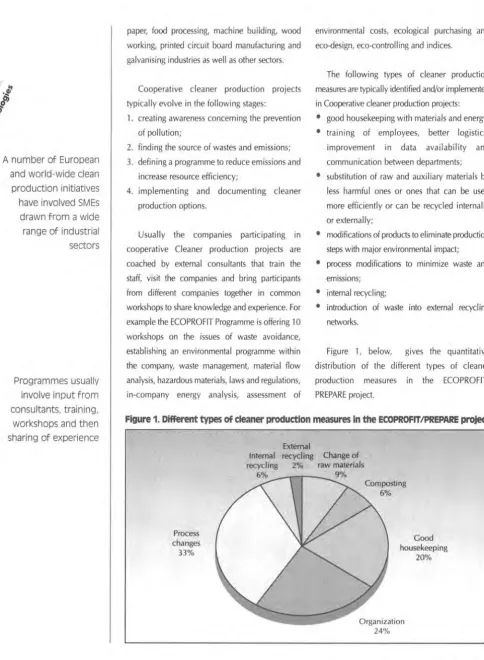
establishing an environmental programme within Figure 1, below, gives the quantitative
the company, waste management, material flow distribution of the different types of cleaner
analysis, hazardous materials, laws and regulations, production measures in the ECOPROFIT/
in-company energy analysis, assessment of PREPARE project.
Figure 1. Different
typesof
cleaner production measures in the ECOPROFITIPREPARE
project
Process
changes 33%
External
Internal recycling Change of recycling 2% raw materials
6%
Composting 6%
Good
housekeeping
20%
Organization 24%
I I I I I
[image:12.542.39.523.61.721.2]N
o
2 7 S e p t e m b e r 1998Achievements and limitations
of
cooperative cleaner production projects
use are relatively small in comparison to the scale
of the company's activities. Table 1 gives typical
results for companies participating successfully in
Generally, experience shows that cooperative cooperative cleaner production projects. The
cleaner production projects are successful in results of cooperative cleaner production projects
improving the eco-efficiency of SMEs, although are related to the type of innovation that triggers an
sometimes the reduction in material and energy increase in eco-efficiency. Generally, we can
Table 1: Measures and results of ECOPROFIT/PREPARE cooperative cleaner production projects
Sector
Turnover
Number of
.
Measures
Results
!Million ecul
employers
metal processing
metal processing
electrical ind.
electronic ind.
wood~orking
food processing
pulp and paPer
textile
32.9
30.4
17.9
71.7
l8.65
109
2
© IPTS - JRC -Seville, 1998
1100
340
243
328
108
420
26
creating responsibiliti~s, -50°/o,solid waste
waste logistics
waste ·logistics, optimi- ~30% solid'waste, -30%
zation of paint-shop (paint paints
and_ guns)
waste logisti~s, increasing
batch sizes - by quasi
'continuous' manu-facturing of cables
better· dosing of diverse
chemicals, opti,mization of
0.21 million ECl)/yr from less waste and better logistics
0.14 million ECU/yrfrom
less chemicals and
waste water trea~ment plant, recycling of cleaning
fa~rics
change to water based • ·paints, efficiency of cutting
textiles, waste l?gistics
reuse of water, better
maintenance of fat
separators··
flow analysis of Cadmium, composting sludge
optimization of boiler,
elimination of washing cycles, better control of washing, exact dosing of chemic,a,ls
-40% solid waste, 0.35 million ECU/yr from less textiles
.-40% COD 1 in waste
water, 30% water use
-25% sludge to disposal
elimination of Chr\)fllium, -30% water, -30% steam
The IPTS Report
Although
generally
successful,
programmes involving
SMEs
do not always
achieve
results on a
scale comparable
to
the companies'
[image:13.540.22.410.186.709.2]The IPTS Report
Three kinds of
innovation are
involved: optimization
,
redesign and function
innovation
.
The most
radical innovation
is often the most
effective
,
but inertia is
often an obstacle to
implementation
A number of factors
militate against the
effectiveness of cleaner
production innovation
implementation in
SMEs
N
o .
2 7 S e p t e m b e r 1998distinguish three ideal kinds of innovation: production chain and control only a small part of optimization, redesign and function innovation. the product life cycle, so the possibilities of
Optimization focuses on improving existing designing products in a completely new way are processes and does not essentially modify the limited. (Even the cooperative approach seems to system of production but rather increases the
efficiency of the system by making slight
modifications (e.g. reducing heat losses by better
insulation). Redesign partly changes the actual
design of existing processes. Specific features of
the system are changed, for instance by choosing
to use materials that can be made suitable for reuse in the disposal stage or that are less eco-toxic (e.g. substitution of FCHC by non-halogenated hydrocarbons in air-conditioners). The system concept however remains largely unchanged. Function innovation departs from the system concept and develops new systems which perform
the same function better. This can result in a
be unable to compensate for this relative
disadvantage of SMEs compared to large
companies, which usually control a bigger part of the entire product life cycle.)
So cooperative cleaner production projects in
SME rarely lead to revolutionary improvements in
the eco-efficiency of the companies involved but
rather to incremental progress. Nevertheless, due to multiplicative effects, cleaner production may
contribute considerably to improve the material
and energy efficiency of European economies.
The cooperative cleaner production approach does have a considerable although not radical change as to how the function is fulfilled overwhelming potential to contribute to (e.g. more intelligent architecture that makes
air-conditioners obsolete) (Weterings,
et al.
,
1997).Most cleaner production options reported by cooperative projects can be classified as optimization or redesign. They typically reduce
the material or energy intensity of companies or
individual processes within companies by 5 to 50%. Cleaner production case-studies quite often
report considerable reduction of an individual energy or material flow within a company, with
the flaw that the affected flow is relatively irrelevant within the context of the entire production process. This may partly be due to the fact that the really important flows are already fairly well optimized before the start of the cleaner
production project as they represent an important cost factor. In practice too, cooperative cleaner
production projects are often the province of environmental managers. They are not always well integrated with the mainstream of the business and so cannot always influence
innovation processes. Products of SME are often
highly dependent on the integration in the entire
sustainable development.
Economy of cleaner production
The ECOPROFIT project has shown that cleaner production projects can reduce
companies' total costs by 1 - 1.5
%
byinvestments made according to the companies' own investment standards. This correlates well with the findings of the Deutsche
Bundesumweltstiftung. However, not all cleaner production measures reduce costs. Required investments, higher labour intensity, substitution of more expensive (but environmentally less harmful) materials or energy-carriers or necessary research and development may bring additional costs that outweigh savings in energy and
raw-materials. A relative increase of raw-material and energy costs compared to other production factors (e.g. by tax reform) would logically give more importance to cost reductions by energy or material savings. Due to accounting and valuation problems it is sometimes difficult for companies
to quantify the financial effects of cleaner
. I . I . I . I . I
N
o
.
2 7September 1998
production measures. Uncertainty and risks are protection options. Findings and results of often a hurdle to cleaner production investments. cooperative cleaner production projects should
So to get a better basis for investment decisions, be disseminated to the relevant industries using
methodologies would have to be clarified and various communication tools.
data availability improved.
Most companies participating in the
ECOPROFIT and PREPARE projects believe that
the projects have increased their competitiveness
Motivation and satisfaction of employees
has improved significantly. Direct effects on
employment can generally be neglected.
conclusions
Cooperative cleaner production projects
improve the eco-efficiency of processes and
companies and can at the same time reduce
Transfer of knowledge on cleaner production
from universities and consultants to companies
and between companies could be improved. The diffusion of identified cleaner production options
within a sector and between sectors should be
enhanced. Many cleaner production solutions
(such as improved energy efficiency) can be
applied to companies in different industrial
sectors. Cooperative cleaner production projects
have identified a number of technological
bottlenecks for improving eco-efficiency. For
example in waste water reprocessing and
recycling many specific problems need to be
costs, thus leading to an improvement in researched. Cooperation between industry and
competitiveness. lt is desirable that cleaner universities in this field should be stimulated.
production find broad resonance in industry, Specific research programmes may be set up
especially also in SMEs. Despite the inherent
positive ecological, economic and financial
effects, an economy-wide implementation of
cleaner production in SMEs requires additional
measures in order to be successful. More
political commitment to promote cleaner
production solutions instead of end-of pipe
technology would give an important stimulus. An
ecological tax reform which increases the
relative costs of raw-materials and energy, in
comparison to other cost factors such as labour,
would clearly be beneficial. Laws regulating the
concession of operating permits to companies
could demand the adoption of cleaner
production more explicitly. In this
context the definition of BAT (best available
technologies) should put a strong emphasis on
preventive environmental protection
approaches. Information campaigns promoting
the advantages of cleaner production could
provide the background for a positive response
of companies to preventive environmental
I I I I I
© IPTS - JRC -Seville, 1998
drawing from the experience of cooperative
cleaner production projects.
The integration of cleaner production and
environmental management systems promises
synergies. EMAS and ISO 14001 are mainly
focused on the auditing of the management
system. The standards and the regulations do not
provide the organization with explicit tools how
to understand and measure its waste, discharges
and emissions. Without a regular analysis of
the flows of energy and materials caused by
a company it has no real picture of its
environmental relevance. Tools developed in
cooperative cleaner production projects can help
to close this gap. On the other hand, an
environmental management system integrating
the implementation of cleaner production
strategies can cause a cleaner production project
to develop in such a way that it moves towards a
continuous improvement process, decreasing the
environmental effects of an organization by
The IPTS Report
To the extent that
energy and
raw-materials costs increase
cleaner production
wil
l
become more
competitive
Despite the inherent
positive ecological.
economic and financial
effects, an
economy-wide implementation
of cleaner production
in SMEs requires
additional measures in
order to be successful
Measures could include
improved knowledge
transfer and the
development of
analytical tools to
The IPTS Report
About
the authors
Peter Eder is a
biochemist with
a PhD in chemical
engineering from
Graz University of
Technology, he is
working at the IPTS
on issues concerning
sustainable
technologies. He has
experience as a
consultant on cleaner
production and
environmental
legislation, and has
carried out research on
sustainability indicators,
and worked for
a year on
a technical
cooperation project
(bio-diesel programme)
in Managua, Nicaragua.
Johannes
Fresner is a
chemical engineer,
holding a
degree from
Graz University of
Technology. He has
been working in
Cleaner Production
since 1992 and in
Environmental
management since
1995. He is currently
working as a
consultant. trainer and
researcher in the field
and is
a
partner
in the company
Stenum GmbH.
N
o
2 7 S e p t e m b e r 1998improving eco-efficiency. So legislation and
regulations should try to integrate the cleaner
production and Environmental Management
approaches.
There seems to be a consensus that
sustainable development requires a considerable
increase in em-efficiency of production, or in
other words, a decrease in material and energy
intensity. There are concepts such as Factor 4
or Factor 10, which estimate the necessary
reduction of raw-materials and energy use to
Keywords
cleaner production, SME, em-efficiency, cooperative
Note
1-Chemical Oxygen Demand.
References
achieve a certain product or service to be 75
%
or 90
%,
respectively. If we contrast this to thetypical achievements of cooperative cleaner
production projects, it becomes obvious that they
clearly represent a move in the right direction.
Nevertheless, sustainable development wi 11
require even more profound innovation with
more drastic reductions in material and energy
efficiency. lt seems that function innovation with
a radical restructuring of the system of production
is crucial to achieving production compatible
with sustainable development.
_I"
• Weterings, R., Kuijper, j., Smeets, E., Annokkee, G.J., Minne, B., 81 Options: Technology for
Sustainable Development, Ministry of Housing, Spatial Planning and the Environment, The
Netherlands, 1997.
• Gee, D., Clean production - from industrial dinosaur to em-efficiency, Manufacturing Science
Finance, 1995.
• Nielsen, B., Waste Management: Clean Technologies, an update on the situation in EU member
states, Rendan/Kruger(rME Report, prepared for the commission of the European Union, DG XI, 1994.
• Okoprofit-Steiermark-Prepare, Initiative fur innovatives und umweltbewuf5tes Wirtschaften, Land
Steiermark, Rechtsabteilung 3.
• Ulh0i, J.P., Industry and the environment: a case study of cleaner technologies in selected European
countries, 1997.
• Word Business Council for Sustainable Development, UNEP, £eo-Efficiency and Cleaner
Production - Charting the Course to Sustainability.
Contacts
Peter Eder, IPTS
Tel.: +34 95 448 84 52, fax: +34 95 448 82 35, e-mail: [email protected]
Johannes Fresner, Stenum GmbH
Geidorfgurtel 21, A-8010 Graz
Tel.: +43 316 367156 0, fax: +43 316 367156 13, e-mail: [email protected]
. I . I . I . I . I
'
N
o
2 7September
1998
consensus-Based Approaches to the
Development of sustainable Industry
Celia
Greaves.
CESTIssue: Many types of organizations are Increasingly realising the value of active
engagement with various groupings of stakeholders as they seek to Improve their
environmental performance. Both regulators and the regulated can benefit from a shift
away from the traditional Industrial stance of
'decide,
announce, defend' to one based
around Informed debate. Potential advantages Include greater flexibility In achieving
environmental objectives
.
better environmental solutions and Improved cost·
effectiveness leading to enhanced competitiveness. These need to be balanced against a
variety of practical challenges to effective consensus-based approaches. and these need
to be recognized and overcome. If the benefits are to be fully
r~allzed.Relevance: New approaches aimed at achieving a sustainable
Industry
across Europe will
have the greatest potential for success where they can be deveioped within the context
of an appropriate and supportive policy and regulatory framework. such a framework Is
most likely to be characterized by elements which encourage positive dialogue between
Industry,
regulators and other stakeholders
.
As new Industrial paradigms evolve. policy
makers will be best placed to encourage progress towards sustalnablllty where the
relationship with Industry allows for consensus based decision making, which brings
clear benefits to all parties.
Better dialogue
•
better environmental
solutions?
I
n recent timesinterest in a more , there has consensual approach been a growing toenvironmental management. This has been stimulated, in part, by the development of a
number of new concepts, such as 'best practical
environmental option', which provide scope for
flexibility and recognize that there is usually more
than one acceptable solution which balances
cost, safety, technological considerations
scrutinising powers of the media have meant that it is no longer possible, or appropriate, for companies to operate in a communication vacuum.
The types of organizations which could
fruitfully engage in dialogue as a means of working towards sustainable industry are
numerous and varied. Depending on individual
circumstances, and the aims of the dialogue
process, they could include companies,
regulators, NGO's, employees, trade associations and local communities. There are, however, a
and practicality. In parallel with this, the number of generic issues to be considered by any communications revolution and increasing group involved in the process. First, and perhaps
1 1 1 1 1
© IPTS · JRC-Seville. 1998
The IPTS
Report
The IPTS Report
Engagement between
stakeholders requires a
willingness to share
information openly,
moreover
,
the limits
and purpose of the
dialogue need to be
fully understood by all
those involved from
the outset
The fle
x
ibility of
voluntary agreements
makes them an
increasingly attractive
alternative to ever
more complex
regulation
N
o .
2 7 S e p t e m b e r 1998most importantly, there is the question of risk. such as emissions and waste. Here, initiatives Engagement between stakeholders requires a based around voluntary agreements are receiving
willingness to share information openly, and increasing attention.
evidence that the process has an intrinsic value
beyond public relations. All parties need to be
clear as to their aspirations for the dialogue, and
the limits beyond which they are not prepared to
extend themselves. A second major concern is the scope of the engagement. The boundaries of the
dialogue, as well as its purpose, need to be fully understood by all those involved, and it is prudent to decide exactly who is to be included in the
discussions from the outset. For example, under
what conditions would it not be appropriate for
discussions between a regulator and a company
on environmental performance to be extended to
the local community in which the company
operates? The method of engagement between
the parties (open fora, mail questionnaires,
focused meetings, etc.) also need to be carefully considered.
There are a variety of situations where a
consensus based approach might be appropriate.
A future for voluntary agreements?
The term voluntary agreements attempts to
capture the idea that environmental goals and/or
instruments of implementation are agreed with
the companies to be regulated in such a way as to
provide a degree of flexibility of response amongst
those affected (Hansen, 1996). With the trend towards globalization, and the growing
complexity of regulation (both in terms of
design and implementation), such approaches
are becoming increasingly attractive as an
environmental management tool. In 1996, there
were over 300 voluntary agreements recognized
by national authorities (EEA, 1997).
In many countries, environmental legislation
has developed over a number of years, and may be
characterized by a variety of instruments often
with only a limited degree of connection and
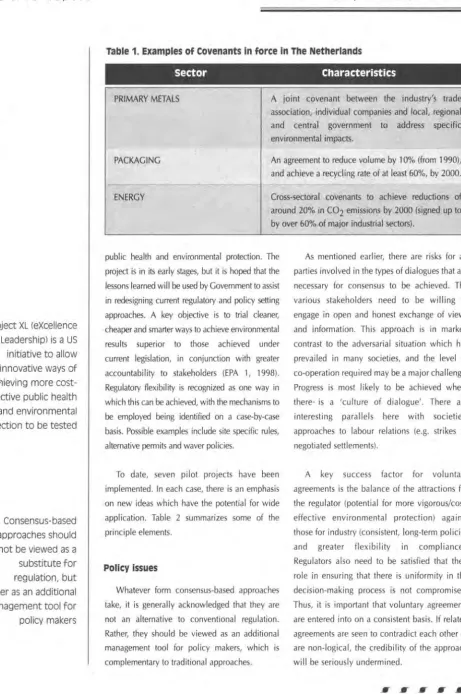
Some examples are presented in Box 1. continuity between them. This presents particular challenges to companies seeking to carry out their
Of particular interest to the policy maker is the activities whilst ensuring full compliance with
scope for consensus based approaches to improve all relevant environmental controls. Voluntary industrial environmental performance in areas agreements have the potential to play an important
Box 1. use of consensus based approaches
• Corporate policy -
where a company might wish to engage with the full range of stakeholdersas it develops its response to a specific environmental issue (e.g. the Brent Spar case).
-• Corporate
strategy~ particularly in the context of the involvement of stakeholders in developing Corporate Environmental Reports. Companies such as IBM have-been at the forefront of efforts· in this area.
• Area-based strategies -
applying consensus tools to initiatives covered by Local Agenda 21 -adopted by various local authorities.'
• Local issues-
companies working with local communities on site specific environmental issues.• Regulatory compliance -
providing opportunities lor the development of more flexibleapproaches to the achievement of environmental targets and objectives.
.IT .IT .IT .IT .IT
i
© IPTS - JRC - Seville, 1998