This is a repository copy of From cradle to grave?: policy responses to death in the UK. White Rose Research Online URL for this paper:
http://eprints.whiterose.ac.uk/122251/ Version: Accepted Version
Article:
Foster, L. orcid.org/0000-0003-1471-842X, Woodthorpe, K. and Walker, A. (2017) From cradle to grave?: policy responses to death in the UK. Mortality. ISSN 1357-6275
https://doi.org/10.1080/13576275.2017.1414776
[email protected] https://eprints.whiterose.ac.uk/
Reuse
Items deposited in White Rose Research Online are protected by copyright, with all rights reserved unless indicated otherwise. They may be downloaded and/or printed for private study, or other acts as permitted by national copyright laws. The publisher or other rights holders may allow further reproduction and re-use of the full text version. This is indicated by the licence information on the White Rose Research Online record for the item.
Takedown
If you consider content in White Rose Research Online to be in breach of UK law, please notify us by
From Cradle to Grave?: Policy Responses to Death
Abstract
While death features widely in various humanities and some social science disciplines, to date
it has not been given the attention it deserves in social policy discourse or research. This paper
sets out to begin to rectify that omission. Outlining a range of policy areas affected by death, it
argues that budget and outcome-driven priorities in the UK have resulted in the evolution of
disconnected and inconsistent policy responses to death. The paper begins by outlining death
rates and characteristics of population ageing before focussing on social divisions in death and
associated policies. It considers the death and UK social policy agenda before outlining the key
characteristics involved in developing a coherent policy response and policy analysis in this
field. It argues for a more comprehensive, consistent and joined up policy response to death,
and corresponding academic study of death, which acknowledges and supports individuals
preparing to die, when they die, and those left behind.
Keyword: austerity, bereavement, death, demography, end of life, inequality
Introduction
Death and taxes are the only certainties in life – an aphorism commonly associated with
Benjamin Franklin in 1789 (but coined by Daniel Defoe five decades earlier). For such an
inevitability it is remarkable that death has been long neglected by social policy makers and
policy analysts alike. This paper examines why this has been the case, specifically in the
‘from the cradle to the grave’1. Through doing so the paper demonstrates that death presents
the opportunity to bring together a sizable range of policy areas which are not usually
considered together (Drakeford, 1998; Rowlingson, 2006; blinded for review).
At the outset it is important to note that policy responses to death are not just about dying, the
moment of death, and bereavement. It is evident that individuals’ experiences of death and the
situation of those ‘left behind’ are the products of decisions made across the life course and
the impact of policies on these decisions. For instance, age at the point of death is connected to wider social policies which affect health, employment, income, participation, and individuals’
overall quality of life. Death can also be linked to various characteristics such as social class
(Marmot, 2010), gender (Austad, 2006) and ethnicity (Holloway, 2007), all of which shape and contextualise people’s lives before they die.
Moreover, historical policy developments play a role in shaping communities’ and individuals’
experiences of death. These have an impact on the resources and quality of services available
to dying individuals and those close to them, as well as on measures to prevent death (Monroe
et al., 2011). In turn, these are shaped by the prevailing political ideology at any particular time.
In policy terms, the prevailing political ideology has implications for how rights and
responsibilities are conceptualised and operationalised; responses to times of crisis (including
austerity measures); and the extent to which (financial) support is provided by the state or the
market, or indeed whether it is provided at all. For instance, governments in the UK the last
few decades have been dominated by neoliberal ideologies, which have promoted the role of
markets in providing for individual needs, challenging whether the state should provide welfare
1 This was established in the 1942 Beveridge Report that became the basis for the establishment of the welfare
state in the UK in the mid 1940s. The Report lauded the creation of an extensive system of social insurance
above a minimum level (blinded for review).As a result, policy not only affects the way people
near the end of life are supported but also the financial circumstances of those left behind
through factors such as Social Fund Funeral Expenses Payments and inheritance tax.
In short, policy is closely involved and intertwined in how death is experienced and our
understanding(s) of death in the modern world. Given this, it is surprising that death is routinely
overlooked within policy debates and literature in the UK and beyond (blinded for review).
While any conventional social policy book for undergraduates will cover a range of issues
associated with crime, health, poverty and welfare, it is rare that the death is acknowledged or
explicitly mentioned beyond mortality rates. Certainly, mainstream social policy analysis has
continued to neglect death beyond health policy specifically focused on palliative care/end of
life care. As a result, the policy analysis of death has lagged behind other disciplines. For
instance, within sociological inquiries there has been an increasing emphasis on attempting to
examine the norms and social structures that aid in defining and managing dying and the
consequences of death (Riley, 1983; Hunt, 2017), while in gerontology literature the dying
process, end of life care, spirituality and bereavement have all been considered (Dickenson et
al., 2000). Epidemiology has also explored death in relation to health-related factors and
longevity (Marmot, 2010).
It is within this context that this paper seeks to identify the limited (and overwhelmingly end
of life care focused) discussions on death within social policy, and to make the case for a
consolidated and consistent policy response to death, dying and bereavement. If this is to
happen then policy requires a holistic account of death – as presented here - in order to make a
convincing case for death to be allocated a higher priority by policy makers. Such an account
need for such focus is enhanced by the ageing of the global population and projected increases
in death rates meaning that the challenges for policy responses to death are likely to intensify
and expand over the next 20 years.
Focused on the UK specifically, the paper begins with a very brief overview of the
characteristics of population ageing before moving on to consider death rates, social divisions
in death and associated policies. It discusses the death and social policy agenda before
preparing the ground for the development of policy responses to, and policy analysis of, death.
Population ageing and death rates
Ageing
As with almost every country around the world, the UK population is ageing. In 2015 of the
65.1million UK population 11.6million (17.8 per cent) were aged 65 years and over. This
proportion has increased between 1975 and 2015, from 14.1 per cent of the population to 17.8
per cent (ONS, 2017). At age 65, women can on average expect to live another 20.9 years and
men 18.5 years (ONS, 2016a). Often referred to as the ‘Golden Cohort’, people aged in their
70s and 80s have seen the most improvements in mortality over the course of their lifetime
(ONS, 2017). By 2015, there were estimated to be over half a million people aged 90 years or
over. This represents a rise of 73 per cent over the last decade (ONS, 2016b). In the same year
there were 14,570 people aged 100 years or older. This ageing of the population, and particularly the growth in ‘the oldest old’, shows no sign of slowing down. ONS projections
indicate that of all those babies born in 2013, a third can expect to live to their 100th birthday
Death rates
One reason for the ageing of the population is the decline in the number of deaths per year as
individuals benefit from enhanced diet, sanitation and medical treatment over the course of
their lifetime. The number of deaths in the UK has fallen steadily since 2003, reaching a low
in 2009 with 553,400 deaths. More recently there has been a slight rise again – to 603,000
deaths in 2015 – mostly because the number of deaths is affected by the increasing size of the
population (ONS, 2017). Moreover we know that the death rate is due to rise: the ONS (2015c)
has predicted that between 2014 and 2024 there will be almost 200,000 more deaths per year.
A rise in the number of deaths is directly related to an increase in the numbers of people dying
at older ages due to the growth of the older population (ONS, 2017). Indeed, in England and
Wales in 19632, deaths were highest for males aged 70 to 74 years (15 per cent of all male
deaths) whereas deaths were highest for females at ages 80 to 84 and 85 and over (each with
18 per cent of all female deaths). In the UK in 2013–2015, the majority of all deaths fell in the
80 and over age group, accounting for 57.4% of deaths for men and 68.8% for women in 2013–
2015 (ONS, 2016a).The most common age at death in the UK in 2013 2015 was 85 for men
and 89 for women (ONS, 2016b).
These demographic changes are not unique to the UK; such trends have also been witnessed
across the western world where, according to global predictions, 91 million people will die in
2050 compared with 56 million in 2009 (Gomes et al., 2011). It is projected that Europe’s
population aged over 65 will rise over the next 50 years, with three times as many people aged
80 years and over in 2060 as in 2010 (Eurostat, 2014). Furthermore, it is predicted that from
2015 the number of deaths across Europe will start to outnumber the number of births (Eurostat,
2014).
Given that death is primarily associated with later life, there exists a risk that discussing policy
responses may over-emphasize the false but still prevalent notion that old age is associated
with continuous loss and decline – which has been termed the ‘burden of dependency’ thesis
(blinded for review). Indeed, the social construction of later life dependency may be an
influential factor in the neglect of death by policy makers and policy analysts, by portraying it
as the inevitable result of decrescence. However, while the evidence overwhelmingly refutes
this thesis (Townsend, 2007) and also demonstrates the major formal and informal roles older
people play within society (Lain, 2016), it is the case that older people are more likely to
experience co-morbidities and their illness trajectories are more likely to fluctuate than those
of younger adults. They are also less likely than younger people to have access to wide(r) social
networks, with fewer links within and beyond the local community (Thomas, 2015). They are
also less likely to die in a place of their choosing (Seymour et al., 2005) as ‘very few people
now live their lives to the end, in their own homes, without any recourse to formal health and social care services’ (Holloway, 2007: 21). For the majority of those dying in older age various
service providers are involved in their lives and the lives of their families, and often intensively
(Brown and Walter, 2014). Therefore, the way in which health and social care policy responses
and services are structured and delivered can have profound effects on the experiences of death
and bereavement for older people, their families and their friends.
Deaths before older age
At the same time it is important to not overlook deaths that occur before people reach older
case that death may be ‘untimely’. ‘Premature’ mortality, in the form of deaths between the
ages of 16 and 64, account for 16 per cent of deaths, with deaths in childhood accounting for 1
per cent in England and Wales (Victor, 2010). These deaths may be as a result of accident or
injury, euthanasia or suicide, and not related to older age (Richards et al., 2013). The death may also be considered ‘untimely’ as a result of risk taking behaviours such as drug or alcohol use
(Valentine and Walter, 2015). As such, policy in relation to death should not exclusively focus
on the needs of the oldest proportion of the population; it needs to include services that may be
accessed as a result of unexpected, abusive, or violent deaths.
The Social Division of Death
Crucially, death is not experienced equally. It does not exist in a social, economic or political
vacuum: it mirrors life, who we are and how we are able to live. Therefore, like life, death is
characterised by one of the long-standing preoccupations of politicians and policy analysts
alike: inequality. An example of this can be found in life expectancy: for example in England
and Wales while average life expectancy has risen among all socio-economic groups, the
disparities between these groups have actually widened. In 1982-86, life expectancy at birth
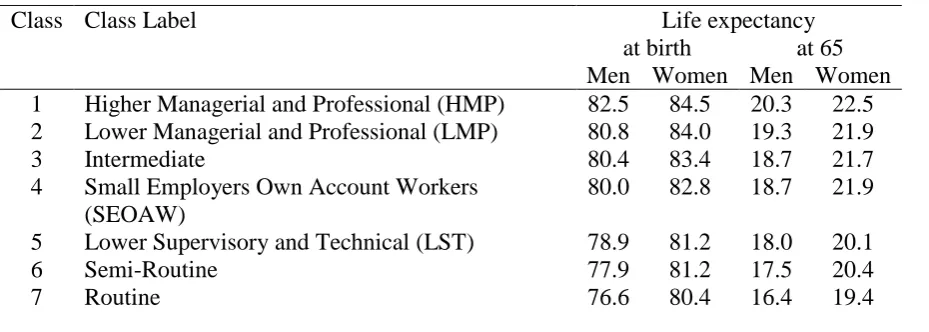
for women who were employed in routine manual occupations was 77 years; Table 1 shows
that by 2007-11 it had risen to 80.4 years (ONS, 2015a). While such trends are to be celebrated
the equivalent figures for higher managerial/professional groups were 81 years and 84.5 years
respectively, indicating significant variation in longevity according to occupational status. For
men, life expectancy at birth for those taking up routine manual occupations rose from 70.5
years (1982-86) to 76.6 years (2007-11), while for those in higher managerial/professional
occupations it increased from 75.5 years to 82.5 years respectively (ONS, 2015a). There is thus
a remarkable 4.1 years for women and 5.9 years for men difference in their expected ages of
differences are further replicated at age 65 for men and women. Table 1 indicates that the life
expectancy of men and women at age 65 who had worked in routine manual occupations were
3.9 years and 3.1 years less (respectively) than those in higher managerial/professional
occupations.
Insert Table 1
It is not only life expectancy that reflects the divided nature of UK society but also healthy life
expectancy. In England, healthy life expectancy (defined by the World Health Organisation
(nd) as the number of years a person can expect to live in ‘full health’, where they are not
suffering from a disease or injury) at birth for women in social class V (manual) in 2001-3 was
68.5 years and 64 years for men in the same class. Compared with those in social class I
(professional/managerial), where the figures were 80 years and 77 years respectively, this
equates to a stark difference of 11.5 years for women and 13 years for men between the top
and bottom social classes (ONS, 2010). Furthermore, healthy life expectancy at age 65 for
women and men in social class V (manual) in 2001-3 were 13.5 years and 9.8 years
respectively. Once again, there are considerable differences when compared with those in
social class I (professional/managerial) where the figures were 19.5 years and 16.2 years
respectively (ONS, 2010). This indicates that not only do those in the lowest social class die
prematurely in comparison with those in higher classes but, also, their deaths are likely to be
preceded by much longer than average periods of ill-health and/or chronic disability. Needless
to say (almost all of) these expectations regarding longevity and healthy life will have a
As well as inequality being reflected starkly in the pathway to death’s door and the passage
through it, what is left behind at the individual’s journey end is a product of unequal
socio-economic status. Unequal lives result in wide disparities in bequests: one half of the UK
population currently leaves nothing of any financial value when they die, with one in twenty
leaving more than £500,000 (Rowlingson, 2016). In other words, the majority of people have
nothing to fear from inheritance taxes (which currently begin at around £300,000), but there is
almost universal abhorrence of their very idea (Rowlingson and McKay, 2005). This apparently deeply ingrained dislike of taxes on inheritance, or ‘death taxes’ as the tabloids call them at
election times, represents a fundamental barrier to the creation of a more equal society, or even
a less unequal one, where financial inequalities continue to widen through cycles of deprivation
and affluence (Rowlingson and Connor, 2011).
Death and austerity policies
In the UK, government austerity policies have had an impact on this social division of death.
Two major waves of neoliberalism since the 1980s have attacked the welfare state, first because
it was said to cause economic harm (by ‘crowding out’ private investment) and, most recently,
because it is blamed for the financial crisis in 2007/8. In both cases such claims have
contributed to a political rhetoric which disguises a very simple ideological aversion to public
provision, except where such provision subsidises corporations and the rich (Titmuss, 1958;
Farnsworth, 2013). The enduring pain from resulting public expenditure cuts, particularly since
2010, commonly referred to in shorthand as ‘austerity measures’, have caused millions of
people hardship - including hundreds of thousands who work for poverty level wages – and
has been well documented (Bennett, 2014). Moreover, the implementation of such austerity
measures has represented a major barrier to the development of fairer, more equitable, social
downturns in addition to a lack of generous employment benefits increase levels of suicide,
especially among young men (Cylus et al., 2014). Austerity politics and reductions in services
have also had a damaging impact on end of life care and the opportunities for the poorest
members of society to die with dignity.
The Funeral Expenses Payment
The generosity of state support in relation to funeral assistance also has implications for how
death and its aftermath are experienced. The origins of the Funeral Expenses Payment (FEP)
can be found in the establishment of the UK Welfare State in the late 1940s. In order to provide
financial assistance for funeral provision a Universal Death Grant was introduced in 1949, set
at £20 and available to all. In 1987, the then Conservative government withdrew the Grant as
a way of curbing rising expenditure (Drakeford, 1998), replacing it with a means-tested FEP
that was a part of the newly established Social Fund. This was, and continues to be, a
conditional benefit to those eligible, with claims assessed on both the availability of resources,
familial and close relationships, and the claimant’s income. Introduced to ‘target benefits on
those most in need through a process of ‘considered decision making’, and to control
expenditure more carefully’ (Silburn and Becker, 2009: 66) for some time there have been
concerns about how the FEP operates and the low level of the award (blinded for review). The
costs associated with the funeral ritual and disposal are now in the region of £3,500 and are
predicted to rise to between £4,500 and £5,000 up to 2020 (Royal London, 2014; Sunlife,
2014). Despite these substantial costs, in 2003 a cap of £700 for funeral director fees was
introduced and has remained ever since, ignoring the Social Security Select Committee (2001)
As a result, the disparity between the average award and the current cost of a funeral means
that, even if a claimant is successful, they are likely to face a shortfall. Moreover, the complex
and invasive procedures that means-testing often entails has the effect of discouraging many
potential beneficiaries from applying (Gugushvili and Hirsch, 2014). The Work and Pensions’
Select Committee Inquiry into Bereavement Benefits (2016) recommended a review of the
system of funeral payments. The benefit was devolved to Scotland as part of the Scotland Act
(2016), and will be re-launched as the Funeral Assistance Payment in Scotland in 2019. In
England, Wales and Northern Ireland, regulations are being changed but there is to be no lifting
of the £700 cap at the time of writing.
In sum, despite the challenges presented by increasing mortality rates and increased life
expectancy, alongside austerity measures in policy provision, death has remained largely
absent from the social policy and policy analysis agendas. This has led to the development of
policy responses in an ad-hoc, department-by-department basis (blinded for review). Such a
silo approach has further consequences, with budget and outcome-driven priorities resulting in
the fragmentation of separate tasks associated with dying, death and bereavement, as opposed
to a focus on the whole person (Holloway, 2007). This has created a ‘knowledge gap’ at both
an individual and societal levels as to how to handle, manage and prepare for death (blinded
for review).
This lack of coherence and the way in which policy areas intersect and work together (or not)
was recognised in the above mentioned Work and Pensions’ Select Committee’s Special
Inquiry into Bereavement Benefits in 2016. It recommended that a holistic and
department-wide review be undertaken of all policy areas associated with death, in order to ensure that the
of life. This recommendation was rejected by the Government the day before the 2016 UK
Referendum on EU membership, and perhaps unsurprisingly has failed to gain traction since,
despite repeated pressure for review (blinded for review).
Death and end of life care
The one area of policy associated with death which has received consistent policy and academic
attention is healthcare policy and, more recently, on managing the end of life. Yet despite the
increase in policy on managing the end of life (blinded for review), there are shortfalls as ‘it is
only recently that the realities of the sheer scale of the increasing numbers and proportion of
older people in many Western societies has led to a focus on the deficiencies in the end of life
care of many of them’ (Monroe et al., 2011: 5). Georghiou and Bardsley (2014) estimate that
hospital costs in the final 90 days of life represent some of the largest cost elements in
healthcare, averaging over £4,500 per person. The bulk of this cost is due to emergency hospital
admissions, increasing rapidly in the last few weeks of life. Other potential costs include local
authority funded social care, visits to the GP and seeing a community nurse. Within this,
equitable access to end of life care remains a perennial issue, with the Health Select Committee
report on Department of Health’s End of Life Care Strategy (DoH, 2015) citing a need to
improve access to services for people with a non-cancer diagnosis, older people and individuals
with dementia in particular.
Nearly a decade ago, seeking to address some of these deficiencies, and originating from over 50 years’ worth of developments in palliative and end of life care, the Department of Health’s
End of Life Care Strategy (EOLCS) (2008) represented a milestone in aiming for consistent
end of life care treatment across the UK. Such changes at a national level marked a radical
2009) and was part of a positive recognition of the need to formalise holistic end of life care
services within contemporary healthcare provision. These changes in approach to supporting
people at the end of their lives have been transformative and ongoing (see for example Public
Health England, 2013); however, it has resulted in the majority of policy and corresponding
academic analytical work focusing on end of life care.
Moreover, a more holistic approach to healthcare at the end of life alone has not been
problem-free; deficiencies in end of life care are still apparent in the application of the EOLCS (2008),
which has, at times, failed to live up to expectations. For instance, whilst it was largely greeted
as providing a positive vision for the future, there have been concerns about the role of choice
(Randall and Downie, 2010) and how standards and tools – such as the Liverpool Care Pathway
– have been implemented. There are concerns about whether it will remain on the policy agenda
(Ellis et al, 2016), not least because end of life care is under considerable strain as a direct
result of recent public spending cuts made in the name of austerity. Moreover, the four nations
within the UK are now embarking on their own end of life care strategies, with Scotland leading
the way in creating targets for accessible-for-all palliative care by 2021 (blinded for review).
Technology and preparation at the end of life
The Dying Matters Coalition argues that a societal taboo surrounds death, resulting in many
people not experiencing a ‘good death’ or suffering complicated grief (see Seymour et al.,
2010). Given the significance of the medical profession at the end of life the idea of a good
death may be at odds with some doctors who view ‘death as a failure’ of healthcare (Richards
2008). At the same time, technological developments that diminish the impact(s) of reaching
old age mean that there has been a growing belief that we are able to control what happens as
Society’s ever increasing preoccupation with developing technologies to eradicate the
effects of ageing, coupled with the omnipresent hope of mastery over death itself,
encourages us all to view ageing, and by extension dying, as a phenomenon we have
the potential to control (Gott and Ingleton, 2011: XVI).
One outcome of a growing reliance on technology to extend life is that the process and
experience of dying in contemporary societies is further removed from everyday experiences
and taken into specialist institutions (hospitals or nursing homes) to be supervised by
professional personnel and managed by appropriate technologies (Hunt, 2017). Such
technologies are not exclusively ‘high tech’ interventions and can include antibiotics, and
assisted support for receiving nutrition and addressing breathing difficulties.
Thus the advance of medicine does not always represent inevitable progress and may actually
promote a disengagement with death. The enormous advances in healthcare over the last 50
years have led to many of the challenges that affect people at the end of life arising from a
failure to fit neatly into a way of framing and organising dying. Rather, people often die
unpredictably and without any planning for the process (Samsi and Manthorpe, 2011). The
unpredictability of death can mean that preparation for it is compromised. Using British Social
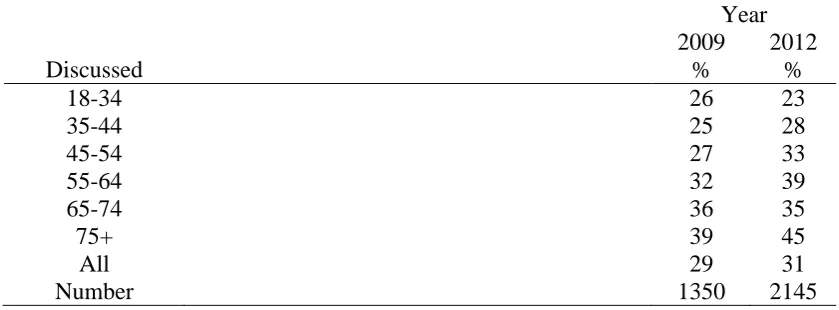
Attitudes Survey data from 2009 and 2012, Shucksmith et al. (2012) found that less than a third
of people had discussed any end of life plans (Table 2). Only 5 per cent had a living will or
advance care plan and 11 per cent had written plans in place for their funeral (see also Public
Health England, 2013). This lack of preparation was despite 70 per cent of respondents saying
they felt comfortable talking about death, with the main reason given for not discussing end of
Insert Table 2
While death may seem like a long way off for some, it is not for others. Table 2 shows the
likelihood of making plans does rise with age (45 per cent of 75+ year olds in 2012 compared
with 23 per cent of those aged 18-34 had discussed end of life issues). There remains however
a significant proportion of people aged 75 or over who have not made plans for the end of their
life, be they health or financial, serving as another explanation for why policy interest and
corresponding academic analysis has been lacking – it is simply not on the radar of many
people, even those who are coming towards the end of their lives (blinded for review).
Towards a social policy of death
Why a Social Policy of Death?
This paper has so far shown that death has been vastly underrepresented in both official and
academic policy discourses, with most attention concentrated on end of life care. Yet the impact
of death is much wider than obviously death-specific policy. Death has implications for the
workforce, including bereavement leave (Corden and Hirst, 2013), families (Valentine and
Walter, 2015), financial services, pensions, and the distribution of housing (Rowlingson,
2016). As noted in this journal, it has further implications for land usage and environmental
policy in relation to the disposal of remains (blinded for review). How it is approached and
handled thus reveals much about the values a society espouses and upholds (Department of
In the UK and at a time of austerity and population ageing, the issue of societal values has
arguably never been more important. At stake is the very meaning of what it constitutes to be
a citizen and a full member of society. In terms of death and dying, a fundamental question is
raised concerning whether an individual should be responsible for their own circumstances at
the end of life, or whether the state – and by implication everyone – has a responsibility to step
in (blinded for review). For instance, official policies governing inheritance and taxation are
major drivers of inequality and the ‘cycle of privilege’ (Rowlingson and Connor, 2011)
whereas financial assistance for funerals through the FEP represents only very minimal
redistribution based on (stigmatising) means-testing. Moreover, it is difficult to identify values
when there is a relative dearth of policy responses, for example to the rising cost of cremation
and burial, both of which contribute to funeral inflation (House of Commons Work and
Pensions Committee, 2016). Similarly, bereavement provision has habitually not warranted
much attention by policymakers and policy analysts (Croxall and Hillcoat-Nalletamby, 2007;
blinded for review) with the literature on the availability of bereavement support tending to be
restricted to a narrow range of issues such as spousal loss (Corden et al., 2008).
Why then do we need a coherent social policy of death? First and foremost, death throws up ‘a
complex mesh of issues unique to the individual, yet shaped by prevailing social, political,
legal, economic, philosophical, religious and cultural imperatives’ (Holloway, 2007: 1). Key
to the case is that death touches the widest possible range of interests: the role of the state;
national infrastructures; public health and sanitation; the individual in relation to whether they
planned (and were able to plan for) death; their family, friends and wider networks; services
provided by the third sector; the role of the commercial sector; policing; land availability;
environmental policy and so on. This wide impact of death has not been grasped by policy
the state (blinded for review), policy responses and analysis should be needs driven rather than
purely market driven and, ideally, underpinned by an equality and choice agenda.
What would a coherent social policy of death look like?
In preparing the ground for a coherent policy on death a ‘good death’ (itself a contested term)
is best assured by, first of all, promoting a ‘good life’. While not diminishing the critical
importance of debating precisely what that means in practice and how society may enable or
prevent it (blinded for review), focus here is specifically on the inequalities that underlie
premature death. Thus, the first priority of a policy response to death should be to ensure that
its experience and aftermath are as equally distributed as possible in all but emotional terms.
This requires a life course perspective and action to prevent premature death and disability.
While the evidence base for such action is very strong, for example with regard to the benefits
of physical exercise (Marmott, 2010), the main challenge is the sheer scale of what is required
to seriously reduce inequalities in life expectancy and healthy life expectancy. From the
eradication of poverty and the promotion of healthy diets, to the transformation of the NHS
from the treatment of sickness to the promotion of health, without such a programme to reduce
inequalities death will remain fundamentally unequal.
Second, as noted earlier, it is important to recognise that the impact of death is often
unpredictable. People have very different needs and experiences and, as such, require different
levels of support or assistance. However, a lack of coherent policy responses in relation to
death has resulted in a disjointed range of policies, practices and state provision, where national
and local government can end up with competing interests. For example, there is limited
nation-wide cash benefit that can adequately absorb the rise in funeral service costs – which
are in part driven by local authorities and their increases in cremation and burial fees. Nor is
there recognition of the impact on carers of terminally ill people; the implications of
experiencing bereavement in old age; or the vacuum of policy and guidance for public health
funerals and how the uptake of these is affected by the FEP (blinded for review).
In practice, what this means is that national policy should be clear and coordinated,
incorporating comprehensible working between various government departments and
organisations in order to ensure that they operate in an integrated manner. Inter-professional
and interagency communication, community and family support all need to be incorporated in
assessments in order to provide a ‘whole person approach’ (Brown and Walter, 2014).
Moreover, public services that are available at the end of life, or to recently bereaved people,
need to be based on solid and sustainable financial and political foundations that reflect
population demography and contemporary family structures. This last point is imperative given
the projected rises in death rates, population growth and the ageing of the population, which
have the potential to create considerable strain on individuals, families, organisations and the
state as they try to meet these challenges.
The implications
Given the policy void in this area, what are the implications for society’s understanding and
handling of death more broadly? One significant consequence is the reinforcement of the
individualisation and commodification of death. With little policy input the convention has
become that death, with the exception of end of life care, is a private matter, of little
consequence to the state. Sociologists and anthropologists have long been arguing this in this
While death is often an intensely personal tragedy for the family and friends of the deceased it
can, as readers of this journal will know, also be an opportunity for public recognition and the
expression of solidarity amongst the living. Without state intervention, potential financial
pressures at the time of death can challenge this notion of solidarity (Corden et al., 2008). A
rise in policy interest in death could therefore embrace consideration of the ways in which the
personal and the social can be combined, for instance from the national allocation of resources
and cost control to ensure at least an adequate funeral for everybody, and to enable the
celebration of individual lives.
A coherent policy response to death should be further characterised by a joined-up approach
where those individuals coming to the end of their life and those left behind are provided with
the necessary state endorsed support, which in turn is not stigmatised nor provided in isolation
from other public funded services. The World Health Organisation (2010) suggests that dying
needs to be perceived as a ‘normal’ life event and process, and a support system offered to help
dying people and their relatives, making use of available national, local and community
resources. To enable this, communication between central government departments and clear
signposting of services and resources associated with death and policy need to be readily
available. There is potential for this to occur by bringing together existing services: for example
while the Bereavement Service operated by the Department for Work and Pensions3 provides
some support, its remit is limited to those receiving social security benefits; at the same time,
some hospices provide benefit information for dying people and their family but this is ad-hoc
and dependent on the resources of the hospice itself rather than it being a systemic priority.
3 This is a telephone service that assists bereaved relatives in determining whether they are eligible for
Moreover, systems for the administration of state support should be systematically reviewed
on a regular basis to ensure they operate in an effective manner; the ‘hangover’ of policy
response and the ongoing fragmentation of benefits and services cannot be permitted to
continue. A principle concern is that where infrastructure associated with death and policy is
inconsistent, allowed to wither, or if provision is cut, there is a greater likelihood of
discrimination and inequity emerging between particular groups, relationships and individuals.
For example, in the newly implemented Bereavement Support Payment, marriage or civil
partnership are the only grounds on which a widowed spouse can claim for state support
following a bereavement; co-habiting couples are not considered eligible for the benefit.
Conversely, cohabitation is recognised as a legitimate relationship in FEP claims. Elsewhere,
the eradication of derived benefits in the state pension system is likely to adversely affect a
greater number of women than men given their increased likelihood of having interrupted work
histories as a result of caring responsibilities and reliance on spouses’ pensions (Price, 2007).
A reduction in the financial support associated with death is thus likely to magnify inequalities
and increase reliance on other means-tested benefits such as pension credits.
A more holistic policy approach that brings together disparate policy areas is thus required, one
which takes into account diverse life course experiences, and contemporary relationship
patterns. While policies associated with children and childcare, employment and pensions have
received considerable attention over recent years, those associated with death require a greater
role on the policy agenda.
Conclusion
Reflecting the recommendation made by the Work and Pensions’ Select Committee (2016) for
and a more comprehensive infrastructure are required to support the potential growth in the
number of people requiring state funded support or services, either in preparation for death or
in response to it. This can be done in a number of ways.
First, a new policy framework for death could start from a life course perspective and
endeavour to prevent as much inequality as possible in terms of life expectancy and healthy
life expectancy. Second, the infrastructure around death should be informed by evidence
generated by policy analysts regarding the most efficient means of provision so that public
services that are available at the end of life or to recently bereaved people are based on solid
and sustainable foundations. Third, policy responses must recognise the impact of inequity in
access to resources and the need for provision which takes into account the diversity in individuals’ circumstances and contemporary relationship patterns. These challenges are
especially important at a time of economic uncertainty where, in addition to ageing populations,
‘every society has to make complex, rational, yet pragmatic decisions that translate the rhetoric
of progress and choice and the realities of health economics into appropriate service delivery
for all groups and communities of the dying’ (Monroe et al., 2011: 5).
Policies related to death face the twin challenges of increasing financial demands (linked to
increases in mortality rates) and the pressure to provide services that adequately meet the needs
of those dying and the people left behind. These need to be delivered with attention to respect
and dignity. Improving daily living conditions, and tackling an unequal distribution of power
and resources, all have an impact on longevity and reducing inequalities. At the same time, services for dying and bereaved people need to contend with the consequences of people’s life
experiences of poverty and inequality (Payne, 2011). While the life course approach to death
circumstances throughout their lives, there is also an urgent need to deal with the challenges of
those dying and those left behind. As this paper has shown, the universal nature of death and
the aspiration of cradle to grave welfare in the UK mean that it should be central to social
policy.
References
Austad S (2006) Why women live longer than men: Sex differences in longevity. Gender
Medicine 3(2): 79–92.
Bennett F (2014) The 'living wage', low pay and in work poverty: Rethinking the relationships.
Critical Social Policy34(1): 46–65.
Bradbury M (1999) Representations of Death: A Social Psychological Perspective. London:
Routledge.
Brown, L. and Walter, T. (2014) Towards a Social Model of End-of-Life Care, The British
Journal of Social Work, 44 (8): 2375-2390.
Butler P (2015) Thousands have died after being found fit for work, DWP figures show:
available at
http://www.theguardian.com/society/2015/aug/27/thousands-died-after-fit-for-work-assessment-dwp-figures (accessed 15 July 2016).
Corden A, Hirst M and Nice K (2008) Financial implications of death of a partner. York: Social
Policy Research Unit, University of York.
Corden A and Hirst M (2013) Financial constituents of family bereavement. Family Science
4(1): 59-65.
Croxall J and Hillcoat-Nalletamby S (2007) Living on after death: Bereavement and social
Cylus J, Glymour M and Avendo M (2014) Do Generous Unemployment Benefit Programs
Reduce Suicide Rates? A State Fixed-Effect Analysis Covering 1968–2008. American Journal
of Epidemiology 180(1): 45–52.
Department of Health (2008) End of life care strategy: Promoting high quality care for all
adults at the end of life. The Stationery Office: London: Crown.
Dickenson D, Johnson M and Katz JS (2000) (eds) Death, Dying and Bereavement. London:
Sage.
DoH (2015) House of Commons Health Committee: End of life care Fifth Report of Session
2014-15. London, England: The Stationery Office.
Drakeford M (1998) Last rights? Funerals, poverty and social exclusion. Journal of Social
Policy 27(4): 507-24.
Eurostat (2014) Population statistics at regional level, available at
http://ec.europa.eu/eurostat/statistics-explained/index.php/Population_statistics_at_regional_level (accessed 30 July 2016).
Ellis J, Winslow, M and Noble, B (2016) Social policy and the care of older people at the end
of life in: Blinded for review
Farnsworth K (2013) Bringing corporate welfare in. Journal of Social Policy 4(1): 1-22.
Farnsworth K and Irving ZM (eds) (2015) Social Policy in Times of Austerity: Global Economic
Crisis and the Politics of Welfare. Bristol: Policy Press.
Georghiou T and Bardsley M (2014) Exploring the cost of care at the end of life. Research
report, September, Nuffield Trust.
Gomes B, Cohen J, Deliens L and Higginson I (2011) International trends in circumstances of
death and dying amongst older people. In: Gott M and Ingleton C (eds) Living with Ageing and
Gott M and Ingleton C (2011) Introduction. In: Gott M and Ingleton C (eds) Living with Ageing
and Dying. Oxford: Oxford University Press, pp.1-2.
Gugushvili D and Hirsch D (2014) Means-Testing or universalism: What strategies best
address poverty? CRSP 634, Centre for Research and Social Policy: University of
Loughborough.
Holloway M (2007) Negotiating Death in Contemporary Health and Social Care. Bristol:
Policy Press.
House of Commons Work and Pensions Committee (2016) Support for the bereaved. Ninth
Report of Session 2015-16.
http://www.publications.parliament.uk/pa/cm201516/cmselect/cmworpen/551/551.pdf
(accessed 25 July 2016).
Hunt S (2017) The Life Course. Basingstoke: Palgrave.
Lain, D. (2016). Reconstructing retirement. Bristol: Policy Press.
Marmot M (2010) Fair society, healthy society, The Marmot Review, available at
http://www.ucl.ac.uk/gheg/marmotreview (accessed 10 October 2016).
Monroe B, Oliviere D and Payne S (2011) Introduction: Social differences-the challenges for
palliative care. In: Oliviere D, Monroe B and Payne S (eds) Death, Dying, and Social
Differences. Oxford: Oxford University Press, pp. 3-7.
NHS England (2014) Actions for End of Life Care: 2014-2016: London.
Oeppen J and Vaupel JW (2002) Broken limits to life expectancy. Science 296: 1029-31.
ONS (2010) Inequalities in healthy life expectancy by social class and area type: England,
2001–03. Health Statistics Quarterly 45, Spring, 2010.
ONS (2013) Historic and projected mortality data from the period and cohort life tables,
2012-based, UK, 1981-2062, Statistical bulletin. available at
ONS (2015a) Trend in life expectancy at birth and at age 65 by socioeconomic position based
on the National Statistics Socio-economic Classification, England and Wales,
1982-1986 to 2007-2011, available at http://www.ons.gov.uk/ons/dcp171778_420190.pdf
(accessed 30 September 2016).
ONS (2015b) Mortality statistics: employment and support allowance, incapacity benefit or
sever disablement allowance, available at
https://www.gov.uk/government/uploads/system/uploads/attachment_data/file/459106/mortal
ity-statistics-esa-ib-sda.pdf (accessed 30 September 2016).
ONS (2015c) National Population Projections: 2014-based Statistical Bulletin, available at
https://www.ons.gov.uk/peoplepopulationandcommunity/populationandmigration/population
projections/bulletins/nationalpopulationprojections/2015-10-29 (accessed 7 September 2016).
ONS (2016a) National life tables, UK: 2013–2015
https://www.ons.gov.uk/peoplepopulationandcommunity/birthsdeathsandmarriages/lifeexpect
ancies/bulletins/nationallifetablesunitedkingdom/20132015 (accessed 22 May 2017).
ONS (2016b) Estimates of the very old (including centenarians), UK: 2002 to 2015
https://www.ons.gov.uk/peoplepopulationandcommunity/birthsdeathsandmarriages/ageing/bu
lletins/estimatesoftheveryoldincludingcentenarians/2002to2015 (accessed 22 May 2017).
ONS (2017) Overview of the UK population: March 2017
https://www.ons.gov.uk/peoplepopulationandcommunity/populationandmigration/population
estimates/articles/overviewoftheukpopulation/mar2017 (accessed 22 May 2017).
Payne M (2011) Poverty and finance. In: Oliviere D, Monroe B and Payne S (eds) Death,
Dying, and Social Difference. Oxford: Oxford University Press.
Price D (2007) Closing the gender gap in retirement income: What difference will recent UK
Public Health England (2013) What we know now 2013: New information collated by the
National End of Life Care Intelligence Network (London: NEoLCIN).
Randall F and Downie RS (2010) End of Life Choices: Consensus and Controversy. Oxford:
Oxford University Press.
Reith M and Payne M (2009) Social Work in End-of-life and Palliative Care. Bristol: Policy
Press.
Richards M (2008) The end of life care strategy: Promoting high quality care for all adults at
the end of life. Presentation for End of Life Care Strategy.
Richards N, Ingleton C, Gardiner C and Gott M (2013) Awareness contexts revisited:
indeterminacy in initiating discussions at the end-of-life. Journal of Advanced Nursing 69(12):
2654-64.
Riley J (1983) dying and the meaning of death: Sociological inquiries. Annual Review 52:1-14.
Rowlingson K (2006) ’Living poor to die rich’? Or ‘spending the kids’ inheritance’? Attitudes
to assets and inheritance in later life. Journal of Social Policy (35)2: 175-92.
Rowlingson K (2016) ’You can’t take it with you when you die’: Wealth, intestacy rules and
inheritance tax’ in Blinded for review.
Rowlingson K and Connor S (2011) The 'deserving' rich? Inequality, morality and social
policy. Journal of Social Policy 40(3): 437-52.
Rowlingson, K., and McKay, S. (2005). Attitudes to inheritance. York: Joseph Rowntree
Foundation.
Royal London (2014) How funeral costs are rising, available at
http://www.royallondon.com/products/over50s/aboutover50s/helpforyourfamily/how/
(accessed 12 September 2016).
Samsi K and Manthorpe J (2011) “I live for today”: A qualitative study investigating older
Seymour J, French J and Richardson E (2010) Dying matters: Let's talk about it. British
Medical Journal 341: 646-48.
Seymour J, Witherspoon R, Gott M, Ross H and Payne S with Owen T (2005b) End-of-life
care: Promoting comfort, choice and well-being for older people. Bristol: Policy Press in
association with Help the Aged.
Shucksmith J, Carlebach S and Whittaker V (2012) Dying Discussing and planning for end of
life. British Social Attitudes 30.
Silburn R and Becker S (2009) Life beyond work? Safety nets and security for those who
cannot. In Millar J (ed) Understanding Social Security. Bristol: Policy Press.
Social Security Select Committee (2001) Third Report, available at
http://www.publications.parliament.uk/pa/cm200001/cmselect/cmsocsec/232/23204.htm
(accessed 12 September 2013).
Sunlife (2014) Cost of Dying Report 2014: the 8th annual report, available at
https://www.sunlifedirect.co.uk/press-office/2014-cost-of-dying-soars/ (accessed 10 June
2015).
Thomas J (2015) Insights into loneliness, older people and well-being 2015 ONS, available at
http://webarchive.nationalarchives.gov.uk/20160105160709/http://www.ons.gov.uk/ons/dcp1
71766_418058.pdf (accessed 9 September 2016).
Titmuss, R, M. (1958) Essays on the welfare state. London: Allen and Union.
Townsend P (2007) Using human rights to defeat ageism: Dealing with policy induced ‘structured dependency’’. In: Bernard M and Scharf T (eds) Critical Perspectives on Ageing
Societies. Cambridge: Polity Press.
Valentine C and T (2015) Creative responses to a drug- or alcohol-related death: A
socio-cultural analysis. Illness, Crisis, and Loss 23(4): 310-22.
Williams L (2014) Government benefit cuts are already being blamed for the deaths of three
vulnerable people. available at
http://www.independent.co.uk/voices/comment/government-
benefit-cuts-are-already-being-blamed-for-the-deaths-of-three-vulnerable-people-and-there-9942735.html (accessed 5 December 2016).
World Health Organisation (2010) WHO definition of palliative care, available at
www.who.int/cancer/palliative/definition/en/ (accessed 15 December 2016).
World Health Organisation (nd) Health Status Statistics: Mortality, available at
[image:29.595.72.537.389.555.2]http://www.who.int/healthinfo/statistics/indhale/en/ (accessed 25 September 2017)
Table 1 - Life expectancy at birth and at aged 65 by NS-SEC class, 2007 to 2011 in England and Wales
Class Class Label Life expectancy
at birth at 65
Men Women Men Women
1 Higher Managerial and Professional (HMP) 82.5 84.5 20.3 22.5
2 Lower Managerial and Professional (LMP) 80.8 84.0 19.3 21.9
3 Intermediate 80.4 83.4 18.7 21.7
4 Small Employers Own Account Workers
(SEOAW)
80.0 82.8 18.7 21.9
5 Lower Supervisory and Technical (LST) 78.9 81.2 18.0 20.1
6 Semi-Routine 77.9 81.2 17.5 20.4
7 Routine 76.6 80.4 16.4 19.4
Table 2 - Discussing end of life issues with someone, by age, 2009 and 2012
Year
2009 2012
Discussed % %
18-34 26 23
35-44 25 28
45-54 27 33
55-64 32 39
65-74 36 35
75+ 39 45
All 29 31
Number 1350 2145