HAZARD MODELS ANALYSIS OF BIRTH INTERVALS:
A STUDY BASED ON WEST AFRICAN DATA
By
Dickson Yaw Ofosu
A thesis submitted for the degree of
Doctor of Philosophy
at the Australian National University
Except where it is indicated otherwise, this thesis
represents original research I conducted as a scholar in the
Department of Demography, Australian National
University from March 1986 to March 1989.
D. Y. Ofosu
ACKNOWLEDGEMENTS
This study was made possible by the award of an Australian National University scholarship. Generous facilities for study and research within the Department of Demography and elsewhere in the University were put at my disposal, and the International Statistical Institute and the national statistical agencies of Benin, Cameroon, Cote d’Ivoire, Ghana and Nigeria provided me with data sets from the World Fertility Survey. I hereby express my gratitude to these institutions and organizations. I am also thankful to the former head of the Department of Demography, Professor J. C. Caldwell, to the present acting head, Dr G. W. Jones, and to Ms Pat Caldwell for their interest, encouragement and support throughout my course.
My supervisors, Professor Caldwell and Dr Gigi Santow, have made enormous contributions to this work. They selflessly shared their time and their knowledge with me, and were always willing to listen to my problems and to point me to practical solutions. Their prompt and careful reading of drafts resulted in considerable improvements in the thesis. They also provided me with a great deal of inspiration. Substantial contributions have also been made by my advisors, Dr Michael Bracher and Dr Sue Wilson. I have benefited greatly from their guidance, comments and suggestions. Gigi and Michael spent a lot of time with me throughout the study, discussing the direction of the thesis at each stage. They also taught me useful programming techniques, and allowed me to use several of their programs. My friend and colleague, Tetteh Dugbaza, and Professor Hubert Gerard of the Universite Catholique de Louvain, Belgium, read drafts of some chapters and made several useful suggestions, as did Anne-Marie, my companion and friend. Evina Akam of the Universite Catholique de Louvain checked my classification of Cameroonian ethnic groupings and made helpful suggestions. I owe all of these individuals a sincere debt of gratitude.
provided me with valuable editorial advice. I also appreciate her kindness and warmheartedness towards me and my family.
Assistance for this work has also come from Jennie Widdowson, who performed the initial data set-up for me, and from Di Cook and Sue Kennedy, who helped me with solutions to data management and other computer problems. Kae has been a friend, and has uncomplainingly endured my frequent intrusions into her office; Daphne, Deirdre, Milisa and Pat Quiggin have all been very helpful to me throughout my course. I am very grateful to all of them.
My special thanks go to the academic and administrative staff of the Department and to my fellow students, all of them too numerous to name here, for creating a stimulating atmosphere for study and making my stay in the Department worthwhile and rather enjoyable.
ABSTRACT
The methodological objectives of this thesis centre around the application of multiplicative hazard model techniques to birth interval data. A second set of objectives, of a substantive nature, relate to birth spacing and fertility in Western Africa using WFS data from Benin, Cameroon, Cote d’Ivoire, Ghana and Nigeria.
The methodological study took on a largely supporting role as the means to the substantive ends. Grouped data models were adopted for their intuitive appeal, since the failure time data were heavily tied and suffered from considerable heaping. However, comparisons of results from grouped data and marginal and partial likelihood techniques showed similar parameter estimates and inference outcomes. Models involving births of several orders, with statistical control for birth order, were preferred over birth-interval-specific ones, because fewer final models needed to be fitted and statistics digested, without undue loss of information. Other issues considered included the calculation of summary measures based on ‘standardized’ birth functions to complement the estimated relative risks, and the relaxation of the proportionality assumption. It has also been demonstrated that given the availability of regression techniques such as hazard models, fertility surveys need not involve the kind of large samples which characterized the WFS program. The use of smaller samples will, other things being equal, lead to improvements in the quality of information collected.
The substantive side of the thesis is based on the fundamental proposition that distinct socio-economic and cultural sub-populations have different life styles and different outlooks on life, and that they face different choices with respect to reproduction. As a result, they follow different cultural models of fertility. Subgroups were defined according to ethnic grouping, religion, level of education, type of place of residence and occupation.
vü tradition, for the relatively more modem subgroups defined on the other ‘explanatory’ variables tended to observe shorter durations of breastfeeding and abstinence. Furthermore, ethnic differentials tended to narrow with modernization, and will probably disappear eventually. Within ethnic groupings, the longer the traditional practice and the greater the degree of social change, the wider the differentials. On the whole, durations of breastfeeding and abstinence exhibited little dependence on age, and no dependence on parity.
Apart from a few cases, birth interval lengths tended to vary in the same way as durations of breastfeeding and abstinence among sub-populations. But differentials in birth intervals were not as important as differentials in the two postpartum variables, and were clear-cut only among the Ghanaian respondents. The Ghanaian respondents were also different in that the increasing erosion of breastfeeding and abstinence durations associated with education and urban residence was accompanied by longer birth intervals and lower fertility. On the whole, the longer the birth interval the lower the quantum of fertility, although respondents with secondary or higher education who were not from Ghana tended to have shorter birth intervals but levels of fertility similar to or slightly lower than those with no education. Evidence of fertility change appears only in the Ghanaian and Cameroonian data sets, the first showing signs of incipient fertility decline, and the second, signs of increasing fertility.
TABLE OF CONTENTS
ACKNOWLEDGEMENTS iv
ABSTRACT vi
TABLE OF CONTENTS viii
LIST OF TABLES xiv
LIST OF FIGURES xvü
CHAPTER 1 A FRAMEWORK FOR DIFFERENTIAL FERTILITY
ANALYSIS 1
1.1 Introduction 1
1.2 Comparative Research in Fertility 2
1.3 An Hypothesis of Cultural Models of Fertility 6
1.3.1 The collective conscience 6
1.3.2 The process of change 7
1.3.3 A framework for the comparative analysis of fertility 12
1.4 Some Analytical Considerations 17
CHAPTER 2 HAZARD MODELS ANALYSIS OF BIRTH INTERVALS 19
2.1 Introduction 19
2.2 Some Methodological Issues in Birth Interval Analysis 21
2.2.1 Definitions 21
2.2.2 Truncation in birth history data 22
2.2.3 Selection effects 23
2.3 Hazard Models Methodology 25
2.3.1 Introduction 25
2.3.2 The simple proportional hazards model 28
ix
2.3.4 A grouped data PH model 30
2.3.5 Note on the estimation procedure 31
CHAPTER 3 CHARACTERISTICS OF THE SAMPLES AND OF THE
RESPONDENTS 33
3.1 Introduction 33
3.2 The Surveys 34
3.2.1 Benin, 1982 35
3.2.2 Cameroon, 1978 36
3.2.3 Cote d’Ivoire, 1980-81 37
3.2.4 Ghana, 1979-80 38
3.2.5 Nigeria, 1981-82 39
3.3 The WFS Standard Recode Files 40
3.4 Socio-economic and Cultural Characteristics of the
Respondents 41
3.4.1 Ethnic origin, religion and family organization 41
3.4.2 Education 49
3.4.3 Type of place of residence 55
3.4.3.1 A few problems associated with the use of data
on residence 55
3.4.3.2 Current versus childhood residence 57
3.4.4 Occupation/labour force participation 61
3.5 Relationships Between Background Variables 65
3.5.1 Introduction 65
3.5.2 Childhood and cuiTent residence 67
3.5.3 Associations between background variables of the
respondent 68
3.5.4 Associations between respondents’ background variables
and those of partners, ever-married women 70
CHAPTER 4 SOME ASPECTS OF DATA QUALITY 73
4.1 Introduction 73
4.2 Questionnaire Planning and Data Editing 74
4.2.1 Questionnaire planning 75
4.2.2 Field and office editing of the data 76
4.2.3 Machine editing 77
4.3 Quality of Age Data 79
4.3.1 Digit preference in the age data 80
4.3.2 Grouping of age data 87
4.4 Quality of Data on Exposure to the Risk of Childbearing 91
4.5 Quality of Fertility Data 97
4.5.1 Data on the first live birth 98
4.5.2 Exploratory study of the effects of displacements of first
confinements on the dating of subsequent births 106
4.5.3 Omission of births: all birth orders 107
4.5.4 Distribution of births over time 112
4.6 Conclusion 118
CHAPTER 5 EXPLORATORY DATA ANALYSIS FOR HAZARD
MODELS 120
5.1 Introduction 120
5.2 The Birth Interval Data 121
5.2.1 Choice of birth orders for analysis 122
5.2.2 Consideration of ties 123
5.2.2.1 Inference about ß 126
5.2.2.2 Comparison of estimated baseline survivor
functions 130
5.3 Further Methodological Considerations 131
5.3.1 The proportionality assumption 131
5.3.2 Initial identification of ‘best’ categories 134
5.3.3 Birth order as an explanatory variable 135
5.3.5 Summary measures 141
5.4 Hazard Models Methodology and Sample Size in Fertility
Surveys 147
5.4.1 Sample size and parameter estimates 148
5.4.2 Sample size and discrimination between models 154
5.4.3 Conclusion 155
CHAPTER 6 BIRTH INTERVAL DIFFERENTIALS 156
6.1 Introduction 156
6.2 Differentials by Age at Reference Event and by Birth Order 158
6.3 Socio-economic and Cultural Differentials 161
6.3.1 Benin 161
6.3.1.1 Religion and level of education 161
6.3.1.2 Type of place of current residence 163
6.3.2 Cameroon 164
6.3.3 Cote d ’Ivoire 167
6.3.3.1 Ethnic grouping, religion and current
residence 168
6.3.3.2 Level of education 170
6.3.4 Ghana 172
6.3.4.1 Ethnic grouping and religion 172
6.3.4.2 Type of place of current residence 175
6.3A3 Level of education 175
6.3.5 Nigeria 177
6.3.5.1 Region of residence and religion 177
6.3.5.2 Type of place of current residence 179
6.3.5.3 Level of education 180
6.4 Period Differentials: Recent Trends in Birth Spacing 181
6.4.1 Benin 183
6.4.2 Cameroon 184
6.4.3 Cote d ’Ivoire 186
xi
6.4.5 Nigeria 191
6.5 Summary and Discussion 192
CHAPTER 7 BREASTFEEDING AND POSTPARTUM SEXUAL
ABSTINENCE 196
7.1 Introduction 196
7.2 The Data on the Postpartum Variables 200
7.2.1 Some preliminary methodological considerations 200
7.2.2 Reported durations of breastfeeding, amenorrhoea and
sexual abstinence 202
7.2.3 Comparison of distributions from the open birth interval
to those from the last closed birth interval 212
7.3 Data Relating to the Last-but-one Live Birth 215
7.3.1 Variation explained in the national samples 216
7.3.2 Structure of relationships in breastfeeding data 218
7.3.3 Structure of relationships in the data on postpartum
sexual abstinence 224
7.3.4 Correlations between breastfeeding, sexual abstinence,
birth order and age at confinement 229
7.4 Further Insights from Data Relating to the Last Live Birth 231
7.4.1 Estimated differentials in durations of breastfeeding and
postpartum sexual abstinence, Ghana 232
7.4.2 Exploratory analysis of recent trends 236
7.5 Conclusion 239
CHAPTER 8 CONCLUSION 241
APPENDIX 2.3 A Censoring and the Estimation Procedure 252
A. The Product-limit Estimate of the Survivor Function 254
B. The ‘Standard’ Life Table Estimate of the Survivor
x ii i
APPENDIX 2.3B Estimation and Inference Procedures for the PH
Models 256
A. Partial Likelihood with Oakes’s Approximation for
Ties 256
B. Marginal Likelihood 258
C. Grouped Data PH Model 258
APPENDIX 4.5.1 A Age-Period First Confinement Rates for Five-year Age
Groups and Five-year Periods 261
APPENDIX 4.5.IB Cohort Age-specific First Confinement Rates for
Five-year Age Groups 263
APPENDIX 4.5.2 Multiple Classification Analysis of the Length of the
Open Birth Interval, according to the Reported Age at First Confinement, Adjusting for the Effects of Age at
Interview (AGE) and Parity 265
APPENDIX 5.2.1 A Mean Age at First Confinement by Age at Interview and
by Number of Live Confinements 268
APPENDIX 5.2.IB Mean and Median Lengths of Interbirth Intervals (in
Months) by Number of Confinements, Respondents Aged 40 Years and Above at the Time of the Interview 271
APPENDIX 5.3.4 Estimates of Regression Coefficients for Final
Models 274
APPENDIX 6.5 Per Cent of Respondents Reportedly Using Birth Control
Methods by Socio-economic Category 277
LIST OF TABLES
T able 3.4.1.1 Percentage o f respondents professing adherence to particu lar
religions, by region or ethnic grouping 47
T able 3.4.2.1 P er cent distribution o f respondents according to highest level o f school attended and age at interview , by region o r
ethnic grouping 50
Table 3.4.3.1 P er cent distribution o f respondents according to type o f place o f current and childhood residence, by region or ethnic
grouping 58
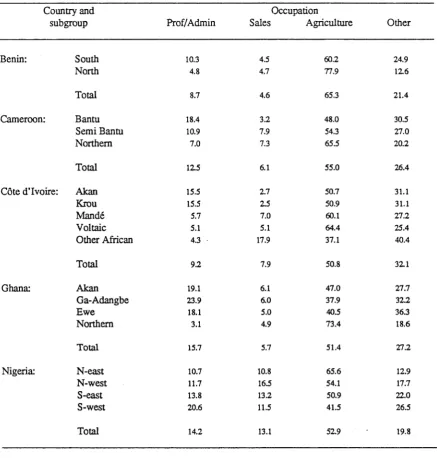
T able 3.4.4.1 P er cent distribution o f respondents according to current or
m ost recent occupation 62
T able 3 .4 A 2 Per cent distribution o f respondents ever in union according
to p a rtn e r’s occupation 63
T able 3.4.4.3 Per cent distribution o f m ale and fem ale populations
according to occupation, m ost recent census figures
available 64
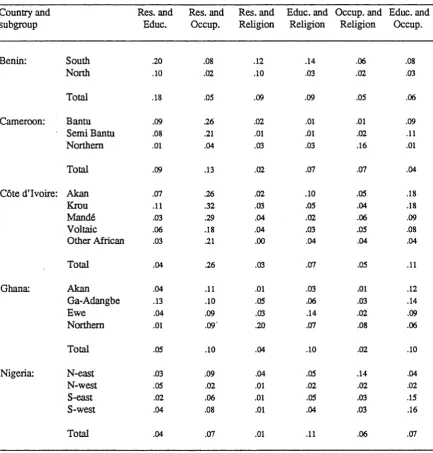
T able 3.5.3.1 V alues o f tau (sym m etric) for pairs o f resp o n d en ts’
background variables. 69
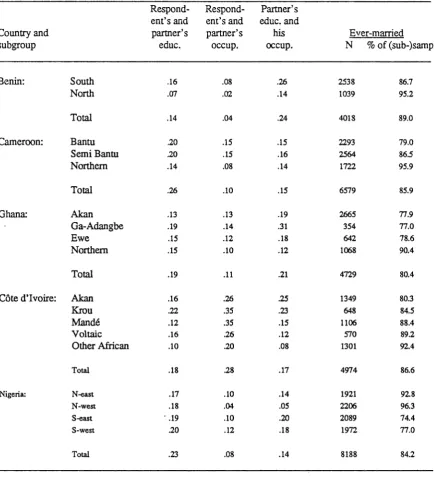
T able 3.5.4.1 V alues o f tau (sym m etric) for p a rtn e r’s education and occupation, ever-m arried respondents and the current or m ost
recent partner 71
T able 4.3.1.1 M y er’s indices and deviations betw een expected and
observed percentages for term inal digits, age o f respondent in
single years 82
T able 4.3.2.1 P er cent distribution o f respondents in conventional
five-year age groups, by survey 88
T able 4.3.2.2 D eviations betw een reported and expected p ercentages o f
respondents in various quinquennial age groupings 90
T able 4 .3 .2 3 U .N . age accuracy indices fo r various quinquennial age
groupings 91
T able 4.4.1 Percentage o f ‘ever-m arried’ w om en reportedly m arried
before age 15, according to age at interview 93
Table 4.5.1.1 R eported m inim um and m axim um ages at first confinem ent and percentage o f m others reportedly confined for the first
tim e before age 15 99
T able 4.5.1.2 P er cent distribution o f the difference betw een the reported ages at m enarche and at first confinem ent, respondents
X V
T able 4.5.3.1 M ale births per 100 fem ale births by period o f birth 108
T able 4.5.3.2 Per cen t o f children deceased, by m o th er’s age group 109
T able 4.5.4.1 E stim ates o f age-period cum ulative fertility 113
T able 4.5.4.2 E stim ates o f cohort cum ulative fertility by age at
confinem ent 116
T able 5.2.2.1 D istribution o f birth intervals, second and seventh
confinem ents, B enin and N igeria 123
T able 5.2.2.2a T im e to second confinem ent am ong ethnic groupings, G hana,
m ethod: G rouped data PH, 1-m onth intervals 127
T able 5.2.2.2b T im e to second confinem ent am ong ethnic groupings, G hana,
m ethod: G rouped data PH, 3-m onth intervals 127
T able 5.2.2.2c Tim e to second confinem ent am ong ethnic groupings, G hana,
m ethod: G rouped data PH, 6-m onth intervals 128
T able 5.2.2.2d T im e to second confinem ent am ong ethnic groupings, G hana,
m ethod: Partial likelihood (O akes) 128
T able 5.2.2.2e Tim e to second confinem ent am ong ethnic groupings, G hana,
m ethod: M arginal likelihood 129
Table 5 .2 .2 3 E stim ates o f baseline survival probabilities at selected
durations o f exposure 130
T able 5.3.5.1 E stim ates o f birth interval differentials fo r educational categories before and after adjusting for age at reference
event 146
Table 5.4.1.1 C om parison o f estim ated regression coefficients and standard errors fo r the full data set w ith m eans o f coefficients, th eir 95 per cent confidence intervals, and ranges o f standard errors o f
400 ran do m sam ples p e r given size 149
T able 5.4.1.2
/v
Per cent o f null hypotheses (ß = ßfuii model) rejected in 400 ran d om sam ples using the likelihood ratio chi-square as test
statistic 152
T able 5.4.1.3 C om parison o f the baseline birth function fo r the full d ata set w ith those obtained from 400 random sam ples p er given
size 153
T able 5.4.2.1 P er cen t distribution o f best P H regression m odels across
1000 random sam ples, by sam ple size 154
Table 6.2.1 E stim ated birth interval differentials by birth order and age at
reference event, G hana. 159
Table 6.3.1.1 E stim ated birth interval differentials by religion and by level
Table 6.3.2.1 Estimated birth interval differentials by ethnic grouping,
religion, current residence and education, Cameroon 167
Table 6.3.3.1 Estimated birth interval differentials by ethnic grouping,
religion and current residence, Cote d’Ivoire 169
Table 6.3.4.1 Estimated birth interval differentials by level of education,
Ghana 176
Table 6.3.5.1 Estimated birth interval differentials by region of residence
and by religion, Nigeria 178
Table 6.4.1.1 Estimated birth interval differentials by period of reference
event and by religion, Benin 183
Table 6.4.2.1 Estimated birth interval differentials by period of reference
event and by level of education, Cameroon 185
Table 6.4.4.1 Estimated relative risks by birth order, age at reference event,
and period of reference event, Ghana 187
Table 6.4.4.2 Estimated birth interval differentials by period of reference
event and by socio-economic subgroup, Ghana 190
Table 7.1.1 Medians of the distributions of breastfeeding, amenorrhoea and sexual abstinence in the open and the last closed birth
intervals, by region or ethnic grouping 198
Table 7.2.2.1 Myer’s blended index for the reported durations of
breastfeeding, amenorrhoea and sexual abstinence, open and
last closed birth intervals 209
Table 7.3.1.1 Percentage of variation in breastfeeding data accounted for
by each background variable 217
Table 7.3.1.2 Percentage of variation in postpartum sexual abstinence
accounted for by each background variable 217
Table 7.3.4.1 Coefficients of correlation between breastfeeding (BFED) and abstinence durations, birth order, and age at confinement last-but-one births occurring in the ten years preceding
interview 230
Table 7.4.1.1 Estimated differentials in duration last child was breastfed
by categories of background variables, Ghana 233
Table 7.4.1.2 Estimated differentials in duration of sexual abstinence after the birth of the last child by categories of background
xvii
LIST OF FIGURES
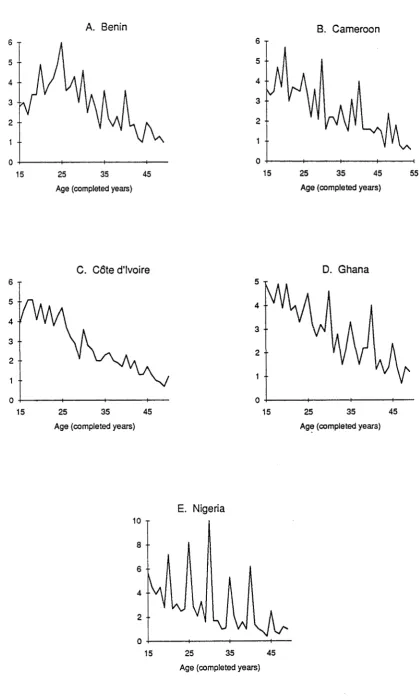
Figure 4.3.1.1 Per cent distribution of age in single completed years 81
Figure 4.4.1 Per cent distribution of reported age at first sexual intercourse
by broad age group 95
Figure 4.5.1.1 Per cent distribution of reported age at first confinement by
broad age group 100
Figure 4.5.3.1 Mean number of children ever bom by age at interview,
according to ethnic grouping or region of residence 110
Figure 5.3.1.1 Plots of log-minus-log survivor function for ethnic grouping,
birth order 2 133
Figure 5.3.3.1 Estimated birth functions for Northern ethnic grouping,
birth-interval-specific (B.I.S.) and ‘integrated’ models 138
Figure 5.3.5.1 Estimated relative risks for birth orders 2 to 7, selected
subgroups, Cote d’Ivoire 142
Figure 5.3.5.2 Comparison of estimated birth functions by relative age and estimated birth function adjusted for relative age, fourth
confinement, Middle School education or higher (Ghana) 143
Figure 5.4.1.1 Relative frequency distribution of coefficient estimates for
regressor variable 3, by sample size 150
Figure 6.2.1 Estimated birth functions by relative age, Nigeria 160
Figure 6.3.1.1 Estimated birth functions by religion and education,
Benin 162
Figure 6.3.1.2 Estimated birth functions by current residence, Benin 164
Figure 6.3.3.1 Estimated birth functions by education and current residence,
Cote d ’Ivoire 171
Figure 6.3.4.1 Estimated birth functions by ethnic grouping, Ghana 173
Figure 6.3.4.2 Estimated birth functions by religion, Ghana 173
Figure 6.3.4.3 Estimated birth functions by education, Ghana 176
Figure 6.3.5.1 Estimated birth functions by current residence, Nigeria 179
Figure 6.3.5.2 Estimated birth functions by education, Nigeria 181
Figure 6.4.4.1 Estimated birth functions for birth order 6 by period of reference event, relative ages 24 or under and 35 or above,
Figure 7.2.2.1 Per cent distribution of reported durations of breastfeeding in
the open and the last closed birth intervals 203
Figure 7.2.2.2 Per cent distribution of reported durations of postpartum amenorrhoea in the open and the last closed birth
intervals 205
Figure 1 2.2.3 Per cent distribution of reported durations of postpartum
sexual abstinence in the open and the last closed birth
intervals 207
Figure 7.2.2.4 Per cent distribution of reported durations of sexual abstinence in the last closed birth interval, rural respondents with no formal education (Akans and Northerners),
Ghana 210
Figures 7.2.3.1 Proportions still breastfeeding in the open and the last closed
birth intervals, by duration since confinement 213
Figure 1.2.32 Proportions still abstaining in the open and the last closed
birth intervals, by duration since confinement 214
Figure 7.3.2.1 Relationships between background variables and the reported
durations of breastfeeding in the last closed birth interval 220
Figure 7.3.3.1 Relationships between background variables and the reported durations of postpartum sexual abstinence in the last closed
CHAPTER 1
A FRAMEWORK FOR DIFFERENTIAL FERTILITY ANALYSIS
1.1 Introduction
The large body of fertility and related data made available by the WFS program has
increased the possibilities for comparative research in this field, possibilities that have
previously been derived mainly from the earlier KAP studies. The WFS bibliography
now contains a considerable number of analyses involving several population subgroups
in different countries. However, most of these studies have not gone beyond mere
descriptions of fertility levels, their proximate determinants, and their associations with
socio-economic and other variables. Hence, although the objective of assessing the
current state of fertility throughout the world has been achieved to some extent, far less
progress has been made in accounting for differential fertility in the surveyed societies.
One of the reasons for this state of affairs lies in the slight attention paid by many
researchers to the theoretical underpinnings of large-scale comparative work, as
compared to the effort put into the accumulation of demographic facts. Thus, as
Wunsch has observed,
[A] large part of the work done in demography remains remote from the canons of scientific inquiry: theoretical developments are most often scanty, ex post facto
explanations abound, hypotheses are rarely falsified, and replication o f experiments [is] practically non-existent (Wunsch, 1984: 1; cf. Freedman, 1975: 10).
To a large extent the relationship between observation and analysis on the one hand and
cart before the oxd Einstein says much the same thing. ‘Theory,’ he writes, ‘cannot be
fabricated out of the results of observation; it can only be invented.’1 2 The point is that
for an understanding of fertility, its differentials and its decline, theory must not be
derived ex post. Rather, observation and analysis must be based on theory, and serve to refine or else refute it. Caldwell (1977: 59 - 60) notes in connection with the failure of
family planning related research to contribute to our understanding of fertility decline
that applied research cannot flourish unless it is based on fundamental research.
Similarly, in Bierstedt’s presentation of Dürkheim’s The Division o f Labor he forcefully argues the point that, in the final analysis, theoretical research contributes more to
technological and other advancement than do purely mechanical or practical
refinements (Bierstedt, 1966: 36 - 37).
What is lacking in the area of comparative fertility research, then, is a more systematic
treatment of the latter’s theoretical underpinnings in such a way as to make observation
and analysis serve theory. The present chapter constitutes an attempt to place this
otherwise statistical study in a larger sociological context, and thereby not only aid the
interpretation of the subsequent substantive results, but also create more avenues for comparison and continuity with previous and further research in the comparative study
of West African fertility.
1.2 Comparative Research in Fertility
A large proportion of differential fertility studies take as their starting point the well
known framework developed by Davis and Blake (1956), under which cultural factors
1 'll faul reflechir pour mesurer et non pas mesurer pour reßechir.’ Quoted by Duchene and Wunsch (1984: 1). The WPS planners were not entirely negligent about this point, as the document ‘Strategies for the Analysis of WFS Data’ (Basic Documentation, No. 9, WFS TECH.449) demonstrates.
3 affecting fertility do so through eleven variables relating to exposure to intercourse,
conception, and gestation and parturition: age of entry into sexual unions, permanent
celibacy, reproductive time lost in between unstable unions, voluntary abstinence,
involuntary abstinence, coital frequency, involuntary sterility, contraception, voluntary
infecundity, involuntary foetal mortality, and voluntary foetal mortality. Any factor
that is associated with fertility in a causal manner, according to these two authors, must
be so associated ‘in some way classifiable under one or another’ of the eleven variables;
indeed, as Freedman (1975: 19) has argued, one test of a hypothesized connection
between a given factor and fertility is to specify the intermediate variable through which
the factor acts. Consequently, the intermediate variables have become known as the
proximate determinants of fertility.
From the Davis and Blake framework comes the proposition that differences between
population subgroups or between societies in one or more of the intermediate variables
should result in differentials in fertility (Freedman, 1975: 19), although societies with
essentially different cultures, even if they have more or less the same level of fertility,
are expected to exhibit different patterns in the distribution of proximate determinants
(Davis and Blake, 1956: 213).
Admittedly, the study of proximate determinants has made significant contributions to
our understanding of the fertility mechanism in a number of societies. However, the
main focus of the Davis-Blake model, namely, the cultural factors that operate through
the intermediate variables to bring about fertility differentials, has often been neglected.
In effect, Davis and Blake proposed a framework for the sociological explanation of
fertility and why it varies from one society to another or indeed among different sub
populations of the same society. Conceptual frameworks, as Jones (1977: 7, 37) has
noted, help to systematize the study of particular phenomena, and are ‘broad enough to
encompass many different theories’. Nevertheless conceptual frameworks are based on
certain postulates and do generate hypotheses for testing. Thus, implicit in the Davis-
Blake model is the hypothesis that, faced with high mortality, people in pre-industrial
assure their survivals The relevance of these matters to a study such as this derives from the fact that, among other things, hypotheses underlying the adopted framework
determine, or at least influence, the manner in which the intermediate variables would
be treated in the analysis.
As expected, further attempts to explain the existence of fertility differentials between
different societies or between identifiable sub-populations of the same society have
yielded other frameworks. Freedman (1975), for example, proposes a model based on
the Davis-Blake framework, in which he stresses norms about family size rather than
institutional mechanisms. Others are based on economic rather than sociological
explanations for fertility. Among these are the micro-economic models proposed by Leibenstein (1975) and Easterlin (1975); see Jones (1977) for a comprehensive
discussion of these models. Caldwell’s theory stressing the direction of
intergenerational wealth flows could be considered as partly economic in nature
(Caldwell, 1976; 1977; 1982).
Although economic factors are important in the determination of fertility in practically
all societies, in West Africa their role is probably only secondary {cf. Faulkingham, 1977; Cleland, 1985). Several writers have stressed the importance of parenthood for
individual fulfilment as well as for the fulfilment of the individual’s social and religious
obligations in the subregion (cf. Oppong, 1977a; Orubuloye, 1977a; Caldwell, 1977;
Fortes, 1978; Ferry, 1978; Bekombo-Priso, 1978; Bleek, 1978). Fortes (1978), for
instance, argues that the desire to be a parent is universal, as evidenced by the
widespread cross-cultural and cross-racial dread of sterility. However, he asserts that in
the West African situation the mere attainment of parenthood is not sufficient, else a
few children would suffice, for there is ‘the deeply ingrained idea that normal men and
women should continue to beget and bear children throughout their fecund years’
5
(Fortes, 1978: 45). In other words, not only is there a need to achieve parenthood as
evidence of virility, there is also the need to demonstrate continued ‘virility, potency
and fecundity’. This ‘ideal that maximum is optimum for number of offspring’, he
states, is not ‘confined to the rural communities or the non-literate traditionalists, [but] is as common among westernized elites’ (Fortes, 1978: 44). Caldwell and Caldwell
(1985) agree with this assessment. They write:
The central fact of African high fertility is a culture, molded by religion, that encourages repeated child-bearing and abhors sterility at any stage. It is powerfully supported by the unusually high value of children which arises from a continuing economic flow from the young to the old which is also grounded in a culture shaped by religion (p. 38).
This proposition probably overgeneralizes by ignoring the cultural diversity that has
resulted in varying constraints on childbearing in African societies. Nevertheless the
existence of a virtually universal desire for large families, and the central role played by culture in perpetuating it, can hardly be contested. It could be said, in fact, that high
fertility is a cultural value with a life of its own, and that individuals, once they have internalized it, escape from its power only with great difficulty. Although individuals
may bring to this value their own personal mark (Dürkheim, 1950: xxii - xxiii), on the whole they do not — or perhaps are unable to — deviate significantly from the general pattem of reproductive behaviour. Thus in many societies fertility differentials existing
after controlling for such factors as involuntary subfecundity, age of entry into sexual unions, and various other practices and traditions specific to members of particular
ethnic groups, may be considered as indicators of the extent to which individuals are able or willing to deviate from the dominant cultural values. If this proposition is valid,
1.3 An Hypothesis of Cultural Models of Fertility
1.3.1 The collective conscience
The Durkheimian concept of collective (or common) conscience denotes the totality of beliefs and sentiments common to average members of the same society. These beliefs
and sentiments, by definition, constitute a social fact, having a life of their own, and
more importantly, the power to impose themselves on the individuals of the society
(Bierstedt, 1966: 56).4 Bierstedt (1966: 45) remarks that this concept is largely similar
to that of ‘culture’ as used in modem social science, and that both concepts perform the
same function.
The idea of a collective conscience (or culture) with a life of its own which imposes
itself on the members of society and limits their range of socially permissible deviation
in any aspect of life is an attractive one indeed. For, if both illiterate rural folk and
educated urban elites in West Africa demonstrate that they share more or less the same
high fertility ideals, then that must be an indication of the existence of an efficient, powerful and dominant fertility model in these societies. This model, assimilated by
individuals through the process of socialization but nonetheless external to them, may
adapt itself to new cultural elements as they are introduced into the society, and yet
remain largely unchanged. This may be the reason why, in spite of considerable socio
economic and cultural change, fertility differentials observed between broad social
classes in the subregion have tended to be rather narrow (cf. Caldwell, 1968: 52 - 95; Okediji et al., 1978; WFS First Country Repons for Benin, Cameroon, Cote d’Ivoire, Ghana and Nigeria). Yet changes are, without doubt, taking place among some sections
7 of these societies with regard to the elements of the social conscience which relate to
fertility, changes emanating from both internal evolutionary processes and outside
influences, and which are largely responsible for even the limited differentials
mentioned above.
1.3.2 The process of change
Dürkheim, perhaps with inspiration from Spencer (Bierstedt, 1966: 54), put forward in
The Division of Labor the idea that in ‘primitive’ societies the collective conscience is strong and extensive and brings about a high degree of homogeneity. With time, he
argued, the collective conscience becomes weaker as the division of labour in the
society increases, and the society itself becomes more heterogeneous (Bierstedt, 1966:
54). Whether this thesis is generally true as a sociological proposition is highly debatable (see Bierstedt, 1966: 50 - 56). In the specific area of fertility, it must be
recognized that in recent decades homogeneity in reproductive behaviour, including
behaviour relating to the intermediate variables, appears to have increased in Western
society and indeed in societies which have already completed a fertility transition. This tendency towards homogeneity follows an initial increase in heterogeneity at the onset
of transition. Arguably it is not the ‘primitive’ nature of a society, however this term is
defined, that determines the force of imposition of the collective conscience. Rather, it
is its degree of stability, and an initially stable society, should it be disturbed whether by
internal processes or by external forces — assuming the latter are not resisted — will
tend towards heterogeneity in the earlier phases of transition, moving back to greater
conformism while transitional stability is being attained.5 Admittedly, the
transitional society will probably be less conformist than the initial society, since the
collective conscience necessarily undergoes some change in the course of transition.
How does all this relate to differential fertility in West Africa? I have already
mentioned the intensity of the cultural hold on individuals with respect to high fertility.
In a situation of pretransitional cultural stability we would expect those elements of the
collective conscience which concern fertility to constitute a sort of social logic about
reproductive behaviour which pervades the whole society (or, to be specific, the ethnic
group, since traditional norms and practices relating to reproduction vary between
ethnic groups), a kind of quasi-universal social logic about reproductive behaviour. In
time, however, changes in other aspects of life will, directly or indirectly, encourage
certain categories of individuals to re-appraise their fertility values and modify their
reproductive behaviour, the degree of modification being a function of the extent of
change the group has undergone. The result is a multiplicity of fertility models, some
quite consistent with the initial ‘unique’ model while others may constitute a major
deviation from it.
West African societies have, evidently, undergone important changes in several aspects of life over the last few centuries. Busia (1956: 424), writing about rapid social
transformation in the then Gold Coast, identified the main source of change as being
‘the impact of European countries through trade, Christianity, education and British
rule’. We could say much the same thing about other areas of the subregion,
substituting only for religion and/or colonial power. In another paper Busia singles out
the economic life as the one area in which the impact of the West upon West Africa is
most obvious, noting that changes in occupations, life-styles and the physical
environments have brought about ‘a redistribution of population and new social
patterns’. He explains:
9
.Around each of the resulting nascent social groupings may develop a more or less
different social logic vis-ä-vis reproductive behaviour, and indeed vis-a-vis other aspects of life. In other words, membership of a social group or class, as Gerard points
out, confers on the individual a particular lifestyle and outlook on life and on the world,
and links him/her with particular ways of being, of thinking, of doing things (Gerard
and Loriaux, 1983: 86 - 105). The systematic association of socio-economic and
cultural factors with differentials in demographic phenomena may be the result of this
in-group effect.
The hypothesis of cultural models has been proposed by Gerard to describe the role of
social determinism in human behaviour with respect to demographic phenomena
(fertility, mortality, migration). As indicated in the preceding paragraph, under this
framework differentials in demographic phenomena between population subgroups are
attributed to the development of group social logic or cultural models with respect to the
particular phenomenon (Gerard and Loriaux, 1983: 90 - 91; Gerard, 1983). A cultural
model is a social fact, and thus imposes itself on the individual through the process of
socialization and through social control to the extent that it defines socially acceptable limits for individual behaviour. It consists of norms, images, habits, ideas, necessities,
and daily practices, which have a bearing on the particular phenomenon, and provide
the individual with a frame of reference for matters relating to the phenomenon. It
forms the basis of the individual’s socio-cultural values, and gives to his or her personal
characteristics their real cultural significance. Cultural models of fertility are, in a
sense, ‘the crystallization and the interpretation of whatever influence the different
elements of the socio-cultural system can have’ on fertility (Gerard and Loriaux, 1983:
91, my translation).
In any society characterized by a degree of heterogeneity we might expect the existence
of more than one cultural model for each demographic phenomenon. These models will
Africa the dominant models are those followed by the most traditional members of each
ethnic group, and the others will be characterized by various degrees of innovation.
If the hypothesis is valid, then its application in comparative fertility analysis is
immediate: groups of individuals following different cultural models will tend to have
different levels of fertility and/or different practices with respect to the intermediate
variables. Although cultural models are themselves not palpable in the sense that they
are intangible and unobservable, groups following different models may be identified
by the more important socio-cultural elements that are associated with fertility
differentials, elements referred to by Gerard as being crucial: family organization, women’s role, aggregates of individual characteristics such as level of education,
religion and ethnic origin. The existence of models and the importance of particular
variables to their elaboration are, of course, issues that can generate hypotheses for
empirical verification.
Traditional fertility models probably came into existence as one of the products of the
formation of nation-states, and their high-fertility ideals may have been motivated, at least in part, by political and economic considerations. Traditional models are thus
likely to be specific to ethnic groups, whose ruling classes had considerable interest in
their being adopted and observed.6 In many sub-Saharan societies the rulers performed dual political and religious roles, and laws of social organization certainly had some
spiritual input; see, for instance, Rattray (1923) and Meyerowitz (1951; 1958), all of
which deal with the Akans. Arguably, appeals to religion ensured a high degree of
compliance, and also led to high-fertility ideals being deeply rooted in African cultures.
Traditional religion plays an important role in traditional models of fertility.
How new systems of social logic or cultural models of fertility are formed is still a
matter for open debate. Caldwell has stressed the role of the media and especially that
6 The Bono (Akan group of central Ghana) king Dwamena Kwame (1475 - 95), whose reign began nearly 200 years after the establishment of the Bono kingdom, for instance, made laws establishing the type of funeral rites according to the cause of death (Meyerowitz, 1958: 112). One category dealt with the death of a childless woman or man. Such a person was deemed to have ‘failed to justify his or her life on earth: "the barren has no face in the other world (ascunan [i.e., the domain o f spirits of the
11
of the new Western-oriented educational systems, factors largely responsible for the
social westernization of the family.7 If this proposition is valid, then the more exposed
a group is to ideas and values imported from the West, for instance by virtue of level of
education or type of place of residence, the closer will be its fertility model to Western
models. The pre-eminence of the role of social westernization in bringing about family
change and hence fertility change is, however, disputed by other researchers. Oppong
(1977a), for example, argues that individuals in new occupational and other
environments are experiencing considerable stress, and that changes in family systems
— changes which will ultimately have a bearing on fertility — arise from the responses
and reactions of these individuals to the new economic and domestic circumstances in which they find themselves. Others have cited the changing economic environment as
being responsible, pointing to such factors as monetization and changing modes of
production (Faulkingham, 1977; Mendosa, 1977; Freedman, 1979).
All of these factors are almost certainly involved in the process of change from
traditional to new models of fertility (Ohadike, 1967: 305 - 306). Their order of importance is yet to be established, and might even vary from one society to another although, as Ohadike (1967: 317) has pointed out, the ‘outstanding role’ of education in
effecting change is not derived solely from the exposure to new ideals and values which it provides, but also from the fact that it places the educated in those situations (urban
residence, modem occupation, improved living standards) where the other factors have
significant effect. In any case, the process appears to be more a synthesis of new ways
of life than the wholesale adoption of foreign values and practices, and it must be
recognized that internal conflicts and stresses, as well as the knowledge of the existence
of alternatives which are also legitimate for one’s social grouping, are vital. Also, once
identification with a social group has taken place, social control makes the adoption of
the emerging values and models of the group not only convenient, but also necessary.
With few exceptions, severance of ties with tradition probably develops very slowly,
and may at first entail only minor aspects of reproductive behaviour, such as failing —
or refusing — to observe a period of postpartum sexual abstinence, perhaps because
knowledge and availability of modem contraception and the willingness to use it makes
non-adherence rather expedient. To the extent that such an act is consistent with what is
common practice in one’s environment, it may be considered as a shift in the direction
of a new cultural model of fertility. It may be possible to classify cultural models in
hierarchical order according to their proximity to the traditional model. 8 It is also
possible to envisage a situation where an individual moves through a series of models,
particularly in circumstances of rapid social change and social mobility. However, to
the extent that socialization during one’s childhood and adolescence is paramount in the
formation or evolution of one’s socio-cultural values, aspirations and models, people
are likely to adhere to the models with which they identified when young. Thus, for
example, type of place of residence during adolescence may be more important as a
fertility determinant than is current residence.
1.3.3 A framework for the comparative analysis of fertility
At the basis of Gerard’s analytical model is the assumption that fertility determinants
exist at two levels of social reality: at the individual level, and at the collective level.
Two categories of factors may be recognized at the individual level. The first concerns personal characteristics which are directly related to the person’s fertility: physiological variables such as fecundability, durations of postpartum amenorrhoea, and pregnancy
loss; behavioural variables involving practices like the frequency of sexual relations,
13
breastfeeding, contraception and abortion, which affect, in one way or another, the
physiological variables; and mental variables such as the value individuals attach to children and to motherhood, their knowledge of and attitudes towards contraception,
their desired fertility, and, in general, their outlook on life and on fertility. Readers will
recognize in this category the intermediate variables of Davis and Blake, to which have
been added variables relating to the mind. Since variations in their distribution and in
the nature of interrelationships between them (in space and in time) are directly
responsible for fertility differentials, these variables are in fact the proximate determinants of fertility. The second set of variables consists of general characteristics
by which individuals are socially identified, the so-called explanatory variables: sex,
age, level of education, profession, religion, ethnic origin, income, to name but a few.
As under the Davis and Blake framework, these variables are supposed to affect fertility
through the enlarged set of intermediate variables.? However, under Gerard’s
framework the effect of the explanatory variables on the latter is not always, nor even
mainly, direct. Rather, their principal role, as variables serving to identify the social entities to which the individuals belong, is to link such individuals to the appropriate cultural model of fertility. Likewise, the intermediate variables are not mere channels
through which the impact of the explanatory variables may be observed: they are
governed by the relevant cultural model which fixes their limits of variation; therefore
they also serve to interpret the effect of the explanatory variables, and hence that of the
cultural model. And they do so, not individually, but by their synergic effect on
fertility.
At the collective level, reproduction is assumed to be determined by cultural models
which have a bearing on both the set of intermediate variables and on the level of
fertility. As already indicated, the cultural fertility models condition these variables, fix
limits that are socially acceptable, and give them their real cultural significance.
Under the resulting analytical framework each cultural model is defined by the
distribution of those explanatory variables that are identified as being crucial, the
distribution of intermediate variables, and the level (quantum and tempo) of fertility.
The cultural model, in turn, determines the range of values of the intermediate variables
for each individual, as well as her actual fertility.
Given the abstract or intangible nature of the concept of cultural model, empirical
verification of its existence, at least in the field of fertility, may be obtained only
indirectly, for instance in the form of tests of hypotheses and propositions that underlie
the analytical model. However, a number of arguments can be advanced to motivate the
assumption.
It is evident, from the foregoing, that ethnic origin is perhaps the most important factor
in the identification of traditional cultural models, since the cultural norms, types and
traits that constitute a model are likely to be specific to ethnic groups (cf‘ Gaisie, 1981). Likewise, factors such as education and urbanization will play crucial roles in the
evolution of new models. Caldwell, in a book devoted to incipient change in domestic
relations and in reproductive behaviour among the educated urban elites in Ghana,
observes that antecedent traditions, those related to ethnic origin in particular, have, in general, little influence on the elites, and that similar experiences in education and
employment are factors that are active in creating a tendency towards homogeneity. 10
In contrast, he notes, among other sections of the society such traditions result in
important differences in outlook and behaviour (Caldwell, 1968: 178). Busia (1956),
also writing about the Ghanaian elites, argues that Western-type education creates a
class of Africans who become somewhat alienated from the traditional culture, and
whose goals and aspirations are determined by standards set by Europeans. He adds
that the elites in turn set standards for the whole society (cf. also Caldwell, 1968: 1 - 8). Indeed it is probably the fact that being ‘elites’ they are imitable and command the
deference of others (Nadel, 1956) that enables them to adopt non-traditional values and
15
models without fierce opposition from the traditional sections of society. Caldwell’s
remarks are very pertinent in this connection:
As traditional society becomes transidonal society and as educated people appear within it, those without schooling no longer expect the same adherence to traditional roles from the educated that they do from the illiterate. Those who have been to school, even for relatively short periods to village schools, assume that they have been given different models and have experienced a deep personal change. The authority o f the school directly challenges the traditional authority structure, especially the authority o f the old... Everywhere in W est Africa, and beyond, the impact o f schooling is so decisive because it changes not only the educated but the attitudes o f others to them. (Caldwell, 1979: 411)
Lesthaeghe (1980) makes the same point in suggesting the possibility that individuals
employ factors such as education to claim their emancipation from traditional control.
To add an anecdote here, an illiterate relative of mine once remarked about an educated
cousin who was having several children in quick succession that she ‘was behaving as if she never went to school’ (emphasis added). The expectations of the literate are often equally clear. P. Caldwell and J. Caldwell (1987) report this answer from an Ibadan
woman who was asked if her use of contraception to shorten the period of postpartum
sexual abstinence was in any way a traumatic experience: ‘Only illiterates would feel
problems about resorting to family planning’, she said.
The role of urbanization in the process of change is similar to that of education. The
town, like the school, separates the individual, especially the migrant, from the
traditional setting. It provides a basis for the synthesis of new cultural values and traits,
even of a new society, from antecedent traditions and new, partly imported, models
(McCall, 1961). Its impact on structures, statuses and minds, as Ferry (1978) has
argued apropos of family change in Dakar, is to change lives and to arouse non-
traditional aspirations about conjugal relations and even about reproductive behaviour.
And as in the case of education, the effect of urbanization on the values and behaviour
of town residents is consolidated by the peer group effect, from which is also derived
legitimation for the new behaviour (P. Caldwell and J. Caldwell, 1987).
Many other factors contribute to the process of change. The effect of foreign religions
on postpartum sexual abstinence, for instance, has been documented by
earlier (Oppong, 1977a), may place individuals in situations where they find deviation
from tradition considerably attractive. Most of these factors are, of course, interrelated,
and their effects may be mutually reinforcing. The urban centres, for example, tend to
have most of the available educational institutions and the modem forms of occupation
to which education provides access. Moreover, at least in the past, many of the
educational institutions were set up and run by religious organizations.
It must be stressed, in conclusion, that with the possible exception of the relatively few
highly educated persons, the direction of change is not expected to be uniformly
towards homogeneity — at least not at this early stage of transition. Rather, as Clignet
(1967: 289) has observed in connection with urbanization, the process of change often
involves
the incorporation o f new sets of norms and practices into the framework o f traditional requirements, [and may lead] to the persistence or even the accentuation o f the original contrasts between ethnic groups.
Elsewhere he writes with respect to the institution of plural marriages in Cote d’Ivoire
that urbanization and modernization, rather than changing the norms and values of individuals, ‘increase their resources and enable them to multiply the choices that they
can make with regard to styles of life’ (Clignet, quoted by Vellenga, 1971: 137). This
conclusion contrasts with the observations made by Busia and Caldwell that the
Western-oriented education provided in much of West Africa11 inspires a deep change
in the educated individuals; the various agents of change obviously have different
effects on the traditional system. In addition, it is reasonable to expect the extent of
change to be a function of the degree of durability of traditions, and the level and
proportions in which the agents or factors of change are available in the society.
1.4 Some Analytical Considerations
17
The fundamental postulate of the conceptual framework is that differences in
reproductive behaviour that are not the result of involuntary physiological factors12 are
attributable to the existence of different cultural models of fertility. Accordingly, this
study focuses mainly on differentials in reproductive behaviour between subgroups
formed by categories of explanatory variables. If different subgroups show no
differentials of a voluntary nature in fertility or in intermediate variables, they are
regarded as sharing the same cultural model. Explanatory variables not associated with
such differentials are considered as unimportant to any cultural model. However, it is
considered that explanatory variables found to be associated with differentials are not
necessarily crucial for any particular cultural model.
In line with the arguments of the preceding sections, however, particular explanatory
variables may be posited as being important in the elaboration of new cultural models,
even though they may not be crucial to those models. For instance, ethnicity is
important in the identification of traditional cultural models, while factors such as foreign religions, education, urbanization and occupation facilitate the development of
new models. Consequently, for lack of a better term, background variables other than
ethnic origin are referred to as ‘modifying factors’.
Ethnic grouping is likely to interact with the modifying factors with respect to both the
intermediate variables and fertility. In effect, changes in intermediate variables depend
on which elements of the traditional cultural model have changed. Similarly, changes
in the quantum and/or tempo of fertility depend on which intermediate variables have
changed and how. Consequently, underlying the hypothesis of cultural models is the
principle that associations between explanatory variables and fertility will not
necessarily be the same in all societies.^ Explanatory variables for which information
is available are presented in Chapter 3, Section 3.4, and consist of background
information on the respondents of World Fertility Surveys conducted in five West
African countries: Benin, Cameroon, Cote d’Ivoire, Ghana and Nigeria. The five
countries were selected for the simple reason that the data were available, providing an
excellent opportunity for a comparative study of the subregion. Brief descriptions of
the surveys are provided in Chapter 3.
Reproductive behaviour will be characterized by the quantum and tempo of fertility,
and by two intermediate variables, namely, durations of breastfeeding and postpartum
sexual abstinence. Prolonged breastfeeding and postpartum sexual abstinence are
recognized as measures instituted with the main objective of ensuring the survival of as
many children as possible, and may be considered, for that matter, as important to the
traditional models of fertility (Lorimer 1954: 87 - 88; see also Caldwell and Caldwell,
1977; Orubuloye, 1977b; Lesthaeghe, 1980; P. Caldwell and J. C. Caldwell, 1981;
Lesthaeghe et al., 1981; Schoenmaeckers et al., 1981; and Lesthaeghe, 1984). Moreover, with the possible exception of areas with very high levels of sterility, the two variables and the long periods of postpartum amenorrhoea induced by prolonged
breastfeeding, are the most important of the proximate determinants of fertility in the
West African subregion, h The quantum and the tempo of fertility are considered in terms of measures based on the birth interval. Issues that are pertinent to this approach
are discussed in the next chapter.
13 In this respect, Lesthaeghe (1980: 534) has argued that the process of modernization is often characterized by a ‘lack of synchronization in the evolution to greater sophistication of the economic, political, and cultural subsystems’.
CHAPTER 2
HAZARD MODELS ANALYSIS OF BIRTH INTERVALS
2.1 Introduction
The study of birth intervals fits quite usefully into the analytical framework of cultural
fertility models. For a given woman, the length of a particular interbirth interval and
the number of intervals she will have in the course of her reproductive career are all
functions of one or the other of the enlarged set of intermediate fertility variables which,
as noted in Section 1.3.3 of Chapter 1, are governed by the relevant cultural model.
This suggests, under my conceptual framework, two principal foci for birth interval analysis. The first concerns the study of those proximate determinants which are, in
fact, direct mechanisms through which the cultural models bring about differentials in the quantum and/or tempo of fertility. Such a study could be undertaken with the
objective of determining the contributions of individual intermediate variables to total
fertility as, for instance, under the Bongaarts model. Alternatively, it could aim at
clarifying issues associated with the intermediate variables themselves.
The usefulness of analysis based on the intermediate variables has been well
demonstrated in the literature. Here, it will suffice to cite pioneering works by Henry
(1956), Vincent (1961), and others, based on historical populations (see Henry, 1965,
for an overview); studies of breastfeeding and postpartum infecundity by Tietze (1957;
1963), Potter (1963) and several others, for instance those published as supplements to
the Journal of Biosocial Science (e.g., Parkes et a i, 1977; Potts et al., 1985); studies of fecundity variations and the birth interval (Henry, 1958; Dandekar, 1959);