Rochester Institute of Technology
RIT Scholar Works
Theses
Thesis/Dissertation Collections
11-5-1997
Transgressions and disturbance
Andrzej Siwkiewicz
Follow this and additional works at:
http://scholarworks.rit.edu/theses
This Thesis is brought to you for free and open access by the Thesis/Dissertation Collections at RIT Scholar Works. It has been accepted for inclusion in Theses by an authorized administrator of RIT Scholar Works. For more information, please [email protected].
Recommended Citation
ROCHESTER
INSTITUTE
OF
TECHNOLOGY
A
Thesis
submittedto the
Faculty
ofthe
College
of
Imaging
Arts
andSciences
in
candidacy
for
the
degree
ofMaster
ofFine Arts.
TRANSGRESSIONS
AND DISTURBANCE
by
Andrzej
Siwkiewicz
Approvals
Chief Advisor: Prof. Philip W. Bornarth
Date
I
2.
~
/
r
7
i f
Associate Advisor: Prof. Lawrence Williams
Associate Advisor: Dr. Robert C. Morgan
Chairperson: Prof. Thomas Lightfoot
Date
/2-/11/1
7
7
~,
I, Andrzej Siwkiewicz, hereby grant permIssIon to the Wallace
Memorial Library of RIT to reproduce my thesis in whole or in part.
Any reproduction will be not for commercial use or profit.
Signature
TRANSGRESSIONS
AND
CONTENTS:
1. Acknowledgments
1
2.
List
ofIllustrations
2
3. Introduction
3
Chapter:
I.
Inspiration
andInterpretation
5
II. Process
17
III.
Closing
Remarks
23
Acknowledgments.
Over
the
period ofmy study
and work onthis
thesis, I have
receivednoteworthy
support and encouragementfrom
a number offriends
andfaculty
atRIT.
I
especially
wantto thank
Prof.
Philip
W. Bornarth
andProf. Lawrence
Williams for
their
complementary
views onpainting
andthe
process ofart;
Dr.
Robert
C. Morgan for
great,
intellectually
stimulating
thoughts
and
lectures;
fellow
painters and others whose work contributedto the
rich creative
environment,
whichI
enjoyed on numerous occasions.Finally,
I
amdeeply
indebted
to
my
wife,
Ala,
for her
patience andList
ofIllustrations:
1.
Standing
Nude
, charcoal on pappr2.
Figure
,ink
on paper3.
Grey
Nude
,ink
on paper4.
In The Corner
, charcoal on paper5.
Head
,ink
on paper6.
Twisted
, colorlithograph
7.
Plotters
,ink
on paper8.
Unplotters
,ink
on paper9.
Frequent
Beauty
Seated,
oil on canvas10.
Black Meat
, oil on canvas11.
Split
, oil on canvas12.
Balls
andGuts
, oil on canvas13.
Groinkickers
, oil on canvas14.
Groins
(Beheaded)
, oil on canvas15.
Groinkickers Series
, oil on canvas16.
Stranglers
, oil on canvasIntroduction
The
purpose ofthis thesis
is
an attemptto
identify
and articulate someof
the
elements ofthe
cultural and personal contexts whichI
regard ascritical and
necessary
whenconsidering
the
body
of workI
exhibitedat
the
Thesis Show
in
the
School
ofArt
andDesign
in
May
of1994.
That
set of external and
internal,
or cultural and personalconditions,
as wellas
the
physical space whichD.W.
Winnicott
defines
as"good-enough
environmental
provision"
(D.W. Winnicott
1982, 71),
is
abasis
and aprerequisite
to
one's creative self-realization.The
workin
mention spans several years spentin
Upstate
New York.
It
was one ofmany
stages ofmy
life,
whenchanging
geographicalloca
tion
and ethnicbackground,
I
strivedto
balance
the
external withthe
internal,
the
social withthe
intimate,
the
creative withthe
subsistent.That
time
bears
a particular significancefor my
personallife
as anindi
vidual and an
artist,
sinceI just
had
undergone aturbulent
metamorphosis
merging my
past withthe
new presentin
America.
As
a personborn
in
Europe,
I
was raisedin
anentirely
different
cultural
environment,
tradition,
with adifferent
sense ofhistory
and ahierarchy
ofvalues, than that
ofthe
people with whomI
cameto
study
-3-and work.
I
had had
already
over adecade
of an artisticexperience,
with more or
less
significant accomplishments onthe
record.My
workreflected
my
background,
whichimmediately
distinguished
mefrom
my
peers,
in
sometimes ambivalentfashion.
Hence,
it
became
animportant
experiencefor
meto
face
that
new environment with all ofits
complexity,
and reactto
it.
It
took
placeboth
onthe
formal,
process-related
level,
as well asthe
conceptual plane.The latter
was a result ofadditional psychological
factors,
like
maturation, aging,
andextending
my life
experience,
which would mostlikely
gained greater significance at some point anyway.
However,
the
intensity
ofthe
change andthe
reactionto the
new environmentundoubtedly
created a situationthat
acceleratedthat
process.Facing
violence,
terror
anddeath,
orits imminence
andthreat,
onalmost
daily
basis,
eitherdirectly
orthrough
avariety
ofmedia,
created a perception of
life
as a continuous conflictthat
leads
toward the
destruction
of elements.Transgressions
become
anintegral
part of ourexistence.
Defining
a positionfrom
whichI
would addressthem,
seemed
like
a centralimperative
for
me as an artist and ahuman being.
Harold
Rosenberg
likened
artiststo
". . . roaches
in
the
cracks of society.Critical
consciousnessis
the
mostannoying
roach of allin
the
worldCHAPTER
I
From
early
years ofmy
engagementin
art,
the
human
figure
wasthe
central
theme
around whichanything
else evolved.It
waspartly
a continuation
ofthe
European
tradition,
withits
focus
on man as a centerof
the
Universe,
thus
functioning
as a potential medium which offeredtemporary
resolutionsto the
fundamental
questions ofhuman
existence,
or atleast
allowing
their articulation;
partly
adirect
referenceto
my
physical and psychological experience andits
resonancein
the
memory.
The
needfor
atangible reference,
and an object ofanalysis,
found its direct
realizationin
drawings
which most oftendealt
with alife
model,
giving
me anopportunity
to
study
intricacies
ofits
dynam
ics
andinternal
relationships.It
was a realliving
flesh,
with allits
vulnerability
andstrength,
growth anddecay,
grace andimperfections
exposed.
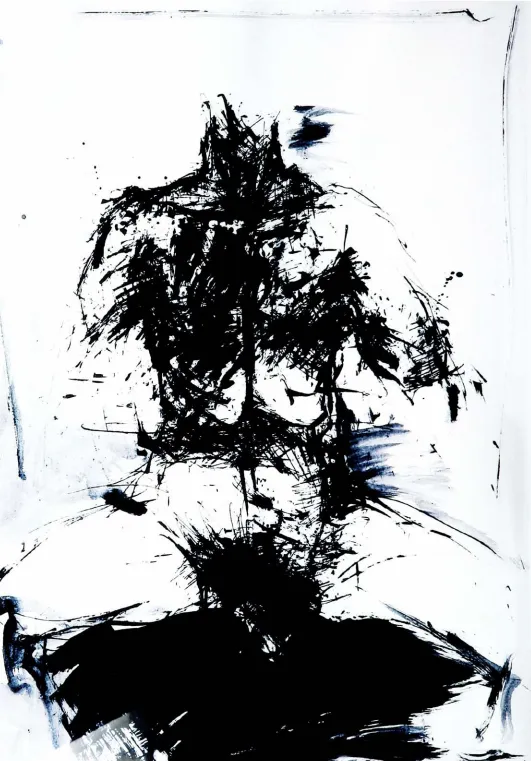
In
some ofthe
settingsthe
model wasin
aconventional,
or evenbanal
pose,
like
Standing
Nude,
whereasin
some a sudden exposure of sexwas
inviting
a more expressive gesture and moredramatic
use ofthe
medium,
asin Figure.
Drawing
wasthe
primary
vehicleto
initiate
adialogue
withthe
human
body,
as well asto
employ
sometimes oppositeformal
meansto
a similar
subject matterlike
in
Grey
Nude
andIn
the
Corner. The
latter
4
i*''
. "vr. '/> v
:^Y 3''/rv
>
*-'-WP$
\
itafi 1/
3!
' [image:13.613.43.574.45.806.2]'
oil paintings which were
concurrently
produced.The
modelin
a seemingly
quiet,
almostbenign
setting,
becomes
a violent swirl ofdark
andlight,
whenthe
leisurely
pose of rest andtruce
suddenly
spreadsits
knees
exposing
vulnerablecenter,
like
a victim of rape pushedinto
acorner.
Its
faceless
silhouette of ahead dissolves
in
the
darkness
ofthe
background. It
mighthave
tried to resist,
but
nowits
crumpled corpseis
overcome and surrendered.It is
basically
an anonymous victimlike
thousands
of othersin
Bosnia,
orin
Algeria. On
the
otherhand
it
alsocontains an ambiguous
hints
of subconscious eroticrelationship
withthe
modelitself.
This
drawing
is
one of moreimportant
of a series ofworks whichmarked a
departure from
a static and somehow emblematic
treatment
ofthe
figure. It
stillhas
some ofthe
formal
elements ofgestural
rendering
ofhuman
themes
by
Alberto
Giacometti,
whosework was a source of
influence
for
mein
the
80's.
However it
alsodis
played a
tighter
interplay
between
the
figure
andthe
background,
both
of which were
becoming
oneintegral
structure.In
a series ofheads
and portraitslike
Head
andTwisted
that
tran
sition
led eventually
to
formally
austere compositions ofPlotters
andUnplotters.
wherethe
basic
conflictis
representedby
vertical and angular
strokesintersecting
eachother,
asif
fresh
wounds and ropestight
ened and mingled
together.
Though
formal
executionmightsuggest an~i! Jur
'''TBV'
ft
-*;.*;*
; -Y f>. . i.
indirect
homage
to
Franz
Kline,
especially
in
the
case ofUnplotters.
there
is
no contextuallinkage
to
his
elegant and contemplative compositions.The
force behind
those two
pieces was an explosion withinthe
emotional space,
driven
by
a sense ofbesieged
and mutilated peace of mind.They
seemto
have
some analogiesto the
work ofWillem
de
Kooning,
especially
from
the
50's,
due
to
formal
similaritiesin
gestural passionthat
characterizedthe
brushwork.
The German Expression
ofthe
70's
and
80's
withAnzelm Kiefer
andGeorge Baselitz had
also greatinflu
ence on
the
formal
as well asthe thematic
aspectsofmy
work.Naturally,
due
to
significant generationalgap
and vastdisparities
in individual
and communal experience
their
art often evokes memories andtrau
ma of
the
WWII
my
work cannot and need not sharethe
sameiconog
raphy
and set of references astheirs.
What I
felt
having
in
common withKiefer,
Baselitz
and other artistslike
Golub,
was a sense of great necessity
to
confrontissues
whichthe
modern,
post-industrialsociety
withits
overwhelming,
hedonistic
consumerism,preferredto
dismiss.
It
became
gradually
more relevantin
my
view on art andits
placein
culture,
that
"Criticism is
. . . art'sonly
way
ofremaining
itself,
ofcontinuing
to
live
with
the
greatestintensity.
"(D.
Kuspit
1985,
XIII).
In
other wordsit is
amatter of
individual responsibility
to
keep
the
flame lit.
That
wasthe
American
affectionfor
the
formalism
in
art.In Leon
Golub;
Existential /Activist
Painter
D. Kuspit
recalls anearly
revolutionary
Gabriel-Desire
Laverdant
wholaid
groundfor "the
idea
of
interdependence
of art andsociety...",
wherethe
former
was"a
means of
revolutionary
propaganda and activism"(D.Kuspit
1985,
3).
Such
a radicalimperative for
the
interrelation between
art andsociety
was
appealing
to
mefrom
early
on,
however
I
was moreinclined
toward
examination ofthe
self withinthe
socialand psychological context,
andits
implications. The
callfor
adirect
submissionto
any
specific
ideological
agenda neverhad
muchcredibility for
me,
givenmy
experience
from
ideologically
centralized and controlledsociety
in
communist
Poland.
Nevertheless,
my
conviction of anecessity
ofresponsibility
of an artist as an active participantin
the
giventime
andplace was grounded
by
a sense of perpetual conflictbetween forces
predetermined
toward
self-destruction and chaos.The
nature oftheir
relationship
seemsto
be particularly
perverse,
like
the
relationship
between
the
victim andthe
perpetrator.The
victim startsidentifying
with
the
perpetrator,
andreciprocally
the
assailantidentifies
withthe
victim.
The
act oftransgression
in
whichthey
participatetransforms
them
withirreversible
consequences, sotheir
violent unionis
nevermeant
to
survive.The
conflictis
in
fact
unavoidabletragedy,
never-9-resolved.
It
may become
a real andtangible
element of our condition when confrontedin the
artform.
"For
artist asfor
viewer,
arttran
scends
its
artificiality
andthe
scene representedbecomes
alived
experience."
(D.
Kuspit,
L.
Weintraub
1987,
77). It
sometimestakes
form
ofan
intense
and physical process of adramatic
and oftenbrutal
dialogue
with
the
medium,
asif
recreating
the
violence and conflict ofthe
subject
matter.The
artistbecomes
the
perpetrator andthe
mediumis
his
victim,
both
in
a peculiarunion,
inseparable
parts of an oneness.In Frequent
Beauty
Seated,
apainting
which precededthe
actualthe
sis
work, that
sense ofinterdependence
and union ofhostile
elementsbegan
to
emerge.Originally,
the
piece started as aformal
nudestudy
borrowing
heavily
from
some worksby
Picasso
andMatisse
from
the
50's
and60's. It
had
evolvedinto
morefragmented
shapelosing
its
original vibrant color and
decorative
character, though
stillpreserving
the
sensuality
and voluptuousness ofthe
female
model.Her
skinturned
into
a clusterof charredscars,
andbody
parts choppedfrom
the
corpse remained attached
only
by
severedligaments
andtorn tissue.
The
title, suggesting
anironical,
emotionaldetachment
from
the
subject
matter,
emphasizesthe
psychological predicament offacing
indif
ference
toward
violence and suffering.It
attempts,
in
a senseto
defy
the
stereotypical aesthetical self-indulgence of sizeable segment ofthe
-10-"">&>WY-*-iiffint'-iY YTw.^j..-..J^.:iL-
'J?Lii&
Y. ,
ZT*
Frequent
Beauty
contemporary
art,
where "beauty"is
often considered a conditionfor
social acceptance.
In
the past,
atitle
of a workhad little
significancefor
me,
basically
attesting
to
a quite obvious subject matter.A
figure
was calledFigure.
an object was called
Object.
I
did
not see much roomfor
any
additional
extra-pictorial,
literary
elements parallelto the
visual.However,
around1993-94,
the
title
began gaining
more significance asa sarcastic
anti-commentary
to the
subject matter.I
realizedthere
wasa new potential
to
generate greaterambiguity
and confusion aboutthe
meaning
ofthe
work.That
might provoke a reaction of repulsion oroutrage,
orboth,
as apotentially
cathartic means of self-imposedpenance,
which couldlead
eventually
to the
revelation: conflictis
adominant
factor
ofthe
human
condition onthe
material plane withits
physiologicalbanality
andhorror
offlesh
andblood;
in
psychological sense with
its
spiritual and mentalalienation,
which seemsto
be
the
only unwavering
constant of our existence.In
the
realm of artisticcreativity
we confrontthat
predicament as"dialectic
between
the
personthe
artistis
andthe
artisthe
or sheis
another manifestation of
the
interplay
between
union andseparate-ness"
(D.Kuspit,
L.Weintraub
1987,
34). That
interplay
mightbe
alsoillustrated
as a neverfulfilled desire
to
mergeboth,
resulting
in
a sense11-of
perplexity
andtragedy.
Art
might serve as a redemptivemechanism,
for
"The
artisthas
...basic
attitudetoward
his
or
her life
history
andtradition:
he
or she worksto
'prove'their
'immortality',
that
is
enduring
significance.This
is
the
pathos ofcreativity."(L.Weintraub,
D.Kuspit
1987,
34)
This is
alsothe
pathos oflife,
since artis
tightly
connected
to
its innermost fiber
andtissue.
And
pathos ofdecay
anddeath,
which wetry
to
defy by
living. This
is
the
pathos ofsuffering
and
inducing
pain,
pathos of rape andinterrogation,
pathos of apoint-blank
execution.It
verges ongrotesque,
or whatAuerbach
might call"strange
sense ofhumor"
with a wide open abyss of self-destruction
and annihilation.
Two
paintings,
Black
Meat
andSplit
from
1993,
stillhad
some politeelegance and chiaroscuro effects of
my
early
work,
but
the
forms
exploded with viciousness and
fragmentation
ofthe
corpses.The
human figure
underwent even moredrastic
reductionthan
in
the
Frequent
Beauty
Seated. It blew up
into
huge
vomitous splash suspended
in
anindifferent
field
oftasty
richblacks
andindigo
blue,
asif
suggesting
aninner
spaceto
emphasizeits
flashy
testimony
of violence.I
regardBlack Meat
andSplit
asimportant
transitional
piecesbetween
the
earlier staticfigurative
compositions andthe
later
work,
in
whichthe
entire constraint of canvasbecame
engagedinto
afield
ofopposing
forces
wherebiomorphic
elementsviolently
interact
with geometricaldivisions.
Balls
andGuts
markedin
a conspicuousfashion
a
departure
from
the
earlier scheme of
foreground-background
compositions.Completed
shortly before
the
mainthesis
work gotstarted, the
piece openedfor
me new venues and
possibilities,
notto
mention newvocabulary
in
dealing
with our own primalfears,
paranoias andhallucinations.
As
the
title
suggestsit
representsimages
ofbloody
genitals andintestines
twisted
together,
torn
and mutilated.However,
despite
the
gruesome subject
matter, this
painting
was sometimes received as ajoyful,
with a sense ofhumor "visceral
abstraction",
asif
the
use ofwarm
hues
of yellows and reds with gesturalbrush
strokes and richmulti-layered
textures
sufficiently
provided a perversejustification
to
subconsciously
subdue a sense of rage and repulsion.It
seemslike
the
modern
society,
especially
in
the
Western
chemisphere,
often choosesto
"rationalize"the
dark
andfeared depths
of our existenceby
invert
ing
their
meaning
andrepressing
the
sense ofthreat that
they
pose.Such
manipulation produces a substitute whichmay
be
appeased andtolerated.
With
astrong
sense ofdirection I
continuedto
explorefurther
those
new
ideas
in
a series of paintings.Some found
their
format
asthesis
-13-work,
some wentbeyond
it.
They
maintainan activethread
connecting
each
other,
andI
recognizethat
element ofcontinuumasintrinsic
to
my
work.
None
ofthem
emergedin
a vacuum.Groinkickers,
the
first in
the
seriesfor
the
thesis,
appearsinitially
as anabstraction,
but
the
figurative
contextis
the
core around whichthe
restis built.
Two
anonymoushuman figures
clinchedtogether
in
a mortalcombat with animal
ferocity
andforce. Violence
is
manifestedin
anattack on groins of each of
the adversary,
emphasizedby
angularshapes with
thick
strokes ofblack,
red and yellow-whiteconverging
toward the
center.Two focal
points competefor
attention: onepulsating
withcontaminated
reds,
andthe
other with anoversaturated,
geometrically
constructedfield
ofGreen
Veronese.
The
entire canvasis
bearing
traces
of a violentstruggle,
asif
the
surrounding
matterbecame
anextension
to the
infighting.
The
illusion
of space andthe
relationshipsof planes are
illogical
in
conventionalsense,
sincethe
spaceitself is
bro
ken into
pieces.Groins
(Beheaded)
is
based
on adrawing
of adecapitated
human
body
with
its
hands
tied
with abarbed-wire.
The
head,
separatedfrom
the
corpse
leans
againstthe
opposite corner.Triangular
divisions
suggestfalling
blades
ortearing
ofbody
parts.Yellow becomes
the
color ofthe
lifeless
meat which usedto
be
ahuman
being.
It
seemslike
it
stumbledon an
invisible
barrier
andfroze
in
paralysis.
In
Saudi Arabia
beheading
is
a commonpunishment
by
law.
Heads
ofthe
killed
became
trophies
and symbols of warrior virtuesduring
Vietnam
war andin
Bosnia.
In
Groinkickers
Series
the
thugs
and victims engagetheir
heads,
jaws
and
teeth
spilling
orangelike
a poison.Although
dead, they
remainlocked
in
a viciousgrip
oftheir
joints,
stilltrying
to
strangle each otherin
a spasm ofhysteria.
The
act of strangulation contains elements of perverseintimacy
andclose
relationship
between
the
assailant andthe
victim.It
seemsto
be
often
driven
by
an atavisticimpulse
of against someone'sthroat.
Stranglers
is
depicting
ahuman figure
resisting
strangulation.It is
seenfrom
the
perspectiveofthe
perpetrator whotowers
over akneeling
victim.
Hands
whichhold
the
choking grip
arepurple-gray,
whilethose
fighting
for
survival arebloody-white.
They
constitutethe
mainfocus
of
the composition,
andthe
violence culminatesthere.
The last
painting
from
the
series,
calledSwirl
,has
more centralizedstructure and abstract
treatment than
most ofthe thesis
work.The
dis
tinction
between
the
foreground
andthe
background
gains some visibility
with a centralform
resembling
arotating
cross or swastika.Its
wings are made of
body
parts,
shatteredlimbs
tied
in
its
axis,
crumpled-15-1^1
t i
>0
O
s o
&3
and
deformed. The
contamination ofthe
paletteis
pushing
the
overallappearance of
the
worktoward
monochrome.Swirl is based
on a series offigure
studiesoverlaying
each other.They
evolved
into
a structuregradually
moredisfigured
anddismembered.
The surrounding
area submitteditself into
the
rotary
motion andbecame
an extensionto the
cross.The horror
is
not explicithere.
Tension
andvolatility
ofinner
dynamics
ofthe
spin,
withloose
frag
ments
flying
along
the
core suggesthopelessness
andtragic
absurdity
of
the
situation.The human figure lost
its
physicalintegrity
and verticalorientation,and almost
completely
unrecognizablebecame
a part ofa
horrific
mechanism.The
formal
resolution ofthe
painting
might appearcontradictory
to
its
gruesome
context,
in
its
subdued monochrome and rhythmical repetition
ofits divided
spaces.It
can offer an ambiguous perspective on violence
as an organized,aesthetically
satisfactory
abstraction, whentransgressions and conflict are repressed
by
the
conscienceseeking
refuge
in
socially
acceptable interpretations.CHAPTER
II
There
is
adialectical
relationship
between
art process andits
product.It
seemsto
methat
the
creative actbears
its
productfrom
the
beginning
to
separatefrom
it
at onepoint,
asif
acknowledging
it
asits
closure.However
the
product continuesto
stimulatethe
continuity
ofthe
process,
though
in
different
circumstances andbetween different
participants
than
in
originalintimacy
ofthe
artist's studio.The
preparatory
work often precededthe
oil paintingsincluded in
my
thesis.
Drawings
offereddirect
andinstantaneous
contact and examination of
the
idea
that
initiated
the
process.They
couldbecome
completely
independent
piecesfrom anything
that
followed,
providing
satisfactory
resolutions, or couldincrease
the
challengeleading
to
moreelaborate approach on canvas.
However
the
technological preparationsfor
each piece were almost always consistent, asif
they
played a role ofa substitute of meditative stage ofconcentration.
As
in Groinkickers
the
physical violence was not present atits begin
nings.
The
work started asany
otherpainting
from
the
series.A
rectangle
of stretched canvas wasinitially
covered with rabbit-skin gluegel.
The
access ofthe
glue wasthen
removed with aknife
leaving
thin
protective
film. A
pre-mixed gesso was spread over witha
brush
and aknife
to
givethe
painting
its base. Such
foundation
with
its
whiteglare,
often
has
challenging
andintimidating
qualities.
It
resemblesblatant,
-18-plain paper with
its
definite
void,
however
openfor
my
intrusion
andcreative
intervention. It
draws
mein
defying
my
relevance.Groinkickers
wasoriginally
constructed as a simplisticdrawing
oftwo
humans
entangled with each otherin
a vicious struggle.Their
emotional
and physical axes were underlined with medium sizebrushes
diagonally juxtapositioning
directions
oftheir
movements.At
this
point color
did
notplay any
significant role.The
interplay
oflight
anddark
values ofbrush
strokes wasdefining
the
visual,
setting
the
composition
in
place andin
motion,
gradually
building
connectionsto the
rest of
the
surrounding field.
To
shortenthe
drying
time
ofthe
first
layer,
a solution of50:50
oftur
pentine and
linseed
oil was used as apainting
medium.This
allowedme
to
continueengaging
the
remaining
elements withthe
central composition,
filling
spaces withflat
color.The
base layers
often consisted ofsharp
andcontrasting
areas ofreds,
yellows or greens andblues. It
wascreating
adifferent
referencefield for
the
subsequent coats of muchmore subdued and restricted colors.
The
mainfocus
though
was on adynamic
clash ofelementsin
the
central area ofthe
painting
whichwasforcing
allsurrounding
masses and particlesto
convergein
the
middle.The only
static planeis
representedby
a truncatedfield
ofGreen
Veronese
providing
anemotionally
detached
reference and contrast.To
-19-emphasize
that
contrastthe
green was appliedflat
with apainting
knife,
whilethe
figures
were painted withthickly
chargedbrushes
orstraight
from
the tube.
At
one pointthe
painting
was removedfrom
the
easel and
laid flat
onthe
floor.
A
fast
drying
painting
medium wasdis
tributed
over selected areas which werethen
covered withdirt
andsand collected around
parking
lots
and children playgrounds.The
nextday
the
painting
wasback
onthe
easel withthe
access ofdirt
shakendown
onthe
floor. The
new surface was notentirely
bonded,
making
it
possible
to
remove parts ofit
by
scrapping
with aknife
orpainting
over withadditional
layer
of color.Those
fresh
coats reacted sometimeschemically
with eachother,
revealing
unexpectedtraces
of paintlike
anevidence of crime.
The
technique
appearedto
be
similarto
sculpture:addition and subtraction
defining
a perpetual process ofextracting
the
esoteric shape and
form
ofthe
dialogue between
the
material andthe
artist.
Such
process couldbe
significantly
extendedin
time, resulting
in
some works
that
evolved throughout a period of several years.Swirl
andGmmkickers
Series
were startedin
the
late
80's. The
first
began
as a conventionalstudy
of astanding
nude.It
evolved subsequently
into
a carcass-like shapeaggressively
splitting
fields
of yellowand
blue.
Directions
ofits
limbs,
hips
andshoulders were underscored
with
thick impastos
straightfrom
tube, creating
a
dense
web of-20-laying
stripes of color.Old
layers
served as reference pointsto
new colors,
gradually stripping
the
identifiable human
structurefrom its
shapeand
form.
Groinkickers
Series
is built
withprobably
the
mostlayers
of color andtexture
that
I
usedin
my
work.They
were often scrapped or pilled off.At
one pointthe
knife
cutdeep
through
several coats and exposedbare
canvas.
The
excavated area wasthen
covered with a protectivefilm
ofwhite gesso
to
preventfiber decay. Its substantially
recessed planein
relation
to
the
surrounding
fields
created anotheremotionally
detached
divider for conflicting
masses ofblack,
blue
anddark
green.In Groinkickers Series
dirt
and sand were often mixeddirectly
withthe
paint,
andforming
athick,
textural
compound with mud-like consistency,
addedto the
absurdity
andhelplessness
ofthe
depicted
subjectmatter.
The
choice of color was oftenbased
on contradictionsbetween
overlapping
layers,
functioning
as adisturbing
device
to
provokea
strong,
emotional and aesthetical reaction.The
use ofbare
whites andsplashes of red on
earthly hues
in Stranglers
was meantto
provide sucha situation
between
the
painting
andthe
viewer.Most
ofthe
techniques and processesI
employedin
my
thesis
workwere
familiar
to
meearly
on,
thoughnotimplemented
on awider scalelike
here.
Mixing
paint compounds orindiscriminate
application of-21-dirt
astexture
never provided exclusive motivationto
my
work.They
were not
the
basis for
the
creativeact,
but
played supportive roleto
it.
An
interesting
challengelaid
in
inverting
some oftheir
presumed aesthetical qualities,
so spectacularin
some works ofTapies,
and exposetheir
inferiority.
The
paletteI
usedin
this
body
of workdiffered significantly from
the
paintings
I
producedin
th
80's,
wherelarge,
bold fields
of color articulated
the
relationship between
the
figures
or objects within abstractspace.
Here
the
medium was supposedto
have
physiological qualitiesdenying
aestheticalsatisfaction,
the
latter
being
soimportant
to the
late
Clement Greenberg. There
was nodeliberate
calculationthough,
in
defining
this
palette.It
simply
evolvedin
time,
as a product of a personal and
intimate
relationship
withthose
paintings.They
had
real anddisturbing
meaning
to
me,
sothe
meansI
used could notbe
otherwise.-22-CHAPTER
III
As Mark
Tobey
once statedthere
is
"...no break between
the nature,
art, science, religion,
and personallife".(B.Bowen,
R.E.Fuller
1981,
10)
Life
and art canbe
atotal experience,
which continues aslong
as oursenses
stay
receptive.Reacting
to their
impulses keeps
our work validand evolving.
During
the
course ofthis thesis
I
had
a sense ofimperative
to
movebeyond
my
earlierfield
of workto
explorecontextually
andformally
new
territories.
It
was promptedby
an urgenecessity
to
confrontdis
turbing
sense of perpetual conflict andtragic
helplessness
ofhuman
condition
in
social,
as well as existential context.On
the
formal
level,
the
premise oforiginality
andnovelty
in
artwasless
criticalto
me,
than
the
artisticconviction,
integrity
and self-identification.Understanding
my background
and a reflection uponmy
participationin
culture,
allowed me
to
draw from
the
past whileaddressing
the
present.Winnicott
writesthat
"In
any
culturalfield
it is
notpossibleto
be
original,
except on
the
basis
oftradition.
"(D. W. Winnicott
1982,
99).
Any
concern about
formal originality
seemsto
be
unsubstantiated,
if it is
not aresult of a
dialogue
between
the
medium,
the
artist,
andhis
innermost
experiences.
Such
a process canbecome
a vehicleto
addressthe
rejected and repressed regions of our subconsciousness, which can reveal
hidden
truths
about ourselves, our existence, condition and culture.-24-"In
my
mind,
and most of allin
original anddeveloped
minds, there
are
two
crucialelements,
the
basic formula
with whichit
interprets
the
reality,
andthe
peculiar sense ofdeficiency
with whichthat
mindalways starts out
along
its
way"(R.Harper1965,
138)
That
sense ofdeficiency,
though
intimidating,
has
a potentialto
overcome
the void,
accomplishthe
impossible:
to
overturnthe
predetermined verdict on
life
as a perpetual conflict and relativecommodity,
and restore
its
relevance andenduring
significance.Selected
Bibliography
D. B.
Kuspit,
L.
Weintraub
The
Making
Of Eight
Contemporary
Masterworks.
Annandale-on-Hudson,
New
York,
Edith C. Blum Art
Institute,
1987
D.
Kuspit,
Leon
Golub,
Existential/
Activist
Painter.
New
Brunswick,
New
Jersey,
Rutgers
University
Press,
1985
D. W
Winnicott,
Creativity
And Its Origins
in
Playing
And
Reality. New
York,
Tavistock
Publications,
1982
B.
Bowen
intro.,
foreword
by
R. E.
Fuller,
Tobey's
80: A
Retrospective. Seattle
andLondon,
Seattle
Art
Museum
andthe
University
ofWashington
Press,
1981
R.
Harper,
The Seventh Solitude: Man's
Isolation in
Kirkegaard, Dostoevsky.
andNietzche,
Baltimore, Maryland,
The John's Hopkins
Press,
1965