Ml.b blAllbllUUE DES COMMUNAUTES EUROPEENNES - STATISTICAL OFFICE OF THE EUROPEAN COMMUNITIES - STATISTISCHES AMI DER EUROPAISCHEN GEMEINSCHAFTEN - ISTITUTO STATISTICO DELLE COMUNITÀ EUROPEE - BUREAU VOOR DE STATISTIEK DER EURcf 'ESE GEMEENSCHAPPEN - DET STATISTISKE DEPARTEMENT FOR DE EUROPÆ ISKE FÆ LLESSKABER - OFFICE STATISTIOUE DES C O M M J IAUTES EUROPEENNES - STATISTICAL OFFICE OF THE EUROPEAN COMMUNITIES - STATISTISCHES AMT DER EUROPAISCHEN GEMEINScJ iFTEN - ISTITUTO STATISTICO DELLE COMUNITÀ EUROPEE - BUREAU VOOR DE STATISTIEK DER EUROPESE GEMEENSCHAPPEN - DET Sil TISTISKE DEPARTEMENT FOR DE EUROPÆ ISKE F Æ LLESSKABER - OFFICE STATISTIOUE DES COMMUNAUTES EUROPEENNES - STATISTI ;AL OFFICE OF THE EUROPEAN COMMUNITIES - STATISTISCHES AMT DER EUROPAISCHEN GEMEINSCHAFTEN - ISTITUTO STATISTICO DElT E COMUNITÀ EUROPEE - BUREAU VÎ)OR DE STATISTIEK DER EUROPESE GEMEENSCHAPPEN - DET STATISTISKE DEPARTEMENT FOR DEI IROPÆISKE FÆ LLESSKABER - OFFICE STATISTIOUE DES COMMUNAUTES EUROPEENNES - STATISTICAL OFFICE OF THE EUROPEAN O 1MUNITIES - STATISTISCHES AMT DER EUROPAISCHEN GEMEINSCHAFTEN - ISTITUTO STATISTICO DELLE COMUNITÀ EUROPEE 'OOR DE STATISTIEK DER EUROPESE GEMEENSCHAPPEN - DET STATISTISKE DEPARTEMENT F
IFFICE STATISTIOUE DES COMMU™ 1ER EUROPAISCHEN G E M E I N S C H ! :SE GEMEENSCHAPPEN - DEI JAUTES EUROPEENNES - STA AFTEN - ISTITUTO STATISTICI ATISTISKE DEPARTEMENT FOI CAL OFFICE OF THE EUROPEA
E COMUNITÀ EUROPI UROPÆISKE FÆLLE: lUNITIES - STATISTISCHES AW 'OR DE STATISTIEK DER EURO ICE STATISTIQUE DES COMMUN
EUROPAISCHEN GEMEINSCHAF EMEENSCHAPPEN - DET STATIS|
EUROPEENNES - STATISTICAL OFF
ITITUTO STATISTICO DELLE COMUNITÀ EUROPEE - BUREAU VOOR DE STATISTIEK OER EUROPESE GEMEENSCHAPPEN -DET STATISTISK EPARTEMENT FOR DE EUROPÆ ISKE FÆ LLESSKABER - OFFICE STATISTIOUE DES COMMUNAUTES EUROPEENNES - STATISTICAL OFFIC F THE EUROPEAN COMMUNITIES - STATISTISCHES AMT DER EUROPÄISCHEN GEMEINSCHAFTEN - ISTITUTO STATISTICO DELLE COMUNI EUROPEE - BUREAU VOOR DE STATISTIEK DER EUROPESE GEMEENSCHAPPEN - DET STATISTISKE DEPARTEMENT FOR DE EUROPÆ IS FÆLLESSKABER - OFFICE STATISTIOUE DES COMMUNAUTES EUROPEENNES - STATISTICAL OFFICE OF THE EUROPEAN COMMUNITIES TATISTISCHES AMT DER EUROPAISCHEN GEMEINSCHAFTEN - ISTITUTO STATISTICO DELLE COMUNITÀ EUROPEE - BUREAU VOOR DE ST ISTIEK DER EUROPESE GEMEENSCHAPPEN - DET STATISTISKE DEPARTEMENT FOR DE EUROPÆ ISKE FÆ LLESSKABER - OFFICE STATIS QUE DES COMMUNAUTES EUROPEENNES - STATISTICAL OFFICE OF THE EUROPEAN COMMUNITIES - STATISTISCHES AMT DER EUROPÀI ¡HEN GEMEINSCHAFTEN - ISTITUTO STATISTICO DELLE COMUNITÀ EUROPEE - BUREAU VOOR DE STATISTIEK DER EUROPESE GEMEENS' N - DET STATISTISKE DEPARTEMENT FOR DE EUROPÆISKE FÆLLESSKABER - OFFICE STATISTIOUE DES COMMUNAUTES EUROP
eurostat
BUREAU EUROPÆ ISKE FÆ LLESSKABER - i l
E EUROPÆISKE FÆLLESSKABER - OFFICE STATISTIQUE DES COMMU. COMMUNITIES - STATISTISCHES AMT DER EUROPAISCHEN GEME!NSC| EAU VOOR DE STATISTIEK DER EUROPESE GEMEENSCHAPPEN - DET :
- OFFICE STATISTIQUE DES COMMUNAUTES EUROPEENNES - STATISI ¿T DER EUROPAISCHEN GEMEINSCHAFTEN - ISTITUTO STATISTICO DEU 'PESE GEMEENSCHAPPEN - DET STATISTISKE DEPARTEMENT FOR DE 7 FAUTES EUROPEENNES -STATISTICAL OFFICE OF THE EUROPEAN COlJ :TEN - ISTITUTO STATISTICO DELLE COMUNITÀ EUROPEE - BUREAU \ riSTISKE DEPARTEMENT FOR DE EUROPÆ ISKE FÆ LLESSKABER - OFj AL OFFICE OF THE EUROPEAN COMMUNITIES -STATISTISCHES AMT DB
£
eurostat
DE EUROPÆISKE FÆLLESSKABERS STATISTISKE KONTOR STATISTISCHES AMT DER EUROPÄISCHEN GEMEINSCHAFTEN STATISTICAL OFFICE OF THE EUROPEAN COMMUNITIES OFFICE STATISTIQUE DES COMMUNAUTÉS EUROPÉENNES ISTITUTO STATISTICO DELLE COMUNITÀ EUROPEE
BUREAU VOOR DE STATISTIEK DER EUROPESE GEMEENSCHAPPEN
Luxembourg, Centfe Européen. Boite postale 1907 Tel 43011 Télex Comeur Lu 3423 1049 Bruxelles Bâtiment Berlaymont. Rue de la Loi 200 (Bureau de liaison) — Tel 735 80 40
To obtain this bulletin regularly please apply to:
EUROSTAT Publications B.P. 1907 Luxembourg
Grand Duché de Luxembourg
Printed in Belgium
EUROSTAT NEWS
10-1977
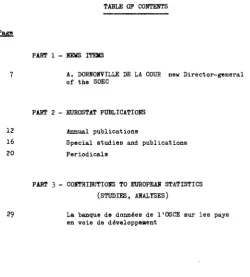
TABLE QP COHTEHTS
Pag«
PART 1 - HEWS ITEMS
Α. DORHOKVILLE DE LA COUR new Director-general of the SOEC
PART 2 - EUROSTAT PUBLICATIONS
12 Annual publications
16 Special studies and publications
20 Periodicals
PART 3 - COBTRIBUTIOHS TO EUROPEAS STATISTICS (STUDIES, ASALYSES)
- 7
«Γ. Α. DORHOHVILLE DE LA COUR HEW DIREOTOR-GEHERAL OP TBE SOEC
Following the departure of M. Jacques MATER (see number 5/6 of EUROSTAT HEWS), on the 27th July 19771 the Commission appointed Mr. Aage DORHOHVILLE DE LA COUR as the new Director-General of the Statistical Office of the European Communities. Mr. LA COUR took up his post on the let September 1977.
Born in Copenhagen in 1917, he graduated from University in 1949* He joined
Denmarks Statistik in 1950 and his work there covered many statistical fields.
He became Head of Division in I962 and Deputy Director in 1967· He was chairman
of a number of committees including the committee preparing the legislation
for the register of establishments and enterprises. For many years, he was
consultant to the committees which examined the economic and transport problems
related to the projects for bridges and tunnels crossing the Great Belt and
the Sur.d between Denmark and Sweden.
Besides his statistical experience, Mr. LA COUR was lecturer at the University
of Copenhagen and from I962 Assistant professor in Transport Policy and Public
The EUROSTAT publications are delivered
by the following sales agents:
Belgique - België United Kingdom
Moniteur belge - Belgisch Staatsblad
Rue de Louvain 40-42 — Leuvenseweg 40-42 1000 Bruxelles — 1000 Brussel
Tel 512 00 26
CCP 000-2005502-27 — Postrekening 000-2005502-27 Sous-depöf — Agentschap
Librairie européenne — Europese Boekhandel Rue de la Loi 244 — Weistraai 244 1040 Bruxelles - T040 Brussel
CREDOC
Rue de la Montagne 34 - Ble. 11 Bergstraat 34 - Bus 11 1000 Bruxellos - 1000 Brussel
j H Schultz — Boghandel
Montergade 19 1116 KoOenhavn K Tel 14 11 95 Girokonlo 1195
BR Deutschland Verlag Bundesanzeigcr
Breite Straße - Posttacn 108 006 5000 Koin 1 Tel (0221)21 03 4β
(Fernschreiber Anzeiger Bonn 08 882 595) Poslscheckkonio 834 00 Köln
Sfaconery Oftice
Beggar s Bush Dunim 4 Tel 68 84 33
Libreria dello Slato
Piazza G Verdi 10 00198 Roma — Tel |6)850 Telex 62008
CCP 1/2640
Agenzia : Via XX Settembre (palazzo Ministero del tesoro) 00 187 Roma
Grand-Duché de Luxembourg Office des publications officielles des Communautés europeennes
5 rue du Commerce Boite postale 1003 — LuxemDourg Tel 49 00 81 — CCP 191-90 Compie courant bancaire BIL 8-109/6003/300
H M Stationery Oftice
Ρ O Box 569
London SEI 9NH
Tel (01)928 6977 e»! 365
National Giro Accounl 562-1002
United Stales of America European Community Information Service
2100 M Streel. Ν W Sude .'07 Wash.nglon DC 20 037 Tel (202) 872 8350
Schweiz - Suisse - Svizzera Librairie Payot
6 rue Grenus 1211 Geneve Tel 3189 50 CCP 12 236 Geneve
Sverige Librairie C E Fritze
2 Fredsgatan Stockholm 16
Postgiro 193. Bankgiro 73/4015
Service de vente en France des publications des Communautés européennes Journal officiel
26 rue Desaix 75 732 Pans — Cedex 15 Tel (1)57661 39 — CCP Pans 23-96
Nederland
Staatsdrukkerij- en uitgeven/bedn/l
Chrislollel Plantiinstraal s-Gravenhage Tel (070181 45 11
Postgiro 42 53 00
España Libreria Mundi-Prensa
Castella 37 Madrid 1 Tel 275 46 55
Andre land· · Andar« Lindar - Other countn·» - Autres pays - Altri paasi - Andara landen
Konloret tor De europæiske Fællesskabers officielle Publikationer - Ami tur amtliche Veröffentlichungen der Europaischen Gemeinschaften - Office tor Official Publications of the European Communities · Office des publications officielles des Communautés européennes - Ufficio delle pubblicazioni ufficiali delle Comunità europee - Bureau voor officiële publikaties der Europese Gemeenschappen
11
-SUMMARY
Published
Special publications and Beries :
Input-Output Tables 1970, Vol. . 1 - 4 17
Structure of earnings in wholesale and retail distribution,
banking and insurance in 1974, Vol. 1 18
Confidentiality and business statistics in the EC (D, E, F) 16
September 1977 ι
Balances of payments - Global data (197O-I976) 12
Earnings in agriculture 1975 13
Statistical yearbook of Transport, communications, tourism - 1975
(E/F) 15
Production of v e g e t a b l e and f r u i t 1965-76) 14
October 1977 t
S t a t i s t i c s on education I97O-76 13
Coal s t a t i s t i c s 14
Gas p r i c e s 1970-76 (E/fc) 19
T a r i f f s t a t i s t i c s - I974 15
To be published s h o r t l y :
S o c i a l accounts i n the European Community - S o c i a l p r o t e c t i o n
accounts 12
Statistical yearbook of Transport, communications, tourism - 1975
(D/l and DK/ÏL) 15
Gas prices I97O-76 ( D /1) *9
Tariff statistics - 1975 15
Methodology of the EC index of producer prices of agricultural
12
AHHUAL PUBLICATIOHS
Purple series ι Balances of payments - Global data (1970-1976)
£
DKr U3Î FB4.80 49,20 8.25 300 93 pages Format A 4
Multilingual edition published in September 1977
This publication provides the latest available annual data on the global balances of payments (flows) and the' external position of the monetary authorities (amounts outstanding) of each European Community country and of the United States and Japan.
The presentation includes totals relating to the nine Member States (EUR-9) as a whole.
For the first time, the data are expressed in millions of European units of account (Mio EUA); they are presented according to the EUROSTAT's balance of payments scheme and cover the period 1970 to 1976.
Tello*· aeriee t Social aocounta in the European Conamiity Social protection accounta
Price : £ DKr US* FB
4.90
49
8.30 300
Approximately 158 pages Format A 4
Multilingual edition to be published in October 1977
13
-ε
DKrus$
FB6.30
26 11 400 Earnings in agriculture 1975
145 pages Format A 4
Multilingual edition published in September 1977
This publication contains the methodology and detailed results of the first Community survey of earnings of permanent workers in agriculture in 1975.
These results cover labour forces, earnings and monthly duration of paid work, broken down by sex, age, training, type of work, relative size of holding and the provision or not of payment in kind. In the case of certain countries, these data are also broken down by major region.
Statistics on education - 1970-1976
Price : C 7.70 DKr 78,15 USS 13.35 198 pages Format A 4
Multilingual edition published in October 1977
This publication presents the principal figures relating to the school and university systems in the Community between the schoolyears 1970/71 and 1975/76. To the statistics previously published in this field (distribution of pupils and students by type and level of education and by region) have been added new data which will from now on be periodically updated.
- 14
Green series : Production of vegetables and fruit 1965-1976
Price : £ 4.80 DKr 49120 US$ 8.25 FB 300 74 pages Format A 4
Multilingual edition published in September 1977
This edition contains statistics of areas and production of vegetables and fruit in the 9 countries of the EC.
A common presentation for all countries has been adopted for the first time in the tables by country. They show details, by product, of the cultivated area, yields achieved and usable production for vegetables, and the total area, production area and usable production for fruit. The data relate to the years 1973. 1974 and 1975.
The recapitulation summarises production data for the 9 member countries from 1965 to 1976, the data for the latter year being partially incomplete and provisional.
Ruby series : Coal statistics - 1976
Price : £ 2.40 DKr 24,60
us$
4.20
79 pagee Format A 4 FB I50 Multilingual edition published in October 1977
This publication supplies the vast array of harmonised data, in large part definitive, permitting one to see at a glance the actual and synthetic activity in the coal industry over the past year. The concepte used are those utilized within the coal industry. The data catalogued
15
-Red series : Tariff statistics - 1974 ( 4 volumes)
4 volumes £ 36 DK 352
USt 60,75 FB 2.250 per £ DK U5Î FB volume 12 117 20,25 75O 4209 pages Format A 4
Bilingual edition German/French published in October 1977 Imports by weight and by value of the EEC and of each Member State, classified by country of origin for each subdivision of the Common Customs Tariff.
Tariff statistics - 197 S (4 volumes)
Price 4 volumes £ 36 DK 352 US$ 60,75 FB 2.250 per £ DK USS FB volume 12 117 20,25 750 Approximately 1.350 pages Format A 4
Bilingual edition German/French to be published in October 1977 Importe by weight and by value of the EEC and of each Member State, classified by country of origin for each Bubdivision of the Common Customs Tariff.
Crimson »»ri.« 1 Statistical yearbook of Transport, communications, tourism - 1975 Price 1 £ 11
DKr 118,70 us* 19.35 FB 700 133 pages Format A 4
1/7 edition published in September 1977
D/l and Dl/BX editions to be published in Hovember 1977
Statistics on the infrastructure, on the equipment, and on the operations
of the different modes of transport.
Statistics on traffic accidents, and on communications (post, telegraph,
- 16
SPECIAL PUBLICATIONS AND SERIES
Orange f e r i e s : C o n f i d e n t i a l i t y and b u s i n e s s s t a t i s t i c s in the European Community
P r i c e ι £ 3.20 DKr 31,30
us$
5.40
FB 200
147 pages Format C 5
Editions DK, D, E, F, I, EL
Published : D, E, F
It is the constant concern of the official statistical services to safeguard the confidentiality of the information with which they are entruEted. Each Member Country has its own customary procedures taking the form, in many cases, of national laws defining the rules of con fidentiality applicable to business statistics.
These rules, which were elaborated in a national context, are now applied to Community statistics where they have led, in combination, to a far more drastic shrinkage of information than that which they cause at a national level. At the same time, in industrial circles in every Member Country, there is evident reluctance to release more information than is released by the others, apprehensions conducive to the development of a restrictive approach.
For that reason, the Statistical Office of the European Communities has decided, in agreement with the national statistical services, to examine this problem with a view to its solution. This report is a major con tribution to such an undertaking. Its preparation was rendered possible by the collaboration of the various National Statistical Institutes, which not only provided the author with the necessary information regarding the laws and practices relating to the confidentiality of business statistics in their respective countries but also submitted their comments on the first version of the report. Nevertheless, as the author himself has emphasized in his preface, the opinions ex pressed in this document are strictly his own, and are in no way to be taken as those of the national statistical services or of the Commission of the European Communities.
- 17
Purple series : Input-Output Tables v p
Price :
complete series p e r volume
£ 30,50 £ 4 2 5
DKr 393,50 D Kr 55
-u s* ^ 71,60 uss 10,10
Special 9-volume series Format A 4 FB 350 Published :
Volume 1 - Methodology 1970-1975 : 38 pages F, D, E, NL, I, DK
Volume 2 - United Kingdom I97O : 121 ua*ea
Edition E/F * ^ Volume 3 - Nederland ΙΡγο : 119 pageB
Edition NL/F
Volim· 4 - Italy 1970 ι II9 pages Edition I/F
Volume 1 of this series describes the methodology established by the SOEC for the construction of input-output tables calculated, from the year 1970 on, according to Community rules. A general description of the input-output table is given, with some detail on its various componente and their relationships. The classifi cations and the accounting rules which are used are defined by a number of references to the European System of integrated economic Accounts (ESA). The last chapter shows a few examples of the way in which the tables can be used for economic analysis.
Each of the volumes 2 to 7 deals with the input-output table of one country (United Kingdom, the Netherlands, Italy, Belgium, Germany, France). In each volume, the first part describes the problems encountered when using the Community classifications and methods and the adjustments made in order to improve comparability from one country to another. A short description of the table is also given. The second part is composed of the input-output table expressed in units of account EUR, tablee of direct coefficients (vertical and horizontal) and several tables of indirect coefficients (inverse natrix, content of imports, content of primary inputs in the final uses).
- 18
Structure of earnings in wholesale and retail distribution, banking and insurance in 1974
Price : complete series
£
55DKr 708 FB 4.5OO US$ 130 A 4 223 pages published per volume £ 7,30 DKr 94,50 FB 600 USt 17,20 Special series in 10 volumes Format
Volume 1 - Methods and Definitions : multilingual
This survey has been conducted simultaneously, and according to identical methods, in the 9 countries of the European Community. Its essential objective was to obtain details of the earnings and of individual characteristics (sex, age, level of professional qualification, length of service, etc.) of employed persons, and of the structure (branch of activity, size, etc.; of the enter-prises employing them, in order to bring out the relationships between these facts and the levels of remuneration.
The results are published in one volume for each country.
Methodology of the
Green series : EC-Index of producer prices of agricultural products
Price : £ 6.20 DKr 62,50 us$ 10.70 Approximately 270 pages Format A 4
Multilingual edition to be published in November 1977
This publication is a treatise. It contains the description of the method, the composition and, enriched by graphs, the evolution of the new EC-Index (EUR-9) of the producer prices for agricultural products (base I97O = lOO).
The field of observations covered by the index has been enlarged with regard to the former EC-Index (EUR-6). Numerous seasonal products have been included. Whereas on the annual basis the index comprises also the prices for fruit and vegetables, this information is not yet available at monthly level.
- 19
-Ruby series : Gas prices
Price : £ 13-90 DKr 140,70
USS 24
F B (··00
264 pages Format A 4
Edition E/F published in October 1977 .Edition D/I 'to be published in November I977
The study gives the results of the enquiry into gas prices for th<: period 1970-76 in the nine countries of the Community, with a bre:
20
Orange series :
EUROSTAT PERIODICALS
Monthly general s t a t i s t i c s b u l l e t i n p r i c e
s u b s c r i p t i o n : £ 21.45 i n d i v i d u a l issue DKr 231 USt 36.60 FB 1.500 : £ DKr US S FB 2.60 27,60 4.40 180
approximately 195 pages Format A 4 monthly
Principal figures on the short-term economic evolution in the enlarged Community, i.e. : employment, industry, services, foreign trade, prices and wages, finance, balance of payments.
Yellow series : Hourly earnings - Hours of work
subs
appri c r i p t
)xima' ion tely : £ DKr
us$
FB 8. 60 85,40 14. 540 248 pages 70 Formati n d i v i d u a l issue
A 4 6-monthly : £ DKr US$ FB 5, 57, n, 360 ,70 ,60 ,80
Harmonized data on workers1 hourly wages and weekly hours worked,
plus indices of developments in employees1 monthly salaries. These
data are broken down according to HACE, and, for certain countries, by region.
Green series : Crop production subscription £
DKr US$ FB 25 27O 42.70 I.75O
i n d i v i d u a l issue £ 2.85 DKr 30,80
us,
4.90
FB 200
approximately 120 pages Format A 4 11 i s s u e s per year
The most recent information on
1) Crop production of a r a b l e land ( a r e a , y i e l d , production)
o r F r u i t and vegetable production ( a r e a , y i e l d , production)
2) Areas sown (twice a year)
3J Stocks and d e l i v e r i e s of c e r e a l s and potatoes
4) Meteorological report
- 21
Monthly statistics of meat
subscription : £ 32.80
DKr 354
US» 56.10
FB 2.300
individual issue : £
DKr US S FB
3.85
41,55
6.60
270approximately 132 pages Format A 4 monthly
Publication of monthly statistics supplied by Member States in application of the Council's Directives 68/161/EEC and 73/132/EEC concerning surveys to be carried out in the cattle and pig sectors. The bulletin contains information on slaughterings, on foreign trade in live animals, on production by species and by country. In addition, it may also give information on head structure - comments
(red pages) - information about supply balances.
Monthly statistics of milk subscription £
DKr US S FB 20
215,50
34.15
I.400
individual issue : £
DKr US, FB
2.60
27,60
4.40
180approximately 70 pages Format A 4 10 issues per year
Publication of weekly and monthly statistics transmitted by Member States in compliance with the Council directive of 31st July 1972, on the statistical surveys to be made by Member States concerning milk and milk products (72/280/EEC).
The bulletin contains the data relating to cows milk collection and the production of processed products by the dairy industry. From time to time the bulletin may contain a commentary on the supply balance sheets and information on dairy structure.
Monthly statistics of eggs
subscription : £ 20 individual issue : £ DKr US, FB 20
215,50
34.15
1.400
£ DKr US, FB2.60
27,60
4.4O
180approximately 70 pages Format A 4 10 issues per year Publication of monthly statistics transmitted by Member States in compliance with the Council regulation 1349 and 2335 °a ^he
22
-Prices of vegetable products
s u b s c r i p t i o n : ( P r i c e s of animal products included)
approximately 108 pages £ DKr
US S
FB
F o r m a t A 4
28.60 i n d i v i d u a l 308 i s s u e :
48.80 2.000 bi-monthly £ DKr USS FB
3.75
41,45
6.40 260Monthly and annual up-dating of the selling prices of the most important vegetable products and of a number of products processed by the food industry. The prices are given in national currency and in EUA as well. The monthly evolutions of the prices in EUA of most products are illustrated also by graphs.
Prices of animal products
s u b s c r i p t i o n : ( P r i c e s of vegetable products included)
approximately 140 pages £ DKr US J FB
Format A 4
28.60 i n d i v i d u a l 308 issue :
48.80 2.000 bi-monthly £ DKr US, FB
3.75
41,45 6.40 260Monthly and annual up-dating of the selling prices of the most important animal products and of a number of products processed by the food industry. The prices are given in national currency and in EUA as well. The monthly evolutions of the prices in EUA of most products are illustrated also by graphs.
Prices of the means of production subscription £
DKr USJ FB 10.70 115,50 18.30 750
i n d i v i d u a l i s s u e : £ DKr USJ FB 3.60 38,50 6.10 250
approximately I50 pages Format A 4 quarterly
23
-EC-Index of producer prices of agricultural products
subscription : £ 11 individual issue : £ 2.40 DKr 115 DKr 24,60 US* 19 USJ 4 FB 700 FB 150
approximately 28 pages Format A 4 bi-monthly
This monthly publication presents for EUR-9 and each of the member countries the evolution of the indices of the producer prices for agricultural products during the last known 12 months.
Blue series : Quarterly bulletin of industrial production
subscription : £ 8.6O individual issue : £ 2.85 DKr 92,50 DKr 30,80
uss
14.65
uss4.90
FB 600 FB 200 approximately 17O pages Format A 4 quarterly
Annual and quarterly indices of industrial production in the countries of the Community.
Data on production within the Community of certain raw materials and finished or semi-finished products.
Quarterly iron and steel statistical bulletin
subscription : £ 21.45 individual issue : £ 7·15 DKr 231 DKr 77 USS 36.60 USS 12.20 FB I.5OO FB 5OO approximately 340 pages Format A 4 quarterly
24
-Rub.^ series : Coal - Monthly bulletin
subscription (Coal, Oil £ 12.85 individual issue ι £ 0.45
and natural gas, DKr 139 (Coal) DKr 4t65
Electrical energy) US$ 22 US$ 0.75 FB 900 FB 30
approximately 8 pages Format A 4 monthly
Produce monthly the principal statistical series characterising the short term movements in the coal industry.
Oil and natural gas - Monthly bulletin
subscription (Coal, Oil £ 12.85 individual issue : £ 0.72.1/2 and natural gas, DKr 139 (Oil and DKr 7,70 Electrical energy) USS 22 natural gas) US$ 1.25
FB 900 FB 50
approximately 16 pages Format A 4 monthly
Produce monthly the principal statistical series characterising the short term movements in the petroleum and gas industries.
Electrical energy - Monthly bulletin
subscription (Coal, Oil £ 12.85 individual issue : £ 0.35 and natural gas, DKr 139 (Electrical DKr 3,85 Electrical energy) USS 22 energy) USS 0.35
FB 900 FB 25 approximately 12 pages Format A 4 monthly
Produce monthly principal statistical series characterising the short term movements in the electrical economy in general and fuel consumption in power stations in particular.
Red series : Monthly external trade bulletin
subscription : £ 21.45 DKr 231 USS 36.60 FB 1.500
individual issue 1 £
DKr US, FB 2.60 27,60 4.40 180
approximately 130 pages Format A 4 monthly
General summary of foreign trade of the European Community by countries and by products.
Trends in EC trade by countries and by products. Indices.
25
-Trade flows
s u b s c r i p t i o n : i n d i v i d u a l issue :
approximately 30 pages Format A 4 bi-monthly
Analysis of the e x t e r n a l t r a d e and r e l a t e d s t a t i s t i c s of t r a d i n g p a r t n e r s of t h e Community, p a r t i c u l a r l y s t a t e - t r a d i n g c o u n t r i e s .
Crimson s e r i e s : Transport/Monthly t a b l e s
£ DKr USJ FB
1.15 12,30 1.95 80 s u b s c r i p t i o n : £ 10 i n d i v i d u a l i s s u e
DKr 108 USS 17.10 FB 700
approximately 60 pages Format A 4 monthly
29
-LA BANQUE DE DONNEES DE L'OSCE SUR LES PAYS EN VOIE DE DEVELOPPEMENT
par MM. Daniel BYK
et Jean-Claude ROMAN
L'OSCE en collaboration avec la Direction Générale Développement de la Commission des Communautés Européennes a mis sur pied une banque de données statistiques socio-économiques de PVD. Pourquoi ?
Le recours à l'information etatistique est, en effet, très fréquent pour les travaux effectués à la CCE en relation avec les PVD. Certes, il existe déjà pour le commerce extérieur des pays ACP un ensemble de procédures informati-ques allant de l'exploitation classique, productrice de listes et de tableaux, à la banque de données. Mais le travaux se diversifiant, la limitation au commerce extérieur et aux seule pays ACP devenait un obstacle, car la quantité d'informations et de données statistiques à manipuler pour aller au-delà de ce premier ensemble eet très importante et l'utilisation dee publica— tione leB contenant devient vite une charge entraînant une perte de temps considérable.
Il faudrait, en outre, que, au moins au sein de la Commiseion, lee divers services amenés à participer à l'élaboration de la politique communautaire d'aide au développement utilisent un matériel statistique comparable qui ne débouche sur des analyses incohérentes ou contradictoires en raison de l'hétérogénéité des données utilisées.
Ces deux soucie amènent à rechercher une solution informatique qui facilite le travail de manipulation, de présentation des chiffres à l'analyste écono-mique ou au décideur politique. Là Burgit un nouvel obstacle, la disponibi-lité de toutee ces informations sur support magnétique ne résout pas tout, il faut pouvoir la traiter. Cee traitements ne sont pas fixes. Par exemple, pour une négociation comme le Dialogue Nord-Sud, divers types de moratoires ont été étudiés nécessitant des calculs statistiques plue ou moins différents à chaque fois. Par conséquent, si l'on choisit une option type programmation adaptée à chaque besoin on se heurte très vite à un manque de ressources humaines côté programmation et souvent à une difficulté de dialogue entre le statisticien ou l'économiste et l'informaticien, les besoins des premiers se définissent et se modifient au fur et à mesure que le second fournit des résultats.
30
-En résumé, la démarche ee préeente de la façon suivante :
- définition dee besoine d'information
- recherche avec les informaticiens d'une solution technique - adaptation de l'information statistique à cette solution - utilisation.
LA DEFINITION DES BESOINS D'INFORMATION
Pour cette banque, dix domaines (cf. tableau 1) ont été retenus, chaque domaine recouvrant un ensemble homogène de statistiques sur l'évolution démo-graphique et économique des PVD (au nombre de 150 environ, la notion de PVD étant assez extensive).
Un des avantages de la Banque est de permettre, grâce aux fonctions de calcul du système de geetion CRONOS, l'utilisation conjointe de ceB dix domainee afin de calculer dee indicateure facilitant l'analyse économique.
Les Statistiques Démographiques comprennent des données globales ainai que des indications B U T la structure de la population active, ce qui permet ainsi de faire des comparaisons avec la structure de l'activité économique (origine du PIB) décrite dans le domaine des Comptes Nationaux*
La Comptabilité Nationale indique également la répartition de l'emploi du PIB, par exemple la part de la consommation publique par rapport à l'investissement ¡ enfin le PNB et différents taux d'accroissement du PNB couramment utilisés.
Les Apports Extérieurs suivant le type d'apport et le type de donneur (avec croisement des critères) montrent la place du secteur privé, l'importance de l'aide publique (dons par rapport au prêts). Ces chiffres peuvent évidemment atre rapprochés des statistiques démographiques ou du PNB pour déterminer l'aide reçue par habitant par rapport au PNB/habitant.
L'Endettement Extérieur se décontracte principalement en montant total, inté-rêts et service.
En relation avec d'autree domaines (Comptabilité Nationale, Financée Publiques, Commerce Extérieur), on peut calculer différents indicateurs sur l'importance de l'endettement pour le pays et sur son prix (par exemple : Montant de la DEP/PNB, Service de DEP/Exportation ; Montant de la DEP/Exportations = nombre de mois d'exportations pour rembourser la dette).
Les Finances Publiques, la Situation Monétaire et les Réserves Internationales ont été regroupées dans un même domaine qui comprend ainsi les recettes et dépenses budgétaires, la dette intérieure publique, les taux de change, et les différents postes d'actif et de passif du groupe réunissant la Banque Centrale et les banques commerciales.
- 31
partir de ces séries les indicateurs usuels : couverture des importations par les exportatione, déficit commercial en pourcentage du PNB, propension à importer···
Les Statietiques du Commerce Extérieur indiquent les flux (imports/exports par origine/destination en provenance/vers lee différents pays de la CEE, les EtatB—Unis, le Japon, la Claese 2, la Classe 3, ainsi que les indices de volume et de prix (et donc les termes de l'échange) ; également les exporta-tions suivant les secexporta-tions de la CST (et de quelques divisions et groupes de cette nomenclature).
Quant au commerce des Produits Agricoles, il fait l'objet d'un domaine parti-culier avec les principaux groupes, rubriques ou position de la CST (en quantité et en valeur).
La Production Agricole et Industrielle reprend les principales productions agricoles et industrielles pour le pays, mesurées en quantité.
Enfin, un domaine indique leB principales statistiques de transports et de Bervices (primee d'assurance et recettes de tourisme).
L'ensemble dee domaines de la Banque permet ainsi d'obtenir une synthèse sur l'ensemble de l'évolution démographique ou économique.
Tableau 1 ί Domaines retenus dans la banque de données
Domaine 0 1 2
3
4
5
6
7
8
9
Démographie et Indicateurs Sociaux
Consommation et Commerce Alimentaire Comptes Nationaux
Transports Commerce Extérieur Apports Extérieurs Dette Extérieure Publique
Finances Publiques, Monnaie, Change Balance des Paiements
Production Agricole et Industrielle
Sources principales (1) Dï, BIT, UNESCO, BMS FAO BMS, NAS Sï YITS CAD BIRD FMI FMI FAO
(1) DT - Demographic Tear-Book
BUS - Bulletin Mensuel de Statistiques (ONU)
NAS m National Accounts Statistics (ONU)
ST - Statistical Tear-Book (ONU)
- 32
LA SOLUTION INFORMATIQUE
Ce besoin d'organisation et de manipulation de l'information statistique eet commun à de nombreux autres secteurs de la politique communautaire. C'est pourquoi a été développé au sein de l'OSCE un système de geetion de banques de données statistiques appelé CRONOS.
Ce système a été conçu pour la gestion d'une certaine catégorie de statisti-ques des séries chronologistatisti-ques de périodicité fixe. Une série est un ensemble de valeurs, chaque valeur correspondant à une date et étant séparée de la suivante par un intervalle de temps fixe, la valeur de cet intervalle de temps détermine ce que l'on nomme, selon la terminologie CRONOS, la périodicité· Le système admet des séries de périodicité mensuelle, trimestrielle, semestrielle et annuelle. Ces séries statistiques sont regroupées par grandee catégories qui correspondent aux secteurs de la statistique (comptabilité nationale, balance des paiements..·).
A chacun de ces secteurs statistiques eet associé un domaine CRONOS appelé SEF (sous-ensemble de fichiers). A chaque SEF correspond un espace physique bien défini sur disque magnétique»
Dans un domaine ou SEF, il y a lieu d'identifier chaque série ce qui eet fait à l'aide d'un identifiant numérique de 9 caractèree· Cet identifiant n'est pas attribué de façon séquentielle mais après découpage des 9 chiffres en plusieurs sous—codes, chaque sous—code ayant une signification particulière. Cet ensemble de sous—codes et les correspondances valeur au sous—code—signi-fication forment un plan de classement qui est propre au domaine· Si l'on considère de près ce point, on est amené à dégager des types d*informatione qui interviennent dans l'identification d'une série, en prenant le cas de séries annuelles commerce extérieur on peut recenser
- le pays déclarant - le flux
- le produit - le pays partenaire - l'unité de mesure
les sous—codes correspondront à ces types d'informations ou à un regroupement de types d'informations tel que
- pays déclarant - flux et unité - produit - pays partenaire.
La structure des sous-codes et les liens entre sous-codes sont une représenta-tion du schéma d'élaborareprésenta-tion ou d'organisareprésenta-tion de l'informareprésenta-tion dans la base· Il existe dans le système CR0N06 deux types de séries : dee séries primairee et des séries dérivées. Une série primaire est une série pour laquelle sont fournie des termes, une série dérivée est une série pour laquelle est fournie une formule de calcul dont les termes sont calculés à partir dee termes de
- 33
(voir exemples fournis sur le tableau 2). Les calculs que l'on peut effectuer peuvent aller de la totalisation de séries à des calculs plus sophistiqués.
Tableau 2 : Exemples d'utilisation du langage de calcul CRONOS (54, ) = (0234521270 + O23452I28O) * : 1204.53 S
Cette expression définit une série dérivée depuis 1954 jusqu'à une date indéterminée par un calcul consistant à faire la somme terme à terme des deux séries 0234521270 et 0234521280, et à multiplier chaque terme de la somme par la valeur constante 1204*53.
(57,75) = LJÓGD (0234521270 + 0234521280) %
Cette expression définit une série dérivée de 1957 à 1975 par un calcul consistant à faire la somme terme à terme des deux séries 0234521270 et O23452I28O, et à prendre le logarithme décimal de chaque terme de la somme.
La création et la mise à jour de séries dans un SEF peuvent se faire eoit directement à l'aide de bordereaux standards soit par reprise de fichiers existants sur bande· (Résultat d'un traitement ou encodage). Un ensemble de programmes simples est à la disposition du statisticien pour ce genre de travaux·
Il existe des possibilités de consultation d'un SEF CRONOS soit en temps différé avec sortie sur liste, sur bande soit en conversationnel à l'aide d'un terminal vidéo et d'une imprimante· Outre la sortie de ce qui est dans la base, une consultation permet d'effectuer des calculs sur les séries de la base et d'afficher des graphiques·
34
L'ADAPTATION
Le travail d'adaptation consiste à organiser les divers types d'informations prévues dans cette base en séries chronologiques, cet aspect chronologique n'est pas de façon évidente celui qu'on retiendrait. Ainsi dans le cas d'une balance des paiements, la structure de l'actif pour une année donnée pourrait être retenue plutôt que celle de chronique, soit une structure "matricielle" plutôt que "vectorielle"· En fait, par la structuration du code identifiant CRONOS en sous—codes on définit en quelque sorte des axes d'observation, des dimensions, le temps étant un axe ou une dimensions supplémentaire et CRONOS lui faisant jouer un rôle particulier.
La détermination de la structure du code CRONOS et les listes de valeurs de chaque sous-code sont le premier travail d'adaptation (voir tableau 3 ) .
Tableau 3 : Structure du code-série à 9 chiffres de la banque de données de l'OSCE sur les pays en voie de développement
PPP : sous—code pays (3 chiffres sont nécessaires car il y a plus de 100 pays)
D : sous-code domaine (1 chiffre suffit : il y a juste 10 domaines)
CCCC : sous-code contenu (4 chiffres) U : sous-code unité (ï chiffre).
Le troisième sous—code a une signification qui dépend du domaine (sous—code précédent). Ainsi dans le cas du domaine 9i Production, le troisième sous-code identifie un produit alors que dans le domaine 5, il identifie le type d'aide et le pays donateur (il est en fait découpé en deux sous-codes type d'aide (2 chiffres) et pays donateur (2 chiffres).
Par exemple, la consommation publique en fo du Cameroun est représentée par la série
302 2 2110 2 302 pour le Cameroun
2 pour le domaine "Comptes Nationaux" 2110 pour consommation publique
2 pour %m
35
l'information contenue dans la base et très délicat parce qu'il repose sur une bonne connaissance du contenu de la bande et sur une organisation asse2 cohérente de ce contenu, autant d'éléments dont le gérant de la banque de données à Luxembourg est loin d'être maître. Force est de constater que cette étape a été très diffice à passer pour toutes les bandes qui ont été traitées.
L'UTILISATION
La consultation, le traitement des séries de la base en temps différé et l'édition d'un annuaire sont une première catégorie d'utilisation de cette base.
En temps différé, un éditeur très simple, OSIRIS, permet d'utiliser pour les tableaux les résultats des calculs réalisés par les fonctions de CRONOS.
Ces poeeibilités ont été utilisées pour éditer un certain nombre de tableaux sur l'aide aux PVD permettant l'étude du problème du moratoire des dettes dans le cadre du Dialogue Nord-Sud. On a établi pour chaque pays du CAD ou organis-me donneur (AID, FED, PNUD...) ou regroupeorganis-ment (Total CEE, Total Multilatéral..·) l'Aide Publique au Développement (APD) fournie aux différents PVD ou regroupe-ments de pays receveurs (Total par zone géographique, par tranche de PNB/habi-tant, Total MSA, Moins Avancés...). Ces données annuelles en raillions de S permettaient une analyse détaillée de l'aide, des moyennes triennales étaient calculéee pour éviter les erreurs d'appréciation dues aux variations annuelles, deB données en pourcentage pour apprécier la valeur relative de l'aide reçue. L'information détaillée (données annuelles) était complétée par des indicateurs de synthèse sur l'Aide Publique au Développement (taux de croissance de l'Aide).
Les possibilités de traitement des données pour la création de tableaux sont améliorées par l'ensemble des fonctions de calculs disponibles : valeur abso-lue, corrélation, logarithme décimal, moyenne.·· mais aussi par les opérations plus spécifiques aux séries (désaisonnalisation, somme des termes de la série, terme maximum···)·
Ces fonctions permettent ainsi de réaliser la plupart des calculs nécessaires pour une banque de données sur les PVD : taux d'accroissement exponentiel moyen démographique, sélection des principales exportations (sur un critère de pourcentage minimum par rapport au total des exportations), corrélation de la masse monétaire et des exportations, coefficient de régression, d'élasticité, conversion des données de monnaie nationale en une unité monétaire commune... Le système permet ainsi une utilisation assez satisfaisante de la Banque.
36
n'est pas très élevée (recensement démographique, statistique de l'emploi). D'autre part, la disponibilité des données est très variable suivant les PVD. Outre la perte d'information, ceci peut conduire -en raison de la particula-rité du système CRONOS qui exige de remplacer les données absentes à l'inté-rieur d'une série par zéro- à une confusion entre donnée absente (information non disponible) et donnée nulle (ou inférieure à la moitié de l'unité utilisée). Ainsi le manque d'information risque de diminuer la qualité de la base et des calculs que l'on y peut effectuer. Enfin la cohérence même de la Banque est affectée par l'existence de sources diverses, par le fait que les estimations varient suivant les Bources ou que les concepts utilisés ne sont pas exactement les mêmes et rendent ainsi difficiles les rapprochements entre les différents domaines d'information. Or il est très souvent important d'opérer de tels rapprochements. Par exemple, entre la Balance des Paiements, la Dette extérieure publique et les Apports extérieurs ; également entre le commerce extérieur et la Balance des Paiements. Dans ce dernier cas, essentiel-lement pour des raisons de période de référence, les données Balance des Paiements et Commerce extérieur ne sont pas comparables. On ne sait d'ailleurs où finit la différence entre les concepts et où commence les différences dues aux estimations. Quelquefois la diversité des sources n'est même pas en cause mais plutôt le manque d'harmonisation des concepts de l'organisme fournisseur de données.
Ainsi l'égalité
PNB - PIB + (Exportations nettes de Biens et Services de la Comptabilité Nationale) = Exportations nettes de BienB et Services de la Balance des Paiements
n'est pas toujours observée.
De même les encours des avoirs et engagements extérieurs aux sections de la monnaie et du crédit (pour l'IFS) et les variations correspondantes dans la Balance des Paiements (...) ne sont pas directement comparables car ceux de la Balance des Paiements ne représentent que les variations résultant de transac-tions alors que les (autres) chiffres (...) comprennent les variatransac-tions résul-tant de réévaluations* (1).
Autre exemple, s'agissant de la population active, "la comparabilité des données est affectée par les différences que présentent, selon les pays —et souvent pour un même pays—, les définitions utilisées, les groupes d'âge et les méthodes de rassemblement et de tabulation employées. (.··) Dans certaine paye, les statistiques de la population active n'englobent que les personnes ayant atteint un certain âge minimum, dans d'autres, une telle limite d'âge n'est pas prévue dans la définition de la population active" (2).
37
-Ce problème d'harmonisation est très important et, bien que commun à de
nombreuses bases, particulièrement important pour la base PVD.
Sa solution suppose une uniformisation des concepts et des corrections sur
les données, ce qui est un travail long, rendant impossible pour certaines
données l ' u t i l i s a t i o n de procédures simples de mise à jour et c'est, de
toute façon, un travail conduisant à créer des nouvelles données pouvant
être discutables.
Conclusion
Au terme de cette présentation, la réponse aue l'on peut apporter à la Question
"une banque de données : pourquoi faire ?" est un peu plus complète.
STATISTICAL OFFICE OF THE EUROPEAN COMMUNITIES
Director-General
Assistant to Director-General
A. DORNONVILLE DE LA COUR E. HENTGEN
Directors :
Statistical methods - Processing of data General statistics and national accounts Demographic and social statistics Agriculture, forestry and fisheries statistics Industrial and environmental statistics
External relations, transport and services statistics
KONTORET FOR DE EUROPÆISKE FÆLLESSKABERS OFFICIELLE PUBLIKATIONER AMT FÜR AMTLICHE VERÖFFENTLICHUNGEN DER EUROPAISCHEN GEMEINSCHAFTEN OFFICE FOR OFFICIAL PUBLICATIONS OF THE EUROPEAN COMMUNITIES
OFFICE DES PUBLICATIONS OFFICIELLES DES COMMUNAUTÉS EUROPEENNES UFFICIO DELLE PUBBLICAZIONI UFFICIALI DELLE COMUNITÀ EUROPEE BUREAU VOOR OFFICIËLE PUBLIKATIES DER EUROPESE GEMEENSCHAPPEN