http://eprints.whiterose.ac.uk/85855/
Version: Accepted Version
Article:
Kalfao lu, C. and Stafford, T. (2014) Performance breakdown effects dissociate from error
ǧ
detection effects in typing. Quarterly Journal of Experimental Psychology, 67 (3). 508 -
524. ISSN 1747-0218
https://doi.org/10.1080/17470218.2013.820762
[email protected] https://eprints.whiterose.ac.uk/ Reuse
Unless indicated otherwise, fulltext items are protected by copyright with all rights reserved. The copyright exception in section 29 of the Copyright, Designs and Patents Act 1988 allows the making of a single copy solely for the purpose of non-commercial research or private study within the limits of fair dealing. The publisher or other rights-holder may allow further reproduction and re-use of this version - refer to the White Rose Research Online record for this item. Where records identify the publisher as the copyright holder, users can verify any specific terms of use on the publisher’s website.
Takedown
If you consider content in White Rose Research Online to be in breach of UK law, please notify us by
University of Sheffield
Corresponding author: Dr. Tom Stafford, The University of Sheffield, S10 2TP, UK Tel: (+44) 0114 222 6620; Fax: (+44) 0114 276 6515; [email protected]
Abstract
Mistakes in skilled performance are often observed to be slower than correct actions. This error-slowing has been associated with cognitive control processes involved in performance monitoring and error detection. A limited literature on skilled actions however, suggests that pre-error actions may also be slower than accurate actions. This contrasts with findings from unskilled, discrete trial tasks, where pre-error performance is usually faster than accurate performance. We tested 3 predictions about error related behavioural changes in continuous typing performance. We asked participants to type 100 sentences without visual feedback. We found 1) pre-error performance was more variable before errors than correct key-presses, 2) error and post-error key-presses were slower than matched correct key-presses and 3) errors were preceded by greater variability in speed compared to matched correct key-presses. Our results suggest that er-rors are preceded by a behavioural signature which may indicate breakdown of fluid cognition, and that the effects of error detection on performance (error and post error slowing) can be dissociated from breakdown effects (pre-error increase in variability).
Keywords: Skilled Actions, Error Detection, Performance Monitoring, Typ-ing, Post-Error Slowing
Performance monitoring is a crucial skill, the absence of which may lead to negative consequences ranging from slips of the tongue to traffic accidents. Insight into performance monitoring can be gained through the study of errors. To avoid confusion, we use the term cognitive control systems to refer to the mechanisms responsible for keeping ongoing be-haviour in line with long term goals and changes in environment (c.f. outer loop component in the hierarchical control model of Logan & Crump, 2009, 2010). We use the term perfor-mance monitoring to refer to the mechanisms which signals the need for increased cognitive control. The need for a performance monitoring system is particularly acute for the control of highly practised tasks involving precise coordination of very quick movements.
Typing
Touch-typing has a number of benefits as an experimental paradigm for the study of psychological processes, which has been recognized for decades (Lashley, 1951), if not a century (Wells, 1916). Firstly, typing is an everyday action, which has become an integral part of many people’s professional and social lives. Because of this, the number of hours of practice an ordinary person acquires over several years in typing is close that expert athletes or musicians acquire in their fields (Ericsson & Krampe, 1993). It shares common aspects with other skilled actions like driving or musical performance. A key similarity is the chunking of multiple action units through practice. Once sufficient practice has been undertaken, the amount of cognitive effort required to execute these actions becomes minimal (Gentner, 1984; Ohlsson, 1996). However, this does not mean that the importance of monitoring performance in these actions becomes less important, particularly in tasks like driving. Performance in these actions is subject to intervention from cognitive control systems and can be adjusted as external stimuli change or internal goals are updated (Logan & Crump, 2011).
Bringing ecologically valid tasks into the psychology laboratory is often difficult. Problems include the lack of control the experimenter has over the task, and the diffi-culty in quantitatively evaluating the accuracy of performance. For example, there are lots of different ways of making tea, or moving a car from one point to another. In typing how-ever, there is only one way of typing any word correctly: The correct letters should be typed in the correct order. Because any violation of this rule constitutes an error, the distinction between errors vs. accurate performance is clear cut. This is an important advantage when studying performance monitoring, because most of the performance monitoring literature is focused on error and post-error performance. It would be difficult to interpret our re-sults in this context without a clear and a priori definition of error. The fact that typing involves hundreds of finger presses every minute (Rosenbaum, 1991) ensures that a lot of error instances can be observed within a relatively short amount of time (cf. discrete trial choice reaction time (CRT) tasks of de Bruijn, Hulstijn, Meulenbroek, & van Galen, 2003; Holroyd, Dien, & Coles, 1998; Miltner, Braun, & Coles, 1997). Because what the partic-ipant needs to do is tightly controlled by the presented text, and any deviance from the text constitutes an error, typing is a suitable method to studying natural behaviour in the psychology laboratory.
it appears that errors can take an infinite number of forms (Reason, 1990, 2000; Woltz, Gardner, & Bell, 2000). Even when one considers such simple actions as those used in discrete trial tasks with binary responses, there are multiple ways in which things can go wrong (e.g. errors in perception of the stimulus, decision making, execution of the key-press in time, strength, etc.). Typing in English language involves 26 letters and several frequent punctuation symbols, substantially increasing the number of ways one can make a typing error. This is because only one correct key can be pressed at a given moment in time, and any of the other 25 letters or the punctuation marks would constitute an error. Nevertheless, we find that errors are not usually as frequent and their form is not as variable (Reason, 1990). For example, Salthouse (1986) suggests in his review of typing literature that a vast majority of errors take one of 4 forms (substitutions, omissions, insertions and transpositions).
Performance Monitoring
Performance monitoring mechanisms have been studied using discrete response exper-imental paradigms including different versions of flanker (Ullsperger & von Cramon, 2006; van Veen & Carter, 2002), go/no-go (Scheffers, Coles, Bernstein, Gehring, & Donchin, 1996) and Stroop tasks (Vidal, Burle, Bonnet, Grapperon, & Hasbroucq, 2003; Vidal, Hasbroucq, Grapperon, & Bonnet, 2000). In almost all of these experiments, the focus is on the errors the participants make. Thus, performance monitoring related parameters largely overlap with error related parameters. For example, early studies (Laming, 1979; Rabbitt, 1966, 1968) have found that people make increasingly faster responses before a mistake, a very fast mistake, and a very slow response right after the error response. In such cases, there are at least two factors in play: Changes in performance due to error detection (e.g. slowing down after the error), changes in performance which lead to error commission (e.g. speed-ing up before the error). Pre-error speedspeed-ing and post-error slowspeed-ing might not necessarily share the same mechanism (Dudschig & Jentzsch, 2009). These factors can be difficult to disentangle particularly if their effect on performance is in the same direction (e.g. if both slow the performance down). This difficulty is exacerbated in highly skilled actions like typing and piano playing where there is a temporal overlap between action units in a sequence (Soechting & Flanders, 1992). This makes the use of an overt and natural error signalling response crucial if one is to separate the effects of error detection on performance from effects of changes in performance (e.g. increased speed) on error commission.
attentional orientation responses (Castellar, Kuhn, Fias, & Notebaert, 2010; Desmet et al., 2012; Notebaert et al., 2009). Further, a recent study with data from 800 typists found no evidence that errors were followed by a sustained error-prevention strategy to improve accuracy (Crump & Logan, 2012).
In addition to engaging performance monitoring mechanisms, errors inform us about what parameters are important for accurate performance. A direct comparison of errors and correct responses in typing may reveal important differences not only after, but also
before an error. Just as post-error effects can inform us about performance monitoring mechanisms, pre-error changes can inform us about the interaction between other cognitive mechanisms and motor output processes. For example, we may find that the amount of pre-error variance in a given measure (e.g. force) predicts accuracy better than others (e.g. speed). To our knowledge, pre-error changes in skilled actions have not received much interest in the performance monitoring literature.
How skilled typists monitor their performance is particularly interesting because they can type tens of letters in a matter of seconds with relatively low error rates. As discussed by Ohlsson (1996), there is empirical evidence favouring a dissociation between mental processes that generate the actions, and those that evaluate these actions. Typing is a suitable paradigm to study this distinction: Because most finger movements in typing are initiated before the previous ones in the sequence are completed (Flanders & Soechting, 1992; Soechting & Flanders, 1992), typists usually have little conscious insight about which letter they are typing at any given moment. However, they can signal most of their errors almost instantly (Logan, 1982; Rabbitt, 1978). It is curious that typists can judge the accuracy of each finger movement when they don’t know where their fingers are at a given time.
Hierarchical Control of Typing
Detection of Errors and Response Times
There are multiple hypotheses accounting for the detection of errors. However, most of these hypotheses were developed to explain how errors are detected when there are only two response alternatives (Ohlsson (1996), see Alexander and Brown (2010) for a review of these models). Compared to the amount of research that has gone into error detection mechanisms in non-continuous and non-skilled actions, error detection mechanisms in continuous and skilled actions such as typing have received less interest.
Most studies using CRT tasks show that people detect their errors after their initia-tion. Using the terminology used by Alexander and Brown (2010) this suggests a reactive error detection mechanism (for a review of reactive vs. pro-active error detection accounts, see Alexander & Brown, 2010). Post-error slowing (Rabbitt, 1966) is a well established result (Rabbitt & Rodgers, 1977). After participants make a mistake, their response time in the following trial is usually slow. The error trial itself however, is faster than average. This re-sult suggests a reactive error detection mechanism where errors are detected very soon after the error action is initiated. This interpretation is strengthened by electro-encephalography (EEG) findings. Many studies have now confirmed that there are time-locked changes in the activity of frontal areas of the brain very shortly after the onset of the error response (Error Related Negativity (ERN), Falkenstein, Hohnsbein, Hoormann, & Blanke, 1991; Gehring, Goss, Coles, Meyer, & Donchin, 1993).
However, a number of studies using skilled, continuous tasks have found that people slow down before making an error and execute error responses with less force compared to correct responses (Herrojo-Ruiz, Jabusch, & Altenmuller, 2009; Palmer, Mathias, & Anderson, 2012; Rabbitt, 1978; Shaffer, 1975). Shaffer (1975) showed that in typing, error keys were slower than correct keys, and some keys preceding the error (pre-error keys) were also slower than keys preceding correct keys. Rabbitt (1978) showed that error keys were pressed down with less force in typing. Reduced response force on error trial has also been found for discrete tasks (Gehring et al., 1993). Palmer et al. (2012) showed that the intensity of pre-error key-strokes were lower than that of correct key-strokes in piano-playing. Herrojo-Ruiz et al. (2009) showed that in piano playing, key-strokes up to 3 keys before errors are slower than those preceding correct strokes. Herrojo-Ruiz and colleagues further reported the onset of the ERN to precede that of error responses.
Herrojo-Ruiz et al. (2009) claim that the pre-error slowing and pre-error ERN (or pre-ERN) can be explained by early error detection based on feed forward models (Wolpert & Miall, 1996). One hypothetical function of feed forward models is to predict the sen-sory outcome of a motor command before that motor command is executed by the effector muscles. According to Herrojo-Ruiz et al. (2009), the error can be detected ahead of time because 1) skilled actions like piano-playing involve preparation of multiple responses ahead of the time of execution, and 2) these responses can be compared to the correct actions, and thus any mismatch can be detected,before a response is actually initiated. This interpreta-tion of pre-error slowing suggest a pro-active mechanism for error detecinterpreta-tion (Alexander & Brown, 2010). We refer to this account linking pre-error slowing to error detection as the
Pre-Error Slowing - Cause or Effect
Based on the contrasting observations from CRT tasks (where error and pre-error actions are fast), and skilled, continuous tasks (where the error and pre-error actions are slowed), there are two competing hypothesis explaining pre-error performance. Speed ac-curacy trade-off account predicts that speeding up should increase likelihood of error com-mission, decreasing accuracy. One testable hypothesis based on this is that participants’ error and/pre-error actions should be faster compared to correct actions. The early error detection account, on the other hand, predicts that an error can be detected before it is executed. One testable prediction of this hypothesis is that errors detected before they are executed are inhibited, slowing down their execution. Thus, errors, and possibly pre-error actions, should be slowed down compared to correct actions.
Another explanation for pre-error slowing also acknowledged by Herrojo-Ruiz et al. (2009) is pre-error performance breakdown. This alternative explanation suggests that it is not necessarily the error detection that leads to slowing down of the key-presses, but that the relationship can also be the other way around: Performance starts to degrade, as indexed by slowing down, loss of rhythm etc., and this foreshadows error commission. One advantage of typing over tasks like piano playing is that typing errors are naturally signalled (i.e. corrected) by the backspace key. Thus, using backspace we can separate objective errors from subjective errors, and infer that corrected errors were associated with a higher degree of error awareness than uncorrected errors.
Aims and Predictions
The primary aim of the current study was to study the effects of error awareness on typing performance. As explained above, we separated subjective errors from objective errors using backspace. All incorrectly typed letters are referred to as objective errors, and those which are corrected by the backspace are referred to as subjective errors. We evaluated the effect error awareness on performance by analysing typing speed in error, pre-error and post-pre-error key-presses. Our predictions were based on two competing accounts: 1) The speed-accuracy trade-off prediction that errors should be preceded by faster key-presses than those before correct key-presses (i.e. faster than usual error and pre-error speed), and 2) Early error detection hypothesis’ prediction that performance will be slowed before the error action is completed. Specifically, if these effects are caused by error detection, error and pre-error typing speed should be slower for corrected errors than uncorrected errors. From this point on, we use the term error detection to refer to error awareness.
out” and “zone out” used by Schooler, 2002; Smallwood, McSpadden, & Schooler, 2007) for typing, their key-presses should consist of more abrupt pauses or delays compared to when they are in the zone. Thus, a third prediction was that pre-error key-presses should be associated with a higher level of variability than pre-correct key-presses.
Methods
Participants
In total, 19 participants volunteered for the study, 9 of whom were males. The mean age was 29 years (SD = 7.64). Participants were invited to participate by email, and included students, librarians and secretaries associated with different departments of the University of Sheffield. Informed consent was obtained prior to the start of the experiment, in line with University of Sheffield ethics regulations.
Procedure
Participants were required to type the first 100 sentences from the first part of the book Cumulative Record without visual feedback (Skinner, 1959, following Rabbitt (1978)). The order of presentation of the sentences was randomized for all participants. Sentences were presented on a computer screen preceded by the word “Ready” which stayed on the screen for 2 seconds (see Figure 1). After typing the sentence, participants had to press the right arrow key on keyboard to start the next sentence, and were told that they could use this as an opportunity to rest between the sentences if they needed to. Participants had no visual feedback as their hands were covered and the output of their typing did not appear on the screen. Visual feedback was eliminated in an effort to replicate the findings of Rabbitt (1978) as closely as possible. MATLAB cPsychtoolbox (Brainard, 1997; Kleiner, Brainard, & Pelli, 2007; Pelli, 1997) was used to present the sentences and record the key-presses.
We also recorded electro-physiological data from the participants as they were typing. The details of the EEG recording and analysis is excluded from this report and will be made available when the EEG analysis is completed in a different report.
Recording of Typing Performance
Key-presses and their timing were recorded using cMATLAB running on Microsoft Windows XP. Key-press times were recorded such that the very first key-press had a time of zero, and the time of the subsequent key-presses were the times elapsed since time zero. The absolute time for each key-press was transformed into inter-keypress-intervals (IKI) such that the IKI for the current key-press would be the time elapsed between the pressing of the previous key-press and the current one. This way, changes in typing performance could be assessed at the key-press level.
READY
Timeworn objections to the
planned improvement of
cultural practices are already
losing much of their force
2 Seconds
Timeworn objections to the
planned improvement of
cultural practices are already
[image:9.612.101.506.124.433.2]losing much of their force
Figure 1. Figure showing the presentation of the sentences. The participants were asked to start typing after the “Ready” sign disappeared.
Behavioural Data Analyses
Individual Differences in Typing Speed. Average IKI varies from one person to another. An IKI of 300ms might be among the slowest IKIs for one typist, but be close to the average IKI for another one. Thus, the average IKI for key-presses would vary not only with the accuracy of the key-presses (as shown previously by Rabbitt (1966, 1978)), but also with individual differences in typing speed. In order to minimize the amount of variance contributed to IKIs by individual differences, we calculated an error slowing measure for each error key-press within participants. Thus, rather than using the average of raw IKIs for error key-presses and comparing it to that for correct key-presses, we calculated the error slowing value for each error key-press by subtracting from it the average IKI for matched correct key-presses. We call this difference measure error slowing and use it as a measure of error effects on performance. We used this parameter in all of our statistical tests of typing speed. Consequently, positive error slowing indicates that error key-presses were slower than correct key-presses, and vice a versa for negative error slowing.
our participants during accurate (i.e. error-free) typing was 82.63 words per minute (wpm, SD = 10.07), ranging from 64.35wpm to 100.22wpm. The typing speed of theexpert typists
of Gentner (1983) ranged from 61 to 90wpm. The range of typing speed of participants in the study of Inhoff (1991) was 51-116wpm. Typing speed of typist participants of Logan (1982) ranged from 47-79wpm. The single participant who took part in the study of Shaffer (1975) could type more than 100wpm. Based on these data, we believe the skill level of our participants was comparable to those considered to be skilled typists in the literature.
Error Slowing. When calculating error slowing (see below), error key-presses were matched to correct letters in word length and letter position. This is because we found, in line with previous research (Rosenbaum, 1991; Shaffer & Hardwick, 1969) that these factors affected both the accuracy and speed of typing. For example, to calculate the error slowing associated with the 4th letter in a 6 letter error word, we subtracted the mean IKI of all
4th letters in correctly typed 6 letter words from the IKI associated with it. Then, for each
letter in incorrectly typed words, we obtained a difference score (i.e. error slowing) such that:
Error Slowing = IKIErrorKeypress −Average IKIM atchedCorrectKeypresses
The same procedure was applied to calculate the slowing associated with the letter preceding (pre-error slowing) and following (post-error slowing) the error letters. Average error slowing was calculated separately for each participant in order to control for individual differences in typing speed. We use the following abbreviations to refer to pre- and post-error key presses. We use‘E’ for the error key; ‘E+1’ for the key that immediately follows the error key; ‘E-1’ for the key that immediately precedes the error key and so on, such that ‘E-6’ refers to the key-presses executed 6 keys before the error, and ‘E+3’ refers to that executed 3 key-presses after the error key. Pre- and post-error key-presses were only considered when they were in the same word as the error (Logan & Crump, 2011).
Error Types. We excluded from our analysis omission errors and simultaneous key-press errors. We defined errors which were constituted by a missing letter from an otherwise correct word as omissions. The reason we excluded them is that 1) a key not pressed doesn’t have an IKI, and 2) we had no way of confirming whether these were genuine errors or caused by a key-press not being recorded by the keyboard. Simultaneous key-presses were those keys adjacent to the preceding or the following key-press, which have an IKI below the 5th percentile. The reason we excluded these errors is that these errors are likely to be caused by a single finger movement leading to the pressing of two key-presses. Because we use IKIs to represent one single finger movement, we excluded any errors which were caused by a finger pressing two keys simultaneously.
Treatment of Outliers and Skewed Distribution of IKIs. We found that in all participants, the distributions of error slowing values as well as IKIs were positively skewed with a long tail. To protect against the effects of outliers and be sensitive to the non-symmetric distribution of within participant data, we used: 1) An IKI cut-off, and 2) non-parametric statistical techniques.
For each participant, we excluded IKIs slower than the 99th percentile as outliers.
affected by potential outliers, and more reliable when the data at hand are not symmetri-cally distributed. Instead of using t-tests which assume data are symmetrisymmetri-cally distributed around the mean, we used Wilcoxon’s signed ranks test. Because this non-parametric ana-logue of the t-test relies on the ranks of the data, it is much less affected by potential outliers than the t-test (Howell, 2002).
Calculation of confidence intervals around the across-participant average error slowing was based on bootstrapping technique (Howell, 2002). We used 1000 re-samples in order to calculate the 95% confidence intervals. 1
Variability in Pre-Error Typing Speed. In order to test our prediction that error key-presses should be preceded by a larger amount of variability in speed, we calculated the variability in IKIs for key-presses that preceded error key-presses. This analysis was constrained to words which contained at least 4 correct key-presses before the error. Pre-error variability in each instance of Pre-error key-press for each participant and was compared to that in matched correct key-presses. We used the same matching procedure for variability analysis as error slowing analysis (i.e. letters were matched for word length and letter position, see section Error Slowing above):
Change in Variability = VariabilityP reErrorKeypress − Average of
VariabilityM atchedCorrectKeypresses
In line with our parametric approach to the rest of the analysis, we used a non-parametric measure of variability. As a non-non-parametric analogue of variance we used a measure of variability based on the percentiles (or ranks) of the data.
Our reasoning was as follows: In symmetric distributions, the middle 68.2% of the data lies within one standard deviation of the average. If IKIs were symmetrically dis-tributed, those that correspond to the 15.9th and 84.1th percentiles (50−34.1 and 50+34.1
respectively) would be exactly 1 standard deviation away from the average. Middle 68.2% of a non-symmetric distribution will also will lie between the 15.9th and 84.1th percentiles.
The IKIs corresponding to the 15.9thand 84.1thpercentiles would be each 1 standard
devia-tion away from the average and 2 standard deviadevia-tions away from each other. Thus, halving the difference between the IKIs corresponding to the 15.9th and 84.1th percentiles, would
give us a measure of variability similar to standard deviation. We call this measure the
inter-percentile range (IPR) from now on. Similar measures of variability based on ranks have been used by Hultsch, MacDonald, and Dixon (2002); Shaffer (1975, 1978).
Error Detection. The analyses described so far are based on error slowing, which is a measure of the difference between error performance and accurate performance. However, as mentioned in the Aims and Predictions section, we were also interested in differences between corrected and uncorrected errors (i.e. the effect of errordetection).
We labelled errors corrected by a backspace as “corrected” errors, and the remain-der as ‘uncorrected‘ errors. We are interested in inferring the cognitive process of error detection from the behavioural measure of error correction but recognise that this is not straightforward. This is why we use the terms “corrected” and “uncorrected” rather than
“detected” and “undetected”. It is likely that some uncorrected errors were actually de-tected but with low confidence. It is probable that the participants became aware of at least some these errors, but were not confident enough to act on them. Another possibility is that the participant actually pressed a key, but not strong enough for the keyboard to register it. Objectively, this would be recorded as an uncorrected omission error, but from the participant’s perspective, it would not be an error at all (particularly in the absence of visual feedback). We tried to work around this problem by excluding omission errors from our analysis, but we are unable to ultimately confirm whether each “uncorrected” error is indeed “undetected”. We therefore interpret with caution this difference between corrected and uncorrected errors, acknowledging that error correction is, at best, an imperfect index of error detection.
Results
Data from 2 of the 19 participants were lost due to hardware failure. The remaining 17 participants contributed an average of 88.47 (SD = 33.34) corrected and 46.41 (SD = 31.92) uncorrected errors. The average error-free IKI of participants was 147.35ms (SD= 18.67), whereas that for the error key-presses was 189.34ms (SD = 25.30).
Post-Error Results
As shown in Figure 2, uncorrected errors were associated with significant post-error slowing. The three key-presses immediately following uncorrected errors were found to be significantly slowed down compared to matched correct keys. Average post-error slowing was 48.75ms (SD = 28.24, Z = 3.62, p < 0.001), 38.19ms (SD = 23.88, Z = 3.48, p < 0.001), and 27.64ms (SD = 34.31, Z = 3.15, p = 0.002) for E+1, E+2 and E+3, respectively. Average Post-error slowing values for corrected as well as uncorrected errors and associated confidence intervals are shown in Figure 2.
A reliable post-error slowing measure for corrected errors was harder to obtain. Most of the corrected errors were immediately followed by the backspace, meaning that scores on this measure consisted of few data points. On average, only 13.65%, 1.82%, and 0.93% of corrected errors were followed by 1, 2, and 3 correct letters, respectively. In contrast, 47.81%, 35.71% and 27% of uncorrected errors were followed by 1, 2 and 3 matched correct letters, respectively.
Error Slowing
E−6 E−5 E−4 E−3 E−2 E−1 E E+1 E+2 E+3 −20
0 20 40 60 80
Corrected Errors, CI= 95%
Error Slowing (ms)
Letter Position
E−6 E−5 E−4 E−3 E−2 E−1 E E+1 E+2 E+3 −20
0 20 40 60 80
Uncorrected Errors, CI= 95%
Error Slowing (ms)
Letter Position
[image:13.612.125.485.129.396.2]Student Version of MATLAB
Figure 2. The bar charts show average error slowing in milliseconds. Letter positions are shown such that E corresponds to the error key-press, E-1 corresponds to the letter typed before the error, and E+1 corresponds to the letter typed immediately after the error. Error bars show 95% confidence intervals obtained by bootstrapping based on 1000 re-samples
Pre-Error Performance
As can be seen from Figure 2, neither the uncorrected-error speed, nor the corrected-error speed was different than matched correct speed. We collapsed all pre-error slowing for corrected pre-errors (i.e. E-6 through to E-1) and found that on average participants key-presses were no different than matched correct key-presses (error slowing = -2.66ms, SD = 7.77, Z = 1.21, p = 0.227).
Similarly, participants’ pre-error performance before uncorrected errors was found to be no different (error slowing = -1.81ms, SD = 12.99, Z = 0.54, p = 0.586) than matched correct key-presses.
Variability in Pre-Error Speed
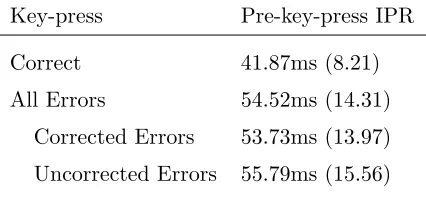
The across participant averages for the variability2 for pre-correct and pre-error
key-presses used in the variability analysis are presented in Table 1. Note that the values reported in Table 1 show the variability of these key-presses before any matching procedure is applied.
Key-press Pre-key-press IPR
Correct 41.87ms (8.21)
All Errors 54.52ms (14.31)
Corrected Errors 53.73ms (13.97)
[image:14.612.200.413.202.301.2]Uncorrected Errors 55.79ms (15.56)
Table 1
Table showing the across participant average variability (IPR) in pre-correct, pre-error (all), pre-corrected error, and pre-uncorrected error key-presses in milliseconds. Values in brackets shows the standard deviation associated with each average. Note that these values show the grand average of all variability measures, before matching the error words to correct words for word length and letter position.
A Wilcoxon’s signed ranks test showed that IPR before errors was found to be 6.02ms (SD = 6.89) larger than that before correct key-presses (Z = 2.77, p = 0.006).
We conducted pre-error variability analysis on corrected and uncorrected errors sepa-rately. We found that corrected errors werenot preceded by a significant increase (3.35ms, SD = 8.23) in variability compared to matched correct key-presses (Z = 1.54, p = 0.124).
Uncorrected errors however were found to be associated with a significant increase in variability (8.98ms, SD = 13.15) compared to matched correct key-presses (Z = 2.44, p = 0.015).
Change in pre-error variability before corrected errors (3.35ms) was no different than that before uncorrected errors (8.98ms, Z = 1.11, p = 0.27).
The sample sizes for corrected errors, uncorrected errors and correct key-presses were not equal. In order to check if this lead to the differences we observed in the pre-error variability measures, we re-conducted the same set of analyses by matching the sample sizes. For example, if a participant contributed 40 uncorrected errors and 80 corrected errors, we didn’t compare the average of 40 uncorrected errors to 80 corrected errors. Instead, we took 500 bootstrapped re-samples from each group with a sample size of 40, and compared the means of these. Similarly, we imposed a restraint on the analysis such that the number of correct key-presses used in the analysis never exceeded the number of error key-presses. We found that the pattern of results after this bootstrap-based matching procedure was identical to results reported above. This ensured that the pre-error changes we report were not caused by the differences in sample sizes.
2As the measure of variability, we used the inter-percentile range as discussed earlier. To be confident,
Discussion
Error Speed Predictions
Error and pre-error speed. In the current study, we tested three predictions about errors of typing performance. Two of these were about the relationship between typing speed and accuracy. According to speed-accuracy trade-off account, error and pre-error performance should be associated with faster than usual typing speed. According to early error detection account, error and possibly pre-error key-presses should be associated with slower than usual typing speed. In line with the latter account, we found that error key-presses were reliably slowed down. Further, corrected errors were slowed down to a significantly greater extent than uncorrected errors. This pattern supports previous inter-pretations of Rabbitt (1978) and Shaffer (1975) that errors are slowed down due to error detection. The significant error slowing in uncorrected errors is likely to be caused by a number of unsure errors. Whereas all corrected errors were subjectively error key-presses, uncorrected errors consisted of unsure (e.g. slowed) and subjectively correct error key-presses (not slowed, see Woltz et al., 2000). This is likely why uncorrected error key-key-presses were slower than matched correct key-presses, but nevertheless faster than corrected error key-presses, on average.
Our results also partially support the interpretation of Herrojo-Ruiz et al. (2009) in that error actions were slowed down before they were executed. However, the effect of error detection did not extend back to the pre-error performance: We found that pre-error slowing was no different before corrected errors than before uncorrected errors.
We believe that there are a number of reasons for this contrast between the cur-rent results and those of Herrojo-Ruiz et al. (2009). First, there is a lack of an overt error signalling response in piano playing (c.f. backspace in typing) which would enable an external observer to distinguish between subjective and objective errors. This in turn pre-cludes disentangling the effects of performance on accuracy from effects of error detection on performance. Second is a very important distinction between piano playing and typing. Piano-playing performance is constrained to an extra dimension compared to typing: In typing, any finger movement is correct as long as it leads to the typing of the letter that needs to be typed: Pressing the key “a” when the letter “a” needs to be typed will be accurate, irrespective of the speed of typing, or the force applied when typing it. Whether this key-press is too fast, or too strong will not compromise its accuracy. In piano playing however, the accuracy of performance depends on the timing and the force of the key-press as well as the note that needs to be played. Any violation of what is dictated by the score, particularly in terms of the timing/speed of key-presses will constitute an error. Thus, speed of performance in piano playing is constrained by external rules to a much greater extent than that in typing.
(disguised as pre-error slowing), but also a ‘pre-ERN’: Olvet and Hajcak (2009) show that 6 to 8 pure instances of errors are enough to obtain a statistically significant ERN when compared to a set of correct responses. Thus, it is plausible that an incorrectly slow press of a correct note preceding an incorrect note yields a partial, but nevertheless reliable ERN. Since ERN is a well established marker of error detection (Gehring, Liu, Orr, & Carp, 2012), the “pre-ERN” can then be interpreted as an early index of error detection.
Because of these reasons, we believe that typing is a more sensitive task than piano playing for studying changes in performance speed before the error. With the support of our observation that corrected error key-presses were executed with significantly slower key-presses than uncorrected error key-presses, we reject the interpretation that pre-error slowing in skilled actions is caused by error detection.
Error and post-error speed. We found that error and post-error key-presses were slowed down irrespective of error correction: Uncorrected errors were associated with reliable post-error slowing. These results replicate those of Logan and Crump (2009, 2011), who showed that conscious error awareness could be dissociated from post-error slowing in typing of 5 letter words and extend it to continuous typing in the absence of visual feedback. In skilled tasks like typing which involve tens of key-presses in a matter of seconds, correcting an error needs to be executed very quickly. Because the motor processes that generate the key-press actions and the processes that evaluate or monitor them can dissociate (Ohlsson, 1996), it is difficult to correct an error accurately before the next key-presses are executed. In cases where error awareness is not experienced in time or with enough confidence, the performance might be slowed without being corrected. This suggests that post-error slowing is not necessarily an adaptive reaction to errors to improve performance, but can also be caused by a state of confusion (Wilbert & Haider, 2012).
Previous studies of Logan and Crump (2009, 2010, 2011) showed that when the typists were not allowed to use the backspace key, there was a strong and reliable post-error slowing effect. However, Crump and Logan (2012) recently reported an experiment which shows that when allowed to use the backspace key, post-error performance of the typists was not significantly slowed. Further, Crump and Logan (2012) report that even under conditions (in a different experiment) where the average error slowing is present, 47% of the post-error key-presses were faster than the pre-post-error key-presses. These findings all add weight to the idea that post-error slowing is not an automatic and adaptive post-error response to “prevent” subsequent errors, but rather serves to “cure” the performance (Crump & Logan, 2012). It is difficult to directly compare our results to those of Crump and Logan (2012) for a number of reasons such as the use of a different baseline (i.e. E-1 key-press in Crump and Logan (2012) vs. matched correct key-presses in our study) and our focus on pre-error rather than post-error performance. However, we believe that the results from our study (particularly the post-uncorrected error slowing) along with those of Crump and Logan (2012) provide support for the double-dissociation between explicit error-detection (i.e. backspacing) and post-error slowing in typing: There are instances when post-error slowing exists without explicit error detection, and when explicit error detection exists without post-error slowing.
that one possibility is the violation of an expected outcome (which includes but is not limited to subjective experience of error commission). As mentioned above, unsure errors might cause enough confusion to slow the performance, but not to press the backspace.
In addition to the behavioural studies cited in this section, neuroscientific support for the claim that it is the post-error confusion Wilbert and Haider (2012) or unexpected out-comes Notebaert et al. (2009) that causes post-error slowing out-comes from a study by Hewig, Coles, Trippe, Hecht, and Miltner (2011). Hewig et al. (2011) asked their participants to enter 5 digit numbers using a custom built number pad. Participants were given no visual feedback, and were asked how confident they were about the accuracy of their response (correct, unsure, incorrect) at the end of each trial. Hewig et al. (2011) found that among objective error trials, the average ERN amplitude was largest for subjectively error trials, intermediate for subjectively unsure trials, and smallest for subjectively correct trials (all contrasts statistically reliable). Further, when compared to the correct trial event related potentials (ERP), ERN was only significant during subjectively incorrect, and subjectively unsure trials, but not during objective error trials which were judged to be correct. These results of Hewig et al. (2011) point to the fact that error detection is not a binary variable, and ranges from errors which escape our performance monitoring mechanisms (objective errors but subjectively correct actions) to errors which one is absolutely sure about (ob-jective and sub(ob-jectively error actions). Further, in order for an error to have any effect on performance, it must be registered at some (conscious or sub-conscious) level.
Our typist participants corrected more than 85% of their errors without making a subsequent key-press. This is in line with the observations of Logan (1982) and Rabbitt (1978) who showed that errors could be detected in the absence of any visual feedback and most errors can be detected almost instantly. This suggests that 85% of the time error detection was quick enough to interfere with typing performance before the execution of the error action was actually completed. This is only possible if 1) Errors can be detected during the typing of pre-error key-presses, or 2) Errors are detected as soon as they are initiated but before they are completed (i.e. in a time window of 150ms in our study). Our data favour the second explanation over the first one because significant effects of error detection (significant differences between corrected and uncorrected errors) were only evident after all pre-error key-presses were completed. In other words, the only difference between corrected and uncorrected error key-presses were in the speed of the error key-presses andnot before: Neither the speed nor the variability with which pre-error key-presses were executed differed between corrected and uncorrected errors.
Pre-error Performance - Variability
We found that when all error key-presses were collapsed together, they were associated with a larger amount of pre-error variability than matched correct key-presses. This is a direct prediction of the hypothesis that error commission is foreshadowed by performance breakdown. Further, we wanted to check whether there would be an interaction between pre-error performance and pre-error detection. We found that uncorrected pre-errors were associated with increased variability in pre-error typing performance, but corrected errors were not. This adds to the bigger picture in that: Performance before corrected typing errors is similar to that before accurate typing performance in terms of both speed and variability. Uncorrected errors on the other hand are preceded by performance that is similar in speed, but reliably more variable than accurate typing performance.
One possible interpretation to account for this set of observations is to assert that variability in typing speed indexes breakdown not only at the behavioural level, but also at the cognitive level (e.g. in performance monitoring). Significant increases in variability with no average change in typing speed before uncorrected errors suggest that participants might be in a mental state similar to the “zone outs” described by Smallwood et al. (2007) during commission of uncorrected errors. According to Smallwood and Schooler (2006), mind-wandering involves decoupling of one’s attention from the current task at hand (e.g. typing the current sentence) to task-irrelevant information (e.g. what to have for lunch, see Schooler et al., 2011, for a review).
According to Smallwood et al. (2007) mind-wandering can have different effects on performance depending on whether the performers are aware of the fact that they are mind-wandering or not. Supporting their arguments, Smallwood et al. (2007) found that when participants were aware of the fact that they were mind-wandering (i.e. when they “tuned out”) they were more likely to inhibit an incorrect response than they were not aware of their mind-wandering (i.e. when they “zoned out”, see also Smallwood, Beach, Schooler, & Handy Todd, 2008). Smallwood et al. (2007) refer to one’s ability to reflect upon the content of one’s own mental state as meta-awareness (see Smallwood & Schooler, 2009, for a short review on mind-wandering). Further, Schooler (2002), suggests that even though highly practised actions like typing are associated with a relatively smaller degree of awareness (e.g. lack of awareness of where one’s fingers are), they are nevertheless experienced, but lack in meta-awareness. Meta-awareness is brought into play only when the person runs into difficulty as when typing an unfamiliar word, or when an error is committed. This would present itself as an interruption of the behaviour such as error or post-error slowing, or simply as slowing down due to attentional re-orientation (Notebaert et al., 2009).
With the additional assumption that mind-wandering without awareness decreases the efficiency of performance monitoring mechanisms, our results are in line with those of Smallwood et al. (2007). It is possible that when participants are mind-wandering without awareness, not only does their performance become less consistent, but their ability to detect their errors quickly enough is hindered. Thus, we interpret the increased variability before uncorrected errors as a sign of performance breakdown rather than an effect of the upcoming uncorrected error.
Hierarchical Control in Typing: Implications of The Current study
inner loop is sensitive to the kinaesthetic/proprioceptive feedback from the fingers, and the outer loop is sensitive to the final product of the typing behaviour as it appears on the screen. Further, the inner loop is informationally encapsulated, such that the outer loop does not know how the inner loop gets the job (typing of individual letters) done.
Within this framework, our participants had no feedback at the outer-loop level, because the screen provided no feedback on the participants’ typing and the workings of the inner loop are not accessible to the outer loop. However, in many instances, our participants made mistakes in the middle of words, pressed the backspace, and started from the right position in the word. If the outer loop doesn’t know what the inner loop is doing, and has no feedback other than the screen, then it cannot instruct the inner loop to stop typing, press the backspace, and continue from where the error was initially committed.
Our results suggest that the outer loop does have access to different channels of feedback, and these channels are weighted differently under different circumstances. For example, during everyday typing where the typist can see the output of his performance, the outer loop relies almost exclusively on the unambiguous visual feedback. Logan and Crump (2010) have shown that this is the case even when typists are told that the visual feedback they get from the monitor can be misleading during the experiment. Even under these circumstances, typists judged the accuracy of their own performance based not on sensory feedback from their fingers, but on the potentially “untrustworthy” monitor. Observations from our study show however, that when the only available sources of feedback are the relatively noisy sensory information from the fingers (c.f. the visual feedback from the screen), the outer loopwillexploit this source. We believe that with this addition to Logan and Crump’s hierarchical model of typing, our results are compatible with it.
Conclusions
In conclusion, we show using an ecologically valid task that behavioural effects of breakdown at the cognitive and behavioural levels can be dissociated from those of error detection. Our results show clearly that corrected and uncorrected errors cannot be distin-guished by performance speed or variability before the error. This suggests to us that error detection has no effect on pre-error performance in typing. However, we found that error key-presses, particularly the uncorrected error key-presses, were associated with significant variability in pre-error key-presses. This drop in consistency in typing speed before the er-rors suggests to us that erer-rors are foreshadowed by a breakdown in performance. Our results also contribute to the hierarchical model of typing proposed by Logan and Crump (2011) in that under circumstances when one has no visual feedback, the outer-loop is capable of exploiting proprioceptive feedback from the fingers. We are not aware of previous reports which show that pre-error performance breakdown effects can be dissociated from error detection effects on the performance of a highly skilled and ecological action like typing.
References
Alexander, W. H., & Brown, J. W. (2010). Computational models of performance monitoring and cognitive control. Topics in cognitive science,2(4), 658–677.
Castellar, E., Kuhn, S., Fias, W., & Notebaert, W. (2010). Outcome expectancy and not accuracy determines posterror slowing: ERP support.Cognitive Affective and Behavioral Neuroscience,
10, 270-278.
Cavanagh, J. F., Cohen, M. X., & Allen, J. J. B. (2009). Prelude to and resolution of an error: EEG phase synchrony reveals cognitive control dynamics during action monitoring.The Journal of Neuroscience, 29(1), 98–105.
Crump, M. J. C., & Logan, G. (2012). Prevention and correction in post-error performance: An ounce of prevention, a pound of cure. Journal of Experimental Psychology: General,Advance online publicatoin. doi: 10.1037/a00300014
de Bruijn, E. R. A., Hulstijn, W., Meulenbroek, R. G. J., & van Galen, G. P. (2003). Action moni-toring in motor control: ERPs following selection and execution errors in a force production task. Psychophysiology,40(5), 786-95.
Desmet, C., Imbo, I., de Brauwer, J., Brass, M., Fias, W., & Notebaert, W. (2012). Error adaptation in mental arithmetic. The Quarterly Journal of Experimental Psychology,65(6), 1059-1067. Dudschig, C., & Jentzsch, I. (2009). Speeding before and slowing after errors: Is it all just strategy?
BRAIN RESEARCH,1296, 56 – 62.
Eichele, H., Juvodden, H. T., Ullsperger, M., & Eichele, T. (2010). Mal-adaptation of event-related EEG responses preceding performance errors. Frontiers in human neuroscience,4(1), 1–9. Eichele, T., Debener, S., Calhoun, V. D., Specht, K., Engel, K, A., . . . Ullsperger, M. (2008).
Pre-diction of human errors by maladaptive changes in event-related brain networks. Proceedings of the National Academy of Sciences of the United States of America,105(16), 6173–6178. Ericsson, K. A., & Krampe, R. T. (1993). The role of deliberate practice in the acquisition of expert
performance. Psychological review,100(3), 363–406.
Falkenstein, M., Hohnsbein, J., Hoormann, J., & Blanke, L. (1991). Effects of crossmodal divided attention on late ERP components. II. Error processing in choice reaction tasks. Electroen-cephalography and clinical neurophysiology,78(6), 447–455.
Flanders, M., & Soechting, J. F. (1992). Kinematics of typing: Parallel control of the two hands.
Journal of neurophysiology,67(5), 1264–1274.
Gehring, W. J., Goss, B., Coles, M. G. H., Meyer, D. E., & Donchin, E. (1993). A neural system for error detection and compensation. Psychologcial Science, 4(6), 385-390.
Gehring, W. J., Liu, Y., Orr, J. M., & Carp, J. (2012). The error related negativity. In J. Luck S & S. Kappenman E (Eds.),The oxford handbook of event-related potential components. Oxford University Press.
Gentner, D. R. (1983). Keystroke timing in transcription typing. In W. E. Cooper (Ed.),Cognitive aspects of skilled typewriting(pp. 95–117). New York: Springer-Verlag.
Gentner, D. R. (1984, April). Expertise in typewriting. (Tech. Rep. No. ADA142865). California University San Diego La Jolla Center For Human Information Processing.
Herrojo-Ruiz, M., Jabusch, H.-C., & Altenmuller, E. (2009). Detecting wrong notes in advance: Neuronal correlates of error monitoring in pianists. Cerebral cortex,19(11), 2625–2639. Hewig, J., Coles, M. G. H., Trippe, R. H., Hecht, H., & Miltner, W. H. R. (2011). Dissociation of
Pe and ERN/Ne in the conscious recognition of an error. Psychophysiology,48, 1390-1396. Holroyd, C. B., Dien, J., & Coles, M. G. H. (1998). Error-related scalp potentials elicited by hand
and foot movements: Evidence for an output-independent error-processing system in humans.
Neuroscience letters,242(2), 65–68.
Howell, D. C. (2002). Resampling and nonparametric approaches to data. InStatistical methods for psychology (chap. 18). Duxbury.
Hultsch, D. F., MacDonald, S. W. S., & Dixon, R. A. (2002). Variability in reaction time performance of younger and older adults. The Journals of Gerontology Series B: Psychological Sciences and Social Sciences,57(2), P101-P115.
Kleiner, M., Brainard, D. H., & Pelli, D. G. (2007). What’s new in psychtoolbox-3? Perception,
36.
Laming, D. (1979). Choice reaction performance following an error. Acta Psychologica, 43(3), 199–224.
Lashley, K. S. (1951). The problem of serial order in behavior. In L. A. Jeffress (Ed.), Cerebral mechanisms in behavior (pp. 112–136). New York: Wiley.
Logan, G. (1982). On the ability to inhibit complex movements: A stop-signal study of typewriting.
Journal of Experimental Psychology: Human Perception and Performance,8(6), 778–792. Logan, G., & Crump, M. J. C. (2009). The left hand doesn’t know what the right hand is doing:
The disruptive effects of attention to the hands in skilled typewriting. Psychological Science,
20(10), 1296–300.
Logan, G., & Crump, M. J. C. (2010). Cognitive illusions of authorship reveal hierarchical error detection in skilled typists. Science,330(6004), 683–686.
Logan, G., & Crump, M. J. C. (2011). Hierarchical control of cognition and action: The case for skilled typewriting. In B. Ross (Ed.), Psychology of learning and motivation (Vol. 54, pp. 1–27). Academic Press.
Miltner, W. H. R., Braun, C. H., & Coles, M. G. H. (1997). Event-related brain potentials following incorrect feedback in a time-estimation task: Evidence for a generic neural system for error detection. Journal of Cognitive Neuroscience,9(6), 788–798.
Notebaert, W., Houtman, F., van Opstal, F., Gevers, W., Fias, W., & Verguts, T. (2009). Post-error slowing: An orienting account. Cognition,111, 275-279.
Ohlsson, S. (1996). Learning from performance errors. Psychological Review,103, 241 – 262. Olvet, D., & Hajcak, G. (2009). The stability of error-related brain activity with increasing trials.
Psychophysiology,46, 1–5.
Palmer, C., Mathias, B., & Anderson, M. (2012). Sensorimotor mechanisms in music performance: Actions that go partially wrong. Annals of the New York Academy of Sciences, 1252, 185 – 191.
Pelli, D. G. (1997). The videotoolbox software for visual psychophysics: Transforming numbers into movies. Spatial Vision,10, 437 – 442.
Rabbitt, P. (1966). Errors and error correction in choice-response tasks. Journal of Experimental Psychology,71(2), 264–272.
Rabbitt, P. (1968). Three kinds of error-signalling responses in a serial choice task. The Quarterly Journal of Experimental Psychology,20(2), 179–188.
Rabbitt, P. (1978). Detection of errors by skilled typists. Ergonomics,21(11), 945–958.
Rabbitt, P., & Rodgers, B. (1977). What does a man do after he makes an error? An analysis of response programming. The Quarterly Journal of Experimental Psychology,29(4), 727–743. Reason, J. (1990). Human error. Cambridge University Press.
Reason, J. (2000). Human error: Models and management. British Medical Journal, 320, 768 – 770.
Rosenbaum, D. A. (1991). Human motor control. Academic Press.
Salthouse, A., Timothy. (1986). Perceptual, cognitive, and motoric aspects of transcription typing.
Psychological Bulletin,99(3), 303 – 319.
Scheffers, M. K., Coles, M. G. H., Bernstein, P., Gehring, W. J., & Donchin, E. (1996). Event-related brain potentials and error-Event-related processing: An analysis of incorrect responses to go and not-go stimuli. Psychophysiology,33(1–2), 42–53.
Schooler, W., Jonathan. (2002). Re-representing consciousness: Dissociations between experience and meta-consciousness. Trends in Cognitive Sciences,6, 339 – 344.
Schooler, W., Jonathan, Smallwood, J., Christoff, K., Handy, C., Todd, Reichle, E. D., & Sayette, A., Michael. (2011). Meta-awareness, perceptual decoupling and the wandering mind. Trends in Cognitive Neuroscience,15, 319 – 326.
Psychol-ogy,27(3), 419–432.
Shaffer, L. H. (1978). Timing in the motor programming of typing. Quarterly Journal of Experi-mental Psychology,30(2), 333 – 345.
Shaffer, L. H., & Hardwick, J. (1969). Reading and typing. The Quarterly Journal of Experimental Psychology,21(4), 381-383.
Skinner, B. F. (1959). Cumulative record. New York : Appleton-Century-Crofts.
Smallwood, J., Beach, E., Schooler, W., Jonathan, & Handy Todd, C. (2008). Going AWOL in the brain: Mind wandering reduces cortical analysis of external events. Journal of Cognitive Neuroscience, 20, 458 – 469.
Smallwood, J., McSpadden, M., & Schooler, W., Jonathan. (2007). The lights are on but no one’s home: Meta-awareness and the decoupling of attention when the mind wanders. Psychonomic Bulletin & Review, 14, 527 – 533.
Smallwood, J., & Schooler, W., Jonathan. (2006). The restless mind. Psychological Bulletin, 132, 946 – 958.
Smallwood, J., & Schooler, W., Jonathan. (2009). Mind-wandering. In T. Bayne, A. Cleermans, & P. Wilken (Eds.), The oxford companion to consciousnes(pp. 443 – 445). Oxford: Oxford University Press.
Soechting, J. F., & Flanders, M. (1992). Organization of sequential typing movements. Journal of Neurophysiology,67, 1275 - 1290.
Ullsperger, M., & von Cramon, D. Y. (2006). Subprocesses of performance monitoring: A dissocia-tion of error processing and response competidissocia-tion revealed by event-related fMRI and ERPs.
Brain research,5(1), 102–109.
van Veen, V., & Carter, C. S. (2002). The timing of action-monitoring processes in the anterior cingulate cortex. Journal of cognitive neuroscience,14(4), 593–602.
Vidal, F., Burle, B., Bonnet, M., Grapperon, J., & Hasbroucq, T. (2003). Error negativity on correct trials: A re-examination of available data. Biological Psychology,64(3), 265–282.
Vidal, F., Hasbroucq, T., Grapperon, J., & Bonnet, M. (2000). Is the ‘error negativity’ specific to errors? Biological psychology, 51(1–2), 109–128.
Wells, F. L. (1916). On the psychomotor mechanisms of typewriting. The American Journal of Psychology,27(1), 47–70.
Wickelgren, W. A. (1977). Speed-accuracy tradeoff and information processing dynamics. Acta Psychologica,41(1), 67–85.
Wilbert, J., & Haider, H. (2012). The subjective experience of committed errors and the Discrepancy-Attribution hypothesis. Acta Psychologica,139, 370 – 381.
Wolpert, D. M., & Miall, R. C. (1996). Forward models for physiological motor control. Neural Networks,9(8), 1265–1279.