This is a repository copy of
Side-Channel-Free Quantum Key Distribution
.
White Rose Research Online URL for this paper:
http://eprints.whiterose.ac.uk/75301/
Version: Published Version
Article:
Braunstein, Sam orcid.org/0000-0003-4790-136X and Pirandola, Stefano
orcid.org/0000-0001-6165-5615 (2012) Side-Channel-Free Quantum Key Distribution.
Physical Review Letters. 130502. ISSN 1079-7114
https://doi.org/10.1103/PhysRevLett.108.130502
[email protected] https://eprints.whiterose.ac.uk/
Reuse
Items deposited in White Rose Research Online are protected by copyright, with all rights reserved unless indicated otherwise. They may be downloaded and/or printed for private study, or other acts as permitted by national copyright laws. The publisher or other rights holders may allow further reproduction and re-use of the full text version. This is indicated by the licence information on the White Rose Research Online record for the item.
Takedown
If you consider content in White Rose Research Online to be in breach of UK law, please notify us by
Side-channel free quantum key distribution
by Samuel L. Braunstein and Stefano Pirandola
IN DEFENSE OF PRIVATE SPACES
In quantum cryptography unconditional security proofs are derived under the assumption that Alice’s and Bob’s apparata (private spaces) are completely inacces-sible by an eavesdropper who, therefore, can only at-tack the signal systems which are transmitted through the quantum communication channel connecting the two parties. Under this assumption, secret-key rates and se-curity thresholds are derived in both discrete and contin-uous variable quantum key distribution.
One potential loophole in the security proofs is related to how a theoretical protocol is actually implemented perimentally. Any redundant information encoded in ex-tra degree of freedom or exex-tra Hilbert space dimensions outside the theoretical prescription can allow for so-called side-channel attacks. By their nature, such attacks may be of classical or quantum degrees of freedom and are in-sidious because even quantifying their threat appears to involve understanding what have been called unknown unknowns about the vulnerability of the experimental set-up.
Progress has been made on eliminating side channel at-tacks in the quantum communication channels between private spaces, but this leaves open potential attacks on the private spaces through their quantum communica-tion ports. Let us therefore take a step back and consider private spaces in more details: What goes on in Alice’s and Bob’s private spaces involves a significant amount of classical information processing; at the very least the key itself will be generated and stored as classical informa-tion. Now with virtually any technology we have today classical information is stored, processed and transmitted in a highly redundant fashion (many electrons are used to charge a capacitor to represent a bit value, or many electrons must pass through the base junction of a tran-sistor to effect a logical switching operation, tapping on a keyboard produces sound waves and electromagnetic signals in addition to the ‘legitimate’ electrical signals in the wires, etc). In principle any of this redundant infor-mation may leak out of the private space through a “par-asite” channel. An eavesdropper might therefore ignore the quantum communication channel and directly attack Alice’s and Bob’s apparata by exploiting the presence of parasite channels: this is also a “side-channel attack”.
The implicit assumption in quantum cryptography is that we could always improve technology in such a way that Alice’s and Bob’s private spaces are not affected by the presence of parasite channels, so that the legitimate participants do indeed have access to absolutely private
spaces. (For instance, Alice and Bob could simulate the classical information processing on a quantum computer. A hacked operating system on such a machine could be tested for by randomly running subroutines that confirm that coherence is preserved and that no information is copied out to where it can be stored or transmitted by a trojan program — see also Ref. [1].)
However, even if you rely on a perfect isolation tech-nology, there remains a potential chink in this armor, which is the quantum communication port used either to transmit a quantum state out of your private space or to accept a quantum state for detection into it.
If you open a communication port for quantum states to enter or leave you must explicitly deal with side chan-nels which can be probing these links to your private space. Eve can potentially send trojan systems through Alice’s and Bob’s communication ports and detect their reflection to infer both state preparation and measure-ment settings. As an example, in the standard BB84 protocol, Eve can irradiate Alice’s apparatus by using optical modes at slightly different frequencies. Then, from reflection, Eve can infer the polarization chosen in each round of the protocol. Thanks to this information, Eve can measure each signal system in the correct basis. Another example regards the so-called plug-and-play sys-tems, where trojan systems can be reflected together with signal systems, as discussed in Ref. [2].
mea-2
surement apparatus of Bob and, therefore, aboutY.
Alice Bob
Eve
Private Space Private Space
ρ
e fs
[image:3.595.89.270.79.149.2](X) (Y)
FIG. 1: Port attack in a prepare and measure protocol.
In Fig. 2, we depict a general entanglement-based pro-tocol, where an untrusted party (Eve) distributes entan-glement between two parties. This is done by distributing an entangled stateρ =ρAB, where systemA is sent to
Alice and system B is sent to Bob. Alice and Bob can perform entanglement distillation and measure the out-put distilled systems to derive two correlated classical variables, X and Y, respectively. In this scenario, Eve can decide not to attack the sourceρbut directly the two quantum communication ports of Alice and Bob. Eve can probe these ports by using two trojan systemse and f, which can retrieve information about Alice’s and Bob’s distilling and detecting apparata. As a result, Eve can infer information aboutX andY.
Alice Eve Bob
Private Space Private Space
ρ
e f
A B
(X) (Y)
FIG. 2: Port attack in an entanglement-based protocol.
In Fig. 3, we depict our protocol where an untrusted party (Eve) represents an entanglement swapper between Alice and Bob. This is generally done by measuring two
public systems,A′ andB′, received from Alice and Bob, processing the outcome of the measurement, and clas-sically communicating the processed data back to Alice and Bob. As a result the two private systems, A and B, become correlated, so that Alice and Bob can extract two correlated classical variables,X and Y, by applying suitable measurements. In particular, if Alice and Bob can access quantum memories, then they can extract a secret key at a rate which is at least equal to the coher-ent information between A and B. Eve can attempt a side-channel attack against the two ports by sending two trojan systemseandf. In this case, however, the appa-rata which detect the two private systemsA and B are inaccessible to Eve. By exploiting reflections from the ports, Eve can only retrieve information regarding the reduced statesρA′ andρB′ of the two public systemsA′
andB′. However, these reduced states contain no useful
information about the private systemA or B or Alice’s or Bob’s detector settings or outputs.
Alice Bob
ρ ρ
A
A’ B’
B T
Private Space Private Space
E L Eve
(Y)
[image:3.595.350.528.87.185.2](X) e f
FIG. 3: Port attack in our scheme.
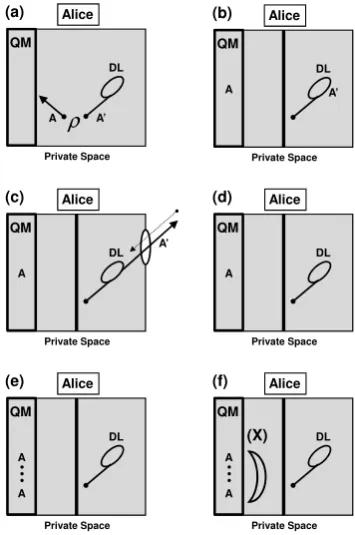
To understand better how the full isolation of the pri-vate systems might be achieved, we may consider the procedure depicted in Fig. 4. It is explained for Alice’s private space, but steps are identical for Bob.
Alice
ρ
A
Private Space A’
QM
DL
(a) Alice
Private Space A’
QM
DL
A (b)
Alice
Private Space
A’ QM
DL A
(c) Alice
Private Space
QM
DL A
(d)
Alice
Private Space
QM
DL A
A
(e) Alice
Private Space
QM
DL A
A (X) (f)
FIG. 4: Possible procedure for the full isolation of the private systems.
In the first step (a), Alice’s port is closed and she pre-pares an entangled state ρ = ρAA′ where system A is
[image:3.595.349.527.276.544.2] [image:3.595.99.256.368.444.2]no detector is in line with the port. In step (d), the port is closed with the private system A kept in the mem-ory. The previous steps (a)-(d) are repeated many times, so that Alice collects many private systems in her quan-tum memory. We therefore reach step (e) of the figure. Finally, once Alice has received all the classical commu-nications, she applies a collective quantum measurement on her quantum memory to retrieve the classical variable X. This measurement can include or be anticipated by an entanglement distillation.
NOTATION AND BASIC FORMULAS
In part of the derivation we adopt the enlarged Hilbert space (EHS) representation, where stochastic classical variables are embedded in quantum systems. Consider a stochastic variableX ={x, p(x)} which is encoded into an ensemble of states of some quantum systemA, i.e.,
EA={p(x), ρA(x)}. (1)
This ensemble may be equivalently represented by the classical-quantum (CQ) state
ρXA=
X
x
p(x)|xi hx|X⊗ρA(x), (2)
where the stochastic variable X is embedded into the dummy quantum system X, by using an orthonormal basis {|xi} in the Hilbert space HX of X. We denote
by ρA(x) the state of a system A which is conditioned
by the valuexof a stochastic variableX. The notation ρA|X refers to the conditional stateρA(x) wherexis not
specified. Clearly, we have
ρA=
X
x
p(x)ρA(x). (3)
Given a quantum systemAin a stateρA, its von
Neu-mann entropyS(ρA) is also denoted byH(A). Given a
quantum system X, embedding the stochastic variable X, its quantum entropyH(X) is just the Shannon en-tropyH(X). Given two quantum systems,AandB, we denote by I(A : B) their quantum mutual information. This is defined by
I(A:B) =H(B)−H(B|A), (4)
where
H(B|A) =H(AB)−H(A), (5)
is the conditional quantum entropy. Note that H(B|A) can be negative and it is related to the coherent informa-tion by the relainforma-tion
I(AiB) =−H(B|A). (6)
ForA=X, the quantum mutual informationI(A:X), which is computed over the CQ-state of Eq. (2), corre-sponds to the Holevo information I(A : X), computed over the ensemble of Eq. (1). For A =X and B = Y, embedding two stochastic variablesX andY, I(X:Y) is just the classical mutual information I(X : Y). For three quantum systems A, B, and C, we can consider the conditional quantum mutual information
I(A:B|C) =H(AC) +H(BC)−H(ABC)−H(C), (7)
which is≥0 as a consequence of the strong subadditivity of the von Neumann entropy. For a classically correlated systemC=X, we have a probabilistic average over mu-tual informations, i.e.,
I(A:B|X) =I(A:B|X)≡X
x
p(x)I(A:B|X =x).
(8) List of other useful elements:
• Given a tripartite quantum system ABC, we can use the “chain rule”
I(A:BC) =I(A:B) +I(A:C|B). (9)
• Invariance of the Holevo information under addi-tion of classical channels, i.e., for a classical chan-nel
p(y|x) :X →Y, (10)
we have
I(A:X) =I(A:XY). (11)
• Given a Markov chain X → Y → Z, the classi-cal mutual information decreases under condition-ing [3], i.e.,
I(X:Y|Z)≤I(X :Y). (12)
Notice that, for three general stochastic variables, we have I(X : Y|Z) R I(X : Y), so that the so-called “interaction information”
I(X :Y :Z)≡I(X :Y|Z)−I(X :Y), (13)
can be positive, negative or zero.
• Data processing inequality. For a Markov chain X →Y →Z, we have
4
Alice Eve Bob
A E B
Private Space Private Space
L’ L’
[image:5.595.95.258.53.129.2]E ~ X
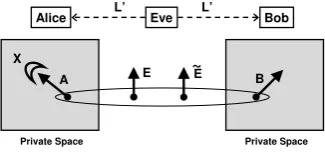
FIG. 5: Purification. Conditional state ΦABEE˜|L′ projected
onto ΦBEE˜|XL′.
PROOF OF THE THEOREM
Let us purify the mixed state ρABE|L′ into the pure
state ΦABEE˜|L′ =|Φi hΦ|ABEE˜|L′ by introducing an
an-cillary system ˜E which is assumed to be in Eve’s hands (so that Eve’s global system consists ofEE˜). This sce-nario is depicted in Fig. 5.
Thus, for the total stateρABE|L′, we have
ρABE(l′) = TrE˜[ΦABEE˜(l
′)]
. (15)
For the conditional stateρBE|XL′, generated by the
mea-surement, we can write
ρBE(x, l′) =
1 p(x|l′)TrA
h
ˆ
A(x)ρABE(l′) ˆA(x)†
i
= 1
p(x|l′)TrAE˜
h
ˆ
A(x)ΦABEE˜(l
′) ˆA(x)†i
= TrE˜[ΦBEE˜(x, l
′)]
, (16)
where
ΦBEE˜(x, l
′)≡ 1 p(x|l′)TrA
h
ˆ
A(x)ΦABEE˜(l
′) ˆA(x)†i,
(17) represents the conditional state ΦBEE˜|XL′which is
gener-ated by the measurement in the purified scenario. Clearly if we discardX, we get the reduced state
ΦBEE˜|L′ ≡
D
ΦBEE˜|XL′
E
X = TrA
h
ΦABEE˜|L′
i
. (18)
Because of Eq. (16), the conditional state ΦBEE˜|XL′ can
be used to computeR′ via
R′≡I(X:B|L′)ρ−I(X :E|L′)ρ
=I(X:B|L′)Φ−I(X :E|L′)Φ, (19) whereρ=ρBE|XL′and Φ = ΦBEE˜|XL′(the computation
is exactly the same up to a trace over ˜E). In the EHS representation, the conditional state ΦBEE˜|XL′ becomes
ΨXL′BEE˜ =
X
x,l′
p(x, l′)|xi hx|X⊗ |l′i hl′|L′⊗ΦBEE˜(x, l
′).
(20) Thus, we can also set
R′=I(X:B|L′)Ψ−I(X:E|L′)Ψ, (21) where Ψ = ΨXL′BEE˜. From the chain rule we have
I(X:EE˜|L′)Ψ=I(X:E|L′)Ψ+I(X: ˜E|EL′)Ψ
=I(X:E|L′)Ψ+γ, (22)
where γ ≡I(X : ˜E|EL′)Ψ ≥ 0 is the information
con-tribution due to the purification [4]. In other words, the (conditional) Holevo information can only increase with the purification, i.e.,
I(X:EE˜|L′) =I(X :E|L′) +γ≥I(X:E|L′). (23)
As a consequence, we haveR′ =R′′+γ, where
R′′≡I(X :B|L′)Φ−I(X:EE˜|L′)Φ. (24)
In terms of conditional entropies, we have
R′′=H(B|L′)Φ−H(B|XL′)Φ
−[H(EE˜|L′)Φ−H(EE˜|XL′)Φ]. (25)
Here H(EE˜|L′) is computed over Φ = ΦBEE˜|XL′
dis-cardingX andB, i.e., over the reduced state
ΦEE|L′ = TrAB
h
ΦABEE˜|L′
i
. (26)
Now since ΦABEE˜|L′ is pure, we have H(EE˜|L
′) =
H(AB|L′), where H(AB|L′) can be computed over ρAB|L′ = TrEE˜[ΦABEE˜|L′]. Clearly, also H(B|L
′)
Φ can
be computed overρAB|L′. As a consequence we can
rec-ognize in Eq. (25) the conditional coherent information
I(AiB|L′) =H(B|L′)−H(AB|L′),
associated with Alice and Bob’s conditional stateρAB|L′.
Thus, we can set
R′′=I(AiB|L′) + [H(EE˜|XL′)Φ−H(B|XL′)Φ]. (27)
Here, we can assume that Alice’s measurement is a rank one POVM. As a result, Φ = ΦBEE˜|XL′ is also a pure
state, and we can set H(EE˜|XL′)Φ = H(B|XL′)Φ, so
thatR′′=I(AiB|L′). Finally, we can write
R∗=R′′+γ+ ∆ =I(AiB|L′) +γ+ ∆
≥I(AiB|L′) + ∆, (28)
where we have usedγ≥0 from its definition.
[1] S. Barzet al., Science335, 303 (2012).
[2] N. Gisinet al., Rev. Mod. Phys.74, 145-195 (2002)
[3] T. M. Cover and J. A. Thomas, (John Wiley and Sons, Hoboken, New Jersey, 2006) p. 35.
[4] Note that the EHS representation has been mainly intro-duced to give the correct interpretation to Eq. (), where
a quantum system E conditions a classical variable X