This is a repository copy of
Learning functional object categories from a relational
spatio-temporal representation
.
White Rose Research Online URL for this paper:
http://eprints.whiterose.ac.uk/74698/
Proceedings Paper:
Sridhar, M, Cohn, AG and Hogg, DC (2008) Learning functional object categories from a
relational spatio-temporal representation. In: Ghallab, M, Spyropoulos, CD, Fakotakis, N
and Avouris, NM, (eds.) ECAI 2008: 18th European Conference on Artificial Intelligence
(Frontiers in Artificial Intelligence and Applications). ECAI 2008 18th European Conference
on Artificial Intelligence, 21-25 July 2008, Patras, Greece. IOS Press , 606 - 610 . ISBN
978-1-58603-891-5
[email protected]
https://eprints.whiterose.ac.uk/
Reuse
See Attached
Takedown
If you consider content in White Rose Research Online to be in breach of UK law, please notify us by
Learning Functional Object-Categories from a Relational
Spatio-Temporal Representation
Muralikrishna Sridhar and Anthony G Cohn and David C Hogg
1Abstract. We propose a framework that learns functional object-categories from spatio-temporal data sets such as those abstracted from video. The data is represented as one activity graph that encodes qualitative spatio-temporal patterns of interaction between objects. Event classes are induced by statistical generalization, the instances of which encode similar patterns of spatio-temporal relationships be-tween objects. Equivalence classes of objects are discovered on the basis of their similar role in multiple event instantiations. Objects are represented in a multidimensional space that captures their role in all the events. Unsupervised learning in this space results in functional object-categories. Experiments in the domain of food preparation suggest that our techniques represent a significant step in unsuper-vised learning of functional object categories from spatio-temporal patterns of object interaction.
1
Introduction
Children learn about the world around them by observing and par-ticipating in activities that engage them in the course of every day life. One aspect of learning activity models involves acquiring no-tions of what objects mean to them based on the function they ful-fill in activities. Functional categories and taxonomies of objects are naturally acquired by humans during the process of observing object behaviour and using them accordingly. An important step toward un-supervised learning of activity models is to learn an analogous model of functional object categories purely by observing their behaviour.
In this work, we represent the behaviour of objects involved in an activity, in terms of an activity graph, which captures qualita-tive spatio-temporal patterns of interaction between these objects. We search for frequent similar subgraph instances and generalize these by variablizing. These are our event classes, the instances of each event class encoding a similar pattern of spatio-temporal relation-ships between their respective object instances.
Then we learn object categories by clustering in an object space, where the similarity measure between objects is measured, based on whether they play a similar role across the event instances for each of the event classes; e.g., a set of objects, even though different in appearance, may tend to play a similar role in events such as washing, cutting and cooking as opposed to others that do not play such a role in these events. By observing multiple instances of such event classes that have the same event role for this set of objects, it is natural to form a category that correspond to what we refer to as vegetables.
Through our experiments we demonstrate that using our frame-work it is possible to learn semantically meaningful functional object
categories and a taxonomy purely by observing object behaviour.
1
School of Computing, University of Leeds, Leeds, UK, email:{krishna,agc,dch}@comp.leeds.ac.uk. This work was funded under EPSRC grant EP/D061334/1.
In section 3 we show how functional object categories can be learned from event classes. The rest of the paper describes a novel procedure for inducing event classes from video input.
2
Related Work
Much previous work has focused on supervised learning of object classes either based on the appearance of the object itself [9] or by recognizing contextual cues such as activities associated with objects [8] to locate and recognize objects. By contrast, unsupervised learn-ing of objects can be divided into two stages, the first belearn-ing object discovery e.g. discovery of blobs that are candidates for objects from video. The second stage is object class learning which involves au-tomatically categorizing these blobs into object classes. Early work on object discovery [6] formed candidate objects by grouping pixels with similar temporal signatures that are constructed by recording colour (RGB) values for stable intervals when objects arrive, stay and depart from a region. In [7], candidate objects are obtained by first over segmenting images in a video and after extracting image features for these segments, rigidly moving features are grouped into potential objects.
Both object discovery and class learning is performed simultane-ously from a collection of static images [5] in two steps. First mul-tiple segmentations for each image are produced, by varying the pa-rameters of the normalized cut technique with the assumption that each object instance is correctly segmented at least by one segmen-tation. Then object classes which are groups of correctly segmented objects that are coherent in a large set of candidate segments, are learned. Another approach [1] obtains a hierarchy of object classes for static scenes by grouping image features which spatially co-occur across images for the same scene, under the same leaf of the hierar-chy. In this manner, the technique learns to identify candidate objects such as keyboards, while also learning higher level object classes such as a desk area (consisting of a computer, desk etc).
In this work we perform object discovery by first over segment-ing the video in terms of colour patches and then groupsegment-ing spa-tially cohesive and continuous coloured blobs to discover a candi-date set of objects. We perform object class learning by clustering on a object space, where the similarity between objects is based on similar spatio-temporal behaviour (specifically object interactions) in scenes.
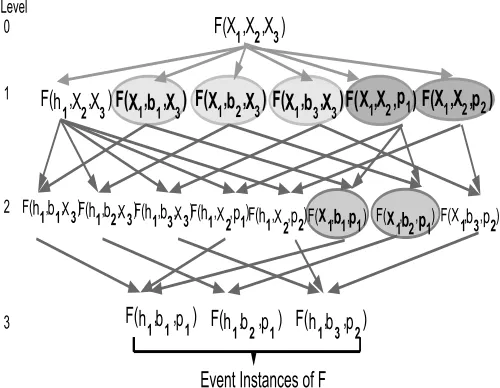
Figure 1. Lattice for general to specific object learning
relationships between discovered objects. We show how this repre-sentation enables event mining and object learning.
3
Object Learning
Assume the existence of a set of event classesF( ¯X), whereX¯ is a sequence of object variables in some canonical ordering, between which some set of spatio-temporal relationships hold and which when instantiated, yields a set of event instances. The event classes
Fi( ¯X) =Fi(X1, .., Xk, ..., Xm)in general have multiple event
in-stances in the corpus so that all these inin-stances encode the same set (or more generally a similar set) of spatio-temporal relationships be-tween their objects. This induces a natural mapping bebe-tween objects corresponding to each object variableXkfor the event instances of
an event class. Given a corpus of such instances, we show, using an example, how to induce functional object categories for the set of objects present in these instances. The event classes could be hand-crafted manually through knowledge engineering techniques, or, as we describe in later sections, could be induced from a video by an event learning procedure.
Let F(X1, X2, X3) be an example event class that represents
events such as “X2 being lifted away from of X3 by X1”. The
example in fig 2(c), is one such event instance (F(h1, b1, p1))
of the event class F with object instances h1, b1, p1 having IDs
3,4 and 6 respectively. Let us suppose that two other instances
F(h1, b2, p3), F(h1, b3, p2)of the same classFhad been observed
in the scene.
A lattice as shown in fig. 1 is grown from event instances at the bottom level (3), by generalizing exactly one argument position to a variable at each successive level. We then search for equivalence classes of objects from general to specific by traversing down this lattice, using the following procedure. For every node of each level
lin the lattice, the procedure involves searching for sets of nodes at levell+ 1, where each set is formed by substituting more than one object instance for the same variableXk, for that node at levell.
Applying this procedure at level 0 of the lattice, we get two such sets at level 1 (shaded with two colours) : {F(X1, b1, X3), F(X1, b2, X3), F(X1, b3, X3)}
obtained by substituting for X2 with b1, b2, b3 and
{F(X1, X2, p1), F(X1, X2, p2)} obtained by substituting forX3
withp1, p2 respectively . As the substituted constants {b1, b2, b3}
and {p1, p2}, play the same roles (as the variables X2 and X3
respectively) for the event class F, we say that F has induced
event roles for instances of the variablesX2 and X3 resulting in
equivalence classes{b1, b2, b3}and{p1, p2}respectively.
We now show that, by applying the same procedure at one level below (level 1) of the lattice, we obtain a more specific event role for the specific event of objects placed on a certain plate
(p1). The procedure applied at level 1 results in a set of nodes
{F(X1, b1, p1), F(X1, b2, p1)}at level 2 (as shaded in fig. 1),
ob-tained by substituting forX2 inF(X1, X2, p1)withb1, b2
respec-tively. We say that the more specific event classF(X1, X2, p1)has
induced a more specific event role for the variableX2resulting in an
equivalence class of objects{b1, b2}, i.e. objects being put on plate
p1. By progressively traversing down the lattice using this procedure,
it becomes possible to create event roles and corresponding equiva-lence classesC1...Cn, from general to specific.
Applying this idea, we produce a matrix of object by equivalence
classes,Oin whichOi,jequals 1 if the objectioccurs in the
equiv-alence classCjand 0 otherwise. As each equivalence class
corre-sponds to an event role, the row vectors of this matrix summarize each object in terms of the role it plays in all the event-roles and thus induce a multidimensional object space. In this space, objects that have a similar role with respect to similar sets of events are expected have a high similarity measure. We therefore performk-means clus-tering using a cluster partition index to determine k. Hierarchical clustering on these categories then yields an object taxonomy.
In the next section, we show how event classes can be learned from video input and in section 6 the results of applying our object learning procedure are discussed.
4
Activity Graphs from Video
Object discovery is performed by first over segmenting the video in terms of colour patches and then grouping these into spatially
contin-uous and cohesive blobs that are a mix of noisy patches along with
potential objects. These blobs are given IDs and their position and extent are recorded from the video.
The spatio-temporal patterns in the entire video are represented using an activity graph. The spatial relationships between the bound-ing boxes of each pair of objects for every frame are mapped to a set of spatial primitivesℜ = {D,S,T}. Two objects are either spatially Disconnected(D) or connected through the Surrounds(S) or Touches(T) relationships2. illustrated in fig. 2(b).
For each pair of objects, these spatial relationships hold during a time interval. In general, If{o1, o2...on}is the set of all the objects
observed in the video, for each pairoi, oj, a particular spatial
rela-tionshipr∈ ℜholds for each framef, i.e.holds(r(oi, oj), f). We
are interested in maximal one-piece time intervals during whichr
holds betweenoiandoj, which we refer to as episodes.
We represent such episodes by a quadrupleE = hoi, oj, τ, ri,
where |{r:Holds(r(oi, oj), f)∈τ}| = 1 and τ is a
con-secutive sequence of frames such that ∀τ′ (τ ⊂ τ′ → |{r:Holds(r(oi, oj), f)∈τ′}|>1. We thus obtain the set of all
episodes∆ = {E1, E2...Em}for all pairs of objects. Episodes
la-belledE1 −E20in fig 2(a) correspond to this set, for the activity
considered in this example.
2
This approach clearly could be applicable to any set of spatial relationsℜ′.
Our simplified approach to video analysis is 2D, thus using this set of spa-tial relations means, e.g. an objecto1placed on an objecto2is represented
(a) An activity
(b) Spatial and Tem-poral Primitives
(c) A subactivity of the activity in (a) (d) Level-0 activity graph for episodesE5−E12in (c)
(e) Level-1 Activity Graph for episodesE1−E20in (a)
Figure 2.
Having obtained all the episodes, we obtain a complete graph – which we call an activity graph – whose vertices represent the episodes and whose edges relate the time intervals corresponding to their respective episodes using Allen’s temporal primitives ℑ. We call the complete graph encoding all temporal relationships between intervalsE1−E20a level-0 activity graph for the activity in fig. 2(a).
More formally, we have the activity graph (V, E, η, ρ,∆,ℑ), where the functionη :V −→ ∆maps the verticesV ={vi}to episodes in∆andρ:E−→ ℑmaps the directed edges between all pairs of verticesE :eij =hvi, vjito temporal relationships inℑ.
We require thatηis a bijective mapping from vertices to the set of episodes in the activity graph.
The complete activity graph is too large to display here and a typ-ical activity graph is too complex to be able to search to find event
classes3. Fig. 2(d) shows a subgraph of the level-0 activity graph for episodesE5−E12- depicted in fig. 2(c). Therefore, prior to
search-ing for event classes we use an attention mechanism to structure and simplify the level-0 activity graph to produce a level-1 activity graph. This is achieved by using a foreground attention mechanism (de-scribed below) to cluster episodes and forming a new graph structure over these clusters. Each cluster represents an atomic event and we call the clusters of episodes and their Allen relationships, a unary
event graph (unary EG). The graph whose nodes are unary event
graphs and whose edges are Allen’s temporal relationships between these nodes is the level-1 activity graph.
3
If we considern= 10objects andkas the average number of episodes in video which is usually102
even for scenes that last for a minute, the activity graph results in a search space ofO(k2
n4
).i.eO(108
Foreground Attention Mechanism: We hypothesize that many
ac-tivities can be conceived in terms of different foreground events each of which involve interactions only between a subset of objects –
fore-ground objects, at different time periods. This idea can be intuitively
explained using fig. 2(a), where the entire activity shown can be con-ceived in terms of three foreground events - (1) the left hand scooping some butter with a knife (2) the right hand removing the bread from the plate (3) the left hand spreading butter on the bread with a knife, while the right hand holds the bread.
As long as {left hand,knife, butter} and {right hand, plate , bread}, are disconnected, we have two sets of foreground objects
{1,2,5},{3,4,6}, between frames 26 and 49. When the knife and the bread start to interact, the foreground set changes to the set of IDs{1,2,3,4}, in which the butter and plate with IDs 5 and 6 are not included (frames 54-75). Three periods and their corresponding set of episodes{E1−E4},{E5−E12},{E13−E20}(as shown in
the parallel lines below the frames), for the three foreground events are thus obtained. The next two paragraphs describe how, in general foreground events are detected and may be ommited on a first read-ing.
We look for spatial changes between a pair of objects. For each such pair of primary foreground objectso1, o2at some framef, we
find the setΩof all moving objects which are connected (i.e.Tor
S) to o1 oro2, or which are connected too1 oro2 indirectly via
another moving object which is connected too1 oro2 (directly or
indirectly). The setΩis propagated forwards to some framef2and
backwards to some framef1 fromfuntil such time that one of the
objects inΩ− {o1, o2}(the secondary foreground objects) changes its spatial relation to some other object inΩtoD, (unlesso1ando2
are connected at that time). The entire time fromf1tof2is termed a
period during which a foreground event involvingo1ando2occurs,
involving all the foreground objectsΩ.
The intuition behind this definition is that a spatial change focuses attention on a pair of objects (at least one of which must be mov-ing, since a change has occurred), and all the objects which are inti-mately connected to the two objects, and groups all the interactions involving the primary objects together until such time as one of the secondary objects becomes fully disconnected from the group of ob-jects (which then terminates this particular set of foreground obob-jects). Note that it is possible, depending on the choice of primary objects
o1ando2for there to be multiple temporally overlapping foreground
events involving shared objects (though this has not occurred in the videos we have analysed so far).
For each foreground event, we create a unary event graph (unary EG) restricted to the foreground objects of the foreground event and just during the temporal extent of the foreground event. Each unary EG endures for a periodP and can be represented by the unary EG
(V, E, η, ρ,∆P,ℑ)between the episodes for the time periodP. The
three unary EGs for the activity in fig. 2(a) are shown as the nodes in the level-1 activity graph in fig. 2(e). Unary EGs (which are single nodes of the level-1 activity graph) typically capture simple events such as removing a slice of bread from a plate.
In the next section we show how to generalize unary events to unary event classes, and then how to formn-ary event classes, which are compound event classes composed of unary event classes. In-stances ofn-ary event classes aren-ary events which are composed of nunary EGs of the level-1 activity graph and which represent complex events such as the entire activity depicted in fig. 2(a,c).
5
Event Learning
The activity graph consists of many individual events; these can be similar in that they have similar spatio-temporal relationships be-tween their constituent objects. In order to formalize the idea of an
event class that captures these regularities, independent of the actual
objects involved, we first introduce a generalized version of an unary
event graph. We then show hown-ary event classes can be formed, consisting of individual unary event classes.
To generalize events to event classes, we first consider a unary EG
φ = (V, E, η, ρ,∆P,ℑ)for a time periodP. Instead of object
in-stancesoi∈Ωand intervalsτ ∈Λ, consider sets of object and
inter-val variablesX =hXO, XTiso thatOi∈XO andT ∈XT4. We
can now generalize the set of episodesE∈∆PtoEX∈∆Xwhere
∆Xis a set such thatEX∈∆Xif and only ifEX=hO1, O2, T, ri
whereO1 ∈ XO, O2 ∈ XO, T ∈ XT, r ∈ ℜ. We use the
gener-alised set of episodes to formalise event classes by first defining a
unary event class graph (unary ECG) which captures a common
pat-tern of spatio-temporal relationships amongst a set of similar unary EG (instances), in a generic form.
Definition Letφ= (V, E, η, ρ,∆P,ℑ)be a unary EG of the
trans-formed activity graph, thenγ = (V′, E′, η′, ρ′,∆
X,ℑ)is a unary
event class graph (unary ECG) ofφ, or we say thatγ θ-generalizes
φif∃θ=θO·θT whereθO :XO →ΩandθT :XT →Λ, such
thatγis isomorphic toφunder the substitutionθ, i.e.
1. {η′(v′)θ:v′∈V′}={η(v) :v∈V}.
2. {ρ′(e′
ij) :e′ij= (v′i, vj′)∈E′}={ρ(eij) :eij= (vi′θ, vj′θ)∈
E}.
We require that a unary ECG generalises at leastλunary EGs, i.e. instances must occur frequently.
We now extend the the idea of a unary event class graph to an
n-ary event class graph (n-ary ECG) composed of unary ECGs. A
n-ary ECG is just a graph made up of unary ECGsγ1...γn,n >2as
its vertices and whose edges relate the time periodsPiandPj
cor-responding toγiandγjby Allen’s temporal primitivesℑ. An-ary
ECGΓwhose vertices are the set{γ1, ..., γn}θ-generalizes ann-ary
EGΦwith vertices{φ1, ..., φm}, if eachγiθ-generalizes a
corre-spondingφiand the temporal relationship between anyhφi, φji ∈Φ
is the same as for the correspondinghγi, γji ∈γ. An-ary ECG
rep-resents an-ary event class if it generalises at leastλ n-ary EGs. We modelλas an exponential decreasing function ofnin order to allow for largern-ary ECGs toθ-generalise fewern-ary EGs.
Using these definitions, we finally formalize event classes as max-imal event class graphs. We define a maxmax-imal event class graph (MECG) as a event class graph which generalises some set of EGs, such that no other ECG which contains it generalizes this set. I.e. every MECG generalises a set of EGs which are not generalised by some larger ECG. The procedure for computing MECGs involves two stages. In the first stage, unary ECGs with a statistically signifi-cant number of EG instantiations are found. In the second stage, these unary ECGs are iteratively used to build larger and larger ECGs (with statistically significant number of instantiations), until a final set of MECGs are obtained. In this manner we discover event classes as MECGs from the level-1 activity graph.
Having found all the MECGs, we give them names
F1( ¯X)...Fk( ¯X), where X¯ is a sequence of variables in the
4
Figure 3. A hierarchy of objects categories.
MECGs, in some canonical ordering of nodes in each MECG. In section 3, where we were purely concerned with inducing an object taxonomy from the event definitions we ignored the internal structure of an MECG and used just theseFi( ¯X), which can be
defined as predicates from each of the MECGs.
6
Experiments
We demonstrate our framework using a video taken with a toy (plas-tic) kitchen set up. We have chosen a constrained environment for the moment, in order to minimize the complexities arising in a real kitchen as a result of cluttered backgrounds, flickering lights, shiny surfaces, multiple shadows etc. We have further simplified the prob-lem by focusing only on the hand (not the entire person) along with the other objects in the kitchen scene and taking care in the actions of the cook to not create complications arising, for instance, from full occlusion of objects involved. However, despite such simplifications, a large number of noisy patches are produced from the object discov-ery module, making the learning problem challenging. The video is taken with a static overhead camera that focuses on the scene. The scene consists of hands simulating the preparation of sandwiches, hot drinks, cutting vegetables and cooking vegetable dishes, lasting around 10 minutes. The video consists of exactly one instance for each of these preparations.
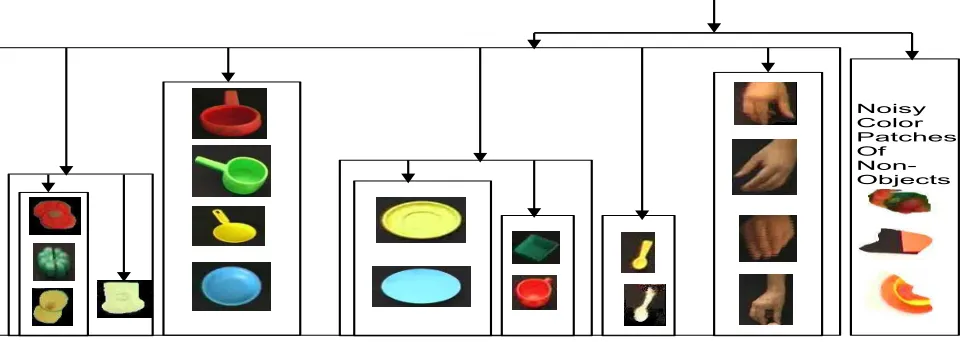
After applying event and object learning, we obtain the object hi-erarchy in fig. 3. While our procedure outputs a hihi-erarchy of object IDs, we replace these labels with the corresponding objects from the video, in order to visualize the results. It can be observed that the pro-posed framework has been able to differentiate between broader cat-egories such as food items and containers and interestingly separate noisy patches from all other objects. Finer levels of granularity are captured in the grouping which separates a slice of white bread from another group consisting of vegetables. A distinction between plates pans and spoons is also clear from the hierarchy. It can therefore be concluded that the learned categories and taxonomy is intuitive and corresponds to a functional classification of objects.
7
Summary and Future Work
A framework for learning object and event categories from video has been introduced. This framework offers a general way of repre-senting activities in terms of spatio-temporal graphs. Techniques for
mining events from this graph and then learning object functional categories from these events have been proposed in this work. Our experiments show that our framework offers a promising approach toward learning functional categories.
In the future, we plan to extend this framework in several direc-tions. At present, event generalisation requires exact graph isomor-phism. We plan to extend event classes to generalize a larger set of event instances by experimenting with similarity metrics between our event graphs. This will allow our approach to exploit a greater variety of video input to learn event and object taxonomies , and to cope bet-ter with noise (which might also inbet-tervene during an event instance). In contrast to almost all work in object recognition which is based on learning categories based on perceptual features, we have tackled the little researched problem of learning categories from function. How-ever, there is clearly scope to use the learned functional categories to supervise visual appearance based object learning.
REFERENCES
[1] D.Parikh and C. Tsuhan;, ‘Unsupervised learning of hierarchical seman-tics of objects (hsos).’, Computer Vision and Pattern Recognition, 2007.
CVPR ’07., 1–8, (2007).
[2] Givan R.L. Fern, A.P. and J.M. Siskind, ‘Specific-to-general learning for temporal events with application to learning event definitions from video’, Artificial Intelligence Research (JAIR), 17, 379–449, (2002). [3] Somboon Hongeng, ‘Unsupervised learning of multi-object event
classes’, in: Proc. 15th British Machine Vision Conference (BMVC’04),
London, UK, 2004, 487–496, (2004).
[4] A. Bobick R. Hamid, S. Maddi and I. Essa, ‘Structure from statistics -unsupervised activity analysis using suffix trees’, in Proc. of Conf. on
Computer Vision, (2007).
[5] Bryan C. Russell, William T. Freeman, Alexei A. Efros, Josef Sivic, and Andrew Zisserman, ‘Using multiple segmentations to discover objects and their extent in image collections’, CVPR 06: Proc. of Comp. Soc.
Conf. on Computer Vision and Pattern Recognition, 1605–1614, (2006).
[6] Brandon C.S. Sanders, Randal C. Nelson, and Rahul Sukthankar, ‘A the-ory of the quasi-static world’, Proc. 16th Int’l Conf. on Pattern
Recogni-tion ICPR02, (2002).
[7] Tristram Southey and James J. Little, ‘Object discovery using motion, appearance and shape’, Cognitive Robotics Workshop, AAAI, (2006). [8] M Veloso, P Rybski, and F von Hundelshausen, ‘Focus: A generalized
method for object discovery for robots that observe and interact with humans’, Proc. Conf. on Human-Robot Interaction, (2006).