Tupni: Automatic Reverse Engineering of Input Formats
Weidong Cui
Microsoft Research Redmond, WA 98052[email protected]
Marcus Peinado
Microsoft Corporation Redmond, WA 98052[email protected]
Karl Chen
University of CaliforniaBerkeley, CA 94720
[email protected]
Helen J. Wang
Microsoft Research Redmond, WA 98052
[email protected]
Luiz Irun-Briz
Microsoft Corporation Redmond, WA 98052[email protected]
ABSTRACT
Recent work has established the importance of automatic reverse engineering of protocol or file format specifications. However, the formats reverse engineered by previous tools have missed impor-tant information that is critical for security applications. In this paper, we present Tupni, a tool that can reverse engineer an input format with a rich set of information, including record sequences, record types, and input constraints. Tupni can generalize the for-mat specification over multiple inputs. We have implemented a prototype of Tupni and evaluated it on 10 different formats: five file formats (WMF, BMP, JPG, PNG and TIF) and five network protocols (DNS, RPC, TFTP, HTTP and FTP). Tupni identified all record sequences in the test inputs. We also show that, by aggre-gating over multiple WMF files, Tupni can derive a more complete format specification for WMF. Furthermore, we demonstrate the utility of Tupni by using the rich information it provides for zero-day vulnerability signature generation, which was not possible with previous reverse engineering tools.
Categories and Subject Descriptors
D.4.6 [Operating Systems]: Security and Protection; D.2.5 [Software Engineering]: Testing and Debugging
General Terms
Security
Keywords
protocol reverse engineering, binary analysis
1. INTRODUCTION
Recent work [6, 12, 26, 42] has established the importance of automatic reverse engineering of protocol or file format specifi-cations. For example, the availability of such specifications gives security applications like firewalls [5,41] or intrusion detection sys-tems [32, 33] the context information of a network communication
Permission to make digital or hard copies of all or part of this work for personal or classroom use is granted without fee provided that copies are not made or distributed for profit or commercial advantage and that copies bear this notice and the full citation on the first page. To copy otherwise, to republish, to post on servers or to redistribute to lists, requires prior specific permission and/or a fee.
CCS’08,October 27–31, 2008, Alexandria, Virginia, USA. Copyright 2008 ACM 978-1-59593-810-7/08/10 ...$5.00.
or file parsing session, which is crucial for accurately detecting or preventing intrusions. Being able to automatically reverse engi-neer such protocol or file format specifications alleviates the time-consuming and error-prone manual effort.
Discoverer [12] and Polyglot [6] pilot the initial explorations in this research direction. Discoverer assumes no software access and performs automatic reverse engineering purely from network traces. Polyglot assumes software access and performs dynamic data flow analysis for reverse engineering. Both Discoverer and Polyglot reverse engineer network messages as a “flat” sequence of fields. With software access and dynamic data flow analysis, Polyglot has the advantage of being able to reverse engineer binary fields and certain dependencies (e.g., length fields). In addition to Polyglot, Linet al.in [26] and Wondraceket al.in [42] developed new tools to reverse engineer network message formats by observ-ing how a program processes network messages.
However, the formats reverse engineered by previous tools have missed important information that is critical for security applica-tions. First, many input formats include arbitrary sequences of data elements (records). For example, most media files consist of se-quences of chunks of compressed media data. Second, input fields may have arbitrary dependencies which cannot be captured by pre-defined semantics. For example, there are many different ways to compute checksums. The ShieldGen system [14] has shown that it is important to understand record sequences and various data de-pendencies in an attack instance for constructing a high-quality vul-nerability signature for a zero-day vulvul-nerability.
In this paper, we present Tupni, a tool that can reverse engi-neer an input format with a rich set of information, given one or more inputs of the unknown format and a program that can process these inputs. The main novelty in Tupni is the identification and analysis ofarbitraryrecord sequences. Unlike previous tools that either ignore record sequences [6] or only work for some special cases [26,42], Tupni can identify arbitrary record sequences by an-alyzing loops in a program, using the fact that a program usually processes an unbounded record sequence in a loop. Tupni can also cluster records into a small set of types based on the set of instruc-tions that process a record. In addition, Tupni can infer constraints of various, not pre-defined dependencies across fields or messages (e.g., checksums or sequence numbers) by tracking symbolic pred-icates from dynamic data flow analysis. Furthermore, to mitigate a fundamental problem of dynamic analysis that our view is lim-ited by the execution path associated with a particular input, Tupni can derive a more complete format specification by aggregating the format information inferred from multiple inputs.
TIF) and five network protocols (DNS, RPC, TFTP, HTTP and FTP). We manually compared the formats reverse engineered by Tupni with published format specifications to evaluate Tupni’s ac-curacy. Our experimental results show that Tupni can correctly identify all fields except for those that were ignored by the pro-gram, and it can identify all record sequences in the published for-mat specification. We also show that, by aggregating over multiple WMF files, Tupni can derive a more complete format specifica-tion for WMF. Furthermore, we demonstrate the utility of Tupni by using its reverse engineered format for zero-day vulnerability signature generation, which was not possible with previous reverse engineering tools.
The rest of this paper is organized as follows. After defining the goals of this paper in Section 2, we describe the design of Tupni in Section 3. Then we present our evaluation results in Section 4 and demonstrate the utility of Tupni for zero-day vulnerability sig-nature generation in Section 5. We compare Tupni to related work in Section 6 and discuss its limitations and potential future research directions in Section 7. Finally, we conclude the paper in Section 8.
2. GOALS
2.1 Scope of the Problem
Most application-level protocols involve the concept of an appli-cationsession, which consists of a series ofmessagesexchanged between two hosts that accomplishes a specific task. Correspond-ingly, there are two essential components in an application-level protocol specification:protocol state machineandmessage format. The former characterizes all possible legitimate sequences of mes-sages, while the latter specifies the format for all possible legitimate messages. Files are a special case of protocols in the sense that each file is a single “message” and there is no “session” concept in a file specification.
In this paper, we focus on deriving the network message or file format and leave the inference of the protocol state machine to fu-ture work. We uniformly refer to both network message formats and file formats asinput formats. We assume the boundaries of network messages can be identified.
2.2 Goals
Our goal is to design an algorithm that, given one or more inputs (files, network messages) of an unknown format and an application that can process these inputs, outputs a specification of the input format. More precisely, the format specification we seek to gener-ate contains the following pieces of information:
• Field boundaries: An input instance (e.g., a particular RPC request) typically is a sequence of fields. We aim to recover the boundaries of the fields in the input.
• Record sequences: The identification of base fields by it-self is sufficient for simple fixed input formats, i.e., formats such as TFTP in which every input instance has the same fields and only the field values differ. Most input formats do not fall into this simple class. A very common pattern is for a format to allow arbitrary sequences of records. Ex-pressed in BNF notation, such record sequences have the form(R1|R2|. . .|Rn)∗, whereR1, R2, . . . , Rn are
differ-ent record types each of which may comprise differdiffer-ent se-quences of fields. An example of a record sequence are the property-value pairs (records) that may appear in arbitrary sequences in HTTP inputs. Other examples are records in WMF files, video and audio chunks in a number of multime-dia and streaming formats (WMA, WMV, ASF, AVI, MPG,
etc.) and tags in HTML. One of our goals is to recognize such sequences.
• Constraints: In addition to the structural information pro-vided by knowledge of fields and record sequences, we aim to derive information about the values of fields. In the sim-plest case, the input format may mandate that certain fields must have certain constant values. More generally, fields in a valid input may have to satisfy certain constraints. Exam-ples are length fields, where one field specifies the length of an array field, and checksum fields, where the value of the checksum field depends on the values of other (possibly all other) fields in the input.
3. DESIGN
We begin by giving a high-level overview of the algorithm. Fig-ure 1 shows the sequence of processing stages performed by Tupni. A raw input is first segmented into basic fields (Section 3.3). The next processing stage identifies record sequences (Section 3.4). We then classify the records we have identified in the previous stage (Section 3.5). This gives us record types. We look for constraints at several processing stages. Our techniques for identifying con-straints are described in Section 3.6.
Most of the processing stages combine a baseline algorithm with an error correction scheme. The baseline algorithm captures the main idea underlying the processing stage. The error correction scheme accounts for the fact that real world applications do not always conform to the baseline algorithm.
Most of the descriptions in this section show how Tupni analyzes a single run of a parsing application on a particular input. At the end of the section, we describe how Tupni aggregates the results of its analysis over several runs of the same application on different inputs. For a single run of the application, the sequence of instruc-tions that is executed during this run is called theexecution traceof the run. Each execution trace is associated with the list of binaries that were loaded during the run and the base addresses at which the binaries were loaded. This information is readily available from tools such as iDNA [4] that capture program execution traces.
We refer to the byte positions in the input asoffsets. We use the termpositionto identify instructions in the execution trace. For ex-ample, a particularmovinstruction in the application binary may appear at multiple positions in the execution trace. We refer to sequences of contiguous positions in the execution trace as subse-quences.
3.1 Background
Tupni assumes the availability of a taint tracking engine such as [10, 11, 31, 38]. These systems associate data structures with addresses in the application’s address space and update them as the application executes. In the simplest case, the data structures indicate whether the value stored at an address depends on input. When input data arrive in the application’s address space, the mem-ory locations storing them are marked as tainted. Whenever an instruction reads and writes data, the data structure for the desti-nation operand is updated depending on whether any of the source operands was tainted.
Raw Input Field Identification
Sequence of Fields
Identification of Record Sequences
Sequence of Records
Identification of Record Types
[image:3.612.129.487.52.102.2]Sequence of Record Types
Figure 1: The processing stages of Tupni
2 1 13 ... 5 10 ...
Record 1 Record 2
0 1 2 3 4 5 6 7 8 16 17 18 19 20 21 26
Figure 2: Running example input.
1 BYTE input[ BUF_SIZE ]
2 ULONG num_records, i=0, offset=4 3 USHORT record_type, record_size 4 FCT_PTR record_hdlr[NUM_REC_TYPES]
5 call read_input( input )
6 mov num_records, (ULONG *)&input[0]
7 loop: cmp i, num_records
8 jeq end
9 mov record_type, (USHORT *)&input[offset] 10 mov record_size, (USHORT *)&input[offset+2]
11 call record_hdlr[record_type](&input[offset])
12 add offset, record_size
13 inc i
14 jmp loop 15 end:
Figure 3: Example application.
3.2 Running Example
Throughout this section we will use a running example to help illustrate the stages of Tupni. For ease of exposition, we use a very simple synthetic input format and a similarly simple application that processes inputs from this format.
The input format consists of a header followed by a sequence of records. The header has only one field. It specifies the number of records that follow. Each record starts with a two-byte field that specifies the record type, followed by a second two-byte field that specifies the size of the record in bytes. The remaining bytes of each record depend on the record type. This simple format is struc-turally similar to real world formats such as WMF, PNG, WMA and WMV.
Figure 2 shows an example input from this format. The first field specifies the number of records as 2. The next 13 bytes make up the first record, and the following ten bytes make up the second record. These lengths are specified in the second field of each record. The first field of each record specifies its type (as types 1 and 5, respec-tively).
Figure 3 shows a simple application that parses inputs from our example format. Our pseudo assembly notation can be mapped to working x86 machine code by assigning x86 registers to our variables and adding instructions to pass function call parameters. Line 5 reads the input into a sufficiently large buffer (input). Line 6 reads the first four bytes ofinputintonum_records, which tells the application how many records it needs to process. Each iteration of the following loop (lines 7 to 14) processes one record. Lines 7 and 8 exit the loop after the last record has been
processed (i == num_records). Lines 9 and 10 read the type field and the length field of the record. Line 11 calls the handler function for the given record type. We assume that the function pointer arrayrecord_hdlrhas been initialized with a handler function for each record type. These handler functions are part of the application, but not displayed in Figure 3 to keep the example manageable. Finally, line 12 setsoffsetto the beginning of the next record, and line 13 increments the index variable that counts how many records have been processed.
The execution trace of running this program on the example in-put is5,6,7,...,14,7,...,14,7, 8,15. That is, after ex-ecuting lines 5 and 6, the trace contains two full iterations of the loop. Each segment7,...,14contains the instructions of the handler function between lines 11 and 12.
3.3 Field Identification
This first step partitions the input into short sequences of consec-utive bytes that are likely to correspond to basic fields in the input format. Typically, several consecutive input bytes will be mapped to a larger field such as a 32-bit integer. We deduce this mapping by observing the operands of CPU instructions. Given an operand of a CPU instruction in the execution trace, we call the longest sequence of tainted bytes from contiguous offsets contained in the operand achunk. Our algorithm identifies all chunks in the execution trace by stepping through the trace and inspecting the operands of each instruction for taint. We ignore move instructions as they do not process the operand and contain little information about field sizes. Any byte of the input that is read by the application will be con-tained in at least one chunk. In general, a chunk may be accessed by multiple instructions. We keep track of this by assigning a weight
w(c)to each chunkc. The weight of a chunk is simply the number of instructions in the execution trace that access the chunk (ignor-ing move instructions).
In this way, by observing the operands of x86 instructions, we can identify chunks contained in 8-, 16-, 32- and 64-bit integer operands as well as floating point chunks. We can also recognize big-endian integers if we see a chunk with reversed bytes. Cur-rently we track input chunks at byte granularity; we believe it takes only engineering efforts to refine this to bit granularity.
Running Example.
The first time the application reaches line 7, the second operand of thecmpinstruction is tainted with the first four bytes of the in-put. This causes Tupni to create a chunk[0,3]for offsets 0 to 3 and to assign it weight 1. Note that themovinstruction in line 6 does not create a chunk. It simply propagates taint intonum_records. Analogous statements apply to lines 9 and 10.
The next chunk[4,5]is created in line 11 becauserecord_type
is tainted with offsets 4 and 5. The instructions executed by the record handler function called in line 11 will typically create further chunks for the offsets inside the record. Since our simple example does not specify handler functions, we ignore this part of the exe-cution trace. Line 12 creates the chunk[6,7]sincerecord_size
In the second loop iteration, line 7 increases the weight of[0,3]
to 2, and lines 11 and 12 act as in the previous iteration, creating chunks[17,18]and[19,20], respectively. Finally, the third exe-cution of line 7 raises the weight of[0,3]to 3. The final set of chunks is[0,3],[4,5],[6,7],[17,18]and[19,20]; plus any chunks generated by the handler functions.
3.3.1 Error Correction
The next step is to map chunks to fields. A general difficulty is that, during the course of its execution, an application may access the same offset using different operand types. Thus, an offset may be contained in different chunks. The most common application behavior that gives rise to such inconsistencies includes (a) bulk accesses (memory copies, checksums, etc.) in which the applica-tion reads a part of the input without concern for field boundaries and (b) optimized string processing code that uses 32-bit (or larger) operations to process an ASCII or unicode string.
The goal is to find a consistent subsetSof chunks such that we can identify each chunk inSwith a field. Tupni has to find a subset
Sof chunks such that all chunks inSare disjoint and the combined weight of the chunks inSis maximized. This is an instance of the weighted Maximumk-Set Packing problem. While it is intractable to even approximate the optimal solution under worst-case analy-sis [21], the problem instances we obtain from real-world execution traces are quite simple with little overlap among chunks. We use the greedy algorithm [7] to computeSand identify the chunks inS
with input fields. Based on our evaluation (Section 4), this simple algorithm seems sufficient.
In general, the fields we have found may not cover the entire input. In many cases, the application never accesses certain parts of the input. Thus, observing the application reveals no information about these parts. All Tupni can do is to mark the contiguous gaps between fields as virtual fields.
In our simple example, all chunks are disjoint. Thus, Tupni pro-motes all chunks into fields. Again, ignoring the handler functions, offsets[8,16] and[21,26]are gaps between fields. Tupni adds
[8,16],[21,26]as virtual fields.
3.3.2 Strings
We consider strings as regular record sequences. Thus, we have no string fields. Given a string, Tupni will recognize the string characters as fields. The next section will describe how Tupni infers that these character fields form a string as part of the more general framework for recognizing record sequences.
A special problem arises for strings because many applications use optimized string processing code that uses 32-bit rather than 8-bit or 16-8-bit instructions to access strings. This could cause string characters to be misclassified as 32-bit integers. Fortunately, the optimized string processing code is easy to recognize. All instances we have observed on Windows and Linux involve boolean and comparison operations with two or three specific constants. If we recognize optimized string processing code, we ignore the corre-sponding instructions in the calculation of chunk weights.
3.4 Identification of Record Sequences
This section describes how we identify record sequences. As defined in Section 2.2, a record sequence covers a contiguous se-quence of offsets in the input. Our algorithm is based on the obser-vation that applications have to use a loop or recursive calls to pro-cess an unbounded sequence of records. We have developed Tupni for the common case of loops. We believe that similar techniques can be used to handle recursive calls.
The algorithm proceeds in the following three steps: (a) Identify
all loops that are executed in the execution trace; (b) For each loop, find the relevant input fields that are accessed in each loop iteration; (c) For each loop that processes relevant input fields, identify the record boundaries. The rest of the section describes each of the three steps in detail.
3.4.1 Loop Identification
The first problem is to find loops in the application. The solution is to search for cycles in the control flow graph (e.g., [3]). This method yields a complete list of loops and their relationship. We only consider loops with a single entry point.
The next task is to map the loop information to the execution trace. Given a loop (a cycle in the control flow graph), we can map each instruction in that cycle to the program counter (EIP) value at which the instruction was stored when the execution trace was created. This makes use of the information about loaded binaries mentioned in Section 3.1. For each loop, we maintain a compact representation of the set of EIP values of the instructions in the loop. We also store the EIP of the unique entry point of each loop.
Tupni tests for each position in the trace and for each loop whether the EIP value at that position is contained in the set of EIP values of the loop. The result of this process is the list of all subsequences of the execution trace that correspond to the execution of a loop (labeled with an identifier for that loop).
Finally, we identify the individual loop iterations within each subsequence. We mark the beginning of an iteration at the points where the execution trace hits the (unique) entry point of the loop.
Running Example.
The code in Figure 3 has a single loop (cycle in the control flow graph) in lines 7 to 14. Line 7 is the only entry point of this loop. LetAbe a label for this loop. There may be further loops in the handler functions. Those would be recognized as nested within loopA. Since the execution trace in Section 3.2 uses line numbers rather than EIP values, there is no mapping to be done. Otherwise, we would have to look up at what base address the application bi-nary was loaded when the execution trace was created. Comparing the line numbers in the execution trace in Section 3.2 with the line numbers of our loop (7 to 14), we find that the subsequence that starts at the third instruction in the trace and ends right before the last instruction corresponds to the execution of loopA.
Tupni identifies iterations by looking for the entry point of loop
A (line 7) within the subsequence. It finds three occurrences of line 7 in the subsequence (at the very beginning, toward the middle and at the end. Thus, Tupni splits the subsequence into three itera-tions at these three posiitera-tions. The third iteration contains only lines 7 and 8.
3.4.2 Identifying Relevant Fields
In the following, we will also use the termloopas a shorthand for “a subsequence of the execution trace labeled by a loop iden-tifier”. Most loops executed by applications do not process record sequences from the input. We are only interested in those loops that iterate over multiple input fields. In this step, we identify such loops.
Consider a loopland letnbe the number of iterations that were executed. We define setsIi(1≤i≤n) as follows: An instruction
(identified by its instruction pointer (EIP) value) is contained inIi
if the instruction accesses a field during thei-th loop iteration that it does not access in any other iteration ofl.
IfIn is empty then we treat the loop as if it had onlyn−1
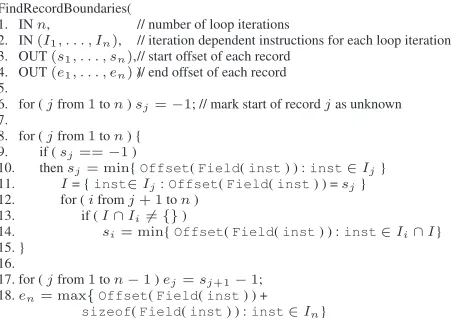
FindRecordBoundaries(
1. INn, // number of loop iterations
2. IN(I1, . . . , In), // iteration dependent instructions for each loop iteration
3. OUT(s1, . . . , sn),// start offset of each record
4. OUT(e1, . . . , en))// end offset of each record
5.
6. for (jfrom1ton)sj=−1; // mark start of recordjas unknown
7.
8. for (jfrom1ton) { 9. if (sj==−1)
10. thensj= min{Offset(Field(inst) ) :inst∈Ij}
11. I= {inst∈Ij:Offset(Field(inst) ) =sj}
12. for (ifromj+ 1ton) 13. if (I∩Ii6={})
14. si= min{Offset(Field(inst) ) :inst∈Ii∩I}
15. } 16.
17. for (jfrom1ton−1)ej=sj+1−1;
18.en= max{Offset(Field(inst) ) +
[image:5.612.55.281.61.224.2]sizeof(Field(inst) ) :inst∈In}
Figure 4: Identification of record boundaries
condition (as in our example, where the third iterations consists only of lines 7 and 8).
We callSiIithe set ofiteration dependentinstructions. We call
a loopiteration dependentifIi6={}for alli∈ {1, . . . , n−1}.
We compute the setsIifor all loops identified in the previous
step. At the end of this analysis, we obtain the list of iteration dependent loops in the execution trace and, for each iteration de-pendent loop, the setsIiof its iteration dependent instructions.
Running Example.
I1 ={9,10,11}andI2 ={9,10,11}. Thus, the loop is
itera-tion dependent. For example, line 9 accesses field[4,5]in the first iteration and only in the first iteration. Thus, it belongs toI1, It
also accesses field[17,18]in the second iteration and in no other iteration. Thus, it also belongs toI2. On the other hand, line 7
is not iteration dependent. It accesses the same field ([0,3]) in all iterations.
3.4.3 Identifying Record Boundaries
In this step, we group fields into records and identify the record boundaries. We make use of the fact that, given the definitions of Section 2.2, a record is a contiguous sequence of fields and a record sequence consists of contiguous records. Furthermore, we assume that the loop processes records in the order in which they appear in the input. Loops that do not satisfy this assumption are ignored. However, we can handle loops whose iterations access fields in records outside the record currently being processed.
Our algorithm is shown in Figure 4. Tupni calls this algorithm for every iteration dependent loop. For ease of presentation, the figure assumes that each iteration dependent instructioninst ac-cesses only one field (Field(inst)). This assumption has no fundamental importance. Its only purpose is to remove tedious de-tails from Figure 4.
For any fieldf, letOffset(f)denote the offset in the input of the first byte off. The algorithm sets the start of the first record to
min{Offset(f)}, where the minimum is taken over all fields that are accessed by iteration dependent instructions in the first it-eration of the loop (line 10). Next, in line 11, it identifies the set
Iof iteration dependent instructions that access the field at the be-ginning of the first record in the first iteration. The scheme now uses the heuristic that the instructions inIare likely to access the beginning of a record whenever they appear. Thus, it looks for in-structions fromI in each iteration (line 13) and sets the start of the corresponding record accordingly (line 14). The process is
re-peated (line 8) for the case that an iteration does not use any in-struction fromI. Finally, the end of each record is set to the offset immediately before the start of the next record (line 17). The end of the last record is set to the last input byte accessed by any iteration dependent instruction in the last iteration (line 18). This procedure is performed for all iteration dependent loops. A loop is ignored if the computed record start addresses are not increasing.
Running Example.
The algorithm setss1 = 4(line 10), sinceI1 = {9,10,11},
Field(9) = [4,5]andOffset([4,5]) = 4. That is, 4is the smallest offset accessed by instructions inI1. Line 11 setsI =
{9,11}since both instructions accessed field[4,5]in the first iter-ation. Next, it setss2= 17since instructions9and11access field [17,18]in the second iteration. Line 17 setse1 =s2−1 = 16.
Fi-nally, line 18 setse2= 20the largest offset accessed by an
instruc-tion fromI2. While all other values are correct,e2is somewhat too
small. This is primarily the result of the fact that we have ignored the handler functions called in line 11 of the example application.
3.4.4 Length Determination
We also output for each record sequence how its length is de-termined. We consider the following three cases: (a) The length is determined by a termination record (e.g., null terminated ASCII strings); (b) The length is determined by a separate length field; (c) The length is fixed and implicitly determined by the protocol specification.
Tupni identifies case (a) (termination record) by checking all equality comparisons between a constant and the value of a field ac-cessed by an iteration dependent instruction. We classify the record sequence as case (a) if we observe a constant for which there is such an equality check that evaluates to false in each iteration (up to but not including the last iteration) and if the last iteration contains an equality check with the same constant that succeeds. For case (b) (length fields), we use a technique from Polyglot [6]: We iden-tify fields that are accessed to compute the termination condition of loops. If we do not recognize case (a) or (b), we classify the record sequence as case (c) (implicit length).
3.5 Record Type Identification
Typical formats specify record sequences such that records come from a small set of classes (the record types of Section 2.2). So far, we have identified record sequences, found out how the length of the record sequence is determined and found the boundaries of the individual records in a sequence. In this step, Tupni tries to find the record type for each record. More precisely, Tupni considers two records as belonging to the same record type if the loop iterations that process the records execute “mostly” the same instructions. This is based on the observation that applications typically have a separate handler function for each record type.
The problem is complicated by the fact that record sequences may be nested. That is, there are sequences whose records contain other sequences. If a record contains a child record sequence then the instructions that process it may depend heavily on the particu-lar instance of the child record sequence it contains. Thus simply looking for similar instruction sequences will not solve the prob-lem.
Letl be an iteration dependent loop, and let r be the record sequencelprocesses. Letnbe the number of records inr. For
i∈ {1, . . . , n}, we defineQito be the subset of instructions from
Iithat access fields in thei-th record ofr. We compute the setsQi
relevant. As outlined above, if records inrcontain nested record sequences then records of the same record type may have widely different setsQi. Therefore the next step of our algorithm is to
transform each setQiinto a setQ0ias follows.
Tupni collapses every segment of the instruction trace that con-tains an execution of a child loop into a single virtual instruction. This instruction is assigned a virtual identifier (virtual EIP) such that two virtual instructions have the same identifier if and only if they correspond to executions of the same loop. Q0
i is set toQi,
except that all instructions in the child loop execution are removed from theQiand replaced by the identifier of the virtual instruction
that represents the child loop. The net effect of this transformation is that iteration dependent loops that process child record sequences contribute a single virtual instruction to theQ0
iof the parent record.
This way, it only matters whether the child loop was executed, but not what happened during its execution.
In summary, Tupni considers each record sequencer that was identified in the previous step and computesQ0
ifor every recordi
inr. Tupni classifies two recordsi, jas having the same type if
Q0 i=Q0j.
Running Example.
Recall that, in the previous step, Tupni had identified one record sequence with two records. We haveQ1 ={9,10,11} ∪h1and Q2={9,10,11} ∪h5, whereh1andh5denote the instructions in
record_hdlr[1]and record_hdlr[5], respectively, that access the record sequence. Typically,h1 andh5 will be
differ-ent.
If neither of the two records contains a nested record sequence thenQ0
1 = Q1 and Q02 = Q2. In order to examine the other
case, letrecord_hdlr[1]contain a loop that iterates byte-by-byte over the payload of record 1 (offsets 8 to 16). In this case,h1
contains up to 9 different instructions (for the nine loop iterations from offset 8 to offset 16).Q0
1would now beQ01={9,10,11, v1},
wherev1is a unique identifier for the loop inrecord_hdlr[1].
3.6 Constraint Identification
This section describes how Tupni identifies conditions on the values of fields that an input must satisfy to be valid. This includes relations between the values of multiple fields. We call such condi-tionsconstraints. Tupni considers three types of constraints.
Symbolic Predicates.
The dynamic data flow analysis engine [10] used by Tupni out-puts a sequence of conditions on the input (symbolic predicates) that were checked by the application during its execution. These conditions encode the application’s execution path. In general, some of these conditions will represent properties that any valid input must have while other conditions simply represent properties of the particular input the application was run on. For the purpose of gathering constraints on the format, we are interested in the for-mer, but not in the latter.
Tupni generates constraints on the value of single fields (single-value constraints) as follows. For each input fieldi, Tupni outputs the conjunction of all symbolic predicates of the formf(input[i]){< ,=, >,6=}y, wherefis a function that depends on nothing but in-put values and constants that are hard coded into the application (e.g., immediate operands of x86 instructions). In addition, we ig-nore all symbolic predicates associated with checks for termination values of record sequences, as the information contained in them is already accounted for by the analysis of length determination (Sec-tion 3.4).
Tupni also outputs symbolic predicates of the form input[x]=
f(input[y],input[z], . . .), where f is a function that depends on nothing but input values and constants that are hard coded into the application. This type of constraint can capture many types of checksum calculations. We call such constraintsfunctional con-straints.
The constraints generated by this simple procedure may be par-ticular to the input the application was run on and may not represent the input format in general. This is a general limitation of dynamic analysis. Recent systems such as Bouncer [9] and ShieldGen [14] were designed to overcome this limitation in a different application domain. We believe that the techniques employed by these systems could be used to eliminate most of the remaining input specific con-ditions.
Inter-Message Dependencies.
An inter-message constraint for a multi-message network proto-col determines the value of a field in a later message based on the values of one or more fields in an earlier message. Typical exam-ples include session IDs and sequence numbers.
Tupni inspects all attempts by the application to send data to the network. If it finds tainted data in an outgoing message, it outputs the associated data flow graph that describes how the tainted output field depends on the previous input.
Length Fields.
Tupni uses three techniques for identifying length fields. The first technique makes use of the semantics of certain platform func-tions as described in Section 3.7. The other two techniques are similar to techniques used in Polyglot: identifying fields used to compute pointers that are used to access other input fields and iden-tifying fields that are accessed to compute the termination condition of loops that process record sequences.
3.7 Platform-Specific Functions
Knowledge of the semantics of platform specific functions such as system calls, application programming interface (API) functions and functions in runtime libraries can significantly enhance the ac-curacy and functionality of Tupni. The idea of using the semantics of library calls has been used in Bouncer [9]. However, the way in which Tupni makes use of function calls is quite different from the method in Bouncer. As a preliminary step, we have added specifi-cations of six string processing functions and 20 memory allocation functions to Tupni. These specifications are used in the following areas:
• Field identification: Use of an input chunk as a function pa-rameter can provide strong evidence that the chunk is a field. This evidence is incorporated into the field recognition step by increasing the weightw(c)of the chunk if Tupni sees a call to a known function in the execution trace. More exten-sive use of function semantics has the potential of providing very detailed information about the types and semantics of input fields. We leave this for future work.
• Identification of record sequences: Functions may have record sequences (or pointers to them) as parameters. For example, a call to a standard string processing function with achar -pointer that points to tainted data provides strong evidence that the pointer marks the start of a string.
parameter provides evidence that this parameter is a length field.
In general, we do not consider the parts of the execution trace that are spent inside any of the known functions in our analysis. Effectively, this collapses calls to these functions into a single vir-tual instruction with special semantics.
3.8 Output Format
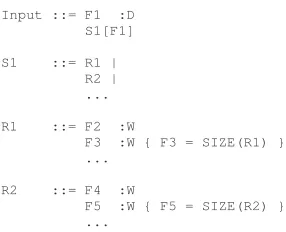
Input ::= F1 :D S1[F1]
S1 ::= R1 | R2 | ...
R1 ::= F2 :W
F3 :W { F3 = SIZE(R1) } ...
R2 ::= F4 :W
[image:7.612.70.213.150.266.2]F5 :W { F5 = SIZE(R2) } ...
Figure 5: The output format for the running example.
At this point, Tupni’s analysis of a single input is complete. Tupni outputs the fields and record sequences it identifies in an enhanced BNF format. An example of this output format is shown in Figure 3.8 for the running example. Tupni generates a rule that lists the top-level fields and record sequences in the order of their positions in the input. We refer to this rule as theroot rule. For each record sequence, Tupni generates an alternation rule to cover all its record types. For each record type Tupni generates a rule to list its fields and child record sequences. This process continues recursively for all record sequences and record types. In addition, Tupni outputs constraints in the enhanced BNF format.
3.9 Aggregation over Multiple Inputs
So far, we have discussed how Tupni analyzes a single execution trace – corresponding to a single input. If multiple inputs of the unknown format are available, the application can be run on each of them, and Tupni can perform its analysis on each of the resulting execution traces. The last step is to combine the individual results into a single format specification.
To do so, Tupni matches fields, record sequences, and record types across different execution traces. Consider two execution traces from the same application, but different inputs. Tupni con-siders two base fields from two execution traces to match if they are accessed by the same set of instructions. Tupni considers two record sequences from two execution traces to match if they are processed by the same loops (identified by the unique loop entry point). Finally, Tupni considers two records from matching record sequences to have the same type if their respective sets Q0
i are
equal.
After identifying all matching fields, record sequences and record types in the two execution traces, Tupni merges the BNF rules for each of the execution traces into a single set of BNF rules. Tupni first identifies the pairs of BNF rules that can be merged. These include the root rules and the BNF rules of matched record se-quences and record types. To merge BNF rules of matched record sequences, Tupni simply creates a new alternation rule that includes all record types in the old rules. Tupni merges the root rules and rules of matched record types in two steps. It first aligns the list of fields and record sequences using the type-based sequence align-ment technique proposed in [12]. If all fields and record sequences
are perfectly matched, it means that the two rules are identical; Tupni simply keeps one. Otherwise, it creates a new alternation rule for each pair of unmatched fields or record sequences. Then it creates a new rule that lists matched fields and record sequences as well as the alternation rules for unmatched fields or record se-quences.
4. IMPLEMENTATION AND EVALUATION
We have developed a prototype of Tupni. Our dynamic data flow engine was built on a re-implementation of the Vigilante sys-tem [10]. Our prototype syssys-tem uses iDNA [4], a binary program translator, to capture and replay program execution traces. Our sys-tem works on x86 instructions directly. Excluding the code of the original Vigilante and iDNA, our Tupni prototype has 14,000 lines of C++ and 4,100 lines of Perl.
In this section, we first describe our experimental setup and eval-uation methodology. After that, we present our experimental re-sults.
4.1 Experimental Setup
Our evaluation is divided into two parts. We first tested how accurately Tupni can reverse engineer the format of a single input message or file. Then we evaluated its capability of generalizing the input format over multiple inputs.
In the first set of experiments, we evaluated Tupni on both files and network messages. We tested five binary files (WMF, BMP, JPG, PNG and TIF), three binary network messages (DNS response, TFTP data and RPC bind request), and two text network messages (HTTP GET request and FTP port command). We selected these input formats because they are representative protocols and were studied in previous work. We intentionally avoided types of input formats for which we knew a priori that our prototype would per-form poorly (see Section 7 for a discussion of these per-formats). For instance, our prototype does not work well if the field boundaries of a format do not coincide with byte boundaries due to its byte-based taint tracking. For the compressed image files among our test cases, we used Tupni to reverse engineer the container file for-mat and ignored the forfor-mat of the compressed data blobs. We used WMF, the DNS response message, and the HTTP request message to guide our design. We ran the remaining seven test cases without changing the prototype.
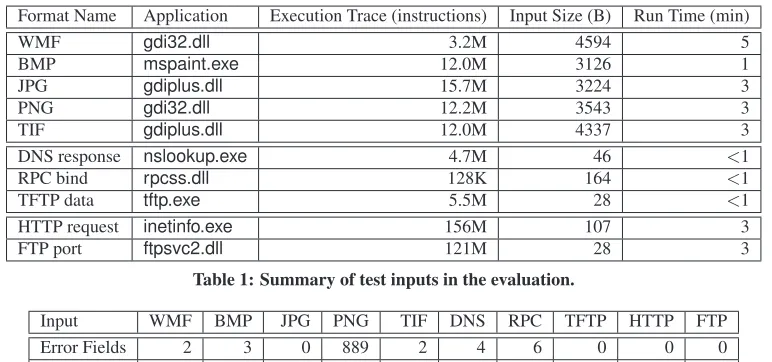
For each input, we recorded an execution trace of a binary pro-gram parsing and processing it on Windows XP Professional SP2. Then we fed the execution trace to Tupni to reverse engineer the format. The inputs and binary programs are listed in Table 1. In all our test cases, Tupni can reverse engineer the formats in at most 5 minutes on a 3GHz machine running Windows XP Professional SP2.
4.2 Evaluation Methodology
In our first set of experiments on single test inputs, we focused our evaluation onaccuracy, that is, how accurately Tupni can iden-tify the fields, record sequences, record types, and constraints in the test inputs. Tupniautomaticallyoutputs the reverse engineered for-mats in an enhanced BNF format (referred to as theTupni format). In order to evaluate the accuracy of Tupni’s output, we compare the format specification Tupni produced for each test case with the published specification [1, 2, 16, 20, 28, 34, 37, 39, 40] (referred to as thepublished format) for the same format and identify discrep-ancies. In our second set of experiments, we focus our evaluation oncompleteness, that is, how well Tupni can infer a more complete input format over multiple inputs.
Format Name Application Execution Trace (instructions) Input Size (B) Run Time (min)
WMF gdi32.dll 3.2M 4594 5
BMP mspaint.exe 12.0M 3126 1
JPG gdiplus.dll 15.7M 3224 3
PNG gdi32.dll 12.2M 3543 3
TIF gdiplus.dll 12.0M 4337 3
DNS response nslookup.exe 4.7M 46 <1
RPC bind rpcss.dll 128K 164 <1
TFTP data tftp.exe 5.5M 28 <1
HTTP request inetinfo.exe 156M 107 3
[image:8.612.113.499.51.232.2]FTP port ftpsvc2.dll 121M 28 3
Table 1: Summary of test inputs in the evaluation.
Input WMF BMP JPG PNG TIF DNS RPC TFTP HTTP FTP
Error Fields 2 3 0 889 2 4 6 0 0 0
Total Fields 2257 3087 3211 1551 4220 32 137 26 23 4
Table 2: Summary of field identification results.
42] quantitatively as these tools are not publicly available, and we used different file/protocol formats for evaluation. We will give a qualitative comparison in Section 6.
In the rest of this section, we will first summarize our experimen-tal results on the ten test cases and discuss why Tupni made errors in reverse engineering the formats. After that, we will analyze the aggregation of format information across multiple inputs.
4.3 Experimental Results on Single Inputs
4.3.1 Field Identification
To evaluate the accuracy of field identification, we counted the number of fields in the published format that were identified incor-rectly by Tupni. The results are shown in Table 2.
By analyzing the execution traces and source code, we found that most of these errors have the same cause—a program ignores certain parts of an input. When this happens, Tupni will mark these gaps as virtual fields. For example, there are 127 virtual fields in the PNG test. This happens because the first 128 chunks in the PNG test file are identical, and the parsing program ignored the data bytes in all but the first chunk. Since the application never ac-cessed the data bytes, Tupni had to create one virtual field for each chunk that covers all the data bytes in the chunk. The published specification defines seven fields on these data bytes. This results in a misclassification of 889 fields (7 fields per chunk times 127 chunks).
One of the errors in the DNS test case occurs because the pro-gram processed each byte in a two-byte flag field separately.
4.3.2 Record Sequence Identification
We evaluated the accuracy of record sequence identification by measuring the number of record sequences that are in the published format but missed by Tupni and the number of record sequences that are not in the published format but identified by Tupni. We refer to the former asfalse negative(FN) sequences and to the latter asfalse positive(FP) sequences. The results are shown in Table 3. Tupni did not miss any record sequences in the published format of any of the ten test cases. This confirms our observation that a parsing program usually parses and processes record sequences in loops.
Tupni output false positive sequences in three test cases. By an-alyzing the applications, we found that, in most cases, this happens
because the application uses a loop to process input fields that do not belong to a record sequence in the published format. In the PNG case, Tupni identified two false positive sequences from ex-ecution loops in decoding the image file. In the JPG test, Tupni identified the first two bytesffd8as a sequence because the pars-ing program compared them with a two byte strpars-ing to look for the start of image. Tupni found extra record sequences in the HTTP test because the program processed some substrings in loops.
4.3.3 Record Type Identification
Ideally, the set of record types identified by Tupni (referred to as theTupni record types) should correspond one-to-one to the record types in the published format (referred to as thepublished record types). There may be two kinds of inaccuracies. First, records of a single Tupni record type may belong to multiple published record types. Second, records of multiple Tupni record types may belong to a single published record type. In our evaluation, we analyzed these two kinds of errors for each record type seen in the test cases. For the first kind of error, we counted the num-ber of Tupni record types that have records belonging to multiple published record types. We will refer to them asunder-classified record types. For the second kind of error, we counted the number of published record types that contain records assigned to multiple Tupni record types. We will refer to them asover-classified record types. We did not analyze the FTP and HTTP test cases in this evaluation because all their record sequences are ASCII strings and have trivial record types. The results are shown in Table 4. Tupni did not make any errors of the first kind, and it made two errors of the second kind.
By analyzing the execution traces and source code, we found that these two errors arise because a record type defined in the pub-lished specification may be an abstraction of a complex object that has multiple semantics, which causes the parsing program to be-have differently on records of the same record type. In the WMF test case, the published record type associated with the error is
CreateBrushIndirectwhose parameters contain three flags that control many different behaviors of Brush objects. In the JPG test case, Tupni assignedDHTmarker segments (records) to two different record types. We found that this happens because DHT
Input WMF BMP JPG PNG TIF DNS RPC TFTP HTTP FTP
FN Sequences 0 0 0 0 0 0 0 0 0 0
FP Sequences 0 0 1 2 0 0 0 0 3 0
[image:9.612.124.486.53.161.2]True Sequences 35 0 15 4 1 4 6 1 12 3
Table 3: Summary of record sequence identification results.
Input WMF BMP JPG PNG TIF DNS RPC TFTP
Under-Classified Record Types 0 0 0 0 0 0 0 0
Over-Classified Record Types 1 0 1 0 0 0 0 0
Table 4: Summary of record type identification results.
4.3.4 Constraint Identification
In this section, we discuss Tupni’s accuracy on constraint iden-tification. Tupni can identify three kinds of constraints: symbolic-predicate, inter-message, and length. Since length field identifica-tion has been widely studied in previous work and Tupni achieved similar performance, we will not discuss length constraints but fo-cus on the other two kinds.
Symbolic-Predicate Constraints: Our evaluation on functional constraints was focused on whether Tupni can identify all check-sum dependencies. In the ten test cases, only two input formats, WMF and PNG, have checksum fields. Tupni identified one func-tional constraint in the WMF test that captures the dependency be-tween thechecksumfield in the WMF header and the rest of the header. A PNG file [40] has a sequence of chunks and each chunk has a 4-byte CRC checksum field calculated on the preceding bytes in the chunk. Tupni did not find functional constraints that reflect these checksum dependencies. By analyzing the execution trace, we found that this happens because the parsing programignored the checksums while parsing each chunk.
Tupni also identified single-value constraints in every test case, many of which revealed interesting insights into the input formats. For example, Tupni inferred that the first byte of a marker segment in the JPG file must be 0xff; the size field of a draw record in the WMF file must be at least 3; there are at most 20 context elements in the RPC bind message. We also observed that there are con-straints that are particular to the input. For example, Tupni inferred that the version of the WMF file must be 0x0300; however, by ana-lyzing the source code we found that it can also be 0x0100. This is a general limitation of dynamic analysis. We will discuss this issue further in Section 7.
Inter-Message Constraints: In the ten test cases, only three net-work protocols, DNS, RPC and TFTP, have inter-message con-straints. To identify the inter-message constraints in DNS and RPC, one must track the server program but we tracked the client pro-gram in our tests. Thus, TFTP is our only test case with an inter-message constraint. Tupni correctly identified this constraint. In particular, by tracking how the ACK message was generated after receiving the data message, Tupni identified that the AckNum in the acknowledge message must equal the BlockNum in the data message.
4.4 Experimental Results on Multiple Inputs
In this section, we present the experimental results of running Tupni over 150 WMF files to generate a more complete WMF for-mat specification. The 150 files were randomly selected from a test template repository at Microsoft. The average file size is 1,577 bytes. The average number of draw records per file was 63. We first examine how accurately Tupni can match fields and record se-quences across multiple inputs, then describe how much improve-ment on format coverage Tupni can achieve over multiple inputs.
We do not present results on matching record types since we have evaluated how accurately Tupni can identify record types in Section 4.3.3. To evaluate the accuracy on matching fields, we in-spected the first 17 fields identified in the 150 Tupni formats gen-erated on each individual file. These 17 fields correspond to the metafile header in a WMF file. We say two fields have the same typeif they match. For each field position, we counted the num-ber of different types. We found that 12 out of the 17 field posi-tions have only one field type, which ensured a correct alignment of BNF rules from different inputs. Also, there are at most three dif-ferent types for a field position. By analyzing the traces and source code, we found that the different types appear because the program took different execution paths based on different parameters (e.g., whether the file size is the same as specified in the MetaFile_Size field). There are ten different record sequences in the 150 WMF files. Tupni matched all record sequences correctly.
To evaluate the improvement on format coverage, we counted the number of distinct draw record types in each WMF file and in the 150 files together. The minimum number of distinct draw record types in a single file is 9. However, there are 80 distinct draw record types in the 150 files. The aggregated output of Tupni included these 80 record types. These results show that Tupni can significantly improve the format coverage by aggregating multiple inputs.
5. TUPNI FOR ZERO-DAY
VULNERABIL-ITY SIGNATURE GENERATION
We have shown that Tupni can automatically reverse engineer the input formats with high accuracy in the ten test cases. In this section, we evaluate Tupni’s effectiveness by using its reverse engi-neered formats in a real-world security application: zero-day vul-nerability signature generation. Tupni can also be used for other security applications such as fuzzing tests. Fuzzing tests can toler-ate more inaccuracies than vulnerability signature generation since the latter constructs a vulnerability signature based on the reverse engineered format while the former only uses it to generate new test inputs.
Oracle
Data Analyzer
Probe Generator & Analyzer Suspicious
Traffic
Probe Zero-Day
Attack
Data Patch Probe
successful or failed
Data Format
[image:10.612.107.285.53.172.2]Attack Data with Semantics
Figure 6: Original ShieldGen
Oracle
Tupni
Probe Generator & Analyzer
Suspicious Traffic
Probe Zero-Day
Attack
Data Patch Probe
successful or failed
Vulnerable Program
[image:10.612.346.523.53.171.2]Attack Data with Semantics
Figure 7: ShieldGen + Tupni
most important aspect of this search is the removal of all records from probes that are not required to exploit the vulnerability. Thus, information about record sequences and associated constraints in the input specification is critical for ShieldGen.
In our experiments, we replaced the Data Analyzer module with Tupni and replaced the Data Format with the vulnerable program. The new architecture is shown in Figure 7. Then we repeated the case study of the WMF vulnerability in the ShieldGen paper [14] with this new signature generation system. The new system auto-matically generated thesamevulnerability signature as in [14].
None of the existing reverse engineering tools [6,12,26,42] lends itself to the ShieldGen application because they fail to reliably iden-tify record sequences in a sufficiently broad class of input formats. In the case of WMF, without identifying record sequences, the sys-tem will not be able to eliminate iterative elements, and the gen-erated vulnerability signature will be particular to the attack in-stance and may have thousands of conditions if the attack inin-stance is crafted with thousands of draw records. On the other hand, Tupni can identify not only fields but also record sequences and important constraints. Therefore, it can potentially be used to generate high-quality vulnerability signatures.
6. RELATED WORK
Network protocols and file formats have been subject to painstak-ing manual reverse engineerpainstak-ing [18, 36]. Recently, there has been rising interest in automatic protocol reverse engineering.
The Protocol Informatics Project [35] and Discoverer [12] an-alyzed network traces to infer protocol formats. Fisheret al.[17] have presented a system that automatically infers the structure of an ad hocdata source and that produces a format specification in the PADS data description language. Specifically, the system infers several structural relationships based on the histogram of the fre-quencies of all tokens in the input. These systems are useful when a parsing program is unavailable. However, leveraging a parsing program can significantly improve the quality of the reverse engi-neered format.
Polyglot [6] uses dynamic data flow analysis to reverse engi-neer network message formats. With the rich information revealed by how a program consumes an input, Polyglot can identify ba-sic fields and certain dependencies (e.g., length fields). Compared to Tupni, the main limitation of Polyglot is that it infers a mes-sage format as a “flat” sequence of fields, and cannot infer record sequences that are common in network protocol and file formats. Furthermore, Polyglot does not generalize a network message for-mat over multiple message samples.
AutoFormat [26] reverse engineers network message formats by using context-aware monitored execution. To identify fields, it
groups contiguous inputs accessed consecutively in a function as a field. This heuristic works well for ASCII strings but is likely to fail for complex data structures. For example, different binary fields will be clustered into a single field if an application makes two subsequent accesses to adjacent input fields in a function. To iden-tify record sequences, it identifies input positions that have been read by the same functions and declares each of them to be the start of a record. The input data between two subsequent record start markers is considered to belong to the first record. This heuristic may produce arbitrary false positives when confronted with com-plex input formats. For example, if an application accesses the first and the last byte of the input in the same functions, AutoFormat will conclude that the entire input is a record sequence. It also does not recognize nested record sequences such as those in WMF, JPG and PNG. AutoFormat does not attempt to identify record types or aggregate the analysis over multiple input samples.
In [42], Wondraceket al. propose a system for automatic net-work protocol analysis. When identifying basic fields, the system breaks an input chunk that cannot be attributed to any semantics (e.g., delimiters, lengths) into individual bytes and thus may fail to identify binary fields with more than one byte. For record se-quences, the system can only identify those in which all records are structurally identical. Therefore, it cannot identify complex record sequences such as those in HTTP, WMF, JPG, PNG and TIF. It also does not identify record types. Unlike Polyglot and AutoFor-mat, the system in [42] can generalize a network message format over multiple messages. However, its sequence alignment algo-rithm may introduce more inaccuracies than Tupni because it does not have type information for individual byte fields and assumes any byte field can be matched with any other byte field. In contrast, Tupni infers field types based on the set of instructions that operate on each field and aligns fields based on their types.
Compared to previous efforts [6,26,42] that reverse engineer work message formats by observing how a program processes net-work messages, Tupni makes significant advances in the follow-ing ways: (1) It can identifyarbitraryrecord sequences, includ-ing nested ones, by analyzinclud-ing loops in a program; (2) It can infer field or record types by comparing the set of instructions that pro-cess each field or record; (3) It can derive constraints of various, not pre-defined dependencies across fields or messages by tracking symbolic predicates from dynamic data flow analysis; (4) It can improve its format specifications by aggregating its analysis over multiple inputs.
pro-gram control dependence follows the parsing structure. However, real-world programs may not follow this assumption (e.g., a pro-gram may scan an input multiple times). Unlike Tupni, this system does not attempt to aggregate the analysis over multiple inputs or infer input constraints.
Besides using dynamic analysis, Limet al.[25] have proposed FFE/X86, a binary static analysis tool that infers file formats based on the program’s output routines. The system can generate gram-mars with alternation and repetition, but requires manual annota-tions to the executable.
Previous work has also studied reverse engineering for specific applications such as replay. RolePlayer [13] and ScriptGen [23, 24] leverage byte-wise sequence alignment techniques to achieve application-level replay. Replayer [29] uses binary analysis to re-play an application dialog. Kannanet al. semi-automatically dis-cover session structures [22]. Christodorescuet al. perform bi-nary static analysis to infer all possible strings at a given program point [8].
Dynamic data flow analysis has been used in many security ap-plications, including exploit detection, patch generation, worm con-tainment, and fuzz testing [10, 11, 14, 15, 19, 30, 31].
7. LIMITATIONS AND FUTURE WORK
In this section, we discuss the limitations of Tupni and describe future research directions for solving these limitations.
A fundamental limitation faced by Tupni is that the coverage of its reverse engineered format is dependent on the diversity of the input samples. We can mitigate this limitation from two perspec-tives. First, ShieldGen [14] and SAGE [19] have shown that one can construct new inputs to probe a program, which leads to bet-ter code coverage. Second, it is also possible to combine dynamic analysis with static analysis. However, it remains a research prob-lem to integrate them effectively for reverse engineering a complete input format.
Another fundamental limitation in Tupni is that the constraints identified by Tupni may be specific to the input samples, which is a general limitation of dynamic analysis. This limitation can be mit-igated by techniques presented in ShieldGen [14] and Bouncer [9]. Currently, Tupni does not work well for certain classes of input formats. The first class are formats whose field boundaries do not coincide with byte boundaries. This includes many encrypted and compressed file formats. The reason is that the Tupni prototype tracks taint at the byte level. We believe that this problem could be resolved by a more sophisticated implementation.
Another class of inputs that causes problems for Tupni are for-mats that cannot be described as regular expressions. For example, attempts to generate a C language specification by having Tupni analyze execution traces of a compiler would most likely produce poor results.
In addition, the quality of Tupni’s output depends on the qual-ity of the parsing application. Applications that neglect to compute checksums, ignore fields or deviate in other ways from the pub-lished specification reveal no information about those aspects of the format specification. This was the main cause of errors in our experiments. Any system that attempts to use a parsing application to obtain a format specification faces this problem. A possible way to mitigate this problem is to run multiple parsing applications on the input samples.
8. CONCLUSIONS
We have presented Tupni, a tool to reverse engineer input for-mats. Based on the observation that an application usually
pro-cesses iterative data records in a loop, Tupni can automatically identify (nested) record sequences, and record types in input for-mats. Tupni also can find different types of constraints on the val-ues of fields. Furthermore, Tupni can generalize input formats over multiple inputs. We have demonstrated that Tupni can effectively reverse engineer 10 common, real-world file and network message formats. Given the rich set of information available in the input formats reverse engineered by Tupni, it can potentially be used for security applications such as zero-day vulnerability signature gen-eration.
9. ACKNOWLEDGMENTS
We would like to thank Xuxian Jiang for his valuable comments on an early draft of this paper. We are grateful to Andrew Edwards, Stuart de Jong and Jinlin Yang for helping us understand iDNA. We also want to thank the anonymous reviewers for their constructive comments.
10. REFERENCES
[1] International Telecommunication Union Recommendation T.81: JPEG Specification.http:
//www.w3.org/Graphics/JPEG/itu-t81.pdf.
[2] TIFF Revision 6.0.http://partners.adobe.com/
public/developer/en/tiff/TIFF6.pdf.
[3] A. Aho, M. Lam, R. Sethi, and J. Ullman.Compilers: Principles, Techniques, and Tools. Addison-Wesley, 2007.
[4] S. Bhansali, W.-K. Chen, S. de Jong, A. Edwords, R. Murray, M. Drinic, D. Mihocka, and J. Chau. Framework for instruction-level tracing and analysis of program executions. InProceedings of the Second International Conference on Virtual Execution Environments, Ottawa, Canada, June 2006.
[5] N. Borisov, D. J. Brumley, H. J. Wang, J. Dunagan, P. Joshi, and C. Guo. A Generic Application-Level Protocol Analyzer and its Language. InProceedings of the 14th Annual Network & Distributed System Security Symposium (NDSS), March 2007.
[6] J. Caballero, H. Yin, Z. Liang, and D. Song. Polyglot: Automatic Extraction of Protocol Message Format using Dynamic Binary Analysis. InProceedings of the 14th ACM Conference on Computer and Communications Security, Alexandria, VA, October 2007.
[7] B. Chandra and M. Halldórsson. Greedy local improvement and weighted setpacking.Journal of Algorithms,
39(2):223–240, 2001.
[8] M. Christodorescu, N. Kidd, and W.-H. Goh. String analysis for x86 binaries.6th ACM SIGPLAN-SIGSOFT Workshop on Program Analysis for Software Tools and Engineering (PASTE 2005), 31(1):88–95, 2006.
[9] M. Costa, M. Castro, L. Zhou, L. Zhang, and M. Peinado. Bouncer: Securing Software by Blocking Bad Input. In Proceedings of the21stACM Symposium on Operating
Systems Principles (SOSP), pages 117–130, 2007.
[10] M. Costa, J. Crowcroft, M. Castro, and A. Rowstron. Vigilante: End-to-End Containment of Internet Worms. In Proceedings of the Symposium on Systems and Operating Systems Principles (SOSP 2005), 2005.