Cisco Press 201 W 103rd Street Indianapolis, IN 46290
Cisco CCNA Exam #640-507
Certification Guide
ii
Cisco CCNA Exam #640-507 Certification Guide
Wendell Odom
Copyright© 2000 Lacidar Unlimited, Inc.
Cisco Press logo is a trademark of Cisco Systems, Inc. Published by:
Cisco Press
201 West 103rd Street Indianapolis, IN 46290 USA
All rights reserved. No part of this book may be reproduced or transmitted in any form or by any means, electronic or mechanical, including photocopying, recording, or by any information storage and retrieval system, without written permission from the publisher, except for the inclusion of brief quotations in a review.
Printed in the United States of America 1 2 3 4 5 6 7 8 9 0
Library of Congress Cataloging-in-Publication Number: 99-67898 ISBN: 0-7357-0971-8
Warning and Disclaimer
This book is designed to provide information about the Cisco CCNA #640-507 exam. Every effort has been made to make this book as complete and as accurate as possible, but no warranty or fitness is implied. The information is provided on an “as is” basis. The author, Cisco Press, and Cisco Systems, Inc., shall have neither liability nor responsibility to any person or entity with respect to any loss or damages arising from the information contained in this book or from the use of the discs or programs that may accompany it. The opinions expressed in this book belong to the author and are not necessarily those of Cisco Systems, Inc.
Trademark Acknowledgments
All terms mentioned in this book that are known to be trademarks or service marks have been appropriately capitalized. Cisco Press or Cisco Systems, Inc., cannot attest to the accuracy of this information. Use of a term in this book should not be regarded as affecting the validity of any trademark or service mark.
Feedback Information
At Cisco Press, our goal is to create in-depth technical books of the highest quality and value. Each book is crafted with care and precision, undergoing rigorous development that involves the unique expertise of members from the professional technical community.
Readers’ feedback is a natural continuation of this process. If you have any comments regarding how we could improve the quality of this book, or otherwise alter it to better suit your needs, you can contact us through e-mail at [email protected]. Please make sure to include the book title and ISBN in your message. We greatly appreciate your assistance.
iii
Publisher John Wait
Executive Editor John Kane
Cisco Systems Program Manager Jim LeValley
Managing Editor Patrick Kanouse
Development Editor Christopher Cleveland
Senior Editor Jennifer Chisholm
Copy Editor Krista Hansing
Technical Editors David Barnes
Tinjin Chang Steve Kalman Frank Knox Barbara Nolley
Team Coordinator Amy Lewis
Book Designer Gina Rexrode
Cover Designer Louisa Klucznik
Production Team Argosy
Indexer Christopher Cleveland
Copyright © 2000 Cisco Systems, Inc. All rights reserved. Printed in the USA. Access Registrar, AccessPath, Any to Any, AtmDirector, CCDA, CCDE, CCDP, CCIE, CCNA, CCNP, CCSI, CD-PAC, the Cisco logo, Cisco Certified Internetwork Expert logo, CiscoLink, the Cisco Management Connection logo, the Cisco NetWorks logo, the Cisco Powered Network logo, Cisco Systems Capital, the Cisco Systems Capital logo, Cisco Systems Networking Academy, the Cisco Systems Networking Academy logo, the Cisco Technologies logo, ConnectWay, ControlStream, Fast Step, FireRunner, GigaStack, IGX, Internet Quotient, Kernel Proxy, MGX, Natural Network Viewer, NetSonar, Network Registrar, Packet, PIX, Point and Click Internetworking, Policy Builder, Precept, RouteStream, Secure Script, ServiceWay, SlideCast, SMARTnet, StreamView, The Cell, TrafficDirector, TransPath, ViewRunner, VirtualStream, VisionWay, VlanDirector, Workgroup Director, and Workgroup Stack are trademarks; Changing the Way We Work, Live, Play, and Learn, Empowering the Internet Generation, The Internet Economy, and The New Internet Economy are service marks; and ASIST, BPX, Catalyst, Cisco, Cisco IOS, the Cisco IOS logo, Cisco Systems, the Cisco Systems logo, the Cisco Systems Cisco Press logo, Enterprise/Solver, EtherChannel, EtherSwitch, FastHub, FastLink, FastPAD, FastSwitch, GeoTel, IOS, IP/TV, IPX, LightStream, LightSwitch, MICA, NetRanger, Registrar, StrataView Plus, Stratm, TeleRouter, and VCO are registered trademarks of Cisco Systems, Inc. and/or its affiliates in the U.S. and certain other countries. All other trademarks mentioned in this document are the property of their respective owners. The use of the word partner does not imply a partnership relationship between Cisco and any of its resellers. (9908R)
Cisco Systems has more than 200 offices in the following countries. Addresses, phone numbers, and fax numbers are listed on the Cisco Connection Online Web site at http://www.cisco.com/offices.
Argentina • Australia • Austria • Belgium • Brazil • Canada • Chile • China • Colombia • Costa Rica • Croatia • Czech Republic • Denmark • Dubai, UAE Finland • France • Germany • Greece • Hong Kong • Hungary • India • Indonesia • Ireland • Israel • Italy • Japan • Korea • Luxembourg • Malaysia • Mexico • The Netherlands • New Zealand • Norway • Peru • Philippines • Poland • Portugal • Puerto Rico • Romania • Russia • Saudi Arabia • Singapore • Slovakia • Slovenia • South Africa • Spain • Sweden • Switzerland • Taiwan • Thailand • Turkey • Ukraine • United Kingdom • United States • Venezuela
Corporate Headquarters Cisco Systems, Inc. 170 West Tasman Drive San Jose, CA 95134-1706 USA
http://www.cisco.com Tel: 408 526-4000
800 553-NETS (6387) Fax: 408 526-4100
European Headquarters Cisco Systems Europe s.a.r.l. Parc Evolic, Batiment L1/L2 16 Avenue du Quebec Villebon, BP 706 91961 Courtaboeuf Cedex France
http://www-europe.cisco.com Tel: 33 1 69 18 61 00 Fax: 33 1 69 28 83 26
American Headquarters Cisco Systems, Inc. 170 West Tasman Drive San Jose, CA 95134-1706 USA
http://www.cisco.com Tel: 408 526-7660 Fax: 408 527-0883
Asia Headquarters Nihon Cisco Systems K.K. Fuji Building, 9th Floor 3-2-3 Marunouchi Chiyoda-ku, Tokyo 100 Japan
http://www.cisco.com Tel: 81 3 5219 6250 Fax: 81 3 5219 6001
iv
About the Author
Wendell Odom has worked with networking technology for 15 years. He is currently a Cisco Systems Senior Systems Engineer in the Atlanta, Georgia office, assigned to several large Cisco customers. Prior to joining Cisco in 1999, Wendell provided consulting services on large networks as well as training services. He spent his first eight years in networking working for IBM, helping customers evolve their SNA networks into multiprotocol networks. Wendell is CCIE #1624, is a Certified Cisco Systems Instructor, is Cisco CIP-certified, and is a CCNA-WAN. He has taught various Cisco-certified courses, including Introduction to Cisco Router Configuration (ICRC), Advanced Cisco Router Configuration (ACRC), Cisco SNA for Multi-protocol Administrators (SNAM), Cisco Channel Interface Processor (CIP), MPLS over Cisco WAN Switches, and Cisco ATM (CATM). Wendell is one of the first Cisco instructors certified without a proba-tionary testing period and is the first non-Cisco instructor in the United States to teach Cisco’s SNAM, CIP, and DLSw courses.
About the Technical Reviewers
David Barnes is a Network Consulting Engineer for Cisco Systems in Dallas, Texas. He is a Cisco Certified Design Professional, MCSE+Internet, and Master CNE. David specializes in large-scale network design and optimization. He has designed, implemented, and managed networks for numerous Fortune 500 companies over the past 10 years.
Tinjin Chang, CCIE #5137 and CCSI, is an instructor and consultant for Chesapeake Network Solutions, Inc. Tinjin has more than seven years of experience in planning, deploying, and troubleshooting complex and large-scale IP and multiprotocol networks. Prior to joining Chesapeake, he was the lead network engi-neer at Discover Brokerage, where his design and troubleshooting skills minimized downtime and guaran-teed network availability. Discover Brokerage was named the Best Online Broker by Barron’s magazine for the two years that he worked there.
Steve Kalman is a data communications trainer. He is the author or tech editor of 12 CBT titles and has been the author, tech editor, or trainer for eight instructor-led courses. Steve also is beginning a new dis-tance-learning project as both author and presenter. In addition to those responsibilities, he runs a consulting company, Esquire Micro Consultants, that specializes in data network design.
Frank Knox, CCIE #3698, is a consultant and instructor currently involved in design, implementation, and customer training for mixed SNA-IP networks. He is considered to be an expert in the area of mainframe attached routers. Frank has more than 33 years of networking experience with IBM, GTE, and Skyline Com-puter Corp.; during that time, he has worked in field service and support, product planning, education, and management. In addition, he has developed and taught several courses for the University of Dallas (Telecom-munications MBA program). Frank has a master’s degree in telecom(Telecom-munications from Pace University. Barb Nolley is the president and principal consultant for BJ Consulting, Inc., a small consulting firm that specializes in networking education. Since starting BJ Consulting, Barb has developed and taught training courses for Novell’s Master CNE certification, as well as several courses for Cisco System’s Engineering Education group. Barb stays current on networking technologies by constantly reading published books and perusing more than 50 industry publications each month. Prior to starting her own company in 1993, Barb worked for Apple Computer, Tandem Computer, and Tymnet (now part of MCI), where she held positions in everything from technical support to project management.
v
Dedication
My wife, Kris, was a great help to me during this latest writing project. While she took no direct role in the book, everything I do in life is a lot better because the love of my life is with me! Thanks to my parents, Raymond and Fay, who took care of many things during some health problems I had while writing the book. And finally, but most importantly, thanks to Jesus Christ, especially for your joy, peace, and protection in the midst of a tough year.
vi
Acknowledgments
Chris Cleveland, development editor for Cisco Press, is the best in the business! Chris made my job much easier so that I could concentrate totally on the content. I’d probably refuse to write another book if Chris wouldn’t be the development editor!
John Kane, executive editor for Cisco Press, provided a great deal of assistance, as usual. John’s frequent e-mails and conference calls with Cisco’s Worldwide Training organization allowed him to gather the infor-mation needed to guide Cisco Press’s Cisco certification books, and it also allowed me to focus on writing, instead of sending e-mails and participating in conference calls! Thanks for everything, John.
Many people at Cisco Press have helped make this book a success. Amy Lewis helped greatly by taking care of many details. Many others worked behind the scenes, and although I never met them, they are appreci-ated! Cisco Press spends much more time producing the book than I do to simply write it—they have the laborious tasks! Thanks to all on the team!
The technical editors deserve most, if not all, of the credit for making the content robust and complete. There is no question that the book is immensely better after the edit process! While all the editors gave a great deal of help, each brought some particular strengths to the task. Tinjin, thanks for pointing out topics for which just a little deeper technical coverage would help to clear up a topic. Steve, thanks for the input relating to points that come up in the many classes you teach. David, thanks for jumping into the fray in the middle of the process and adding some great help. Barb, you get the most credit for removing errors from the book! (Of course, I take full responsibility for any remaining errors.) And, to my old friend Frank, thanks for all the help and the occasional good-bad joke in your editing comments! (An example: “What’s a gateway? About 50 pounds!” If you didn’t get it, “gateway” sounds like “gate weigh.”) All the technical edi-tors were an immense help.
vii
Contents at a Glance
Introduction xx
Chapter 1 All About the Cisco Certified Network Associate Certification 2
Chapter 2 Cisco Internetwork Operating System (IOS) Fundamentals 20
Chapter 3 OSI Reference Model & Layered Communication 68
Chapter 4 Bridges/Switches and LAN Design 128
Chapter 5 Network Protocols 210
Chapter 6 Routing 352
Chapter 7 Understanding Access List Security 454
Chapter 8 WAN Protocols and Design 514
Chapter 9 Scenarios for Final Preparation 638
Appendix A Answers to the “Do I Know This Already?” Quizzes and Q&A Sections 700
Appendix B Decimal to Hexadecimal and Binary Conversion Table 776
Index 786
viii
Table of Contents
Introduction xx
Chapter 1 All About the Cisco Certified Network Associate Certification 2 How This Book Can Help You Prepare and Pass the CCNA Exam 4
Overview of Cisco Certifications 4 Exams Required for Certification 6 Other Cisco Certifications 7
What’s on the CCNA Exam 8
Topics on the Exam 9
Recommended Training Path for CCNA 11
How to Use This Book to Pass the Exam 12 I’ve Taken ICND—Now What? 14 I’ve Taken ICRC—Now What? 15
I’ve Taken the Cisco Networking Academy Courses—Now What? 16
I’m New to Internetworking with Cisco, and I Will Not Be Taking the ICND Course— Now What? 17
I’ve Learned a Lot About CCNA Topics Through Experience, But I Will Not Be Taking the ICND Course—Now What? 18
Conclusion 18
Chapter 2 Cisco Internetwork Operating System (IOS) Fundamentals 20 How to Best Use This Chapter 21
“Do I Know This Already?” Quiz 22
The IOS and Its User Interface 26 Router Components 26 Command-Line Interface 28 Navigating the IOS CLI 30
Configuration Processes and the Configuration File 34 Example Configuration Process 37
Managing Configuration Files 39 Cisco Discovery Protocol (CDP) 45
ix
Upgrading an IOS Image into Flash Memory 48 Choosing Which IOS Image to Load 50
Scenario 2-1 61
Questions on Scenario 2-1 62
Scenario 2-2 63
Questions on Scenario 2-2 63
Scenario 2-1 Answers 66
Scenario 2-2 Answers 66
Chapter 3 OSI Reference Model & Layered Communication 68 How to Best Use This Chapter 69
“Do I Know This Already?” Quiz 70
The OSI, TCP/IP, and NetWare Protocol Architectures 74 OSI: Origin and Evolution 74
OSI Layers 75
Layering Benefits and Concepts 78 Interaction Between OSI Layers 79 The TCP/IP and NetWare Protocols 86
OSI Transport Layer Functions 87
Connection-Oriented Versus Connectionless Protocols 87 How Error Recovery Is Accomplished 89
Flow Control 91
OSI Data Link Layer Functions 94 Data Link Function 1: Arbitration 95 Data Link Function 2: Addressing 96 Data Link Function 3: Error Detection 98
Data Link Function 4: Identifying the Encapsulated Data 98 Summary: Data Link Functions 102
OSI Network Layer Functions 103 Routing 103
Network Layer (Layer 3) Addressing 107
Scenario 3-1 121
Task 1 for Scenario 3-1 122 Task 2 for Scenario 3-1 123 Task 3 for Scenario 3-1 123
x
Answers to Task 2 for Scenario 3-1 124
Answers to Task 3 for Scenario 3-1 126
Chapter 4 Bridges/Switches and LAN Design 128 How to Best Use This Chapter 129
“Do I Know This Already?” Quiz 130
LAN Overview 135 LAN Addressing 138 LAN Framing 140
Fast Ethernet and Gigabit Ethernet 142 LAN Standards 143
Bridging, Switching, and Spanning Tree 145 Transparent Bridging 145
LAN Switching 148
Comparison of LAN Segmentation Using Bridges, Switches, and Routers 155 Spanning Tree 158
Virtual LANs 171
VLAN Summary 177
LAN Switch Configuration 177
Basic 1900 Switch Configuration 178 Basic VLAN Configuration 187 VLAN Trunking Protocol (VTP) 194
Chapter 5 Network Protocols 210
How to Best Use This Chapter 211
“Do I Know This Already?” Quiz 212
TCP/IP Protocols 217
Transmission Control Protocol 217 User Datagram Protocol 224 Address Resolution Protocol 226 Internet Control Message Protocol 227 FTP and TFTP 232
IP Addressing and Subnetting 235 IP Addressing Review 235
Five Ways the Exam Will Test Your IP Addressing Knowledge 244 CIDR, Private Addressing, and NAT 267
xi
IP Configuration 272
Using Secondary Addresses 283
IP Addressing with Frame Relay Subinterfaces 284 MTU and Fragmentation 287
IP Naming Commands and Telnet 288
Default Routes and the ip classless Command 292
IPX Addressing and Routing 296
Internal Networks and Encapsulation Types 299
IPX Configuration 303
Scenario 5-1: IP Addressing and Subnet Calculation 328
Scenario 5-2: IP Subnet Design with a Class B Network 330
Scenario 5-3: IP Subnet Design with a Class C Network 331
Scenario 5-4: IPX Examination 333
Scenario 5-5: IPX Configuration 339
Answers to Scenario 5-1: IP Addressing and Subnet Calculation 340
Answers to Scenario 5-2: IP Subnet Design with a Class B Network 341 Answers to Task 1 for Scenario 5-2 341
Answers to Task 2 for Scenario 5-2 342 Answers to Task 3 for Scenario 5-2 343
Answers to Scenario 5-3: IP Subnet Design with a Class C Network 344 Answers to Task 1 for Scenario 5-3 344
Answers to Task 2 for Scenario 5-3 345 Answers to Task 3 for Scenario 5-3 346
Answers to Scenario 5-4: IPX Examination 347
Answers to Scenario 5-5: IPX Configuration 349 Answers to Task 1 for Scenario 5-5 349 Answers to Task 2 for Scenario 5-5 350
Chapter 6 Routing 352
How to Best Use This Chapter 353
“Do I Know This Already?” Quiz 354
Distance Vector Routing Protocols 359 Comparing Routing Protocols 360 Distance Vector Routing 362
xii
The network Command 375 IGRP Metrics 378
Split Horizon and Infinity 378
RIP-1 and IGRP—No Subnet Masks 383 RIP Version 2 386
Auto Summary and Route Aggregation 389 Multiple Routes to the Same Subnet 395
Troubleshooting Routing and Routing Protocols 396
IPX RIP, SAP, and GNS 403
Service Advertisement Protocol 403 Configuration of IPX 405
Tunneling 409
Tunneling for VPNs 411 Configuring Tunneling 412
Integrated Routing Protocols 413
Scenario 6-1: IP Configuration 1 426
Scenario 6-2: IP Configuration 2 427
Scenario 6-3: IP Addressing and Subnet Derivation 429
Scenario 6-4: IPX Examination 435
Answers to Scenario 6-1: IP Configuration 1 444 Answers to Task 1 for Scenario 6-1 444 Answers to Task 2 for Scenario 6-1 445 Answers to Task 3 for Scenario 6-1 445 Answers to Task 4 for Scenario 6-1 446 Answers to Task 5 for Scenario 6-1 446
Answers to Scenario 6-2: IP Configuration 2 446 Answers to Task 1 for Scenario 6-2 447 Answers to Task 2 for Scenario 6-2 448 Answers to Task 3 for Scenario 6-2 448 Answers to Task 4 for Scenario 6-2 449
Answers to Scenario 6-3: IP Addressing and Subnet Derivation 449 Answers to Task 1 for Scenario 6-3 449
Answers to Task 2 for Scenario 6-3 450 Answers to Task 3 for Scenario 6-3 450
xiii
Answers to Task 2 for Scenario 6-4 452 Answers to Task 3 for Scenario 6-4 453 Answers to Task 4 for Scenario 6-4 453
Chapter 7 Understanding Access List Security 454 How to Best Use This Chapter 455
“Do I Know This Already?” Quiz 456
Filtering IP Traffic 460
Standard IP Access Lists 462 Extended IP Access Lists 466 Named IP Access Lists 472
Controlling vty Access with IP Access Lists 475 IP Access List Summary 476
Filtering IPX Traffic and SAPs 476 IPX Packet Filters (Access Lists) 478 Standard IPX Access Lists 479 Extended IPX Access Lists 484 SAP Filters 487
Named IPX Access Lists 490
Scenario 7-1: IP Filtering Sample 1 503
Scenario 7-2: IP Filtering Sample 2 504
Scenario 7-3: IP Filtering Sample 3 504
Scenario 7-4: IPX Filtering 505
Answers to Scenario 7-1: IP Filtering Sample 1 508
Answers to Scenario 7-2: IP Filtering Sample 2 508
Answers to Scenario 7-3: IP Filtering Sample 3 509
xiv
Chapter 8 WAN Protocols and Design 514 How to Best Use This Chapter 515
“Do I Know This Already?” Quiz 516
Point-to-Point Leased Lines 520 HDLC and PPP Configuration 523 WAN Cabling Standards 528
Frame Relay Protocols 529
Frame Relay Features and Terminology 530 LMI and Encapsulation Types 532
DLCI Addressing and Frame Relay Switching 534 Network Layer Concerns with Frame Relay 538 How Address Mapping Works 543
Review: Basic Frame Relay Initialization 549 Compression 549
Frame Relay Configuration 551
Configuring Networks Without Subinterfaces 553
Configuring Networks with Point-to-Point Subinterfaces 555 Configuring Networks with Coexisting Point-to-Point and Multipoint
Subinterfaces 559
Payload Compression Configuration 563
ISDN Protocols and Design 567 ISDN Channels 567
ISDN Protocols 568
ISDN Function Groups and Reference Points 570 Typical Use of ISDN 574
PAP and CHAP 574 Multilink PPP 577
Dial-on-Demand Routing and ISDN Configuration 578 DDR Legacy Concepts and Configuration 580
A Comparison of WAN Options 590
Scenario 8-1: Point-to-Point Verification 608
Scenario 8-2: Frame Relay Verification 612
Scenario 8-3: Point-to-Point Configuration 619
Scenario 8-4: Frame Relay Configuration 620
xv
Answers to Scenario 8-1: Point-to-Point Verification 626
Answers to Scenario 8-2: Frame Relay Verification 627
Answers to Scenario 8-3: Point-to-Point Configuration 629
Answers to Scenario 8-4: Frame Relay Configuration 631
Answers to Scenario 8-5: Frame Relay Configuration Dissection 636
Chapter 9 Scenarios for Final Preparation 638 How to Best Use This Chapter 640
Scenario 9-1 641
Scenario 9-1, Part A—Planning 641
Solutions to Scenario 9-1, Part A—Planning 644 Scenario 9-1, Part B—Configuration 645
Solutions to Scenario 9-1, Part B—Configuration 646 Scenario 9-1 Part C—Verification and Questions 647
Solutions to Scenario 9-1, Part C—Verification and Questions 656
Scenario 9-2 658
Scenario 9-2, Part A—Planning 658
Solutions to Scenario 9-2, Part A—Planning 660 Scenario 9-2, Part B—Configuration 662
Solutions to Scenario 9-2, Part B—Configuration 662 Scenario 9-2, Part C—Verification and Questions 664
Solutions to Scenario 9-2, Part C—Verification and Questions 673
Scenario 9-3 675
Scenario 9-3, Part A—Planning 675
Solutions to Scenario 9-3, Part A—Planning Answers 678 Scenario 9-3, Part B—Configuration 681
Solutions to Scenario 9-3, Part B—Configuration 681 Scenario 9-3, Part C—Verification and Questions 684
xvi
Appendix A Answers to the “Do I Know This Already?” Quizzes and Q&A Sections 700 Answers to the Chapter 2 “Do I Know This Already?” Quiz 701
Answers to the Chapter 2 Q&A Section 703
Answers to the Chapter 3 “Do I Know This Already?” Quiz 708
Answers to the Chapter 3 Q&A Section 710
Answers to the Chapter 4 “Do I Know This Already?” Quiz 715
Answers to the Chapter 4 Q&A Section 718
Answers to the Chapter 5 “Do I Know This Already?” Quiz 724
Answers to the Chapter 5 Q&A Section 728
Answers to the Chapter 6 “Do I Know This Already?” Quiz 745
Answers to the Chapter 6 Q&A Section 748
Answers to the Chapter 7 “Do I Know This Already?” Quiz 754
Answers to the Chapter 7 Q&A Section 757
Answers to the Chapter 8 “Do I Know This Already?” Quiz 766
Answers to the Chapter 8 Q&A Section 768
Appendix B Decimal to Hexadecimal and Binary Conversion Table 776
Index 786
xvii
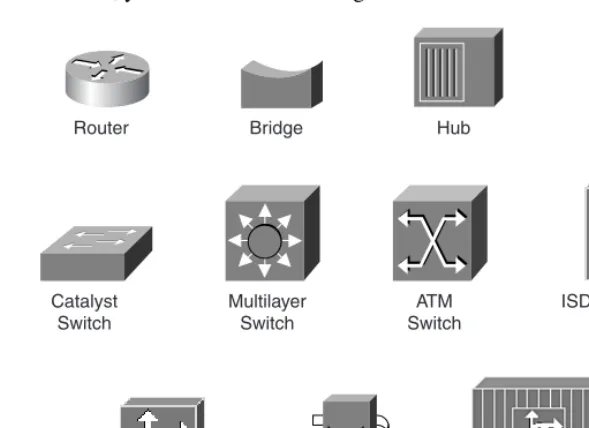
Figure Icons Used in This Book
Throughout the book, you will see the following icons used for networking devices:Communication Server Router
Gateway
Hub
ISDN/Frame Relay Switch
Access Server Catalyst
Switch
ATM Switch
DSU/CSU DSU/CSU Bridge
Multilayer Switch
xviii
Throughout the book, you will see the following icons used for peripherals and other devices.
PC PC with
Software
Sun Workstation
Macintosh
Terminal File
Server
Web Server
Cisco Works Workstation
Printer Laptop IBM
Mainframe
Front End Processor
Cluster Controller
xix
Throughout the book, you will see the following icons used for networks and network connections.
Line: Ethernet
Line: Serial
Line: Switched Serial
Frame Relay Virtual Circuit
Token Ring
FDDI
xx
Introduction: Overview of
Certification and How to Succeed
Professional certifications have been an important part of the computing industry for many years and will continue to become more important. Many reasons exist for these certifications, but the most popularly cited reason is that of credibility. All other considerations held equal, the certified employee/consultant/job candi-date is considered more valuable than one who is not.Objectives and Methods
The most important and somewhat obvious objective of this book is to help you pass the CCNA exam (640-507). In fact, if the primary objective of this book was different, then the book’s title would be mis-leading; however, the methods used in this book to help you pass the CCNA exam are designed to also make you much more knowledgeable about how to do your job. While this book and the accompanying CD together have more than 500 questions, the method in which they are used is not to simply make you mem-orize as many questions and answers as you possibly can.
One key methodology used in this book is to help you discover the exam topics about which you need more review, to help you fully understand and remember those details, and to help you prove to yourself that you have retained your knowledge of those topics. So, this book does not try to help you pass by memorization, but by helping you truly learn and understand the topics. The CCNA exam is the foundation for many of the Cisco professional certifications, and it would be a disservice to you if this guide did not help you truly learn the material. So, this book will help you pass the CCNA exam by using the following methods:
• Helping you discover which test topics you have not mastered
• Providing explanations and information to fill in your knowledge gaps
• Supplying exercises and scenarios that enhance your ability to recall and deduce the answers to test questions
• Providing practice exercises on the topics and the testing process via test questions on the CD
Who Should Read This Book?
This book is not designed to be a general networking topics book, although it can be used for that purpose. This book is intended to tremendously increase your chances of passing the CCNA exam. Although other objectives can be achieved from using this book, the book is written with one goal in mind: to help you pass the exam.
So why should you want to pass the CCNA exam? To get a raise. To show your manager you are working hard to increase your skills. To fulfill a requirement from your manager before he will spend money on another course. To enhance your résumé. To please your reseller-employer, who needs more certified employees for a higher discount from Cisco. To prove that you know the topic, if you learned via on-the-job training (OJT) rather than from taking the prerequisite classes. Or, one of many other reasons.
xxi
Multilayer Switched Networks (BCMSN) courses. If you can answer a high percentage of the questions in this book, you should be ready for those courses.
Strategies for Exam Preparation
The strategy you use for CCNA preparation might be slightly different than strategies used by other readers, mainly based on the skills, knowledge, and experience you already have obtained. For instance, if you have attended Cisco’s Interconnecting Cisco Networking Devices (ICND) course, then you will need to take a slightly different approach compared to someone who has learned Cisco knowledge via on-the-job training. Chapter 1, “All About the Cisco Certified Network Associate Certification,” includes a strategy that should closely match your background.
Regardless of the strategy you use or the background you have, the book is designed to help you get to the point where you can pass the exam with the least amount of time required. For instance, there is no need for you to practice or read about IP addressing and subnetting if you fully understand it already. However, many people like to make sure that they truly know a topic and thus read over material that they already know. Several book features will help you gain the confidence that you need to be convinced that you know some material already, and to also help you know what topics you need to study more.
How This Book Is Organized
Although this book could be read cover-to-cover, it is designed to be flexible and allow you to easily move between chapters and sections of chapters to cover just the material that you need more work with. Chapter 1 provides an overview of the CCNA certification, and offers some strategies for how to prepare for the exam. Chapters 2 through 8 are the core chapters and can be covered in any order. If you do intend to read them all, the order in the book is an excellent sequence to use. Chapter 9, “Scenarios for Final Preparation,” provides many scenarios that will help you review and refine your knowledge, without giving you a false sense of preparedness that you would get with simply reviewing a set of multiple-choice questions. The core chapters, Chapters 2 through 8, cover the following topics:
• Chapter 2, “Cisco Internetwork Operating System (IOS) Fundamentals”
• The IOS is the software that runs on a variety of Cisco products, particularly in routers and in some LAN switches. This chapter covers many of the features and functions of the IOS, as well as its command-line interface (CLI). Also included in this chapter are details about router hardware.
• Chapter 3, “OSI Reference Model & Layered Communication”
• The OSI reference model is mainly used today for comparison to other protocol architectures. The purposes and meanings behind the use of a layered model are discussed in this chapter. The features typically implemented at the various layers also are covered, and example protocols for each layer are given. Much of this information is conceptual and is not necessarily needed in order to implement networks, but it is covered on the exam.
Also covered in Chapter 3 are the concepts involved in typical operation of the OSI network and data link layers. This conceptual discussion is vital to complete understanding of OSI Layer 2 and Layer 3 operation.
xxii
• Chapter 4, “Bridges/Switches and LAN Design”
• LANs—in particular, the various forms of Ethernet—are covered in this chapter. The logic behind transparent bridging and LAN switches is also discussed in depth, as is the operation of the Spanning-Tree Protocol. LAN switch configuration on the 1900 series LAN switch, using its IOS CLI, is covered as well.
• Chapter 5, “Network Protocols”
• This chapter discusses TCP/IP and NetWare protocols, as well as their configuration on Cisco routers. IP addressing is covered in great depth, with many tools to prepare you for questions on the exam. NetWare initialization flows and encapsulations are detailed as well.
• Chapter 6, “Routing”
• Routing protocols are used by routers to dynamically learn routing information. This chapter covers the types of routing protocols, with a detailed look at distance vector routing protocol logic. The implementation of IP RIP and IGRP, and Novell RIP and SAP, is covered here as well.
• Chapter 7, “Understanding Access List Security”
• Network security is a very broad subject area. This chapter focuses on the security topics covered on the CCNA exam—namely access lists. IP standard access lists, both numbered and named, are discussed as well. Likewise, numbered and named IPX and SAP access lists are described.
• Chapter 8, “WAN Protocols and Design”
• This chapter covers point-to-point serial links as the first type of WAN link and then discusses the various data link protocols used on point-to-point links, both for concepts and configuration. Frame Relay is covered in great detail, largely because point-to-point links and Frame Relay are the two most popular WAN options in routers today. Finally, this chapter covers ISDN protocols and their use in simple dial-on-demand (DDR) environments.
Additional scenarios in Chapter 9 provide a method of final preparation with more questions and exercises. Example test questions and the testing engine on the CD allow simulated exams for final practice.
Each of these chapters uses several features to help you make best use of your time in that chapter. The fea-tures are as follows:
• “Do I Know This Already?” Quiz and Quizlets—Each chapter begins with a quiz that helps you determine the amount of time you need to spend studying that chapter. The quiz is broken into subdivisions, called “quizlets,” that correspond to a section of the chapter. Following the directions at the beginning of each chapter, the “Do I Know This Already?” quiz will direct you to study all or particular parts of the chapter.
• Foundation—This is the core section of each chapter that explains the protocols, concepts, and configuration for the topics in the chapter.
• Foundation Summary—Near the end of each chapter, a summary collects the most important tables and figures from the chapter. The “Foundation Summary” section is designed to help you review the key concepts in the chapter if you score well on the “Do I Know This Already?” quiz, and they are excellent tools for last-minute review.
xxiii
• Scenarios—Located at the end of most chapters, as well as in Chapter 9, the scenarios allow a much more in-depth examination of a network implementation. Rather than posing a simple question asking for a single fact, the scenarios let you design and build networks (at least on paper) without the clues inherent in a multiple-choice quiz format.
• CD-based practice exam—The companion CD contains a large number of questions not included in the text of the book. You can answer these questions by using the simulated exam feature, or by using the topical review feature. This is the best tool for helping you prepare for the test-taking process.
Approach
Retention and recall are the two features of human memory most closely related to performance on tests. This exam preparation guide focuses on increasing both retention and recall of the topics on the exam. The other human characteristic involved in successfully passing the exam is intelligence; this book does not address that issue!
Adult retention is typically less than that of children. For example, it is common for 4-year-olds to pick up basic language skills in a new country faster than their parents. Children retain facts as an end unto itself; adults typically either need a stronger reason to remember a fact or must have a reason to think about that fact several times to retain it in memory. For these reasons, a student who attends a typical Cisco course and retains 50 percent of the material is actually quite an amazing student.
Memory recall is based on connectors to the information that needs to be recalled—the greater the number of connectors to a piece of information, the better chance and better speed of recall. For example, if the exam asks what ARP stands for, you automatically add information to the question. You know the topic is networking because of the nature of the test. You might recall the term “ARP broadcast,” which implies that ARP is the name of something that flows in a network. Maybe you do not recall all three words in the acro-nym, but you recall that it has something to do with addressing. Of course, because the test is multiple-choice, if only one answer begins with “address,” you have a pretty good guess. Having read the answer “Address Resolution Protocol,” then you might even have the infamous “aha” experience, in which you are then sure that your answer is correct (and possibly a brightly lit light bulb is hovering over your head). All these added facts and assumptions are the connectors that eventually lead your brain to the fact that needs to be recalled. Of course, recall and retention work together. If you do not retain the knowledge, it will be dif-ficult to recall it.
This book is designed with features to help you increase retention and recall. It does this in the following ways:
• By providing succinct and complete methods of helping you decide what you recall easily and what you do not recall at all.
• By giving references to the exact passages in this book that review those concepts you did not recall so that you can quickly be reminded about a fact or concept. Repeating information that connects to another concept helps retention, and describing the same concept in several ways throughout a chapter increases the number of connectors to the same piece of information.
xxiv
• By including exercise questions that supply fewer connectors than multiple-choice questions. This helps you exercise recall and avoids giving you a false sense of confidence, as an exercise with only multiple-choice questions might do. For example, fill-in-the-blank questions require you to have better recall than a multiple-choice question.
• By pulling the entire breadth of subject matter together. A separate, larger chapter (Chapter 9) contains scenarios and several related questions that cover every topic on the exam and gives you the chance to prove that you have gained mastery over the subject matter. This reduces the connectors implied by questions residing in a particular chapter and requires you to exercise other connectors to remember the details.
• Finally, accompanying this book is a CD-ROM that has exam-like, multiple-choice questions. These are useful for you to practice taking the exam and to get accustomed to the time restrictions imposed during the exam.
C
H
A
P
T
E
R
1
All About the Cisco Certified
Network Associate Certification
Congratulations! You have made your first step in beginning your journey to joining the Cisco Career Certifications group of certified professionals. CCNA is the first step into your journey.
The Cisco Certified Network Associate (CCNA) certification is the most popular
certification among all Cisco certifications. CCNA certification is a prerequisite for several other Cisco Certifications, which of course adds to its popularity.
The exam itself is a computer-based exam, with multiple choice, fill-in-the-blank, and drag-and-drop style questions. The CCNA exam is delivered by our testing vendor, Sylvan Prometric, which you can reach at 1-800-829-NETS, or you may register online at www.2test.com. As we continually update the exams, the duration and number of questions per exam will vary. When you register for your exam, the registrar will reserve the appropriate time. You should check with Sylvan Prometric for the exact length of the exam.
NOTE Be aware that when you register for the exam, you might be notified of a specific length of time, and when you actually log in to the testing software at the testing center, you might find that the testing time is 15 minutes shorter; that’s because Sylvan Prometric expects some time to be required for getting settled and taking the tutorial on the testing engine.
The CCNA exam is not an easy, read the book and you pass kind of exam. It is surprisingly hard, but Cisco’s philosophy is that by passing the exam, you fully understand the concepts. More importantly, Cisco wants to be sure that passing the exam proves that you have the skills to actually implement the features, not just talk about them. For instance, you can expect questions that ask for the name of a router command that displays a particular piece of information—most of us don’t memorize all the types of things displayed by every show
command! So, the difficulty helps enhance the value of the CCNA certification, which ultimately is better for those of us who are getting certified.
Also, in order to ensure the exam proves that you know your stuff, the exam does NOT allow you to go back and change an answer, as many other exams allow, and as the original version of the CCNA exam allowed.
4 Chapter 1: All About the Cisco Certified Network Associate Certification
Although it is a difficult exam, if your time is spent on training, experience, and study, you are preparing yourself for success. If you don’t prepare adequately, it is more than likely that you will not pass the first time. The concepts and commands covered on the exam are not secrets locked in some vault, though—the information is available in many places and forms, including this book. So, while difficult, passing the exam is certainly attainable with proper training and preparation.
How This Book Can Help You Prepare and Pass the CCNA
Exam
The first goal for this book came at the request of the Cisco Career Certifications team; they asked that we build a book that didn’t just help you pass a test, but also for a book that helped you really understand the concepts and implementation details. (Because Cisco Press is the only Cisco authorized publisher, we tend to listen to Cisco!) A second goal was to make the content of the book the most comprehensive coverage of CCNA-related topics available, but without a lot of coverage of topics not on the exam. The third and ultimate goal is to get you from where you are today to the point where you can confidently pass the CCNA exam. So, all the book features, which are outlined in the Introduction, are geared toward helping you discover what CCNA topics you do know well, what CCNA topics you don’t know well, and what information and tools you need to fill in the gaps.
One key assumption this book makes is that the perfect audience is made up of people who either have attended the Interconnecting Cisco Networking Devices class or the Introduction to Cisco Router Configuration class, or have had similar experience with Cisco switches and routers. If you are relatively new to Cisco networking and have not taken any classes, do not despair! You can still use this book, but also should consider either taking the ICND class or buying the book version of the ICND class from Cisco Press—Interconnecting Cisco Network Devices. The ICND course, and therefore also the ICND book, are written for an audience of those who are just starting out in the Cisco world.
Overview of Cisco Certifications
Cisco’s main motivation behind the current certification program is to provide a means of measuring the skills of people working for Cisco Resellers and Certified Partners. Cisco fulfills only a small portion of its orders via direct sale from Cisco; most times, a Cisco reseller is involved. Also, Cisco has not attempted to become the primary source for consulting and implementation services for network deployment using Cisco products; instead, the company prefers to use partners as much as possible. With that business model, a great need arose to certify the skill levels of the partner companies.
Overview of Cisco Certifications 5
Sylvan Prometric centers) and then pass a 2-day hands-on lab test administered by Cisco. Cisco does not publish numbers on pass/fail rates for CCIE or the other certifications, but rumors have it that the failure rate on all lab test-takers is more than 50 percent, with failure rate for first-time lab-takers at more than 80 percent.
By using the number of employed CCIEs as the guage, certifying resellers and services partners worked well originally, partly because Cisco had significantly fewer partners than today. Cisco uses the number of CCIEs on staff as part of the criteria in determining the level of partner status for the company, which in turn dictates the discount received by the reseller when buying from Cisco. (If you want a little more insight into reseller certification, look at www.cisco.com/warp/ public/767/chan/ptnrcert-matrix.html.) This practice continues to be a good way for Cisco to judge the commitment of resellers to hire people with proven Cisco skills, which in turn improves customer satisfaction—and customer satisfaction is tied to every Cisco executive’s bonus plan.
The CCIE certification fell short of the goal to help certify resellers and other partners as the number of partners increased. For instance, there are around 4500 CCIEs worldwide, and about half that many resellers—and not all the CCIEs work for resellers, of course. More importantly, many resellers that did not perform services did not need a CCIE on staff except to get a better discount. Thus, Cisco needed certifications that were less rigorous than CCIE, which would allow Cisco more granularity in judging the skills on staff at a partner company. So, Cisco created several additional certifications, with CCNA included. Figure 1-1 shows the CCIE and career certifications for routing and switching.
Two categories of certifications were developed: one to certify implementation skills, and the other to certify design skills. Resellers working in a presale environment need more design skills, whereas services companies need more implementation skills. So, the CCNA and CCNP provide implementation-oriented certifications, whereas the CCDA and CCDP certifications provide design-oriented certifications.
Rather than instituting just one level of certification besides CCIE, Cisco created two additioanl levels: an Associate level and a Professional level. CCNA is the more basic, and CCNP is the intermediate level between CCNA and CCIE. Likewise, CCDA is more basic than CCDP. You can view these details at Cisco’s Web site, www.cisco.com/warp/public/10/wwtraining/ certprog/lan/course.html.
Several of the certifications require other certifications as a prerequsite. For instance, CCNP certification requires CCNA first. Also, CCDP requires both CCDA and CCNA certification. CCIE, however, does not require any other certification prior to the written and lab tests, mainly for historical reasons.
Cisco certifications have taken on a much larger role in the networking industry. From a career standpoint, Cisco certification certainly can be used to help you get a new job. Or, you can add certification to your performance evaluation plan and justify a raise based on passing an exam. If you are looking for a new job, not only might certification help you land the job, but it actually might help you make more money!
6 Chapter 1: All About the Cisco Certified Network Associate Certification
Figure 1-1 Cisco Routing and Switching Certifications
Exams Required for Certification
To certify for CCNA, a single exam is required: Sylvan Prometric exam number 640-507. For CCDA, a single exam is required as well, but multiple exams are required for CCNP and CCDP. The exams generally match the same topics that are covered in one of the official Cisco courses, but in most cases—and certainly on the CCNA exam—more topics are covered on the exam than are in the course. Table 1-1 outlines the exams and the courses with which they are most closely matched.
Table 1-1 Exam-to-Course Mappings
Certification
Exam
Number Name
Course Most Closely Matching Exam Requirements
CCNA 640-507 CCNA Exam Interconnecting Cisco Network Devices (ICND)
CCDA 640-441 CCDP Exam Designing Cisco Networks
CCNP 640-503 Routing Exam Building Scalable Cisco Networks (BSCN)
640-504 Switching Exam
Building Cisco Multilayer Switched Networks (BCMSN)
640-505 Remote Access Exam
Building Cisco Remote Access Networks (BCRAN)
640-509* Foundation Exam
BSCN, BCMSN, and BCRAN
640-506 Support Exam Cisco Internetwork Troubleshooting (CIT)
Network Support
Cisco Certified Internetwork Expert Cisco Certified Network Professional Cisco Certified Network Associate
Network Design
Cisco Certified Design Professional Cisco Certified Network Associate Cisco Certified Design Associate
CCNA Proves Implementation Skills for Simple Networks CCDA Proves Design Skills for Simple Networks
Overview of Cisco Certifications 7
* Exam 640-509 meets the same requirements as passing these three exams: 640-503, 640-504, and 640-505.
Be cautioned that, while the exam coverage and course coverage are similar, there are no guarantees that you will pass the test if you know absolutely everything in the course. Cisco is moving more toward tying the certifications to technology, not to specific courses; note that the exam names do not match the course names, as they previously did. So, a study guide can help you with the other certifications as well as CCNA, with the added guidance of stressing the most important exam items and covering other topics not held in the prerequisite courses.
Other Cisco Certifications
The certifications mentioned so far are oriented toward routing and LAN switching. Cisco has many other certifications as well, as summarized in Table 1-2. Refer to Cisco’s Web site at www.cisco.com/warp/public/10/wwtraining/certprog/index.html for the latest information. CCDP 640-503 Routing Exam Building Scalable Cisco Networks (BSCN)
640-504 Switching Exam
Building Cisco Multilayer Switched Networks (BCMSN)
640-505 Remote Access Exam
Building Cisco Remote Access Networks (BCRAN)
640-509* Foundation Exam
BSCN, BCMSN, and BCRAN
640-025 CID Exam Cisco Internetwork Design (CID)
Table 1-2 Additional Cisco Certifications
Certification Purpose, Prerequisites
CCNA-WAN Basic certification for Cisco WAN switches.
CCNP-WAN Intermediate certification for Cisco WAN switches. Requires CCNA-WAN.
CCDP-WAN Design certification for Cisco WAN switches. Requires CCNP-WAN.
CCIE-WAN Expert-level certification for Cisco WAN switches. No prerequisite. Requires exam and lab.
CCIE-ISP Dial CCIE-level certification for Internet service provider (ISP) and dial network skills. No prerequisite. Requires exam and lab.
Table 1-1 Exam-to-Course Mappings (Continued)
Certification
Exam
Number Name
Course Most Closely Matching Exam Requirements
8 Chapter 1: All About the Cisco Certified Network Associate Certification
What’s on the CCNA Exam
Every test-taker would like to know exactly what is on the CCNA exam, as well as the other Cisco certification exams. Well, to be honest, exactly what is on the exam is a very closely guarded secret. Only those who write the questions for Cisco, and who have access to the entire question database, truly know what is really on the exam.
Cisco makes fairly general CCNA exam content available to the public at the Web site www.cisco.com/warp/public/10/wwtraining/certprog/lan/course.html. In fact, two direct quotes from this Web site sumarize the exam:
CCNA Certification skills: Install, configure, and operate simple-routed LAN, routed WAN, and switched LAN networks.
What defines “simple” networks: IP, IGRP, IPX, Serial, AppleTalk, Frame Relay, IP RIP, VLANs, IPX RIP, Ethernet, Access Lists.
Frankly, most people could guess more detail about the exam than what these two quotes say about it. As Cisco’s authorized external publishing company, Cisco Press provides some additional information, part of which includes some details that are expected to be posted on Cisco’s Web site at a later date. At press time, Cisco had not finalized what other details about the exam will be posted on the Web site, so none of those details can be discussed here. Fortunately, you’ll have easy access to what Cisco does decide to post. Be sure to check Cisco’s Web site for the latest information on the exam.
A couple of comments can be made about the exam in general:
•
If we at Cisco Press believe that a topic is definitely on the exam, it is covered in Chapters 2 through 8.•
If we at Cisco Press believe that a topic is simply not in the Cisco CCNA question database, then it is not covered in this book. The only exception would be a topic that is not on the exam that must be explained in order to make a topic that is on the exam more understandable.CCIE-SNA-IP Expert-level certification for Cisco products and features used for melding SNA and IP networks. No prerequisite. Requires exam and lab.
CCNP and CCDP specializations
Several specialized certifications are available for CCNP and CCDP (routing/switching); see www.cisco.com/warp/public/10/wwtraining/ certprog/special/course.html for more details.
Table 1-2 Additional Cisco Certifications (Continued)
Topics on the Exam 9
Topics on the Exam
The following list outlines the topics that will be the focus of the exam. These topics are shown corresponding to the chapters in which they are covered.
•
Chapter 2, “Cisco Internetwork Operating System (IOS) Fundamentals”— Router components
— The IOS CLI
— Managing configuration files
— Cisco Discovery Protocol (CDP)
— Upgrading flash memory
— IOS initialization
•
Chapter 3, “OSI Reference Model & Layered Communication”— OSI layers, benefits of layering, interactions of OSI layers
— TCP/IP and NetWare comparisons with OSI
— Connectionless and connection-oriented protocols
— Data link layer functions
— Network layer functions: addressing and routing
•
Chapter 4, “Bridges/Switches and LAN Design”— LAN addressing and framing
— Fast Ethernet and Gigabit Ethernet
— LAN standards
— Transparent bridging
— LAN switching
— Spanning-Tree Protocol
— LAN switch configuration (1900 family)
10 Chapter 1: All About the Cisco Certified Network Associate Certification
•
Chapter 5, “Network Protocols”— TCP/IP
— IP addressing and subnetting
— TCP/IP configuration
— IPX addressing and routing
— IPX configuration
•
Chapter 6, “Routing”— Distance vector routing protocols
— Configuration of IP RIP and IP IGRP
— Autosummarization and route aggregation
— IPX RIP, SAP, and GNS concepts
— IPX configuration
— Tunneling
— Integrated routing protocols
•
Chapter 7, “Understanding Access List Security”— Filtering IP traffic
— Filtering IPX traffic
•
Chapter 8, “WAN Protocols and Design”— Frame Relay concepts and configuration
— Point-to-point concepts and configuration
— ISDN concepts
Recommended Training Path for CCNA 11
Recommended Training Path for CCNA
Cisco recommends that you take two courses before you take the CCNA exam. The first, Internetworking Technology Multimedia (ITM), is a CD-based course that you can order directly from Cisco (www.cisco.com/warp/customer/10/wwtraining/cust/course_itm.html) currently for $50. This course covers many of the protocol basics needed for CCNA.
The other suggested course is the instructor-led Interconnecting Cisco Network Devices (ICND) course, which is available from almost every Cisco training partner (for a list of training partners, go to www.cisco.com/warp/public/10/wwtraining/listAllTP.html). The ICND course replaces the old Introduction to Cisco Router Configuration (ICRC) course, as well as the less-popular Cisco Routing and LAN Switching (CRLS) course.
So, if you have taken or will take ICND, that’s the best way to prepare for the CCNA exam. Reading the ITM CD will be helpful as well. But what if you took one of the older courses? Or, what if you took the Cisco Networking Academy curriculum? Or, what if you simply choose not to spend the money on an introductory course? The final section of this chapter suggests a strategy for people from each background.
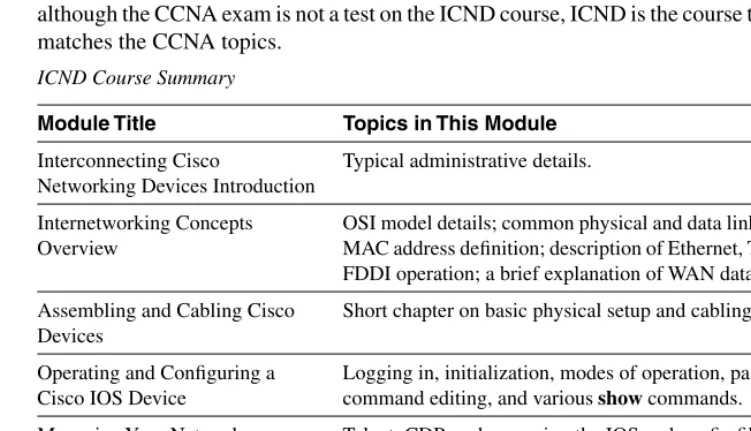
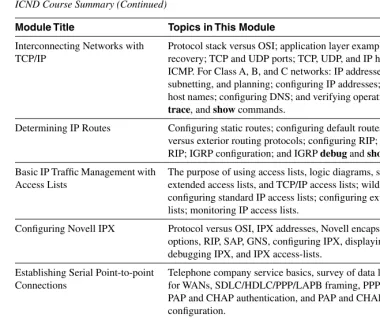
[image:35.612.127.503.353.569.2]First, an outline of the ICND course, shown in Table 1-3, should be helpful. Remember, although the CCNA exam is not a test on the ICND course, ICND is the course that most closely matches the CCNA topics.
Table 1-3 ICND Course Summary
Module Title Topics in This Module
Interconnecting Cisco
Networking Devices Introduction
Typical administrative details.
Internetworking Concepts Overview
OSI model details; common physical and data link specifications; MAC address definition; description of Ethernet, Token Ring, and FDDI operation; a brief explanation of WAN data links.
Assembling and Cabling Cisco Devices
Short chapter on basic physical setup and cabling.
Operating and Configuring a Cisco IOS Device
Logging in, initialization, modes of operation, passwords, help, command editing, and various show commands.
Managing Your Network Environment
Telnet, CDP, and managing the IOS and config files.
Catalyst 1900 Switch Operations LAN switching concepts, spanning tree, and 1900 switch configuration.
Extending Switched Networks with Virtual LANs
Virtual LANs, VLAN trunking, and VLAN configuration on 1900 switches.
12 Chapter 1: All About the Cisco Certified Network Associate Certification
How to Use This Book to Pass the Exam
One way to use this book is to start at the beginning and read it cover to cover. Although that certainly would help you prepare, most people would not take that much time, particularly if you already knew a lot about some of the topics in the book.
The rest of you might want to consider a different strategy on how to best use this book, depending on what training you have had. This book is designed to help you get the most out of the time you take to study.
Interconnecting Networks with TCP/IP
Protocol stack versus OSI; application layer examples; TCP error recovery; TCP and UDP ports; TCP, UDP, and IP headers; and ICMP. For Class A, B, and C networks: IP addresses, mask subnetting, and planning; configuring IP addresses; configuring host names; configuring DNS; and verifying operation with ping,
trace, and show commands.
Determining IP Routes Configuring static routes; configuring default routes; interior versus exterior routing protocols; configuring RIP; debugging RIP; IGRP configuration; and IGRP debug and show commands.
Basic IP Traffic Management with Access Lists
The purpose of using access lists, logic diagrams, standard and extended access lists, and TCP/IP access lists; wildcard masks; configuring standard IP access lists; configuring extended access lists; monitoring IP access lists.
Configuring Novell IPX Protocol versus OSI, IPX addresses, Novell encapsulation options, RIP, SAP, GNS, configuring IPX, displaying IPX, debugging IPX, and IPX access-lists.
Establishing Serial Point-to-point Connections
Telephone company service basics, survey of data link protocols for WANs, SDLC/HDLC/PPP/LAPB framing, PPP functions, PAP and CHAP authentication, and PAP and CHAP
configuration.
Completing an ISDN BRI Call ISDN Protocol basics and dial-on-demand routing (DDR).
Establishing a Frame Relay PVC Connection
[image:36.612.81.461.104.421.2]Terminology, LMI messages, Inverse ARP, addressing, configuration, monitoring, configuration using subinterfaces, NBMA, and full and partial mesh issues.
Table 1-3 ICND Course Summary (Continued)
How to Use This Book to Pass the Exam 13
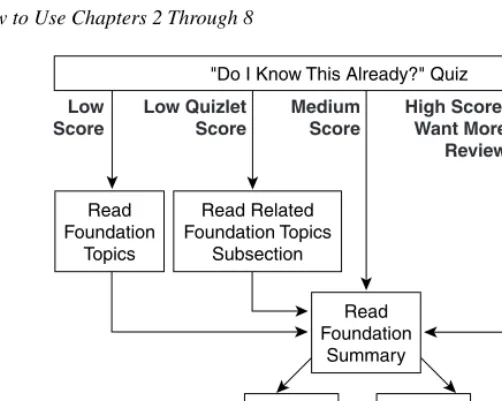
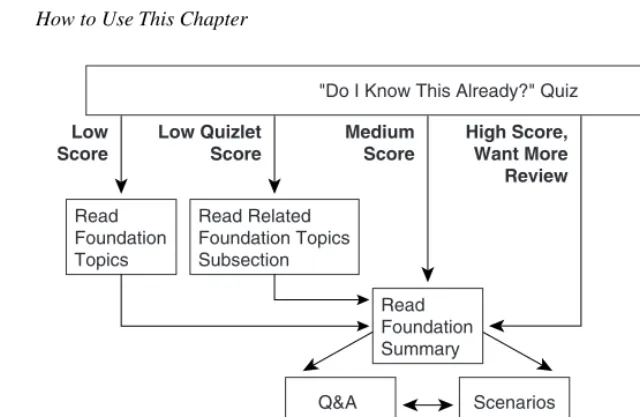
[image:37.612.162.413.165.366.2]The core material for the CCNA is covered in Chapters 2 through 8. At the beginning of each chapter, you are instructed on how to make the best use of your time reading that chapter, assuming that you are not going to read every detail. The instructions on how to use each chapter are outlined in Figure 1-2.
Figure 1-2 How to Use Chapters 2 Through 8
Each of these chapters begins with a quiz, which is broken into subdivisions called “quizlets.” If you get a high score, you might simply review the “Foundation Summary” section at the end of the chapter. If you score well on one quizlet but low on another, you are directed to the section of the chapter corresponding to the quizlet on which your score was low. If you score less than 50 percent on the overall quiz, you should read the whole chapter. Of course, these are simply guidelines—if you score well but want more review on that topic, read away!
After completing the core chapters (Chapters 2 through 8), you have several options for your next study activity. Because Chapter 9, “Scenarios for Final Preparation,” is the next chapter in succession, it outlines the directions on what to do next. These same directions are repeated here as well. Figure 1-3 outlines your options for final study for the exam.
"Do I Know This Already?" Quiz
Read Foundation
Topics
Read Foundation
Summary Read Related
Foundation Topics Subsection
Q&A Scenarios
Go to Next Chapter Low
Score
Low Quizlet Score
Medium Score
High Score, Want More Review
High Score
14 Chapter 1: All About the Cisco Certified Network Associate Certification
Figure 1-3 Final CCNA Exam Preparation Study Strategy
As shown, if you want even more final preparation, you can go over the many practice questions located in each chapter and on the CD. All pre-chapter quiz and chapter-ending questions, with answers, are in Appendix A, “Answers to the ‘Do I Know This Already?’ Quizzes and Q&A Sections.” You can read and review these conveniently located questions and explanations quickly. The CD includes testing software, as well as many additional questions in the format of the CCNA exam. These questions should be a valuable resource when performing final preparations.
Anyone preparing for the CCNA exam can use the guidelines at the beginning of each chapter as a study aid. However, for some additional guidance, the final parts of this chapter give a few strategies for study, based on how you have prepared before buying this book. So, find the section that most closely matches your background in the next few pages, and read about some additional ideas to help you prepare. There is a section for people who have taken ICND, one for those who have taken ICRC, one for those from the Cisco Networking Academies, one for those who will not be taking any classes and have not had much experience, and a final set of strategies for those who will not be taking any classes but who have some experience.
I’ve Taken ICND—Now What?
For starters, you’ve taken the best path to prepare yourself. But let me temper that with the fact that if you retain more than 50 percent of what you heard in class, then you are an extraordinary person! That said, you need the following three strategies:
Review, with Focus on Core CCNA Topics and Commands
Review, with Focus on Breadth of CCNA Topics
Review Particular Topic Using Typical Test Questions
Take a Practice Test
CD-Based Topical Exam Questions
CD-Based Practice Test Read Each Chapter's
Foundation Summary Chapter 9:
Scenarios
How to Use This Book to Pass the Exam 15
Strategy 1: Use this book exactly as described in the opening pages of Chapters 2 through 8, respectively. Each of the foundational chapters begins with a quiz that helps you assess what you need to study. It then directs you to the appropriate sections in the chapter rather than requiring you to read all of each chapter.
Strategy 2: Make it a point to read the sections of the book that cover topics not found in ICND. These section titles are as follows:
•
Chapter 2—“Syslog and Debug”•
Chapter 3—“The OSI, TCP/IP, and NetWare Protocol Architectures”•
Chapter 3—“OSI Transport Layer Functions”•
Chapter 5—“CIDR, Private Addressing, and NAT”•
Chapter 6—“Distance Vector Routing Protocols”•
Chapter 6—“Tunneling”Strategy 3: Use the directions at the beginning of Chapter 9 to direct your final study before the exam. Chapter 9 is designed to review many concepts, and it outlines a good process for study in the days leading up to your exam.
By using these three strategies, you will fill in the gaps in your knowledge and be confident taking your CCNA exam.
I’ve Taken ICRC—Now What?
The current version of the exam more closely matches the ICND class. However, if you compared the two course books, you would find much more in common than is different. In fact, more than half of ICND is directly taken from the ICRC course. Of course, if you retain more than 50 percent of what you heard in class, then you are an extraordinary person, so you probably still need to fill in some holes in your knowledge base. For you, the following strategies will be most helpful:
Strategy 1: Begin with a complete study of Chapter 4, which covers LANs and LAN switching. ICRC did not cover LAN switching and Spanning-Tree Protocol, which are covered here in detail. Do not skip the configuration sections, either—they are very important.
Strategy 2: Use this book exactly as described in the opening pages of Chapters 2 through 8. Each of the foundational chapters begins with a quiz that helps you assess what you need to study. It then directs you to the appropriate sections in the chapter rather than requiring you to read all of each chapter. In fact, you probably should use Chapter 4 this way as well, in spite of having read it already, because that will validate what you have learned.
Strategy 3: Make it a point to read the sections of the book that cover topics not found in ICRC. Other than almost all of Chapter 4 of this book, the section titles you will want to be sure to read are as follows:
16 Chapter 1: All About the Cisco Certified Network Associate Certification
•
Chapter 2—“Syslog and Debug”•
Chapter 3—“The OSI, TCP/IP, and NetWare Protocol Architectures”•
Chapter 3—“OSI Transport Layer Functions”•
Chapter 5—“CIDR, Private Addressing, and NAT”•
Chapter 6—“Distance Vector Routing Protocols”•
Chapter 6—“Tunneling”Strategy 4: Use the directions at the beginning of Chapter 9 to direct your final study before the exam. Chapter 9 is designed to review many concepts, and it outlines a good process for study in the days leading up to your exam.
So, compared to those who have taken ICND, you should not require a lot of additional study time. The ICRC course did a great job of explaining the basics, and hopefully this book will help you retain enough to confidently pass the exam.
I’ve Taken the Cisco Networking Academy Courses—Now What?
First of all, congratulations on having the foresight to get into the Cisco Networking Academy program—we need more people who can make this stuff work! (Those of you who didn’t take the Cisco Networking Academy track and are wondering what it’s all about, check out www.cisco.com/warp/public/779/edu/academy/.) Thankfully, the Networking Academy curriculum actually does a great job of preparing you with the skills and knowledge you need to pass the exam. Unfortunately, your study was probably spread over several semesters, and possibly over a couple of years. So, the details that you do not use frequently may have been forgotten. Now, on to the strategies for success on CCNA:
Strategy 1: Pull out your Networking Academy curriculum and notes, and reread them. Most people’s memory is exercised better by seeing familiar material—and even more so when you wrote it down yourself. If you have ever taken a test and pictured in your mind where the answer was on your page of notes, then you can relate.
Strategy 2: Use this book exactly as described in the opening pages of Chapters 2 through 8. Each of the foundational chapters begins with a quiz that helps you assess what you need to study. It then directs you to the appropriate sections in the chapter rather than requiring you to read all of each chapter.
Strategy 3: Make it a point to read the sections that cover some of the theory behind networking and some of the standards. The biggest reason for that is that the Networking Academy is oriented more toward building skills than theoretical knowledge. The suggested sections are listed here: