arXiv:1705.06738v1 [cs.PL] 18 May 2017
Submitted to: VPT 2017
c
A. P. Lisitsa, A. P. Nemytykh This work is licensed under the Creative Commons Attribution License.
Alexei P. Lisitsa
Department of Computer Science, The University of Liverpool [email protected]
Andrei P. Nemytykh
Program Systems Institute, Russian Academy of Sciences∗
We explore an approach to verification of programs via program transformation applied to an in-terpreter of a programming language. A specialization technique known as Turchin’s supercompi-lation is used to specialize some interpreters with respect to the program models. We show that several safety properties of functional programs modeling a class of cache coherence protocols can be proved by a supercompiler and compare the results with our earlier work on direct verification via supercompilation not using intermediate interpretation.
Our approach was in part inspired by an earlier work by De E. Angelis et al. (2014-2015) where verification via program transformation and intermediate interpretation was studied in the context of specialization of constraint logic programs.
Keywords: program specialization, supercompilation, program analysis, program transformation,
safety verification, cache coherence protocols
1
Introduction
We show that a well-known program specialization task called the first Futamura projection [11, 37, 17] can be used for indirect verifying some safety properties of functional program modeling a class of non-deterministic parameterized computing systems specified in a language that differs from the object programming language treated by a program specializer deciding the task. Let a specializer transforming programs written in a languageL and an interpreterIntM of a languageM, which is also implemented inL, be given. Given a program p0 written in M, the mentioned task is to specialize the interpreter IntM(p0,d)with respect to its first argument, while the datadof the programp0is unknown.
Our interest in this task has been inspired by the following works [2, 4] especially the presentation given by the authors of these articles at the Workshop VPT-2015. The authors work in terms ofconstraint logic programming (CLP), where the constraint language is the linear arithmetic inequalities imposed on integer values of variables. They use partial deduction [22] and CLP program specialization [9, 3] methods for specializing an interpreter of a C-like language with respect to given programs, aiming at verification of the C-like imperative specifications with respect to the postconditions defined in CLP and defining the same functions (relations) as done by the corresponding C-like programs. Additionally to the CLP program specialization developed by De E. Angelis et al. and called VeriMAP [3] they also use external satisfiability modulo theories (SMT) solvers. We would also refer to an earlier work by J. P. Gallagher et al. [12] reported on a language-independent method for analyzing the imperative programs via intermediate interpretation by a logic programming language. The success of such a method depends eventually on the analysis tools available for the logic programming languages. Note that the transformation examples given in the papers [12, 9, 3] presenting the both mentioned approaches deal with neither function nor constructor application stack in the interpreted programs.
In this paper we focus our attention on self-sufficient methods for specialization of functional pro-grams, aiming at proving somesafetyproperties of the programs. Such a property problem is a (un)rea-chability problem meaning that when a program is running, an unsafe program configuration cannot be reached from any initial configuration. We consider a program specialization method called Turchin’s supercompilation [38, 37, 36, 18] and study potential capabilities of the method for verifying the safety properties of the functional programs modeling a class of non-deterministic parameterized cache coher-ence protocols [6]. We use an approach to functional modeling of non-deterministic computing systems, first presented by these authors in [24, 25, 27]. The simple idea behind the approach is as follows. Given a program modeling a deterministic computing system, whose behavior depends on and is controlled by an input parameter value, let us call for an oracle producing the input value. Then the meta-system in-cluding both the program and the external oracle becomes non-deterministic one. And vice versa, given a non-deterministic system, one may be concerned about the behavior of the system only along one possi-ble path of the system evaluation. In such a case, the path of interest may be given as an additional input argument of the system, forcing the system to follow along the path. Dealing with unknown value of the additional parameter one can study any possible evolution of the non-deterministic system, for example, aiming at verifying some properties of the system.
Viability of such an approach to verification has been demonstrated in previous works using super-compilation as a program transformation and analyzing technique [24, 25, 27, 26, 19], where it was applied to safety verification of program models of parameterized protocols and Petri Nets models. Fur-thermore, the functional program modeling and supercompilation have been used to specify and verify cryptographic protocols, and in the case of insecure protocols a supercompiler was utilized in an inter-active search for the attacks on the protocols [1, 32]. In these cases the supercompiler has been used for specializing the corresponding program models, aiming at moving the safety properties of interest from the semantics level of the models to simplest syntactic properties of the residual programs produced by the supercompiler. Later this approach was extended by G. W. Hamilton for verifying a wider class of temporal properties of reactive systems [13, 14].
Given a specializer transforming the program written in a language L and used for program model verification, in order to mitigate the limitation of the specification languageL, in this paper we study potential abilities of the corresponding specialization method for verifying the models specified in an-other language M, removing the intermediate interpretation overheads. We analyze the supercompi-lation algorithms allowing us crucially to remove the interpretation layer and to verify indirectly the safety properties. The corresponding experiments succeed in verifying some safety properties of the series of parameterized cache coherence protocols specified, for example, in the imperative WHILE language by N. D. Jones [16]. Nevertheless, in order to demonstrate that our method is able to deal with non-imperative interpreted programs, we consider the case when a modelling languageM is a non-imperative subset of the basic languageL. On the other hand, that allows us to simplify the presentation. In order to prove the properties of interest, some our program models used in the experiments required one additional supercompilation step (i.e., the corresponding residual programs should be supercompiled once again1).
The considered class of cache coherence protocols effectively forms a benchmark on which various methods for parameterized verification have been tried [6, 25, 27]. In [25, 27] we have applied direct ver-ification via supercompilation approach without intermediate interpretation. The corresponding models may be very large and the automatic proofs of their safety properties may have very complicated
struc-1Note that the method presented in the papers [2, 4] mentioned above sometimes requires a number of iterations of the
tures. See, for example, the structure of the corresponding proof [26] produced by the supercompiler SCP4 [28, 29, 31] for the functional program model of the parameterized Two Consumers - Two Pro-ducers (2P/2C) protocol for multithreaded Java programs [42]. Taking that into account, the experiment presented in this paper can also be considered as a partial verification of the intermediate interpreters
IntM(p,d)used in the experiments. That is to say, a verification of the interpreters with respect to the subset of the input values of the argumentp, being the program models of the cache coherence protocols. A supercompiler is a program specilalizer based on the supercompilation technique. The program examples given in this paper were specialized by the supercompiler SCP4 [28, 29, 31]. We present our interpreter examples in a variant of a pseudocode for a functional program while real supercompilation experiments with the programs were done in the strict functional programming language Refal [40]2, [41] being both the object and implementation language of the supercompiler SCP4. One of advantages of using supercompilation, instead of other forms of partial evaluation or CLP specialization, is the use of Turchin’s relation 4.2 (see also [39, 29, 34]) defined on function-call stacks, where the function calls are labeled by the times when they are generated by the unfold-fold loop. This relation is responsible for accurate generalizing the stack structures of the unfolded program configurations. It isbased on global propertiesof the path in the corresponding unfolded tree rather than on the structures of two given con-figurations in the path. Turchin’s relation both stops the loop unfolding the tree andprovides an evidence of how a given call-stack structure has to be generalized. Proposition 1 proven in this paper shows that a composition of the Turchin and Higman-Kruskal relations may prevent generalization of two given interpreter configurations encountered inside one big-step of the interpreter. Such a prevention from generalization is crucial for optimal specialization of any interpreter with respect to a given program.
This paper assumes that the reader has basic knowledge of concepts of functional programming, pattern matching, term rewriting systems, and program specialization.
The contributions of this paper are: (1) Developing a method aiming at uniform reasoning on proper-ties of configurations’ sequences that are encountered in specializing an interpreter of a Turing complete language. (2) In particular, we have proved the following statement. Consider specialization of the inter-preter with respect to any interpreted program from an infinite program set that is large enough to specify a series of parameterized cache coherence protocols, controlled by a composition of the Turchin 4.2 and Higman-Kruskal 4.1 relations. Given a big-step of the interpreter to be processed by the unfold-fold loop, we assume that no both generalization and folding actions were still done by this loop up to the moment considered. Then any two non-transitive 4.3 big-step internal configurationsC1,C2 are prevented from both generalization and folding actions. (3) We show that supercompilation controlled by the composi-tion of the relacomposi-tions above is able to verify some safety properties of the series of parameterized cache coherence protocols via intermediate interpretation of their program models. Note that these program specifications include both the function call and constructor application stacks, where the size of the first one is uniformly bounded on the input parameter while the second one is not. Unlike VeriMAP [3] our indirect verification method involves no post-specialization unfold-fold.
The paper is organized as follows. In Section 2 we describe the syntax and semantics of a pseudocode for a subset of the strict functional language Refal which will be used throughout this paper. We also give the operational semantics of the subset, defining its “self-interpreter”. In Section 3 we outline our approach for specifying non-deterministic systems by an example used through this paper. In Section 4 we shortly introduce an unfold-fold program transformation method known as Turchin’s
supercompi-2The reader is welcome to execute several sample Refal programs and even any program written by the user directly from
lation that is used in our experiments presented in this paper. We describe the strategy controlling the unfold-fold loop. The corresponding relation is a composition of Turchin’s relation and a variant of the Higman-Kruskal relation. This composition plays a central role in verifying the safety properties of the cache coherence protocols’ models via intermediate interpretation. In Section 5 we prove in a uniform way a number of properties of a huge amount of the complicated configurations generated by special-ization of the self-interpreter with respect to the given program modeling a cache coherence protocol. The argumentations given in the section are applicable for the whole series of the protocols mentioned in Section 6. Developing the method of such argumentations is the main aim of the paper and both Proposition 1 and the proof of this proposition are the main results of the paper. The statement given in Proposition 1 can be applied to a wide class of interpreters of Turing complete programming languages. This statement is a theoretical basis to the following. Why the approach suggested in the paper does succeed in verifying the safety properties of the series of the cache coherence protocols via intermediate interpretation. Finally, in Section 6 we report on some other experimental results obtained by using the approach, discuss the results presented in the paper, and compare our experiments with other ones done by existing methods.
2
An Interpreter for a Fragment of the SCP4 Object Language
A first interpreter we consider is an interpreter of a subsetL of the SCP4 object language, which we aim to put in between the supercompiler SCP4 and programs modeling the cache coherence protocols to be verified. We will refer to this interpreter as a “self-interpreter”.
In this section, we describe the syntax and semantics of a pseudocode for the subset of the strict func-tional language Refal which will be used throughout this paper. We also give the operafunc-tional semantics (that is, the interpreter) of the subset.
2.1 Language
prog::= def1 . . . defn Program
def ::= f(ps1)⇒exp1; . . .; f(psn)⇒expn; Function Definition
exp::= v Variable
| term:exp ConsApplication
| f(exp1, ...,expn) Function Application
| exp1++exp2 AppendApplication
| [] Nil
term::= s.name Symbol-Type Variable
| (exp) Constructor Application
| σ Symbol
ps::= p1, ...,pn Patterns
p::= v
| s.name:p
| (p1):p2
| σ :p
| []
Programs inL arestrictterm rewriting systems based on pattern matching.
The rules in the programs are ordered from the top to the bottom to be matched. To be closer to Refal we use two kinds of variables: s.variables range oversymbols (i.e., characters and identifiers, for example,’a’and True), whilee.variables range over the whole set of theS-expressions.3 Given a rule
l⇒ r, any variable of r should appear in l. Each function f has a fixed arity, i.e., the arities of all left-hand sides of the rules off and any expression f( exp1, ..., expn ) must equal the arity off. The
parenthesis constructor (•)is used without a name. Consconstructor is used in infix notation and may be omitted. The patterns in a function definition are not exhaustive. If no left-hand side of the function rules matches the values assigned to a call of the function, then executing the call is interrupted and its value is undefined. In the sequel, the expression set is denoted byE;DandSstand for the data set, i.e., the patterns containing no variable, and the symbols set, respectively. The name set of the functions of an arityn is denoted byFn whileFstands for
S∞
n=0Fn. Ve andVsstand for thee- ands-variable sets,
respectively, andV denotesVe∪Vs. Let an expressionexpbe given. Ve(exp),Vs(exp),V(exp)denote the corresponding variable sets ofexp.µv(exp)denotes the multiplicity ofv∈V inexp, i. e., the number
of all the occurrences ofvinexp.expis called passive if no function application occurs inexpotherwise it is called an active expression. T stands for the term set,σ stands for a symbol. Given an expression
expand a variable substitutionθ,expθ stands forθ(exp).
2.2 Encoding
In our experiments considered in this paper the protocol program models have to be input values of the interpreter argument with respect to which the interpreter is specialized. Thus the program model should be encoded in the data set of the implementation language of the interpreter. The program models used in this paper are written in a fragment of the language described in Section 2.1, where ++ constructor is not allowed and only unary functions may appear.
Now we have to define the corresponding encoding function denoted by the underline, where the functionAgroups the program rules belonging to the same function as it is shown in the second definition line.
prog= ( A(prog) ); Program
f{rules}defs= (f rules):defs; Function Definitions
rule; rules= (rule ):rules; Rules
f(pattern) ⇒ exp= ( pattern ) :’=’: ( exp ); Rule
term:exp=term : exp; Hereterm::= (exp)|s.name|σ (exp) = (’*’ exp); f(exp) = (Call f exp); Applications
e.name= (Var ’e’ name); s.name= (Var ’s’ name); Variables
[] = []; σ =σ; Niland Symbol
Note that any pattern is an expression.
Supercompiler SCP4 in its processing dealing with programs as input data uses this encoding func-tion and utilizes its properties. The image ofDunder the encoding is a proper subset ofD, i. e.,D6=D. For example,(Var’s’name)∈/D.
3This fragment of Refal is introduced for the sake of simplicity. The reader may think that the syntactic categoryexpof list
Int( (Call s.f e.d), e.P)⇒Eval(EvalCall(s.f,e.d,e.P),e.P);
Eval( (e.env):(Call s.f e.q):e.exp,e.P)
⇒Eval(EvalCall(s.f,Eval( (e.env):e.q, e.P), e.P),e.P)++Eval( (e.env):e.exp,e.P);
Eval( (e.env):(Var e.var):e.exp,e.P)⇒Subst(e.env, (Var e.var) )++Eval( (e.env):e.exp, e.P);
Eval( (e.env):(’*’e.q):e.exp, e.P)⇒(’*’Eval( (e.env):e.q,e.P)):Eval( (e.env):e.exp, e.P);
Eval( (e.env):s.x:e.exp, e.P)⇒s.x:Eval( (e.env):e.exp, e.P);
Eval( (e.env):[],e.P)⇒[];
EvalCall(s.f, e.d, (Prog s.n) )⇒Matching(F, [],LookFor(s.f,Prog(s.n) ), e.d);
Matching(F,e.old, ((e.p):’=’:(e.exp)):e.def,e.d)
⇒Matching(Match(e.p,e.d,([]) ), e.exp,e.def, e.d);
Matching( (e.env), e.exp, e.def,e.d)⇒(e.env):e.exp;
Match( (Var’e’s.n),e.d,(e.env) )⇒PutVar( (Var’e’s.n) :e.d, (e.env) );
Match( (Var’s’s.n):e.p,s.x :e.d, (e.env) )
⇒Match(e.p,e.d,PutVar( (Var’s’s.n) :s.x, (e.env) ) );
Match( (’*’e.q):e.p, (’*’e.x):e.d,(e.env) )
⇒Match(e.p,e.d,Match(e.q, e.x,(e.env) ) );
Match(s.x:e.p,s.x:e.d,(e.env) )⇒Match(e.p, e.d,(e.env) );
Match([], [],(e.env) )⇒(e.env);
Match(e.p,e.d,e.fail)⇒F;
PutVar(e.assign,(e.env) )⇒CheckRepVar(PutV( (e.assign), e.env,[]) );
PutV( ((Var s.t s.n):e.val), ((Var s.t s.n):e.pval):e.env,e.penv)
⇒(Eq(e.val,e.pval)):((Var s.t s.n):e.pval):e.env;
PutV( (e.assign),(e.passign):e.env, e.penv)
⇒PutV( (e.assign),e.env,(e.passign) :e.penv);
PutV( (e.assign),[], e.penv)⇒(T):(e.assign) : e.penv;
CheckRepVar( (T):e.env)⇒(e.env);
CheckRepVar( (F):e.env)⇒F;
Eq(s.x : e.xs, s.x : e.ys)⇒Eq(e.xs,e.ys);
Eq( (’*’e.x):e.xs,(’*’e.y):e.ys)⇒ContEq(Eq(e.x, e.y),e.xs,e.ys);
Eq([],[])⇒T;
Eq(e.xs, e.ys)⇒F;
ContEq(F,e.xs,e.ys)⇒F;
ContEq(T,e.xs,e.ys)⇒Eq(e.xs,e.ys);
LookFor(s.f, (s.f : e.def):e.P)⇒e.def;
LookFor(s.f, (s.g : e.def):e.P)⇒LookFor(s.f,e.P);
Subst( ((Var s.t s.n):e.val):e.env, (Var s.t s.n) )⇒e.val;
Subst( (e.assign):e.env, e.var)⇒Subst(e.env,e.var);
2.3 The Interpreter
The self-interpreter used in the experiments is given in Figure 1.
The entry point is of the following form Int( (Call s.f e.d),e.P). Here the first argument is the application constructor of the main function to be executed. The second argument provides the name of a program to be interpreted. The encoded source of the program will be returned by a function call ofProgwhenever it is asked byEvalCall. For example, interpretation of program model Synapse N+1 given in Section 3.1 starts with the following applicationInt( (Call Main d0), (Prog Synapse) ), where
d0is an input data given to program Synapse. Due to the large size of the encoded programs we omit the definition of functionProg.
EvalCall( (Call s.f e.d), e.P) asks for the definition of functions.f, callingLookFor, and initiates matching the data given bye.d against the patterns of the definition rules. In order to start this pattern matching, it imitates a fail happening in matching the data against a previous nonexistent pattern.
FunctionMatching runs over the definition rules, testing the result of matching the input data (e.d) against the current pattern considered. In the case if the result isFthe function calls functionMatch, ask-ing for matchask-ing the input data against the next rule pattern. The environmente.envis initialized by[]
(see the third argument of theMatch call). If the pattern matching succeeds then functionMatching re-turns(e.env):e.exp, where expressione.expis the right-hand side of the current rule and the environment includes the variable assignments computed by the pattern matching.
FunctionMatchis trying to match the input data given in its second argument, step by step, against the pattern given in its first argument. It computes the environment containing the variable substitution defined by the matching (see the first and second function rules). If a variable is encountered then function PutVar callsPutV looking for an assignment to the same variable and, if such an assignment exists, the function tests a possible coincidence of the new and old values assigned to the variable. The third rule of functionMatchdeals with the tree structure, calling this function twice.
FunctionEvalpasses through an expression given in its second argument. The secondEvalrule deals with a variable and calls functionSubstlooking the environment for the variable value and replacing the variable with its value.
We intend to specialize interpreterIntwith respect to its second argument. The correspondingRefal
source code of the self-interpreter may be found in
http://refal.botik.ru/protocols/Self-Int-Refal.zip.
3
Specifying Cache Coherence Protocols
We show our method [25, 27] for specifying non-deterministic systems by an example used through this paper. The Synapse N+1 protocol definition given below is borrowed from [5]. The parameterized version of the protocol is considered andcounting abstractionis used in the specification. The protocol has to react to five external non-deterministic events by updating its states being three integer counters. The initial value of counterinvalidis parameterized (so it could be any positive integer), while the other two counters are initialized by zero. The primed state names stand for the updated state values. The empty updates mean that nothing happened.
(rh) dirty+valid≥1 → .
(rm) invalid≥1 →dirty′=0,valid′=valid+1,invalid′ =invalid+dirty−1. (wh1) dirty≥1 → .
Specification of Safety Properties Any state reached by the protocol should not satisfy any of the two following properties: (1) invalid≥0,dirty≥1,valid≥1 ; (2) invalid≥0,dirty≥2,valid≥0 .
Main( (e.time):(e.is) )⇒Loop( (e.time) :(Invalid I e.is):(Dirty):(Valid) );
Loop( ([]):(Invalid e.is):(Dirty e.ds):(Valid e.vs) )
⇒Test( (Invalid e.is) :(Dirty e.ds) :(Valid e.vs) );
Loop( (s.t :e.time) :(Invalid e.is):(Dirty e.ds):(Valid e.vs) )
⇒Loop( (e.time) :Event(s.t :(Invalid e.is) :(Dirty e.ds) :(Valid e.vs) ) );
Event(rm :(Invalid I e.is):(Dirty e.ds):(Valid e.vs) )
⇒(Invalid Append( (e.ds) :(e.is) )):(Dirty) :(Valid I e.vs);
Event(wh2 :(Invalid e.is):(Dirty e.ds):(Valid I e.vs) )
⇒(Invalid Append( (e.vs) :(Append( (e.ds) :(e.is) )) )):(Dirty I):(Valid);
Event(wm:(Invalid I e.is):(Dirty e.ds):(Valid e.vs) )
⇒(Invalid Append( (e.vs) :(Append( (e.ds) :(e.is) )) )):(Dirty I):(Valid);
Append( ([]):(e.ys) )⇒e.ys;
Append( (s.x :e.xs):(e.ys) )⇒s.x :Append( (e.xs):(e.ys) );
Test( (Invalid e.is):(Dirty I e.ds):(Valid I e.vs) )⇒False;
Test( (Invalid e.is):(Dirty I I e.ds):(Valid e.vs) )⇒False;
Test( (Invalid e.is):(Dirty e.ds):(Valid e.vs) )⇒True;
Figure 2: Model of the Synapse N+1 cache coherence protocol
3.1 Program Model of the Synapse N+1 Cache Coherence Protocol
Let us then specify a program model of our sample protocol. The Synapse N+1 program is given in Figure 2. The idea behind the program specifications modeling the reactive systems is given in Introduction 1 above. The finite stream of events is modeled by a time value. The time ticks are labeled by the events. The counters’ values are specified in the unary notation. The unary addition is directly defined by functionAppend, i.e., without referencing to the corresponding macros. FunctionLoopexhausts the event stream, step by step, and calls forTestverifying the safety property required from the protocol. Thus functionMainis a predicate.
Note that given input values the partial predicate terminates since the event stream is finite. The termination is normal, if the final protocol state asked by the input stream is reachable one, otherwise it is abnormal.
4
On Supercompilation
In this paper we are interested in one particular approach in program transformation and specialization, known as supercompilation4. Supercompilation is a powerful semantics-based program transformation
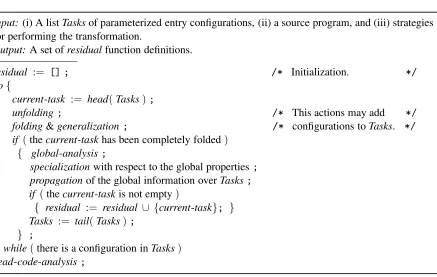
technique [36, 38] having a long history well back to the 1960-70s, when it was proposed by V. Turchin. The main idea behind a supercompiler is to observe the behavior of a functional program prunning on a partiallydefined input with the aim to define a program, which would be equivalent to the original one (on the domain of the latter), but having improved properties. Given a program and its parameter-ized entry point, supercompilation is performed by an unfold-fold cycleunfolding this entry point. It reduces the redundancy that could be present in the original program. It folds the tree into a finite graph of states and transitions between possible parameterized configurations of the computing system. And, finally, it analyses global properties of the graph and specializes this graph with respect to these proper-ties (without additional unfolding steps).5 The resulting program definition is constructed solely based on the meta-interpretation of the source program rather than by a (step-by-step) transformation of the program. The result of supercompilation may be a specialized version of the original program, taking into account the properties of partially known arguments, or just a re-formulated, and sometimes more efficient, equivalent program (on the domain of the original).
Turchin’s ideas have been studied by a number of authors for a long time and have, to some extent, been brought to the algorithmic and implementation stage [31]. From the very beginning the development of supercompilation has been conducted mainly in the context of the programming language Refal [28, 29, 30, 40]. A number of model supercompilers for subsets of functional languages based on Lisp data were implemented with the aim of formalizing some aspects of the supercompilation algorithms [18, 20, 36]. The most advanced supercompiler for Refal is SCP4 [28, 29, 31].
The verification system VeriMAP [3] by De E. Angelis et al. [2, 4] uses nontrivial properties of integers recognized by both CLP built-in predicates and external SMT solvers. We, like the VeriMAP authors, use a nontrivial property of the configurations. The property is the associativity of the built-in append function++supported by the supercompiler SCP4 itself6, rather than by an external solver.
4.1 The Well-Quasi-Ordering onE
The following relation is a variant of the Higman-Kruskal relation and is a well-quasi-ordering [15, 21] (see also [23]).
Definition 1 The homeomorphic embedding relation ∝is the smallest transitive relation onEsatisfying the following properties, where f ∈Fn,α,β,τ,s,t,t1, . . . ,tn∈Eandα,β,τ ∈T.
∀x,y∈Ve.x∝y,∀u,v∈Vs.u∝v; Variables (4.1)
[]∝t,t∝t,t∝ f(t1, . . .,t, . . . ,tn),t∝(t),t∝α:t; Monotonicity
(4.2)
if s∝t andα ∝ β,then(s)∝(t),α:s∝β:t;
if s∝t, then f(t1, . . . ,s, . . . ,tn)∝f(t1, . . .,t, . . . ,tn).
Note that the definition takes into account function append, since its infix notation exp1 ++ exp2
stands for append( exp1, exp2 ). We use relation ∝ modulo associativity of ++ and the following
equalitiesterm:exp1=term ++ exp1,exp ++ []=expand[] ++ exp=exp.
Corollary 1 If t1, . . . ,tn−1∈T and tn∈E, and given i1, . . . ,ijsuch that1≤i1<i2< . . . <ij≤n, then
ti1 :. . . :tij ∝ t1:. . .:tn.
5See also Section 7.1 in Appendix.
Corollary 2 For any f ∈Fn,α,β,γ,t1, . . . ,tn∈E ( monotonicity of relation 6∝ )
ifα ∝6 β,then f(t1, . . . ,ti−1,α,ti+1, . . . ,tn)∝6 f(t1, . . . ,ti−1,β,ti+1, . . . ,tn).
(4.3)
Given an infinite sequence of expressions t1, . . . ,tn, . . ., relation ∝ is relevant to approximation of
loops increasing the syntactical structures in the sequence; or in other words to looking for the regular similar cases of mathematical induction on the structure of the expressions. That is to say the cases, which allow us to refer one to another by a step of the induction.
An additional restriction separates the basic cases of the induction from the regular ones. The restric-tion is:∀σ.([])6∝(σ)&∀v∈Vs.([])6∝(v).
We impose this restriction on the relation ∝ modulo the equalities above and denote the obtained relation as4. It is easy to see that such a restriction does not violate the quasi-ordering property. Note that the restriction may be varied in the obvious way, but for our experiments its simplest case given above is used to control generalization and has turned out to be sufficient. In the sequel,t1≺t2stands for the following relationt14t2andt16=t2, which is transitive.
Definition 2 A parameterized configuration is a finite sequence of the form
lete.h=f1(exp11, . . . , exp1m) in . . . lete.h=fk(expk1, . . . , expkj) in expn+1, where expn+1is
passive, for all i>1µe.h(fi( . . .)) =µe.h(expn+1) =1, andµe.h(f1( . . .)) =0; for all i and all j variable
e.h does not occur in any function application being a sub-expression of expij. In the sequel, we refer to
such a function application fi( . . .)given explicitly in the configuration as an upper function application.
The configurations present the function application stacks, in which all constructors’ applications not occurring in arguments of the upper function applications are moved to the rightmost expressions. Here theappend ++ is treated as a complex constructor7, rather than a function. The rightmost expression is the bottom of the stack. Since the value ofe.his reassigned in eachletin the stack, for brevity sake, we use the following presentation of the configurations:
f1(exp11, . . . , exp1m), . . . ,fk(expk1, . . . , expkj), expn+1, where variablee.his replaced with bullet
•. I.e., the bullet is just a placeholder. The last expression may be omitted if it equals •. An example followsf(a :e.xs++e.ys), g( • ++e.ys, (Var b c), []), f(s.x :•), s.x :•++t(s.x :e.zs), •.
4.2 The Well-Disordering on Timed Configurations
Let a program to be specialized and a path starting at the root of the tree unfolded by the unfold-fold loop widely used in program specialization be given. The vertices in the path are labeled by the program parameterized configurations. These configurations form a sequence. Given a configuration from such a sequence and a function application from the configuration, we label the application by the time when it is generated by the unfold-fold loop. Such a labeled function application is said to be a timed application. A configuration is said to be timed if all upper function applications in the configuration are timed. Note that, given a timed configuration, all its timed applications have differing time-labels. Given two different configurationsC1,C2, if the unfold-fold loop copies an upper function application fromC1and uses this copy inC2, thenC1,C2share this timed application. In the sequel, a sequence of the timed configurations generated by the unfold-fold loop is also called just a path.
In this section we define a binary relation ⊳ on the timed configurations in the path. The relation is originated from V. F. Turchin [39] (see also [29, 33, 34]). It isnottransitive8, but like the well-quasi-ordering it satisfies the following crucial property used by supercompilation to stop the loop unfolding the tree.
For any infinite pathC1,C2, . . . ,Cn, . . .there exist two timed configurationsCi,Cj such thati< j
andCi ⊳Cj(see [39, 34]). For this reason we call relation ⊳ a well-disordering relation. In the sequel,
the time-labels are denoted with subscripts.
Definition 3 Given a sequence of timed configurations C1, . . . Cn, . . .; Ci and Cj are elements of the
sequence such that i< j and Ci ::= ft11(. . .), . . . , f k
tk(. . .),exp1, Cj ::= g 1
τ1(. . .), . . . ,g m
τm(. . .),exp2,
where fs ts and g
q
τq,1≤s≤k and1≤q≤m, stand for function names f
s, gqlabeled with times t
sandτq,
respectively, and exp1,exp2are passive expressions.
If k≤m,δ=m−k and∃l.(1<l≤k)such that∀s.(0≤s≤k−l) ftll++ss=gδτδ++l+s
l+s (i.e., f
l+s=gδ+l+s
and tl+s=τδ+l+shold), ftll−−116=g δ+l−1
τδ+l−1, and∀s.(0<s<l) f s ts ≃g
s
τs (i.e., f
s=gs), then C i ⊳Cj.
We say that configurations Ci, Cjare in Turchin’s relation Ci ⊳Cj. This longest coincided rest of the
configurations are said to be a context, while the parts equal one to another modulo their time-labels are called prefixes of the corresponding configurations.
The idea behind this definition is as follows. The function applications in the context never took a part in computing the configurationCj, in this segment of the path, while any function applications in the
prefix ofCitook a part in computing the configurationCj. Since the prefixes ofCi,Cj coincide modulo
their time-labels, these prefixes approximate a loop in the program being specialized. The prefix ofCi
is the entry point in this loop, while the prefix ofCj initiates the loop iterations. The common context
approximates computations after this loop. Note that Turchin’s relation does not impose any restriction on the arguments of the function applications inCi,Cj.
For example, consider the following two configurations C1 ::= f4(. . .),f3(. . .),g2(. . .),t1(. . .),• and C2 ::= f10(. . .),f7(. . .),g5(. . .), . . . , t1(. . .),•, thenC1 ⊳ C2holds. Here the context ist1(. . .), the prefix ofC1 is f4(. . .), f3(. . .),g2(. . .), and the prefix of C2 is f10(. . .), f7(. . .),g5(. . .), where the subscripts of the application names stand for the time-labels. See also Section 7.3 for a detailed example regarding Turchin’s relation.
4.3 The Strategy Controlling the Unfolding Loop
Now we describe the main relation controlling the unfold-fold loop. That is to say, given a path starting at the root of the unfolded tree, and two timed configurationsC1,C2in the path such thatC1was generated beforeC2, this relation stops the loop unfolding the tree and calls the tools responsible for folding this path. These tools, firstly, attempt to foldC2 by a previous configuration and, if that is impossible, then attempt to generalize this configuration pair. The relation is a composition of relations ⊳ and 4. It is denoted with⊳◦4and is a well-disordering (see [39, 34]).
Thus we are given two timed configurationsC1,C2from a path, such thatC1is generated beforeC2, andC2is the last configuration in the path. If relationC1 ⊳ C2does not hold, then the unfold-fold loop unfolds the current configurationC2and goes on. In the case relationC1 ⊳C2holds, these configurations are of the forms (see Section 4.2 for the notation used below):
C1 = ft11(. . .), . . . , f l−1
tl−1(. . .),f l
tl(. . .), . . . , f
k
tk(. . .),exp1,
C2 = fτ11(. . .), . . . , f l−1
τl−1(. . .),g l
τl(. . .), . . . ,g
m
τm(. . .), f
l
tl(. . .), . . . , f
k
tk(. . .),exp2, where the context starts at fl
tl(. . .). LetC
p
i stand for the prefix ofCi, andCicstand for the context ofCifollowed byexpi.
that the context may be generalized despite the fact that it does not take a part in computing the current configurationC2, since a narrowing of the context parameters may have happened.
A parameterized program configuration is said to be a transitive configuration if one-step unfolding of the configuration results in a tree containing only the vertices with at most one outgoing edge. That is to say, any of the tree vertices is not a branching vertex. For example, any function application of the form f(d1, . . . ,dn), where anydi∈D, is transitive.
For the sake of simplicity, in the experiments described in this paper, the following strategy is used. The unfold-fold loop skips all transitive configurations encountered and removes them from the tree being unfolded. In the sequel, we refer to the strategy described in this section, including relation⊳◦4, as the⊳◦4-strategy.
5
Indirect Verifying the Synapse N+1 Program Model
In this section we present an application of our program verification method based on supercompilation of intermediate interpretations. In general the method may perform a number of program specializations9, but all the cache coherence protocol program models that we have tried to verify by supercompiler SCP4 require at most two specializations.
Given a program partial predicate modeling both a cache coherence protocol and a safety property required from the protocol, we use supercompilation aiming at moving the property hidden in the pro-gram semantics to a simple syntactic property of the residual propro-gram generated by supercompilation, i.e., this syntactic property should be easily recognized. In the experiments discussed in this paper we hope the corresponding residual programs will include no operatorreturn False;. Since the original di-rect program model terminates on any input data (see Section 3.1), this property means that the residual predicate never returnsFalseand alwaysTrue. Thus we conclude the original program model satisfies the given safety property. In the terms of functional languageL presented in Section 2.1 the corresponding syntactic property is“No rule’s right-hand side contains identifier False”.10
We can now turn to the program modeling the Synapse N+1 protocol given in Section 3.1. In order to show that the Synapse program model is safe, below we specialize the self-interpreterInt(see Section 2.3) with respect to the Synapse program model rather than the program model itself. Since program Synapse terminates, the self-interpreter terminates when it interprets any call of theMainentry function of Synapse. Since Synapse is a partial predicate, the calls of the formsInt((Call Main e.d),(Prog Synapse)), where e.d takes any data, define the same partial predicate. Hence, the self-interpreter restricted to such calls is just another program model of protocol Synapse N+1. This indirect program model is much more complicated as compared with the direct model. We intend now to show that supercompiler SCP4 [28, 29, 31] is able to verify this model. Thus our experiments show potential capabilities of the method for verifying the safety properties of the functional programs modeling some complex non-deterministic parameterized systems. In particular, the experiments can also be considered as a partial verification of the intermediate interpreter used. In other words, verifying the interpreter with respect to a set of the interpreted programs that specify the cache coherence protocols. This specialization by supercompilation is performed by following the usual unfold-fold cycle controlled by the ⊳◦ 4-strategy described in Section 4.3. Note that this program specification includes both the function call and
9I. e., the iterated ordinary supercompilation, which does not use any intermediate interpretation, of the residual program
produced by one indirect verification.
10ActuallyFalseis never encountered at all in any residual program generated by repeated launching the supercompiler SCP4
constructor application stacks, where the size of the first one is uniformly bounded on the input parameter while the second one is not.
We start off by unfolding the initial configurationInt( (Call Main e.d), (Prog Synapse) ), where the value ofe.dis unknown. The safety property will be proved if supercompilation is able to recognize all rules of the interpreted program model, containing theFalseidentifier, as being unreachable from this initial configuration.
In our early work [27] we have given a formal model of the verification procedure above by super-compilation. Let a program model and its safety property be given as described above, i.e., a partial program predicate. Given an initial parameterized configuration of the partial predicate, it has been shown that the unfold-fold cycle may be seen as a series of proof attempts by structure induction over the program configurations encountered during supercompilation aiming at verification of the safety prop-erty. Here the initial configuration specifies the statement that we have to prove. There are too many program configurations generated by the unfold-fold cycle starting with the initial configuration given above and the self-interpreter configurations are very large. As a consequence it is not possible to con-sider all the configurations in details. We study the configurations’ properties being relevant to the proof attempts and the method for reasoning on such properties.
5.1 On Meta-Reasoning
Let a programP0written inL and a function application f(d0), whered0∈Dis its input data, be given. Letπ0stand for expression(Prog NP0), whereNP0 is the program name.
The unfolding loop standing alone produces a computation pathC0,C1, . . . ,Cn, . . .starting off f(d0). If f(d0)terminates then the path is finiteC0,C1, . . . ,Ck. In such a case, for any 0≤i<k Ci is a
config-uration not containing parameters, whileCk is either a passive expression, if partial function f defined
on the given input data, or the abnormal termination sign⊥otherwise. If the application does not termi-nate then allCi are non-parameterized configurations. The unfolding iterates functionstep(·) such that
step(Ci) =Ci+1.
Now let us consider the following non-parameterized configurationK0=Eval(([]): f(d0),π0)of
the self-interpreter. If f(d0)terminates then the loop unfolding the configurationK0results in the encoded passive configuration produced by the loop unfolding f(d0).
K1=step(K0) =Eval(EvalCall(f, Eval( ([]):d0, π0), π0), π0) ++ Eval( ([]):[],π0)
ExpressionK1is not a configuration. According to the strategy described in Section 2.3 the unfolding has to decompose expression K1 in a sequence of configurations connected by the let-variables. This decomposition results in
Eval( ([]):d0,π0),EvalCall(f, •,π0),Eval( •,π0), • ,
lete.x= • in {Eval( ([]):[], π0), e.x ++ • }, wheree.xis a fresh parameter.
Hence, considering modulo the arguments, the following holds. Given a function-call stack element
between two consecutive applicationsstep(Ki), step(Kj)of the firstEvalrewriting rule unfolds the
big-step of the interpreter, interpreting the regular big-step corresponding to the application of a rewriting rule of the f definition interpreted.
Given an expression expto be interpreted by the interpreter, expdefines the current state of theP0
function-call stack. LetCbe the configuration representing this stack state (see Section 2.3). Let f(exp1) be the function application on the top of the stack. Then the current stepstep(Ki)corresponding to the
application of the firstEvalrewriting rule maps f to the stack segment Eval1,EvalCall2, Eval3 of the
interpreter, considering modulo their arguments, and this stack segment becomes the leading segment of the interpreting function-call stack. The remainder of the interpreted stack is encoded in the arguments ofEval3,Eval4.
This remark allows us to follow the development of these two stacks in parallel. Given the following two parameterized configurations f(exp1)andEval((expenv): f(exp1),π0)we are going to unfold these
configurations in parallel, step by step. The simpler logic of unfolding f(exp1)will provide hints on the logic unfoldingEval((expenv):f(exp1),π0).
Now we consider the set of the configuration pairs that may be generated by the unfold-fold loop and are in the relation⊳◦4.
5.2 Internal Properties of the Interpreter Big-Step
In this section we consider several properties of the configurations generated by the unfold-fold loop inside one big-step of the self-interpreter.
Thus in order to prove indirectly that the program model is safe, we start off by unfolding the follow-ing initial configurationInt( (Call Main e.d),(Prog Synapse) ), where the value ofe.dis unknown. Let πsstand for(Prog Synapse).
Consider any parameterized configurationCbgenerated by the unfold-fold loop and initializing a
big-step of the interpreter. Firstly, we assume thatCbis not generalized and no configuration was generalized
by this loop beforeCb. In such a case,Cbis of the following form
Eval( (env):arg, πs), EvalCall(f, •, πs), Eval( •,πs), . . .
wherearg stands for the formalsyntactic argument taken from the right-hand side of a rewriting rule where f(arg) originates from, env::= ( var:val ):env| [], var ::=s.n |e.n, and val stands for a partial known value of variablevar. Since applicationf(arg) is on the top of the stack, argumentarg
includes no function application. As a consequence, the leadingEvalapplication has only to look for variables and to call substitutionSubstif a variable is encountered.
Thus, excluding all the transitive configurations encountered before the substitution, we consider the following configuration
Subst(env,(Var vart.n) ), • , lete.x1= • in Eval( (env):arg1,πs), • ,
lete.x2=• in
EvalCall(f, e.x1 ++ e.x2, πs), Eval( •,πs), . . .
where e.x1,e.x2 are fresh parameters, arg1 stands for a part of arg above to be processed, and vart.n
denotes the type and the name of the variable encountered.
We turn now to the first configuration to be unfolded. All configurations unfolded, step by step, from the first configuration are transitive sinceSubsttests only types and names of the environment variables. FunctionSubstis tail-recursive and returns valuevalasked for.
We skip transforming these transitive configurations and continue with the next one.
Eval( (env):arg1, πs), • , lete.x2= • in
By our assumption above, the loop unfolding this first configuration never generates a function applica-tion. So the leading configuration proceeds to look for the variables in the same way shown above.
When arg is entirely processed and all variables occurring inarg are replaced with their partially known values from the environment, then the current configuration looks as follows.
EvalCall(f,arg2, πs),Eval( •,πs), . . .
Here expressionarg2isargθ, wereθis the substitution defined by environmentenv. I. e.,arg2may
include parameters standing for unknown data, whileargdoes not.
FunctionEvalCallis defined by the only rewriting rule. So, any application of this function is one-step transitive. Recallingπs, we turn to the next configuration.
Prog(Synapse),LookFor(f,•), Matching(F, [], •,arg2), Eval( •,πs), . . .
Prog( Synapse) returns the source code of the interpreted program Synapse, while the LookFor
application returns the definition of the function called by the interpreter, using the known name f. Skipping the corresponding transitive configurations, we have:
Matching(F, [],((p1):’=’:(exp1)):defr1,arg2), Eval( •,πs), . . .
Here the thirdMatching argument is thef definition, wherep1,exp1,defr1 stand for the pattern, the right-hand side of the first rewriting rule of the definition, and the rest of this definition, respectively. ThisMatching application transitively initiates matching the parameterized dataarg2against patternp1
and calls anotherMatching application in the context of this pattern matching. This second Matching
application is provided with thefdefinition rest andarg2for the case this pattern matching will fail. The
next configuration is as follows.
Match(p1, arg2,([]) ), Matching(•,exp1, defr1, arg2), Eval( •,πs), . . . (X)
Remark 1 By now all the configurations generated by the unfolding loop were transitive. The steps pro-cessing syntactic structure of the function application considered might meet constructor applications. These constructor applications are accumulated in the second EvalCall argument. The analysis above did not use any particular property of the interpreted program despite the fact that the source code of the interpreted program has been received and processed.
Now we start to deal with functionMatchplaying the main role in our analysis. In order to unfold this configuration, we have now to use some particular properties of the interpreted program.
Since for any patternp1 in program Synapse and anyv∈V µv(p1)<2 holds, Proposition 1 below
implies that the unfold-fold loop never stops unfolding the configurationXuntil theMatchapplication on the top of the stack will be completely unfolded to several passive expressions, step by step. These expressions will appear on different possible computation paths starting at the configuration above. Skip-ping the steps unfolding the tree rooted in this stack-top configuration, we turn to the configurations that appear on the leaves of this tree. Each path starting at the top configuration leads to a configuration of one of the following two forms. These configurations are transitive.
Matching( (env1), exp1,defr1,arg3),Eval( •, πs), . . .
Matching(F, exp1,defr1,arg3),Eval( •, πs), . . .
In the first case, the pattern matching did succeed and functionMatchingreplaces the current function application with the right-hand side of the chosen rewriting rule, provided with the constructed environ-ment. The big-step being considered has been finished. In order to launch the next big-step, interpreter
In the second case, the pattern matching fails and functionMatchingonce again callsMatch, aiming to match the parameterized data against the pattern of the next rewriting rule of function f. The next configuration is of the formXabove, in which the thirdMatching argument value is decremented with the rewriting rule has been considered. If this value is empty and cannot be decremented, then, accord-ing to the languageL semantics 2.1, we have the abnormal deadlock state and the interpreter work is interrupted.
Starting off from this configuration, the unfold-fold loop proceeds in the way shown above.
Proposition 1 For any pattern p0 such that for any v∈V µv(p0)<2 and any parameterized passive
expression d, the unfold-fold loop, starting off from configuration Match(p0, d, ([]) )and controlled
by the⊳◦4-strategy, results in a tree program11such that any non-transitive vertex in the tree is labeled by a configuration of the form Match( pi, di, (envi) ), . . . . Given a path in the tree and any two
configurations of the forms Match(pi, di, (envi) ), . . . and Match(pj, dj, (envj) ), . . . belonging to
the path, such that the second configuration is a descendant of the first one, then pj≺piholds.
Proof If all descendants of configurationMatch(p0,d,([]) )are transitive then the unfold-fold loop
results in a tree being a root and this tree satisfies the property required. Now consider non-transitive descendants of Match( p0, d, ([]) ) that may be generated by the unfold-fold loop before the first
generalization or folding action happened. The patterns of thePutV rewriting rules never test unknown data, hence any application ofPutV is transitive. Since for anyv∈V relationµv(p0)<2 holds, then functionEqwill be never applied and the application ofCheckRepVar is transitive. As a consequence, all the non-transitive descendants are of the formsMatch(pi, di,(envi) ), . . . .
Note that only the paths originated by applications of the 2-nd, 3-rd, 4-thMatchrewriting rules may contain configurations of such forms.
Consider a configurationMatch(pi, di,(envi) ), . . . . BelowMidenotes such a configuration.
Since pi is a constant, hence one-step unfolding this configuration by the 2-nd rewriting rule leads
to configurationPutVar(s.n:ds, (envi) ),Match(pi+1,di+1,•), . . . such thatpi+1is a proper piece of
pi, in which at least one constructor is removed. Hence,pi+1≺pi holds. Since thePutVarapplication is
transitive, a number of unfolding steps lead transitively toMatch( pi+1, di+1, (envi+1) ), . . . such that
pi+1≺pi.
One-step unfolding the configuration Match(pi, di, (envi) ), . . . by the 3-rd rewriting rule leads to
configurationMatch(pi+1, di+1,(envi) ), Match(pi+2,di+2,•), . . . such thatpi+1andpi+2are proper
pieces of constantpi. Hence,pi+1≺piandpi+2≺pihold.
One-step unfolding the configuration Match(pi, di, (envi) ), . . . by the 4-th rewriting rule leads to
configurationMatch(pi+1,di+1,(envi) ), . . . such thatpi+1is a proper piece ofpi, in which at least one
constructor is removed. Hence,pi+1≺piholds.
Now consider any two configurations of the formsMatch(pi, di,(envi) ), . . . and
Match(pj,dj,(envj) ), . . . such that the second configuration belongs to a path originating from the first
one and is encountered before any generalization. Hence,piandpjare constants.
Given a configuration C, the length ofC, denoted bylnc(C), is the number of the upper function
applications inC. (See Definition 2 above.)
Iflnc(Mj)<lnc(Mi)then Mi ⋪ Mj and the Turchin relation prevents Mj,Mi from generalization
andMjfrom any folding action. (See Section 4.3.)
Iflnc(Mj)≥lnc(Mi)then we consider the first shortest configurationMk in the path segment being
considered. By definition of the stack,Match(pk, dk, •) is fromMi and Match(pj, dj, (envj) ) is a
descendent ofMatch(pk,dk,(envk) ).
Since Match( pk, dk, •) took a part in computing Mj, it is the last function application of the
stack prefix defined by the following Turchin relation Mi ⊳ Mj, which holds. On the other hand, by
the reasoning given above, for any pjl from the prefix ofMj, defined bythisTurchin relation, pjl ≺pk holds, and, as a consequence, the following relation Match( pjl, djl, (envjl) )≺Match( pk, dk, •) holds. According to Turchin’s relation, this relation preventsMj,Mi from generalization and Mj from
any folding action. (See Section 4.3.) The proposition has been proven.
5.3 Dealing with the Interpreter Function-Application Stack
Firstly, assuming again that no generalization happened in the unfold-fold loop up to now, given a right-hand sideexp0of a rewriting rule returned by functionMatchingas described in Section 5.2, the following
configuration has to map, step by step, the segment of the interpreted function-application stack, that is defined by knownexp0, on the top of the interpreting stack.
Eval( (env):exp0,πs), . . .
According to the call-by-value semantics, function Eval looks for the function application, whose right bracket is the leftmost closing bracket, in completely knownexp0. It moves from left to right along
exp0, substitutes transitively the variables encountered, as shown in Section 5.2, pushes the interpreted
function application in the interpreting stack, mapping it into an EvalCall application, whenever the interpreted application should be pushed in the interpreted stack. See Section 5.1 for the details. Finally the depth firstEvalCallapplication starts the next big-step.
Since for any patternpof program Synapse and anyv∈V µv(p)<2 holds, hence, all applications of
Eq,ContEqandPutVare transitive. This note together with Proposition 1 implies Proposition 2 below. Letpistand for sub-patterns of a pattern of program Synapse,argi anddef stand for partially known
parameterized expressions and several, maybe zero, rewriting rules being a rest of a function definition of Synapse, respectively. Letexp stand for the right-hand side of a rewriting rule from this definition.
env::= (var:val):env|[],var::=s.n|e.n, andvalstands for a partially known value of variable
var. LetInt0denoteInt( (Call Main e.d),πs), where the value ofe.dis unknown.
Proposition 2 Let the unfold-fold loop be controlled by the⊳◦4-strategy. Let it start off from the initial configuration Int0. Then the first generalized configuration generated by this loop, if any, will generalize
two configurations of the following forms and any configuration folded, before this generalization, by a previous configuration is of the following form, where n>0,
Match(p1, arg1,(env) ), . . . , Match(pn, argn,•), Matching(•,exp,def, arg0),
(¶)
Eval( •, πs), . . .
Now consider any application of the form Match( p1, arg1, (env) )staying on the stack top. Let
Match1 denote this application. Only the third rewriting rule ofMatchincreases the stack. In this case
the next state after the stack¶ is of the form Match3, Match2 . . .. Then, by Proposition 1, along any
path originating from Match2 the application Match2 is not replaced until application Match3 will be
completely unfolded. Hence, for any stack state of the form fi, . . . , Match2, . . .on such a path, where fi
denotes any function application, the following relationMatch2, . . . ⋪ fi, . . . , Match2, . . .holds. That
Corollary 3 Given a timed application Matchingt0(•,exp,def,arg0), any two timed configurations of
the form. . . , Matchingt0(•,exp, def,arg0), Eval( •,πs), . . .can neither be generalized nor folded
one by the other.
Since any applicationMatching(. . ., exp, def, )decreases, step by step, the listdef of the rewriting rules, the following corollary holds.
Corollary 4 Given a big-step of Int, a timed pair expt1,deft1
12, and a timed application
Matchingτ0(•, expt1, deft1,arg0)inside this big-step, then any two timed configurations of the form . . . , Matchingτi(•, expti, defti,arg0), Eval( •, πs), . . .can neither be generalized nor folded one by
the other.
Given a function definitionF and a rewriting ruler of the definition, letexpF,r stand for the
right-hand side ofr, whiledefF,r stand for the rest of this definition rules following the ruler. The following
is a simple syntactic property of the Synapse program model given in Section 3.
For anyF1,F2∈ {Main,Loop,Event,Append,Test}and for any twodistinctrewriting rulesr1,r2 (5.1)
ofF1,F2, respectively,(expF1,r1,defF1,r1)6= (expF2,r2,defF2,r2)holds.
That together with Corollaries 3, 4 imply:
Proposition 3 Given two configurations C1 and C2 of the form ¶ to be generalized or folded one by
the other. Then (1) C1 and C2 cannot belong to the same big-step of Int; (2) there are two functions
F1, F2of a cache coherence protocol model from the series mentioned in Section 6 (and specified in the
way shown in Section 3) and rewriting rules r1,r2of F1,F2, respectively, such that (expF1,r1,defF1,r1) =
(expF2,r2,defF2,r2), where functions F1, F2and rules r1,r2may coincide, respectively.
Remark 2 Proposition 3 depends on Property 5.1. Nevertheless, the restriction imposed by 5.1 is very weak and the most of programs written inL satisfy 5.1. It can easily be overcome by providing the interpreting function Matching with an additional argument that is the interpreted function name. The second statement of this proposition is well and crucial for the expectation of removing the interpretation overheads. Despite the fact that the reasoning above follows the Synapse program model, it can be applied to any protocol model used in our experiments described in this paper.
We conclude that any configuration encountered by the loop unfolding the given big-step is neither generalized with another configuration generated in unfoldingthisbig-step nor folded by such a config-uration.
5.4 On Generalizing the Interpreter Configurations
The unfold-fold loop processes the paths originating from the initial configurationInt0, following the
corresponding interpreted paths. The latter ones are processed according to the order of the rewriting rules in the Synapse function definitions.
The initial configuration Int0is unfolded according to function definition ofMainof the interpreted
program. Application of this function leads transitively to the following function application
Loop( (time):(Invalid I is):(Dirty):(Valid) )
12Here we use the denotation given above and the timed expressions, which are defined in the same way as the timed