
Theory and Modelling of Routes to Information Storage on
the Atomic Scale
Thesis submitted in accordance with the requirements of the University of Liverpool for the degree of Doctor in Philosophy
by
John C. Sharp
Preface
This thesis covers the work I have performed since the 1st of November 2010 in the
research group of Mats Persson at the Surface Science Research Centre, University of
Liverpool. My work as a PhD student has involved theoretical modelling of molecular
systems adsorbed on surfaces. Throughout the text, results from various experiments
will appear. These experiments were not carried out by me, but by experimental
partners, as stated in the beginning of each chapter, or found in literature in which
case it is clearly stated in the text. If not stated otherwise, the results presented in
this thesis were obtained by me during my time as a PhD student at the University of
Liverpool.
John Sharp
Acknowledgements
First and foremost my thanks for this work goes to my supervisor, Prof. Mats
Pers-son, for his time and patience in guiding me through my PhD, his proof-reading and for his always illuminatng suggestions of further reading.
I am also very indebted to Dr. Felix Hanke for stimulating discussions and his always being willing to help (not to mention his willingness to exhaust me physically
as well as mentally with his strict regime of runs and walks). I owe equal thanks to
Dr. Ivan Scivetti, for being so willing to spend time explaining things to me and for developing the perfect conductor model integral to the work on Cu(dbm)2 (and also,
for his constant good humour).
For the work on 4CT and CoTPP I thank my experimental colleagues at Liverpool,
in the group of Prof. Rasmita Raval, not least Prof. Rasmita Raval herself, but also Dr.Steve Barrett, Dr.Jorge Miguel, Dr.Sarnjeet DhesiandGary Ledger, for conducting and discussing the experimental work on CoTPP, and to Dr.Andrew Mark for the experimental work on 4CT. I would also like to thank Dr. Matthew Dyer for explaining his initial work on CoTPP to me and for other useful discussions I have enjoyed.
I would like to thank Sebastien Gauthierand Herman Walch for their collab-oration with the work on Cu(dbm)2 and Leonard Grill and Takashi Kumagai for
the Porphycene work.
The work in this thesis required lots of computer time and for that I am grateful to
Dave Love and Cliff Addison for their maintenance of the University of Liverpool computer cluster as well as the EPSRC high performance computing services, Hector
funding during my PdD.
Also, I’d like to thank all the friends I made while at work in the Surface Science
Research Center, for making coming in to work so much fun over the years. Especially
Chrissy,Bart, Liz, Piotr, Scott, Gary, Torsten,Felix and especially Kathryn, for remaining friends despite being forced to read early versions of this thesis.
Abstract
This thesis concerns molecules with potential uses for information storage on the atomic
scale. Density functional theory (DFT) calculations are used to study the molecules in
depth, to further understand their properties and to ascertain whether they are suited
to such applications.
Throughout this thesis, particular attention is paid to the effect of the surface on
the properties of the adsorbates. This includes the effect of dispersion interactions, the
quenching effect of a metal surface on the spin moment of the adsorbate and the role
of a polarising thin film in stabilising various charge states of a molecule.
The molecule 4-carboxy-TEMPO (4CT) is studied, adsorbed on Cu(110). In
gas-phase, this molecule has an unpaired electron on the NO group, surrounded by methyl
groups which could shield the radical from being quenched when adsorbed on a metal
surface. Spin-polarised DFT calculations are used in combination with scanning
tun-nelling microscopy simulations to identify the adsorption geometry of 4CT on Cu(110).
Information about the electronic structure of the system from the DFT calculations
is then used to determine that the NO radical is not preserved upon adsorption on
Cu(110).
Following this, DFT calculations of cobalt tetraphenylporphyrin (CoTPP), also
ad-sorbed on Cu(110), are used to examine the magnetic properties of the system.
Specif-ically, whether the spin moment of the central Co atom is quenched upon adsorption
on the metal. The treatment of the highly-correlated d-electrons of the Co atom is
problematic for semi-local DFT, such as GGA. As a result, the impact of the inclusion
of an on-site Coulomb repulsion, U, is studied to understand its effect on the spin
comparisons are made with experimental measurements of the spin moment of the Co
by X-ray magnetic circular dichroism (XMCD). An overestimation of the value of U
by self-consistent methods is discovered, which leads to qualitatively wrong magnetic
behaviour, however, it is found that the experimentally observed moment is observed
for calculations carried out for a narrow range of U-values.
The copper complex, bis-dibenzoylmethanato-copper (Cu(dbm)2), is next to be
studied. Experimental work on this complex showed that, upon being exposed to
an STM voltage pulse, it exhibited a reversible switching behaviour when adsorbed on
a NaCl bilayer on Cu(111) and Cu(100). By using a recently developed perfect
con-ductor (PC) model, where the metal substrate is replaced by a PC, calculations of the
oxidation and reduction of this system can be carried out. Such calculations reveal that
the ionic polarisation of the NaCl thin-film is able to stabilise various charge-states of
the complex. Furthermore, it is shown that charging of the complex is not sufficient to
explain the switching, with a new charged state being found to be necessary to explain
the switching process. This new charge state, predicted by the theoretical calculations,
was later observed experimentally.
Finally, a study of the hydrogen transfer in porphycene (Pc) on Cu(110) is
con-ducted. A nudged elastic band calculation is used to determine the minimum energy
path and barrier height of hydrogen transfer in this molecule, showing that the transfer
proceeds step-wise through a short lived trans state, and not via concerted motion of
the hydrogens. By calculation of the frequencies of the N-H modes of the adsorbed
molecule it is shown that the zero point energy of the hydrogens has a significant role
in lowering the barrier of the transfer process.
These results show the important part played by the surface in the behaviour of
the adsorbates, and illustrate how interaction with a surface can qualitatively alter the
behaviour of adsorbates in comparison to the gas-phase. Theory and experiment are
brought into contact and used to both refine theoretical understanding, and to direct
Contents
Preface i
Acknowledgements ii
Abstract iv
Contents ix
List of Figures xvi
Nomenclature xviii
1 Introduction 1
1.1 Introduction to Molecular Electronics . . . 1
1.2 Molecular Switches . . . 3
1.2.1 Stability, Reversibility and Reliability . . . 5
1.2.2 External Influences on Switch . . . 6
1.3 Self-Assembly . . . 7
1.4 Surface Influence . . . 8
1.5 Role of Theory . . . 10
2 Theory and Computational Methods 11 2.1 Density Functional Theory . . . 12
2.1.1 The Hohenberg-Kohn Theorems . . . 12
2.1.2 The Kohn-Sham Equations . . . 13
2.1.4 Spin-polarised DFT, local spin density approximation . . . 22
2.1.5 DFT+U . . . 23
2.1.6 Plane Wave Basis Sets . . . 27
2.1.7 Projector Augmented Wave Method . . . 29
2.1.8 Charged Unit Cells and the Perfect Conductor Model . . . 30
2.2 Theory of the Scanning Tunnelling Microscope . . . 35
2.2.1 Bardeen’s Tunnelling Theory . . . 36
2.2.2 Tersoff-Hamann Formula . . . 38
2.3 Nudged Elastic Band Method . . . 40
2.4 The Harmonic Approximation of Molecular Vibrations . . . 42
2.5 Transition State Theory . . . 44
3 4CT on Cu(110): A Self-Assembling Organic Paramagnet? 50 3.1 Introduction . . . 51
3.2 Gas-Phase Calculations . . . 52
3.3 Low Surface-Coverage . . . 55
3.3.1 Energies . . . 55
3.3.2 Preservation of Radical . . . 59
3.3.3 Low Coverage STM Simulations . . . 64
3.4 High Surface-Coverage . . . 68
3.4.1 Energies and preserved radicals . . . 68
3.4.2 STM Images . . . 72
3.4.3 Summary . . . 74
4 DFT+U Study Of Cobalt Tetraphenylporphyrin 79 4.1 Introduction . . . 80
4.2 Gas-Phase . . . 82
4.3 CoTPP on Cu(110) . . . 85
4.4 Dependence of electronic structure onU parameter . . . 88
5 Simulations of the Switching of a Copper Complex on a Polar, Thin
Film 95
5.1 Introduction . . . 96
5.2 Gas-Phase . . . 100
5.3 Adsorbed . . . 103
5.3.1 Adsorbed on NaCl (2ML) . . . 104
5.3.2 NaCl on Cu(100), NaCl on Cu(111) . . . 106
5.3.3 Cu(dbm)2 on NaCl (2ML) on Perfect Conductor . . . 108
5.3.4 Cu(dbm)2 on NaCl 2ML Cu(100) . . . 111
5.3.5 Conclusions and Summary . . . 120
6 Calculation of Hydrogen Transfer Barrier in Porphycene 123 6.1 Introduction . . . 124
6.2 Pc on Cu(110) . . . 125
6.3 Nudged Elastic Band Calculation . . . 128
6.4 Calculation of Rate Constant . . . 129
6.5 Vibrational Spectrum of Pc . . . 134
6.6 Summary . . . 139
7 Concluding Remarks and Outlook 141 Publications and Contributions at Conferences 145 A Appendix to Chapter 3 147 A.1 Computational Details . . . 147
B Appendix to Chapter 4 148 B.1 Computational Details . . . 148
C Appendix to Chapter 5 149 C.1 Computational Details . . . 149
List of Figures
1.1 Schematic of the energy landscape of a molecular switch, featuring two
meta-stable states and an accessible path between them, along a
gener-alised ‘reaction coordinate’ . . . 4
1.2 Three examples of molecular switches, involving different switching
mech-anisms. (a) azobenzene, a conformal switch that switches via
stereoiso-merization (b) naphthalocyanine, a conformal switch that switches via
structural isomerisation (c) Au on NaCl(2ML) Cu(111) an example of a
redox switch. . . 4
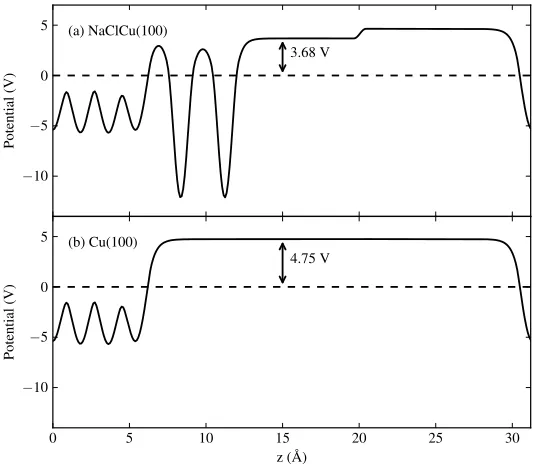
2.1 Laterally averaged electrostatic potential for (a) a NaCl bilayer on Cu(100)
and (b) a bare Cu(100) surface. Electrostatic potential is given relative
to the Fermi level. The work function (difference in potential between
the Fermi level and the vacuum level) is given in each case. In (a) the
effect of the dipole correction, resulting in a discontinuity in the
electro-static potential, can clearly be seen. . . 33
3.1 Two organic radicals: (a) 2,2,5,5-tetramethyl-3carboxypyrrolidine
ni-troxide (3CP) , which DFT calculations suggested retained its radical
when adsorbed on Cu(110) [50] and (b) 4-caboxy-TEMPO (4CT) a
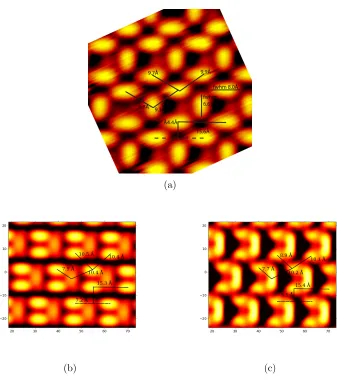
3.2 STM images of 4CT adsorbed on Cu(110), taken with a sample-bias of
-1.1 V (probing the filled states of the molecule) (a) the unit cell of the
monolayer contains 3 molecules, labelled H1, H2 and V, the unit cell on
Cu(110) is illustrated in (b). (c) Image of long-range ordering with some
islands of isolated molecules which appear to be mobile on the surface
at room temperature (RT). Image reproduced by permission of A. Mark
and R. Raval. . . 53
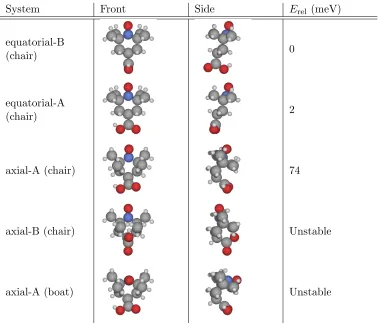
3.3 Diagram showing the chair and boat configurations of the TEMPO ring.
The numbering of the ring atoms is the same as in Figure 3.1. . . 55
3.4 Partial density of states of 4CT on Cu(110) for contributions summed
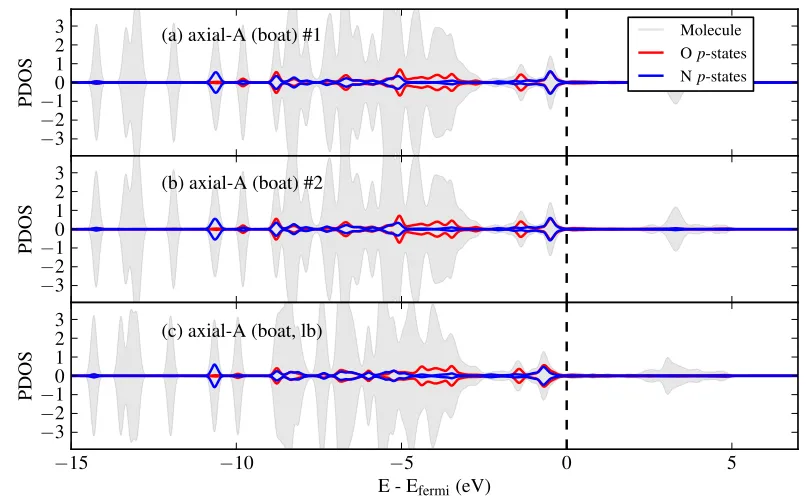
over the molecule and the nitrogen and oxygen p-states, (a) in the
gas-phase in the equatorial-B (chair) configuration and adsorbed at
low-coverage in the (b) axial-A (chair, 1), (c) axial-A (boat), (d) axial-A
(boat, lb), (e) axial-B (boat) configurations. . . 60
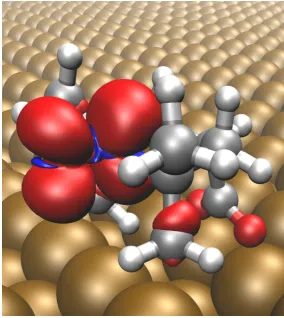
3.5 Spin-density difference plot of 4CT, in the axial-A (chair, 1)
adsorp-tion geometry, showing the preservaadsorp-tion of the radical upon adsorpadsorp-tion.
An isosurface of the spin-up density minus the spin-down is shown,
ef-fectively showing the shape of the singly occupied molecular orbital of
4CT. The isosurface plotted is 0.01e˚A−3. . . . 60
3.6 Experimental (a) STM image, taken at a bias of -1.1 V (i.e. probing the
occupied states of the sample) and simulated images from the most stable
calculated structure (b) at a bias voltage of -1.0 V (c) at a bias voltage
of 0.5 V. Experimental images reproduced by permission of A. Mark and
R. Raval. . . 76
3.7 Experimental images of high-coverage 4CT taken at positive and
nega-tive bias. Reproduced by permission of A. Mark and R. Raval. . . 76
3.8 Partial density of states of 4CT in the high-coverage structure 1, for contributions summed over the molecule and nitrogen and oxygen p
-states, (a) for the first axial-A (boat) molecule, (b) for the second axial-A
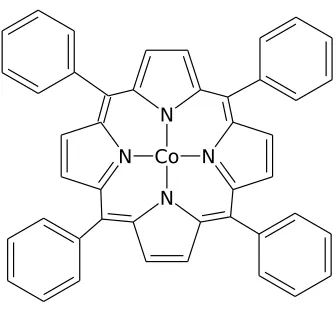
4.1 Diagram of CoTPP. . . 80
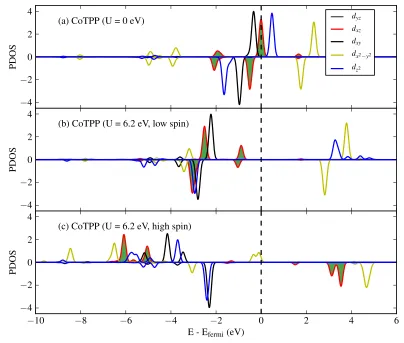
4.2 PDOS of Co d-states of CoTPP, (a) from a calculation with U = 0 eV,
(b) from a meta-stable low-spin state (S = 1/2), with U = 6.2 eV, (c)
from a high-spin state (S = 3/2), also with U = 6.2 eV, more stable
than the low-spin state by 77 meV. . . 83
4.3 Calculated adsorption geometry of CoTPP on Cu(110), as calculated by
Donovan and coworkers [133]. . . 86
4.4 PDOS of d-states of CoTPP adsorbed on Cu(110), (a) with no U
pa-rameter applied (S = 1/2) and (b) with a self consistent U = 6.2 eV
(S = 3/2). . . 87
4.5 PDOS of Cod-states of CoTPP for increasing values of U parameter. . 90
4.6 Magnetisation of central Co ion for CoTPP adsorbed on Cu(110) with
increasingU parameter. . . 91
4.7 Relative energy of CoTPP adsorbed on Cu(110) as a function of U
pa-rameter, and given relative to adsorbed system with U=0 eV. . . 92
4.8 d-occupation of central Co in CoTPP adsorbed on Cu(110) as a function
of U parameter. . . 92
4.9 Molecular orbital density of states, for U = 3.5 eV, where the
Kohn-Sham states of the adsorbed system are projected onto Kohn-Kohn-Sham
states of the system isolated, without the presence of the substrate but
constrained in the adsorption geometry. Plot at the bottom shows the
Kohn-Sham eigenvalues for the isolated system. . . 93
5.1 Cu(dbm)2, a copper complex that behaves like a molecular switch when
adsorbed on 2ML NaCl Cu(111). . . 96
5.2 (a) and (b): the two switchable metastable states identified in the STM
experiment conducted by L´eoni et al. [158] and (c) and (d): the square
planar (SP) and tetrahedral (Td) conformations of Cu(dbm)2 that these
two states were identified with. . . 97
5.4 Schematic showing the lifting of the degeneracies of the d-orbitals in a
square planar (SP) and tetrahedral (Td) crystal field, together with the
occupation of these orbitals for a d9 state. . . . 100
5.5 Partial density of states of Cud-orbitals for neutral and charged SP and
Td Cu(dbm)2 in gas-phase. In can be seen that charging corresponds to
the occupation of thedx2−y2 SOMO. When an on-site Coulomb term,U,
is added the splitting of thed-orbitals in the ligand field is accentuated. 102
5.6 Relaxed ionic geometries of Cu(dbm)2 in the (a) SP0, (b) SP− and (c)
Td− configurations. . . . 103
5.7 Adsorption sites of Cu(dbm)2 over NaCl (2ML) that were tested. . . 105
5.8 Binding curves of Cu(dbm)2 on NaCl (2ML) at various adsorption sites. 105
5.9 Adsorption geometry of Cu(dbm)2on NaCl(2ML). The central Cu of the
complex has dropped out to bond with a Cl ion of the substrate. . . 106
5.10 Diagram showing the adsorption position of the first layer of NaCl on
Cu(100). The small circles indicate Cl ions, the large Na ions. . . 107
5.11 Electrostatic potential averaged in thexandy directions of NaCl (2ML)
Cu(100) and NaCl (2ML) Cu(111) together with a measurement of the
workfunction. . . 107
5.12 Partial density of states of Cu(dbm)2 and the central Cu d-states for
Cu(dbm)2 adsorbed on NaCl Cu(100). Geometries of the molecule and
NaCl bilayer were obtained from perfect conductor calculations. The
system names ‘SP0’, ‘SP−’, ‘SP−
rot’,‘Td−’, ‘Td−v’ and ‘Td
−
rot’ refer to the
perfect conductor model geometries shown in Table 5.2. . . 113
5.13 Simulated STM image of SP0 conformation with the integration of the
LDOS running from an energy ofE−EFermi=−1.0 eV toE−EFermi=
−0.1 eV. This is equivalent to artificially shifting the effective Fermi-level
of the simulation to 1 V lower bias and taking the image at a bias of
5.14 Two experimental STM images of Cu(dbm)2in the SP configuration. (a)
Imaged at 65 mV (b) Imaged at 80 mV. Tunnelling current is 500 fA.
Image used by permission of L´eoni and coworkers. . . 118
5.15 (a) I(V) and (b) ∆f(V) curves for a SP Cu(dbm)2. Black line shows
a scan of increasing bias, the red line shows a scan of decreasing bias.
The switch from the state pictured in Figure 5.14 (a) to Figure 5.14
(b) occurs at ≈ 0.6 V. (c) I(V) and (d) ∆f(V) curves for a different
Cu(dbm)2 complex in the SP conformation. Note how in this case there
is a much bigger hysteresis. The switch between the two states pictured
in Figure 5.14 occurs at 0.6 V and the shift of the peak of the ∆f(V)
parabola indicates the charging of the state shown in Figure 5.14. Figures
used by permission of L´eoni and coworkers. . . 119
5.16 (a) PDOS and (b) STS of Cu(dbm)2 in the SP0 state. (c) PDOS and
(d) STS spectrum of Cu(dbm)2 in the SP− state. In (b) and (d) STS
spectrum is taken from the point indicated by the cyan star in (e). PDOS
is of the states of the molecule and its carbon pz states. . . 121
6.1 Molecular structure of porphycene. . . 124
6.2 (a) STM image of Pc on Cu(110) at 5 K, It = 10 nA, Vbias = 100 mV,
(b) simulated STM image atVbias = 100 mV. Figure taken from [30]. . 126
6.3 Voltage dependence of STM image of Pc molecule adsorbed on Cu(110).
All images taken at 5 K, scanning time≈9 sec/image,It= 5 nA. Figure
taken from [30]. . . 126
6.4 Geometries of Pc adsorbed on Cu(110) in (a) the cis configuration, (b)
the trans configuration and (c) the cis2. Figures (d), (e) and (f) show
the systems from the side. . . 127
6.5 Minimum energy path between of the adsorbed Pc molecule in the cis
conformation and the trans conformation. Path was calculated with the
climbing nudged elastic band method, red points indicate the energies of
6.6 Transition states of Pc undergoing a tautomerisation from the cis
con-formation (a) to the trans (c) via the saddle point concon-formation (b) . . 130
6.7 Experimental Arrhenius plot showing the dependence of the rate of
tau-tomerisation, R, on temperature T. The barrier to tautomerisation is
calculated to be 168 meV. Figure taken from [30]. . . 130
6.8 Theoretical Arrhenius plot showing the dependence of the rate constant
calculated under harmonic transition state theory, kHTST, on
temper-ature T. Also shown is a line of best fit, from which the barrier to
tautomerisation is calculated to be 209 meV. . . 131
6.9 Tunnelling correction, κ −1, for Pc (Cu(110)), over the temperature
range used for the Arrhenius plot, Figure 6.8. The rate constant
cor-rected for tunnelling is given byκkHTST. . . . 132
6.10 (a) Tautomerisation yield given as a function of yield for H-Pc (red
cir-cles) and D-Pc (blue circir-cles), measured by STM (b)dI/dV conductance
spectra of single H- and D-Pc molecules (after subtracting background
from clean surface). Spectra were obtained at the point indicated by the
star in the STM image in the inset at an apparent tip height that led
to a current at 100 mV of 20 nA for H-Pc and 30 nA for D-Pc. Figures
taken from Kumagai and coworkers [30]. . . 136
6.11 Projected vibrational density of states (PVDOS) where the vibrational
spectrum is projected onto the in-plane motion of the N and H (D) nuclei
for a) H-Pc and b) D-Pc. A Gaussian broadening of 2 meV has been
applied to the vibrational modes. . . 138
6.12 Projected vibrational density of states (PVDOS) where the vibrational
spectrum is projected onto the out-of-plane motion of the N and H (D)
nuclei for a) H-Pc and b) D-Pc. A Gaussian broadening of 2 meV has
6.13 Projected vibrational density of states (PVDOS) for Pc where only the
vibrational modes of the two inner H (D) nuclei are calculated. The
vibrational spectrum is projected onto the in-plane motion of the H (D)
nuclei for a) H-Pc and b) D-Pc. A Gaussian broadening of 2 meV has
Nomenclature
3CP 2,2,5,5-tetramethyl-3carboxypyrrolidine nitroxide, an organic radical based on
a 5-membered pyrrollidine ring, page 51
4CT 4-carboxy-TEMPO, an organic radical based on a 6-membered TEMPO ring,
page 51
CFSE Crystal field stabilisation energy, page 99
CI-NEB Climbing image nudged elastic band method, page 42
CoTPP cobalt tetraphenylporphyrin, a transition metal complex, consisting of a Co
atom in the centre of a porphyrin ring, page 80
Cu(dbm)2 Bis-dibenzoylmethanato-copper, a copper complex, page 96
DFT Density functional theory, page 12
DFT+U Density functional theory with an orbital-dependent screened Coulomb
inter-action included, the strength of which is prescribed through U, page 23
DOS Density of states, page 59
GGA The generalised gradient approximation, page 18
LDA Local density approximation, page 18
LDOS Local density of states, density of states in some region of space, page 39
MEP Minimum energy path, page 40
NEB Nudged elastic band method, page 40
optB86b GGA functional that, when used to describe exchange energy, complements
the description of the non-local correlation energy of the van der Waals
func-tional used in this thesis, page 22
PBE A flavour of the generalised gradient approximation, page 20
PC Perfect conductor model, page 34
Pc Porphycene, an aromaticmacrocycle, isomer of porphine, page 124
PDOS Partial density of states, density of states of some sub-set of the wavefunction,
usually the wavefunction projected onto projectors representative of atomic
or-bitals, page 59
PES Potential energy surface, page 40
PVDOS Projected vibrational density of states, vibrational density of states of normal
mode vibrational states projected down onto some sub-set, page 136
STM Scanning tunnelling microscope, page 35
TST Transition state theory, page 44
vdW-DF van der Waals density functional, page 20
Chapter 1
Introduction
1.1
Introduction to Molecular Electronics
The idea of making electronic components out of individual molecules has long been
an attractive one. Traditional electronic components (for example silicon transistors
or capacitors) have physical size limits and drawbacks such as dissipative heating [1].
These put intrinsic limits on the size to which they can be reduced to and the efficiencies
at which they can operate.
Thus it has long been known that, despite ingenuity bringing ever higher densities
of information processing and storage, eventually, a fundamental change of approach
would be required. This is necessary for two reasons, firstly because of limitations
in-herent to the lithography techniques used to fabricate such devices [2, 3] and, secondly,
because quantum effects, such as tunnelling, become of increasing importance as
de-vice sizes shrink, requiring fundamental changes in the principles by which electronic
components function.
In light of this, molecular electronics, in which electronic components would be
fashioned out of mere tens of atoms, is a natural and compelling avenue to explore. Such
electronic components would be built from the ‘bottom up’, out of the individual atoms
and molecules for the task they’re designed for, using principles such as molecular
self-assembly and molecular recognition to control design. This is opposed to the ‘top down’
used and where the components are commonly etched out of a bulk piece of material.
Ideas of the fabrication of the bottom up components from individual atoms can
trace their genesis back over a long period of time; Richard Feynman is popularly cited
as being one of the first to consider the idea of bottom up construction of molecular
machines in his 1960 speech, ‘There’s Plenty of Room at the Bottom’ [4], although the
actual influence of his speech is questionable [5] and others, for example von Hippel in
1956 [6] had similar ideas.
A fundamental obstacle to making progress towards bottom up fabrication was the
lack of a means to address, manipulate and control atoms and molecules on an atomic
scale. This obstacle was overcome by the invention in the 1980s by Binnig and Rohrer
of the scanning tunnelling microscope (STM) [7, 8, 9] which enabled individual atoms
to not only be imaged, but also to be manipulated on the surface. Eigler and Schweizer
manipulated individual Xe atoms on Ni(110) and by picking them up with the atomic
tip of an STM were able to move them at will on the surface, to the extent where they
could spell out the letters ‘IBM’ [10].
Techniques for the manipulation of atoms on surfaces with an STM range from
manipulation of molecules on surfaces [11], to inducing chemical reactions [12, 13],
to cutting or creating bonds [14, 15], to inducing tautomerizations [16]. Such a rich
range of techniques make it possible to probe the behaviour of molecules and test their
behaviour and its often sensitive dependence on molecular composition, substrate type
and chemical environment. An understanding of these factors and the roles they play
is a necessary prerequisite to integrating molecules in functional molecular electronic
circuits.
However, there is a limit to the amount of information that can be deduced from
STM experiments. The design of functional systems requires an understanding of the
processes and mechanisms behind the adsorption and manipulation of the molecular
components, on the level of understanding the electronic structure of these systems
and the specific atomic configuration in which the molecule is adsorbed. Only once
the principles that lay behind these systems are understood can larger, more complex,
Answers to such questions can only be completely provided with the aid of
theoret-ical studies. The determination of the electronic structure of a system is a many-body
quantum mechanical problem, once this is solved, theoretical work can be combined
with experimental work through comparing experimental STM images and STS spectra
to theoretical simulations, which can be obtained from theory via the electronic local
density of states (LDOS) [17, 18]. Similarly, the vibrational spectrum of molecules can
be linked back to STM experiments [14].
The theoretical determination of the electronic structure of a system is a complex
problem and is discussed in more detail in Section 2.1. It would be intractable but
for the development of density functional theory (DFT) by Kohn, Sham, Hohenberg
and others which provide the route towards making approximations that facilitate the
determination of the electronic structure of systems of such size that they would be
useful in molecular electronics.
This thesis consists of the theoretical treatment of a series of such systems where the
goal is to use theory to help understand the principles behind their behaviour with a
view towards informing the design of future molecular electronic devices. There follows
a discussion of the properties it is desirous for a molecular switch to possess and a
review of previous work on example systems.
1.2
Molecular Switches
Molecular switches are molecules with (at least) two meta-stable states and a reliable
method of switching between them. Information encoded as the different states of a
molecular switch has the potential to be stored at unprecedented densities, and so the
study of them is of obvious interest.
In addition to their exciting potential practical use, molecular switches are of
inter-est to study on a fundamental level, since they are small confined systems that exhibit a
variety of behaviours which (depending on the switching mechanism) include
electron-electron interaction, electron-electron-phonon interaction and electron-electron-photon interaction [19].
A diagrammatic representation of the energy landscape of a molecular switch is
Free Energy
Reaction Coordinate
Excited State
Ground State
Figure 1.1: Schematic of the energy landscape of a molecular switch, featuring two meta-stable states and an accessible path between them, along a generalised ‘reaction coordinate’
Azobenzene Naphthalocyanine Au on NaClCu
Figure 1.2: Three examples of molecular switches, involving different switching mech-anisms. (a) azobenzene, a conformal switch that switches via stereoisomerization (b) naphthalocyanine, a conformal switch that switches via structural isomerisation (c) Au on NaCl(2ML) Cu(111) an example of a redox switch.
them. Switching can proceed in two ways, either by exciting the molecule into an
excited state (for example by illumination [20, 21]) followed by a decay with a certain
probability into one of the meta-stable states, or by pushing it over the barrier directly,
for example, by the application of an electric field [22] or through vibrational modes
excited either by heating or by tunnelling electrons [23].
The path between the meta-stable states can be parameterized in terms of a
gen-eralised ‘reaction coordinate’. The nature of this reaction coordinate can be used to
categorise different types of molecular switches. Molecular switches can be split into
two fundamental groups, conformal switches and redox switches.
Conformal switches switch between two different meta-stable conformers of a molecule,
and the reaction coordinate will be some coordinate that links these two conformers.
For example, in azobenzene (see Figure 1.2) the reaction coordinate is the dihedral
is the displacement of the H atoms from the N atoms they are bonded to. Conformal
switches can be divided into two further sub-groups; switches which undergo
stereoiso-merisation, that is, there is is a change in the conformation, but no bonds are made or
broken, and switches which undergostructural isomerisation, that is, bonds are broken
and made when the switching process takes place. An example of a switch that switches
via stereoisomerisation is azobenzene, which just switches by a rotation around a bond.
An example of a switch that switches by structural isomerisation is naphthalocyanine,
where two H bonds are broken with one pair of N atoms and remade with another pair.
Redox switches are switches in which the switch is between different charge state of
the molecule. Switching the molecule involves reducing or oxidising the molecule, this
will entail some sort of conformational change, but the main change is in the charge
state of the molecule. As an example of a redox switch there is a single Au atom
adsorbed on a NaCl bilayer on Cu(111) (see Figure 1.2), which it was shown by Repp
and co-workers could be charged by applying an STM bias voltage, with relaxations of
the polarising NaCl film acting to stabilise the atom in two different charge states.
1.2.1 Stability, Reversibility and Reliability
In addition to a molecular switch having two meta-stable states and a way of switching
between them, for a molecular switch to be useful in an actual device a number of
different aspects should be taken into consideration. These include that a molecular
switch should be stable,reversible and reliable.
For a switch to be stable means that there should be a negligible chance of a
spontaneous switching at the typical operating temperature,T, of the component. In
other words, the relation:
∆Ebarrier kBT (1.1)
should hold, for an energy barrier of size, ∆Ebarrier.
The energy of activation can be estimated, either experimentally by observing the
temperature dependence of switching and applying the Arrhenius rate law, or
the two meta-stable states, for example with the nudged elastic band method (see
section 2.3).
A switch should also be reversible if it is to be useful, and reliable, that is to say
that when an attempt is made to switch the switch into a certain state there should be
a very good probability that it has indeed been switched into that state.
1.2.2 External Influences on Switch
For a molecular switch in gas-phase to have a practical use in molecular electronics it
should maintain its switching behaviour when exposed to a number of external
influ-ences. It is important to bear these external influences in mind since the coupling of a
molecule with these external influences can make a switchable molecule passive, or, in
rare cases, can make a passive molecule switchable [19].
The utilisation of a molecular switch in a logic circuit involves connecting the switch
to electrodes, and this will impact on the switching behaviour and electron transport
through the switch. A common simplification, often applied when looking at the effect
of electrodes, is to model them as semi-infinite and made out of homogeneous jellium,
as was done in a study of benzene dithiolate [24]. This study also nicely illustrated
the importance of the molecule-electrode interface in determining the behaviour of the
system. The qualitative results obtained were much improved upon the introduction
of a single gold atom to each of the jellium electrodes, which had the effect of making
the theoretical model’s molecule-electrode interface more like its physical counterpart.
In the work done in this thesis, the switching of systems is investigated
experimen-tally using the scanning tunnelling microscope (STM). Here, one electrode will be the
surface the switch is adsorbed on, and the other will be the tip of the STM. The
com-putational work contained in this thesis simulates the effect of the surface and describes
the tunnelling electrons using a method based on time-dependent perturbation theory
known as Bardeen’s tunnelling theory with the electronic states of the tip replaced by
a single s-wave (this is known as the Tersoff-Hamann approximation). Thus, in this
work, the effect of the tip electrode is treated in a very generic way. Such a set of
experiment in previous works [25, 26, 27].
The interaction of the adsorbate with the surface has a large effect on the behaviour
of the adsorbed molecule. In Cu(dbm)2 (Chapter 5) the presence of the surface changes
which conformation is most stable when the molecule is charged. For Porphycene
(Chapter 6) the most stable isomer changes from trans to cis because of the effect of
the Cu [1¯10] rows. The surface is therefore important to describe accurately and the
approaches to this adopted in this thesis are described in Section 1.4.
A final external influence to be considered is that of a molecular switch with
its neighbours. A practical molecular electronic device would consist of an array of
switches, arranged on the surface at a high density. Therefore the influence of a switch
on its neighbours becomes important. For example, when azobenzene derivatives were
adsorbed on Au(111) the hydrogen bonds they formed between each other prevented
their switching [28]. This consideration makes switches that involve only a small amount
of conformational change are attractive, such as switches that involve tautomerisation
in a nitrogen cage, such as happens in naphthalocyanine [29] and porphycene [30, 31].
1.3
Self-Assembly
For molecular electronic systems to have practical use they would have to be
address-able, and to achieve this there should be control over how they are deposited on the
surface. Because of this, there is interest in the factors that control self-assembly, where
knowledge of surface-molecule and molecule-molecule interactions enable bottom-up
control over the creation of nanostructures of various dimensions [32, 33, 34, 35, 36].
Such nanostructures have their characteristics determined by the interplay of a wide
range of different interactions; hydrogen bonding,π-π stacking, dipolar, van der Waals,
metal-ligand and covalent interactions. Understanding how these determine the
struc-ture of the nanostrucstruc-ture is important for controlling the process of self-assembly.
As a first example, thiol-functionalised molecules form densely packed self assembled
monolayers when adsorbed on group 1-b metals and are or interest for enabling the
controlled construction of well ordered molecular electronics components [37, 38]. By
created self-ordering arrays of redox switches [39, 40].
Grill and coworkers carried out work with porphyrins with bromine and iodine
sub-stituents. Upon heating, the bromine and iodine atoms evaporate and the porphyrin
molecules covalently bond into networks. By controlling the site where the halogens are
substituated, molecular dimers, chains, or grids can be created [41]. The different
evap-oration temperatures of bromine and iodine enable further control over the assembly
of the networks [42].
Additionally, the orientation of the chains was controlled by the corrugation of the
reconstruction of the Au(100) surface, which created a preferred orientation for the
molecular chains. Lipton-Duffin and coworkers used the corrugation of the Cu(110)
surface, with its close-packed rows, to constrain the growth of diobenzene chains to a
specific direction [43]. A similar effect was observed in the growth of PEDOT chains
[44]. Chapter 3 looks at a network of organic radicals, whose long range ordering is
governed by the corrugation of the Cu(110) surface.
1.4
Surface Influence
As was intimated in the previous section, the influence of the surface has a large effect
on the adsorption properties of an adsorbate.
One of the most striking effects of the surface is the capability of insulating thin
films to decouple the electronic states of the adsorbate from that of the substrate. Even
a thin film of two monolayers of NaCl can support multiple charge states of Au and
Ag atoms on a Cu substrate [45, 46]. That such a thin film can have such an effect
is convenient experimentally, since it means that the redox processes of these atoms
can be investigated using STM. Chapter 5 looks at a copper complex that exhibits two
different charge states, stabilised by a NaCl bilayer.
On an ionic film, such as NaCl, adsorbates will be dispersion bonded, meaning that
the van der Waals (vdW) interaction will play a dominant role, contributing
signifi-cantly to the adsorption energy and adsorption geometry of the adsorbate. As discussed
in Section 2.1.3, special care needs to be taken to incorporate such effects in density
that salicylic acid adsorbed on NaCl derives a large amount of its adsorption energy
from the vdW interaction and has its adsorption height reduced.
The large effect of the vdW force is not confined to molecules adsorbed on ionic
films. Kim and coworkers showed that, on metals too, the vdW interaction plays a
large role, in the study of aπ-conjugated hydrocarbon molecule on Au(111), reducing
the adsorption height by 20% [48]. On Cu, also, hydrogenated carbon structures derive
a large part of their adsorption energy from the vdW interaction [49], although in this
case the adsorption height is actually increased by the inclusion of vdW effects.
An accurate determination of the adsorption geometry is of special importance
in Chapters 3 and 4, which both deal with the question of whether a spin magnetic
moment is preserved upon adsorption onto a metal surface. Preserved spins on a metal
surface have potential applications in spintronics, however, the tendency of a metal
surface is to quench magnetic moments via bonding and charge transfer. The question
of whether a spin moment is preserved is one that can have sensitive dependence on the
distance between the site on which the spin resides and the metal surface. For example,
W¨akerlin and coworkers were able to observe that for Co porphyrins adsorbed on Ni
the preserved moment could be enhanced or quenched by using more or less bulky
substituents. In a similar vein, Robin and coworkers [50] found indications that the
carboxylate groups of 3CP were enough to shield the NO radical upon adsorption onto
Cu(110) and ensure its preservation. In both cases, the influence of the surfaces is
paramount to the problem.
The influence of the surface is also important when considering molecular switches;
with the influence of the surface sometimes being such that a molecule that is a switch
in solution loses this characteristic upon adsorption. An example of this is that the
molecular switch azobenzene, when adsorbed on Au(111), no longer exhibits switching
properties. To overcome the interaction with the surface, however, it is possible to
introduce tert-butyl side groups which raises the molecule from the surface and mean
that the switching behaviour is preserved upon adsorption [20].
In general, the surface is an essential part a molecular electronic system, and should
1.5
Role of Theory
The work in this thesis uses density functional theory (DFT) to calculate the energies,
geometries and electronic structure of the systems studied. DFT is well suited to
systems of this size, since it is scalable enough to allow inclusion of the many atoms
needed to accurately describe an adsorbate-surface system, and yet it is still ab-initio
and still provides information about the electronic structure.
The Tersoff-Hamann approximation provides a simple way for going from the
elec-tronic structure to a simulated STM image; the tunnelling current is given in
Tersoff-Hamann to be proportional to the local density of states in that area. Such simulated
STM images often display a very good agreement with experimentally derived images
and provide a point of contact between theory and experiment. Through the
compari-son of experimental with simulated STM images, it is frequently possible to determine
the adsorption geometry that is being observed experimentally.
When conducting spin polarised DFT studies, the electronic structure provides
information about the local spin density. By projecting this onto atomic orbitals, the
moment that can be attributed to a single site can be determined. In such a way,
it is calculated in Chapters 3 and 4 whether the spin moments of the adsorbates are
preserved upon adsorption.
The electronic structure also provides insight into what bonding mechanisms are
taking place in a system. It is also possible to observe whether charge transfer has
taken place, which is of importance in Chapter 5 for determining whether the adsorbed
molecule is reduced upon adsorption or not.
In summary, the amount of information that is available from a DFT calculation
about energies, geometries and electronic structure is valuable in understanding why
adsorbed molecules behave the way they do. Such understanding can lead to insights
about the interactions between adsorbates and surfaces which helps aid the design
of molecular electronics systems that have desirable properties, such as controlled
Chapter 2
Theory and Computational
Methods
This thesis concerns understanding the behaviour of molecules on surfaces with
po-tential applications in molecular electronics. To reach this end an understanding of
the electronic structure of such systems is essential. However, for these systems, which
must include the molecule and the substrate and therefore consist of hundreds of atoms,
the calculation of the electronic structure is a substantial challenge. The formulation
of Density Functional Theory (DFT) by Hohenberg, Kohn and Sham helped to make
such calculations tractable, and this chapter covers the theoretical and computational
methods that underpin the rest of the chapters.
This chapter gives a brief overview of DFT, including the Hohenberg-Kohn theorems
and the formulation of the Kohn-Sham equations that enable the principles of the
Hohenberg-Kohn theorems to be practically applied.
Particular attention is then paid to aspects of DFT of importance for the study
of the systems discussed in this thesis. This includes the inclusion of electron spin in
DFT, and modifications to the density functional to both include non-local Van der
Waals interactions and to more accurately treat strongly correlated electrons.
Following this discussion, the theory of the Scanning Tunnelling Microscope (STM)
is discussed, which uses the electronic structure calculated by DFT to simulate STM
electronic structure and experiment.
2.1
Density Functional Theory
2.1.1 The Hohenberg-Kohn Theorems
The problem of calculating the ground-state electronic structure of a many-electron
system can be stated deceptively simply. In the non-relativistic limit, the equation to
be solved is the many-body time-independent Schr¨odinger equation, in atomic units:
( N
X
i=1
−12∇2i +
1 2
N
X
i6=j
1 |~ri−~rj|
+
N
X
i=1
vext(~ri)
)
Ψ(~x1, ~x2, . . . , ~xN) =EΨ(~x1, ~x2, . . . , ~xN)
(2.1)
Here Ψ(~x1, ~x2, . . . , ~xN) is the many-body wavefunction, which is subject to the Pauli
exclusion principle, i.e. it should be anti-symmetric on exchange of any two electrons.
The notation~xiis used to refer to a combination of position and spin index,~xi = (~ri, σi),
~ri is the position vector of the ith electron,∇2i =∂2/∂x2i +∂2/∂yi2+∂2/∂zi2,vext(~r) is
an external potential, andE is the energy of the system.
The ground state of the system is then the state corresponding to the wavefunction
that minimises the energy in Eq. (2.1).
Wavefunction methods seek to approximate the ground state by minimising the
energy of Eq. (2.1) for a truncated sum of determinants of single particle wavefunctions.
The problem is that such a minimisation takes place in a parameter space of p3N
dimensions, where p is the number of parameters used to describe a single particle
wavefunction, and to store a many-body wavefunction requiresq3N bits, whereq is the
number of bits required to store a single particle wavefunction.
Thus, when wavefunction methods are applied to large problems, they very quickly
hit an ‘exponential wall’ where the parameter space is too huge for minimisation to
be computationally feasible [51] and where the amount of bits required to store the
many-body wavefunction becomes larger than the number of baryons in the Universe
[52].
empirical reasoning based on electron density maps, Hohenberg and Kohn in 1967
established a pair of key theorems where finding the ground state energy of a system
uses the electron density,n(~r), as the key variable [53].
These theorems essentially state that:
1. For a many-particle system moving in an external potential,vext(~r), the particle
density,n(~r), is uniquely defined by vext(~r) (up to an additive constant).
2. A universal functional of the density, E[n(~r)], yielding the energy of the system
with densityn(~r) can be defined, and is valid for allvext(~r). The global minimum
of this functional with respect to n(~r) for a system in a given vext(~r) will yield
the ground state particle density for that vext(~r).
The consequences of the Hohenberg-Kohn theorems are that the ground state energy
of a system, rather than being given by the minimisation of E over all anti-symmetric
wavefunctions, Ψ(~x1, ~x2, . . . , ~xN), is instead obtained by the minimisation of:
E=FHK[n(~r)] +
Z
vext(~r)n(~r)d3~r (2.2)
over all valid densities, n(~r). The Hohenberg-Kohn functional, FHK[n(~r)], nicknamed
by Ann Matson ‘the divine functional’, works without modification for all electron
systems. Eq. (2.2) is formally exact; its minimisation yields the exact ground state
energy and ground state density. The problem now is thatFHK[n(~r)] is not known, the
next section discusses the steps that are taken in order to be able to use Eq. (2.2) to
obtain ground state properties.
2.1.2 The Kohn-Sham Equations
The Hohenberg-Kohn theorems formally establish that there exists a one-to-one
cor-respondence between an external potential, vext(~r), and the electron density, n(~r).
However, the idea of obtaining the ground state energy of a system from a functional
of the density predates the formulation of the Hohenberg-Kohn theorems. Work in the
homogeneous electron gas, an expression for the kinetic energy density as a function of
electron density,E(n(~r)), is readily obtained, and by integrating this over all space the
kinetic energy of a givenn(~r) is calculated.
The resulting kinetic energy functional gives the kinetic energy of a givenn(~r) under
the approximation that the kinetic energy in the regiond3~r, is the same as the kinetic
energy of a homogeneous electron gas of the same density. Thus a quantity (here the
kinetic energy of the system) is approximated as an integral over all space of its density
in a homogeneous electron gas. Such an approximation is known in DFT as a ‘local
density approximation’.
This kinetic energy functional can be combined with the Coulomb interaction energy
of the electron distribution with itself, the Hartree interaction energy:
EH[n(~r)] =
1 2
Z
n(~r1)n(~r2)
|~r1−~r2|
d3~r1d3~r2, (2.3)
the interaction energy of the electron distribution withvext(~r):
Eext[n(~r)] =
Z
vext(~r)n(~r)d3~r, (2.4)
and Dirac’s local density approximation of the exchange energy:
ExLDA[n(~r)] =Cex
Z
n(~r)4/3d3~r, (2.5)
(whereCex is a constant) to give the Thomas-Fermi-Dirac density functional:
ETF[n(~r)] =T[n(~r)] +EH[n(~r)] +Ex[n(~r)] +Eext[n(~r)] (2.6)
By minimising this functional with respect to n(~r), subject to a constraint in the
total number of electrons, a ground state energy and density can be obtained for any
vext(~r). However the results of this theory are very disappointing, not even predicting
the binding of molecules [54].
One reason for the poor performance is the neglect of electron correlation in the
density with itself given that there is no correlation between the position of an electron
at ~r1 and an electron at ~r1. In reality, the position of an electron at ~r1 will effect
the probability of finding an electron at~r2, firstly because of the requirement that the
wavefunction resulting in the electron density be anti-symmetric, and secondly because
Coulomb repulsion from the electron at ~r1 will effect the probability of finding an
electron at ~r2. The first source of correlation, commonly referred to as the exchange
energy, is accounted for by Ex, while the Coulomb energy of the second source of
correlation must be accounted for by an extra term termedUc. This leaves the energy
functional as:
E[n(~r)] =T[n(~r)] +EH[n(~r)] +Ex[n(~r)] +Uc[n(~r)] +Eext[n(~r)]. (2.7)
where the kinetic energy functional is denoted by T[n(~r)].
The main reason for the poor performance of the Thomas-Fermi-Dirac model,
though, is that the approximation for T[n(~r)] is very poor, and in fact it is extremely
difficult to find a good approximation for the kinetic energy as a functional of the
density.
In the absence of a good approximation for T[n(~r)], Kohn and Sham [55] proposed
that progress could be made by introducing a set of non-interacting electrons, defined
by the facts that their states are orthogonal to one another and they represent an
electron density that is equal to the density of the interacting system:
hψσ0
m |ψσni=δσ0,σδm,n (2.8)
X
σ
X
n
fnψσn(~r)ψ
∗σ
n (~r) =n(~r) (2.9)
Here, the nth non-interacting electron state with spin σ is denoted byψσ
n, and the
occupation of thenth state by the occupation numberfn.
Following Bl¨ochl [56], the kinetic energy of these non-interacting electrons can be
written as a functional ofn(~r), with the constraints maintained by the two Lagrange
TKS[n(~r)] = min
{fn∈[0,1],|ψni} (
X
n
Z
d3~rX
σ
fnψn∗σ(~r)(−
1 2∇
2)ψσ n(~r)
+ Z
d3~rveff(~r)
X
n
X
σ
fnψnσ(~r)ψn∗σ(~r)−n(~r)
!
−X
m,n
Λm,n hψσ 0
m |ψnσi −δσ0,σδm,n
!)
(2.10)
Note that the kinetic energy of the Kohn-Sham orbitals,TKS, will differ from that of the
many-body wavefunction, T. This difference is combined with the previous exchange
and correlation potential energy of Eq. (2.7) to define the new exchange-correlation
functional,Exc:
Exc[n(~r)] =T[n(~r)]−TKS[n(~r)] +Ex[n(~r)] +Uc[n(~r)] (2.11)
The first Hohenberg-Kohn theorem and the fact that the Kohn-Sham orbitals are
defined to represent n(~r) guarantees that all terms in Eq. (2.11) can be expressed as
functionals of n(~r).
Equation. 2.11 provides a new expression forT[n(~r)], which can be substituted into
Eq. (2.7):
E[n(~r)] =TKS[n(~r)] +EH[n(~r)] +Exc[n(~r)] +Eext[n(~r)]
= min
{fn∈[0,1],|ψni} (
X
n
Z
d3~rX
σ
fnψn∗σ(~r)(−
1 2∇
2)ψσ n(~r)
+ Z
d3~rveff(~r)
X
n
X
σ
fnψσn(~r)ψ
∗σ
n (~r)−n(~r)
!
−X
m,n
Λm,n hψσ 0
m |ψσni −δσ0,σδm,n
!)
+EH[n(~r)] +Exc[n(~r)] +Eext[n(~r)] (2.12)
The minimisation over the Kohn-Sham orbitals, |ψσ
ni, leads to the so called
− 12∇2+veff(~r)
!
|ψσni=n|ψnσi, (2.13)
where thenare elements of Λm,n once it has been diagonalised. An expression for
veff(~r) can be obtained by minimising Equation. 2.12 with respect ton(~r). This yields:
veff(~r) =
δEH
δn(~r) +
δExc
δn(~r) +
δEext
δn(~r). (2.14)
δEH/δn(~r) andδEext/δn(~r) may easily be calculated from Eq. (2.3) and Eq. (2.4)
respectively, whileδExc/δn(~r) can be calculated once an appropriate approximation for
Exc has been made (such approximations will be discussed in Section 2.1.3).
The introduction of the Kohn-Sham orbitals is thus seen to reduce a problem
in-volving a 3N dimensional many-body wavefunction into a problem inin-volving N
non-interacting 3 dimensional wavefunctions, whose solution involves solving the Schr¨
odinger-like equation Eq. (2.13). Unodinger-like the Schr¨odinger equation, the equation Eq. (2.13) is
nonlinear, its solutions are implicitly linked throughveff(~r), which is dependent onn(~r),
which in turn depends on the solutions,|ψσ
ni, of Eq. (2.13).
This non-linearity means that an iterative approach must be made towards the
determination of | ψσ
ni. Schematically, a trial density nin is first chosen and used to
construct an effective potential veff. The Kohn-Sham equations (Eq. (2.13)) can then
be solved for this effective potential and the resultant Kohn-Sham wavefunctions used
to construct a new density nout. This process can be repeated; nin and nout can be
combined to produce a new input charge density, nin, which would result in a new
effective potential. The loop is broken when a self-consistent solution is reached, that
is, when E[nin(~r)] =E[nout(~r)] to within an acceptable degree of accuracy.
The efficient self-consistent solution to the Kohn-Sham equations involves lots of
subtleties. For a more in-depth discussion of their efficient solution, see for example
the papers by Kresse and Furthm¨uller [57, 58] which discuss the algorithms used in the
2.1.3 The Exchange-Correlation Functional
It is worthwhile reiterating at this point that Eq. (2.12) contains no approximations
and DFT is an exact theory [56]. However, the exchange correlation functional,Exc is
not known and it is with the creation of exchange correlation functionals that
approx-imations enter the theory. In this section various approxapprox-imations toExc are discussed.
The Local Density Approximation
The local density approximation (LDA) has previously been mentioned with regards to
a local density approximation of the kinetic energy functional used in Thomas Fermi
theory and Dirac’s calculation of the exchange functional of a homogeneous electron
gas.
In the LDA ofExc,Exc is split into separate exchange and correlation parts:
Exc[n(~r)] =Ex[n(~r)] +Ec[n(~r)] (2.15)
Ex can be calculated exactly for a homogeneous electron gas and is given in Eq.
(2.5). No such analytical expression exists for Ec. However c, the correlation energy
per electron, can be found in the limit of high density [59] and low density [60] and
Perdew and Yang [61] provide an expression for intermediate densities, with parameters
that can be fitted, for example, to Quantum Monte Carlo simulations [62],c can then
be used to obtainEc through the integration:
Ec[n(~r)] =
Z
d3~rn(~r)c(n(~r)) (2.16)
The Generalised Gradient Approximation
Despite being quite a drastic simplification, the LDA provides surprisingly good results,
especially in the field of solid state physics. The reasons for this are three fold; firstly,
the LDA satisfies an important sum rule, that the exchange correlation hole contains
exactly one electron. Secondly, in metals, electrons are very often highly delocalised
and can be well approximated by a nearly free electron gas, where n(~r) varies only
solid state physics bonds are rarely broken, they are more often merely rearranged, and
this fact covers up the LDA’s gravest shortcoming, that it systematically over estimates
bonding energies. In solid state physics these errors are less serious.
An obvious extension to the LDA is not only to include the local density in the
approximation of the exchange-correlation functional, but also include the gradient of
the density. A simple Taylor expansion ofExcis known but does not lead to a consistent
improvement on the LDA [63, 64] because it violates the basic sum rules of the exchange
correlation hole.
Instead, functionals including dependence on the density gradient are constructed
in such a way that they behave in a manner that provides improvements over the
LDA, and approaches of such a sort are known as generalised gradient approximations
(GGAs).
In GGAs, Exc is written as a product of the LDA and an additional ‘enhancement
factor’,F(s(~r)):
Exc[n(~r)] =
Z
d3~rA(n(~r))F(s(~r)), (2.17)
where A is the LDA exchange-correlation energy density, and s is the dimensionless
gradient of the electron density:
s(~r) = ∇n(~r)
n(~r)43
(2.18)
The functional form of the enhancement factor is guided by physical arguments.
The reduced gradient,shas its highest value when the the electron density is decaying
exponentially, at distances far from the nucleus. At this distance, the exchange
correla-tion hole induced by an electron far from the nucleus will be, to a good approximacorrela-tion,
centred on the nucleus. This means that the exchange correlation energy of an electron
at a point far from the nucleus,~r, will just be the interaction energy of this electron
with its hole:
xc(n(~r), s) =−
1 2
e2
The enhancement factor can be set in such a way so as to enforce this behaviour
at large gradients (s → ∞). For s = 0 we know that F(s) = 1 so as to recover the
behaviour of the homogeneous electron gas when the density does not change over
space.
There are several ways to interpolate between these criteria and, as a consequence,
several flavours of GGAs. Some of the most common include PW91 [65, 66] and PBE
[67].
The corrections provided by GGA in the vacuum tails of the atomic wavefunction
lead to the stabilisation of the tail region by GGA compared to LDA. Because of this,
bond energies in GGA are less than LDA, and are, in general, a great improvement. It
is GGA’s stabilisation of the vacuum tails that made density functional theory useful
for chemists.
van der Waals Density Functional
The van der Waals interactions (vdW interaction) arise as an attraction due to the
electrostatic interaction of correlated fluctuations in the electron density in
neighbour-ing molecules. As the London formula suggests, this attraction is stronger between
systems with higher polarisability [68].
For sparse systems vdW interactions become important. For example, molecules
with aromatic rings obtain a significant part of their adsorption energy on NaCl from
the vdW interaction [47, 69]. As discussed by Chen and coworkers [47] this affects
not merely the adsorption energy, but also the adsorption height. These observations
suggest that the inclusion of vdW effects will be important for some of the systems
looked at in this thesis, where the adsorption height can have an impact on other
aspects of behaviour of the system which are of interest.
vdW interactions are not accounted for in the local and semi-local approximations
to Exc provided by the LDA and GGA, which are both based on the local electron
density. In response to this shortcoming there are various schemes for including vdW
interactions, including semi-empirical ‘C6 corrections’ where pair-potentials between
However, the work in this thesis will instead use a vdW-DF, developed by Dion and
coworkers [70], building on work by Langreth and coworkers [71] where the exchange
correlation functional is modified. The benefit of this method is that, in-keeping with
the approach adopted by the LDA and GGA approximations toExc, only the electron
density is used to describe the vdW interactions.
The modification to Exc is made by introducing a new exchange correlation
func-tional, Exc,vdW, defined in the following way:
Exc,vdW=Ex,GGA+Ec,LDA+Ec,nl. (2.20)
Here, the GGA description of exchange, Ex,GGA, is retained, but the correlation
functional is replaced by the LDA approximation to correlation, Ec,LDA, to account
for local correlation, and a new functional to account for long range correlation, called
Ec,nl.
The derivation ofEc,nlis described by Dion and coworkers [70]. An exact expression
forEcis expanded in terms of a quantity s= 1−−1, whereis the dielectric function.
An approximation is then made for s as a functional of the density. One advantage
of this method is that the long range terms of the correlation energy are insensitive
to approximations of dielectric response, only a good approximation of polarisation
properties needs to be made [71].
The result of this expansion is a double space integral:
Ec,nl=
Z Z
d3~rd3r~0n(~r)n(r~0)φ(~r, ~r0). (2.21)
whereφ(~r, ~r0) is a general function that can be tabulated, derived from the expansion
ofEc.
A subtlety in the treatment arises when choosing the GGA for the exchange
func-tional. Many GGAs have an enhancement factor that becomes saturated for large
values of the reduced density gradient. This means that the stabilisation of the
‘vac-uum tails’ mentioned before in the discussion of the GGA has a limit and the property
‘dispersion like’ bonding at long distances described by the GGA exchange functional
but not reproduced by exact exchange Hartree-Fock calculations [72, 71, 73]. Care
must be taken when choosing the GGA exchange functional that the prescription of
the enhancement factor does not include these correlation effects in its exchange part.
Klimeˇs et al. [74, 75] tested various modified vdW functionals and constructed one
that provided good results for a large array of test data. This functional, optB86b, is
what is used in this thesis. It was found that even for hard solids there was a systematic
improvement in the prediction of a variety of materials properties.
2.1.4 Spin-polarised DFT, local spin density approximation
In two of the systems that are looked at in this thesis, the organic radical 4CT (Chapter
3) and CoTPP (Chapter 4), a quantity of primary interest is the spin polarisation of
the systems. So far, in the outline of the density functional theory given in Section 2.1,
spin has been neglected.
von Barth and Hedin [76] generalised the theorems of Hohenberg and Kohn to
include the spin degree of freedom. For spin-polarised density functional theory the role
of the electron density is replaced by a density matrix. It can be shown that, unlike in
the non-spin-polarised case, when spin is included, there is no one-to-one relationship
between a general external potential and the spin density [76, 77]. However, there is
still a unique relationship between the many-body wavefunction of the ground-state
and the density matrix.
A spin-polarised DFT then can be developed; the task is to find equivalents to the
LDA and GGA that include spin. In this thesis, and in most systems in general, it
is safe to assume that spins are co-linear. The exceptions are cases when spin-orbit
coupling takes a significant role, when you have competing exchange interactions from
different neighbours (in FCC Fe and Cr, for instance) or for finite systems such as metal
clusters, where the direction of spin quantisation changes through space.
Under this assumption there are two separate spin channels, corresponding to two
different spin densities, n↑(~r) and n↓(~r), with the electron density given by n(~r) =
den-sity approximation (LSDA) is quite straightforward. Two different sets of Kohn-Sham
orbitals are introduced, defined to represent densities equal to the two different spin
densities, and the minimisation of the resultant functional with respect to the two spin
densities yields two Schr¨odinger-like equations for the non-interacting wavefunctions
with two different effective potentials.
The Hartree-like part of the effective potential is the same as results from taking
the functional derivative of Eq. (2.3):
vH(~r) =
Z n(r~0)
|~r−r~0|d~r
0, (2.22)
whereas the exchange potential in the LSDA is given by the functional derivative of
Eq. (2.5):
δEx
δn↑(~r) = 4 3Cexn
↑(~r)1
3, (2.23)
with a similar expression holding for the down-spin case.
The correlation potential can be interpolated from the non-spin-polarised
correla-tion potentials [78], for example, by using an interpolacorrela-tion formula based on the random
phase approximation [79].
It is important that, in contrast to the non-spin-polarised case, the extra spin degree
of freedom means that there will be multiple self-consistent solutions with different
metastable spin-densities [80]. Depending on the initial spin-density in a self-consistent
calculation, different self-consistent solutions to the Kohn-Sham problem will be found
with different energies. To find the global minimum it may be necessary to start from
a variety of starting spin densities, for instance, with different initial spin moments
applied to atoms.
2.1.5 DFT+U
Some of the systems in this thesis involve transition metal complexes (Chapters 4 and
3), with highly localised and correlated d-electrons. Such systems are problematic for

![Figure 4.3: Calculated adsorption geometry of CoTPP on Cu(110), as calculated byDonovan and coworkers [133].](https://thumb-us.123doks.com/thumbv2/123dok_us/8074304.227404/105.612.234.406.70.204/figure-calculated-adsorption-geometry-cotpp-calculated-bydonovan-coworkers.webp)
