Semi-Supervised Multi-Task Word Embeddings
James O’ Neill and Danushka Bollegala
Department of Computer Science, University of LiverpoolLiverpool, L69 3BX England
{james.o-neill, danushka.bollegala}@liverpool.ac.uk
Abstract
Word embeddings have been shown to benefit from ensem-bling several word embedding sources, often carried out us-ing straightforward mathematical operations over the set of vectors to produce a meta-embedding representation. More recently, unsupervised learning has been used to find a lower-dimensional representation, similar in size to that of the word embeddings within the ensemble. However, these methods do not use the available manual labeled datasets that are often used solely for the purpose of evaluation.
We propose to improve word embeddings by simultaneously learning to reconstruct an ensemble of pretrained word em-beddings with supervision from various labeled word sim-ilarity datasets. This involves reconstructing word meta-embeddings while simultaneously using a Siamese Network to also learn word similarity where both processes share a hidden layer. Experiments are carried out on 6 word similar-ity datasets and 3 analogy datasets. We find that performance is improved for all word similarity datasets when compared to unsupervised learning methods with a mean increase of 11.33 in the Spearman Correlation coefficient. Moreover, 4 of 6 of word similarity datasets from our approach show best performance when using of a cosine loss for reconstruction and Brier’s loss for word similarity.
Introduction
Distributed word representations have shown good mance for tasks in natural language. Given that the perfor-mance is dependent on the model used for embedding (e.g skipgram,cbow), it is clear that each model exploits differ-ent aspects of the semantic space. Hence, meta-embedding combines multiple word embeddings to increase the cover-age and accuracy of word embeddings. We are further mo-tivated in that adding the additional step of combining sev-eral word representations into one representation is a rel-atively fast computation and only requires a shallow neu-ral network for reconstruction. Moreover, stacked ensembles have shown state of the art performance for various prob-lems in NLP (Jozefowicz et al. 2016; Wang et al. 2017; Bao and Bollegala 2018). Current approaches to meta-word representations rely on unsupervised learning such as autoencoding (Bao and Bollegala 2018) to find a lower-dimensional hidden representation of the ensemble set. This can be advantageous in cases where (1) pre-training is ex-pensive, (2) pre-training embeddings are available but not
the algorithm or data and (3) the available embeddings vary in dimensionality size. However, for problems that rely on representations that are better aligned with human judgment, word embeddings and word meta-embeddings alike can find it difficult to preserve from word associations alone. There-fore, we aim to incorporate supervision from these datasets into word meta-embeddings.
Hence, this paper describes our proposed semi-supervised learning approach that combines the benefits of unsuper-vised learning for finding a lower-dimensional represen-tations of concatenated word meta-embeddings, and also learns to predict word similarity using a siamese network that incorporates a shared representation from an autoen-coder. We consider both of these to be individual tasks, hence the reference to multi-task learning. We evaluate our approach on held-out word similarity datasets and also in-clude an evaluation on the transferability of the resultant word meta-embeddings on three analogy tasks. We find that performance is improved for all word similarity datasets with a mean increase of 11.33 in the Spearman Correlation coefficient when compared to unsupervised learning meth-ods. Before discussing related work, we summarize the main points of our work.
Angular-Based Cost Function Current unsupervised learning methods minimize the Euclidean distance (`2)
be-tween source word embeddings their meta-embedding. Considering that in meta-embedding learning we use source embeddings trained on different resources, we argue that it is more important to preserve the semantic orienta-tion of words, which is captured by the angle between two word embeddings, not their length. Indeed, cosine similar-ity, a popularly used measure for computing the semantic re-latedness among words, ignores the length related informa-tion. We also note the relationship between KL-divergence and cosine similarity in the sense both methods perform a normalization that is proportional to the semantic informa-tion. Hence, we compare several popular measures such as MSE and MAE that use`2and`1respectively, against
KL-divergence and cosine similarity for the purpose of learn-ing meta-embeddlearn-ings and show that the loss which accounts for this orientation consistently outperforms the former ob-jectives that only consider length which corresponds to co-occurrence frequencies. We demonstrated this across multi-ple benchmark datasets.
Supervision From Manual Annotations
The second point is that both word embeddings and word meta-embedding methods currently do not leverage the available manual annotations in the learning process, such as Spearman correlation scores for word similarity. In particular, word vectors often struggle to preserve true similarity, which in many cases is difficult to identify from statistical associations alone. Hence, we find in previous work (Hill, Reichart, and Korhonen 2016) that has found word embeddings to struggle for word similarity in compar-ison to word association, particularly for abstract concepts.
Our semi-supervised method addresses this point by learning to reconstruct meta-embeddings while using shar-ing the hidden layer to also predict word pair similarity. We argue that this explicit use of true similarity scores can greatly improve embeddings for tasks that rely on true sim-ilarity. This is reflected in the results as we find for Simlex and RareWord there is a 29.63 and 27.05 increase in Spear-man correlation respectively. Improvements on RareWord also brings us to our last point that word meta-embeddings allow for more coverage.
Dealing with Out-of-Vocabulary WordsWord vectors suffer in performance for out-of-vocabulary words that are not seen during training. This is often addressed by tak-ing the stem or lemma of the unseen word and ustak-ing this word representation (if present in the word vector dictio-nary) as a replacement. We find this is particularly an is-sue on evaluation datasets that look to gauge performance on words that are morphologically complex words or rare words (Luong, Socher, and Manning 2013), and words that convey more abstract concepts with low concreteness (Hill, Reichart, and Korhonen 2016) (often found to be the case for verbs). In fact (Luong, Socher, and Manning 2013) have used sub-word vectors for such issues. Alternatively, (Cao and Rei 2016) have used a character-level compo-sition from morphemes to word embeddings where mor-phemes that yield better predictive power for predicting con-text words are given larger weights, showing improvement over word-based embeddings for syntactic analogy answer-ing. Their model incorporated morphological information into character-level embeddings which in turn, produced better representations for unseen words.
In contrast, word meta-embeddings allow for much larger coverage by combining the ensemble set of pretrained word embeddings, trained from different corpora. Hence, the like-lihood of rare words occurring is decreased. This approach also allows for sub-word level combinations between word vectors.
Related Research
Word Meta-Embeddings
The most straightforward approaches to meta-embeddings are: concatenation (CONC) and averaging (AV) (Coates and Bollegala 2018). The former is limited since the dimen-sionality grows with the number of source embeddings as more vectors are concatenated and the latter does not pre-serve most of the information encoded in each embedding. Although, it would seem surprising that concatenating
vec-tors from different embedding spaces to be valid, it has been shown by (Coates and Bollegala 2018) if the word vec-tors are approximately orthogonal, AV approximates CONC even though the embedding spaces may be different. Hence, we include AV in our comparisons of unsupservised meth-ods as one of the baselines.
Although, to address the loss of information when using AV, Singular Value Decomposition (SVD) has been used to factorize the embeddings into a lower-rank approximation of the concatenated meta-embedding set.
Linear methods include the use of a projection layer for meta-embedding (known as 1TON) (Yin and Sch¨utze 2015), which simply is trained using an`2-based loss.
Sim-ilarly, (Bollegala, Hayashi, and ichi Kawarabayashi 2018) have focused on finding a linear transformation between count-based and prediction-based embeddings, showing that linearly transformed count-based embeddings can be used for predictions in the localized neighborhoods in the target space.
Most recent work (Bao and Bollegala 2018) has fo-cused on the use of an autoencoder (AE) to encode a set of N pretrained embeddings using 3 different variants: (1) Decoupled Autoencoded Meta Embedding (DAEME) that keep activations separated for each respective embedding input during encoding and uses a reconstruction loss for both predicted embeddings while minimizing the mean of both predictions, (2) Coupled Autoencoded Meta Embed-ding (CAEME) instead learn to predict from a shared en-coding and drop the expectation minimization loss used in DAEME, and (3) Averaged Autoencoded Meta-Embedding (AAME) is simply an averaging of the embedding set is performed instead of using a concatenated input. This is the most relevant work to ours, hence, we include these 3 autoencoding schemes along with aforementioned methods for experiments, described in Section . We also include two subtle variations of the aforementioned AEs. The first pre-dicts a target embedding from an embedding set using the remaining embedding set, where after training the single hidden layer is used as the word meta-embedding. The sec-ond method is similar except an AE is used for each input embedding to predict the designated target embedding, fol-lowed by an averaging over the resulting hidden layers. This alternative is described in more detail in Section .
MTL Representations
Using Multi-Task Learning (MTL) to improve generaliza-tion of text representageneraliza-tions in natural language tasks has been well-established within the past two decades. Here, we briefly describe some of the related MTL research.
re-lated word similarity datasets with full supervision to pre-dict the auxiliary task (ie a left out word similarity dataset for testing). In their work, context part-of speech (PoS) tags are used to predict the current words PoS tag in an unsuper-vised fashion, similar to predict-based methods for the cur-rent state of the art word embeddings (e.gskipgram). This is done by masking some features that are to be predicted. This is carried out while learning on the supervised task of text categorization, allowing the model to choose masks that remove features that are unrelated to the main task. They yielded SoTA performance on PoS tagging and NER using a language model that predicted a target word given context words.
MTL for Neural Machine Translation (Dong et al. 2015) have used MTL to improve the quality of machine translation to multiple target languages. Therefore, source language representations are shared in the encoder-decoder sequence model given the availability of the required paral-lel data. The model showed higher BLEU scores over inde-pendent sequence-to-sequence language models when there is full availability of parallel data and partially available par-allel data, highlighting the importance of integrating related source language representations.
MTL Neural networks for Query Classification and Web SearchLiu et al. (2015) too use MTL for query clas-sification using multiple binary classifiers, and web search ranking based on maximum likelihood with deep neural net-works. Their MTL architecture consisted of 3 shared hidden layers that use character and word n-gram inputs, where the last layer are independent task-specific layers for query clas-sification and web search respectively. The MTL approach showed large improvements over baseline Support Vector Machines and neural networks that learned each task inde-pendently.
MTL BenchmarksMore recently, we have seen an up-take of MTL for various natural language text similarity tasks. In fact, a benchmark called Understanding Evalua-tion benchmark (GLUE) has been introduced for this pur-pose (Wang et al. 2018). This benchmark allows both trans-fer learning (TL) and MTL models to be developed for tence classification and learning relationships between sen-tences (e.g paraphrasing, natural language inference). For the purpose of learning better distributed word representa-tions, in a similar vein we encourage further use of the word similarity datasets for MTL of word meta-embeddings, such as those used for evaluation in this work.
Remarks In contrast, tasks that do benefit from each other and share representations have the advantage of produc-ing better regularization by (1) introducproduc-ing relevant inter-dependent features, (2) multiple tasks mutually regularize the model, (3) using future tasks to interpolate to present tasks (less relevant in this work as the dynamics of word meaning do not change greatly of the timeline of dataset creation), (4) improve the model’s ability to learn general features from noisy signals and (5) potentially leverages loose structure among the parent tasks that aid more specific downstream child sub-tasks (e.g tasks are designated based
on the word relation type such as hyponymy, antonymy or synonymy). These are just a few reasons as to why MTL can improve performance over single-task learners, for a de-tailed exploration see (Caruana 1998).
Lastly, all of the aforementioned work focus on using MTL on high-level natural language tasks. This work is dis-tinctly different in that it is focusing on improving the input distributed word representations themselves using a semi-supervised MTL approach.
Methodology
Before introducing the semi-supervised MTL approach to learning word meta-representations we first outline the unsu-pervised learning baselines used for comparison. Firstly, we include both the aforementioned 1TON/1TON+ (Yin and
Sch¨utze 2015) and standard AEs (Bao and Bollegala 2018) presented in previous work. We also include a slight vari-ant of the AE, which we refer to as a Target Autoencoder (TAE) which learns an ensemble of nonlinear transforma-tions between sets of basesXsin sets of vector spacesXS=
{X1, ..,Xs, ..,XN} s.t Xs ∈ R|vs|×ds to a target space
Xt ∈ R|vt|×dt, wheref
(i)
w : X
(i)
S → Xt ∀iis the nonlin-ear transformation function used to make the mapping. Once a set of parameteric modelsfθ = {f(1)θ ,fθ(i), ..,f(θM)} are trained with various objective functionsLθto learn the map-pings between the word vectors, we obtain a set of lower-dimensional target latent representations that represent dif-ferent combinations of mappings from one vector space to another.
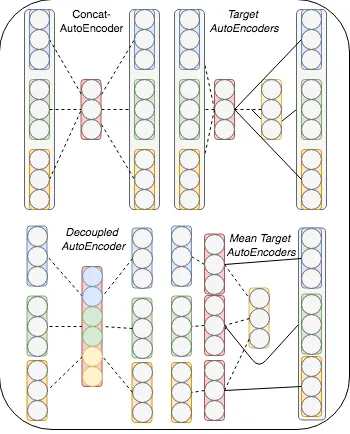
Figure 1 shows a comparison of the previous autoen-coder approaches (Bao and Bollegala 2018) (left) and the alternative AE (right), where dashed lines indicate connec-tions during training and bold lines indicate predicconnec-tions that are subsequently concatenated. The Concat-AutoEncoder (CAEME) simply concatenates the embedding set into a sin-gle vector and trains the autoencoder so to produce a lower-dimensional representation (shown in red), while the decou-pled autoencoder (DAEME) keeps the embedding vectors separate in the encoding.
In contrast, the target encoder (TAE) is similar to that of CAEME only the label is a single embedding from the em-bedding set and the input are remaining emem-beddings from the set. After training, TAE then concatenates the hidden layer encoding with the original target vector. The Mean Tar-get AutoEncoder (MTE) instead performs an averaging over separate autoencoded representation. The TAE approach is motivated by Caruana (1998) who points out that treating inputs as auxiliary output tasks can, in some cases, be more useful.
AutoEncoder Meta-Embedding
pertaining to all tested word association and word similar-ity datasets (n = 4819) and performs Stochastic Gradient Descent (SGD) with batch sizex˜ = 32trained between 50 epochs for each dataset∀d∈ D. This results in a set of vec-torsXi∈R|vi|×200∀ithat are then used for finding the
sim-ilarity between word pairs. The above parameters were cho-sen (hd,x˜and number of epochs) over a small grid search. As stated, we compare against previous methods (Yin and Sch¨utze 2015; Bao and Bollegala 2018) that use`2distance,
as shown in Equation 1).
Lθ(ˆx, x) = 1 N
N
X
i=1
x(i)−xˆ(i)2
(1)
Similarly, the MAE (`1 norm of difference) loss
1/NPN
i=1|x−xˆ| is tested. We also compare against a
KL divergence objective, as shown in Equation 2, yˆ is the last activation output from the log-softmax that repre-sents q(x) and the KL-divergence is given as KL(p|q) =
PN
i−1p(xi) log q(xi)/p(xi)
.
Lθ(ˆx, x) = 1 N
N
X
i=1
x(i)·log x(i)
−log ˆx(i) (2)
Sincetanhactivations are used and input vectors are`2
[image:4.612.86.261.461.678.2]normalized we propose a Squared Cosine Proximity (SCP) loss, shown in Equation 3. This forces the optimization to tune weights such that the rotational difference between the embedding spaces is minimized, thus preserving semantic information in the reconstruction. In the context of its utility for the TAE, we also want to minimize the angular difference between corresponding vectors in different vector spaces. It is also a suitable fit since it is a proper distance metric (i.e symmetric), unlike KL-divergence.
Figure 1: AE Meta-Embedding Methods
Lθ(ˆx, x) = 1 N
N
X
i=1
1−
Pm
j=1xˆij×xij
q
Pm
j=1xˆ 2
ij
q
Pm
j=1x 2
ij
!2 (3)
The model is kept relatively simple so that the compar-isons against previous methods are directly comparable and that the performance comparison between the proposed SCP loss and KL divergence loss against MSE and MAE is con-trolled. In experimentation, we found performance obtained via deep networks was not significantly better than a shal-low network. Additionally, all comparison are that of models which are trained from co-occurrence statistics that are not leveraging any external knowledge (cf. AutoExtend (Rothe and Sch¨utze 2015)).
Semi-Supervised Multi-Task Meta-Embeddings
MTL for Word Similarity Semi-supervised MTL is also used to learn both the word similarity from human provided annotations and reconstructions of an ensemble of word vec-tors. This is deemed semi-supervised because both tasks are distinct and both share the hidden layer representation. MTL is particularly apt for improving the overall generalization of ensembled word vectors since the shared representation that is used in standard neural network MTL is also explicitly be-ing used as input word vectors for all other upstream tasks.
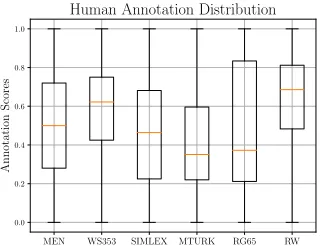
The labels y for each datasetd are [0,1] normalized as some of d ∈ D are in the range [0,10]. The scores are then considered as soft labels where the targets are consid-ered probabilities. We had also considconsid-ered converting the continuous outputs into binary classes where the threshold was based on the mean of the annotation scores. However, the quartiles of the distribution over the annotation scores are not symmetric around the median, with the exception of MEN and Simlex.
For testing, we train word similarity on all datasets except the one we test on, while an autoencoder is also used to pro-duce reconstructions from word pairs(x1, x2)is also used
on the test dataset as it is the unsupervised (self-supervised) learning part of the network. This is illustrated in Figure 3, where red coloring indicates the hidden layer representa-tions. For training, the hidden layer dimension sizes ofh(1) -h(2)-h(3)is200−50−10. Note thath(1)has dimensionality d= 200, the same size as the aforementioned unsupervised learning approach that does not use MTL (ie word similarity is not learned). The example shows inputs words “cup” of “tea”, a typical example of wheretrue similarity is differ-ent from the commonly associated teacup and teabag. Once MTL has converged over a set of epochs, we compare the Spearman correlationρsof the shared hidden layerh1 out-puts, as opposed to usingyˆproduced in the siamese network that predicts word similarity directly.
We test various distance measures for word similarity, including Manhattan, Euclidean and Cosine dissimilarity. Since the data is 0-1 normalized the pairwise distancezl= dθ(hl
1, h
l
2), as shown in Equation 4 is kept in this range
MEN WS353 SIMLEX MTURK RG65 RW
0.0 0.2 0.4 0.6 0.8 1.0
Annotation
Scores
[image:5.612.89.250.61.184.2]Human Annotation Distribution
Figure 2: Word Association Annotation Distribution
wherey are soft labels. Since each dataset proposes differ-ent guidelines for annotation with differdiffer-ent annotators, the output distributions∀Y ∈ Yare quite different as shown in Figure 2.
ˆ
y=e−dω(hl1,hl2) (4)
The total lossLis simplyLr+Lswhere the formerLrin Equation 5 is the reconstruction loss andLsshown in Equa-tion 6 the cross-entropy error between both word encod-ings for the similarity between word pair meta-embeddencod-ings guided by the provided annotation scoresy.
Lr= 1 N
N
X
i=1 2
X
j=1
xij−xˆij
2
(5)
Ls=− 1 N
N
X
i=1
yilog ˆyi+ (1−yi) log(1−yˆi)
(6)
[image:5.612.107.242.499.675.2]We argue that when annotators decide on word similar-ity given a word pair that they choose on howx1relates to
Figure 3: Multi-Task Meta-Embedding
x2only, and not vice-versa (Tversky 1977). In other words,
the relationship between two words is not strictly symmet-ric and the viewing order matters when humans are tasked with estimating word similarity. Therefore, when coming up with a similarity measure using this argument, we test an asymmetric similarity measure between(hl
2, h
l
2)encodings.
This simply involves replacing the denominator of the co-sine similarity (||x1||2)· ||x2||2) that is used as the distance
functiondω(·)to||x1||2· ||x1||2before being passed to the
negative exponent for the final probability output. Hence, the model is trained to learn howx1is related tox2.
MTL for Analogy We also wish to test our method for analogy, given that it also plays a fundamental role in human cognition (Gentner et al. 2001; Gentner and Forbus 2011). Since not all words in the embedding set are known to pre-serve analogies as a side effect of training, we would expect that the single embeddings that this quality does hold for would outperform the ensemble. We test if the word meta-embedding encodes analogical structure. Furthermore, we test if the supervision has improved performance in this re-gard and whether it is transferable to analogy.
Experiments
The word vectors considered in the embeddings set are skipgramandcbow(Mikolov et al. 2013a), FastText (Bo-janowski et al. 2016), LexVec (Salle, Idiart, and Villavicen-cio 2016), Hellinger PCA (HPCA) (Lebret and Collobert 2013) and Hierarchical Document Context (HDC) (Sun et al. 2015). We now report results on the performance of meta-embedding autoencodings with various loss functions, while also presenting target autoencoders for combinations of word embeddings and compare against existing current SoTA meta-embeddings.
Word Similarity Results
The following word association and word similarity datasets are used throughout experimentation: Simlex (Hill, Re-ichart, and Korhonen 2015), WordSim-353 (Finkelstein et al. 2001), RG (Rubenstein and Goodenough 1965), MTurk (MechanicalTurk-771) (Halawi et al. 2012), RareWord (RW) (Luong et al. 2014) and MEN (Bruni et al. 2012).
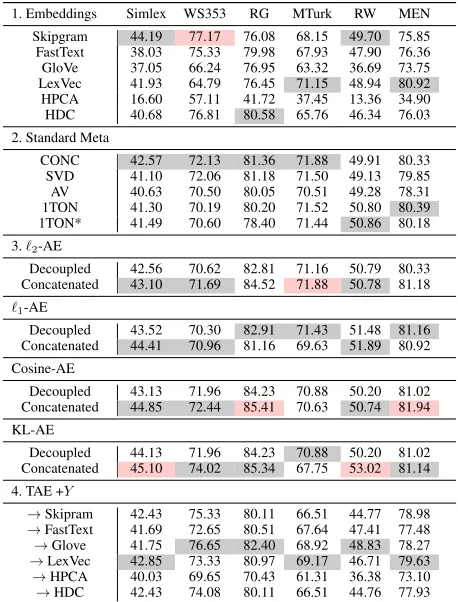
Best performing word meta-embeddings are held be-tween concatenated autoencoders that use the proposed Cosine-Embedding loss, while a KL-divergence also per-forms well on Simlex and RareWord. Interestingly, both of these dataset are distinct in that Simlex is the only dataset providing scores ontrue similarity instead of free associa-tion, which has shown to be more difficult for word embed-dings to account for (Hill, Reichart, and Korhonen 2016), while RareWord provides morphologically complex words to find similarity between. Concretely, it would seem KL-divergence is well suited for encoding when the word rela-tions exhibits of a more complex or rare nature. Similarly, we find SCP loss to achieve best results on RG and MEN, both the smallest and largest datasets of the set. Further-more, the TAE variant has lead to competitive performance against other meta-embedding approaches, showing good results on WS353. However, overall, standard AE performs better. Lastly, we found that when weak embeddings such as HPCA directly attribute to a degradation in the performance of models which use dimensionality reduction techniques or reconstruction methods such as autoencoding.
The autoencoder that uses a squared cosine loss and a KL-divergence loss improves performance in the majority of the cases, reinforcing the argument that accounting for angles explicitly through normalization (log-softmax for KL) is an important step in encoding to account for large documents of varying length and semantics. Lastly, we have shown its use in the context of improving word meta-embeddings, al-though this suggests cosine loss is also suitable for minimiz-ing angular differences for word embeddminimiz-ings.
Table 1 shows the results of unsupervised learning meth-ods, where grey represents the best model for each section (1-4) and red represents the best model for all sections (also the case for proceeding tables). We find it is clearly diffi-cult to obtain relatively good performance on Simlex and RareWord. The former was introduced to make a clear dis-tinction between association and true similarity, hence the annotation scores reflect this difference, making it difficult for DSMs which only rely solely on word associations.
In contrast, we see in Table 2 there is a large improve-ment in ρs over these datasets using the semi-supervised multi-task learning with asynchronous loss updates (ALU). ALU refers to propagatingLr andLsseparately one after the other. In training, the order of the updates is randomly chosen to avoid biasing towards either reconstruction of the word meta-embedding or learning word similarity.
The first measure (e.g Cosine-) represents the reconstruc-tion lossLrand second represents the word similarity loss
Ls(e.g NLL). We find that a cosineLrand the Brier’s score
Lsperforms the best on average. Brier’s score (Brier 1950) is a scoring function of probabilistic predictions (since we are considering soft labels), where MSE is used in practice. We distinguish from`2that is the MSE used for
reconstruc-tion of word meta-embeddings. Log-likelihood is often used for fitting models, however when the evaluation measures are different from that of the maximum likelihood (i.e Spear-man Correlation) it is not completely clear if this is the best option. Furthermore, our labels in this case are soft labels. Brier’s score is often used in classification in such cases
1. Embeddings Simlex WS353 RG MTurk RW MEN
Skipgram 44.19 77.17 76.08 68.15 49.70 75.85 FastText 38.03 75.33 79.98 67.93 47.90 76.36 GloVe 37.05 66.24 76.95 63.32 36.69 73.75 LexVec 41.93 64.79 76.45 71.15 48.94 80.92 HPCA 16.60 57.11 41.72 37.45 13.36 34.90 HDC 40.68 76.81 80.58 65.76 46.34 76.03
2. Standard Meta
CONC 42.57 72.13 81.36 71.88 49.91 80.33 SVD 41.10 72.06 81.18 71.50 49.13 79.85 AV 40.63 70.50 80.05 70.51 49.28 78.31 1TON 41.30 70.19 80.20 71.52 50.80 80.39 1TON* 41.49 70.60 78.40 71.44 50.86 80.18
3.`2-AE
Decoupled 42.56 70.62 82.81 71.16 50.79 80.33 Concatenated 43.10 71.69 84.52 71.88 50.78 81.18
`1-AE
Decoupled 43.52 70.30 82.91 71.43 51.48 81.16 Concatenated 44.41 70.96 81.16 69.63 51.89 80.92
Cosine-AE
Decoupled 43.13 71.96 84.23 70.88 50.20 81.02 Concatenated 44.85 72.44 85.41 70.63 50.74 81.94
KL-AE
Decoupled 44.13 71.96 84.23 70.88 50.20 81.02 Concatenated 45.10 74.02 85.34 67.75 53.02 81.14
4. TAE +Y
[image:6.612.324.553.53.354.2]→Skipram 42.43 75.33 80.11 66.51 44.77 78.98 →FastText 41.69 72.65 80.51 67.64 47.41 77.48 →Glove 41.75 76.65 82.40 68.92 48.83 78.27 →LexVec 42.85 73.33 80.97 69.17 46.71 79.63 →HPCA 40.03 69.65 70.43 61.31 36.38 73.10 →HDC 42.43 74.08 80.11 66.51 44.76 77.93
Table 1: Meta-Embedding Unsupervised Results
which is equivalent to the Mean Squared Error (MSE) class probabilities, in this case binary classification. We find that using Brier’s score for the annotations improves the Spear-man correlations for 4 out of 6 datasets, as shown in Table 2.
Meta-embeddings that are learned only using unsuper-vised methods (Table 1) giveρs= 45.10, on Simlex, while the semi-supervised MTL approach produces the most no-ticeable performance gain with a dramatic increase ofρs= 74.73. Firstly, this indicates that although Simlex has made a clear distinction between word associations and true similar-ity in its annotation scheme, there is still value in predicting such scores from different annotation distributions that only score word association and not the true similarity that is the focus of Simlex (Hill, Reichart, and Korhonen 2016).
In the semi-supervised MTL setting shown in Table 2, we see that results are also consistent with Table 1 as the cosine loss in reconstruction results in best performance for 4 out of the 6 datasets.
Analogy Results
Simlex WS353 RG MTurk RW MEN
Cosine-OLS 53.63 73.13 83.07 69.41 60.49 80.25
Cosine-NLL 59.22 76.09 80.45 70.43 61.31 82.49
Cosine-Brier’s 63.72 80.21 89.54 83.45 70.76 84.14
`1-OLS 55.16 68.80 82.82 70.35 61.07 78.56
`1-NLL 53.54 77.82 82.09 73.12 64.46 79.12
`1-Brier’s 68.78 77.60 87.44 80.67 78.05 79.73
`2-OLS 68.31 73.85 84.48 70.91 53.20 81.60
`2-NLL 53.80 71.15 85.10 71.51 50.61 79.38
`2-Brier’s 74.73 69.68 85.29 76.30 80.07 70.64
KL-OLS 62.47 68.93 85.75 72.35 50.38 80.95
KL-NLL 48.91 67.93 86.67 72.33 48.91 78.98
[image:7.612.354.525.53.241.2]KL-Brier’s 71.39 66.91 87.58 73.43 67.11 81.78
Table 2: Semi-Supervised Multi-Task Word Embedding Learning Results on Word Similarity
question with 79 relations). The former two consist of cate-gories of different analogy questions and the latter includes ranked candidate word pairs based on word pair relational similarity for a set of chosen word pairs. CosAdd (Mikolov, Yih, and Zweig 2013) is used for calculating the analogy answers for Google and MSR which ranks candidates given as CosAdd(a : b, c : d) = cos(b−a+c, d)and chooses the answer as the highest ranking candidate. For SemEval 2012 task 2, the word pair relations are manually assigned categories that are also assigned a class membership score which represents how well the pair represent a class. There-fore, the scores provided are word relation similarity scores, hence the spearman correlation is used for this dataset when evaluating the models.
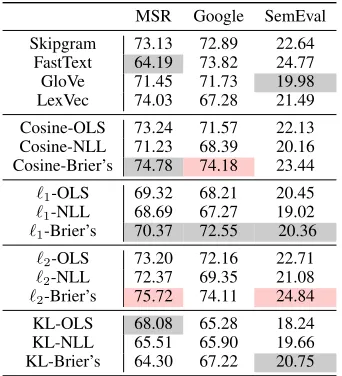
Table 3 shows the results of transferring the learned semi-supervised multi-task learning (SS-MTL) embeddings to analogy tasks. Here, we analyze (1) whether the word meta-embeddings carry over to analogy even if not all embedding algorithms preserve analogy relations and (2) check if the similarity encoded with SS-MTL has any effect on perfor-mance on analogy. We find that in general, semi-supervised MTL that incorporates similarity scores has some transfer-ability to analogy, at least based on the scores provided by the aforementioned word similarity datasets. Using word similarity scores for supervision is a general measure of sim-ilarity, whereas analogy relations are more specific, hence it is not surprising that the difference in performance is slight.
However, for Google Analogy, the larger of the three datasets with the smallest range of relation types, we find that the SS-MTL model that previously trained with Cosine-Brier’s loss functions shows the best performance overall. This is consistent with findings from Table 2 where the same model performs best over 4 of 6 word similarity datasets. This suggests that performing additional nonlinear meta-word encoding somewhat preserves the linear structures pre-served in models such as skipgram and fasttext. Addition-ally, it remains clear that Brier’s score (i.e`2for
classifica-tion) is best suited, at least when evaluating with Spearman correlation.
MSR Google SemEval
Skipgram 73.13 72.89 22.64
FastText 64.19 73.82 24.77
GloVe 71.45 71.73 19.98
LexVec 74.03 67.28 21.49
Cosine-OLS 73.24 71.57 22.13
Cosine-NLL 71.23 68.39 20.16
Cosine-Brier’s 74.78 74.18 23.44
`1-OLS 69.32 68.21 20.45
`1-NLL 68.69 67.27 19.02
`1-Brier’s 70.37 72.55 20.36
`2-OLS 73.20 72.16 22.71
`2-NLL 72.37 69.35 21.08
`2-Brier’s 75.72 74.11 24.84
KL-OLS 68.08 65.28 18.24
KL-NLL 65.51 65.90 19.66
KL-Brier’s 64.30 67.22 20.75
Table 3: SS-MTL Embedding Transferability To Analogy
Conclusion
This paper introduced a semi-supervised learning method for improving word meta-embeddings by reconstructing an ensemble of word vectors while also learning to pre-dict word similarity whereby the hidden layer representa-tion is shared between both tasks. We find performance in-creased significantly when using manually annotated scores from word similarity datasets in comparison to single word embeddings and unsupervised word meta-embedding ap-proaches. We also find that angular-based loss functions are well suited for word meta-learning for both unsupervised learning and the proposed multi-task semi-supervised learn-ing method, showlearn-ing best results on 4 out of the 6 word sim-ilarity datasets in both cases. In particular, we find most sig-nificant improvements on relatively difficult word similar-ity and association datasets such as Simlex and RareWord, while still improving by a large margin on the remaining datasets. Finally, we see slight improvements made when transferring the semi-supervised models for analogy tasks. However, this is expected given that similarity scores are more general than specific word pair relation types and not all word embedding algorithms preserve analogical relations to the same degree.
References
[Ando and Zhang 2005] Ando, R. K., and Zhang, T. 2005. A framework for learning predictive structures from multi-ple tasks and unlabeled data. Journal of Machine Learning Research6(Nov):1817–1853.
[Bao and Bollegala 2018] Bao, C., and Bollegala, D. 2018. Learning word meta-embeddings by autoencoding. COL-ING.
[image:7.612.53.294.54.190.2]Bollegala, D.; Hayashi, K.; and ichi Kawarabayashi, K. 2018. Think globally, embed locally — locally linear meta-embedding of words. InProc. of IJCAI-EACI. [Brier 1950] Brier, G. W. 1950. Verification of forecasts
ex-pressed in terms of probability. Monthey Weather Review
78(1):1–3.
[Bruni et al. 2012] Bruni, E.; Boleda, G.; Baroni, M.; and Tran, N.-K. 2012. Distributional semantics in technicolor. InProceedings of the 50th Annual Meeting of the Associa-tion for ComputaAssocia-tional Linguistics: Long Papers-Volume 1, 136–145. Association for Computational Linguistics. [Cao and Rei 2016] Cao, K., and Rei, M. 2016. A joint
model for word embedding and word morphology. arXiv preprint arXiv:1606.02601.
[Caruana 1998] Caruana, R. 1998. Multitask learning. In
Learning to learn. Springer. 95–133.
[Coates and Bollegala 2018] Coates, J., and Bollegala, D. 2018. Frustratingly easy embedding–computing meta-embeddings by averaging source word meta-embeddings. arXiv preprint arXiv:1804.05262.
[Dong et al. 2015] Dong, D.; Wu, H.; He, W.; Yu, D.; and Wang, H. 2015. Multi-task learning for multiple language translation. InProceedings of the 53rd Annual Meeting of the Association for Computational Linguistics and the 7th International Joint Conference on Natural Language Pro-cessing (Volume 1: Long Papers), volume 1, 1723–1732. [Finkelstein et al. 2001] Finkelstein, L.; Gabrilovich, E.;
Matias, Y.; Rivlin, E.; Solan, Z.; Wolfman, G.; and Ruppin, E. 2001. Placing search in context: The concept revisited. In
Proceedings of the 10th international conference on World Wide Web, 406–414. ACM.
[Gao, Bian, and Liu 2014] Gao, B.; Bian, J.; and Liu, T.-Y. 2014. Wordrep: A benchmark for research on learning word representations. arXiv preprint arXiv:1407.1640.
[Gentner and Forbus 2011] Gentner, D., and Forbus, K. D. 2011. Computational models of analogy. Wiley interdis-ciplinary reviews: cognitive science2(3):266–276.
[Gentner et al. 2001] Gentner, D.; Holyoak, K. J.; Holyoak, K. J.; and Kokinov, B. N. 2001. The analogical mind: Per-spectives from cognitive science. MIT press.
[Halawi et al. 2012] Halawi, G.; Dror, G.; Gabrilovich, E.; and Koren, Y. 2012. Large-scale learning of word relat-edness with constraints. InProceedings of the 18th ACM SIGKDD international conference on Knowledge discovery and data mining, 1406–1414. ACM.
[Hill, Reichart, and Korhonen 2015] Hill, F.; Reichart, R.; and Korhonen, A. 2015. Simlex-999: Evaluating semantic models with (genuine) similarity estimation.Computational Linguistics41(4):665–695.
[Hill, Reichart, and Korhonen 2016] Hill, F.; Reichart, R.; and Korhonen, A. 2016. Simlex-999: Evaluating semantic models with (genuine) similarity estimation.Computational Linguistics.
[Jozefowicz et al. 2016] Jozefowicz, R.; Vinyals, O.; Schus-ter, M.; Shazeer, N.; and Wu, Y. 2016. Exploring the limits of language modeling.arXiv preprint arXiv:1602.02410.
[Jurgens et al. 2012] Jurgens, D. A.; Turney, P. D.; Moham-mad, S. M.; and Holyoak, K. J. 2012. Semeval-2012 task 2: Measuring degrees of relational similarity. In Proceed-ings of the First Joint Conference on Lexical and Compu-tational Semantics-Volume 1: Proceedings of the main con-ference and the shared task, and Volume 2: Proceedings of the Sixth International Workshop on Semantic Evaluation, 356–364. Association for Computational Linguistics. [Lebret and Collobert 2013] Lebret, R., and Collobert, R.
2013. Word emdeddings through hellinger pca. arXiv preprint arXiv:1312.5542.
[Liu et al. 2015] Liu, X.; Gao, J.; He, X.; Deng, L.; Duh, K.; and Wang, Y.-Y. 2015. Representation learning using multi-task deep neural networks for semantic classification and in-formation retrieval. InNAACL.
[Luong et al. 2014] Luong, M.-T.; Sutskever, I.; Le, Q. V.; Vinyals, O.; and Zaremba, W. 2014. Addressing the rare word problem in neural machine translation. arXiv preprint arXiv:1410.8206.
[Luong, Socher, and Manning 2013] Luong, T.; Socher, R.; and Manning, C. D. 2013. Better word representations with recursive neural networks for morphology. InCoNLL, 104– 113.
[Mikolov et al. 2013a] Mikolov, T.; Chen, K.; Corrado, G.; and Dean, J. 2013a. Efficient estimation of word represen-tations in vector space.arXiv preprint arXiv:1301.3781. [Mikolov et al. 2013b] Mikolov, T.; Sutskever, I.; Chen, K.;
Corrado, G. S.; and Dean, J. 2013b. Distributed represen-tations of words and phrases and their compositionality. In
Advances in neural information processing systems, 3111– 3119.
[Mikolov, Yih, and Zweig 2013] Mikolov, T.; Yih, W.-t.; and Zweig, G. 2013. Linguistic regularities in continuous space word representations. Inhlt-Naacl, volume 13, 746–751. [Rothe and Sch¨utze 2015] Rothe, S., and Sch¨utze, H. 2015.
Autoextend: Extending word embeddings to embeddings for synsets and lexemes. arXiv preprint arXiv:1507.01127. [Rubenstein and Goodenough 1965] Rubenstein, H., and
Goodenough, J. B. 1965. Contextual correlates of synonymy.Communications of the ACM8(10):627–633. [Salle, Idiart, and Villavicencio 2016] Salle, A.; Idiart, M.;
and Villavicencio, A. 2016. Matrix factorization using window sampling and negative sampling for improved word representations. arXiv preprint arXiv:1606.00819.
[Sun et al. 2015] Sun, F.; Guo, J.; Lan, Y.; Xu, J.; and Cheng, X. 2015. Learning word representations by jointly model-ing syntagmatic and paradigmatic relations. InProceedings of the 53rd Annual Meeting of the Association for Computa-tional Linguistics and the 7th InternaComputa-tional Joint Conference on Natural Language Processing (Volume 1: Long Papers), volume 1, 136–145.
[Tversky 1977] Tversky, A. 1977. Features of similarity.
Psychological review84(4):327.
of the 55th Annual Meeting of the Association for Computa-tional Linguistics (Volume 1: Long Papers), volume 1, 189– 198.
[Wang et al. 2018] Wang, A.; Singh, A.; Michael, J.; Hill, F.; Levy, O.; and Bowman, S. R. 2018. Glue: A multi-task benchmark and analysis platform for natural language un-derstanding. arXiv preprint arXiv:1804.07461.