The Single-Phase ProtoDUNE
Technical Design Report
June 23, 2017
B. Abi , R. Acciarri , M. A. Acero , M. Adamowski , C. Adams , D. L. Adams , P. Adamson , M. Adinolfi11, Z. Ahmad139, C. H. Albright45, T. Alion131, J. Anderson5, K. Anderson45, C. Andreopoulos81,121,
M. P. Andrews45, R. A. Andrews45, J. dos Anjos14, A. Ankowski141, J. Anthony23, M. Antonello47, A. Aranda Fernandez30, A. Ariga9, T. Ariga9, E. Arrieta Diaz129, J. Asaadi135, M. Ascencio115, D. M. Asner106,
M. S. Athar2, M. Auger9, A. Aurisano28, V. Aushev77, D. Autiero66, F. Azfar105, J. J. Back144, H. O. Back106, C. Backhouse22, X. Bai126, M. Baird141, A. B. Balantekin147, S. Balasubramanian149, B. Baller45, P. Ballett39,
B. Bambah54, H. Band149, M. Bansal109, S. Bansal109, G. J. Barker144, G. Barr105, J. Barranco Monarca49, N. Barros112, A. Bashyal104, M. Bass105, F. Bay137, J. L. Bazo115, J. F. Beacom103, B. R. Behera109,
G. Bellettini113, V. Bellini24, O. Beltramello16, N. Benekos16, P. A. Benetti110, A. Bercellie119, E. Berman45,
H. Berns19, R. Bernstein45, S. Bertolucci16, V. Bhatnagar109, B. Bhuyan59, J. Bian20, K. Biery45, M. Bishai12,
A. Bitadze87, T. Blackburn131, A. Blake79, F. d. M. Blaszczyk10, E. Blaufuss88, G. C. Blazey95, M. Blennow73,
E. Blucher26, V. Bocean45, F. Boffelli110, J. Boissevain83, S. Bolognesi15, T. Bolton74, M. Bonesini61, T. Boone32,
C. Booth122, S. Bordoni16,16, P. Bour35, B. Bourguille55, S. B. Boyd144, D. Boyden95, D. Brailsford79, A. Brandt135,
J. Bremer16, S. J. Brice45, C. Bromberg91, G. Brooijmans33, G. Brown135, G. Brunetti45,108, N. Buchanan32,
H. Budd119, P. Calafiura80, A. Calatayud115, E. Calligarich110, E. Calvo17, L. Camilleri33, M. Campanelli82,
C. Cantini40, B. Carls45, M. Cascella82, E. Catano-Mur68, M. Cavaili-Sforza55, F. Cavanna45,149, S. Centro108,
A. Cervera Villanueva56, T. Cervi110, M. Chalifour16, A. Chappuis78, A. Chatterjee135, S. Chattopadhyay45,95,
S. Chattopadhyay139, L. Chaussard66, S. Chembra54, H. Chen12, M. Chen20, D. Cherdack32, C. Chi33, S. Childress45, S. Choubey50, B. C. Choudhary36, G. Christodoulou81, C. Christofferson126, E. Church106,
T. E. Coan129, A. Cocco96, P. Cole63, G. Collin89, J. M. Conrad89, M. Convery120, R. Corey126, L. Corwin126, J. I. Crespo-Anad´on33, J. Creus Prats16, P. Crivelli40, D. Cronin-Hennessy94, C. Crowley45, A. Curioni61,
D. Cussans11, H. da Motta14, D. Dale63, T. Davenne121, G. S. Davies65, J. Davies131, J. Dawson1, K. De135, I. De Bonis78, A. De Gouvea101, P. C. de Holanda41, P. De Jong100, P. De Lurgio5, J. J. de Vries23,
M. P. Decowski100, P. Dedin-Neto41, A. Delbart15, D. Delepine49, M. Delgado4, D. Demuth140, S. Dennis81,
C. Densham121, R. Dharmapalan5, N. Dhingra109, M. Diamantopoulou6, J. S. Diaz65, G. Diaz Bautista119,
P. Ding45, M. Diwan12, Z. Djurcic5, M. J. Dolinski37, G. Drake5, D. Duchesneau78, D. Dutta50, M. Duvernois147,
H. Duyang124, D. A. Dwyer80, S. Dye51, A. S. Dyshkant95, S. Dytman114, M. Eads95, B. Eberly120, D. Edmunds91,
S. Elliott83, W. M. Ellsworth52, M. Elnimr20, S. Emery15, S. Eno88, A. Ereditato9, C. O. Escobar45,
L. Escudero Sanchez23, J. J. Evans87, A. Falcone135, L. Falk131, A. Farbin135, C. Farnese108, Y. Farzan62,
M. Fasoli61, A. Fava45, J. Felix49, E. Fernandez-Martinez86, L. Fields45, F. Filthaut100, A. Finch79, M. Fitton121,
B.T. Fleming149, T. Forest63, J. Fowler38, W. Fox65, K. Francis95, J. Freeman45, J. Freestone87, D. Friant63, J. Fried12, A. Friedland120, S. Fuess45, B. Fujikawa80, A. Gago115, H. Gallagher138, S. Galvin112, S. Galymov66,
T. Gamble122, R. Gandhi50, S. Gao12, D. Garcia-Gamez87, S. Gardiner19, D. Gastler10, A. Gendotti40, D. Gibin108, I. Gil-Botella17, R. Gill12, A. K. Giri60, D. Goeldi9, M. Gold98, S. Gollapinni133, R. A. Gomes46,
J. J. Gomez Cadenas56, M. C. Goodman5, D. Gorbunov67, S. Goswami107, N. Graf114, N. Graf120, M. Graham120, E. Gramelini149, R. Gran93, C. Grant10, N. Grant144, V. Greco24, H. Greenlee45, L. Greenler147, M. Groh65,28,
K. Grzelak142, E. Guardincerri83, V. Guarino5, G. P. Guedes44, R. Guenette105, A. Guglielmi108,
K. K. Guthikonda76, M. M. Guzzo41, A. T. Habig93, A. Hackenburg149, R. W. Hackenburg12, H. Hadavand135,
R. Haenni9, A. Hahn45, M. D. Haigh144, T. Haines83, T. Hamernik45, P. Hamilton132, T. Handler133, S. Hans12,
D. Harris45, J. Hartnell131, T. Hasegawa72, R. Hatcher45, A. Hatzikoutelis133, S. Hays45, E. Hazen10,
M. Headley127, A. Heavey45, K. M. Heeger149, J. Heise127, K. Hennessy81, J. Hernandez-Garcia86, J. Hewes87,
A. Higuera52, T. Hill63, A. Himmel45, A. Holin82, E.W. Hoppe106, S. Horikawa40, G. Horton-Smith74, M. Hostert39,
A. Hourlier89, B. Howard65, J. Howell45, J. Hugon84, P. Hurh45, J. Huston91, J. Hylen45, J. Insler37, G. Introzzi110,
A. Ioannisian150, A. Izmaylov56, D. E. Jaffe12, C. James45, E. James45, C. H. Jang27, F. Jediny35, C. Jen141,
A. Jhingan109, S. Jim´enez17, M. Johnson45, R. Johnson28, J. Johnstone45, J. Joshi12, H. Jostlein45, C. K. Jung130,
T. Junk45, A. Kaboth121, I. Kadenko77, Y. Kamyshkov133, G. Karagiorgi33, D. Karasavvas6, Y. Karyotakis78, P. Kaur109, B. Kayser45, N. Kazaryan150, E. Kearns10, P.T.Keener112, E. Kemp41, C. Kendziora45, W. Ketchum45,
S. H. Kettell12, M. Khabibullin67, A. Khotjantsev67, B. Kirby12, M. Kirby45, J. Klein112, Y. J. Ko27, T. Kobilarcik45, B. Kocaman137, L.W. Koerner52, S. Kohn18,80, G. Koizumi45, A. Kopylov67, M. Kordosky146,
L. Kormos79, U. Kose16,9, V. A. Kosteleck´y65, M. Kramer18,80, I. Kreslo9, K. Kriesel147, W. Kropp20, Y. Kudenko67, V. A. Kudryavtsev122, S. Kulagin67, A. Kumar109, J. Kumar51, L. Kumar109, V. Kus35, T. Kutter84,
M. K¨opr¨u137, K. Lande112, C. Lane37, K. Lang136, T. Langford149, F. Lanni12, A. Laundrie147, T. Le138,
J. Learned51, P. Lebrun45, D. Lee83, W. M. Lee45, M. A. Leigui de Oliveira43, Q. Z. Li45, S. Li12, S. W. Li103,
X. Li130, Y. Li12, Z. Li38, C. S. Lin80, S. Lin32, R. Linehan120, J. Link141, Z. Liptak31, D. Lissauer12,
L. Littenberg12, B. R. Littlejohn57, J. Liu125, Q. Liu83, T. Liu129, S. Lockwitz45, N. Lockyer45, T. Loew80, M. Lokajicek13, L. LoMonaco24, K. Long64, K. Loo71, J. P. Lopez31, D. Lorca9, J. M. LoSecco102, W. Louis83,
M. Luethi9, K. B. Luk18,80, T. Lundin45, X. Luo149, T. Lux55, J. Lykken45, J. Maalampi71, A. A. Machado41, C. T. Macias65, J. R. Macier45, R. MacLellan125, S. Magill5, G. Mahler12, K. Mahn91, M. Malek122,
F. Mammoliti24, S. K. Mandal36, S. Mandodi54, S. Manly119, A. Mann138, A. Marchionni45, W. Marciano12,
D. Marfatia51, C. Mariani141, J. Maricic51, A. D. Marino31, M. Marshak94, C. M. Marshall80, J. Marshall23,
J. Marteau66, J. Martin-Albo105, D. A. Martinez Caicedo57, M. Masud50, S. Matsuno51, J. Matthews84,
C. Mauger112, K. Mavrokoridis81, D. Mayilyan150, R. Mazza61, A. Mazzacane45, E. Mazzucato15, N. McCauley81,
E. McCluskey45, N. McConkey122, K.T. McDonald116, K. S. McFarland119, C. McGivern45, A. M. McGowan119,
C. McGrew130, S. R. McGuinness102, R. McKeown146, D. McNulty63, R. McTaggart128, A. Mefodiev67, P. Mehta70,
D. Mei125, O. Mena56, S. Menary151, D. P. Mendez131, H. Mendez117, A. Menegolli110, G. Meng108, M. Messier65,
W. Metcalf84, M. Mewes65, H. Meyer145, T. Miao45, R. Milincic51, W. Miller94, G. Mills83, O. Mineev67,
O. G. Miranda29, C. S. Mishra45, S. R. Mishra124, B. Mitrica53, D. Mladenov16, I. Mocioiu111, K. Moffat39,
R. Mohanta54, N. Mokhov45, L. Molina Bueno40, C. Montanari110,16, D. Montanari45,16, J. Moon89, M. Mooney12, C. D. Moore45, B. Morgan144, C. Morris52, W. Morse12, C. Mossey45, C. A. Moura43, J. Mousseau90, L. Mualem22,
M. Muether145, S. Mufson65, S. Murphy40, J. Musser65, Y. Nakajima80, D. Naples114, J. Navarro7, D.Navas-Nicols17, J. Nelson146, M. Nessi16, D. Newbold11, M. Newcomer112, K. T. T. Nguyen135, R. Nichol82,
T. C. Nicholls121, E. Niner45, A. Norman45, B. Norris45, P. Novakova12, P. Novella56, E. Nowak16, J. Nowak79, M. S. Nunes41, H. O’Keeffe79, A. Olivares Del Campo39, R. Oliveira41, A. Olivier119, Y. Onishchuk77,
T. Ovsjannikova67, S. Pakvasa51, O. Palamara45,149, J. Paley45, C. Palomares17, E. Pantic19, V. Paolone114,
V. Papadimitriou45, S. Paramesvaran11, J. Park141, S. Parke45, Z. Parsa12, S. Pascoli39, J. Pasternak64, J. Pater87,
R. B. Patterson22, S. J. Patton80, T. Patzak1, B. Paulos147, L. Paulucci43, Z. Pavlovic45, G. Pawloski94,
D. Payne81, S. J. M. Peeters131, E. Pennacchio66, G. N. Perdue45, O. L. G. Peres41, L. Periale40, J. D. Perkin122,
K. Petridis11, R. Petti124, A. Petukhov126, P. Picchi110, F. Pietropaolo108,16, P. Plonski143, R. Plunkett45,
R. Poling94, M. Popovic45, S. Pordes45, M. Potekhin12, R. Potenza24, B. Potukuchi69, S. Poudel52, J. Pozimski64,
O. Prokofiev45, N. Pruthi109, P. Przewlocki97, N. Pumulo126, D. Pushka45, X. Qian12, J. L. Raaf45, R. Raboanary3,
V. Radeka12, J. Rademacker11, B. Radics40, A. Radovic146, I. Rakhno45, H. T. Rakotondramanana3, L. Rakotondravohitra3, Y. A. Ramachers144, R. Rameika45, J. Ramsey83, A. Rappoldi110, G. Raselli110, P. Ratoff79,
B. Rebel45, C. Regenfus40, J. Reichenbacher126, S. D. Reitzner45, A. Remoto78, A. Renshaw52, S. Rescia12, L. Rice95, K. Rielage83, K. Riesselmann45, D. Rivera112, M. Robinson122, L. Rochester120, O. B. Rodrigues46,
P. Rodrigues119, B. Roe90, R. M. Roser45, M. Ross-Lonergan39, M. Rossella110, S. Roy50, A. Rubbia40, C. Rubbia48, R. Rucinski45, C. Rudolph von Rohr9, B. Russell149, D. Ruterbories119, R. Saakyan82, K. Sachdev45, N. Sahu60,
P. Sala92,16, N. Samios12, F. Sanchez55, M.C. Sanchez68, W.R. Sands116, S. Santana117, R. Santorelli17,
L. M. Santos41, G. Santucci130, N. Saoulidou6, G. Savage45, A. Scaramelli110, A. Scarpelli1, T. Schaffer93,
H. Schellman104, P. Schlabach45, D. Schmitz26, J. Schneps138, K. Scholberg38, A. Schukraft45, E. Segreto41,
S. Sehrawat50, J. A. Sepulveda-Quiroz68, F. Sergiampietri40, K. Sexton12, L. Sexton-Kennedy45, M. H. Shaevitz33,
S. Shahsavarani135, P. Shanahan45, R. Sharma12, R. K. Sharma118, T. Shaw45, D. Shooltz91, R. Shrock130,
N. Simos12, J. Sinclair9, G. Sinev38, I. Singh109, J. Singh109, J. Singh85, V. Singh8, F. W. Sippach33, K. Siyeon27,
A. Smith23, P. Smith65, J. Smolik35, M. Smy20, E. Snider45, P. Snopok57, J. Sobczyk148, H. Sobel20,
M. Soderberg132, N. Solomey145, W. Sondheim83, M. Sorel56, A. Sousa28, K. Soustruznik25, M. Spanu110, J. Spitz90,
N. J. C. Spooner122, M. Stancari45, D. Stefan16,97, A. Stefanik45, H. M. Steiner80,18, J. Stewart12, J. Stock126,
S. Stoica53, J. Stone10, J. Strait45, M. Strait94, T. Strauss45, S. Striganov45, R. Sulej97, G. Sullivan88, Y. Sun51, L. Suter45, C. M. Sutera24, R. Svoboda19, B. Szczerbinska134, A. M. Szelc87, S. S¨oldner-Rembold87, R. Talaga5,
S. Tariq45, E. Tatar63, R. Tayloe65, K. Terao33, M. Thiesse122, L. F. Thompson122, M. Thomson23, C. Thorn12, X. Tian124, D. Tiedt126, S. C. Timm45, J. Todd28, A. Tonazzo1, T. Tope45, F. R. Torres41, M. Torti110,
M. Tortola56, F. Tortorici24, M. Toups45, C. Touramanis81, J. Trevor22, M. Tripathi19, I. Tropin45, W. H. Trzaska71, Y. Tsai120, K. V. Tsang120, A. Tsaris45, R. Tsenov123, S. Tufanli149, C. Tull80, J. Turner39,
M. Tzanov84, E. Tziaferi6, Y. Uchida64, S. Uma Sankar58, J. Urheim65, T. Usher120, M. R. Vagins75,20, P. Vahle146,
G. A. Valdiviesso42, L. Valerio45, Z. Vallari130, J. Valle56, R. Van Berg112, R. Van de Water83, F. Varanini108,
G. Varner51, G. Vasseur15, K. Vaziri45, G. Velev45, S. Ventura108, A. Verdugo17, M. A. Vermeulen100, E. Vernon12,
T. Viant40, T. V. Vieira41, C. Vignoli47, S. Vihonen71, C. Vilela130, B. Viren12, P. Vokac35, T. Vrba35,
T. Wachala99, D. Wahl147, M. Wallbank122, B. Wang129, H. Wang21, T. Wang39, T.K. Warburton68, D. Warner32,
M. Wascko64, D. Waters82, A. Weber121,105, M. Weber9, W. Wei125, A. Weinstein68, X. Wengin125, D. Wenman147,
M. Wetstein68, A. White135, L. H. Whitehead16, D. Whittington65, M. J. Wilking130, J. Willhite45, P. Wilson45,
R. J. Wilson32, P. Wittich34, J. Wolcott138, H. H. Wong18,80, T. Wongjirad89, K. Wood130, L.S. Wood106,
E. Worcester12, M. Worcester12, S. Wu40, C. Yanagisawa130, S. Yang28, T. Yang45, J. Ye129, M. Yeh12,
N. Yershov67, K. Yonehara45, B. Yu12, J. Yu135, J. Zalesak13, L. Zambelli78, B. Zamorano131, L. Zang122, A. Zani16, K. Zaremba143, G.P. Zeller45, C. Zhang12, C. Zhang125, Y. Zhou39, E. D. Zimmerman31, M. Zito15, J. Zuklin13,
2Aligarh Muslim University, Department of Physics, Aligarh-202002, India 3
University of Antananarivo, BP 566, Antananarivo 101, Madagascar
4Universidad Antonio Nari˜no, Cra 3 Este No 47A-15, Bogota, Colombia 5
Argonne National Laboratory, Argonne, IL 60439, USA
6University of Athens, University Campus, Zografou GR 157 84, Greece 7Universidad del Atlantico, Km 7 antigua via Puerto Colombia, Barranquilla, Colombia
8Banaras Hindu University, Department of Physics, Varanasi - 221 005, India 9University of Bern, Sidlerstrasse 5, CH-3012 Bern, Switzerland
10Boston University, Boston, MA 02215, USA
11University of Bristol, H. H. Wills Physics Laboratory, Tyndall Avenue Bristol BS8 1TL, United Kingdom 12Brookhaven National Laboratory, Upton, NY 11973, USA
13Institute of Physics CAS, Na Slovance 2, 182 21 Praha 8, Czech Republic 14Centro Brasileiro de Pesquisas F´ısicas, Rio de Janeiro, RJ 22290-180, Brazil
15CEA/Saclay, IRFU (Institut de Recherche sur les Lois Fondamentales de l’Univers), F-91191 Gif-sur-Yvette
CEDEX, France
16CERN, European Organization for Nuclear Research 1211 Geneve 23, Switzerland, CERN 17
CIEMAT, Avenida Complutense 40, E-28040 Madrid, Spain
18University of California (Berkeley), Berkeley, CA 94720, USA 19
University of California (Davis), Davis, CA 95616, USA
20University of California (Irvine), Irvine, CA 92697, USA 21University of California (Los Angeles), Los Angeles, CA 90095, USA
22California Institute of Technology, Pasadena, CA 91125, USA
23University of Cambridge, JJ Thomson Avenue, Cambridge CB3 0HE, United Kingdom 24University of Catania, INFN Sezione di Catania, Via Santa Sofia 64, I-95123 Catania, Italy
25Institute of Particle and Nuclear Physics of the Faculty of Mathematics and Physics of the Charles University in
Prague, V Holeˇsoviˇck´ach 747/2, 180 00 Praha 8-Libeˇn, Czech Republic
26University of Chicago, Chicago, IL 60637, USA 27
Chung-Ang University, Dongjak-Gu, Seoul 06974, South Korea
28University of Cincinnati, Cincinnati, OH 45221, USA 29
Cinvestav, Apdo. Postal 14-740, 07000 Ciudad de Mexico, Mexico
30Universidad de Colima, 340 Colonia Villa San Sebastian Colima, Colima, Mexico 31
University of Colorado (Boulder), Boulder, CO 80309, USA
32Colorado State University, Fort Collins, CO 80523, USA 33Columbia University, New York, NY 10027, USA
34Cornell University, Ithaca, NY 14853, USA
35Czech Technical University in Prague, Bˇrehov´a 78/7, 115 19 Prague 1, Czech Republic 36University of Delhi, Department of Physics and Astrophysics, Delhi 110007, India
37Drexel University, Philadelphia, PA 19104, USA 38Duke University, Durham, NC 27708, USA
39University of Durham, South Road, Durham DH1 3LE, United Kingdom 40ETH Zurich, Institute for Particle Physics, Zurich, Switzerland 41Universidade Estadual de Campinas, Campinas - SP, 13083-970, Brazil 42
Universidade Federal de Alfenas, Po¸cos de Caldas - MG, CEP 37715-400, Brazil
43Universidade Federal do ABC, 5001 Santo Andr´e - SP, 09210-580, Brazil 44
UEFS/DFIS - State University of Feira de Santana, Feira de Santana - BA, 44036-900, Brazil
45Fermi National Accelerator Laboratory, Batavia, IL 60510, USA 46
Universidade Federal de Goias, Goias, 74690-900, Brazil
47Laboratori Nazionali del Gran Sasso, I-67010 Assergi, AQ, Italy 48Gran Sasso Science Institute, Viale Francesco Crispi 7, L’Aquila, Italy
49Universidad de Guanajuato, Gto., C.P.37000, Mexico 50Harish-Chandra Research Institute, Jhunsi, Allahabad 211 019, India
51University of Hawaii, Honolulu, HI 96822, USA 52University of Houston, Houston, TX 77204, USA
53Horia Hulubei National Institute of Physiscs and Nuclear Engineering, Strada Reactorului 30, M˘agurele, Romania 54University of Hyderabad, Gachibowli, Hyderabad - 500 046, India
55
Institut de F`d’Altes Energies, Barcelona i.e. Catalan ersitat Autonoma de Barcelona, E-08193 Cerdanyola del
Valles, Barcelona, Spain
56
Instituto de Fisica Corpuscular, C/Catedratico Jose Beltran, 2 E-46980 Paterna (Valencia), Spain
57Illinois Institute of Technology, Chicago, IL 60616, USA 58
Indian Institute of Technology Bombay, Department of Physics Mumbai 400 076, India
59Indian Institute of Technology Guwahati, Guwahati, 781 039, India 60Indian Institute of Technology Hyderabad, Hyderabad, 502285, India 61INFN Sezione di Milano Bicocca, Piazza della Scienza 3, 20126 Milano, Italy
62Institute for Research in Fundamental Sciences (IPM), Farmanieh St. Tehran, 19538-33511, Iran 63Idaho State University, Department of Physics 921 South 8th Ave. Pocatello, ID 83209, USA
64Imperial College of Science Technology & Medicine, Blackett Laboratory Prince Consort Road, London SW7 2BZ,
United Kingdom
65Indiana University, Bloomington, IN 47405, USA
66Institut de Physique Nucleaire de Lyon (IPNL), Rue E. Fermi 4 69622 Villeurbanne, France
67Institute for Nuclear Research of the Russian Academy of Sciences (INR RAS), 60th October Anniversary Prosp.
7a Moscow, 117312, Russia
68Iowa State University, Ames, Iowa 50011, USA 69
University of Jammu, Physics Department, JAMMU-180006, India
70Jawaharlal Nehru University, Jawaharlal Nehru University, New Delhi 110067, India 71
University of Jyvaskyla, P.O. Box 35, FI-40014, Finland
72High Energy Accelerator Research Organization (KEK), Ibaraki, 305-0801, Japan 73KTH Royal Institute of Technology, Roslagstullsbacken 21, SE-106 91 Stockholm, Sweden
74Kansas State University, Manhattan, KS 66506, USA
75Kavli Institute for the Physics and Mathematics of the Universe (WPI), Kashiwa, Chiba 277-8583, Japan 76K L University, Guntur - 522 502, AP, India
77Kyiv National University, 64, 01601 Kyiv, Ukraine
78Laboratoire d’Annecy-le-Vieux de Physique des Particules, CNRS/IN2P3 and Universit´e Savoie Mont Blanc,
74941 Annecy-le-Vieux, France
79
Lancaster University, Bailrigg, Lancaster LA1 4YB, United Kingdom
80Lawrence Berkeley National Laboratory, Berkeley, CA 94720, USA 81
University of Liverpool, L69 7ZE, Liverpool, United Kingdom
82University College London, London, WC1E 6BT, United Kingdom 83
Los Alamos National Laboratory, Los Alamos, NM 87545, USA
84Louisiana State University, Baton Rouge, LA 70803, USA 85University of Lucknow, Lucknow 226007, Uttar Pradesh, India
86Madrid Autonoma University, Ciudad Universitaria de Cantoblanco 28049 Madrid, Spain 87University of Manchester, Oxford Road, Manchester M13 9PL, United Kingdom
88University of Maryland, College Park, MD 20742, USA 89Massachusetts Institute of Technology, Cambridge, MA 02139, USA
90University of Michigan, Ann Arbor, MI 48109, USA 91Michigan State University, East Lansing, MI 48824, USA 92INFN Milano, INFN Sezione di Milano, I-20133 Milano, Italy
93University of Minnesota (Duluth), Duluth, MN 55812, USA 94
University of Minnesota (Twin Cities), Minneapolis, MN 55455, USA
95Northern Illinois University, Department of Physics DeKalb, Illinois 60115, USA 96
Istituto Nazionale di Fisica Nucleare - Sezione di Napoli, Complesso Universitario di Monte S. Angelo, I-80126 Napoli, Italy
97
National Centre for Nuclear Research, A. Soltana 7, 05 400 Otwock, Poland
98University of New Mexico, 1919 Lomas Blvd. N.E. Albuquerque, NM 87131, USA 99H. Niewodniczanski Institute of Nuclear Physics, Polish Academy of Sciences, Cracow, Poland
100Nikhef National Institute of Subatomic Physics, Science Park, Amsterdam, Netherlands 101Northwestern University, Evanston, Il 60208, USA
102University of Notre Dame, Notre Dame, IN 46556, USA
103Ohio State University, 191 W. Woodruff Ave. Columbus, OH 43210, USA 104Oregon State University, Corvallis, OR 97331, USA
105University of Oxford, Oxford, OX1 3RH, United Kingdom 106Pacific Northwest National Laboratory, Richland, WA 99352, USA
107Physical Research Laboratory, Ahmedabad 380 009, India 108
University of Padova, Dip. Fisica e Astronomia G. Galilei and INFN Sezione di Padova, I-35131 Padova, Italy
109Panjab University, Chandigarh, 160014 U.T., India
113
University di Pisa, Theor. Division; Largo B. Pontecorvo 3, Ed. B-C; I-56127 Pisa, Italy
114University of Pittsburgh, Pittsburgh, PA 15260, USA 115Pontificia Universidad Cat´olica del Per´u, Apartado 1761, Lima, Peru
116Princeton University, Princeton, New Jersey 08544, USA 117University of Puerto Rico, Mayaguez, 00681, USA
118Punjab Agricultural University, Department of Math. Stat. & Physics, Ludhiana 141004, India 119University of Rochester, Rochester, NY 14627, USA
120SLAC National Acceleratory Laboratory, Menlo Park, CA 94025, USA
121STFC Rutherford Appleton Laboratory, OX11 0QX Harwell Campus, Didcot, United Kingdom 122University of Sheffield, Department of Physics and Astronomy, Sheffield S3 7RH, United Kingdom
123University of Sofia, 5 James Bourchier Blvd., Sofia, Bulgaria 124
University of South Carolina, Columbia, SC 29208, USA
125University of South Dakota, Vermillion, SD 57069, USA 126
South Dakota School of Mines and Technology, Rapid City, SD 57701, USA
127South Dakota Science And Technology Authority, Lead, SD 57754, USA 128
South Dakota State University, Brookings, SD 57007, USA
129Southern Methodist University, Dallas, TX 75275, USA 130Stony Brook University, Stony Brook, New York 11794, USA
131University of Sussex, Brighton, BN1 9RH, United Kingdom 132Syracuse University, Syracuse, NY 13244, USA 133University of Tennessee at Knoxville, TN, 37996, USA
134Texas A&M University (Corpus Christi), Corpus Christi, TX 78412, USA 135University of Texas (Arlington), Arlington, TX 76019, USA
136University of Texas (Austin), Austin, TX 78712, USA 137
TUBITAK Space Technologies Research Institute, TR-06800, Ankara, Turkey
138Tufts University, Medford, MA 02155, USA 139
Variable Energy Cyclotron Centre, 1/AF, Bidhannagar Kolkata - 700 064 West Bengal, India
140Valley City State University, Valley City, ND 58072, USA 141
Virginia Tech, Blacksburg, VA 24060, USA
142University of Warsaw, Faculty of Physics ul. Pasteura 5 02-093 Warsaw, Poland 143Warsaw University of Technology, Nowowiejska 15/19 00-665 Warszawa Poland, Poland
144University of Warwick, Coventry CV4 7AL, United Kingdom
145Wichita State University, Physics Division 1845 Fairmount St. Wichita, KS 67260, USA 146College of William and Mary, Williamsburg, VA 23187, USA
147University of Wisconsin (Madison), Madison, WI 53706, USA 148Wroclaw University, Plac Maxa Borna 9, 50-204 Wroclaw, Poland
149Yale University, New Haven, CT 06520, USA
150Yerevan Institute for Theoretical Physics and Modeling, Halabian Str. 34; Yerevan 0036, Armenia 151York University, Physics and Astronomy Department, 4700 Keele St. Toronto M3J 1P3, Canada
2016-06-01
Contents i
List of Figures iv
List of Tables 1
1 Introduction 2
1.1 ProtoDUNE-SP in the context of DUNE/LBNF . . . 2
1.2 The ProtoDUNE-SP detector . . . 3
1.3 Goals of ProtoDUNE-SP . . . 5
1.3.1 Detector engineering validation . . . 6
1.3.2 Physics . . . 7
1.4 The ProtoDUNE-SP Run plan . . . 9
2 Detector components 12 2.1 Overview . . . 12
2.2 Anode Plane Assemblies (APA) . . . 13
2.2.1 Scope and requirements . . . 13
2.2.2 APA design overview . . . 15
2.2.3 Wire properties . . . 18
2.2.4 APA frame and mesh . . . 19
2.2.5 Anchoring elements and wire boards . . . 19
2.2.6 Interconnection features . . . 26
2.3 Cathode Plane Assembly (CPA) . . . 28
2.3.1 Scope and requirements . . . 28
2.3.2 Design considerations . . . 30
2.3.3 CPA design . . . 30
2.3.4 Mechanical and electrical interconnections between modules . . . 33
2.4 Field Cage (FC) . . . 37
2.4.1 Scope and requirements . . . 37
2.4.2 Mechanical design . . . 38
2.4.3 Electrical design . . . 40
2.4.4 Top/bottom FC assemblies and ground-plane modules . . . 40
2.4.5 Interfaces to other TPC components . . . 41
2.5 TPC high-voltage (HV) components . . . 45
2.5.2 HV feedthrough design, power supply and cabling . . . 48
2.5.3 HV monitoring . . . 48
2.6 TPC front-end electronics . . . 50
2.6.1 Scope and requirements . . . 50
2.6.2 Grounding and shielding . . . 53
2.6.3 Distribution of APA wire-bias voltages . . . 53
2.6.4 Front-end mother board (FEMB) . . . 55
2.6.5 CE feedthroughs and cold cables . . . 63
2.6.6 Warm interface electronics . . . 68
2.6.7 External power and cables . . . 71
2.7 Photon detection system (PDS) . . . 72
2.7.1 Scope and requirements . . . 72
2.7.2 Photon detector modules . . . 74
2.7.3 Sensors . . . 74
2.7.4 Mechanical design and installation . . . 75
2.7.5 Alternative photodetector under development . . . 77
2.7.6 Photon detector UV-light monitoring system . . . 78
2.8 PDS electronics . . . 80
2.9 Data acquisition (DAQ) . . . 82
2.9.1 Scope and requirements . . . 82
2.9.2 Timing, trigger and beam interface . . . 84
2.9.3 TPC data readout . . . 86
2.9.4 RCE-based readout . . . 87
2.9.5 FELIX-based readout . . . 87
2.9.6 PDS and beam instrumentation data readout . . . 87
2.9.7 Event-building software . . . 88
2.9.8 Control, configuration and operational monitoring . . . 89
2.9.9 Interface of the DAQ to the online storage . . . 89
2.9.10 Online monitoring . . . 90
2.10 Cryostat and feedthroughs . . . 90
2.10.1 Scope and requirements . . . 90
2.10.2 Storage characteristics . . . 92
2.10.3 Cold GTT vessel . . . 92
2.10.4 Temporary Construction Opening (TCO) . . . 94
2.10.5 LAr pump penetration . . . 94
2.10.6 Beam window penetration . . . 94
2.10.7 Roof signal, services and support penetrations . . . 95
2.10.8 Detector support structure (DSS) . . . 95
2.11 Cryogenics and LAr purification systems . . . 97
2.11.1 Overview, overall planning and ES&H . . . 97
2.11.2 Cryogenics layout . . . 100
2.11.3 Modes of operation . . . 103
2.11.4 Features . . . 106
2.11.5 Cryostat pressure control . . . 109
2.12 Detector monitoring and slow control . . . 111
2.12.1 Monitoring devices and sensors . . . 111
4 Detector Installation 120
4.1 Overview . . . 120
4.2 Anode Plane Assemblies (APAs) . . . 120
4.3 Photon Detection System (PDS) . . . 122
4.4 Cold Electronics (CE) . . . 123
4.5 Cathode Plane Assemblies (CPAs) . . . 125
4.6 Field Cage (FC) . . . 125
5 Software and Computing 128 5.1 Overview . . . 128
5.2 Data storage and management system . . . 129
5.2.1 Data characteristics . . . 129
5.2.2 Raw data flow . . . 129
5.3 Prompt Processing for Data Quality Monitoring . . . 130
5.4 Production processing . . . 131
5.5 The LArSoft framework for simulation and reconstruction . . . 131
5.6 Event simulation . . . 132
5.7 Event reconstruction algorithms and performance . . . 134
5.7.1 Reconstruction . . . 134
5.7.2 Performance . . . 135
6 Test beam specifications 144 6.1 Beam requirements . . . 144
6.2 Beamline . . . 146
6.2.1 H4 beamline layout and optics . . . 146
6.2.2 Beam properties . . . 147
6.2.3 Muon halo . . . 149
6.3 Beamline instrumentation . . . 150
6.3.1 Beamline monitors . . . 150
6.3.2 Particle identification system . . . 152
6.3.3 Material budget and discussion . . . 155
6.3.4 Trigger and data acquisition . . . 156
6.4 Muon Tagger . . . 157
6.4.1 Overview . . . 157
6.4.2 CRT module design and readout . . . 157
6.4.3 Layout of CRT modules . . . 159
6.4.4 DAQ and readout . . . 161
6.4.5 Testing of modules during installation . . . 161
List of Figures
1.1 Major components of the ProtoDUNE-SP TPC . . . 4
1.2 Kinetic energy at interaction point for different beam momenta . . . 9
2.1 The field cages . . . 13
2.2 APA diagram . . . 16
2.3 APA dimensions . . . 19
2.4 APA bolted joint drawing . . . 20
2.5 APA full-size mesh drawing . . . 20
2.6 APA board stack . . . 21
2.7 APA wire board connection to electronics . . . 22
2.8 APA side board model . . . 23
2.9 APA side board photo . . . 24
2.10 APA support comb model . . . 25
2.11 Field maps of the region near the inactive gap of an APA . . . 26
2.12 Corner of APA with electron diverter boards installed . . . 27
2.13 Solid model of modular CE boxes . . . 28
2.14 APA interconnect drawing . . . 29
2.15 Resistive surface CPA concept . . . 32
2.16 CPA geometry . . . 34
2.17 Views of various parts of a CPA . . . 35
2.18 Hinged connection between CPA and FC module . . . 36
2.19 Model of the HV bus . . . 36
2.20 An end-wall field cage assembly . . . 39
2.21 The field cage with ground planes . . . 39
2.22 Field cage schematic diagram . . . 40
2.23 Top/bottom FC panel with endwall frame . . . 41
2.24 CPA to field cage connection . . . 42
2.25 Beam plug . . . 43
2.26 Beam plug nitrogen system . . . 44
2.27 Electric field calculation of beam plug electrode ring design . . . 45
2.28 Electric field calculation near the vicinity of the beam plug electrode . . . 46
2.29 Beam plug to field cage interface . . . 46
2.30 TPC HV circuit . . . 47
2.31 HV feedthrough . . . 49
2.32 Connections between signal flange and APA . . . 51
2.36 Layout of the 16-channel FE ASIC . . . 59
2.37 Measured pulse response with details . . . 60
2.38 The layout of the 16-channel ADC ASIC . . . 61
2.39 Measured ENC vs filter time constant . . . 63
2.40 Faraday box for the FEMB . . . 64
2.41 CE feedthrough configuration and internal cable routing . . . 64
2.42 Conceptual design of TPC CE feedthrough . . . 65
2.43 TPC cable routing scheme . . . 66
2.44 Results from cable validation testing . . . 67
2.45 Exploded view of the signal flange . . . 68
2.46 Power and Timing Card (PTC) and timing distribution . . . 69
2.47 LV power distribution to the Warm Interface Boards and FEMBs . . . 69
2.48 Warm Interface Board . . . 70
2.49 Micro TCA power connectors . . . 71
2.50 Photon detection system overview . . . 73
2.51 Radiator plate mounting Blocks . . . 74
2.52 Diagram of PDS installation into APA frame and installed SiPM mounting board . . . . 75
2.53 Photo of PD mock installation . . . 76
2.54 SiPM mounting board with 12 SiPMs and with Rj-45 connector . . . 76
2.55 Cables in APA frame . . . 77
2.56 ARAPUCA array installed in a APA frame . . . 78
2.57 UV-light monitoring system . . . 79
2.58 SSP module prototypes . . . 81
2.59 Block diagram of the ProtoDUNE SSP module . . . 82
2.60 DAQ Overview . . . 83
2.61 Warm vessel layout . . . 91
2.62 Cryostat overall dimensions . . . 93
2.63 Cross section of insulation layers on membranes . . . 93
2.64 Front view of the cryostat with the TCO for the NP04 cryostat . . . 94
2.65 Detector support system (DSS) . . . 97
2.66 DSS showing full set of beams . . . 98
2.67 Cryogenics process flow diagram . . . 101
2.68 3D model of the installation . . . 102
2.69 Detail of the internal cryogenics . . . 102
2.70 A purity monitor from ICARUS T600 . . . 112
2.71 Process control, detector control and safety systems . . . 116
3.1 ProtoDUNE-SP cryostat in EHN1 . . . 117
3.2 Conventions for labeling the four sides of the cryostat . . . 118
3.3 Elevation section view of the cryostat . . . 118
3.4 Layout of rails in clean room and dimensions . . . 119
4.1 Locations of activities in clean room . . . 121
4.2 APA with the special tooling attached . . . 122
4.4 CE installation . . . 123
4.5 Cold test stand . . . 124
4.6 Top/bottom FC assembly . . . 125
4.7 FC end wall panel . . . 126
4.8 Field cages deployed in Salève-side drift . . . 127
5.1 Conceptual diagram of the flow of raw data in ProtoDUNE-SP . . . 130
5.2 CNN-based EM selection in pion event . . . 136
5.3 CNN-based EM selection in pion samples . . . 136
5.4 Reconstructed invariant masses ofπ0 candidates in MC . . . 137
5.5 PANDORA reconstruction, single muons, 300 MeV/c < p< 5 GeV/c . . . 138
5.6 PMA reconstruction, single muons, 300 MeV/c < p< 5 GeV/c . . . 139
5.7 Vertex resolution for inelastic interaction of π± on Ar where aπ0 is produced . . . 140
5.8 Reconstructed event of simulated proton with initial momentum 2 GeV/c . . . 141
5.9 Example of reconstructed cosmic muons in ProtoDUNE-SP . . . 141
5.10 Comparison of imaging recon qualities with and without charge information . . . 142
5.11 Reconstructed image for one neutrino interaction event; comparison to MC . . . 143
6.1 Beam window locations . . . 145
6.2 H4 beamline layout . . . 146
6.3 H4 beam optics . . . 148
6.4 Beam momentum uncertainty . . . 150
6.5 Muon halo intensity at the cryostat face . . . 151
6.6 CERN threshold Cherenkov counter . . . 152
6.7 Cherenkov gases . . . 153
6.8 Required ToF resolution . . . 154
6.9 pLAPPD time-of-flight system . . . 155
6.10 Material budget . . . 156
6.11 Placement of upstream and downstream Cosmic Ray Tagger (CRT) panels . . . 158
6.12 Drawing of Cosmic Ray Tagger (CRT) module . . . 158
6.13 Photo of CRT module . . . 159
6.14 Orthogonal layout of a four-module CRT unit . . . 160
List of Tables
1.1 Preliminary run plan for ProtoDUNE-SP hadron beam . . . 10
1.2 Preliminary run plan for ProtoDUNE-SP electron beam . . . 11
2.1 TPC detection components, dimensions and quantities . . . 12
2.2 Prelim physics requirements that motivate APA design parameters . . . 14
2.3 APA design parameters . . . 15
2.4 Baseline bias voltages for APA wire layers . . . 17
2.5 CuBe wire tensile strength and CTE . . . 18
2.6 Electronics components and quantities . . . 52
2.7 Physics requirements for the PDS electronics . . . 80
2.8 Parameters defining data rate and volume in the “most likely” scenario . . . 84
2.9 Cryostat penetrations, roof . . . 96
2.10 Engineering parameters for cryogenics installation . . . 105
2.11 Estimated heat loads within the cryostat . . . 107
2.12 Cryostat pressures during normal operations . . . 110
5.1 Raw data storage parameter estimates . . . 129
6.1 Particle beam requirements . . . 145
6.2 Beam composition . . . 147
Chapter 1: Introduction 1–2
Chapter 1
Introduction
1.1
ProtoDUNE-SP in the context of DUNE/LBNF
ProtoDUNE-SP is the single-phase DUNE Far Detector prototype that is under construction and will be operated at the CERN Neutrino Platform (NP) starting in 2018. It was proposed to the CERN SPSC in June 2015 (SPSC-P-351), and following positive recommendations by SPSC and the CERN Research Board in December 2015, was approved at CERN as experiment NP-04 (Pro-toDUNE). The Fermilab Director and the CERN Director of Research and Scientific Computing signed a Memorandum of Understanding (MoU) for this experiment in December 2015 that is initially valid until December 2022, and may be extended by mutual agreement.
ProtoDUNE-SP, a crucial part of the DUNE effort towards the construction of the first DUNE 10-kt fiducial mass far detector module (17 kt total LAr mass), is a significant experiment in its own right. With a total liquid argon (LAr) mass of 0.77 kt, it represents the largest monolithic single-phase LArTPC detector to be built to date. It is housed in an extension to the EHN1 hall in the North Area, where the CERN NP is providing a new dedicated charged-particle test beamline. ProtoDUNE-SP aims to take its first beam data before the LHC long shutdown (LS2) at the end of 2018.
ProtoDUNE-SP prototypes the designs of most of the single-phase DUNE far detector module (DUNE-SP) components at a 1:1 scale, with an extrapolation of about 1:20 in total LAr mass. This is similar to the scaling factor adopted by ICARUS; its T600 detector, split into two half-modules of about 375 t total LAr mass each, was preceded by the 14-t “10-m3” prototype.
The construction and operation of ProtoDUNE-SP will serve to validate the membrane cryostat technology and associated cryogenics, and the networking and computing infrastructure that will handle the data and simulated data sets. A charged-particle beam test will enable critical calibra-tion measurements necessary for precise calorimetry. It will also enable the colleccalibra-tion of invaluable data sets for optimizing the event reconstruction algorithms – i.e., for finding interaction vertices and for particle identification – and ultimately for quantifying and reducing systematic uncertain-ties for the DUNE far detector. These measurements are expected to significantly improve the physics reach of the DUNE experiment.
The timescale for the validation of the basic TPC design is driven by the schedule for the major LBNC and DOE reviews of the DUNE TDR that will take place in 2019. This sets the requirement for ProtoDUNE-SP data collection in 2018.
Given its technical challenges, its importance to the DUNE experiment and the timeframe in which it must operate, ProtoDUNE-SP has put in place a strong organizational structure incorporating contributions from a large number of DUNE collaboration institutes.
1.2
The ProtoDUNE-SP detector
The ProtoDUNE-SP TPC, illustrated in Figure 1.1 comprises two drift volumes, defined by a central cathode plane that is flanked by two anode planes, each at a distance of 3.6 m, and a field cage (FC) that surrounds the entire active volume. The active volume is 6 m high, 7 m wide and 7.2 m deep (along the drift direction). Each anode plane is constructed of three adjacent Anode Plane Assemblies (APAs) that are each 6 m high by 2.3 m wide in the installed position. Each APA consists of a frame that holds three parallel planes of sense and shielding wires; the wires of each plane are oriented at different angles with respect to those on the other planes to enable 3D reconstruction. The wire pitch for all wire planes is 4.5 mm, and each APA holds a total of 2,560 wires.
The cathode plane, called the Cathode Plane Assembly (CPA) is an array of 18 (six wide by three high) CPA modules, which consist of flame-retardant FR4 frames, each 1.18 m wide and 2 m high, that hold thin panels with a resistive coating on both sides. The CPA is held at −180 kV
providing the 500-V/cm drift field in the 3.6-m-deep drift regions. Uniformity of the electric field is guaranteed by the surrounding FC.
The CE, mounted onto the APA frame, and thus immersed in LAr, amplifies and continuously digitizes the induced signals on the sense wires at several MHz, and transmits these waveforms to the Data Acquisition system (DAQ). From the DAQ the data are transmitted through the buffer to disk, then to the central CERN Tier-0 Computing Center, and finally to other partner sites for processing and analysis.
Chapter 1: Introduction 1–4
longer-wavelength photons, in the visible blue range. Some of the converted photons are emitted into the bar, a fraction of which are then internally reflected to the bar’s end where they are detected by silicon photomultipliers (SiPMs). Each APA frame is designed with ten bays into which PDs are inserted after the TPC wires have been strung. This allows for final assembly at the integration area (in a clean room) at the CERN NP prior to installation inside the cryostat.
1.3
Goals of ProtoDUNE-SP
ProtoDUNE-SP has four principal goals, all of which are essential parts of the DUNE far detector development program:
• Prototype the production and installation procedures for the single-phase far detector design.
• Validate the design from the perspective of basic detector performance; this can be achieved
with cosmic-ray data. This is the critical step from the perspective of establishing the design for the DUNE TDRs, which will undergo LBNC and DOE reviews in 2019.
• Accumulate large samples of test-beam data to understand/calibrate the response of the
detector to different particle species.
• Demonstrate the long-term operational stability of the detector as part of the risk mitigation
program ahead of the construction of the first 10-kt far detector module.
Commissioning and successfully bringing the detector into operation and maintaining it in a stable operating condition over a period of one-to-three months would allow for validation of the design through a full characterization of the detector components, including the membrane cryostat and the cooling and purification circuit, the APA design and the layout of its cold read-out electronics, the HV system, and the PDS and its warm read-out electronics. This can be achieved by collecting cosmic-ray data.
The large samples of test-beam data of different particle species would allow for a more in-depth understanding the response of the detector and could ultimately be used for calibration purposes. The analysis of the test-beam data will involve strong feedback between reconstruction, detector simulation, and hadronic modeling. Three types of systematic effects will be addressed: (1) a detailed understanding of energy scale and energy resolution for electromagnetic and hadronic showers; (2) the detector response to different particle species, including the impact of recombi-nation effects as a function of angle; and (3) improved modeling of the interactions of hadrons in argon, which will provide constraints to the GEANT4 physics models. A run period of approx-imately three months in the test beam is considered sufficient, assuming stable operation under good beam conditions. The aim is to accumulate these data before the start of LS2 (Jul-Oct, 2018).
Chapter 1: Introduction 1–6
associated with the extended operation of the DUNE far detector modules. This argues for cosmic-ray operation in 2019 and most likely 2020. This extended running period would be an important component of our risk mitigation strategy for the overall DUNE detector construction effort.
Ongoing detailed studies aim to quantify estimates regarding the level at which systematics in DUNE oscillation measurements can be constrained through analysis of ProtoDUNE test-beam data. The precise number of beam events required to meet the DUNE oscillation analysis physics goals is not yet determined - but this is not the primary driver of the beam time request. It should be noted that the run duration will depend heavily upon actual detector performance and the beam quality (i.e., precision in particle momentum, impact position, beam PID), and that large uncertainties will remain until both ProtoDUNE-SP and the H4 beamline are commissioned. For all these reasons, beam operation after LS2 cannot be excluded.
1.3.1
Detector engineering validation
ProtoDUNE-SP is designed such that it will provide information on the actual far detector perfor-mance in as close as possible a configuration to the actual far detector layout, given the practical considerations imposed by time, space, and cost. To achieve this, the cold components are identical to the components proposed for the far detector, to the extent possible.
The APAs are full-scale pre-production modules for the far detector. The ground connections between the electronics, the APA mechanical structure, the photon detectors, and the detector support structure are the same as those proposed for DUNE-SP. ProtoDUNE-SP is instrumented with three APAs along each wall; this will test for cross talk between the middle APA and its neighbors. Whereas DUNE-SP is designed with a 12-m-high TPC, based on a two-APA-high layout, ProtoDUNE-SP TPC is one APA high, due to practical limitations. The collaboration will test the mechanical process of installing the two-APA detector configuration, along with the related cabling, separately.
The cold readout electronics is based on the DUNE-SP cryogenic front-end pre-amp/shaper chip and ADC design. The front-end ASIC is essentially the final design while the cold ADC ASIC is not the final version and the dedicated ASIC (COLDATA) for serializing the data and providing a 1-GB/s link is not yet available. Given the schedule constraints for ProtoDUNE-SP, an FPGA that emulates the COLDATA functionality is used and mounted on a dedicated mezzanine board. All the analog components, the conversion to digital, and the grounding/power distribution for the final electronics can be tested in this configuration.
This configuration of the electronics chain is the only option for meeting the requirement for protoDUNE-SP data collection in 2018 (requirement set by the schedule for the major LBNC and DOE reviews of the DUNE TDR that will take place in 2019 and the need of validation of the basic TPC design by then). In the event further optimization of the ASICs (ADC and COLDATA) is required based on the ProtoDUNE-SP findings, it can be implemented before the start of production in 2020.
sensitive. The grounding and shielding are therefore critical, and the designs are as similar as is practical to those of DUNE-SP. The building ground in ENH1, with the interconnected rebar in the concrete floor connected to the building ground bus, will provide a fairly good ground. The cryostat itself is isolated from the building ground, and all the mechanical/electrical connections have dielectric breaks. DUNE-SP, in contrast, will be installed a mile underground in a very dry mine, and better isolation from the environment is expected. ProtoDUNE-SP will test the ground isolation and shielding under conservative conditions.
The FC and cathode planes are full-scale prototypes, with the same maximum drift distance and corresponding high voltage. This allows ProtoDUNE-SP to use the same HV feedthrough and drift-field configuration as is planned for DUNE-SP. The cryostat dimensions are selected to be the same for both ProtoDUNEs to leverage the same cryostat and cryogenics system designs. In order to fit the ProtoDUNE-SP TPC in the cryostat, the wall-to-cathode plane distance is slightly smaller than in DUNE-SP, making this setup a conservative test of the HV design. Testing the TPC components under the most likely operating conditions for DUNE-SP is extremely important, as this is the first test of the updated LArTPC design, which incorporates a resistive cathode and FC construction with metal profiles and fiberglass I-beam support.
ProtoDUNE-SP also offers a unique platform to validate and possibly optimize the cryogenics design for DUNE-SP. All cryostat penetrations are designed with gas purge to prevent contaminates from migrating from warm surfaces to the ullage volume, and the the liquid and gas flows inside the cryostat are being modeled. This is expected to provide an excellent test bed to validate the cryogenics design for DUNE-SP.
ProtoDUNE-SP will prototype the tooling and procedures for transporting APAs and transferring them to a suspended rail system. Similarly, the assembly and transport processes of the CPAs and top/bottom FC assemblies are being developed. Due to space constraints inside the cryostat, the rail structure on which the detector is hung will most likely be different for DUNE-SP. Despite these differences, the experience gained in installing the ProtoDUNE-SP detector will be invaluable in planning the DUNE-SP installation.
Integration of the test beam with ProtoDUNE-SP is quite different from the neutrino beam inte-gration planned for DUNE-SP. To minimize the material interactions of the particle beam in the ProtoDUNE-SP cryostat upstream of the TPC, a volume of LAr along the beam path (between the cryostat membrane and the FC) is displaced, and replaced by a less dense volume of dry nitrogen gas. This requires a penetration into one of the FC assemblies to install a beam plug. To en-sure that the displacement plug does not compromise the ProtoDUNE-SP operation, a dedicated HV test at Fermilab is planned that will test the final beam plug in the exact field configuration planned for ProtoDUNE-SP.
1.3.2
Physics
Chapter 1: Introduction 1–8
calorimetric energy measurements. The beam measurements will also provide a calibration data set for tuning the Monte Carlo simulations and a reference data set for the DUNE experiment.
Pion and proton beams in an energy range from about one to a few GeV will be used primarily to study hadronic interaction mechanisms and secondary particle production. At higher energies, these beams will be used to study shower reconstruction and energy calibration. Electrons will be used to benchmark and tune electron/photon separation algorithms, to study electromagnetic cascade processes and to calibrate electromagnetic showers at higher energies. Charged kaons pro-duced in the tertiary beamline are rare but are copiously propro-duced by the pion beam interactions inside the detector. These will be extremely useful for characterizing kaon identification efficiency for proton decay sensitivity studies. Samples of stopping muons with Michel electrons from muon decay (or without them, in the case of negative muon capture) will be used for energy calibra-tions in the low-energy range of the SN neutrino events and for the development of charge-sign determination methods.
A cumulative ProtoDUNE-SP test-beam run period of 16 weeks is assumed, but it depends on the extent of beamline sharing with other users at EHN1. The run will take place prior to the long shutdown of the LHC in late 2018 (LS2).
ProtoDUNE-SP will acquire cosmic data during periods with no beam. A dedicated external trigger system consisting of arrays of scintillator paddles, suitably positioned and arranged in
coincidence trigger logic, will select specific classes of cosmic muon events. Dedicated runs, e.g.,
runs looking for long muon tracks crossing the entire detector at large zenith angles, allow for an overall test of the detector performance and the DAQ. Runs looking for muons stopping inside the LAr volume and the accumulation of accurate Michel electron spectra may be useful for energy calibration purposes in the low-energy range.
It is important to note that ProtoDUNE-SP offers much beyond calibration and detector perfor-mance characterization. The LArTPC simultaneously features precise 3D tracking and accurate measurement of energy deposited. Its large active volume allows for good containment of the hadronic and electromagnetic interaction products in the few GeV range. These capabilities have never before been combined in one detector. The unprecedented event reconstruction capability combined with the exposure of the detector’s large active volume to the CERN charged-particle beams open the way to a truly rich program of new physics investigations into particle interaction processes.
Hadronic (π, K and p) interactions on an Ar target around one GeV produce low-multiplicity final
states rather than “hadron showers,” and similarily 1-GeV electrons (with critical energy ' 30
MeV in Ar) produce low-populated cascades, with only a few tens of secondary energetic electrons (positrons). “TPC/imaging-aided calorimetric measurements” will allow investigations of energy deposition mechanisms in this energy range where the standard hadronic and electromagnetic shower concepts and features are either not well defined or cannot be applied. The calorimetric measurement of the total energy deposited can, in fact, be accomplished, by detecting and sum-ming over the energy deposited by each individual secondary particle/track thanks to the imaging capabilities of the LArTPC. In particular, the determination of the electromagnetic content in hadron-initiated cascades,π0 multiplicity, and the energy fraction carried as a function of primary
1.4
The ProtoDUNE-SP Run plan
Beam simulations show that the hadron rates at energies below 1 GeV/c are low. Moreover, low-energy beams are more subject to degradation by materials in the beamline. The optimization of the run plan factors in the beam composition and particle rates of the H4 beamline, and also particle interaction topologies in the ProtoDUNE-SP detector. Full simulations of particle transport in the ProtoDUNE-SP detector, including the beam window, have been performed.
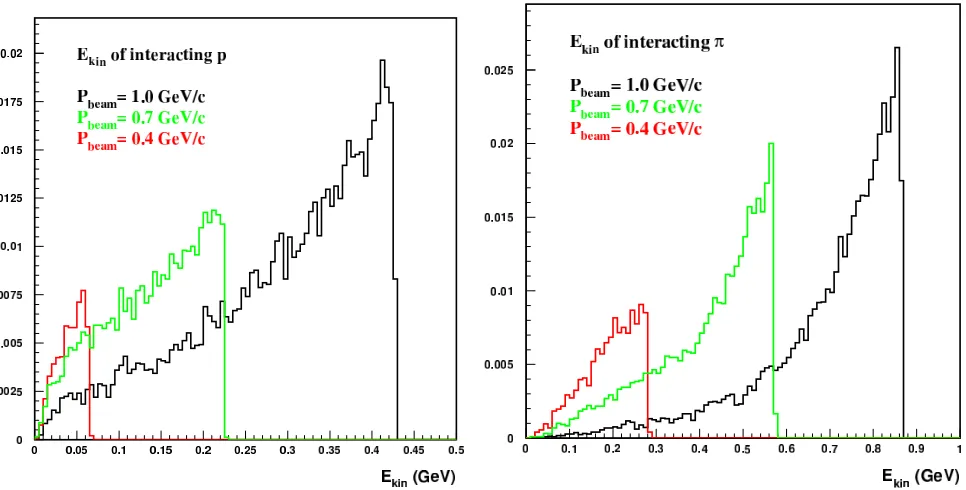
At a beam momentum of 1 GeV/c, 35% of protons are stopped before reaching the active TPC region, while the percentage reduces to 0.5% at 2 GeV/c. The kinetic energy distributions of protons and pions at the entrance point of the TPC for different beam momenta are shown in Figure 1.2. The fraction of stopping π’s for one π produced at the secondary target is 3% at p = 0.4 GeV/c and decreases to 1.3% at p = 0.7 GeV/c. The long distance (37 m) between the
secondary target and the front of the LAr cryostat has a significant impact on the pion and kaon rates in the TPC. Due to pion lifetime, many of the low-energy pions produced at the secondary target decay in the beam pipe before reaching the cryostat. The situation is even more significant for kaons; most kaons below 2 Gev/c do not make it to the cryostat. Consequently the H4 beamline will not be operated much below 1 GeV/c in the hadron mode. For electrons, the beam momentum should go as low as possible to study the topology of very low-energy electron-initiated showers.
Figure 1.2: Kinetic energy of particles at the point of interaction in the ProtoDUNE-SP active volume, for different beam momenta. Histograms are normalized to one particle injected in the beamline accep-tance. Simulations include the beam window materials, beams are considered as monochromatic and parallel. Left: protons, Right: pions.
[image:22.612.67.550.358.603.2]Chapter 1: Introduction 1–10
• Trigger rate = 25 Hz
• Two 4.8 sec spills per SPS Super Cycle
• SPS Super Cycle = 48 sec
• 106 (104) secondary particles on target per spill for hadron (electron) beam
• Particle ID trigger for electrons from 0.5 to 7 GeV/c
• Trigger rate for electron in hadron beam is prescaled to 0.5 Hz
• Data collection efficiency = 50%
It has not yet been determined whether the H2 and H4 tertiary beamlines at EHN1 can run simultaneously, or whether the secondary beam (upstream the target of the H4 beamline) will be shared with other users. Therefore, a collection efficiency of 50% has been assumed.
It is planned to run the H4 beamline in two modes: the first configuration is optimized for the production of hadrons and the second configuration is optimized for the production of high-purity electrons. Even in the hadron mode, the beam is still dominated by electrons, especially for low beam momenta. However, the electrons in the hadron beam are not particularly “clean” due to the amount of materials in the beamline from the particle identification (PID) instrumentations. The proposal is to heavily prescale the electron events using PID (e.g., Threshold Cherenkov counters) trigger while running in hadron mode. The PID systems that contribute significantly to the material budget will be removed when the beamline is reconfigured for electron beam. Various run plan scenarios are under investigation. One of the scenarios is shown in Tables 1.1 and 1.2. Similar values are expected for the negative beam sample.
Table 1.1: A preliminary run plan for ProtoDUNE-S P hadron beam. The expected sample (positive beam) as a function of momentum is shown.
P # of # ofe+ # of K+ # of µ+ # ofp # of π+ Total # Beam Time
(GeV/c) Spills of Events (days)
1 70K 84K ≈ 0 70K 689K 625K 1.5M 19.4 days
2 16K 19K 9K 36K 336K 572K 1.0M 4.4 days
3 13K 16K 26K 17K 181K 540K 780K 3.6 days
4 11K 13K 19K 16K 107K 510K 660K 3.1 days
5 11K 13K 29K 13K 96K 510K 660K 3.1 days
6 11K 13K 36K 12K 94K 510K 660K 3.1 days
7 11K 13K 42K 8K 87K 510K 660K 3.1 days
Total 143K 171K 161K 172K 1.6M 3.8M 5.9M 39.7 days
Table 1.2: A preliminary run plan for ProtoDUNE-SP electron beam. The expected sample for positive beam configuration is shown.
Momentum Bins # of Spills per Bin # e+ per Bin Beam Time per Bin
(GeV/c) (days)
Chapter 2: Detector components 2–12
Chapter 2
Detector components
2.1
Overview
The elements composing the detector, listed in Section 1.2, include the time projection chamber (TPC), the cold electronics (CE), and the photon detection system (PDS). The TPC components, e.g., anode planes, a cathode plane and a field cage, are designed in a modular way. The six APAs are arranged into two APA planes, each consisting of three side-by-side APAs. Between them, a central cathode plane, composed of 18 CPA modules, splits the TPC volume into two electron-drift regions, one on each side of the cathode plane. A field cage (FC) completely surrounds the four open sides of the two drift regions to ensure that the electric field within is uniform and unaffected by the presence of the cryostat walls and other nearby conductive structures. The sections in this chapter describe the components individually.
Figure 2.1 illustrates how these components fit together.
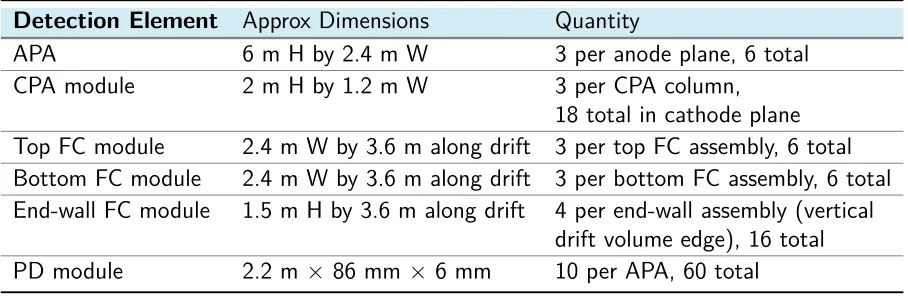
Table 2.1 lists the principal detection elements of ProtoDUNE-SP along with their approximate dimensions and their quantities.
Table 2.1: TPC detection components, dimensions and quantities
Detection Element Approx Dimensions Quantity
APA 6 m H by 2.4 m W 3 per anode plane, 6 total
CPA module 2 m H by 1.2 m W 3 per CPA column,
18 total in cathode plane
Top FC module 2.4 m W by 3.6 m along drift 3 per top FC assembly, 6 total
Bottom FC module 2.4 m W by 3.6 m along drift 3 per bottom FC assembly, 6 total
End-wall FC module 1.5 m H by 3.6 m along drift 4 per end-wall assembly (vertical
drift volume edge), 16 total
[image:25.612.78.532.570.718.2]Figure 2.1: A view of the TPC field cage and the central cathode plane (CPA). The APAs, which would be positioned at both open ends of the FC, are not shown.
2.2
Anode Plane Assemblies (APA)
2.2.1
Scope and requirements
Anode Plane Assemblies (APAs) are the detector elements utilized to sense ionization created by charged particles traversing the liquid argon volume inside the single-phase TPC. The scope of the APAs includes:
• a framework of lightweight, rectangular stainless steel tubing;
• a mesh layer attached directly to both sides of the APA frame;
• layers of sense and shielding wires wrapped at varying angles relative to each other;
• stacked head electronics boards, which are wire boards for anchoring the wires at the top
(head) of the APA;
• capacitive-resistive (CR) boards that link the wire boards to the CE;
• side and foot boards along the other three edges of the APA with notches and pins to hold
Chapter 2: Detector components 2–14
• modular boxes to hold the CE;
• comb wire supports, mounted on cross braces distributed along the length of the APA, to
prevent wire deflection; and
• pin/slot pairs on the side edges of adjacent APAs to maintain coplanarity.
The initial physics performance requirements that drive the design of the APA are listed in Ta-ble 2.2. These are chosen to enaTa-ble high-efficiency reconstruction throughout the entire active volume of the LArTPC.
Table 2.2: Preliminary physics requirements that motivate APA design parameters.
Requirement Value
MIP Identification 100%efficiency
High efficiency for charge reconstruction >90%for >100 MeV
Vertex Resolution (x,y,z) (1.5 cm, 1.5 cm, 1.5 cm)
Particle Identification
Muon Momentum Resolution <18%for non-contained
<5%for contained
Muon Angular Resolution <1◦
Stopping Hadrons Energy Resolution 1-5%
Hadron Angular Resolution <10◦
Shower identification
Electron efficiency >90%
Photon mis-identification <1%
Electron Angular Resolution <1◦
Electron Energy Scale Uncertainty <5%
The ability to identify minimum-ionizing particles (MIPs) is a function of several detector param-eters, including argon purity, drift distance, diffusion, wire pitch, and Equivalent Noise Charge (ENC). It is required that MIPs originating anywhere inside the active volume of the detector be reconstructed with 100% efficiency. The choice of wire pitch (i.e., ∼5 mm), combined with the
design values of the other high-level parameters, listed in Table 2.3, is expected to enable this efficiency.
The fine wire spacing of the APA enables excellent precision in identifying the location of any vertices in an event (e.g., the primary vertex in a neutrino interaction, or gamma conversion points in a π0 decay), which has a direct impact on reconstruction efficiency. It is required to
reach a vertex resolution of ∼1.5 cm along each coordinate direction. In practice, the resolution
on the drift-coordinate (x) of a vertex or hit will be better than that on its location in the y-z
2.2.2
APA design overview
An APA is constructed from a framework of lightweight, rectangular stainless steel tubing, with a fine mesh covering the rectangular area within the frame, on both sides, that defines a uniform ground across the frame. Along the length of the frame and around it, over the mesh layer, layers of sense and shielding wires are strung or wrapped at varying angles relative to each other, as illustrated in Figure 2.2. The wires are terminated on boards that anchor them and also provide the connections to the cold electronics. The APAs are 2.3 m wide, 6.3 m high, and 12 cm thick. The size of the APAs is chosen for fabrication purposes, compatibility with over-the-road shipping, and for eventual transport to the 4850 level at SURF and installation into the membrane cryostat of a detector module. Sufficient shock absorption and clearances are taken into account at each stage. The dimensions are also chosen such that an integral number of electronic readout channels and boards fill in the full area of the APA. The modularity of the APAs allows them to be built and tested at off-site production facilities, decoupling their manufacturing time from the construction of the membrane cryostat. As mentioned above, the principal design parameters are listed in Table 2.3.
Table 2.3: APA design parameters
Parameter Value
Active Height 5.984 m
Active Width 2.300 m
Wire Pitch (U,V) 4.67 mm
Wire Pitch (X,G) 4.79 mm
Wire Position Tolerance 0.5 mm
Wire Plane Spacing 4.75 mm
Wire Angle (w.r.t. vertical) (U,V) 35.7◦
Wire Angle (w.r.t. vertical) (X,G) 0◦
Number Wires / APA 960 (X), 960 (G), 800 (U), 800 (V)
Number Electronic Channels / APA 2560
Wire Tension 5.0 N
Wire Material Beryllium Copper
Wire Diameter 150 µm
Wire Resistivity 7.68 µΩ-cm @20◦ C
Wire Resistance/m 4.4 Ω/m @20◦ C
Frame Planarity 5 mm
Photon Detector Slots 10
Starting from the outermost wire layer, there is first a shielding (grid) plane, followed by two induction planes, and finally the collection plane. All wire layers span the entire height of the APA frame. The layout of the wire layers is illustrated in Figure 2.2.
The angle of the induction planes in the APA (±35.7◦) is chosen such that each induction wire
Chapter 2: Detector components 2–16