Article
Computer Simulation Study for Functional Group
Effect on Methane Adsorption in Porous Silica Glass
Pongpon Teerachawanwong, Bharanabha Makkaroon, Chontira Boonfung,
Chaiyot Tangsathitkulchai, and Atichat Wongkoblap*
School of Chemical Engineering, Institute of Engineering, Suranaree University of Technology, Nakhon Ratchasima 30000, Thailand
*E-mail: [email protected] (Corresponding author)
Abstract. In this paper, adsorption of methane on porous silica glass was investigated to see whether functional groups can affect the adsorption behavior. Adsorption isotherms for pores having widths between 7 and 40Å at 283 and 298 K were investigated using a Monte Carlo simulation (MC) method. The model of porous silica glass proposed in this study was assumed to be a finite-length slit pore which consisted of two parallel walls. The tetrahedral structure of SiO4 was used as atomic structure for the wall surface. Hydroxyl was assumed as the surface functional group which allocated either at pore mouth or random with concentration of 5 and 10%. It was found that the concentration of functional group has less significant effect on the adsorption of methane. The adsorption isotherm decreased a bit with an increase of functional group concentration. Effects of functional group position on adsorption isotherm were also investigated, the adsorption isotherm obtained for the random topology was greater than that for the pore mouth topology, due to the pore blocking effects. At the same pore width, the adsorption isotherm at 283K was greater than that at 293K, and this was due to that the adsorption of methane on porous silica glass was a physical adsorption. The initial adsorption of methane shifted to the higher pressure by increasing pore width, and the maximum adsorption capacity decreased with an increase of pore size, because of the pore packing effect.
Keywords: adsorption isotherm, functional group, methane, Monte Carlo simulation, porous silica glass.
ENGINEERING JOURNAL Volume 23 Issue 5 Received 1 April 2019
1.
Introduction
To develop the new material for gas purification and separation processes or energy storage as a vehicular fuel has been of significant interest to scientists and engineers, and adsorption process is one of the commonly used unit operations for these applications. This is due to that it consumes lower energy than other processes such as liquid-liquid extraction and distillation processes. Most adsorbents used in adsorption process are nanoporous materials which fluid mostly confines in micropores due to the stronger interaction between fluids and pore surfaces. Therefore the physical and porous properties of these new materials have to be investigated and characterized, because the adsorption capacity of fluid in nanopores depends on total surface area, mesopore and micropore volumes of porous solid. Although there are many types of adsorbents used in adsorption processes e.g. activated carbon, zeolite and metal organic framework (MOF), porous silica glass has become an importance adsorbent used in many applications, this is due to its high thermal and chemical stability, high mechanical strength and very narrow pore size distribution. Methane is implicated as one of greenhouse gases that can cause global warming due to greenhouse effects, therefore the utilization and reduction of greenhouse gases are becoming more important. Adsorption technique, such as membrane technology and pressure swing adsorption together with porous adsorbents, is one of promising candidates for these separations [1]. Therefore study of methane adsorption helps to tailor porous solid absorbent for energy storage application, and this issue becomes an attractive area for researchers in the field of fuel cell technology [2]. It is found in the literature that metal catalyst can enhance the adsorption of methane and this will lead to the development of methane fuel cell [1-2]. In this study, porous silica glass is used as the adsorbent for investigation the adsorption behavior of methane to see whether the functional group can enhance the adsorption capacity.
Molecular simulation can be used as a tool to study the fluid adsorption in confined space of nanopores, for the purpose of modelling, porous silica pores mostly are assumed to be cylinder. In reality, porous glass is amorphous and contains various pore shapes. It is proposed in the literature that the simple pore model can be used to describe the adsorption behavior on porous glass quite well [3]. In this work, we construct a simple pore model of finite-length slit pore to show the adsorption behavior of methane (CH4) in different widths. In material and method section, firstly porous glass and fluid models are described, and then the simulation methodology is presented. In results and discussion section, the effect of functional group concentration and position on adsorption behavior of methane will be discussed. Concluding remark is summarized in the last section.
2.
Material and Method
2.1. Molecular Model of Methane
The molecular model of methane is assumed to be a spherical model of one single Lennard-Jones (LJ) fluid, this is due to the assumption that methane is a non-polar molecule. The LJ 12-6 equation is used to evaluate the interaction potential between methane molecules [4-5], and that between methane and SiO4. In the case of surface functional group, the additional potential energy between methane and functional group is also approximated and the LJ 12-6 equation is also applied. The collision diameter (σff) of methane is 3.73Å and the energy well depth (εff/kb) of methane is 148.0K [6].
6 12 4 ij ij ij ij ij ij r r
(1)
2.2. Molecular Model of Porous Silica Glass
In this work, the porous silica glass model is assumed to be a slit-shape geometry and finite in length. Two walls of the slit pore are parallel and perpendicular to the z axis, and each wall comprises of SiO4 crystals which formed tetrahedral structure. Silicon is located at the tetrahedral centre and four atoms of oxygen are allocated at the tetrahedral vertices. These four dispersive sites have negative charge of -0.36e, and silicon has positive charge of +0.18e [7]. The molecular parameters of SiO4 used in this study are ɛss/kb of 185.0 K, σss of 2.708Å [8] and the O-Si-O angle of 147 [9]. Two walls are separated from each other with the pore width (H) as shown in Fig. 1 and the length of porous silica glass in x and y axis are 100Å.
Fig. 1. The porous silica glass model with SiO4 crystal structure.
2.3. Molecular Model of Surface Functional Group
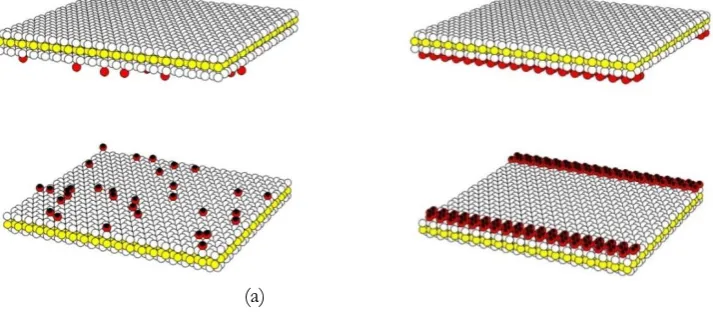
The surface functional group used in this present work is assumed to be the hydroxyl group (OH). The LJ dispersive site of functional group is the center of oxygen and has negative charge of -0.64e. A distance between dispersive site and the pore wall is 1.364Å where the dispersive site is perpendicular to the wall. The center of hydrogen has positive charge of +0.45e and is located far from the center of the functional group about 0.96Å. Molecular parameters of OH used in this study are ɛss/kb of 78.23K, σss of 3.07Å and the angle of O-H of 109 [10]. Two models of functional group allocation are used in this study to investigate the effects of functional group position on methane adsorption isotherm. Hydroxyl groups are placed randomly on solid surfaces as presented in Fig. 2(a) for the first model. While the second model, the location of functional groups are fixed at the pore mouth as shown in Fig. 2(b). Hereafter, the terms random and fix topologies will be used to represent the first and second models, respectively.
(a) (b)
[image:3.595.205.414.213.349.2] [image:3.595.140.497.565.723.2]2.4. Monte Carlo Simulation (MC) Method
There are many types of Monte Carlo simulation methods used to investigate the adsorption behavior of fluid, however a Grand Canonical Monte Carlo (GCMC) simulation is chosen in this study. In the present study, the GCMC method has used to perform the adsorption isotherm of methane in porous silica glass. For the GCMC ensemble, we have to specify the pore volume, the chemical potential and the system temperature to obtain the adsorption isotherm. One GCMC cycle consists of one thousand trial moves, there are three types of moves in the GCMC ensemble; displacement move, insertion and deletion moves with equal probability. The number of cycles is 10,000 cycles for the equilibrium step, and additional 10,000 cycles are used in the sampling step. An empty box is used as the initial configuration, and the simulation is performed until there is no change in the number of particle (in statistical sense). The equation of state proposed by Johnson et al. [11] is used to evaluate the bulk gas pressure at a given chemical potential. Pore density (adsorption capacity) were evaluated by Eq. (2).
𝜌 = 𝑉<𝑁>
𝑝𝑜𝑟𝑒
(2)
where N is number of particle and < > is defined as an average.
3.
Results and Discussion
3.1. Adsorption Isotherms
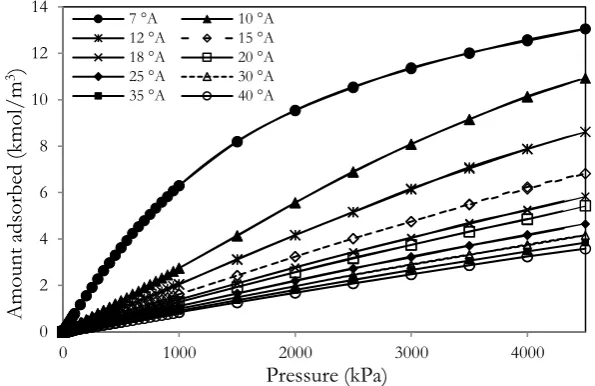
The adsorption isotherms of CH4 versus pressures for various pore widths (from 7 to 40Å) at 298 K are shown in Fig. 3. The solid model of random topology and 5% of functional group are used to obtain the adsorption isotherm. The adsorption of methane increases with pressures and the continuous pore filling of monolayer can be observed. The capillary condensation cannot be observed, this is due to that CH4 behaves as supercritical fluid at 298 K. When pore width increases, the adsorption isotherm decreases, due to the less interaction between solid and methane in the case of larger width [12-14]. It is noted that the number of adsorbed molecules in the larger pore increases with pore width, although the pore density is decreased. The maximum adsorption isotherm can be obtained in the case of pore having width of 7Å, this is due to that methane having the collision diameter (σff) of 3.73Å can be packed tightly inside the pore. Therefore the maximum gas uptake can be obtained if the pore width is fitted tightly with the single layer of fluid at specific surface area and temperature [13].
Fig. 3. Methane adsorption isotherms for various pore widths with the random topology contained 5% of functional group at 298 K.
0 2 4 6 8 10 12 14
0 1000 2000 3000 4000
A
mount
a
ds
or
be
d
(kmol/m
3)
Pressure (kPa)
[image:4.595.146.444.516.709.2]3.2. Effects of Temperature on Methane Adsorption
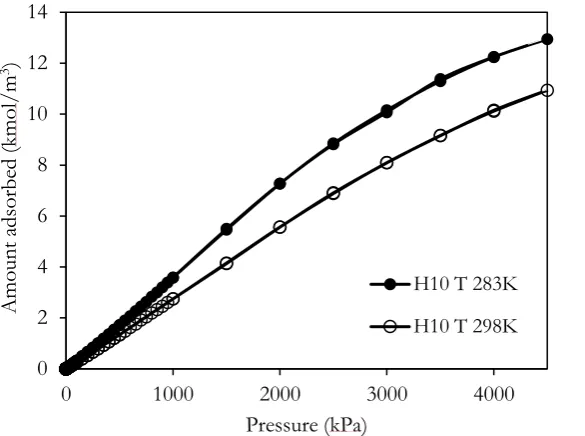
The adsorption is carried out for the random pore topology and the concentration of functional group 5% at different temperatures. The adsorption isotherms of CH4 in pore having width of 10Å at 283 and 298K obtained by using the GCMC method are shown in Fig. 4. The isotherm obtained for methane adsorption at 283K is similar to that obtained at 298K, a single layer of pore layering phenomenon is observed. However the adsorption isotherm at 283K is greater than that at 298K, this suggests that adsorption of methane in porous glass is physical adsorption. The adsorbed molecules attain the greater energy to evaporate due to the exothermic process [15].
Fig. 4. Isotherms obtained for CH4 adsorption in the random pore topology having width of 10Å and 5% of functional groups at 283 and 298K.
3.3. Effects of Functional Group Concentration on Methane Adsorption
In the previous section, we have shown how pore width and temperature affected on the adsorption behaviour, now turn to the effects of functional group concentration on adsorption of methane in porous silica glass at 298K. The isotherms obtained for CH4 in the random pore topology contained either 5% or 10% of OH group and 10Å width are shown in Fig. 5. At low pressures, the functional group shows insignificant effect on adsorbed isotherm, the concentration of functional group becomes significant when pressures increase. The isotherm obtained in the case of 10% of OH group is less than that in the case of 5% of functional group, because the larger number of functional groups of 10% reduces the pore volume for methane adsorption. However an insignificant effect at lower pressures can imply that the pore blocking effect is not occurred in the case of methane adsorption.
3.4. Effects of Functional Group Topology on Methane Adsorption
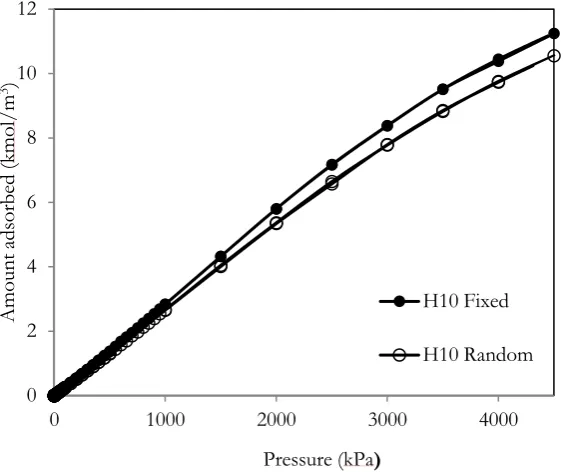
Having seen the functional group concentration effect, now the discussion for the effect of functional group topology on methane adsorption will be presented. Adsorption isotherms obtained for 10Å width with 10% of hydroxyl group at 298K for different functional group topologies are shown in Fig. 6. The isotherm obtained for the fix topology is greater than that for the random topology. The reason is that methane molecules interact with the functional group at the pore mouth and create the nucleation such that molecules can enter the pore and formed the monolayer, as shown in snapshots of Fig. 7. The adsorption isotherms obtained for both topologies are similar to that observed in the experiment. Snapshots of methane adsorption for the random and fix topologies are also shown in Fig. 8, the formation of two contact layers adjacent to the two walls at low pressures is observed which is similar to the adsorption of fluid in activated carbon [16].
0 2 4 6 8 10 12 14
0 1000 2000 3000 4000
Amount
a
ds
or
be
d
(kmol
/m
3)
Pressure (kPa)
H10 T 283K
[image:5.595.158.451.209.427.2]Fig. 5. Adsorption isotherms of CH4 in pore having width of 10Å with different concentration of functional group at 298K.
Fig. 6. Adsorption isotherms of methane at 298K in pore having width of 10Å with different functional group topologies.
0 2 4 6 8 10 12 14
0 1000 2000 3000 4000
A
mount
a
ds
or
be
d
(kmol
/m
3)
Pressure (kPa)
H10 C5% H10 C10%
0 2 4 6 8 10 12
0 1000 2000 3000 4000
A
mo
unt
a
dsor
be
d
(k
mo
l/m
3)
Pressure (kPa)
H10 Fixed
[image:6.595.153.429.84.317.2] [image:6.595.155.437.377.613.2]Fig. 7. Snapshots of methane particles in heterogeneous porous glass of 10Å width contained 10% of functional group for the fix topology. In these figures, white spheres represent oxygen atoms of SiO4, yellow spheres represent silicon atoms, red spheres represent oxygen atom of functional group, small blue spheres represent hydrogen atoms of functional group and green spheres represent methane particles.
(a) (b)
Fig. 8. Snapshots of methane particles in heterogeneous porous glass of 10Å width contained 10% of functional group for the random (a) and fix (b) topologies.
4.
Conclusion
In this paper, the adsorptions of CH4 in finite-length slit pores of porous silica glass in the presence and absence of functional group are presented. The adsorption of methane in heterogeneous finite-length pore is quite similar to that in homogeneous finite-length pore. The continuous adsorption isotherm of the formation of monolayer at room temperature can be observed, and the adsorption isotherm decreases if the pore width increases due to the weak interaction between fluid and solid. The adsorption decreases by increasing temperature resulting the exothermic process of methane adsorption in porous silica glass. The adsorption decreases with an increase of functional group due to the decreasing of pore volume at high pressures. The topology of functional group also affects the adsorption of methane in porous glass, the adsorption for fix allocation of functional groups at the pore mouth is greater than that allocated randomly. This is due to the greater interaction between fluid and functional group at pore mouth which becomes the nucleation for further adsorption inside the pore.
Acknowledgements
[image:7.595.71.519.83.232.2] [image:7.595.97.499.329.498.2]References
[1] A. Policicchio, E. Maccallini, R. G. Agostino, F. Ciuchi, A. Aloise, and G. Giordano, “Higher methane storage at low pressure and room temperature in new easilyscalable large-scale production activated carbon for static and vehicularapplications,” Fuel, vol. 104, pp. 813-821, Feb. 2013.
[2] R. T. Yang, Adsorbents Fundamentals and Applications. New Jersey: John Wiley & Sons, 2003.
[3] X. Yang and X. Yue, “Adsorption and structure of Lennard-Jones model fluid in slit-like amorphous silica nanopores,” Colloids and Surfaces A: Physicochem. Eng. Aspects., vol. 301, pp. 166–173, Jul. 2007. [4] R. J. Sadus, Molecular Simulation of Fluids, Theory, Algorithms and Object-Orientation. Amsterdam: Elsevier
Science B.V., 1999.
[5] D. Frenkel and B. Smit, Understanding Molecular Simulation. New York: Academic Press, 2002.
[6] W. L. Jorgensen, J. D. Madura, and C. J. Swenson, “Optimized intermolecular potential functions for liquid hydrocarbons,” J. Am. Chem. Soc. vol. 106, pp. 6638-6646, 1984.
[7] E. D. Burchart, B. Vandegraaf, and E. T. C. Vogt, “A consistent molecular mechanics force field for aluminophosphates,” J. Chem. Soc., Faraday Trans., vol. 88, pp. 2761-2769, 1992.
[8] Y. He and N. A. Seaton, “Experimental and computer simulation studies of the adsorption of ethane, carbon dioxide, and their binary mixtures in MCM-41,” Langmuir, vol. 19, pp. 10132-10138, 2003. [9] S. Calero, D. Dubbeldam, R. Krishna, B. Smit, T. J. H. Vlugt, J. F. M. Denayer, J. A. Martens, and T. L.
M. Maesen, “Understanding the role of sodium during adsorption: A force field for alkanes in sodium-exchanged faujasites,” Journal of the American Chemical Society. vol. 126, no.36, pp. 11377-11386, 2004. [10] M. Jorge, C. Schumacher, and N. A. Seaton, “Simulation study of the effect of the chemical
heterogeneity of activated carbon on water adsorption,” Langmuir, vol. 18, pp. 9296-9306, 2002. [11] J. K. Johnson, J. A. Zollweg, and K. E. Gubbins, “The Lennard-Jones equation of state revisited,”
Molecular Physics, vol. 78, no. 3, pp. 591-618, 1993.
[12] A. Wongkoblap, W. Intomya, W. Somrup, S. Charoensuk, S. Junpirom, and C. Tangsathitkulchai, “Pore size distribution of carbon with different probe molecules,” Engineering Journal, vol. 14 no. 3, pp. 45-56, 2010.
[13] D. D. Do and H. D. Do, “Refined method of potential enhancement in the equilibria characterization of activated carbon. Comparison with GCMC and DFT,” Langmuir, vol. 19, pp. 8302, 2003.
[14] W. Chiang, E. Fratini, P. Baglioni, J. Chen, and Y. Liu, “Pore size effect on methane adsorption in mesoporous silica materials studied by small-angle neutron scattering,” Langmuir, vol. 32, no. 5, pp. 8849-8857, 2016.
[15] D. D. Do, Adsorption Analysis: Equilibria and Kinetics. New Jersey: Imperial College Press, 1998.