This is a repository copy of Tutorial in biostatistics - Sample sizes for clinical trials with Normal data.
White Rose Research Online URL for this paper: http://eprints.whiterose.ac.uk/145474/
Version: Accepted Version
Article:
Julious, S.A. (2004) Tutorial in biostatistics - Sample sizes for clinical trials with Normal data. Statistics in Medicine, 23 (12). pp. 1921-1986. ISSN 0277-6715
https://doi.org/10.1002/sim.1783
This is the peer reviewed version of the following article: Julious, S.A. (2004) Tutorial in biostatistics - Sample sizes for clinical trials with Normal data. Statistics in Medicine, 23 (12). pp. 1921-1986, which has been published in final form at
https://doi.org/10.1002/sim.1783. This article may be used for non-commercial purposes in accordance with Wiley Terms and Conditions for Use of Self-Archived Versions.
Reuse
Items deposited in White Rose Research Online are protected by copyright, with all rights reserved unless indicated otherwise. They may be downloaded and/or printed for private study, or other acts as permitted by national copyright laws. The publisher or other rights holders may allow further reproduction and re-use of the full text version. This is indicated by the licence information on the White Rose Research Online record for the item.
Takedown
If you consider content in White Rose Research Online to be in breach of UK law, please notify us by
Tutorial in Biostatistics: Sample sizes
for clinical trials with Normal data.
SUMMARY
This article gives an overview of sample size calculations for parallel group and cross-over
studies with Normal data. Sample size derivation is given for trials where the objective is to
demonstrate: superiority, equivalence, non-inferiority, bio-equivalence and estimation to a
given precision, for different Type I and Type II errors. It is demonstrated how the different
trial objectives influence the null and alternative hypotheses of the trials and how these
hypotheses influence the calculations. Sample size tables for the different types of trials and
worked examples are given.
Key Words
Sample size, Power, Type I error, Type II error, Superiority trials, Equivalence trials,
Non-inferiority trials, Bio-equivalence, Precision, Baselines, Cross-over trials, Parallel group
CONTENTS
1. Introduction
1.1. Estimation of the variance for calculations
2. Superiority trials
2.1. Parallel group trials
2.1.1. Worked Example
2.1.1.1. Using the sample size tables
2.1.1.2. Repeated using sample size software
2.2. Cross-over trials
2.2.1. Paired t-tests and period adjusted t-tests
2.2.2. Sample size calculations
2.2.3. Worked Example
2.2.3.1. Using the sample size tables
2.2.3.2. Repeated using sample size software
3. Equivalence trials
3.1. General case
3.2. Special case of no treatment difference
3.3. Type I and setting the equivalence limit
3.3.1 Choice of Type I error
3.3.2. Choice of Equivalence Limit
3.4. Parallel group trials
3.4.1. General case
3.4.2. Special case of no treatment difference
3.4.3. Worked example
3.4.3.2. Repeated using sample size software
3.5. Cross-over trials
3.5.1. General case.
3.5.2. Special case of no treatment difference.
3.5.1. Worked example
3.5.1.1. Using the sample size tables
3.5.1.2. Repeated using sample size software
4. Non-inferiority trials
4.1. Parallel group trials
4.1.1. Worked example
4.1.1.1. Using the sample size tables
4.1.1.2. Repeated using sample size software
4.2. Cross-over trials
4.2.1. Worked example
4.2.1.1. Using the sample size tables
4.2.1.2. Repeated using sample size software
5. As good as or better trials
5.1. A test of non-inferiority and a one sided test of superiority
5.2. A test of non-inferiority and a two sided test of superiority
5.3. Worked example and other considerations
6. Bio-equivalence trials
6.1. Justification for log transformation
6.2. Rational for using coefficients of variation
6.3.2. Special case of ratio equalling unity
6.3.3. Replicate Designs
6.3.4. Use of quick formulae to estimate the sample size of a
bioequivalence trial
6.3.5. Worked Example
6.3.5.1. Using the sample size tables
6.3.5.2. Repeated using sample size software
6.4. Parallel Group Studies
6.4.1. General case
6.4.2. Special case of ratio equalling unity
6.4.3. Worked Example
6.4.3.1. Using the sample size tables
6.4.3.2. Repeated using sample size software
6.5. Individual and Population Bio-equivalence
7. Trials to a give precision
7.1. Parallel group trials
7.1.1. Worked Example
7.1.1.1. Using the sample size tables
7.1.1.2. Repeated using sample size software
7.2. Cross-over trials
7.2.1. Worked Example
7.2.1.1. Using the sample size tables
7.2.1.2. Repeated using sample size software
8. Design considerations
8.2. Post dose measures summarised by summary statistics
8.3. Inclusion of Baseline or Covariates as well as Post Dose Measures
9. Summary
1. INTRODUCTION
Since the first 'modern' randomised clinical trial was reported in 1948 [1], clinical trials have
become a central component in the assessment of new therapies. The primary objective of
any clinical trial is to obtain an unbiased and reliable assessment of a given regimen response
independent of any known or unknown prognostic factors. First, by ensuring that the
patients studied in the various regimen arms are objectively similar with reference to all
predetermined relevant factors other than the regimens themselves. Second, by making sure
that the assessment of the regimen response is independent of a given subject's regimen and
finally through inclusion of an appropriate control to quantify a given regimen response [2].
Randomisation is important as it ensures that patients are objectively similar in the regimen
groups being investigated for any demographic or prognostic factors that either known or
unknown [3]. Randomisation achieves this by ensuring that each subject has a known chance
of being given a given treatment in an allocation that can not be predicted [4].
Blinding is important as it removes any systematic bias there may be in treatment assessment
and allocation during the conduct of the trial. It is important too once the trial has been
completed during the cleaning and derivation of the data [5]. If there is any knowledge of
treatment during the cleaning and querying of the data then this knowledge may affect how
these data are consequently queried and cleaned [3].
The choice of an appropriate control is dependent on the objective of the trial being designed.
For example a non-inferiority or equivalence trial will usually have a control which is active
if the primary outcome is efficacy. The different types of trials will be described through this
paper.
When planning a trial one essential step is the calculation of a sample size which will give
the minimum sample size required to meet the given objectives of the study. Sample size
large may be judged unethical [6]. For example, a study that is too large could have met the
objectives of the trial before the actual study end had been reached, and so some patients may
have unnecessarily entered the trial. A trial that is too small will have little chance of meeting
the study objectives, and patients may be put through the potential trauma of a trial for no
tangible benefit. The general approach to choosing sample size will be described in this
article where a statistic can be assumed to take a Normal form and an estimate of the
variance of that test statistic is available. The sections of the paper detail computation of
sample sizes appropriate for:
1. Superiority trials.
2. Equivalence trials.
3. Non-inferiority trials.
4. As good as or better trials.
5. Bio-equivalence trials.
6. Trials to a given precision.
A distinction therefore is drawn to emphasise differences in trials designed to demonstrate
'superiority' and trials designed to demonstrate 'equivalence' or 'non-inferiority'. This is
discussed with an emphasis on how differences in the null hypothesis can impact on
calculations. The ICH guidelines E3 and E9 provide general guidance on selecting the
sample size for a clinical trial [3, 7]. The ICH E9 guideline states that:
"The number of subjects in a clinical trial should always be large enough to provide a reliable
answer to the questions addressed. This number is usually determined by the primary
objective of the trial ….The method by which the sample size is calculated should be given
in the protocol together with any quantities used in the calculations (such as variances, mean
This paper will go through the methods of sample calculation for studies with the six distinct
objectives listed above. The paper will also, under the worked examples, give a brief
description of how the calculations could be undertaken in the two packages PASS 2000 [8]
and nQuery 4 [9]. Although PASS 2000 and nQuery 4 are the only packages described in
detail this does not confer a recommendation as to their use by the author.
The paper is written on the premise that just two treatments are to be compared in the clinical
trial and two study designs will be discussed: parallel group and cross-over designs.
With a parallel group design subjects are assigned at random to the two treatments to form
two treatment groups which it is hoped are the same in all respects other than the treatment
received.
With a cross-over trial all subjects receive both the treatments but it is the order that subjects
receive the treatments which is randomised. The big assumption here is that prior to starting
the second treatment all subjects return to baseline and that the order which subjects receive
treatment does not affect their response to treatment. Cross-over trials can not be used
therefore in degenerative conditions, where subjects get worse over time. Also, they are
more sensitive to bias than parallel group designs [2].
Although this paper will concentrate on data that take a Normal form this does not limit its
scope as trials where the primary endpoint is assumed to be Normal probably account for the
majority of trials. Also, the discussion in each section on the null hypothesis for each trial
and the sample size derivation is generalisable for other types of data. For superiority trials
there is work for cross-over [10] and parallel group [11] trials where the data take other
distributional forms as well as methodologies for parallel group non-inferiority [12] and
equivalence trials [13] for binary data.
Conventions for multiple comparisons are not discussed in this paper, although the
made. Koch and Ganksy give an overview of this topic [14] whilst the CPMP have issued
guidelines [15].
Each section of the paper will walk through the derivation of the appropriate sample size
formulae. Tables are given in each section which provide sample size estimates using these
formulae and worked examples are described which use these tables. Also, within each
section quick formulae are given which do not necessitate the use of tables for calculations.
1.1. Estimation of the variance for calculations
Through out this paper one of the most important components in the sample size calculation is
the variance estimate used. This variance estimate is usually estimated from retrospective
data sometimes from a number of studies. To adjudicate on the relative quality of the
variance one should consider the following aspects of the trial from which the variance is
obtained
1. Design: is the study design ostensibly similar to the one you are designing? On the basic
level is the data from a randomised controlled trial - observational or other data may greater
variability. If you are undertaking a multi-centre trial is the variance estimated too from an
similarly designed trial? Were the endpoints similar to those you plan to use – not just the
actual endpoints but was the time relative to treatment of the outcome of interest similar to
you own?
2. Population: is the study population similar to your own? The most obvious consideration
is to ask is whether the demographics were the same but if the trial conducted was a multi
centre one was it conducted in similar countries? Different countries may have different types
of care (e.g. different concomitant medication) and so may have different trial populations.
3. Analysis: was the same statistical analysis undertaken? Not just the question of whether
the same procedure was used for the analysis but were the same covariates fitted into the
model? Was the same summary statistics used? Section 8 details how covariates and
summary statistics impact on the variance.
The quality of the variance will obviously influence the strategy of an individual clinical trial -
it has not been unknown to have next to no data on hand when designing a trial such that the
range divided by four is taken as a variance estimate. Depending on the quality of the
variance estimate (or even if one has a good variance estimate) it may be advisable to have
some form of variance re-estimation during the trial. There is a developing literature on this
2. SUPERIORITY TRIALS
In a superiority trial the objective is to determine whether there is evidence of a statistical
difference in the comparison of interest between the regimens with reference to the null
hypothesis that the regimens are the same. The null (H0) and alternative (H1) hypotheses
may take the form:
Ho: The two treatments are not different with respect to the mean response (µA =µB).
H1: The two treatments are different with respect to the mean response (µA ≠µB).
In the definition of the null and alternative hypotheses µAand µBrefer to the mean response
on regimens A and B respectively. In testing the null hypothesis there are two errors one can
make:
I. Rejecting Ho when it is actually true.
II. Not rejecting Accepting Ho when it is actually false.
These errors are usually referred to as Type I and Type II errors [25, 26, 27, 28, 29, 30]. The
aim of the sample size calculation is to find the minimum sample size for a fixed probability
of Type I error to achieve a value of the probability of a Type II error. The two errors are
commonly referred to as the regulator's (Type I) and investigator's (Type II) risks and by
convention are fixed at rates of 0.05 and 0.10 or 0.20 respectively. The Type I and Type II
risks carry different weights as they reflect the impact of the errors. With a Type I error
medical practice may switch to the investigative therapy with resultant costs whilst with a
Type II error medical practice would remain unaltered.
In general, one usually thinks not in terms of the Type II error but in terms of the power of a
trial (1-probability of a Type II error) which is the probability of rejecting the Ho when it is in
fact false. Key trials should be designed to have adequate power for statistical assessment of
noted though that with 80% power one is doubling Type II error for only a 25% saving in
sample size.
For a superiority trial there are two chances of rejecting the null hypothesis and thus making
a Type I error. The null hypothesis can be rejected if µA >µB or if µA <µB by a
statistically significant amount. As there are two chances of rejecting the null hypothesis the
statistical test is referred to as a two tailed test with each tail allocated an equal amount of the
Type I error (of 2.5%). The sum of these tails adds up to the overall Type I error rate of 5%.
Thus, the null hypothesis can be rejected if the test of µA >µB is statistically significant at
the 2.5% level or the test of µA >µB is statistically significant at the 2.5% level.
The purpose of the sample size calculation is hence to provide sufficient power to reject Ho
when in fact some alternative hypothesis is true. One might therefore test that the two means
are equal, against an alternative that they differ by an amount 'd' [31]. The amount d is
chosen as a clinically important difference or effect size and is the main factor in determining
a sample size. Reducing the effect size by half will quadruple the required sample size [32].
Formally the aim is to calculate a sample size suitable for making inferences about a certain
function of given model parameter, µ, f
( )
µ say. For data that take a Normal form f( )
µwill be µ −A µB i.e. the difference in means of two populations A and B. Now let S be a
sample estimate of f
( )
µ . Thus S is defined as the difference in the sample means. As oneis assuming that the data from the clinical trial are sampled from a Normal population, then,
using standard notation, S~N( f
( )
µ , Var (S) ), giving( )
( )
S ~ N(0,1) Varf
S− µ
.
A basic equation can now be developed in general terms from which a sample size can be
assigned to each tail of the two tailed test, and let Z1−α/2denote the
(
1−α/2)
100 percentagepoint of a standard Normal distribution.
Thus, an upper 2-tailed, α -level critical region for a test of f
( )
µ =0 is( )}
S Var S >Z1−α/2 .For this critical region one needs to test it against an alternative that f
( )
µ = d, for somechosen d and specified power (1- ) [33]:
( )
S Var Zd− 1−β =Z1−α/2 Var
( )
S , (2.1)where β is the overall Type II error level and Z1−βis the 100(1- )% point of the standard
Normal distribution. Thus, in general terms for a 2-tailed, α -level test one has:
Var (S) = 2
2 / 1
1 Z )
(Z
2
α
β −
− +
d
(2.2)
where Var (S) will be unknown and depends on the sample size. Once Var (S) is written in
terms of sample size, the above expressions can be solved to give the sample size.
In this section, and throughout the paper for parallel group trials, the assumption will be
made that the variances in each group are equal i.e. that 2 A
σ = 2 B
σ =σ2
. This assumption is
referred to as homoskedasticity. There are alternative derivations for the case of unequal
2.1 Parallel Group Trials
Suppose one wishes to design a two group study where the sample size in the second group,
nB, can be written as some multiple of the first, nA, (say nB= nA). Then Var (S) can be
written in terms of nA and hence equation (2.2) can be solved for nA. For example, for an
r:1 Var(S) can be derived as:
( )
A 2 B A n . 1 n 2 n2 σ σ
σ
r r S
Var = + = + (2.3)
Where σ2
is the population variance estimate. Substituting into equation (2.2) gives [35]:
(
)
d r 2 Z Z ) 1 (r n 2 2 2 / 1 1 A σ α β − − + += , (2.4)
where nB =rnA. Note: n=nB + nA is minimised when r = 1.
When the clinical trial has been conducted and the data has been collected and cleaned for
analysis it is usually the case that for the analysis the population variance, σ2, is considered
unknown and a sample variance estimate, s , is used instead of 2 σ2. As a consequence of
this a t-statistic as a opposed to a Z-statistic is used for inference. This fact should be
represented in the sample size calculation rewriting equation (2.4) so that t- as opposed to
Z-values are used. Hence, the following equation should be used:
d r
nA nA r
2 ) t (Z ) 1
(r 2 2
2 ) 1 ( , 2 / 1
1−β + −α + − σ +
≥ (2.5)
where nA is now defined as the least integer values that satisfies equation (2.5). As nA
appears on both the left and write side of the equation (2.5) it is best to re-write the equation
in terms of power and then use an iterative procedure to solve for nA:
− + Φ =
− 2 1− /2, ( +1)−2 2
) 1 (
1 n r
A A t r d rn α σ
where Φ
( )
• is the defined as the cumulative density function of N(0,1). Practically onecould use equation (2.4) for the initial sample size calculation and then calculate the power
for this sample size using equation (2.7), iterating the sample size up as necessary until the
required power is reached. However, when a sample variance is being used in the analysis
the power should be estimated from a cumulative t distribution as opposed to a cumulative
Normal [35, 36, 37]. The reason for this is that by replacing σ2 with s2 equation 2.6
becomes: − + =
− 2 1− /2, ( +1)−2 2
) 1 (
1 n r
A A t s r d rn P α β
where P
( )
• denotes a cumulative distribution defined below. This equation can in turn bere-written as: − + =
− 2 2 1− /2, ( +1)−2
) 1 (
1 n r
A A t s r d rn P α σ σ β
by dividing top and bottom by σ2. Thus, one has a Normal over a square root of a
chi-squared which by definition is t-distribution. In fact as the power is estimated under the
alternative hypothesis, and that under this hypothesis d≠0, Senn has shown specifically that
instead of a t distribution the power should be estimated from a non-central t distribution
with degrees of freedom nA(r+1)-2 and non-centrality parameter rnA (r+1)σ2 [35]. Thus,
equation 2.6 should in fact be rewritten as:
+ − + − =
− 1− /2, ( +1)−2 2 2
) 1 ( , 2 ) 1 ( , Probt 1 1 σ β α r d rn r n t A A r
nA (2.7)
where Probt
( )
• is defined as the cumulative density function of a non central t distribution.(
)
4 2
Z Z ) 1
(r 2 2 1 /2
2 / 1
1−β −α σ −α
+ +
+
= Z
d r
nA . (2.8)
For quick calculations the following formula, to calculate a sample size, with 90% power and
a two-sided 5% type I error rate, can be used:
r r d nA
) 1 ( 5 . 10
2
2 +
= σ , (2.9)
or for r=1:
2 2 21
d nA = σ .
This, 21/δ2 (δ =d/σ ) is a particularly useful result to remember for quick calculations.
Equations (2.4) and (2.8) are close approximations to equation (2.7), giving estimates only
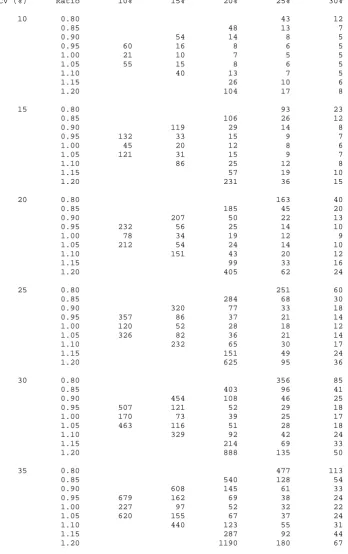
one or two lower and thus provide quite good initial estimates. Table 2.1 gives sample sizes
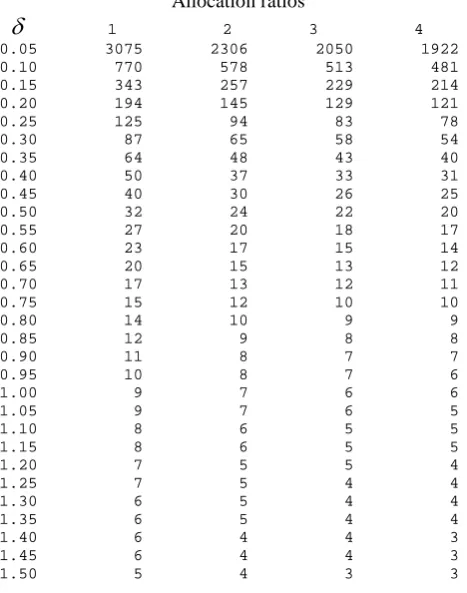
using equation 2.7 for various standardised differences (δ =d/σ ).
2.1.1. Worked Example
2.1.1.1. Using the sample size tables
An investigator wishes to design a hypertension trial with equal allocation between groups
where the clinical effect of interest is a reduction in blood pressure, compared to control, of
8mmHg (d). The expected standard deviation in the population in which the trial is to be
undertaken is 40mmgHg (σ ). Thus, the standardised difference equates to
20 . 0 40 / 8
/ = =
= σ
δ d . With the Type I and Type II errors fixed at 5% and 10% equation
2.8 gives a sample size of 526. Using this sample size to initiate iterations in Equation 2.7
one gets the following steps:
Iteration n Power
1 526 0.8993
Thus, the sample size required is 527 subjects in each arm of the trial and a total sample size
of 1054. Alternatively one could look up the standardised effect of 0.20 in table 2.1 which
gives the same sample size.
If the trial was designed with an unequal allocation of 2:1 (r=2) in favour of the control then
one would required 395 subjects on the control arm and 790 in the investigation arm; a total
sample size of 1185 patients.
2.1.1.2. Repeated using sample size software
To do the same calculations in nQuery one would need to click on File/New for Goal tick
Means, Number of Groups tick Two and Analysis Method tick Test. Then select
Two-sample t-test. There is an additional tick box depending whether wanted to have an equal or
unequal sample size. Above is the dialogue box that subsequently comes from nQuery and
the entries required to repeat the calculations given in Table 2.1. nQuery also returns a
sample of 527 patients per group for an equal allocation ratio and 395 and 790 if the
To repeat the calculations in PASS one needs to highlight Means and then t-test: 2 Groups.
PASS gives a sample size of 526 one less than nQuery and Table 2.1 for equal allocation but
gives the same sample sizes for an allocation ratio of 2:1. More details of the dialogue boxes
of PASS will be given in the worked example of the next sub section on cross-over trials.
2.2 Cross-over trials
For the analysis of cross-over trial data this paper will concentrate on the case where an
analysis of variance is the primary analysis (with a model with terms for subject, period and
treatment). The additional assumption is that one is undertaking an AB/BA cross-over trial
although the methodology described can be extended to a pair wise comparison in a
multi-period cross-over trial (with appropriate adjustment to the degrees of freedom). With the
analysis of variance approach the within subject residual errors are assumed to be sampled from
a Normal distribution. This approach is equivalent to the period adjusted t-test which will be
described on section 2.2.1 [35].
2.2.1. Paired t-tests and period adjusted t-tests
The difference between a period adjusted test and a standard paired test is that for a paired
t-test one simply places the observed individual effects on the two treatments in two columns –
ignoring any treatment ordering. For each subject a treatment difference is calculated and
consequently a mean of these differences, d (equivalent to a difference in the treatment means
B
A µ
µ − ), and a n an estimate of the population standard deviation of the differences s . The d
test statistic is thus d n sd . This is compared to the t distribution on n-1 degrees of freedom.
In comparison for a period adjusted t-test for each treatment sequence (AB or BA) a mean
Assuming that there is equal allocation to each sequence, nAB =nBA =n 2, and the within
sequence variances, sd2AB =sd2BA = sd2, are the same then the mean difference of interest,
2 )
(dAB−dBA , has the variance sd nAB nAB sd n 2 2 4 ) 1 1
( + = . Thus, the test statistic is
(
)
n s d d d BA AB − 2 1which is compared to the t distribution on n-2 degrees of freedom.
If there is truly no period effect then,
(
)
(
)
d d A B B A d BA AB s n d n s n s d d ≈ − − − ≈− 12 ( ) ( )
2
1 µ µ µ µ
and thus one would have an equivalent test to a paired t-test but with one less degree of
freedom.
2.2.2. Sample Size Calculations
To estimate a sample size for a cross-over trial as well as quantifying the within subject
estimate of the difference in treatment means that is of interest ( i.e. the effect size), one needs
an estimate of the within- (intra-) subject standard deviation σw. The within-subject standard
deviation is taken from the residual line of an ANOVA model and quantifies the expected
variation among repeated measurements on the same individual [10].
Note that the within subject variability estimates from an ANOVA, model is related to the
variability about the difference from a paired t-test through the following result σd2 =2σw2.
With an estimate of both the within subject standard deviation and the effect size equation (2.2)
can again be solved as per a parallel group study:
(
)
d n w 2 Z Z2 1−β + 1−α/2 2σ2
where n here is the total sample size. Note that the allocation ratio has not been used as per
equation (2.4) as in a cross-over trial the meaning of r here would be the allocation ratio to each
treatment sequence AB and BA. The assumption here is that an equal number of subjects will
be assigned to each sequence. For unknown variance one can rewrite equation (2.10) as:
d n w 2 ) t (Z
2 1−β + 1−α/2,n−2 2σ2
≥ , (2.11)
where n now is the least integer value that satisfies equation (2.11). In turn equation (2.11)
can be rewritten in terms of power to solve iteratively for n:
− Φ =
− 2 1− /2, −2 2 2 1 n w t nd α σ
β . (2.12).
Similarly to parallel group trials, when the population variances is unknown, under H1: d≠0
the Type II error (and hence the power) should be calculated under the assumption of a
non-central t distribution with degrees of freedom n-2 and non-non-centrality parameter nd2 2σw2
[35]. Thus, equation 2.12 can be rewritten as:
− − =
− 1− /2, −2 22
2 , 2 , Probt 1 1 w n nd n t σ
β α . (2.13)
Again to solve for n in the same manner as for a parallel group study one can add a
correction factor of Z1−α/2 2 to equation (2.10) to allow for the Normal approximation, and
use this for initial calculations in equation (2.13) [38]:
(
)
2 2
Z Z
2 1−β 1−α/2 2σ2 1−α/2
+ +
= Z
d
n w . (2.14)
For quick calculations one can adapt equation (2.10) for the calculation of sample sizes
(estimated with 90% power and a two-sided 5% type I error rate):
2 2 21
d
n= σw
Equations (2.14) and (2.15) give slightly lower results than equation 2.13. Table 2.2 gives
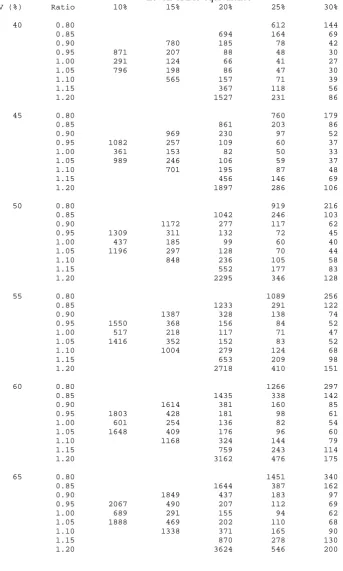
sample sizes using equation (2.13) for various standardised differences (δ =d/σ ). The
total sample for a cross-over trial are nearly equivalent to that for one arm of a parallel group
study, for each standardised difference (δ ). The slight differences are accounted for by the
different degrees of freedom used in equations (2.7) and (2.13). Practically, though, they are
the same.
It should be noted that the standardised differences in Tables 2.1 and 2.2 represent different
quantities. The within- subject variance in a cross-over trial can be derived from
) 1 ( 2
2 σ ρ
σw = − - where 2
σ is the population variance from a conventional parallel group
design and ρ is the Pearson correlation coefficient estimated between two measures on the
same subject. For a relatively modest correlation of 0.5, the within-subject variance would be
half the population variance, and as a consequence for an equivalent mean difference the
standardised difference would be 40% larger in a cross-over trial compared to a parallel group
study. Parallel group and cross-over trials will only have an equivalent standardised difference
for a zero correlation.
2.2.3. Worked Example
2.2.3.1. Using the sample size tables
An investigator wishes to design a hypertension trial similar to that in Section 2.1.1. The
clinical effect of interest is a reduction in blood pressure compared to control of 10mmHg
(d). The expected within-subject standard deviation in the trial population the trial is
expected to be half that of the between-subject standard deviation at 20mmHg (σw). Thus,
the standardised difference is δ =d/σw =10/20=0.50. For the Type I and Type II errors
2.2.3.2. Repeated using sample size software
For the sample size calculations in PASS and nQuery the assumption is that instead of doing an
analysis of variance for the final analysis a paired t-test would be undertaken. As described in
Section 2.2.1. for studies with paired data, one must specify the standard deviation of the
difference of the outcome variable measured on the two treatments and the standard deviation
of the difference can be calculated from the within subject standard deviation from the result
w
d σ
σ = 2 . Thus, for a paired t-test the standard deviation of the difference, σd, should be
used instead of the within subject standard deviation and one should therefore replace 2σw2
with σd2 in each of equations 2.10 to 2.15 and adjust the degrees of freedom to n-1 in equations
2.12 and 2.13.
To repeat the calculations in PASS one selects Means and then T-Test: 1 Group. The
The mean difference is still the same as in the worked example, 10, but the standard deviation
for the calculations is now 2*20=28.28. PASS gives the sample size as 86 as per table 2.2.
To do the same calculations in nQuery one would need to click on File/New for Goal tick
Means, Number of Groups tick One and Analysis Method tick Test. Then select Paired t-test.
nQuery too returns a sample size of 86.
By looking at the two dialogue boxes for nQuery (given earlier for the parallel group case)
and PASS one can see the two approaches to calculations in the two packages. nQuery works
like a spread sheet where the inputs are entered into a column with the answer (i.e. the sample
size) given at the bottom of the column. If one wishes to do several sample size calculations
then one needs to fill in several columns. PASS works by entering the inputs into dialogue
input, for example for Mean one can enter "5, 10, 15" or "5 to 15 by 5", and PASS will output
the sample sizes for different values (or combination of values) in one Output window.
3. EQUIVALENCE TRIALS
In certain cases the objective of a clinical trial is not to demonstrate superiority but to
demonstrate that two treatments have no clinically meaningful difference, i.e. that they are
clinically equivalent. The null (H1) and alternative (H0) hypotheses for such equivalence
trials take the form:
H0: The two treatment differences are different with respect to the mean response (µA ≠µB).
H1: The two treatments are not different with respect to the mean response ( µA =µB).
Usually these hypotheses are written in terms of a clinical difference, d. and become:
H0: µA −µB ≤−d or µA −µB ≥+d.
H1: −d <µA −µB <+d.
These hypotheses are an example of an intersection-union test (IUT), in which the null
hypothesis is expressed as a union and the alternative as an intersection. In order to conclude
equivalence, one needs to reject each component of the null hypothesis.
Note that in an IUT, each component is tested at level α giving a composite test which is also
of level α [39].
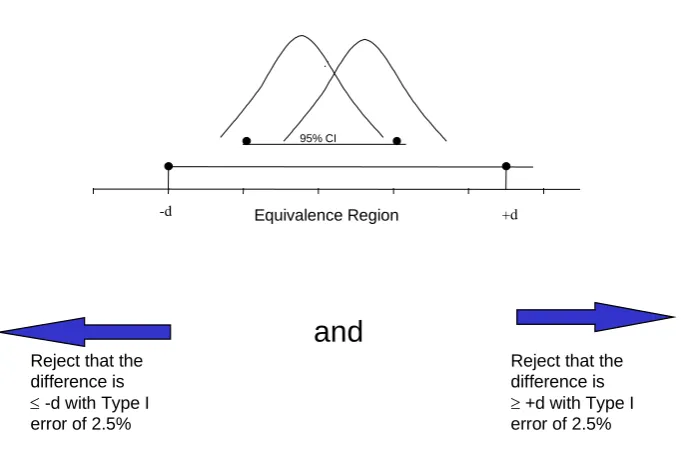
A common approach with equivalence trials to test each component of the null hypothesis
with a t test - called the Two One-Sided Test (TOST) procedure. In practice, this is
operationally the same as constructing a (1-2α)100% confidence interval for f
( )
µ whereequivalence is concluded provided that each end of the confidence interval falls completely
within the interval (−d,+d) [40]. This is because the (1-2α)100% confidence interval is
excluding two regions each of size α, each of which must simultaneously preclude (-d, +d).
Figure 1 highlights how equivalence can be demonstrated through confidence intervals and
Figure 2 demonstrated how confidence intervals are used to test the different hypotheses in
superiority and equivalence trials. The special case of bioequivalence is covered in Section 6.
ICH E10 [41] goes into some detail in the description of equivalence trials, and the related
non-inferiority trials (discussed in Section 4) whilst ICH E9 and E3 discuss the appropriate
analysis of such trials [3, 7].
In this section the sample size formulae will initially be derived
i) For the general case of inequality between treatments (i.e. f
( )
µ =∆)ii) Adopting the same notation and assumptions as in Section 2
iii) Under the assumption that the equivalence bounds –d and d are symmetric about zero
This section will then move on to the special case of no treatment difference replacing (i)
with:
i) For the special case of no mean difference (i.e. f
( )
µ = 0).
3.1. General case
As with Section 2:
( )
(S ) ~ N(0,1) Varf
S− µ
,
Hence, the
(
1−2α)
100% confidence limits for a non-zero mean difference would be:S Var Z
S−∆+ 1−α ,
To declare equivalence the lower and upper confidence limit should be within ±d:
( )
S d VarZ
Thus, by extending the arguments for superiority trials, for the two one sided test procedure
(TOST) with this critical region there are two opportunities against an alternative to have a
Type II error for some chosen d and power (1-β)
Var(S) Var(S) -d -and Var(S) )
( 1 1 1
1−β1 = −α ∆ −β2 = −α
− +
∆ d Z Var S Z Z Z . (3.2)
where β1 and β2are the Type II errors associated with each one sided test from the TOST
procedure and β = β1 +β2. Hence,
( )
α β( )
αβ − − −
− − ∆ − = − ∆ − −
= 1 1 1
1 1 and 2 Z
S Var d Z Z S Var d Z (3.3)
3.2. Special case of no treatment difference.
For the special case of no treatment difference ∆=0 can be entered into (3.1). Thus, with
the TOST procedure the Type II error for some chosen d and power (1-β) will come from
Var(S) Var(S) -d -and Var(S) )
( 1 1 1
1−β = −α −β = −α
−Z Var S Z Z Z
d .
Hence,
( )
αβ −
− /2 = − 1
1 Z S Var d Z , giving: 2 2 / 1 1 ) ( 2 ) ( β α − − + = Z Z d S
Var . (3.4)
3.3. Type I and setting the equivalence limit 3.3.1. Choice of Type I error
Strictly speaking when undertaking two simultaneous one tailed tests setting α=0.05 would
controversial issue. The convention for equivalence trials is to set the Type I error rate at
half of that which would be employed for a two sided test used in a superiority trial i.e.
α=0.025. That is, giving a Type I error rate of 2.5% [3]. However, setting the Type I error
rate for equivalence trials at half that for superiority trials could be considered to be
consistent. This is because although in a superiority trial one has a two sided 5%
significance level in practice for most trials in effect what one has is a one sided investigation
with a 2.5% level of significance. The reason for this is that one usually has an investigative
therapy and a control therapy and it is only statistical superiority of the investigative therapy
that is of interest.
Through the rest of the sections on equivalence and non-inferiority trials the assumption will
be that α=0.025 and that 95% confidence intervals will be used in the final statistical
analysis. This issue will be discussed again in the section on Bioequivalence.
3.3.2. Choice of Equivalence Limit
The discussion on equivalence limits in this section can also be generalised to non-inferiority
trials discussed in the proceeding section. As with the choice of the Type I error the setting
of the non-inferiority/equivalence limit is a controversial issue. The equivalence limit is
defined as the "largest difference that is clinically acceptable, so that a difference bigger than
this would matter in practice" [42]. This difference also cannot be "greater than the smallest
effect size that the active (control) drug would be reliably expected to have compared with
placebo in the setting of the planned trial" [41].
However, beyond this there has not much formal guidance. Jones, Jarvis, Lewis et al [40]
have recommended that the choice of limit be set at half the expected clinically meaningful
difference between the active control and placebo. There are no hard regulatory guidance
acceptable to have an equivalence limit "of one half or one third of the established superiority
of the comparator to placebo, especially if the new agent has safety or compliance
advantages"
The definition of the acceptable level of equivalence or non-inferiority is made therefore with
reference to some retrospective comparison to placebo [44, 45, 46]. In this context the
definition of the non-inferiority and equivalence limits should address steps of the form [45,
46].
1. One must be confident that the active control would have been different from placebo had
one been employed.
2. One should be able to determine that there is no clinically meaningful difference between
investigative treatment and the control.
3. Through comparing the investigative treatment to control one should indirectly be able to
determine that it is superior to placebo.
Steps 1. and 3. are important as there is a view that non-inferiority and equivalence trials
reward "failed" studies i.e. if one conducted a poor trial where it would not have been
possible to demonstrate the control to be superior to placebo then a poor investigative therapy
may slip through comparison to this control. However, Julious and Zariffa [2] point out that
this may not be the case as poor studies are poor for most objectives due to their higher
statistical variability.
In summary therefore one can infer that the clinical difference used for the limits of
equivalence and non-inferiority will be smaller than the difference used for placebo
controlled superiority trials. There is no generic definition for its setting – its definition will
3.4. Parallel group trials 3.4.1. General case.
For equivalence trials the sample size cannot be derived directly for the general case where
the expected true mean difference is not fixed to be zero. This is because the total Type II
error is the sum of the Type II errors associated with each one-tailed test.
As is the case with superiority trials Var(S) can be defined as :
( )
A 2 B A n . 1 n 2 n2 σ σ
σ
r r S
Var = + = + . (3.5)
From this (and the fact that β =β1 +β2), equation (3.3) can be used to derive the power
(and Type II error):
(
)
(
)
1 ) 1 ( ) ( ) 1 ( ) (1 2 1
2 1 2 2 − − + + − Φ + − + − − Φ =
− −α −α
σ µ µ σ µ µ β Z r rn d Z r rn
d A A B A
B
A . (3.6)
To obtain the required sample size equation (3.6) until a sample size is reached which gives
the required power (Type II error ). For unknown variance equation (3.6) can be re-written
as:
(
)
(
)
1 ) 1 ( ) ( ) 1 ( ) (1 2 1 , ( 1) 2
2 2 ) 1 ( , 1 2 2 − − + + − Φ + − + − − Φ =
− − + − A B A − n r+ −
r n A B A A A t r rn d t r rn d α α σ µ µ σ µ µ β .(3.7)
As with superiority trials it is best to use a non-central t-distribution to calculate the Type II
error and power. From a non-central t-distribution the power can be calculated using the
following formula [37, 47, 48]
(
1 , ( 1) 2, ( 1) 2, 2)
-Probt(
1 , ( 1) 2, ( 1) 2, 1)
Probt
1−β = −t−αnA r+ − nA r+ − τ t−αnA r+ − nA r+ − τ , (3.8)
where τ1and τ2are non centrality parameters defined as:
(
)
2 1 ) 1 ( ) ( σ µ µ τ + + − = r rn d A B Aand
(
)
For quick calculations (and to provide an initial value for the sample size in the iterations), an
estimate of the sample size can be obtained from the following equation
(
)
(
)
22 1 1 2 ) ( ) 1 ( d r Z Z r n B A A − − + + = − − µ µ
σ β α
. (3.9)
This provides reasonable approximations for the sample size when the mean difference is
greater than zero (µA −µB >0), and approaches d. For very quick calculations (for 90%
power and Type I error of 2.5%), the following formula can be used:
(
d)
rr n B A A 2 2 ) ( ) 1 ( 5 . 10 − − + = µ µ σ
, (3.10)
or for r=1:
(
)
22 ) ( 21 d n B A A − − = µ µ σ
. (3.11)
3.4.2. Special case of no treatment difference.
For the special case of no treatment difference (µA −µB =0), equation (3.5) can be
substituted into equation (3.4) to obtain a direct estimate of the sample size
(
)
2 2 1 2 1 2 ) 1 ( rd Z Z r nA α βσ − + −
+
= . (3.12)
For unknown variance equation (3.12) can be as
2 2 2 ) 1 ( , 1 2 1 2 ) 1 ( rd t Z r n r n A A + + ≥ − + −
−β α
σ
, (3.13)
Where nA is the smallest integer value to satisfy equation (3.12). Equation 3.13 can in turn
be rewritten to give power in terms of the sample size:
1 )
1 ( 2
1 1 , ( 1) 2
2 2 − − + Φ =
− A − n r+ −
A t r n rd α σ
Similarly to equation (3.8), under the assumption of a non-central t-distribution, the power
can be derived from
(
, ( 1) 2,)
1Probt 2
1−β = −t1−α,nA(r+1)−2 nA r+ − τ − , (3.15)
where τ is defined as
2 ) 1
( σ
τ
+ − =
r rd nA
.
For quick calculations (for 90% power and Type I error of 2.5%), the following formula can
be used:
r d
r
nA 2
2 ) 1 (
13 +
= σ , (3.16)
or, for r=1,
2 2 26
d nA
σ
= . (3.17)
It is worth noting here the difference between equations 3.16 and 3.17 and those given earlier
equations 3.10 and 3.11. There is a difference in the coefficients (10.5 and 21 for equations
3.10 and 3.11 respectively and compared to 13 and 16 for equations 3.16 and 3.17) which is
due to the non-symmetric allocation of the Type II error if the population mean is non zero.
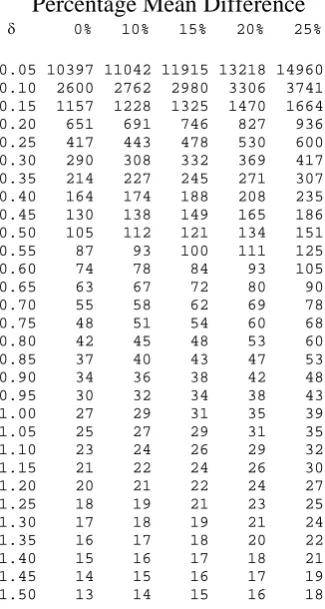
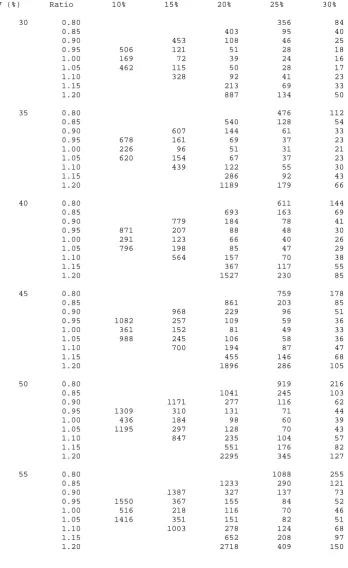
Table 3.1 gives sample sizes using equation 3.8 for various standardised equivalence limits
3.4.3. Worked example
3.4.3.1. Using the sample size tables
An investigator wishes to design a pain trial where the objective is to demonstrate
equivalence between two treatments. The largest clinically acceptable effect for which
equivalence can be declared is a change in visual analogue scale (VAS) assessed pain of
10mm (d). There is to be equal allocation between groups. The true mean difference
between the treatments is thought to be zero and the expected standard deviation in the
population in which the trial is to be undertaken is 50mm (σ ). Thus, the standardised
equivalence limits are ±δ =±d/σ =±10/50=±0.20. For the Type I and Type II errors
fixed at 2.5% and 10% respectively Table 3.1 gives a sample size of 651 patients in each arm
of the trial.
Suppose the true mean difference is thought to be 2mm. This equates to 20% of the
standardised equivalence limits and would inflate the sample size to 827 patients in each arm
of the trial.
3.4.3.2. Repeated using sample size software
To repeat the calculations in PASS one needs to select Means and then Equivalence-Means.
The dialogue box below details the entries required to repeat both calculations in the worked
example. One typographical issue to note is that PASS does not distinguish between
bioequivalence and equivalence trials which as will be highlighted Section 6 are two
difference concepts and so as a result PASS has as the heading in the output box
PASS gives a sample sizes respectively 651 and 827 respectively for the case of no treatment
difference and a treatment difference of 2mm. The same as table 3.1.
To repeat the calculations in nQuery one would need to click on File/New, for Goal tick
Means, Number of Groups tick Two and Analysis Method tick Equivalence. Then select
Two one-sided tests (TOST) for two group or cross-over. nQuery too gives the same answers
as table 3.1 for the two cases in the worked example.
3.5. Cross-over trials
The methodologies and assumptions for an equivalence trial with a cross-over design
are the same as those for parallel group trials . This subsection will therefore only go
3.5.1. General case.
The power (and Type II error) can be estimated from
(
)
(
)
1 2 ) ( 2 ) (1 2 1
2 1 2 2 − − + − Φ + − − − Φ =
− −α −α
σ µ µ σ µ µ
β d n Z d n Z
w B A w B A
. (3.17)
For unknown variance equation (3.17) can thus be re-written as
(
)
(
)
1 2 ) ( 2 ) (1 2 1 , 2
2 2 , 1 2 2 − − + − Φ + − − − Φ =
− − − − n−
w B A n w B A t n d t n d α α σ µ µ σ µ µ
β , (3.18)
and under the assumption of a non-central t-distribution the power [Owen, Diletti et al, Chow
et al) the power can be estimated from
(
1 , 2, 2, 2)
-Probt(
1 , 2, 2, 1)
Probt1−β = −t−αn− n− τ t−αn− n− τ , (3.19)
where τ1and τ2are defined as
(
)
2 1 2 ) ( w BA d n
σ µ µ
τ = − + and
(
)
2 2 2 ) ( w B
A d n
σ µ µ
τ = − − .
For quick calculations one could use:
(
)
(
)
22 1 1 2 ) ( 2 d Z Z n B A w − − + = − − µ µ
σ β α
, (3.20)
for sample size estimation and for very quick calculations (for 90% power and Type I error of
2.5%), one can use the following formula:
(
)
22 ) ( 21 d n B A w − − = µ µ σ
3.5.2. Special case of no treatment difference.
For the special case of no treatment difference (µA −µB =0), a direct estimate of the sample
size can be estimated from
(
)
2 2 1 2 1 2 2 d Z Zn= σw −β + −α , (3.22)
which, with unknown variance, can be re-written as
2 2 2 , 1 2 1 2 2 d t Z n n w + = − −
−β α
σ
. (3.23)
Equation 3.23 can in turn be re-written in terms of power for a given sample size
1 2
2
1 2 1 , 2
2 − − Φ =
− − n−
w t n d α σ
β , (3.24)
which in turn (under the assumption of a non-central t-distribution), can also be rewritten as:
(
, 2,)
1 Probt2
1−β = −t1−α,n−2 n− τ − , (3.25)
where τ is defined as
2 2 w d n
σ τ = − ,.
For quick calculations (for 90% power and Type I error of 2.5%), the following formula,
can be used:
2 2 26
d
n= σw . (3.26)
The quick equations give reasonable estimates of the sample size, underestimating the
sample size by just one or two subjects, and thus provides reasonable initial values for
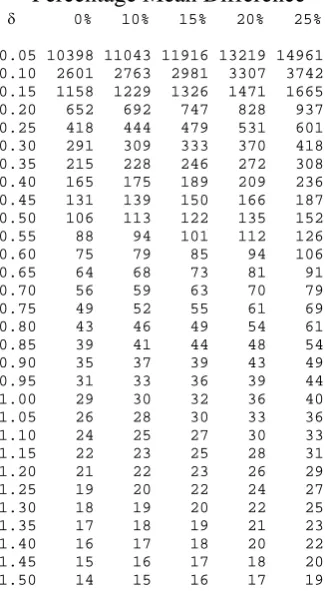
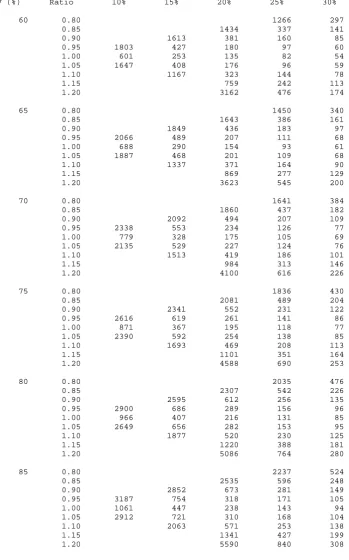
equations (3.19) and (3.25). Table 3.2 gives sample sizes using equation 3.19 for various
3.5.3 Worked example
3.5.3.1. Using the sample size tables
An investigator wishes to design a pain trial similar to that in Section 3.4.3.1. Again the
largest clinically acceptable effect for equivalence to be declared is a change in visual
analogue scale (VAS) assessed pain of 10mm (d) and the true mean difference between the
treatments is thought to be zero. The expected within-subject standard deviation in the trial
population is 20mm (σw). Thus, the standardised equivalence limits equate to
50 . 0 20 / 10
/ =± =±
± =
±δ d σ . For the Type I and Type II errors fixed at 2.5% and 10%,
respectively, Table 3.2 gives a total sample size of 106 patients in the trial.
If the true mean difference is thought to be 2mm, equating to 20% of the standardised
equivalence limits, the sample size would be inflated to a total of 135 patients in the trial.
3.5.3.2. Repeated using sample size software
To do the same sample size calculations in nQuery one would need to click on File/New, for
Goal tick Means, Number of Groups tick Two and Analysis Method tick Equivalence. Then
select Two one-sided tests (TOST) for two group or cross-over. For equivalence trials
nQuery does not use σd, as it does for superiority trials, or σw, as used in equation 3.9 but a
new variance σw 2, as described in the right hand dialogue box below under the heading
"Suggestion". One rational for using this variance is that nQuery does not give the total
sample size but the sample size per sequence (assuming one has two sequences AB and BA).
By using σw 2 for the variance estimate (and by giving the sample size per sequence) it
enables nQuery to use the same formula (equation 3.8), for sample size calculations for both
statistic in equation (3.8) will be correct for both cross-over and parallel group trials using
the nomenclature of sample size per sequence.
The dialogue box below gives the entries to repeat the sample size calculations in nQuery
For the equivalent sample sizes to those given earlier for no mean difference and a mean
difference of 2 nQuery gives a sample size per treatment sequence of 53 and 68 respectively
or 106 and 136 in total. Taking account of rounding nQuery gives the same results for the
total sample size as table 3.2. To do the same calculations in PASS one needs to select
Means and then Equivalence-Means. the dialogue box is the same as that in Section 3.4.3.2.
It is worth noting that for the variance PASS uses σw2 (and not σw2 2 as with nQuery) but
like nQuery it does give the sample size per sequence. PASS gives the same sample size per
sequence as nQuery.
There is an issue with the approach of nQuery and PASS in calculating the sample size per
sequence as this is assuming that one is investigating just 2 treatments in just 2 sequences
(BA and AB). If one was simultaneously investigating 3 treatments say one may have 6
sequences. Another issue is that even if just two treatments are being investigated one may
be applying a replicate design as described in Section 6.3.3 where again more than two
sequences may be being used. It is more optimal therefore to calculate the total sample size
and divide this by the number of sequences to get the sample size per sequence rather than
4. NON-INFERIORITY TRIALS
For certain trials the objective is not to demonstrate that two treatments are different or
equivalent but rather to demonstrate that a given treatment is clinically not inferior compared
to another. The null (H0) and alternative (H1) hypotheses for non-inferiority trials may take
the form:
H0: A given treatment is inferior with respect to the mean response.
H1: A given treatment is non-inferior with respect to the mean response.
As with equivalence trials these hypotheses are written in terms of a clinical difference, d,
which equates to the largest difference that is clinically acceptable [42]:
H0: µA −µB ≤−d .
H1: µA −µB >−d.
In the context of non-inferiority trials –d is know as the non-inferiority limit. Please see
discussion in section 3.3.2 as to its definition. ICH E3 and E9 go into detail on the analysis
of non-inferiority trials whilst ICH E10 discusses the definition of d [3, 7, 41].
In order to conclude non-inferiority, one needs to reject the null hypothesis. In terms of the
equivalence hypotheses in Section 3 this is equivalent to testing just one of the two
components of the TOST procedure. Thus, non-inferiority trials reduce to a simple one-sided
hypothesis and test. In practice, this is operationally the same as constructing a (1-2α)100%
confidence interval and concluding non-inferiority provided that the lower end of this
confidence interval is greater than –d.
Usually non-inferiority trials (like equivalence trials) compare the investigative therapy to an
active control. Statistically they could be considered a special case of equivalence trials.
However, operationally non-inferiority trials are more often conducted since it is only the
lower equivalence (now non-inferiority) limit that is usually of interest. For a non-inferiority
the study. Please see also the discussion on "as good as or better trials" for the context of
non-inferiority studies with superiority studies.
Figure 3 highlights how non-inferiority can be demonstrated through a confidence interval
and Figure 2 shows how confidence intervals are used to test the different hypotheses in
superiority, equivalence and non-inferiority trials.
Adopting the same notation and assumptions as in Section 3 but with f
( )
µ =−∆ and thenon-inferiority bound set at –d, the lower
(
1−2α)
100% confidence limit isS Var Z
S−∆− 1−α . (4.1)
To declare non-inferiority the lower end of the confidence interval should lie above –d:
( )
S d VarZ
S−∆− 1−α >− . (4.2)
For this critical region one therefore requires a
(
1−β)
100% chance that the lower limit liesabove –d i.e.:
Hence:
( )
11−β − −α
∆ + −
= Z
S Var
d
Z , (4.3)
giving:
(
)
2 1 1
2
) (
) (
β
α −
− +
∆ − =
Z Z
d S
Var . (4.4)
4.1. Parallel group trials
As with superiority and equivalence trials Var(S) can be defined as
( )
A r r S Var
n . 1 σ2
+
= ,
(
)
(
)
22 1 1 2 ) ( ) 1 ( d r Z Z r n B A A − − + + = − − µ µ
σ β α
. (4.5)
Re-writing equation (4.5) to give power for a give sample size results in:
(
)
− + − − Φ =− −α
σ µ µ
β 2 2 1
) 1 ( ) ( 1 Z r rn d A B A
. (4.6)
The equivalent formula to (4.6), in the case of unknown variance is
(
)
− + − − Φ =− 2 1− , ( +1)−2
2 ) 1 ( ) (
1 A B A n r
A t r rn d α σ µ µ
β . (4.7)
As with the sections on equivalence and superiority trials when the population variance is
unknown it is best to calculate the power under the assumption of a non-central t-distribution
[37]:
(
τ)
β 1 Probt α , ( 1) 2, 1− = − t1− ,n (r+1)−2 nA r+ −
A , (4.8)
where τ is defined as
(
)
2 ) 1 ( ) ( σ µ µ τ + − − = r rn d A B A .For quick calculations (for 90% power and Type I error of 2.5%), the following formula,
similar to equation (2.9) can be used:
(
d)
rr n B A A 2 2 ) ( ) 1 ( 5 . 10 − − + = µ µ σ
. (4.9)
In the case of r=1 (4.9) resolves to:
(
)
22 ) ( 21 d n B A A − − = µ µ σ
. (4.10)
Equations 4.9 and 4.10 are equivalent to equations 3.10 and 3.11 for the case of a non zero
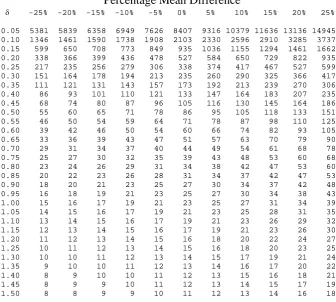
sample size, although with slight underestimation. Table 4.1 gives sample sizes using
equation 4.8 for various standardised non-inferiority limits (δ =d σ ) and standardised mean
differences assuming equal allocation between groups.
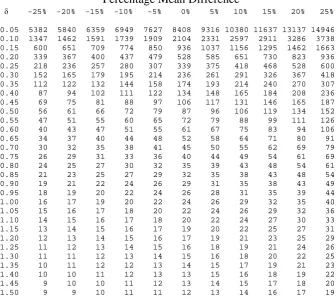
One important feature to highlight in tables 4.1 and 4.2 is the asymmetric effect on the sample
size of different values for the true mean difference. In equivalence trials as there are two
margins when one moves away from a zero mean difference - in any direction - the sample
size is inflated. However, in non-inferiority trials the sample size is inflated only if the true
mean difference moves towards the non-inferiority margin. If it is expected that the true mean
difference is in favour of the comparator regimen (compared to control) then the sample size
is significantly reduced.
The asymmetric effect of the mean difference on the sample size should be considered when
designing non-inferiority trials as even only a small expected mean difference in favour of the
comparator could have a marked effect on the sample size.
4.1.1. Worked example
4.1.1.1. Using the sample size tables
An investigator wishes to design an hypertension trial where the objective is to demonstrate
that one treatment (an investigative therapy) is non-inferior to another (a standard therapy).
As with the worked example in Section 3.2.3 the largest clinically acceptable effect to be
able to declare non-inferiority is a change in blood pressure of 10mmHg (d). The true mean
difference between the treatments is thought to be zero with an expected standard deviation
in the trial population of 40mmHg (σ ). There is to be equal allocation between groups.
Thus, the standardised non-inferiority limits equate to −δ =−d/σ =−10/40=−0.25. For
size of 338 patients in each arm of the trial. The quick formula (equation 4.10) gives 336
patients in each arm.
Suppose, though, that one believes that the investigative therapy is a little superior to the
standard such that the true mean difference is thought to be 2mmHg. This inflates the
distance one expects the mean to be away from the non-inferiority margin by 20% and as a
consequence reduces the sample size to required to 235 patients in each arm of the trial.
4.1.1.2. Repeated using sample size software
To do non-inferiority sample size calculations in nQuery one would need to click on
File/New, for Goal tick Means, Number of Groups tick Two and Analysis Method tick
Equivalence. Then click on Equivalence of Two Means.
Note that nQuery does not refer to these calculations as non inferiority but equivalence.
However, it is clear from the instructions and the definition of the null hypothesis given in
nQuery that the calculations are for a Non-inferiority trial (see the definition of the null