This is a repository copy of Cycle-time properties of the timed token medium access
control protocol.
White Rose Research Online URL for this paper:
http://eprints.whiterose.ac.uk/1452/
Article:
Zhang, S., Burns, A. orcid.org/0000-0001-5621-8816 and Cheng, T.H. (2002) Cycle-time
properties of the timed token medium access control protocol. IEEE Transactions on
Computers. pp. 1362-1367. ISSN 0018-9340
https://doi.org/10.1109/TC.2002.1047759
[email protected]
https://eprints.whiterose.ac.uk/
Reuse
Items deposited in White Rose Research Online are protected by copyright, with all rights reserved unless
indicated otherwise. They may be downloaded and/or printed for private study, or other acts as permitted by
national copyright laws. The publisher or other rights holders may allow further reproduction and re-use of
the full text version. This is indicated by the licence information on the White Rose Research Online record
for the item.
Takedown
If you consider content in White Rose Research Online to be in breach of UK law, please notify us by
Brief Contributions
________________________________________________________________________________Cycle-Time Properties of the Timed Token
Medium Access Control Protocol
Sijing Zhang, Alan Burns, and Tee-Hiang Cheng
Abstract—We investigate the timing properties of the timed token protocol that are necessary to guarantee synchronous message deadlines. A tighter upper bound on the elapse time between the token’sltharrival at any nodeiand its ðlþvÞtharrival at any nodekis found. A formal proof to this generalized bound is presented.
Index Terms—Protocol timing properties, timed token medium access control (MAC) protocol, timed token networks, FDDI networks, real-time communications.
æ
1
INTRODUCTION
GUARANTEEINGmessage deadlines is a key issue in distributed real-time applications. The timed token medium access control (MAC) protocol [1], [2] is suitable for real-time applications due to its special timing property of bounded token rotation time. With this protocol [2], messages are distinguished into two types: synchronousandasynchronous. Synchronous messages are periodic with delivery time constraints. Asynchronous messages are nonperiodic with no delivery time constraints. During network initialization time, all nodes negotiate a common value for the Target Token Rotation Time (T T RT) which should be small enough to meet responsiveness requirements of all nodes. Each node iis assigned a fraction of theT T RT, denoted as Hi, as its
synchronous bandwidth, which is the maximum time the node is allowed to transmit its synchronous messages every time it receives the token [3], [4]. Whenever nodeireceives the token, it transmits its synchronous messages (if any) first for a time up to
Hi. If the time elapsed between the previous and the current token
arrivals at the same nodeiis less thanT T RT(i.e., the token arrived earlier than expected), node i can then send asynchronous messages to make up the difference.
Johnson [5] first proved that the token rotation time cannot exceed2T T RT. Chen et al. [3], [4] generalized the bound derived by Johnson on the maximum token rotation time, extending it from between any two to between any v (integer v2) successive token’s arrivals at a node. This result was widely used in studying various synchronous bandwidth allocation (SBA) schemes [3], [4], [6], [7], [8], [9], [10], [11]. Unfortunately, their generalized bound may not keep tight when v grows large and, consequently, the worst-case performance of SBA schemes, which is derived based on this bound, could be too pessimistic and, hence, much poorer than actually achievable. Han et al. [12] derived a more generalized bound between any two token visits to any two nodes, which makes the previous results by Johnson and by Chen et al. a special
case. However, for the bound on successive token arrivals to a particular node, the bound by Han et al. is no tighter than that derived by Chen et al.. Zhang and Burns [13], [14] improved the bound of Chen et al. by deriving another generalized upper bound which may become tighter when the number of successive token rotations grows large.
This paper derives a tighter upper bound on the elapsed time between the token’s lth arrival at any node i and the token’s ðlþvÞtharrival at any nodek(where integerv0). This result generalizes all the previous findings on the cycle-time properties and is better than any of them in the sense that it is more general and/or tighter. For the rest of this paper, Section 2 describes the network model, Section 3 presents a formal proof to our generalized bound, and Section 4 shows how our result generalizes and why it is better than any published result on cycle-time properties. An example, given in Section 5, shows the superiority of our derived result for guaranteeing hard real-time messages with the timed token protocol. Finally, the paper concludes with Section 6.
2
NETWORK
MODEL
The network is assumed to consist ofnnodes forming a logical ring. The message transmission is controlled by the timed token MAC protocol [2]. Let i be the maximum amount of overhead
incurred from the token’s arrival at node i till its immediately subsequent arrival at node ðiþ1Þ, then the maximum time unavailable for message transmission during one complete token rotation, denoted as, can be expressed by ¼Pn
i¼1i. Since
forms part of the token rotation time and synchronous sion with guaranteed bandwidth precedes asynchronous transmis-sion, clearly, as a protocol constraint on the allocation of synchronous bandwidth,Pn
j¼1HjT T RTÿ must be met. The
protocol constraint is assumed to hold for the rest of this paper.
3
THE
FORMAL
PROOF
Before formally proving a better result on the protocol cycle-time property, we need to define some terms and to show a lemma.
Let “c; i” (a pair of integers) denote the token’s cth visit to nodei. Visitc; iis followed byc; iþ1if1i < nor bycþ1;1if
i¼n. Similarly, ifi¼1, thenc; iÿ1(the visit immediately before
c; i) should be taken to becÿ1; n. The sum total of some quantity, say,q, for all the visits fromj; ktow; zinclusive can be expressed as
Pw;z
x;y¼j;kqx;y¼Pny¼kqj;yþPwx¼ÿj1þ1
Pn
y¼1qx;yþPzy¼1qw;y.
Signs “¼;” “<,” “,” “>,” and “” can be used to link two visits such that “x; y¼c; i,” “x; y < c; i,” “x; yc; i,” “x; y > c; i,” and “x; yc; i” mean, respectively, visit x; y being the same as, before (earlier than), no later than, after (later than), and no earlier thanc; i.
Lettc;ibe the time when the token makes itsctharrival at node
i. Let hc;i, ac;i, and c;i, respectively, represent the times spent
transmitting synchronous and asynchronous traffic and the various overheads involved in visitc; i. Then, the duration of visit
c; i, denoted as vc;i, can be expressed as vc;i¼hc;iþac;iþc;i.
Further, letBc;i be the length of a complete token rotation ending
with visitc; i, i.e.,Bc;i¼Pc;ix;y¼cÿ1;iþ1vx;y.
According to the timed token protocol [2], each node i can transmit synchronous messages for a time up toHiand can then
send asynchronous messages (if the token arrived early) up to the amount of time by which the token arrived early. So, forc1and
1in, hc;iHi, ac;imaxð0; T T RTÿBc;iÿ1Þ. Also, with this
protocol, no nodes are allowed to hold the token for a time over
1362 IEEE TRANSACTIONS ON COMPUTERS, VOL. 51, NO. 11, NOVEMBER 2002
. S. Zhang is with the School of Computing and Technology, University of
Derby, Kedleston Road, Derby DE22 1GB, England, UK. E-mail: [email protected].
. A. Burns is with the Department of Computer Science, University of York,
Heslington, York YO1 5DD, England, UK. E-mail: [email protected].
. T.-H. Cheng is with the School of Electrical and Electronic Engineering,
Nanyang Technological University, Nanyang Avenue, Singapore 639798, Republic of Singaport. E-mail: [email protected].
Manuscript received 6 Nov. 1997; revised 17 Jan. 2001; accepted 24 Oct. 2001.
For information on obtaining reprints of this article, please send e-mail to: [email protected], and reference IEEECS Log Number 105901.
T T RT, i.e.,ac;iT T RTÿhc;i. Combining these two constraints on
ac;i, we get
ac;iminfT T RTÿhc;i;maxð0; T T RTÿBc;iÿ1Þ g: ð1Þ
BecauseBc;iÿ1¼, when no nodes have messages, either
synchro-nous or asynchrosynchro-nous, to send during the preceding token rotation ending with visitc; iÿ1, the bandwidth available for transmitting asynchronous messages is bounded by T T RTÿ (since
ac;imax½0; T T RTÿBc;iÿ1).
Let Pf
eQj be defined as follows (where eandf are positive
integers and “mod n” represents “modulo_n” operation):
X
f
e
Qj¼
Pf
j¼eQj if 1efnande6¼ ðf mod nÞ þ1
Pn
j¼eQjþPfj¼1Qj if 1f < enande6¼fþ1
0 ife¼ ðf mod nÞ þ1:
8 > <
> :
Then, the sum of overheads incurred during less than n
successive token visits (from node eto node f inclusive) can be expressed as Pf
ej.
We also need the following lemma for the proof of our generalized result.
Lemma 1 [14].If the token is early on visitc; i (i.e., early on its cth
arrival at nodei), then
tc;iþ1ÿtcÿ1;i¼
X
c;i
x;y¼cÿ1;i
vx;yT T RTþhc;iþc;iT T RTþHiþi:
Before formally proving our generalized upper bound given in Theorem 1, we briefly describe the simple idea behind the proof: For visits betweenl; iandlþv; kÿ1, examine each visit backward starting from lþv; kÿ1. If the current visit is a late visit (where only synchronous transmission is allowed), replace it by the allocated amount of synchronous bandwidth (allocated to the node which the late visit corresponds to) plus an upper-bounded amount of overheads involved in the visit and then move onto thenext visit immediately before this late visit. Otherwise, if the current visit is an early visit, replace ðnþ1Þ successive visits ending with this early visit by the bound specified in Lemma 1 and then move onto the next visit immediately before these ðnþ1Þ
visits. Check the new current visit in exactly the same way as above and continue the backward examining process until visitl; i
has been replaced by a bound formed either individually or jointly with other visits. Finally, by smartly concatenating and formulat-ing all produced component bounds (each for one or ðnþ1Þ
replaced visits), one can easily reach the proposed upper bound. Following this proof route, the upper bound is easy to derive though it looks quite complex.
Theorem 1 (Generalized Johnson’s Theorem). For any integersl and vðl1; v0Þand any nodesi and k ð1in;1knÞ, if tlþv;k> tl;i, t h e n , u n d e r t h e p r o t o c o l c o n s t r a i n t ( i . e . ,
Pn
j¼1HjþT T RT),
tlþv;kÿtl;i
vnþkÿi nþ1
T T RTþX
kÿ1
iþ1
Hþþ
vnþkÿiÿ1 n
ÿ vnþkÿi
nþ1
þ1
X
n
j¼1
Hjþ
!
:
Proof.The time interval oftlþv;kÿtl;iexactly corresponds to visits
from l; i to lþv; kÿ1, inclusive. There are two cases to consider:
CASE 1:The token is late on all visits froml; itolþv; kÿ1
inclusive.
Since ax;y¼0 (l; ix; ylþv; kÿ1), the time elapsed
during any complete token rotation, if any, is bounded by
Pn
j¼1Hjþ. As there are, in total, (vnþkÿi) visits between
l; iandlþv; kÿ1, inclusive, and each token rotation consists of
nsuccessive visits, the number of complete token rotations is given byb¼ bvnþkÿi
n c. The elapsed time in the remaining visits
from node i to node (kÿ1) inclusive, if any, is bounded by
Pkÿ1
i HjþPkiÿ1j. Based on the above analysis, we have,
tlþv;kÿtl;i¼
X
lþv;kÿ1
x;y¼l;i
vx;y¼
Xbÿ1
j¼0
X
lþjþ1;iÿ1
x;y¼lþj;i
vx;y
!
þ X
lþv;kÿ1
x;y¼lþb;i
vx;y
¼X
bÿ1
j¼0
X
lþjþ1;iÿ1
x;y¼lþj;i
ðhx;yþx;yÞ
!
þ X
lþv;kÿ1
x;y¼lþb;i
ðhx;yþx;yÞ
b X
n
j¼1
Hjþ
!
þX
kÿ1
i
Hjþ
Xkÿ
1
i
j
ðsincex;yy; ¼
Xn
j¼1
i; hx;yHyÞ
¼ vnþkÿi
n
X
n
j¼1
Hjþ
!
þX
kÿ1
i
Hjþ
since X
kÿ1
i
j
!
X
kÿ1
iþ1
Hjþþ vnþkÿiÿ
1 n
þ1
X
n
j¼1
Hjþ
!
X
kÿ1
iþ1
Hjþþ vnþkÿiÿ
1 n
þ1
X
n
j¼1
Hjþ
!
þ vnþkÿi
nþ1
T T RTÿX
n
j¼1
Hjÿ
!
since X
n
j¼1
HjþT T RT
!
¼ vnþkÿi
nþ1
T T RTþ X
kÿ1
j¼iþ1
Hjþ
þ vnþkÿiÿ1
n
ÿ vnþkÿi
nþ1
þ1
X
n
j¼1
Hjþ
!
:
CASE 2:There is at least one early visit froml; itolþv; kÿ1
inclusive.
Letp1; q1; ; . . . ; pm; qm, where
l; ip1; q1< p2; q2< < pm; qm< lþv; k;
be allmearly visits betweenl; iandlþv; kÿ1inclusive such that, for 1sm (assuming lþv; k¼pðmþ1Þÿ1; qðmþ1Þ),
ps; qs< pðsþ1Þÿ1; qðsþ1Þ, whereps; qsis the last early visit before
pðsþ1Þÿ1; qðsþ1Þ. The following observations can be made from
the above definitions:
1. For1s < m, betweenps; qsexclusive andpðsþ1Þ; qðsþ1Þ
inclusive, there are at least ðnþ1Þ successive visits. Since there are, in total,vnþ ðkÿiÞvisits betweenl; i
andlþv; kÿ1inclusive, we havem dvnþkÿi nþ1 e.
2. Any visit between ps; qs and pðsþ1Þÿ1; qðsþ1Þ
exclusive (where 1sm and, as assumed,
Thus,Ppðsþ1Þÿ1;qðsþ1Þÿ1
x;y¼ps;qsþ1 vx;y¼
Ppðsþ1Þÿ1;qðsþ1Þÿ1
x;y¼ps;qsþ1 ðhx;yþx;yÞ.
3. If p1ÿ1; q1> l; i, there are no early visits (thus no
asynchronous transmission) between l; i and p1ÿ
1; q1ÿ1inclusive. Hence,
X
p1ÿ1;q1ÿ1
x;y¼l;i
vx;y¼
X
p1ÿ1;q1ÿ1
x;y¼l;i
ðhx;yþx;yÞ:
4. According to Lemma 1, the time elapsed in anyðnþ1Þ
successive visits ending with an early visit is bounded by T T RT plus the synchronous bandwidth used and the amount of overheads incurred in this early visit. For simplicity of proof, suppose that this bound is formed by two imaginary parts:the firstnsuccessive visits(that form one complete token rotation) being bounded by
T T RT and the ðnþ1Þth visit of only synchronous transmission. Note that this imaginary (equivalent) situation, though not what happens in reality, leads to the same theoretically derived upper bound and, at the same time, simplifies the derivation making the proof easy to follow.
Note that removing any n successive visits (say, replaced by the imaginary upper bound of T T RT) does not break the neighboring relationship between nodes because any n successive visits make up one complete token rotation. That is, the node corre-sponding to the visit immediately before these n
visits and the node corresponding to the visit immediately after these n visits neighbor each other (i.e., the latter is the immediately subsequent node of the former), although these two corresponding visits are one-token-rotation apart. For example, the node corresponding to visit psÿ1; qsÿ1(i.e., node (qsÿ1))
and the node corresponding to visitps; qs(i.e., nodeqs)
neighbor each other, with the removed n visits (replaced by T T RT) between psÿ1; qs and ps; qsÿ1
inclusive.
5. Based upon how far the visitp1; q1 is froml; i, several
cases are considered below:
a. Ifp1ÿ1; q1l; i (i.e.,p1; q1lþ1; i).
Allmearly visits, each corresponding toðnþ1Þ
successive visits, fall within the visits froml; ito
lþv; kÿ1, inclusive. By 4, we can replace the first
nsuccessive visits of eachðnþ1Þsuccessive visits by the imaginary upper bound of T T RT. So, the final derived upper bound (on the elapse time from l; i to lþv; kÿ1 inclusive), for this case, should include “mT T RT.”
After removing m sets of token rotations (replaced bymT T RT), the number of remaining visits will be the total number of all visits minus the number of removed visits, i.e.,ðv:nþkÿiÞ ÿmn. Note that we should only consider transmission of synchronous messages in each of these remaining visits because it is either a late visit x; y (if
x; y6¼ps; qs;1sm) or has been supposed so
(ifx; y¼ps; qs) in our imaginary equivalent scenario
stated in 4. Due to the unbroken feature of neighboring relationships between nodes (when-ever the removal of any n successive nodes happens), the number of the imaginary equivalent
token rotations within these remaining visits is given by q¼ bðvnþkÿniÞÿmnc ¼ bvnþkÿi
n c ÿm. The
elapsed time in theqequivalent token rotations is bounded by
q X
n
j¼1
Hjþ
! ¼
vnþkÿi n
ÿm
X
n
j¼1
Hjþ
!
;
which should also be a component of the final derived upper-bound expression.
Also, with the unbroken neighboring feature between nodes, it is easy to check that the elapsed time in the leftover visits (after taking out the q
rotations) is bounded byPkÿ1
i HjþPkiÿ1j, which
should also appear in the final expression. b. Iflÿ1; ip1ÿ1; q1< l; i, i.e.,
l; ip1; q1< lþ1; i:
Divide all ðnvþkÿiÞ visits (from l; ito lþ
v; kÿ1inclusive) into two groups:
Group1¼ fx; yjp1; q1þ1x; ylþv; kÿ1g
Group2¼ fx; yjl; ix; yp1; q1g:
We now discuss the upper bounds for visits in these two groups, respectively.
For visits in Group 1, we can do exactly the same analysis as that adopted in (5.a) forðmÿ1Þ
early visits (i.e., “p2; q2”;“p3; q3”; ... ; “pm; qm”). So,
the final upper-bound expression (for Group 1) should include “ðmÿ1Þ T T RT” and
q¼ ðlþvÿp1Þ nþ ðkÿq1Þ ÿ1
n
ÿ ðmÿ1Þ:
Similarly, the time elapsed in theqrotations is upper bounded by
q ðX
n
j¼1
HjþÞ ¼
ðlþvÿp1Þ nþ ðkÿq1Þ ÿ1
n
ÿ ðmÿ1ÞÞ
X
n
j¼1
Hjþ
!
and the leftover visits can never exceed
Pkÿ1
q1þ1ðHjþjÞ ¼ Pkÿ1
q1þ1Hjþ Pkÿ1
q1þ1j. Also, both
of these two bounds, together with “ðmÿ1Þ T T RT,” form an upper bound for Group 1.
For Group 2, by Lemma 1, we have
X
p1;q1
x;y¼l;i
vx;y<
X
p1;q1
x;y¼p1ÿ1;q1
vx;yT T RTþhp1;q1þp1;q1
T T RTþHq1þq1:
Note thatl; i becomes the only visit in Group 2 whenp1; q1¼l; i. By (1), whenp1; q1¼l; i, we have
vl;iT T RTþl;iT T RTþi.
With the above observations 1-5, the upper bound of Theorem 1 can be derived as follows:
tlþv;kÿtl;i
¼ ðtlþv;kÿtpm;qmþ1Þ þ X
mÿ2
j¼0
½ ðtpmÿj;qmÿjþ1ÿtpmÿjÿ1;qmÿjÞ þ ðtpmÿjÿ1;qmÿjÿtpmÿjÿ1;qmÿjÿ1þ1Þ
þ
ðtp1;q1þ1ÿtp1ÿ1;q1Þ þ ðtp1ÿ1;q1ÿtl;iÞ ifp1ÿ1; q1> l; i
ðtp1;q1þ1ÿtl;iÞ iflÿ1; i < p1ÿ1; q1l; i
ðtl;iþ1ÿtl;iÞ ifp1ÿ1; q1¼lÿ1; i
8 > < > : ¼ X
lþv;kÿ1
x;y¼pm;qmþ1
vx;y þ
X
mÿ2
j¼0
X
pmÿj;qmÿj
x;y¼pmÿjÿ1;qmÿj
vx;yþ
X
pmÿjÿ1;qmÿjÿ1
x;y¼pmÿjÿ1;qmÿjÿ1þ1
vx;y 2 4 3 5 þ Pp1;q1
x;y¼p1ÿ1;q1vx;yþ
Pp1ÿ1;q1ÿ1
x;y¼l;i vx;y ifp1ÿ1; q1> l; i
Pp1;q1
x;y¼l;ivx;y iflÿ1; i < p1ÿ1; q1l; i
vl;i ifp1ÿ1; q1¼lÿ1; i
8 > < > : X
lþv;kÿ1
x;y¼pm;qmþ1
ðhx;yþx;yÞþ
X
mÿ2
j¼0
X
pmÿj;qmÿj
x;y¼pmÿjÿ1;qmÿj
vx;y 2 4 3 5 þX
mÿ2
j¼0
X
pmÿjÿ1;qmÿjÿ1
x;y¼pmÿjÿ1;qmÿjÿ1þ1
vx;y 2 4 3 5 þ Pp1;q1
x;y¼p1ÿ1;q1vx;yþ
Pp1ÿ1;q1ÿ1
x;y¼l;i ðhx;yþx;yÞ
ðbyðCÞÞ ifp1ÿ1; q1> l; i Pp1;q1
x;y¼p1ÿ1;q1vx;y ðsince Pp1;q1
x;y¼l;ivx;y<Px;yp1;q¼1p1ÿ1;q1vx;yÞ
iflÿ1; i < p1ÿ1;
q1l; i
hl;iþal;iþl;i ifp1ÿ1; q1¼lÿ1; i
8 > > > > > > < > > > > > > :
ðby observation 2 aboveÞ
X
lþv;kÿ1
x;y¼pm;qmþ1
ðhx;yþx;yÞ þ
X
mÿ2
j¼0
ðT T RTþhpmÿj;qmÿjþpmÿj;qmÿjÞ
þX
mÿ2
j¼0
X
pmÿjÿ1;qmÿjÿ1
x;y¼pmÿjÿ1;qmÿjÿ1þ1
ðhx;yþx;yÞ
2
4
3
5þ
ðT T RTþhp1;q1þp1;q1Þ þPp1ÿ1;q1ÿ1
x;y¼l;i ðhx;yþx;yÞ
ifp1ÿ1; q1> l; i
T T RTþhp1;q1þp1;q1 iflÿ1; i < p1ÿ1; q1l; i
hl;iþl;iþminfT T RTÿhl;i;
maxð0; T T RTÿBl;iÿ1Þgðbyð1ÞÞ
ifp1ÿ1; q1¼lÿ1; i
8 > > > > > > < > > > > > > :
ðby Lemma 1Þ
mT T RTþ ð vnþkÿi n
ÿmÞðPn
j¼1HjþÞ
þPkÿ1
i HjþPkiÿ1j
ðby observation 5:a aboveÞ
ifp1ÿ1; q1l; i
ðmÿ1Þ T T RTþ ðbðlþvÿp1Þnþðkÿq1Þÿ1
n c ÿ ðmÿ1ÞÞ
ðPn
j¼1HjþÞþPqkÿ1þ11Hjþ Pkÿ1
q1þ1j þðT T RTþHq1þq1Þ
ðby observation 5:b aboveÞ
iflÿ1; i < p1ÿ1;
q1< l; i
ðmÿ1ÞT T RTþ
ðbvnþðknÿiÞÿ1c ÿ ðmÿ1ÞÞðPn
j¼1HjþÞ
þPkÿ1
iþ1HjþPikþÿ11jþ ðT T RTþiÞ
ðsinceal;iT T RTÿhl;iÞ
ðby observation 5:b aboveÞ
ifp1ÿ1;
q1¼lÿ1; i
8 > > > > > > > > > > > > > > > > > > > > > > > > > > > > < > > > > > > > > > > > > > > > > > > > > > > > > > > > > :
ðbecausex;yy; ¼
Xn
j¼1
iandhx;yHyÞ
mT T RTþ bvnþ ðkÿiÞ ÿ1
n c ÿ ðmÿ1Þ
X
n
j¼1
Hjþ
!
þX
kÿ1
iþ1
Hjþ
vnþkÿi
nþ1
T T RTþX
kÿ1
iþ1
Hjþþ
vnþkÿiÿ1 n
ÿ vnþkÿi
nþ1
þ1
X
n
j¼1
Hjþ
!
ðby observation 1 above and the fact of the above
upper bound being an increasing function ofmÞ:
t u
As shown in the above proof process, the derived upper bound is independent ofhx;y(l; i=leqx; y < lþv; k) as long as the protocol
constraint holds. So, the bound still works even whenhx;y¼0for
somex; y. Realizing this fact is important for real-time commu-nication with the timed token protocol.
4
COMPARISON WITH
PREVIOUS
RESULTS
Zhang and Burns [13] demonstrate how the previous findings by Johnson [5] become a special case of their generalized upper bound and why their bound is tighter than that derived by Chen et al. when the number of consecutive token rotations grows large enough under Pn
j¼1Hj< T T RTÿ. It is easy to check that
Theorem 1 becomes the generalized upper bound expression derived by Zhang and Burns [13] whenk¼i.
LetdiðlÞbe the time when the token makes its lth departure
from nodeiandb;iðl; cÞbe the time difference betweendbðlÞand
the time when the token departs from nodeithecthtime afterdbðlÞ
[12], i.e.,
b;iðl; cÞ ¼ ddiðlþcÿ1Þ ÿdbðlÞ if 1b < in iðlþcÞ ÿdbðlÞ if 1ibn:
ð2Þ
Han et al. [12] derived a generalized upper bound on b;iðl; cÞ(i.e.,
the elapses time between the token’slthdeparture from nodeband the token’s ðlþcÞth departure from node i) which makes the previous results by Johnson [5] and by Chen et al. [3] a special case of their result. The following theorem shows their generalized upper bound expression.
Theorem 2 (Generalized Johnson’s Theorem by Han et al. [12]).
For the timed-token MAC protocol, under the protocol constraint, for anyl1andc1,
b;iðl; cÞ cT T RTþ
Xi
j¼bþ1
Hjþ ðcþ1Þ T T RT ;
wherePi
j¼bþ1Hjis subject to the definition of Pfj¼eHj as shown
below:
Xf
j¼e
Hj¼
HeþHeþ1þ þHf if 1efn
HeþHeþ1þ þHnþH1þH2þ þHf if 1f < en:
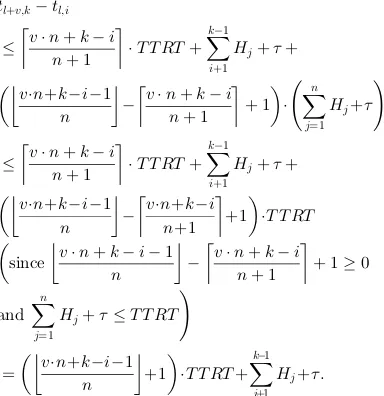
tlþv;kÿtl;i
vnþkÿi
nþ1
T T RTþX
kÿ1
iþ1
Hjþþ
vnþkÿiÿ1 n
ÿ vnþkÿi
nþ1
þ1
X
n
j¼1
Hjþ
!
vnþkÿi
nþ1
T T RTþX
kÿ1
iþ1
Hjþþ
vnþkÿiÿ1 n
ÿ vnþkÿi
nþ1
þ1
T T RT
since vnþkÿiÿ1 n
ÿ vnþkÿi
nþ1
þ10
and X
n
j¼1
HjþT T RT
!
¼ vnþkÿiÿ1
n
þ1
T T RTþX
kÿ1
iþ1
Hjþ:
ð3Þ
As shown below, even the above relaxed upper bound (3) is still tighter than that derived by Han et al. To enable comparison, we need to represent b;iðl; cÞ using our notation
tc;i. Letbe the delay between the departure of the token from
any node i and its immediate arrival to node (iþ1), i.e.,
diðlÞ ¼ tlþbi=nc;ði mod nÞþ1 ÿ , then b;iðl; cÞ can be converted as
follows:
b;iðl; cÞ ¼
diðlþcÿ1Þ ÿdbðlÞ if 1b < in
diðlþcÞ ÿdbðlÞ if 1ibn
¼
ðtðlþcÿ1Þþbi=nc;ði mod nÞþ1ÿÞ ÿ ðtl;bþ1ÿÞ if 1b < in
ðtðlþcÞþbi=nc;ði mod nÞþ1ÿÞ
ÿðtlþbb=nc;ðb mod nÞþ1ÿÞ
if 1ibn
8 > < > : ¼
tlþc;1ÿtl;bþ1 if 1b < i¼n
tlþcÿ1;iþ1ÿtl;bþ1 if 1b < i < n
tðlþcÞþ1;1ÿtlþ1;1 ifi¼b¼n
tlþc;iþ1ÿtlþ1;1 if 1i < b¼n
tlþc;iþ1ÿtl;bþ1 if 1ib < n
8 > > > > > > < > > > > > > :
ðbcnþ1ÿðnbþ1Þÿ1c þ1Þ T T RT
þPn
½ðbþ1Þmod nþ1Hjþ
if 1b < i¼n
ðbðcÿ1Þnþðiþn1Þÿðbþ1Þÿ1c þ1Þ T T RTþ Pi
bþ2Hjþ
if 1b < i < n
ðbcnþ1ÿ1ÿ1
n c þ1Þ T T RTþ
Pn
2Hjþ ifi¼b¼n
ðbðcÿ1Þnþðniþ1Þÿ1ÿ1c þ1Þ T T RTþPi
2Hjþ if 1i < b¼n
ðbcnþðiþ1Þÿðn bþ1Þÿ1c þ1Þ T T RTþ Pi
½ðbþ1Þmod nþ1Hjþ
if 1ib < n
8 > > > > > > > > > > > > > > > > > < > > > > > > > > > > > > > > > > > :
ðbyð3ÞÞ
¼
cT T RTþHbþ2þ þHiþ if 1bnÿ2< i¼n
cT T RTþ if 1b¼nÿ1< i¼n cT T RTþHbþ2þ þHiþ if 2bþ1< i < n
cT T RTþ if 2bþ1¼i < n cT T RTþH2þ þHiþ ifi¼b¼n
cT T RTþH2þ þHiþ if 1< i < b¼n
cT T RTþ if 1¼i < b¼n cT T RTþH1þ þHiþ if 1ib¼nÿ1
cT T RTþHbþ2þ þHn
þH1þ þHiþ
if 1ibnÿ2:
8 > > > > > > > > > > > > > > > > > > < > > > > > > > > > > > > > > > > > > :
On the other hand, according to Theorem 2, we have,
b;iðl; cÞ
cT T RTþHbþ1þ þHiþ if 1b < in
cT T RTþH1þ þHiþ if 1ib¼n
cT T RTþHbþ1þ þHn
þH1þ þHiþ
if 1ib < n:
8 > > > < > > > :
Comparing each case of the bound obtained from Theorem 2 with those of its corresponding cases obtained from (3), clearly, Theorem 1 gives a tighter upper bound (for b;iðl; cÞ) than
Theorem 2.
5
AN
EXAMPLE
Consider a network with three nodes. Assume that each nodei
(i¼1;2;3) has a synchronous message streamSicharacterized by
a period Pi, a maximum transmission time Ci, and a relative
deadlineDi. Messages fromSiarrive regularly with periodPiand
have relative deadlineDi(i.e., if a message fromSiarrives at timet,
it must finish its transmission at nodeiby timetþDi). Table 1 lists
all network and message parameters, whereSNandDNrepresent Source NodeandDestination Node, respectively.
Clearly, the protocol constraint holds for the given network parameters. We now check if these parameters can ensure that all synchronous messages will arrive at their destination nodes before their deadlines by, respectively, using our proposed generalized upper bound (Theorem 1) and that derived by Han et al. (Theorem 2). LetRi be the message response time for a message
fromSi(i.e., the interval from arrival of the message till completion
of its transmission at node i) and Rw
i (Ri) be the worst-case
message response time (i.e., the longest possible interval). In the worst case, a message fromSibecomes available for transmission
immediately after sometl;i, thus it misses thefirstchance of being
transmitted on visit l; i [13], [14]. Because Ci units of time are
needed for transmission of a whole message fromSiand nodei
can use at most Hi time units for transmitting synchronous
messages whenever it receives the token, a total ofdCi=Hietimes’
token arrivals is required for transmitting the whole message, which is divided intodCi=Hieframes (to be transmitted separately
on each of the token arrivals). Since the message misses the first chance at timetl;iin the worst case, we have
Ri¼
ðtlþdCi=Hie;iÿtl;iÞ þCiÿ ðd
Ci
Hie ÿ1Þ Hi ðfor use with Theorem 1Þ
iÿ1;iÿ1ðl;dCi=HieÞ
þCiÿ ðdCHiie ÿ1Þ Hi
ðfor use with Theorem 2Þ 8
> <
> :
ð4Þ
With the above analysis, we can calculateR1based on Theorem 2
as follows:
[image:6.612.56.248.65.263.2]1366 IEEE TRANSACTIONS ON COMPUTERS, VOL. 51, NO. 11, NOVEMBER 2002
TABLE 1
R1¼3;3 l;
C1
H1
þC1ÿ
C1
H1
ÿ1
H1 ðbyð4ÞÞ
C1
H1
T T RTþX
3
j¼1
HjþþC1ÿ
C1
H1
ÿ1
H1
ðby Theorem2Þ
¼ 3:1
1
8þ1þ2:16þ0:84þ1þ3:1ÿ 3:1
1
ÿ1
1¼37:1:
Thus,Rw
1 ¼37:1ms > D1¼36ms, i.e., the message ofS1misses its
deadline when judged with Theorem 2. However, as shown below, this is not the case. Based on Theorem 1, we have
R1¼ tlþdC1 H1e;1ÿtl;1
þC1ÿ
C1
H1
ÿ1
H1 ðbyð4ÞÞ
d
C1
H1e n
nþ1
& ’
T T RTþX
3
j¼2
Hjþþ
C1
H1
ÿ d
C1
H1e n
nþ1
& ’!
ðX
3
j¼1
HjþÞ þ C1ÿ C1
H1
ÿ1
H1 ðby Theorem 1Þ
¼ d
3:1 1e 3
3þ1
8þ2:16þ0:84þ1þ 3:1
1
ÿ d
3:1 1e 3
3þ1
ð4þ1Þ þ3:1ÿ 3:1
1
ÿ1
1¼33:1:
Thus, Rw
1 ¼33:1ms < D1¼36ms, i.e., the deadline ofS1 is met
when judged with Theorem 1.
Similarly, calculatingR2andR3based on Theorem 1, we have:
R2¼20:98ms < D2¼21ms; R3¼28:68ms < D3¼30ms. So, no
messages miss their deadlines when judged with Theorem 1.
6
CONCLUSION
We have presented a formal proof to a generalized upper bound on the elapsed time from the token’sltharrival at any nodeitill its
ðlþvÞtharrival at any nodek(where integerv0). Our derived upper bound expression, which is particularly important for hard real-time communications in any timed token network, is better than any of the previous findings on the protocol cycle-time properties due to the fact that it is more general and may produce a tighter upper bound.
REFERENCES
[1] R.M. Grow, “A Timed Token Protocol for Local Area Networks,”Proc. Electro ’82, Token Access Protocols, Paper 17/3,May 1982.
[2] “Fibre Distributed Data Interface (FDDI)—Token Ring Media Access Control (MAC),” ANSI Standard X3.139, 1987.
[3] G. Agrawal, B. Chen, W. Zhao, and S. Davari, “Guaranteeing Synchronous Message Deadlines with the Timed Token Medium Access Control Protocol,”IEEE Trans. Computers,vol. 43, no. 3, pp. 327-339, Mar. 1994.
[4] B. Chen, G. Agrawal, and W. Zhao, “Optimal Synchronous Capacity Allocation for Hard Real-Time Communications with the Timed Token Protocol,”Proc. 13th IEEE Real-Time Systems Symp.,pp. 198-207, Dec. 1992.
[5] M.J. Johnson, “Proof that Timing Requirements of the FDDI Token Ring Protocol Are Satisfied,”IEEE Trans. Comm.,vol. 35, no. 6, pp. 620-625, June 1987.
[6] G. Agrawal, B. Chen, and W. Zhao, “Local Synchronous Capacity Allocation Schemes for Guaranteeing Message Deadlines with the Timed Token Pprotocol,”Proc. IEEE Infocom ’93,Mar. 1993.
[7] M. Hamdaoui and P. Ramanathan, “Selection of Timed Token Parameters to Guarantee Message Deadlines,”IEEE/ACM Trans. Networking,vol. 3, no. 3, pp. 340-351, June 1995.
[8] C.C. Lim, L. Yao, and W. Zhao, “Transmitting Time-Dependent Multi-media Data in FDDI Networks,”Proc. SPIE Int’l Symp. (OE/FIBERS ’92),
pp. 144-154, 1992.
[9] N. Malcolm and W. Zhao, “The Timed-Token Protocol for Real-Time Communications,”Computers,vol. 27, no. 1, pp. 35-41, Jan. 1994.
[10] Q. Zheng and K.G. Shin, “Synchronous Bandwidth Allocation in FDDI Networks,”Proc. ACM Multimedia ’93,pp. 31-38, 1993.
[11] B. Chen, N. Malcolm, and W. Zhao,The Telecommunication Handbook: FDDI/ CDDI and Real-Time Applications,K. Terplan and P. Marreale, eds. CRC Press and IEEE Press, 2000.
[12] C.-C. Han, K.G. Shin, and C. Hou, “On Non-Existence of Optimal Local Synchronous Bandwidth Allocation Schemes,”Proc. 14th IEEE Ann. Int’l Phoenix Conf. Computers and Comm.,pp. 191-197, Mar. 1995.
[13] S. Zhang and A. Burns, “An Optimal SBA Scheme for Guaranteeing Synchronous Message Deadlines with the Timed-Token MAC Protocol,”
IEEE/ACM Trans. Networking,vol. 3, no. 6, pp. 729-741, Dec. 1995.