White Rose Research Online
Universities of Leeds, Sheffield and York
http://eprints.whiterose.ac.uk/
This is a copy of the final published version of a paper published via gold open access
in
Frontiers in Neurology
.
This open access article is distributed under the terms of the Creative Commons
Attribution Licence (
http://creativecommons.org/licenses/by/4.0/
) which permits
unrestricted use, distribution, and reproduction in any medium, provided the
original work is properly cited.
White Rose Research Online URL for this paper:
http://eprints.whiterose.ac.uk/87129
Published paper
Kinematic and neurophysiological consequences of an
assisted-force-feedback brain-machine interface training:
a case study
Stefano Silvoni1,2*, Marianna Cavinato1, Chiara Volpato1, Giulia Cisotto1,3, Clara Genna1,2, Michela Agostini2, Andrea Turolla2, Ander Ramos-Murguialday4,5 and Francesco Piccione1
1
Department of Neurophysiology, I.R.C.C.S. S.Camillo Hospital Foundation, Venice, Italy
2
Laboratory of Kinematics and Robotics, I.R.C.C.S. S.Camillo Hospital Foundation, Venice, Italy
3
Department of Information Engineering, University of Padua, Padua, Italy
4Institute of Medical Psychology and Behavioral Neurobiology, Eberhard-Karls-University, Tübingen, Germany 5TECNALIA, San Sebastian, Spain
Edited by:
Cuntai Guan, Institute for Infocomm Research, Singapore
Reviewed by:
Ricardo Chavarriaga, Ecole Polytechnique Fédérale de Lausanne, Switzerland
Donatella Mattia, Fondazione Santa Lucia, Italy
*Correspondence:
Stefano Silvoni , Department of Neurophysiology, I.R.C.C.S. S.Camillo Hospital Foundation, Via Alberoni, Venice 70-30126, Italy
e-mail: stefano.silvoni@ ospedalesancamillo.net
In a proof-of-principle prototypical demonstration we describe a new type of brain-machine interface (BMI) paradigm for upper limb motor-training. The proposed technique allows a fast contingent and proportionally modulated stimulation of afferent proprioceptive and motor output neural pathways using operant learning. Continuous and immediate assisted-feedback of force proportional to rolandic rhythm oscillations during actual movements was employed and illustrated with a single case experiment. One hemiplegic patient was trained for 2 weeks coupling somatosensory brain oscillations with force-field control dur-ing a robot-mediated center-out motor-task whose execution approaches movements of everyday life. The robot facilitated actual movements adding a modulated force directed to the target, thus providing a non-delayed proprioceptive feedback. Neuro-electric, kinematic, and motor-behavioral measures were recorded in pre- and post-assessments without force assistance. Patient’s healthy arm was used as control since neither a placebo control was possible nor other control conditions. We observed a generalized and significant kine-matic improvement in the affected arm and a spatial accuracy improvement in both arms, together with an increase and focalization of the somatosensory rhythm changes used to provide assisted-force-feedback. The interpretation of the neurophysiological and kine-matic evidences reported here is strictly related to the repetition of the motor-task and the presence of the assisted-force-feedback. Results are described as systematic observations only, without firm conclusions about the effectiveness of the methodology. In this prototyp-ical view, the design of appropriate control conditions is discussed. This study presents a novel operant-learning-based BMI-application for motor-training coupling brain oscillations and force feedback during an actual movement.
Keywords: brain-machine interface, motor-training, proprioception, assisted-force-feedback, operant learning
INTRODUCTION
Motor rehabilitation in neurological disorders has been recently combined with neurophysiologic feedback of brain activity related to motor functioning to improve functional outcome. Based on observations of neural plasticity (1–4), assistive technologies, and robot-aided therapies are currently exploited (5) to aug-ment visuospatial/proprioceptive feedback (6,7) and provide an alternative rehabilitation strategy, especially in severe patients (8–
11). These approaches include devices such as: robotic-arms, gait machines, treadmills, mechanical orthosis, and haptic devices suit-able for finger, hand, and arm (5,12). Other active rehabilitation treatments include: functional electrical stimulation (FES) devices (13) and virtual environments (6,7). All these devices are usually employed in an open-loop modality, with a pre-defined or a user-adapted feedback according to assist-as-needed strategy (14,15). Principles of a rewarding feedback during motor-training have been evaluated in many studies where reinforced or task-oriented
feedback have been used with promising results in terms of func-tional recovery (5,6,12,16–18). In one study a long-term robot-assisted treatment was compared with standard rehabilitation care showing a significant improvement of the Fugl-Meyer score (12). In another case the positive effects of a short-term goal-directed robotic therapy were sustained 4 months after the treatment (18). Other recent studies investigating the haptic-based intervention in an open-loop modality without brain activity proved its effective-ness in comparison to the standardized repetitive physiotherapy practice (19) and stability of the functional improvement (20). Because of the poor clinical outcome, these results seem to suggest that an enhanced brain-self-regulated proprioceptive assistance might be a promising modality for motor rehabilitation after stroke.
closed-loop, generally combining neurophysiological signals, an operant learning paradigm, and an external device (21–24). This combination allows the contingent stimulation of down-stream and afferent neural fibers to promote neural plasticity (2–4). Dif-ferently from the context considered in the present study, another way to promote brain plasticity relies on stimulation techniques operating directly on the central nervous system (3,25).
Most BMI-studies on motor re-learning reported positive results (10,11,22,26,27) and are almost always characterized by the following main components: (i) the combination of BMI-training with goal-oriented physical practice, (ii) the involvement of severely paralyzed post-stroke patients or individuals with tetraparesis, (iii) the focus of BMI-systems’ ability on detecting intention (i.e., the neurophysiological signals changes classifi-cation accuracy). Only a few studies involving patients associ-ated motor-behavioral and functional changes to brain activity changes (24).
During a BMI-based motor-training, increase and control of targeted brain activity is the first important step to achieve the intended goal (10,11,26). This is accomplished through feed-back mediated learning. The feedfeed-back is used to successfully complete specific tasks and to provide reward, even if feedback output devices are frequently controlled in a binary mode only, i.e., opening and closing the hand. Often these BMIs imply a delayed proprioceptive feedback in the intention-action loop, especially when motor-imagery (MI) and an external device are combined and applied to severe cases, such as a typical MI cursor BMI-task whose successful completion triggers a robotic action (10,11) or FES stimulation (26). Four exceptions were presented by Ramos-Murguialday et al. (21,23,24) and Gomez-Rodriguez et al. (22), who reported an on-line intention decoding example during a BMI-task to flex or extend the hand and forearm with a robotic device. These on-line applications provided participants with a non-delayed haptic feedback during the task (not at the end of the mental task) allowing contingent stimulation of involved affer-ent and efferaffer-ent neural networks; however, these studies involved mainly healthy participants, except for two stroke patients in Gomez-Rodriguez et al. (22), who were not clinically described, and the two patients groups described in Ramos-Murguialday et al. (24). These first studies employing non-delayed feedback (i.e., closed-loop paradigm and on-line feedback) emphasized the advantages to closely relate the feedback with intended actions or goals, and consequently to promote cortical reorganization (4, 28). Moreover one study has proven large motor-function improvements in presence of a moderate BMI-performance (27). Therefore, BMI-based motor-training could offer further expla-nations of the role of feedback into the mechanisms underlying recovery of motor-functions (3,4,29).
In this study we describe a new closed-loop BMI-application with assisted-feedback of force in which the electroencephalo-graphic (EEG) oscillations of sensori-motor rhythms (SMR) were used to continuously assist the intended movement by adding a force to the actual motor execution. This added force is propor-tional to the contralateral rolandic rhythm de-synchronization caused by movement intention and movement execution (ME). We call this BMI-system an “assisted-force-feedback” BMI (29). The main elements of this application are: the use of a motor
execution task (not a MI task), the type of feedback and the concomitant recording of motor kinematic performance (8,30). In particular and differently from other methods, the proposed augmented feedback allows a fast (non-delayed) contingent and proportionally modulated (non-binary) activation of afferent proprioceptive and motor output neural pathways for motor rehabilitation in an operant learning context.
To demonstrate the feasibility, a patient with a moderate impairment of the upper limb motor-function, due to hemi-paresis, was trained for 2 weeks with pre- and post-assessment evaluations. In accordance with the above considerations we report the methodology, neurophysiological signal changes, behavioral outcome during training and motor-task kinematic outcome.
MATERIALS AND METHODS
PATIENT
A 25-years-old moderate right-hemiplegic female chronic stroke survivor participated in the study. She suffered from a left-sided thalamic-capsular bleeding at the age of 16, due to a vascular malformation. A surgical intervention at the age of 17 stabilized her conditions. After 6 years, a right-hemiplegia with tingling and numbness due to the peri-lesional edema, probably caused by the intervention, occurred. She was admitted to the S.Camillo Hos-pital, for a short hospitalization period, where she underwent the BMI-training (see BMI Protocol) with both arms. Her disabil-ity was characterized by a limited right-arm and forearm control, right-hand grasping, external rotation, and a restricted volitional movement of the fingers (spasticity). However, she was able to use her right-hand or arm for some daily living activities (i.e., open a door, objects grasping), and was able to walk slowly with-out external aid. The chronic character of her impairment was assessed by multiple functional measurements after the surgical intervention (6, 3, and 1 months before inclusion in the present study). The following clinical tests were assessed 2 days before the experimental protocol: Fugl-Meyer Assessment for Upper Extrem-ity (FMA-UE, score 40/66), sensibilExtrem-ity (S, score 21/24), Modified Ashworth Score (MAS, score 4, biceps brachii, pectoralis major, flexor carpi, flexor digitorum profundus, flexor digitorum super-ficialis were measured), Reaching Score (RS, score 21/36), and Nine Hole Peg Test (NHPT, score 5 p./50 s).
The standardized language test (Aachener Aphasie Test, AAT; token test score: eight minimal deficit; comprehension score: seven slight deficit) and cognitive assessment was carried out to ensure understanding capability and execution of the proposed task. The participant was recruited for the study because she was able to ini-tiate and complete the target-reaching task of our protocol, albeit with limited performance (inclusion criteria). The unaffected arm was used as control since neither placebo control was possi-ble nor different control conditions. The experimental protocol was approved by the Ethical Committee of the S.Camillo Hospi-tal. Written informed consent was obtained from the participant according to the Declaration of Helsinki.
BMI MOTOR-TASK
It relies on two basic principles (see Control of the Robotic Device):
- to provide brain-signal-based continuous proportional modu-lation of assisted-force-feedback (closed-loop);
- to estimate motor-behavioral kinematic outcome.
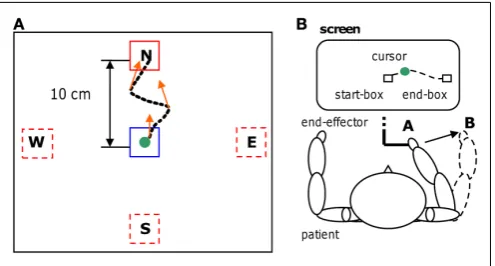
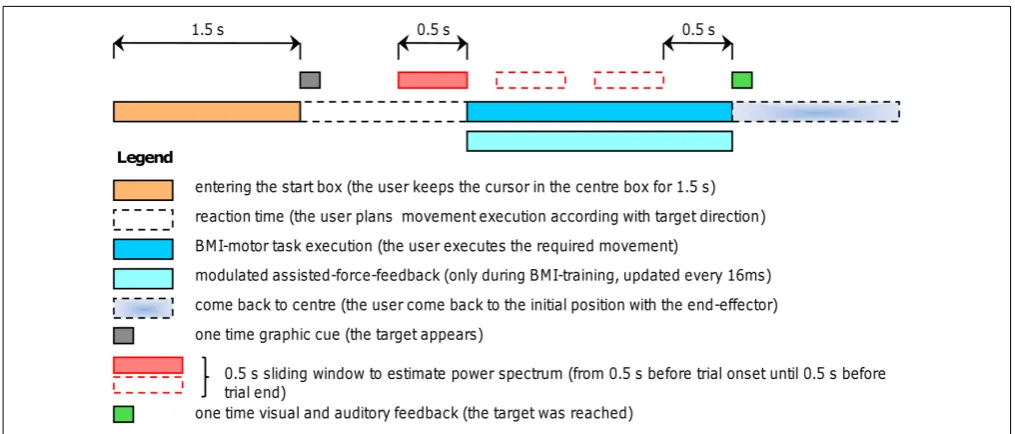
[image:4.595.304.552.62.195.2]A robotic device (PHANTOM Premium 3.0/6DOF, Sensable Technologies) was used to supply assisted-force-feedback propor-tional to event-related de-synchronization which was obtained using the BCI2000 platform [(31); www.bci2000.org]. Since the exercises required a volitional motor output we used oscillatory brain activity changes denoted here as movement-related de-synchronization (MRD). The EEG was recorded using 16 Ag/AgCl scalp electrodes located over fronto-central, central, and centro-parietal areas, according to the International 10–20 System (Fz, Cz, Fc1, Fc2, F3, F4, Fc5, Fc6, C3, C4, Cp1, Cp2, Cp5, Cp6, P3, P4), with a sampling rate of 512 Hz, and two pre-conditioning filters: a band-pass from 0.1 up to 60 Hz and a 50 Hz notch (gUSBAmp, g.tec GmbH). The robotic device allowed recording kinematic parameters of the movement (position and speed) every 1 ms. The experimental protocol consisted of a series of standard target-reaching tasks over a horizontal plane. The patient was seated comfortably in front of a table covered with a slippery surface and was asked to hold the robotic device stylus (i.e., the end-effector) and to focus on the computer screen. The position of the end-effector was always displayed as a cursor (diameter correspondent to 9 mm, cursor’s trajectories were never displayed) on the screen. During the repetitive task, the patient grasped the stylus device and controlled the position of the cursor on the screen receiving visuospatial (watching the cursor) and proprioceptive muscular force (contracting and moving the muscles) feedback. The patient underwent self-paced four targets “center-out” task: one out of four (N, E, S, and W) target positions was randomly selected in each trial for the ME (seeFigure 1). Each target was represented by a white square of 18 mm. After an anticipation period of 1.5 s with the cursor in the center box (18 mm) a target appeared. The patient was asked to move the cursor, controlling the end-effector from the center to the target in a pre-defined time window (0.5÷0.7 s) and to perform the task as accurate as possible (seeFigures 1and2). This interval was chosen on the basis of Fitts’ law, reviewed for the two-dimensional tasks by Scott MacKenzie and Buxton (32). A coherent visual and auditory feedback was provided at the end of each movement depending on its duration: the target exploded with a sound, if the duration of movement was between 0.5 and 0.7 s (i.e., “correct” trial); the target became red if the duration was below 0.5 s or it became blue if the duration was longer than 0.7 s. As soon as the target was reached, the patient was asked to move back to the center box and to repeat the task. The center-target distance was 10 cm (visual angle equal to 8°). A single run comprised 80 movements (20 trials for each direction). Before starting each run, a 40 s rest period was recorded while patients’ arms rested on the table. Triggers were saved on EEG traces to distinguish rest and movement conditions. A session consisted of three runs. During training on-line assisted-force-feedback was provided in each trial depending on brain activity changes as explained below (see On-line BMI Assisted-Force-Feedback).
FIGURE 1 | Motor-training. Four targets “center-out” task(A)with an example of a trajectory and some assisted-force-feedback vectors (orange arrows); physical representation(B)of the reaching task. The trajectory is shown for clarity, but during the motor task was never present.
Summarizing, during training the patient received also a mod-ulated assisted-force-feedback perceived haptically as a force supporting ME.
BMI PROTOCOL
The robot training was performed on both healthy and paretic arms in daily sessions during 2 weeks, 3 days a week, resulting in 18 runs for each arm (seeFigure 3). Overall treatment duration was adapted to the hospitalization interval of the examined patient. A pre-evaluation session without assisted-force-feedback was per-formed 2 days before BMI-training on both arms of the patient as baseline assessment. An identical post-evaluation session was car-ried out without assisted-force-feedback as final assessment 2 days after the last BMI-training session. The “center-out” reaching task was employed during the robot training as well as in pre- and post-evaluations. A similar study (19) which exploited the same robot assistive device used here, but in an open-loop modality, reported results difficult to compare because of different types of exercise and measured outcome. For this reason we chose to use the unaffected arm of the same patient as control condition.
EEG OFF-LINE DATA PROCESSING
FIGURE 2 | Experimental procedure. Timing of self-paced trials with and without assisted-force-feedback (the force applied to the robotic arm was continuously updated every 16 ms). A self-paced trials starts by entering the center box, after 1.5 s a target appears (one out of four possible directions), thus the user plans the movement execution and initiates the movement
[image:5.595.45.558.473.635.2]toward the target; as soon as the target was reached (i.e., at the end of the trial) both visual and auditory feedback inform the user about the task completion; then the user comes back to the center position to start another trial. During BMI-training an assisted-force-feedback was provided according to the algorithm explained in Section “On-Line BMI Assisted-Force-Feedback.”
FIGURE 3 | Experimental protocol. Interval between blocks consisted of 2 days.
Table 1 | “Correct” trials kinematic outcome.
Categories Description Healthy arm Affected arm
Pre-evaluation (N=134) Mean (STD)
Post-evaluation (N=201) Mean (STD)
Statistics Pre-evaluation (N=93) Mean (STD)
Post-evaluation (N=122) Mean (STD)
Statistics
p-Value p-Value
General behavior % Of “correct” trials 55.8 (16.3) 83.8 (6.5) 0.046*a 38.8 (14.2) 50.8 (8.3) 0.184a
Reaction time (ms) 380 (49) 417 (47) <0.001** 487 (460) 528 (75) <0.001**
Raw arm control Duration (ms) 604 (52) 604 (50) 0.959 590 (52) 610 (49) 0.008** Mean speed (mm/s) 159 (13) 157 (15) 0.331 161 (14) 155 (14) 0.005**
Fine-tuned distal arm control
Speed peak (mm/s) 275 (33) 226 (23) <0.001** 271 (40) 234 (29) <0.001** Orthog. error (mm) 5.2 (2.3) 4.5 (1.8) 0.003** 6.9 (3.4) 4.7 (2.2) <0.001** Area error (mm2) 15.1 (15.6) 11.0 (11.9) 0.021* 22.1 (28.1) 10.8 (12.2) <0.001**
Statistics were performed by means of Wilcoxon test, except for the percentage of “correct” trials for which we used the Kruskal–Wallis testa
. Significance level: *p<0.05, **p<0.01.
replicate the on-line settings (seeFigure 2), and ended 0.5 s before a valid interval offset. All power spectrum estimates within the same valid interval were averaged. In this way we estimated, in
the frequency analysis provided spectral power estimates subdi-vided in equally spaced bins starting from 0.5 up to 30.5 Hz with a bin width of 3 Hz. Spectral features distributions of the two condi-tions were then compared using the highest explained variance (R2
values) as reported in some studies (10,21,23,26). TheseR2values were successively used as criteria to select electrodes and frequency bands to provide feedback (see Feedback Sources Selection).
A cross-check method was used to verify spectral power decrease during a movement condition in pre- and post-evaluations. For each valid trial of a run we estimated the movement-related de-synchronization of each electrode used for feedback as the fraction of spectral power decrease during a move-mentcondition interval in comparison to the mean spectral power of therestcondition of the same run. The following formula was used for each validmovementcondition trial (and for each selected electrode) of a single run:Pn=[Pi−Pr-mean]/Pr-mean(wherePiis
the power spectrum value of each validi-th trial in a run and
Pr-mean is the rest condition mean spectral power of the same
run). The main difference with respect to theR2values estimation relies on the fact that power spectral values were normalized con-sidering each single run separately. This normalization allowed a comparison of the movement-related de-synchronization across runs and specifically between pre- and post-evaluations.
FEEDBACK SOURCES SELECTION
Consistent with previous studies’ findings on event-related de-synchronization and motor tasks (33,34), we selected electrode locations and frequency bins more related to a motor execu-tion task than to a MI task. Therefore we: (i) preferred regions where cortical activities were correlated with the requested motor-task and its proprioception [proprioceptive afferent inputs could enhance the possibility to distinguish the movement condition; (21–23)], (ii) selected electrodes and frequency bins yielding high-est and significant explained variance (R2) between rest and
movementconditions of pre-evaluation sessions performed by the same patient before the training [without assisted-force-feedback; (21, 23, 24, 26)], (iii) chose frequency bins closely related to SMR activity and to avoid electromyographic artifacts (33,34), (iv) used contralateral EEG electrodes, to constrain selection on ipsilesional brain areas (for the paretic arm) and contralesional brain areas for the left-healthy arm (to ensure almost equal con-trol conditions for arms comparison). Therefore, we chose for the BMI-feedback electrodes over the primary motor cortex (M1), pri-mary somatosensory cortex, and secondary somatosensory cortex. For the right-affected arm we used EEG power at 14–17 Hz and electrode locations C3, Cp1, P3, Cp5, while for left-healthy arm we used EEG power at 11–14 Hz and electrode locations C4, Cp2, P4, Cp6. This configuration remained unchanged during on-line feedback BMI-training (seeFigure 3).
ON-LINE BMI ASSISTED-FORCE-FEEDBACK
For each arm power spectral components of selected frequency bins and channels were used as input of the standard linear clas-sifier implemented by BCI2000 platform. Hence, the specified spectral components were linearly combined with equal weights of −1. The result was normalized (zero mean, unit variance, a standard operation computed by BCI2000 software) with respect
to the rest period of each training run to adaptively take into account changes in the shape ofrest period power spectral distri-bution across runs (21,23,26). We defined this normalized result as theneuro-feedback(NFB) value. A power spectrum decrease of selected locations and frequencies was reflected by positive values of NFB (since we used negative weights for the classifier). The
NFBvalue was updated on-line every four samples (see EEG Off-Line Data Processing) as soon as the patient started the movement alone and for the total duration of task execution. In this way a continuous updating of the force to be applied to the robotic arm (to aid patient movement) was possible. If a positiveNFB
value was detected at movement onset, this can be attributed to movement planning phase (i.e., intention to move toward the target), because the analysis window used to compute theNFB
value started 0.5 s before this time-instant; successiveNFBvalues referred to either intention to move and/or ME. When the tar-get was reached and during the (back-) path to the center box the assisted-force-feedback was disabled. Using pre-evaluation data of the patient, we separatedrestandmovementspectral power distri-butions optimizing a thresholdT (equal to 0.5 for both arms) in terms of rest condition distribution standard errors (i.e., Stan-dard Deviation). The threshold value T was used to compute the assisted-force-feedback factor as follows (i.e., the coefficient used to compute the assisting force module, denoted asAFF):
AFF=NFB-T. This operation ensured the activation of the
assist-ing force when at least a minimum necessary movement-related de-synchronization occurred (i.e., a deviation of at least 0.5×STD of the de-synchronization from the mean of the power spectrum distribution at rest). The assisting force factor was used during a trial to compute the force assistance with the following rules: (i) no force in absence of selected frequency bands and elec-trodes power decrease (AFF≤0); (ii) a force proportional to the movement-related de-synchronization, using the assisting force factor as linear coefficient (AFF>0), always directed to the target (target directed force:TDF=AFF·C, were the constantCwas sep-arately determined for the two arms, see Control of the Robotic Device); (iii) the force module was limited to the maximum force constraint of 10 N, independently of further assisting force factor increase; (iv) the force module was continuously updated dur-ing a trial every 16 ms (SampleBlockSize=4 combined with a 1000 Hz robotic device servo-loop rate; every two sample blocks the assisting force factor was updated). The target directed assist-ing force was applied to the end-effector of the robotic device. Summarizing, an additional force always directed to the target was provided during training runs every time the patient pro-duced a relevant movement-related de-synchronization intending and executing the movement (3), thus exploiting a smooth and modulated assistive-strategy (14).
CONTROL OF THE ROBOTIC DEVICE
the cursor position and scheduling each trial phase according to the timing of the task (seeFigure 2). During an on-line session the robotic interface sends the task execution status (rest condition, target appearing, trial start, and target reached) to BCI2000, while BCI2000 transfers theNFB value to the robotic interface every sample block. The latter drives the robotic arm updating the force to be supplied to the end-effector. This is accomplished calculat-ing the assisted-force-feedback factor accordcalculat-ing to the previously explained algorithm (see On-Line BMI Assisted-Force-Feedback) and determining the direction of the force depending on the actual cursor position. For the two arms we used two different constant factorsC to evaluate the module of the assisting force based on mean maximum movement-related de-synchronization estimated through pre-evaluation runs data (left-healthy arm:Ch=7.0 N;
right-affected arm:Ca=3.8 N). Crisp changes of force feedback
were avoided by adjusting internal robotic device parameters. Dur-ing a run, the end-effector trajectory and instantaneous speed time-courses of each trial were recorded. Trial duration and mean speed mainly refers to the raw arm control for which the patient received the mixed visual and auditory feedback at the end of a trial. The ME accuracy is estimated by means of two trajectory-related parameters: orthogonal error and area error (fine-tuned distal arm control, for which the patient did not receive any feed-back). These two measures refer to the trajectory error using as an ideal path the (invisible) segment that joins center box and tar-get box: orthogonal error is the maximum orthogonal trajectory displacement with respect to the ideal path; area error is the mea-sure of the area comprised between real trajectory and ideal path. These data allowed a comprehensive description of the kinematic performance as explained in the Section “Kinematic Outcome.”
STATISTICAL ANALYSIS
The statistical analysis compared conditions (restandmovement) and pre- and post-evaluation estimates and outcomes. Wilcoxon rank-sum test was applied for trials comparison. To compare the percentage of successfully completed trials within a run (i.e., “cor-rect” trials) we employed the Kruskal–Wallis test since assumption criteria to apply more advanced statistics were violated (we had only one value per run resulting in three “correct” trials per-centage values for both pre- and post-evaluations). Feedback and kinematic relationship during training were assessed by Spearman correlation.
RESULTS
NEUROPHYSIOLOGICAL DATA
Selected frequency bands power spectral components ofrestand
movement conditions were compared by their explained variance
R2 values across electrodes, which resulted in a series of maps describing the topographic evolution of the relevant cortical activ-ities starting from pre-evaluation assessment to final assessment
(seeFigure 4).
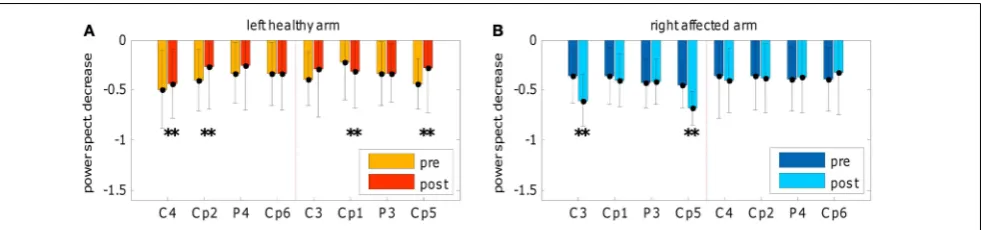
The topographic evolution consists of a focalization (i.e., reduction of the extent) of the brain areas that discriminate the two conditions. This process occurred during the treatment and was confirmed in the post-sessions by a significant SMR de-synchronization difference between pre- and post-evaluation of both hemispheres (see Figure 5). For the affected arm, the
focus of increased de-synchronization was mainly located in the ipsilesional hemisphere (seeFigure 5B), while at the healthy hemi-sphere a significant decrease of the de-synchronization occurred
(see Figure 5A), probably reflecting a pre-post habituation
effect.
Due to the classification algorithm (i.e., negative weights) and variance-normalization we expected for theNFBvariable a mean value around zero atrest and a positive value during the
movements (reflecting a movement-related de-synchronization).
Figure 6 confirms this expectation with regard to the healthy
arm: a significant distinction between movement and rest con-ditions during the training and the post-session can be noted. Differently, for the affected arm a significant movement-related de-synchronization can be observed in the second week of the training only, as well as in the post-session; while during the first week of training this neurophysiological change was not visible since we obtained on average a negativeNFBvalue (i.e., synchronization).
BEHAVIORAL OUTCOME DURING BMI-TRAINING
Consistently with the required motor-task we focused the atten-tion on correct trials percentage and the presence of the assisted-force feedback during training. Considering the healthy arm, the patient received an assisted-force-feedback in 67.4% of training trials only, with a mean force of 1.64±1.49 N (mean force peak of 2.68±2.24 N); in 72.7% of the total training trials she
suc-cessfully completed the task reaching the target between 0.5 and 0.7 s; in remaining trials she was too fast or too slow. During training of the healthy arm there were no significant relation-ship between the number of correct trials and the presence of the feedback (no. of correct trials vs. no. of all trials with feedback:
r= −0.33,p=0.181; no. of correct trials vs. no. of only correct
trials with feedback:r= −0.01, p=0.968); similarly, the mean force peak and the number of only correct trials with feedback showed a non-significant correlation (r=0.12;p=0.644). With regard to the affected arm, the patient received an assisted-force-feedback in 58.1% of training trials only, with a mean force of 0.88±0.9 N (mean force peak of 1.57±1.24 N); only in 35.6% of the total training trials she successfully completed the task. Dif-ferently from the healthy arm, during training of the affected arm there were significant relationship between the number of correct trials and the presence of the feedback (no. of correct trials vs. no. of all trials with feedback:r=0.66;p<0.01; no. of correct trials
vs. no. of only correct trials with feedback:r=0.75;p<0.001); in line with these results, the mean force peak and the number of only correct trials with feedback showed a significant correlation (r=0.73;p<0.001).
KINEMATIC OUTCOME
FIGURE 4 | Brain oscillations before and after training.R2maps of the
two conditions across training (restandmovement); “pre” refers to pre-evaluation, “tr” refers to training, “post” refers to post-evaluation, “wk” refers to week (1 or 2), “R” refers to the right-hemiplegic arm, and “L” refers to the left-healthy arm.R2values were evaluated between the
two conditions with a variable number of trials depending on protocol phase and trials rejection percentage. TopR2maps show spatial
distribution related to the frequency bin 14÷17 Hz identified for the right-affected arm using pre-evaluation data (number of trialsN: pre-R,
N=221; tr-R wk1,N=659; tr-R wk2,N=501; post-R,N=215). Bottom
R2
maps show spatial distribution related to the frequency bin 11÷14 Hz identified for the left-unaffected arm using pre-evaluation data (number of trialsN: pre-L,N=216; tr-L wk1,N=662; tr-L wk2,N=515; post-L,
N=230).
FIGURE 5 | Spectral power decrease. Comparison of spectral power decrease duringmovementexecution between pre- and post-evaluations.
(A)Frequency bin from 11 to 14 Hz for left-healthy arm and(B)frequency bin from 14 to 17 Hz for the right-affected arm. The graphs depict the
movement-related de-synchronization as the fraction of spectral power decrease during amovementcondition interval in comparison to the mean spectral power of therestcondition (of the same run); for each electrode mean and standard deviation was represented. The normalization to the mean
spectral power of therestcondition allows a comparison between pre- and post-evaluations by means of Wilcoxon test (for the number of pre- and post-evaluations trials seeFigure 4description). Electrodes showing the largest effects are slightly different than those showed inFigure 4because the normalized computation is different fromR2estimation (see the
cross-check method explained in Section “EEG Off-Line Data Processing”). In addition, significant changes of power decrease referred to the comparison between pre- and post-evaluations.
behavior); duration, mean speed (raw arm control); speed peak, orthogonal error, and area error (fine-tuned distal arm control).
For the left-healthy arm, only changes related to fine-tuned distal arm control (i.e., spatial accuracy) showed a significant improvement, while reaction time appeared significantly slower in the post-session. Conversely, regarding the right-affected arm we observed a generalized improvement including the spatial accu-racy. As for the healthy arm, reaction time was slower in the post-evaluation. The increase of reaction time should be exam-ined together with the other kinematic results (see Discussion). Kinematic and behavioral effects resulted in an enhanced accuracy of the ME.
Task-related spatial accuracy was compared between arms by means of orthogonal error and area error changes nor-malizing post-session data with mean results of pre-evaluation data. Each post-session “correct” trial value, for both orthogo-nal error and area error variables, was normalized as a fraction [Vn=(Vpost-Mpre)/Mpre, whereVpost is the value of the
con-sidered variable in each “correct” post-session trial and Mpre
[image:8.595.59.550.354.469.2]higher than unaffected arm (post-evaluation “correct” trials:
Nhealthy=201, Naffected=122; orthogonal error change
frac-tion,OE:OEhealthy= −0.14,OEaffected= −0.32,p<0.00001; area
error change fraction,AE:AEhealthy= −0.27,AEaffected= −0.51,
p<0.00001).
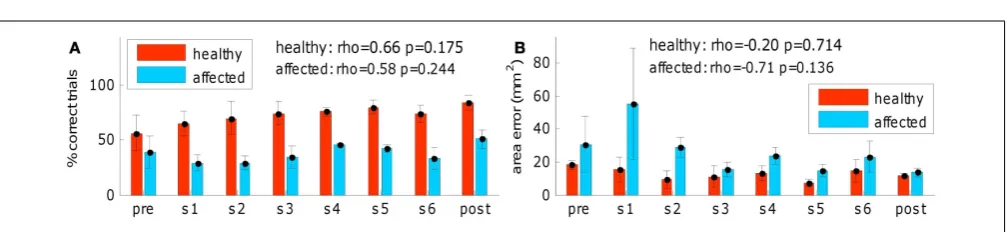
Finally, a session-by-session analysis of the training process
(see Figure 7) revealed that no sudden changes throughout
the training sessions occurred, on the other hand a gradual improvement can be observed.Figure 7shows, session-by-session, the trend of two main parameters across the training and in pre- and post-evaluations. The gradual enhancement is partially confirmed by the comparison (using Wilcoxon test) of most important kinematic parameters between the 2 weeks of train-ing (% “correct” trials: phealthy=0.197, paffected=0.023;
dura-tion:phealthy=1.0, paffected=0.05; mean speed:phealthy=0.031,
paffected=0.436; speed peak: phealthy=0.019, paffected=0.73;
orthogonal error: phealthy=0.666, paffected=0.161; area error:
phealthy=0.931,paffected=0.258).
DISCUSSION
In this study a new closed-loop BMI-application with assisted-force-feedback is described in a proof-of-principle prototypi-cal demonstration. BMI-training was delivered to both arms of a patient with unilateral chronic brain injury for 2 weeks. This feedback was continuously modulated during a reaching
movement task driven by rolandic rhythm oscillations. Neuro-physiological and kinematic evidences reported here are strictly related to the repetition of the motor-task and the presence of the assisted-force-feedback: the patient was asked to move the cur-sor, controlling the end-effector from the center to the target in a pre-defined time window (0.5÷0.7 s) and to perform the task as accurate as possible. Since one single case is presented without control conditions, except the evaluation of the unaffected arm, the interpretation of the neurophysiological and kinematic evi-dences reported here is limited. Results are described as systematic observations only and the design of proper control conditions is discussed below.
[image:9.595.45.552.359.478.2]Neurophysiological correlates showed an increase and focaliza-tion of the sensori-motor cortical activity used to control the BMI. A significant increase of selected SMR changes was found, particu-larly in the second part of the treatment and in the post-evaluation. In line with previous findings, these SMR changes reflect an increased de-synchronization during motor-training (11). The lack of an increased de-synchronization during right-affected arm exercises in the first week of the training could be explained with at least three factors: (i) motor-task execution may be too fast (i.e., about 600 ms) to induce a noticeable movement-related de-synchronization (most likely we observed only the onset of SMR de-synchronization); (ii) in some cases the assisted-force-feedback reached large values interfering with the assistive-strategy and
FIGURE 6 | Neuro-feedback.Neuro-feedbackevolution across training and in pre- and post-evaluations:(A)left-healthy arm and(B)right-affected arm. The
neuro-feedbackwas obtained linearly combining power spectral components of selected electrodes and normalizing (zero mean, unit variance) with respect to therestperiod of each training run;y-axis is represented in terms
ofrestcondition standard errors (off-line corrected, without artifacts). Positive values ofneuro-feedbackreflected a movement-related de-synchronization; “pre” refers to pre-evaluation, “tr” refers to training, “post” refers to post-evaluation, “wk” refers to week (1 or 2). Wilcoxon test was applied betweenrestandmovementconditions only.
FIGURE 7 | Training process outcome.(A)Successful task completion (general behavior) and(B)area error (fine-tuned distal arm control) across the training and in pre- and post-evaluations (red for left-healthy arm, light blue for right-affected arm). “pre” refers to pre-evaluation and “post” refers to post-evaluation. “s1,” “s2,” “s3,”
[image:9.595.47.551.542.658.2]distracting the patient during ME; (iii) threshold selection to pro-vide feedback should be accurately selected in order to teach the patient more distinctively how to complete the task successfully. In addition, such neurophysiological patterns could be more specifi-cally described using high density EEG recording. The focalization phenomenon was confirmed for movements executed with the right-affected arm in the post-evaluation (without assisted-force-feedback) and was associated with a significant increase of the SMR de-synchronization in two ipsilesional sites (C3 and Cp5) without significant effects on contralesional locations. Differently, we observed for movements executed with unaffected left arm a bilateral focalization. In the ipsilesional hemisphere two sites showed opposite behaviors: in Cp1 we observed an increased SMR synchronization, while in Cp5 we noted a decreased SMR de-synchronization. In the contralesional hemisphere a decreased SMR de-synchronization could be noted in C4 and Cp2 sites. The bilateral focalization seems to be related to the complexity of the task and involved brain areas: body spatial representation, target representation, visuomotor integration of target selection and movement selection (i.e., movement planning) and inter-hemispheric inhibition are parallel processes that involve parietal to frontal areas in both hemispheres during a reaching movement (35–38). However, the focalization suggests also successive reduc-tion of resources and a progressive automareduc-tion of the involved processes accompanied by sequential elimination of processing resources outside the sensory-motor areas.
The focalization covaried with improved kinematic spatial accuracy control. Analyzing behavioral and kinematic outcomes related to “correct” trials we observed a significant improvement of the fine-tuned distal control in both arms, mainly measured by spatial movement’s accuracy (i.e., orthogonal and area errors significantly decreased). Raw arm control showed a significant improvement in right-affected arm only; in particular, we observed a significant slowing. Behavior related to the motor-task was characterized by a significant increase of reaction time which appeared slower in the post-assessment for both arms. This effect is associated to a slightly prolonged movement planning phase, with enhanced accuracy of the ME (39,40). Considering all these effects, during the BMI-training the patient improved her skill. As a con-sequence, in the post-evaluation we observed for the right-affected arm a prolonged movement planning (increased reaction time), slowing, a significant reduction of the spatial errors and an upward trend of “correct” trials. The first two effects (the extended move-ment planning and the slowing) allowed the patient to complete the task more often “correctly” than in pre-evaluation and more accurately. In addition, a direct comparison between arms shows that affected arm task-related spatial accuracy improvement was significantly higher than the unaffected arm. Although the gradual improvement on percentage of “correct” trials was non-significant for the affected arm, during the training a positive, strong, and significant relationship between this behavioral parameter and the assisting force provided to the patient was found, indicating the close association betweenneuro-feedbackand behavioral per-formance. During the training of the unaffected arm a gradual improvement of the successful task completion was observed, but we did not find the same positive and significant relationship as in the affected arm. This could be explained by two inter-related
factors: a higher mean and peak value of the force applied dur-ing traindur-ing preventdur-ing correct movements and a ceildur-ing effect on the number of “correct” trials due to the unaltered and precise motor-task execution.
The neurophysiological and motor-behavioral kinematic results might be associated with two fundamental determinants characterizing the BMI-training: the repetition of the task (with visual and acoustic feedback at the end of each trial) and the presence of the closed-loop assisted-force-feedback. Regardless of the positive evidence observed in this application, we are unable to separate these two factors and draw consistent conclusions about the effectiveness of this novel methodology. To this pur-pose proper control conditions should be designed. The main aim of such a control is to assess the effectiveness of this BMI-system in terms of motor-behavioral and functional recovery. As suggested by Ramos-Murguialday et al. (23), one possibility is to design a study where three groups are involved in the same training, each one receiving a different assisted-force-feedback contingency. The group A should receive a contingent feedback linked to SMR de-synchronization. The group B should receive a contingent feed-back coupled with SMR-synchronization. While the third group should receive sham feedback [independent from brain activity (23,24)]. A comparison of the three groups might supply evidence of the feedback modalities effectiveness, together with a systematic evaluation of the performance related to the duration of the train-ing. In addition, follow-up measurements should be planned in order to verify whether learned motor skills are maintained over time (18). Another control condition could be a group of stroke patients trained with the same system in an open-loop modality with a pre-defined control of the force-field assistance and without brain activity involvement as reported in (19).
Another relevant aspect of the training design is the amount of the assisting force received by the patients because it strongly depends on their residual motor abilities. As the extent of motion increases patients should receive less assistance or even an opposing force. An exemplary case is reported by Fasoli et al. (18) where two types of goal-directed robotic therapies (assisted and progressive-resistive exercises) were delivered, without the BMI, to patients with different clinical conditions. Considering that motor abilities (i.e., functional recovery) can improve during a training protocol, future studies should take into account the overall duration (roughly short-term or long-term treatments). In a BMI context, this suggests that the amount and/or the sign of the robot assistance should be adapted to both the activation of the selected patterns to provide the feedback and to the dura-tion of the training, or else, the motor abilities recovered by the patients. These observations can lead to different choices of the experimental setting (i.e., changing the sign of the proportional rule used to provide force assistance or to generate an opposing force), that in turn address and limit the study design, patients’ inclusion criteria, and definition of proper controls.
support, range of motion measurement, strength of the provided force assistance). In future studies cost-benefit ratio parameters in the evaluation of the proposed rehabilitation treatment and its effectiveness should be included. This encompasses a quanti-tative definition of the target population and a comparison with standardized and widely used rehabilitation interventions.
Finally, the presented BMI strategy approaches daily living movements more closely compared with delayed haptic feedback BMI-applications because ME is closely related to enhanced pro-prioception (41). This assisted-force-feedback BMI-application is designed for motor impaired patients with residual move-ments (29) and might open new possibilities in terms of robotic-rehabilitation.
CONCLUSION
This study describes a BMI-based training with closed-loop continuous muscular assisted-force-feedback. Neurophysiological findings and kinematic/behavioral results, reported for a proto-typical case, provide time-limited beneficial evidence for both the repetition of the task and the presence of the closed-loop assis-tance. This novel application might be useful to examine in depth neurophysiological phenomena and learning mechanisms under-lying re-learning of specific motor behaviors. A proper controlled design is necessary to evaluate feedback modality effectiveness. Future robot-mediated rehabilitation protocols could be designed following this new learning strategy that allows to add sensory and proprioceptive information to the closed-loop motor-training.
ACKNOWLEDGMENTS
Supported by I.R.C.C.S. S.Camillo Hospital Foundation, Ital-ian Ministry of Health (Institutional research lines n.2 and n.6), Deutsche Forschungsgemeinschaft (DFG Bi 195/69-1), Euro-pean Research Council (ERC), Bernstein Center for Computa-tional Neuroscience, German Ministry of Education and Research (BMBF 01GQ0831), Baden-Württemberg Stiftung. We are grate-ful to the contribution of Jürgen Mellinger and Ernesto Soares in developing the BMI-system.
REFERENCES
1. Birbaumer N, Cohen LG. Brain-computer interfaces: communication and restoration of movement in paralysis.J Physiol(2007)579:621–36. doi:10.1113/ jphysiol.2006.125633
2. Daly JJ, Wolpaw JR. Brain-computer interfaces in neurological rehabilitation.
Lancet Neurol(2008)7:1032–43. doi:10.1016/S1474-4422(08)70223-0 3. Dimyan MA, Cohen LG. Neuroplasticity in the context of motor rehabilitation
after stroke.Nat Rev Neurol(2011)7:76–85. doi:10.1038/nrneurol.2010.200 4. Grosse-Wentrup M, Mattia D, Oweiss K. Using brain-computer interfaces to
induce neural plasticity and restore function.J Neural Eng(2011)8:025004. doi:10.1088/1741-2560/8/2/025004
5. Hogan N, Krebs HI. Physically interactive robotic technology for neuromo-tor rehabilitation.Prog Brain Res(2011)192:59–68. doi:10.1016/B978-0-444-53355-5.00004-X
6. Piron L, Turolla A, Agostini M, Zucconi CS, Ventura L, Tonin P, et al. Motor learning principles for rehabilitation: a pilot randomized controlled study in poststroke patients.Neurorehabil Neural Repair(2010)24:501–8. doi:10.1177/ 1545968310362672
7. Laver KE, George S, Thomas S, Deutsch JE, Crotty M. Virtual reality for stroke rehabilitation. Cochrane Database Syst Rev (2011) 2011:CD008349. doi:10.1002/14651858.CD008349.pub2
8. Finley MA, Fasoli SE, Dipietro L, Ohlhoff J, Macclellan L, Meister C, et al. Short-duration robotic therapy in stroke patients with severe upper-limb motor
impairment.J Rehabil Res Dev(2005)42:683–92. doi:10.1682/JRRD.2004.12. 0153
9. Hochberg LR, Serruya MD, Friehs GM, Mukand JA, Saleh M, Caplan AH, et al. Neuronal ensemble control of prosthetic devices by a human with tetraplegia.
Nature(2006)442:164–71. doi:10.1038/nature04970
10. Buch E, Weber C, Cohen LG, Braun C, Dimyan MA, Ard T, et al. Think to move: a neuromagnetic brain-computer interface (BCI) system for chronic stroke.Stroke
(2008)39:910–7. doi:10.1161/STROKEAHA.107.505313
11. Broetz D, Braun C, Weber C, Soekadar SR, Caria A, Birbaumer N. Combina-tion of brain-computer interface training and goal-directed physical therapy in chronic stroke: a case report.Neurorehabil Neural Repair(2010)24:674–9. doi:10.1177/1545968310368683
12. Lo AC, Guarino PD, Richards LG, Haselkorn JK, Wittenberg GF, Federman DG, et al. Robot-assisted therapy for long-term upper-limb impairment after stroke.
N Engl J Med(2010)362:1772–83. doi:10.1056/NEJMoa0911341
13. Tarkka IM, Pitkänen K, Popovic DB, Vanninen R, Könönen M. Functional elec-trical therapy for hemiparesis alleviates disability and enhances neuroplasticity.
Tohoku J Exp Med(2011)225:71–6. doi:10.1620/tjem.225.71
14. Casadio M, Morasso P, Sanguineti V, Giannoni P. Minimally assistive robot training for proprioception enhancement.Exp Brain Res(2009)194:219–31. doi:10.1007/s00221-008-1680-6
15. Belda-Lois JM, Mena-del Horno S, Bermejo-Bosch I, Moreno JC, Pons JL, Farina D, et al. Rehabilitation of gait after stroke: a review towards a top-down approach.
J Neuroeng Rehabil(2011)8:66. doi:10.1186/1743-0003-8-66
16. Pomeroy V, Aglioti SM, Mark VW, McFarland D, Stinear C, Wolf SL, et al. Neu-rological principles and rehabilitation of action disorders: rehabilitation inter-ventions.Neurorehabil Neural Repair(2011)25(Suppl 5):33S–43S. doi:10.1177/ 1545968311410942
17. Wade E, Winstein CJ. Virtual reality and robotics for stroke rehabilitation: where do we go from here?Top Stroke Rehabil(2011)18:685–700. doi:10.1310/tsr1806-685
18. Fasoli SE, Krebs HI, Stein J, Frontera WR, Hughes R, Hogan N. Robotic therapy for chronic motor impairments after stroke: follow-up results.Arch Phys Med Rehabil(2004)85:1106–11. doi:10.1016/j.apmr.2003.11.028
19. Abdollahi F, Case Lazarro ED, Listenberger M, Kenyon RV, Kovic M, Bogey RA, et al. Error augmentation enhancing arm recovery in individuals with chronic stroke: a randomized crossover design.Neurorehabil Neural Repair (2013). doi:10.1177/1545968313498649. [Epub ahead of print].
20. Cameirão MS, Badia SB, Duarte E, Frisoli A, Verschure PF. The combined impact of virtual reality neurorehabilitation and its interfaces on upper extrem-ity functional recovery in patients with chronic stroke.Stroke(2012)43:2720–8. doi:10.1161/STROKEAHA.112.653196
21. Ramos-Murguialday A, Halder S, Birbaumer N. Propioceptive feedback in BCI.
Proceedings of NER’09 4th International IEEE EMBS Conference on Neural Engi-neering; 2009 Apr 29–May 2; Antalya (2009). p. 279–82. doi:10.1109/NER.2009. 5109287
22. Gomez-Rodriguez M, Peters J, Hill J, Schölkopf B, Gharabaghi A, Grosse-Wentrup M. Closing the sensorimotor loop: haptic feedback facilitates decoding of motor imagery.J Neural Eng(2011)8:036005. doi:10.1088/1741-2560/8/3/ 036005
23. Ramos-Murguialday A, Schürholz M, Caggiano V, Wilgrüber M, Caria A, Hammer EM, et al. Proprioceptive feedback and brain computer interface (BCI) based neuroprostheses.PLos One(2012)7:e47048. doi:10.1371/journal.pone. 0047048
24. Ramos-Murguialday A, Broetz D, Rea M, Läer L, Yilmaz O, Brasil FL, et al. Brain-machine-interface in chronic stroke rehabilitation: a controlled study.
Ann Neurol(2013)74:100–8. doi:10.1002/ana.23879
25. Pichiorri F, De Vico Fallani F, Cincotti F, Babiloni F, Molinari M, Kleih SC, et al. Sensorimotor rhythm-based brain-computer interface training: the impact on motor cortical responsiveness.J Neural Eng (2011)8(2):025020. doi:10.1088/1741-2560/8/2/025020
26. Daly JJ, Cheng R, Rogers J, Litinas K, Hrovat K, Dohring M. Feasibility of a new application of noninvasive Brain Computer Interface (BCI): a case study of training for recovery of volitional motor control after stroke.J Neurol Phys Ther
(2009)33:203–11. doi:10.1097/NPT.0b013e3181c1fc0b
28. Niazi IK, Jiang N, Tiberghien O, Nielsen JF, Dremstrup K, Farina D. Detection of movement intention from single-trial movement-related cortical potentials.
J Neural Eng(2011)8:066009. doi:10.1088/1741-2560/8/6/066009
29. Silvoni S, Ramos-Murguialday A, Cavinato M, Volpato C, Cisotto G, Turolla A, et al. Brain-computer interface in stroke: a review of progress.Clin EEG Neurosci
(2011)42:245–52. doi:10.1177/155005941104200410
30. Dipietro L, Krebs HI, Fasoli SE,Volpe BT, Hogan N. Submovement changes char-acterize generalization of motor recovery after stroke.Cortex(2009)45:318–24. doi:10.1016/j.cortex.2008.02.008
31. Schalk G, McFarland DJ, Hinterberger T, Birbaumer N, Wolpaw JR. BCI2000: a general-purpose brain-computer interface (BCI) system.IEEE Trans Biomed Eng(2004)51:1034–43. doi:10.1109/TBME.2004.827072
32. Scott MacKenzie I, Buxton W. Extending Fitts’ law to two-dimensional tasks.
CHI 1992 Proceedings of the SIGCHI Conference on Human Factors in Computing Systems. New York: ACM (1992). p. 219–26. doi:10.1145/142750.142794 33. McFarland DJ, Miner LA, Vaughan TM, Wolpaw JR. Mu and beta rhythm
topographies during motor imagery and actual movements.Brain Topogr(2000)
12:177–86. doi:10.1023/A:1023437823106
34. Labyt E, Szurhaj W, Bourriez JL, Cassim F, Defebvre L, Destée A, et al. Changes in oscillatory cortical activity related to a visuomotor task in young and elderly healthy subjects.Clin Neurophysiol(2003)114:1153–66. doi:10.1016/S1388-2457(03)00058-0
35. Kim DH, Cruse H. Two kinds of body representation are used to control hand movements following tactile stimulation.Exp Brain Res(2001)139:76–91. doi:10.1007/s002210100741
36. Mirabella G, Pani P, Paré M, Ferraina S. Inhibitory control of reaching move-ments in humans.Exp Brain Res(2006)174:240–55. doi:10.1007/s00221-006-0456-0
37. Naranjo JR, Brovelli A, Longo R, Budai R, Kristeva R, Battaglini PP. EEG dynamics of the frontoparietal network during reaching preparation in humans.Neuroimage(2007)34:1673–82. doi:10.1016/j.neuroimage.2006.07. 049
38. Perfetti B, Moisello C, Landsness EC, Kvint S, Pruski A, Onofrj M, et al. Temporal evolution of oscillatory activity predicts performance in a choice-reaction time reaching task.J Neurophysiol(2011)105:18–27. doi:10.1152/jn.00778.2010 39. Klatzky RL, Fikes TG, Pellegrino JW. Planning for hand shape and arm
transport when reaching for objects.Acta Psychol (Amst)(1995)88:209–32. doi:10.1016/0001-6918(93)E0068-D
40. Barthélémy S, Boulinguez P. Orienting visuospatial attention generates manual reaction time asymmetries in target detection and pointing.Behav Brain Res
(2002)133:109–16. doi:10.1016/S0166-4328(01)00446-6
41. Birbaumer N, Ramos-Murguialday A, Cohen L. Brain-computer inter-face in paralysis. Curr Opin Neurol (2008) 21:634–8. doi:10.1097/WCO. 0b013e328315ee2d
Conflict of Interest Statement:The authors declare that the research was conducted in the absence of any commercial or financial relationships that could be construed as a potential conflict of interest.
Received: 12 April 2013; accepted: 22 October 2013; published online: 07 November 2013.
Citation: Silvoni S, Cavinato M, Volpato C, Cisotto G, Genna C, Agostini M, Turolla A, Ramos-Murguialday A and Piccione F (2013) Kinematic and neurophysiological con-sequences of an assisted-force-feedback brain-machine interface training: a case study. Front. Neurol.4:173. doi: 10.3389/fneur.2013.00173
This article was submitted to Neuroprosthetics, a section of the journal Frontiers in Neurology.