RIT Scholar Works
Theses Thesis/Dissertation Collections
5-28-2015
A Study on the Social and the Environmental
Impacts of Bottled Water & A Design Solution to
Improve the User Experience of Reusable Water
Bottles
Chia-Wei Chang
Follow this and additional works at:http://scholarworks.rit.edu/theses
This Thesis is brought to you for free and open access by the Thesis/Dissertation Collections at RIT Scholar Works. It has been accepted for inclusion in Theses by an authorized administrator of RIT Scholar Works. For more information, please [email protected].
Recommended Citation
Impacts of Bottled Water & A Design Solution to Improve
the User Experience of Reusable Water Bottles
by
Chia-Wei Chang
A Thesis Submitted in Partial Fulfillment of the Requirements for
the Degree of the Master of Fine Arts in Industrial Design
School of Design
College of Imaging Arts and Sciences
Name: Degree: Title of Thesis:
Examining Committee:
Chia-Wei Chang
Master of Fine Arts in Industrial Design
A Study on the Social and the Environmental Impacts of Bottled Water & A Design Solution to Improve the User Experience of Reusable Water Bottles
Stan Rickel
Director of Industrial Design Graduate Program
Alex Lobos
Associate Professor
Don Arday Professor
The consumption of bottled water is likely to emerge as a global trend in the coming decades. The expansion of the bottled water industry and rapid growth of bottled water sales has caused serious concerns regarding the possible contamination of bottled water, the impact of its refuse on the environment, and the management of water resources. Some factors accelerating the sales and use of bottled water are complex and multifaceted and involve pollution, values, politics, water shortages, commercial behaviors, consumption behaviors, a widening disparity between the rich and poor within society, and the unfair distribution of resources. Any single solution is unlikely to alter the overall circumstances. However, some relevant issues may be altered or alleviated through individual effort, such as the habit of drinking bottled water. Based on the data collected through surveys and interviews, if the user experience of a reusable water bottle can be improved by increasing its portability, the consumers’ intention to use reusable water bottles will increase, resulting in encouragement of the habit of drinking tap water and a decrease in the reliance on bottled water. The more that people drink tap water, then the less that bottled water consumption will negatively affect the environment, society, and the public health.
Preface
5
I.
Problem :
Chapter
1
The
Effects
of
Bottled
Water 15
Chapter 2 The Global Obsession with Bottled Water
39
Chapter
3
Consumer
Behavior
Survey
53
II. Design Solution:
Chapter
4
The
Concept
Development
59
Chapter 5 Final Concept: The Ogee Soft Bottle
85
Preface
Like many other countries, my home city of Taipei, which is the capital of Taiwan, has been struggling with water pollution problems for a long time. Therefore, even though the authorities have declared that the tap water is examined strictly to ensure the safety and meet the drinking water standard, the public in Taiwan still do not trust the quality of tap water. I remember that when I was a child, boiling water was the most common way for most households to sterilize tap water. My mom usually put the kettle on the stove and waited until the water had boiled, and then she would open the lid and let the water simmer for at least 5 to 10 minutes to dissipate through evaporation any residual chlorine. According to a report from Taiwan’s Department of Environmental Sanitation & Toxic Substance Management, this method can reduce most chlorine and trihalomethanes (THMs) in tap water. Even today, many households in Taiwan still use this method to have low-priced, clean, and safe drinking water.1
After I graduated from high school, I decided to go to the United States to study abroad, and hence, I had the opportunity to have direct experience of handling recyclables in this country and to learn more about issues arising from consumption of bottled water. In 2002, I left Taiwan and moved to Los Angeles County, California. Unlike many households in Taiwan, I found that people in Los Angeles rarely purified water through boiling. Many households had installed water purification systems at home or used water filter pitchers such as the “Brita” pitcher; others would drink bottled water or buy distilled water from water stores. I was someone using the latter. Purchasing water from a water store was an interesting experience for me. I had not ever seen any water stores like this when I lived in Taipei. When I walked into a water store in Rowland Heights for the first time, I saw a variety of porcelain water dispensers and reusable water bottles were orderly placed on shelves along a long wall. Near the exit of the store, there was a counter. Behind the counter, there was a very large room with a large window. Through the window, I could see a huge water purification system which looked like several stainless steel barrels, machines connected together by thick tubes. The purified distilled water was dispensed from a tap on the side of the water purification machine. Customers could either bring their own bottles or buy empty bottles at the store to fill with distilled water. I bought a five gallon reusable bottle in that store which cost $24 dollars and paid another 75 cents to fill this bottle with distilled water. During the time I lived in Southern California, buying distilled water from a water store was a relatively convenient choice for me compared to drinking boiled water.
life. Every month I purchased a pack of twenty-four, 16.9 ounce bottles of water to take to school and another five, 1 gallon bottles of water for drinking at home. It goes without saying that a large number of empty plastic disposable bottles soon accumulated in my room and became overwhelming. In the community where I lived in the Bay Area, it was not required for residents to sort trash for recycling. Residents only needed to throw away all kinds of trash into garbage containers placed in a certain area. A garbage truck would come to empty those garbage containers every morning.
In Taiwan, we have built a well-developed recycling system. It is mandatory for every household to sort garbage into six different categories and recycle. Initially, the policy was only implemented in Taipei City on January 1st, 2005, and then it was implemented effective nationwide on January 1st, 2006. The garbage trucks routinely stop at specific times and spots, five days a week to collect recycling materials and garbage. Whenever a garbage truck arrives at a collection point, it comes with three to four attendants to guide residents to place garbage and recyclable materials into the correct containers. Offenders who violate the
Household Waste Pick-up Schedule in Taipei City
Category Description Pickup Schedule
Flat Recyclable Materials clothes, paper, film plastics, and clean plastic bags Mon & Fri
Solid Recyclable Materials bottles, containers, metal, tires, styrofoam, small electric appliances, and
used motor oil recycle Tue, Thu, and Sat
Electronic Waste batteries, disc, cell phone, and fluorescent tube Mon, Tue, Thu, Fri, and Sat
Cooked Food Scraps cooked food scraps will be processed to produce pig feed Mon, Tue, Thu, Fri, and Sat
Raw Food Scraps raw food scraps will be processed to produce organic fertilizer Mon, Tue, Thu, Fri, and Sat
recycling regulations and refuse to do recycling and/or garbage classification can be fined from TWD$1200 to $6000 (or roughly USD$40 to $200). The government has also promoted a policy called “Keeping Trash off The Ground,” which means that residents are not allowed to leave garbage on the ground and have to hold it while waiting for garbage trucks to pick up. These policies did draw criticism initially but ultimately gained support from the public and successfully increased the recycling rate. In 2011, the overall recycling rate in Taiwan already reached 48.8% which is higher than the United States, the United Kingdom, Japan, and other industrialized nations.2
Unfortunately, there was not a comprehensive recycling system like the one in Taiwan when I lived in the Bay Area. In order to deal with the massive amount of plastic waste, I found an El Cerrito Recycling Center, which was about one mile away from my residence. This recycling center basically accepted all curbside recycling materials and some hard to recycle items such as chemistry equipment, bricks, house wares, furniture, and electronic waste. I drove over and dropped off a large cardboard box full of plastic bottles at the recycling center every month. In the meanwhile, I was thinking that there should be a more effective and interactive recycling system to reduce the waste to the lowest possible level, especially when reducing waste and doing recycling had become commonplace. The lack of a complete and efficient recycling system in a city, like in El Cerrito, seems to encourage residents to throw items away rather than recycle. The experience of dealing with and recycling numerous plastic disposable bottles was also a factor that inspired me to consider the environmental impact generated by the simple behavior of drinking bottled water.
After I graduated from UC Berkeley, I applied to and was accepted by the Industrial Design Graduate School at Rochester Institute of Technology, so I moved to an apartment in Rochester, NY in 2008. Due to the troublesome experience of struggling with numerous plastic bottles in the Bay Area, I decided to use a Brita filtration pitcher instead of buying bottled water. The most basic Brita filtration pitcher costs $9.99, and a 3-pack of Brita replacement filter cartridges costs about $19.99. Each filter can last 1 to 2 months. Obviously using a filtration pitcher is much less expensive when compared to buying bottled water. After using the Brita filtration pitcher for a period of time, I found that it did really help to save both money and plastic bottles, but the filter cartridges were impossible to be recycled and could only be discarded as household trash. That also creates unnecessary plastic wastes.
together will downgrade the value or cause contamination of recycled materials. In term of the complicated recycling situation in the United States, thousands and thousands of Brita filter cartridges are wastefully ending up either in landfills or incineration plants.
Brita Company was founded in Germany in 1966. Starting in 1992, Brita in Europe has implemented a recycling program that customers in Germany, Great Britain, Ireland, France, and Switzerland can easily return used filter cartridges by dropping them into collection bins placed in front of retail stores. All used cartridges are then shipped back to Brita’s own recycling plant in Germany where all the component parts are dismantled and processed for secondary use. While Brita cartridges are systematically collected and recycled in Europe, Clorox Company, which is the sole distributor of Brita products in North America, had refused to create a recycling system similar with the one in Europe for customers to recycle used cartridges. With the rise of environmental consciousness, a wave of criticism began to grow compelling Clorox Company to undertake its social responsibility to reduce its carbon footprint and to achieve a good balance between business operations and environmental protection. In April 2008, a plastic-free pioneer, Beth Terry, decided to take action and published a petition online to urge Clorox to collect and recycle used Brita water filter cartridges. She soon collected 6,267 signatures on the petition and initiated a campaign called “Take Back The Filter” in June of 2008. The purpose of the campaign was to urge Clorox to:
1. Redesign its Brita filter cartridges so that the plastic housing can be refilled rather than discarded each time the filter
is changed.
2. Provide a take-back program, such as the one that exists in Europe, so that used cartridges can be returned to the company for recycling.
3. Create a system for the cartridges to be dismantled and for the components to be recycled or reused domestically rather than sent to domestic landfills, incinerated, or shipped overseas.
Under this pressure from environmental campaign groups, Clorox Company eventually agreed to cooperate with Preserve, a company specifically producing 100% recycled household consumer goods, to launch a recycling program called Gimme 5 in early January 2009. According to a press release from Clorox Company in November 2008, “Preserve will recycle 100 percent of each Brita plastic pitcher filter casing collected. The type 5 polypropylene plastic from the casing will be used by Preserve in their line of products. The filter ingredients…will be regenerated for alternative use or converted into energy.” The purpose of the Gimme 5 program is to collect type 5 plastic, which is rarely recyclable in most communities, from individuals and retail stores and to reprocess these discarded plastic products into new “green” products for sale. Consumers can either drop off any type 5 plastic products, including used Brita filters, into Preserve’s Gimme 5 collection bins placed at participating cooperative stores without additional costs or mail them to the Preserve Company directly on their own paying postage costs.3
Whole Foods Stores, there are not many large chain stores participating in this program. People living in some regions, such as Rochester, NY, are unable to find a Gimme 5 drop box and have to mail the type 5 plastic products to Preserve Company located in Cortland, NY at their own expense. This certainly decreases the willingness of consumers to participate in this recycling program. In addition, lacking the participation of large chain stores means that there is a lack of an important platform to promote this recycling program to the public. Second, only Brita brand filter cartridges are recycled via the Gimme 5 program; other non-Brita pitcher filters are still not accepted. To amplify its influence and encourage more people to support this program, the Preserve Gimme 5 program should consider accepting other brands of filter cartridges as long as those cartridges are made of type 5 plastic.4
My experience of recycling in Rochester is another story. The community in which I live is similar to the one in which I lived in the Bay Area in that residents simply dump all their trash into garbage containers, and a truck routinely comes by and take it away. If residents want to recycle their goods, they must sort recyclables out, separate them, and bring them to a recycling center on their own; and while some beverage bottles and cans are collected by automatic recycling machines installed in most large supermarket chains such as Wegmans and Tops, the conditions for a thorough and successful recycling program are lacking. The appearance of these automatic recycling machines looks like a vending machine. Each machine is specifically designed to recycle either plastic bottles or beverage cans. Consumers need to insert beverage containers into an opening in the front of the machines following instructions. In order to avoid mixing different types of plastic together, caps are not recyclable and must be removed before inserting bottles. After beverage containers are inserted into the machines, the machines read the barcode printed on each container to sort the waste according to its type and also print out a voucher of the value of recyclable items which may be used to shop in stores. It is a very good idea that motivates consumers to recycle plastic bottles and beverage cans by providing store vouchers, but the problem is that not all kinds of beverage containers are accepted by the machines. Some beverage containers which are not produced by large, well-known brands in the United States are not recognized via the barcode scanning process and are rejected by the machines even though the containers are made of recyclable materials such as type 1 or type 2 plastics as well. This situation is inefficient that recycling materials are sorted by barcode rather than being entirely dependent upon the types of materials to be recycled. As a foreign student, I shopped in Taiwanese and Japanese grocery stores frequently, consequently most of the beverage containers I purchased were not accepted by these machines. Thus, although the automatic recycling machines are a convenient way to encourage recycling, it did not help me personally very much in recycling beverage containers. I am sure other outliers also prevented optimal recycling to occur in regard to other consumers as well.
national level. Citizens should be encouraged to recycle as responsible citizens to attain the benefits of a sustainable lifestyle. However, the U.S. government has virtually no power over policymaking regarding recycling programs because such a power is not enumerated among the powers of Congress. The power to regulate solid waste and recycling is delegated to state governments under the U.S. Constitution. The positive aspect of this is that each state enjoys its own autonomy to manage its recycling programs and set up regulations based on different circumstances and public opinions. A negative aspect is that a state government can only do what it can afford fiscally. Consequently it is relatively difficult to build a comprehensive recycling system when a state government does not have sufficient funds to support it. Hence, lacking a convenient and well-established recycling system decreases many citizens' willingness to participate in recycling.
It may be argued that capitalism is like a monster driving people to exhaust the earth’s natural resources for merely the pursuit of personal comfort and material desires. Once the resilience of the planet’s ecosystem fails to resist the dramatic damage and exploitation caused by human beings, everyone will pay a very heavy price. The report, Melting Snow and Ice: A Call for Action, commissioned by Former Vice President Al Gore and Former Norwegian Minister of Foreign Affairs Jonas Gahr Støre, states that the “sea ice extent in the Arctic has shrunk by almost 40% since 1979, with the lowest amounts of ice observed in the last three summers: 2007, 2008, and 2009… An Arctic summer almost without sea ice may be expected before mid-century.” The rapid loss of sea ice is one of the signs and effects of global warming and climate change. If the temperature of the earth continues to rise, most coastal and low-lying regions face the prospect of being submerged by rising oceans. Countless thousands of people will become refugees seeking to escape from the rising waters, and civilization will face the prospect of collapse when the environmental support system is completely destroyed. Now, it has become urgently necessary for every individual’s responsibility to alter his or her lifestyle to one that is much more environmentally sustainable. How to avoid producing unnecessary waste and conserve more natural resources and energy would be a significant start.5
statistics of the United States Environmental Protection Agency, “San Francisco now diverts 70% of its municipal solid waste and is on track to reach its goal of 75% by 2010, while the state of California diverts 58%. Minnesota has reached a 40% recycling rate and South Carolina is at 28%. But eleven states are still below 10%, and dozens of major metropolitan areas are in the single digits.” The issue of whether recycling should be mandatory or voluntary has been discussed by the public for years. People who agree with mandatory recycling laws claim that recycling is just an easy simple task. Since people in general are lazy and unaware of environmental issues, establishing a mandatory recycling program is the most practical and effective way to reduce wastes, to protect the environment, and to save the planet for future generations. Opponents who are against mandatory recycling believe that even though recycling can significantly benefit the environment, people should have the freedom to make their own decisions and should not be forced to do so by law. In addition, a number of opponents insist that recycling programs may not help to save more resources. Angela Logomasini, the director of risk and environmental policy at the Competitive Enterprise Institute, in an article published in The Wall Street Journal states that former New York Mayor Michael Bloomberg had planned to temporarily suspend the city's recycling of metal, glass, and plastic to save $57 million dollars in the 2003 city budget proposal because “the city spends about $240 per ton to "recycle" plastic, glass, and metal, while the cost of simply sending waste to landfills is about $130 per ton.” Former Mayor Bloomberg claimed that the recycling program was not saving resources but caused a waste of both money and energy. To set up and support a mandatory recycling program, consumed considerable funds, water, and labor hours to collect, sort, and process the materials. The city also needed to increase spending to convert to two set of trucks (garbage versus curbside recycling) which largely increased exhaust emissions, traffic, and wear on streets from the second set of trucks prowling for recyclables. Despite the fact that everyone recycled, much of recyclables sorting by residents still ended up in the landfill because about 40% of New York’s glass, metal, and plastic waste was not of suitable quality for recycling. "You could do a lot better things in the world with $57 million," said former Mayor Bloomberg. It is hard to judge whether former Mayor Bloomberg's point is correct, but the recycling experience in New York City realistically demonstrates the predicament of promoting mandatory recycling law. Many municipalities do not have sufficient financial resources to run a recycling program. In the meanwhile, most landfills still have considerable capacity, and the risk of posing health hazards to surrounding communities has been minimized in modern landfills. Landfilling waste is hence still the most efficient and economical disposal method in the United States.6
When I studied at RIT, I obtained an opportunity to attend the Scandinavian Furniture Design Program in Copenhagen, Denmark during the summer of 2009 and therefore had an opportunity to experience the sustainable method of life of Danes. It is really impressive how the Danes successfully put sustainability into practice in their daily life. I remember that when I arrived in Copenhagen, it was July, which was Copenhagen’s hottest month with heat waves and extremely long daylight hours. The temperature could frequently reach above 85 degrees Fahrenheit (°F) under the sunshine. Even the wind was torrid and muggy. However, many of the places, including local stores, hotels, galleries, classrooms, workshops, and my dorm room, were not equipped with air conditioning. It was hard to imagine that people in Copenhagen primarily relied on fans to help alter temperatures and air circulation during summer time when people in the United States use air conditioning almost everywhere. In addition, in the laundry room located in my dorm, I discovered a type of hydroextractor which can conserve considerable water and energy when doing laundry. The appearance of the hydroextractor looks like a stainless steel keg with a lid, and it was about 25-27 inches in height. In the beginning, I did not know what it was, and then I saw that my Danish friends dropped their sopping wet clothes into the hydroextractor prior to placing clothes into tumble dryers. After using the hydroextractor for 3-5 minutes in advance, the length of time required to use a tumble dryer could be drastically reduced from 60-90 minutes to 15-20 minutes. Though modern washing machines all have a spin cycle, when using coin operated washing machines in dorms, laundry stores, or apartments, people can only select the quantity and speed. They cannot choose to run a “spin cycle only” or set the duration of the spin cycle which they need. Therefore the “hydroextractor” machines that I observed in Copenhagen are even more helpful to reduce drying time and energy consumption. As everyone knows, a tumble dryer is one of the most energy-intensive appliances in a home and can cost as much as 23p per cycle. With approximately 85% of U.S. households owning a tumble dryer, it would significantly help to save a very considerable amount of energy if the government in the United States could promote the usage of dewatering machines like the ones in Copenhagen, especially in dorms or apartments.7
Copenhagen is also famous as one of the most bicycle-friendly cities in the world. The city has constructed a well-designed city bike system and cycling paths and has planned many car-free zones and slow-speed limit streets. Since the early 1960s, 18 parking lots in the downtown area have been converted into beautiful public spaces for citizens to gather, relax, and enjoy. Most streets in city have a speed limit of 30 to 40 km/h (19 to 25 mph). Some blocks in certain neighborhoods even have speed limits as low as 15 km/h (9 mph) where cars must yield to residents. Other areas are planned as shared spaces for cars, bikes, and pedestrians. Thus, unlike Americans who own an average of 2.28 vehicles per household, half of Danes do not drive and usually use bikes as their primary mode of transportation to work or school. Inge Nilsson, a project leader in the City of Copenhagen’s environmental office, said that “we have a common goal of being environmental (conservationists). It is a quality of life issue.” In fact, according to the UN's 2013 World Happiness Report, Danes were officially ranked as the happiest people on the planet.7
things more convenient and consider that this is "progress" which is better for the future. However, this may be a false premise. If this convenience only qualifies as progress and entails widespread pollution, degradation of the environment, and the extinction of species, I do not believe that this is actual "progress" but rather regression, or even a tendency towards self-destruction. As part of the earth, harmoniously coexisting with all forms of life on the planet and constantly maintaining the ecosystem’s function is the only way to lead society towards sustainable development. In brief, the most valuable wisdom that I gleaned from the trip to Copenhagen is that the beauty of simplicity can not only be applied to arts and design but also it can be practiced in people’s lives with a compassionate and conscientious approach to our world.
As long as people can think about the “big picture” and slightly adjust their behavior, even a small change will affect the environment positively to a very large degree. As an enterprise, if Brita filter cartridges were not designed for single use or if Clorox Company could build a more comprehensive recycling system afterward to collect used filter cartridges, more polypropylene could be diverted from landfills, and the negative impact upon the environment caused by the wasteful disposal of Brita water filters would be largely decreased. As citizens, if everyone would participate in recycling, more valuable space in landfills would be saved, and more materials would be reintroduced into the industrial chain or reused for other purposes. As consumers, likewise, if each person could choose either sustainable or high quality, long-lasting products and avoided the purchase of disposable products in the market, it could greatly reduce both every individual’s carbon footprint and prevent the unnecessary waste of precious resources. Averting unnecessary waste is much more environmentally and economically preferable from the perspective of sustainable development; for instance, declining to purchase bottled water rather than recycling plastic bottles can conserve more energy and decrease resource consumption. Indeed, more people drinking tap water instead of drinking bottled water can compel the government to pay more attention to maintaining and improving the municipal drinking water system thus ensuring the right of the poor to access clean water. Also, the over-expansion of water privatization might be curbed.8
recycled. Considering the fact that approximately 60 million plastic bottles are disposed of every day, it is estimated that there will be nearly 18 billion plastic bottles entered into landfills each year. Each bottle can take hundreds or even thousands of years to completely biodegrade. Bottled water has been widely accepted by the public mostly due to its convenience, but the price and consequence of convenience might be too heavy to bear.9
Chapter 1
Water is an essential element of our lives. It comes from nature and is should be free and easily obtained everywhere for everyone. However, over the past decade, since the pollution of water resources has become a serious concern and an issue worldwide, the bottled water industry has grown rapidly and expands while disparaging the purity and quality of tap water and playing upon people’s fear about contamination and contagion in drinking water. According to the statistics released by the International Bottled Water Association (IBWA) in May 2011, although the overall consumption of bottled water in the United States had slightly declined in 2008 and 2009, total U.S. bottled water consumption grew 3.5% in 2010. As the world’s largest consumer market for bottled water, each person in the United States drinks an average of 28.3 gallons of bottled water annually (which equals approximately 107.12 liters of bottled water). In addition the United States’ bottled water industry has expanded its business to almost every major geographical region of the world.1 According to data from the Beverage Marketing Corporation, global bottled
water consumption was estimated to have already reached 53 billion gallons in 2008.2 It is believed that global bottled water
consumption is likely to continue to increase in the future. As the bottled water industry emerges to prominence globally, it also triggers significant concerns regarding the contamination of bottled water, its impact on the environment, and the management of water resources.
The Contamination of Bottled Water
By implementing clever marketing strategies, the bottled water industry convinces consumers to believe that bottled water is fresher, tastier, and healthier and is worth paying even up to 1000 times more than the cost of tap water in some markets. For example, Evian Natural Spring Water, which is a famous brand of bottled water, costs as much as $2.50 per 50.7oz ($6.28 per gallon), but the average price of U.S. municipal drinking water is only about $1.5 for 1000 gallons; thus, one gallon of municipal drinking water only cost less than a penny. Although the price of bottled water is already higher than the price of gasoline, many researches and experts have suggested that bottled water is no safer and better than tap water. The expensive price does not reflect on the quality of bottled water. Behind the sophisticated advertisements and brand images, bottled water actually sales a lifestyle, a fashion, constitutes a trend, and is an illusion and is proven to not be pristine water.
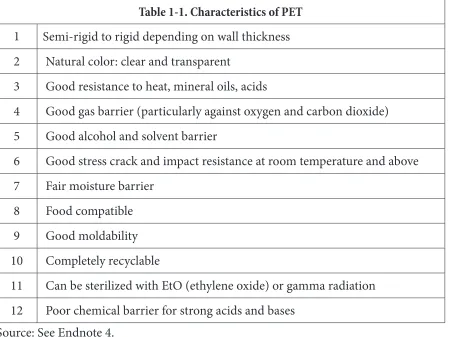
Bottled water enterprises are most criticized for the use of polyethylene terephthalate (PET) for bottling water. PET is an engineered thermoplastic. It was invented in 1941 by British chemists John Rex Whinfield and James Tennant Dickson.3 It
Table 1-1. Characteristics of PET 1 Semi-rigid to rigid depending on wall thickness 2 Natural color: clear and transparent
3 Good resistance to heat, mineral oils, acids
4 Good gas barrier (particularly against oxygen and carbon dioxide) 5 Good alcohol and solvent barrier
6 Good stress crack and impact resistance at room temperature and above 7 Fair moisture barrier
8 Food compatible 9 Good moldability 10 Completely recyclable
11 Can be sterilized with EtO (ethylene oxide) or gamma radiation 12 Poor chemical barrier for strong acids and bases
Source: See Endnote 4.
the Institute of Environmental Geochemistry in Germany, released a study measuring antimony concentrations in 132 brands of bottled water from 26 countries that indicated that bottled water can be contaminated with antimony that is constantly leaching from PET plastic into the water. In general, PET contains several hundred mg/kg of Sb, compared with less than 1 mg/ kg Sb which is found occurring naturally in most rocks and soils at the surface of the earth. Dr. Shotyk and his team measured Sb in groundwater from a rural region of Canada. The pristine groundwater was found to have antimony levels of only two parts per trillion (ppt) of Sb, but samples of bottled waters were typically found to have a few hundred times greater the level of antimony in groundwater. For comparison, Dr. Shotyk collected samples from three German brands of water available in both glass bottles and PET containers, and the results showed that water bottled in PET containers had up to 30 times more Sb. In the final test of the contamination hypothesis, the sample from a commercial source in Germany was found to have antimony levels of only four ppt of Sb before bottling, yet this same brand of water in PET bottles was measured to contain 360 ppt. The longer the water was stored in plastic bottles, the higher the concentration of antimony was measured. When samples were stored at room temperature for six months, the antimony level of many brands’ bottled water reached levels near 2000 ppt, which is the limit for antimony in drinking water in Japan. “This doesn't mean there is a clear health risk,” said Dr. Shotyk, “but I would say it's something to think about." According to Larry Wade of the Ottawa Water Study/Action Committee, “If people knew that after only six months of storage, a chemical that may be hazardous to human health could reach levels in this water unacceptable in countries like Japan, they would likely think twice about relying on bottled water.”5
Another study released in the United States, which was conducted by the Department of Civil and Environmental Engineering at Arizona State University in 2008, reports that elevated temperatures could increase antimony concentrations leaching from PET containers. Samples from nine commercially available brands of bottled water in the southwestern U.S. (Arizona) were tested. That study showed that when bottled water was stored at 22 degree C, samples were measured to contain only about 0.095 to 0.521 parts per billion (ppb), which was well below the maximum contaminant level (MCL) set by United States Environmental Protection Agency at 6 ppb. However, when samples were stored at high temperature, the statistics had significant differences. Under exposure temperatures of 60, 65, 70, 75, 80, and 85 degrees C, the antimony concentration in samples could exceed the 6 ppb MCL after 176, 38, 12, 4.7, 2.3, and 1.3 days. The result demonstrates that consumers should take into consideration elevated storage temperatures to avoid potential leaching of chemicals from PET bottles, especially in some environments exposed to extremely high temperature.6
beverage alternative on the market. IBWA also emphasized that the quality of products be it water itself or its containers, are comprehensively regulated under both federal and state laws. Regarding the safety and regulation of bottled water, IBWA’s response was as follows:
Bottled water is a safe, healthy, and convenient packaged food product, which is comprehensively regulated at both the federal and state level. At the federal level, bottled water must comply with the Federal Food, Drug, and Cosmetic Act (FFDCA) (21 U.S.C. §§ 301 et seq.) and several parts of Title 21 of the Code of Federal Regulations. Section 410 of FFDCA requires that the Food and Drug Administration’s (FDA) bottled water regulations be as stringent and as protective of the public health as the U.S. Environmental Protection Agency’s (EPA) tap water standards.8
Though bottled water is not an unregulated product, the controversy comes rather from whether or not bottled water is a well regulated product under the supervision and control of government. As per the statement of IBWA, bottled water is regulated under the U.S. Food and Drug Administration (FDA) because it is considered a food product sold in individual packages which explains why consumers can find a “Nutrition Label” on bottled water which redundantly indicates that water contains no calories, no protein, no fat, no carbohydrates, no sodium, and no sugars. On the premise of protecting public health, the standards of the FDA for bottled water are supposed to be as effective as the regulations of the Environmental Protection Agency (EPA) are regarding public drinking water. However, the different enforcing authorities and divergent procedures found between FDA and EPA create ambiguities and increase the potential risks of drinking bottled water.9
Any quality assurance of water quality can only rely on the frequency of the inspections, the impartiality of testing, and the effectiveness of practice. The companies producing bottled water assert that they can better control water quality than the authorities regulating tap water can and provide purer and safer water compared with tap water, but this is not true. The significant differences of inspection standards and operating procedures between the FDA and the EPA make bottled water no safer than tap water, or even less safe.
A. The Frequency of Inspections
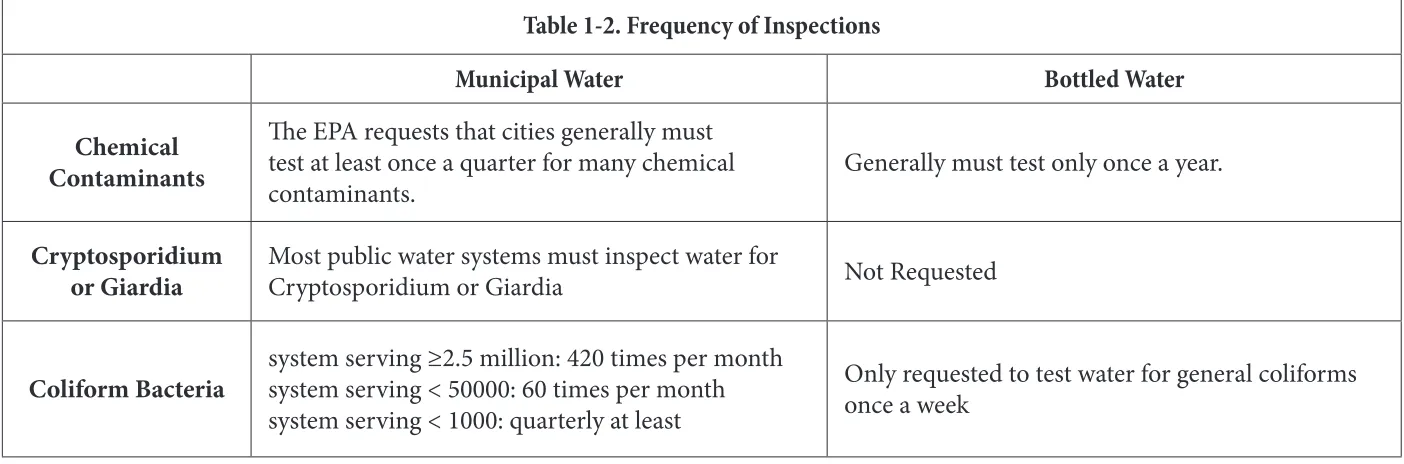
The quality and safety of municipal water and bottled water can be analyzed through the frequency of inspections for chemical contaminants, cryptosporidium or giardia, and caliform bacteria. (See Table 1-2.)
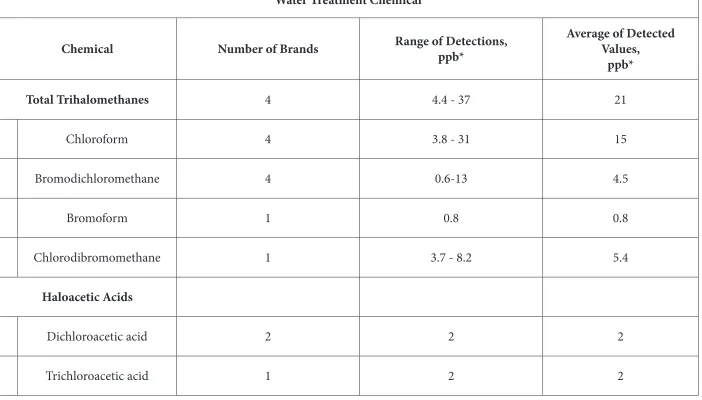
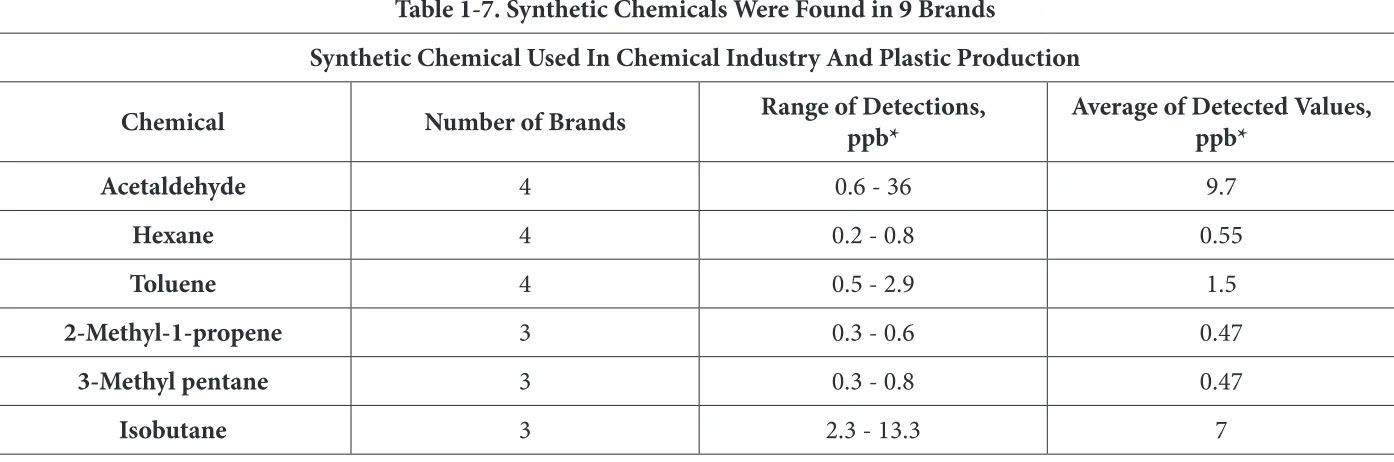
According to the website of the EPA, "The chemical contaminants are regulated in phases, which are collectively referred to as the Chemical Phase Rules. These rules regulate over 65 contaminants in three contaminant groups: Inorganic Contaminants (IOCs), Volatile Organic Contaminants (VOCs), and Synthetic Organic Contaminants (SOCs)." Depending on various types, sizes, and water sources for the public water system, the EPA determines which chemical contaminants are important to monitor for the system. The cities tested by the EPA must be tested at least once quarterly for many chemical contaminants. However, unlike the EPA's rules, bottled water must only be tested only once a year.10 Even when the water is contaminated, the results of contaminant testing on that water need not be disclosed to the public. Consumers never know what is actually contained in bottled water for drinking and there exists a significant likelihood of consumers drinking chemically contaminated water to some degree. In 2008, laboratory tests conducted for the Environmental Working Group (EWG) revealed that a mixture of 38 different pollutants from 10 popular bottled water brands in the United States were found. (see Table 1-3., Table 1-4., Table 1-5., Table 1-6., and Table 1-7.) Chemical contaminants in the report are categorized into water treatment chemicals, pollutants from fertilizers, drugs, and synthetic chemicals. Drinking water containing certain amounts of chemical contaminants repeatedly could cause acute and chronic health effects. These tests conducted for the EWG strongly prove that the FDA's regulation is not strict enough and creates a loophole which threatens the public health.11
Table 1-2. Frequency of Inspections
Municipal Water Bottled Water
Chemical Contaminants
The EPA requests that cities generally must test at least once a quarter for many chemical
contaminants. Generally must test only once a year.
Cryptosporidium
or Giardia Most public water systems must inspect water for Cryptosporidium or Giardia Not Requested
Coliform Bacteria system serving ≥2.5 million: 420 times per monthsystem serving < 50000: 60 times per month system serving < 1000: quarterly at least
Only requested to test water for general coliforms once a week
Table 1-3. Disinfectant byproducts that were Found in 4 Brands
Water Treatment Chemical
Chemical Number of Brands Range of Detections, ppb* Average of Detected Values, ppb*
Total Trihalomethanes 4 4.4 - 37 21
Chloroform 4 3.8 - 31 15
Bromodichloromethane 4 0.6-13 4.5
Bromoform 1 0.8 0.8
Chlorodibromomethane 1 3.7 - 8.2 5.4
Haloacetic Acids
Dichloroacetic acid 2 2 2
Trichloroacetic acid 1 2 2
Table 1-4. Fluoride Was Found in 5 Brands Water Treatment Chemical
Chemical Number of Brands Range of Detections, ppm* Average of Detected Values,ppm*
Fluoride 5 0.15-1.07 0.67
*ppm = parts per million (micrograms per liter, mg/L) Source: Environmental Working Group.
Table 1-5. Pollutants from Fertilizers Found in 6 Brands Fertilizer Pollution
Chemical Number of Brands Range of Detections, ppm* Average of Detected Values,ppm*
Nitrate (Nitrogen as N) 6 0.1 - 1.7 0.51
Ammonia (Nitrogen as N) 1 0.12 0.12
[image:23.792.42.771.234.371.2]Table 1-6. Drugs and Drug Breakdown Products Were Found in 3 Brands Drugs
Chemical Number of Brands Range of Detections, ppt* Average of Detected Values, ppt*
Acetaminophen 2 1.1 - 1.3 1.2
Caffeine 1 51 51
1,7-Dimethylxanthine
(breakdown product of
caffeine) 1 10 10
*ppt = parts per trillion (nanograms per liter) Source: Environmental Working Group.
Table 1-7. Synthetic Chemicals Were Found in 9 Brands
Synthetic Chemical Used In Chemical Industry And Plastic Production
Chemical Number of Brands Range of Detections, ppb* Average of Detected Values, ppb*
Acetaldehyde 4 0.6 - 36 9.7
Hexane 4 0.2 - 0.8 0.55
Toluene 4 0.5 - 2.9 1.5
2-Methyl-1-propene 3 0.3 - 0.6 0.47
3-Methyl pentane 3 0.3 - 0.8 0.47
[image:24.792.49.746.320.551.2]Methylcyclopentane 3 0.7 - 1.3 0.9
Octane 3 0.2 - 4 1.7
3-Methyl heptane 2 0.4 - 0.6 0.5
Cyclohexane 2 0.4 - 1.3 0.73
Decane 2 0.6 - 1.5 0.93
Heptadecane 2 0.3 - 1.2 0.75
(Z)-13-Docosenamide 1 1.2 1.2
1-Hexene 1 0.2 0.2
Hexadecanamide 1 0.7 0.7
Hexadecane 1 0.5 0.5
Methyl cyclopentane 1 1.3 1.3
Naphthalene 1 0.3 0.3
Nonadecane 1 0.4 0.4
Nonanoic acid 1 0.4 0.4
o-Hydroxybiphenyl 1 1.0 1.0
Tetrachloroethene 1 0.5 0.5
Coliform Bacteria
The EPA has a special regulation called the “Total Coliform Rule” to prevent the existence of Coliform Bacterial in public drinking water. All public water systems are required to monitor tap water for total coliform. Systems serving 2.5 million customers or more are required to test 420 times per month. Systems serving fewer than 50,000 customers must test 60 times per month. Small systems serving fewer than 1,000 people must test quarterly at least. In the inspection process, if any coliforms are detected, the water has to be tested repeatedly for the more dangerous fecal coliform called Escherichia coli (E. coli). Once fecal coliform are detected, it is mandated by the EPA’s regulations to immediately notify the relevant state government by the end of that day, to disinfect the tap water system, and to release a public notification to the public on the same day.9 Nevertheless, according to the website of the FDA, the “FDA has established specific regulations for bottled water in Title 21 of the Code of Federal Regulations (21 CFR)… that establish allowable levels for chemical, physical, microbial, and radiological contaminants in bottled water.” The regulations of the FDA only require that bottled water enterprises test water for general coliforms once a week, and a certain amount of any type of coliform organisms is legally allowed to be contained in bottled water. Even if coliform organisms are found in water, there is no additional action required to retest for the existence of any dangerous kind of fecal coliform.12
Cryptosporidium or Giardia
As detailed just prior, bottled water companies claim that spring water is more pure and natural than municipal water, but it does not mean that spring water is any safer than tap water. Peter H. Gleick states in his book entitled Bottled & Sold that "Municipal water, after all, is already considered safe to drink under the EPA's regulation. And as for spring water, there are loopholes in U.S. regulations that open the door to contamination by viruses and other pathogenic organisms." Cryptosporidium and Giardia are two common water pathogens which can cause diarrhea and other intestinal problems. Most public water systems must be inspected for Cryptosporidium or Giardia, but the bottled water industry is not required to do this under FDA rules. Spring water without appropriate treatment processes and regular inspection can increase the risk of contamination of drinking water.9
B. The Impartiality of Testing
samples are collected during inspections if the inspector's observations warrant collection to test for contaminants or if the bottled water facility has a previous history of contamination. Other samples are collected in response to trade or consumer complaints.” Although the FDA may operate the inspection and test the quality of water in certain circumstances, it rarely happens because bottled water is considered to have a “good quality” status per the FDA’s records. Generally the FDA assigns the authority to states to inspect, sample, and approve the water sources and the finished products. Bottlers are required under laws to maintain testing records for two years and to show these to government inspectors at reasonable times, but the test results, which have all been done by the bottlers themselves, are not required to be open to the public, not sent to any federal office, or even be confirmed by the FDA laboratories independently. The FDA’s standards for the bottled water industry basically are built on the assumption that bottled water is totally safe, and is lacking comprehensive regulations and strict enforcement. Basically anything could be going on given this total lack of oversight. The “good record” of bottled water may actually only reflect the FDA’s lack of knowledge to what is actually inside each bottle.13
C. The Effectiveness of Practice
Under the regulations of the EPA, it is mandatory that local water treatment plants provide a detailed report to city residents which include any tap water's source, the results of any examinations, and even the contaminant level violations, but bottled water companies are under no such oversight from the FDA. When any contamination is discovered in tap water, the EPA requires water agencies to report it to government immediately, notify the public, and correct the problem immediately. Nevertheless, when bottled water companies find any contamination in water, the procedure is entirely different. By the FDA’s standards, bottlers must only take actions to “remove or reduce” found contamination, but there is no obligation upon bottlers to promptly report problems to the government or to notify the public about what they have detected. Most egregious is the fact that the FDA is only authorized under laws to order a recall when a medical device, human tissue products, or contaminated infant formula may cause a risk to human health. In general, the FDA can request a company to recall contaminated products such contaminated bottled water. If the company refuses that request, the FDA can then pursue legal action and ask a court to order the company to recall the contaminated products. The procedure for recalling contaminated products usually takes a very long period of time and is entirely insufficient to protect the public health properly and in a timely manner.9
some states do not regulate bottled water at all.9 According to the Natural Resource Defense Council (NRDC), nearly one out of five states does not regulate bottled water. For states that regulate bottled water, the policies may be too weak to ensure bottled water quality, or state governments may lack enough funds and resources to enforce the policies. Even if bottled water is sold across state borders and thus covered by the FDA’ standards, these standards are far weaker than the EPA’s standards that apply to tap water in so many ways.14
Debate regarding the safety of bottled water is thus still ongoing. The safety of the public can be ensured only if all the results of tests and inspections are transparent to the public. The public has the right to know what a bottle of water that they buy contains, especially after paying a thousand times the price of their tap water. Even so, bottled water will be no safer than tap water unless the system regulating bottled water is made stricter and more comprehensive.
The Impact of Bottled Water Consumption on the Environment
In Plan B 3.0: Mobilizing to Save Civilization, Lester R. Brown, the founder and president of the Earth Policy Institute, points out the challenges that human beings must face and deal with in modern society, saying “Today, we are an oil-based civilization, one that is totally dependent on a resource whose production will soon be falling. Since 1981, the quantity of oil extracted has exceeded new discoveries by an ever-widening margin. In 2006, the world pumped 31 billion barrels of oil but discovered fewer than 9 billion barrels of new oil. World reserves of conventional oil are in a free fall, dropping every year.”15 In 1956, a geoscientist,
M. King Hubert, proposed his Peak Oil Theory to the American Petroleum Institute and predicted that the United States would reach its peak oil production between the late 1960’s and the early 1970’s. The theory is that oil production will inevitably reach it maximum and then begin a downward slope of decline. In 1970, Hubert’s theory was proven correct when the United States’ oil production first began to decrease as it has continued to do since that time. Nowadays, many scientists and experts endeavor to find out when the world’s peak oil production will occur. In a press release by Cambridge Energy Research Associates (CERA) in 2008, it is reported that “the aggregate global decline rate for fields currently in production is approximately 4.5 percent per year, and the annual field decline rates are not increasing with time.” Thus, based on this research, experts in CERA believe that there is no near-term world peak oil. Although this analysis of CERA represents a basis of confidence in the future availability of oil, the global 4.5% decline rate still indicates that the world is losing the equivalent of nearly 4 million barrels of oil per day. To prevent the complete exhaustion of natural resources and the collapse of civilization, the world’s citizens need to put forth an effort to transform the global economy into a sustainable one.16
equivalent of more than 17 million barrels of oil. To include the energy consumed for the whole production and sales process such as filling the bottles with water, hauling it long distances to market, and storing it in refrigeration, the total demand for bottled water industries in the United States alone can consume roughly 50 million barrels of oil per year. That is enough to fuel 3 million cars for one year. If everyone would drink as much bottled water as Americans do, the world would consume more than 1 billion barrels of oil in order to produce approximately 650 billion bottles. Though the whole world faces an energy crisis, bottle water industries globally continue to consume valuable natural resources, oil, to produce and sell clean water which arguably should be free for all. Obviously, the existence of bottled water industries is one factor accelerating the exploitation of natural resources.17
Other than wasteful and irresponsible consumption of energy, the single-use design of bottled water is another factor to blame for damaging the environment. Although the International Bottled Water Association (IBWA) claims that PET is a safe food contact material according to federal regulations and permitted to be used for food and beverage packaging for both single and repeated use, disposable containers made of PET actually are not suitable for long-term use because it is not capable of withstanding hot temperatures over 140 degrees. It means that the disposable PET containers cannot be placed in dishwashers or be sanitized by heat; otherwise, the PET containers have a high likelihood of deformation and leaching of toxic chemicals. The narrow-neck design increases the difficulty to clean the inner surface of bottles, so bacteria may build up on niches of bottles. In fact, the bottled water containers with thin sidewalls and narrow mouths are designed for single-use only on purpose due to economic considerations. To deal with the huge amount of plastic bottles intentionally produced to be thrown away, ethically, industry ought to make efforts to build a more effective and comprehensive recycling system to encourage recycling. Unfortunately, the reality is that they take no social responsibility for this and leave it up to government. Every year around 2.7 million tons of plastic are used worldwide to produce disposable bottled water containers, and 4 out of 5 plastic water bottles end up in landfills rather than recycling centers. These discarded bottles occupy a large volume of space in landfills. Plastic bottles buried in landfills can take up to 1000 years to biodegrade and may leak toxic additives such as phthalates or antimony into the groundwater. Some consumers drink bottled water because they are afraid of the potential pollution in tap water and believe that bottled water is cleaner and purer. Ironically, the bottled water containers which they throw away can lead to more pollution affecting the quality of groundwater and the balance of nature.18
The FDA has established guidelines to regulate this industry entitled Standards of Identity to classify bottled water into different categories in Title 21 of the Code of Federal Regulations (21 CFR) 165.110(a)(2):
1. Artesian Water: The name of water from a well tapping a confined aquifer in which the water level stands at some height above the top of the aquifer is "artesian water" or "artesian well water."
3. Mineral Water: The name of water containing not less than 250 parts per million (ppm) total dissolved solids (TDS), coming from a source tapped at one or more bore holes or springs, originating from a geologically and physically protected underground water source, may be "mineral water." Mineral water shall be distinguished from other types of water by its constant level and relative proportions of minerals and trace elements at the point of emergence from the source, due account being taken of the cycles of natural fluctuations. No minerals may be added to this water.
4. Purified Water: The name of water that has been produced by distillation, deionization, reverse osmosis, or other suitable processes and that meets the definition of "purified water" in the United States Pharmacopeia, 23d Revision, January 1, 1995, may be "purified water" or "demineralized water." Alternatively, the water may be called "deionized water", "distilled water”, or "reverse osmosis water". 5. Sparkling Bottled Water: The name of water that, after treatment and possible replacement of carbon dioxide, contains the same amount of carbon dioxide from the source that it had at emergence from the source may be "sparkling bottled water."
6. Spring Water: The name of water derived from an underground formation from which water flows naturally to the surface of the earth may be "spring water." Spring water shall be collected only at the spring or through a bore hole tapping the underground formation feeding the spring. There shall be a natural force causing the water to flow to the surface through a natural orifice. The location of the spring shall be identified. Spring water collected with the use of an external force shall be from the same underground stratum as the spring, as shown by a measurable hydraulic connection using a hydrogeologically valid method between the bore hole and the natural spring, and shall have all the physical properties, before treatment, and be of the same composition and quality, as the water that flows naturally to the surface of the earth. If spring water is collected with the use of an external force, water must continue to flow naturally to the surface of the earth through the spring's natural orifice. Plants shall demonstrate, on request, to appropriate regulatory officials, using a hydrogeologically valid method that an appropriate hydraulic connection exists between the natural orifice of the spring and the bore hole.
7. Sterilized Water: The name of water that meets the requirements under "Sterility Tests" in the United States Pharmacopeia, 23d Revision, January 1, 1995, may be "sterile water" or "sterilized water."
8. Well Water: The name of water from a hole bored, drilled, or otherwise constructed in the ground which taps the water of an aquifer may be "well water."19
undergone a purification process like distillation, deionization, or reverse osmosis, it can be legally defined as "purified water" and does not need to indicate that the water is actually derived from a municipal source. Although bottling and selling of tap water to the public at exorbitant price is an undeniable fact, the IBWA has argued that “purified bottled water is not just tap water in a bottle” because the water has undergone several specialized treatments and processes to ensure the taste and quality as a finished water product. The remaining brands of bottled water sold on the market are mostly obtained from approved underground sources and labeled as “spring water.” Some consumers specifically prefer and choose “spring water” because they assume that it is more natural and thus protected from pollutants compared with surface water. In point of fact, water obtained from such natural sources is not guaranteed to have any such quality, but the high demand for spring water has already negatively influenced the groundwater level and the ecosystem.20
Groundwater is a valuable natural resource and comprises about 95% of the world's freshwater. Surface water, lakes, and rivers only comprise 3% of the world's freshwater. When groundwater reaches the surface through natural pathways, it becomes springs and wells. Although groundwater is not as vulnerable as surface water which is more exposed to pollutants, it can still be contaminated by pollutants and hazardous substances that seep into the ground from the earth's surface. Since consumers usually have the misconception that “spring water” is purer to drink and is protected from the contaminations coming from the earth's surface, the demand for spring water has increased in the marketplace. Per the FDA's regulations, in order to use the term "spring water," bottlers are required to derive the water from a spring or from groundwater or a well that is hydrologically connected to a spring. So bottled water companies have built more and more bottling plants nearby watersheds and pumped groundwater from aquifers and wells for commercial withdrawals. The use of withdrawn groundwater is dedicated to irrigation for almost 70 percent of the entire world's groundwater usage, and the rest is utilized for supplying businesses, industries, or domestic uses. The reservoirs of groundwater can be naturally replenished or recharged by rainfall, snow melt, and infiltration from surface water features. When groundwater is excessively withdrawn in excess of the rate at which it can be recharged by natural processes, the groundwater level can fall and lead to water shortages for agriculture. Environmentalists and many communities have started to have grave concerns that the global expansion of the bottled water industry and the existence of large-scale bottling plants may negatively impact local ecological environments and significantly influence the conditions of rivers, streams, and wetlands.21
for consumption by humans, so the bottling process is a very efficient one." This research has not passed any peer review for scientific publication and has not been published in any research journal, but the bottled water industry makes claims based upon and cites the results of the research regularly as evidence to ignore all voices of concerns regarding excessive groundwater withdrawals by its own members. What the DWRF's research does not reveal through the report is that the groundwater withdrawn by bottled water enterprises may not be relevant to the total amount of groundwater in the United States overall but can be considerable in regional areas and individual watersheds. As pointed out by Peter H. Gleick, who is co-founder and president of the Pacific Institute in Oakland, California, "When a bottled water plant is taking only a small part of the flows in a watershed, the impact can be modest, or even barely noticeable. But if a bottled water plant takes a significant fraction of the flows of water in a water shed, the impact can be large. And the impact is never zero." Before building a bottling plant, the enterprise should evaluate and analyze a sustainable water extraction amount, but these enterprises ignore the potential influence on the groundwater flow system and rarely undertake the social responsibility to analytically evaluate the impact in a scientifically defensible way. In addition, setting a standard to restrict the use of groundwater withdrawals is important and necessary to protect precious groundwater resources, to balance the natural recharging cycle, and to maintain the ecological environment. Unfortunately, the U.S. government and its officials have done little to establish relevant regulations to ensure reasonable water extraction for bottled water enterprises in individual watershed regions.22
The widespread of operation of bottled water ventures does not only indicate a method of consumption behavior which appreciates the convenience of purchasing water on the go, it also demonstrates unsustainable industrial systems and designs exacerbating the problems of throwaway culture and causing a negative impact and damages that threaten the survival of the planet and of humanity. The excessive consumption of energy for the production of bottled water directly or indirectly involves the issues of global warming and the global energy crisis. The disposable design of water bottles causes the landfill issue, and the PET bottles buried in landfill sites may leak chemicals and pollute groundwater. The existence of bottling plants built nearby watersheds may deplete valuable groundwater resources and impact regional ecological environments. Although the bottled water business has rapidly expanded capturing market share worldwide, that market is not unbreakable. Other than purchasing bottled water, people can choose to spend some time on preparing their own reusable water bottle to help to decrease the negative influences of bottled water industries globally. Even a small change can possibly lead the world toward a significantly better future.
The Management of Water Resources
and that valuable water resources are increasingly being monopolized by commercial interests and the wealthy. While people living in richer nations distrust the quality of tap water and spend more money on purchasing bottled water, people living in poor countries are struggling and fighting for their fundamental human rights, one of which is access to a clean water source. In 2012, the report by the WHO/UNICEF Joint Monitoring Programme (JMP) for water supply and sanitation, estimated that, as of 2010, over 780 million people across the globe would still lack access to a proven, safe drinking water source, and that is more than 2.5 times the population of the United States. Every year more than 3.4 million people die from poor water, sanitation, and hygiene-related causes, with nearly 99 percent of all these deaths occuring in the developing world. "Access to safe water is a fundamental human need and, therefore, a basic human right," stated Kofi Annan, the former Secretary General of the United Nations, on 22nd March 2001, on the occasion of World Water Day, "contaminated water jeopardizes both the physical and social health of all people. It is an affront to human dignity." Lack of access to clean water not only causes illness or disease but also impacts children's right to education and the development of macroeconomics.23
In Sub-Saharan Africa, one of the world's poorest regions, approximately 334 million people, a figure that represents 39 percent of the total population, lack access to a source of clean water. The absence of clean water usually involves complex and complicated issues of politics, economics, climate, and social structure. As with most developing countries, women and children become the most vulnerable victims. Data shows that about 2000 children die every day from diarrheal diseases which are spread through contaminated water and poor sanitation. Since plumbing infrastructure is not available in many regions, people have to walk for miles to collect water from distant water sources or buy water sold from trucks by entrepreneurs at an expensive price. Women and young girls usually bear the responsibility to collect and manage water consuming much of their time. On average, women walk six kilometers every day to collect water. Due to spending most of their time collecting water, more than half of girls in Sub-Saharan Africa are unable to attend school. According to the website of Water.org, "In just one day, 200 million work hours are consumed by women collecting water for their families. This lost productivity is greater than the combined number of hours worked in a week by employees at Walmart, United Parcel Service, McDonald's, IBM, Target, and Kroger." If the basic right of access to clean water can be achieved, women in developing countries can save more time and gain the opportunity for productive endeavors, adult education, empowerment activities, and leisure. Both women and girls can also be released from the fear of sexual assault/harassment while gathering water. Only after access to clean and safe water source is accomplished in developing countries, can poverty, hunger or AIDS be addressed.24
the brunt of the impact. Hence, the global issue of bottled water is also the fight against the privatization of water. The more people that rely on bottled water, then the less people that will be concerned with supervision of authorities’ maintenance of municipal drinking water systems. As Peter H. Gleick notes in the book Bottled & Sold, “If we let our tap water system decay, however, soon bottled water won’t be a choice – it will be a necessity, as it is already is in countries without safe tap water.” The precious clean water resources ought to be available and easily obtained anywhere. Only when the basic human right to clean drinking water can be protected and guaranteed can an equal and just society be built, and then civilization can advance on a sustainable path.9
Campaigns against Bottled Water
Recognizing the threat behind the rapid growth of the bottled water industry, many people have begun to strive for banning or restricting the sales of bottled water. Bundanoon, which is a country town of approximately 2500 people in Australia, is well-known as the first bottled water free community in the world. In July 2009, a total of 356 residents attended a public meeting in the town hall to vote for pulling all bottled water from the shelves in September. "I have never seen 350 Australians in the same room all agreeing to something," said Jon Dee, the spokesperson of the campaign and the funder of Do Something, "It's time for people to realize they're being conned by the bottled water industry." Only two people voted in support of the sale of bottled water. One said that he was worried banning bottled water would encourage people to drink sugary beverages. The other was Geoff Parker, the director of Australasian Bottled Water Institute and represented the bottled water industry in the meeting. Parker argued that the ban is unfair, misguided, and ineffective. "To take away someone's right to choose possibly the healthiest option in a shop fridge or a vending machine we think doesn't embrace common sense," said Parker.25
“We are very much hoping that this move will get Australians to rethink the half billion dollars a year that they spend on bottled water…we believe that Bundanoon will lead the way on bottled water,” Dee said. The act of Bundy on Tap in Bundanoon indicates that the consumption behaviors and habits of consumers can be adjusted and altered in favor of a more sustainable and environmentally-friendly way while having adequate complementary measures. Thus, if the government can effectively promote greater awareness of water related issues by educating consumers about the negative effects of bottled water and establish a well-developed public drinking water system, the demand for bottled water may decrease.25
Some groups of faith have also stepped up to call upon a ban on bottled water. They proclaim that the behavior of drinking bottled water is unethical because clean drinking water, like air, is a sacred gift given by God and should not be sold for profit and be privatized by certain groups or individuals. In 2006, The United Church of Canada (UCC), the largest Protestant denomination in Canada, has added “drinking bottled water” to a list of immoral acts. The list also includes participation in the Iraq war and gambling. The church urged its 3 million members across the country to avoid bottled water and drink tap water instead to prevent the monopolization of precious water resources. “Water is a human right, and no one should profit from it,” said Richard Chambers, an executive minister in the church. “We are against the commodification, and the privatization is another way to say it, of water in any way, anywhere.” This resolution passed by the church's general council in August was prompted by Jordan Newell, who was a high-school student in Springfield, Ontario. "They're taking this clean water, and they're selling it back to us," said Newell, "They're making us scared of tap water, something that is perfectly fine. It's pretty much immoral." And then, in October 2006, the National Coalition of American Nuns passed a resolution asking members to avoid purchasing bottled water as well. Moreover, the United Church of Christ, which partnered with the National Council of Churches, produced a 60-minute documentary "Troubled Waters" which was filmed at locations around the world to capture the stories of evaporating water resources consumed by the world's burgeoning population and privatized by the wealthy and powerful. "The moral call for us is not to privatize water. Water should be free for all," said Cassandra Carmichael, who is director of eco-justice programs for the National Council of Churches. She also noted that an increasing number of religious groups have begun to consider that bottling and selling water to specific people who can afford it is a wrongful – perhaps immoral – act. Rather than calling a formal boycott against the bottled water industry, the purpose of these faith groups is to raise the public’s awareness of the issues and promote avoidance of drinking bottled water and to educate the public to the dangers of water privatization.26
other alternatives with more sustainable features.27
Polyactic Acid Plastics
In order to face the pressure from the public and hit back at criticisms from environmentalists and anti-bottled water activists, bottled water companies have begun to make great efforts to improve their environmental performance by reducing the use of plastic for packaging. Many scientists and experts have contributed to innovate and develop biodegradable materials instead of petroleum-based plastics, and thus a green trend called "bioplastics" has emerged. Bioplastics are introduced as one solution to consumers concerns with sustainability and negative environmental impact when selecting plastic products. Polyactic acid (PLA) plastic is the most common type of bioplastic which has been widely utilized in people's everyday life. In 1932, the first low molecular weight polymer of lactic acid was made at DuPont Laboratories, and then further research and development was conducted in the 1980s. The discovery of polylactic acid opens a new era in packing technology and industry.28
Many people believe that using PLA instead of petroleum-based plastic can be helpful to decrease the impact of plastics on the environment. The concept is that since bioplastics are made of plant material, the excessive use of oil consumed through the manufacture of conventional