This is a repository copy of Undergraduates' Internet Literacies.
White Rose Research Online URL for this paper:
http://eprints.whiterose.ac.uk/77757/
Version: Published Version
Thesis:
Stordy, PH (Filed: 2012) Undergraduates' Internet Literacies. UNSPECIFIED thesis.
[email protected] https://eprints.whiterose.ac.uk/ Reuse
Unless indicated otherwise, fulltext items are protected by copyright with all rights reserved. The copyright exception in section 29 of the Copyright, Designs and Patents Act 1988 allows the making of a single copy solely for the purpose of non-commercial research or private study within the limits of fair dealing. The publisher or other rights-holder may allow further reproduction and re-use of this version - refer to the White Rose Research Online record for this item. Where records identify the publisher as the copyright holder, users can verify any specific terms of use on the publisher’s website.
Takedown
If you consider content in White Rose Research Online to be in breach of UK law, please notify us by
1
Undergraduates
’
Internet literacies
Thesis submitted for the degree of Doctor of Philosophy to the
Faculty of Social Sciences
Peter Stordy
Information School
University of Sheffield
2
Abstract
This study explores information management undergraduates’ and their teachers’
perceptions of being Internet literate, of Internet literacy and their Internet-related
practices, with the aim of identifying implications for information departments’
pedagogy and curriculum. In particular, it explores the extent to which popular digital
native narratives surrounding students’ use of the Internet, coincide with the
outcomes of this study.
Following a constructivist qualitative methodology, focus groups and interviews were
conducted with a cohort of 24 undergraduates at the beginning and end of their
Information Management studies. Interviews were also conducted with the 17
academics who taught these undergraduates. The information collected was
analysed using techniques developed from Naturalistic Inquiry and Constructivist
Grounded Theory. This enabled the reconstruction of the multiple realities that exist
within the school in relation to the study’s aims.
Academics perceived that being Internet literate involved the development of a set
of competencies, capabilities and qualities that spanned the entire range of Bloom’s
cognitive and affective taxonomy. They were critical of students’ academic-related
Internet skills, particularly to find authoritative sources, but aligned themselves with the digital native rhetoric when talking about students’ non-academic Internet use. This contrasted with undergraduates, who had an information searching centric
perceptions of being Internet literate, both at the beginning and end of their studies,
and were highly confident in the areas they associated with being Internet literate,
including being able to find Internet sources. Furthermore, students felt they had ‘picked-up’ their Internet-related skills, as opposed to have been taught them.
This study concludes that undergraduates’ Internet literacies, coupled with their perception of their own Internet-related abilities and how they became Internet
literate, are potentially at odds with academics’ understandings of undergraduates’
Internet literacies and their role in facilitating students’ Internet literacies. This study
suggests that unless this divide is bridged, the effective development of
undergraduates’ Internet literacies within many information schools and departments
3
Acknowledgements
I would like to thank Professor Philippa Levy for being a wonderful supervisor, a
careful listener and inspiring colleague, Professor Nigel Ford and Dr. Andrew
Madden for their insights and endless encouragement, and Dr. Andrew Cox for his
many words of wisdom and valuable quantitative data that supported this thesis. In
addition, I would like to acknowledge the University of Sheffield’s Information School
for providing me with the opportunity to undertake doctoral studies, the financial
support provided by my Senate Award for Excellence in Learning and Teaching, and
all the undergraduates and academics that took part in this research. Finally, I would
like to thank my amazing wife Julie and my caring son Aidan. There are no words
4
Table of Contents
Abstract ... 2
Acknowledgements ... 3
Table of Contents ... 4
List of tables and figures ... 9
Abbreviations ... 10
Chapter 1
: Introduction ... 11
1.1 Inspiration for the research ... 12
1.2 Theoretical framework ... 14
1.3 Research Aims ... 15
1.4 Delimitations ... 16
1.5 Constructivist research design ... 18
1.6 Emergent research design ... 19
1.7 Research methods ... 23
1.8 Research rationale ... 23
1.9 Objectives ... 26
1.10 Research purpose ... 26
Chapter 2
: Research context... 27
2.1 Higher Education ... 27
2.2 University ... 30
2.3 Information School ... 31
2.4 iSchools network of universities ... 31
2.5 Learning and teaching strategies ... 32
2.6 The undergraduate degrees ... 33
2.7 Information Management... 33
2.8 Undergraduate curriculum ... 34
2.9 Research participants ... 36
2.10 Undergraduates’ communication preferences
... 37
2.11 Undergraduates’ learning styles
... 40
2.12 My role ... 41
2.13 Implication ... 43
5
3.1 Digital native rhetoric ... 45
3.2 Digital native critiques... 46
3.3 New digital divide ... 48
3.4 Conclusion ... 49
Chapter 4
: Internet-related practices and abilities ... 50
4.1 Pre-university Internet studies ... 50
4.2 New Internet-related practices ... 52
4.3 Undergraduates’ use of the Internet
... 54
4.4 Facebook ... 56
4.5 Conclusion ... 57
Chapter 5
: Internet literacies ... 59
5.1 Development of literacy within the educational discourse ... 59
5.2 Literacy to Literacies ... 60
5.3 Literacies related to the Internet ... 64
5.3.1 Autonomous–Conventional perspective ... 67
5.3.2 Autonomous-Peripheral perspective ... 70
5.3.3 Autonomous–Paradigm perspective ... 72
5.3.4 Ideological–Conventional perspective ... 73
5.3.5 Ideological–Peripheral perspective ... 74
5.3.6 Ideological–Paradigm perspective ... 75
5.4 Conclusion ... 78
Chapter 6
: Learning designs for Internet literacies ... 79
6.1 Bloom’s Taxonomy
... 79
6.2 Blended learning ... 84
6.3 Learning literacies in a digital age ... 85
6.4 Academics’ pedagogies for information literacy
... 85
6.5 Pedagogies for Internet-related literacies ... 87
6.6 Conclusion ... 88
Chapter 7
: Research Design ... 90
7.1 Crotty’s research design elements
... 90
7.2 Epistemology ... 91
7.2.1 Implications for this research ... 92
7.3 Research theoretical perspective ... 93
7.3.1 Reflexivity ... 94
6
7.3.3 Implications for this research ... 97
7.4 Methodology ... 98
7.4.1 Naturalistic Inquiry ... 100
7.4.2 Constructivist Grounded Theory ... 100
7.4.3 Comparison between methodologies ... 101
7.4.4 Implications for this research ... 102
7.5 Methods ... 103
7.5.1 Interviewing ... 103
7.5.2 Focus Groups ... 104
7.5.3 Qualitative coding ... 105
7.5.4 Hermeneutic-dialectic techniques ... 107
7.5.5 Triangulation ... 107
7.5.6 Constant Comparison ... 108
7.5.7 Use of quantitative data ... 108
7.6 Implications for this research ... 109
Chapter 8
: Applying the constructivist research design ... 111
8.1 Ethics... 111
8.2 Academics ... 112
8.3 Undergraduates ... 116
8.3.1 Exploratory phase ... 116
8.3.2 First developmental phase ... 119
8.3.3 Member checking phase ... 122
8.3.4 Second developmental phase ... 122
8.3.5 Issues related to the researcher-student relationship ... 126
Chapter 9
: Analysis - research conversations with academics... 128
9.1 Academics’ Internet literacies
... 129
9.1.1 Impact of the Internet ... 129
9.1.2 Internet-related confidence ... 131
9.2 Issues related to analysing the research conversations ... 133
9.3 Internet literacy triangle ... 135
9.4 Perspectives and facets of Internet literacies ... 138
9.4.1 Internet literacies as competencies ... 138
9.4.2 Internet literacies as capabilities ... 145
9.4.3 Internet literacies as qualities ... 148
9.4.4 External perspective ... 151
9.5 Cognitive and affective dimensions to being Internet literate ... 151
9.5.1 Applying Bloom’s Revised Taxonomy ... 151
7
9.6 Responsibility for developing Internet literate students ... 158
9.7 Perceptions of Internet literacy ... 159
9.7.1 Internet literacy education ... 159
9.7.2 Internet literacy levels ... 160
9.7.3 Internet literacy’s relationship with information literacy ... 161
9.8 Academics’ understandings of undergraduates’ Interne
t-related abilities
and practices ... 163
9.8.1 Undergraduates’ informal and academic uses of the Internet ... 163
9.8.2 Undergraduates’ searching abilities ... 163
9.8.3 Uncertainty about undergraduates’ informal Internet practices ... 164
9.8.4 Generational Internet divides ... 164
9.9 Issues related to the terminology used ... 165
Chapter
10
: Undergraduate information analysis ... 167
10.1 Level 1 focus groups and research conversations ... 167
10.1.1 Becoming Internet literate ... 168
10.1.2 Perceptions of the Internet ... 169
10.1.3 Self-efficacy ... 171
10.1.4 Internet use ... 173
10.1.5 Generational differences ... 175
10.1.6 Facebook ... 176
10.1.7 Perceptions of being Internet literate and Internet literacy ... 178
10.2 Level 3 research conversations ... 180
10.2.1 Becoming Internet literate ... 181
10.2.2 Perceptions of the Internet ... 182
10.2.3 Self-efficacy ... 183
10.2.4 Use of the Internet ... 184
10.2.5 Facebook ... 184
10.2.6 Perceptions of being Internet Literate ... 185
10.2.7 Perceptions of academics’ Internet literacies... 186
10.3 Issues ... 187
10.3.1 Issues related to the researcher-student relationship ... 187
10.3.2 Issues related to student-student relationships ... 187
10.3.3 Issues related to focus group reflexivity ... 189
10.3.4 Issues related to using research conversations ... 189
Chapter 11
: Discussion ... 191
11.1
Academics’ understanding of Internet literacy
... 191
11.2 Disparities and tensions between academics and students ... 193
8
11.2.2 Academics imply student confidence hinders their ability to learn ... 196
11.2.3 Disparities between students’ and academics’ expectations ... 196
11.2.4 Conflicting messages about students as ‘Internet natives’ ... 197
11.2.5 Students’ views of academics’ Internet literacies ... 200
11.2.6 Potentially conflicting views about the evaluating the trustworthiness of sources ... 200
11.2.7 Contrasting views about acquiring Internet skills and understandings ... 201
11.2.8 Potential limitations in academics understanding of how students use the Internet ... 201
11.2.9 Students’ general learning styles may conflict with Internet learning style ... 201
11.2.10 Implications ... 202
11.3 Proposals emanating from this research ... 203
11.4 Use of models and frameworks ... 205
Chapter
12
: Conclusions ... 207
12.1 Contribution and usefulness ... 213
12.2 Credibility ... 214
12.3 Resonance ... 215
12.4 Transferability ... 216
12.5 Dependability and confirmability ... 216
12.6 Authenticity and final comment ... 217
Appendices
... 218
1. Terminology ... 218
2. Original information sheet (2008) ... 220
3. Student information sheet (2011) ... 223
4. Consent form ... 225
5. Screenshot of NVivo being used to code the research conversations
with academics ... 226
6. Screenshot of NVivo being used to code the research conversations
with students ... 227
9
List of tables and figures
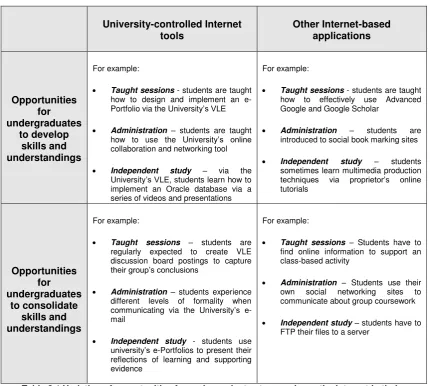
Table 2.1 Variation of opportunities for undergraduates to experience
the Internet during their studies
35
Table 2.2 My role in relation to the teaching of Internet skills and
understandings
43
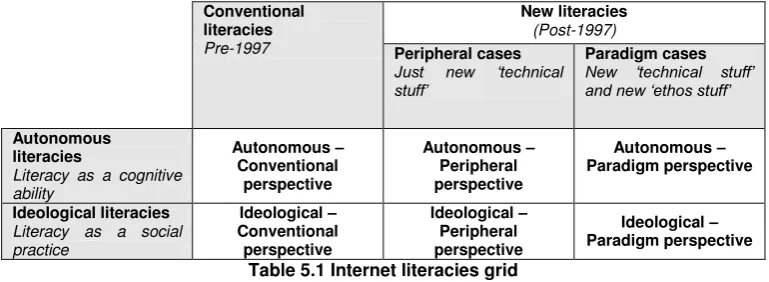
Table 5.1 Internet literacies grid 66
Figure 5.1 SCONUL Seven Pillars Model for Information Literacy 69
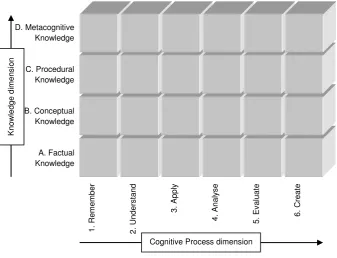
Figure 6.1Bloom’s revised taxonomy 81
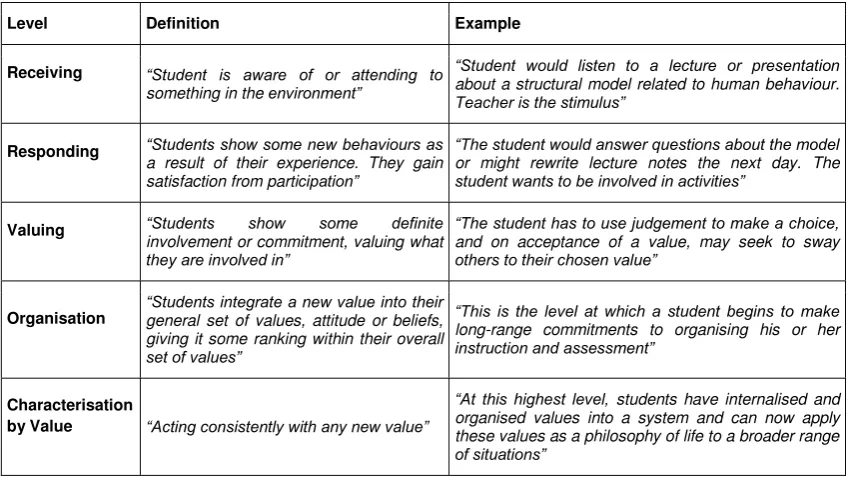
Table 6.1 Taxonomy of the Affective Domain 82
Figure 6.2Bloom’s Digital Taxonomy 83
Table 6.2 JISC framework for comparing and contrasting learning
designs and pedagogies
88
Table 7.1 Levels of reflexivity 95
Table 8.1Academics’ research conversation prompts 114
Table 8.2 Focus group prompts 118
Table 8.3 Undergraduate research conversation prompts 120-121
Table 8.4 Level 3 Undergraduate research conversation prompts 124-126
Table 8.5 Research questions addressed in Chapter 9 128
Figure 9.1 Academics' perspectives and facets of an Internet literate
student
138
Table 9.1Academics’ perceptions of being Internet literacy mapped
on to Bloom’s Revised Taxonomy
152
Table 9.2Krathwohl’s Revised taxonomy for the Affective Domain 153
Figure 9.2 Cognitive-Affective model 154
Figure 11.1 Dominant perceptions of Internet literacy held by
academics mapped to those found in the literature
192
Figure 11.2 All perceptions of Internet literacy held by academics
mapped to those found in the literature
193
Figure 11.3 Comparison of students' and academics' perceptions of
being Internet literate
10
Abbreviations
BIS Department of Business, Innovation and Skills
DCMS Department of Culture, Media and Sports
DfEE Department for Education and Employment
DfES
ESRC
Department for Education and Skills
Economic and Social Research Council
FE
HE
HEA
Further Education
Higher Education
Higher Education Academy
HEI Higher Education Institution
HEFCE
ICT
IT
Higher Education Funding Council for England
Information Communication Technology
Information Technology
JISC Joint Information Systems Committee
TEL Technology Enhanced Learning
UCISA
UCL
University and Colleges Information System Association
University College London
11
Chapter 1: Introduction
As an undergraduate teacher and coordinator, I frequently observe students who
appear highly confident using the Internet, yet this apparent expertise does not
always transfer to their performance in learning activities, coursework assignments
or other university-related interactions. The undergraduates within my Information
School go on to become information professionals, and it is likely their future
colleagues and managers will also have high expectations about their
Internet-related abilities and experiences. It follows that my school has a responsibility to
ensure its graduates are equipped to meet these challenges, not just as students
and future employees, but as citizens and individuals. Hence, this research primarily
seeks to illuminate an understanding of an area that will specifically benefit my own
School’s undergraduates and potentially other information schools and departments.
My school both educates for and researches information literacy and its academics
are also pivotal in developing an understanding of this area. They facilitate activities that develop students’ Internet literacies by acting upon their understandings of what it means to be Internet literate. For this reason, their views and understandings are
central to this research and any future curriculum intervention that facilitates students’ Internet literacies.
This thesis describes a research journey that begins with the initial inspiration for
this research and the theoretical framework adopted: the undergraduates I teach, and Sonia Livingstone’s conception of Internet literacy (Livingstone, 2008). Having fleshed out the purpose of this research and introduced the constructivist
methodology used to achieve its aims, I then describe the research context in
sufficient depth to allow the reader to vicariously experience the research
undertaken. This research takes place amid increased interest in the digital abilities
needed by students to be successful in their studies and various critiques of the ‘digital native’ narrative evident in popular media and government-related strategies and reports, in which young people are portrayed as having ‘natural’ aptitudes
towards new technologies. These, along with an illustrated framework for positioning
the multitude of Internet literacies prevalent in the literature, are presented as a
formative backdrop to the research undertaken. Before embarking on a description
of research methods employed, I provide an overview of research design issues of
relevance to this research, from the relativist, transactional and subjectivist
12 the methods used and information gathered. The research focuses on one cohort of
Information Management undergraduates and their teachers. The primary methods
used to gather information from these participants included focus groups and
interviews. Using methods developed from Grounded Theory, the information
collected was analysed to provide rich descriptions of undergraduates’ and academics’ Internet experiences, and perceptions of and pedagogies for Internet literacy. A model is presented that encapsulates academics’ perceptions of Internet literacy and takes centre-stage in the subsequent discussion of potential Internet
pedagogical tensions and disparities that exist within my School. A set of proposals
are developed to inform further pedagogical and curriculum discussions, aimed at
ensuring our undergraduates have the Internet-related abilities and experiences to
be successful during their Information Management degree studies, future
employment and life-long learning. Finally, the research undertaken is evaluated
against the original research aims and questions posed, and constructivist
trustworthiness and authenticity criteria.
1.1 Inspiration for the research
As a University Teacher teaching Information Management to undergraduates within
a Russell Group university, I work with students who have grown up with increasing
levels of Internet access. These students are frequently portrayed in the media and
literature as having a natural aptitude towards using new technologies, and the
Internet in particular. Their early exposure supposedly endows them with skills that
those older cannot emulate. Undoubtedly, the undergraduates today need less
tuition in using Internet technologies than they did when I first started my university
career back in 2004. For example, I spend less time teaching students how to
navigate complex websites and I no longer teach students how to use a basic
search engine. I also notice differences in students’ relationship with Internet
technologies. For example, as I walk around my school and university, the most
common application filling the students’ computer screens is not MSN Messenger, Google or the library’s catalogue, but the social networking application Facebook. It is the first application many students start when they log on and the last one they
close when they log off. However, my reflections suggest that overarching terms like
Net Generation (Tapscott, 2009), Digital Natives (Prensky, 2001b; Prensky, 2001a;
Prensky, 2009) and Millennials (Howe and Strauss, 2000; Oblinger and Oblinger,
13 observe. The following cases illustrate the variety of behaviour that led me to
question the Internet savvy rhetoric:
Case 1: After twenty minutes explaining and demonstrating recommended Google
search techniques (see Google, 2011), I asked my first year Information
Management undergraduates to find Web pages relevant to their Climate Change
search topic. As I wandered around the computer laboratory, I glanced at one student’s computer screen and noticed what he was typing into a standard Google search box: What are the factors that might cause Climate Change? Undoubtedly,
this search would have retrieved some relevant web sites, but would also have
excluded many more. Regardless, he had not incorporated the previously
mentioned recommendations into his Google searching despite appearing to listen
attentively. When I reminded him, he shrugged, quickly deleted some words and
continued. I moved away not really convinced he understood. Why had this
conscientious and attentive student apparently ignored my recommendations?
Case 2: Three of our more engaged Information Management undergraduates had
independently shown an interest in developing a school undergraduate society. All
three students are avid uses of Facebook. One was particularly interested in
developing and maintaining a Facebook online community, another had already
arranged a departmental social event via Facebook and third saw the society as an
extension of his Facebook social life. Despite their courses overlapping, they did not
know each other. They were given each others’ names and I suggested they contact
each other before attending a Student Union meeting devoted to setting-up a
society. All three attended the meeting, but never spoke to each other. The society
never started. Why was it that these three avid users of Facebook not use this
communication tool to communicate with each other before attending the meeting?
Case 3: One of my own Information Management first year courses aims to make
students more familiar with Web page authoring. Rather than use third party
drag-and-drop applications to develop Web pages, a pedagogic decision was made to
teach the very basics of HTML, the mark-up language of the Web. Students have
repeatedly said that this was one of the most rewarding aspects of their first year
and most achieve high grades, including those who have had no previous ICT
tuition. However, the situation before 2006 was very different. The HTML
laboratories were conducted during the first weeks of their studies and around ten
14 was too difficult. The laboratories were postponed to later in the semester and now
very few students request a transfer1. Why was it that students studying a degree
related to the use and application of technologies and who are portrayed in the
media as being comfortable with new technologies, perceive HTML to be so
difficult?
The cases cited above could be interpreted in numerous ways. For example, rather
than adopting a didactic approach to the teaching of Google skills, maybe I should
have adopted a more reflective approach (Case 1). Maybe the three students who
wanted to form a school society had contacted each other via Facebook prior to the
meeting, but failed to develop a rapport (Case 2). Maybe the students who wanted
to withdraw from the degree because of the HTML had mistakenly thought their
entire degree involved hard-core computing (Case 3). However, these are just three
of many examples of non-Internet savvy behaviour that my colleagues and I could
have cited. Overall, one begins to wonder, what is going on? Why do supposedly
Internet savvy students sometimes appear inept at using the Internet, particularly for
their studies? What experiences of the Internet are students bringing to their
studies? What do students know or need to know to use the Internet for their studies
and beyond? What pedagogies might usefully be employed to promote this
knowledge? It was tentative questions like these that inspired the research
described in this thesis.
1.2 Theoretical framework
The questions resonate with research conducted by Sonia Livingstone and her
colleagues (Livingstone, 2003; Livingstone and Bober, 2003; Livingstone and Bober,
2004; Livingstone et al., 2005; Livingstone, 2008)2. They investigated children’s and young people’s Internet-related behaviour, attitudes and abilities, along with the Internet views and practices of their parents. Their conclusions challenged popular
proclamations that children and young people are Internet savvy and thus
highlighted deficiencies within compulsory education. By positioning their research
around behaviours and attitudes within different social contexts, they went beyond a narrow evaluation of children’s and young people’s Internet skills. Sonia Livingstone
1
Undergraduates in our university are only allowed to transfer to another degree within the first three
weeks of their studies 2
15 found it useful to conceptualise her young people studies within the theoretical
framework of literacy, justifying this as follows:
“… the widespread struggle among educators … researchers and policy
makers to conceptualize what it is (young) people ‘know’ or need to know when using the internet is usefully resolved by conceptualizing this knowledge in terms of literacy. This allows us to draw on, and learn from, a long intellectual history of debate over the nature of literacy (from print literacy to audiovisual and media literacies, information literacy, advertising literacy, cyberliteracy, games literacy, critical literacy, and
many more) …”
(Livingstone, 2008:102)
By conceptualising her Internet-related research in terms of literacy, she has
expanded notions of reading, writing and text within the context of the Internet and
thus enabled her to “… weave together ... basic and advanced skills, linking individual skills with social practices and crossing the boundary between formal and
informal learning” (Livingstone, 2008:102). By addressing the tentative questions raised in the previous section, this research continues where these Internet literacy
inquiries end. The subjects of this research are older, but to what extent do their
Internet literacies differ?
This research was conceptualised within the broad theoretical framework of literacy, thus enabling undergraduates’ academic and social Internet-related practices and abilities3 to be considered within the context of their studies and life-long learning. In
short: undergraduates’ Internet literacies.
1.3 Research Aims
The research described in this thesis was conceived as extending pre-university
Internet literacy studies into the university sector, in particular the research
conducted by Sonia Livingstone and her colleagues. However, as a university
teacher I am also interested in the impact my school’s Information Management
curriculum and pedagogy has on undergraduates’ Internet literacies, their views
about what it means to be Internet literate, and their views about the Internet
literacy-related teaching they have experienced. Hence, this research aims to:
3 The term ‘abilities’ is used in this thesis to encompass all Bloom’s cognitive, affective and
16 A1-20114: To explore undergraduates’ perceptions5 of being Internet literate,
Internet literacy education and their Internet-related practices
In addition to this more scholarly aim, the research has an action orientation, since
the outcomes will inform my own teaching and the teaching that takes place in my
school. This primarily relates to ensuring undergraduates are successful in their
studies, but it is also to equip them with Internet-related abilities that may useful
beyond their studies. It follows that this research aims:
A2-2011: To develop pedagogical approaches to enable our undergraduates to
become more Internet literate
These will inform School discussions and strategy related to undergraduates’
Internet literacies. However, central to any departmental curriculum development is
the perspective of those that teach students. Hence, this research also aims:
A3-2011: To explore academics’ perceptions of undergraduates’ Internet literacies,
what it means to be an Internet literate student and their views about Internet
literacy education
1.4 Delimitations
Delimitations are restrictions that researchers impose prior to the inception of the
study (Creswell, 2003). This research was delimited to a specific group of
technologies and research design axioms, and a particular cohort of students and
theoretical framework. These delimitations are expanded upon in the following
paragraphs.
This research primarily relates to technologies that are dependent on the Internet. It
is not about digital technologies, which are a broader set of technologies subsuming
Internet technologies6. Hence, this research is not about undergraduates’ mobile
4 The nomenclature used identifies the type of item and, to help the reader understand the emergent
aspects to the research design employed, the year the item was created i.e. [abbreviation for the type
of item][item number]-[year the item was created]
5 The term, ‘perception’ has been used here to mean, “… the way in which something is regarded,
understood, or interpreted” (Oxford University Press, 2011)
6
17 phone, portable media player or personal digital assistant (PDA) practices. Nor is this research about how students’ use applications like Microsoft Word that can effectively work without Internet access. However, this research does focus on undergraduates’ and academics’ practices related to the World Wide Web technologies like Google running in a Web browser requiring Internet access on
demand and the virtual 3D world Second Life requiring continuous Internet access.
One corollary of delimiting this research to Internet technologies as opposed to
digital technologies is that the terms ‘Internet literacy’ and ‘Internet literacies’ are preferred to the terms ‘digital literacy’ and ‘digital literacies’. Whilst the latter terms have been in the educational arena for more than a decade, their use has only
recently become more widespread and common (see Section 5.3.2). In addition,
these terms refer to a broader set of abilities and practices than would be implied by
the use of the terms ‘Internet literacy’ and ‘Internet literacies’.
The aims of this research stress the multiple viewpoints of its participants. This is
consistent with a constructivist research design originally proposed by Lincoln and
Guba in their seminal book entitled, ‘Naturalistic Inquiry’ (Lincoln and Guba, 1985).
Explicit in this research design are five axioms that distinguish it from other forms of
inquiry: “Realities are multiple, constructed, and holistic”; “Knower and known are
interactive and inseparable”; “Only working hypotheses are possible”; “It is
impossible to distinguish causes from effects”; “Inquiry is value bound” (Lincoln and Guba, 1985:37). The implications of adopting this research design and axioms are
far reaching. These include the choice of qualitative methods in preference to
quantitative methods, an emergent design as opposed to one that remains fixed
from the beginning of the inquiry, the production of ‘theory’ that is grounded in and induced from the ‘data’ collected as opposed to testing some priori theory, and the production of research outcomes that are tentative rather than law-like
generalisations. One corollary of the last axiom is that the goal of constructivist
inquiry is to allow for transferability of the findings rather than wholesale
generalisation of those findings. Hence, whilst this research focused on a particular
cohort of Information Management undergraduates that studied at my Information
School during 2008 and the academics who taught these undergraduates, the
findings could be transferred to other cohorts and other university information
departments if sufficient contextual similarities exist. For example, many information
management and iSchool (see Section 2.4) university departments would satisfy this
18 As stated in Section 1.2, this thesis was conceptualised within the theoretical
framework of literacy and primarily draws upon the literature at the intersection of
literacy, the Internet and HE. However, I acknowledge that other disciplinary
perspectives could have informed this research. For example, the discipline of
information behaviour overlaps broader conceptions of information literacy that stress people’s information-related (including Internet) practices, as well as their information-seeking abilities (for example, Johnston and Webber, 2003). Defined by
Wilson (2000:49) as “the totality of behavior in relation to sources and channels of
information …”, Bawden and Robinson (2009) claim information behaviour research better accounts for the complexity of people’s information-related behaviour. For example, drawing upon his own research, psychology and sociology, Wilson (1997)
formulated a general model of information behaviour that extends the core stages of
information seeking and retrieval common to many models of information literacy. It
includes those factors that influence the formation of a person’s information need,
an account of why people choose to select of reject certain information sources and
the variables that might affect a person’s motivation to persist in certain information
seeking behaviour. This and other information behaviour models could offer a
valuable alternative perspective to that of literacy, but due to time constraints were
omitted from this research.
1.5 Constructivist research design
A constructivist research design is appropriate for a study that seeks to illuminate
constructed meanings (understandings) within a specific context of social practice,
and that also seeks to integrate a participatory, action-orientated dimension into the
research process (Lincoln and Guba, 1985). The constructivist approach enables
the identification of contextualised meaning from multiple points of view (Green,
2000), with the goal of creating a joint, collaborative reconstruction from the multiple
realities that exist (Guba and Lincoln, 1989b). Whilst Lincoln and Guba’s (1985)
seminal work ‘Naturalistic Inquiry’ was inspiring and thought provoking, it failed to
provide me with sufficient methodological guidance, particularly when analysing the
information gathered. Grounded Theory, as originally proposed by Glaser and
Strauss (1967), provides such methodological guidance and supports some tenants
of constructivist inquiry; for example, ensuring any theory developed is grounded in
the research data. However, Grounded Theory has its roots in the positivist research
traditions with an objectivist view of knowledge (Charmaz, 2006), whereas
19 epistemological level at least, Glaser and Strauss’s Grounded Theory (1967) and Lincoln and Guba’s (1985) Naturalistic Inquiry are ultimately incompatible. However
Charmaz (2006), a student of Glaser and Strauss, proposes a research design that
is consistent with the underlying research paradigm of constructivism and the
rigorous methods promoted by Grounded Theory: Constructivist Grounded Theory.
This methodological approach inspired the methods used in this inquiry, particularly
in the analysis and treatment of data, but less so in the data gathering procedures
employed.
1.6 Emergent research design
The research described in this thesis was conceived in 2008. Since then, my
understanding of research and Internet literacies has evolved; Literature that was
relatively recent in 2008 now seems dated; Internet technologies that were
innovative in 2008 now seem old hat; my understanding of students’ Internet
literacies in 2008 feels naïve in 2011. These reflections about the longitudinal
implications of research are commensurate with a emergent research design since
“it is inconceivable that enough could be known ahead of time about the many multiple realities to devise the design adequately” and because the researcher and those being researched “interact in unpredictable ways to influence the outcome” of the study (Lincoln and Guba, 1985:41). An emergent research design does not
negate the constructivist researchers’ responsibilities to plan or become lax at
maintaining focus. However, an emergent design does allow constructivist
researchers to respond to their own reflections, thoughts about reflexivity and the ‘data’ collected. Research methods are chosen and configured on the latest tentative ‘theories’ or ‘working hypotheses’ (Lincoln and Guba, 1985), but may evolve or become more refined as the research moves forward. This thesis
describes the research process that took place and the outcomes of this journey.
The emergent aspects of how the research design became finalised is evident at
various points in the thesis. Within its linear and sanitised structure the principal
research design iterations and parallel research-related processes are indicated. For
clarity and brevity, many of the less significant complexities have been obscured
from the reader. However, its evolving nature begins with the original 2008 research
20 A1-2008: To explore undergraduates’ and their academics’ perceptions of being ‘Internet literate’
In hindsight, this aim was narrowly conceived, omitting the broader intentions of the
research conducted and any implicit rationale. The previously stated aims A1-2011
and A2-2011 better encapsulate the intention of this research and subsume (as
opposed to replace) aim A1-2008.
After reviewing the literature available in 2008, a tentative cognitive-orientated
definition of being Internet literate was created:
The capability to capitalise on the various affordances offered by both current and
future Internet enabled technologies
This definition guided my initial research design, my initial research questions and
the questions asked during the first phase of focus groups and interviews. The initial
research questions related to undergraduates were:
RQ1-2008: What are undergraduates’ conceptions of the Internet and experiences
of Internet-related technologies?
RQ2-2008: To what extent do undergraduates value the Internet and
Internet-related technologies?
RQ3-2008: What are undergraduates’ perceptions of being Internet literate?
RQ4-2008: To what extent do undergraduates perceive themselves as Internet
literate?
RQ5-2008: How do undergraduates perceive they have become Internet literate
prior to starting their university studies?
RQ6-2008: How do undergraduates perceive the value of their pre-university
21 Secondly, from the perspective of their teachers (academics):
RQ7-2008: To what extent do academics value the Internet and Internet-related
technologies?
RQ8-2008: To what extent do academics perceive themselves as Internet literate?
RQ9-2008: What are academics’ perceptions of undergraduates’ Internet
experiences?
RQ10-2008: To what extent do academics perceive their students are, or have to
be, Internet literate?
RQ11-2008: What are academics’ perceptions of, and pedagogies for, Internet
literacy?
RQ12-2008: Whose role do academics feel it is to facilitate Internet literate
students?
A corollary of researching these academics’ and undergraduates’ perceptions of
being Internet literate is that hitherto unrecognised parities and disparities in their
perceptions and experiences may be exposed. Hence, a further research question
was posed:
RQ13-2008: What [dis]parities exist between undergraduate’ and academics’
perceptions of Internet literacy?
The above research questions stress undergraduates’ and academics’ perceptions as opposed to overt observations or their Internet behaviour, since it has long been
recognised that perceptions have an important affect on human behaviour (James,
1890) and more recent research has emphasised this relationship (Deci and Ryan,
2000). In addition, having previously researched primary and secondary school teacher’s perceptions of Internet literacy (unpublished) and having reviewed literature related to formal education and Internet literacy, including Sonia Livingstone’s earlier Children Go Online studies, the research questions stress undergraduates’ perceptions at the transition from their [mostly] school-based
22 focused on my school’s Level 17 undergraduates and their teachers. However in
2010, after conducting a final literature review for this thesis (see Chapters 3, 4 and
5) it became apparent that my previous understanding of Internet literacy had
omitted a significant dimension. Hence, in Chapter 5 a broader definition of Internet
literacy that encompasses both cognitive and practice dimensions:
The abilities a person or social group draws upon when interacting with Internet
technologies to derive or produce meaning, and the social, learning and
work-related practices that these abilities are applied to.
Furthermore, the more recent reviews of the literature revealed popular media and
Government Internet-related reports and strategies frequently portraying students as
digital natives and their teachers as digital immigrants. This combined with a
realisation that this research had the potential to explore undergraduates’ Internet
literacies towards the end of their studies, led to the development of six more
research questions:
RQ1-2011: To what extent are the Information School’s undergraduates demanding,
critical and sophisticated users of the Internet technologies, seamlessly integrating
them into their lives?
RQ2-2011: To what extent do the Information School’s undergraduates demand
Internet technologies and pedagogies in their studies?
RQ3-2011: To what extent do the Information School’s undergraduates perceive
their university studies have developed their Internet literacies?
RQ4-2011: To what extent do the Information School undergraduates’ Internet
literacies, and perceptions of being Internet literate, evolve through their Information
Management studies?
RQ5-2011: To what extent is the digital native-immigrant rhetoric prevalent amongst
Information School’s academics and undergraduates?
RQ6-2011: To what extent do the findings from pre-university Internet literacy
studies coincide with the findings from this research?
7Typically undergraduates’ first year of study
23
1.7 Research methods
Whilst constructivist inquiry accommodates all data research methods, the principal
data collection method is the research interview (Lincoln and Guba, 1985). Before
summarising the research methods I employed in this study, my use of more
constructivist terminology needs to be clarified. For example, I have preferred to use
the term ‘information’ than the term ‘data’ since the latter has positivist, objectivist
connotations (Charmaz, 2006) whereas the former implies more than data or facts,
and in the case of humans, leads to the “intelligent acquisition of understanding and
wisdom” (Kaye, 1995) and encompasses “all of the intangible but real resources we
create and use as we interact with the world around us” (Whitworth, 2009:3)8. Furthermore, to avoid more objectivist, positivist connotations of term ‘interview’, I
have followed Levy’s (2002) lead and used term ‘research conversation’. Levy
coined the term to highlight the constructivist nature of the social interactions that
took place during her study, and how they resembled a ‘real’ conversational
exchange than a classic research interview.
To achieve the research aims and explore the research questions, a series of focus
groups and research conversations was held with a cohort of 24 first year BSc
Information Management students near the very beginning and end of their studies,
and a separate series of research conversations with the 17 academics who taught
them. The information collected was analysed using techniques developed from Charmaz’s Constructivist Grounded Theory, which in turn draws upon the ideas of Glaser (1978) and Lincoln and Guba (1985). Participants had opportunities to reflect
and comment upon their respective analysis before the two analyses were
compared to illuminate any parities and disparities. At various stages in the study, I
held extended dialogues with a few colleagues to discuss my tentative findings and
conclusions.
1.8 Research rationale
The rationale for conducting this research remains the same as it was in 2008,
although subsequent reviews of the literature, my developing understanding of
Internet literacies and interactions with both students and academics, have refined
8I tended to use the term ‘information’ in the context of my own constructivist research and the term
‘data’ when referring to other research or the research design literature (since this is frequently the
24 and further focussed the study. In addition to a genuine desire to understand the
Internet literacies of the undergraduates in my school, there were scholarly and
other action-orientated rationales for conducting research into undergraduates’
Internet-related practices and views. These are expanded upon in the following
paragraphs and refined in the following chapters, but in essence relate to deficits in the research that has been conducted into undergraduates’ Internet literacies and the need to inform decisions with my school regarding how undergraduates’ Internet
literacies might be developed.
At a national level, various developments have brought Internet-related literacies to
the forefront of the HE agenda. These are elaborated later, but suffice to say that
various Government, HEFCE and JISC reports, strategies and reviews have
stressed that HE has an important role in developing a labour force that can
capitalise on recent technological developments, prioritising digital technologies
including the Internet. Within the University, one outcome has been the inclusion of
information literacy and ICT skills in its list of graduate attributes. These describe the
transferable knowledge, skills and qualities that our students are meant to
demonstrate when they graduate. Each University department or school interprets
the University’s graduate attributes according to their own priorities and disciplinary
perspectives. Being an information school, these two graduate attributes are central
to our Learning, Teaching and Assessment Strategy, and given that the Internet has
arguably transformed what it means to be information literate and is integral to many
ICT packages, the promotion of Internet literacies within my school are paramount.
Furthermore, the undergraduates in my school are studying Information
Management, a discipline perceived by employers as closely related to the Internet
technologies9 and a discipline that has arguably become more relevant in an
information society (Webster, 2002). As such, employers expect our undergraduates
to be particularly Internet literate and undergraduates might expect Internet literacies
to be an aspect of their degree.
Within the University and Information School there is no overall rationale or strategy
for the inclusion of Internet literacies per se within the undergraduate experience.
What might be identified as Internet literacies are developed within the specific
teaching courses that students study and are implicit in my schools’ Learning,
9 Anecdotal comments made by the department’s panel of information-related employers and experts
25 Teaching and Assessment Strategy, but no framework exists to ensure continuity
and progression between specific courses, and ultimately no overall agreement
about what it means to be an Internet literate Information Management graduate.
This research will inform School discussions about the Information Management degree and to ensure its curriculum and pedagogy are aligned to students’ Internet literacies.
Given the lack of any framework or policy to support undergraduates develop their
Internet literacies I looked towards the literature and research. Within the
educational-related literature there is an ongoing debate about undergraduates’
Internet literacies, what it means to be literate in a digital age and whether younger
people are predisposed to being more Internet literate. This is expanded upon in
later chapters, but predominantly draws upon anecdotal comments and research into undergraduates’ Internet use (for example, Hardy et al., 2009; Smith et al., 2009; Jones and Czerniewicz, 2010) rather than substantive research into undergraduates’ Internet literacies: their knowledge, skills, motivations, attitudes and practices. As a consequence, guidance relating to the knowledge and skills that
undergraduates need to acquire to be successful in their studies, in future
employment or for life-long learning is lacking, as are any suggestions about what
pedagogies might be effective in developing their Internet literacies. Conspicuously,
the research that has been conducted has tended to exclude those that teach
undergraduates, despite their direct involvement in ensuring an Internet-able labour
force: the academics in university departments. No research has been conducted
about their perceptions of being Internet literate, their understanding of undergraduates’ practices and the tensions and harmonies that exist between their perspective and those held by the undergraduates they teach. Furthermore,
academics in my school are national and international leaders in information-related
research. Their views are of particular relevance to gaining a broader understanding
of what it means to be Internet literate, one that extends the action-orientated aims
of this research.
It follows that the scholarly rationale for conducting a study of undergraduates’ Internet literacies relates to the lack of research in this area and the absence of
research that considers the perspective of those that teach undergraduates. In
short, there is a scholarly rationale for extending pre-university Internet literacy
studies into the university sector. This will inform the broader debate taking place
26 The action-orientated rationale for conducting a study of undergraduates’ Internet
literacies relates to a need to improve the educational experience of the students I
teach and help ensure our undergraduates satisfy national, university and future
employer expectations in relation to their Internet literacies.
1.9 Objectives
The original objectives for conducting this research specify the tangible and
verifiable research outcomes. They were:
O1-2008: Develop theoretical models and/or typologies that describe and explain
the findings, and reflect upon the multiple perspectives held by students, academics
and the literature
O2-2008: Identify curriculum and pedagogical implications for my school
O3-2008: Develop frameworks that could be used by my school to develop or
evaluate the Internet literacy aspects of the undergraduate curriculum
The objectives were not added to or modified during the process of conducting this research.
1.10 Research purpose
Creswell states that “the purpose statement is the most important statement in an
entire study” since “It orients the reader to the central intent of the study, and from it,
all other aspects of the research follow” (Creswell, 2003:87). The purpose statement for this research is thus:
The purpose of this constructivist study is to explore undergraduates’ and their teachers’ perceptions of Internet literacy, being Internet literate and their Internet-related practices. The term ‘Internet literacies’ is used throughout this thesis to
encapsulate what students know, or need to know, to use the Internet for their
studies, life-long learning and beyond. It includes their Internet-related abilities,
practices and experiences, and is influenced by those that educate them. The
outcomes of this study will inform my school’s Learning, Teaching and Assessment
Strategy, and contribute to the broader debate around undergraduates’ Internet
27
Chapter 2: Research context
To contextualise this research and enable the reader to judge the extent to which
the research findings transfer to their own situation, it is necessary to position this
research within the context of national developments that have brought the
educational use of the Internet to the forefront of the HE agenda and also highlight
salient features of the University and School in which I teach. The latter will include
the strategies that inform learning and teaching, the iSchools network of universities
that my school is a member of, the undergraduate degrees offered in my school and
the undergraduates that took part in the research. In addition, within a constructivist
research design, my own background, my role in teaching Internet literacies and my
relationship with those taking part in the research cannot be partitioned from what I
am researching (Lincoln and Guba, 1985). Hence, these are also disclosed within
this section to facilitate a more reflexive approach towards developing research
outcomes. In addition, this section will tease out additional research questions and
rationales for conducting the more action-orientated aspects of the research
presented in this thesis.
2.1 Higher Education
“Only a Digital Britain can unlock the imagination and creativity that will
secure for us and our children the highly skilled jobs of the future. Only a Digital Britain will secure the wonders of an information revolution that could transform every part of our lives. Only a Digital Britain will enable us to demonstrate the vision and dynamism that we have to shape the
future.”
(Rt. Hon Gordon Brown, 2009 in BIS & DCMS, 2009:6).
This quote headlines the ‘Digital Britain’ (BIS & DCMS, 2009) Government strategy
to ensure that the UK (England, Wales, Scotland and Northern Ireland) is at the
leading edge of the global digital economy. It cites the role of HE in developing a
labour force that can capitalise on recent technological developments, prioritising
digital technologies including the Internet. Similar motivations are central to various
other recent Government and quango strategy reports relating to Internet-enabled
computers. Paraphrasing, they all address a perceived ensuing information
revolution resulting from living in a digital age. This necessitates that all individuals,
education institutions, businesses and organisations reflect upon their current
position and promptly take any necessary action, else risk being left behind and
28 technologies or whether the changes are more evolutionary and less determined by
the technologies available is beyond the scope of this review, but comprehensively
discussed elsewhere (for example, Dutton, 1999; Webster, 2002). Regardless,
Government-related strategies and policies have an impact upon HE strategies
relating to the use of Internet for learning and teaching (Goodfellow et al., 2008).
The role of HE in achieving the aims stated in the Digital Britain report is articulated via the Government’s HE framework entitled ‘Higher Ambitions’ (BIS, 2009). It stresses how HE in conjunction with external partners can make the UK “world leaders in the growing market in transnational education based on e-learning” (BIS, 2009:92). Whilst the emphasis is on ‘e-learning’, which it stresses is not “distance
learning”, it also implies the promotion of Internet literate students when it stresses that students should leave HE with “competent mastery” of “communications
technologies” to enable them to access digital “information and content” (BIS, 2009:78). JISC, who have joint responsibility with the HEA for taking forward
HEFCE's e-learning strategy (JISC, 2006), articulates its digital intentions via three
yearly strategy documents informed by consultation and its own studies. Like Higher
Ambitions, these documents have tended to stress the economic gains resulting
from the appropriate online technologies due to their perceived efficiency and their
potential to produce higher satisfaction levels from an increasingly demanding
student population (for example, JISC, 2006; JISC, 2009c). Whilst stating that
learning and pedagogy should not be determined by technology, JISC still defines “Effective practice … in a digital age [as including]the ability to … involve the use of technology as part of a learning session or programme” (JISC, 2009a:8). Hence, HE faces pressure from the Government’s recent framework for HE and various JISC strategies to increase its use of digital technologies for teaching and learning,
particularly in the area of e-learning.
The importance attached to promoting e-learning opportunities and ensuring digitally
able graduates is matched by the funding provided to HE to support and maintain such developments. HEFCE’s Strategy for e-Learning (2005a) has arguably been the most influential (Goodfellow et al., 2008), being supported by £33 million of block
grants (HEFCE, 2005b). Addressing DfES’s e-Learning Strategy (2005) and
believing the link between technology and enhancement of learning and teaching
was well established, HEFCE’s Strategy for Learning funded investments in
e-learning technologies and course development over ten years (HEFCE, 2005).
29 funding would have on the enhancement of learning and teaching. As JISC later
stated, “the relationship between pedagogy and technology is not as simple as it first
appears” (JISC, 2009a:6). As a result of a series of predominantly negative reviews and research relating to the impact of HEFCE block grants on changing HE
digitally-related pedagogy (for example, Leitch, 2006; Browne et al., 2008; JISC, 2008)
HEFCE published its revised e-learning strategy that moved away from capital
investments in learning technologies towards engaging academics in the
opportunities digital technologies afford (HEFCE, 2009). In relation to this research,
whilst there has been considerable investment in developing the technical infrastructure to support HE students’ online learning, university Internet-related pedagogies are perceived to be lagging behind.
Along with the economic rationale driving the e-learning pedagogy of Higher
Ambitions is a rationale that those entering HE have qualitative different
expectations than their predecessors. It is claimed that a “digitally self-confident
generation of school leavers” are entering HE who are critical consumers of online learning. As such, they will bring about “the most powerful force for change over the
next decade” (BIS, 2009:79) and will opt for HE courses that meet their high expectations. JISC has joint responsibility with the HEA for taking forward
Government-related digital strategies. It articulates its intentions via three yearly
strategy documents informed by consultation and its own studies. As with Higher
Ambitions, students have been portrayed as being qualitatively different than those
who studied before the ‘digital age’. In the latest JISC Strategy (JISC, 2009c) and
various JISC-funded studies (for example, Conole et al., 2006; Browne et al., 2010),
students are portrayed as being both demanding and sophisticated users of online
technologies seamlessly integrating them into their complex lives. However, the
2010-12 JISC Strategy also claims to have not anticipated students’ current use of
social networking tools to support their learning, having assumed students would
migrate to institutionally supported software for all their learning-related needs. One
consequence is an increased interest in teaching students how to effectively use
digital technologies. JISC has recently funded two digital literacies projects (JISC,
2009d; JISC, 2011c) and have run a series of related workshops as part of its
30
individual for living, learning and working in a digital society” (JISC, 2011a). Whilst the emphasis is on ‘digital’, the LLiDA and SLiDA projects (JISC, 2009d; JISC, 2011c) use of the term prioritises the Internet.
To summarise, various national reports and strategies have stressed the role of HE
in developing a labour force that can capitalise on recent digital and Internet
developments. These tend to perceive HE students as confident and increasingly
critical and savvy digital and Internet users, prioritising digital infrastructures and
institutionally supported e-learning. However, JISC now suggest these previous priorities need to be revised in the light of students’ current use of Internet technologies including social networking applications. One consequence is
increasing interest in digital literacies, a concept that embraces the Internet.
University departments are encouraged to consider the implications of Internet
technologies for undergraduates’ learning, teaching and assessment.
2.2 University
My university is one of the original ‘red brick’ universities10 and a member of the
Russell Group of research intensive universities. The majority of its undergraduates
are from the UK, but there are also a significant number of international students
from a wide range of countries, primarily China and India. Like many of its
immediate competitors, it claims to be a top university of its kind, with endorsement
from many prestigious university guides and rankings and a portfolio of household
names as research partners and clients. My university has a goal to be recognised
worldwide for excellence in its research-led teaching and learning. Existing
excellence led to HEFCE awarding the University a Centre for Excellence in
Teaching and Learning (CETL) for inquiry-based learning (IBL) that initially focussed its initiatives within the University’s Social Science Faculty, but later to other Faculties. IBL, in all its various forms and with information literacy at its core, is now embedded within most university departments’ pedagogies, including the Information School.
10‘Red brick’
is an informal term referring to the six most established universities that were founded in
the major industrial English cities in the late 19th century or very early 20th century as civic science