JISC Final Report
Project InformationProject Identifier To be completed by JISC
Project Title RePosit
Project Hashtag #reposit
Start Date 20/07/2010 End Date 20/10/2011
Lead Institution University of Leeds Project Director Bo Middleton Project Manager Lizzie Dipple
Contact email [email protected]
Partner Institutions University of Exeter, Keele University, Plymouth University, Queen Mary University of London, Symplectic Ltd Project Web URL http://jiscreposit.blogspot.com/
Programme Name jiscDEPO
Programme Manager Balviar Notay
Document Information
Author(s) Bo Middleton, Lizzie Dipple, Richard Jones, Rachel Proudfoot, Jodie Double, Jill Evans, Ian Tilsed, Ellie James, Nicola Cockarill, Sarah Molloy, Project Role(s) Project Director, Project Manager,
Project Technical Champion, Project Team Members
Date 20/10/2011 Filename FinalRePositprojectre
port-draft_v2-5.pdf
URL http://jiscreposit.blogspot.com/2011/10/
final-project-report.html
Access This report is for general dissemination
Document History
Version Date Comments
1.1 12/09/11 Initial draft of general sections by LD shared through Google
docs
1.2 03/10/11 First contributions from all project partner institutions added
and shared within Google docs
1.3 07/10/11 Additions from RJ, shared within Google docs
2.1 14/10/11 Formatted version with more content and part of project
summary–BM
2.2 17/10/11 Draft incorporating content from all sites –some tweaks from
BM, JD, LD
2.3 18/10/11 Project summary completed. Most text reviewed. Further
amendments needed –highlighted text (yellow highlights or red text).
2.4 19/10/11 Final draft for review –final additions and tweaks from LD
Contents
1. Acknowledgements ... 3
2. Project Summary ... 4
3. Project Outputs and Outcomes ... 5
4. Project Overview/Methodology ... 7
5. Institutional Context ... 12
5.1. University of Exeter ... 12
5.2. Keele University ... 12
5.3. University of Leeds ... 14
5.4. Plymouth University ... 15
5.5. Queen Mary, University of London ... 16
6. Project findings and Lessons Learnt ... 18
6.1. Technological ... 18
6.2. Organisational ... 18
6.3. Terminology... 19
6.4. Policy ... 19
6.5. Advocacy ... 20
6.6. Other ... 20
6.7. Survey Analysis ... 21
7. Impact ... 23
7.1. University of Exeter ... 23
7.2. Keele University ... 24
7.3. University of Leeds ... 25
7.4. Plymouth University ... 28
7.5. Queen Mary, University of London ... 30
7.6. Dissemination events ... 32
7.7. Sherpa RoMEO data and potential deposits ... 34
8. Future Impact ... 35
8.1. University of Exeter ... 35
8.2. Keele University ... 35
8.3. University of Leeds ... 36
8.4. Plymouth University ... 36
8.5. Queen Mary, University of London ... 36
8.6. Symplectic Ltd ... 37
9. Conclusions ... 37
10. Recommendations ... 38
11. Implications for the future ... 39
12. References ... 39
Appendix 1: Repository holdings statistics over time ... 40
Appendix 2: Example Advocacy Plan ... 45
Appendix 3: Institutional Survey ... 56
Appendix 4: Survey Results ... 58
1. Acknowledgements
2. Project Summary
The RePosit Project was funded under JISC funding call 2/10 – under the Deposit of Research Outputs strand. The purpose of the call was to fund projects which would ensure „take-up of solutions that enable and encourage author deposit of Open Access research outputs into repositories by embedding deposit into research or related practice.‟
The RePosit Project partners were all in the process of introducing a Research Information System (RIS) integrated with an institutional repository – and the purpose of the Project was to explore whether use of the RIS could increase the number of full-text deposits in a repository. Different partners were at different stages of this integration, had different repository infrastructure and/or were at different stages of repository implementation/take-up. All partners were introducing Symplectic Elements1 as their RIS – perhaps better described as a researcher-facing publications management system.
Our intention was to understand the effectiveness of using a RIS as the primary user interface to the institutional repository by: gathering user feedback; compiling a commentary on the issues surrounding repository/RIS integration; considering strategies for increasing uptake of repository deposit; and producing materials to support these strategies. A key part of the Project was to engage with a wider community – institutions that were using other RIS software in order to develop a sustainable discussion within and across the repository and research manager communities – in order to consider the applicability of lessons learned.
The Project was successful in a number of ways: the partners benefitted greatly from the shared experience; substantial project outputs were produced which will benefit a wider community (advocacy materials, exemplar advocacy plans and training strategies); an extension to the repository community was spawned – with currently active discussion about the RIS/repository model (and other models); increased knowledge about the RIS/repository model resulting from wide dissemination. Outcomes varied across the partner institutions – the number of deposits in the respective institutional repositories did show a moderate increase at sites where the repository was previously well established (i.e. where there is good previous data to compare with), but some institutions were not able to produce good comparative data to demonstrate an increase. The primary conclusions from the Project are:
The deposit tool (i.e. a link for depositing full-text from a researcher-facing publications management system) enables engagement with the repository, and encourages use by academics who would otherwise not have done so.
Technology is not enough to fix the issues with encouraging deposit. Copyright is still the primary reason that people don‟t deposit, whilst awareness of the repository and its existence is still a major factor.
Integration and interoperability in scholarly systems is far from a solved area, and significant more work in development and cooperation between universities and commercial partners is required.
Institutions should ensure appropriate project planning and local resources are in place to handle the RIS-to-repository connection, including, for established repository services, effective handling of existing repository data and careful handling of transition advocacy to local stakeholders.
3. Project Outputs and Outcomes
Output / Outcome
Brief Description/URLs
Materials for re-use
A series of customisable (to local names/logos/URLs) advocacy posters and postcards: https://qmro.qmul.ac.uk/jspui/handle/123456789/1200/browse?type=title&submit_browse=Title Other
materials
Advocacy and training strategies, i.e. an exemplar from each of the five project partners: https://qmro.qmul.ac.uk/jspui/handle/123456789/1200/browse?type=title&submit_browse=Title Reports Final report available at:
https://docs.google.com/document/pub?id=1lP0-lwkZBB-3tzb1gcvOJIW11dB750yfyRmfIZgI7Oo
User survey report –results and analysis included in final report (results: Appendix 4, conclusions: section 6.7)
Change in behaviour
Generally there was an increase in repository holdings at the partner institutions and in depositors (based on both anecdotal evidence from advocacy/training events and the survey results, and the statistical evidence, i.e. repository content count) –see the individual
institutions‟ undersection 7. Leeds:
Modest though not dramatic increase in deposit (reinforces what we already know: significantly more advocacy and outreach is needed to alert depositors to the new deposit method and to continue to promote the advantages of open access to research).
Spontaneous deposit by those „discovering‟ the Deposit Tab in Symplectic often came from early career researchers depositing conference presentations/papers (these researchers are aiming to raise their profile and reputation and see the immediate personal benefits of open access).
The proportion of deposited publisher PDFs has also grown: most of these files cannot be made openly available. (This deposit pattern increases the number of metadata-only records in our repository. However, there are potential advantages in capturing all types/versions of research outputs (explored in section 7.3below). All deposits offer us a good opportunity to explain versioning/open-access issues to academics and hopefully influence their future deposit behaviour.
Keele:
Repository grew from nothing to over 150 articles –some academic staff have now incorporated deposit as part of their research management process.
QMUL:
Some anecdotal evidence, through sustained uploading of new content, that academics are engaging with the repository for self-archiving purposes–which is encouraging for the future.
Plymouth:
Knowledge and
relationships built
Increased knowledge in the community about the use case, through continued presentations at appropriate events and conferences and engagement with the community –for example, working with other JISC projects such as RSP, SONEX and Kultivate.
The setting up and use of the Project‟s Google discussion group
(https://groups.google.com/forum/#!forum/reposit), has now led on to one member looking at initiating a combined ARMA/UKcorr „super-list‟.
Feedback on Sherpa RoMEO
4. Project Overview/Methodology
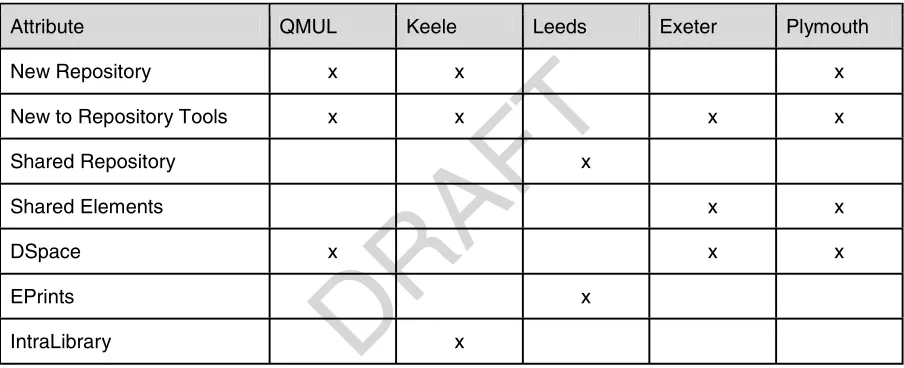
The aim of the RePosit Project was to increase use of a web-based repository deposit tool embedded in a researcher-facing publications management system – in the case of all the partner institutions, Symplectic‟s „Repository Tools‟ (see Appendix 5) linked to Symplectic Elements Research Publications Management system. Use of a common front-end that a researcher associates with all publications management-based issues should enhance the quantity and quality of full-text deposits into the institutional repositories. Tying deposit into other publications-based activities such as manicuring data for the institutional website, preparing grant applications or government returns embeds the activity more centrally in the academic workflow and demonstrates that repositories can play a part in the researcher‟s daily activities. This approach shows that a deposit mandate could be viable for the partner institutions. One of the key ideas behind the Project was to see how different institutions at different technological stages would need to approach the advocacy. Does an institution such as Keele University, with a brand-new repository as well as a brand-new deposit tool, take a different tack to an institution such as the University of Leeds, with a relatively longstanding repository and where advocacy plans have been in place for some time?
Attribute QMUL Keele Leeds Exeter Plymouth
New Repository x x x
New to Repository Tools x x x x
Shared Repository x
Shared Elements x x
DSpace x x x
EPrints x
[image:7.595.72.524.315.499.2]IntraLibrary x
Table 1: the spread of attributes at each of the partner institutions, demonstrating the spread of conditions that the advocacy programme would have to address
A key part of the Project was to develop a general advocacy strategy which could then inform a specific advocacy plan (each institution wrote a plan specific to their situation containing these strategies, for their own use and for future sharing) to be put into action. Other project work included gathering feedback from users and administrators (formally via a survey and also via more informal channels) and creating a community commentary (started through the Project‟s Google group). Alongside the discussion group, project team members used different events and conferences as forums for disseminating the Project‟s existence, activities, outputs for sharing, and so on.
project plan was the idea that training workshops would be separate events but, like with the materials, it soon became clear that the advocacy could not be separated out.
The initial project work included a review of the current status at each of the partner institutions, and a review of previous JISC project work in related advocacy or technology areas. This exercise was invaluable in ensuring that RePosit Project activity and outputs were built on previous lessons learnt. Projects and initiatives that were reviewed included: IncReASe, CTREP, Embed, Embedding Repositories in Research Management Systems and Processes and EM-Loader (full references in section 12 of this report). The results of this literature review2 then informed our planning at the second project team meeting – the key lessons being:
Create advocacy plans across institutional silos – that is Library, Computing and Research Support units should work as one team (combined advocacy across departments).
Advocacy should be tailored/targeted whenever possible – to the needs of the
department/subject area/institution (be aware of cultural differences/barriers in different institutions).
Advocacy is most effective when embedded in the organisation‟s culture and in the
researcher‟s work/life-cycle. Advocacy is not a one-off activity – need regular reminders, but also many routes to raising awareness.
Best practice tips:
o Demonstrate usability
o Don‟t use repository jargon
o Demonstrate value/benefits
o Key benefit is the one point of submission for integrated systems
Be aware of costs of advocacy materials
The project team developed a comprehensive list of benefits for using a linked RIS/repository model and then mapped these against stakeholder groups (e.g. academic researchers, senior management, librarians). Interestingly, many of the benefits were for depositing in general, rather than specifically via the deposit tool; however, any of those more general reasons could be converted by applying the „deposit tool makes it quick and easy‟ argument as well. The mapped benefits against stakeholders formed the basis of the Project‟s reusable advocacy presentation slide deck3, from which one can pick and choose the most appropriate points to use with a particular audience. Finally, advocacy mechanisms and strategies were described and listed, and the project partners were each able to develop institutional advocacy plans – aimed at their stakeholders and using those methods and strategies most appropriate to their individual context.
Mechanisms:
One-to-one sessions
Interactive info
Group presentations
Workshops
Passive info
Viral dissemination
Strategies:
Using „champions‟
Targeting new academics
Targeting early-career academics
Blanket awareness-raising
Targeting engaged groups
Top-down vs bottom-up
Carrot vs stick
Using sponsors
Creating an advocacy group
In order to test use of the slide bank, project team members developed two example presentations – one for senior managers, and one for academic researchers – drawing on the slide bank according to the stakeholder group (the slides in the bank are all marked with codes to indicate which benefit/reason/selling point should be used with which stakeholder group). During the third project team meeting a mixed group of willing „guinea pigs‟ (academics, research support staff, senior managers) agreed to give feedback on these example presentations. This testing was invaluable – giving informative feedback which was used to tailor the partners‟ institutional advocacy plans. The key feedback points were:
The presentation should be short and focused
Ensure key positive points are made early e.g. quick and easy to deposit (no re-keying of metadata)
Points relevant to „you and your research‟ will resonate most strongly with researchers (local evidence is always better, and it‟s important that researchers understand that this is a sales pitch for their research)
Concrete examples, evidence (statistics) and stories are needed to engage the audience
Include a summary slide
Leave the audience with a simple take away message – a strap line?
Alongside the advocacy plans, the Project was committed to producing designs for printed advocacy materials that could be used not only by the partner institutions but more widely by the community at large. After a couple of false starts the Project Team decided to focus in on a punchy, memorable and simple message or strap line – on two media formats, posters and postcards. Several different approaches were worked up; some examples are given below.
Spotlight on Your Research
Don't Hide Your Assets
Be Seen, Be Read, Be Cited, Create Impact [can remove „Be Cited‟ for institutions with many non-science faculties]
It's as Easy as 1,2,3... Login, Upload, Share
the person who actually did the depositing themselves. Each institution, therefore, would gather their own versions of depositor statistics and a cross-institutional analysis would not be possible. In addition, Symplectic developers wrote a report to output the number of publications in each institution‟s research management system (split out by SHERPA/RoMEO colour) as a measure of the potential deposits. These statistics are shown in Appendix 1.
Whilst advocacy activities were underway at each institution, each partner site launched a user survey. BOS4 was used for ease of sharing generic questions and for later analysis. The aim of the survey was to garner feedback on why people were depositing and what did/didn‟t work for them. Attempts were also made to access those potential users who are not depositing into their repository. The original plan was for all project partners to run a survey using five core questions centred around awareness of the repository and publication systems. It became quickly apparent after the core questions were decided that in order for the survey to run successfully at each institution local language would need to be introduced e.g. inserting PEARL into the questions for Plymouth instead of the generic term „repository‟ and so on for each site. It was then agreed that each institution would run the core five questions individually with local language inserted in specified places and each site could also add additional questions as long as it did not detract from the RePosit data. Each institution would reward a random participant with a £100 Amazon voucher as an incentive to filling out the survey and giving feedback on the services. The results of the survey are given in Appendix 3, and the analysis is explained in section 6.7.
As a project team, we had been involved in a number of dissemination events (see section 7.6), culminating in the RSP conference event held in Nottingham on 19th July 2011.
Unfortunately, there were various difficulties and delays with the implementations at both the University of Exeter and Plymouth University, resulting in less time being available for advocacy activities with a functioning connector. However, the project work was still invaluable at those sites for the purpose of preparation and also the sharing of experience and ideas. Teamwork and collaboration were key themes for the project and the joint working practices have created supportive relationships – in effect a real basis for the community-building project aim.
5. Institutional Context
5.1. University of Exeter
The work for the RePosit Project at Exeter took place against a backdrop comprised of two key activities:
an existing project relating to the roll-out of Symplectic Elements, to facilitate enterprise-wide management of research information
a shared system / service arrangement with Plymouth University, with Exeter as the supplier The activities required to produce the RePosit deliverables can be summarised in two related work streams, namely technical implementation and advocacy.
The technical work to implement the Repository Tools link unfortunately suffered various delays, some arising from the unavailability of personnel (sickness absence, change) and others arising from technical issues (workflow integration etc.). As described in more detail under the Plymouth University section 5.4, what had to be developed was actually a Multiple Repository Tools link. The technical work stream has led to closer working between the Library and IT teams, however, and also led to the production of some additional DSpace code to resolve a problem. The latter problem is not unique to Exeter, so the locally developed solution is an unexpected, but additional, output for the RePosit Project. Despite the issues, the project team is now on the verge of conducting the last remaining tests before roll-out.
The advocacy work commenced with the development of a detailed advocacy and communications plan5 (see Appendix 2). This utilised the various governance structures of the University, alongside other opportunities, to ensure appropriate and timely delivery of advocacy, to maximise exposure and ensure the embedding of the new deposit methodology in the institutional mindset. This plan has been in effect for some time and has already delivered tangible outputs ahead of the roll-out of the actual software (evidenced, in part, by the anticipation of many stakeholders for the release of the tool).
It would be amiss not to mention the shared services aspect. Whilst the arrangement has brought the two project partners closer together, a few contractual and related issues complicated the earlier part of the RePosit Project, contributing to some delay for both partners. However, following the resolution of those early issues, the team effort across both institutions has been a positive experience.
5.2. Keele University
During 2010/11 Keele University implemented its Research Repository. The University had not previously had a repository, and was therefore in a unique position of having a zero base line of deposits, with no previous awareness raising of the benefits repositories. However the University was in a good position, having already implemented its Publications database (Symplectic Elements), and the repository having a direct feed from this significantly improved efficiency. The interface was with the University‟s existing learning and teaching repository provided by Intralibrary, which had not been previously linked to Symplectic Elements, but after several months‟ technical work, Keele University and Intralibrary created an interface based on Symplectic‟s existing DSpace repository interop tools.
5
This period of technical work seems relatively short when compared to other Institutions, although this significant workload/resource should not be underestimated.
At Keele, academics „self archive‟ using the publications database to add their research object to the repository (they are not able to deposit straight to the repository as this won‟t include metadata). The publications database utilises Sherpa RoMEO data, indicating to the academic which version the publisher allows to be deposited. Due to lack of resources, and to facilitate maximum engagement with the academic community, Keele is taking a „risk management approach‟ to the repository. This means that it allows outputs to be go straight into the repository (and therefore searchable on the web), which will not be held up in a checking „workflow‟ in the library (as is the practice in some universities). There is a systematic audit of deposits, which will focus on publishers with difficult copyright permissions to ensure they have been followed. To support this approach the University has a robust „take down‟ policy to try and minimise institutional risk from inappropriate material being made available through the repository.
Once the repository interface was working, the repository was released across the University – following an advocacy plan6 with the following aims, all of which have been achieved:
Launch Keele‟s research repository
Raise awareness of the wider context of research repositories (to target groups across the University)
Encourage academic staff to embrace depositing research objects as part of their routine research process
Increase deposit activity (from zero baseline)
Incorporate this activity within the University‟s research strategy
A key part of the plan was a presentation to Research Committee, which included senior leaders from across the University. They gave their strong support to the project and invited further advocacy work, along with setting up a working group to consider the electronic deposit of etheses. Following on from this positive response from senior leaders at Research Commitee, advocacy work continued across the University, and Keele-specific advocacy materials were produced (posters and flyers). The most effective advocacy seemed to be presentations to research groups with a live demonstration of how to upload to the repository (via the publications database), where individuals felt able to ask questions directly – this often resulted in deposits following the presentation. (Note: the presentations were tailored to the users using the slide pack with Keele-specific tailoring). However, there were some colleagues who tried to upload to the repository but were quickly „put off‟. This is predominately due to issues around complicated copyright and having the correct version of a paper to satisfy the publishers‟ rules. Sometimes the RoMEO colour coding confused matters further, by providing „green‟ publishers that do not allow final version PDFs to be uploaded (which is often the only copy saved). Once academics found the process confusing, they disengaged completely with the repository.
A further key aspect which is outside the scope of this project, but was a significant contributing factor to engaging academic colleagues, was having the Publications database and repository link directly to academics‟ staff webpage profiles. Therefore, as well as the output being available in the University repository, it is also available to download from their personal webpage.
The immediate impact has been an increase in the number of (full-text) deposits to around 160. There has also been an increased awareness of repositories across the University, with some staff
incorporating this into their research-management processes. The University has recently approved and is now implementing electronic deposit of research theses for all research degree students commencing study in 2011/12 but with an option for current students to utilise this facility. Continuous advocacy work is required to remind colleagues of the benefits of the repository, and to encourage their engagement. This engagement will be strongly supported by the University at a high level, and will be incorporated in its Research strategy as part of promoting the University‟s research.
5.3. University of Leeds
The local open-access repository, White Rose Research Online (WRRO), was established in 2004. The repository mainly holds textual research outputs (etheses are held in a separate sister service, White Rose Etheses Online). Over WRRO‟s lifespan, we have demonstrated steady but modest growth. Work to embed the repository into researcher workflows has been an ongoing challenge for us, as Leeds is a large, complex institution. It has been tricky to raise and, as importantly, sustain awareness of the repository service. Symplectic Elements was, from the off, a high-profile service (borne out by our RePosit questionnaire results7), publicised and promoted widely in the context of REF. As soon as Symplectic Elements was procured there was no question that we would not link the repository to it – asking researchers to deposit into two systems was untenable. Plus, we saw the Elements link as a valuable opportunity to improve the profile, accessibility and uptake of WRRO. The repository link was promoted as part of the initial Elements roll-out – primarily through open invitation events. However, as the link between the two systems was not immediately in place, we were unable to fully exploit this early publicity. Through RePosit, we aimed to consolidate our initial work with Symplectic, ensure that the connector was put in place, feed back user experience (depositor and repository staff) to Symplectic and refresh WRRO promotion in the new „linked system‟ context.
Various groups were targeted throughout the project – primarily through presentations at formal meetings and more informal conversations about the deposit route.8 The new Elements-based deposit route was demonstrated to Library staff including subject librarians, and Library Academic Representatives. A presentation to the Library Strategy Advisory Board (LSAB) helped raise awareness of both the new deposit route and the rationale for open access research dissemination. LSAB have agreed to actively promote and support open-access (OA) deposit, commenting that the deposit route looks simple and that this simplicity is a key selling point for researchers. LSAB could also provide support for institutional drivers and incentives for deposit, which up to this point have been lacking at Leeds.
To support awareness of the repository connection, we worked closely with our central Research Office and central IT department who jointly support Elements with the Library. Monthly discussion meetings began and these have been very valuable. The main face-to-face support for Elements users is provided by a member of IT staff; he is aware that research can be deposited and has promoted awareness of the repository connection. Beyond RePosit, we will continue to share experience and work together to address common questions and problems.
Our local priorities (set by Leeds Research Board) were to target the Faculty of Engineering and the School of History. We made sure the relevant subject librarians were aware we would be targeting these two areas.
7 70% of respondents were aware of Symplectic N=255; 57% had used it N=205. NB figures include
administrative staff – the percentages for academic staff are higher –across Lecturers, Research Fellows, Senior
Lecturers, Senior Research Fellows, Readers and Professors, 90% were aware and 78% had used N=183.
The RePosit questionnaire was disseminated widely using Leeds researcher email lists and a link from the Elements home page. We encouraged researchers and administrators to complete the questionnaire. The timing (4th July to 5th August) was effective, catching staff between exams and vacation. We received a larger than expected response (N=362). All RePosit partners offered a chance to win a £100 Amazon voucher; we delayed announcing our winner with a view to making the most of publicity opportunities in the Autumn 2011 term.
5.4. Plymouth University
The research repository at Plymouth University is called Plymouth Electronic Archive and Research Library (PEARL, http://pearl.plymouth.ac.uk) and runs on DSpace software. PEARL is currently used for the direct submission of ePHDs and, since 1st October 2010, it has been mandatory for students to deposit a copy of PHDs.
Plymouth has also implemented Symplectic Elements Publications Module, which was launched here in June 2010. To date, over 30% of academic staff have logged into Publications and there are currently over 12,500 approved publications. Symplectic Elements is run as a shared service between the University of Exeter and Plymouth University and the single instance is hosted at Exeter. The Research Information Management Systems project plan outlined the implementation of Symplectic‟s Repository Tools with PEARL to integrate the two systems. Plymouth is going to use a self-deposit model. Publications then connects, via a Multiple Repositories Tool (MTR), to two separate research repositories at the respective universities. This is a unique set-up for Symplectic.
The PEARL Communication strategy9 was written in Autumn 2010. The key aims were:
To raise awareness and understanding of PEARL and the wider context of research repositories, Open Access and copyright to support and underpin key University objectives, research centre objectives and individual researcher aspirations
To gain the endorsement and support for PEARL from Senior Management and key research stakeholders such as Research Centre coordinators
To increase the number of users depositing items in PEARL and the numbers of items deposited in PEARL
Key messages included that submission is quick and easy, all within one interface, Publications, which gives benefits and meets requirements of both the researcher and institution. The strategy included awareness-raising of both the university services and the wider context, accompanied by practical information for users as core activities. This was approached in a variety of activities/methods:
Communications to senior university staff – meetings and presentations
Practical training sessions – four 90-minute sessions, demonstrating both Publications and PEARL with opportunities for practical use and questions
Producing statistics, updates and capturing real-life examples to enhance presentations and keep key stakeholders informed
Creating an internal staff support site with supporting documentation including two guides – a submission guide and a guide to interpreting RoMEO policies, using an acronym of CAVE (Conditions, Acknowledgements, Versions, Embargos) to give a sequence of steps to work through
Posters and postcards – will be produced when new university branding logos has been confirmed
It is essential to note at this point that the full communication strategy and activities have not been carried out as originally envisioned. Despite concerted efforts, the Repository Tools integration is not live and at the time of writing it is still not possible to specify a live date for the integration. The project risk of having one commercial partner with limited internal resource, together with limited resource within Plymouth University, was exacerbated by the unexpected contractual and technical issues that have beset the implementation process. The time and technical work required to implement RT was underestimated and unexpected by both the company and Plymouth. It is fair to say that the uniqueness of the set-up (the complexity of implementing a system for two universities running a single version of the Symplectic Elements software between the two institutions) and factors beyond anyone‟s control, such as staff resources, have also added some complexity and delay. It is important to note, though, that the shared service set-up only contributed to difficulties regarding contracts, which were resolved in January 2011, after which the creation of the MTR was very swift and has been mitigated by the development of an effective shared-service working partnership between Plymouth and Exeter.
5.5. Queen Mary, University of London
At Queen Mary, there had been a previous attempt to set up a repository as part of the Sherpa-LEAP (London E-Prints Access Project), which Queen Mary joined in 2005. Whilst Sherpa-LEAP was highly successful elsewhere, the then E-Prints @ Queen Mary was not, experiencing delays whilst policies for obtaining and archiving content were put in place, and momentum was lost in actively obtaining the content itself.
With a new Research Publications Management System project beginning in September 2008, an opportunity arose to both establish an institutional repository and also to introduce a simple method of deposit that would enable academics to self-deposit without the need to manually create metadata within the repository interface. Whilst there was no prior experience of mediated or self-deposit at QM, there was a perception that self-deposit using the repository interface was a barrier to deposit, due to the need for separate authentication, a new interface to learn, and the time required to create metadata.
The Communications Strategy for PubLists and QMRO at Queen Mary10 was developed in light of the lack of previous advocacy activity, with the assumption that it would be more beneficial to begin from scratch in considering advocacy for open access, institutional repositories and, more particularly, the new Queen Mary Research Online, launched on-campus in April 2010. The strategy therefore encompasses all stakeholders, methods of dissemination and communication, with a view to providing the full breadth of options for speaking about and demonstrating the benefits of both open access and this particular deposit method.
Queen Mary Research Online was publicly launched in July 2011, after a period of bug fixing and approval of a substantial corpus of content. Advocacy, particularly in demonstrating the method of deposit, began in earnest at this time.
The Communication Strategy has since been taken up as a formal College plan for dissemination and communication of information on open access and QMRO, and has therefore been included in the
Professional Services Planning Round, with the expectation that the various elements of the strategy will be both carried out and reported on.
In disseminating information, we have largely so far focussed on ad hoc one-to-one and 2-minute pitch style delivery, partly because of the time of year, with academic staff taking extended leave or undertaking research during the summer break. The main programme of advocacy will begin with a week of events around Open Access Week in October 2011.
6. Project findings and Lessons Learnt
The project was a significant learning experience in a number of different aspects.
6.1. Technological
There is a great need for deposit automation; even small barriers to use, or complexities in the process, can permanently put off potential depositors
It is easy to underestimate the challenges of integration and interoperability as well as the issues which arise from shared services. The project was significantly more complex and
time-consuming than anyone had expected.
RePosit partners were surprised by how much local customisation was required with some code needing to be written from scratch even where there are existing customers with the same repository platform. There is a risk in all situations where vendors may overstate the simplicity of the system.
Vendors should offer more structured help for connector planning and implementation
Uploading content is easy but the uploaded versions are problematic. Co-authors may not have the relevant version, which may reside with lead or corresponding author.
It is hard to collect statistical evidence about deposits; statistical reports need to be easy to generate and be based on well-defined concepts, but reliably tracking downloads and author engagement across papers with multiple authors is difficult.
Symplectic‟s RoMEO colour report breaking down potential deposits by institution was an unexpected addition to the project – being specially written to meet the needs of the RePosit community. This report would be even more effective if it could be broken down by academic unit. Some partners found this report valuable, others less so.
Institutions need to consider the degree of synchronisation between a research management and repository system: do changes in an Elements record with a live repository equivalent generate a new version of the repository record, or overwrite the live repository metadata – or, once a record has been validated, is it effectively „locked‟ in the repository so that subsequent changes in the Elements record are not reflected?
Joining up of two systems increases the file handling, complexity and load on the repository staff. System architecture and workflows should be planned in addition to managing expectations of depositors would assume files will be live upon upload.
The deposit process could be simplified by allowing depositors to agree to the deposit licence (click-through licensing) once for all items, rather than having to agree separately for each.
6.2. Organisational
With all of the partners at different stages, it was expected this would provide diversity to the project. While this is true, it also brought with it delays due to technical issues. It may have been better to wait until all partners were live before beginning the project, as that would have made the timelines easier to predict.
Staffing resources within Universities for highly technical projects are easy to underestimate, and the project suffered set-backs due to staff unavailability (illness, etc), and had to call in more staff to manage their technical projects.
Getting the system live and running the system requires two different sets of staffing resources.
Working with other institutions in a similar position was a very positive experience; the project partners had colleagues they could call on in similar positions to validate their experiences and provide advice, support and a sounding-board for ideas.
Collaboration and relationship building: people can be nervous about revealing what they don‟t know; therefore a trusted and safe community is very important for open discussion of issues. Peer discussion can be a quicker and more appropriate way to solve problems than relying on the software vendor to be able to answer more complex questions.
A shared service can add complication – but RePosit helped to bring shared-service partners together.
There‟s a passion to get the connector model to work despite the difficulties because we can see the benefits. Huge commitment from library and research colleagues.
Project management: it was useful to break the project into small workgroups. This helped individuals focus and work towards achievable goals. Without the smaller groups, actions could seem overwhelming. Skype meetings were very helpful – there was otherwise a danger of partners feeling isolated, particularly where partners were geographically dispersed.
Most project partners reported that the project meant increased working and engagement with other teams and departments across their institutions. This has provided opportunities for
discussions and raising the profile for Symplectic Elements and the repository as well as the staff managing and running these services. This heightened profile has, in some cases, extended to wider research information management issues and services.
6.3. Terminology
The RoMEO colour scheme, which is presented to users via the deposit tool, is confusing. It is valuable for domain experts such as librarians, but can be tricky for end users. Highlighting journals where the final published PDF can be made openly available would be very helpful. The RoMEO data is presented in a simplified version at the initial point of deposit; it is important that this wording does not mislead depositors. It would be useful to undertake further assessment of the optimal way to present RoMEO data via a third party system, including academics'
interpretations of publisher policies presented in this way. How RoMEO data is used may also depend on the local deposit model, for example, whether deposit is mediated or unmediated.
CRIS (or RIS) is a good catch-all term; not everyone felt it was the most appropriate description for Symplectic Elements. Discussion of the CRIS+repository model can be terminologically clunky because a variety of terms are in common use for commercial and in-house CRIS-type systems.
6.4. Policy
Publisher policies are often confusing or obstructive.
There was uncertainty over whose battle Open Access is. Is it down to the institution, the Vice-Chancellor, the Funders, individual authors or libraries – or all of the above?
Academics tend to be positively predisposed to repositories/OA but this doesn‟t often translate into deposits.
Cutting journal subscriptions may have an impact; it will bring home to academics the fact that not all material is accessible to everyone.
We need more statistics that can help with service planning and advocacy.
The results of our questionnaire confirm the findings of other studies – most academics are willing to deposit if mandated.
6.5. Advocacy
The creation of „generic‟ advocacy materials was very challenging. In addition, taking the generic materials and re-applying them to a specific situation required more work than expected.
Generic materials work to a point but really need to be institution specific – such as including screen shots from their repository and incorporating local deposit statistics – as this is what catches attention. There was some tension between generic needs and local needs, such as the choice of tag lines and images. This was highlighted by the pilot presentations delivered to a group of researchers, library staff and research support staff at the University of Leeds. The feedback given indicated that presentations should be short and concise and to have impact; they need to be institution specific and highlight the benefits to individual researchers as well as the institution; the key benefits have to match the audience and these benefits will also vary across subjects as well as institutions. This meant that the RePosit group realised they would have to edit the bank of standard slides and enhance them with specific information, local statistics and case studies.
Institutions should decide whether researchers need to know there are two systems at play in the CRIS+repository model. Depositors may become confused unless advocacy is carefully handled. Although advocating a single integrated system is attractive, this approach risks diluting or even losing the core open-access message.
Symplectic Elements and similar systems can embed very quickly into institutions, as they are at the heart of research management; potential depositors are often familiar with the system and this is helpful for both online demonstrations and in encouraging full-text deposit as a natural part of research management.
Fulfilling funder open-access mandates provides a compelling advocacy case; this case is strengthened where CRIS+repository systems link funder, grant number and associated (open-access) research outputs.
6.6. Other
The project looked at one barrier to filling repositories – the deposit method – but this can‟t be taken in isolation. There are other barriers that need sorting out. Are the rest of the barriers even more fundamental? The biggest barriers are perceived to be publishers‟ policies and the
academic deposit culture. Cultural change seems the most difficult to address.
ensure no pre-peer-reviewed content could be added. Academics can be concerned about the quality of other research deposited in the repository – they don‟t want their research to „sit alongside‟ it. Academics don‟t always grasp how repository data is exposed and used in practice.
Feedback from depositors about automatically harvested metadata is positive. However, not all subject disciplines are equally well served by the available data sources offered by Symplectic and similar systems. It‟s important not to oversell the automated elements of the system to less well-represented disciplines.
Automatically harvested metadata will vary in quality and decisions need to be made about what level of quality control will be applied; this is relevant for metadata-only and full-text records.
6.7. Survey Analysis
The user survey (see Appendix 3) was carried out during different periods depending upon the academic calendar at each institution (and also dependent on the stage of integration implementation at each partner site). Keele was the first to run the survey (1st June to 31st July), followed by QMUL (21st June to 31st July), Leeds (4th July to 5th August) and Plymouth (17th August to 9th September). Exeter decided to wait to run their survey until their linked systems were fully live. Academic activity during these periods may have affected response rates as Keele and Plymouth had very low numbers in contrast to QMUL and Leeds.
The five core questions were:
1. Are you aware that the University of X has an institutional repository called XXXX where you can upload your full-text publications and view others?
2. Have you personally uploaded full-text versions of research output into XXXX?
3. What was your incentive for uploading research output into XXXX, OR what would encourage you to upload in the future?
4. Have you not uploaded full-text versions of your research output into XXXX?
5. What would be the best means to provide you with information about uploading into XXXX? The survey results (see Appendix 4) clearly show that lack of awareness of the repository and copyright concerns are the two main barriers to deposit. Over 50% of the respondents for question 1 at Leeds and QMUL stated they were unaware of the open-access repository where they could deposit full-text materials. As Leeds had 362 respondents out of the 555 total and QMUL had 165 respondents, the data begins to reinforce what we already know about the ongoing and continuous work around advocacy. Keele demonstrated an inverse result – most likely due to the fact their repository was a new service and survey participants were directly contacted and selected. Keele respondents were a target audience already aware of the resources so those data points do not reflect the rest of the survey. Plymouth had 8 survey respondents and a new connector. Exeter has yet to run the survey due to technical delays at this point. Leeds faculty and research support staff were emailed en-masse via list-serves in addition to having the £100 Amazon voucher incentive advertised on the Symplectic homepage.
findings from question 1 – 54% of respondents stated they were unaware of the repository. Of primary importance is the fact that we have valuable data and feedback from our users but, with hindsight, the difficulties in tailoring a set of questions for each institution have led to a lack of comparator data.
The overall conclusion to be drawn from the survey responses must be: it is evident that we have even more work to do in order to embed in the research life-cycle, create easy deposit routes, and train people on copyright. However, there is a clear trend towards linking deposit with funder mandates, i.e. an increased awareness linked to recent publicity regarding EPSRC (and other) directives to deposit research – as indicated by some of the quotes:
“…. publicise it please and train me up on it!”
7. Impact
7.1. University of Exeter
With the Advocacy Plan underway, the RePosit Project has ensured time to focus specifically on raising awareness of repositories. It has led to a greater understanding of the level of knowledge/awareness of repositories and to the identification of some of the main obstacles to deposit, e.g. which version of a paper to be deposited, the signing of copyright over to publishers. This, in turn, will permit the tailoring of training materials and inform the practical advice and support delivered alongside repository advocacy.
For the Library, the Academic Support Consultants (ASCs) across all campuses have become much more engaged with repository and Open Access (OA) activities in general through greater consultation with the Repository Manager. All ASCs have contributed ideas to the advocacy activities and will contribute to their delivery. Some have already commenced, such as filming researchers, who are heavy users of the repository, talking about the benefits (with the aim of putting the films on the new Repositories website as peer-to-peer advocacy).
Cross-departmental collaboration has led to a clearer understanding of what other related activities are being undertaken across the University – particularly those that may affect the direction of repository and OA work (such as the Research & Knowledge Transfer Division – RKT). The greater communication and co-ordination will reduce duplication of effort, increase effectiveness and improve consistency of guidance.
With regards to the researchers themselves, the opportunity for new relationships with researchers has been identified, in part, for example, by using initial testers as future advocates of deposit in their academic units. These new relationships have also led to the identification of previously unknown collections of publications that could, with a little work, be uploaded via the new tool to the repository as soon as it is live.
Within the broader institution, the purpose and value of repositories is starting to be recognised more by a wider section of researchers. Part of the Advocacy Plan has been to target the Assistant Directors for Research (ADRs) in the academic Colleges, who, it is hoped, will cascade knowledge to their researchers.
Exeter Deposit Growth
7.2. Keele University
Awareness of the benefits of a research repository has significantly increased across Keele University. Coupled with this, the knowledge that Keele now has a repository and the logistics of how to deposit is widely understood. However, understanding the benefits and how to do it is one thing, but actually doing it is different.
As part of the advocacy campaign, the vibes coming from the academic community were very positive. The principle of a repository and the benefits of promoting the institution‟s research excellence were widely and strongly supported. However, the administration behind uploading each paper and checking copyright information was often seen as quite cumbersome, when academics could be spending time actually doing their research. Colleagues did comment that the Symplectic interface made deposit as simple as it could be, with minimum effort required.
Often requests were made for administrators to upload papers on behalf of academics. This was undertaken centrally where possible (when final version PDFs could be sourced and were allowed); however, in a vast majority of cases the final version PDF was not allowed into the repository so researchers would need to be contacted to supply their version of the paper. Obviously this is extremely resource intensive and therefore not possible and, even if it were, academics have commented that they often only store the final version PDF. Therefore future awareness-raising will concentrate on this aspect.
seemed to „get it‟ and deposited all of their papers, and will incorporate deposit as part of their research management process – these academics have almost become self-nominated „repository champions‟ encouraging and showing their colleagues how to deposit.
Looking back to before this project started, the University (stakeholders) has made a significant step forward in understanding and utilising its research repository. It will take some time for processes to embed across the academic community, and constant advocacy work and reminders will be needed. In some areas of the University benefits for meeting funding mandates are being recognised, along with the wider benefits of having these papers available in the repository and therefore on our webpages to promote our research excellence.
Keele Deposit Growth
7.3. University of Leeds
The Project has strengthened our working relationship with Symplectic, Leeds Research Support staff and Leeds IT staff. It has given us the opportunity to discuss and reflect upon our new IT architecture with other repository services – in both RePosit and non-RePosit institutions. This has helped us review our service from fresh perspectives and will help to inform future changes as we manage new content.
In other ways, the nature of the service has been changed – including advocacy. It‟s not possible to discuss the repository in isolation any more – depositors will make no distinction between CRIS and repository systems. In many ways this is a positive outcome as it means a larger support community – in the case of Leeds, working with the Research Office. It does mean, though, repository staff need a good understanding of Symplectic Elements and any day-to-day issues which depositors may wish to feed back e.g. extracting data from Elements in multiple formats, screen design, help text and so on. Effective communication and expertise-sharing between all those involved in supporting both the repository and the CRIS are vital to ensure we‟re all „on message‟ and providing researchers with optimum information and help. So, in essence, the complexity of interactions has increased – hopefully influencing deposit – and we are now are making inroads into the entire research lifecycle as opposed to being an endpoint file-store.
Elements is an administrative system with a comprehensive record keeping function. Should the link to this type of research support system change our collection policy for the linked repository? We have always targeted open-access content for the White Rose repository – and continue to do so. However, academics may naturally want to deposit various stages of an academic work, including any final published versions, in one place. We need to consider whether a repository has a revised function in this environment – to complement the CRIS by enabling the deposit and curation of any and all versions of a work. Leeds has not reached definite conclusions about this yet. Of course, whatever approach we take, we will have to be careful that the difficult task of collecting research for open dissemination does not take a back seat.
Implementation of the connector was not without growing pains. Early technical difficulties with the repository connector had a knock-on effect on advocacy. In our experience, instituting a repository connector consumed much more staff time than we thought it would; it is not „plug and play‟. Connection is particularly complex where there is a body of pre-existing repository records which must be „linked‟ to their Elements counterparts. We were a relatively early adopter of both Symplectic and the EPrints connector so there was limited repository community knowledge and support to draw on. We were concerned – perhaps too concerned – about making „wrong‟ decisions about how the two systems should interact. Early testing also suggested the connector could overwrite and degrade validated metadata in EPrints records. So, although our Elements-to-EPrints connector was up and running early in the RePosit Project and academics were able to deposit, technical concerns held us back. In retrospect, this was an error – we should have actively promoted the link in any case. The deposit mechanism was not perfect, but it was effective from the depositor perspective albeit less satisfactory from the repository staff perspective.
The Elements/EPrints link is not a magic bullet. Departmental variations in deposit behaviour have been carried over to the new environment: those who are engaged with OA continue to be so; those who are not won‟t suddenly be converted because of a deposit route change. Two short case studies may serve as examples.
Leeds Engineering Faculty
generate a list of Elements publications with and without documents attached. Our questionnaire shows awareness of WRRO is good in Engineering compared with other Faculties11. So the key challenges to improve uptake are technical improvements and reminders to deposit.
School of History
Historians did not deposit much into WRRO and on the whole do not deposit using the new route. In part this is due to lack of awareness – there is much more we need to do locally to promote the service. However, in contrast to the Engineers, some Historians feel open access is not relevant, even inappropriate, to their discipline and choose to expose their research via different vehicles on the web. Here the challenges are more fundamental – explaining and advocating open access, raising awareness of research funder policies and so on. Technical considerations will follow later in terms of which repository is most appropriate to house their outputs. Initial advocacy to History has helped us to understand disciplinary differences and we have established a supportive local contact in the School to work with the team post-RePosit.
The EPSRC mandate12 in June 2011 proved a very timely and useful advocacy tool; it prompted more enquiries and requests for information/presentations than anything else in the RePosit project period. The continued evolution of research funder policies gives us yet more common ground with our Research Office colleagues and good reason to work very closely together for our mutual benefit. We have collected deposit statistics throughout the project, and plan to collect very similar statistics into the future to monitor deposit patterns.
Leeds Deposit Growth
11 Based on our RePosit questionnaire 76% of Engineers are aware of WRRO compared with an average
awareness of 42%. NB these figures include research and administrative staff. WRRO awareness amongst researchers, particular senior researcher, is higher: 71% of Senior Research Fellows, Readers and Professors are aware of WRRO N=93. Questionnaire N=362; Engineers N=49)
Deposit (using the Symplectic Elements Full Text tab) by Faculty
7.4. Plymouth University
The repository statistics do show an increase in holdings in PEARL; however, this relates to ePHDs which have either been self-deposited directly to PEARL by students (the advocacy for this happened outside of RePosit activities) or as part of bulk uploads by Library staff. The large increase seen in May/June was due to a retrospective digitalization of paper PHDs which was done by Library staff directly into PEARL.
Gaining feedback from staff on the integration tool, using piloting on Test systems and the RePosit survey have all been used to inform the support documentation and advocacy materials. Staff need more clarity around copyright, publishers‟ policies on RoMEO, RoMEO colours and versions/terminology. The overall response was that the process is simple, but it is the consideration of whether an output can be submitted and/or which version that takes the time and causes confusion. Researchers reported perceived benefits such as meeting funder requirements and having a sustainable and open-access location to store grey literature, conferences and supporting evidence for REF Impact statements. A key benefit was raising the external visibility of research via surfacing the information from Publications (Symplectic Elements) and PEARL on Staff Personal Profile Pages. These benefits will be highlighted in future advocacy activities.
highlighted the integration between the systems and introduced the idea of managing the record as well as the full text. The integration did cause some confusion especially as session leaders were also discussing the integration of Publications with PPPs, and staff were getting confused over the systems and the connections between them. The integration also exacerbated users‟ concerns around Publications especially with the extent of their research outputs picked up by the automatic harvesting and misconceptions around this, what can be added to Publications/PEARL and concepts of quality and submission to the REF. These concerns are now explicitly addressed in training sessions.
The advocacy highlighted that, for some researchers, the concepts were familiar so they were more likely to see the benefits. For others, the contents of the session were completely new and as they could not see an immediate need, which in many cases was reinforced by a lack of perceived benefits, or lack of relevant publisher information on RoMEO, some concluded that „PEARL was not for them‟. The Pilot demonstrated that it would be best to roll out faculty by faculty as opposed to the whole institution at one time, in order to have the staffing capacity to provide support as well as addressing the often subject-specific nature of questions and concerns.
The long-term aim is to continue the discussions about Open Access and PEARL with senior university managers to secure their endorsement and support for PEARL. This has started with a presentation in May 2011, but it was felt not sensible to fully roll out the communications strategy and activity plan without the live integration to give coherence as well as a need to place the emphasis on securing endorsement for Publications first. Open Access Week, beginning 24th October 2011, is seen as a key milestone and activities are planned which build on the work started and advocacy materials created during the RePosit Project.
The RePosit Project has seen an increase in joint working and closer links across directorates within the University, especially ILS (Information and Learning Services) and R&I (Research and Innovation). This has seen more sharing of information and opportunities to input professional knowledge to achieve project objectives and key University missions. The shared service between Plymouth and Exeter has been a learning experience and can provide examples of best practice for other potential opportunities which seek to create business efficiencies, sharing of good practice and building of professional links between universities and other organisations.
Plymouth Deposit Growth
7.5. Queen Mary, University of London
From the survey results, particularly comments to some of the later questions, there are a number of issues regarding uptake of Queen Mary Research Online (QMRO); the simplicity of upload being a minor issue compared to awareness of the service, concerns about copyright and all the usual concerns regarding open access more generally. This indicates that there is much work to do to raise awareness of QMRO, to reassure academics and their administrative staff of the mechanisms in place to ensure compliance with copyright restrictions, and to more actively outline the real benefits of open access. Whilst there are a few, as with all institutions, who are actively against open access in principle, or perhaps see it as an additional responsibility that there isn‟t the time or inclination to engage with, many respondents simply needed more and better information on what they need to do, and how the two systems, the Publications Management System (PubLists) and the Repository (QMRO), work together. This was perhaps a missed opportunity during the year, due partly to the ongoing technical issues that needed to be addressed and a failing in terms of advocacy, to talk about open access in preparation for a time when the repository would be available publicly. These are straightforward issues to resolve, and perhaps therefore may lead to better and more widespread engagement in the future.
From a personal perspective, working more closely with the Planning Office (Research), Research Office and Vice-Principal (Research) has enabled me to raise expectation of the delivery of the repository, and also new initiatives to engage academics with open access, make them more aware of how QMRO can help them to meet funding-body requirements or increase awareness of their research, and help prepare for REF2014. Additionally, I have had the opportunity to make contacts with administrators within Schools, who do still tend to be the people to upload content, and who therefore need support and information regarding the work they are asked to perform. They too could become champions in the future and also act as a conduit to forward enquiries to me as the Repository Manager.
Having a fully outlined Communications Strategy has provided me with a springboard from which to begin talking about open access and encouraging people to engage with it, and also to help people understand what and how to meet the terms of their funding. It has also helped me to identify how much time and what resource needs to be invested in these activities in order to be able to both successfully deliver the strategy and realise its aims.