Rochester Institute of Technology
RIT Scholar Works
Theses
Thesis/Dissertation Collections
5-2015
Handi & V
Fenway Wei Fan
Follow this and additional works at:
http://scholarworks.rit.edu/theses
This Thesis is brought to you for free and open access by the Thesis/Dissertation Collections at RIT Scholar Works. It has been accepted for inclusion in Theses by an authorized administrator of RIT Scholar Works. For more information, please [email protected].
Recommended Citation
Handi & V
By Fenway Wei Fan
SUBMITTED IN PARTIAL FULFILLMENT OF THE REQUIREMENTS FOR THE DEGREE OF MASTER OF FINE ARTS
IMAGING ARTS/COMPUTER ANIMATION SCHOOL OF FILM AND ANIMATION COLLEGE OF IMAGING ARTS AND SCIENCES
ROCHESTER INSTITUTE OF TECHNOLOGY ROCHESTER, NEW YORK
May 2015
____________________________ Stephanie Maxwell
Chair, Professor
School of Film and Animation
____________________________ Tom Gasek
Associate Professor
School of Film and Animation
____________________________ Brian Larson
Assistant Professor
T
ABLE OF
C
ONTENTS
A
BSTRACT III
ACKNOWLEDGEMENTS
IV
1.
M
OTIVATION 1a) For animation study 1 b) For thesis production Handi & V 2
2.
R
ESEARCH 3a) Story 3 i. Movies 3 ii. Animations 5 b) Art 6 i. Artists 7 ii. Books 7 iii. Location Research 8 c) Movements – study of a variety of animation styles 9 i. Disney style 9 ii. Limited – UPA 9
3.
WHAT TO ACCOMPLISH
10a) Story 10 b) Design 11 c) Animation 11
4.
H
OWI
MADEH
ANDI&
V
–
S
TEP BY STEP 11a) Design 11 i. Character Design 12 ii. Environment Design 17 b) Storyboard 19 c) Animation 21 d) Sound Effects 23 e) Postproduction 24 f) Twisting and Refining 24
5.
DIFFICULTIES
25a) As an International Student 25 b) As a Pregnant Lady –
My Healthy Way of Working! 26 c) Get ready for Any Unexpected Problems 26
6.
CONCLUSION
28a) My MFA Study at RIT 28 b) My Wonderful life in the U.S. 29
7.
A
PPENDIXA-‐F
30-‐55
ABSTRACT
Handi & V is a 5-minute, 38-second long animated graduate thesis film that is a
story about Grandpa V and his journey through time. After Grandma Handi passes
away, Grandpa V lives in sadness. One day, he finds a picture is missing from their
family photo album. He begins hallucinating and then travels back through the time of
his life with Grandma Handi.
This film is a 2D computer animation that was mostly produced in Toon Boom
animation software. It was created in full color and has an original music track.
This paper outlines the whole film creation process from the very beginning, my
motivations, research, and idea development until finishing with conclusions. It
describes all my inventions, obstacles, failures, and successes, as well as the technical
ACKNOWLEDGEMENTS
My deepest appreciation goes to my thesis advisor, Professor Stephanie Maxwell,
who’s always there for me, not only pointing out trenchant academic solutions but also
giving the most helpful suggestions for life as a true friend.
I would also like to express my gratitude to my thesis committee members,
Professor Tom Gasek and Professor Brian Larson, who gave me many practical
suggestions while developing Handi & V.
In addition, I would like to express special thanks to my husband Jinkai Qian and
classmate Kefeng Nai, who contributed their ideas in developing a more creative and
full story. I also thank Jack Heiter, who shared a wealth of information on the UPA and
encouraged of my artistic style.
Lastly, I want to thank my family and friends for their support, including my baby,
who kicked me inside me and kept me full of energy throughout my thesis.
I could not have achieved success with Handi & V without those mentioned above.
MOTIVATION
a. FOR ANIMATION STUDY
I was lucky to be in the generation of children in China that grew up with many
beautiful animations from all over the world. One of my favorite masters of animation
is Hayao Miyazaki1. Every time I watch his films, even the same work over and over, I
experience new thoughts. I not only enjoy the beautiful images and become addicted to
the story, I also find myself through the movie and after thoughts. I always look at
things in a positive manner and Miyazaki’s films make me feel like doing great things
after I watch them. I think animation has the magic power to spread hope and plant new
dreams in people’s heart, which is especially meaningful for a young heart.
When I was about 13 years old, I once read a short paragraph on the DVD of an
animated film made by Studio Ghibli2, Grave Of The Fireflies3. I watched this animated
film in tears. It communicated something I will never forget, and the short paragraph
stated that everyone who sees this film will think Japan is the country that was harmed
most in World War II, when actually China was injured a thousand times more. I was
sad and angry when I read this. Why? Why don’t we make animated films like this?
Aren’t we brave enough to express our anger? Do we lack talent? I asked myself many
1 Hayao Miyazaki is a Japanese film director, animator, producer, and screenwriter. Through a career that has
spanned over fifty years, Miyazaki has attained international acclaim as a maker of anime feature films and, co-founded Studio Ghibli, a film and animation studio.
2 Studio Ghibli is a Japanese animation film studio based in Tokyo, Japan, which has produced 18 feature films. 3 Grave of the Fireflies is a 1988 Japanese animated drama film written and directed by Isao Takahata and
questions and then suddenly an idea flashed in my mind- I can be that person to create a
great film about war in China in the future! But, before this I would need to acquire
lots of knowledge, accumulate many experiences, and raise a lot money… That began
my motivation for animation study. Even though I might not create a film just about
war in China, I would definitely set my goals as high as those as the 13-year-old girl
years ago. This dream was firmly rooted in my heart firmly all those years ago and it
continues to grow healthy and strong.
Gradually, I was able to study what I love with support from my family.
b. FOR THESIS PRODUCTION, HANDI & V
It was a cold winter in January when my Grandma passed away, shortly after our
Christmas together in China. Her sudden disappearance left my Grandpa and my whole
family in sorrow for a very long time. We tried everything we could do to cheer up my
Grandpa. Grandma and Grandpa had been such a loving couple for more than 50 years,
and my Grandpa suffered greatly after his wife was gone. Their love story had always
touched me very deeply. So, I decided to create a film not only to cheer my Grandpa
up, but also to cheer everyone who watches it.
During my study in RIT, I got a chance to learn about the United Productions of
America (UPA)4. I was so addicted to the innovative, fun, and beautiful art that the
UPA artists created! Also, during my summer internship at Curious Pictures in 2012, I
was asked to work on a segment of a commercial that needed the UPA4 style. That was
4 United Productions of America, better known as UPA, was an American animation studio active from the
the very beginning of my journey with UPA. It was a great experience and I found
myself so smoothly and spontaneously suited to the UPA art style. My work on this
commercial was applauded by everyone on the production, including our clients.
I was rather sad on the demise of the UPA. My desire to continue the great UPA art
form became very strong. Therefore, I decided to illustrate and animate my thesis in my
own interpretation of the UPAstyle – as a tribute to the artists of United Productions of
America that I admire.
RESEARCH
a. STORY
I struggled hard with the story. At the proposal stage, I had an outline based on the real love
story of my grandparents. At first, it was just bits and pieces of memories I had of them,
beautiful or tough, linked together in a dream-like journey through the sky.
Later, my husband, Jinkai Qian suggested that I should have something more relatable for an
audience. The images would be beautiful, but my story was a bit plain and no one would care
about a simple story of an old couple. Then, he gave me the idea of using a time travel approach,
which would highlight the whole story.
So, I changed the story and did a lot of research on movies and animations that had anything
related to the manipulation of time.
I drew the conclusion that for this kind of film with a time theme there are two
ways back in time: One is to attend past events with affection, and the other is to attend
past events without affection. In addition, there are two ways of attending the past,
either as a first person experience or as a third person experience. The complexity of
the story depends on how the characters attend the past, how many affections they
create in the past, and if those affections influence present or future events. Sometimes
there are difficulties in concluding the results caused by a series of time issues.
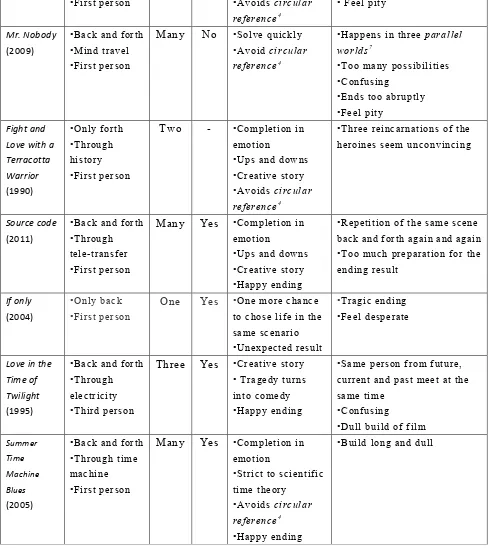
In the table below, I made comparisons in the advantages and disadvantages of
different solutions of time travel in different live action movies.
[image:9.595.67.557.399.660.2]
Table 1- Comparison on Time theme films (Live action) Name Means of Travel Occurr
ence
Affec tions
Advantages Disadvantages
The Time Traveler's Wife
(2009)
•Back and forth •Nature ability •First person
Many Yes •Warm story
•Completion in emotion
•Problem solved
•Travel too many times •Confusing
•Lacking excitement
Somewhere In Time
(1980)
•Back and forth •Spirit
•First person
One Yes •Completion in
emotion
•Tragic ending
•Created Chicken or the Egg
dilemma5
Mannequin
(1987)
•Only Forth •Spirit •First person
One - •Warm story
•Completion in emotion •Avoids circular reference6 •Predictable ending •No surprise
Jumanji
(1995)
•Back and forth •Magic prop
Two No •Completion in
emotion
•Happens only in one parallel world7
5 The chicken or the egg causality dilemma is commonly stated as "which came first, the chicken or the egg?"
To ancient philosophers, the question about the first chicken or egg also evoked the questions of how life and the universe in general began.
6 A circular reference is a series of references where the last object references the first, resulting in a closed
•First person •Avoids circular reference4
• Feel pity
Mr. Nobody
(2009)
•Back and forth •Mind travel •First person
Many No •Solve quickly
•Avoid circular reference4
•Happens in three parallel worlds7
•Too many possibilities •Confusing
•Ends too abruptly •Feel pity
Fight and Love with a Terracotta Warrior
(1990)
•Only forth •Through history •First person
Two - •Completion in
emotion
•Ups and downs •Creative story •Avoids circular reference4
•Three reincarnations of the heroines seem unconvincing
Source code
(2011)
•Back and forth •Through tele-transfer •First person
Many Yes •Completion in
emotion
•Ups and downs •Creative story •Happy ending
•Repetition of the same scene back and forth again and again •Too much preparation for the ending result
If only
(2004)
•Only back •First person
One Yes •One more chance
to chose life in the same scenario •Unexpected result
•Tragic ending
•Feel desperate
Love in the Time of Twilight
(1995)
•Back and forth •Through electricity •Third person
Three Yes •Creative story
• Tragedy turns into comedy •Happy ending
•Same person from future, current and past meet at the same time
•Confusing
•Dull build of film
Summer Time Machine Blues (2005)
•Back and forth •Through time machine •First person
Many Yes •Completion in
emotion
•Strict to scientific time theory
•Avoids circular reference4
•Happy ending
•Build long and dull
ii. Animations
There are also many, great animated films with time themes. Compared with the
live action films they are more fantastical and flexible with both time and space. Good
[image:10.595.67.556.78.627.2]
examples include: Memories8 (1995), Paprika9, The Girl Who Leapt Through Time10
(2006), Millenium Actress11 (2001).
At the conclusion of my research on the story for my film, I found that there were
several things that needed to be reckoned with while developing the plot:
• Traveling back and forth too many times can bring a lot of confusion to the
audience.
• Only back or forth only travel helps to possibly avoid circular reference4.
• Travel with a first person experience can simplify the story.
• There doesn’t need be a scientific reason for how people travel through time.
• It is better to have a solution for a completion in emotion at the end of the story.
b. ART
I did a lot of research on art styles, including traditional art media, like pastel, watercolor,
chalk, color pencil, oil painting, and computer digital art media. Since I had decided to create in
the UPA4 style, I concluded that a digital - vector painting style would work best.
8 Memories is an anime produced in 1995 by artist/director Katsuhiro Otomo that is based on three of
his manga short stories. The film is composed of three episodes: Magnetic Rose, Stink Bom and Cannon Fodder.
9 Paprika is a 2006 Japanese animated film co-written and directed by Satoshi Kon, based on Yasutaka
Tsutsui's 1993 novel of the same name, about a research psychologist who uses a device that permits therapists to help patients by entering their dreams. It is Kon's fourth and final feature film before his death in 2010.
10 The Girl Who Leapt Through Time is a 2006 Japanese-animated science fiction romance film produced by
Madhouse, directed by Mamoru Hosoda and written by Satoko Okudera. Makoto Konno, a teenager who inadvertently gains a mysterious power. She learns from her aunt Kazuko Yoshiyama—protagonist to the original story—that she has the power to travel through time. Makoto begins using the time-leaps frivolously to fix problems.
11 Millenium Actress is a 2001 Japanese anime film by director Satoshi Kon and animated by the Studio
i. Artists
As I continued my research, I found there were many inspiring early artists in industry.
Mary Blair’s12 art inspired me with her colorful, simple and fantastical worlds. One of my
favorites, Al Hirschfeld13, was good at using extremely beautiful and simple lines to build fun
shapes of characters. Also, JohnandFaith Hubley14, who had worked on many amazing UPA
animations, like Rooty Toot Toot15. These artists are the most famous early artists that I admire.
There are also lots of great artists who are currently active in the animation
industry that have also been an inspiration, including Peter Sève16, Nico Marlet17, Carter
Goodrich18, Bill Plympton19, and John Dilworth20.
ii. Books
There are two books I personally think are great for UPA research, When Magoo
Flew by Adam Abraham and Mister Magoo’s Christmas Carol by Darrell Van Citters.
12 Mary Blair (October 21,1911 – July 26, 1978) was an American artist who was prominent in producing art
and animation for The Walt Disney Company, drawing concept art for such films as Alice in Wonderland, Peter Pan, Song of the South and Cinderella.
13 Albert "Al" Hirschfeld (June 21, 1903 – January 20, 2003) was an American caricaturist best known for his
black and white portraits of celebrities and Broadway stars.
14 John Hubley (May 21, 1914 – February 21, 1977) was an American animation director, art director, producer
and writer of traditional animation films. Faith Hubley (September 16, 1924 – December 7, 2001) was an animator, known for her experimental work both in collaboration with her husband John Hubley, and on her own following her husband's death.
15 Rooty Toot Toot was a Academy Award winning UPA animation directed by John Hubley in 1951. 16 Peter Sève is an American artist who is best known for his character design work in Ice age.
17 Nico Marlet is a French-American animation artist and character designer. He is best known for his character
design work in Kung Fu Panda and How to Train Your Dragon.
18 Carter Goodrich is an American artist who is best known for his character design work in Despicable Me,
Brave and Finding Nemo.
19 Bill Plympton is an American animation artist, director best known for his 1987 Academy Award-nominated
animated short Your Face.
20 John Dilworth is an American animation artist, best known for his animated short, The Chicken From Outer
Adam’s book is about the rise and fall of this unique American enterprise and is based
on many interviews with former UPA employees and their families. Darrell’s book
presents, in a more visualized way, the creation of the classic animated Christmas
special with many first hand pictures.
iii. Location Research
During my preproduction research, I was lucky to get the chance to spend time in
different places, like New York City, Washington D.C., and Shanghai. On weekends, I
often spent a day or two in museums, galleries, or parks. Either to gain inspiration from
so many art forms or to do sketching using new tools.
While I was in Shanghai, my Grandma’s hometown, I wandered through the
historical districts, enjoying the old buildings, and imagining my Grandma’s world
from decades ago.
Also, I spent a week back in my hometown of Wuxi, where I stayed with my
Grandpa in the apartment where he and my Grandma had once lived together. It looked
quite different to me than when my Grandma was living there, even though nothing had
been moved, replaced or taken away since she passed away. I could feel the emptiness
and how empty my Grandpa’s life had become without my Grandma. The action in the
beginning of my film, Handi & V conveys what I experienced in their living room – the
emptiness of the echoing cuckoo clock, their deeply sentimental photo album, and the
interruption of thought because of the often reflection on the past. Truthful emotions
Therefore, my location research was very meaningful and important in the development
of Handi & V.
c. MOVEMENTS – STUDY OF A VARIETY OF ANIMATION STYLES
The study of animation styles is the most fun part of researching – I can spend days on
watching different animations with a great excuse. I reviewed all of my favorite classical
animated films created by Disney21, UPA, and StudioGhibli and studied their different
styles of movements.
i. Disney style
I started with Disney’s most classic films, like Cinderella, Sleep Beauty, and
Beauty and the Beast. Just like their magnificent art style, the movement in these films
is extremely fluid and lively, almost close to the reality. Meanwhile, we can find all the
animation principles in Richard Williams’s22 Survival Kit23 in Disney films. The
Disney animations were usually drawn in single frame, 24 frames per second. That’s
why they had the best movement quality, even though this required more time and
budget.
ii. Limited – UPA
Compared to Disney2 1, the limited animation that UPA animators made always use
as few frames as possible while playing with visual illusions that create a perception of
21 Disney is an American diversified multinational mass media, is the largest media conglomerate in the world
in terms of revenue, and established itself as a leader in the American animation industry before diversifying into live-action film production, television, and travel.
22 Richard Williams is a Canadian-British animator. He is best known for serving as animation director on
Disney/Amblin's Who Framed Roger Rabbit.
23 The Animator's Survival Kit: A Manual of Methods, Principles, and Formulas for Classical, Computer,
smooth movement. Also the UPAstyle of movement is more exaggerated, artistic, and
funny. The films were designed to move in a more innovative way, which personally I
love more. I believe this limited animation technique is magic, and it takes time and a
creative mind either to practice or develop this style. Another advantage of limited
animation is that budget is smaller and it is also very suitable for individuals who need
to complete animations in short periods of time.
WHAT TO ACCOMPLISH
Before I started production, I made a plan for myself that listed all the things that needed to
be accomplished during a first couple of months.
a. STORY
Although the story is based on my grandparents’ love story, there would be added some
fictional elements that would bring the whole story to a more creative level and add
entertainment for the audience.
Here is a list of what I needed for the story:
•First person travel experience
•Avoid circular reference
•Completion in emotion
•Warm story
• Happy ending
I was also very lucky to have the help of one of my classmates, Niky (Kefeng Nai),
who was a scriptwriter before coming to RIT, and who helped me develop the ending of
my story.
b. DESIGN
My goal for design was to, basically, fit the UPA style with my own fresh and original
touch: simple, elegant, colorful, and beautiful graphical outlines. Design was related to different
themes within the story, and also to different emotions.
c. ANIMATION
I studied and developed possible limited animation techniques, and then experimented with
them to see if they were suitable in my production. There would be tests in Flash24 and Toon
Boom25 before I started animating. The qualities I wanted for the production were: exaggerate,
smooth, efficient, stylize, and lively.
HOW I MADE
H
ANDI&
V
– STEP BY STEP
a. DESIGN
Design was my favorite part and also one of the most important stages of this film,
since I needed to both capture the spirit of UPA and also achieve my own artistic style.
After recalling the story in my mind with wonderful music, I started to capture the
images that flashed in my mind with quick sketches.
24 Flash is a vector based animation software, owned by Adobe company.
Picture 1- Concept sketches, pastel on color paper
i. Character Design
There are three main characters, Grandpa V, Grandma Handi and the Clown. The
first two are based on the real images of my grandparents, and they needed to be
recognizable to anyone who knew my them.
Picture 2 - Some possible styles (pencil sketches)
After sketching some possible styles, I began to study the facial characteristics of
Picture 3 – Photos of my grandparents
Picture4 – Facial study sketches (pencil on paper)
The way I approached this study was to make a traditional life drawing first to help
me understand Grandpa’s facial characteristics better. Then, secondly, I exaggerated
and made the caricature. And then, thirdly, I placed different shapes of faces, eyes,
noses and mouths together to test for more possibilities. At last, I chose my favorite.
Similarly, the steps described above can be applied to body shape development.
The final design of the Grandpa V character (young and old) is seen in Picture 6.
I use the same procedure to create the design of the Grandma Handi character (see
Picture 7). The final designs of all the other characters in the film can be seen in
Picture 8.
Picture 7 – Final design of Handi (digital illustration)
ii. Environment Design
During the testing stage, I was struggling on how complex the environment design
could be. Since the story was mainly located in my hometown, I was thinking of
bringing in more elements of Chinese culture. Two of my very first street designs can
be seen in Picture 9.
Picture 9 – First design of a complex, desperate street (digital illustration)
However, I quickly realized that I couldn’t make such complicated backgrounds
because my timeline didn’t allow me to spend more than 20 hours on a single
background and the style also didn’t fit the simple, elegant design theme. So I
simplified my environments, as can be seen in Picture 10.
With the notion of “simple” kept in mind I did all the background designs in about
three hours each. I also chose a different color for each different theme – bright and
colorful for happy themes, and dark and dull for sad ones. See Picture 11-13 for more
designs.
Pictures 11-13 –Wedding/ Egypt trip/ Grandpa sees Handi for first time (digital illustrations)
As for the design of the interior home sets, I made the room furniture layouts
according to the real life layouts of my Grandpa’s living room. See Picture14.
There is a great contrast in design with the Hope Shop. The first time the interior of
the Hope is seen, it is a fantasy place that differs from the desperate nature of the street
environments. And there is a Clown shop assistant who produces the magic Time
Capsules for Grandpa V to swallow to be able to travel into his memories. So, I made a
continuity of design for the exterior and interior of this place and the Clown. When
Grandpa V desperately returns to the Hope Shop for the second time, it is meant to be
just an empty, poor space without any “hope”. Therefore, I made the shop dark with
low saturation, and with the same layout as before, but everything now looking shabby
and poor. See Picture 15.
Since it is very happy times when Grandpa and Grandma travel around the world, I
designed the map scene to be colorful and bright. See Picture 16.
Picture 16 –Map design (digital illustration)
b. STORYBOARD
According to the story, I sketched every shot and made changes back and forth several times
on the advice of my committee. Every time we made changes together, we tried to cut shots or
concentrate them into fewer ones while demonstrating a clearer story at the same time.
Here is a visual example of the three steps I took in developing my storyboards for the
same shots:
• STEP 1: Pencil draft with basic color tone (see Picture 17).
• STEP 2: Digital layouts with a well-formed frame style. See Picture 18.
Picture 18–Digital draft of storyboards
Picture 19–Digital shotlist with updated contents
At the end of the above stepwise process, a more detailed and specific
storyboard was created, called the Shotlist here because it seems like more shots,
but it also develops simpler and smoother animations for later on. (Please see
Appendix E for a full detailed Shotlist.)
c. ANIMATION
Animation was another very important stage for this film. Since UPA is renown for its fun,
exaggerated and stylized limited animation, I also needed to include these qualities in my work
to achieve the UPA-like style. On the other hand, I went back to China for two months from
December 2012 to late January 2013 for my Chinese wedding without working on the film.
When I returned to the States, there was less than three months left for me to finish the work.
over and over again. I would play clips frame by frame to understand how their limited
animation worked. I thought it was more important to clarify a smarter way of working rather
than having to put in more hours that I didn’t have. So during the first two weeks I took time
learning and testing , and finally I developed my own way of limited animation.
There are three techniques I used quite often:
Technique 1: Reverse and repeat
Picture 20 – Animation test for 1st shot
As Picture 20 illustrates, from A to B I drew 7 frames. By reversing and repeating the
illustrations in the sequence three more times, I made a 2-second animation for the 1st shot of the
film with just 7 frames. This technique can be found in many places in my film. Sometimes I
would also change certain frames during the repeating process in order to make the repeating not
that obvious.
To create a big contrast in subtle and broad movements, I created more holds for emotions
like sadness, shock, romance, etc. and I used jump cuts between two different poses in two
frames for quick actions like a sudden stand up, bursting out crying, etc.
Technique 2: Animate only one part
One efficient way in UPA animation was to create a lot of still characters/objects
with only one part moving. This is what I did for Grandpa in the shot when he is
running on the street. Grandpa’s whole character is a still image with only his legs
moving in a back and forth looping of his animated legs. So, it creates the illusion that
the character is actually running. This is really a time saving way of animating.
By using these techniques, along with a good time management, I finished all
animation within two months. And, I was pregnant at the same time. I will demonstrate
more of my healthy way of working in later chapters. I'd say, nothing’s impossible as
long as you believe.
d. SOUND EFFECTS
Sound effects for this work were something that I thought about from the early stages, even
earlier than the storyboard. As the story went through my mind, there were sound effects in my
brain too. So, as soon as I put all the images from Shotlist together I was able to find what I
needed very quickly from a sound library, and I finished a lively animatic within three days.
Thanks to planning ahead, I was on the right track for sound all the time, and I didn’t change
much on this from the beginning to the end.
The most difficult part for sound effects was when I had to search for world music for the
needed to reflect the different cultures at the locations on the map. I spent almost the whole last
week of the production researching and adding on those little pieces of music. The result turned
out to be very great though.
e. POSTPRODUCTION
This was a more relaxed stage for me. As soon as I’d finish a shot, I’d put together all the
image layers in After Effects and see how it worked. If it was not working out nicely, I would go
back to Toon Boom and revise the details and then export to After Effects again. By doing this, I
always kept a clear mind on what was going on in the compositing. Also, it was more convenient
to report to my adviser in a more complete form of progress every two weeks. So, by the time I
finished my last shot, the film was 99% complete.
f. TWISTING AND REFINING
There were still two weeks time when I finished all the animations include a full credit.
During the last two weeks I had several meetings with all my committee members and also
joined two critiques with a group of people. I took most of the suggestions and made changes I
thought were beneficial. One of my favorite things after production is listening to feedback. As
long as I still have some time I would make changes to improve the work.
The film was originally titled as “Handy”, which is my grandma’s name, while the English
word ‘handy’ has a different meaning that might confuse the audience (handy means convenient
or useful). And, it was suggested I think about changing it, especially since the story is about
musical notation in the map shots. Other changes were small detailed things for both animation
and music.
DIFFICULTIES
Producing my own animated film is the most fun thing in the world! On the other hand,
there were some difficulties I need to overcome, too.
a. AS AN INTERNATIONAL STUDENT
I grew up in China and was educated in a traditional Chinese way - eat rice, speak Chinese,
take all kinds of exams, work very hard, stay on top all the way amongst the high volume of the
Chinese student population in order to get into the best middle school, high school and college.
We call it “Hard” mode because we have so many “have to” expectations. In the States,
education is in a more open and relaxed mode - students tend to have more independence and
self direction. The two different ways of education create different ways of studying and
thinking. In addition, cultural diversity and language issues presents the dilemma of how one
should make a film that can be accepted by audiences from both western and eastern countries?
This makes the contents/story of the film even more critical and challenging.
Since it is not a problem for people from my culture to accept my film, I concentrated on
how to make it more successful in the States. I spent time doing researches on western culture, I
watched a lot of classic films, talked with friends here and tried to think in the way like most
Americans do. Gradually, I was able to find a kind of balance, and I felt I understood both
cultures. I find that all human beings actually share the same love for all the beautiful things --
Language was another main challenge. Though I started leaning English in primary school,
and I passed all my tests in order to attend RIT, it was still a second and I felt I could not
compete with native speakers. So, I needed to spend more time on reading, writing and making
myself understood by all. It might be difficult at the beginning but I believed as long as I put my
heart into it, it would get better and better.
b. AS A PREGNANT LADY – MY HEALTHY WAY OF WORKING!
It was my family plan of having a baby. I was glad to learn of my pregnancy in January
2013, the time when I was about to be back at work. That meant which I needed to overcome all
the sickness of pregnancy, get good rest and produce the film at the same time! Meanwhile, I
also planned to work on my portfolio. It was a lot of work for me to accomplish in three months!
So I sat down and made a daily plan and schedule for myself.
Basically I worked six days a week, rested for one day and going out and doing sketches. I
got up 8:30am everyday and went to bed at midnight. I divided everyday into seven working
shifts. One shift for an hour and a half. I planned five of them for just working on my film, and
the other two for working on my portfolio. Between every shift I took a 30-minute break, either
checking emails, eating something, doing some exercise, taking a nap, watching cartoons, or
sketching for a while. I set my alarm clock for every time interval to work on time and rest on
time. By doing this, I ended up working more then 10 hours a day without feeling tired. Because
of taking good times to rest, during every shift I worked very efficient. I set a goal for every
week, everyday and every shift! And at every moment I felt proud of what I had achieved so far.
You will never know what will happen in the future. My suggestion is plan ahead and keep
the tight schedule in front of you. There were two main unexpected problems during my
production: Unpredictable sickness and the loss of the first composer on the musical score for the
film.
I went on a business trip with my husband during the end of my first trainmaster. It was just
a two-day trip and I felt very sick as soon as I came back. I rested in bed for almost a week, and I
fell behind the schedule for an entire week! So I had to work very hard without weekends to
catch up for several weeks, from morning to midnight, to catch up. Thanks to my tight timeline
plan, I was able to make everything up within one month’s time.
Earlier on, I had a composer in China who would score the film and who was also a
childhood friend. During the proposal stage of my film, we made and oral agreement to work
together. He worked on the music from the very beginning while always been very busy with his
own work. But, because of the geographical separation and time zone differences we were not
able to be adequately in touch with each other. This created a serious delay and a little bit
misunderstanding right up close to the end of the production. There were only three weeks left
and he told me he was sick and would not be able to finish the remaining 80% of the music. It
was sad that he quit the project, but on the other hand I was so lucky to find Ben Shaw later, who
is very professional and talented composer who understood everything that was needed
musically in the film and did the whole music score in a more interesting style. Most amazingly,
he finished the majority of the music in just one week’s time! And in one more week, he sent me
a full music score! Just as I had planned, we had one final week for any emergency changes to
As a filmmaker, it is always good to have your own network of talented artists with whom
you might work together with in the future. Ben was actually the boyfriend of one of my
classmates (now they are married!) and I knew about his music style. We had shared meals
together before and talked about opportunities for collaborating, and that is why I was able to get
his help so quickly.
CONCLUSION
Like what I said to the audience after the premier careening of my film, I have achieved so
much from both my study and life here. I still remember, three years ago, there was a Chinese
girl carrying two big pieces of luggage, who traveled around half of the earth alone and landed
on this new world and started a life of pursuing her dreams. And at the premiere of her film, she
was able to stand in front of such a great audience showing her own animated film and expecting
a baby at the same time. I’d say, I have experienced so many and most wonderful things at RIT,
and in the USA.
a. MY MFA STUDY AT RIT
Before I came here I knew nothing about animation. It was RIT that taught me everything
step by step. I learned Maya from scratch, I was also trained in great 2D skills, and I also
enjoyed the stop motion process. I also got the chance to take several elective classes from other
departments in the College. The systematic learning made me both capable of 2D and 3D. And, I
was able to put my skills to work in my one-quarter mixed 2D and 3D production and my two
I spent my spring quarter of second year in New York City on SOFA’s Big Apple Animation
Program. We visited many animation studios, met famous artists and saw how the animation
industry works in NYC. It was such wonderful time because it not only widened my view, but I
also learned how to network, which helped me get my internship the following summer.
Gradually, I found my biggest interest during my studies of every aspect of the animation
industry, and that is preproduction design. I was able to focus myself on design during my
studies and I would to do preproduction design after graduation.
b. MY WONDERFUL LIFE IN THE US
My husband and I met because of RIT. We were both new international students
from Shanghai at that time. My life was like a fairytale: We studied together, shot films
together, and traveled together to many places. We also got a marriage certification
during the first summer we were back in China. The following year we held a beautiful
wedding in Rochester with friends, classmates and professors. After a half year of
moving between different cities for both our internships, we went back to Shanghai
again and had a grand wedding with our family. Later on, god gave us a most precious
gift – our baby.
I really enjoyed the perfect ending to my MFA studies at RIT: Graduate on time
with a film I am proud of, with honors and awards, and also with a wonderful, new start
on life.
APPENDIX A
EARLY PROPOSAL (SUBMITTED APRIL 2011)
A Half Century of Love
An Animated Production By
Fenway Wei Fan
Thesis proposal submitted in partial fulfillment of the requirements for the degree of Master of Fine Arts in the School of Film and Animation in the College of Imaging Arts and Sciences at the Rochester Institute of
Technology April 2012
Approved by:
Thesis Advisor: Stephanie Maxwell, School of Film and Animation Committee:
Working Title: A Half Century of Love Start Date: April 2012 Director: Fenway Wei Fan End Date: May 2013 Advisor: Stephanie Maxwell Runtime: 5 minutes Technique: 2D and 2.5D animation Format: Digital
Synopsis:
My grandfather, Weiyi, deeply misses my grandmother, Handy, who passed away January 22, 2012. My grandfather dreams of her every night, and she is alive in his conversations and stories of his life. A Half Century of Love is a journey. A journey through a celestial space amongst the stars to when Weiyi and Handy first met and their life together until Handy’s death.
Treatment:
Grandfather Weiyi Lu sits on a sofa, looking at the cozy little apartment that he once shared with his recently deceased wife Handy. Weiyi imagines Handy in every corner of the apartment -‐-‐ cooking, sewing, exercising, watching TV, coming into his arms,… He closes his eyes and hears Handy singing gracefully and then he sees her smile.
Weiyi opens his eyes and stares at the apartment around him. A cuckoo clock chimes on a nearby wall. He takes a photograph of Handy from his pocket and holds it to his heart. A wind suddenly blows in from the outside through the open windows of the apartment. Weiyi shivers. He looks over to the windows and sees stars are shining beautifully in the sky outside. Each of them spins and rotates. They dance with each other and change formation patterns. Suddenly, the stars aggregate together to compose a smile on
a woman’s face. Tears fall down Weiyi’s cheeks. He closes his eyes and he begins to weep.
Weiyi opens his eyes and suddenly finds himself amongst the stars in the night sky. He is confused and he looks around him. It is beautiful all around him. He begins to explore and he steps from star to star carefully. In the distance he notices a very shiny star. He moves forward, and as he nears the star, he sees that it is a brightly glowing young woman (Handy). She is playing basketball and has neat short hair. Wind blows through her hair and her eyes are brilliantly shining, and her lips are red as a rose. Weiyi is frozen by the sight of her beauty.
Weiyi moves towards the girl and takes her in his arms and lifts her up. They are now wearing bride and groom clothing. Weiyi twirls Handy in circles in a dance amongst the stars.
the steps of the train and then turn around and wave goodbye to friends who are throwing flowers at the couple. Handy catches a flower and turns around and moves up into the train. Weiyi turns to follow her inside, but suddenly he hears children crying and he turns his head back to the platform and sees himself and Handy there. It is day and they are older. They are kissing two children goodbye (age 7 and age 1) and leaving them. The children begin to cry, and their attendants, an elderly couple, draw the children close to them and comfort them. Weiyi and Handy on the platform then jump onto another train with a destination marquis that reads “To Inner Mongolia”. Handy holds a letter from Chairman Mao Tse Tung that states their obligation to serve China in the countryside.
Weiyi and Handy are walking home in a storm in the Mongolia countryside. They live in a stable, eat limited food, and dress simply. He works on heavy manufacturing machinery while she works on a large farm growing vegetables. Day after day, Handy’s face is becoming more pale and she is staying in bed more often than she is going to the farm. Weiyi prepares medicines for her, feeds her, washes their clothing by hand, and works both on the machinery and replaces Handy on the farm. Handy’s coughs are becoming more intense and constant day by day, but she still smiles and Weiyi always sees her beauty even though she is getting paler and weaker.
Weiyi looks at Handy sick in her bed. His eyes are filled with sorrow. He is distracted by the sound of a plane outside and he goes to a window to look. He sees Himself and Handy getting on a plane. The plane lifts off the runway and travels around the world. Weiyi and Handy are sitting outside on the wings of the plane and they are smiling and happy to see the sites below them (Eiffel Tower, London Bridge, Taj Mahal, Great Wall of Chins, Tokyo City, etc.). A world map traces their voyage across 11 countries in Europe and 16 cities in the US. They grow older during this flight. In the air they hold each other closely, and Weiyi closes his eyes contentedly.
Weiyi opens his eyes and sees himself amongst the stars again. A meteor cuts across the sky and carves a big crevice in the sky in front of Weiyi. There’s a glow coming from the crevice. Weiyi moves towards the glow and steps into the crevice. Weiyi emerges on the other side between two dark window curtains into a hospital room, and he sees Handy lying on a bed. He quickly runs to her and kneels beside the bed. Handy is wearing an oxygen mask. She opens her eyes weakly. She opens her month slowly but cannot say a word. However, she manages her beautiful smile for Weiyi. Weiyi feeds her gently and stays with her 24 hours a day for days and days. He holds her hands. They communicate through eye contact and nodding and shaking their heads. Families and friends come to visit and Weiyi always stays nearby Handy. Weiyi often strokes her hair and kisses her forehead tenderly. She falls asleep gently as he holds her. On one night, Weiyi is holding Handy in his arms and he drifts off to sleep. When he opens his eyes he finds himself all alone on the couch in his apartment. It is quiet and starlight is visible out the window in the night sky. The starlight casts a glow into the lonely room. Weiyi begins to cry again and calls out for Handy.
Weiyi cries himself to sleep and has a dream. In this dream the stars in the sky outside his apartment at night fly into the apartment and Handy forms from these stars. She wears a beautiful dress and she approaches Weiyi and kisses him tenderly on his forehead as he sleeps on the couch.
Rationale:
This thesis is inspired by the memories of love between my grandparents. My grandma passed away three months ago, which is a great pain to our whole family. Especially for my grandpa, they had just celebrated their 50-‐year marriage anniversary together. I can feel my grandfather’s heartbreak even we are on the opposite half of the earth. So I have a strong feeling that I must make a film for them. I have also been inspired by animator John Canemaker, who came to my Big Apple class recently and showed his powerful and touching film, The Moon and The Son that is based on the real story of his relationship with his father. This gave me more confidence to attempt a personal story for this thesis production.
As for the techniques, I will use mostly 2D and mixed with 2.5D (3D that is applied for 2D effects) in background movements. I will also experiment on unique metamorphoses expressions for emotion transitions and transitions between reality and imagination/dream. I will learn more sophisticated 2D techniques, like dynamic animation, hand drawing, coloring, and TV paint software to achieve these effects.
Sound for this work will consist of music and simple foleyed and recorded sound effects, like trains, coughs, crying, wind or atmosphere sound expressions, etc. I will be contacting a composer, whom I have known for years, to score for this movie.
APPENDIX B
UPDATED PROPOSAL (FALL 2011)
Untitled
An Animated Production By
Fenway Wei Fan
Thesis proposal submitted in partial fulfillment of the requirements for the degree of Master of Fine Arts in the School of Film and Animation in the College of Imaging Arts and Sciences at the Rochester Institute of
Technology September 2012
Approved by:
Thesis Advisor: Stephanie Maxwell, School of Film and Animation Committee:
Working Title: Untitled Start Date: April 2012 Director: Fenway Wei Fan End Date: May 2013 Advisor: Stephanie Maxwell Runtime: 5 minutes Technique: 2D animation Format: Digital
Synopsis:
My grandfather, Weiyi(also know as V), deeply misses my grandmother, Handy, who passed away January 22, 2012. My grandfather dreams of her every night, and she is alive in his conversations and stories of his life. Untitled is a journey, a journey through time or even just illusions.
Treatment:
(Daytime)
Grandfather V sits on a sofa, looking at the cold little apartment that he once shared with his recently deceased wife Handy. It is dark and gray around. V imagines Handy in every corner of the apartment -‐-‐ cooking, sewing, exercising, watching TV, coming into his arms,…… He closes his eyes and hears Handy singing gracefully and then he sees her smile.
V opens his eyes and stares at the apartment around him. A cuckoo clock chimes on a nearby wall. He takes a photograph of Handy from his pocket and holds it to his heart. A wind suddenly blows in from the outside through the open windows of the apartment. V shivers.
(At dusk)
V strolls on the cold street for a while and finally stops in front of a little wood house. There is a sign reads “ Time Capsule”. He looks up and finds the door slightly open. He curiously opens the door and surprisely notices its fancy interior decoration. Everything seems magic. A