Int. J. Electrochem. Sci., 9 (2014) 931 - 942
International Journal of
ELECTROCHEMICAL
SCIENCE
www.electrochemsci.org
Synthesis and Electrochemical Performance of Nanosized
Multiple-doped LiMn
2O
4Prepared at Low Temperature for
Li-ion Battery
Tian Jian-Kun1, Wan Fu-Cheng1, Vincent S. Battaglia2,*, Zhang Hai-Lang2,3**
1
Xinyang Vacational & Technical College , Xinyang 464000, Henan Province, P. R. China
2
EETD, Lawrence Berkeley National Laboratory, Berkeley, California 94720, USA
3
School of Chemical and Material Engineering, Jiangnan University,Wuxi 214122, Jiangsu Province, P. R. China
*
E-mail: [email protected]
**
E-mail: [email protected]
Received: 1 October 2013 / Accepted: 16 November 2013 / Published: 8 December 2013
Undoped and multiple doped Li-Mn spinel cathode materials for Li-ion battrry have been successfully synthsized by citric acid sol-gel method at a lower temperature 600 oC. The micro-structures for the materials were charactered by X-ray diffraction (XRD) and scanning electron microscope (SEM). All the synthesized materials are pure spinel phase with cubic structure and nano-sized. Their electrochemical properties were tested by galvanostatic charge-discharge cycling for the half-cells at at the current density 0.2 mA·cm-2
(equal to about C/3) between 3.0~4.5V (versus. Li/Li+) at room temperature. The undoped LiMn2O4 spinel has a high initial discharge specific capacity of 122.5
mAh.g-1 and a very high capacity retention of 92.4% after 40 cycles. The good result could be ascribed to its nano-scale size synthesized in lower temperature in a large part. By multiple doping, pure phase spinel Li1.03M0.06Mn1.91O4 (M= Zn0.03Mg0.03,Al0.03Zn0.03, Al0.03Mg0.03,Al0.03Mg0.015Zn0.015) were
obtained. Multiple doping could improve the Li-Mn spinel Li-ion battrry cathode materials furthermore. Among the synthesized materials, Li1.03Zn0.03Mg0.03Mn1.91O4 has the highest capacity
retention of 97.4% after 40 cycles with an initial discharge specific capacity of 107.5mAh.g-1.
Keywords: Li-Mn Spinel, multiple doping, cathode material, nano material, lithium-ion battery
1. INTRODUCTION
For almost more than 20 years, spinel LiMn2O4 has been widely studied as a promising cathode
cost, low toxicity, high working voltage and high safety; on another aspect, it is hard to overcome its some drawbacks such as severe capacity fading during charge–discharge cycles and low specific capacity. Also it has other advantages, such as high-rate capability, higher thermal stability and high power density. These have made it a hot topic of research as a very hopeful cathode material in large-scale lithium-ion batteries for electric vehicles (EV) or hybrid electric vehicles (HEV)in recent years[ 23-26]. However its low specific discharge capacity, especially its fast capacity fading at high temperature limits its application in large scale. Although the fading mechanism is not yet very clear, it has been agreed that there are three main reasons for the capacity fading: (1) manganese dissolution from LiMn204 into electrolyte solution, (2) the Jahn-Teller effect out of the deep discharging to distort
the crystal lattice, and (3) the decomposition of electrolyte solution in the higher voltage region. It has been verified by many researchers that single metal element doping is one good way to improve the cycling performance of LiMn2O4. There has been much work on single metal element doping by such
as Li[7], Al[5,27-30], Co[1,31-33], Cr[13,15,26,33], Fe[8,20], Mg[14,34-37,], Ni[10,33,38], Sc[39], Zn[10,25],and some rare earth elements [40-42]. Dual metal element doping has also been found effective in improving the cycling performances of LiMn2O4 [17, 22, 23, 26, 43-45]. These include
Li+Ni [43, 44], Li+Al [44, 45], Li+Co [45], Li+Cr [26, 45], Li+Mg [17, 44], Co+Gd [22], and Ce+Zn [23] et.al. The functions of LiMn2O4 could also be enhanced by co-substitution [4, 5, 28,] i.e., by one
metal element and one non-metal element, especiallly the F element.
It has been demonstrated by some authors that doping Al element could improve the crystallinity, rate capacity and the coulombic efficiency of LiMn2O4 very well . Locati et al. have
found that doping Mg element could increase crystallinity and decrease charge transfer resistance. Takahashi et al [14]have proved that doping Mg could decresses the oxygen deficiency of LiMn2O4
and the Li-Mn spinel’s performance has been improved at a high temperature. Many years ago, Ito et al [10]. found that doping Zn could improve the cycle performance. Arumugam et al.[25] have verified that Zn doped LiMn2O4 cathode materials have the excellent capacity retention, high rate capability,
high reversible capacity and good reversibility. Therefore in this paper, multiple doping has been made by the combination of Li+, Mg2+, Zn2+ and Al3+ to dope into LiMn2O4. To effectivly check the doping
effect, the advanced synthesis method, i.e. the citric acid sol-gel method was used [26]. In this work, a series of cathode materials Li1.03M0.06Mn1.91O4 ( M=Zn0.03Mg0.03, Al0.03Zn0.03, Al0.03Mg0.03,
Al0.03Mg0.015Zn0.015)have been prepared at a low temperature of 600℃. To our knoweledge, although
dual doping and even triple doping researching have been found in in recent years literatures, almost no report has been found on doping more than three metal elements.
Nano-sized materials could show special properties. Nano-sized cathode material has been proved to be able to drain high capacity at high currents, because diffusion path of Li+ in the solid is significantly smaller than in electrodes of the same kind of materials with higher particle size [45]. Arumugam et al [25] have successfully synthesized nano-scaled Zn doped spinel with high reversible capacity and excellent electrochemical performance. It has been demonstrated by Subramannia et al [32] that nano-scaled LiMn2O4 may be synthesized at low temperature with enhanced cyclicity. Iqbal
and Ahmad [42] considered that nano-sized cathode materials would take an important role in lithium-ion batteries and proved that the sol-gel method is suitable for the synthesis of nanosized LiMn2O4
o
C. Nano-crystalline pure LiMn2O4 powders have been synthesized by Subramania et al [47] as low
temperature and the work revealed that smaller nanoparticles better electrochemical performance. Raja et al [48] also gave a work on low-temperature synthesis of nanocrystalline LiMn2O4 spinel. Phase
pure LiMn2O4 spinel nanoparticles were obtained with rather good capacity and cycle performance,and
an especially excellent high rete capability by Jiang et al[49]. One good method for synthesizing smaller nanocrystalline powders at low temperature has been found by Vivekanandhan et al [50].Kamarulzaman et al [51] have presented a good discussion on the structure properties and electrochemical behavior of LiMn2O4 nano powders.
Based on above information, multiple doping nano-sized LiMn2O4 spinel has been synthesized
by traditional citric acid sol-gel method at low-temperature 600 oC. This is for one purpose to get excellent LiMn2O4 spinel cathode materials for lithium-ion batteries.
2. EXPERIMENTAL
2.1 Preparation of materials
The synthesis process is similar to our previous work[26]. The stoichiometrical reagents LiNO3
(A.R grade), Mn(CH3COO)2 · 4H2O (A.R. grade), or/and Al(NO3)3 · 9H2O (A.R. grade) , or/and
Mg(NO3)3 · 6H2O (A.R. grade) or/and Zn(NO3)3 · 6H2O (A.R. grade) were dissolved into deionized
water. The resulting solution was heated to 80 oC, then a proper amount of citric acid (A.R grade) was dissolved into it. The pH value of the solution was adjusted to about 7.0 by adding concentrated NH3
·H2O. After continous stirring for 3–5 h, the sol–gel was formed. Then, the gel was dried in vacuum
drying oven for 12 h at 120 oC. In order to remove the organic contents, the dry gel was heated at 500
o
C for 5 h in air. Then, the resulting precursor was ground to fine powders and calcined at 600 oC in air for 12 h to obtain the final spinel powders.
2.2 Materials characterization-diffraction methods and Materials morphogical studies
X-ray diffraction (XRD) for the materials were measured by the instrument Bruker D-8 with Cu Kα radiation at 4 °/min in 2θ = 10 ~ 90°. The morphology of the as-prepared materials were measured by scanning electron microscope (Hitachi S4800).
2.3 Cell Fabrication and electrochemical characterization
The separator is Celgard 2325. The electrolyte is LB-315 (1M LiPF6 in m(DMC) : m(EMC) : m(EC) =
1: 1:1 ). Constant current charge-discharge was made for the cells at the current density 0.2 mA·cm-2 ( equal to about C/3 ) between 3.0~4.5V (versus. Li/Li+) at room temperature. The measuring instrument is Land battery testing instrument made in China.
3. RESULTS AND DISCUSSION
3.1. X-ray diffraction analys
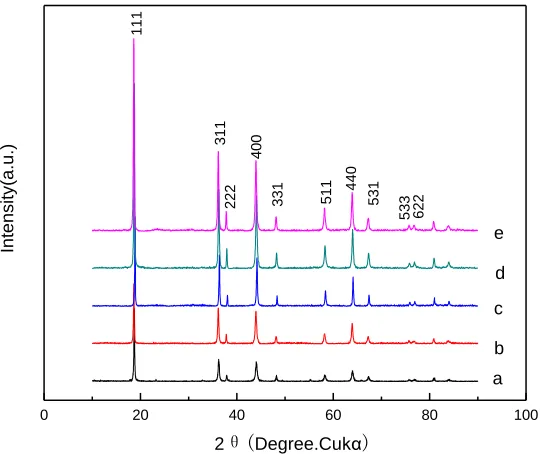
The X-ray diffraction patterns of undoped and doped Li-Mn oxide samples are presented in Fig. 1. It could be seen that all the materials show single phase diffraction patterns. This could be indexed on the basis of the cubic spinel structure. It was demonstrated that pure cubic spinel phase Li-Mn oxides could be obtained at lower temperature 600 oC by traditional citric acid sol-gel method. After doping the structures are still typical of pure spinel phase,which shows that doped metal ions have been occupued the 16 sites for Mn. So the spinel’s strcuture has been enhanced.
0 20 40 60 80 100
622
533
531
440
511
331
400
222
311
111
e
d
c
b
a
In
te
n
si
ty(a
.u
.)
2θ(Degree.Cukα)
Figure 1. XRD Patterns of the as-prepared samples:(a)pristine LiMn2O4,(b)Li1.03 Zn0.03Mg0.03Mn1.91O4,
(c) Li1.03 Al0.03Zn0.03Mn1.91O4,(d) Li1.03 Al0.03Mg0.03Mn1.91O4,(e)
Li1.03Al0.03Mg0.015Zn0.015Mn1.91O4
[image:4.596.165.435.377.604.2]
Table 1. Lattice parameters and crystallite sizes of the as-prepared samples
No. Samples Lattice
parameter(Å)
Cell size(Å3
) Crystallite size(nm)
A LiMn2O4 8.2230 557.3738 89.8
B Li1.03 Zn0.03Mg0.03Mn1.91O4 8.2306 557.5636 87.6
C Li1.03 Al0.03Zn0.03Mn1.91O4 8.2213 554.5949 62.1
D Li1.03 Al0.03Mg0.03Mn1.91O4 8.2199 555.3920 71.9
E Li1.03Al0.03Mg0.015Zn0.015Mn1 .91O4
8.2304 557.5230 93.3
From the data in Table1, it can be proposed that the distances between different facets increase due to the increase of crystal cell parameters for B and E samples compared to the undoped sample and this is favourable for the quick and easy insertation-deinsertation for Li+ . This is also due to that either the radius of Mg2+(r Mg2+=0.074nm) or the radius of Zn2+ (r Zn2+=0.072nm) is larger than that of
Mn4+(r Mn4+=0.065nm). For the sample C and D, their structure parameters change a little due to
containing Al3+ which radius (rAl3+ = 0.0535nm) is smaller than that of Mn4+(r Mn4+=0.065nm) apart
from containing either larger Mg2+ or larger Zn2+ [36] .The crystallite sizes have been obtained by Scherrer equation.
3.2. Surface morphology and particle size analysis
(b)
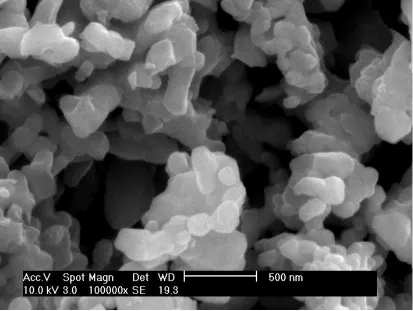
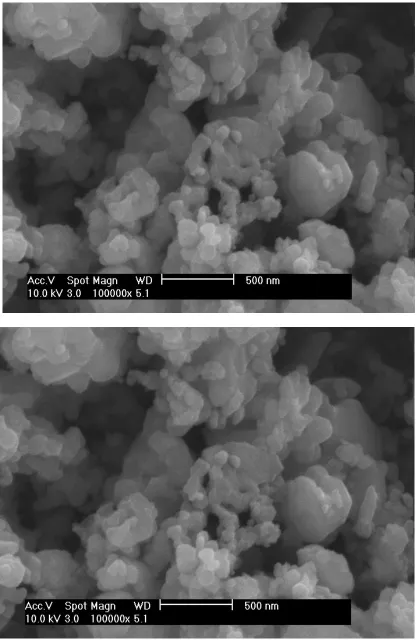
Figure 2. SEM of the as-prepared samples:(a)pristineLiMn2O4,(b)Li1.03Zn0.03Mg0.03Mn1.91O4,
(c)Li1.03Al0.03Zn0.03Mn1.91O4,(d)Li1.03Al0.03Mg0.03Mn1.91O4, (e) Li1.03Al0.03Mg0.015 Zn0.015
Mn1.91O4 (d)
[image:7.596.91.508.68.712.2]
SEM photoes are presented in Figure 2. From the figures, it could be seen that all the samples heve good morphologies, even particle sizes. The average diameter for each sample is smaller 100 nm, which indicats that the materials could be considered to be nano-materials. This can also be verified by the results in Table1 obtained from Scherrer equation. But agglomeration appeares in some samples. Based on the particle size and morphology results, the as-prepared materials should have better electrochemical performances.
3.3 Galvanostatic charge/discharge studies
0 20 40 60 80 100 120 140
2.8 3.0 3.2 3.4 3.6 3.8 4.0 4.2 4.4 4.6 a LiMn2O4 Li
1.03Zn0.03 Mg0.03Mn1.91O4
Li1.03Al0.03Zn0.03Mn1.91O4 Li1.03Al0.03Mg0.03 Mn1.91O4
Li1.03Al0.03Mg0.015Zn0.015Mn1.91O4
V /V ( v s. L i/ L i + ) Capacity/mAhg-1
0 20 40 60 80 100 120
2.8 3.0 3.2 3.4 3.6 3.8 4.0 4.2 4.4 4.6 b LiMn2O4
Li1.03Zn0.03 Mg0.03Mn1.91O4 Li1.03Al0.03Zn0.03Mn1.91O4 Li1.03Al0.03Mg0.03 Mn1.91O4 Li1.03Al0.03Mg0.015Zn0.015Mn1.91O4
V /V ( v s. L i/ L i + ) Capacity/mAhg-1
[image:8.596.159.436.230.719.2]
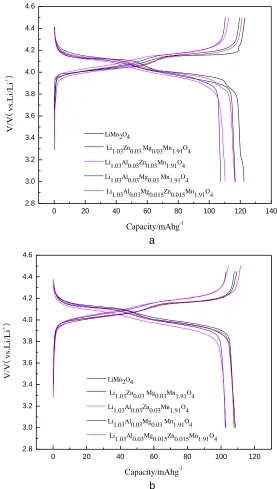
In Figure 3 the initial charge/discharge curves are for the materials at the current density of 0.2mA/cm2 in the voltage cut-off 3.0-4.5 V. From (a) It could be found that the curves show two distinct voltage plateaus with the charging voltage plateaus of 4.15V and 4.05V and the discharging plateaus of 4.10V and 3.92 V, which is typical of the plateaus of undoped LiMn2O4. This indicates that
doping does not destroy the spinel strcucture[14,44], which is consistant with the XRD results. In Figure 3 charge/discharge curves for the 40th cycle are also presented. The voltage plateaus are still well, which means that the cycled cells have reached stable states. Also from a and b in Fig.3 it could be found that the couloumic efficencies for the materials are still very high in the 40th cycle. Perhaps the nano-effect could also play an important part in improving the performance.
3.4 Cycling performances
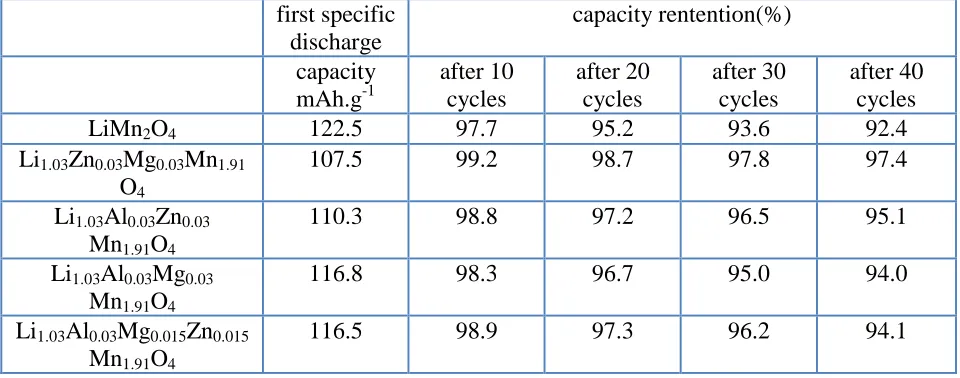
The cycling curves for the synthesized spinel cathode materials are presented in Fig.4. The initial discharge specific capacities and the discharge specific capacities in 10th, 20th,30th and 40th are listed in Table 2. So the capacity retentions can also be presented in Table 4 for detailed comparisons. It could be happily found that the undoped has a relatively very high capacity retention of 92.4% after 40 cycles. By our knowledge this could be the highest capacity retention for undoped LiMn2O4. In
consideration of its high initial discharge specific capacity of 122.5 mAh.g-1, so good undoped LiMn2O4 spinel could be ascribed to its nano-scale sizes synthesized in lower temperature in a large
part. After multiple doping, the capacity retentions for the doped LiMn2O4 become even larger than the
undoped LiMn2O4. Especially for the material Li1.03 Zn0.03Mg0.03Mn1.91O4 , it has a very high capacity
retention of 97.3% after 40 cycles. It could be demonstrated that multiple doping can improve the electrochemical performance of LiMn2O4 in a great degree.
0 10 20 30 40
80 85 90 95 100 105 110 115 120 125 130 135 LiMn2O4 Li
1.03Zn0.03Mg0.03 Mn1.91O4
Li
1.03Al0.03Zn0.03Mn1.91O4
Li
1.03Al0.03Mg0.03 Mn1.91O4
Li1.03Al0.03Mg0.015Zn0.015Mn1.91O4
[image:9.596.151.448.489.737.2]D is c h a rg e C a p a c it y /m A h g -1 Cycle number
Table 2. Discharge Capacity and Capacity retention data of Li1.03M0.06Mn1.91O4(M= Zn0.03Mg0.03,
Al0.03Zn0.03,Al0.03Mg0.03,Al0.03Mg0.015Zn0.015)
first specific discharge
capacity rentention(%) capacity
mAh.g-1
after 10 cycles
after 20 cycles
after 30 cycles
after 40 cycles
LiMn2O4 122.5 97.7 95.2 93.6 92.4
Li1.03Zn0.03Mg0.03Mn1.91
O4
107.5 99.2 98.7 97.8 97.4
Li1.03Al0.03Zn0.03
Mn1.91O4
110.3 98.8 97.2 96.5 95.1
Li1.03Al0.03Mg0.03
Mn1.91O4
116.8 98.3 96.7 95.0 94.0
Li1.03Al0.03Mg0.015Zn0.015
Mn1.91O4
116.5 98.9 97.3 96.2 94.1
For the Li1.03Al0.03Mg0.03 Mn1.91O4 cathode material, doped Al could promote and stability the
crystal structure of spinel. Meanwhile the amount of Mn4+ relative to Mn3+ is increased and cation disoder around has been reduced [36]. Mg doping can increase the average valence of Mn.
From Table 2 it can also be found that the cycling retentions for the Zn-doped materials are a little larger than those for spinel materials containing no Zn, but the previous capacites are slightly smaller than the later. This is most possibly due to that the radius of Zn2+ is larger than that of either Mg2+ or Al3+ and that there is no Jahn-Teller effect because of its 3d10 structure.
4. CONCLUSIONS
Nano-size Li-Mn spinel cathode materials have been successfully synthsized by citric acid sol-gel method at a lower temperature 600 oC . The undoped LiMn2O4 spinel has a high initial discharge
specific capacity of 122.5 mAh.g-1 and a very high capacity retention of 92.4% after 40 cycles at a lower current density. To our knowledge this could be the best pure LiMn2O4 synthesized by common
synthesis methods at lower temperatures. This good result could be ascribed to its nano-scale size synthesized in lower temperature in a large part. By multiple doping, pure phase spinel Li1.03M0.06Mn1.91O4(M= Zn0.03Mg0.03,Al0.03Zn0.03,Al0.03Mg0.03,Al0.03Mg0.015Zn0.015) have been obtained
by the method mentioned above, All the doped materials are nano-scale. By multlple doping, their electrochemical performances become better. Among the synthesized materials, Li1.03Zn0.03Mg0.03Mn1.91O4 has the highest capacity retention of 97.4% after 40 cycles.
ACKNOWLEDGMENT
[image:10.596.59.539.113.302.2]
References
1. B. Banov, Y.Todorov , A. Trifonnova , A.Momchilov and V. Manev, J.Power Sources, 1997, 68 (1997) 578
2. Y.-K.Sun, Solid State Ionics, 100 (1997) 115 3. B. Scrosati, Electrochim Acta, 45 (2000) 2461
4. Y.-K. Sun, B. Oh and H.-J. Lee, Electrochim Acta, 46 (2000) 541
5. G. G. Amatucc, N. Pereira, T. Zheng and J. M .Taraseon, J. Electrochem. Soc., 148 (2001) A171 6. G. Amatucci, J.-M. Tarascon, J. Electrochem. Soc., 149 (2002) K31
7. M. Lanz, C. Kormann and P. Novák, J.Solid State Electrochem., 7 (2003) 658.
8. S. M .Malyovanyi, A. A. Andriiko and A. P. Monko, J.Solid State Electrochem., 8 (2003) 7 9. M. Nakayama, K. Watanabe, H. Ikuta, Y. Uchimoto and M. Wakihara, Solid State Ionics, 164
(2003) 35
10. Y.Ito, Idemoto,Y.Tsunoda and N. Koura, J.Power Sources, 119–121 (2003) 733 11. J.T. Son., H.G. Kim, J.Power Sources, 147 (2005)220
12. H.M.Wu, J.P. Tu, Y.F.Yuan, Y. Li, X.B. Zhao and G.S.Cao,Mater Chem Phys. , 93 (2005) 461 13. R.Thirunakaran, K.-T. Kim,Y.-M. Kang and J.-Y. Lee, Mater Res Bull., 40 (2005)177
14. M. Takahashi,T. Yoshida, A. Ichikawa, K. Kitoh, H. Katsukawa,Q. Zhang and M. Yoshio, Electrochim. Acta, 51 (2006) 5508
15. P. Zh. Shen, Y. D. Huang, L. Liu, D. Z. Jia and Z. P. Guo, J Solid State Electrochem., 10 (2006) 929
16. A. Ritchie, W. Howard, J.Power Sources, 162 (2006) 809
17. X. Q. Wang, O. Tanaike, M. Kodama and H. Hatori, J Power Sources, 168 (2007) 282 18. D. Q. Liu, Z. Zh. He, and X. Q. Liu, J. Alloys. Compd., 440 (2007) 69
19. Y. G. Xia, H. Y. Wang, Q. Zhang, H. Nakamura, H. Noguchi and M. Yoshio, J. Power Sources, 166 (2007) 485
20. Yu.G. Mateyshina, U.Lafont, N. F. Uvarov and E. M. Kelder, Solid State Ionics, 179 (2008) 192 21. X. F. Li, Y. L. Xua and Ch. L. Wang, J. Alloys. Compd., 479 (2009) 310
22. X. J. Sun, X. H. Hu, Y. Shi, Sh. X. Li and Y. Q. Zhou, Solid State Ionics,180 (2009) 377 23. R.Thirunakaran Ivashanmugam, S.Gopukumar, Rajalakshmi, J.Power Sources, 187 (2009) 565 24. A.Sakunthala, M.V.Reddy, S.Selvasekarapandian, B.V.R.Chowdari and S.P.Christopher,
Electrochim. Acta, 55 (2010) 4441
25. D.Arumugam,G.Paruthimal Kalaignan, K.Vediappan and Ch.-W.Lee, Electrochim. Acta, 55 (2010) 8439
26. J.F.Wang , H.L. Zhang, Funct. Mat. Lett., 3 (2010) 189
27. Y.-J. Kang, J.-H. Kim and Y.-K. Sun, J Power Sources, 146 (2005) 237
28. Sh.-J. Bao, Y.-Y. Liang, W.-J. Zhou, B-L.He and H.-L. Li, J Colloid Interface Science, 291 (2005) 433
29. W.-J. Zhou, Sh.-J. Bao, B.-L. He, Y.-Y. Li,H.-L. Li, Electrochim. Acta, 51 (2006) 4701 30. T. Kakuda, K. Uematsu, K. Toda and M. Sato, J. Power Sources, 167 (2007) 4 99
31. K. Suryakala, K. R. Marikkannu, G. Paruthimal Kalaignan and T.Vasudevan, J.Solid State Electrochem., 11 (2007) 1671
32. A. Subramania, N. Angayarkanni and T. Vasudevan, Ionics, 13 (2007) 61 33. M. J. Iqbal, Z. S. Zahoor, J. Power Sources, 165 (2007) 393
34. N. Hayashi, H. Ikuta and M. Wakihara, J. Electrochem. Soc., 146 (1999) 1351 35. I.-S. Jeong, J.-U. Kim and H.-B. Gu, J. Power Sources, 102 (2001) 55
36. B. H. Deng, H. Nakamura, Q. Zhang, M. Yoshio and Y.Y. Xia, Electrochim. Acta, 49 (2004) 1823
38. H. M. Wu, J. P .Tu, X. T. Chen, Y. Li, X. B. Zhao and G. S.Cao, J.Solid State Electrochem., 11 (2007) 173
39. F. Zhou, X. M. Zhao, H. Zheng, Z. D. Zhang and M. R. Ji, Mater. Lett., 58 (2004) 3720 40. S. Rahul , Suprem R. Das, Maharaj S. Tomar, Osbert Ovideo, Santander Nieto, Ricardo E.
Melgarejo and Ram S. Katiyar, J. Power Sources, 164 (2007) 857
41. D. Arumugam, G. Paruthimal Kalaignan and P. Manisankar, Solid State Ionics, 179 (2008) 580 42. M. J. Iqbal, Z. Ahmad, J. Power Sources, 179 (2008) 763
43. Y.-J. Shin, A. Manthiram, J. Power Sources, 126 (2004) 169
44. K.-S. Lee, S.-T. Myung, H. J. Bang, S.J. Chung and Y.-K. Sun,. Electrochim. Acta., 52 (2007) 5201
45. M. Amarillaa, K. Petrovb, F. Picóa, G. Avdeevb, J. M. Rojoa and R. M. Rojasa, J. Power Sources, 191 (2009) 591
46. Y. H. Tong, M. W. Shao, Y. B. Ni, G. X. Qian, Y. Ye and P. Zhang, Mater Lett., 60 (2006) 2578 47. A. Subramania, N. Angayarkanni, T. Vasudevan, Mater. Chem. Phys., 102 (2007) 19
48. M. W. Raja, S. Mahanty, Paromita Ghosh, R. N. Basu and H. S. Maiti, Mater. Res. Bull., 42 (2007) 1499
49. C. H. Jiang, S. X. Dou, H. K. Liu, M. Ichihara and H. S. Zhou, J. Power Sources, 172 (2007) 410 50. S. Vivekanandhan , M. Venkateswarlu and N. Satyanarayana, J. Alloys. Compd., 441 (2007) 284. 51. N. Kamarulzaman, R. Yusoff, N. Kamarudin, N. H. Shaari, N. A. Abdul Aziz, M. A. Bustam, N.
Blagojevic, M. Elcombe, M. Blackford, M. Avdeev and A. K. Arof, J. Power Sources, 175(2009) 274