Sharing our normative worlds: A theory of normative
thinking
A thesis submitted for the degree of Doctor of Philosophy at the Australian
National University
by
Ivan Gonzalez-Cabrera
in
August 2017
© Copyright by Ivan Gonzalez-Cabrera 2017
Statement of Originality
This thesis is solely the work of its author. No part of it has previously been submitted for any degree or is currently being submitted for any other degree. To the best of my
knowledge, any help received in preparing this thesis, and all sources used, have been duly acknowledged.
Parts of this thesis draw on earlier published work. Chapter 3 is taken, with some changes, from Gonzalez-Cabrera (forthcoming): On social tolerance and the evolution of human normative guidance. Sections 4.4 and 4.5 of this chapter are based on worked published in Tomasello and Gonzalez-Cabrera (2017): The role of ontogeny in the evolution of human cooperation. These sections have been modified to meet university guidelines.
Signed,
Ivan Gonzalez-Cabrera
To my partner and friend, Ana.
Acknowledgments
This thesis represents the end of a long journey. The conception of the project started when I was a graduate student at the University of Tokyo. I am especially grateful to Tomoko Ishida, Ryota Morimoto, Senji Tanaka, Sohei Yajima, and all the members of the interdisciplinary group on evolutionary ethics and human ecology for their support during those early days. Thanks also to Yosaku Nishiwaki and Yoshiyuki Hirono for his
encouragement to pursue a Ph.D. in philosophy. That project crystallized only years later as a graduate student at the Australian National University (ANU). My decision to move to Canberra to gain further training in philosophy of psychology and biology is one of the best that I have made. It was the stimulating environment of the School of Philosophy at ANU that allowed the core ideas of this thesis to grow and flourish. I owe special thanks to my supervisor, Kim Sterelny. My decision to start working on human cognitive evolution is largely attributable to the profound impact that his impressive and insightful body of work has had on many philosophers of my generation. He was always supportive and generous in spirit. I am honored and enriched for having been one of his students.
I learned from Kim’s students almost as much I learned from him. I am grateful to Rachael Brown, Heather Browning, Carl Brusse, Brett Calcott, Adrian Currie, Ben Fraser, Jessica Isserow, David Kalkman, Stephan Kubicki, Christopher Lean, Kim Shaw-Williams, and John Zerilli for their friendship and intellectual rigor. I am also glad to have met through them much of the PhilBio community in the Sydney area including Pierrick Bourrat, Paul Griffiths, Adam Hochman, Linus Huang, Richard Menary, Dominic Murphy, and Elena Walsh. I am also grateful to Lindell Bromham, Peter Godfrey-Smith, Russell Gray, Peter Hiscock, Mateo Mameli, Claudia Passos, Kyle Stanford, and Michael Weisberg for their kindness and patience as well as for bringing clarity out of my often confused ideas.
My debts to the members of the ANU’s School of Philosophy are many, but a
few of them deserve special mention. Thanks to Alma Barner and Daniel Gregory for their constant companionship and insight. Thanks also to Rachael Briggs, Justin Bruner,
Zoe Drayson, Edward Elliott, Anya Farennikova, Liz Irvine, Colin Klein, Leon Leontyev, Hanti Lin, Gabriel Rabin, Paolo Santorio, Wolfgang Schwarz, and Julia Staffel. Many thanks to all the faculty members of the school but, in particular, to David Chalmers, Alan Hájek, Victoria McGeer, Daniel Nolan, Philip Pettit, Nicholas
Southwood, and Daniel Stoljar, which gave me crucial advice at some point or another during my time at ANU.
I am also grateful to Cristina Bicchieri, Gilbert Harman, and Stephen Stich for allowing me to take part in the Penn-Princeton-Rutgers Graduate Seminar in Moral
Psychology. I had the opportunity to discuss earlier versions of this work with them and their students who provided me with valuable feedback. Much of the material I worked
out during those days did not make the cut to the final version of the thesis, but I was decisively encouraged by those discussions to do empirical research in moral psychology. Much of my recent work would not be as empirically oriented as it is now if it were not for them.
I also owe a great debt to the Department of Comparative and Developmental Psychology at the Max Planck Institute in Leipzig, which for a long period of my Ph.D. was my second home. The influence of experimental psychology on my philosophical work is obvious, and my sincerest thanks go to Michael Tomasello, Josep Call, and Malinda Carpenter for taking me in and for providing me with unprecedented opportunities. During this period, I had the opportunity to work and discuss with biologist, psychologists, and philosophers alike. All of us were interested in mutually interconnected topics ranging from the ontogeny of human social cognition to language acquisition to primate cognition. I am especially in debt with Avi Benozio, Manuel Bohn, Shona Duguid, Jan Engelmann, Sebastian Grüneisen, Susanne Hardecker, Robert Hepach, África de las Heras Martínez, Bailey House, Margherita Isella, Patricia Kanngiesser, Cathal O’Madagain, Federico Rossano, Alex Sanchez, Martin Schmelz, Barbora Siposova, Gregor Stöber, and Margarita Svetlova. Although most of the experimental work I carried out during my time in Leipzig was not included in the
thesis, I have to give special thanks to Jana Jurkat, Roger Mundry, Dairon Rodriguez, Marco Schmidt, and Christoph Völter for their collaboration, guidance, and support.
I finish the writing of this dissertation in a heady six-month period in Vienna as a Writing-Up Fellow at the Konrad Lorenz Institute for Evolution and Cognition Research. I would not have been able to finish my Ph.D. without the unconditional support of Gerd Müller, Johannes Jäger, Isabella Sarto-Jackson, and Eva Lackner. Thanks also to all the fellows at the institute, Lee Altenberg, Wesley Herb Anderson, Argyris Arnellos, Lorenzo Baravalle, Riana Betzler, Daniel Brooks, James DiFrisco, Chiara Elettra Ferrario, Barbara Fischer, André Strauss, Wim Hordijk, George McGhee, Celeste Marina Pérez Ben, André Strauss, Zsóka Anna Vásárhelyi, and Berta Verd with whom I had the privilege to share the final version of this thesis.
This research was supported by an Australian Government Research Training Program (RTP) Scholarship. This project was also partially supported by a PhD Research Contract from the Max Planck Institute for Evolutionary Anthropology and a KLI Writting-Up Fellowship from the Konrad Lorenz Institute for Evolution and
Cognition Research.
Abstract
This thesis focuses on the evolution of human social norm psychology. More precisely, I want to show how the emergence of our distinctive capacity to follow social norms and make social normative judgments is connected to the lineage explanation of our capacity to form shared intentions, and how such capacity is related to a diverse cluster of prototypical moral judgments. I argue that in explaining the evolution of this form of normative cognition we also require an understanding of the developmental trajectory of this capacity. For this purpose, the thesis is organized as follow. In the first chapter, I make some methodological remarks and provide the general overview and plan for the dissertation. In the second chapter, I explain what my explanatory target is and why it matters. On the view I am defending, shared intentional psychology gives rise to a special form of psychology that enables us to engage in social normative thinking. These norms are represented as shared intentional states. Moral psychology, in contrast, is more diverse. For moral judgments define a quite heterogeneous class of mental states—although some moral judgments may involve the representation and execution of norms, certainly not all of them do. I show that although much of our distinctive social norm psychology can be explained within the framework of shared intentionality, moral judgments cannot be unified in the same way. In the third chapter, I provide the baseline of social-cognitive capacities that serve as starting point for my lineage explanation. I argue that hominin social cognition was for a very long period of our
evolutionary history essentially a matter of low-level cognitive and motivational processes. On this picture, bottom-up affective processes regulated the social lives of
we learn them gives rise to some prototypical cluster of moral judgments. Thus, this chapter returns to some of themes and arguments of the first chapter by explaining how the distinction between moral judgments and nonmoral judgments can be culturally transmitted.
Table of contents
Statement of Originality ... i
Acknowledgments ... i
Abstract ... iv
Table of contents ... vi
List of figures, tables, and boxes ...vii
Glossary ... ix
Chapter 1.Introduction ... 1
1.1. Methodological reflections ... 1
1.2. Overview... 6
1.3. Structure of the thesis ... 8
Chapter 2.Fragmenting moral judgments and unifying the psychology of norms ... 11
2.1. Defining moral judgments ... 16
2.2. What does it mean to claim that moral judgments are a unified cognitive kind? ... 20
2.3. Social domain theory ... 22
2.4. Fragmenting moral judgments ... 31
2.5. The psychology of norms ... 36
2.6. From norms to morals ... 42
2.7. Conclusion ... 46
Chapter 3.On social tolerance and the evolution of human normative thinking ... 47
3.1. The demonic male hypothesis... 49
3.2. The puzzle of hominin evolution ... 53
3.3. The mosaic hypothesis ... 55
3.4. Evidence for the model ... 59
3.5. Paleoanthropological support ... 65
3.6. The self-domestication hypothesis... 71
3.7. Normative guidance ... 75
3.8. Conclusion ... 80
Chapter 4.Big game hunting and the evolution of human social norm psychology ... 81
4.1. Big game hunting ... 84
4.2. The interdependence hypothesis ... 88
4.3. Did meat make us moral? ... 98
4.3.1. Social expectations ... 100
4.3.2. Social rationality ... 104
4.3.3. Punitive attitudes ... 109
4.4. Cooperative breeding ... 111
4.5. Evolutionary development ... 120
4.6. Conclusion ... 128
Chapter 5.Sharing our normative worlds ... 130
5.1. Moral nativism ... 131
5.2. The ontogeny of human social norm psychology ... 135
5.3. Norm acquisition ... 144
5.3.1. Acquiring social norms as shared intentional states ... 147
5.3.2. The mechanisms of acquisition ... 150
5.3.3. Norm classification ... 154
5.4. Moral sentimentalism ... 157
5.5. Language and norms ... 167
5.6. Conclusion ... 171
Chapter 6.Conclusion ... 173
6.1. Summary ... 173
6.2. Limitations and future research ... 176
References ... 180
List of figures, tables, and boxes
Figures
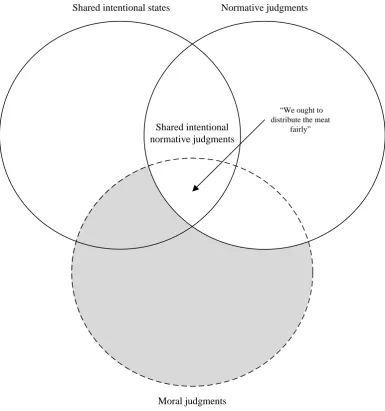
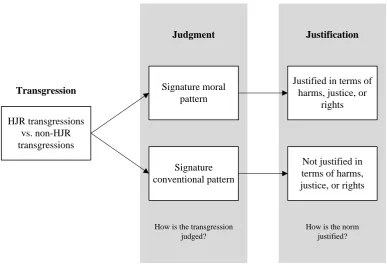
Figure 2.1. Diagram of the relation between joint intentional states, normative judgments, and moral judgments ... 13Figure 2.2. Diagram of the relation between transgressions, signature patterns, and types of justification in Turiel’s (1983) social domain theory ... 24
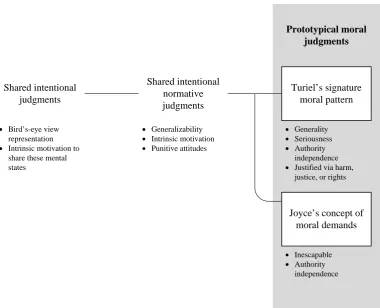
Figure 2.3. Diagram of the relation between shared intentionality, social norms, and prototypical moral judgments... 44
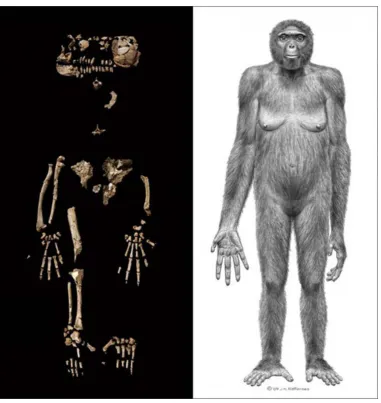
Figure 3.1. Partial skeleton (right) and artist’s reconstruction (left) of a relatively complete female specimen of Ar. ramidus, ARA-VP 1/500 ... 67
Figure 3.2. Traditional phylogenetic arrangement of five hominid species ... 69
Figure 3.3. Alternative evolutionary arrangement of five hominid species ... 70
Figure 3.4. Model of bonobo evolution due to self-domestication ... 73
Figure 4.1. Sequence of stages in the lineage of shared intentionality ... 87
Figure 4.2. Selective feedback loop between cooperative breeding and collective hunting of big game... 127
Figure 5.1. Model of norm acquisition ... 145
Tables
Table 5.1. List of basic cognitive and motivational infrastructure for norm acquisition ... 151
Technical boxes
Technical box 3.1. Comparative analysis of cooperation in great apes and humans ... 57
Technical box 4.2. Comparative analysis of cooperation in great apes and humans ... 90
Technical box 4.3. Group-mindedness and the Pleistocene-Holocene transition ... 97
Glossary
agent-independent representation a representation is agent-independent if its content does not specify any agent—e.g., when a child realizes that a particular role in a group activity can be variably filled by different agents over time. This form of agent-independency is a matter of degree. A representation is increasingly agent-independent when it relies less on the specifics of an agent or group of agents (see Nagel, 1986).
bird’s-eye view representation a bird’s-eye view is a distinctive perspective to represent social interactions. This perspective is a case of functional abstraction and role/occupant distinction. The notion of a bird’s-eye view representation is a closely connected but different idea from that of an agent-independent representation. For an agent could deploy, in principle, a bird’s-eye view representation of a certain task only when interacting with specific partners.
bottom-up cognitive process the processing of sensory and affective information that depends more directly on features of the stimulus input (see Rauss & Pourtois, 2013). top-down control is the reverse of bottom-up processing, i.e., the processing of sensory and affective information that is driven by more cognitive processes such as goals or intentions.
cognitive process an operation that affects an agent’s mental content. Examples of cognitive processes are perception, memory, language, problem-solving, and
abstract thinking. Cognitive processes have hierarchical structure. Many contemporary models of processes specify a superordinate level (e.g., processes
of emotional control) that controls and monitors lower level processes (e.g., emotions). Similarly, models of representation comprise higher superordinate levels that represent information in a more general form and lower subordinate levels where information is represented more specifically.
want to do p” (see also ‘we-mode representation’). Since we-mode representations are representations of intentional states that are held by individuals but which make fundamental reference to a collective formed in conjunction with the other individuals (Searle, 1990), collective intentional states
are also irreducible collective.
collective mental state a collective mental state is any shared intentional mental state ψ in which the subject is represented in a we-mode. A we-mode representation of the subject of a shared intentional mental state is a plural representation of the agents A1,A2,...,An who collectively are in the mental state ψ such as in “We
believe that p” (see also ‘we-mode representation’).
corrective attitudes see punitive attitudes.
emotion the term ‘emotion’ refers here to a set of valenced behavioral and
concomitant physiological responses that correlate with specific subjective experiences (McClure, Botvinick, Yeung, Greene, & Cohen, 2007). These emotional processes can be understood as a subset of automatic processes that are quick to respond and produce stereotyped effects on behavior. They can be differentiated from other automatic processes because they are valenced, i.e., because they have valuative significance, carrying a level of attraction or aversion to the events that evoke them (McClure et al., 2007, p. 206). For example, Ekman and colleagues (Ekman, 1999; Ekman & Friesen, 1971) have shown that some emotions such as some forms of anger and guilt are a distinctive class of psychological phenomena marked out by their automaticity, by unique behavioral and physiological signatures, and by the existence of homologous states in other primates. In addition, LeDoux (1993, 1996) has also
distinguished between ‘cognitive computations’ which yield information about stimuli and the relations between them, and ‘affective computations’ which yield
information about the significance of stimuli for the organism and lead to physiological and behavioral responses appropriate to that significance. Similarly, researchers also sometimes distinguish emotions from feelings (Damasio, 1994, 1999). Emotions are automatic response repertoires, while feelings are subjective or experiential counterparts of emotions (mental representations of physiological changes that characterize and are consequent upon processing emotion-eliciting objects or states).
emotion regulation see emotional control.
emotional control the ability to exercise influence over emotion, and modulate emotion through the use of cognitive or behavioral strategies (Gross, 1998b; Lazarus & Folkman, 1984). It can be an attempt to change and regulate aspects of a situation and emotional experience prior to the generation of emotion or an
attempt to alter the responses to the experience of emotion after the emotion has occurred (Gross, 1998a, 1999, 2002).
generalizability a property of social norms as defined in this thesis (see also ‘social norms’). Generalizability refers to the scope of the judgment and its context-sensitivity—normative beliefs can regulate the behavior of only some individuals in specific situations or roles. Thus, normative beliefs can be characterized by a gradient of generalization or abstraction depending on how tightly they are conceived to be linked to specific individuals or situations.
I-mode representation a representation of intentional states that are fundamentally egocentric such as “I believe that p” or “I want p”. When a state of affairs is represented as something that each agent individually believes, desires, or intends, this state of affairs is represented in the I-mode. The mode of a representation captures the subject’s perspective or attitude on the intentional object. There are different forms of I-mode intentional states such as beliefs, desires, and intentions. Each I-mode intentional state has a we-mode counterpart. For example, an I-mode representation of an agent’s intention ϕ is called an ‘I-intention’ of the form “I intend to ϕ”, which has a we-intention counterpart of the form “We intend to ϕ” (see also ‘we-mode representation’).
instrumental rationality a form of rationality thatfocuses on the necessary and most efficient means of achieving a certain goal. Failing to do so makes an agent
instrumentally irrationally. For example, if an agent is thirsty and intends to drink water, it would be rational for the agent to look for a nearby pond. All
other things being equal, it would be irrational either to look for a more distant pond or not to take any means to this end.
predict each other behavior through these practices but also for making our behavior more readily interpretable by them (Sterelny, 2003). Our explanatory and predictive practices are then causally connected to whatever physical implementation of those putative mental states might be through our biological
and cultural evolutionary history.
intentional mental state intentional mental states are the thoughts we ascribe to an
agent whose content can be roughly specified through a proposition toward which the agent takes a propositional attitude (see also ‘propositional attitude’).
intentionality a property of mental states which consists in their being directed towards objects or events. Mental states that are characterized by its intentionality are intentional mental states. Examples of intentional states are beliefs, desires, and intentions. An agent cannot have a belief, desire, or intention without these mental states being about something.
intrinsic motivation a property of social norms as defined in this thesis (see also ‘social norms’). A mental state possess intrinsic motivation when it motivates behavior as an ultimate end rather than solely as a means to other ends. An agent A is motivated to do ϕ solely as a means to an end E if and only if (i) A is motivated to do ϕ, (ii) A is motivated to achieve E, and (iii) A is motivated to do ϕ only because A believes that doing ϕ suffices (or just promotes) achieving E. On the contrary, A is intrinsically motivated to do ϕ precisely when (i') A is motivated to do ϕ and (ii') for all other ends E1,E2,...,En, that A has, it is false
that A is motivated to do ϕ solely because A is a means to satisfying one or more of these other ends. This means that if A is intrinsically motivated to do ϕ, A may recognize that ϕ contributes to achieve some of these other ends, but this cannot
be the sole motivation for A to do ϕ. Avoiding pain is an intuitive example of intrinsic motivation. People seek to avoid pain not only because they think this
will contribute to some other goals but also because avoiding pain is something we want to do for its own sake (see Sober & Wilson, 1998, pp. 200-201). Intrinsic motivation is not the same as having overriding power. For example, social norms are understood in this thesis as having intrinsic motivation, but its motivational force can be overridden by the motivational force of other mental states. What is essential for a mental state to be an ultimate end is to motivate the agent to bring about a certain state of affairs irrespective of the way it promotes other agent’s goals. In contrast, instrumental ends are those mental states that
determine the means through which an agent will bring about that state of affairs.
joint intentional mental state a joint intentional mental state ψ is the mental state of an agent who joins the mental state of another. An agent A joins the intentional mental state ψ of another agent B when (i) Ais intrinsically motivated to be in ψ because B is in ψ, and (ii) A co-represents ψ in a way that A and B are represented as a singular subject who is in ψ as opposed to each one simultaneously being in ψ. A can represent A and B as a singular subject who is in ψ either through recursive mindreading (see also ‘recursive mindreading’) or through a we-mode representation (see also ‘we-mode representation’). A is intrinsically motivated to be in ψ because B is in ψ if and only if A is motivated to be in ψ as an end in itself because B is in ψ. An intentional mental state ψ is co-represented by a group of agents A1,A2,...,An when A1,A2,...,An are in ψ. An
agent A can actively join the mental states of another agent B when A is intrinsically motivated to intentionally interpret B’s behavior and joins his/her mental states. Unless further qualification is made, in all that follows ‘joint mental states’ will denote joint, shared, and collective intentional mental states.
lineage explanation an explanation that specifies a sequence of changes which aim to show how a certain trait or mechanism could be changed into another through a set of minor modifications. The aim of these explanations is to make plausible certain phylogenetic trajectories. They can be given at the level of phenotypic change as well as at the level of developmental mechanisms (Calcott, 2009).
mental representation a theoretical construct in cognitive science, especially in computational theories of cognition, according to which mental states and
processes are constituted by the occurrence, transformation, and storage of information-bearing structures (representations) of some kind. Representations
are intentional mental states with semantic properties such as content, reference, and truth-conditions.
mindreading the capacity to predict, explain, or understand the behavior of other agents by attributing intentional mental states to them.
moral judgment a heterogeneous class of mental states, which although might be unified at a certain level, is not unified at the cognitive level. For this reason, I focus in this dissertation on prototypical clusters of moral judgments that are central to the philosophical tradition in moral psychology. In particular, I focus on moral judgments as defined by the domain theory of moral development
(Turiel, 1983) and judgments that are considered inescapable and authority independent by the agent (Foot, 1972; Joyce, 2006; Mackie, 1977; Williams, 1985). Moral judgments can only be partially grouped at the cognitive level in terms of the properties stipulated by these theories.
normative cognition roughly construed, normative cognition is an umbrella term that covers different kinds of symbolically mediated normative information. At a
very basic level, human and animal cognition is driven, modulated, and governed by symbolically mediated information about what to do in a particular situation. When a mental state plays this role in cognition, that mental state carries normative information. Some mental states carry normative information because they govern different aspects of individual cognition and behavior in a private way, i.e., they do not govern or regulate other agents’ cognitive precesses or behavior. However, humans (and more controversially other primate species) can represent normative information that is fundamentally intersubjective and social. For humans can produce, share, acquire and implement different kinds of norms and conventions that not only govern own behavior but also other agents’ behavior. For example, food taboos about what pregnant women can eat are represented in a way that apply to all pregnant women regardless of whether one is pregnant or not. In this thesis, normative cognition refers more narrowly to this social form of normative cognition (see also ‘social normative thinking’).
normative guidance a top-down capacity to understand and respond to commands
(see also ‘top-down cognitive process’).
normative thinking see normative cognition.
norms see social norms.
offline cognition a form of cognition that occurs when an agent is not acting but reflecting on the world and its possible actions. Agents switch to offline forms of
cognition to make more careful considerations in situations that require forward planning.
online cognition online cognition is concerned with immediate input from the
environment. It deals with tasks that require fast moment-by-moment processing and involves an agent’s active sensorimotor engagement with the world.
practical rationality a capacity for solving the question of what one is to do through reflection. Deliberation of this kind is practical because is concerned with action and because it is assumed that reflection about action itself directly moves agents to act.
propositional attitude a propositional attitude is a mental state held by an agent such as intending, believing, desiring, and the like, which possesses a direction of fit and expresses how we regard a certain proposition. An agent can have different propositional attitudes toward the same proposition—e.g., one can believe that p while simultaneously desiring that p. A propositional attitude can have either a mind-to-fit-world direction of fit such as beliefs, which are meant to reflect the
world, or world-to-fit-mind direction of fit such as desires, which are meant to influence the world.
punitive attitudes a property of social norms as defined in this thesis (see also ‘social norms’). Punitive attitudes refer to the motivational force people feel to police, punish, or correct others, including themselves, when they think that they have violated a norm. These punitive attitudes are sometimes salient and explicit, while other times are less evident. For example, in some cases, the violation of a norm engenders actual physical punishment. In other cases, the perceived violation of a norm engenders punitive attitudes like anger and blame (or shame and guilt) toward the transgressor. And yet in other cases, it just drives corrective behaviors that target the transgressor without any harshness or evident signals of reprisal—e.g., when an adult correct a child for the violation a certain norm of etiquette.
rational action an action that maximizes the expected utility of the outcome
according to some model o rational action. Models of rational action assume that agents’ decisions are a function of their preferences among a number of available choices. In these models, rational agents use available information to assess the probabilities of events and the cost/benefit ratio to determine their
choices, acting consistently with the best option available. Preferences are assumed to be both complete and transitive. Preferences are complete when
agents can always say which of two alternatives they consider preferable (or whether neither is preferred to the other). Preferences are transitive if an option A is preferred to an option B, and B is in turn preferred to an option C, then A is also preferred to C.
rationality see practical rationality.
recursive mindreading recursive mindreading is the ability to embed representations about mental states inside other mental representations. For example, an agent A may believe that another agent B believes that A believes that p. This capacity allows an agent A to represent multiple agents A1,A2,...,An as a singular subject
who is in a joint mental state ψ as opposed to each one simultaneously being in ψ. A is able to represent both agents A and B as a singular subject who is in a joint mental state ψ through recursive mindreading if (i) A is in a mental state ψ, (ii) A believes that B is in a mental state ψ, and (iii) A believes that B believes that A is in a mental state ψ. Unlike we-mode representations, the ability to represent multiple agents as a singular subject via recursive mindreading is
constrained by our cognitive capacity to embed representations about mental states inside other mental representations.
representation see mental representation.
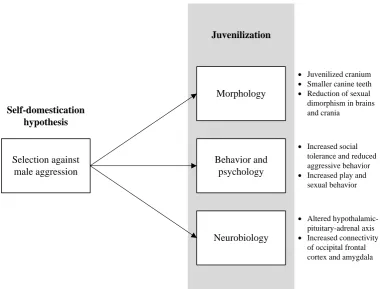
self-domestication a process of social selection against aggression in humans that resembles the process of adaptation of other wild animals to humans without systematic human selective breeding (Hare, Wobber, & Wrangham, 2012; Wrangham, 2011).
shared intentional mental state a shared intentional mental state ψ is the mental state of an agent who shares that mental state with other(s). A group of agents A1,A2,...,An shares an intentional mental state ψ when (i') each agent Ai in the
group is intrinsically motivated to be in ψ because the others are in ψ, and (ii') A1,A2,...,An co-represent ψ in a way that A1,A2,...,An are represented as a
singular subject who is in ψ as opposed to each one simultaneously being in ψ. Each agent Ai in the group is intrinsically motivated to be in ψ because the other
agents are in ψ if and only if each of the Ai agents in the group is motivated to be
in ψ as an end in itself because the others are in ψ. An agent A can actively share a mental state ψ in which A is in when A is intrinsically motivated to display and signal ψ for others to join.
shared intentionality the capacity to form joint intentional states. Joint intentional states are hybrid mental states, which are characterized by the systematic
co-occurrence of cognitive and motivational components. From a cognitive point of view, representing activities in a joint form requires being able to represent plural subjects of action (e.g., “We want to hunt” or “We are attending to that antelope”) and task roles or activities that are not necessarily linked to particular individuals (e.g., agent-independent representations of the different roles that our particular hunting technique requires). This creates a gradient of generalizability and abstraction depending on the scope of the plural subject of action and the degree of abstraction with which these activities are represented. From a motivational point of view, shared intentional states are intrinsically
motivational, e.g., by definition, entertaining a joint intention of the form “We want to hunt” implies a motivation to hunt with others that is not purely instrumental. That is, an agent joins the activity because he/she finds its collective nature intrinsically rewarding, rather than because the agent merely
thinks that the activity is instrumentally beneficial for him/her, or even instrumentally beneficial for everyone.
social normative thinking a social form of normative cognition that deals with social norms (see also ‘social norms’). On the view I am defending, shared intentional psychology gives rise to a special form of psychology that enables us to engage in social normative thinking by enabling the sharing of the kind of normative mental states that govern the instrumental and practical rationality of hominid agency.
social norms normative mental states that are generalizable, intrinsically motivating, and engender punitive attitudes. A normative mental state is generalizable when multiple agents can fall within the scope of the normative mental state and that normative state is applicable to multiple counterfactual situations (see also ‘generalizability’). A normative mental state is intrinsically motivating when the agent is motivated to comply with that state as an end in itself rather than as a means to fulfill other end (see also ‘intrinsic motivation’). A normative mental state engenders a punitive attitude if the agent is motivated to police, punish, or correct others, including themselves, when they think that they have violated the normative state (see also ‘punitive attitudes’).
social rationality a form of instrumental rationality that takes place when agents share intentional states such as goals and intentions (see also ‘instrumental
rationality’). Social rationality gives rise to social expectations about what one should do in a given situation as well as to social expectations about what others
should do in turn to achieve a common goal. For example, when hunters share a goal such as “We want meat”, this goal is only achieved when all the hunting partners obtain some of the meat. In such a context, sharing the meat is socially rational.
third-person representation see bird’s-eye view representation.
top-down cognitive process the processing of sensory and affective input that is driven by higher cognitive processes such as goals or intentions. These processes occur at a superordinate level in the sense that they control and monitor lower level processes that handle incoming sensory and affective information.
up processing is the reverse of top-down processing, i.e., the processing of sensory and affective information that depends more directly on features of the stimulus input (see Rauss & Pourtois, 2013).
we-mode representation intentional states held by individuals but which make
fundamental reference to a collective formed in conjunction with the other individuals (Searle, 1990). They are agent-independent representations of
intentional states that cannot be reduced to recursive mindreading. For example, knowledge states can be represented through recursive mindreading such as “I believe that you believe that I believe that p”. But these mental states can also have an irreducible we-mode of representation when the plural subject of that knowledge state cannot be represented via recursive mindreading due to cognitive limitations in our capacity to embed representations about mental states inside other mental representations. The mode of a representation captures the subject’s perspective or attitude on the intentional object. As in the case of I-mode representations, there are different forms of we-I-mode intentional states such as beliefs, desires, and intentions (see also ‘I-mode representations’). A we-mode representation of an agent’s intention, for instance, is called a ‘we-intention’.
Chapter 1.
Introduction
The goal of this dissertation is to explain and defend a naturalistic theory of normative cognition—particularly, human social norm psychology. Social norms can be roughly understood as the rules that govern group behavior. Humans seem to be a unique species in this respect since our behavior is largely governed by a widespread network of social norms. They have been extensively studied in the social sciences, although they are typically seen as exogenous variables that constrain individual behavior. However, despite their vital role in organizing human life, there has been relatively little attention in philosophy and the psychological sciences to understand this phenomenon. Much existing experimental research on the psychology of social norms is relatively recent and more often than not, focused on the understanding of moral norms. In the philosophical literature, social norms are usually seen as equilibria of coordination games or cooperative equilibria in prisoner’s dilemma-type games. But there is little mention of the mental processes involved and the implications for both philosophy of mind and philosophy of psychology. This thesis aims to fill this gap by building a naturalistic account of a distinctively human form of social norm psychology and the particular kind of normative thinking it engenders. Although partial and piecemeal, this thesis is intended as an important first step towards a more comprehensive theory of human norm psychology in particular and normative thinking in general.
1.1. Methodological reflections
Naturalism is understood here as a methodological approach—one that takes the philosophical practice to be continuous with the natural sciences. On this view, philosophical theories are empirically testable conjectures. Certainly, philosophy is often understood as a matter of pure conceptual analysis aimed to find necessary truths. But I am skeptical of the prospects of understanding the mind by this method alone. Granted, conceptual clarification is a major feature of the philosophical enterprise, but it is hardly a methodological tool under the exclusive control of philosophers. Conceptual
analysis is, and has been always, an important component of the scientific practice. Of course, there will be parts of this project that will require more conceptual clarification than empirical input. This will be clear at times in certain parts of this work. But the whole theoretical enterprise that this thesis attempts will be carried out by a mixture of
traditional conceptual analysis, empirical data, and some formal modeling—although I do not develops these models myself, many of those on whom I rely do.
Philosophy is not a scientific enterprise on its own, but it is part of our scientific worldview, for its goal is also the pursuit of knowledge. Philosophy and science can be
integrated in different ways. One is by realizing that many of the most relentless problems in science are partly philosophical in nature. Another is by noticing that
philosophical ventures are often integrative. Philosophical thinking typically takes place when our subject matter does not match (or it does only in a very partial way) with any of the established sciences. Understanding human nature, for instance, is a too wide topic to be monopolized by one of the sciences alone even though individually they can make significant contributions to the overall picture. Concerning its topic, this dissertation has also a distinctive philosophical flavor since it deals with one striking aspect of human nature, namely our capacity to engage in social normative thinking. Moreover, the project aims to make a substantive contribution to our understanding of this capacity by connecting this issue with what some philosophers have called ‘shared intentionality’ (see, for instance, Bratman, 1992; Gilbert, 1989; Searle, 1990; Sellars, 1963). Thus, although this thesis should be primarily understood as a first-order project in the empirical sciences, since despite its highly conjectural nature each of its parts is independently testable, it will become clear throughout this dissertation that this first order project is directly relevant to many other standard philosophical projects. As Godfrey-Smith (2014) put it, one way to do philosophy of science is focusing on scientific disciplines as target of philosophical investigation. But another way is to use science as a tool to gain an understanding of the universe and our place within it, i.e., “[...] working out what the raw science is really telling us, and using it to put together an
overall picture of the world”. (p. 4) He calls the latter ‘philosophy of nature’. This thesis can be understood as project of the latter kind.
The scope of the dissertation is broad as it is often the case in philosophy. Roughly construed, the topic of this thesis is the evolution of normative cognition and, more specifically human social norm psychology.1 Evolutionary approaches in
1 I will not provide here definitions of key terms such as ‘normative thinking’ or ‘human norm
psychology’. One of the central goals of the thesis is precisely to shed light on those issues by trying to
build a psychological theory of a special form of normative thinking. This is part and parcel of the
naturalistic spirit of the project, since on this view, normative thinking, human norm psychology, and the
like, are psychological phenomena whose very nature has to be discovered using the tools of the empirical
sciences.
philosophy are now in vogue. Debunking arguments of morality, for instance, are typically grounded in evolutionary considerations and they have been shown to have wide philosophical reach. Yet historical approaches are anything but new. They have been a common strategy in the humanities and the social sciences to understand human
nature. Unsurprisingly, they have been an important part of the philosopher’s toolkit since an important part of understanding who we are is to understand how we came to
be.
In tackling the evolution of human social norm psychology, I also focus on its development as well as its underlying cognitive and motivational mechanisms. This might indeed sound too ambitious. But as I will try to show in the following chapters, this is a necessity because I am interested in the psychological underpinnings of this form of normative thinking and how they evolved. And as I will explain in chapter 3, explaining the evolution of this form of human norm psychology requires understanding the developmental trajectory of this cognitive capacity. So, in order to explain its evolution, we need an idea about both the cognitive machinery and the developmental trajectory of human social norm psychology. I think we can make significant progress in the historical sciences through these integrative views since they allow putting together multiple independent lines of evidence, which increasingly constrain the space of possible explanations.
Reconstructing the past is certainly difficult. The causal connections between current evidence and past events are remote and the traces of these processes are usually eroded by time. Historical processes typically destroy evidence about themselves as they unfold. For example, when an organism dies, it triggers a process of cellular decay, which is only prevented by the mineralization of small portion of tissues such as bones
and teeth. The chances of an organism becoming fossilized are poor; the probability of intact preservation is even lower. Fossils usually suffer damage from weathering and
sedimentation before they can be discovered. These evidential problems only escalate when our explanatory targets are social-cognitive traits since they can only be indirectly inferred from the physical evidence that these processes leave behind. Unlike bones, behavior does not fossilize. Thus, evidential issues become a central problem for the historical sciences, and this problem is more acute in the case of our evolutionary history. Reconstructing the social behavior of early hominins requires serious evidential bootstrapping. No single strand of evidence can tell us everything about the social behavior of our ancestors in the distant past.
One way to do this is by comparing lineages that may serve as models of our explanatory target. Closely related species may provide valuable information about our past due to their phylogenetic connection with us—e.g., information about ancestral morphology, social organization, or baseline cognitive capacities. Also, given enough
symmetries between relevant selective pressures, even unrelated taxa can offer a glimpse into our evolutionary past through parallel, convergent evolution. The
comparative strategy certainly does not solve the problems of scarcity and low resolution of evidence that plague the historical sciences, but it helps us to deal with them. Admittedly, we can rarely give an accurate portrait of the past. Yet well-crafted comparative analyses within a reasonably tractable chunk of our lineage can yield meaningful conclusions. For example, comparative studies in great apes and humans have concluded that unlike children, apes do not engage in true imitation (learning focused on actions) but rather emulation (learning focused on goals and results) (Tomasello, 1996). As a result, emulation is thought to be one of the baseline capacities of hominin evolution, while true imitation is not (for a different view, see Whiten, McGuigan, Marshall-Pescini, & Hopper, 2009).2
Moreover, the paleoanthropological record can help us to determine the significance of the similarities and differences we find between closely related species. Fossil evidence can support comparative claims by telling us how compatible our comparative analyses are with the physical traces of the past. Phylogenetic reconstructions via common ancestry are highly sensitive to patterns of dental abrasion, skull morphology, and the like, as phylogenetic inferences generate hypotheses about our ancestors that can be later confronted with their physical imprint. For example, the number of branches in our evolutionary tree has grown significantly since ‘Lucy’ was
discovered—in fact, all the three genera predating this specimen, Sahelanthropus
2 Whiten and colleagues (2009) have argued that chimpanzees possess a minimal capacity for imitative
learning since diffusion studies in chimpanzees suggest that this species have a capacity for copying local
behavioral traditions and experiments involving so-called ‘ghost’ experimental conditions have shown
that chimpanzees cannot learn if there is no agent demonstrating the action. However, in all these studies,
the specific details of the actions are ignored. Since chimpanzees are not completely blind to goal-directed
behavior, observing an action could potentially transmit information about the demonstrator’s goal, which
helps the chimpanzee to learn the relevant actions to achieve the desired goal. Therefore, emulation could
still be a mechanism for acquiring these behaviors since the focus of attention would be placed on the goal
of the demonstrator rather than on the actions themselves. This explanation has been argued to be
consistent with the primate literature on social learning (Call & Carpenter, 2002; Dindo, Thierry, &
Whiten, 2008; Galef, 2009; Tennie, Call, & Tomasello, 2006, 2009; Tennie & Hedwig, 2010).
(Brunet et al., 2002, p. 150), Orrorin (Senut et al., 2001), and Ardipithecus (White et al., 2006), were discovered after this finding. The discovery of these hominins has crucially changed the way we think about the origin of human bipedalism (White, Lovejoy, Asfaw, Carlson, & Suwa, 2015). Likewise, convergent selective pressures require
structurally similar ancestral environments and parallel socioecological pressures. Luckily, paleoenvironmental data frequently allows a reliable reconstruction of the
geology, flora, and fauna of early hominins (see, for instance, Hart & Sussman, 2005). All this evidence is framed in the context of the evolution of human sociality and cooperation. The type of questions I am interested in are questions like “How did the human mind change in response to our living a more prosocial, cooperative life?” and “Where does human social norm psychology fit within this change?” So, most of the data I offer in this thesis comes from well-established models of great ape and human sociality and cooperation, which are built upon comparative and paleoanthropological data. These models serve as proxies of early hominins’ and early human hunter-gatherers’ social-cognitive capacities as well as the crucial differences between, for instance, early hominin foraging practices and human foraging.
More specifically, I aim to provide in the following chapters what can be characterized as a ‘lineage explanation’ of this form of normative thinking (see Calcott, 2009), i.e., an explanation that specifies a sequence of changes that takes us from agents with an ape-like baseline capacity for social cognition to agents with human-like social norm psychology. The explanation I offer in this dissertation relies, in particular, on a model of great ape and human cooperation that has been built over the last two decades of psychological research within the theoretical framework of shared intentionality. I want to argue that human social norm psychology is closely linked to our shared
intentional psychology and that this capacity is in turn connected to moral cognition—in particular, some prototypical cluster of moral judgments that is central to the
philosophical tradition in moral psychology. Thus, the primary target of this thesis is social norm psychology rather than normative phenomena per se. Most importantly, I want to link the emergence of this capacity with the lineage explanation of our capacity to form shared intentions.
As we will see in the following chapters, the lineage explanation I want to defend in this thesis bears on some traditional metaethical debates in philosophy. Metaethics is sometimes narrowly understood as a discipline focused on moral language but it might be more broadly construed as the study of the metaphysical, epistemological, semantic, and psychological presuppositions and commitments of
moral thought, talk, and practice (Sayre-McCord, 2007; Schroeder, 2012). I understand the metaethical consequences of this lineage explanation in the latter, broader sense. For example, the proposed lineage has important consequences for debates on moral nativism since it relies on the evolution, tuning, and integration of domain-general
mechanisms. Likewise, it also bears on debates about the mental content of moral judgments since joint intentional states are hybrid mental states, which are partially
cognitive and partially motivational.3 As a result, the class of moral judgments that are shared normative thoughts is hybrid as well.
1.2. Overview
My goal here is to provide an explanation of how the basic psychological machinery for hominin sociality and cooperation worked at each major stage in the evolutionary
trajectory leading to modern humans. Differences between adjacent stages are of great importance here. For they give us crucial information about how hominin basic social-cognitive machinery changed into another working mechanism through a sequence of relatively minor modifications. In the view I am proposing, for instance, subtle cognitive and motivational changes in the direction of shared intentionality explain not only much of the differences in cooperation between great apes and humans but also the increase in complexity of the hominin foraging practices, e.g., as it is evidenced by the gradual appearance of big game hunting in the fossil record. This sequence of changes shows the plausibility of a certain evolutionary trajectory. It would be implausible, for instance, to speculate about the origins of collaborative big game hunting in a highly aggressive and dominant hominin species (Boehm, 1999). It is true that some carnivores such as wolves and hyenas hunt in groups. But their hunting strategies were neither evolutionarily accessible to the hominin lineage nor a case of real collaborative hunting, as I will argue in chapter 4. Thus, one advantage of bringing additional information to bear on the problem is that it introduces new constraints on our evolutionary narratives—e.g., through data in comparative and developmental psychology. These hypotheses are not just-so stories. They gain their epistemic credentials because building them gets harder
3 That is to say, I conceive of shared intentional states as the regular, typical, and systematic
co-occurrence of these cognitive and motivational components. While I think it is possible for one to appear
without the other, both in development and evolution, the regular co-occurrence and recruitment in
driving human behavior is what will matter.
as the number of possible trajectories that met the imposed conditions significantly reduces.
To put it more precisely, I want to show how the machinery behind the psychological phenomenon of shared intentionality is behind human social norm
psychology and how shared intentionality emerged from variation in the psychological machinery for social cognition within our lineage. I will argue that human social norm
psychology relies on our shared intentional capacities because the underlying cognitive and motivational machinery behind shared intentionality accounts for a wide range of core cases of social normative thinking, which have played a central role in human evolution. In other words, my working hypothesis is that much of human social norm psychology is indeed a special form of our distinctively human shared intentional psychology.
This approach is particularly important for those interested in issues about continuity in evolutionary explanations. Lineage explanations can be given at the level of phenotypic change, but they can also be offered at the level of developmental mechanisms (Calcott, 2009). I aim to offer a lineage explanation of the latter kind. Since shared intentionality can be decomposed into a number of components, one may explain the psychological continuity of our lineage in terms of these components and how they are reassembled and rearranged in development. To be clear, when I talk about incremental evolutionary explanations, I expect the reader to see some continuity in my explanation because the components used to describe hominin social cognition can be credibly tuned and reorganized in development in such a way that they give rise to new cognitive skills such as the capacity for shared intentionality. In principle, these gradual changes in development might lead to abrupt changes in adult phenotypes. Therefore,
the continuity I am arguing for is developmental, i.e., it is given in terms of gradual changes in hominin psychological development.
This approach also allows us to explain the emergence of key cognitive innovations. I argue that the ability to form shared intentional mental states was an evolutionary novelty in our lineage—very likely a unique capacity within the mammalian clade. As we will see in this thesis, an evolutionary developmental approach can use lineage explanations to explain the origins of novel cognitive capacities through subtle changes in developmental timing. This means that developmental data in psychology is central to this project since they provide crucial information to explain how novel, human unique psychological traits such as shared intentionality and its
normative dimension are generated in ontogeny through relatively subtle changes in the cognitive and motivational machinery that support prosocial, cooperative behavior.
1.3. Structure of the thesis
The rest of the thesis is organized as follow. In chapter 2, I start explaining what my explanatory target is and why it matters for both philosophy and psychology. I will focus on the evolution of our general capacity to grasp social norms and to make a special class of normative judgments that I will call ‘shared intentional normative judgments’, explaining why this discussion is important for our understanding of human moral thinking. On the view I defend in this dissertation, human social norm psychology is a form of shared intentionality. These norms are represented as shared, collective intentional states that create emergent, social level facts. There might be other kinds of
norms, but the relevant sense of norm I will discuss in this dissertation is social, i.e., they are norms about social interactions that are also expressed and endorsed in public contexts. Since I assume that norms have this social nature, I will not focus on normative mental states that agents keep for themselves—they will not count as norms in the relevant sense. I will try to show in this thesis that this particular form of normative thinking defines a unified cognitive kind that has played a central role in human evolution.
Moral psychology, in contrast, is more diverse. For as I will argue in the next chapter, moral judgments define a quite heterogeneous class of mental states. Sure, normative cognition and moral thinking are related to each other since moral thinking is normative thinking. But I do not believe that shared intentionality unifies moral judgments in the same way that, say, it defines a clear class of normative mental states, namely shared intentional normative thoughts. Indeed, some members of the class will be moral judgments, i.e., the ones that are the result of the kind of norm psychology I propose in this dissertation. But I am not arguing that all shared intentional normative thoughts are moral or that all moral judgments belong to the class of shared intentional normative thoughts. Shared intentionality singles out only one particular class of normative thinking, so I do not even argue that all moral judgments are a special case of shared intentional states. I left this question open to empirical scrutiny.
In chapter 3, I aim to provide the baseline of social-cognitive capacities from which my lineage explanation begins. To a large extent, this is a comparative task, i.e., I
the social-cognitive skills of great apes. I argue that, for a very long period of our evolutionary history, social behavior was basically a matter of tuning our preexisting affective mechanisms against the backdrop of our great ape-like baseline of social-cognitive capacities. On this picture, early hominin ancestors’ social lives were mainly
regulated by bottom-up affective processes. It was not organized around social norms. No sensitivity to commands was required. So, at the end of this chapter, I suggest that
high-level cognitive processes of normative guidance evolved as a consequence of the selective pressures that led to shared intentional states—more specifically, the demands that came from collective hunting.
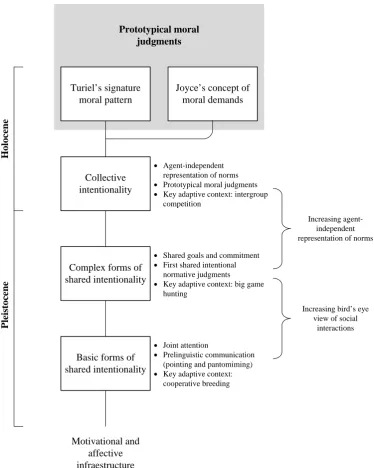
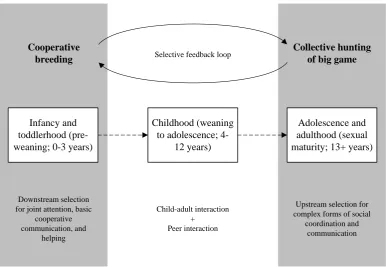
I develop this view in some detail in chapter 4. I argue that shared intentionality emerged from the interplay between the selective pressures that led to cooperative breeding in humans as well as organized, goal-oriented, collective hunting. In this story, selection did not only act upon adult cognitive capacities but rather upon the entire life cycle. Very basic capacities for shared intentionality such as joint attention and pointing behavior emerged as ontogenetic adaptations for early childhood in the context of cooperative breeding. These capacities were extended in development into adulthood where they were redeployed in the context of cooperative foraging, especially collective hunting. As a result, the motivation and commitment with the shared goals and intentions of these collective activities were carefully monitored and enforced by all the group members. The coupling of these punitive or corrective attitudes with some other common features of shared intentional states was the origin of human social norm psychology. So, my claim is not only that shared intentionality was an essential precursor to normative thinking but also that some special class of shared intentional states provides a well-defined target for the psychological study of normative thinking.
Human social norm psychology is a special form of shared intentionality that is linked to punitive attitudes toward norm violators.
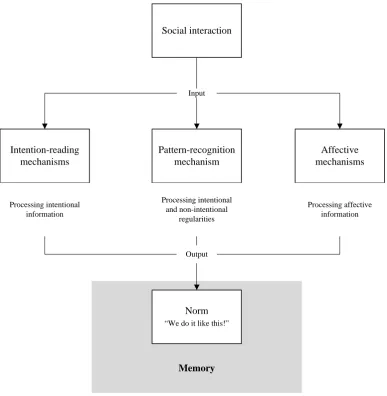
associated with the sentimentalist tradition in moral philosophy, but also that we sometimes classify these judgments as moral in virtue of their own motivational and affective profile. Take for example norms prohibiting stealing. Transgressions of this norm reliably trigger reactions of anger toward thieves or guilt for stealing. So, we learn
to identify these norms and the responses they elicit as moral because a disposition to react in such a way in these situations is prototypically linked to moral responses. They
form a very peculiar cluster of punitive attitudes. These affective and motivational dispositions help us to explain why we perceive certain judgments to be prototypically moral rather than just normative like the rules of conventional games. For they make us perceive normative judgments as being independent and authority independent, which are prototypical properties of moral judgments. Thus, this chapter returns to some of themes and arguments of chapter 1 by explaining how the distinction between moral judgments and nonmoral judgments can be culturally transmitted and by explaining how moral cognition can be prototype- or exemplar-based.
Chapter 2.
Fragmenting
moral judgments and unifying the
psychology of norms
One of the central aims of this thesis is to use philosophical tools to advance our understanding of normative and moral cognition. More specifically, I want to show how and why what some philosophers have called ‘shared intentionality’ (see, for instance, Bratman, 1992; Gilbert, 1989; Searle, 1990; Sellars, 1963) can help us to understand our distinctive capacity for normative thinking and how this capacity is closely related to a particular cluster of prototypical moral judgments. Thus, the primary target of this dissertation is normative and moral cognition rather than normative or moral phenomena, i.e., the features of the world that normative and moral judgments are about.
The goal of this chapter is to explain the relationship between the type of normative thinking on which I focus in this thesis and moral judgments. On the view I propose, the distinctive shared intentional capacities of the hominin lineage help us to define an important form of normative thinking, namely shared intentional normative thoughts. These thoughts are generated by a peculiar, but important, kind of psychology
of norms. Hereafter, I will understand norms as social norms. There might be other kinds of norms but my interest will focus on the psychology of this particular class of
norms. Roughly speaking, social norms are rules of behavior that are considered acceptable in a group or society. These norms are represented in the form of shared intentional states, or so I will argue. When a norm is executed in cognition, it generates shared or joint intentional normative judgments. Since joint intentional states are hybrid mental states, I will argue in this chapter that shared intentional normative judgments are also hybrid mental states, i.e., states which are functionally defined by both its cognitive component and its motivational component. I will explain the essential psychological properties that this kind of normative thinking picks up in virtue of these components.
The kind of psychology of social norms I will propose accounts for a large and important spectrum of our normative cognition. Moral judgments, in contrast, are more diverse. For as I will try to argue in this chapter, they seem to define a quite heterogeneous class of mental states. Although in metaethics the term ‘moral judgment’ is sometimes used to denote a kind of speech act, the term is being treated here as
denoting a mental state.4 We can isolate different kinds of prototypical moral judgments that map onto particular psychological processes, e.g., moral judgments about harm, justice, or rights which possess a particular functional profile (see Nucci & Turiel, 1978; Nucci, Turiel, & Encarnacion-Gawrych, 1983; Turiel, 1983, 1998) or judgments about
moral demands that are seen by the agent as inescapable and authority independent (see Joyce, 2001; Mackie, 1977; Mameli, 2013). But we can do this only in a fragmentary
fashion because these theories define local psychological kinds that only cover particular cases (I will expand on this issue in section 2.5). To put it briefly, while we can define within the shared intentional framework a family of normative judgments as what some philosopher would call a ‘natural kind’ (Quine, 1969), moral judgments as a whole are not a natural kind in the psychological sciences but a family of prototypical kinds (Machery, 2012; Parkinson et al., 2011; Armstrong, 2008; Sinnott-Armstrong & Wheatley, 2012, 2013; Sripada & Stich, 2007; Stich, 2016). In this chapter, I will focus mainly on the negative part of this claim, i.e., that there are good reasons to doubt that moral judgments define a unified natural kind in psychology. At the end of this chapter, I will outline the general strategy that I will follow in the rest of thesis.
This way to conceive of moral judgments is important for the overall argument of the thesis. Thus, before getting into details, it may be important to explain how this chapter fits into the larger landscape of my project. For to say that moral judgments are not a unified target for the psychological sciences is not the same as saying that they cannot be a subject of study for psychology. It means that our understanding is piecemeal and that we should advance research without a preconceived view of what make some mental states to be moral judgments. Certainly, normative cognition and
moral thinking are related to each other since moral thinking is always normative. This is a plausible working assumption. As a result, there are reasons to think that the kind of
normative thinking that shared intentionality defines subsumes an important class of moral judgments. Since there are plausible explanations of the ontogeny and phylogeny of shared intentionality, there are grounds to connect the lineage explanation of our shared intentional capacities with the psychological machinery of prototypical kinds of moral judgments (see figure 2.1).
4 If one understands metaethics more narrowly as the study of moral language, one might be inclined to
treat moral judgments as some kind of speech acts rather than as a class of mental states. Of course,
understood as speech acts they may perhaps express a mental state, but that is a different matter.
Shared intentional states Normative judgments
Moral judgments
“We ought to distribute the meat
fairly”
Shared intentional normative judgments
Figure 2.1. Diagram of the relation between joint intentional states, normative
judgments, and moral judgments. Shadow zones represent empty zones. All moral
judgments are assumed to be normative but not all moral judgments are taken to be a
special class of joint intentional states, i.e., they are not shared intentional normative
judgments. Normative and moral judgments include claims that are perceived by the
agent as right, true, correct, valid, or justified, as well as those that are perceived by the
agent as wrong, false, incorrect, invalid, or unjustified. Dashed lines indicate that the
domain is not a natural kind but likely possesses a prototypical structure.
To be clear, shared intentional normative thoughts are a special and important subclass of normative thoughts. This means that there are normative thoughts that are not shared. One can imagine thoughts that regulate individual behavior in rather egocentric way such as the normative thoughts that stem from individual instrumental rational action (Camp & Shupe, 2017). Non-human animals seem to be able of some sort of instrumental reasoning. Chimpanzees, for instance, display a form of strategic
[image:35.595.133.519.63.475.2]reasoning to outsmart conspecifics, although they do not hold others to the same standards of rational action. Humans are a much more complex case. If I want to drink water from the drinking fountain, I think that I should go to the fountain. But unlike apes, we are inclined to hold others to our standards of rationality. When someone does
not meet our expectations of what the rational course of action should be, we often (and perhaps always) judge others as stubborn, incompetent, or just simply foolish. To be
clear, it is not that norms of social interaction are shared while norms of reasons are not. Instead, the point is that great apes do not share these mental states at all—these normative mental states are useful to outcompete conspecifics rather than to cooperate with them.
The evolution of the capacity for shared intentionality is foundational for our capacity to form the class of shared intentional normative judgments. Moreover, an important class of moral judgments, though not all moral judgments, are shared intentional normative thoughts—i.e., some shared intentional normative thoughts are just not moral judgments. As I will argue in chapter 4, the psychology of the norms that govern conventional games fall within the spectrum of shared intentionality. These norms apply selectively to those that we think share with us the relevant information about the rules of the game, so we enforce those norms only on them and expect others to do the same when someone violate the rules. But norms of conventional games do not lead to prototypical cases of moral judgments—at least not of the kind that we will discuss in this chapter.
Shared intentionality gives us a framework that allows singling out a particular class of normative judgments. As we will see in section 2.5, these normative judgments can be characterized by a distinctive gradient of generalizability, intrinsic motivation,
and punitive attitudes. There might be other kinds of social normative thoughts that are not covered by this account. Yet as we will see throughout the thesis, they define a class
of social normative judgments that is central to our social lives. They are normative because they give rise to a certain form of social rationality (e.g., about how we should share the meat among hunting partners) and because we enforce them in ourselves and others (e.g., when excluding partners who do not meet our expectations). But although judgments like “We ought to share the meat fairly” may perhaps significantly overlap with prototypical moral judgments, the framework does not define by itself any special class of moral judgments.