W i l l i a m Ia n R o b e r t s o n
1971
A T h e s i s S u b m i t t e d f o r t h e D e g r e e of
D o c t o r of P h i l o s o p h y
w a s c a r r i e d o u t u n d e r t h e s u p e r v i s i o n of
D r S u p r o k a s h M u k h e r j e e , a n d is t h a t of
t h e c a n d i d a t e a l o n e , e x c e p t w h e r e n o t e d
o t h e r w i s e .
I s h o u l d l i k e t o t h a n k m y s u p e r v i s o r , D r S u p r o k a s h
M u k h e r j e e , f o r m a n y d i s c u s s i o n s on t h e q u e s t i o n s i n v e s t i g a t e d in t h e
t h e s i s , an d f o r m u c h a d v i c e on m a t h e m a t i c a l p r o b l e m s .
D r K a i l a s h K u m a r g u i d e d m e in a r e l a t e d s t u d y of t i m e -
d e p e n d e n t s c a t t e r i n g t h e o r y , a nd I t h a n k h i m f o r c o m m e n t s on
p r e l i m i n a r y d r a f t s of t h e t h e s i s .
I a m i n d e b t e d to D r W. S. W o o l c o c k , wh o p o i n t e d o u t a
b a s i c e r r o r in a n e a r l i e r c a l c u l a t i o n o f t i m e d e l a y , a n d h a s m a d e
s e v e r a l h e l p f u l c o m m e n t s on m a t h e m a t i c a l p o i n t s .
I a m g r a t e f u l to P r o f . K. J . L e C o u t e u r f o r c o n t i n u e d
e n c o u r a g e m e n t a n d a d v i c e .
M r s M. K e l l a r a n d M r s A. M u s i k of t h e P h y s i c s L i b r a r y ,
I. A. S. , h a v e b e e n m o s t h e l p f u l in t h e m a t t e r of o b t a i n i n g r e f e r e n c e s ,
a n d t h e a s s i s t a n c e of t h e L i b r a r y s t a f f , C. S. I. R. O. D i v i s i o n of
R a d i o p h y s i c s , i s a l s o a p p r e c i a t e d .
M r F . K o u s a l of t h e A. N. U. T r a n s l a t i o n U n i t p r o v i d e d
e n c o u r a g e m e n t .
T h e w o r k r e p o r t e d in t h e t h e s i s w a s c a r r i e d o u t w h ile th e
a u t h o r h e l d a n A. N . U . R e s e a r c h S c h o l a r s h i p .
F i n a l l y , I m u s t m a k e s p e c i a l m e n t i o n o f M r s Sue G e r d e s ,
who t y p e d t h e t h e s i s , a n d M i s s C a r o l E d w o r t h y , who d r e w th e d i a g r a m s
a n d c a r r i e d o u t a l l th e p r i n t i n g and c o l l a t i n g .
E a c h s t e p p e d in , a t v e r y
s h o r t n o t i c e , to r e s c u e m e f r o m a c r i s i s in th e p r o d u c t i o n of t h e t h e s i s ,
a n d e a c h h a s b e e n a b s o l u t e l y u n s t i n t i n g in th e t i m e and e f f o r t a p p l i e d to
th e t a s k .
T h e y h a v e d o n e a s u p e r b jo b , a n d I ow e t h e m m o r e t h a n I c an
T h e s c a t t e r i n g of a w a v e p a c k e t by a f i n i t e r a n g e p o t e n t i a l
m a y be d e s c r i b e d b y a w a v e f u n c t i o n in w h i c h t h e i n i t i a l s t a t e i s
s p e c i f i e d a t t i m e t = 0 , a n d t h e t i m e d e p e n d e n c e a p p e a r s in f u n c t i o n s
M ( r , k, t), f i r s t o b t a i n e d b y M o s h i n s k y .
T h e t = 0 w a v e f u n c t i o n i s d e r i v e d , f o l l o w i n g t h e t r e a t m e n t
of R o s e n f e l d , b u t u s i n g t h e G r e e n ' s f u n c t i o n f o r t h e r a d i a l w a v e e q u a t i o n
to s i m p l i f y t h e c a l c u l a t i o n of t h e L a p l a c e t r a n s f o r m .
T h e t r e a t m e n t is
e x t e n d e d to i n c l u d e t h e c a s e of a p a c k e t i n i t i a l l y w i t h i n t h e p o t e n t i a l , and
t h e w a v e f u n c t i o n f o r a d e c a y i n g w a v e p a c k e t i s d e r i v e d .
T h i s a g r e e s
in f o r m w i t h t h e w a v e f u n c t i o n o b t a i n e d b y J e u k e n n e in a n o t h e r a p p r o a c h .
By u s i n g a n a l t e r n a t i v e e x p r e s s i o n f o r t h e G r e e n ' s f u n c t i o n ,
it i s s h o w n t h a t t h e t = 0 w a v e f u n c t i o n i s e q u i v a l e n t to a n e x p a n s i o n in
s c a t t e r i n g s t a t e s .
T h e r e l a t i o n s h i p b e t w e e n t h e t = 0 w a v e f u n c t i o n
a n d t h e
t -* -°°
w a v e f u n c t i o n of s t a n d a r d s c a t t e r i n g t h e o r y i s e x a m i n e d ,
a n d t h e r e s t r i c t i o n s on t h e p o s i t i o n a nd s h a p e of t h e i n i t i a l p a c k e t in t h e
l a t t e r w a v e f u n c t i o n a r e e m p h a s i z e d .
On t h e q u e s t i o n of t r a n s i e n t s in
t i m e - d e p e n d e n t s c a t t e r i n g t h e o r y , it i s p o i n t e d o u t t h a t a d i s t i n c t i o n
s h o u l d b e d r a w n b e t w e e n p l a n e w a v e t r e a t m e n t s and t h o s e u s i n g w a v e
of t i m e d e l a y f o r a n a r b i t r a r y w a v e p a c k e t i n t e r a c t i n g w i t h a f i n i t e r a n g e
p o t e n t i a l .
T h e t = 0 w a v e f u n c t i o n i s u s e d , a n d a n e w m e t h o d of
c a l c u l a t i o n d e v e l o p e d , i n w h i c h m o m e n t u m c o e f f i c i e n t s in t h e w a v e f u n c t i o n
a r e w r i t t e n a s t r a n s f o r m s of t h e i n i t i a l p a c k e t , a n d m o m e n t u m i n t e g r a l s
a r e e x p r e s s e d i n t e r m s o f G r e e n ' s f u n c t i o n s .
G e n e r a l e x p r e s s i o n s a r e
o b t a i n e d f o r t h e t i m e s p e n t w i t h i n a s p h e r e of f i n i t e r a d i u s by t h e w a v e
p a c k e t , in t h e p r e s e n c e o f t h e p o t e n t i a l a n d w i t h t h e p o t e n t i a l r e m o v e d .
T h e i d e a of t i m e d e l a y f o r a s c a t t e r e d p a c k e t i s e x t e n d e d to i n c l u d e t h e
l i f e t i m e of a d e c a y i n g w a v e p a c k e t , a n d c o r r e s p o n d i n g e x p r e s s i o n s a r e
o b t a i n e d w h e n t h e p a c k e t i s i n i t i a l l y w i t h i n t h e r e g i o n of t h e p o t e n t i a l .
P r e v i o u s e x p r e s s i o n s f o r t i m e d e l a y h a v e b e e n d e r i v e d u s i n g
t h e
t -> -°° w a v e f u n c t i o n , and it i s f ou n d t h a t t h e u s e of t h e t = 0 w a v e
f u n c t i o n g i v e s n e w t e r m s , w h i c h a r i s e f r o m t h e p r i n c i p a l p a r t i n t e g r a l of
(+)
a 6
f u n c t i o n .
T e r m s of t h e t y p e da
t
w h i c h a p p e a r in O h m u r a ' s
dk
e x p r e s s i o n f o r t i m e d e l a y , a r e f o un d o n l y in t h e c a l c u l a t i o n of l i f e t i m e .
A d i s c u s s i o n in o n e d i m e n s i o n s h o w s t h a t t h e s e t e r m s r e p r e s e n t t h e m e a n
a r r i v a l t i m e o f t h e p a c k e t a t t h e o r i g i n , a n d t h a t o t h e r t e r m s a p p e a r i n g in
I N T R O D U C T I O N
1
C H A P T E R
1
T H E t = 0 W A V E F U N C T I O N
10
l a
I n t r o d u c t i o n
10
l b
D e r i v a t i o n of t h e t = 0 W a v e F u n c t i o n
12
l c
T h e M F u n c t i o n s
32
C H A P T E R
2
S C A T T E R I N G S T A T E E X P A N S I O N
O F T H E W AV E F U N C T I O N
37
2 a
T h e t = 0 W a v e F u n c t i o n
37
2b
T h e t
- » W a v e F u n c t i o n a n d t h e
A s y m p t o t i c L i m i t
44
2c
T r a n s i e n t s
49
C H A P T E R
3
T I M E D E L A Y O F A S C A T T E R E D
W A V E P A C K E T
5 3
3a
I n t r o d u c t i o n
53
3b
D e f i n i t i o n of T i m e D e l a y
63
3c
C a l c u l a t i o n of T_
(R)
67
f r
3d
C a l c u l a t i o n of T .
(R)
77
i n t
C H A P T E R 4
L I F E T I M E O F A D E C A Y I N G
W A V E P A C K E T
83
4 a
I n t r o d u c t i o n
8 3
4b
C a l c u l a t i o n of T„
(R)
91
f r
4c
C a l c u l a t i o n of T.
(R)
100
i n t
A P P E N D I X B
R A D I A L I N T E G R A L S
I N T R O D U C T I O N
Time-dependent scattering theory describes the development of the scattering system from the initial state to the final state under the action of the Hamiltonian H = H + V.
o
The scattering process is usually divided into three stages. Initially, the particles are free and propagate according to the
Hamiltonian H . The collision occurs when the particles come within the o
range of interaction, and the potential V takes effect. After some time, the particles separate, and in the final state the propagation is again governed by H .
o
In the standard treatment of Lippmann and Schwinger (1950), the initial and final states are actually eigenstates of H^ (plane w a v e s ) , and the interaction producing the scattering is switched on and off adiabatic-ally,
V (r, t) = V (r) + 0 . (1.1)
t -> ±°°
This procedure leads to the wave functions of formal scattering theory,
'T- ' = $ + 1_______ V 'T- ' , (1.2)
E ± ie - H
o o
where $ is a plane wave state,
H $
The use of plane waves is familiar from elementary
(time-independent) scattering theory, but it introduces the complication that
the wave functions are not readily normalised.
Some artifice such as
box normalisation must be used, and this in turn makes it necessary to
treat the limiting procedures of time-dependent theory very carefully
(Gell-Mann and Goldberger 1953).
It is more satisfactory to treat
scattering in terms of wave packets, since normalisation is then included
automatically, and the variation of the interaction with time arises from
the approach and separation of the localised particles, rather than
switching of the potential.
Wave packet scattering has been treated by many authors
(Sunakawa 1955, Moses 1955, Jauch 1958, Low 1959, Haag 1960, Green and
Lanford 1960, Goldberger and Watson 1964) but it is generally the case
that discussion is limited to obtaining plane wave results.
The treat
ment may be such that it is valid only for long wave packets, or the
restriction to a narrow momentum distribution may be applied at the end
of a more general calculation.
In either case, the cross section (or
some other quantity) is derived for a fixed value of the momentum, and
the use of wave packets in the derivation simply provides a reasonable
physical picture, or permits a mathematically rigorous treatment.
The results thus obtained are sufficient to describe most
current scattering experiments, but they do not exhaust the possibilities
of wave packet scattering.
The most obvious application of wave packet
ideas is in the consideration of time-dependent experiments.
If the
-time at which an interaction occurs is to be well defined, the particles
involved must be strongly localised in space, and so must be described by
A model of a time-dependent scattering situation which has been
studied by several authors (Nussenzveig 1961, Dodd and McCarthy 1964,
Goebel and McVoy 1966) is that of a wave packet of resonance shape inter
acting with a scatterer which has a resonance of similar position and
width.
As the width of the packet is varied, the rise time and decay
time for the compound system also vary.
If the width of the packet, y ,
is much less than that of the resonance, y , the rise time is roughly
2x^
(t.11 1 ) but the decay time is
2tq .This corresponds to exciting
v .
■ l
the resonance with a very long packet, so that the rate of decay is equal
to the rata at which the incident packet dies away.
If instead
y >>y^,
the rise time is 2x and the decay time 2
t-
,
- the resonance is excited
o 1
rapidly by a sharp packet, and then decays at its natural rate.
It has been suggested that wave packet experiments would provide
a means of separating direct and compound nucleus processes in nuclear
reactions, and the model mentioned above is relevant to discussion of such
experiments.
In order that the direct and compound scattered packets may
be well separated in time, the incident packet must have a very broad
momentum distribution (y >> y^).
This produces a direct packet which
leaves the scatterer almost immediately, and a compound packet which
emerges after an appropriate time delay.
If the momentum distribution
is too narrow (y << y ), the duration of the incident packet is so long
o 1
that there is still a direct component present when the compound packet
emerges, and it is not possible to separate the two by time resolution.
An important quantity in the consideration of such time-dependent
experiments is the time delay suffered by the particle as it interacts with
the scatterer. If the particle is captured in a resonance it is delayed for
a long time before being emitted from the compound nucleus, whereas if it
corresponding free particle. The idea of separating compound nucleus and direct processes in a w^ve packet experiment depends, of course, on the
fact that the two types of scattering give vastly different time delays.
This thesis is concerned with the question of time delay in scattering situations, and in particular, with the calculation of the time delay experienced by an arbitrary wave packet as it interacts with an arbitrary finite range potential.
It should be mentioned that the notion of time delay is closely linked with the idea of measuring the mean arrival time of the wave packet at a point or at a surface. The measurement of arrival times in quantum mechanics has recently been the subject of an intensive investigation by Allcock (1969), but the questions and problems raised by Allcock's paper are quite beyond the scope of our discussion. We shall be content rather to start from a generally accepted definition of time delay, and to
compare our results with those of other authors who have used the same, or a similar, definition.
Previous discussions of wave packet scattering have generally been b a sed on the wave function of standard scattering theory, which involves the asymptotic limit t -> . The initial state of the system is defined by a free wave packet, $(r,t), such that the total wave function for the interacting system, ¥(r,t) , approaches 3>(r,t) as t -* -00 . The use of this wave function imposes certain restrictions on the position and
shape of the initial packet, however, as may be seen by examining a free wave packet in one dimension.
packet
Let us consider a free particle of mass y, described by a wave
<Mx,t)
ikx dk A(k) e
ihk2t
2y
(1.4)w i t h the n o r m a l i s a t i o n
00
1 dk A* (k) A(k) = 1
— OO
(1.5)
The m e a n p o s i t i o n of the w a v e p a c k e t at time t is g i v e n by
x(t) dx $ (x,t) x $(x,t)
-ikx + ifik2 t
- t I *
dx (2tt) dk A (k) e
i k ' x - fftk,2t
x ( 2t t)- h dk ' A (k 1 ) e
dk A (k) i d A(k) + dk A (k) fik A(k) . t
= x(o) + v t (1 .6 )
ik * x
In d e r i v i n g E q . (6) we h a v e e x p r e s s e d x e in the s e c o n d line
as -i d e
dk'
ik'x
, and u s e d i n t e g r a t i o n by p a r t s w i t h i n the k' i n t e g r a l
-ifik' 2 t
to t r a n s f e r the d e r i v a t i v e to A(k') e . Since the i n t e g r a l (4)
converges, the i n t e g r a t e d p a r t v a n i s h e s at the u p p e r a nd l ower limits.
The e x p r e s s i o n for x(o) m a y be shown to be real b y ta k i n g the c o m p l e x
The m e a n v alue o f x 2 (t) m a y be c a l c u l a t e d similarly:
x 2 (t) = dx $ (x,t) x 2 $(x,t)
OO CO
f * 9 f *
_
dk A (k)
OO
i d dk
2 A(k) + dk A (k)
— 00
i d dk
fik + *fik i d U dk
A (k) t
CO
f *
+ dk A (k) fik —o0 _y _
A (k) . t 2
= x2 (o) + [_ x ( o ) v + vx(o) ] t + v2 t 2 (1.7)
T hen the m e a n s quare d e v i a t i o n of x is
A 2 (t) = a?(t) - x 2 (t) x
A 2 (o) + f x ( o ) v + vx(o) - 2 x ( o ) v I t + A 2t 2
X V
(1 .8 )
F r o m E q . (6), if we assume v is p o s i t i v e it w i l l be s een that
x(t) -> -oo as t -> -°° , so the centre o f the p a c k e t is s i t u a t e d at an inf i n i t e d i s t a n c e f rom the origin. F r o m E q . (8), since A 2 is p o s i t i v e , A 2 (t) -+ 4-co as t -* -00 , so the w i d t h of the p a c k e t i n c r e a s e s i n d e f i n i t e l y in this limit. Since the w a v e p a c k e t r e m a i n s n o r m a l i s e d , as the w i d t h of
the p a c k e t i n c r e a s e s the a m p l i t u d e at a g i v e n p o i n t d e c r e a s e s , and in the limit the p a c k e t is " t h i n l y s pread" o v e r all space. In g e neral, f or a w a v e p a c k e t w h i c h c o n t a i n s no b o u n d state components, the p r o b a b i l i t y of
-3
limit t -> ±°° (Haag 1960) .
The sense in which the wave functions $(r,t) and Y(r,t)
approach each other in the initial state must be defined with some care,
since the wave functions at any point r go to zero individually as
t -> -°o . The notion of pointwise convergence is inadequate in this
situation, and it must be shown instead that ¥(r,t) converges strongly
to $ (r ,t) , i. e.
lim dr | Y(r,t) - <t(r,t) |2 = 0 (1.9)
t ~ ° ° ~
The use of the asymptotic limit in scattering theory is
usually justified on the grounds that scattering experiments involve
distances and times which are large on the quantum scale - the initial
packet is prepared in the source of an accelerator, and the time of
travel down the accelerator tube is long compared to the time taken to
cross a region of nuclear dimensions. However, scattering can be
studied in situations which do not involve large distances and times.
As an example we mention proximity scattering (Fox 1962),in which the
incident and target particles are produced by sequential nuclear decay.
Proximity scattering occurs when the final state of a nuclear
reaction contains three particles, and the kinematics are such that two
of the particles may subsequently rescatter. In the reaction
ic *
a + b -* B ->• c + D -* c + d + e , (1.10)
if the energy and angular distribution of (say) particle d are suitable,
it is possible for d to catch up with c and produce the proximity
scattering
c + d -+ c + d prox
*
The lifetime x^ of D and the c-d scattering cross section may be
related to the observed energy and angular correlation of c and d.
-20
Lifetimes of the order of 10
sec have been measured by this method
(Lang et al 1966), and it also presents a way of obtaining cross
sections when either c or d is unstable.
Since c and d are the products of decay processes, they do
not have well defined momenta, but may be represented by exponentially
decaying wave packets whose momentum widths are inversely proportional
to the respective lifetimes.
From the mean energies of c and d, and
the order of magnitude of x^, it is possible to estimate the distance
travelled by d before it interacts with c, and in the examples considered
by Fox this is typically «J-400 fm.
The initial state of the reaction (11)
thus consists of two exponential wave packets, separated by a distance of
several hundred fermis, and the proper treatment of such a reaction
requires a scattering theory which is not limited to long wave packets or
to infinite separation of the incident and target particles.
Wave packet scattering can in fact be treated as a simple
initial-value problem, with the initial state specified at time t = 0.
In such a treatment the initial packet, of arbitrary shape, may be
localised in a finite region and situated at a finite distance from the
scatterer.
We shall use the t = 0 wave function in the calculation of
time delay in order to obtain expressions valid for an arbitrary initial
packet, without restriction on its position or shape.
Apart from allowing the initial packet to be quite general,
the use of the t = 0 wave function opens up the possibility of carrying
are taken into account.
In discussions of time-dependent scattering
theory, mention is often made of "transients" in the wave function.
Gell-Mann and Goldberger (1953), for instance, represent the initial
state of the scattering system as a train of waves fed in over a period
of time in order to avoid "undesirable transients", which would arise
if the incident waves were released all at once.
The method of
adiabatic switching may also be viewed as a device for avoiding transients.
It is understandable that transient effects should be removed or avoided
if the system under consideration is essentially stationary, but this
does not seem reasonable if we are dealing with a situation which is
time-dependent.
Transients usually reflect the rate at which an
interaction is switched on, or an excitation produced, so a discussion
of a time-dependent scattering situation should include a proper treat
ment of transient effects.
In the t = 0 wave function, transient effects are found to be
described by certain functions M(r,k,t) of position, momentum and time,
whose form is known explicitly.
By using this wave function in the
calculation of time delay, therefore, we aim to obtain an expression
for time delay containing terms representing transient effects, from
which the importance of such effects in a particular scattering
situation can be gauged.
Chapters 1 and 2 of the thesis are devoted to the derivation
C H A P T E R 1
T HE t = 0 WAV E FUN CT I ON
la.
I n t r o d u c t i o n
In early treatments of scattering (Dirac 1926, 1927) the initial
state of the system was specified at time t = 0.
The wave function for
subsequent times was obtained by time-dependent perturbation theory,
however, and so was accurate only to some order in the perturbation.
The
first exact solution of a scattering problem with the initial state at
t = 0 seems to have been given by Moshinsky (1951, 1952 a), who considered
the situation of a scatterer suddenly inserted into a beam of particles.
Moshinsky obtained the space and time dependence of the wave function for
t > 0 in terms of functions M(r,k,t) (in Moshinsky's notation x(r /k,t) )
related to the complementary error function.
In subsequent papers
Lozano (1953, 1954) treated the scattering of an arbitrary wave packet
by a finite range potential, and the transmission of a wave packet through
a potential barrier, with the wave function in each case being expressed
in terms of the functions M(r,k,t).
Sasakawa (1959) examined the s-wave
scattering problem independently, and solved the time-dependent Schrödinger
equation by the Laplace transform method.
He obtained functions denoted
by G which are essentially the M functions of Moshinsky.
A detailed exposition of initial-value problems in both classical
and quantum physics has been given by Beck and Nussenzveig (1960).
They
show that the problem of the "exponential catastrophe", which arises in
discussions of scattering and
decay,
is eliminated by
taking into account
the exponentially increasing Gamow states are replaced by the functions M,
and Beck and Nussenzveig discuss the properties cf these functions in some
detail.
With the initial packet specified at t = 0, it is no longer
necessary to treat scattering and decay on different footings (cf Heitler
1954, pp 150, 163).
A unified treatment is possible, in which the two
processes differ only in the position of the initial packet.
If the packet
is completely outside the interaction region at t = 0, the wave function for
subsequent times describes its scattering by the potential.
If the packet
is completely inside the potential at t = 0, the wave function describes the
decay of the wave packet as it leaks through the potential.
Nussenzveig
(1961) has considered the interaction of an arbitrary wave packet with a
partially transparent sphere, and followed the behaviour in time of the wave
function in the cases when the packet is scattered by the sphere and when it
is decaying from within the sphere.
All the previous work on the scattering problem is brought together
in a paper by Rosenfeld (1965), and more recently Jeukenne (1967 a,b, 1968)
has studied examples of scattering and decay.
Our treatment is similar to
that of Rosenfeld, though we shall make explicit use of the Green's function
for the radial wave equation, since this simplifies the derivation of the
Laplace transform.
By allowing the initial wave packet to be non-zero
within the potential, we shall be able to extend Rosenfeld's treatment, and
derive the wave function for the decay problem in a form similar to his
scattering wave function.
The wave functions for scattering and decay may be obtained in
two different, but equivalent, forms.
In the first, the initial packet is
f u n c t i o n f o r t > 0 i s e x p r e s s e d a s a n i n t e g r a l o v e r r o f t h e p r o d u c t o f
t h e i n i t i a l p a c k e t an d a s p a c e - t i m e p r o p a g a t o r .
The wave f u n c t i o n s i n
t h e p a p e r s o f N u s s e n z v e ig a n d J e u k e n n e a r e g iv e n i n t h i s fo rm .
A l t e r
n a t i v e l y , t h e i n i t i a l p a c k e t may b e e x p a n d e d i n te r m s o f p l a n e w a v e s , and
t h e n t h e w ave f u n c t i o n s a r e o b t a i n e d a s i n t e g r a l s o v e r momentum, c o n t a i n
i n g t h e c o e f f i c i e n t s o f t h e e x p a n s io n a n d f u n c t i o n s o f r , k a n d t .
T h is
m e th o d h a s b e e n u s e d by L o z a n o , S a s a k a w a , an d R o s e n f e l d .
We s h a l l a d o p t t h e s e c o n d a p p r o a c h , a s t h i s w i l l a ll o w u s , i n
C h a p te r 2 , t o d e r i v e a s i m p l e r e x p r e s s i o n f o r t h e wave f u n c t i o n a n d t o
r e l a t e i t t o t h e wave f u n c t i o n o f s t a n d a r d s c a t t e r i n g t h e o r y , w h ic h i s
b a s e d on t h e a s y m p t o ti c l i m i t t -*■ -°° .
S in c e we a r e i n t e r e s t e d o n l y i n
t h e g e n e r a l f e a t u r e s o f t h e wave f u n c t i o n , we s h a l l r e t a i n t h e M i t t a g -
L e f f l e r e x p a n s io n u s e d by R o s e n f e l d .
I n a p p l i c a t i o n s i n v o l v i n g t h e
s i n g l e - l e v e l a p p r o x i m a t io n , J e u k e n n e (1967a) h a s shown t h a t a C auchy
e x p a n s i o n (H um blet sind J e u k e n n e 1966) , w h ic h a v o id s t h e i n f i n i t e p o w er
s e r i e s i n t h e b a c k g ro u n d t e r m , i s m ore u s e f u l .
lb.
Derivation of the t = 0 Wave Function
We c o n s i d e r a w ave p a c k e t , r e p r e s e n t i n g a s p i n l e s s p a r t i c l e o f
m ass y , i n t e r a c t i n g w i t h a r e a l s p h e r i c a l p o t e n t i a l V ( r ) , o f f i n i t e r a n g e a ,
V( r )
=
0
,
r > a
.
( 1 .1 )
The i n i t i a l p a c k e t i s a r b i t r a r y , a n d i n p a r t i c u l a r we s h a l l a ll o w i t t o
o v e r l a p t h e r e g i o n o f t h e p o t e n t i a l .
The wave f u n c t i o n f o r tim e t > 0
w i l l b e fo u n d t o c o n t a i n tw o c o m p o n e n ts .
The f i r s t r e p r e s e n t s t h e
potential, and is the wave function appropriate to the scattering problem.
The second represents the propagation of that part of the packet initially
inside the potential, and is the wave function for the decay problem.
The initial packet may be expanded in plane waves,
$(r)
ik.r
dk A(k) e (1.2)
and in terms of partial waves
<Mr) = I Y. (ft) 1 4> (r) U Jim — O m
£ m
(1.3)
where
(r) £ m
dk A. (k) J (kr)
£ m £
(1.4)
The functions Y„ (ft) are spherical harmonics, with the normalisation £m
dft Y (ft) Y , (ft)
£ m £' m '
6
£ £ ’ mm'6
(1.5)4tt
The J^(kr) are Riccatti - Bessel functions^, related to the usual spherical
Bessel functions j by
(p ) = P j £ (P) (1.6)
and they satisfy the orthogonality relation
dr J^(kr) J^(k'r) tt_ 6 (k - k ')
2
(1.7)
t In Rosenfeld's paper, and also in Humblet and Rosenfeld 1961, the Riccatti - Bessel functions are denoted by a script ^ . Since this symbol was not available to us, we use for the Riccatti - Bessel functions.
Using Eq. (7) in Eq. (4) we have
\ m (k)
2
1
dr V (
r) V kr)
ITO
(1.8)
and the packet is normalised so that
•71
y
dk A 2 Um Jo <k > A o (k)
icm Jtm (1.9)
By retaining the factor ir_ in Eq. (9) , we avoid the appearance of factors
2
in the wave functions derived later.
We wish to solve the time-dependent Schrödinger equation
ih f (r , t ) at
-h2 V2 + V(r)
2y
Y(r,t) (1.10)
subject to the initial condition
V (r,0) = $(r) (
1
.11
)Let us definet
T = fit , (1.12)
V
v (r) = 2y_ V (r) , (1.13)
h 2
t We shall make frequent use of the variable t throughout the thesis, since
-ihk2t
-ik2T
this simplifies the appearance of the time factor e 2^ e 2
and expand the wave function
V ( r ,
t) in partial waves,
^ (r#
t)
=
I
1 ip0m(r,T)
(1.14)
Then \p
(r,i) satisfies the radial wave equation
Jem
21
I ^ m (r'T)
3x
.3^ + 1(1
+ 1 )
+ v(r)
3r2
r2
ip0 (r ,x)
,
(1.15)
Jem
subject to the boundary conditions
^ m ( 0 'T)
(1.16)
lim
\ p n (r,x)
=
0
Jem
(1.17)
and the initial condition
V (r)
(1.18)
E q . (16) is the condition that the wave function be regular at the origin,
and E q . (17) is necessary for the wave function to be normalised.
The solution of Eqs (15) to (18) may be obtained by means of the
Laplace transform.
Let
[pZ m ( r , p ) ^ I
dT e’PT* - (r'T>
(1.19)
be the Laplace transform of ipn (r,x) , and let there be positive constants
x-m
M, a and
tsuch that
o
M e
for T > T0 ‘
Then ip^(r,p) is an analytic function of the complex variable
remain finite for all times, so in fact a = 0, and
\pn
(r,p) is analytic 5cmfor Re p > 0.
Applying the transform (19) to E q . (15), and using Eqs (16) to (18), we have
-li V (r'P> +
W r’
p)
+ v(r)
W r’p) -
2
ipW r'
p) - -
2
iV (r) •
9r2 r2
with
V ° ' p)
= °
(
1
.20
)(
1
.21
)and lim = 0
(1.22)
The homogeneous part of E q . (20) is just the radial wave equation with k* replaced by 2ip. Let us define a complex wave number k by
P
•
/2|pT
+ 2L
2 4
0 = arg p , (1.23)
so that k 2 = 2ip, and let
G n
(k : r . r ’) denote the Green's function for thep
a
radial wave equation,
-32 + JC (51 + 1 ) + v(r) - k ‘ G £ (k : r ,r' ) = 6 (r - r' )
(1.24)
Then the solution of E q . (20) is
We define regular and irregular solutions, <f>£ (k,r) and f£ (k,r), of the radial wave equation by (Newton 1960)
lim
(21
+ 1) !! r" £_1 <{>£ (k,r) = 1 r + o(1.26)
i V r
lim e f£ (k,r)
•£ -*■ 00
(1.27)
and the Jost function f (k) by
f£ (k) = lim (kr) f £ (k,r)/(2£ - 1) !! r -*• o
(1.28)
(The potential V(r) is assumed to satisfy the condition
dr r IV(r)| < »
in addition to (1), so that the regular solution 4>^(k,r) does in fact exist.) Then the Green's function appropriate to the boundary conditions (21) and
(22) is
G (k : r , r ')
I
p (“ )Ä k 5,p
i
(k ,r )f (-k ,r )p <a
p > f 0 (-k )i
p(1.29)
where r< is the lesser, and r> the greater, of r and r'.
Note that for Re p > 0 , the argument of k lies between 0 and tt , and
P
2
Im k > 0 . P
We shall use the following relations, which may be derived from the differential equation for <p and f , and the corresponding equation
X/ X/
with v(r) = 0 for J £ :
dr' <f> (k ,r') J 0 (kr')
£ p Z
(k2 - k 2 ) P
J. (kr) ,<P (k ,r)
^ ^ P J ,
dr' v ( r ')^ (k ,r') J (kr')
OO
d r ’ f (-k , r ' ) J.(kr')
J i p i
r
(k2 - k 2 ) P
-W J (kr),f (-k ,r)
i i p dr' v ( r ')f (-k , r ') J . ( k r ’)l i p i , (1.30b)
where the Wronskian is defined as
W g(r) , h(r) g (r) 9_ h (r) - 3_ g(r) h(r)
3r 3r
(1.31)
By direct expansion of the Wronskians, and using Eq. (4.3) of Newton I960, we also have
f 0 (“k , r) W
i p
Jl
(kr)' W r>
- <J> (k ,r) Wi p J (kr), f (-k ,r)i i p _= W f (-k , r) ,<p (k ,r)
i p i p
V kr)
(-) f (-k ) J (kr)
i p i
P
(1.32)
Inserting (4) and (29) into E q . (25), and using (30) and (32), we obtain for the Laplace transform
hm(k>
--2A_ ] V kr)
(k2 - k 2 ) P
(-) Ä k Ä f (-k ,r)
P £ P
f 0 (-k )
i p
dr' v(r')$Ä (k ,r')JÄ (kr
- (-)1 k 2, <j> (k ,r) P £ P
f
i0 (“ k )p
dr' v(r') f 0 (-k ,r') J .(kr*)
i p i
oo
In the third term within the curly brackets, / dr' has been replaced by
a r
/ dr', since v(r') is zero for r' > a. r
The derivation so far is valid for all values of r, so that we
could, if we wished, calculate the wave function ^(r,!) for points inside
the interaction region. Nussenzveig (1961) and Jeukenne (1967 b)
have carried out such calculations for the scattering problem in order to
follow the formation and decay of the "compound nucleus". We shall limit
our discussion to the external region r > a, however, and in this case the a
first integral over r' in E q . (33) becomes / , and the second integral over
r' vanishes. Using the relation
o
(-) f ^ (-k, r) = O^(kr) r > a (1.34)
where 0 ^ (kr) is the outgoing spherical Hankel function, and rewriting the
r' integral by means of Eq.(30a), we obtain finally
M r'p>
r > a ^
\ m<k>.ji .
„.K (kr) - v kpr) wC y ka> ' W a)]
(k2 - k 2 ) ^P
a
+ I dk A o (k) (-2i) 0 ( k r)
I
dr’ J „ (kr* ) <J> 0 (k ,r’ ) £m 11 p o_______ £____ £ p____w[o,, <kp a> O y a ) ]
(1-35)
The specification r > a will be omitted from subsequent equations, it being
understood that the wave functions are those for the external region.
The first integral in E q . (35) is given in Rosenfeld 1965, where
the initial packet is assumed to be localised outside the potential, and
i m v e r s e Laplace transform of this term, Rosenfeld obtains the wave function fcor the scattering problem in the form
.2.
-ik T
*'ta,( r 'T) dk A £m (k) J (kr) eic
oo '
— oo s
A £ m (k) ° £ (r)> l Pn (k) + 1 a (k) 1 3
0 Ln (k-k ) n s-o
n
L
3r
-M (r,k , t )
- OO r "js
l Pn (k) + 1 a (k) 1 3 n — — :— . s=o i 3r
(-k-k )
L- n t —
M(r,-k ,x)
- J 2k p (k) M(r,k ,x) n n
(k2- k 2 ) n
True operator D (r) is given by
(1.36)
V r)
1 (-r)2i
£+1
I i
r 3r
(1.37)
wi.th
(r) e' -k 0 (kr) 2i
(1.38)
a m d the M functions by
M( r , k ^ ,t)
ik r
v ik2 xv 1_ e
2
erf c r - k t
v v2iT
(1.39)
wheere
erfc (z) = 2 /n" 2
“u ^
e du
In writing E q . (36) we have combined and of Rosenfeld's E q . (42) into the term in M(r,k,x), expressed in terms of M(r,-k,x), and combined and S „ into the term in M(r,k ,1). The sums over n and s
3 4 n
arise from a Mittag - Leffler expansion of the Wronskian term in E q . (35) :
-2i k-8-
wCyka> - w a) ]
w[o£ (kp a ) , ^ ( k p ,a)]
00
l
a
S=o P
(1.40)
The poles k are at the zeros of the Wronskian in the denominator, n
wfo (k a)
,<p
(k ,a)"] = 0L
i
n It n -1 (1.41)and coincide with the poles of the S matrix (Humblet and Rosenfeld 1961). Comparing Eqs (4) and (36), it can be seen that the first integral in E q . (36) is the wave function for the incident packet, and the second integral the wave function for the scattered packet.
Lozano (1953) has treated the scattering problem for arbitrary angular m o m entum by another method, and obtained a wave function similar to (36). Sasakawa (1959) has considered s-wave scattering, but he overlooks the poles of the S matrix in the evaluation of a contour integral, so that his expression for the wave function lacks the terms in M(r,k ,x ).
The second integral in E q . (35) represents the contribution from the part of the initial packet inside the potential, as may be seen by
a
rearranging it into the form -2i
f
dr' G„ (k : r,r') (r') . We shallo
i
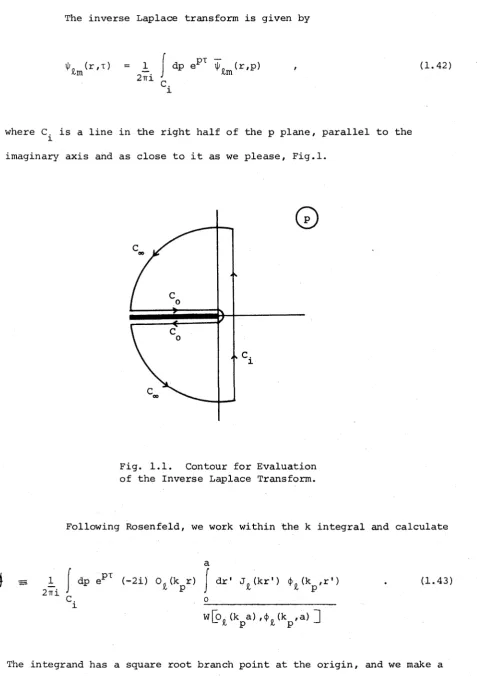
p UrnThe inverse Laplace transform is given by
^ m ( r ' T )
(1.42)
where Ch is a line in the right half of the p plane, parallel to the imaginary axis and as close to it as we please, Fig.l.
Fig. 1.1. Contour for Evaluation of the Inverse Laplace Transform.
Following Rosenfeld, we work within the k integral and calculate
a
j- = 1_ dp ePT (— 2 i ) 0^(k r) | dr' J^(kr') <J>^ (k ,r') . (1.43)
2 tt i P J P
C. o
w[ot (kp a),*£ (kp ,a) ]
[image:30.547.55.533.45.723.2]half of the p plane, and an indentation C around the cut. o
The poles of the integrand are again given by E q . (41), and they are distributed in the k plane as shown in Fig.2.
Fig.1.2 Zeros of
wfo
f (p 1 , Eq. (41) . L— X, icH a--- Second bisector.
B Bound state R Resonance V Virtual
A Antibound state TR Time-reversed TV Time-reversed
resonance virtual
We divide the k plane into two regions, labelled (l) and ( 2) , separated by the second bisector. From E q . (23) we see that region (l) is mapped onto the first sheet ( -tt <. 0 <. it) of the p plane, and region (2) is mapped onto the second sheet (tt < 0 <. 3tt) . Accordingly, in integrating around the contour in Fig.l, we shall obtain contributions from the residues of the bound state and resonance poles in region (T) . The integral
around C v a n i s h e s , so we have
00
4
+1
_
2TTi
I
©
nThe integral around the indentation C may be evaluated by o
reverting to the plane, where the path of integration coincides with
the second bisector. Denoting the integral by
,
and using Eq. (38)to rewrite the Hankel function 0„(k r ) , we have
Z
p-f-00 — j_00
4
D (r) 1 I dk e1
27i
—oo-f-j_oo
I
P
ik r-ik2i
P JL.
Now
-£+l
4ik dr' (kr') (k^,r')
w [ 0 (k
a) ,<|>(k
,a) u x, p x, p-1
(1.45)
<PZ (k,r) f^(_k ) Xz (k,r)
. Z+1
where x^(k /^) is the "physical" solution of the radial wave equation
(Newton 1960), and
■Qo^(ka) ,<|>Ä (k,a) 3
=
^(-k)
(cf. Eqs (32), (34) ), so we have
-£+l
4i k I dr' J 0 (kr')4»_ (k ,r')
p i Z Z p 4i kP dr' J £ (kr') Xjl0t .r')
l+l
w C ° i (kp a> ' h (kp ' a > ^
We know that
(1.46)
xz(k'r)
( Q
(k^+ ^) as k -* 0 ,so the function on the LHS of E q . (46) has a first order zero at k = 0.
Er
Removing a factor ik , we obtain a meromorphic function of k , with poles
gi v e n by E q . (41), w h i c h a p p r o a c h e s a f inite l imit as -* 0. T h e function
m a y be e x p r e s s e d as a M i t t a g - L e f f l e r e x p a n s i o n of the f orm
4k M dr' J (kr')<j)0 (k ,r') = J p ' (k) + £ a'(k) k S , (1.47)
p £ £ p ^ n ^ s p
o _ _____________________
n
i r n r n
W
t V V > ' V V a)^
w h e r e the sum o v e r n i n c l u d e s all p o l e s o f reg i o n s
(T)
a n d(2)
in F i g . 2. The resi d u e s p 1 (k) a n d c o e f f i c i e n t s a'(k) h a v e b e e n p r i m e d to d i s t i n g u i s hn s
t h e m from s i m i l a r q u a n t i t i e s a p p e a r i n g in the e x p a n s i o n u s e d b y Rosenfeld,
E q . (40).
To p r o v e t h a t the sum o v e r the p o l e s in E q . (47) c o n v e r g e s , we
c ompare the residue p'(k) w i t h the res i d u e p (k) of E q . (40). If we d enote
n n
by a fur t h e r p^ the r e s i d u e of the s c a t t e r i n g a m p l i t u d e
S . ( k ) -1
£ p
_2i
W [ 0 4 (kpa),*£ (kp ,a)l
(1.48)
at the p o l e k , R o s e n f e l d has s hown t h a t n
(k)
=
-1_
w Q j (ka), 0 (k a) J
,£+1
* *n
k
(1.49)
N o w it can b e s een f r o m Eqs (47) and (48) that
P' (k)
n 2i 1
k 0
n
-dr' J ( k r ') <J> „ (k ,r')
36 36 n (1.50)
Using the fact that W 0„ (k a) ,<f> (k ,a)| = 0 we can write ^ £ n £ n
w[vkna)' W a
)
^
W C V kna)' V kna)3
h (kn 'a)
o (k a)£ n
~kn W a)
O (k a) £ n
The function <f> (k,r) is given by (Newton 1960)
4>^(k,r) = i_ 1
2 . £+1
k
f^(-k)f^(k,r) - (-) f^(k)f^(-k,r)
but
f 0 (-k ) £ n
W
r)
2.+ 1
1 1 (-) f (k ) f (-k ,r)
2 7 w i
I
n
i
n
Then from Eqs (50),(51) and (52)
P ’ (k)
n -2i_
,
£+1
k o
n —
dr' J.(kr') f 0 (-k ,r') O 0 (k a)
£ £ n £ n
f„ (-k ,a) £ n
Comparing Eqs (49) and (53) we have
P ' (k)
n
pn (k)
2i I dr' J^(kr') f ^ - k ^ r ' ) x
f0 (“k /a)
£ n
0 (k a) £ n
w [ J
(ka) ,(1.51)
(1.52)
(1.53)
°l
(kna)H
Now
y - k n'r)
o ik r . £ n i e
k -► 00 n 1
and except for a finite number of bound states, the pole k^ is given by
k = K - i y , Y > 0 , so for Ik I sufficiently large, the integrand
n n n n n ,
Y r '
in the first term of Eq. (54) contains a factor e . Thus as Ik I -► 00
• i n
ik a
the integral is 0 ( e n ) , and
dr' J.(kr*) f.(-k ,r')
£ £ n 0 (1) as |k I1 n 1 -> 00 (1.55)
Further,
f 0 (-k ,a) £ n
0 (k a) £ n
k -► 00
n
1
o lk a . -£ n l e
0 (k a) £ n
wdVka>< V kna)]
k
l n J
(1.56)
Combining Eqs (54) , (55) and (56) ,
P' (k ) n
pn (k)
6
ik
l n J
k 00
n
1
(1.57)and the series in E q . (47) converges by comparison with the corresponding
series in E q . (40).
On inserting the expansion (47) into E q . (45), we obtain two types
of integrals. The first is related to the function F (kn ) appearing in
4 - 0 0 — j_ 00
F (k )
n
1
2 n i
dk
e
—oo-f-2.00
i k r - i k 2 x
2( 1 . 5 8 )
k - k
Then
-J-00—2_oof
— 0 0 4 - 2 . 0 0
i k r - i k z x
dk
i k
e
P
P
-k
- k
P
n
9
F (k )
9 r
n
( 1 . 5 9 )
The s e c o n d t y p e o f i n t e g r a l may be e x p r e s s e d i n te r m s o f t h e
p o i n t s o u r c e p r o p a g a t o r U ( r , x ) .
U s in g t h e c h a n g e o f v a r i a b l e u = r - k i
we h a v e
2 n i
4-oo-ic
— 0 0 4 - 2 . 0 0
dk e
i k r - i k 2 x
2- 1
/5 T
2 - 1
2
- r
i c
- i 00
d u e
- r 2
- i
e ‘
/2TTiT
1
U ( r , x )
( 1 . 6 0 )T hen
4 - 0 0 — 2 . 0 0
1
2-rri
dk
i k
e
P
P
i k r - i k 2 x
P
J2 .
2
k s
P
— 0 0 4 - 2 . 0 0
3_
9r
1 9_
i 9r
1 U ( r , x )
( 1 . 6 1 )F i n a l l y , fro m E qs
(45) , ( 47),
(59)and
( 61), t h e i n t e g r a l a ro u n d t h e c u t i s
OO
4
=
D
( r )
3. / £P ' (k) F (k ) +
£ a ' ( k )
9r
n
s=o
1_ 9_
i 9 r
Returning to E q . (44), the residue at a pole in region (J?) may be obtained by inspection from Eqs (45) and (47) :
ik r -ik2 x
n n
res D^(r) e ik p ' (k)
n n
Vr>
I
9rik r-ik2x
n n
P '(k) e
n (1.63)
In combining Eqs (62) and (63), we use the following expressions for F(k^) (Rosenfeld 1965, E q . (49) ) :
F(k ) n
ik r-i k 2t
n n
e 2 M(r,k ,x) , k in (T)
n n ^
- M(r,k ,x )
n k n in (^2)
(1.64)
where M(r,k ,x) is defined by Eq. (39). Then from Eqs (44) , (62) and (63) , n
4
V r)i
1
I
p
;00
nM(r,kn ,x)
- I
s=oa ' (k)
s
3
9rJ
U(r ,x)
= D a(r > / £p'(k ) ik X/ a n n M ( r fk #x)n l n
f l i
S + l "
|i 3rJ
U(r,x) (1.65)
where we have used
9 M(r,k ,x)
9r
n
ik M(r,k ,x)
Finally, placing Eq. (65) within the momentum integral we obtain the wave function for the decay problem
im
(r ,x)00
dk A. (k) D. (r)
J £m £
o
l J k p ' (k) M(r ,k ,t)
u
n n nn
00 S + l
+
l
<*;<k) 1 3s=o i 3r
U(r,x)
(1
.66
)The wave function (66) is similar in form to the scattering wave function (36), though we m ay note certain differences. In E q . (36) the first integral represents the wave function of the unscattered packet, and the second the wave function of the scattered packet. E q . (66) does not
f
-ik^xcontain a term dk A ^ ( k ) (kr) e 2““ . in the decay problem,
o
of course, the whole of the initial packet interacts with the potential,
and no part of it experiences free propagation.
Both wave functions
contain the functions M(r,k ,x) summed over all the poles, but the terms n
in M(r,k,x) and M(r,-k,x) in E q . (36) have been replaced by the term in U(r,x) in E q . (66). It is a general feature of this type of calculation that the functions M(r,k,x) and M(r,-k,x) appear only in the wave function for the scattering p r o b l e m (cf Moshinsky 1951, Lozano 1953, 1954).
Wave functions for decay situations have been obtained by
Lozano (1954), Nussenzveig (1961), and Jeukenne (1968). It is difficult to compare our result w i t h those of Lozano and Nussenzveig, however, since there are considerable differences in approach - Lozano expands the initial packet in a Fourier sine series and obtains the wave function as a sum over the terms of the series, while Nussenzveig considers a partially transparent sphere, V(r) = 1_ A 6 (r-a), rather than a general potential.
Jeukenne has treated the s-wave case for an arbitrary potential, and obtained a wave function in terms of a propagator
ip(r,r) 2i a
r
G (r, r ', t ) f(r') dr'
o
(1.67)
where f(r) (= 0 for r > a) is the initial packet. The propagator contains coefficients c (r') and C (r'), and on setting
s n
a h (a)
s 2i f(r') c (r') dr's
0
and
g (a)
n f(r') C (r') dr'n
the wave function is obtained in the form
ip (r,r) = -l I k g (a) M(r-a, k ,x)
L n n n
n
0 m+2
1 q (a) k ™ £ k S
i
am + 2 -s m+l
+ I h (a) 1 1 3_ ’ s+1
L n n u n
n s=o li s=o L s —s! i 3 r
(
1
.68
)where the sum over n is o ver all poles of the scattering matrix.
After making allowance for the use of the space-time propagator rather than the momentum expansion, this wave function may be compared with Eq. (66). The main difference arises from the fact that Jeukenne has used a Cauchy expansion rather than a Mittag - Leffler expansion in his derivation,
00
m+1
so the infinite series £ in E q . (66) is replaced by a polynomial £
s=o s=o
d
V ( r )
, m
*
a - o
0