ON COMPACT LIE GROUPS
WITH APPLICATIONS TO LACUNARITY
by
Anthony Haynes Dooley
A thesis submitted for the degree of Doctor of Philosophy
of the
Australian National University Canberra
STATEMENT
All results in this thesis , except those specifically attributed to others , are the product of my own research.
ACKNOWLEDGEMENTS
I should like to thank the following individuals and organizations for their encouragement and assistance throughout my course:
and
My supervisors : Professor Robert E. Edwards, Dr John F. Price;
The Australian National University
The Commonwealth Department of Education Elizabeth Dooley
ABSTRACT
The study of lacunary subsets of the duals of compact abelian groups can be traced back to Sidon and Hadamard, and it is still an area of
activity today. During the last decade, this study has been extended to the compact non-abelian case, which forms the central theme of this thesis .
•
A notion of lacunary set due to Bozejko and Pytlik is generalized from lhe abelian to the non-abelian setting, and a study is made of the class of sets thus obtained for compact Lie groups. This class includes most types of lacunary sets previously considered. In the process, it is necessary to develop some new techniques of harmonic analysis on compact Lie groups; the results ob.tained generalize and improve a number of known results on
previously considered notions of lacunarity.
Chapter l is a collection of the definitions, notation and elementary results of harmonic analysis which will be used throughout the thesis,
followed by a brief introduction to some aspects of the theory of lacunarity for compact nonabelian groups .
In Chapter 2, I begin the study of sets of type
V(p, q)
and A(p,q)
(p, q E [l, oo]) and their central and local central analogues. Animportant subclass of these sets consists of the p-Sidon and central p-Sidon sets (p E [l, 2[) . Most of the theory of this chapter is valid
for arbitrary compact groups .
Chapter 3 deals with sets of type local central
V(p, q)
and local central A(p, q) , specializing to the case of a compact Lie group . Thetheorems are proved by extensive use of the theory of semisimple Lie
constants which depend on the group . It is also a result of this chapter that the dual of a compact Lie group contains no infinite p-Sidon sets (1 Sp < 2) .
The results of Chapter 4 concern the convolution centres of the classical function and measure algebras of a compact connected Lie group (i .e . the space of trignometric polynomials , the space of continuous
functions , the
LP
spaces (l Sp S 00 ) and the space of measures) . It is shown that the convolution centre of each of these spaces is linearlyisometrically isomorphic to a subspace of the same space of functions or measures on the maximal torus , and a formula is derived which makes it possible to calculate the Fourier transform of a central function or
measure in terms of the Fourier transform of its image under this isometric isomorphism. One is thus able to reduce many questions concerning
convolution centres to questions about abelian groups. Again, important use is made of the representation theory of Lie groups and Lie algebras.
In Chapter 5, the theory of Chapter 4 is applied to sets of type central
V(p
,
q)
and central A(p,q)
for compact connected Lie groups. In particular , it is shown that every infinite subset of the dual contains an infinite set of type A(2+c) (where c is as in Chapter 3) , and it is shown that a set of representations is of type central A(2) if ·and only if the corresponding set of characters of the maximal torus is of type A(2) Finally , central p-Sidon sets are considered; central p-Sidonicity is related to a simple arithmetic condition - r-boundedness - on sets of ch r cters, a new proof of the Ragozin-Rider result that the dual contains no infinite central Sidon sets is given , and it is shown that the dual of SU(2) contains no infinite central p-Sidon sets (1 Sp< 2) .algebras , and ppendix Bon Lie groups . Alis of symbols and definitions ls provided for the reader's convenience , and a list of references relates
DEFINITIONS AND NOTATION
The following definitions and notation will be used without comment in the remainder of the text.
l. E u n
C
A\B
Set theory
{x E A
I
P( x)} card Aelemen thood union of sets
intersection of sets con ta in men t
complement of the set
A u BC
the set of elements of A satisfying property P
cardinal number of A
restriction of function f to a subset A of its domain
f
A -+ B functionf
has domain A and range Bf
a
1--+b
f(a) =b
f o g composition of functions
Definitions and elementary properties of
partially
ordered sets.
~ set of natural numbers {O, 1, 2, .. ·}~
(ll+) set of integers (positive integers) {O, ±1, ±2, ... }({l, 2, 3, . . . })
~ set of rational numbers
R set of real numbers
[ set of complex numbers
2. lgebra
Definitions and elementary properties of
group
,
subgroup,
normal
Definitions and elementary properties of
vector space
~
matrices.
dim V dimension of the vector space V
GL( V) set of invertible endomorphisms of V (See Herstein [l] for these concepts.)
3. Topology
Definitions and elementary properties of
open
sets,
closed
sets,
compactness
,
connectedness
,
arcw~se connectedness
,
simple connectedness,
fundamental group,·
If
a
,
b
EJR
u { 00}'
a
<b
'
let[a' b] --
{x
E lRI
a
< - X < -b}
'
]a' b[
-
-{x
E lRI
a
< X <b}
Similarly define [a, b[ and ]a, b]4. Functional analysis
Definitions and elementary properties of
Hilbert space, Banach space,
Banach algebra
,
Banach
*-algebra, ideals,
homomorphisms of Banach algebras.
V*
B( V)
II
<PII
set of continuous complex-valued linear functionals on
the normed vector space V
set of norm continuous linear endomorphisms of V the
operator noI'l71
of cp EBCV)
---STATEMENT . .
ACKNOWLEDGEMENTS ABSTRACT
BASIC NOTATION
CHAPTER l PRELIMINARIES
TABLE OF CONTENTS
(1.1) Introduction
(1.2) Compact groups
(1. 3) Representation theory of compact groups
( 1. 4) The spaces
Ep
(L( G)) . Fourier transforms (1. 5) Central functions and measures :projection
the central
(1.6) Lacunarity
CHAPTER 2 SOME TYPES OF LACUNARY SETS (2 .1) Introduction
(2 . 2) Definitions and elementary properties : type
V
(
p
,
q)
andA(p
,
q)
(2. 3) Central and local central sets
(2.4) Some results on p-Sidon sets
(2. 5) Test families for non-abelian groups
sets of
CHAPTER 3 NORMS OF CHARACTERS AND LOCAL CENTRAL LACUNARY SETS
(3.1) Introduction (3 .2)
( 3. 3)
An upper estimate for Lower estimates for
(3 .4) The simple Lie groups
(3 .5) Extensions to arbitrary compact Lie groups
(3.6) Applications to lacunary sets CHAPTER 4 CENTRAL FUNCTIONS AND MEASURES
(4.1) Introduction
(4 .2) An extension of the Weyl integration formula (4. 3) The centre of
LP(G)
(l < p S oo)(4.4) The centres of
T(G), C(G)
andM(G)
(4.5) Formulae for Fourier transforms of central functions and measures
(4.6) A convolution formula
(4 .7) An example
(4 .8) A counter example
---111
CHAPTER 5 CENTRAL LACUNARY SETS
(5.1) Introduction
(~.2) The set of antisymmetric trignometric polynomials: a lemma
(5.3) Sets of type central
A(p,
q)
:
motivating discussion(5.4)
( 5. 5)
(5.6)
( 5. 7)
Existence of
Sets of type discussion
Existence of
Existence of
sets of type central
central V(p' q)
.
.
sets of type central
sets of type central
(5.8) The r-bounded sets ..
APPENDIX A LIE ALGEBRAS
(Al) Lie algebras
(A2) Ideals, simple Lie algebras
(A3) Representations, moduleg
A(p'
q)motivating
V(p' q)
V(p, q)
.
.
I
II
(A4) Cartan subalgebras - root space decomposition
(AS)
(A6)
Root systems - bases - Weyl group
Irreducible root systems. Cartan classification
(A7) The set of weights
(AB) Root systems and Lie algebras over an algebraically closed field ..
(A9) Representation theory
(AlO) Some useful formulae
(All) The simple Lie algebras
(Al2) Complexification of a real Lie algebra
APPENDIX B LIE GROUPS
(Bl) Basics
BIBLIOGRAPHY
(B2) Structure of compact connected Lie groups
(B3) Maximal tori in compact connected Lie groups
(B4) Correspondence of representation theories of
G
and
[L(G)
..
(BS) Weights and characters
(B6) Preliminaries to the Weyl integration formula
(B7) The Weyl integration formula
(BB) The restriction of characters to T
(B9) Compact connected Lie groups
INDEX OF NOTATION ...
TERMINOLOGICAL INDEX
.
.
.
.
(ix)
97 ·.
CHAPTER l
PRELIMINARIES
(l .l) Introduction
This chapter has two main aims . Firstly, for completeness , it sets
forth the definitions and fundamental concepts from the theory of harmonic
analysis on compact groups which will be used later in the thesis . These
have been well expounded previously - notably by the encyclopaedic Hewitt
and Ross [l] ; also Edwards [3] and Dunkl and Ramirez [l] provide
well-written introductions to this subject. My treatment is accordingly brief.
In addition to material from these books , I have included a statement of the
structure theorem for compact connected groups (section 2) , and a somewhat
expanded original treatment of central function and measure algebras which
was hinted at in lemma (1.1) of Parker [l ] (section 5).
The second aim of this chapter is to provide an outline of the subject
of lacunarity for compact groups , since this is the main motivating force
behind this thesis . Hewitt and Ross [l ], Volume II , was published in 1970,
and gave a very good summary of what was known up to that time. In section
6, I give a brief outline of the material presented there, followed by a
sketch of snme of the more recent developments. My treatment cannot pretend
to be exhaustive or impartial: I have stressed those lines of research
which lead to the research contained in this thesis, but I hope that it will
help to motivate and set in context that which fol lows .
(1.2) Compact groups
(1.2.l)
A set G which is endowed with a group structure (an identityLopologic 1 spilce is said to be a
topological group
if t l1e map-1
(x, y)
f-+xy
:
G
xG
+G
is continuous . The morphisms for the category of topological groups are the continuous homomorphisms. If there exists a homeomorphism which is also an isomorphism G1 +
c
2 , I shall writec
1 ~
c
2 , and say thatc
1 andc
2 areisomorphic
(
as
topological
groups).
If the underlying topological space of a topological groupG
lS.
alocally compact Hausdorff space ,
G
is called alocally
compact
group;
if the underlying space is a compact Hausdorff space ,G
is acompact group.
(I shall never consider non-Hausdorff groups .)(1.2.2)
The class ofabelian
groups (those for whichVx,
y EG,
xy =
yx)
is an important subclass of the class of topological groups.Perhaps the most important compact abelian group is
1f,
thecircle
group.
1T=
{z E [I lzl
=
l} , has the topology induced from [ and themultiplication induced from the multiplication of [ . Sometimes, it will be convenient to identify the interval ]-TI, TI] with
1f,
via the mapi8
e~e
(1.2.3)
Let G be a topological group . A subgroup H of G whichis a closed set is called a
closed subgroup
of G. It may happen that the number ofH
cosetsxH
(x
EG)
is finite. In this case, we say thatH
hasfinite index
inG,
and denote the number of cosets by [G:HJ
.
If
N
is a closed normal subgroup ofG
,
we can form thequotient
group
,
GIN
.
This is also a topological group , under the strongesttopology for which the quotient map
G
+GIN
is continuous (see Hewitt andRoss [l], §5) .
The direct product,
-r-f
G
.
iEI
bof any family of topological groups,
(ci)iEI,
endowed with the product topology, is again a topological group.If the
G
.
are all compact , so is the product group (see Hewitt and Ross[l], §6 for further elucidation).
If (the underlying topological space of)
G
is a connected topologicalspace,
G
is called aconnected group
.
For any topological groupG,
theconnected component of the identity
,
G
0 , is a closed normal subgroup of
G . We say G i~
totally disconnected
ifG
= {e}0 Note that
.
isalways totally disconnected. (For further details , see Hewitt and Ross [l], § 7. )
(l .2.4)
A groupG
which has the structure of an analytic manifoldsuch that the operation (x,
y
)
f-+xy
-1 is analytic is called aLie group.
Lie groups are locally compact groups . Some further information on Lie groups is presented in appendix B.
It is perhaps worth mentioning here that if
G
is a compact Lie group,then the connected component of the identity, G
0 , has finite index in G
(i.e. GIG
0 is finite). This can be seen by noting that, if G is a Lie group, G
0 is an open subset of G (Price [4], Lemma 2.1.4 (b)) . Hence,
since
G
is compact a finite number of the cosetsxG
0
(x
EG)
coversG
'
i.
.e. GIG0 is finite .A Lie group is called
simple
if it contains no non-trivial connected normal subgroups. A Lie group issemi-simple
if it is the direct product of finitely many simple Lie groups(cf.
(Bl)).A Lie group is
simply connected
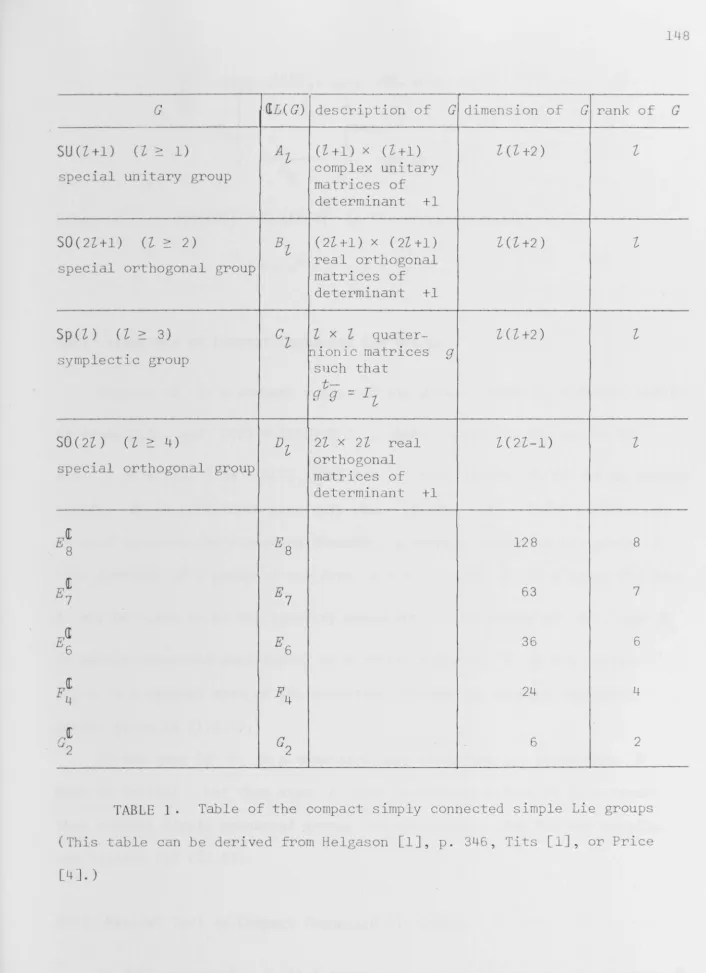
if its underlying topological space isrcwise connected and has trivial fundamental group. In some senses, the compact simply connected simple Lie groups are the fundamental building
blocks for non-abelian compact connected groups, as is shown in the next
paragraph.
(l
.2.5)
THEOREM
(The Structure Theorem for Compact Connected Groups) .---~
(ci)iEI of compact simply connected simple Lie groups., a compact connected
abelian group 11
.,
and a
totally
disconnected
subgroup
Z of the centre of
AX
n
G.
such that
iEI
-iG f " J
[A
xn
G .]/Z
.
iEI
-iTo the best of my knowledge , this theorem first appeared in Weil [l].
A more recent exposition of it is given in Price [4], (6.5~6).
Note that a structure theorem for connected compact abelian groups is
given in Hewitt and Ross [l], (25.23). This theorem is rather technical and
I shall not discuss it here.
If G is a compact Lie group, then we may assume that A is lTn
(i .e. 1T X x
1T
(
n times)) for some n E lN , and that the set I isfinite . This special case i s discussed in (B2 ).
(1.2.6)
LetG
be a compact group. I shall denote by C(G) the setof complex-valued continuous functions on
G.
ThenC(
G)
is a vectorspace , which is a Banach *-algebra under the norm
llfll
00 = sup
I
f(x)
I ,
xEG
pointwise multiplication, and involution
f*(x)
=f(x-
1) . The setM(G)
of (Radon) measures on
G
,
is defined to be the set of continuous functionals on C(C) . If v E M(C) , I shall write v(f) andJ
fdvinterchangeably to mean the value of v at f E
C(
G)
Banach space with normll
vll
1
=
sup{ lv(f)I I
llfll
00=
l} .The space
M(G)
isIf f E
C(
G)
,
definefx
and f EC(
G)
X by
(J)
(
y) - f( xy) andfx(y)
=f(yx)
.
There exists a unique regular measure onG
,
Ac
,
calledHaar measure
such that : for allf
EC(
G)
,
\c(:x/')
=Ac(f)
;
iff(x)
> 0 for allx
EG
andft
O thenAG(f)
> 0 , andAG(
7)
= l .(7
:
x ~ l EC(G)
.)
(Hewitt and Ross [l] , (15.8).) Note that compactFor µ E
M(G)
,
I shall denote by µX ( respectively
11 ) the measure
1-"x (respectively f 1--+ µ(f _1) ).
X
Let
Lp(G)
(1Sp<
00 ) denote the usual LP-spaces with respect tothe measure
AG;
Lp(G)
is the Banach space of equivalence classes offunctions with integrable pth powers (or, in the case p = 00 , of A -G
essentially bounded functions), two functions being declared equivalent
if they are equal almost everywhere. The norm for
Lp(G)
lS.
llfll00 =
AG -
ess supI
f(x)
I .
xEG
space
C(G)
is a dense subspace ofLP(G)
for 1 Sp< 00 •As usual,
The
for 1 <
q
<p
< oo Notice that the embeddingL
1
(G)
~
M(G)
1s given byIf
v,
µ EM(G) ,
definev
*
µ by, for g EC(G) ,
(v
*
µ) ( g) =v ( x
1--+ µ (g))
,
andX (µ*)Cf) = µCf*) .
These operations make
M(G)
into a Banach *-algebra; furtherL
1(G)
is a closed ideal. Note that for
f,
g
EL
1( G)
'
(f
*
g) (y)
=J
f(x)g(x-
1y)dAG(x)
.
otice also that
LP( G)
lS anL
1 (G)-module - forf
EL
P(G)
g EL
1(G)
'
f
*
g EL
P
(
G)
and llf*
gllp S llfll1llgllpL
P
(c)
lS a Banach *-algebrawith convolution and f*(x) = f(x-1)
.
Further, for p E [l, 00J
, let,p ' E [l, 00 be such that ( 1/p) + C 1 /p ') = 1 ( where we set ( 1/oo) = 0
)
.'
Then for p E [l, oo[ ,
LP
(G)
is the dual space ofL
P(G)
The duality is givrn by <f,
g>=
(f.AG) (g)=
f
fgdAG .(f
E LP, (G), g E LP(c)) .These matters have been dealt with extensively elsewhere , and I do not wish to dwell on them here. A very full account is given in Hewitt and Ross [l] , Chapters 3, 4 and 5.
(1.3) Representation theory of compact groups
(1.3.1)
If H lS.
a Hilbert space over [ denote by U( H) th~ set'
of -:ill unitary operators H -+ H (the reader will recall that the linear operator
u
.
H -+ H isunitary
if for all ~'s
E H'
<
u~,
Us)
--
< ~ 's)
).
U(H) is a topological group (with composition asoperation, and the strong operator topology). If H is a finite dimensional Hilbert space, U(H) is a compact group . If H is the simplest of all
Hilbert spaces , [ , then U(H)
=Tr.
(1 .3.2) If
G
is a locally compact group and H is a Hilbert space,then a
representation
ofG
on H is a continuous homomorphismo
:
G-+ U(H) . The dimension of the Hilbert space H (possibly infinite) is called thedimension
ofo
.
I shall be concerned almost exclusively with finite dimensional representations .Let
o
be a representation ofG
onH
.
A closed subspaceV
of H J s calledinvariant
if fer allx
E G ,o(x)
V c V . The representationo
is calledirreducible
if the only invariant subspacP.s of H are H and{ 0} .
Two representations of G
'
01 on Hl and 02 on H2 are calledequivalent
(wri ten 01 ~ 02)
if there lS a linear isometry ¢.
Hl-+ H2such that for all E G ¢ 0
o
1
Cx)
-o
2(x) cp This.
theX
'
- 0.
lS same as11
unitary equivalence" (see Hewitt and Ross
r1J,
(13.43)). Without worryingtoo much about foundational problems, I denote by ~(G) the
dual
of G , a 1nnximal s t of pairwise inequivalent representations ofG
.
(AnHewitt and Ross [l], footnote to (27.3).)
The Gelfand-Raikov theorem (Hewitt and Ross [l], (22.12)) assures us that there are sufficiently many elements of
L(G)
to separate points ofG;
i.e. for everyx
t
yE
G,
there isa
E
L(G)
such thata(x)
t
a(y)
Some authors have considered non-unitary representations of locally compact groups . Actually, it turns out that provided
G
is a compact.
group this gives us no more generality: if H is a Hilbert space, and
a:
G
~B(H)
is a weakly continuous irreducible homomorphism, then a newinner product can be introduced into H so that a is a representation in
he above sense (see Weil [l], §18).
(1.3.3) Suppose
G
is a compact group. Then it is known (seeHewitt and Ross [l], (22.13)) that every irreducible representation of
G
has finite dimension. Henceforth, if a E
L(G)
,
I shall denote by H thea
finite dimensional space such that a
dimension of H
a
I shall always denote byoperator with domain H 0
and by d
a the
H the identity
a
If
a
EL(G)
,
leta
denote the unique element ofL(G)
equivalentto its
conjugate
representation (which acts in the conjugate Hilbert spaceH
see Hewitt and Ross [l], (27.27)). aIf
(ai)iEI
is a family of representations ofG,
we may form theirdirect
sum
(t)iEI
a
.
,
which acts in the space1, (t)
iEI
H.
1, Every representation
of
G
may be uniquely decomposed as a direct sum of irreducible representations (Hewitt and Ross [l], (27 .29) and (27.44)).If are two representations of
G,
theirtensor
product,
o1 ® o
Using the unique decomposition of a representation into a direct sum of
irreducibles , I may, for
o,
n
EI(G)
,
write o®n'::'®
n (B).B, BEI(G)on
where
I(G)
-+ lN and has finite support. The support of n0
n
lS
denoted ox
n
.
We may think of
"X"
and II 11 as arithmetic operations onI(G)
These make
I(G)
into ahypergroup
(in the sense of Helgason [l]). Asubset of
I(G)
closed under x and is called asubhypergroup.
Hypergroups have been considered by Helgason [l], Dunkl and Ramirez [4],
McMullen [l], McMullen and Price [l], [2] (see also Hewitt and Ross [l],
(27 .36)-(27.38)) .
(1.3.4) If
(ci)iEI
is a family of compact groups, thenr
[n
a.]
i
EI 1,,consists of those representations of the form
a finite subset of I , and 0.
1,, • for
J
J E {l, ... , n} .
If G is a compact group and N a normal subgroup, let
A(I(G),
N)
-
{o
EI(G)
I
olN - Id} ThenA(I(G),
N)
may be identified0
with
I(G/N)
(Hewitt and Ross [l], (28.10)).It is possible to get conditions on the hypergroup structure of I(G)
which are equivalent to conditions on the structure of
G.
The mostimportant of these are undoubtedly:
(i)
G
is a Lie group if and only ifI(G)
is finitely generated(i. e . there exist
{o
1, ... ,
on}
c
I(G) ·such that thesmallest subhypergroup containing
.
.
.
'
0 }n lS
I(G)
) ;
for a proof of this , see Price [4], (6.1.1);
(ii)
G
is totally disconnected if and only if every element ofa finite subhypergroup); this is proved by Hewitt and Ross [l], (28 .19) .
In this connection, I would like to record the following
DEFINITION.
A compact groupG
istall
if, for everyn
E ~ , {0 EL(G)
I
d0 =
n
}
is a finite set. It will be seen in (B+) that compact connected semi-simple Lie groups are tall .(1.3.5) Let
G
be a compact group . If 0E
L(G)
and ~'s
E
H0 ,
then
t ~
s 0,~ ·. s x , ,--r _ _____,._ < 0(x)r-, s s r) E C(G) • Th e 1· 1near span o f a 11 sue h f unc ions t· is called the set oftrign
ometric
polynomials
onG,
and is denotedT(G)
By the Gelfand-Raikov and Stone-Wfierstrasse theorems,T(G)
is a densesubalgebra of C(G) It is worth noting that , for 0,
n
EL(G)
,
i f 0 -
n '
0 otherwise,
(see Hewitt and Ross [l], (27.18)). These equations are called the
orthogonality
relations.
Suppose 0 is any finite dimensional representation of
G
ThenX
0 :
x
1-+ tr (0Cx )) is well-defined and an element ofT(G)
This function is called thecharacter
of 0 . Characters of irreduciblerepresentations are called
irreducible
characters
.
The following statements are then true .( i ) If
o
and are irreducible representations ofG
,
thenX
0 -
x
0 if and only ifo
is equivalent too
1 . l(iii) If
o,
n
are two finite-dimensional representations ofG,
then
xo©l =
X
+X
, andxo®l =
Xo
.
xn
.
0
n
(iv) If
o
,
n,
BE
Z:
(
G
)
'
then1 if 0 --
n
'
f
X
XdAG -
-o
n
0 otherwise, and
f
XaXrlBdA
G -- nCB
)
o,
(l.3.6)
If T is a compact abelian group , every irreducible representation is , by Schur's lemma, one-dimensional; that is, is ahomomorphism T ~ 1T. Thus , the set of irreducible representations and the set of irreducible characters co-incide. If
o
,
n
EZ:(T) ,
thenox
n
contains precisely one element, and the above arithmetical operations makeZ:(T)
into a group, thecharacter
group
of T
.
The theory of charactergroups of abelian groups has been extensively studied (e.g. Hewitt and Ross [l] , Rudin [2] , Edwards [2] ).
(l.3.7)
I conclude this section on the representation theory of compact groups with a brief introduction to the theory of inducedrepresentations . This powerful tool is classical for the study of
representations of finite groups (which form, of course, a subclass of the class of compact groups) . It was extended to the class of locally compact groups by Mackey [l] , [2] , [3]. I shall, however, have no need of the theory at the level of generality proposed by Mackey - I shall use it as a tool to extend results on compact connected Lie groups to arbitrary compact Lie groups, by inducing from the component of the identity. Thus the groups
I shall consider are compact, and I shall always induce from a subgroup of
finite index. At this level of simplicity, most theorems can be proved by
simple extension of the method for finite groups , which is well outlined in Curtis and Reiner [l], or Dornhoff [l] .
finite index in
G.
Suppose ~ is a finite dimensional representation ofH on
H
~
.
Define a representation,HG=
{f:
G
~H~
I
Vh
EH,
Vx
~
~G
ofG
f 11s as o ows :
E
G, f(h.x) - ~(h)(f(x))}
This is clearly a finite-dimensional space. (Its dimension is
d~ . [G HJ .) For x E
G
and f EHG,
define~
(
~
G ( X) ·f)
:
Y I-+ f ( xy ) ·It is not hard to check that
~G
is a representation ofG
onHG;
it~
is called the representation of
G induced from
~.
LEMMA.
Let
X l ' ... ' X [ G: HJbe a set of coset representatives
for
G/H
.
Define~ for x
EG
~if
x E H ~0
if
Xf
H •Then
[G:HJ [ l
l
-
L
x~
x~ yx.
· 1 s 1., 1.,
1.,=
This lemma is easy to prove from the above definition. I shall not include a proof here.
(l.3.8)
THEOREM
(The Frobenius Reciprocity Theorem).Let
G
be a
compact group
~
H a closed subgroup of finite index in
G.
Let
~ EL(H)
and
o
E L(G
) .
(
Then
~G is a representation of
G and
olH 1.,S.
a
representation of
H .)The number of times
o
occurs in the decomposition
of ~G as a direct
sum
of irreducible
representations is
the same as the
nwnber of times
~occurs in the decomposition
of
oi
8
as a direct sum of
irreducible
representations.
(1.3.9)
THEOREM
(Clifford).Suppose
G &Sa.
compact
group
~
Ha
l'\crMo. \closed subgroup of finite index in
G .Let a
E [(G)
.
Then there exists
~ E [(H) ~and there exists
such that
where for g
EG and
h
EH~a complete set of coset
representatives
for H~
={
g
EG
I
~(g)~
~} .n E ]N
0
.
&SThis theorem is a very special case of theorem 12.l of Mackey [l].
Perhaps a more amenable presentation is that of Curtis and Reiner [l],
(49.7).
(1.4) The spaces
E
P
(~(c)) .
Fourier transforms
Throughout this section, G will be a compact group, and [(G) will be as defined in (1.3.2).
(l.4.1)
Suppose H is a finite-dimensional Hilbert space. ForA
E
B(H)
and pE
[l, 00 ] , defineIAI
to be the unique positive-definitesquare root of the Hermitian operator
A*A
,
and let be the (necessarily ·i:o,,~\'\i'rt1~) eigenv2lues ofI
A
I .
Then setIIA
II
<Pp
These define norms on the space
(1 ::: p < oo) '
BC
H) ; co-incides with theusual operator norm. For further details, see Hewitt and Ross [l],
c1ppendix D.
(l
.4.2) Define TI : U B(H0) ~ [(G) by TI(A) - 0 if A E B
(H
0) .
This defines a (rather trivial) vector bundle structure over
L(G)
.
LetE(L(G))
denote the set of all sections of this bundle - i.e. mapsa 1--r A
a
:
L(G)
-+ U B(H0) so that If R is any subset ofa
EL ( (;)L(G)
, let E(R) be R'
that is, ~_(R)the set of is the set
all restrictions of elements of
E(L(G))
to of all sections of the restricted bundle map1T U B (H ) -+ R
.
aER
0Now for any subset
R
ofL(G)
,
letfor p E [l, oo[ , and let E
00
(R) = {A E E(R)
I
supIIA
0 JI· =
-
-
aER
~
00It is shown by Hewitt and Ross [l], §28, that for each
p,
EP(R) is a Banach *-algebra with pointwise composition as multiplication and with involution given by (A*)= (A)*a
a
,
Further, ifp
E [l, 00 [ ,Ep (R)
the dual of , under
<A,
B) =>
-
·
da
tr(A
a a
B*) .
a EL(
G)Finally, let
~ (R) -
{A
E E(R)I
l!A 01!~
00
-+ 0 as a-+ 00} ,
~
0
(R
)
=
{A
E E(R)I
A0
=
0 outside a finite set} . Note that, if 1s
p
<q
< 00 , thenprovided R is infinite, all these containments are strict .
A
.
lS(1 .4.3)
Let µ EM(G)
anda
EL(G)
.
Defineµ(a)
to be the Bochnerintegral
J
Gdµ (for the theory of Bochner integrals, see Edwards [l],8.14.1). Then
µ
EE(L(G))
.
In fact , it can be shown thatµ
EE
00(L(G))
,
and that JIµ 11
µ .
A.
It is then true that µ 1-+ µ is a non norm-increasing
.
.
*-isomorphismof the Banach *-algebra
M(G)
into the Banach *-algebra E00(I(G))
.
It can be further shown that if fEL
1(G)
,
thenfE~(I(G)).
(Theseresults are to be found in Hewitt and Ross [l], (28.36) and (28.40) respectively - the latter is known as the
Riemann-Lebesgue
lemma.)
A further , less difficult, result in this direction is thatis a bijective linear map.
(l.4.4)
The following theorems are true :(i)
L
2(G
)
~
_§_2
(I(G))
is an isometric isomorphism of Banach*
-algebras ( L o.. r. .?.theorem
-
Hewitt and Ross [l], (~ ~4s))...I\ ,
for some
p
E
[l,2]
,
then 1E Ep
(I(G))
(ii)
llfllp
,
Sllfllp
.
(TheHausdorff-Young
inequality -
Hewitt and Ross [l],(31.22).)
and
(iii) If g E L2(G) and
p
E [l, 2] thenllgllp
'
<llgllp
(Hewitt andRoss [l], (3l.2s).)
(l
.5)
Central functions and measures:
the central
projection
In this section,
G
will denote an arbitrary compact group. Other notation is taken from previous sections.(l .5.1) LEMMA.
Let
v
EM(G) .
The following propositions are
e
quivalent
:
( i) for
all
f
E
T(G)
V*
f
-f
*
V
.
'
-'
(ii)
for
all
µE
M(G)
V*
µ - µ*
V.
'
-'
(iii)
for all
0E
I(G)
v(o) A.is a multiple of Id
.
(iv)
for
all
x
EG
~ \) = \)X X
The proof of this lemma is omitted; it is based on standard techniques of harmonic analysis (see Hewitt and Ross [l], (28.48) and (28.49)).
If A is any subalgebra of
M(G) ,
define thecentre of
A
,
ZA , byZA
=
{v
EA
I
for allµEA,
v
*
µ
=
µ
*
v} .The above lemmr:1. shows that, provided that A :=::t T( G) , ZA = A n ZM( G) .
(1
.5.2)
Letf
EC(G) .
Define, fory
EG,
~(f)(y)
=f
f(x-
1yx)dAG(x)
.
LEMMA. ...
C(G)
~ZC(G)
is an idempotent bounded linear map of norm
l .
Further~
~,ZC(G)
is the identity map.
Proof.
Now ... i ~ clearly linear; that~,ZC(G)
is the identity followsfrom (l.5.1) (iv). Notice that
sup
yEG
- sup
I
f(x)I
=llfll
00
xEG
This completes the proof. D
(1.5.3) One may extend to a map
manner; for v E
M(G)
andf
EC(
G)
,
let< sup
xEG,yEG
lf(x-
1yx
)
I
M(G)
~ZM(G)
in the following~
0
(v)(f)
=v(~Cf))
.
If we consider the continuous functions g and ~(g) as measures,
(
~( g) .
AG)
( f)
-
-I
f(y)~(g)(y)dAG(y)
-J
I
f(y)g(x-1
yx)dAG(y)dAG(x)
-I -I
f(x-
1yx)g(y)dAG(y)dAG(x)
--
(gAG)
(~Cf))
= (~0
(g. AG)) (f) .
-Thus
~o
... extends I shall henceforth denote both maps by II-;::;' IIIt is now not hard to show:
PROPOSITION
(i)
...
:
M(G)
+ZM(G)
&San
idempotent bounded linear
map
of norm
l .(ii)
~I
ZM(
G)
is the identity map.
(iii) Suppose
Ais a Banach algebra of measures
under
convolution,
with
norm
II·
II
A .,such
that
T(G)
cA,
and such
that
\) f-+ \)X -1
X
.
&San
isometry of
AA+ ZA
is
an
idempotent
bounded linear map of
norm
l . ,and
~lzA
is the identity map.
Proof.
(i) and (ii) may be proved by appealing to(1.5.2).
The details are left to the reader.To prove (iii), notice that, for fixed v
EA,
Xf-+ \) : G+AX -1 .
X
(the reader will recall that , for
x
E G,
v (M(G) ,
andf
E
C(G) ,
V
{+)=
v(
f) -
see(1.2.6))
is an integrable vector valuedX -1 -1 X
X X
function, and ~(v) =
J
xv
_
1
dAG(x)
.
But, using the theory of BochnerG
Xintegrals (see Edwards [l], 8.14), this shows that
(l
.5.4)
It is worthwhile noticing the effect of on the trignometricpolynomials
t(a)
defined in (l.3.5).r,:,c;;
In fact , for 0 EL(G)
,
x EG
and~'
~
E H0 ,
t~~~(x)
-
<a(x)E,:,
~
> ,
andl
-d <E,: ,
~
>x
(x).0 0
(This can be proved by use of the orthogonality relations - see (1.3.5).)
Thus , it is easy to see directly that
~
(T(
G))
=ZT(
G)
.
From this, thedensity of
ZT(G)
inZC(G)
andzL
P
(c)
(1 Sp< oo) follows ; one uses(1.5.3) and the density of
T(G)
inC(G)
andL
P
(c)
(1 Sp< oo)(l .5.5)
IfA
is some subalgebra ofM(G)
,
containingT(
G)
,
~IA
is called the
central projection
ofA
onZA.
The following proposition is now immediate from (1.5.3). A proof of
this proposition in the case
A=
C(G) ,
L
P
(c)
(1 S p < oo)given by Parker [l], lemma (1.1).
PROPOSITION.
Let G
be
a compact group, and let
A
be a
Banach
.
lS
algebra of
measures on G under
convolution
,
with
norm
ll
·
IIA,
such that
for all x
E G , v f-+ v ~san isometry of
AX -1
Suppose further that
X
~~
cJ
<:.v1. \ ~C(G)
~s
.
J.
~-,~Llj ..
·
contained
in
A(
i
.
e
.
C (G)
c A /.__and there exists
K
E
lRso that
for all f
E
C(G)
,
ilfilA
SKi1fi1
00 ) •
Then
(ZA)
*
is
isometrically
isomorphic to
Z(A*) .
In particular,
this conclusion is valid i f
Ais
any one
of
the algebras M(G),
LP(c)
( l
s
ps
00) or C ( G) •Proof.
Denote by ~l ZA 7 A the canonical injection. By lemma=
i*
0l (~)* .
Now consider the map
(ZA)*
+Z(A*)
given by~IA*
o(~IA)* .
SinceC(G)
is continuously contained inA , A*
is a subalgebra ofM(G)
,
hence this is a bounded map; it has an inverse , VbZ .
ii
o b2 , where
b
2 Z(A*) +
A*
is the canonical injection. Since each of the maps~IA'
and has norm 1 , both and its inverse
have norm
1
-
thus this map is an isornetry.D
(l .5.6) PROPOSITION.
Let
v
E
M(G)
~o
E
I(G)
.
Then
The proof of this proposition is not difficult given (1.5.4), and
hence is omitted. D
(l.5.7) LEMMA.
Suppose A
E E([ (G)) .The
following
statements are
equivalent
:
(i)
for all
B E ~O([(G)) ~ AB = BA ~.
(ii)
for all
B E E (I(G)) ~ AB = BA ~ ·(iii)
for all
o
E I( G) ~exists a
0 E [
such
that
D
If Fis a subset of E(I(G)), let ZF denote the set of A E F
satisfying any one of the above equivalent statements. Note that (1.5. 6) says that
(l .5.8)
It is clear that for each p E [l, 00 ] , _zEP(I(G)) is aclosed subalgebra of EP(I(G)) - a similar statement is true for
LEMMA.
Let
p
E [l,
00] •
The map which
associates with
o 1-+ a
0
.
Id
E ZEP (I(G)) (orthe
map
0 1-rd
21
P
.
a
EzF(ICG))
(J (J
isometric
isomorphism.
DNote that this map is not a Banach *-algebra isomorphism
(pt
00 ) .(1.6) Lacunarity
(1.6.1)
Since a large part of this thesis is devoted to a study of lacunary or "thin" subsets of the duals of compact groups , it seemsappropriate to give some background upon this subject here. The study of 1 cunarity for abelian groups is today a vast study - several books have been devoted to it alone : Lindahl and Poulsen [l], Lopez and Ross [l],
Kahane and Salem [l], to name but a few. I shall make no attempt to
summarise developments in this area - indeed , I shall only touch upon those which are of importance in the study of non-abelian lacunarity.
(1.6.2)
SupposeG
is a compact group,shall denote by
A
R
the set{µEA
I
for all often writeL
~
(G)
, C
R(G) ,
etc. in place of An element ofMR (
G) is calledR-spectra
l.A
C
M(G)
IR
cI(G)
and0
f
R, µ(0) -o
} .
I shall(L
P(c))R
,
(C(G))R , etc.A subset
R
ofI
(
G
)
is said to be aSidon set
if (CR(G))~ c E1(rCc))
This condition is equivalent to several other conditions; theexistence of K E lR so that for all f E TR ( G) ,
llf
11
1 S K
llfll
00 ;condition) and a proof of these facts , using Riesz polynomials, see
(37.12)-(37.15) of Hewitt and Ross [l]). From this, it follows that every infinite subset of
L(T)
contains an infinite Sidon set. This isdefinitely not true for non-abelian groups , as the following material will show. An excellent treatment of recent developments in the theory of Sidon sets for abelian groups is given by Lopez and Ross [l].
(1
.6.3)
Let p E ]l, 00 [ • A subsetR
ofL(G)
is said to be oftype
A(p)
if for someq
E [l,p[
,
L
~(G)
=>Li(G)
This, again, isequivalent (see Hewitt and Ross [l], (37.7) and (37.9)) to several other conditions : in particular, to for all q E [l, p[ , and to
the existence of K E lR such that, for all f E TR( G) ,
llfllp ::::
KllflJ
1 .It can be shown that for every Sidon set R there exists KE lR such that for p E ]2, 00 [ and for f E TR(G) ,
Hence a Sidon set is of type
A(p)
set for all p (Hewitt and Ross [l], (37 .10)) .(1.6.4)
The preceding two paragraphs have presented a summary of someof the results pertinent to lacunarity for non-abelian groups which are presented in §37 of Hewitt and Ross [l]. Very little information was available at that time on the existence of lacunary sets in the duals of
compact non-abelian groups. However, three results in this direction are
giv0n wl1ich I should like to mention here, since they have been important ror suh;,c~quent developments in the area.
(i) By estimating the
L
4-norm of Lhe irreducible characters ofSU(2)
,
the authorG arc able to show thatL(SU(2))
conta5ns no infiniteA(4)
sets and hence no infinite Sidon sets. This example can actually be
00
(ii) Let
G
-
n
U
(n)
'whereU
(n)
lS the group of n X n unitaryn=2
matrices . Then G is a compact group . For each n E
lN
,
the proj ecti011·rr
n
G
+U
(n)
Er(G)
,
and{
11
nIn
Ei'J} is a Sidon set.(iii) For each
n
ElN ,
letG
be thP set of n x n unitary matrices;.z
with precisely one +l or -1 in each row and each c.olumn. Then
00
G -
nc
is a compact group ; for eachn ,
the projection 1Tn
G
+ U(n) nn=3
is an ir:!:'ed11cible representation of
G
,
but no infinite subset of{n
I
n
E
~}
is of typeA
(
p
)
for any p >1
.
(This exampleis
due ton
Figa-Talamanca
[
2
].)
Since the publication of Hewitt and Ross [l]; Volume II, research into
this area has developed considerably. It is my aim in the rest of this
section to give an outline of some of the subsequent developments, with
particular emphasis on tho~e which directly motivate the remainder of this t0esis. Some developments not discussed her2 (nstably those concerned with
uniform ap~roximability and the union problem for Sidon sets) appear in th2 book of Dunkl and Ramirez [l].
(l .6.5)
One offshoot of the existence question has been theproliferation of types of lacunary sets considered. I wish to mention here
three additional types : central sets, local sets and local central sets.
Parker [l] defines a set R to be
central
Sidon
ifand
central
A(p) if(
z
L
~(c)
)
:::,
Z
Li(G)
for some (and hence for all)q E [l, p[ . Equivalent statements such as those menticned in (1. 6.2) and
(1.6.3) for Sidon sets and
A(p)
sets are available (with appropriatech, n~es - s jmpl r2place each function algebra, measure algebr~, or space
by its centre - see Parker [l], Theorems 2.1 and 2.2, for details).
'
sets. for abcli n groups , the two notions co-incicte . Dunkl and Ramirez [3]
show that
I(G)
cannot be central Sidon unlessC
is a finite ~roup.n·d
''"l er [2] defines a set R to be a
local Sidon set
if ther8 exists a"'
constant KE
lR
such that for every f ET(G)
such that f is supportedon a single element of R ,
( 1 )
and to be 0f type
local
A(p)
if there is KElR
so that for every suchf ,
llfll
S Kllfll
1 •p - (2)
A set R is of type
local central
A(p)
if (2) holds as f runs through the 3et cf all irreducible ch~racters of elements of2:(G). (It canquickly he seen that every subset of
I(G)
is "local central Sidon".)If sup{d
I
o
ER}<
00 (in particular, this condition is satisfied0
for any subset R of the dti.al of an abelian group), R is local Sidon, and
local
A(p)
for all p .It is clear that the following implications hold:
A(p)
=> localA(p)
=? local central A (p) ,A(p)
=? centralA(p)
=? local centralA(p)
,
Sidon=? local Sidon.
Price [3] proves that a local Sidon set is local
A(p)
for all p .However (see (1. 6.8) (iii)), a central Sidon set need not even be local
central
A(p)
for any p . It seems an open question whetherL(G)
can belocal Sidon with sup{d
I
o
EL(G)}
= 00 •0
(l
.6.6) Hutchinson [l] has recently shown that if R is an infiniteset with sup{d
I
o
ER}<
oo , then R contains an infinite Sidon set.0
!!is method uses the technique of Riesz polynomials on the entry functions of
the representations (Parker [l] was only able to show that such a set
contains an infinite central Sidon set) . It follows from (l .6.7) below that
a central Sidon set R with sup{d
I
o
ER}<
00 is actually of typeA(p)
for all p It seems to be an open question whether such a set must be a Sidon set.
(l .6.7)
Rider [2] proves the following relations between the setsintroduced in (1.6.5):
Suppose R is a central Sidon set , and p
E [2,
00 [ Then(i) if R i s a local central
A(p)
set, R is a centralA(p)
set;
(ii) if R is a local
A(p)
set , R lS.
aA(p)
set.Secondly, he proves that if
s
E ~ ,s
> 1 , and R is any subset ofL(G)
,
thenR
is of typeA(2s)
if and only ifR
is both localA(2s)
and central
A(2s)
.
Thus central sets , local sets and local central sets can be used to
give examples of "ordinary" lacunary sets .
Functional analytic conditions for local sets have been discussed by
Armstrong [l], Price [2] , and Picardello [l].
(l .6.8)
Motivated by (1. 6.4) (ii) and (iii), one has the followingresults.
( i) Let
(ci)
iEI
be a family of compact groups , and for each 'l,.
EI
let
o
.
be an element ofL (
G
.)
.
LetG
=n
G.
.
Then'l, 'l,
iEI
i,
{ • 0
I
'l,EI}
cL(G)
(where 1T •G
-+G.
lS.
the projection) lS.
a'l, 'l, 'l, 1,,
central Sidon set. (This is proved by using a notion of independence; see
Parker [l], theorem 4.2.)
(ii) Rider [2] shows that the set R = {n
I
n E ~} of (1.6.4) (iii)n
'
is local central
A(p)
for every p . The results of (1.6.7) now show that this set is central Sidon and centralA(p)
for every p , but not localA.(p) for any p . This example seems to indicate that "central" properties
nd "local" properties are somehow independent- . I have been able to tighten

![table (3 6 .20) of Hewitt and Ross [l], I have shown that [Li/G)r c E( 2p)/( 2- p )(L(G)}](https://thumb-us.123doks.com/thumbv2/123dok_us/1900556.148100/48.726.16.706.0.1088/table-hewitt-ross-i-shown-li-g-e.webp)