This is a repository copy of
Graph-based correlated topic model for trajectory clustering in
crowded videos
.
White Rose Research Online URL for this paper:
http://eprints.whiterose.ac.uk/130485/
Version: Accepted Version
Proceedings Paper:
Al Ghamdi, M. and Gotoh, Y. orcid.org/0000-0003-1668-0867 (2018) Graph-based
correlated topic model for trajectory clustering in crowded videos. In: 2018 IEEE Winter
Conference on Applications of Computer Vision. 2018 IEEE Winter Conference on
Applications of Computer Vision, 12-15 Mar 2018, Lake Tahoe, NV/CA. IEEE , pp.
1029-1037. ISBN 978-1-5386-4886-5
https://doi.org/10.1109/WACV.2018.00118
[email protected] https://eprints.whiterose.ac.uk/ Reuse
Items deposited in White Rose Research Online are protected by copyright, with all rights reserved unless indicated otherwise. They may be downloaded and/or printed for private study, or other acts as permitted by national copyright laws. The publisher or other rights holders may allow further reproduction and re-use of the full text version. This is indicated by the licence information on the White Rose Research Online record for the item.
Takedown
If you consider content in White Rose Research Online to be in breach of UK law, please notify us by
Graph-based Correlated Topic Model for Trajectory Clustering
in Crowded Videos
Manal Al Ghamdi
Umm Al-Qura University
Department of Computer Science
Saudi Arabia
Yoshihiko Gotoh
University of Sheffield
Department of Computer Science
United Kingdom
Abstract
This paper presents a graph-based correlated topic model (GCTM) to learn and analyse motion patterns by trajectory clustering in a highly cluttered and crowded en-vironment. Unlike previous works that depend on scenes prior, we extract trajectories and apply a spatio-temporal graph (STG) to uncover the spatial and temporal coherence between the trajectories during the learning process. It ad-vances the CTM by integrating a manifold-based clustering as initialization and iterative statistical inference as opti-mization. The output of GCTM are mid-level features that represent the motion patterns used later to generate trajec-tory clusters. Experiments on two different datasets show the effectiveness of the approach in trajectory clustering and crowd motion modelling.
1. Introduction
Trajectory clustering and analysis of crowd movements have been vital components of various applications in pub-lic surveillance, such as flow estimation. The goal is to ana-lyze individual movements by a trajectory associated with a cluster label, thus representing individuals’ paths. A highly crowded scene is particularly challenging because of the density, heavy occlusions and variations in the view. Addi-tionally interaction between individuals can lead to misde-tection of body parts [14]. The presence of such challenges makes it difficult to analyze movements using conventional techniques such as background subtraction and motion seg-mentation, although they may work effectively with less-crowded scenes.
To overcome the shortcomings of conventional tech-niques, motion patterns have been introduced for process-ing crowded scenes. In such a scenario, objects are repre-sented by a small number of pixels; there is thus ambiguity in appearance caused by the dense packing [12]. Therefore,
defining the motion patterns in the crowd is the key to the problem. Examples of motion pattern techniques include scene structure-based force models [2] and the Bayesian framework with spatio-temporal motion models [9]. These models are based on the assumption that the objects move coherently in one direction throughout a video. This is a major shortcoming, as it fails to represent the complex crowded scenes with multiple dominant crowd behaviours in each location.
Trajectory clustering is fundamental in various applica-tions such as crowd analysis and video surveillance. In many applications, a vast amount of trajectories and mo-tion patterns are extracted and clustered into groups with-out manually labeled of the data. Lin et al.[10] detected motion trajectories in crowd scenes by processing the flow fields. They then applied a two-step clustering process to define semantic regions which is used later to recognize pre-defined activities in the crowd. Luet al.[11] extracted the motion trajectories to investigate the characteristics of pedestrians in unstructured scenes. Trajectories were firstly represented as a four-dimensional vector, then clustered us-ing fuzzy c-means (FCM) algorithm to form the motion pat-terns using. Sharma and Guho et al.[16] proposed a two steps trajectory clustering approach (TCA) for segmenting crowd flow patterns. Trajectory extraction step to detect and track blocks or regions in the video followed by clustering step that utilised shape, location and the density of the tra-jectory in the neighborhood. Xu et al.[21] combined the mean shift clustering and the manifold-based model to im-prove the trajectory clustering performance. The center of a cluster is defined by a manifold and the motion pattern is de-fined by the structure of the cluster. They have shown the re-sults of classification using Hidden Markov Model (HMM) as well as of clustering using k-means algorithm.
move-ments, which aim to map the segments of trajectories from low-level feature space to their clusters [23]. Trajectory mid-level features can be learnt with hierarchical latent variable Bayesian models, such as latent Dirichlet alloca-tion (LDA) [5] and the correlated topic models (CTM) [4]. These models are known as ‘topic models’, adopted from the text processing field. They often have hierarchical struc-tures where the latent variables lie at multiple levels. Us-ing these models, documents are represented by trajectories and visual words are given by observations of object tra-jectories. With these approaches the learnt topics represent mid-level features of trajectories.
The CTM was adopted by Rodriguezet al.[14] as a mid-level feature to represent multiple motion behaviours in one scene. Their tracker was weighted to predict a rough dis-placement using a codebook generated from all the mov-ing pixels in the scene, along with the learnt high-level behaviour. Although CTM is an effective model, it only considers the motion direction at each spatial location and disregards the temporal correlation between sequential mo-tions that naturally occur in crowd scenes; it can not create discriminative mid-level features for multiple clusters.
A scene prior belief based correlated topic model (BCTM) [23] was then proposed to construct a mid-level features for trajectory clustering. A feature tracker was firstly employed to generate the trajectory. A spanning tree method was then used to define the initial cluster informa-tion. The mid-level features were generated using BCTM followed by a hierarchical clustering algorithm to produce the final clusters. Their experiment shows that the BCTM as a trajectory clustering method outperforms the CTM, but it could only be applied if the scenes prior were available.
Zhou et al.[22] proposed a random field topic (RFT) model to perform trajectory clustering in a crowd scene. It extended the LDA models by integrating scene prior and us-ing a Markov random field (MRF) algorithm. RFT signifi-cantly improve the clustering performance over LDA mod-els; however, the performance can drop in crowded scenes with correlated topics, where topics are shared with ple clusters, and where clusters are also shared with multi-ple topics.
Despite the effectiveness of the above models, most of them ignored the temporal relationship within the crowded scenes and also the distribution of data. Therefore, they re-quired a complex parameter estimation and variable infer-ence procedure. This paper presents a graph-based corre-lated topic model (GCTM) for analysing crowd movements and clustering trajectory in a complex crowd scene. It ad-vances a CTM by integrating a spatio-temporal graph (STG) to enforce the spatial and temporal coherence between tra-jectories during the learning process. The goal of this work is to address the problem of trajectory clustering and motion pattern analysis in high-density crowds without using any
[image:3.612.312.543.75.131.2](1) (2) (3)
Figure 1. Sample frames from indoor scenes at (1) (2) Al-Masjid Al-Haram [3] and (3) New York’s Grand Central Station [22].
prior knowledge of the motion pattern or the scene. Dif-ferent from previous works, GCTM has a manifold-based cluster initialization step followed by iterative optimization with Bayesian inference. The initialization step helps our approach to generate topics or motion patterns (mid-level features) that effectively reflect data distribution and clus-ter information. Afclus-ter the iclus-terative optimization, the gen-erated topics are discriminative where different trajectories are clustered separately in the manifold space.
We firstly apply the Kanade–Lucas–Tomasi (KLT) tracker [17] to extract trajectories points used later by the locality-constrained linear coding (LLC) technique [20] to generate a set of visual codes as low-level features. The STG is then constructed to uncover the spatio-temporal relations between the trajectories and projected to lower-dimensional space to initialize clusters in a manifold em-bedding space. Using cluster labels, topics are learnt by the GCTM for final trajectory clustering. Experiments on two different video datasets – one collected at the crowded Grand Central station in New York [22] and the other col-lected from multiple locations at Al-Masjid Al-Haram [3], both of which are well known for crowded and busy scenes (Figure 1) – show the effectiveness of the presented ap-proach.
The remainder of the paper is organized as follows: a re-view of the original CTM and the proposed GCTM model are introduced in Section 2. The initial and final trajectory clustering are presented in Section 3. Datasets and exper-iments set-up are presented in Section 4. We discuss our results in Section 5 and conclude the paper in Section 6.
2. Our Approach
This section outlines how the mid-level features (topics) are learnt as motion patterns (paths) by GCTM parameters estimation. To make the paper self-contained, we start by reviewing the conventional CTM (Section 2.1) followed by the proposed GCTM (Section 2.2).
2.1. Correlated Topic Model
!m zm,n xm,n
∑
μ
N
βk
M
(a)
!m zm,n xm,n
∑c
μc
N
βk
M
η C
(b)
K
K ! z
vc
γc
N
φc
M
(c)
[image:4.612.57.284.75.215.2]!
Figure 2. CTM and GCTM models. (a) Graphical representation of CTM [4]. (b) Graphical representation of GCTM. (c) Graphical representation of approximate distribution of GCTM.
The circles in the figure are random variables or model pa-rameters, and the edges specify the probabilistic dependen-cies (or the conditional independences) among them; boxes, withM,N andK, are compact notations for multiple in-stances of the variables or parameters. Shaded variables represent the observed variables, while unshaded variables indicate the latent variables. The CTM assumes that each document is a mixture of words based on a set of hidden topics, and in turn each topic is determined by a distribution over the entire vocabulary. In the figure,θm(orθ) is aK
-dimensional vector, specifying the topic priors for each doc-ument;zm,n(orzn) is a hidden variable, following a
param-eterized multinomial distributionM ult(θ);xm,n(orxn) is
the random variable whose value is the observed word (i.e., ‘feature’); andβis a hyper-parameter, corresponding to the mid-level features. FinallyµandΣare the mean and the co-variance matrix of the multivariate Gaussian process. The generative process of the CTM is outlined as follows:
• Drawθ| {µ,Σ}∼N(µ,Σ)
• Draw the document-specific topic proportions π as
π= expPK(θ) i θi
• For each visual wordxn, n∈ {1, . . . , N}:
1. Choose a topic assignment zn|θ from M ult(π);
2. Choose a word xn|{zn, β1:K} according to
p(xn|zn, β).
According to this model, the document probability given topic variableθ, wordxand individual topic as-signmentzis:
p(θ, z, x|µ,Σ, β) =p(θ|µ,Σ)
N Y
n=1
p(zn|θ)p(xn|zn, β) (1)
Notice that the topic-level information given byθand
zis hidden, while the word-level representation is ob-served.
An approximate method (variational approximation) has been used to estimate the likelihood of performing train-ing and to estimate the most likely topic proportionsθand topic assignmentsz. Further details can be found in [4].
2.2. Graph-based Correlated Topic Model
Corpus, document, topic and words (for text data) in CTM are replaced with path, trajectory, motion pattern (or topic for simplicity) and visual codes (for video data) in GCTM. The topic mixture of a document corresponds to a set of different motion patterns in a trajectory. GCTM learns crowd movements by clustering trajectories. The graphical representation of GCTM is presented in Figure 2(b). Ob-served visual codes (low-level features) and the initial clus-ters are the inputs for GCTM. Section 3 describes the con-struction of the visual codes and initial clusters as low-level features.
We begin with some notations and definitions for the pre-sented Figure 2(b):
• M, the number of trajectories in the path, each of which is modelled as a mixture of K topics. m = 1,2, ..., M, the index of an individual trajectory in the path.
• N, the total number of visual occurrences in a
trajec-tory m. n = 1,2, ..., N, the index of a visual code
occurrence in documentm.
• Kis the number of hidden topics in the model, where each topic is a distribution over a code set given by the hyper-parameterβk.
• c ∼ p(c|η), c = {1, . . . , C}, the initial cluster that has to be defined for each trajectory, whereCis the to-tal number of initial clusters, andηis aC-dimensional vector of a multinomial distribution.
• θm (or θ) is a continuous variable sampled from
a Gaussian distribution for choosing the topic
p(θm|µ,Σ, c).
• µisK-vector andΣis aK×Kcovariance matrix, the parameters of a multivariate Gaussian process.
• zm,n(orzn) is a hidden variable assigned to a visual
codexndrawn from a multinomial distribution.
• xn,m(orxn) is the visual codenin the trajectorym.
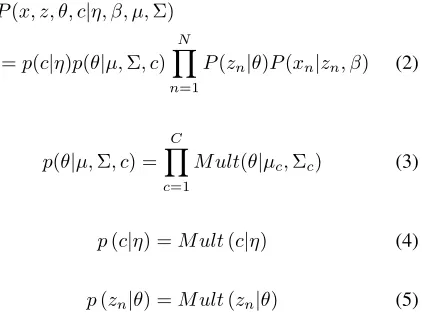
of a topic mixtureθ, a set ofN topicz, a set ofN visual codesxand the clustercis:
P(x, z, θ, c|η, β, µ,Σ)
=p(c|η)p(θ|µ,Σ, c)
N Y
n=1
P(zn|θ)P(xn|zn, β) (2)
p(θ|µ,Σ, c) =
C Y
c=1
M ult(θ|µc,Σc) (3)
p(c|η) =M ult(c|η) (4)
p(zn|θ) =M ult(zn|θ) (5)
whereM ult(·)is a Multinomial distribution based on pa-rameters µc andΣc. The distribution of p(c|η)is always
assumed to be a fixed uniform distribution in whichp(c) = 1/C. Therefore, we will leave out the estimation ofη.
The log probability forxis given as:
p(x|µ,Σ, β, c) =
Z
p(θ|µ,Σ, c)
X
z " N
Y
n=1
p(xn|zn, β)p(zn|θ) #!
dθ (6)
In order to estimate parameters for GCTM, we used parts of video sequences as training data and adopt the variational expectation maximization (EM) algorithm to do variable inference and parameter estimation [4]. Figure 2(c) is the graphical representation of the approximate distribution of the GCTM whereγM×K,vM×K andΦare variational
pa-rameters. Therefore, the log-likelihood for a documentmis given by:
log p(x|µ,Σ, β, c) =L(γc, vc, φc;µc,Σc, β)+ (7)
KL(q(θ, z|γc, vc, φc)||p(θ, z|x, µc,Σc, β))
We iteratively maximize the term L(.) instead of
p(x|µ,Σ, β, c), which results in the minimum of difference between the distribution in Figure 2(b) and Figure 2(c). For details of computation, please refer to [4]. We give modified parameters and variables as:
φc
ki∝ exp{γ c
k}βk (8)
βk∝
X
i
φc
kini (9)
µ= 1
M
X
m
γcm (10)
Video Sequence
KLT Tracker
Initial Clustering (STG + Manifold embedding )
GCTM Visual Codes
(LLC)
Low-Level Features
Trajectory Clustering
[image:5.612.77.288.106.262.2]Mid-Level Features
Figure 3. Flow chart of the crowd behaviours modelling frame-work with GCTM.
Σ = 1
M
X
m
diag(vmc ) + (γ c
m−µc) (γmc −µc) T
(11)
wheremis used to index the trajectory,ito index the word andkto index a topic. φkidenotes the probability that the
ith word belongs to thekth topic,ni is the word count and
βkis thekth topic’s representation in the word space.
3. Low-level Features
In trajectory clustering, the first step is to generate the low-level features by extracting the trajectory segments and representing them with a collection of visual codes (i.e.words). The second step is to apply a spatio-temporal graph on the visual codes to uncover spatio-temporal re-lations among trajectories and embed them in the lower-dimensional space to define the initial cluster. Given ini-tial clusters and the set of visual codes, the final step is to learn the mid-level features by GCTM (Section 2.2) and to produce the final trajectory clustering. The framework is shown by a flow chart in Figure 3.
Low-level Features Given a video sequence, the KLT
tracker [17] is firstly applied to calculate M trajectories. The LLC algorithm [20] is then employed to represent each trajectory with a set of visual codesXas low-level features. LLC is a coding scheme proposed by Wanget al. [20] to project features onto their respective local coordinate sys-tems and encode them using fewer codebook basis in the high-dimensional feature space.
Given a trajectory m with a set of points m = {t1, . . . , tN}, the set of codesX ={x1, . . . , xN}are
de-rived by firstly constructing a neighbourhood graph based on the geodesic distances between the trajectory points and the codebook, then computing the shortest path, performing a kNN search, and finally solving the following constrained least square fitting problem:
min X
N
P
i=1
kti−Bxik2+λkdi⊙xik2 st.1⊤xi= 1,∀i (12)
‘1⊤
xi = 1, ∀i’ means the shift-invariant requirements for
the LLC code. The locality-constrained parameterdi
repre-sents each basis vector with different freedom based on its shortest path to the trajectory pointti. The final step uses
the multi-scale max pooling [15], where the sets of codes computed for each trajectory are grouped together to create the corresponding pooled representationX.
Initial Clustering To obtain the initial clusters C for
the trajectories, we applied the STG algorithm [1] to un-cover spatio-temporal relations among trajectories and con-nect them as initial clusters. The structure in the high-dimensional space is transferred to a spatio-temporal dis-tance graph with nodes representing LLC representations. The method reconstructs the order of the LLC represen-tations based on their spatio-temporal relationship and re-calculates distances along them to ensure the shortest dis-tance. First the similarity matrixS is calculated between the LLC representations using the Euclidean distance. The value of Sij defines the distance betweenXi andXj of
two trajectories (i, j = 1, . . . , M). Then for each instance
Xi(i= 1, . . . , M):
1. Lcodes, whose distance is the closest toXi, are
con-nected. They are referred to as spatial neighbours(sn):
snXi =
Xj1, . . . , XjL|argmin j
L
(Sij)
(13)
whereargmin
j L
impliesLnode indices with the
short-est distances.
2. AnotherLchronologically ordered neighbours around each codeXiare set as temporal neighbours(tn):
tnXi=
n
Xj−L
2, . . . , Xj−1, Xj+1, . . . , Xj+
L
2
o
(14)
3. Optimally(tnsn)is selected from temporal neighbours
of spatial neighbours as:
tnsnXi =tnXj1∪tnXj2∪. . .∪tnXjL ∩tnXi (15)
4. The union between spatial and temporal sets represents spatio-temporal neighbours (stnXi) for codeXias:
stnXi =snXi∪tnsnXi (16)
The above formulation of stnXi effectively selects Xi’s
temporal neighbours that are similar, with a good chance, to its spatial neighbours.
Given the spatio-temporal neighbourhood graph, a new correlationδbased on the geodesic distances is defined by
applying Dijkstra’s distance algorithm between the neigh-bouring nodes [18]. Theδ=ωijvalue represents the
short-est path distance (neighbour weights) between two nodes
Xi andXj. If nodeXj is a spatio-temporal neighbour of
Xiandj ∈ stnXi, thenδ(Xi, Xj) = ωij and their
trajec-tories have neighbor relations, otherwise,δ(Xi, Xj) = 0.
The manifold embedding is then modelled by applying the multidimensional scaling [6]. It is formed as a transfor-mation of the high-dimensional data in terms of the corre-lationδinto a newd-dimensional embedded space that best preserves the neighbouring relations of the clusters. In the lower dimensional manifold embedding space, ak-means algorithm [7] is adopted to perform clustering and obtain initial trajectory cluster labels.
Final Clustering After the mid-level features are learnt
and the topic probabilities of the trajectories are computed, each trajectory has a set of K topics to choose from. A topic label with the highest probability is assigned to the trajectory.
Given a new trajectory mwith an unknown path, LLC representationXis firstly defined withNvisual codes and the probability of each cluster is computed as:
p(c|x, µ,Σ, β, η)∝(x|c, µ,Σ, β)p(c|η)∝(x|c, µ,Σ, β) (17)
where µ,Σ, β andη are parameters learnt by the GCTM model. The decision of the topic is then made by comparing the likelihood ofXgiven each cluster label as
argmax
c
p(x|β, µ,Σ, c) (18)
where the termp(x|β, µ,Σ, c)is defined as in Eq. 6.
4. Datasets and Experimental Setup
We evaluated the graph-based correlated topic model (GCTM) using a trajectory clustering task in crowded videos. Once the GCTM model is learnt, trajectories are clustered based on the motion pattern they belong to. For each trajectory, the decision of the topic is made to the clus-ter that gives the highest likelihood probability. Two differ-ent datasets were employed for evaluation.
• New York’s Grand Central Station [22] — collected from the inside of the Grand Central railway station in New York, USA. It contains multiple entrances and exits where individuals have different paths to follow. Therefore, the crowd presents multiple behaviours (or paths) in various moving directions.
Dataset Resolution Duration Codebook size Trajectories Al-Masjid (S1)[3] 960×540 5,600sec 96×54×4 87,321 Al-Masjid (S2)[3] 960×540 3,400sec 96×54×4 61,760 Station [22] 720×480 1,800sec 72×48×4 47,866 Table 1. The resolution, duration, codebook size and number of extracted trajectories for each dataset.
such as lighting changes, occlusions, a variety of ob-jects, changes of views and environmental effects. Al-Masjid videos were collected from two scenes. The first was at one of the Tawaf area stairs used to enter or leave the Tawaf. It is a very busy area and needs moni-toring to ensure individuals’ safety. Multiple paths can be defined at this scene including (1) a direct path to approach the Tawaf, (2) the left and the right side paths leading to the seating areas. Currently this area is mon-itored and managed by the security officers.
For simplicity, we denote the first dataset as ‘Station’ and the second one as ‘Al-Masjid (S1)’ and ‘Al-Masjid (S2)’. The details of both datasets are presented in Table 1. For the low-level feature step, the initial codebookB used for the LLC codes was learnt from a random half of the tra-jectories. In both datasets, the size of the codebook was designed as follows: the W ×H scene was divided into
10×10cells and the velocities of key-points were quan-tized into four directions. In both datasets, the pooled rep-resentations from the LLC codes were computed for each sub-region (of4×4,2×2and1×1) and pooled together us-ing the multi-scale max poolus-ing. The followus-ing parameters were used: the number of neighboursk = 5andλ= 500
in Eq. (12). For the initial clustering, we used Elkan’s k-means clustering algorithm from theVLFeat toolbox[19],
which was faster than the standard Lloyd’s k-means. The pooled features were then concatenated and normalized us-ing the ℓ2-norm. For the STG, the similarity matrix was computed using the Euclidean distance and the KNN graph was constructed withL= 20.
5. Results
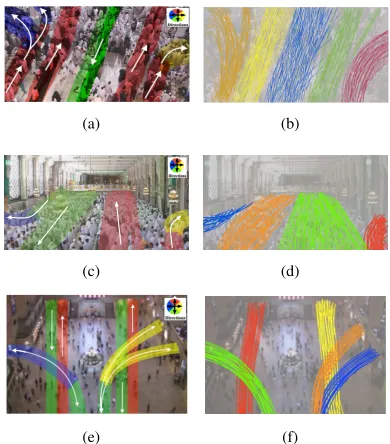
Figures 4(a), (c) and (e) show that crowd movements learnt by GCTM presented clearly discriminative paths in the scene. Each direction of crowd movement was assigned with a different colour. Trajectory clusters, generated by the clustering algorithm, are identified by different colours and presented in Figures 4(b), (d) and (f). In both datasets most trajectory segments were broken; however, spatially distant trajectories could be clustered in one group when they were found to have the same path. For example, the leftmost cluster from Al-Masjid (S1) shown in Figure 4(b) contained trajectories for pedestrians walking towards the left side of the scene. It was not easy to obtain this cluster because occlusion caused by the people sitting on the marble pillar resulted in trajectories observed mostly either at the start or
!∀#∃%&∀∋()
(a) (b)
!∀#∃%&∀∋()
(c) (d)
!∀#∃%&∀∋()
(e) (f)
Figure 4. (a), (c) and (e) present learnt topics by GCTM for Al-Masjid (S1), (S2) and Station. (b), (d) and (f) are their trajectory clusters. (Seen better in colour.)
the end of the path. In Figure 4(d), movements were clus-tered into four groups; one of them was up the left side with an exit and another one was down the right side with an-other exit. Trajectories were mixed with adjacent paths and occluded by the heavy traffic; however, GCTM was able to identify these paths and their exit positions. Similarly, in Figure 4(f), trajectory segments were clustered into five dif-ferent paths; two of them were on the right side to exit the station. Trajectories were shared between these two exits, but the GCTM was able to distinguish between their paths. Figure 5 presents trajectory clusters from Al-Masjid (S1) by various approaches, including GCTM, random field topic1 (RFT) [22], CTM [14] and spectral clustering (SC) [8]. We implemented the SC using a linear interpolation and the Euclidean distance to measure the similarities. Different colours in the figure represent different clusters (paths). It can be observed that GCTM was able to produce the clean-est trajectory paths and clusters. The other three approaches failed to perform trajectory clustering, which was particu-larly evident with the side paths towards the exits because of their heavy occlusion. RFT achieved better results for the central paths in comparison to CTM and SC. SC was the worst. It was only able to cluster the trajectory segments at one end of the movements (the starting or ending positions) as one path and the other end as a different path.
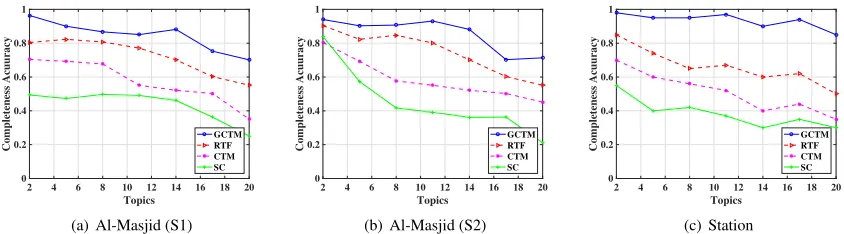
For further quantitative evaluation of the clustering per-formance, we adopted correctness and completeness intro-duced by [13]. Correctness is the accuracy with which a pair of trajectories from different pathways (with the
[image:7.612.52.297.72.113.2]!"# !$# !%#
[image:8.612.94.505.91.285.2]!&# !'#
Figure 5. Comparison of trajectory clustering approaches: (a) original trajectory set, (b) GCTM, (c) RFT, (d) CTM and (e) SC.
2 4 6 8 10 12 14 16 18 20
Topics
0 0.2 0.4 0.6 0.8 1
Completeness Acuuracy
GCTM RTF CTM SC
(a) Al-Masjid (S1)
2 4 6 8 10 12 14 16 18 20
Topics
0 0.2 0.4 0.6 0.8 1
Completeness Acuuracy
GCTM RTF CTM SC
(b) Al-Masjid (S2)
2 4 6 8 10 12 14 16 18 20
Topics
0 0.2 0.4 0.6 0.8 1
Completeness Acuuracy
GCTM RTF CTM SC
(c) Station
Figure 6. Completeness accuracies of trajectory clustering approaches.
groundtruth) are clustered into different groups. Complete-ness is the accuracy with which a pair of trajectories from the same path are clustered into the same group. In an ex-treme case, a 100% completeness and 0% correctness may be achieved when all the trajectories are clustered into a single group. Another extreme is 0% completeness and 100% correctness, achieved when each trajectory is clus-tered into a different group. A good clustering algorithm should achieve high percentages in both correctness and completeness. As a groundtruth we manually labelled 2,500 trajectories for correctness and 1,700 for completeness with Al-Masjid (S1), 2,000 trajectories for correctness and 1,500 for completeness with Al-Masjid (S2) and 2,000 trajectories for correctness and 1,500 for completeness with Station.
Correctness and completeness for GCTM, RFT, CTM and SC are reported in Figures 6 and 7. The correctness and completeness results show that GCTM outperformed the other three approaches in both datasets with a clear mar-gin. The margin was even wider for completeness when the
number of topics was larger. The GCTM with the STG is able to learn discriminative mid-level features better, even with a large number of topics to share the clusters. The other three approaches did not cluster trajectories well because most of these trajectory segments were short and mixed and difficult to be clustered. RFT has advanced the LDA [5] by considering belief priors based on the position and the spatial correlation of trajectories along the video sequence. However, the spatio-temporal correlation between trajecto-ries was disregarded. CTM considered four motion direc-tions at each spatial location, but it ignored the temporal re-lation between sequential local motions in crowded scenes. SC was adversely affected by the outliers because it relied on the linear distance for clustering and did not consider or-dering of points or the direction of moves. All three meth-ods process low-level features of the trajectories in the high-dimensional feature space, which is very sparse, making it difficult to directly perform clustering.
[image:8.612.85.507.331.448.2]2 4 6 8 10 12 14 16 18 20 Topics 0 0.2 0.4 0.6 0.8 1 Correcteness Acuuracy GCTM RTF CTM SC
(a) Al-Masjid (S1)
2 4 6 8 10 12 14 16 18 20 Topics 0 0.2 0.4 0.6 0.8 1 Correcteness Acuuracy GCTM RTF CTM SC
(b) Al-Masjid (S2)
[image:9.612.83.506.75.343.2]2 4 6 8 10 12 14 16 18 20 Topics 0 0.2 0.4 0.6 0.8 1 Correcteness Acuuracy GCTM RTF CTM SC (c) Station
Figure 7. Correctness accuracies of trajectory clustering approaches.
2 4 6 8 10 12 14 16 18 20 22 24 26
Topics 0 1000 2000 3000 4000 5000 6000
Times (in seconds) GCTM RTF CTM SC
(a) Al-Masjid (S1)
2 4 6 8 10 12 14 16 18 20 22 24 26
Topics 0 1000 2000 3000 4000 5000 6000
Times (in seconds) GCTM RTF CTM SC
(b) Al-Masjid (S2)
2 4 6 8 10 12 14 16 18 20 22 24 26
Topics 0 1000 2000 3000 4000 5000 6000
Times (in seconds) GCTM RTF CTM SC
[image:9.612.93.505.76.193.2](c) Station
Figure 8. Comparison between the model learning time.
videos, it generates higher accuracies via all the approaches. This is because most of the trajectories generated in the Al-Masjid datasets are short and mixed in. Therefore, SC, CTM and RFT often failed to cluster them and achieved lower completeness in Figures 6(b) and (c). In the Al-Masjid (S2) videos, some of the trajectories are lying on the sides (blue and red trajectories in Figure 4(d)), and the other three approaches failed to perform trajectory cluster-ing (Figure 6(b)). In contrast, GCTM (with no scene priors) performs well.
Figure 7 shows that GCTM had better correctness ac-curacies compared to the others. RFT, with its priors in-formation achieved the second best performance apart from the Station videos, where CTM with five and eight topics in the Station dataset outperforms RFT. This is because the CTM approach could perform well where scenes were not too crowded (e.g., Station, as opposed to Al-Masjid), and thus full and complete trajectories could be generated with its object-tracking algorithm. They were clustered well by the CTM; however, the accuracy dropped as the number of topics increased.
Finally, Figure 8 presents a comparison of GCTM, RFT, CTM and SC with regard to the topic learning time under a different number of topics. These times include the pre-processing time of feature detection, codebook generation, the topic learning and the final clustering on a 2.6 Ghz ma-chine. The figures show that the learning process of the proposed GCTM model is faster than RFT and CTM.
Gen-erating the LLC codes as low-level features, defining the STG between the trajectory segments and supporting the topic learning process with initial clusters help to improve the computational aspects of topic modelling. While com-puting the scenes prior in RFT and tracking individuals with Optical flow in CTM are computationally more expensive. On the other hand, SC has slightly faster processing time than the GCTM. This is expected, since its clustering pro-cess does not involve tracking of features nor does it con-sider spatio-temporal relations between trajectories. How-ever, SC achieved the worst results in analysing the motion patterns.
6. Conclusions
[image:9.612.80.505.221.339.2]References
[1] M. Al Ghamdi and Y. Gotoh. Video clip retrieval by graph matching. InECIR, 2014.
[2] S. Ali and M. Shah. Floor fields for tracking in high density crowd scenes. InECCV, pages 1–14, 2008.
[3] Y. Ali, B. Zafar, and M. Simsim. Estimation of density levels in the holy mosque from a network of cameras. In Confer-ence on Traffic and Granular Flow, 2015.
[4] D. Blei and J. Lafferty. A correlated topic model of science.
The Annals of Applied Statistics, pages 17–35, 2007. [5] D. Blei, A. Ng, and M. Jordan. Latent dirichlet allocation.
Journal of Machine Learning Research, pages 993–1022, 2003.
[6] I. Borg and P. J. F. Groenen.Modern Multidimensional Scal-ing: Theory and Applications. Springer, 2005.
[7] C. Elkan. Using the triangle inequality to accelerate k-means. InProceedings of the Twentieth International Con-ference on International ConCon-ference on Machine Learning, ICML’03, pages 147–153. AAAI Press, 2003.
[8] W. Hu, D. Xie, Z. Fu, W. Zeng, and S. Maybank. Semantic-based surveillance video retrieval.IEEE Transactions on Im-age Processing, pages 1168–1181, 2007.
[9] L. Kratz and K. Nishino. Tracking pedestrians using lo-cal spatio-temporal motion patterns in extremely crowded scenes.IEEE Trans. on PAMI, 34(5):987–1002, 2012. [10] W. Lin, Y. Mi, W. Wang, J. Wu, J. Wang, and T. Mei. A
diffusion and clustering-based approach for finding coherent motions and understanding crowd scenes. IEEE Transac-tions on Image Processing, 25(4):1674–1687, 2016. [11] W. Lu, X. Wei, W. Xing, and W. Liu. Trajectory-based
mo-tion pattern analysis of crowds. Neurocomputing, 247:213 – 223, 2017.
[12] W. Luo, J. Xing, X. Zhang, X. Zhao, and T. Kim. Multiple object tracking: a literature review.CoRR, 2014.
[13] B. Moberts, A. Vilanova, and J. van Wijk. Evaluation of fiber clustering methods for diffusion tensor imaging. InIEEE Visualization, pages 65–72, 2005.
[14] M. Rodriguez, S. Ali, and T. Kanade. Tracking in unstruc-tured crowded scenes. InICCV, pages 1389–1396, 2009. [15] T. Serre, L. Wolf, and T. Poggio. Object recognition with
fea-tures inspired by visual cortex. InProceedings of the IEEE CVPR, 2005.
[16] R. Sharma and T. Guha. A trajectory clustering approach to crowd flow segmentation in videos. InThe IEEE Interna-tional Conference on Image Processing (ICIP), pages 1200– 1204, 2016.
[17] C. Tomasi and T. Kanade. Detection and tracking of point features. Technical report, Carnegie Mellon University, 1991.
[18] L. van der Maaten, E. Postma, and H. van den Herik. Di-mensionality reduction: a comparative review, 2008. [19] A. Vedaldi and B. Fulkerson. Vlfeat: an open and portable
library of computer vision algorithms. InProceedings of the international conference on Multimedia, pages 1469–1472. ACM, 2010.
[20] J. Wang, J. Yang, K. Yu, F. Lv, T. Huang, and Y. Gong. Locality-constrained linear coding for image classification. InCVPR, pages 3360–3367, 2010.
[21] H. Xu, Y. Zhou, W. Lin, and H. Zha. Unsupervised trajectory clustering via adaptive multi-kernel-based shrinkage. InThe IEEE International Conference on Computer Vision (ICCV), pages 4328–4336, Dec 2015.
[22] B. Zhou, X. Wang, and X. Tang. Random field topic model for semantic region analysis in crowded scenes from track-lets. InCVPR, pages 3441–3448, 2011.
![Figure 1. Sample frames from indoor scenes at (1) (2) Al-MasjidAl-Haram [3] and (3) New York’s Grand Central Station [22].](https://thumb-us.123doks.com/thumbv2/123dok_us/1886584.146098/3.612.312.543.75.131/figure-sample-frames-indoor-scenes-masjidal-central-station.webp)
![Figure 2. CTM and GCTM models. (a) Graphical representationof CTM [4]. (b) Graphical representation of GCTM](https://thumb-us.123doks.com/thumbv2/123dok_us/1886584.146098/4.612.57.284.75.215/figure-gctm-models-graphical-representationof-graphical-representation-gctm.webp)