Int. J. Electrochem. Sci., 7 (2012) 10965 - 10975
International Journal of
ELECTROCHEMICAL
SCIENCE
www.electrochemsci.org
Copper Oxide Based Polymer Nanohybrid for Chemical Sensor
Applications
Sher Bahadar Khan1,2,*, Mohammed M. Rahman1,2, Kalsoom Akhtar3, Abdullah M. Asiri1,2, Khalid A. Alamry2, Jongchul Seo4, Haksoo Han5,*
1
Center of Excellence for Advanced Materials Research (CEAMR), King Abdulaziz University, Jeddah 21589, P.O. Box 80203, Saudi Arabia
2
Chemistry Department, Faculty of Science, King Abdulaziz University, P. O. Box 80203, Jeddah 21589, Saudi Arabia
3
Division of Nano Sciences and Department of Chemistry, Ewha Womans University, Seoul 120-750, Korea
4
Department of Packaging, Yonsei University, Wonju-si, Kangwondo 220-710, Korea 5
Department of Chemical and Biomolecular Engineering, Yonsei University, 262 Seongsanno, Seodaemun-gu, Seoul 120-749, South Korea
*
E-mail: [email protected]; [email protected]
Received: 11 August 2012 / Accepted: 14 October 2012 / Published: 1 November 2012
PCC based nanohybrid has been synthesized by simple intercalation of CuO nano-sheets into PPC matrix. The morphological and phisochemical structure of nanohybrid was characterized by X-ray diffraction (XRD), field emission scanning electron microscopy (FESEM), Energy dispersive spectroscopy (EDS), and Fourier transforms infrared spectroscopy. Interestingly, the morphology of CuO nano-sheets was changed into nanoparticles after intercalation into the polymer matrix. From application point of view, chemical sensing performance of PPC and nanohybrid was investigated by simple I-V technique using nitrophenol as an organic pollutant. By applying to nitrophenol sensing, both PPC and nanohybrid performed as best nitrophenol chemi-sensor in terms of sensitivity. Nanohybrid showed 11.25 times higher sensitivity (4.50 µA.cm-2
.mM-1) than pure PCC (0.40 µA.cm -2
.mM-1). Therefore, nanohybridization is an efficient route to improve sensing performance of PPC.
Keywords: Poly propylene carbonate; CuO nano-sheet; Nanohybrid; Organic pollutants; Nitrophenol, Chemical sensing
1. INTRODUCTION
contribute to health problems. This environmental pollution attracted the attention of environmentalists and scientists [1-3]. Various organic pollutants are responsible for these environmental pollutions. Organic pollutants are extensively employed in industries and daily life and are the main effluents released by the industries to the environment. These organic pollutants have worst effect on the environment and human health due to their hazardous nature [4-6]. Among various organic pollutants, p-Nitrophenol (p-NP) is the most common organic pollutants which badly effect the environment due to their toxicity and hazardous nature. p-NP is a toxic derivative of the parathion insecticide. p-NP is carcinogenic, hazardous, mutagenic, toxic (cytotoxic and embryo-toxic) to mammals [7]. Because of its high solubility and stability in water, it has been found in freshwater, marine environments and has been detected in industrial wastewaters and is difficult to degrade by traditional techniques. Therefore, it is important to build up simple, easy and efficient methods for detecting of p-NP in aqueous solutions to check and protect water resources and food supplies. Therefore, it is straight away desirable to develop a sensor for the detection of organic pollutants to save the environment and human health. Several instrumental techniques have been reported for the detection of organic pollutants. However, they lost their importance due to their cost and efficiency [8-10].
The detection and monitoring of p-NP are crucial for environmental pollution control and industrial applications. Various chromatographic and spectroscopic techniques have been used for the detection and determination of hazardous solvents but they lost their importance due to complication and sluggishness. Electrochemical sensors have gained great attention in the detection and determination of risky compounds because of their simple and fast operation, response and detection [9-12]. Sensor technology plays an important role in environmental safety that normally caused by environmental pollution and accidental leakage of hazardous chemicals which is a big threat for environment. Thus for the interest of environmental and health monitoring, it is important to develop simple, reliable, and inexpensive sensors to detect hazardous chemicals in water. The sensitivity and selectivity of electrochemical sensor strongly dependent on the size, structure and properties of electrode materials and thus nanostructured materials have received much importance and has widely been used as a redox mediator in chemical sensors and photo-catalysis [13-15]. Also the consumption of carbon dioxide has fascinated too much attention due to environmental effluence and energy deficiencies [16]. Global warming, known as the greenhouse effect, is produced frequently by the enormous discharge of carbon dioxide into the atmosphere.
inorganic nanofiller is a method to intensify its various properties [23-25]. Nanoclays and silica are typically employed to advance various properties of the polymers such as thermal, mechanical, and sensing [16-18, 26-28]. However, there is not any report that paying attention on the electrochemical properties of CuO based nanohybrid for the detection of p-NP in aqueous phase.
Polymer-inorganic nanohybrid is pioneering nano-structured materials with modified properties and supreme performances appropriate for practical applications [16]. These multifunctional materials have numerous applications in various fields including optical devices, and as membranes in separation sciences especially in pre-evaporation and food packaging [16]. This is mainly because of the nanometer size and large specific surface area of the nano-sized fillers which are responsible for great improvement in the physical and chemical properties of the polymer. Copper oxide is considered as one of the promising artificial mediators due to its own properties and functionalities. It is a p-type metal oxide semiconductor with narrow band gap (1.2 eV) and demonstrated a versatile range of applications. Due to the good electrical conductivity of CuO, it is widely used in the fabrication of various efficient electrical, optical, photovoltaic, sensing etc devices and reported in the literature [12]. Therefore, in the present investigation we have made an attempt to develop nanohybrid by incorporating of CuO nanosheets into PPC matrix so as to improve the PPC performance. Nanohybrid was structurally studied by FT-IR spectrum and X-ray diffraction. Further the effect of CuO nanosheets on chemical sensing properties of PPC have been studied on the basis I-V technique and the resulting nanohybrid demonstrated excellent p-NP sensing properties in terms of higher sensitivity.
2. EXPERIMENTAL
2.1. Materials
Polypropylene carbonate (PPC), copper chloride, ammonium hydroxide, p-nitrophenol and all other chemicals and solvents were purchased from Sigma-Aldrich Chemicals, USA. All the chemicals and solvents were of reagent grade.
2.2. Synthesis of CuO nanosheets
Pure CuCl2 (Sigma Aldrich) is dissolved in double distilled water and mixed with NH4OH solution such that the pH of the solution was above 10. The stirring process is maintained at 80 ºC for 12h then cooled down to the room temperature. The precipitated black powder has been washed several times with double distilled water to remove the impurities such as surfactants after that it is dried at room temperature. The obtained powder after washing is calcined at 400 0C for 5 hours in the furnace in air environment.
2.3. Preparation of nanohybrid
magnetic stirrer in order to prevent coagulation and precipitation. Further the dispersed solution of CuO/ethanol was added drop wise into the PPC/acetone solution and stirred for 7 hrs at 60 °C. The solvent from the suspension was evaporated and the product was dried at room temperature.
2.4. Characterization
The surface morphology of the nanoparticles was studied using a JEOL Scanning Electron Microscope (JSM-7600F, Japan). Elemental analysis was examined using EDS from JEOL, Japan. X-ray diffraction patterns (XRD) were taken with a computer controlled X’Pert Explorer, PANalytical diffractometer. FT-IR spectra were recorded in the range of 400 to 4000 cm-1 on PerkinElmer (spectrum 100) FT-IR spectrometer whiole the Raman spectra were recorded by Raman spectrometer (Perkin Elmer, Raman station 400). Chemical sensing performances of PPC and hybrid membrane were analyzed by electrometer (Kethley, USA) using I-V technique in two electrode system.
2.5. Fabrication of chemical sensors
For the detection of p-NP, I-V technique was used in which a cell is constructed consisting film of PPC (contact surface area, 0.1 cm2) and nanohybrid (contact surface area, 0.1 cm2) as a working electrode (directly) and Pd wire is used a counter electrode. p-NP solution is diluted at different concentrations in DI water and used as a target chemical. 20.0 mL of 0.1 M phosphate buffer solution was constantly used during the analysis. Solution is prepared with various concentrations of p-NP for both PPC and nanohybrid. The sensitivity was determined from calibration plot as the ratio of voltage and current.0.1 M phosphate buffer solution was prepared using 0.2 M Na2HPO4 and 0.2 M NaH2PO4 and mixing it in 100.0 mL de-ionize water.The prepared solution was used at pH 7.0
3. RESULTS AND DISCUSSION
3.1. Structural characterization
(b)
(d)
(c)
(a)
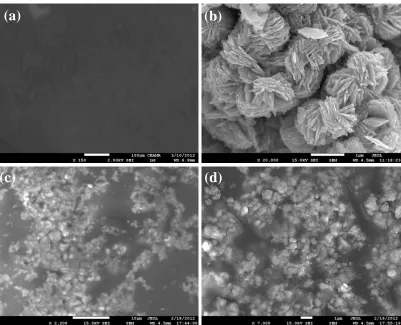
Figure 1. SEM image of PPC (a), CuO (b), NH low magnification (c) and NH high magnification (d).
[image:5.596.97.498.76.401.2]The data is in good agreement with our previous report [16,17]. To evaluate the composition of PPC and nanohybrid, EDS spectrum was analyzed and the data is depicted in Figure 2. EDS spectrum of PPC shows carbon and oxygen peaks while EDS spectrum of nanohybrid shows peaks related only to carbon, oxygen and copper without any impurity peak which confirm that synthesized nanohybrid is composed of carbon, oxygen and copper [12].
[image:5.596.54.547.559.738.2]
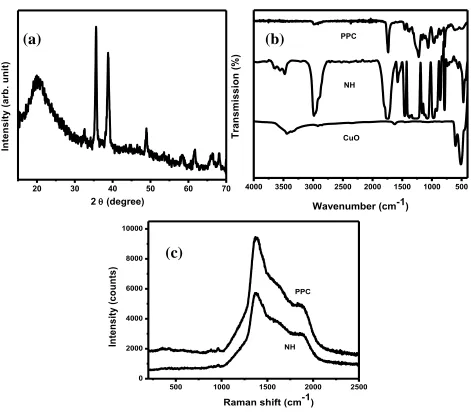
X-ray powder diffraction is an analytical technique which is commonly used for the identification of phase, crystal structures, atomic spacing and unit cell dimensions of crystalline material. X-ray diffraction results are depicted in Figure 2(a). X-ray diffraction pattern (XRD) of nanohybrid shows a hallow peak at 20.0 Å which is responsible for the amorphous phase of PPC. XRD spectrum also showed several well crystalline peaks at 32.5, 35.6, 38.7, 49.2, 58.5, 61.6, 66.4 and 68.2 which are due to the CuO [12]. All diffraction peaks in the obtained pattern clearly confirmed that the synthesized product is a hybrid of PPC and CuO nanostructures. Except PPC and CuO, no other peaks were observed in the pattern verified that the synthesized nanohybrid is composed of PPC and CuO [16].
20 30 40 50 60 70
In te n s it y ( a rb . u n it )
2 (degree)
4000 3500 3000 2500 2000 1500 1000 500 CuO NH PPC T ra n sm is si o n ( % ) Wavenumber (cm-1)
500 1000 1500 2000 2500 0 2000 4000 6000 8000 10000 In te n si ty ( co u n ts )
Raman shift (cm-1) PPC
NH
(a)
(b)
[image:6.596.63.534.250.662.2](c)
Figure 3. Powder XRD patterns (a), FT-IR spectra (b) and Raman spectra (c) of PPC and NC.
FTIR spectrum gives the information about the quantity of material. FT-IR spectrum of PPC demonstrated absorption bands at 2800-2900,1750, 1360, 1220 and 775 cm-1 which match up to C-H, C=O and C-O stretching vibration. CuO nanosheets exhibited absorption bands at 513, 609, 1627, and 3447 cm−1 which are depicted in Fig. 3(a). The characteristic absorption bands at 609 and 513 cm−1 are responsible for Cu-O stretching vibration. The absorption bands at 3447 and 1627 cm−1 are due to the stretching and bending vibrational modes of absorbed water which normally nanocrystalline materials absorbs from environment due their high surface-to-volume ratio [12,16,17]. All these distinctive peaks regarding PPC and CuO nanosheets were identified in nanohybrid spectrum, signifying the configuration of nanohybrid [16].
Raman study was also carried out for PPC and hybrid membrane. Raman spectrum of PPC funciones peaks at 415 cm-1 (C-O-C deformation), 880 cm-1 (C-COO stretching), 962 cm-1 (C-C stretching and CH3 rocking), 1071 cm-1 (C-O stretching), 1131 cm-1 (CH3 asymmetric rocking), 1169 cm-1 (COC asymmetric stretching), 1366 cm-1 (CH deformation and CH3 symmetric deformation), 1452 cm-1 (CH3 asymmetric deformation), and 1751 cm-1 (C=O stretching). All PCC peaks were obtained in the nanohybrid spectrum but less crystalline as coteje to PPC, symptomatic of the fabrication of nanohybrid [29].
3.2. Chemical sensing application
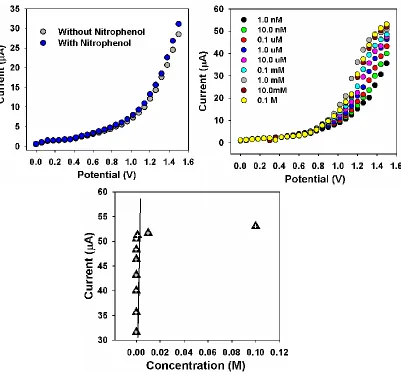
PPC and nanohybrid films were implemented for the detection of p-nitrophenol in liquid phase in order to study their chemical sensing properties toward p-nitrophenol (scheme 1) [1-3]. I-V technique was used to measure the electrical response both PPC and nanohybrid sensor for p-nitrophenol. The electrical response of nanohybrid sensor for p-nitrophenol using I-V technique is shown in Fig. 4.
e
-e
-e
-e
-H+
H+
H+
H+
= H+
= O2
I
V
Figure 4. I-V curves of NC (a) with and without p-NP, (b) with concentration variation of p-NP and (c) calibration curve.
OH
NO2
+ 4e
-+ 4H
+OH
NHOH
OH
NHOH
OH
N=O
+ 2e
-+ 2H
++ H
2O
The effect of p-nitrophenol concentration on the electrical response of nanohybrid film was studied by successive addition of p-nitrophenol in the range of 0.5 µM to 5.0 M into 0.1 M PBS solution (pH =7.0) and the graph is depicted in Fig. 3(c). Increasing electrical current with increasing p-nitrophenol concentration is observed which indicates that the nanohybrid film conductivity increased with increase in the concentration of target chemical. This can be credited to the raise in ions providing surplus electron to the transmission group of the material [8-10].
Calibration curve (Fig. 3(d)) was plotted from the variation of target concentration. Calibration curve depicts two sensitivity regions; region at lower concentrations (physisorption process) is linear with correlation coefficient (R) of 0.7941. The sensitivity is calculated from the slope of the lower concentration region of calibration curve, which is 4.50 µA.cm-2
.mM-1. The linear dynamic range exhibits from 1.0 nM to 1.0 mM and the detection limit was estimated, based on signal to noise ratio (S/N), to be 0.67 nM. At high concentration the sensor become saturated due to chemisorption process which might be due to the unavailability of free nanohybrid film sites for p-nitrophenol adsorption [11-13].
4. CONCLUSIONS
Using simple intercalation reaction, PPC based nanohybrid was successfully synthesized using CuO nano-sheets as inorganic nanofiller. The structure of PPC and nanohybrid were evaluated by XRD, FTIR, SEM, EDS, FT-IR and Raman spectroscopy. Nanohybrid showed superior sensing properties as compared to PPC toward the detection of p-NP. Thus CuO nano-sheets plays an important role in improving p-NP sensing properties of PPC and consequently widely expands its application in various fields.
ACKNOWLEDGMENTS
This work was supported by the National Research Foundation of Korea Grant founded by the Korean Government (MEST) (NRF-2009-C1AAA001-0092926) and the National Research Foundation (NRF) of Korea Grant founded by the Korean Government (MEST) (No. 2011-0016750). Center of Excellence for Advanced Materials Research, King Abdulaziz University, Jeddah, Saudi Arabia is also highly acknowledged.
References
1. M.M. Rahman, A. Jamal, S.B. Khan, M. Faisal, ACS Appl. Mater. Interfaces 3 (2011) 1346. 2. M.M. Rahman, A. Jamal, S.B. Khan, M. Faisal, J. Nanoparticle Res. 13 (2011) 3789. 3. S.B. Khan, M. Faisal, M.M. Rahman, A. Jamal, Talanta 85 (2011) 943.
4. M. Faisal, S.B. Khan, M.M. Rahman, A. Jamal, J. Mater. Sci. Technol. 27 (2011) 594. 5. A. Jamal, M.M. Rahman, M. Faisal, S.B. Khan, Mater. Sci. Applicat. 2 (2011) 676. 6. M.M. Rahman, A. Jamal, S.B. Khan, M. Faisal, Superlat. Microstruc. 50 (2011) 369. 7. R.M. Banik, Mayank, Rajiv Prakash, S.N. Upadhyay, Sens. Actuat. B 131 (2008) 295–300. 8. M. Faisal, S.B. Khan, M.M. Rahman, A. Jamal, Appl. Surf. Sci. 258 (2011) 672.
9. M.M. Rahman, S.B. Khan, A. Jamal, M. Faisal, A.M. Asiri, Sens. Transduc. J. 134 (2011) 32. 10. S.B. Khan, M.M. Rahman, E.S. Jang, K. Akhtar, H. Han, Talanta 84 (2011) 1005.
11. S.B. Khan, M. Faisal, M.M. Rahman, A. Jamal, Sci. Tot. Environ. 409 (2011) 2987. 12. M. Faisal, S.B. Khan, M.M. Rahman, A. Jamal, A. Umar, Mater. Lett. 65 (2011), 1400. 13. M.M. Rahman, A. Jamal, S.B. Khan, M. Faisal, J. Phys. Chem. C 115 (2011) 9503. 14. M.M. Rahman, A. Jamal, S.B. Khan, M. Faisal, Biosens. Bioelectron. 28 (2011) 127. 15. M. Faisal, S.B. Khan, M.M. Rahman, A. Jamal, Chem. Engineer. J. 173 (2011) 178. 16. J. Seo, G. Jeon, E.S. Jang, S.B. Khan, H. Han, J. App. Polym. Sci. 122 (2011) 1101.
17. S.B. Khan, J. Seo, E.S. Jang, K. Akhtar, K.I. Kim, H. Han, Macromolecul. Res. 19 (2011) 876. 18. S.B. Khan, J.C. Seo, E.S. Jang, J.S. Choi, S.H. Choi, H. Han, Mem. J. 19 (2011) 341.
19. Z. Zhang, Q. Shi, J. Peng, J. Song, Q. Chen, J. Yang, Y. Gong, R. Ji, X. He, J.H. Lee, Polymer, 47 (2006) 8548.
20. L. Du, B. Qu, Y. Meng, Q. Zhu, Compos. Sci. Technol. 66 (2006) 913.
21. L.J. Gao, M. Xiao, S.J. Wang, Y.Z. Meng, J. Appl. Polym. Sci. 108 (2008) 1037. 22. J. Xu, R.K.Y. Li, Y.Z. Meng, Y.W. Mai, Mater. Res. Bull. 41 (2006) 244. 23. M. Biswas , S.S. Ray, Adv. Polym. Sci. 155 (2001) 167.
24. S.C. See, Z.Y. Zhang, M.O.W. Richardson, Prog. Org. Coat. 65 (2009) 169. 25. K.J. Yao, M. Song, D.J. Hourston, D.Z. Luo, Polymer, 43 (2002) 1017.
26. E.S. Jang, S.B. Khan, J. Seo, K. Akhtar, J. Choi, K.I. Kim, H. Han, Macromolecul. Res. 19 (2011) 1006.
28. E.S. Jang, S.B. Khan, J. Seo, Y.H. Nam, W.J. Choi, K. Akhtar, H. Han, Prog. Org. Coat., 71 (2011) 36.
29. T. Furukawa, H. Sato, R. Murakami, J. Zhang, I. Noda, S. Ochiai, Y. Ozaki, Polymer, 47 (2006) 3132-3140.