THESES SIS/LIBRARY TELEPHONE: +61 2 6125 4631
R.G. MENZIES LIBRARY BUILDING NO:2 FACSIMILE: +61 2 6125 4063
THE AUSTRALIAN NATIONAL UNIVERSITY EMAIL: [email protected] CANBERRA ACT 0200 AUSTRALIA
USE OF THESES
This copy is supplied for purposes
of private study and research only.
Passages from the thesis may not be
copied or closely paraphrased without the
Optimisation for Complex Value
Databases
Hong-Cheu Liu
A thesis submitted for the degree of
Doctor of Philosophy at
The Australian National University
©
Hong-Cheu Liuresearch. Extended abstracts of Chapter 3 and Chapter 4 have appeared in [Liu and Yu
1998] and [Liu and Yu 1999], which were jointly prepared with Jeffrey Xu Yu based on
research undertaken by the author. A premilinary version of Chapter 6 has appeared
in [Liu and Chirathmajaree 1996]. This was jointly prepared with Chirathmajaree
Chaiyaporn again based entirely on the author's own work. The contents of Chapter
5 and Chapter 7 have apperared in [Liu and Ramamohanarao 1994b], [Liu and
Ra-mamohanarao 1994c] and [Liu and RaRa-mamohanarao 1994a] and are based on research
carried out and prepared solely by the author.
Except where otherwise indicated, this thesis is my own original work.
Hong-Cheu Liu
It is a great pleasure for me to acknowledge the assistance and contributions of a number of individuals to my PhD work. First, I would like to thank my supervisor,
Dr Jeffrey Xu Yu, for his supervision and support during my PhD program at The
Australian National University. He always encouraged me to be enthusiastic and to
develop as a good researcher. I am sincerely grateful to him for his time and patience.
I would like to express my gratitude to my advisors, Dr Brian Molinari and Dr Vicki
Peterson, for their many helpful comments and fruitful discussions on a draft version
of this thesis. They spent much time carefully reading all chapters of the thesis. Their
suggestions have greatly helped to improve the quality and presentation of this thesis.
I am deeply indebted for their efforts and suggestions.
Many thanks go to Nick Craswell and Gail Craswell who helped me in the writing
of this thesis. Ms Gail Craswell proof-read my papers and some chapters of this
the-sis. Nick Craswell suggested various improvements to the thethe-sis. Lynda Lawson also
assisted with corrections.
I am grateful for the support and assistance I received from colleagues at the
De-partment of Computer Science. In particular, I would like to thank Weifa Liang, Steve
Blackburn, Linda Wallace, Zhen He, Richard Walker and Hongxue Wang for their help
in Latex questions, paper retrieval and other assistance.
I would also like to acknowledge the financial support of an Australian National
University Postgraduate Scholarship. The Department of Computer Science, led by
Dr Chris Johnson, provided a warm and excellent working environment including an
enthusiastic technical service support group.
Finally, I would like to gratefully thank my wife and sons for their support, patience
and encouragement. Most of all, I would like to express my sincere gratitude to the
continuing support of my parents.
This thesis considers the theory of database queries on the complex value data model
extended with external functions. In modern intelligent database systems, we expect
that query systems be able to handle a wide range of calculus formulas correctly and
efficiently. Accordingly, they will require general query translators and efficient
opti-misers. Motivated by these concerns, this thesis undertakes a comprehensive study of
query evaluation in the complex value model and investigates the following issues:
• identifying recursive sets of complex value formulas which define domain
inde-pendent queries;
• implementing complex value calculus queries with the incorporation of functions;
• solving the problem of how to process join operation in complex value databases;
and
• investigating some algebraic properties concerning nested relational operators.
The first part of this thesis extends some classical properties of the relational theory
-particularly those related to query safety - to the context of complex value databases
with fixed external functions and investigates the problem of how to implement
cal-culus queries. Two notions of syntactic criteria for queries which guarantee domain
independence, namely, embedded evaluable and embedded allowed, are generalised for
this data model. This thesis shows that all embedded-allowed calculus (or fix-point)
queries are external-function domain independent and continuous.
This thesis discusses the topic of "embedded allowed database programs" and proves
that embedded allowed stratified programs satisfying certain constraints are embedded.
domain independent. It also develops an algorithm for translating embedded allowed
queries into equivalent algebraic expressions as a basis for evaluating safe queries in all
calculus-based query classes.
X
The second part of this thesis considers the issue of query optimisation for nested
relational databases. Within a restricted set of nested schema trees, a join operator,
called P-join, is proposed. The P-join operator does not require as many restructuring
operators and combines the advantages of the extended natural join and recursive join
for efficient data access. A P-join algorithm which takes advantage of a decomposed
storage model and various join techniques available in the standard relational model
to reduce the cost of join operation in nested relational databases is also proposed.
Finally, this thesis investigates some algebraic properties of nested relational
opera-tors which are useful for query optimisation in the nested relational model and outlines
~
-a heuristic optimis-ation -algorithm for nested rel-ation-al expressions by -adopting -
Acknowledgments
Abstract
List of Figures
1 Introduction
1.1 Query Processing in the Standard Relational Model
1.2 Query Processing in Extended Relational Models
1.3 Related Work . . . .
1.4 Overview of the Thesis .
2 Complex Value Databases and Query Languages
2.1 Complex Value Databases
2.2 Query Languages . . .
2.2.1 A Complex Value Algebra .
2.2.2
2.2.3
2.2.4
A Complex Value Calculus
The Calculus (CALccv) +Fix-point
Rule-based Languages for Complex Values.
2.3 Domain-Independent Computable Queries
2.3.1 Notion of Genericity .
2.3.2 Domain Independence
2.3.3 Computable Queries
2.4 Query Translation .
2.5 Query Optimisation
3 Domain-Independent Queries with External Functions
3.1 Basic Concepts . . . .
xii Contents
302 Evaluable Queries 0 0 0 0 0 0 0 0 0 0 0
30201 Embedded Evaluable Formulas
30202 Embedded Allowed Formulas 0
303 Domain-independent Database Programs
3.4 Em-allowed, Finiteness and Domain Independence
4 Translation of Complex Value Calculus Queries
401 Removing Universal Quantifiers and Renaming Variables 0
402 Transforming a Formula into Existential Normal Form 0 0
35 36 39 42 45 47 48 49
403 Transforming an ENF Formula into Complex Value Algebr~ Norrnal Form 55
4.4 Transforming ALGcvNF Formulas into Algebra Expressions
405 Proofs of Theorems 302, 303 and 3.4 0 0 0 0 0 0 0 0
5 A Join Operator for Complex Value Databases
501 Basic Concepts 0 0 0 0 0 0 0
501.1 Nested Schema Tree
501.2 Selection Operator and Projection Operator 0
502 The Path Join 0 0 0 0 0 0 0 0 0 0 0 0 0 0 0 0 0 0 0 0 0
60 65 69 70 70 71 73
50201 Extended Cartesian Product and Path Cartesian Product 74
6
50202 P-join Operator 0 0 0 0 0 0 0 0 0 0 0 0 0 0 0 0 0 0 77
503 A Comparison of the P-join and Other Join Operators
5.4 Algebraic Equivalences 0 0 0 0 0
505 Decomposition P-join Operator
506 Correctness of Decomposition P-Join 0
Implementation of the P-Join
601 Computation Mechanism for P-join 0
601.1 Basic Assumptions
601.2 Storage Model 0 0
601.3 Mechanism of Computing P-join
601.4 Size Estimate of P-join Output
602 Cost Estimate of Computing P-join 0 0
6.2.1 Nested Loop Method .
6.2.2 Sort-merge Method ..
6.2.3 Join Using Index Method
6.3 A P-join Algorithm .
6.4 Discussion . . . .
7 Algebraic Optimisation for Nested Relational Databases
7.1 Extended Relational Operators . . . .
7.2 Equivalences of Algebraic Expressions
7.3 Outline of a Heuristic Optimisation Algorithm
8 Conclusion and Further Research
Bibliography
102
103
103
104
106
109
110
112
121
125
2.1
Representation of complex value2.2
A database instance . . . .3.1
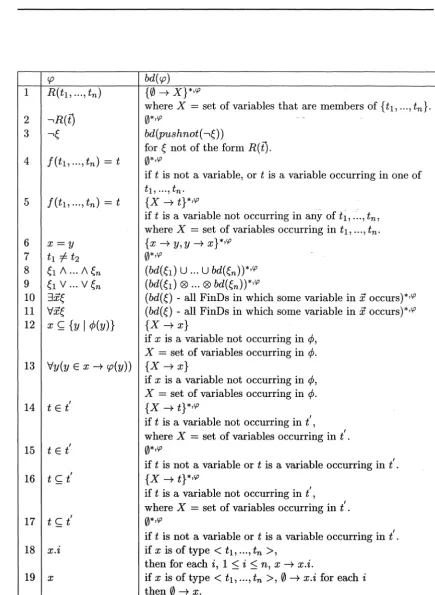
The overall definition of the function bd5.1
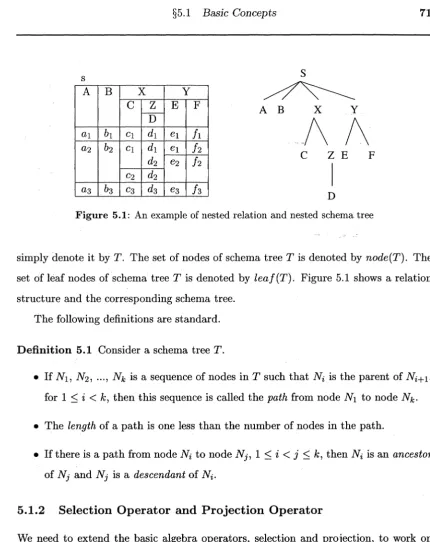
An example of nested relation and nested schema tree5.2
Examples of selection and projection . . . .5.3
An example of extended Cartesian product5.4
An example of path Cartesian product5.5
An example ofe
P-join . . .5.6
Natural P-join between rand q5.7
The schemas of r, q and r ~P q5.8
Natural P-join between rands5.9
The schemas of r, s and r ~P s5.10
Relations r1, r2 and the result ofthe query in Example5.7
5.11
Nested relations r1, r2 and r3...
5.12
The result of the expression5.2
in Example5.9
5.13
An example of decomposition P-join between rand q.6.1
The storage structures of R and S.6.2
The relation Temp6.3
The output of P-join7.1
Examples ofue
andne .
7.2
Examples of ~e and 1re •7.3
Product database . . . .Introduction
Database Management Systems (DBMSs) are being widely used to support new
ap-plications such as engineering design, image and voice data management and spatial
information systems. In order to model these applications the complex value data
model has been proposed as a significant extension of the relational one and in the
last decade much research has been carried out in this areas. Complex values (nested
relations, complex objects) are increasingly parts of these advanced database systems.
Intuitively, complex values are relations in which the entries may be themselves tuples
or relations. In this data model, we use hierarchical structures rather than flat tables
to enable the representation of complex objects. Complex values allow the application
of the tuple and set constructor recursively. A first normal form relation is a special
kind of complex value.
The complex value data model lacks key features of the object-oriented paradigm
such as objects and inheritance. However, it provides the core structure of
object-oriented (object-relational) databases and comprises an important component of
se-mantic models. Therefore languages that access such complex structures are important,
and the capability and performance of query systems are worthy of study.
As in the case of the relational data model, query languages for complex values
have been developed from three paradigms: extensions of relational calculus
[Abite-boul and Beeri 1995; Jacobs 1982; Kuper and Vardi 1993; Roth et al. 1988]; extensions
of relational algebra [Abiteboul and Bidoit 1986; Abiteboul and Beeri 1995; Kuper and
Vardi 1984; Thomas and Fischer 1986; Schek and Scholl1986]; and deductive languages
[Abiteboul and Grumbach 1991; Beeri et al. 1987; Kuper 1988; Kuper 1990]. They all
use higher order types. The variety of features and operations found in these languages
2 Introduction
is quite complicated. Previous investigations of complex value query languages have
focused on equivalent expressive power and complexity of various query classes, various
means for obtaining expressive and tractable languages for complex value databases.
However, the work done in the database community on query translation and
optimi-sation for the complex value model is insufficient and needs further refinement.
1.1
Query Processing in the Standard Relational Model
A query that is expressed in a high-level, declarative style query language, such as SQL
or QUEL, must first be scanned, parsed, and validated. An internal representation of
the query is then created, usually as a tree or a graph expressed by relational algebra.
The database system must then devise an execution strategy for retrieving the result
of the query from the internal database files.
Relational calculus is declarative and suitable for user interface while relational
algebra is procedural and suitable for database operations. The process of internally
translating calculus-based expressions written by the user or generated by a layer of
software into algebra expressions is called query translation. The query translator in
modern sophisticated systems will handle software-generated queries which will surely
be non-conjunctive and much more complex than the large majority of queries, falling
into the class of conjunctive queries, posed by typical users of traditional databases.
This translator is also able to distinguish reasonable queries which can be answered
sensibly from unreasonable ones [Van Gelder and Topor 1991].
In the database field, to answer sensibly means that values of any correct answer lie
within the active domain of the query or the input [Topor 1987]. There are only certain
calculus queries (or formulas) which can be regarded as reasonable in this sense. Such
queries are called domain independent as they yield the same answer no matter what
the underlying domain of interpretation. The following are examples of unreasonable
query phenomenon.
1. {
xi•
Movies( "Cries and Whispers", "Bergman", x)}ques-tion, "Which suppliers supply all parts required by project ICS?'' is expressed by
{xI Vy[•R(ICS,y) V S(x,y)]}.
3. {x, yiS(x, f(y))}.
The set of correct answers for each of the above queries dep~ends on the· domains of the
variables.
Many researchers have tackled these problems, including [Beeri and Milo 1997;
Demolombe 1992; Escobar-Molano et al. 1993; Fagin 1982; Hull and Su 1994; Ramakr..,
ishnan et al. 1987; Topor 1987; Van Gelder and Topor 1991; Ullman1982]. There have
been several attempts to semantically or syntactically characterise the set of formulas
that ensure domain independent [Abiteboul et al. 1995; Demolombe 1992;
Escobar-Molano et al. 1993; Fagin 1982; Topor 1987; Ullman 1982; Ullman 1988; Van Gelder
and Topor 1991]. The class of domain independent formulas defined by Fagin [1982] is
the largest class having the property that the constants in the database and the query
provide a sufficient domain for the values in the answer. This class was shown to be
not solvable by Vardi [1981].
The power of query languages is based on the fact that they express a restricted
class of declarative programs. Although relational calculus queries may not return
finite results, as illustrated in the above examples, a natural subclass of the relational
calculus does, namely, the class of range-restricted queries. This class gives guarantees
of finite output and is complete in this respect: it captures all relational calculus
queries whose outputs are always finite (the safe queries). The class of safe formulas,
introduced by Ullman [1982], characterises those relational calculus formulas that have
equivalent relational algebra expressions. A syntactic definition of safe appears in
Ullman's revised edition [Ullman 1988].
If the answers to relational calculus queries are possibly infinite sets or even
unde-fined, it will be difficult to provide a well-defined procedure for translating user queries
into equivalent relational algebra queries which can be evaluated by the underlying
relational database systems. In the past, Van Gelder and Topor [1991] identified such
problems in SQL and QUEL.
rela-4 Introduction
tively straightforward. However, it is significantly more difficult to support this in the
relational calculus. The main reason is that the semantic of relational algebra queries
evaluated on a database instance is independent of the underlying domains while the
relational calculus is domain sensitive. Therefore, the semantics of calculus queries in
the presence of functions need further investigation.
A query typically has many possible execution strategies, and the process of
choos-ing a suitable execution strategy for processchoos-ing a query is known as query optimisation.
A high-level relation query is more declarative in nature; it specifi'esc what the
intended result of the query is rather than the details of how the result should be
obtained. The query optimiser is responsible for translating such high-level queries
into equivalent queries or machine instruction programs that are arguably more efficient
than a naive execution of the initial query.
A myriad of factors affect query processing, including storage and indexing
tech-niques, page sizes and paging protocols, access routines, information about the stored
data, statistic properties of anticipated queries and updates, and so on [Abiteboul et al.
1995]. Query optimisation can be performed at all levels of the three-level database
architecture. Because of the myriad factors that play a role in query evaluation, most
practically successful techniques rely heavily on heuristics.
There are two main techniques for query optimisation. The first technique, heuristic
optimisation, is often referred to as query rewriting. Heuristic rules are applied to
modify the internal representation of a query - which is usually in the form of a tree or
a graph data structure - to improve its expected performance on execution. The rules
typically reorder the operations in a query execution strategy. The second technique
-systemic optimisation using cost estimates- is often referred to as plan generation. The
query optimiser, possibly after using some heuristics, will estimate and compare the
costs of different execution strategies and choose the execution plan with the lowest
cost estimate. The two techniques are usually combined to some extent in a query
1.2
Query Processing in Extended Relational Models
Most basic issues concerning object-oriented (or object-relational) databases, such as
the design of query languages or the analysis of their expressive power, can be largely
resolved using techniques already developed in connection with standard relational and
complex value models. However, the presence of new features (such as object identifiers,
typing, method calls) bring new issues and techniques. In particular, query processing
is seriously affected by these new features and needs to be further investigated.
A DBMS provides data storage but data processing is provided by a host
program-ming language with a relatively simple query language such as SQL embedded in it.
Therefore, it is desirable to provide effective communication between the underlying
programming language and the database query language. In particular, functions must
be first-class citizens in query languages.
Support for both complex values and user-defined functions is important in a
DBMS. In response to these requirements, SQL3 generalizes the relational model into
an object model offering abstract data types and therefore allows users to define data
types which suit their applications. Tables may then contain collections of objects. As
for supporting the operational behaviours of any user defined type, query languages are
extended in such a way that user-defined functions can be registered in a DBMS such
as Informix and Postgres. For example, the following SQL3 statement [Stonebraker
and Brown 1998] registers a function called "vesting" on a data type "date".
create function vesting (date)
returns float
as external name 'foo'
language C;
The function returns a float value and is written using the programming language C.
The function has been compiled and is kept in the file foo. The DBMS can then use
any user-defined types and functions in the same way as built-in types and functions.
Alternatively, programming languages such as PASCAL/Rand Persistent Java extend
6 Introduction
The practical integration of external functions in query languages is generally well
developed and understood, but the semantics of queries in the presence of external
functions needs to be further investigated. Some attempts to extend the definition
of domain independence for the complex value data model incorporated with external
functions have already been made [Abiteboul and Beeri 1995;- -suciu 1995).
Abite-boul and Beeri [1995) explored the incorporation of arbitrary interpreted functions
and predicates into query languages for complex objects. They defined the notion of
bounded-depth domain independence and showed that, with extended interpreted
func-tions and predicates, the algebra, the bounded-depth domain ind~pendent calculus,
the safe calculus and the Datalog-like language have equivalent expressive power.
Su-ciu [1995) proposed a notion of domain independence (called external-function domain
independence) for queries with external functions which can also be applied to query
languages with fix-points or other kinds of iterators. None of these attempts, however,
address the aspects of calculus queries with fix-points and deductive database
pro-grams. The first goal of this thesis is to identify recursive sets of higher order (complex
value) formulas which define domain independent queries, investigate the notion of
do-main independent deductive database programs and implement dodo-main independent
queries.
Much theoretical and application research on query optimisation are still being
carried out in various extended relational data models. The query optimiser is the
heart of DBMS performance and must also be extended with knowledge about how
to execute user-defined functions efficiently, take advantages of new index techniques,
examine new query processing heuristics, and navigate among data using references.
Object-oriented (object-relational) databases remedy the significant disadvantages of
the standard relational model by borrowing a variety of data structuring construct
from the complex value model. Query processing in the complex value model is very
similar to that in object-oriented databases. For this reason, this thesis focuses on query
optimisation in complex value databases. However, it is expected that the results in this
thesis can be applicable to object (object-relational} databases with minor modification.
As in the relational model, the join operator is one of the most expensive and
Example 1.1 Consider the following database which has nested relations Product and
Part.
Product= (prodname, Warranty(premium, country, w-period), Composition(c-name,
c-id, Parts(p-name, quantity)), Distributor(comyany, fee))
Part = (p-name, weight, Warranty(country, w-period), Source(company, cost))
Consider also the following query.
Find those countries and the corresponding w-periods which are the same
in some product and one of its parts, together with companies that are
both a product distributor and a part source (Presumably, this information
might be used to reduce premium). Group the findings on prodname and
p-name.
Due to the fact that the intending join attributes "company", "p-name" and "w-period"
appear on different subschema levels, this query cannot be expressed by join operators
proposed so far without restructuring operations. When the algebra expression of
queries includes restructuring operators, they are not easily optimised. The second
goal of this thesis is to solve the problem of how to optimise queries which include join
operations in the nested relational model.
In modern intelligent database systems, we expect that query systems be able to
handle a wider range of calculus formulas correctly and efficiently. Accordingly, they
will require more general query translators and optimisers. This thesis undertakes a
more comprehensive study of query evaluation in the complex value model.
1.3 Related Work
This section briefly reviews the research literature relating to this thesis. The evaluable
formulas, originally proposed by Demolombe [1992) and discussed by Van Gelder and
Topor [1991) in the context of standard relational databases, comprise the largest
de-cidable subclass of the domain independent formulas. Demolombe [1992) proved that
8 Introduction
the same expressive power as domain independent formulas. The allowed formulas
pro-posed by Topor [1987] are a strict subclass of the evaluable formulas. Van Gelder and
Topor [1991] investigated the properties of two such classes and developed algorithms
to transform an evaluable formula into an equivalent allowed formula and from there
into relational algebra. This thesis generalises the notions of eviifuable and allowed for
the complex value model.
Topor [1991] investigated the algebra, calculus and Datalog languages in which the
underlying domain is partitioned into two sorts, namely, the sort Z holding the integers
and the sort, dom, ranging over a disjoint set of uninterpreted constants. This thesis
also considers query evaluation using domains based on subsets of Z whereas Topor
[1991] did not. Therefore, the notion of Topor's domain independence is different from
our notion of domain independence.
The notion of safe calculus queries developed in [Abiteboul and Beeri 1995] is based
on "range-restriction" of variables occurring in calculus formulas. Each variable is
attached to a range formula. The positive literal R(x), x E
t,
x=
t,
x ~t
and \fy(y E x --+ cp(y)), and formulas obtained from them by using/\, V are called range formulas. For example, R(z) 1\y E z restricts z andy; if 'PI(xi), ... ,cpn(xn) restrictXI, ... , Xn respectively, then 'PI (xi) 1\ ... 1\ 'Pn (xn) 1\ f(xi, ... , Xn)
=
y restricts y.Abiteboul and Beeri [1995] also presented a sketch showing the translation from
safe calculus into algebra. This translation is based on associating, with each
sub-formula, "range-restriction" for the free variables that are occurring in the formula.
The translation is motivated from a primarily theoretical perspective whereas this
thesis adopts the finiteness dependency approach which influences the choice of some
translation steps in the algorithm. The issue of the order in which the conjunctions
are evaluated is also considered in this thesis. The translation of [Abiteboul and Beeri
1995] is potentially less efficient than the algorithm developed in this thesis which
adopts a heuristic to simplify the computation involving finite dependencies required
to implement the translation.
Escobar-Molano, Hull, and Jacobs [1993] introduced the notion of embedded
al-lowed, which generalised the "allowed" criteria to incorporate scalar functions and
rela-tional algebra. The notion of range-restriction is weaker than the notion of embedded
allowed. The notion of embedded domain independence developed in [Escobar-Molano
et al. 1993] is restriction to the fiat relational case of the notion of bounded depth
domain independence in [Abiteboul and Beeri 1995]. Both notions are used only in
conjunction with query languages without recursive queries (or any other kind of
iter-ations). This thesis generalises the notion of embedded allowed for (recursive) queries
for the complex value model. Their translation framework used the notion of finiteness
dependencies [Ramakrishnan et al. 1987] which is analogous to functional dependencies
and carries information about how sub-formula involving scalar functions can restrict
the possible range of variables. This thesis also develops an algorithm for translating
embedded allowed queries into equivalent algebra expressions as a basis for evaluating
safe queries in all (complex value) calculus-based query classes.
The notion of external-function domain independence, proposed by [Suciu 1995],
generalises those of generic and domain independent queries on databases without
ex-ternal functions and can also be applied to query languages with fix-points or other
kinds of iterations. Suciu [1998] showed that all queries in an nested relational algebra
language over a set of external functions, NRA(1:) +fix, are external-function
do-main independent and continuous, while this thesis shows that all "embedded allowed
formulas" are external-function domain independent.
Beeri and Milo (1997] studied the issue of safe calculus and their translation to
an algebra based on the perspective of algebraic specifications. The notion of "strict
DB-domain independent" defined there is similar to the notion of embedded domain
independent in [Escobar-Molano et al. 1993]. Their paper also provided a definition
of "safe" calculus queries, showed that they are strict DB-domain independent and
indicated how to translate these into algebra queries. However, the notion of safe
used in [Beeri and Milo 1997] is strictly weaker than "embedded allowed" developed in
[Escobar-Molano et al. 1993]. Also the translation is potentially less efficient than the
algorithm developed in this thesis as it will in some cases involve a construction of the
active domain of the input instance while the algorithm in this thesis avoids to use it.
This thesis extends the above notions for the complex value data model and explores
10 Introduction
There is a growing interest among database researchers in constraint databases
which generalise relational databases by finitely representable infinite relations
[Kanel-lakis et al. 1995; Benedikt et al. 1998]. Each constraint relation is a quantifier-free
first-order DNF (disjunctive normal form) formula in some constraint theory. Each
disjunct of the DNF formula is a constraint tuple. The constraint data model and
query languages provide an alternative approach to resolving the problem of safety,
that permits query to have answers that are infinite but finitely representable.
How-ever, there is an analogy of the closed-form evaluation problem as in un-constraint
setting, i.e., the class of constraints used in output queries should be the same as the
class used to define input databases. This closed-form requirement has been difficult to
meet in constraint query languages that contain the negation symbol. Many researchers
have attempted to tackle this safe issue in constraint query languages [Revesz 1998;
Benedikt and Libkin 1998].
The literature relating to query optimisation is now briefly reviewed. Roth, Korth,
and Silberschatz [1988] defined an extended relational calculus as the theoretical basis
for their nested database query language, defined a minimal extended relational algebra
and proved its equivalence to the extended relational calculus. They also defined a class
of nested relations, called partition normal form, with certain good properties and
extended their algebra operators to work within this domain. However, the extended
natural join defined in [Roth et al. 1988] limits the relations that can participate in
the join to those whose only common attributes are elements of the top level schema.
This thesis proposes a new join operator which combines the benefits of the extended
natural join and recursive join for efficient data retrieval.
Colby [1990] developed a recursive algebra for nested relations that allows tuples
at all levels of nesting in a nested relation to be accessed and modified without any
special navigational operators and without having to flatten the nested relation. Colby
also showed that most of the query optimisation techniques that have been developed
for relational algebra can be easily extended for this recursive algebra. However, the
operators of this algebra can only be applied at a fix level of a nested relation. For
example, a relation can be joined to another relation at a fixed level by using standard
schemas at multi-levels (see Chapter 5).
1.4
Overview of the Thesis
This thesis considers a number of issues m query translation and optimisation for
complex value databases. These include
• identifying recursive sets of complex value formulas which define domain
inde-pendent queries;
• extending the notion of embedded allowed formula to a higher order logic
(com-plex value calculus) with fix-points, such that all embedded allowed formulas
define a domain independent, computable query;
• implementing complex value calculus queries with the incorporation of functions;
• solving the problem of how to efficiently express and optimise queries which
include join operations in the complex value model; and
• designing algorithms for query optimisation in the complex value databases.
The first part of this thesis explores the issue of the semantics of complex value
calculus queries in the presence of functions, and investigates the problem of how
to implement complex value calculus queries. Chapter 2 gives a brief review of the
main theoretical foundations and results from database systems which are used in this
thesis. The review begins with some basic concepts from complex value databases and
query languages. Several topics are discussed including notions of genericity, domain
independence and computable queries. Finally query evaluation is briefly reviewed and
the terminology is presented concerning query translation and optimisation.
Chapter 3 explores how external functions can be incorporated into the complex
value queries to provide the power needed to express such queries in advanced database
systems. Adding external functions in the calculus paradigm raises some serious
prob-lems that require effort and care to resolve satisfactorily. This chapter is developed in
12 Introduction
independence in the context of the complex value model extended with external
func-tions and develop some solufunc-tions for them. The second stage is to investigate the
im-portant problem of finding syntactic restrictions on the database programs (Datalogcv)
that ensure domain independence. Finally, the chapter presents a brief discussion
con-cerning the relationship between finite and domain independence: The main results in
Chapter 3 have appeared in [Liu and Yu 1998; Liu and Yu 1999}.
Chapter 4 describes a procedure to translate any embedded allowed formula into an
equivalent algebra expression, by progressing through two forms, Existential Normal
Form (ENF) and Complex Value Algebra Normal Form (ALGcvNF).
The translation procedure has four phases.
1. Replace all sub-formulas of the form Vy(y E x
-+
<p(y)) with x ~ {yI
<p(y)},replace any remaining sub-formula of the form V<p by -,::J-,<p and rename the
quantified variables if necessary.
2. Transform the embedded allowed formula into ENF.
3. Transform the ENF formula into ALGcvNF.
4. Translate the ALGcvNF formula into an equivalent algebra expression.
Our goal in defining ALGcvNF is to ensure that each sub-formula that we need to
evaluate is finite. An abstract of the work presented in Chapter 4 has appeared in [Liu
and Yu 1999).
The second part of this thesis considers query optimisation issues in the complex
value model. The join operation is one of the most critical issues in nested relational
query processing. Chapter 5 introduces a new join operator (P-join) which merges two
schema trees and combines the advantages of the extended natural join [Roth et al.
1988} and recursive join [Colby 1990] for efficient data access. The algebra expressions
of queries, when expressed using P-join, are more succinct and more easily optimised
than they are when using other join operators. This chapter also presents a series of
algebraic equivalences which are useful for query optimisation in the nested relational
which include join operations in the nested relational model. The contents of Chapter
5 have appeared in [Liu and Ramamohanarao 1994b; Liu and Ramamohanarao 1994c).
Chapter 6 proposes an algorithm for computing the P-join and estimates the cost
of using various join techniques developed in relational database systems. The
com-plexity of the P-join algorithm is not more than other join- algorithms with expensive
restructuring operators involved and additional block shuffle for reading unnecessary
data files. The contents of Chapter 6 have appeared in [Liu and Chirathmajaree 1996).
Chapter 7 considers the issue of algebraic optimisation which is both theoretically
and practically important for query processing. This chapter investigates some
alge-braic properties concerning the nested relational operators, and outlines a heuristic
optimisation algorithm for nested relational expressions by adopting algebraic
trans-formation rules developed in this chapter and previous related work. The results of
Chapter 7 have appeared in [Liu and Ramamohanarao 1994a).
Finally, the last chapter concludes this thesis by summarising the author's research
Complex Value Databases and
Query Languages
This chapter presents terminology for those previously studied concepts including
com-plex values and their types, query languages, domain independence, and the notion of
query translation and optimisation.
2.1
Complex Value Databases
The data structure in the relational model can be viewed as the result of applying to
atomic values two basic constructors: a tuple constructor and a set constructor, to
make instances of a relation (sets of tuples). The complex value data model is formed
using the tuple and set constructors recursively. A fundamental characteristic of such
complex values is that, in them, sets may contain members with arbitrarily deep nesting
of tuple and/or set constructors.
This section briefly reviews the notions of complex values, complex value data types,
and nested relation schema.
We assume the existence of a countably infinite set att of attributes. Different
attributes should have distinct domains. As the nature of the elements of the domains
is irrelevant to our theoretical development in this thesis, it suffices to use the same
domain of values for all of the attributes. Thus we now fix a countably infinite set
dom, called the underlying domain. The elements of this domain are called atomic
values. Complex values are constructed from them using the constructors.
We also assume a countably infinite set relname of relation names disjoint from
16 Complex Value Databases and Query Languages
the previous sets. We associate a sort (i.e., type) with each relation name and each
(complex) value. The family of complex value data types is defined recursively from
the underlying domain dom and the tuple and set constructors.
At the schema level, we specify a set of complex sorts (or types). These indicate
the structure of the data. The following two definitions are adopted from [Abiteboul
et al. 1995).
Definition 2.1 The abstract syntax of sorts is given by
7 = dom
I<
B1: 7, ... ,Bk: 7>I
{7},where k
2::
0 and B1, ... , Bk are distinct attributes. A sort is fiat if it has the form<
B1: dom, ... ,Bk: dom>.
We assume that there is a function sort from relname to pfin ( att) (the finitary
powerset of att). The sort of a relation name is simply sort(R).
Definition 2.2 The interpretation of a data type 7 (i.e., the set of values of 7), denoted
[7], is defined recursively as follows:
1. [dom]
=
dom,2. [{7}] = pfin([7]) ={X
I
X~ [7] and X finite}, and3.
[<
Bl: 71, ... ,Bk: 7k>]=
[71] X ... X [7k]= {
<
Bl :VI, ... , Bk : Vk>I
Vj E [7j],j E (1, k)}.Example 2.1 Consider the sort of a complex value relation
R: {
<
A : dom, B : dom, C : {<
A : dom, E : { dom}>} > }.
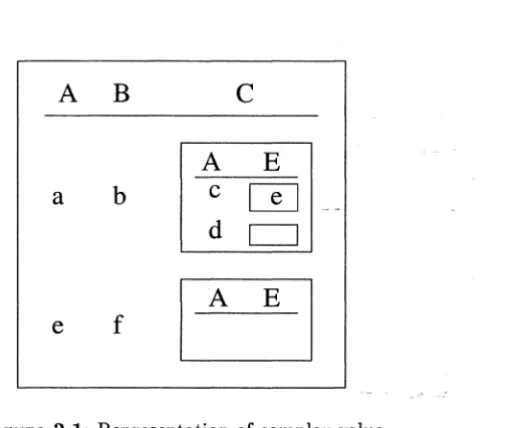
A value of this sort is {
<
A : a , B : b , C : {<
A : c , E : { e}>, <
A : d , E : {}>} >
, <A: e , B:
f ,
C: {}> }.
This value is shown in Figure 2.1.A (complex value) relation of sort 7 is a finite set of values of sort 7 - that is, a finite
subset of [7]. A complex value database is an extension of a relational database. It
A B
c
a
b
e
f
Figure 2.1: Representation of complex value
Definition 2.3 A (complex value) relation schema is a relation name with an
associ-ated sort, i.e., an expression R[Tb ... , Tn], where R E relname and Tb ... , Tn are sorts. A (complex value) database schema is a sequenceR=
<
R1 : TI, ... , Rn : Tn>,
where1. Ri E relname fori E [l...n);
2. Ti is a sort fori E
[L.n);
andAn instance r of a relation schema R is a finite subset of [sort(R)]. An instance over
a database schema R is a mapping associating with every relation schema in R an
instance of that relation schema.
The principal variation of the complex value model is the nested relation model,
which is to be discussed in Chapter 5 . For nested relations, set and tuple constructors
are required to alternate. A more fundamental constraint is imposed in the so-called
Verso-relations [Scholl et al. 1989). A Verso-relation is a nested relation such that each
component may itself be a nested relation but at least one of them must be atomic.
A further assumption for Verso-relations is that for each set of tuples, the atomic
attributes form a key. The definition is given below.
Definition 2.4 Let R be a nested relation schema with attributes attR containing
[image:34.598.233.499.96.310.2]18 Complex Value Databases and Query Languages
schema R is in partitioned normal form (PNF) if and only if the following two conditions
hold1:
2. For each tuple t E rand for all Xi : 1 ::::;
i::::;
l, t[Xi] is in PNF.2.2
Query Languages
Theoretical research on data models and languages for manipulating complex value
data has grown out of three different but equivalent perspectives, namely, algebraic,
calculus-based and logic programming oriented paradigms. This section briefly reviews
notation that encompasses different formulations reflecting each of them.
2.2.1
A Complex Value Algebra
A many-sorted algebra, denoted ALGcv, for complex value databases is reviewed as
follows. A family of core operators of the algebra is first presented and then an extended
family of operators is described. The detailed description of this algebra can be found
in [Abiteboul et al. 1995].
The Core of ALGcv
Let r, r1, r2, ... be relations of sort 7, 71, 72, ... respectively.
Set operations: Union (U), intersection (n), and difference(-) are binary set operations.
Tuple operations: Selection (a) and projection (n") are defined in the natural manner.
Powerset: powerset(r) is a relation of sort {7} where
powerset(r)
=
{v iv ~ r }.Tuple Creation: If A1, ... ,An are distinct attributes, tup_createA1 , ••• ,An(rl, ... ,rn) is of
sort
<
A1 : 71, ... ,An : 7n >,andSet Creation: seLcreate(r) is of sort {7}, and seLcreate(r)
=
{r}.Tuple Destroy: If r is of sort
<
A:/ >, tup_destroy(r) is a relation of sort / andtup_destroy(r) ={vI< A: v >E r }.
Set Destroy: If T ={/},then seLdestroy(r) is a relation of sort/ and
seLdestroy(r)
=
Ur=
{wI
:3v E r,w E v}.
-There are infinite possibilities in the choice of algebraic operations for complex values.
There are several additional algebraic operations. It is important to note that all these
operations can be simulated by the core of ALGcv [Abiteboul and Beeri 1995]. Now
two important ones, nest and unnest, are presented.
Restructuring operators:
The restructuring operators nest and unnest are used to add one level of nesting to
a relation and to flatten a relation by one level, respectively._ Nest(v) takes a relation
R and groups together tuples with common values in some subset of the attributes in
R. Unnest(p,), the inverse of the nest operator, takes a relation nested on some set of
attributes and un-groups it by one level.
Suppose we have R and S with sorts
sort(R) =<AI: TI, ... ,Ak: Tk,X: { < Ak+l: Tk+I, ... ,An: Tn
>} >
sort(S) = <AI : TI, ... , Ak : Tk, Ak+I : Tk+b ... ,An : Tn
>
Then for instances r of R and s of S, we have
J-Lx(r) = {<AI :XI, ... , An : Xn
>I
3t E r,< AI :XI, ... , Ak : Xk >= t[AI, ... , Ak] 1\ < Ak+l : Xk+I, ... ,An : Xn >E t[X]}
vx=(Ak+1 , •.. ,An)(s) = {<AI :XI, ... , Ak : Xk, X: u
>I
3t E s,t[AI, ... , Ak] =<AI :XI, ... , Ak : Xk
>
1\u
= {
v[Ak+b ... ,An]I
v E s 1\ v[AI, ... , Ak]=
t[AI, ... , Ak]}}Example 2.2 In Figure 2.2, we have
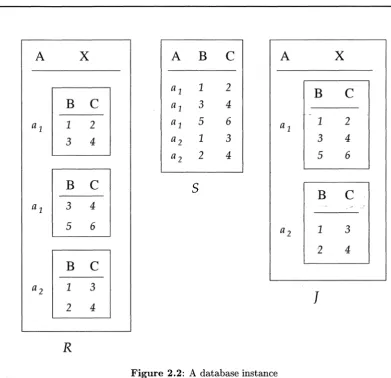
J-Lx(R) = S and vx=(B,c)(S)
=
JAn important subset of ALGcv, denoted
NRA,
is formed from the core operations of20 Complex Value Databases and Query Languages
A
X
A
B
c
A
X
al 1 2
B
c
B
c
al 3 4al 1 2 al 5 6 al 1 2
3 4 a2 1 3 3 4
a2 2 4 5 6
B
c
s
B
c
al 3 4
5 6 a2 1 3
2 4
B
c
a2 1 3
J
2 4
[image:37.598.91.483.86.465.2]R
Figure 2.2: A database instance
NRA is usually called the nested relation algebra in the context of nested relational
databases. The complex value algebra ALGcv can express queries which have
hyper-exponential time data complexity. In contrast, the nested relation algebra NRA has
complexity in PTIME [Grumbach and Vianu 1995].
2.2.2 A Complex Value Calculus
In the complex value data model, the calculus is a many-sorted calculus. Calculus
vari-ables may denote sets so the calculus will permit quantification over sets. The complex
value calculus, modeled after a standard first-order logic, is normally considered to be
a second-order logic.
The calculus, denoted CALCcv, is a strongly typed extension of first order logic
infinite set { x7 , y7 , .•. } of variables of that type is assumed. The alphabet includes typed
logical predicates for each type T, equality =71 membership E7 and containment ~{T}
to manipulate sets. We generally omit the type indices when the types are understood.
The vocabulary of the calculus language is defined as follows.
1. parentheses (, ) ;
2. logical connectors /\, V, •, -7;
3. quantifiers :3, V;
4. typed equality =7 , membership E71 and containment ~7 symbols;
5. typed predicate symbols;
6. typed tuple functions
<>
71 , ... ,7 n, and typed set functions {}71 , ... ,Tn·The logical notations, such as terms, atomic formula, well-formed formula,
interpreta-tion and calculus query are introduced as follows.
Definition 2.5 Terms of the complex value calculus language are defined as follows:
1. complex value constants of some type T;
2. variables whose types can be inferred from the context, and
3. if x is a tuple variable and Cis an attribute of x, then x.C is a term.
Definition 2.6 Atomic formulas (positive literals) are typed expressions of the form
I I I
R(h, ... , tn),
t
=
t , t
Et,
ort
~t,
where R E R, R is a database schema; and
ti, t,
and t1 are terms with the obvioustype compatibility restrictions.
22 Complex Value Databases and Query Languages
Example 2.3 The collection of subsets of the second component of tuples of relation
R:{
<
A, B> }, which do not contain the values 5 or
10, is represented by the formula:{y
I
::lu(R(u) 1\ y s;;; u.B 1\5 ~ y 1\10 ~ y)}Example 2.4 The replacement of the second component of tuples of relation R:{
<
A, B : {} >} by its count number is represented by the formula:
{xI ::ly(R(y) 1\ x.A = y.A 1\ x.B = count(y.B))}
As in the case of the algebra, we also consider extensions of the calculus that can be
simulated by the core syntax described above.
Constructed Terms
If t1, ... , tk are terms and B1, ... , Bk are distinct attributes, then
<
B1 : t1, ... , Bk : tk>
is a term; if the ti are of the same sort, {tb ... , tk} is a term; and if t1 is a tuple term
with attribute C, then t1.C is a term.
To define the semantics of complex value calculus queries, it is convenient to
intro-duce some notation. Given a database instance I, its active domain adom(I) is the set
of all constants occurring in I. The set of constants occurring in a query q is denoted
adom(q). We use adom(q, I) as an abbreviation for adom(q) U adom(I). We define
dom(r, d), for some sort T and set d to be:
( ) def
1. dom dom,d
=
d,{ '} def f. ' )
2. dom( T ,d)
=
'P m(dom(r ,d) , and3. dom(
<
B1 : r1, ... , Bk : Tk >,d)~f
dom(r1, d) x · · · x dom(rk, d)We now present the notion of relativised interpretation, which explicitly specifies
the underlying domain of base values used. We write <p(xb ... , Xn) to indicate that
X1, ... , Xn is a listing of the variables occurring free in <p. A valuation v over a finite set
of variables is a ground substitution of those variables. A database over schema R is
DB= (d, I), where I is an instance over R, dis an arbitrary set of elements containing
adom(<p,I), i.e., adom(<p,I), s;;; d s;;; dom. If vis a valuation over free variables Xi of
sort Ti,
1:::;
i:::;
n, with range contained in dom(ri,d), then I satisfies <p for v relativeA query is an expression {XI, ... , Xn
I
<p(x1, ... , xn)}. We sometimes use <p(x1, ... , xn)to denote the query {xb···,xn
I
<p(xb···,xn)}. If vis a valuation over free(<p) the answer to a query q on a database DB= (d, I), denoted q(DB), is defined byq(DB) = {v([x1, ... , Xn])
I
IFd
<p[v],
v is a valuation over free ( <p)}
Then in the evaluation of <p on I, each variable of type Ti in <p ranges over dam( Ti, adom(I) ).
2.2.3 The Calculus
(CALccv)
+
Fix-pointFix-point operators are redundant in the context of unrestricted higher-order logic
[Grumbach and Vianu 1995]. However, a fix-point construct provides a tractable form
ofrecursion, e.g., it can express transitive closure in polynomial space (time) and yield
languages which are well-behaved with respect to expressive power [Grumbach and
Vianu 1995]. We review inflationary and non-inflationary extensions of the calculus
with recursion.
Partial Fix-point Operator and Logic
Let R be a database schema, and let T[T1, ... , Tm] be a typed relation which is not in R.
Let <p(T) be a formula using T and relations in R, with m free variables x1 : T1, ... , Xm :
Tm· Then J-Lr(<p(T)) denotes the relation of type [T1, ... , Tm] which is the limit, if it
exists, of the sequence { <I>n}n::::o defined by
<I>o
0;
n
>
0.where <p( <I>n-1, x1, ... , Xm) denotes the result of evaluating cp on the instance I over R and the instance <I>n-1 overT.
The expression J-LT( <p(T)) can be used as a term or as a relation in more complex
formulas like any other relation. For example, if x is a variable of type {[T1, ... , Tm]}
then x
=
J-LT( <p(T)) is a fix-point formula.The extension of the calculus with J-L is called partial fix-point logic, denoted CALccv
24 Complex Value Databases and Query Languages
and the partial fix-point operator, starting from atoms. Partial fix-point operators can
be nested. CALccv
+
f-L queries over a database schema R are expressions of the form{<
X1, ... ,Xn>}I 0
where
e
is a CALccv+
f-L formula.Inflationary Fix-point Operators and Logic
Adding /-L+ instead of f-L to CALccv yields the inflationary fix-point logic, denoted by
CALccv
+
f-L+. The definition of f-Lj(cp(T)) is identical to that of the partial fix-pointoperator except that the sequence { <I>n}n;:::o is defined as follows:
<I>o
0;
n
> 0.
Note that the sequence { <I>n}n;:::o is increasing: <I>i-1 C <I>i for each i
>
0, and the sequence converges in all cases.Example 2.5 Let R be a binary relation. The following formula defines the nest
operation on the second argument, using a unary relation T and variables x: dom, s:
{dom}.
{ <
x, s>I
3z(R(x, z)) 1\ s=
f-Lj((R(x, y) V T(y))}2.2.4 Rule-based Languages for Complex Values
Query languages based on the deduction paradigm are extensions of Datalog to
incor-porate complex values. These languages are based on the calculus and do not increase
the expressive power of ALGcv or CALccv. However, certain queries can be expressed
in this deduction paradigm more efficiently and with lower complexity than they can be
by using the powerset operator in the CALccv (Grumbach and Vianu 1991; Grumbach
and Vianu 1995]. A major difference between the various proposals of logic
program-ming with a set construct lies in their approach to nesting: grouping in C:D C (Beeri
et al. 1987], data functions in COL (Abiteboul and Grumbach 1991], and a form of
universal quantification in (Kuper 1990]. We briefly review the concept of Datalog for
Definition 2.7 A database clause (rule) is an expression of the form
where the head p is a derived predicate, and each Li of the body is a literal. A program
P is a finite set of rules.
We distinguish between the intentional predicates and functions, which appear in heads
of rules, and the extensional ones, which appear only in bodies.
Definition 2.8 A database is a finite set of database clauses. A query is a formula
of the form +- W, where W is a calculus formula (i.e., W E CALccv) and any free
variables in W are assumed to be universally quantified at the front of the query.
Definition 2.9 Let P be a database program,
Q
a query +- W. An answer to PU{ +- W} is a ground substitution
e
such that \I(WO) is a logical conseqaence of P.Definition 2.10 Let P be a database program, W a formula, and San interpretation.
Then ans(P, W, S) is the set of all answers toP U{ +- W} that are ground substitutions
for all free variables in W.
Example 2.6 The following is a Datalogcv program:
p( {a})
+-r(x) +- q(x) 1\p(z) !\ x tf. z
2.3 Domain-Independent Computable Queries
To formulate a precise definition of a query, we focus on a high level abstraction and
thus on the mappings between input instances and output instances expressible by
queries. Queries on complex value databases are defined by extending the classical
definition for relational ones.
A query takes as input an instance over R and returns as answer a relation over
some schema S. It is understood that the arities of the input relations Ri, as well
26 Complex Value Databases and Query Languages
is referred to well-typeness. In addition to this basic requirement, queries must be
generic, domain independent and computable.
2.3.1 Notion of Genericity
A query is usually defined to be a generic database transformation, i.e., a function
mapping input database instances to output relations which is invariant under
isomor-phisms. The idea is that queries must conform to the data independence principle.
This principle is a database that provides an abstract interface and in which the
in-ternal representation of data has no effect on the results of queries~ Essentially, this
means that the query treats data values as uninterpreted objects.
Definition 2.11 Let R be database schema. A query q is generic with respect to
a domain d ~ dom iff for each database instance I over R, adom(I) ~ d, and each
permutation p of d, p(q(I)) = q(p(I)).
We will assume throughout this thesis that all queries are generic in this sense, i.e.,
they map isomorphic database instances to isomorphic outputs.
2.3.2 Domain Independence
A property usually imposed upon queries is domain independence, meaning that the
answer of the query depends only on the active domain of the input instance and not
on the underlying universe.
As mentioned in Chapter 1, the calculus paradigm, used without care, can easily
express queries whose "answers" are infinite. To overcome these obstacles, a variety
of approaches have been developed to resolve this problem based on the use of both
semantic and syntactic restrictions. We focus on semantic restriction in this subsection
and discuss syntactic restriction in Chapter 3.
Recall from relational database theory that an arbitrary calculus formula can be
effectively transformed into a semantically equivalent formula in prenex normal form
[Abiteboul et al. 1995):
where each % is either V or :.3 and \li(·) is a quantifier-free formula with free variables
among XI, ... , Xn.
There are two important interpretations of calculus queries. Under the
active-domain semantics, all quantified variables range over the active active-domain of a database.
That is, a sentence given by formula 2.1 defines the query-q such that the value of q
on a database I is the value of
%1x1 E adom(q, I), ... , %nXn E adom(q, I)\li(x1, ... , Xn)
Under the natural semantics, all quantified variables range over infinite set d ~ dam.
That is, the sentence defines the query q whose value on I equals
%1x1 Ed, ... , %nXn E d\li(x1, ... , Xn)
It is easy to write queries with undefined output under natural interpretation. Although
the active domain semantic has the advantage that the output is always defined, the
active domain information is not readily available to users. One approach to resolving
this problem is to consider the class of queries that yield the same output on all possible
underlying domains [Demolombe 1992; Hull and Su 1994; Topor 1987; Ullman 1988;
Van Gelder and Topor 1991].
Definition 2.12 A calculus query q is domain independent if for any databases DB1
=
(d1, I) and DB2=
(d2, I) (i.e., same instances, but different domains), then q(DBI)=
q(DB2).2.3.3 Computable Queries
A query is computable if there exists a Turing Machine which, when started with
a natural encoding of a database instance I on its tape, halts with an encoding of
q(I) on the tape, or diverges, when q(I) is undefined. That is, the query must be
"implementable" by a Turing Machine.
2.4
Query Translation
As mentioned in Chapter 1, the class of relational calculus queries or formulas that